


IEC 62208:2011
(Main)Empty enclosures for low-voltage switchgear and controlgear assemblies - General requirements
Empty enclosures for low-voltage switchgear and controlgear assemblies - General requirements
IEC 62208:2011 applies to empty enclosures, prior to the incorporation of switchgear and controlgear components by the user, as supplied by the enclosure manufacturer. This standard specifies general definitions, classifications, characteristics and test requirements of enclosures to be used as part of switchgear and controlgear assemblies (e.g. in accordance with the IEC 61439 series), the rated voltage of which does not exceed 1 000 V a.c. or 1 500 V d.c., and suitable for general use for either indoor or outdoor applications. This second edition cancels and replaces the first edition published in 2002. This edition constitutes a technical revision and includes the following significant technical changes with respect to the last edition:
- consideration of the restructured series of standards IEC 61439;
- alignment of test procedures with the newest relevant standards.
Enveloppes vides destinées aux ensembles d'appareillage à basse tension - Règles générales
La CEI 62208:2011 s'applique aux enveloppes vides, avant incorporation de l'appareillage par l'utilisateur, dans l'état où elles sont fournies par le fabricant. Cette norme spécifie les définitions, les classifications, les caractéristiques et les exigences d'essai générales des enveloppes à utiliser en tant que partie d'ensembles d'appareillage (selon par exemple la série CEI 61439), dont la tension assignée ne dépasse pas 1 000 V en courant alternatif ou 1 500 V en courant continu pour usage général extérieur ou intérieur. Cette deuxième édition annule et remplace la première édition parue en 2002. Cette édition constitue une révision technique et elle inclut les modifications techniques majeures suivantes par rapport à l'édition antérieure:
- prise en compte de la série de normes CEI 61439 restructurée;
- alignement des procédures d'essai sur les toutes nouvelles normes applicables.
General Information
- Status
- Published
- Publication Date
- 18-Aug-2011
- Technical Committee
- SC 121B - Low-voltage switchgear and controlgear assemblies
- Drafting Committee
- MT 6 - TC 121/SC 121B/MT 6
- Current Stage
- DELPUB - Deleted Publication
- Start Date
- 01-Jun-2023
- Completion Date
- 30-Nov-2020
Relations
- Effective Date
- 05-Sep-2023
- Effective Date
- 05-Sep-2023
Overview
IEC 62208:2011 is an international standard developed by the International Electrotechnical Commission (IEC) that specifies general requirements for empty enclosures used in low-voltage switchgear and controlgear assemblies. This standard applies specifically to enclosures supplied by manufacturers before the integration of switchgear and controlgear components by users. It targets assemblies with rated voltages not exceeding 1,000 V AC or 1,500 V DC, suitable for both indoor and outdoor environments.
The 2011 edition is the second edition of IEC 62208, which cancels and replaces the first edition published in 2002. It includes technical revisions aligned with the restructured series of standards IEC 61439 and updates test procedures to align with the latest relevant standards.
Key Topics
Scope and Application
- Covers empty enclosures before component installation for low-voltage assemblies.
- Suitable for both indoor and outdoor use.
- Ensures adherence to voltage ratings of up to 1,000 V AC and 1,500 V DC.
- Excludes enclosures covered under other specific product standards (e.g., IEC 60670 series).
- Provides a basis for other technical committees and further technical development.
Classification and Definitions
- Standardizes general definitions and classifications for enclosures.
- Incorporates IEC’s degree of protection codes such as IP (Ingress Protection) and IK (Impact Protection) ratings.
- Establishes classifications based on environmental and operational factors.
Design and Construction Requirements
- Specifies construction aspects including static loads, lifting and transport support, and accessibility.
- Defines requirements for protective circuits, dielectric strength, and thermal stability.
- Addresses material properties, resistance to mechanical impacts, UV radiation, corrosion, and fire.
Test Procedures
- Details comprehensive type test requirements including:
- Static load tests
- Degree of protection tests (IP and IK codes)
- Dielectric strength tests
- Corrosion and UV resistance tests
- Thermal power dissipation tests
- Aligns with latest testing standards for consistent performance evaluation.
Marking and Documentation
- Specifies necessary information and markings on the enclosure for traceability and safe use.
- Documentation must provide details such as dimensions, mounting arrangements, permissible loads, and protective circuit details.
Applications
IEC 62208:2011 enclosures are critical in industries requiring reliable low-voltage switchgear and controlgear assemblies, such as:
- Electrical distribution systems in commercial and industrial facilities
- Infrastructure projects requiring robust electrical protection
- Outdoor installations where environmental protection and durability are essential
- Renewable energy systems needing certified enclosures for safety and performance
- Manufacturing automation where custom switchgear assemblies are built into empty enclosures
By adhering to IEC 62208 requirements, manufacturers and users ensure compliance with international safety, quality, and performance standards, enhancing product reliability across diverse electrical applications.
Related Standards
IEC 62208 interacts with and complements several other IEC standards, including:
- IEC 61439 series – Standards for low-voltage switchgear and controlgear assemblies
- IEC 60670 series – Standards covering specific types of enclosures not included within IEC 62208
- NEMA 250 – US standard for enclosure types, often referenced alongside IEC IP codes for environmental requirements
- Various material and testing standards referenced within IEC 62208 for dielectric strength, corrosion resistance, and thermal performance
For best practice, users and manufacturers should consider IEC 62208 in conjunction with these related standards to ensure comprehensive compliance and optimized enclosure performance.
By following IEC 62208:2011, stakeholders gain assurance that empty enclosures for low-voltage switchgear and controlgear assemblies meet stringent international quality and safety requirements, essential for reliable electrical system operation worldwide.


Frequently Asked Questions
IEC 62208:2011 is a standard published by the International Electrotechnical Commission (IEC). Its full title is "Empty enclosures for low-voltage switchgear and controlgear assemblies - General requirements". This standard covers: IEC 62208:2011 applies to empty enclosures, prior to the incorporation of switchgear and controlgear components by the user, as supplied by the enclosure manufacturer. This standard specifies general definitions, classifications, characteristics and test requirements of enclosures to be used as part of switchgear and controlgear assemblies (e.g. in accordance with the IEC 61439 series), the rated voltage of which does not exceed 1 000 V a.c. or 1 500 V d.c., and suitable for general use for either indoor or outdoor applications. This second edition cancels and replaces the first edition published in 2002. This edition constitutes a technical revision and includes the following significant technical changes with respect to the last edition: - consideration of the restructured series of standards IEC 61439; - alignment of test procedures with the newest relevant standards.
IEC 62208:2011 applies to empty enclosures, prior to the incorporation of switchgear and controlgear components by the user, as supplied by the enclosure manufacturer. This standard specifies general definitions, classifications, characteristics and test requirements of enclosures to be used as part of switchgear and controlgear assemblies (e.g. in accordance with the IEC 61439 series), the rated voltage of which does not exceed 1 000 V a.c. or 1 500 V d.c., and suitable for general use for either indoor or outdoor applications. This second edition cancels and replaces the first edition published in 2002. This edition constitutes a technical revision and includes the following significant technical changes with respect to the last edition: - consideration of the restructured series of standards IEC 61439; - alignment of test procedures with the newest relevant standards.
IEC 62208:2011 is classified under the following ICS (International Classification for Standards) categories: 29.130.20 - Low voltage switchgear and controlgear; 33.200 - Telecontrol. Telemetering. The ICS classification helps identify the subject area and facilitates finding related standards.
IEC 62208:2011 has the following relationships with other standards: It is inter standard links to IEC 62208:2002, IEC 62208:2023. Understanding these relationships helps ensure you are using the most current and applicable version of the standard.
IEC 62208:2011 is available in PDF format for immediate download after purchase. The document can be added to your cart and obtained through the secure checkout process. Digital delivery ensures instant access to the complete standard document.
Standards Content (Sample)
IEC 62208 ®
Edition 2.0 2011-08
INTERNATIONAL
STANDARD
NORME
INTERNATIONALE
Empty enclosures for low-voltage switchgear and controlgear assemblies –
General requirements
Enveloppes vides destinées aux ensembles d'appareillage à basse tension –
Exigences générales
All rights reserved. Unless otherwise specified, no part of this publication may be reproduced or utilized in any form or by
any means, electronic or mechanical, including photocopying and microfilm, without permission in writing from either IEC or
IEC's member National Committee in the country of the requester.
If you have any questions about IEC copyright or have an enquiry about obtaining additional rights to this publication,
please contact the address below or your local IEC member National Committee for further information.
Droits de reproduction réservés. Sauf indication contraire, aucune partie de cette publication ne peut être reproduite
ni utilisée sous quelque forme que ce soit et par aucun procédé, électronique ou mécanique, y compris la photocopie
et les microfilms, sans l'accord écrit de la CEI ou du Comité national de la CEI du pays du demandeur.
Si vous avez des questions sur le copyright de la CEI ou si vous désirez obtenir des droits supplémentaires sur cette
publication, utilisez les coordonnées ci-après ou contactez le Comité national de la CEI de votre pays de résidence.
IEC Central Office
3, rue de Varembé
CH-1211 Geneva 20
Switzerland
Email: inmail@iec.ch
Web: www.iec.ch
About the IEC
The International Electrotechnical Commission (IEC) is the leading global organization that prepares and publishes
International Standards for all electrical, electronic and related technologies.
About IEC publications
The technical content of IEC publications is kept under constant review by the IEC. Please make sure that you have the
latest edition, a corrigenda or an amendment might have been published.
Catalogue of IEC publications: www.iec.ch/searchpub
The IEC on-line Catalogue enables you to search by a variety of criteria (reference number, text, technical committee,…).
It also gives information on projects, withdrawn and replaced publications.
IEC Just Published: www.iec.ch/online_news/justpub
Stay up to date on all new IEC publications. Just Published details twice a month all new publications released. Available
on-line and also by email.
Electropedia: www.electropedia.org
The world's leading online dictionary of electronic and electrical terms containing more than 20 000 terms and definitions
in English and French, with equivalent terms in additional languages. Also known as the International Electrotechnical
Vocabulary online.
Customer Service Centre: www.iec.ch/webstore/custserv
If you wish to give us your feedback on this publication or need further assistance, please visit the Customer Service
Centre FAQ or contact us:
Email: csc@iec.ch
Tel.: +41 22 919 02 11
Fax: +41 22 919 03 00
A propos de la CEI
La Commission Electrotechnique Internationale (CEI) est la première organisation mondiale qui élabore et publie des
normes internationales pour tout ce qui a trait à l'électricité, à l'électronique et aux technologies apparentées.
A propos des publications CEI
Le contenu technique des publications de la CEI est constamment revu. Veuillez vous assurer que vous possédez
l’édition la plus récente, un corrigendum ou amendement peut avoir été publié.
Catalogue des publications de la CEI: www.iec.ch/searchpub/cur_fut-f.htm
Le Catalogue en-ligne de la CEI vous permet d’effectuer des recherches en utilisant différents critères (numéro de référence,
texte, comité d’études,…). Il donne aussi des informations sur les projets et les publications retirées ou remplacées.
Just Published CEI: www.iec.ch/online_news/justpub
Restez informé sur les nouvelles publications de la CEI. Just Published détaille deux fois par mois les nouvelles
publications parues. Disponible en-ligne et aussi par email.
Electropedia: www.electropedia.org
Le premier dictionnaire en ligne au monde de termes électroniques et électriques. Il contient plus de 20 000 termes et
définitions en anglais et en français, ainsi que les termes équivalents dans les langues additionnelles. Egalement appelé
Vocabulaire Electrotechnique International en ligne.
Service Clients: www.iec.ch/webstore/custserv/custserv_entry-f.htm
Si vous désirez nous donner des commentaires sur cette publication ou si vous avez des questions, visitez le FAQ du
Service clients ou contactez-nous:
Email: csc@iec.ch
Tél.: +41 22 919 02 11
Fax: +41 22 919 03 00
IEC 62208 ®
Edition 2.0 2011-08
INTERNATIONAL
STANDARD
NORME
INTERNATIONALE
Empty enclosures for low-voltage switchgear and controlgear assemblies –
General requirements
Enveloppes vides destinées aux ensembles d'appareillage à basse tension –
Exigences générales
INTERNATIONAL
ELECTROTECHNICAL
COMMISSION
COMMISSION
ELECTROTECHNIQUE
PRICE CODE
INTERNATIONALE
CODE PRIX S
ICS 29.130.20 ISBN 978-2-88912-661-3
– 2 – 62208 © IEC:2011
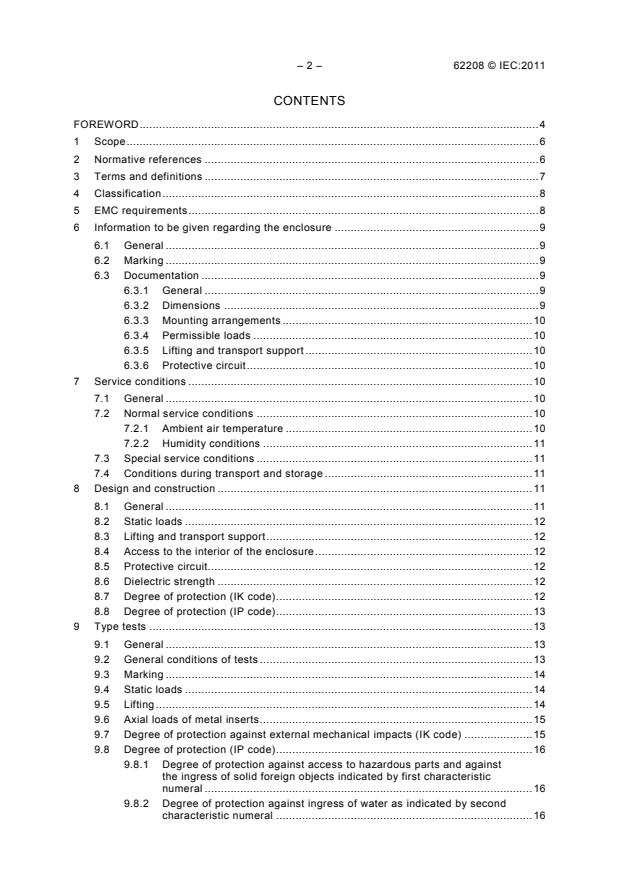
CONTENTS
FOREWORD . 4
1 Scope . 6
2 Normative references . 6
3 Terms and definitions . 7
4 Classification . 8
5 EMC requirements . 8
6 Information to be given regarding the enclosure . 9
6.1 General . 9
6.2 Marking . 9
6.3 Documentation . 9
6.3.1 General . 9
6.3.2 Dimensions . 9
6.3.3 Mounting arrangements . 10
6.3.4 Permissible loads . 10
6.3.5 Lifting and transport support . 10
6.3.6 Protective circuit . 10
7 Service conditions . 10
7.1 General . 10
7.2 Normal service conditions . 10
7.2.1 Ambient air temperature . 10
7.2.2 Humidity conditions . 11
7.3 Special service conditions . 11
7.4 Conditions during transport and storage . 11
8 Design and construction . 11
8.1 General . 11
8.2 Static loads . 12
8.3 Lifting and transport support . 12
8.4 Access to the interior of the enclosure . 12
8.5 Protective circuit. 12
8.6 Dielectric strength . 12
8.7 Degree of protection (IK code) . 12
8.8 Degree of protection (IP code) . 13
9 Type tests . 13
9.1 General . 13
9.2 General conditions of tests . 13
9.3 Marking . 14
9.4 Static loads . 14
9.5 Lifting . 14
9.6 Axial loads of metal inserts . 15
9.7 Degree of protection against external mechanical impacts (IK code) . 15
9.8 Degree of protection (IP code) . 16
9.8.1 Degree of protection against access to hazardous parts and against
the ingress of solid foreign objects indicated by first characteristic
numeral . 16
9.8.2 Degree of protection against ingress of water as indicated by second
characteristic numeral . 16
62208 © IEC:2011 – 3 –
9.8.3 Degree of protection against hazardous parts as indicated by
additional letter . 17
9.9 Properties of insulating materials . 17
9.9.1 Thermal stability . 17
9.9.2 Resistance to normal heat . 17
9.9.3 Resistance to abnormal heat and to fire . 17
9.10 Dielectric strength . 18
9.10.1 General . 18
9.10.2 Preconditioning. 19
9.10.3 Enclosures without metal elements inside the protected space . 19
9.10.4 Enclosures having metal elements inside the protected space . 19
9.10.5 Results to be obtained . 19
9.11 Continuity of the protective circuit. 19
9.12 Resistance to ultra-violet (UV) radiation . 20
9.13 Resistance to corrosion . 20
9.13.1 General . 20
9.13.2 Test procedure . 20
9.13.3 Results to be obtained . 21
9.14 Thermal power dissipation capability . 21
Bibliography . 22
Table 1 – Number of samples to be tested and order of test per sample . 13
Table 2 – Axial loads of metal inserts. 15
– 4 – 62208 © IEC:2011
INTERNATIONAL ELECTROTECHNICAL COMMISSION
____________
EMPTY ENCLOSURES FOR LOW-VOLTAGE
SWITCHGEAR AND CONTROLGEAR ASSEMBLIES –
GENERAL REQUIREMENTS
FOREWORD
1) The International Electrotechnical Commission (IEC) is a worldwide organization for standardization comprising
all national electrotechnical committees (IEC National Committees). The object of IEC is to promote
international co-operation on all questions concerning standardization in the electrical and electronic fields. To
this end and in addition to other activities, IEC publishes International Standards, Technical Specifications,
Technical Reports, Publicly Available Specifications (PAS) and Guides (hereafter referred to as “IEC
Publication(s)”). Their preparation is entrusted to technical committees; any IEC National Committee interested
in the subject dealt with may participate in this preparatory work. International, governmental and non-
governmental organizations liaising with the IEC also participate in this preparation. IEC collaborates closely
with the International Organization for Standardization (ISO) in accordance with conditions determined by
agreement between the two organizations.
2) The formal decisions or agreements of IEC on technical matters express, as nearly as possible, an international
consensus of opinion on the relevant subjects since each technical committee has representation from all
interested IEC National Committees.
3) IEC Publications have the form of recommendations for international use and are accepted by IEC National
Committees in that sense. While all reasonable efforts are made to ensure that the technical content of IEC
Publications is accurate, IEC cannot be held responsible for the way in which they are used or for any
misinterpretation by any end user.
4) In order to promote international uniformity, IEC National Committees undertake to apply IEC Publications
transparently to the maximum extent possible in their national and regional publications. Any divergence
between any IEC Publication and the corresponding national or regional publication shall be clearly indicated in
the latter.
5) IEC itself does not provide any attestation of conformity. Independent certification bodies provide conformity
assessment services and, in some areas, access to IEC marks of conformity. IEC is not responsible for any
services carried out by independent certification bodies.
6) All users should ensure that they have the latest edition of this publication.
7) No liability shall attach to IEC or its directors, employees, servants or agents including individual experts and
members of its technical committees and IEC National Committees for any personal injury, property damage or
other damage of any nature whatsoever, whether direct or indirect, or for costs (including legal fees) and
expenses arising out of the publication, use of, or reliance upon, this IEC Publication or any other IEC
Publications.
8) Attention is drawn to the Normative references cited in this publication. Use of the referenced publications is
indispensable for the correct application of this publication.
9) Attention is drawn to the possibility that some of the elements of this IEC Publication may be the subject of
patent rights. IEC shall not be held responsible for identifying any or all such patent rights.
International Standard IEC 62208 has been prepared by subcommittee 17D: Low-voltage
switchgear and controlgear assemblies, of IEC technical committee 17: Switchgear and
controlgear.
This second edition cancels and replaces the first edition published in 2002.
This edition constitutes a technical revision and includes the following significant technical
changes with respect to the last edition:
– consideration of the restructured series of standards IEC 61439;
– alignment of test procedures with the newest relevant standards.
62208 © IEC:2011 – 5 –
The text of this standard is based on the following documents:
FDIS Report on voting
17D/442/FDIS 17D/447/RVD
Full information on the voting for the approval of this standard can be found in the report on
voting indicated in the above table.
This publication has been drafted in accordance with the ISO/IEC Directives, Part 2.
The committee has decided that the contents of this publication will remain unchanged until
the stability date indicated on the IEC web site under "http://webstore.iec.ch" in the data
related to the specific publication. At this date, the publication will be
• reconfirmed,
• withdrawn,
• replaced by a revised edition, or
• amended.
– 6 – 62208 © IEC:2011
EMPTY ENCLOSURES FOR LOW-VOLTAGE
SWITCHGEAR AND CONTROLGEAR ASSEMBLIES –
GENERAL REQUIREMENTS
1 Scope
This International Standard applies to empty enclosures, prior to the incorporation of
switchgear and controlgear components by the user, as supplied by the enclosure
manufacturer.
This standard specifies general definitions, classifications, characteristics and test
requirements of enclosures to be used as part of switchgear and controlgear assemblies (e.g.
in accordance with the IEC 61439 series), the rated voltage of which does not exceed
1 000 V a.c. or 1 500 V d.c., and suitable for general use for either indoor or outdoor
applications.
NOTE 1 Additional requirements may apply for specific applications.
NOTE 2 The United States of America (USA) uses enclosure “Type” designations according to NEMA 250. The
NEMA Enclosure Type designations specify additional environmental requirements for conditions such as
corrosion, rust, icing, oil, and coolants. For this reason, the IEC Enclosure Classification Designations IP are used
with an enclosure Type designation number appropriate for these markets.
This standard does not apply to enclosures, which are covered by other specific products
standards (e.g. IEC 60670 series).
Compliance with the safety requirements of the applicable product standard is the
responsibility of the assembly manufacturer.
NOTE 3 This standard may serve as a basis for other technical committees.
2 Normative references
The following referenced documents are indispensable for the application of this document.
For dated references, only the edition cited applies. For undated references, the latest edition
of the referenced document (including any amendments) applies.
IEC 60068-2-2:2007, Environmental testing – Part 2-2: Tests – Test B: Dry heat
IEC 60068-2-11:1981, Basic environmental testing procedures – Part 2-11: Tests – Test Ka:
Salt mist
IEC 60068-2-30:2005, Environmental testing – Part 2-30: Tests – Test Db: Damp heat, cyclic
(12 h + 12 h cycle)
IEC 60085:2007, Electrical insulation – Thermal evaluation and designation
IEC 60529:1989, Degrees of protection provided by enclosures (IP Code)
IEC 60695-2-10:2000, Fire hazard testing – Part 2-10: Glowing/hot-wire based test methods –
Glow-wire apparatus and common test procedure
___________
There is a consolidated edition 2.1 (2001) that includes IEC 60529 (1989) and its Amendment 1 (1999).
62208 © IEC:2011 – 7 –
IEC 60695-2-11:2000, Fire hazard testing – Part 2-11: Glowing/hot-wire based test methods –
Glow-wire flammability test methods for end-products
IEC 61439-1:2011, Low-voltage switchgear and controlgear assemblies – Part 1: General
rules
IEC 62262:2002, Degrees of protection provided by enclosures for electrical equipment
against external mechanical impacts (IK code)
ISO 178:2001, Plastics – Determination of flexural properties
ISO 179 (all parts), Plastics – Determination of Charpy impact properties
ISO 2409:2007, Paints and varnishes – Cross-cut test
ISO 4628-3:2003, Paints and varnishes – Evaluation of degradation of coatings – Designation
of quantity and size of defects, and of intensity of uniform changes in appearance – Part 3:
Assessment of degree of rusting
ISO 4892-2:2006, Plastics – Methods of exposure to laboratory light sources – Part 2: Xenon-
arc sources
Amendment 1 (2009)
ISO 11469:2000, Plastics – Generic identification and marking of plastic products
3 Terms and definitions
For the purposes of this document, the following terms and definitions apply.
3.1
empty enclosure
enclosure intended for support and installation of electrical equipment, whose internal space
provides suitable protection against external influences as well as a specified degree of
protection against approach to or contact with live parts and against contact with moving parts
NOTE 1 Throughout this standard, the word enclosure is used for empty enclosure.
NOTE 2 The terms boxes, cubicles, desks or cabinets are alternative terms for enclosures.
3.2
protected space
internal space or portion of the internal space of the enclosure as specified by the
manufacturer intended for the mounting of switchgear and controlgear for which the specified
protection is provided by the enclosure
3.3
cover
external part of the enclosure
3.4
door
hinged or sliding cover
___________
To be published.
– 8 – 62208 © IEC:2011
3.5
mounting plate
separate internal accessory of the enclosure intended for the mounting of electrical
components
3.6
cable gland plate
removable accessory of the enclosure, intended for securing and sealing of cables,
conductors and conduits at their point of entry
3.7
removable cover
cover which is designed for closing an opening in the external enclosure and which can be
removed for carrying out certain operations and maintenance work
NOTE A lid is considered as a removable cover.
3.8
enclosure manufacturer
manufacturer of an enclosure or the vendor who resells under his own responsibility
4 Classification
Enclosures are classified according to:
a) the type of material:
• insulating;
• metallic;
• combination of insulating and metallic;
b) method of fixing:
• floor standing;
• wall mounting;
• flush mounting;
• pole mounting;
c) the intended location:
• outdoor;
• indoor;
d) the degree of protection:
• IP code, according to IEC 60529;
• IK code, according to IEC 62262;
e) the rated insulation voltage (for enclosures made of insulating materials).
5 EMC requirements
EMC requirements are not applicable for enclosures to this standard.
NOTE For degrees of protection provided by enclosures against electromagnetic disturbances (EM code), see
IEC 61000-5-7.
62208 © IEC:2011 – 9 –
6 Information to be given regarding the enclosure
6.1 General
The following information shall be given by the manufacturer.
6.2 Marking
The enclosure shall be identifiable, making it possible for the assembly manufacturer to obtain
relevant information from the enclosure manufacturer. Such identification shall comprise:
• either the name, trade mark or identification mark of the enclosure manufacturer;
• type designation or identification number of the enclosure.
The marking shall be durable and easily legible and may be inside the enclosure.
Compliance is checked according to the test of 9.3 and by inspection.
Marking for the recycling of plastic parts shall be as stated in ISO 11469.
NOTE Marking of enclosures intended for total insulation (equivalent to class II) assemblies with the symbol
IEC 60417-5172 is the responsibility of the assembly manufacturer.
6.3 Documentation
6.3.1 General
The manufacturer's documentation shall include all relevant constructional, mechanical
characteristics, the enclosure classification (see Clause 4) and any instruction necessary for
the correct handling, assembling, mounting and service conditions of the enclosure as well as
reference to this standard:
• dimensions (see 6.3.2);
• mounting arrangements (see 6.3.3);
• permissible loads (see 6.3.4);
• lifting devices, if necessary (see 6.3.5);
• provisions for protection against electric shock (see 6.3.6);
• applicable service conditions (see Clause 7);
• location and size of protected space;
• data of thermal power dissipation capability;
• rated insulation voltage of enclosures constructed of an insulating material;
• degree of protection (IK and IP codes, see 8.7 and 8.8).
The data for the thermal power dissipation capability are a function of the admissible
temperature inside the enclosure. They shall be provided for the different installation methods
(e.g. flush mounting, surface mounting) of the enclosure and of the design of the enclosure,
i.e. with or without ventilation openings and number of horizontal partitions. They shall include
at least temperature rise inside the enclosure, at the top, and external surfaces temperature
rise, for a given power loss inside the enclosure. This will provide the user with the correct
data for the selection of the enclosure according to electrical equipment to be installed. For
the purpose of the calculation, it is assumed that the heat generated by the selected
equipment is distributed uniformly inside the protected space.
6.3.2 Dimensions
The dimensions shall be given in millimetres.
– 10 – 62208 © IEC:2011
The external dimensions: height, width and depth are nominal values and shall be indicated in
the catalogue of the enclosure manufacturer.
The projection of cable gland plates, removable covers and handles shall not be included in
the external nominal dimensions, the dimensions of such shall be included in the
manufacturer’s documentation.
6.3.3 Mounting arrangements
The means and location of the enclosure mounting shall be defined in the enclosure
manufacturer's documentation.
The location of the equipment mounting surfaces and their means of fixing shall be defined in
the enclosure manufacturer's documentation.
6.3.4 Permissible loads
The permissible loads that the enclosure and its doors are able to carry shall be defined in the
enclosure manufacturer's documentation (see also 8.2).
6.3.5 Lifting and transport support
Where required, the correct location and installation of lifting and transport support and the
thread size of lifting devices, if applicable, shall be given in the enclosure manufacturer's
documentation or in the instructions on how the enclosure has to be handled (see also 8.3).
6.3.6 Protective circuit
The enclosure manufacturer shall indicate in the technical documentation, if the enclosure
ensures electrical continuity throughout by the conductive structural parts of the enclosure or
if and how separate protective conductors to the protective circuits of the installation shall be
carried out (see also 8.5).
7 Service conditions
7.1 General
Enclosures conforming to this standard are intended for use under the following service
conditions.
The enclosure manufacturer shall specify the locations for which the enclosure is intended.
7.2 Normal service conditions
7.2.1 Ambient air temperature
7.2.1.1 Ambient air temperature for indoor locations
The ambient air temperature does not exceed +40 °C and its average over a period of 24 h
does not exceed +35 °C.
The lower limit of the ambient air temperature is –5 °C.
7.2.1.2 Ambient air temperature for outdoor locations
The ambient air temperature does not exceed +40 °C and its average over a period of 24 h
does not exceed +35 °C.
62208 © IEC:2011 – 11 –
The lower limit of the ambient air temperature is –25 °C.
7.2.2 Humidity conditions
7.2.2.1 Humidity conditions for indoor locations
The relative humidity of the air does not exceed 50 % at a maximum temperature of +40 °C.
Higher relative humidity may be permitted at lower temperatures, for example 90 % at +20 °C.
Moderate condensation should be borne in mind which may occasionally occur due to
variations in temperature.
7.2.2.2 Humidity conditions for outdoor locations
The relative humidity may be temporarily as high as 100 % at a maximum temperature of
+25 °C.
7.3 Special service conditions
Where any of the following special service conditions exist, the applicable particular
requirements shall be subject to agreement between user and manufacturer.
Examples of such conditions may include the following:
• abnormal ambient air temperature and humidity;
• presence of corrosive substances;
• presence of particular dusts (coal, cement, etc.);
• abnormal mechanical stresses (seismic, etc.);
• presence of fauna, flora, mould;
• ionizing influences;
• electromagnetic interferences;
• vibrations;
• UV radiation other than solar.
Agreements reached shall not contradict any safety regulations in force.
7.4 Conditions during transport and storage
A special agreement shall be made between the enclosure manufacturer and the user if the
conditions during transport, storage and installation, for example temperature and humidity
conditions, differ from those defined in 7.2.
8 Design and construction
8.1 General
The enclosure shall be constructed only of materials capable of withstanding the mechanical,
electrical and thermal stresses, as specified in Clause 9, as well as the effects of humidity
which are likely to be encountered in normal use.
Protection against corrosion shall be ensured by the use of suitable materials or by the
application of protective coating to the exposed surface, taking into account the intended
conditions of use.
Compliance to this requirement is checked by the test of 9.13.
– 12 – 62208 © IEC:2011
In addition for enclosures or parts of enclosures made of insulating materials, thermal
stability, resistance to heat, fire and weathering shall be verified according to the tests of 9.9
and 9.12.
8.2 Static loads
Compliance of the permissible load that the enclosure and its doors are able to carry is
checked according to the test of 9.4.
8.3 Lifting and transport support
Where required, enclosures shall be provided with the appropriate lifting devices or transport
means.
Compliance is checked according to the test of 9.5.
8.4 Access to the interior of the enclosure
Adequate access to the protected space shall be provided by means of a door(s) or
removable cover(s). Access may be restricted by the use of a key or tool.
Cable gland plates and covers which are removable from the outside shall require the use of
a tool.
8.5 Protective circuit
Metallic enclosures shall ensure electrical continuity throughout either by the conductive
structural parts of the enclosure or provisions for a separate protective conductor to earth or
both.
When a removable part of an enclosure is removed, the protective circuit for the remainder of
the enclosure shall not be interrupted.
For lids, doors, removable covers and the like, the usual metal screwed connections and
metal hinges may ensure continuity of the protective circuit provided no electrical equipment
is attached to them. Where these are intended for mounting electrical equipment additional
means shall be provided to ensure the continuity of the protective circuit.
Compliance is checked according to the test of 9.11.
The enclosure manufacturer shall provide means to facilitate the connection of the external
protective conductor by the assembly manufacturer.
8.6 Dielectric strength
The enclosures constructed of an insulating material shall fulfil the dielectric test of 9.10.
8.7 Degree of protection (IK code)
The degree of protection against mechanical impact, as declared by the manufacturer, shall
be in accordance with IEC 62262.
Compliance is checked according to the test of 9.7.
62208 © IEC:2011 – 13 –
8.8 Degree of protection (IP code)
The degree of protection against access to hazardous parts, against ingress of solid foreign
objects and/or against ingress of water, as declared by the manufacturer, shall be in
accordance with IEC 60529.
Compliance is checked according to the test of 9.8.
NOTE An enclosure may be assigned differing IP codes dependent upon the declared IK code.
9 Type tests
9.1 General
Tests according to this standard are type tests.
9.2 General conditions of tests
The enclosures under test shall be mounted and installed as in normal use according to the
enclosure manufacturer's instructions.
Unless otherwise specified, the tests shall be carried out at an ambient temperature of
between +10 °C and +40 °C.
Table 1 shows the number of samples to be tested and the order of test per sample.
Table 1 – Number of samples to be tested and order of test per sample
Subclause Test Sample Sample Sample Representative
1 2 3 sample
(see 9.12)
9.3 Marking 8
9.4 Static loads 1
9.5 Lifting 2
9.6 Axial loads of metal inserts 3
Degree of protection against external
9.7 4
mechanical impacts (IK code)
Degree of protection against access to
9.8 hazardous parts and against ingress of solid 5
objects and/or water (IP code)
9.9.1 Thermal stability 1
9.9.2 Resistance to heat 2
9.9.3 Resistance to abnormal heat and fire 3
9.10 Dielectric strength 6
9.11 Continuity of the protective circuit 7 3
a
9.12 Resistance to ultra-violet (UV) radiation
9.13 Resistance to corrosion 2
b
9.14 Thermal power dissipation capability 1
a
Tests carried out on representative sample only.
b
Only applicable if verified by test.
– 14 – 62208 © IEC:2011
All tests shall be carried out on complete enclosures. If this is not possible, they can be
carried out on representative samples taken from the enclosure.
9.3 Marking
Marking made by moulding, pressing, engraving or similar. Labels with a laminated plastic
covering shall not be submitted to the following test.
The test is made by rubbing the marking by hand for 15 s with a piece of cloth soaked in
water and then for 15 s with a piece of cloth soaked with petroleum spirit.
NOTE The petroleum spirit is defined as a solvent hexane with a content of aromatics of maximum 0,1 % in
volume, a kauributanol value of 29, an initial boiling point of 65 °C, a final boiling point of 69 °C and a density of
approximately 0,68 g/cm .
After the test the marking shall be easily legible.
9.4 Static loads
The enclosure fitted with all its required components to support the permissible load is loaded
with a weight of 1,25 times the permissible load as declared by the manufacturer.
The loads are arranged on the mounting plate or switchgear and controlgear supports and on
the door evenly distributed as specified by the enclosure manufacturer.
The loads are retained for 1 h in the closed position.
For enclosures constructed of insulating material and metallic enclosures with parts (hinges,
locks, etc.) of insulating material, this shall be carried out at 70 °C.
The closed door is opened five times through 90 °, resting at least 1 min in the open position.
For enclosures constructed of insulating material and metallic enclosures with parts (hinges,
locks, etc.) of insulating material, this part of the test may be carried out at ambient
temperature external to the heating cabinet.
After the test, with the test loads in place, the enclosure shall show no cracks or permanent
distortions and during the test no deflections which could impair any of its characteristics.
9.5 Lifting
This test only applies to enclosures with provisions for lifting.
The enclosure is loaded as in 9.4 and with its door closed, is lifted with the specified lifting
means and in the manner defined by the enclosure manufacturer.
From the standstill position, the enclosure is raised up three times in a vertical plane returning
to the standstill position.
The enclosure is raised up and suspended for 30 min at a height of ≥ 1 m for 30 min without
any movement.
Following this test, the enclosure is raised to a height of ≥ 1 m and moved (10 ± 0,5) m
horizontally, then set down. This cycle, which should be carried out for 1 min ± 5 s is repeated
three times at uniform speed.
After the test, with the test loads in place, the enclosure shall show no cracks or permanent
distortions and during the test no deflections which could impair any of its characteristics.
62208 © IEC:2011 – 15 –
9.6 Axial loads of metal inserts
This test applies to all kind of enclosures when threaded metal inserts are provided to retain
the mounting plate or switchgear and controlgear supports in place.
The test shall be carried out by applying an axial load for 10 s to representative samples, as
indicated in Table 2.
Table 2 – Axial loads of metal inserts
Size of inserts Axial load
a
N
M
4 350
5 350
6 500
8 500
10 800
12 800
a
M: metric thread-size.
During the test, the enclosure shall fully rest on a supporting platform to allow the application
of the above-mentioned load.
At the end of the test, the insert shall still be in its original position; any sign of movement is
not acceptable.
Cracks and splits in the material containing the insert are also not acceptable.
NOTE Small cracks or air bubbles that were visible before the test, but not caused by the application of the axial
load, are ignored.
9.7 Degree of protection against external mechanical impacts (IK code)
Verification of the degree of protection against mechanical impacts shall be carried out in
accordance with IEC 62262 by means of a test hammer suitable for the dimensions of the
enclosure.
The enclosure shall be fixed on a rigid support as for normal use.
The impact energy shall be applied:
• three times to each exposed surface in normal use whose largest dimension is not
above 1 m;
• five times to each exposed surface in normal use whose largest dimension is greater
than 1 m.
The test shall not be applied to the enclosure components (e.g. locks, hinges, etc.).
The impacts shall be applied with even distribution over the faces of the enclosure.
After the test, the enclosure shall continue to provide the IP code and dielectric strength.
Removable covers can be removed and reinstalled, doors opened and closed.
– 16 – 62208 © IEC:2011
9.8 Degree of protection (IP code)
9.8.1 Degree of protection against access to hazardous parts and against the ingress
of solid foreign objects indicated by first characteristic numeral
9.8.1.1 Protection against access to hazardous parts
Subclauses 12.1 and 12.2 of IEC 60529:1989 apply.
The access probes shall not enter the protected space.
9.8.1.2 Degree of protection against the ingress of solid foreign objects
For IP 2X, IP 3X, IP 4X enclosures, 13.2 and 13.3 of IEC 60529:1989 apply.
For IP 5X enclosures, 13.4, category 2 (without vacuum pump) and 13.5 (without vacuum
pump) of IEC 60529:1989 apply. Ingress of talcum powder into protected space is verified as
follows:
• Ingress of talcum powder is verified by using a watch glass installed at the centre of
the base of the protected space of the enclosure in order to pick up the talcum powder
entering the protected space during the test. After the test, talcum powder shall not
form deposits of more than 1 g/m .
• In practice the weight of the watch glass is measured before and at the end of the test
and the difference between both measures is representative of the amount of the
talcum powder which has entered the protected space.
For IP 6X enclosures, 13.6 of IEC 60529:1989 apply. No talcum powder shall be observable
inside the enclosure at the end of the test.
Where the enclosure tested according to 9.7 is too large for the verification of IP 5X or 6X, an
additional smaller enclosure having the same design details may be used for this test.
9.8.2 Degree of protection against ingress of water as indicated by second
characteristic numeral
Subclauses 14.1 and 14.2 of IEC 60529:1989 apply.
After the test, water shall not have ingressed into the protected space.
Ingress of water is verified by the use of dry absorbent paper positioned to occupy the base
area of each protected space.
For doors or covers intended to accommodate equipment, a strip of paper, bent to form a 90 °
angle profile, is attached to the base of the declared protected space for that surface.
The paper should project from the surface equal to the depth of the protected space or a
maximum of 30 mm.
Where the enclosure has any uncovered aperture, a section of absorbent paper, equal to or
greater than the size of the aperture, is positioned on the surface of the protected space in its
immediate vicinity.
Immediately after the test, all indicator papers shall still be dry.
In practice, a coloured blotting or filter paper will show very clearly any moisture by its
discolouration.
62208 © IEC:2011 – 17 –
9.8.3 Degree of protection against hazardous parts as indicated by additional letter
Clause 15 of IEC 60529:1989 applies.
The access probe shall not touch the surface of the protected space.
9.9 Properties of insulating materials
9.9.1 Thermal stability
Parts, intended for decorative purposes that have no technical significance shall not be
considered for the purpose of this test.
The thermal stability of enclosures manufactured from insulating material shall be verified by
the dry heat test. The test shall be carried out according to IEC 60068-2-2 Test Bb, at a
temperature of 70 °C, with natural air circulation, for a duration of 168 h.
The enclosure, mounted as for normal use, is subjected to a test in a heating cabinet with an
atmosphere having the composition and pressure of the ambient air with no forced ventilation.
If the dimensions of the enclosure are inconsistent with those of the heating cabinet, the test
may be carried out on a representative sample of the enclosure.
NOTE 1 The sample of the enclosure should include portions in which the molding process would require the
insulating material to flow in a non-linear path and consequently be highly stressed. Place of material sampling
should be determined by agreement between the manufacturer and the testing laboratory.
The use of an electrically heated cabinet is recommended.
After the treatment, the enclosure or sample is removed from the cabinet and kept at ambient
temperature and a relative humidity of between 45 % and 55 % for at least four days (96 h).
The enclosure or sample shall show no crack visible to normal or corrected vision without
additional magnification nor shall the material have become sticky or greasy, this being
judged as follows:
With the forefinger wrapped in a dry piece of rough cloth, the sample is pressed with a force
of 5 N.
NOTE 2 The force of 5 N can be obtained in the following way: the enclosure or sample is placed on one of the
pans of a balance and the other pan is loaded with a mass equal to the mass of the sample plus 500 g
...
Questions, Comments and Discussion
Ask us and Technical Secretary will try to provide an answer. You can facilitate discussion about the standard in here.
Loading comments...