


IEC 61439-5:2010
(Main)Low-voltage switchgear and controlgear assemblies - Part 5: Assemblies for power distribution in public networks
General Information
- Abstract
IEC 61439-5:2010 gives specific requirements for public electricity network distribution assemblies (PENDAs), which are stationary assemblies verified by verification tests, as defined in this standard. These ASSEMBLIES are used for the distribution of electrical energy in three-phase systems (see Figure 101 for a typical distribution network). Open type ASSEMBLIES are not covered by this standard. This first edition of IEC 61439-5 cancels and replaces the second edition of IEC 60439-5 (2006), and constitutes a technical revision. This edition of IEC 61439-5 includes the following significant technical changes with respect to the latest edition of IEC 60439-5:
- alignment on IEC 61439-1 regarding the structure and technical content, as applicable;
- introduction of new verifications, accordingly;
- harmonisation of the requirements of substation cable distribution boards and cable distribution cabinets, thereby eliminating the need to identify and define two catagories of assembly;
- simpler standard as a result of a reduction in the number of assembly types defined and the acronyms used to identify the different assemblies.
This publication is to be read in conjunction with IEC 61439-1:2009.
- Status
- Published
- Publication Date
- 28-Nov-2010
- Technical Committee
- SC 121B - Low-voltage switchgear and controlgear assemblies
- Drafting Committee
- MT 16 - TC 121/SC 121B/MT 16
- Current Stage
- DELPUB - Deleted Publication
- Start Date
- 25-Aug-2014
- Completion Date
- 28-Aug-2026
Overview
IEC 61439-5:2010 is a pivotal international standard published by the International Electrotechnical Commission (IEC) that specifies requirements for low-voltage switchgear and controlgear assemblies designed specifically for power distribution in public electricity networks. These assemblies, known as Public Electricity Network Distribution Assemblies (PENDAs), are stationary units used predominantly in three-phase electrical energy distribution systems. The standard excludes open-type assemblies and focuses on stationary, tested, and verified assemblies.
The 2010 edition of IEC 61439-5 supersedes the earlier IEC 60439-5 (2006) standard, introducing technical revisions including harmonization with IEC 61439-1, new verification methods, and streamlined assembly categories. It serves as an essential guideline to ensure the safety, reliability, and performance of power distribution assemblies installed in public networks.
Key Topics
Scope and Application
IEC 61439-5 covers assemblies utilized for electrical energy distribution in public networks, primarily for three-phase systems. It applies to both indoor (PENDA-I) and outdoor (PENDA-O) units but excludes open-type assemblies. It is also relevant where only skilled personnel operate or maintain these assemblies.Assembly Types
- PENDA-I: Indoor public electricity network distribution assemblies, generally installed without full enclosures.
- PENDA-O: Outdoor cubicle-type assemblies fit for environments that might be accessible to the public.
Verification and Testing
The standard mandates rigorous design verification strictly through testing as outlined in Clause 10, excluding alternate verification assessments or design rules applicable in other IEC 61439 parts. Tests include mechanical strength, resistance to shock loads, impact tolerance, static load resistance, and cable connection integrity.Design and Construction Requirements
The document specifies constructional requisites such as interface characteristics, load assumptions, structural parts, and conductive material cross-sections. Design simplification efforts have reduced assembly types to streamline compliance and manufacturing processes.Marking and Information
Requirements for clear and durable designation plates are emphasized to ensure visibility and legibility, assisting in maintenance and operational safety.
Applications
IEC 61439-5 assemblies are fundamental components in the infrastructure of public electricity distribution networks, ensuring the safe and efficient routing of low-voltage electrical power. Typical applications include:
- Public Power Distribution Networks: Providing reliable energy distribution points in urban, suburban, and rural areas.
- Medium Voltage/Low Voltage Substations: Serving as interfaces between MV/LV substations and downstream consumers.
- Skilled Personnel Installations: Where assembly installation, operation, and maintenance are conducted exclusively by trained professionals.
- Outdoor Public Access Locations: Via PENDA-O units designed to withstand environmental challenges while ensuring safety in potentially public-accessible premises.
By adhering to IEC 61439-5, power utilities, manufacturers, and system integrators can achieve improved safety standards, ensure compliance with international regulations, and reduce downtimes due to equipment failure.
Related Standards
IEC 61439-5 is designed to be used in conjunction with other IEC standards for comprehensive coverage:
- IEC 61439-1:2009 – General rules for low-voltage switchgear and controlgear assemblies, providing overarching principles and definitions.
- IEC 60269-1 – General requirements for low-voltage fuses, crucial for protective device coordination.
- IEC 60695-11-10:1999 – Fire hazard testing standards, specifying flame test methods to enhance safety in electrical assemblies.
- ISO 6506-1 – Brinell hardness testing for metallic materials, relevant for assessing component durability.
- ISO 9223:1992 – Classification of atmospheric corrosivity, helping specify material selection for assemblies exposed to various environments.
Utilizing these complementary standards ensures comprehensive safety, reliability, and performance across the entire lifecycle of low-voltage switchgear and controlgear assemblies deployed in public power distribution networks.
Keywords: IEC 61439-5, low-voltage switchgear, controlgear assemblies, public electricity network distribution, PENDA, PENDAs, power distribution assemblies, electrical energy distribution, IEC standards, switchgear verification, electrical safety standards, low-voltage assemblies, public power networks.
Relations
- Effective Date
- 05-Sep-2023
- Effective Date
- 05-Sep-2023
Get Certified
Connect with accredited certification bodies for this standard

IMQ S.p.A. (Certification)
Italian electrical product certification.

SLG Prüf- und Zertifizierungs GmbH
German testing and certification body.

UL Solutions
Global safety science company with testing, inspection and certification.
Sponsored listings
Frequently Asked Questions
IEC 61439-5:2010 is a standard published by the International Electrotechnical Commission (IEC). Its full title is "Low-voltage switchgear and controlgear assemblies - Part 5: Assemblies for power distribution in public networks". This standard covers: IEC 61439-5:2010 gives specific requirements for public electricity network distribution assemblies (PENDAs), which are stationary assemblies verified by verification tests, as defined in this standard. These ASSEMBLIES are used for the distribution of electrical energy in three-phase systems (see Figure 101 for a typical distribution network). Open type ASSEMBLIES are not covered by this standard. This first edition of IEC 61439-5 cancels and replaces the second edition of IEC 60439-5 (2006), and constitutes a technical revision. This edition of IEC 61439-5 includes the following significant technical changes with respect to the latest edition of IEC 60439-5: - alignment on IEC 61439-1 regarding the structure and technical content, as applicable; - introduction of new verifications, accordingly; - harmonisation of the requirements of substation cable distribution boards and cable distribution cabinets, thereby eliminating the need to identify and define two catagories of assembly; - simpler standard as a result of a reduction in the number of assembly types defined and the acronyms used to identify the different assemblies. This publication is to be read in conjunction with IEC 61439-1:2009.
IEC 61439-5:2010 gives specific requirements for public electricity network distribution assemblies (PENDAs), which are stationary assemblies verified by verification tests, as defined in this standard. These ASSEMBLIES are used for the distribution of electrical energy in three-phase systems (see Figure 101 for a typical distribution network). Open type ASSEMBLIES are not covered by this standard. This first edition of IEC 61439-5 cancels and replaces the second edition of IEC 60439-5 (2006), and constitutes a technical revision. This edition of IEC 61439-5 includes the following significant technical changes with respect to the latest edition of IEC 60439-5: - alignment on IEC 61439-1 regarding the structure and technical content, as applicable; - introduction of new verifications, accordingly; - harmonisation of the requirements of substation cable distribution boards and cable distribution cabinets, thereby eliminating the need to identify and define two catagories of assembly; - simpler standard as a result of a reduction in the number of assembly types defined and the acronyms used to identify the different assemblies. This publication is to be read in conjunction with IEC 61439-1:2009.
IEC 61439-5:2010 is classified under the following ICS (International Classification for Standards) categories: 29.130.20 - Low voltage switchgear and controlgear; 33.200 - Telecontrol. Telemetering. The ICS classification helps identify the subject area and facilitates finding related standards.
IEC 61439-5:2010 has the following relationships with other standards: It is inter standard links to IEC 60439-5:2006, IEC 61439-5:2014. Understanding these relationships helps ensure you are using the most current and applicable version of the standard.
IEC 61439-5:2010 is available in PDF format for immediate download after purchase. The document can be added to your cart and obtained through the secure checkout process. Digital delivery ensures instant access to the complete standard document.
Standards Content (Sample)
IEC 61439-5 ®
Edition 1.0 2010-11
INTERNATIONAL
STANDARD
NORME
INTERNATIONALE
Low-voltage switchgear and controlgear assemblies –
Part 5: Assemblies for power distribution in public networks
Ensembles d'appareillage à basse tension –
Partie 5: Ensembles pour réseaux de distribution publique
All rights reserved. Unless otherwise specified, no part of this publication may be reproduced or utilized in any form or by
any means, electronic or mechanical, including photocopying and microfilm, without permission in writing from either IEC or
IEC's member National Committee in the country of the requester.
If you have any questions about IEC copyright or have an enquiry about obtaining additional rights to this publication,
please contact the address below or your local IEC member National Committee for further information.
Droits de reproduction réservés. Sauf indication contraire, aucune partie de cette publication ne peut être reproduite
ni utilisée sous quelque forme que ce soit et par aucun procédé, électronique ou mécanique, y compris la photocopie
et les microfilms, sans l'accord écrit de la CEI ou du Comité national de la CEI du pays du demandeur.
Si vous avez des questions sur le copyright de la CEI ou si vous désirez obtenir des droits supplémentaires sur cette
publication, utilisez les coordonnées ci-après ou contactez le Comité national de la CEI de votre pays de résidence.
IEC Central Office
3, rue de Varembé
CH-1211 Geneva 20
Switzerland
Email: inmail@iec.ch
Web: www.iec.ch
About the IEC
The International Electrotechnical Commission (IEC) is the leading global organization that prepares and publishes
International Standards for all electrical, electronic and related technologies.
About IEC publications
The technical content of IEC publications is kept under constant review by the IEC. Please make sure that you have the
latest edition, a corrigenda or an amendment might have been published.
§ Catalogue of IEC publications: www.iec.ch/searchpub
The IEC on-line Catalogue enables you to search by a variety of criteria (reference number, text, technical committee,…).
It also gives information on projects, withdrawn and replaced publications.
§ IEC Just Published: www.iec.ch/online_news/justpub
Stay up to date on all new IEC publications. Just Published details twice a month all new publications released. Available
on-line and also by email.
§ Electropedia: www.electropedia.org
The world's leading online dictionary of electronic and electrical terms containing more than 20 000 terms and definitions
in English and French, with equivalent terms in additional languages. Also known as the International Electrotechnical
Vocabulary online.
§ Customer Service Centre: www.iec.ch/webstore/custserv
If you wish to give us your feedback on this publication or need further assistance, please visit the Customer Service
Centre FAQ or contact us:
Email: csc@iec.ch
Tel.: +41 22 919 02 11
Fax: +41 22 919 03 00
A propos de la CEI
La Commission Electrotechnique Internationale (CEI) est la première organisation mondiale qui élabore et publie des
normes internationales pour tout ce qui a trait à l'électricité, à l'électronique et aux technologies apparentées.
A propos des publications CEI
Le contenu technique des publications de la CEI est constamment revu. Veuillez vous assurer que vous possédez
l’édition la plus récente, un corrigendum ou amendement peut avoir été publié.
§ Catalogue des publications de la CEI: www.iec.ch/searchpub/cur_fut-f.htm
Le Catalogue en-ligne de la CEI vous permet d’effectuer des recherches en utilisant différents critères (numéro de référence,
texte, comité d’études,…). Il donne aussi des informations sur les projets et les publications retirées ou remplacées.
§ Just Published CEI: www.iec.ch/online_news/justpub
Restez informé sur les nouvelles publications de la CEI. Just Published détaille deux fois par mois les nouvelles
publications parues. Disponible en-ligne et aussi par email.
§ Electropedia: www.electropedia.org
Le premier dictionnaire en ligne au monde de termes électroniques et électriques. Il contient plus de 20 000 termes et
définitions en anglais et en français, ainsi que les termes équivalents dans les langues additionnelles. Egalement appelé
Vocabulaire Electrotechnique International en ligne.
§ Service Clients: www.iec.ch/webstore/custserv/custserv_entry-f.htm
Si vous désirez nous donner des commentaires sur cette publication ou si vous avez des questions, visitez le FAQ du
Service clients ou contactez-nous:
Email: csc@iec.ch
Tél.: +41 22 919 02 11
Fax: +41 22 919 03 00
IEC 61439-5 ®
Edition 1.0 2010-11
INTERNATIONAL
STANDARD
NORME
INTERNATIONALE
Low-voltage switchgear and controlgear assemblies –
Part 5: Assemblies for power distribution in public networks
Ensembles d'appareillage à basse tension –
Partie 5: Ensembles pour réseaux de distribution publique
INTERNATIONAL
ELECTROTECHNICAL
COMMISSION
COMMISSION
ELECTROTECHNIQUE
PRICE CODE
INTERNATIONALE
U
CODE PRIX
ICS 29.130.20 ISBN 978-2-88912-266-0
– 2 – 61439-5 Ó IEC:2010
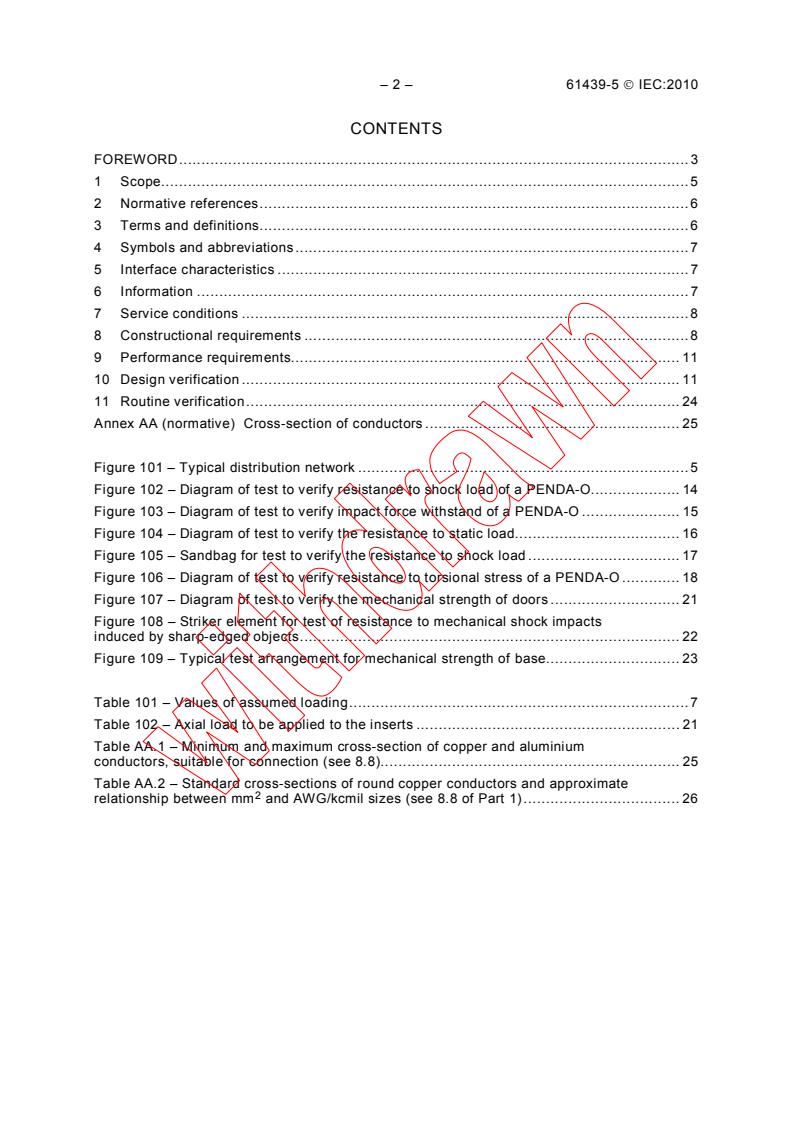
CONTENTS
FOREW ORD . 3
1 Sc o pe . 5
2 Normative references . 6
3 Terms and definitions . 6
4 Symbols and abbreviations . 7
5 Interface characteristics . 7
6 Information . 7
7 Service conditions . 8
8 Constructional requirements . 8
9 Performance requirements. 11
10 Design verification . 11
11 Routine verification . 24
Annex AA (normative) Cross-section of conductors . 25
Figure 101 – Typical distribution network . 5
Figure 102 – Diagram of test to verify resistance to shock load of a PENDA-O. 14
Figure 103 – Diagram of test to verify impact force withstand of a PENDA-O . 15
Figure 104 – Diagram of test to verify the resistance to static load. 16
Figure 105 – Sandbag for test to verify the resistance to shock load . 17
Figure 106 – Diagram of test to verify resistance to torsional stress of a PENDA-O . 18
Figure 107 – Diagram of test to verify the mechanical strength of doors . 21
Figure 108 – Striker element for test of resistance to mechanical shock impacts
induced by sharp-edged objects . 22
Figure 109 – Typical test arrangement for mechanical strength of base . 23
Table 101 – Values of assumed loading . 7
Table 102 – Axial load to be applied to the inserts . 21
Table AA.1 – Minimum and maximum cross-section of copper and aluminium
conductors, suitable for connection (see 8.8). 25
Table AA.2 – Standard cross-sections of round copper conductors and approximate
relationship between mm and AWG/kcmil sizes (see 8.8 of Part 1) . 26
61439-5 Ó IEC:2010 – 3 –
INTERNATIONAL ELECTROTECHNICAL COMMISSION
____________
LOW-VOLTAGE SWITCHGEAR AND CONTROLGEAR ASSEMBLIES –
Part 5: Assemblies for power distribution in public networks
FOREWORD
1) The International Electrotechnical Commission (IEC) is a worldwide organization for standardization comprising
all national electrotechnical committees (IEC National Committees). The object of IEC is to promote
international co-operation on all questions concerning standardization in the electrical and electronic fields. To
this end and in addition to other activities, IEC publishes International Standards, Technical Specifications,
Technical Reports, Publicly Available Specifications (PAS) and Guides (hereafter referred to as “IEC
Publication(s)”). Their preparation is entrusted to technical committees; any IEC National Committee interested
in the subject dealt with may participate in this preparatory work. International, governmental and non-
governmental organizations liaising with the IEC also participate in this preparation. IEC collaborates closely
with the International Organization for Standardization (ISO) in accordance with conditions determined by
agreement between the two organizations.
2) The formal decisions or agreements of IEC on technical matters express, as nearly as possible, an international
consensus of opinion on the relevant subjects since each technical committee has representation from all
interested IEC National Committees.
3) IEC Publications have the form of recommendations for international use and are accepted by IEC National
Committees in that sense. While all reasonable efforts are made to ensure that the technical content of IEC
Publications is accurate, IEC cannot be held responsible for the way in which they are used or for any
misinterpretation by any end user.
4) In order to promote international uniformity, IEC National Committees undertake to apply IEC Publications
transparently to the maximum extent possible in their national and regional publications. Any divergence
between any IEC Publication and the corresponding national or regional publication shall be clearly indicated in
the latter.
5) IEC itself does not provide any attestation of conformity. Independent certification bodies provide conformity
assessment services and, in some areas, access to IEC marks of conformity. IEC is not responsible for any
services carried out by independent certification bodies.
6) All users should ensure that they have the latest edition of this publication.
7) No liability shall attach to IEC or its directors, employees, servants or agents including individual experts and
members of its technical committees and IEC National Committees for any personal injury, property damage or
other damage of any nature whatsoever, whether direct or indirect, or for costs (including legal fees) and
expenses arising out of the publication, use of, or reliance upon, this IEC Publication or any other IEC
Publications.
8) Attention is drawn to the Normative references cited in this publication. Use of the referenced publications is
indispensable for the correct application of this publication.
9) Attention is drawn to the possibility that some of the elements of this IEC Publication may be the subject of
patent rights. IEC shall not be held responsible for identifying any or all such patent rights.
International Standard IEC 61439-5 has been prepared by subcommittee 17D: Low-voltage
switchgear and controlgear assemblies, of IEC technical committee 17: Switchgear and
controlgear.
This first edition of IEC 61439-5 cancels and replaces the second edition of IEC 60439-5
(2006), and constitutes a technical revision.
This edition of IEC 61439-5 includes the following significant technical changes with respect
to the latest edition of IEC 60439-5:
– alignment on IEC 61439-1 regarding the structure and technical content, as applicable;
– introduction of new verifications, accordingly;
– harmonisation of the requirements of substation cable distribution boards and cable
distribution cabinets, thereby eliminating the need to identify and define two catagories of
assembly;
– simpler standard as a result of a reduction in the number of assembly types defined and
the acronyms used to identify the different assemblies.
– 4 – 61439-5 Ó IEC:2010
The text of this standard is based on the following documents:
FDIS Report on voting
17D/422/FDIS 17D/430/RVD
Full information on the voting for the approval of this standard can be found in the report on
voting indicated in the above table.
This publication has been drafted in accordance with the ISO/IEC Directives, Part 2.
This standard is to be read in conjunction with IEC 61439-1. The provisions of the general
rules dealt with in IEC 61439-1 (hereinafter referred to as Part 1) are only applicable to this
standard insofar as they are specifically cited. When this standard states “addition”,
“modification” or “replacement”, the relevant text in Part 1 is to be adapted accordingly.
Subclauses that are numbered with a 101 (102, 103 etc.) suffix are additional to the same
subclause in Part 1.
Tables and figures in this Part 5 that are new are numbered starting with 101.
New annexes in this Part 5 are lettered AA, BB, etc.
In this standard, terms written in small capitals are defined in Clause 3.
A list of all parts of the IEC 61439 series, under the general title Low-voltage switchgear and
controlgear assemblies can be found on the IEC website.
The committee has decided that the contents of this publication will remain unchanged until
the stability date indicated on the IEC web site under "http://webstore.iec.ch" in the data
related to the specific publication. At this date, the publication will be
• reconfirmed,
• withdrawn,
• replaced by a revised edition, or
• amended.
61439-5 Ó IEC:2010 – 5 –
LOW-VOLTAGE SWITCHGEAR AND CONTROLGEAR ASSEMBLIES –
Part 5: Assemblies for power distribution in public networks
1 Scope
This clause of Part 1 applies with the following additions.
Addition:
This standard gives specific requirements for public electricity network distribution assemblies
(PENDAs), which are stationary assemblies verified by verification tests, as defined in this
standard. These ASSEMBLIES are used for the distribution of electrical energy in three-phase
systems (see Figure 101 for a typical distribution network). Open type ASSEMBLIES are not
covered by this standard.
PENDA-I or PENDA-O
PENDA-O
Customers
MV/LV substation
Connecting points
IEC 2568/10
Figure 101 – Typical distribution network
The object of this standard is to state the definitions and to specify the service conditions,
construction requirements, technical characteristics and tests for PENDAs. Network
parameters may require tests at higher performance levels.
NOTE 1 If a PENDA is equipped with additional equipment (for example meters), in such a way that the main
function is changed considerably, then other standards may also apply as agreed between user and manufacturer
(see 8.5).
NOTE 2 Where local regulations and practices permit, a PENDA according to this standard may be used in other
than public networks.
PENDAs are suitable for installation in places where only skilled persons have access for
their use, however, outdoor types may be installed in situations that are accessible to ordinary
persons.
– 6 – 61439-5 Ó IEC:2010
2 Normative references
This clause of Part 1 applies with the following additions.
Addition:
IEC 60269-1, Low-voltage fuses – Part 1: General requirements
IEC 60695-11-10:1999, Fire hazard testing – Part 11-10: Test flames – 50 W horizontal and
vertical flame test methods
IEC 61439-1:2009, Low-voltage switchgear and controlgear assemblies – Part 1: General
rules
ISO 6506-1, Metallic materials – Brinell hardness test – Part 1: Test method
ISO 9223:1992, Corrosion of metals and alloys – Corrosivity of atmospheres – Classification
3 Terms and definitions
This clause of Part 1 applies with the following modifications.
3.1 General terms
Additional terms:
3.1.101
public electricity network distribution ASSEMBLY
PENDA
ASSEMBLY, generally for installation in a public electricty network which in use, receives
electrical energy from one or more supplies and distributes that energy through one or more
cables to other equipment
NOTE 1 A PENDA is installed, operated and maintained solely by skilled persons.
NOTE 2 Some forms of a PENDA were previoulsy known as a cable distribution cabinet (CDC).
3.1.101.1
outdoor public electricity network distribution ASSEMBLY
PENDA-O
cubicle type public electricity network distribution ASSEMBLY that is suitable for outdoor
installation in places that may, or may not, be accessible to the public
3.1.101.2
indoor public electricity network distribution ASSEMBLY
PENDA-I
public electricity network distribution ASSEMBLY suitable for installation indoors, generally
without an enclosure, but including all structural parts necessary to support busbars,
functional units and other ancillary devices, necessary to complete the ASSEMBLY
3.3 External design of ASSEMBLIES
3.3.1
open-type ASSEMBLY
This term of Part 1 does not apply.
61439-5 Ó IEC:2010 – 7 –
3.9 Verification
This subclause of Part 1 applies with the following modifications.
Modifications:
3.9.1
design verification
The note is not applicable, the only method of verification permitted for a PENDA is by test(s)
made in accordance with Clause 10 of this standard.
3.9.3
verification assessment
Not applicable for PENDAs complying with this standard.
3.9.4
design rule
Not applicable for PENDAs complying with this standard.
4 Symbols and abbreviations
This clause of Part 1 applies.
5 Interface characteristics
This clause of Part 1 applies with the following modifications.
5.3.3 Rated diversity factor (RDF)
Addition:
In the absence of an agreement between the ASSEMBLY manufacturer and user concerning the
actual load currents, the assumed loading of the outgoing circuits of the ASSEMBLY or group of
outgoing circuits may be based on the values given in Table 101.
Table 101 – Values of assumed loading
Number of main circuits Assumed loading factor
2 and 3 0,9
4 and 5 0,8
6 to 9 inclusive 0,7
10 (and above) 0,6
6 Information
This clause of Part 1 applies with the following modifications.
6.1 ASSEMBLY designation marking
Addition to first paragraph:
Designation plates may be placed inside an enclosure of an ASSEMBLY provided their intended
place ensures good legibility and visibility when the door(s) is open or the cover is removed.
– 8 – 61439-5 Ó IEC:2010
Replacement of item d):
d) IEC 61439-5.
Replacement of the note:
NOTE Further information may be included by agreement between the user and the manufacturer.
6.3 Device and/or component identification
Additional paragraph:
In the case of removeable fuse-carriers which are specific to a fuseway, a label shall be
placed on the fuse carrier as well as on the fuse base, to avoid incorrect interchangeability of
the fuse-carrier.
Additional subclause:
6.101 Circuit identification
It shall be possible to identify each functional unit in a clearly visible manner.
7 Service conditions
This clause of Part 1 applies with the following modifications.
7.1.1.2 Ambient air temperature for outdoor installations
Replacement of last paragraph with:
Unless the user specifies a PENDA shall be suitable for use in an arctic climate, the lower
limit of ambient air temperature is –25 °C. For an arctic climate the lower limit of ambient
temperature is –50 °C.
7.2 Special service conditions
Addition of the following note to item h):
NOTE Exposure to vibration arising from traffic and/or occasional ground excavation is a normal service condition
for PENDAs.
Additional paragraph:
Additional requirements for a PENDA-O, to be installed where heavy snowfalls occur and
where they are adjacent to areas where there is snow clearance by ploughing, are subject to
agreement between manufacturer and user.
8 Constructional requirements
This clause of Part 1 applies with the following modifications.
8.1 Strength of materials and parts
8.1.1 General
Addition:
61439-5 Ó IEC:2010 – 9 –
A PENDA-O shall be arranged for ground mounting, transformer mounting, pole mounting,
surface wall mounting or mounting within a recess within a wall, as agreed between user and
manufacturer.
A PENDA may be direct coupled to a transformer by means of a flange coupling or it may
connect to its supply by means of cable or via busbars as agreed between user and
manufacturer. Outgoing circuits shall be suitable for connection by means of cables.
A reliable locking device shall be provided on outdoor enclosures which prevents access by
unauthorized persons. Doors, lids and covers shall be so designed that, after they are locked,
they do not open due to subsequent moderate ground settlement, nor due to exposure to
vibration arising from traffic and/or ground excavation and reinstatement works.
8.1.5 Resistance of insulating materials to heat and fire
Additional subclause:
8.1.5.101 Verification of category of flammability
The insulating materials used for enclosures, barriers and other insulating parts shall have
flame retardant properties in accordance with 10.2.3.102 of this standard.
8.1.6 Mechanical strength
Additional subclause:
8.1.6.101 Verification of mechanical strength
The mechanical properties of a PENDA-O shall comply with 10.2.101 of this standard.
Parts of the PENDA-O intended to be embedded in the ground shall withstand the stresses
imposed on them during installation and normal service and comply with 10.2.101.6.
Additional subclause:
8.1.101 Thermal stability
The thermal stability of a PENDA shall be verified according to 10.2.3.101.
8.2 Degree of protection provided by an ASSEMBLY enclosure
8.2.1 Protection against mechanical impact
Subclause 8.2.1 of Part 1 does not apply.
8.2.2 Protection against contact with live parts, ingress of solid foreign bodies and
liquids
Addition:
Open type ASSEMBLIES (IP 00) are not covered by this standard.
When a PENDA-O is intended to be installed in places accessible to the public, its enclosure
shall, when fully-installed in accordance with the manufacturer’s instructions, provide a
degree of protection of at least IP 34D according to IEC 60529. In other locations, the
minimum level of protection shall be at least IP33.
– 10 – 61439-5 Ó IEC:2010
PENDA-O’s that are intended to be installed in places accessible to the public shall, unless
otherwise stated by the user, be designed such that when any temporary cables are
connected, the enclosure shall provide a degree of protection of at least IP 23C according to
IEC 60529. See 8.8 of this standard.
8.4 Protection against electric shock
8.4.2.1 General
The third paragraph does not apply.
Additional subclause:
8.4.2.101 Earthing and short-circuiting means
The outgoing units in an ASSEMBLY shall be so constructed that they can be earthed and short-
circuited in a secure manner by means of a device(s) recommended by the manufacturer,
which ensures the manufacturer’s indicated degree of protection (IP code) is maintained for
all parts of the ASSEMBLY. This requirement is not applicable if it could cause a safety hazard
arising from the system conditions and/or operational practice.
8.4.3.1 Installation conditions
Additional paragraph:
For an ASSEMBLY that is expected to feed overhead cable lines, outgoing units shall be
designed in such a way that an attached cable(s) can be earthed at the termination(s).
8.5 Incorporation of switching devices and components
Additional paragraph:
Individual components, such as fuses and switching devices that are in compliance with
others standards, shall also comply with the supplementary requirements of this standard.
8.5.3 Selection of switching devices and components
Additional paragraph:
Fuses shall comply with the general requirements of IEC 60269-1 or with the relevant national
standard where it is an established practice for such use.
8.8 Terminals for external conductors
Replacement of the first three paragraphs with the following:
In the absence of a special agreement between user and manufacturer, terminals shall be
capable of accommodating cables having copper or aluminium conductors from the smallest
to the largest cross-sectional area corresponding to the appropriate rated current (see
Table AA.1).
The terminations for outgoing circuits shall be located so that adequate spacing is provided
and to facilitate terminating the phase conductors of a cable irrespective of their lay.
Where specified by the user, the incoming circuit shall be suitable for connection by means of
either bare or insulated bars.
Additional subclauses:
61439-5 Ó IEC:2010 – 11 –
8.101 Marking as an obstacle to snow clearance
Where a PENDA-O is intended for use in regions where heavy snowfalls occur in accordance
with 7.2, or alternatively, if required by the user, it shall be possible to mark it as an obstacle
to snow clearance. Holders shall be provided, attached to the PENDA-O, to accommodate
marking rods and it shall be possible to install and make adjustments to the position of the
marking rod from outside the PENDA. The holders shall be constructed in a manner which
ensures that the holder or marking rod will give way to a mechanical force before the
transmitted force to the PENDA-O’s enclosure reaches the value which would adversely affect
the degree of protection (IP code).
8.102 Ease of operation and maintenance
All parts of the ASSEMBLY shall, as far as practicable, be readily accessible and replaceable
without excessive dismantling. The conditions for interchangeability of parts of the ASSEMBLY
may be subject to an agreement between the user and the manufacturer.
The design shall be such that the cables can be readily connected from the front.
When an PENDA does not have a means of measurement incorporated, it shall be possible,
by the use of a portable instrument, to readily and safely measure voltages in all phases of
incoming units and on both sides of all current breaking and/or switch devices of outgoing
units, also the current in one phase of all outgoing units. During this operation all live parts of
the PENDA shall be protected sufficiently to retain the required degree of protection in
accordance with 8.2. Instructions concerning the procedure to be adopted shall be provided
by the manufacturer.
If the ASSEMBLY is intended to be connected to a live reserve power, for example a standby
generator, the switchgear connecting device shall be designed so that connection can be
made with the live parts having a degree of protection of IP 10 according to IEC 60529.
Locking arrangements shall be provided on a PENDA to secure the door(s) and prevent
unauthorised access. The fixings of any covers etc. which are removable for installation or
maintenance operations shall only be accessible while the door(s) are open.
9 Performance requirements
This clause of Part 1 applies.
10 Design verification
This clause of Part 1 applies with the following modifications.
10.1 General
nd
Delete from the 2 paragraph:
‘prior to the publication of the relevant product standard in the IEC 61439 series,’
th
Replacement of 4 paragraph with:
Design verification shall only be achieved by the application of tests in accordance with
Clause 10 of this standard. Alternatives methods of verification by calculation and validation
of design rules are not applicable to PENDAs complying with this standard.
Additional last paragraph:
– 12 – 61439-5 Ó IEC:2010
Where necessary to suit their particular network parameters, users may specify more onerous
or additional test requirements.
10.2 Strength of materials and parts
10.2.2 Resistance to corrosion
10.2.2.1 Test procedure
Replacement of last paragraph with the following:
When the corrosion resistance properties and projected life, as agreed between manufacturer
and user, can be confirmed by reference to ISO 9223, the tests detailed herein need not be
performed.
In all other cases the corrosion resistance of each design of ASSEMBLY shall be verified by
severity test A or B, as applicable and as detailed in 10.2.2.2 and 10.2.2.3 of Part 1.
10.2.2.2 Severity test A
Replacement of the test specification (paragraph 2) with the following:
o
Damp heat cycling test of IEC 60068-2-30: Severity – temperature 55 C, 6 cycles and
variant 1.
At the end of the test, the specimens are removed from the test chamber.
Compliance is checked by visual inspection. The parts tested shall not show rust, cracking or
other deterioration. However, surface corrosion of the protective coating is allowed.
10.2.2.4 Results to be obtained
Subclause 10.2.2.4 of Part 1 is not applicable in respect of tests carried out in accordance
with 10.2.2.2.
10.2.3 Properties of insulating materials
Additional subclauses:
10.2.3.101 Dry heat test
The complete ASSEMBLY shall be placed in an oven, the internal temperature of which is raised
o
to (100 ± 2) C over a period of 2 h to 3 h and maintained at this temperature for 5 h.
Compliance is checked by inspection that there are no visible signs of deterioration.
Deformation of protective covers manufactured from insulating materials is acceptable if they
are more than 6 mm distant from parts which may have a temperature rise in excess of 40 K
and do not support live components.
10.2.3.102 Verification of category of flammability
Representative specimens of each of the materials of enclosures, barriers and other
insulating parts shall be subjected to a flammability test in accordance with test method A –
horizontal burning test of IEC 60695-11-10.
NOTE When agreed between user and manufacturer, other tests to check the resistance to fire of materials of
enclosures, barriers and other insulating parts may be carried out.
61439-5 Ó IEC:2010 – 13 –
Compliance is checked by inspection that each set of specimens can be classified to category
HB40 criteria a) or b) in accordance with 8.4.1 of IEC 60695-11-10.
10.2.6 Mechanical impact
10.2.6 of Part 1 is not applicable to ASSEMBLIES complying with this standard.
Additional subclauses:
10.2.101 Verification of mechanical strength
o o
The tests shall be carried out at an ambient temperature of between 10 C and 40 C.
With the exception of the test of 10.2.101.2.1, a new sample ASSEMBLY may be used for each
of the independent tests. If the same sample ASSEMBLY is used for more than one test of
10.2.101, the compliance check for the second numeral of the degree of protection (IP code)
need only be applied when the tests on that sample have been completed.
All tests shall be carried out with the ASSEMBLY fixed at its normal service mounting and where
appropriate, added support at normal ground level as indicated in Figures 102a, 102b, 103a,
and 103b.
– 14 – 61439-5 Ó IEC:2010
Dimensions in millimetres
Start position
Impact
position
Cabinet
Base Top edge of base
Support as stated
by the manufacturer
IEC 2569/10
Figure 102a – Diagram of test to verify the resistance to shock load
of a ground mounted PENDA-O with embedded base
Dimensions in millimetres
Start position
Impact
position
IEC 2570/10
Figure 102b – Diagram of test to verify resistance to shock load
of a ground mounted PENDA-O without embedded base
Figure 102 – Diagram of test to verify resistance to shock load of a PENDA-O
1 000
1 000
61439-5 Ó IEC:2010 – 15 –
Dimensions in millimetres
Start position
Impact
position
Cabinet
Top edge of base
Base
Support as stated
by the manufacturer
IEC 2571/10
Figure 103a – Diagram of test to verify impact force withstand
for a ground mounted PENDA-O with embedded base
Dimensions in millimetres
Start position
Impact
position
IEC 2572/10
Figure 103b – Diagram of test to verify impact force withstand
for a ground mounted PENDA-O without embedded base
Figure 103 – Diagram of test to verify impact force withstand of a PENDA-O
1 000
1 000
– 16 – 61439-5 Ó IEC:2010
With the exception of the test of 10.2.101.3 of this standard, the door(s) of the ASSEMBLY, if
applicable, shall be locked at the commencement of the test and remain locked for the
duration of the test.
10.2.101.1 Verification of structural strength
10.2.101.1.1 Verification of resistance to static load
The following tests shall be carried out on all types of PENDA-0:
Test 1 – An evenly distributed load of 8 500 N/m shall be applied for 5 min to the roof of
the enclosure (see Figure 104).
Test 2 – A force of 1 200 N shall be applied for 5 min in turn to the front and back upper
edges of the roof of the enclosure (see Figure 104).
Test 3 – A load of 60 N shall be applied for 5 min to each sidewall of the enclosure in turn.
The centre of the load shall be 20 mm from the edge of the sidewall under test and shall
be spread over a circular area of 10 mm diameter.
8 500 N/m
1 200 N
Evenly distributed load
Force
1 200 N
Force
IEC 2573/10
Figure 104 – Diagram of test to verify the resistance to static load
Compliance is checked by verification after the test that the minimum degree of protection is
in accordance with 8.2.2, and the operation of the door(s) and locking points are not impaired;
also by verification that the electrical clearances have remained satisfactory for the duration
of the tests and in the case of an ASSEMBLY having metallic enclosure, that no contact
between live parts and the enclosure has occurred caused by permanent or temporary
distortion.
10.2.101.1.2 Verification of resistance to shock load
The test shall apply to all types of PENDA-O.
A bag in accordance with Figure 105 containing dry sand and having a total mass of 15 kg
shall be hung from an overhead support vertically above the surface under test and at least
1 m above the highest point of the ASSEMBLY.
61439-5 Ó IEC:2010 – 17 –
Dimensions in millimetres
Loop for pendulum
Material: any suitable flexible material
which does not burst on impact
Sand grain size
0,5 … 0,8
Eye for lifting
and release
Seam - only on eye
side, striking side is
seamless
Æ200
IEC 2574/10
Figure 105 – Sandbag for test to verify the resistance to shock load
Each test shall consist of one blow aimed at the upper part of each of the vertical surfaces of
the ASSEMBLY which are visible when the ASSEMBLY is installed in its normal service position.
Separate enclosures may be used for each of the test blows.
NOTE If the enclosure is of cylindrical form, the test should consist of three blows which should be positioned
o
with an angular displacement of 120 .
A test shall consist of raising the lifting eye through a height of 1 m and allowing the sandbag
to fall through a vertical arc to impact the approximate centre of the upper part of the surface
of the ASSEMBLY under test (see Figures 102a and 102b).
Compliance is checked by verification after the test that the degree of protection remains in
accordance with 8.2.2, and the operation of the door(s) and locking points are not impaired;
also by verification that the electrical clearances have remained satisfactory for the duration
of the tests and, in the case of an ASSEMBLY having a metallic enclosure, that no contact
between live parts and the enclosure has occurred caused by permanent or temporary
distortion. In the case of an ASSEMBLY having an insulating enclosure, if the appropriate
conditions are satisfied, then damage such as small dents or small degrees of surface
cracking or flaking are disregarded, provided that there are no associated cracks detrimental
to the serviceability of the ASSEMBLY.
10.2.101.1.3 Verification of resistance to torsional stress
The test only applies to all types of PENDA-O.
The test is carried out using a horizontally rotatable frame constructed from 60 mm ´ 60 mm ´
5 mm angle iron, having vertical locations 100 mm long at the frame arm’s extremities. The
– 18 – 61439-5 Ó IEC:2010
ASSEMBLY under test is rigidly fixed at its base and the frame closely fitted over it, so that the
end locations of the frame arm are in contact with the roof and walls of the ASSEMBLY.
The ASSEMBLY, with the door(s) closed shall have a torsional force of 2 ´ 1 000 N applied for
30 s as shown in Figures 106a and 106b.
Dimensions in millimetres
Rotatable mounting device
Angle iron
60 ´ 60 ´ 5 length 100
Force F = 1 000 N
F F
Cabinet
Centre of rotation
F F
Base Top edge of base
Support as stated
by the manufacturer
PENDA-O turned in a PENDA-O turned in a
clockwise direction counter clockwise direction
IEC 2576/10
Figure 106a – Diagram of test to verify the resistance to torsional stress
of a ground mounted PENDA-O with embedded base
Dimensions in millimetres
Angle iron
60 ´ 60 ´ 5 length 100
Rotatable mounting device
F
F
Cabinet
Centre of rotation
F F
Force F = 1 000 N
PENDA-O turned in a PENDA-O turned in a
clockwise direction counter clockwise direction
IEC 2575/10
Figure 106b – Diagram of test to verify resistance to torsional stress
of a ground mounted PENDA-O without embedded base
Figure 106 – Diagram of test to verify resistance to torsional stress of a PENDA-O
Compliance is checked by verifying that the doors(s) remain closed for the duration of the test
and by verification after the test that the degree of protection remains in accordance with
8.2.2.
61439-5 Ó IEC:2010 – 19 –
10.2.101.2 Verification of impact force withstand
10.2.101.2.1 Test applicable to PENDAs designed for operation at ambient
o o
temperatures of between 40 C and –25 C
The test shall be carried out using impact apparatus in the form of a pendulum incorporating a
9 mm external diameter tube at least 1 m long. The pendulum shall be arranged to swing
through a vertical arc.
Attached to one end is a solid steel ball of 2 kg mass, which shall be raised through a height
of 1 m and allowed to drop and impact the surface of the ASSEMBLY under test, thus providing
an impact energy of 20 J (see Figures 103a and 103b).
For each of the two tests detailed below, the test shall consist of one blow aimed at the centre
of each of the vertical surfaces of the ASSEMBLY which are visible when it is installed in its
normal service position. Separate enclosures may be used for each of the test blows.
NOTE If the enclosure is of cylindrical form, the test should consist of three blows which should be positioned
o
with an angular displacement of 120 .
o o
Test 1 shall be carried out at an ambient air temperature of between 10 C and 40 C after the
ASSEMBLY has been kept within these temperatures for not less that 12 h.
o o
Test 2 shall be carried out at an ambient air temperature of between 10 C and 40 C
o
immediately after the ASSEMBLY has been kept at a temperature of -25(+0;-0,5) C for a period
of not less than 12 h.
Compliance is checked by verification after the test that the degree of protection remains in
accordance with 8.2.2, and the operation of the door(s) and locking points are not impaired;
also by verification that the electrical clearances have remained satisfactory for the duration
of the tests and in the case of an ASSEMBLY having a metallic enclosure, that no contact
between live parts and the enclosure has occurred caused by permanent or temporary
distortion. In the case of an ASSEMBLY having an insulating enclosure, if the appropriate
conditions are satisfied, then damage such as small dents or small degrees of surface
cracking or flaking are disregarded, provided that there are no associated cracks detrimental
to the serviceability of the ASSEMBLY.
10.2.101.2.2 Test applicable to PENDAs designed for operation in an arctic climate
(see 7.1.1.2)
o o
The tests shall be carried out at an ambient air temperature between 10 C and 40 C
o
immediately after the ASSEMBLY has been kept at a temperature of –50(+0;-5) C for a period
of not less than 12 h.
The test sequence shall be as follows:
Tests 1 and 2 involve applying a force of 1 500 N for 30 s to an earthed metal test body
against the enclosure at the considered 10 weakest points. The test body shall be of spherical
or hemispherical shape having a radius of 100 mm ± 3 mm and a surface hardness of HB 160
according to ISO 6506-1.
Test 1 shall be carried out on an empty PENDA-O.
Test 2 shall be carried out on an ASSEMBLY containing equipment that provides the minimum
clearances inside the enclosure. The enclosure shall be earthed and an a.c. voltage in
accordance with 10.9.2.2 of Part 1 shall be applied between all live parts connected together
and the enclosure for the duration of the test.
– 20 – 61439-5 Ó IEC:2010
Test 3 shall be carried out on an empty enclosure using an impact apparatus as described in
10.2.101.2.1 of this standard but having a solid steel ball with an approximate mass of 15 kg.
This striker element shall be raised through a height of approximately 1 m allowed to drop and
impact the surface of the ASSEMBLY under test, to provide an impact energy of 150 J (see
Figures 103a and 103b).
The test shall consist of one blow aimed at the centre of each of the vertical surfaces of the
ASSEMBLY which are visible when it is installed in its normal service position. Separate
enclosures may be used for each of the test blows.
NOTE If the enclosure is of cylindrical form, the test should consist of three blows which should be positioned
o
with an angular displacement of 120 .
Compliance for Test 1 is checked by verification after the test that the degree of protection
remains in accordance with 8.2.2, and the operation of the door(s) and locking points are not
impaired.
Compliance for Test 2 is checked by verification that no puncture or flashover occurs.
Compliance for Test 3 is checked by verification after the test that the degree of the protection
is at least IP 3X.
10.2.101.3 Verification of mechanical strength of doors
The test applies to all types of PENDA-O having a door(s) hinged on a vertical edge of the
enclosure.
The tests shall be carried out with the door(s) fully open and in contact with the designed
restraint. A load of 50 N shall be applied at the top edge of the door perpendicular to the
plane of the door(s) and at a distance 300 mm from the hinged edge and maintained for 3 s.
Unless the door(s) are designed to be unhinged without the use of a tool for maintenance or
operational use, the test shall then be repeated with the load increased to 450 N (see
Figure 107).
61439-5 Ó IEC:2010 – 21 –
Dimensions in millimetres
50 N
450 N
IEC 2577/10
Figure 10
...