

IEC 61162-450:2018
(Main)Maritime navigation and radiocommunication equipment and systems - Digital interfaces - Part 450: Multiple talkers and multiple listeners - Ethernet interconnection
General Information
- Abstract
IEC 61162-450:2018 specifies interface requirements and methods of test for high speed communication between shipboard navigation and radiocommunication equipment as well as between such systems and other ship systems that need to communicate with navigation and radio-communication equipment. This document is based on the application of an appropriate suite of existing international standards to provide a framework for implementing data transfer between devices on a shipboard Ethernet network. This document specifies an Ethernet based bus type network where any listener can receive messages from any sender with the following properties.
- This document includes provisions for multicast distribution of information formatted according to IEC 61162-1, for example position fixes and other measurements, as well as provisions for transmission of general data blocks (binary file), for example between radar and VDR, and also includes provisions for multicast distribution of information formatted according to IEC 61162-3, for example position fixes and other measurements.
- This document is limited to protocols for equipment (network nodes) connected to a single Ethernet network consisting only of OSI level one or two devices and cables (Network infrastructure).
- This document provides requirements only for equipment interfaces. By specifying protocols for transmission of IEC 61162-1 sentences, IEC 61162-3 PGN messages and general binary file data, these requirements will guarantee interoperability between equipment implementing this document as well as a certain level of safe behaviour of the equipment itself.
- This document permits equipment using other protocols than those specified in this document to share a network infrastructure, provided that it is supplied with interfaces which satisfy the requirements described for ONF.
- This document includes provisions for filtering of the network traffic in order to limit the amount of traffic to manageable level for each individual equipment.
This document does not contain any system requirements other than the ones that can be inferred from the sum of individual equipment requirements. An associated standard, IEC 61162-460, further addresses system requirements.
This second edition of IEC 61162-450 cancels and replaces the first edition published in 2011 and Amendment 1:2016. This edition constitutes a technical revision.
This edition includes the following significant technical changes with respect to the previous edition:
a) network traffic filtering based on IGMP snooping added;
b) network traffic balancing added;
c) new encapsulation of IEC 61162-3 PGNs added;
d) new alternative for binary file transfer added: TCP/IP based on Annex H of IEC 62388:2007 on radars;
e) general authentication tag "a:" added to support managing of cyber security risk.
- Status
- Published
- Publication Date
- 06-May-2018
- Technical Committee
- TC 80 - Maritime navigation and radiocommunication equipment and systems
- Drafting Committee
- WG 6 - TC 80/WG 6
- Current Stage
- DELPUB - Deleted Publication
- Start Date
- 04-Apr-2024
- Completion Date
- 31-Jan-2022
Buy Documents

IEC 61162-450:2018 - Maritime navigation and radiocommunication equipment and systems - Digital interfaces - Part 450: Multiple talkers and multiple listeners - Ethernet interconnection Released:5/4/2018

IEC 61162-450:2018 RLV - Maritime navigation and radiocommunication equipment and systems - Digital interfaces - Part 450: Multiple talkers and multiple listeners - Ethernet interconnection Released:5/7/2018
IEC 61162-450:2018 - Maritime navigation and radiocommunication equipment and systems - Digital interfaces - Part 450: Multiple talkers and multiple listeners - Ethernet interconnection Released:5/4/2018
Overview
IEC 61162-450:2018 - "Maritime navigation and radiocommunication equipment and systems - Digital interfaces - Part 450: Multiple talkers and multiple listeners - Ethernet interconnection" - defines interface requirements and test methods for high‑speed shipboard communication over Ethernet. The standard provides a framework for implementing multicast and point‑to‑point data transfer between navigation and radiocommunication devices and other ship systems, ensuring interoperable shipboard Ethernet communications for IEC 61162‑1 sentences, IEC 61162‑3 PGN messages and general binary file transfers.
Key topics and technical requirements
- Ethernet‑based multiple talkers / multiple listeners model (single Ethernet network limited to OSI layer 1 and 2 devices).
- Multicast distribution of IEC 61162‑1 sentence formats (e.g., position fixes) and IEC 61162‑3 PGN messages; support for binary file (image) transfers such as radar → VDR.
- Transport options: UDP multicast for broadcast-style distribution; TCP/IP point‑to‑point file transfer alternative (based on Annex H of IEC 62388 for radars).
- Network traffic management: IGMP snooping based filtering to limit received traffic per device; network traffic balancing to avoid congestion.
- PGN encapsulation: New encapsulation rules for IEC 61162‑3 PGNs (Edition 2).
- Interface‑only scope: Requirements apply to equipment interfaces (guarantee of interoperability and predictable, safe behavior); system-level requirements are outside this document and addressed in IEC 61162‑460.
- Testing and conformance: Methods of test and required results are specified for equipment functions (NF, SF, SNGF, PNGF, ONF), transport and application layers, binary image transfer, error logging and maximum data rates.
- Cybersecurity support: General authentication tag ("a:") added to help manage cyber risk.
Practical applications and who uses it
- Shipboard network design and implementation for commercial and naval vessels.
- Marine electronics manufacturers (radar, GNSS, AIS, ECDIS, VDR) implementing interoperable Ethernet interfaces.
- System integrators and shipyards installing multi‑vendor navigation/radio networks.
- Test laboratories and classification societies verifying interface conformance and safety behavior.
- Onboard network administrators and maritime IT teams ensuring traffic filtering, multicast performance and reliable binary file exchanges.
Related standards
- IEC 61162‑1 - Serial data for shipboard navigation (sentence formats)
- IEC 61162‑3 - Controller Area Network (CAN bus) / PGN messages
- IEC 61162‑460 - System requirements for multiple talkers/multiple listeners
- IEC 62388 (Annex H) - Radar TCP/IP file transfer guidance
By conforming to IEC 61162‑450, maritime equipment vendors and integrators can achieve robust, interoperable shipboard Ethernet communication with controlled multicast traffic, standardized PGN handling and tested binary file transfer mechanisms - supporting safer and more maintainable navigation systems.
Relations
- Effective Date
- 05-Sep-2023
- Effective Date
- 05-Sep-2023
- Effective Date
- 05-Sep-2023
Buy Documents
IEC 61162-450:2018 - Maritime navigation and radiocommunication equipment and systems - Digital interfaces - Part 450: Multiple talkers and multiple listeners - Ethernet interconnection Released:5/4/2018
IEC 61162-450:2018 RLV - Maritime navigation and radiocommunication equipment and systems - Digital interfaces - Part 450: Multiple talkers and multiple listeners - Ethernet interconnection Released:5/7/2018
IEC 61162-450:2018 - Maritime navigation and radiocommunication equipment and systems - Digital interfaces - Part 450: Multiple talkers and multiple listeners - Ethernet interconnection Released:5/4/2018
Get Certified
Connect with accredited certification bodies for this standard

DNV
DNV is an independent assurance and risk management provider.

Lloyd's Register
Lloyd's Register is a global professional services organisation specialising in engineering and technology.

DVS-ZERT GmbH
German welding certification society.
Sponsored listings
Frequently Asked Questions
IEC 61162-450:2018 is a standard published by the International Electrotechnical Commission (IEC). Its full title is "Maritime navigation and radiocommunication equipment and systems - Digital interfaces - Part 450: Multiple talkers and multiple listeners - Ethernet interconnection". This standard covers: IEC 61162-450:2018 specifies interface requirements and methods of test for high speed communication between shipboard navigation and radiocommunication equipment as well as between such systems and other ship systems that need to communicate with navigation and radio-communication equipment. This document is based on the application of an appropriate suite of existing international standards to provide a framework for implementing data transfer between devices on a shipboard Ethernet network. This document specifies an Ethernet based bus type network where any listener can receive messages from any sender with the following properties. - This document includes provisions for multicast distribution of information formatted according to IEC 61162-1, for example position fixes and other measurements, as well as provisions for transmission of general data blocks (binary file), for example between radar and VDR, and also includes provisions for multicast distribution of information formatted according to IEC 61162-3, for example position fixes and other measurements. - This document is limited to protocols for equipment (network nodes) connected to a single Ethernet network consisting only of OSI level one or two devices and cables (Network infrastructure). - This document provides requirements only for equipment interfaces. By specifying protocols for transmission of IEC 61162-1 sentences, IEC 61162-3 PGN messages and general binary file data, these requirements will guarantee interoperability between equipment implementing this document as well as a certain level of safe behaviour of the equipment itself. - This document permits equipment using other protocols than those specified in this document to share a network infrastructure, provided that it is supplied with interfaces which satisfy the requirements described for ONF. - This document includes provisions for filtering of the network traffic in order to limit the amount of traffic to manageable level for each individual equipment. This document does not contain any system requirements other than the ones that can be inferred from the sum of individual equipment requirements. An associated standard, IEC 61162-460, further addresses system requirements. This second edition of IEC 61162-450 cancels and replaces the first edition published in 2011 and Amendment 1:2016. This edition constitutes a technical revision. This edition includes the following significant technical changes with respect to the previous edition: a) network traffic filtering based on IGMP snooping added; b) network traffic balancing added; c) new encapsulation of IEC 61162-3 PGNs added; d) new alternative for binary file transfer added: TCP/IP based on Annex H of IEC 62388:2007 on radars; e) general authentication tag "a:" added to support managing of cyber security risk.
IEC 61162-450:2018 specifies interface requirements and methods of test for high speed communication between shipboard navigation and radiocommunication equipment as well as between such systems and other ship systems that need to communicate with navigation and radio-communication equipment. This document is based on the application of an appropriate suite of existing international standards to provide a framework for implementing data transfer between devices on a shipboard Ethernet network. This document specifies an Ethernet based bus type network where any listener can receive messages from any sender with the following properties. - This document includes provisions for multicast distribution of information formatted according to IEC 61162-1, for example position fixes and other measurements, as well as provisions for transmission of general data blocks (binary file), for example between radar and VDR, and also includes provisions for multicast distribution of information formatted according to IEC 61162-3, for example position fixes and other measurements. - This document is limited to protocols for equipment (network nodes) connected to a single Ethernet network consisting only of OSI level one or two devices and cables (Network infrastructure). - This document provides requirements only for equipment interfaces. By specifying protocols for transmission of IEC 61162-1 sentences, IEC 61162-3 PGN messages and general binary file data, these requirements will guarantee interoperability between equipment implementing this document as well as a certain level of safe behaviour of the equipment itself. - This document permits equipment using other protocols than those specified in this document to share a network infrastructure, provided that it is supplied with interfaces which satisfy the requirements described for ONF. - This document includes provisions for filtering of the network traffic in order to limit the amount of traffic to manageable level for each individual equipment. This document does not contain any system requirements other than the ones that can be inferred from the sum of individual equipment requirements. An associated standard, IEC 61162-460, further addresses system requirements. This second edition of IEC 61162-450 cancels and replaces the first edition published in 2011 and Amendment 1:2016. This edition constitutes a technical revision. This edition includes the following significant technical changes with respect to the previous edition: a) network traffic filtering based on IGMP snooping added; b) network traffic balancing added; c) new encapsulation of IEC 61162-3 PGNs added; d) new alternative for binary file transfer added: TCP/IP based on Annex H of IEC 62388:2007 on radars; e) general authentication tag "a:" added to support managing of cyber security risk.
IEC 61162-450:2018 is classified under the following ICS (International Classification for Standards) categories: 01 - GENERALITIES. TERMINOLOGY. STANDARDIZATION. DOCUMENTATION; 25.040.40 - Industrial process measurement and control; 47.020.70 - Navigation and control equipment. The ICS classification helps identify the subject area and facilitates finding related standards.
IEC 61162-450:2018 has the following relationships with other standards: It is inter standard links to IEC 61162-450:2011, IEC 61162-450:2011/AMD1:2016, IEC 61162-450:2024. Understanding these relationships helps ensure you are using the most current and applicable version of the standard.
IEC 61162-450:2018 is available in PDF format for immediate download after purchase. The document can be added to your cart and obtained through the secure checkout process. Digital delivery ensures instant access to the complete standard document.
Standards Content (Sample)
IEC 61162-450 ®
Edition 2.0 2018-05
INTERNATIONAL
STANDARD
Maritime navigation and radiocommunication equipment and systems – Digital
interfaces –
Part 450: Multiple talkers and multiple listeners – Ethernet interconnection
All rights reserved. Unless otherwise specified, no part of this publication may be reproduced or utilized in any form
or by any means, electronic or mechanical, including photocopying and microfilm, without permission in writing from
either IEC or IEC's member National Committee in the country of the requester. If you have any questions about IEC
copyright or have an enquiry about obtaining additional rights to this publication, please contact the address below or
your local IEC member National Committee for further information.
IEC Central Office Tel.: +41 22 919 02 11
3, rue de Varembé info@iec.ch
CH-1211 Geneva 20 www.iec.ch
Switzerland
About the IEC
The International Electrotechnical Commission (IEC) is the leading global organization that prepares and publishes
International Standards for all electrical, electronic and related technologies.
About IEC publications
The technical content of IEC publications is kept under constant review by the IEC. Please make sure that you have the
latest edition, a corrigenda or an amendment might have been published.
IEC Catalogue - webstore.iec.ch/catalogue Electropedia - www.electropedia.org
The stand-alone application for consulting the entire The world's leading online dictionary of electronic and
bibliographical information on IEC International Standards, electrical terms containing 21 000 terms and definitions in
Technical Specifications, Technical Reports and other English and French, with equivalent terms in 16 additional
documents. Available for PC, Mac OS, Android Tablets and languages. Also known as the International Electrotechnical
iPad. Vocabulary (IEV) online.
IEC publications search - webstore.iec.ch/advsearchform IEC Glossary - std.iec.ch/glossary
The advanced search enables to find IEC publications by a 67 000 electrotechnical terminology entries in English and
variety of criteria (reference number, text, technical French extracted from the Terms and Definitions clause of
committee,…). It also gives information on projects, replaced IEC publications issued since 2002. Some entries have been
and withdrawn publications. collected from earlier publications of IEC TC 37, 77, 86 and
CISPR.
IEC Just Published - webstore.iec.ch/justpublished
Stay up to date on all new IEC publications. Just Published IEC Customer Service Centre - webstore.iec.ch/csc
details all new publications released. Available online and If you wish to give us your feedback on this publication or
also once a month by email. need further assistance, please contact the Customer Service
Centre: sales@iec.ch.
IEC 61162-450 ®
Edition 2.0 2018-05
INTERNATIONAL
STANDARD
Maritime navigation and radiocommunication equipment and systems – Digital
interfaces –
Part 450: Multiple talkers and multiple listeners – Ethernet interconnection
INTERNATIONAL
ELECTROTECHNICAL
COMMISSION
ICS 47.020.70 ISBN 978-2-8322-5636-7
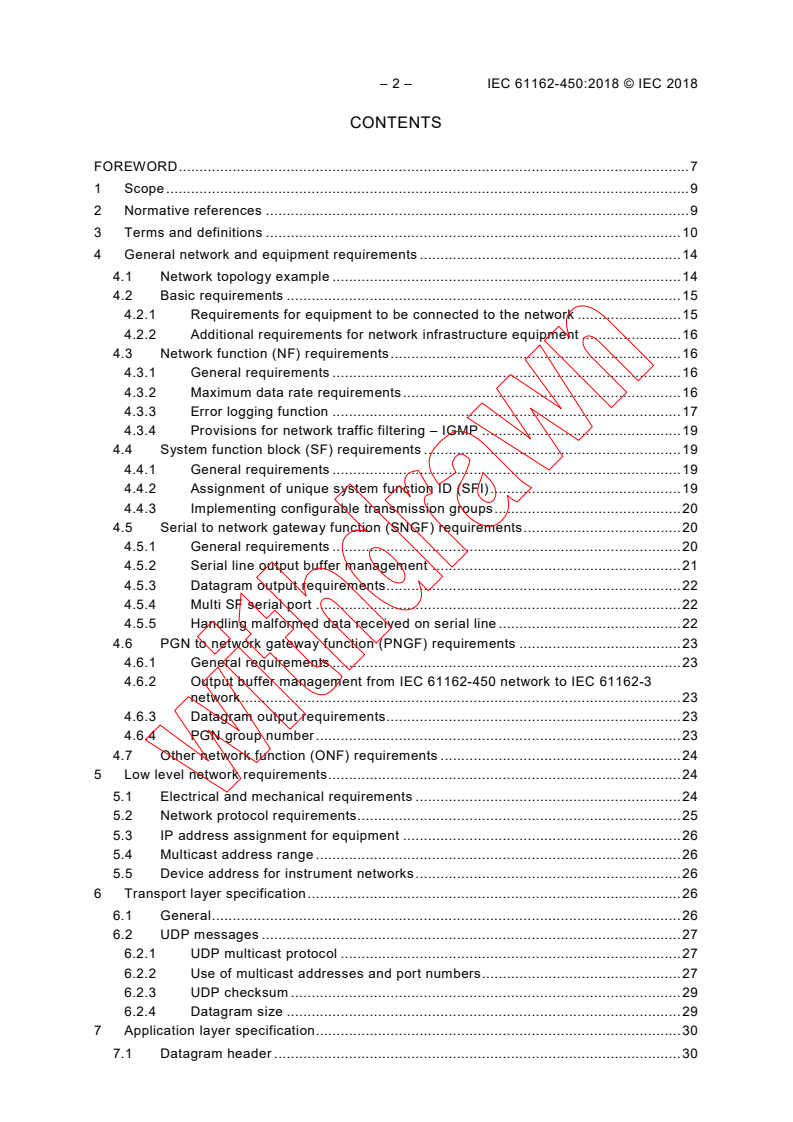
– 2 – IEC 61162-450:2018 © IEC 2018
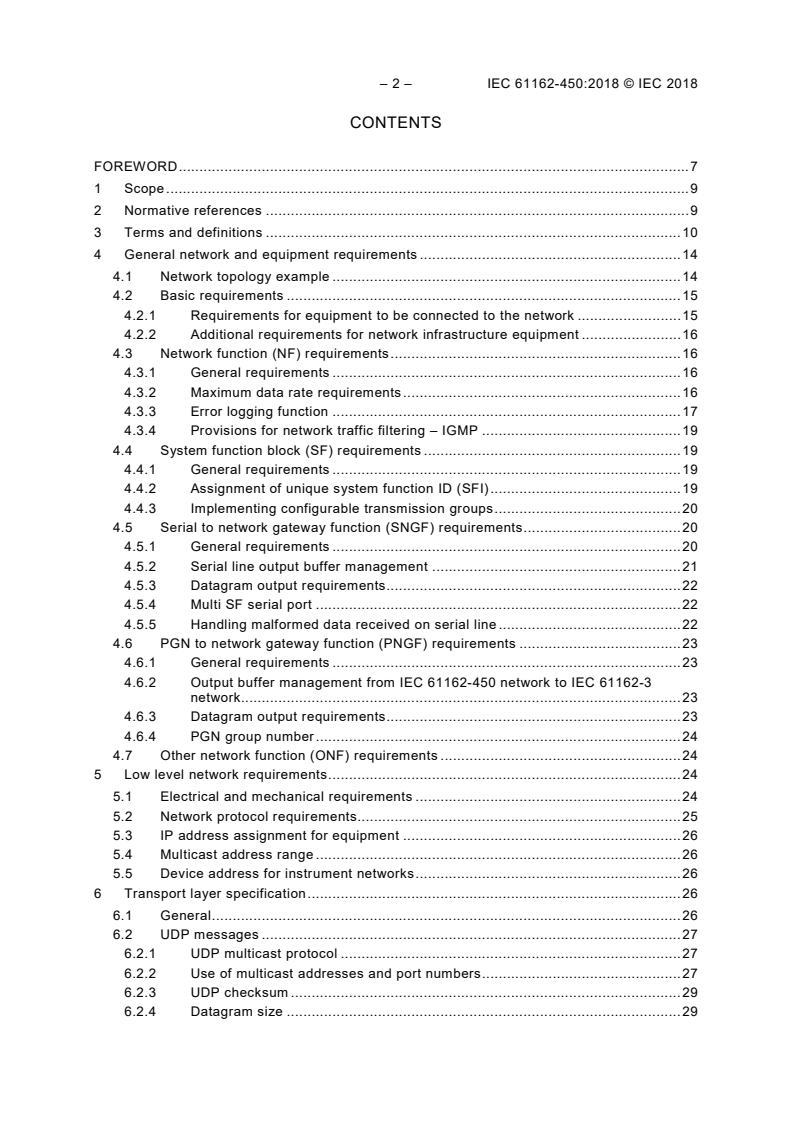
CONTENTS
FOREWORD . 7
1 Scope . 9
2 Normative references . 9
3 Terms and definitions . 10
4 General network and equipment requirements . 14
4.1 Network topology example . 14
4.2 Basic requirements . 15
4.2.1 Requirements for equipment to be connected to the network . 15
4.2.2 Additional requirements for network infrastructure equipment . 16
4.3 Network function (NF) requirements . 16
4.3.1 General requirements . 16
4.3.2 Maximum data rate requirements . 16
4.3.3 Error logging function . 17
4.3.4 Provisions for network traffic filtering – IGMP . 19
4.4 System function block (SF) requirements . 19
4.4.1 General requirements . 19
4.4.2 Assignment of unique system function ID (SFI) . 19
4.4.3 Implementing configurable transmission groups . 20
4.5 Serial to network gateway function (SNGF) requirements . 20
4.5.1 General requirements . 20
4.5.2 Serial line output buffer management . 21
4.5.3 Datagram output requirements . 22
4.5.4 Multi SF serial port . 22
4.5.5 Handling malformed data received on serial line . 22
4.6 PGN to network gateway function (PNGF) requirements . 23
4.6.1 General requirements . 23
4.6.2 Output buffer management from IEC 61162-450 network to IEC 61162-3
network. 23
4.6.3 Datagram output requirements . 23
4.6.4 PGN group number . 23
4.7 Other network function (ONF) requirements . 24
5 Low level network requirements . 24
5.1 Electrical and mechanical requirements . 24
5.2 Network protocol requirements. 25
5.3 IP address assignment for equipment . 26
5.4 Multicast address range . 26
5.5 Device address for instrument networks . 26
6 Transport layer specification . 26
6.1 General . 26
6.2 UDP messages . 27
6.2.1 UDP multicast protocol . 27
6.2.2 Use of multicast addresses and port numbers . 27
6.2.3 UDP checksum . 29
6.2.4 Datagram size . 29
7 Application layer specification . 30
7.1 Datagram header . 30
7.1.1 Valid header . 30
7.1.2 Error logging . 30
7.2 General IEC 61162-1 sentence transmissions . 30
7.2.1 Application of this protocol . 30
7.2.2 Types of messages for which this protocol can be used . 30
7.2.3 TAG block parameters for sentences transmitted in the datagram . 30
7.2.4 Requirements for processing incoming datagrams . 34
7.2.5 Error logging for processing incoming datagrams . 34
7.3 Binary file transfer using UDP multicast – Single transmitter, multiple
receivers . 34
7.3.1 Application of this protocol . 34
7.3.2 Binary file structure. 35
7.3.3 61162-450 header . 35
7.3.4 Binary file descriptor structure . 37
7.3.5 Binary file data fragment . 38
7.3.6 Sender process for binary file transfer . 39
7.3.7 Receiver process for binary file transfer . 42
7.3.8 Other requirements . 44
7.3.9 Error logging . 46
7.4 General IEC 61162-3 PGN message transmissions . 46
7.4.1 Message structure . 46
7.4.2 Message format . 47
7.4.3 Address translation requirements. 47
7.4.4 Message processing . 48
7.4.5 Additional management requirements . 48
7.5 System function ID resolution. 48
7.5.1 General . 48
7.5.2 Transmitter functions . 49
7.6 Binary file transfer using TCP point-to-point . 49
7.6.1 Definition . 49
7.6.2 Data field structure for transfer of files . 50
7.6.3 Structure of the transfer stream . 52
7.6.4 TCP port and IP addresses . 52
7.6.5 Implementation guidance . 52
8 Methods of test and required results . 53
8.1 Test set-up and equipment . 53
8.2 Basic requirements . 54
8.2.1 Equipment to be connected to the network . 54
8.2.2 Network infrastructure equipment . 54
8.2.3 Documentation . 54
8.3 Network function (NF) . 54
8.3.1 Maximum data rate . 54
8.3.2 Error logging function . 55
8.4 System function block (SF) . 55
8.4.1 General . 55
8.4.2 Assignment of unique system function ID (SFI) . 55
8.4.3 Implementing configurable transmission groups . 55
8.5 Serial to network gateway function (SNGF) . 55
8.5.1 General . 55
– 4 – IEC 61162-450:2018 © IEC 2018
8.5.2 Serial line output buffer management . 56
8.5.3 Datagram output . 56
8.5.4 Datagram output multi SF serial port . 56
8.5.5 Handling malformed data received on serial line . 57
8.6 Other network function (ONF) . 58
8.7 Low level network . 59
8.7.1 Electrical and mechanical requirements . 59
8.7.2 Network protocol. 59
8.7.3 IP address assignment for equipment . 59
8.7.4 Multicast address range . 59
8.8 Transport layer . 59
8.9 Application layer . 60
8.9.1 Application . 60
8.9.2 Datagram header . 60
8.9.3 Types of messages . 60
8.9.4 TAG block parameters . 60
8.9.5 General authentication . 61
8.10 Error logging . 62
8.11 Binary file transfer using UDP multicast – Single transmitter, multiple
receiver . 62
8.11.1 Sender process test . 62
8.11.2 Receiver process test . 63
8.11.3 Binary file descriptor test . 64
8.11.4 Binary file transfer error logging . 64
8.11.5 Maximum outgoing rate . 65
8.12 PGN to network gateway function (PNGF). 65
8.12.1 General . 65
8.12.2 Output buffer management . 65
8.12.3 Datagram output . 65
8.12.4 PGN group . 65
8.12.5 Address conflicts . 65
8.13 System function ID resolution. 65
8.14 Binary file transfer using TCP point-to-point . 65
8.14.1 Test of transmit client . 66
8.14.2 Test of receiver server . 66
8.14.3 Maximum outgoing rate . 67
8.14.4 TCP port and IP addresses . 67
Annex A (normative) Classification of IEC 61162-1 talker identifier mnemonics and
sentences . 68
A.1 General . 68
A.2 Talker identifier mnemonic to transmission group mapping . 68
A.3 List of all sentence formatters and the sentence type . 70
Annex B (normative) TAG block definitions . 74
B.1 Validity . 74
B.2 Valid TAG block characters . 74
B.3 TAG block format . 74
B.4 TAG block "hexadecimal checksum" (*hh) . 75
B.5 TAG block "line" . 75
B.6 TAG block parameter-code dictionary . 76
Annex C (normative) Reliable transmission of command-response pair messages . 77
C.1 Purpose . 77
C.2 Information exchange examples . 77
C.3 Characteristics . 77
C.4 Requirements . 77
C.5 Data flow description . 78
C.5.1 Heartbeat message . 78
C.5.2 Command response pair . 78
Annex D (informative) Compatibility between IEC 61162-450 nodes based on
IEC 61162-450:2011 connected to network which uses methods based on IEC 61162-
450:2018 . 79
D.1 General . 79
D.2 Alternative methods for compatibility . 79
D.2.1 Use of IGMP proxy node . 79
D.2.2 Use of virtual LAN (VLAN) . 79
D.2.3 Use of static multicast switch configuration . 80
Annex E (informative) Use of switch setup configuration to filter network traffic . 81
Annex F (normative) Sentence to support SFI collision detection . 82
F.1 General . 82
F.2 SRP – System function ID resolution protocol . 82
Bibliography . 83
Figure 1 – Network topology example . 15
Figure 2 – Ethernet frame example for a SBM from a rate of turn sensor . 27
Figure 3 – Non re-transmittable sender process . 40
Figure 4 – Re-transmittable sender process . 42
Figure 5 – Re-transmittable receive process . 44
Figure C.1 – Command response communications . 77
Table 1 – Syslog message format . 18
Table 2 – Syslog error message codes . 19
Table 3 – Interfaces, connectors and cables . 25
Table 4 – Destination multicast addresses and port numbers . 28
Table 5 – Destination multicast addresses and port numbers for binary data transfer. 29
Table 6 – Destination multicast addresses and port numbers for other services . 29
Table 7 – Description of terms . 35
Table 8 – Binary file structure . 35
Table 9 – 61162-450 header format . 36
Table 10 – Binary file descriptor format . 38
Table 11 – Examples of MIME content type for DataType codes . 38
Table 12 – Binary file data fragment format . 38
Table 13 – Structure for PGN message . 46
Table 14 – PGN message descriptor . 47
Table 15 – Description of terms . 49
Table 16 – Binary file structure . 50
– 6 – IEC 61162-450:2018 © IEC 2018
Table 17 – Header structure . 50
Table 18 – Package data structure . 51
Table A.1 – Classification of IEC 61162-1 talker identifier mnemonics . 68
Table A.2 – Classification of IEC 61162-1 sentences . 70
Table B.1 – Defined parameter-codes . 76
INTERNATIONAL ELECTROTECHNICAL COMMISSION
____________
MARITIME NAVIGATION AND RADIOCOMMUNICATION
EQUIPMENT AND SYSTEMS –
DIGITAL INTERFACES –
Part 450: Multiple talkers and multiple listeners –
Ethernet interconnection
FOREWORD
1) The International Electrotechnical Commission (IEC) is a worldwide organization for standardization comprising
all national electrotechnical committees (IEC National Committees). The object of IEC is to promote
international co-operation on all questions concerning standardization in the electrical and electronic fields. To
this end and in addition to other activities, IEC publishes International Standards, Technical Specifications,
Technical Reports, Publicly Available Specifications (PAS) and Guides (hereafter referred to as "IEC
Publication(s)"). Their preparation is entrusted to technical committees; any IEC National Committee interested
in the subject dealt with may participate in this preparatory work. International, governmental and
non-governmental organizations liaising with the IEC also participate in this preparation. IEC collaborates
closely with the International Organization for Standardization (ISO) in accordance with conditions determined
by agreement between the two organizations.
2) The formal decisions or agreements of IEC on technical matters express, as nearly as possible, an international
consensus of opinion on the relevant subjects since each technical committee has representation from all
interested IEC National Committees.
3) IEC Publications have the form of recommendations for international use and are accepted by IEC National
Committees in that sense. While all reasonable efforts are made to ensure that the technical content of IEC
Publications is accurate, IEC cannot be held responsible for the way in which they are used or for any
misinterpretation by any end user.
4) In order to promote international uniformity, IEC National Committees undertake to apply IEC Publications
transparently to the maximum extent possible in their national and regional publications. Any divergence
between any IEC Publication and the corresponding national or regional publication shall be clearly indicated in
the latter.
5) IEC itself does not provide any attestation of conformity. Independent certification bodies provide conformity
assessment services and, in some areas, access to IEC marks of conformity. IEC is not responsible for any
services carried out by independent certification bodies.
6) All users should ensure that they have the latest edition of this publication.
7) No liability shall attach to IEC or its directors, employees, servants or agents including individual experts and
members of its technical committees and IEC National Committees for any personal injury, property damage or
other damage of any nature whatsoever, whether direct or indirect, or for costs (including legal fees) and
expenses arising out of the publication, use of, or reliance upon, this IEC Publication or any other IEC
Publications.
8) Attention is drawn to the Normative references cited in this publication. Use of the referenced publications is
indispensable for the correct application of this publication.
9) Attention is drawn to the possibility that some of the elements of this IEC Publication may be the subject of
patent rights. IEC shall not be held responsible for identifying any or all such patent rights.
International Standard IEC 61162-450 has been prepared by IEC technical committee 80:
Maritime navigation and radiocommunication equipment and systems.
This second edition of IEC 61162-450 cancels and replaces the first edition published in 2011
and Amendment 1:2016. This edition constitutes a technical revision.
This edition includes the following significant technical changes with respect to the previous
edition:
a) network traffic filtering based on IGMP snooping added;
b) network traffic balancing added;
c) new encapsulation of IEC 61162-3 PGNs added;
– 8 – IEC 61162-450:2018 © IEC 2018
d) new alternative for binary file transfer added: TCP/IP based on Annex H of
IEC 62388:2007 on radars;
e) general authentication tag "a:" added to support managing of cyber security risk.
The text of this International Standard is based on the following documents:
FDIS Report on voting
80/880/FDIS 80/885/RVD
Full information on the voting for the approval of this International Standard can be found in
the report on voting indicated in the above table.
This document has been drafted in accordance with the ISO/IEC Directives, Part 2.
A list of all parts in the IEC 61162 series, published under the general title Maritime
navigation and radiocommunication equipment and systems -Digital interfaces, can be found
on the IEC website.
The committee has decided that the contents of this document will remain unchanged until the
stability date indicated on the IEC website under "http://webstore.iec.ch" in the data related to
the specific document. At this date, the document will be
• reconfirmed,
• withdrawn,
• replaced by a revised edition, or
• amended.
A bilingual version of this publication may be issued at a later date.
MARITIME NAVIGATION AND RADIOCOMMUNICATION
EQUIPMENT AND SYSTEMS –
DIGITAL INTERFACES –
Part 450: Multiple talkers and multiple listeners –
Ethernet interconnection
1 Scope
This part of IEC 61162 specifies interface requirements and methods of test for high speed
communication between shipboard navigation and radiocommunication equipment as well as
between such systems and other ship systems that need to communicate with navigation and
radio-communication equipment. This document is based on the application of an appropriate
suite of existing international standards to provide a framework for implementing data transfer
between devices on a shipboard Ethernet network.
This document specifies an Ethernet based bus type network where any listener can receive
messages from any sender with the following properties.
• This document includes provisions for multicast distribution of information formatted
according to IEC 61162-1, for example position fixes and other measurements, as well as
provisions for transmission of general data blocks (binary file), for example between radar
and VDR, and also includes provisions for multicast distribution of information formatted
according to IEC 61162-3, for example position fixes and other measurements.
• This document is limited to protocols for equipment (network nodes) connected to a single
Ethernet network consisting only of OSI level one or two devices and cables (Network
infrastructure).
• This document provides requirements only for equipment interfaces. By specifying
protocols for transmission of IEC 61162-1 sentences, IEC 61162-3 PGN messages and
general binary file data, these requirements will guarantee interoperability between
equipment implementing this document as well as a certain level of safe behaviour of the
equipment itself.
• This document permits equipment using other protocols than those specified in this
document to share a network infrastructure, provided that it is supplied with interfaces
which satisfy the requirements described for ONF.
• This document includes provisions for filtering of the network traffic in order to limit the
amount of traffic to manageable level for each individual equipment.
This document does not contain any system requirements other than the ones that can be
inferred from the sum of individual equipment requirements. An associated standard,
IEC 61162-460, further addresses system requirements.
2 Normative references
The following documents are referred to in the text in such a way that some or all of their
content constitutes requirements of this document. For dated references, only the edition
cited applies. For undated references, the latest edition of the referenced document (including
any amendments) applies.
IEC 60825-2, Safety of laser products – Part 2: Safety of optical fibre communication systems
(OFCS)
– 10 – IEC 61162-450:2018 © IEC 2018
IEC 60945, Maritime navigation and radiocommunication equipment and systems – General
Requirements – Methods of testing and required test results
IEC 61162-1:2016, Maritime navigation and radiocommunication equipment and systems –
Digital interfaces – Part 1: Single talker and multiple listeners
IEC 61162-3:2008, Maritime navigation and radiocommunication equipment and systems –
Digital interfaces – Part 3: Serial data instrument network
IEEE Std 802.3-2015, IEEE Standard for Ethernet
ISOC RFC 768, User Datagram Protocol, Standard STD0006
ISOC RFC 791, Internet Protocol (IP), Standard STD0005 (and updates)
ISOC RFC 792, Internet Control Message Protocol (ICMP), Standard STD0005 (and updates)
RFC 793:1981, Transmission Control Protocol (TCP)
ISOC RFC 826, An ethernet Address Resolution Protocol
ISOC RFC 1112, Host Extensions for IP Multicasting, Standard STD0005 (and updates),
(include IGMP version 1)
ISOC RFC 1918, Address Allocation for Private Internets, Best Current Practice BCP0005
ISOC RFC 2236, Internet Group Management Protocol, Version 2
ISOC RFC 2474, Definition of the Differentiated Services Field (DS Field) in the IPv4 and IPv6
Headers
ISOC RFC 3376, Internet Group Management Protocol, Version 3
ISOC RFC 5000, Internet Official Protocol Standards, Standard 0001
ISOC RFC 5227, IPv4 Address Conflict Detection
ISOC RFC 5424, The Syslog Protocol
NMEA 0183:2008, Standard for interfacing marine electronic devices, Version 4.00
NOTE The standards of the Internet Society (ISOC) are available on the IETF websites http://www.ietf.org. Later
updates can be tracked at http://www.rfc-editor.org/rfcsearch.html.
3 Terms and definitions
For the purposes of this document, the following terms and definitions apply.
3.1
ASCII
printable 7 bit character encoded in one byte
3.2
binary file
data block without formatting known to this protocol, i.e., non IEC 61162-1 formatted data,
that can be transmitted with the protocol defined in 7.3 or in 7.5
Note 1 to entry: The term "binary file" is used to differentiate the general data transfer protocol (which may or may
not be in ordinary text format) from the transmission of sentences that is always in 7 bit ASCII format.
3.3
byte
group of 8 bits treated as one unit
Note 1 to entry: This corresponds to what is also sometimes called an octet.
3.4
command-response pair
CRP
messages exchanged between parties that synchronize state changes on both sides through
the exchange
Note 1 to entry: CRP are defined in Annex A.
Note 2 to entry: Both the command and the reply message may also be used as a sensor broadcast message in
some cases. Thus, the implementation of the semantics of the message exchange is somewhat different between
different users of the exchange.
3.5
datagram
atomic UDP transmission unit on the Ethernet as defined in ISOC RFC 768 and as
constrained elsewhere in this document
3.6
Ethernet
carrier sense, multiple access collision detect (CSMA/CD) local area network protocol
standard as defined in IEEE Std 802.3 and later revisions and additions to IEEE 802
Note 1 to entry: The types of Ethernet media that can be used for implementation of this document are defined in
Clause 5.
3.7
function block
specified functionality implemented by equipment
Note 1 to entry: Equipment normally implements multiple function blocks. Requirements to equipment are the sum
of requirements to the function blocks it implements. Function blocks are defined in Clause 4.
3.8
Internet Group Management Protocol
IGMP
communications protocol used by hosts and adjacent routers on IPv4 networks to establish
multicast group memberships
Note 1 to entry: The IGMP is an integral part of IP multicast.
3.9
IGMP snooping
process of listening to Internet Group Management Protocol (IGMP) network traffic
– 12 – IEC 61162-450:2018 © IEC 2018
3.10
Internet assigned number authority
IANA
global coordination of the Domain Name Server (DNS) Root, IP addressing, and other Internet
protocol resources, including UDP and TCP port numbers
Note 1 to entry: The currently assigned numbers are listed in http://www.iana.org/assignments/port-numbers.
3.11
Internet protocol
IP
signalling protocol used and defined in ISOC RFC 791 (and updates)
3.12
message
collection of one or more sentences that are grouped by mechanisms internal to the sentence,
for instance by sequence numbers as in the TXT sentence
Note 1 to entry: A stand-alone sentence is a message.
3.13
message type
classification of IEC 61162-1 sentence formatters into SBM, MSM and CRP types
Note 1 to entry: SBM, MSM and CRP types are defined in Annex A.
Note 2 to entry: This document defines different requirements to the transmission of different message types.
3.14
multi-sentence message
MSM
logical group of messages and/or sentences where the full meaning of the group is dependent
on the receiver reading the full group
Note 1 to entry: Multi-sentence messages that are grouped together with a TAG construct are also a sentence
group.
Note 2 to entry: MSM are defined in Annex A.
3.15
network
physical Ethernet network with one Internet address space, consisting only of the network
nodes, switches, cables and supporting equipment such as power supply units
3.16
network function block
NF
function block responsible for physical connectivity to the network and connectivity to the
transport layer as described in 4.3
3.17
network infrastructure
part of the network that provides a transmission path between network nodes
Note 1 to entry: The network nodes are not part of the network infrastructure.
3.18
network node
physical device connected to the network and which have an Internet address
Note 1 to entry: It is also called an Internet host.
Note 2 to entry: A network node will normally correspond to equipment. “Equipment” is used in this document.
3.19
other network function block
ONF
function block that interfaces to the network, but which is not using the protocol definition in
Clauses 5, 6 and 7
Note 1 to entry: For example, real time streaming of radar and CCTV image transfer, or VDR sound transfer.
Note 2 to entry: Requirements as defined in 4.7 ensure that an ONF can co-reside with SF network nodes and
function blocks that make use of this document's protocol.
3.20
PGN to network gateway function block
PNGF
function block that enables transfer of sentences between the network and devices that are
compliant with the IEC 61162-3 serial data instrument network interface
3.21
PGN message
parameter group number message
message consisting of an 8-bit or 16-bit number that identifies each parameter group
Note 1 to entry: The parameter group number (PGN) is analogous to the three-character sentence formatter in
IEC 61162-1. By definition, parameter groups identified by 16-bit parameter group numbers are broadcast to all
addresses on the network. Parameter groups identified by 8-bit parameter group numbers may be used to direct
data for use by a specific address.
[SOURCE: IEC 61162-3:2008, 3.1.21, modified – The word "message" has been added to the
term, and the definition has been rephrased.]
3.22
sensor broadcast message
SBM
message consisting of only one sentence
Note 1 to entry: SBMs are sent with a sufficiently high update rate to ensure that the receiver can maintain the
correct status even in environments where some messages may be lost.
Note 2 to entry: SBMs are defined in Annex A.
3.23
sentence
standard information carrying unit as described in IEC 61162-1
3.24
sentence group
logical group of sentences (which may consist of only one) that need to be processed together
to give full meaning to the information contained in the sentence(s)
Note 1 to entry: The grouping of sentences into sentence group is done by TAG block mechanisms.
Note 2 to entry: This document allows the explicit grouping of sentences by using coding in a datagram. This
document does not enforce any relationship between datagram and sentence group. Thus a datagram may contain
more than one sentence group, or a sentence group may be split over two or more datagrams.
3.25
serial to network gateway function block
SNGF
function block that enables transfer of sentences between the network and devices that are
compliant with the IEC 61162-1 and IEC 61162-2 serial line interface
– 14 – IEC 61162-450:2018 © IEC 2018
3.26
system function block
SF
function block, identified by a unique system function ID (SFI), that is the only function block
that can send information in a datagram format as defined in Clause 7
3.27
system function ID
SFI
parameter string as defined in 4.4.2
3.28
transmission group
pair of a multicast address and a port number that are used by an SF to transmit sentences
Note 1 to entry: The transmission groups are defined in Table 4, and Annex A defines default transmission groups
for the SF.
3.29
transport annotate and group
TAG
formatted block of data, defined in NMEA 0183, that adds parameters to IEC 61162-1
sentences
Note 1 to entry: Annex B gives an overview of the TAG blocks used in this document.
3.30
user datagram protocol
UDP
connection-less datagram protocol defined by ISOC RFC 768
Note 1 to entry: ISOC RFC 768 makes no provision for transport-layer acknowledgement of packets received.
4 G
...
IEC 61162-450 ®
Edition 2.0 2018-05
REDLINE VERSION
INTERNATIONAL
STANDARD
colour
inside
Maritime navigation and radiocommunication equipment and systems –
Digital interfaces –
Part 450: Multiple talkers and multiple listeners – Ethernet interconnection
All rights reserved. Unless otherwise specified, no part of this publication may be reproduced or utilized in any form
or by any means, electronic or mechanical, including photocopying and microfilm, without permission in writing from
either IEC or IEC's member National Committee in the country of the requester. If you have any questions about IEC
copyright or have an enquiry about obtaining additional rights to this publication, please contact the address below or
your local IEC member National Committee for further information.
IEC Central Office Tel.: +41 22 919 02 11
3, rue de Varembé info@iec.ch
CH-1211 Geneva 20 www.iec.ch
Switzerland
About the IEC
The International Electrotechnical Commission (IEC) is the leading global organization that prepares and publishes
International Standards for all electrical, electronic and related technologies.
About IEC publications
The technical content of IEC publications is kept under constant review by the IEC. Please make sure that you have the
latest edition, a corrigenda or an amendment might have been published.
IEC Catalogue - webstore.iec.ch/catalogue Electropedia - www.electropedia.org
The stand-alone application for consulting the entire The world's leading online dictionary of electronic and
bibliographical information on IEC International Standards, electrical terms containing 21 000 terms and definitions in
Technical Specifications, Technical Reports and other English and French, with equivalent terms in 16 additional
documents. Available for PC, Mac OS, Android Tablets and languages. Also known as the International Electrotechnical
iPad. Vocabulary (IEV) online.
IEC publications search - webstore.iec.ch/advsearchform IEC Glossary - std.iec.ch/glossary
The advanced search enables to find IEC publications by a 67 000 electrotechnical terminology entries in English and
variety of criteria (reference number, text, technical French extracted from the Terms and Definitions clause of
committee,…). It also gives information on projects, replaced IEC publications issued since 2002. Some entries have been
and withdrawn publications. collected from earlier publications of IEC TC 37, 77, 86 and
CISPR.
IEC Just Published - webstore.iec.ch/justpublished
Stay up to date on all new IEC publications. Just Published IEC Customer Service Centre - webstore.iec.ch/csc
details all new publications released. Available online and If you wish to give us your feedback on this publication or
also once a month by email. need further assistance, please contact the Customer Service
Centre: sales@iec.ch.
IEC 61162-450 ®
Edition 2.0 2018-05
REDLINE VERSION
INTERNATIONAL
STANDARD
colour
inside
Maritime navigation and radiocommunication equipment and systems –
Digital interfaces –
Part 450: Multiple talkers and multiple listeners – Ethernet interconnection
INTERNATIONAL
ELECTROTECHNICAL
COMMISSION
ICS 47.020.70 ISBN 978-2-8322-5687-9
– 2 – IEC 61162-450:2018 RLV © IEC 2018
CONTENTS
FOREWORD . 7
1 Scope . 9
2 Normative references . 10
3 Terms and definitions . 11
4 General network and equipment requirements . 14
4.1 Network topology example . 14
4.2 Basic requirements . 15
4.2.1 Requirements for equipment to be connected to the network . 15
4.2.2 Additional requirements for network infrastructure equipment . 16
4.3 Network function (NF) requirements . 17
4.3.1 General requirements . 17
4.3.2 Maximum data rate requirements . 17
4.3.3 Error logging function . 17
4.3.4 Provisions for network traffic filtering – IGMP . 19
4.4 System function block (SF) requirements . 19
4.4.1 General requirements . 19
4.4.2 Assignment of unique system function ID (SFI) . 19
4.4.3 Implementing configurable transmission groups . 20
4.5 Serial to network gateway function (SNGF) requirements . 20
4.5.1 General requirements . 20
4.5.2 Serial line output buffer management . 21
4.5.3 Datagram output requirements . 22
4.5.4 Multi SF serial port . 22
4.5.5 Handling malformed data received on serial line . 22
4.6 PGN to network gateway function (PNGF) requirements . 23
4.6.1 General requirements . 23
4.6.2 Output buffer management from IEC 61162-450 network to IEC 61162-3
network. 23
4.6.3 Datagram output requirements . 23
4.6.4 PGN group number . 23
4.7 Other network function (ONF) requirements . 24
5 Low level network requirements . 24
5.1 Electrical and mechanical requirements . 24
5.2 Network protocol requirements. 25
5.3 IP address assignment for equipment . 26
5.4 Multicast address range . 26
5.5 Device address for instrument networks . 26
6 Transport layer specification . 26
6.1 General . 26
6.2 UDP messages . 27
6.2.1 UDP multicast protocol . 27
6.2.2 Use of multicast addresses and port numbers . 28
6.2.3 UDP checksum . 29
6.2.4 Datagram size . 30
7 Application layer specification . 30
7.1 Datagram header . 30
7.1.1 Valid header . 30
7.1.2 Error logging . 30
7.2 General IEC 61162-1 sentence transmissions . 30
7.2.1 Application of this protocol . 30
7.2.2 Types of messages for which this protocol can be used . 30
7.2.3 TAG block parameters for sentences transmitted in the datagram . 31
7.2.4 Requirements for processing incoming datagrams . 34
7.2.5 Error logging for processing incoming datagrams . 34
7.3 Binary image file transfer using UDP multicast – Single transmitter, multiple
receivers . 34
7.3.1 Application of this protocol . 34
7.3.2 Binary image file structure . 35
7.3.3 61162-450 header . 35
7.3.4 Binary image file descriptor structure . 37
7.3.5 Binary image file data fragment . 39
7.3.6 Sender process for binary image file transfer . 39
7.3.7 Receiver process for binary image file transfer . 43
7.3.8 Other requirements . 45
7.3.9 Error logging . 47
7.4 General IEC 61162-3 PGN message transmissions . 47
7.4.1 Message structure . 47
7.4.2 Message format . 48
7.4.3 Address translation requirements. 48
7.4.4 Message processing . 49
7.4.5 Additional management requirements . 49
7.5 System function ID resolution. 49
7.5.1 General . 49
7.5.2 Transmitter functions . 50
7.6 Binary file transfer using TCP point-to-point . 50
7.6.1 Definition . 50
7.6.2 Data field structure for transfer of files . 51
7.6.3 Structure of the transfer stream . 53
7.6.4 TCP port and IP addresses . 53
7.6.5 Implementation guidance . 53
8 Methods of test and required results . 54
8.1 Test set-up and equipment . 54
8.2 Basic requirements . 55
8.2.1 Equipment to be connected to the network . 55
8.2.2 Network infrastructure equipment . 55
8.2.3 Documentation . 55
8.3 Network function (NF) . 55
8.3.1 Maximum data rate . 55
8.3.2 Error logging function . 56
8.4 System function block (SF) . 56
8.4.1 General . 56
8.4.2 Assignment of unique system function ID (SFI) . 56
8.4.3 Implementing configurable transmission groups . 56
8.5 Serial to network gateway function (SNGF) . 56
8.5.1 General . 56
– 4 – IEC 61162-450:2018 RLV © IEC 2018
8.5.2 Serial line output buffer management . 57
8.5.3 Datagram output . 57
8.5.4 Datagram output multi SF serial port . 57
8.5.5 Handling malformed data received on serial line . 58
8.6 Other network function (ONF) . 60
8.7 Low level network . 60
8.7.1 Electrical and mechanical requirements . 60
8.7.2 Network protocol. 60
8.7.3 IP address assignment for equipment . 60
8.7.4 Multicast address range . 60
8.8 Transport layer . 61
8.9 Application layer . 61
8.9.1 Application . 61
8.9.2 Datagram header . 61
8.9.3 Types of messages . 61
8.9.4 TAG block parameters . 62
8.9.5 General authentication . 62
8.10 Error logging . 63
8.11 Binary image file transfer using UDP multicast – Single transmitter, multiple
receiver . 63
8.11.1 Sender process test . 63
8.11.2 Receiver process test . 65
8.11.3 Image Binary file descriptor test. 66
8.11.4 Image Binary file transfer error logging . 66
8.11.5 Maximum outgoing rate . 66
8.12 PGN to network gateway function (PNGF). 66
8.12.1 General . 66
8.12.2 Output buffer management . 67
8.12.3 Datagram output . 67
8.12.4 PGN group . 67
8.12.5 Address conflicts . 67
8.13 System function ID resolution. 67
8.14 Binary file transfer using TCP point-to-point . 67
8.14.1 Test of transmit client . 67
8.14.2 Test of receiver server . 68
8.14.3 Maximum outgoing rate . 69
8.14.4 TCP port and IP addresses . 69
Annex A (normative) Classification of IEC 61162-1 talker identifier mnemonics and
sentences . 70
A.1 General . 70
A.2 Talker identifier mnemonic to transmission group mapping . 70
A.3 List of all sentence formatters and the sentence type . 72
Annex B (informative normative) TAG block example definitions . 76
B.1 Validity . 77
B.2 Valid TAG block characters . 77
B.3 TAG block format . 78
B.4 TAG block "hexadecimal checksum" (*hh) . 79
B.5 TAG block "line" . 79
B.6 TAG block parameter-code dictionary . 79
Annex C (normative) Reliable transmission of command-response pair messages . 80
C.1 Purpose . 80
C.2 Information exchange examples . 80
C.3 Characteristics . 80
C.4 Requirements . 80
C.5 Data flow description . 81
C.5.1 Heartbeat message . 81
C.5.2 Command response pair . 81
Annex D (informative) Network and system design guidance .
Annex D (informative) Compatibility between IEC 61162-450 nodes based on
IEC 61162-450:2011 connected to network which uses methods based on IEC 61162-
450:2018 . 93
D.1 General . 93
D.2 Alternative methods for compatibility . 93
D.2.1 Use of IGMP proxy node . 93
D.2.2 Use of virtual LAN (VLAN) . 93
D.2.3 Use of static multicast switch configuration . 94
Annex E (informative) Use of switch setup configuration to filter network traffic . 95
Annex F (normative) Sentence to support SFI collision detection . 96
F.1 General . 96
F.2 SRP – System function ID resolution protocol . 96
Bibliography . 97
Figure 1 – Network topology example . 15
Figure 2 – Ethernet frame example for a SBM from a rate of turn sensor . 27
Figure 3 – Non re-transmittable sender process . 40
Figure 4 – Re-transmittable sender process . 42
Figure 5 – Re-transmittable receive process . 45
Figure C.1 – Command response communications . 80
Table 1 – Syslog message format . 18
Table 2 – Syslog error message codes . 19
Table 3 – Interfaces, connectors and cables . 25
Table 4 – Destination multicast addresses and port numbers . 28
Table 5 – Destination multicast addresses and port numbers for binary data transfer. 29
Table 6 – Destination multicast addresses and port numbers for other services . 29
Table 7 – Description of terms . 35
Table 8 – Binary image file structure . 35
Table 9 – 61162-450 header format . 36
Table 10 – Binary image file descriptor format . 38
Table 11 – Examples of MIME content type for DataType codes . 38
Table 12 – Binary image file data fragment format . 39
Table 13 – Structure for PGN message . 47
Table 14 – PGN message descriptor . 48
Table 15 – Description of terms . 50
– 6 – IEC 61162-450:2018 RLV © IEC 2018
Table 16 – Binary file structure . 51
Table 17 – Header structure . 51
Table 18 – Package data structure . 52
Table A.1 – Classification of IEC 61162-1 talker identifier mnemonics . 70
Table A.2 – Classification of IEC 61162-1 sentences . 72
Table B.1 – Defined parameter-codes . 79
INTERNATIONAL ELECTROTECHNICAL COMMISSION
____________
MARITIME NAVIGATION AND RADIOCOMMUNICATION
EQUIPMENT AND SYSTEMS –
DIGITAL INTERFACES –
Part 450: Multiple talkers and multiple listeners –
Ethernet interconnection
FOREWORD
1) The International Electrotechnical Commission (IEC) is a worldwide organization for standardization comprising
all national electrotechnical committees (IEC National Committees). The object of IEC is to promote
international co-operation on all questions concerning standardization in the electrical and electronic fields. To
this end and in addition to other activities, IEC publishes International Standards, Technical Specifications,
Technical Reports, Publicly Available Specifications (PAS) and Guides (hereafter referred to as "IEC
Publication(s)"). Their preparation is entrusted to technical committees; any IEC National Committee interested
in the subject dealt with may participate in this preparatory work. International, governmental and
non-governmental organizations liaising with the IEC also participate in this preparation. IEC collaborates
closely with the International Organization for Standardization (ISO) in accordance with conditions determined
by agreement between the two organizations.
2) The formal decisions or agreements of IEC on technical matters express, as nearly as possible, an international
consensus of opinion on the relevant subjects since each technical committee has representation from all
interested IEC National Committees.
3) IEC Publications have the form of recommendations for international use and are accepted by IEC National
Committees in that sense. While all reasonable efforts are made to ensure that the technical content of IEC
Publications is accurate, IEC cannot be held responsible for the way in which they are used or for any
misinterpretation by any end user.
4) In order to promote international uniformity, IEC National Committees undertake to apply IEC Publications
transparently to the maximum extent possible in their national and regional publications. Any divergence
between any IEC Publication and the corresponding national or regional publication shall be clearly indicated in
the latter.
5) IEC itself does not provide any attestation of conformity. Independent certification bodies provide conformity
assessment services and, in some areas, access to IEC marks of conformity. IEC is not responsible for any
services carried out by independent certification bodies.
6) All users should ensure that they have the latest edition of this publication.
7) No liability shall attach to IEC or its directors, employees, servants or agents including individual experts and
members of its technical committees and IEC National Committees for any personal injury, property damage or
other damage of any nature whatsoever, whether direct or indirect, or for costs (including legal fees) and
expenses arising out of the publication, use of, or reliance upon, this IEC Publication or any other IEC
Publications.
8) Attention is drawn to the Normative references cited in this publication. Use of the referenced publications is
indispensable for the correct application of this publication.
9) Attention is drawn to the possibility that some of the elements of this IEC Publication may be the subject of
patent rights. IEC shall not be held responsible for identifying any or all such patent rights.
This redline version of the official IEC Standard allows the user to identify the changes
made to the previous edition. A vertical bar appears in the margin wherever a change
has been made. Additions are in green text, deletions are in strikethrough red text.
– 8 – IEC 61162-450:2018 RLV © IEC 2018
International Standard IEC 61162-450 has been prepared by IEC technical committee 80:
Maritime navigation and radiocommunication equipment and systems.
This second edition of IEC 61162-450 cancels and replaces the first edition published in 2011
and Amendment 1:2016. This edition constitutes a technical revision.
This edition includes the following significant technical changes with respect to the previous
edition:
a) network traffic filtering based on IGMP snooping added;
b) network traffic balancing added;
c) new encapsulation of IEC 61162-3 PGNs added;
d) new alternative for binary file transfer added: TCP/IP based on Annex H of
IEC 62388:2007 on radars;
e) general authentication tag "a:" added to support managing of cyber security risk.
The text of this International Standard is based on the following documents:
FDIS Report on voting
80/880/FDIS 80/885/RVD
Full information on the voting for the approval of this International Standard can be found in
the report on voting indicated in the above table.
This document has been drafted in accordance with the ISO/IEC Directives, Part 2.
A list of all parts in the IEC 61162 series, published under the general title Maritime
navigation and radiocommunication equipment and systems -Digital interfaces, can be found
on the IEC website.
The committee has decided that the contents of this document will remain unchanged until the
stability date indicated on the IEC website under "http://webstore.iec.ch" in the data related to
the specific document. At this date, the document will be
• reconfirmed,
• withdrawn,
• replaced by a revised edition, or
• amended.
IMPORTANT – The “colour inside” logo on the cover page of this publication indicates
that it contains colours which are considered to be useful for the correct understanding
of its contents. Users should therefore print this publication using a colour printer.
MARITIME NAVIGATION AND RADIOCOMMUNICATION
EQUIPMENT AND SYSTEMS –
DIGITAL INTERFACES –
Part 450: Multiple talkers and multiple listeners –
Ethernet interconnection
1 Scope
This part of IEC 61162 specifies interface requirements and methods of test for high speed
communication between shipboard navigation and radiocommunication equipment as well as
between such systems and other ship systems that need to communicate with navigation and
radio-communication equipment. This document is based on the application of an appropriate
suite of existing international standards to provide a framework for implementing data transfer
between devices on a shipboard Ethernet network.
This standard provides a higher speed and higher capacity alternative to the IEC 61162-1 and
IEC 61162-2 standards while retaining these standards’ basic data format. This standard
provides a higher data capacity than IEC 61162-3.
This document specifies an Ethernet based bus type network where any listener may can
receive messages from any sender with the following properties.
• This document includes provisions for multicast distribution of information formatted
according to IEC 61162-1, for example position fixes and other measurements, as well as
provisions for transmission of general data blocks (binary image file), for example between
radar and VDR, and also includes provisions for multicast distribution of information
formatted according to IEC 61162-3, for example position fixes and other measurements.
• This document is limited to protocols for equipment (network nodes) connected to a single
Ethernet network consisting only of OSI level one or two devices and cables (Network
infrastructure).
• This document provides requirements only for equipment interfaces. By specifying
protocols for transmission of IEC 61162-1 sentences, IEC 61162-3 PGN messages and
general binary image file data, these requirements will guarantee interoperability between
equipment implementing this document as well as a certain level of safe behaviour of the
equipment itself.
• This document permits equipment using other protocols than those specified in this
document to share a network infrastructure, provided that it is supplied with interfaces
which satisfy the requirements described for ONF (see 4.6).
• This document includes provisions for filtering of the network traffic in order to limit the
amount of traffic to manageable level for each individual equipment.
This document does not contain any system requirements other than the ones that can be
inferred from the sum of individual equipment requirements. Thus, to ascertain system
properties that cannot be derived from equipment requirements alone, additional analysis or
standards will be required. In particular, this applies to requirements to maintain system
functionality in the face of a single point failure in equipment or networks. Informative
Annex D contains guidance on how to address such issues. An associated standard,
IEC 61162-460, further addresses system requirements.
– 10 – IEC 61162-450:2018 RLV © IEC 2018
2 Normative references
The following documents are referred to in the text in such a way that some or all of their
content constitutes requirements of this document. For dated references, only the edition
cited applies. For undated references, the latest edition of the referenced document (including
any amendments) applies.
IEC 60825-2, Safety of laser products – Part 2: Safety of optical fibre communication systems
(OFCS)
IEC 60945, Maritime navigation and radiocommunication equipment and systems – General
Requirements – Methods of testing and required test results
IEC 61162-1:2016, Maritime navigation and radiocommunication equipment and systems –
Digital interfaces – Part 1: Single talker and multiple listeners
IEC 61162-3:2008, Maritime navigation and radiocommunication equipment and systems –
Digital interfaces – Part 3: Serial data instrument network
IEEE 802.3, IEEE Standards for Local Area Networks: Carrier Sense Multiple Access with
Collision Detection (CSMA/CD) Access Method and Physical Layer Specifications
IEEE Std 802.3-2015, IEEE Standard for Ethernet
ISOC RFC 768, User Datagram Protocol, Standard STD0006
ISOC RFC 791, Internet Protocol (IP), Standard STD0005 (and updates)
ISOC RFC 792, Internet Control Message Protocol (ICMP), Standard STD0005 (and updates)
RFC 793:1981, Transmission Control Protocol (TCP)
ISOC RFC 826, An ethernet Address Resolution Protocol
ISOC RFC 1112, Host Extensions for IP Multicasting, Standard STD0005 (and updates),
(include IGMP version 1)
ISOC RFC 1918, Address Allocation for Private Internets, Best Current Practice BCP0005
ISOC RFC 2236, Internet Group Management Protocol, Version 2
ISOC RFC 2474, Definition of the Differentiated Services Field (DS Field) in the IPv4 and IPv6
Headers
ISOC RFC 3376, Internet Group Management Protocol, Version 3
ISOC RFC 5000, Internet Official Protocol Standards, Standard 0001
ISOC RFC 5227, IPv4 Address Conflict Detection
ISOC RFC 5424, The Syslog Protocol
NMEA 0183:2008, Standard for interfacing marine electronic devices, Version 4.00
NOTE The standards of the Internet Society (ISOC) are available on the IETF websites http://www.ietf.org. Later
updates can be tracked at http://www.rfc-editor.org/rfcsearch.html.
3 Terms and definitions
For the purposes of this document, the following terms and definitions apply.
3.1
ASCII
printable 7 bit character encoded in one byte
3.2
binary image file
data block without formatting known to this protocol, i.e., non IEC 61162-1 formatted data,
that can be transmitted with the protocol defined in 7.3 or in 7.5
Note 1 to entry: The term "binary image file" is used to differentiate the general data transfer protocol (which may
or may not be in ordinary text format) from the transmission of sentences that is always in 7 bit ASCII format.
3.3
byte
group of 8 bits treated as one unit
Note 1 to entry: This corresponds to what is also sometimes called an octet.
3.4
command-response pair
CRP
messages exchanged between parties that synchronize state changes on both sides through
the exchange
Note 1 to entry: CRP are defined in Annex A.
Note 2 to entry: Both the command and the reply message may also be used as a sensor broadcast message in
some cases. Thus, the implementation of the semantics of the message exchange is somewhat different between
different users of the exchange.
3.5
datagram
atomic UDP transmission unit on the Ethernet as defined in ISOC RFC 768 and as
constrained elsewhere in this document
3.6
Ethernet
carrier sense, multiple access collision detect (CSMA/CD) local area network protocol
standard as defined in IEEE Std 802.3 and later revisions and additions to IEEE 802
Note 1 to entry: The types of Ethernet media that can be used for implementation of this document are defined in
Clause 5.
3.7
function block
specified functionality implemented by equipment
Note 1 to entry: Equipment normally implements multiple function blocks. Requirements to equipment are the sum
of requirements to the function blocks it implements. Function blocks are defined in Clause 4. Types of function
blocks are System Function Block (SF), Other Network Function Block (ONF), Network Function Block (NF) and
Serial to Network Gateway Function Block (SNGF).
– 12 – IEC 61162-450:2018 RLV © IEC 2018
3.8
Internet Group Management Protocol
IGMP
communications protocol used by hosts and adjacent routers on IPv4 networks to establish
multicast group memberships
Note 1 to entry: The IGMP is an integral part of IP multicast.
3.9
IGMP snooping
process of listening to Internet Group Management Protocol (IGMP) network traffic
3.10
Internet assigned number authority
IANA
global coordination of the Domain Name Server (DNS) Root, IP addressing, and other Internet
protocol resources, including UDP and TCP port numbers
Note 1 to entry: The currently assigned numbers are listed in http://www.iana.org/assignments/port-numbers.
3.11
Internet protocol
IP
signalling protocol used and defined in ISOC RFC 791 (and updates)
3.12
message
collection of one or more sentences that are grouped by mechanisms internal to the sentence,
for instance by sequence numbers as in the TXT sentence
Note 1 to entry: A stand-alone sentence is a message.
3.13
message type
classification of IEC 61162-1 sentence formatters into SMB SBM, MSM and CRP types
Note 1 to entry: SBM, MSM and CRP types are defined in Annex A.
Note 2 to entry: This document defines different requirements to the transmission of different message types.
3.14
multi-sentence message
MSM
logical group of messages and/or sentences where the full meaning of the group is dependent
on the receiver reading the full group
Note 1 to entry: Multi-sentence messages that are grouped together with a TAG construct are also a sentence
group.
Note 2 to entry: MSM are defined in Annex A.
3.15
network
physical Ethernet network with one Internet address space, consisting only of the network
nodes, switches, cables and supporting equipment such as power supply units
3.16
network function block
NF
function block responsible for physical connectivity to the network and connectivity to the
transport layer as described in 4.3
3.17
network infrastructure
part of the network that provides a transmission path between network nodes
Note 1 to entry: The network nodes are not part of the network infrastructure.
3.18
network node
physical device connected to the network and which have an Internet address
Note 1 to entry: It is also called an Internet host.
Note 2 to entry: A network node will normally correspond to equipment. “Equipment” is used in this document.
3.19
other network function block
ONF
function block that interfaces to the network, but which is not using the protocol definition in
Clauses 5, 6 and 7 of this standard (for example real time streaming of Radar and CCTV
image transfer, VDR sound transfer, etc.)
Note 1 to entry: For example, real time streaming of radar and CCTV image transfer, or VDR sound transfer.
Note 2 to entry: Requirements as defined in 4.7 ensure that an ONF can co-reside with SF network nodes and
function blocks that make use of this document's protocol.
3.20
PGN to network gateway function block
PNGF
function block that enables transfer of sentences between the network and devices that are
compliant with the IEC 61162-3 serial data instrument network interface
3.21
PGN message
parameter group number message
message consisting of an 8-bit or 16-bit number that identifies each parameter group
Note 1 to entry: The parameter group number (PGN) is analogous to the three-character sentence formatter in
IEC 61162-1. By definition, parameter groups identified by 16-bit parameter group numbers are broadcast to all
addresses on the network. Parameter groups identified by 8-bit parameter group numbers may be used to direct
data for use by a specific address.
[SOURCE: IEC 61162-3:2008, 3.1.21, modified – The word "message" has been added to the
term, and the definition has been rephrased.]
3.22
sensor broadcast message
SBM
message consisting of only one sentence
Note 1 to entry: SBMs are sent with a sufficiently high update rate to ensure that the receiver can maintain the
correct status even in environments where some messages may be lost.
Note 2 to entry: SBMs are defined in Annex A.
3.23
sentence
standard information carrying unit as defined described in IEC 61162-1
3.24
sentence group
logical group of sentences (which may consist of only one) that need to be processed together
to give full mean
...
IEC 61162-450 ®
Edition 2.0 2018-05
INTERNATIONAL
STANDARD
NORME
INTERNATIONALE
Maritime navigation and radiocommunication equipment and systems – Digital
interfaces –
Part 450: Multiple talkers and multiple listeners – Ethernet interconnection
Matériels et systèmes de navigation et de radiocommunication maritimes –
Interfaces numériques –
Partie 450: Émetteurs multiples et récepteurs multiples – Interconnexion
Ethernet
All rights reserved. Unless otherwise specified, no part of this publication may be reproduced or utilized in any form
or by any means, electronic or mechanical, including photocopying and microfilm, without permission in writing from
either IEC or IEC's member National Committee in the country of the requester. If you have any questions about IEC
copyright or have an enquiry about obtaining additional rights to this publication, please contact the address below or
your local IEC member National Committee for further information.
Droits de reproduction réservés. Sauf indication contraire, aucune partie de cette publication ne peut être reproduite
ni utilisée sous quelque forme que ce soit et par aucun procédé, électronique ou mécanique, y compris la photocopie
et les microfilms, sans l'accord écrit de l'IEC ou du Comité national de l'IEC du pays du demandeur. Si vous avez des
questions sur le copyright de l'IEC ou si vous désirez obtenir des droits supplémentaires sur cette publication, utilisez
les coordonnées ci-après ou contactez le Comité national de l'IEC de votre pays de résidence.
IEC Central Office Tel.: +41 22 919 02 11
3, rue de Varembé info@iec.ch
CH-1211 Geneva 20 www.iec.ch
Switzerland
About the IEC
The International Electrotechnical Commission (IEC) is the leading global organization that prepares and publishes
International Standards for all electrical, electronic and related technologies.
About IEC publications
The technical content of IEC publications is kept under constant review by the IEC. Please make sure that you have the
latest edition, a corrigenda or an amendment might have been published.
IEC Catalogue - webstore.iec.ch/catalogue Electropedia - www.electropedia.org
The stand-alone application for consulting the entire The world's leading online dictionary of electronic and
bibliographical information on IEC International Standards, electrical terms containing 21 000 terms and definitions in
Technical Specifications, Technical Reports and other English and French, with equivalent terms in 16 additional
documents. Available for PC, Mac OS, Android Tablets and languages. Also known as the International Electrotechnical
iPad. Vocabulary (IEV) online.
IEC publications search - webstore.iec.ch/advsearchform IEC Glossary - std.iec.ch/glossary
The advanced search enables to find IEC publications by a 67 000 electrotechnical terminology entries in English and
variety of criteria (reference number, text, technical French extracted from the Terms and Definitions clause of
committee,…). It also gives information on projects, replaced IEC publications issued since 2002. Some entries have been
and withdrawn publications. collected from earlier publications of IEC TC 37, 77, 86 and
CISPR.
IEC Just Published - webstore.iec.ch/justpublished
Stay up to date on all new IEC publications. Just Published IEC Customer Service Centre - webstore.iec.ch/csc
details all new publications released. Available online and If you wish to give us your feedback on this publication or
also once a month by email. need further assistance, please contact the Customer Service
Centre: sales@iec.ch.
A propos de l'IEC
La Commission Electrotechnique Internationale (IEC) est la première organisation mondiale qui élabore et publie des
Normes internationales pour tout ce qui a trait à l'électricité, à l'électronique et aux technologies apparentées.
A propos des publications IEC
Le contenu technique des publications IEC est constamment revu. Veuillez vous assurer que vous possédez l’édition la
plus récente, un corrigendum ou amendement peut avoir été publié.
Catalogue IEC - webstore.iec.ch/catalogue Electropedia - www.electropedia.org
Application autonome pour consulter tous les renseignements
Le premier dictionnaire en ligne de termes électroniques et
bibliographiques sur les Normes internationales,
électriques. Il contient 21 000 termes et définitions en anglais
Spécifications techniques, Rapports techniques et autres
et en français, ainsi que les termes équivalents dans 16
documents de l'IEC. Disponible pour PC, Mac OS, tablettes
langues additionnelles. Egalement appelé Vocabulaire
Android et iPad.
Electrotechnique International (IEV) en ligne.
Recherche de publications IEC -
Glossaire IEC - std.iec.ch/glossary
webstore.iec.ch/advsearchform
67 000 entrées terminologiques électrotechniques, en anglais
La recherche avancée permet de trouver des publications IEC et en français, extraites des articles Termes et Définitions des
en utilisant différents critères (numéro de référence, texte, publications IEC parues depuis 2002. Plus certaines entrées
comité d’études,…). Elle donne aussi des informations sur les antérieures extraites des publications des CE 37, 77, 86 et
projets et les publications remplacées ou retirées. CISPR de l'IEC.
IEC Just Published - webstore.iec.ch/justpublished Service Clients - webstore.iec.ch/csc
Restez informé sur les nouvelles publications IEC. Just Si vous désirez nous donner des commentaires sur cette
Published détaille les nouvelles publications parues. publication ou si vous avez des questions contactez-nous:
Disponible en ligne et aussi une fois par mois par email. sales@iec.ch.
IEC 61162-450 ®
Edition 2.0 2018-05
INTERNATIONAL
STANDARD
NORME
INTERNATIONALE
Maritime navigation and radiocommunication equipment and systems – Digital
interfaces –
Part 450: Multiple talkers and multiple listeners – Ethernet interconnection
Matériels et systèmes de navigation et de radiocommunication maritimes –
Interfaces numériques –
Partie 450: Émetteurs multiples et récepteurs multiples – Interconnexion
Ethernet
INTERNATIONAL
ELECTROTECHNICAL
COMMISSION
COMMISSION
ELECTROTECHNIQUE
INTERNATIONALE
ICS 47.020.70 ISBN 978-2-8322-6109-5
– 2 – IEC 61162-450:2018 © IEC 2018
CONTENTS
FOREWORD . 7
1 Scope . 9
2 Normative references . 9
3 Terms and definitions . 10
4 General network and equipment requirements . 14
4.1 Network topology example . 14
4.2 Basic requirements . 15
4.2.1 Requirements for equipment to be connected to the network . 15
4.2.2 Additional requirements for network infrastructure equipment . 16
4.3 Network function (NF) requirements . 16
4.3.1 General requirements . 16
4.3.2 Maximum data rate requirements . 16
4.3.3 Error logging function . 17
4.3.4 Provisions for network traffic filtering – IGMP . 19
4.4 System function block (SF) requirements . 19
4.4.1 General requirements . 19
4.4.2 Assignment of unique system function ID (SFI) . 19
4.4.3 Implementing configurable transmission groups . 20
4.5 Serial to network gateway function (SNGF) requirements . 20
4.5.1 General requirements . 20
4.5.2 Serial line output buffer management . 21
4.5.3 Datagram output requirements . 22
4.5.4 Multi SF serial port . 22
4.5.5 Handling malformed data received on serial line . 22
4.6 PGN to network gateway function (PNGF) requirements . 23
4.6.1 General requirements . 23
4.6.2 Output buffer management from IEC 61162-450 network to IEC 61162-3
network. 23
4.6.3 Datagram output requirements . 23
4.6.4 PGN group number . 24
4.7 Other network function (ONF) requirements . 24
5 Low level network requirements . 24
5.1 Electrical and mechanical requirements . 24
5.2 Network protocol requirements. 25
5.3 IP address assignment for equipment . 26
5.4 Multicast address range . 26
5.5 Device address for instrument networks . 26
6 Transport layer specification . 26
6.1 General . 26
6.2 UDP messages . 27
6.2.1 UDP multicast protocol . 27
6.2.2 Use of multicast addresses and port numbers . 27
6.2.3 UDP checksum . 29
6.2.4 Datagram size . 29
7 Application layer specification . 30
7.1 Datagram header . 30
7.1.1 Valid header . 30
7.1.2 Error logging . 30
7.2 General IEC 61162-1 sentence transmissions . 30
7.2.1 Application of this protocol . 30
7.2.2 Types of messages for which this protocol can be used . 30
7.2.3 TAG block parameters for sentences transmitted in the datagram . 30
7.2.4 Requirements for processing incoming datagrams . 34
7.2.5 Error logging for processing incoming datagrams . 34
7.3 Binary file transfer using UDP multicast – Single transmitter, multiple
receivers . 34
7.3.1 Application of this protocol . 34
7.3.2 Binary file structure. 35
7.3.3 61162-450 header . 35
7.3.4 Binary file descriptor structure . 37
7.3.5 Binary file data fragment . 38
7.3.6 Sender process for binary file transfer . 39
7.3.7 Receiver process for binary file transfer . 42
7.3.8 Other requirements . 44
7.3.9 Error logging . 46
7.4 General IEC 61162-3 PGN message transmissions . 46
7.4.1 Message structure . 46
7.4.2 Message format . 47
7.4.3 Address translation requirements. 47
7.4.4 Message processing . 48
7.4.5 Additional management requirements . 48
7.5 System function ID resolution. 48
7.5.1 General . 48
7.5.2 Transmitter functions . 49
7.6 Binary file transfer using TCP point-to-point . 49
7.6.1 Definition . 49
7.6.2 Data field structure for transfer of files . 50
7.6.3 Structure of the transfer stream . 52
7.6.4 TCP port and IP addresses . 52
7.6.5 Implementation guidance . 52
8 Methods of test and required results . 53
8.1 Test set-up and equipment . 53
8.2 Basic requirements . 54
8.2.1 Equipment to be connected to the network . 54
8.2.2 Network infrastructure equipment . 54
8.2.3 Documentation . 54
8.3 Network function (NF) . 54
8.3.1 Maximum data rate . 54
8.3.2 Error logging function . 55
8.4 System function block (SF) . 55
8.4.1 General . 55
8.4.2 Assignment of unique system function ID (SFI) . 55
8.4.3 Implementing configurable transmission groups . 55
– 4 – IEC 61162-450:2018 © IEC 2018
8.5 Serial to network gateway function (SNGF) . 55
8.5.1 General . 55
8.5.2 Serial line output buffer management . 56
8.5.3 Datagram output . 56
8.5.4 Datagram output multi SF serial port . 56
8.5.5 Handling malformed data received on serial line . 57
8.6 Other network function (ONF) . 58
8.7 Low level network . 59
8.7.1 Electrical and mechanical requirements . 59
8.7.2 Network protocol. 59
8.7.3 IP address assignment for equipment . 59
8.7.4 Multicast address range . 59
8.8 Transport layer . 59
8.9 Application layer . 60
8.9.1 Application . 60
8.9.2 Datagram header . 60
8.9.3 Types of messages . 60
8.9.4 TAG block parameters . 60
8.9.5 General authentication . 61
8.10 Error logging . 62
8.11 Binary file transfer using UDP multicast – Single transmitter, multiple
receiver . 62
8.11.1 Sender process test . 62
8.11.2 Receiver process test . 63
8.11.3 Binary file descriptor test . 64
8.11.4 Binary file transfer error logging . 64
8.11.5 Maximum outgoing rate . 65
8.12 PGN to network gateway function (PNGF). 65
8.12.1 General . 65
8.12.2 Output buffer management . 65
8.12.3 Datagram output . 65
8.12.4 PGN group . 65
8.12.5 Address conflicts . 65
8.13 System function ID resolution. 65
8.14 Binary file transfer using TCP point-to-point . 65
8.14.1 Test of transmit client . 66
8.14.2 Test of receiver server . 66
8.14.3 Maximum outgoing rate . 67
8.14.4 TCP port and IP addresses . 67
Annex A (normative) Classification of IEC 61162-1 talker identifier mnemonics and
sentences . 68
A.1 General . 68
A.2 Talker identifier mnemonic to transmission group mapping . 68
A.3 List of all sentence formatters and the sentence type . 70
Annex B (normative) TAG block definitions . 74
B.1 Validity . 74
B.2 Valid TAG block characters . 74
B.3 TAG block format . 74
B.4 TAG block "hexadecimal checksum" (*hh) . 75
B.5 TAG block "line" . 75
B.6 TAG block parameter-code dictionary . 76
Annex C (normative) Reliable transmission of command-response pair messages . 77
C.1 Purpose . 77
C.2 Information exchange examples . 77
C.3 Characteristics . 77
C.4 Requirements . 77
C.5 Data flow description . 78
C.5.1 Heartbeat message . 78
C.5.2 Command response pair . 78
Annex D (informative) Compatibility between IEC 61162-450 nodes based on
IEC 61162-450:2011 connected to network which uses methods based on IEC 61162-
450:2018 . 79
D.1 General . 79
D.2 Alternative methods for compatibility . 79
D.2.1 Use of IGMP proxy node . 79
D.2.2 Use of virtual LAN (VLAN) . 79
D.2.3 Use of static multicast switch configuration . 80
Annex E (informative) Use of switch setup configuration to filter network traffic . 81
Annex F (normative) Sentence to support SFI collision detection . 82
F.1 General . 82
F.2 SRP – System function ID resolution protocol . 82
Bibliography . 83
Figure 1 – Network topology example . 15
Figure 2 – Ethernet frame example for a SBM from a rate of turn sensor . 27
Figure 3 – Non re-transmittable sender process . 40
Figure 4 – Re-transmittable sender process . 42
Figure 5 – Re-transmittable receive process . 44
Figure C.1 – Command response communications . 77
Table 1 – Syslog message format . 18
Table 2 – Syslog error message codes . 19
Table 3 – Interfaces, connectors and cables . 25
Table 4 – Destination multicast addresses and port numbers . 28
Table 5 – Destination multicast addresses and port numbers for binary data transfer. 29
Table 6 – Destination multicast addresses and port numbers for other services . 29
Table 7 – Description of terms . 35
Table 8 – Binary file structure . 35
Table 9 – 61162-450 header format . 36
Table 10 – Binary file descriptor format . 38
Table 11 – Examples of MIME content type for DataType codes . 38
Table 12 – Binary file data fragment format . 38
Table 13 – Structure for PGN message . 46
Table 14 – PGN message descriptor . 47
Table 15 – Description of terms . 49
– 6 – IEC 61162-450:2018 © IEC 2018
Table 16 – Binary file structure . 50
Table 17 – Header structure . 50
Table 18 – Package data structure . 51
Table A.1 – Classification of IEC 61162-1 talker identifier mnemonics . 68
Table A.2 – Classification of IEC 61162-1 sentences . 70
Table B.1 – Defined parameter-codes . 76
INTERNATIONAL ELECTROTECHNICAL COMMISSION
____________
MARITIME NAVIGATION AND RADIOCOMMUNICATION
EQUIPMENT AND SYSTEMS –
DIGITAL INTERFACES –
Part 450: Multiple talkers and multiple listeners –
Ethernet interconnection
FOREWORD
1) The International Electrotechnical Commission (IEC) is a worldwide organization for standardization comprising
all national electrotechnical committees (IEC National Committees). The object of IEC is to promote
international co-operation on all questions concerning standardization in the electrical and electronic fields. To
this end and in addition to other activities, IEC publishes International Standards, Technical Specifications,
Technical Reports, Publicly Available Specifications (PAS) and Guides (hereafter referred to as "IEC
Publication(s)"). Their preparation is entrusted to technical committees; any IEC National Committee interested
in the subject dealt with may participate in this preparatory work. International, governmental and
non-governmental organizations liaising with the IEC also participate in this preparation. IEC collaborates
closely with the International Organization for Standardization (ISO) in accordance with conditions determined
by agreement between the two organizations.
2) The formal decisions or agreements of IEC on technical matters express, as nearly as possible, an international
consensus of opinion on the relevant subjects since each technical committee has representation from all
interested IEC National Committees.
3) IEC Publications have the form of recommendations for international use and are accepted by IEC National
Committees in that sense. While all reasonable efforts are made to ensure that the technical content of IEC
Publications is accurate, IEC cannot be held responsible for the way in which they are used or for any
misinterpretation by any end user.
4) In order to promote international uniformity, IEC National Committees undertake to apply IEC Publications
transparently to the maximum extent possible in their national and regional publications. Any divergence
between any IEC Publication and the corresponding national or regional publication shall be clearly indicated in
the latter.
5) IEC itself does not provide any attestation of conformity. Independent certification bodies provide conformity
assessment services and, in some areas, access to IEC marks of conformity. IEC is not responsible for any
services carried out by independent certification bodies.
6) All users should ensure that they have the latest edition of this publication.
7) No liability shall attach to IEC or its directors, employees, servants or agents including individual experts and
members of its technical committees and IEC National Committees for any personal injury, property damage or
other damage of any nature whatsoever, whether direct or indirect, or for costs (including legal fees) and
expenses arising out of the publication, use of, or reliance upon, this IEC Publication or any other IEC
Publications.
8) Attention is drawn to the Normative references cited in this publication. Use of the referenced publications is
indispensable for the correct application of this publication.
9) Attention is drawn to the possibility that some of the elements of this IEC Publication may be the subject of
patent rights. IEC shall not be held responsible for identifying any or all such patent rights.
International Standard IEC 61162-450 has been prepared by IEC technical committee 80:
Maritime navigation and radiocommunication equipment and systems.
This bilingual version (2018-10) corresponds to the monolingual English version, published in
2018-05.
This second edition of IEC 61162-450 cancels and replaces the first edition published in 2011
and Amendment 1:2016. This edition constitutes a technical revision.
This edition includes the following significant technical changes with respect to the previous
edition:
a) network traffic filtering based on IGMP snooping added;
– 8 – IEC 61162-450:2018 © IEC 2018
b) network traffic balancing added;
c) new encapsulation of IEC 61162-3 PGNs added;
d) new alternative for binary file transfer added: TCP/IP based on Annex H of
IEC 62388:2007 on radars;
e) general authentication tag "a:" added to support managing of cyber security risk.
The text of this International Standard is based on the following documents:
FDIS Report on voting
80/880/FDIS 80/885/RVD
Full information on the voting for the approval of this International Standard can be found in
the report on voting indicated in the above table.
The French version of this standard has not been voted upon.
This document has been drafted in accordance with the ISO/IEC Directives, Part 2.
A list of all parts in the IEC 61162 series, published under the general title Maritime
navigation and radiocommunication equipment and systems -Digital interfaces, can be found
on the IEC website.
The committee has decided that the contents of this document will remain unchanged until the
stability date indicated on the IEC website under "http://webstore.iec.ch" in the data related to
the specific document. At this date, the document will be
• reconfirmed,
• withdrawn,
• replaced by a revised edition, or
• amended.
MARITIME NAVIGATION AND RADIOCOMMUNICATION
EQUIPMENT AND SYSTEMS –
DIGITAL INTERFACES –
Part 450: Multiple talkers and multiple listeners –
Ethernet interconnection
1 Scope
This part of IEC 61162 specifies interface requirements and methods of test for high speed
communication between shipboard navigation and radiocommunication equipment as well as
between such systems and other ship systems that need to communicate with navigation and
radio-communication equipment. This document is based on the application of an appropriate
suite of existing international standards to provide a framework for implementing data transfer
between devices on a shipboard Ethernet network.
This document specifies an Ethernet based bus type network where any listener can receive
messages from any sender with the following properties.
• This document includes provisions for multicast distribution of information formatted
according to IEC 61162-1, for example position fixes and other measurements, as well as
provisions for transmission of general data blocks (binary file), for example between radar
and VDR, and also includes provisions for multicast distribution of information formatted
according to IEC 61162-3, for example position fixes and other measurements.
• This document is limited to protocols for equipment (network nodes) connected to a single
Ethernet network consisting only of OSI level one or two devices and cables (Network
infrastructure).
• This document provides requirements only for equipment interfaces. By specifying
protocols for transmission of IEC 61162-1 sentences, IEC 61162-3 PGN messages and
general binary file data, these requirements will guarantee interoperability between
equipment implementing this document as well as a certain level of safe behaviour of the
equipment itself.
• This document permits equipment using other protocols than those specified in this
document to share a network infrastructure, provided that it is supplied with interfaces
which satisfy the requirements described for ONF.
• This document includes provisions for filtering of the network traffic in order to limit the
amount of traffic to manageable level for each individual equipment.
This document does not contain any system requirements other than the ones that can be
inferred from the sum of individual equipment requirements. An associated standard,
IEC 61162-460, further addresses system requirements.
2 Normative references
The following documents are referred to in the text in such a way that some or all of their
content constitutes requirements of this document. For dated references, only the edition
cited applies. For undated references, the latest edition of the referenced document (including
any amendments) applies.
IEC 60825-2, Safety of laser products – Part 2: Safety of optical fibre communication systems
(OFCS)
– 10 – IEC 61162-450:2018 © IEC 2018
IEC 60945, Maritime navigation and radiocommunication equipment and systems – General
Requirements – Methods of testing and required test results
IEC 61162-1:2016, Maritime navigation and radiocommunication equipment and systems –
Digital interfaces – Part 1: Single talker and multiple listeners
IEC 61162-3:2008, Maritime navigation and radiocommunication equipment and systems –
Digital interfaces – Part 3: Serial data instrument network
IEEE Std 802.3-2015, IEEE Standard for Ethernet
ISOC RFC 768, User Datagram Protocol, Standard STD0006
ISOC RFC 791, Internet Protocol (IP), Standard STD0005 (and updates)
ISOC RFC 792, Internet Control Message Protocol (ICMP), Standard STD0005 (and updates)
RFC 793:1981, Transmission Control Protocol (TCP)
ISOC RFC 826, An ethernet Address Resolution Protocol
ISOC RFC 1112, Host Extensions for IP Multicasting, Standard STD0005 (and updates),
(include IGMP version 1)
ISOC RFC 1918, Address Allocation for Private Internets, Best Current Practice BCP0005
ISOC RFC 2236, Internet Group Management Protocol, Version 2
ISOC RFC 2474, Definition of the Differentiated Services Field (DS Field) in the IPv4 and IPv6
Headers
ISOC RFC 3376, Internet Group Management Protocol, Version 3
ISOC RFC 5000, Internet Official Protocol Standards, Standard 0001
ISOC RFC 5227, IPv4 Address Conflict Detection
ISOC RFC 5424, The Syslog Protocol
NMEA 0183:2008, Standard for interfacing marine electronic devices, Version 4.00
NOTE The standards of the Internet Society (ISOC) are available on the IETF websites http://www.ietf.org. Later
updates can be tracked at http://www.rfc-editor.org/rfcsearch.html.
3 Terms and definitions
For the purposes of this document, the following terms and definitions apply.
3.1
ASCII
printable 7 bit character encoded in one byte
3.2
binary file
data block without formatting known to this protocol, i.e., non IEC 61162-1 formatted data,
that can be transmitted with the protocol defined in 7.3 or in 7.5
Note 1 to entry: The term "binary file" is used to differentiate the general data transfer protocol (which may or may
not be in ordinary text format) from the transmission of sentences that is always in 7 bit ASCII format.
3.3
byte
group of 8 bits treated as one unit
Note 1 to entry: This corresponds to what is also sometimes called an octet.
3.4
command-response pair
CRP
messages exchanged between parties that synchronize state changes on both sides through
the exchange
Note 1 to entry: CRP are defined in Annex A.
Note 2 to entry: Both the command and the reply message may also be used as a sensor broadcast message in
some cases. Thus, the implementation of the semantics of the message exchange is somewhat different between
different users of the exchange.
3.5
datagram
atomic UDP transmission unit on the Ethernet as defined in ISOC RFC 768 and as
constrained elsewhere in this document
3.6
Ethernet
carrier sense, multiple access collision detect (CSMA/CD) local area network protocol
standard as defined in IEEE Std 802.3 and later revisions and additions to IEEE 802
Note 1 to entry: The types of Ethernet media that can be used for implementation of this document are defined in
Clause 5.
3.7
function block
specified functionality implemented by equipment
Note 1 to entry: Equipment normally implements multiple function blocks. Requirements to equipment are the sum
of requirements to the function blocks it implements. Function blocks are defined in Clause 4.
3.8
Internet Group Management Protocol
IGMP
communications protocol used by hosts and adjacent routers on IPv4 networks to establish
multicast group memberships
Note 1 to entry: The IGMP is an integral part of IP multicast.
3.9
IGMP snooping
process of listening to Internet Group Management Protocol (IGMP) network traffic
– 12 – IEC 61162-450:2018 © IEC 2018
3.10
Internet assigned number authority
IANA
global coordination of the Domain Name Server (DNS) Root, IP addressing, and other Internet
protocol resources, including UDP and TCP port numbers
Note 1 to entry: The currently assigned numbers are listed in http://www.iana.org/assignments/port-numbers.
3.11
Internet protocol
IP
signalling protocol used and defined in ISOC RFC 791 (and updates)
3.12
message
collection of one or more sentences that are grouped by mechanisms internal to the sentence,
for instance by sequence numbers as in the TXT sentence
Note 1 to entry: A stand-alone sentence is a message.
3.13
message type
classification of IEC 61162-1 sentence formatters into SBM, MSM and CRP types
Note 1 to entry: SBM, MSM and CRP types are defined in Annex A.
Note 2 to entry: This document defines different requirements to the transmission of different message types.
3.14
multi-sentence message
MSM
logical group of messages and/or sentences where the full meaning of the group is dependent
on the receiver reading the full group
Note 1 to entry: Multi-sentence messages that are grouped together with a TAG construct are also a sentence
group.
Note 2 to entry: MSM are defined in Annex A.
3.15
network
physical Ethernet network with one Internet address space, consisting only of the network
nodes, switches, cables and supporting equipment such as power supply units
3.16
network function block
NF
function block responsible for physical connectivity to the network and connectivity to the
transport layer as described in 4.3
3.17
network infrastructure
part of the network that provides a transmission path between network nodes
Note 1 to entry: The network nodes are not part of the network infrastructure.
3.18
network node
physical device connected to the network and which have an Internet address
Note 1 to entry: It is also called an Internet host.
Note 2 to entry: A network node will normally correspond to equipment. “Equipment” is used in this document.
3.19
other network function block
ONF
function block that interfaces to the network, but which is not using the protocol definition in
Clauses 5, 6 and 7
Note 1 to entry: For example, real time streaming of radar and CCTV image transfer, or VDR sound transfer.
Note 2 to entry: Requirements as defined in 4.7 ensure that an ONF can co-reside with SF network nodes and
function blocks that make use of this document's protocol.
3.20
PGN to network gateway function block
PNGF
function block that enables transfer of sentences between the network and devices
...