

IEC 62337:2012
(Main)Commissioning of electrical, instrumentation and control systems in the process industry - Specific phases and milestones
General Information
- Abstract
IEC 62337:2012 defines specific phases and milestones in the commissioning of electrical, instrumentation and control systems in the process industry. By way of example, it describes activities following the "completion-of-erection" milestone of the project and prior to the "acceptance-of-the-plant" phase by the owner. Such activities need to be adapted for each type of process/plant concerned. This second edition cancels and replaces the first edition published in 2006. This edition constitutes a technical revision. The main changes with respect to the previous edition is: the definition of the documents mentioned in this standard is in accordance with future IEC 62708. The contents of the corrigendum of December 2012 have been included in this copy.
- Status
- Published
- Publication Date
- 21-Feb-2012
- Technical Committee
- SC 65E - Devices and integration in enterprise systems
- Drafting Committee
- WG 3 - TC 65/SC 65E/WG 3
- Current Stage
- PPUB - Publication issued
- Start Date
- 22-Feb-2012
- Completion Date
- 15-Feb-2012
Overview
IEC 62337:2012 is an international standard published by the International Electrotechnical Commission (IEC) that defines specific phases and milestones involved in the commissioning of electrical, instrumentation, and control systems within the process industry. This standard addresses the key activities that take place after the "completion-of-erection" milestone and before the "acceptance-of-the-plant" by the owner. It ensures clarity and mutual understanding between contractors and plant owners on scope, responsibilities, and timelines, helping to accelerate project negotiations and improve overall commissioning efficiency.
The 2012 edition is a technical revision of the original 2006 version and includes updates aligning document definitions with the forthcoming IEC 62708 standard. It integrates the December 2012 corrigendum and reflects up-to-date industry best practices for commissioning complex systems in process plants.
Key Topics
Phases of Commissioning:
- Completion of Erection: Mechanical and electrical erection completed in accordance with project specifications.
- Precommissioning (Mechanical Completion): Activities such as mechanical checks, cold alignment, cleaning, and cold testing of machinery.
- Commissioning:
- Cold Commissioning: Testing and operation using inert test media before actual chemical introduction.
- Hot Commissioning: Testing with actual process chemicals prior to production start.
- Performance Test: Runs designed to demonstrate plant operation at design capacity and contractual performance guarantees.
- Acceptance of Plant: Formal handover of the plant from the contractor to the owner.
Milestones Defined:
- Mechanical Completion: Confirms readiness for cold commissioning after erection and testing.
- Start-Up: Marks transition from cold to hot commissioning, with instrumentation adjusted for operational parameters.
- Start of Production: Indicates the plant is ready for full-scale, continuous operation.
Document and Process Standardization:
- Aligns documentation requirements with future IEC 62708.
- Provides standardized terminology, definitions, and procedures to harmonize commissioning across various types of process plants.
- Emphasizes adaptation to specific industry requirements such as pharmaceuticals, aligning with GMP compliance standards and guidelines like GAMP and FDA 21 CFR.
Applications
IEC 62337:2012 is essential for stakeholders involved in:
- Engineering, procurement, and construction (EPC) contractors managing process industry plants.
- Process plant owners overseeing commissioning and plant acceptance.
- Project managers and commissioning engineers ensuring alignment of activities, responsibilities, and documentation.
- Quality assurance teams verifying proper progression through defined commissioning phases.
- Regulatory and compliance auditors verifying conformance with international and industry-specific standards.
This standard supports various process industries, including chemical, petrochemical, pharmaceutical, and manufacturing sectors, by providing a clear framework to:
- Streamline commissioning workflows.
- Reduce disputes over project scope or milestones.
- Achieve timely and controlled plant startup.
- Ensure all systems are thoroughly tested and validated before production start.
- Facilitate documentation and certification during commissioning stages.
Related Standards
To ensure comprehensive commissioning management and compliance, IEC 62337 references and complements several other key standards, including:
- IEC 62708 (forthcoming): Defines documentation requirements for commissioning and project management in the process industry, which IEC 62337 aligns with.
- IEC 62079: Guidance on preparing user instructions to support commissioning activities.
- IEC 62424: Standards on process control engineering representation supporting interface tools used during commissioning.
- ISO 10628-2: Graphical symbols for diagrams in chemical and petrochemical plants.
- ISA-S7.0.01: Quality standards for instrument air used in process instrumentation.
- Pharmaceutical compliance standards: Such as FDA 21 CFR, GAMP guidelines, and SOP/INSP/2003 by the European Medicines Agency, relevant for plants requiring validated commissioning procedures.
By leveraging IEC 62337:2012, organizations in the process industry gain a well-structured, standardized approach to commissioning electrical, instrumentation, and control systems-helping to minimize risk, ensure operational readiness, and facilitate successful plant handover.
Relations
- Effective Date
- 05-Sep-2023
- Effective Date
- 05-Sep-2023
Get Certified
Connect with accredited certification bodies for this standard

DIBt (Deutsches Institut für Bautechnik)
German Institute for Building Technology.
DIN CERTCO
DIN Group product certification.

Aboma Certification B.V.
Specialized in construction, metal, and transport sectors.
Sponsored listings
Frequently Asked Questions
IEC 62337:2012 is a standard published by the International Electrotechnical Commission (IEC). Its full title is "Commissioning of electrical, instrumentation and control systems in the process industry - Specific phases and milestones". This standard covers: IEC 62337:2012 defines specific phases and milestones in the commissioning of electrical, instrumentation and control systems in the process industry. By way of example, it describes activities following the "completion-of-erection" milestone of the project and prior to the "acceptance-of-the-plant" phase by the owner. Such activities need to be adapted for each type of process/plant concerned. This second edition cancels and replaces the first edition published in 2006. This edition constitutes a technical revision. The main changes with respect to the previous edition is: the definition of the documents mentioned in this standard is in accordance with future IEC 62708. The contents of the corrigendum of December 2012 have been included in this copy.
IEC 62337:2012 defines specific phases and milestones in the commissioning of electrical, instrumentation and control systems in the process industry. By way of example, it describes activities following the "completion-of-erection" milestone of the project and prior to the "acceptance-of-the-plant" phase by the owner. Such activities need to be adapted for each type of process/plant concerned. This second edition cancels and replaces the first edition published in 2006. This edition constitutes a technical revision. The main changes with respect to the previous edition is: the definition of the documents mentioned in this standard is in accordance with future IEC 62708. The contents of the corrigendum of December 2012 have been included in this copy.
IEC 62337:2012 is classified under the following ICS (International Classification for Standards) categories: 91.010.20 - Contractual aspects; 91.040.20 - Buildings for commerce and industry. The ICS classification helps identify the subject area and facilitates finding related standards.
IEC 62337:2012 has the following relationships with other standards: It is inter standard links to IEC 62337:2012/COR1:2012, IEC 62337:2006. Understanding these relationships helps ensure you are using the most current and applicable version of the standard.
IEC 62337:2012 is available in PDF format for immediate download after purchase. The document can be added to your cart and obtained through the secure checkout process. Digital delivery ensures instant access to the complete standard document.
Standards Content (Sample)
IEC 62337 ®
Edition 2.0 2012-02
INTERNATIONAL
STANDARD
NORME
INTERNATIONALE
Commissioning of electrical, instrumentation and control systems in the
process industry – Specific phases and milestones
Mise en service des systèmes électriques, de mesure et de commande dans
l'industrie de transformation – Phases et jalons spécifiques
All rights reserved. Unless otherwise specified, no part of this publication may be reproduced or utilized in any form
or by any means, electronic or mechanical, including photocopying and microfilm, without permission in writing from
either IEC or IEC's member National Committee in the country of the requester.
If you have any questions about IEC copyright or have an enquiry about obtaining additional rights to this publication,
please contact the address below or your local IEC member National Committee for further information.
Droits de reproduction réservés. Sauf indication contraire, aucune partie de cette publication ne peut être reproduite ni
utilisée sous quelque forme que ce soit et par aucun procédé, électronique ou mécanique, y compris la photocopie et les
microfilms, sans l'accord écrit de la CEI ou du Comité national de la CEI du pays du demandeur.
Si vous avez des questions sur le copyright de la CEI ou si vous désirez obtenir des droits supplémentaires sur cette
publication, utilisez les coordonnées ci-après ou contactez le Comité national de la CEI de votre pays de résidence.
IEC Central Office Tel.: +41 22 919 02 11
3, rue de Varembé Fax: +41 22 919 03 00
CH-1211 Geneva 20 info@iec.ch
Switzerland www.iec.ch
About the IEC
The International Electrotechnical Commission (IEC) is the leading global organization that prepares and publishes
International Standards for all electrical, electronic and related technologies.
About IEC publications
The technical content of IEC publications is kept under constant review by the IEC. Please make sure that you have the
latest edition, a corrigenda or an amendment might have been published.
Useful links:
IEC publications search - www.iec.ch/searchpub Electropedia - www.electropedia.org
The advanced search enables you to find IEC publications The world's leading online dictionary of electronic and
by a variety of criteria (reference number, text, technical electrical terms containing more than 30 000 terms and
committee,…). definitions in English and French, with equivalent terms in
It also gives information on projects, replaced and additional languages. Also known as the International
withdrawn publications. Electrotechnical Vocabulary (IEV) on-line.
IEC Just Published - webstore.iec.ch/justpublished Customer Service Centre - webstore.iec.ch/csc
Stay up to date on all new IEC publications. Just Published If you wish to give us your feedback on this publication
details all new publications released. Available on-line and or need further assistance, please contact the
also once a month by email. Customer Service Centre: csc@iec.ch.
A propos de la CEI
La Commission Electrotechnique Internationale (CEI) est la première organisation mondiale qui élabore et publie des
Normes internationales pour tout ce qui a trait à l'électricité, à l'électronique et aux technologies apparentées.
A propos des publications CEI
Le contenu technique des publications de la CEI est constamment revu. Veuillez vous assurer que vous possédez
l’édition la plus récente, un corrigendum ou amendement peut avoir été publié.
Liens utiles:
Recherche de publications CEI - www.iec.ch/searchpub Electropedia - www.electropedia.org
La recherche avancée vous permet de trouver des Le premier dictionnaire en ligne au monde de termes
publications CEI en utilisant différents critères (numéro de électroniques et électriques. Il contient plus de 30 000
référence, texte, comité d’études,…). termes et définitions en anglais et en français, ainsi que
Elle donne aussi des informations sur les projets et les les termes équivalents dans les langues additionnelles.
publications remplacées ou retirées. Egalement appelé Vocabulaire Electrotechnique
International (VEI) en ligne.
Just Published CEI - webstore.iec.ch/justpublished
Service Clients - webstore.iec.ch/csc
Restez informé sur les nouvelles publications de la CEI.
Just Published détaille les nouvelles publications parues. Si vous désirez nous donner des commentaires sur
Disponible en ligne et aussi une fois par mois par email. cette publication ou si vous avez des questions
contactez-nous: csc@iec.ch.
IEC 62337 ®
Edition 2.0 2012-02
INTERNATIONAL
STANDARD
NORME
INTERNATIONALE
Commissioning of electrical, instrumentation and control systems in the
process industry – Specific phases and milestones
Mise en service des systèmes électriques, de mesure et de commande dans
l'industrie de transformation – Phases et jalons spécifiques
INTERNATIONAL
ELECTROTECHNICAL
COMMISSION
COMMISSION
ELECTROTECHNIQUE
PRICE CODE
INTERNATIONALE
CODE PRIX V
ICS 25.040.40; 91.010; 91.040; 91.140 ISBN 978-2-88912-913-3
– 2 – 62337 © IEC:2012
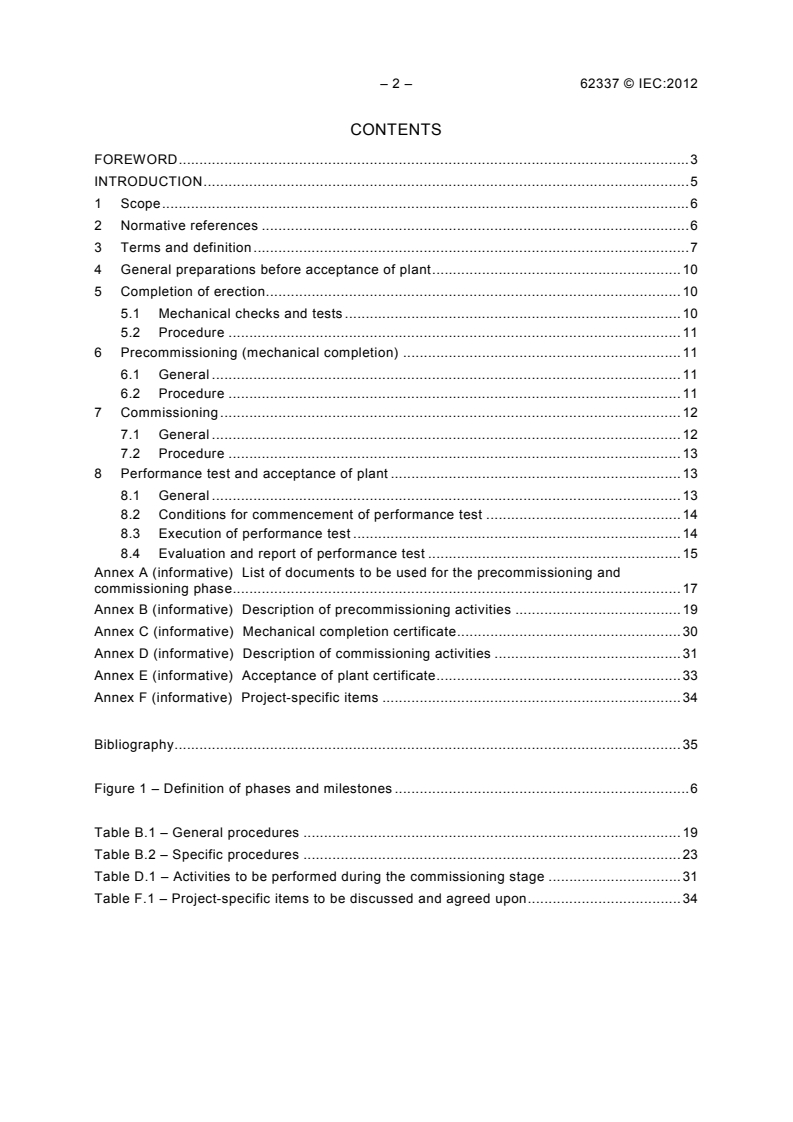
CONTENTS
FOREWORD . 3
INTRODUCTION . 5
1 Scope . 6
2 Normative references . 6
3 Terms and definition . 7
4 General preparations before acceptance of plant . 10
5 Completion of erection . 10
5.1 Mechanical checks and tests . 10
5.2 Procedure . 11
6 Precommissioning (mechanical completion) . 11
6.1 General . 11
6.2 Procedure . 11
7 Commissioning . 12
7.1 General . 12
7.2 Procedure . 13
8 Performance test and acceptance of plant . 13
8.1 General . 13
8.2 Conditions for commencement of performance test . 14
8.3 Execution of performance test . 14
8.4 Evaluation and report of performance test . 15
Annex A (informative) List of documents to be used for the precommissioning and
commissioning phase. 17
Annex B (informative) Description of precommissioning activities . 19
Annex C (informative) Mechanical completion certificate . 30
Annex D (informative) Description of commissioning activities . 31
Annex E (informative) Acceptance of plant certificate. 33
Annex F (informative) Project-specific items . 34
Bibliography . 35
Figure 1 – Definition of phases and milestones . 6
Table B.1 – General procedures . 19
Table B.2 – Specific procedures . 23
Table D.1 – Activities to be performed during the commissioning stage . 31
Table F.1 – Project-specific items to be discussed and agreed upon . 34
62337 © IEC:2012 – 3 –
INTERNATIONAL ELECTROTECHNICAL COMMISSION
____________
COMMISSIONING OF ELECTRICAL, INSTRUMENTATION
AND CONTROL SYSTEMS IN THE PROCESS INDUSTRY –
SPECIFIC PHASES AND MILESTONES
FOREWORD
1) The International Electrotechnical Commission (IEC) is a worldwide organization for standardization comprising
all national electrotechnical committees (IEC National Committees). The object of IEC is to promote
international co-operation on all questions concerning standardization in the electrical and electronic fields. To
this end and in addition to other activities, IEC publishes International Standards, Technical Specifications,
Technical Reports, Publicly Available Specifications (PAS) and Guides (hereafter referred to as “IEC
Publication(s)”). Their preparation is entrusted to technical committees; any IEC National Committee interested
in the subject dealt with may participate in this preparatory work. International, governmental and non-
governmental organizations liaising with the IEC also participate in this preparation. IEC collaborates closely
with the International Organization for Standardization (ISO) in accordance with conditions determined by
agreement between the two organizations.
2) The formal decisions or agreements of IEC on technical matters express, as nearly as possible, an international
consensus of opinion on the relevant subjects since each technical committee has representation from all
interested IEC National Committees.
3) IEC Publications have the form of recommendations for international use and are accepted by IEC National
Committees in that sense. While all reasonable efforts are made to ensure that the technical content of IEC
Publications is accurate, IEC cannot be held responsible for the way in which they are used or for any
misinterpretation by any end user.
4) In order to promote international uniformity, IEC National Committees undertake to apply IEC Publications
transparently to the maximum extent possible in their national and regional publications. Any divergence
between any IEC Publication and the corresponding national or regional publication shall be clearly indicated in
the latter.
5) IEC itself does not provide any attestation of conformity. Independent certification bodies provide conformity
assessment services and, in some areas, access to IEC marks of conformity. IEC is not responsible for any
services carried out by independent certification bodies.
6) All users should ensure that they have the latest edition of this publication.
7) No liability shall attach to IEC or its directors, employees, servants or agents including individual experts and
members of its technical committees and IEC National Committees for any personal injury, property damage or
other damage of any nature whatsoever, whether direct or indirect, or for costs (including legal fees) and
expenses arising out of the publication, use of, or reliance upon, this IEC Publication or any other IEC
Publications.
8) Attention is drawn to the Normative references cited in this publication. Use of the referenced publications is
indispensable for the correct application of this publication.
9) Attention is drawn to the possibility that some of the elements of this IEC Publication may be the subject of
patent rights. IEC shall not be held responsible for identifying any or all such patent rights.
International Standard IEC 62337 has been prepared by subcommittee 65E: Devices and
integration in enterprise systems of IEC technical committee 65: Industrial-process
measurement, control and automation.
This second edition cancels and replaces the first edition published in 2006. This edition
constitutes a technical revision.
The main changes with respect to the previous edition are listed below:
– The definition of the documents mentioned in this standard is in accordance with future
IEC 62708 .
___________
To be published.
– 4 – 62337 © IEC:2012
The text of this standard is based on the following documents:
FDIS Report on voting
65E/221/FDIS 65E/226/RVD
Full information on the voting for the approval of this standard can be found in the report on
voting indicated in the above table.
This publication has been drafted in accordance with the ISO/IEC Directives, Part 2.
The committee has decided that the contents of this publication will remain unchanged until
the stability date indicated on the IEC web site under "http://webstore.iec.ch" in the data
related to the specific publication. At this date, the publication will be
• reconfirmed,
• withdrawn,
• replaced by a revised edition, or
• amended.
The contents of the corrigendum of December 2012 have been included in this copy.
62337 © IEC:2012 – 5 –
INTRODUCTION
There is an increasing trend in the process industry to award the construction of whole plants
to contractors on a lump-sum turnkey or similar commercial basis. Experience has shown that
both the process industry (hereinafter called “the owner”) and the contractor have long and
expensive discussions to lay down unambiguously the scope of activities to be taken by the
contractor and the owner and their responsibilities to achieve the handover of the plant.
This standard is intended to lead to an improvement and acceleration of the negotiation phase
and to a mutual understanding about the scope of the activities of each party.
– 6 – 62337 © IEC:2012
COMMISSIONING OF ELECTRICAL, INSTRUMENTATION
AND CONTROL SYSTEMS IN THE PROCESS INDUSTRY –
SPECIFIC PHASES AND MILESTONES
1 Scope
This International Standard defines specific phases and milestones (see Figure 1) in the
commissioning of electrical, instrumentation and control systems in the process industry. By
way of example, it describes activities following the “completion-of-erection” milestone of the
project and prior to the “acceptance-of-the-plant” phase by the owner. Such activities need to
be adapted for each type of process/plant concerned.
NOTE This standard assumes that the “acceptance-of-the-plant” milestone will occur after the performance test. If
there is a reduced scope, this document should be adapted accordingly.
Acceptance
of plant
Construction Precommissioning Commissioning Production
PHASES
Cold Hot
Completion Mechanical St a rt- up Start of
MILESTONES
of erection completion production Performance
test
IEC 135/12
NOTE Construction and precommissioning activities could be overlapping.
Figure 1 – Definition of phases and milestones
For application in the pharmaceutical or other highly specialized industries, additional
guidelines (for example, Good Automated Manufacturing Practice (GAMP)), definitions and
stipulations should apply in accordance with existing standards, for example, for GMP
Compliance 21 CFR (FDA) and the Standard Operating Procedure of the European Medicines
Agency (SOP/INSP/2003).
2 Normative references
The following documents, in whole or in part, are normatively referenced in this document and
are indispensable for its application. For dated references, only the edition cited applies. For
undated references, the latest edition of the referenced document (including any
amendments) applies.
IEC 62079, Preparation of instruction – Structuring, content and presentation
IEC 62424, Representation of process control engineering – Requests in P&I diagrams and
data exchange between P&ID tools and PCE-CAE tools
ISO 10628-2, Diagrams for chemical and petrochemical industry – Part 2: Graphical symbols
ISA-S7.0.01, Quality standard for instrument air
62337 © IEC:2012 – 7 –
3 Terms and definition
For the purposes of this document, the following terms and definitions apply .
3.1
precommissioning
phase during which the activities of non-operating adjustments, cold alignment checks,
cleaning, and testing of machinery take place
NOTE Refer to Annex B for the detailed activities.
3.2
mechanical completion
milestone which is achieved when the plant, or any part thereof, has been erected and tested
in accordance with drawings, specifications, instructions, and applicable codes and
regulations to the extent necessary to permit cold commissioning
NOTE This includes completion of all necessary electrical and instrumentation work. This is a milestone marking
the end of the precommissioning activities.
3.3
cold commissioning
phase during which the activities associated with the testing and operation of equipment or
facilities using test media such as water or inert substances, prior to introducing any chemical
in the system, take place
3.4
start-up
milestone marking the end of cold commissioning
NOTE At this stage, the operating range of every instrument loop should already be adjusted to reflect the actual
working condition.
3.5
hot commissioning
phase during which the activities associated with the testing and operation of equipment or
facilities using the actual process chemical, prior to making an actual production run, take
place
3.6
start of production
milestone marking the end of hot commissioning
NOTE At this stage, the plant is ready for full and continuous operation.
3.7
performance test
milestone at which time the production plant runs to its design capacity
NOTE This test, carried out by the owner’s personnel with the help and supervision of the contractor, serves to
demonstrate the contractor’s process performance and consumption guarantees as specified in the contract.
3.8
acceptance of plant
milestone in which the formal turnover of the plant from the contractor to the owner is carried
out
___________
Future standard IEC 62708 will provide additional information on the terms used in this document.
– 8 – 62337 © IEC:2012
NOTE At this stage, the contractor is relieved from any obligation, with the exception of defect liability and any
other outstanding obligations which are part of the contract. The owner resumes full responsibility for running and
maintaining the plant.
3.9
owner
company that hired a contractor to build a plant
3.10
contractor
company which is hired by the owner to design and build a plant
NOTE This company is responsible for all activities as described in a separate contract including, for example,
the engineering design, procurement, erection of the plant as well as the implementation of all tests and
acceptances that are necessary to deliver a serviceable plant. This company may also be responsible for training
the owner’s production as well as maintenance personnel on plant operation.
3.11
licenser
company or individual that has a process know-how which willingly provides the owner with
the technology to be used in the construction, operation and maintenance of a plant, or part of
the process in such a plant
3.12
vendor
manufacturer or distributor of a piece of equipment/instrument/package unit
NOTE The vendor is the expert for proper installation as well as operation of the equipment/ instrument/ package
unit.
3.13
process industry
industry that uses chemical reactions, separations, or mixing techniques in order to create
new products, modify existing products or treat waste and includes the following types of
industries: chemical, petrochemical, waste treatment, paper, cement, etc. It does not include
such industries as equipment/machine manufacturing or other similar industries. Industries
which are subject to special requirements and or validation, etc. are also not included.
3.14
manpower mobilization plan
bar chart schedule with associated resources and qualifications
3.15
vendor documentation
product describing documents
Example Datasheets, handbooks, operating manuals and spare part lists of supplied devices or systems are parts
of a vendor documentation.
3.16
piping and instrumentation diagram
P&ID
diagram according to DIN EN ISO 10628 including plant process equipment and connecting
piping. E&I equipment shown according project specific requirements
3.17
general design requirements
design guideline adapted from project specific requirements as well as from relevant legal
requirements and regulations
62337 © IEC:2012 – 9 –
3.18
test report
documentation of test sequence and result
3.19
test plan
overview of tests as provided in the contract
3.20
punch list
list of all open tasks
3.21
check list
list of all tests
3.22
operating manual
manufacturer’s instruction for the intended handling and using of a device or system
according to IEC 62079
3.23
process flow diagram
diagram according to DIN EN ISO 10628 including plant process equipment and important
connecting piping. Important E&I equipment shown according project specific requirements
3.24
loop list
tabulated list of all E&I tags with tagging, function and PID reference
3.25
instrument index
tabulated list of all instruments per tag including tagging, instrument type and labelling
3.26
loop diagram
representation of hardware and/or software functions of a control loop with graphical symbols
e.g. according to IEC 62424. It shows equipment in its topological order and wiring including
the terminals
3.27
loop sheet
data sheet with all essential E&I data concerning tagging, function, description, measuring
range, location, process data, instrument data, etc.
3.28
hazardous area classification drawing
plan showing the hazardous areas and temperature classes. The area classification shall be
clearly indicated by class and division
3.29
plot plan E&I
presentation of the locations of E&I equipment in layout and building drawings
3.30
cabinet layout drawing
drawing to scale of equipment, terminal strips, cable trays etc. in cabinets, consoles and
similar
– 10 – 62337 © IEC:2012
3.31
function diagram or logic diagram
description of the E&I functions according to IEC 61131 Use of such a diagram is limited to
digital signal processing only
3.32
functional description
verbal description of task, function and operation of E&I logic like sequence-, batch control
and interlocks
4 General preparations before acceptance of plant
The following items shall be completed in accordance with the responsibilities as defined
within the contract.
a) Documents
The documents agreed upon according to A.1 shall be issued by the contractor to the
owner.
b) Manpower mobilization plan
The agreed amount of manpower required both from the owner and from the contractor,
including their qualification and their availability, shall be available. The organization of
personnel during precommissioning, commissioning and performance testing shall be
established.
c) Equipment and tools
The agreed required tools and equipment to be supplied by the owner or the contractor
shall be available.
d) Raw materials and utilities
For the agreed supply of raw materials and utilities, the contractor and the owner shall
agree upon a detailed time schedule and the conditions for supply within a reasonable
time before the completion of erection.
e) Catalysts and consumables
For the agreed supply of required catalysts, lubricants, chemicals and other consumables,
the contractor and the owner shall agree upon a detailed time schedule and conditions
within a reasonable time before the completion of erection.
5 Completion of erection
5.1 Mechanical checks and tests
After erection of the plant, of each piece of equipment, facility or discrete part of the plant,
mechanical checks and tests shall be carried out by the contractor.
The mechanical checks and tests shall verify that:
a) the plant is erected in accordance with the piping and instrument diagram (P&I), plot plan
and the vendor’s documentation;
b) the equipment is installed and mechanically functions in accordance with the general
design requirements;
c) applicable codes, as listed in the general design requirements, are followed for materials
and workmanship.
Items such as painting, thermal insulation and final clean-up which would not affect the
operation or safety of the plant could be excluded. All these items shall be listed and
62337 © IEC:2012 – 11 –
completed after precommissioning or commissioning within a mutually agreed schedule
between the contractor and the owner but before the acceptance of the plant.
5.2 Procedure
The following shall apply:
a) The contractor shall prepare and maintain on-site test reports and records which shall
include the following information:
– description of the type of test or check;
– date and time of test or check;
– identification of equipment and facilities;
– test pressure if applicable, test data and results, including remarks, if any;
– signature of the owner’s personnel witnessing the data recorded, if required.
b) Check, test and records thereof shall be carried out by the contractor’s personnel.
Wherever the owner’s witness or attesting for the check or test is required, the owner’s
personnel shall attend such check and test. For this purpose, the contractor shall keep the
owner informed of the day-to-day test-plan schedule. The test-plan schedule should be
constantly revised to reflect the actual progress of the work and test.
c) Any items found incomplete or requiring repair or adjustment shall be marked as such on a
separate punch list and reported by the contractor to the owner’s and the contractor’s
personnel in charge of the relevant construction area. The check list for items in the punch
list will be left blank until the problem has been corrected.
d) The contractor shall expedite and follow up the termination of all incomplete, repaired or
adjusted work items in the punch list and shall keep these expediting records up to date.
e) Checking procedures shall be repeated until all the items on the check list are cleared.
f) At the completion of each test, the owner shall certify on the test reports that the test has
been satisfactory; otherwise, the contractor shall repeat the tests. Upon satisfactory
completion of the re-test, re-certification by the owner shall be made accordingly.
g) A complete set of test reports shall be handed over to the owner on completion and, at
this date, the completion of the erection shall be considered as achieved.
6 Precommissioning (mechanical completion)
6.1 General
After completion of the erection, the precommissioning activities listed in the procedure
defined in Annex B and the final steps listed in 6.2 shall be carried out in accordance with the
contract to make the plant mechanically complete and ready for commissioning.
The documents to be utilized are listed in Annex A.
6.2 Procedure
a) The contractor’s personnel responsible for the checks, tests and recording of results on
the completion of erection shall be responsible for the completion of any remaining work,
adjustments and repairs of the equipment marked on the check list during
precommissioning and for the maintenance of appropriate records.
b) The contractor’s personnel appointed for commissioning should also participate in the
precommissioning work to verify the satisfactory performance of the plant.
c) During the checks and tests, the contractor’s personnel is responsible for training the
owner’s personnel on the operation of the plant, as defined within the contract.
– 12 – 62337 © IEC:2012
d) The owner or the contractor shall furnish operating and maintenance personnel, according
to the manpower mobilization plan, to perform those parts of the precommissioning work,
which are agreed to be the owner’s responsibility in accordance with Annex B.
e) The contractor shall ensure that his personnel work in close conjunction with the owner’s
personnel by providing supervision and advice where necessary.
f) The contractor shall prepare detailed procedures for each precommissioning activity listed
in Annex B. Procedures shall be updated or added by the contractor as necessary to
support any additional work.
g) Mechanical completion shall be confirmed on each part/section/unit/facility of the plant
individually.
h) A detailed schedule for the precommissioning of each part/section/unit/facility shall be
submitted by the contractor to the owner before completion of the erection.
i) Upon completion of the precommissioning activities of each part/section/unit/facility of the
plant, the contractor shall submit to the owner a written notice of mechanical completion,
which shall include:
– identity of a part/section/unit/facility of the plant considered mechanically complete;
– a copy of all relevant completed test reports;
– the date on which the completion of the tests was achieved;
– a check list;
– a request for acceptance of a mechanical completion certificate in respect of that
part/section/unit/facility.
j) Within an agreed period from the date of receipt of the contractor’s written notice, the
owner shall:
– in the case of acceptance:
sign the issued mechanical completion certificate similar to the form given in Annex C;
or
– in the case of objection:
submit a rejection statement listing the remaining items to be completed or defects or
deficiencies to be corrected before the mechanical completion status can be accepted.
k) When the owner rejects the contractor’s notice, the contractor shall take any necessary
action to complete or correct the items marked and give the owner a subsequent notice of
mechanical completion.
l) The owner shall sign either a completion certificate or shall issue a rejection statement
within an agreed period after the date of any subsequent notice of mechanical completion.
m) Upon acceptance of the mechanical completion certificate of the last part/section/
unit/facility of the plant by the owner, the owner shall, within an agreed period, accept the
relevant issued mechanical completion certificate for the plant similar to the form given in
Annex C.
7 Commissioning
7.1 General
After the owner has issued a mechanical completion certificate for a part/section/unit/facility
of the plant, the commissioning activities listed in 7.2 shall be carried out as far as possible to
enable the start-up and/or start of production.
The documents to be used are listed in Annex A.
62337 © IEC:2012 – 13 –
7.2 Procedure
a) Commissioning shall be carried out in the following sequence:
– warming up or cooling down;
– initial running using test media such as water or other inert substances;
– operability adjustment;
– feeding in;
– stable operation;
– loading up to the design capacity;
– final adjustment.
b) At all stages of the commissioning sequence, the plant shall be operated at optimum and
in safe plant conditions. To ensure this, the contractor may make adjustments to the
condition indicated in the operating manual and process flow diagrams as necessary.
c) The contractor shall specify for each discrete part of the plant the operational data to be
recorded and the manner in which the data is to be taken.
d) All the operating data shall be recorded by the owner on the predefined forms to be
mutually agreed upon. A copy of the operating log and analytical data from the initial
operation through to the completion of the performance test shall be made available by the
owner to the contractor for evaluation.
e) When any part of the plant is pressurized or placed in hot alignment, regular checking on
thermal expansion, vibration, noise and the like shall be performed by the contractor.
f) The detailed methods and procedures for each of the commissioning tests and operations
shall be specified by the contractor in the operating manual or issued to the owner as
additional work procedures.
g) The contractor shall arrange for the presence of the vendor's and the licenser’s rep-
resentatives at the site to assist the contractor’s personnel, wherever necessary.
h) The contractor’s construction personnel appointed for precommissioning should remain on
site to carry out any necessary adjustment and remedial work.
i) All changes and modifications applied during commissioning shall be documented.
8 Performance test and acceptance of plant
8.1 General
After the initial operation of the plant, a performance test shall be carried out to demonstrate
the contractor’s process performance and consumption guarantees specified in the contract.
a) Detailed test procedure
The contractor shall propose detailed performance test procedures within an agreed
period of time and the contractor and the owner shall agree upon the test procedures prior
to starting the performance test based on the test procedure specified in the contract.
b) Type of operation
Unless otherwise specified in the contract, the performance test will be limited to one type
of operation, raw material and one operation mode.
c) Measurement
The instrument, apparatus and method of measuring of the quantity and quality of
individual media, consumption, etc. should be specified and used to measure such
streams in relation to the process performance and consumption guarantees based on the
measurement specifications described in the contract.
The measurement tolerances, loss corrections, performance for sampling methods and
analytical procedures shall be specified on a project-related basis.
– 14 – 62337 © IEC:2012
d) Performance test schedule
The performance test schedule shall be determined with due regard to the actual progress
of the work and the condition of the plant.
8.2 Conditions for commencement of performance test
The performance test will be commenced when the following conditions are satisfied from the
viewpoint of the process design requirements.
a) Plant operation
The plant shall be operated at the normal operating conditions shown on the applicable
flow diagrams and in the operating manual.
Minor variations from the conditions indicated on the flow diagrams and in the operating
manual to obtain optimum process performance shall be agreed upon by the owner.
b) Instruments
Verify that all plant instruments and analytical apparatus perform as expected.
c) Supply of raw materials and utilities by the owner or the contractor
The plant is supplied with adequate and uninterrupted supplies of raw materials and
utilities by the owner as required at the battery limit conditions to permit a successful
performance test to be completed.
d) Supply of catalysts, lubricants and chemicals by the contractor or the owner
The plant is supplied with adequate and timely supplies of catalysts, lubricants, chemicals
and other consumables to permit a successful performance test to be completed.
e) Transfer of products and waste
The owner shall be responsible for the safe transfer of the plant products and waste from
the battery limit of the plant.
h) Other conditions
Any other conditions necessary for the commencement of the performance test as agreed
between the owner and the contractor shall be satisfied.
8.3 Execution of performance test
a) Notice of readiness to carry out performance test
When the contractor considers that the plant is ready for the performance test and that all
of the conditions stated in 8.2 have been fulfilled, he shall then give the owner a notice of
readiness to carry out the performance test.
Within a predefined period of the receipt of such notice, the owner shall
– acknowledge that the plant is ready for the performance test to be conducted;
or
– submit to the contractor a written statement setting forth in which respects the plant is
not ready for such a test.
If the owner considers that the plant is not ready, then he shall specify in writing the
conditions preventing the start of the performance test. The party responsible for such
conditions shall rectify the problem.
The performance test shall be commenced as soon as the above conditions are corrected.
b) Performance test run
The performance test shall extend continuously over a period specified in the contract.
62337 © IEC:2012 – 15 –
c) Two or more units
Where the plant includes two or more individual process units for which separate process
performance and consumption guarantees are to be demonstrated, a performance test or
tests may be carried out individually on each of the units or simultaneously with any other
unit or units.
d) Operating data
Operating and analytical data recorded during the performance test shall be documented
by the owner and made available to the contractor for evaluation as stated in 8.4.
e) Sampling and analysis
During the performance test, samples necessary for the evaluation of the performance of
the plant shall be taken as often as the contractor and the owner mutually agree or have
agreed.
The samples shall include all streams which may be necessary to check the data from
which the degree of compliance with the process performance and consumption
guarantees can be determined.
The locations and methods of sampling the streams shall be in accordance with those
agreed between the parties under 8.1.
f) Testing
Testing of all samples shall be carried out by the owner’s laboratory. The contractor’s and
the owner’s personnel may have access to the laboratory when the samples are tested
and may check the results. However, by agreement, the contractor may also carry out
testing of samples.
8.4 Evaluation and report of performance test
a) Evaluation of performance test data
Evaluations of performance test data including operating and laboratory data accumulated
during, or as a part of, the performance test shall be carried out by the contractor within a
predefined period after the completion of the performance test.
b) Abnormal test data
Any abnormal test data, which is not compatible with other significant data, shall be taken
again from the plant operating conditions.
c) Tolerances
The performance of the plant shall be evaluated on the basis of the average performance
over the entire period of the performance test and after adjustment with due regard to
tolerances in instrument readings according to the agreed performance test procedures.
d) Report of test results
The contractor shall submit to the owner a report on the performance test in writing,
indicating whether the process performance and consumption guarantees have been met.
The report shall include:
– test results;
– analysis;
– the contractor’s evaluation;
– reference information supporting the evaluation (the necessary signatures, where
required).
e) Reasons for failure
If the performance test results show that a test was unsuccessful, the contractor shall
state probable reasons for such failure.
– 16 – 62337 © IEC:2012
f) Owner’s response to the report
Within a predefined time period after receipt of the performance test report, the owner
shall signify in writing agreement or comments.
g) Contractor’s action in the case of performance test failure
If the evaluation of performance test results shows that the failure of the performance test
is the contractor’s fault, then the contractor shall act in accordance with the contract
conditions.
62337 © IEC:2012 – 17 –
Annex A
(informative)
List of documents to be used for
the precommissioning and commissioning phase
A.1 Technical documents
a) Operating manual/analytical manual
b) Design document including, but not limited to, the following information:
– piping and instrumentation diagram (P&ID);
– equipment index;
– equipment specification;
– vendor documentation;
– loop list;
– instrument index;
– loop diagram;
– loop sheet;
– technical drawings (hazards area classification drawing, plot plan E&I, cabinet lay out
drawing), etc.);
– functional description;
– function diagram or logic diagram;
– operating manuals for equipment;
– fulfilment of the relevant regulations;
– fulfilment of additional regulations demanded by authorities of the government.
c) Others
– special tools and equipment list;
– spare-parts list;
– lubricants/chemicals/catalyst list.
A.2 Procedures
a) Mechanical testing procedure;
b) Detailed precommissioning and commissioning procedure and operating manual;
c) Detailed performance test procedure.
A.3 General and coordination documents
a) Detailed organization charts for precommissioning and commissioning showing:
1) lines of authorities and responsibilities;
2) functions of all key personnel.
b) The job description of the members of this team;
c) The scheduled dates of assignment of each member to precommissioning and
commissioning organizations;
d) A detailed schedule showing the time sequence which the contractor anticipates to follow
for the various steps in completion of erection, precommissioning and commissioning of
each unit and equipment;
– 18 – 62337 © IEC:2012
e) The owner’s regulations for health, environment and safety;
f) The practical organization of the relationship (meetings, reports, etc.) between the
contractor and the owner at the phases of precommissioning and commissioning;
g) Owner’s emergency communication route.
62337 © IEC:2012 – 19 –
Annex B
(informative)
Description of precommissioning activities
This check list defines the activities and responsibilities of the contractor and the owner and
the achievement of the mechanical completion. The allocation of responsibility, i.e. whether
the cross is in the left or the right column is a recommendation which is based on practical
experience, but no enforcement in a given situation is required. The work responsibility should
be defined in accordance with actual project requirements. Some of the activities below might
not occur during erection but are nevertheless included in this list for the sake of
completeness.
Table B.1 lists the general procedure and also outlines the work to be performed by the
contractor and by the owner.
Table B.2 lists the procedure applicable to specific systems or equipment including outline of
the work to be performed by t
...