

IEC 61000-4-7:2002+AMD1:2008 CSV
(Main)Electromagnetic compatibility (EMC) - Part 4-7: Testing and measurement techniques - General guide on harmonics and interharmonics measurements and instrumentation, for power supply systems and equipment connected thereto
General Information
- Abstract
IEC 61000-4-7:2002+A1:2008 applies to instrumentation intended for measuring spectral components in the frequency range up to 9 kHz which are superimposed on the fundamental of the power supply systems at 50 Hz and 60 Hz. For practical considerations, this standard distinguishes between harmonics, interharmonics and other components above the harmonic frequency range, up to 9 kHz. Defines the measurement instrumentation intended for testing individual items of equipment in accordance with emission limits given in certain standards (for example, harmonic current limits as given in IEC 61000-3-2) as well as for the measurement of harmonic currents and voltages in actual supply systems. The contents of the corrigendum of July 2004 have been included in this copy. This consolidated version consists of the second edition (2002) and its amendment 1 (2008). Therefore, no need to order amendment in addition to this publication.
- Status
- Published
- Publication Date
- 27-Oct-2009
- Technical Committee
- SC 77A - EMC - Low frequency phenomena
- Current Stage
- PPUB - Publication issued
- Start Date
- 28-Oct-2009
- Completion Date
- 28-Oct-2009
Buy Documents

IEC 61000-4-7:2002+AMD1:2008 CSV - Electromagnetic compatibility (EMC) - Part 4-7: Testing and measurement techniques - General guide on harmonics and interharmonics measurements and instrumentation, for power supply systems and equipment connected thereto
Overview
IEC 61000-4-7:2002+A1:2008 is an international standard published by the International Electrotechnical Commission (IEC) that addresses instrumentation and testing methods for the measurement of harmonics and interharmonics in power supply systems. Designed to ensure electromagnetic compatibility (EMC), this standard is crucial for power supply networks and electrical equipment operating at 50 Hz and 60 Hz. It applies to equipment specifically intended for the measurement of spectral components up to 9 kHz superimposed on the main system frequency.
The standard also defines the measurement instruments required to evaluate compliance with emission limits as established in related standards (such as IEC 61000-3-2 and IEC 61000-3-12), as well as for harmonic analysis in operational power networks. The consolidated version includes all amendments and corrigenda, ensuring alignment with the latest IEC requirements.
Key Topics
- Measurement Scope:
- Harmonics, interharmonics, and spectral components up to 9 kHz
- Focus on power systems operating at 50 Hz and 60 Hz
- Instrumentation Requirements:
- Specifications for instruments based on techniques such as the Discrete Fourier Transform (DFT)
- Accuracy classes (I and II) to cover various application needs
- Harmonics and Interharmonics:
- Definitions and calculations for harmonic frequency, harmonic order, and r.m.s. values
- Grouping, smoothing, and reporting of harmonic and interharmonic values
- Testing and Measurement Methods:
- Recommendations for steady-state and fluctuating signals
- Averaging techniques and appropriate measurement cycles
- Compatibility and Emission Limits:
- Reference to emission limit standards for currents and voltages
- Guidance for compliance assessment of individual equipment and supply systems
Applications
IEC 61000-4-7 plays a vital role in industries that rely on accurate EMC testing and power quality management:
- Manufacturers of Electrical and Electronic Equipment:
- Instrumentation designed in accordance with this standard ensures that products comply with harmonic emission requirements.
- Testing Laboratories and Certification Bodies:
- Used as a core standard for EMC compliance assessments and measurements of harmonic currents and voltages.
- Utility Providers and Industrial Facilities:
- Helps in ongoing monitoring, diagnosis, and mitigation of power quality disturbances.
- Research and Development:
- Serves as a reference for developing new EMC measurement technologies and improving existing processes.
By standardizing the approach to harmonics and interharmonics measurements, IEC 61000-4-7 facilitates global compliance, supports consistent reporting, and contributes to the reduction of electromagnetic disturbances in power systems.
Related Standards
IEC 61000-4-7 is part of the IEC 61000 series dealing with EMC. Key related standards include:
- IEC 61000-3-2: Limits for harmonic current emissions (equipment input current ≤16 A per phase)
- IEC 61000-3-12: Limits for harmonic currents produced by equipment connected to public low-voltage systems with input current >16 A and ≤75 A per phase
- IEC 61000-2-2: Compatibility levels for low-frequency conducted disturbances and signaling in public low-voltage power supply systems
- IEC 60050-161: International Electrotechnical Vocabulary – Electromagnetic compatibility
For organizations involved in EMC testing, power quality, and harmonics measurements, IEC 61000-4-7 provides an essential framework for ensuring robust, reliable, and standardized approaches across global markets.
Buy Documents
IEC 61000-4-7:2002+AMD1:2008 CSV - Electromagnetic compatibility (EMC) - Part 4-7: Testing and measurement techniques - General guide on harmonics and interharmonics measurements and instrumentation, for power supply systems and equipment connected thereto
Get Certified
Connect with accredited certification bodies for this standard

ANCE
Mexican certification and testing association.

Intertek Slovenia
Intertek testing, inspection, and certification services in Slovenia.

LNE (Laboratoire National de Métrologie et d'Essais)
French national laboratory for metrology and testing.
Sponsored listings
Frequently Asked Questions
IEC 61000-4-7:2002+AMD1:2008 CSV is a standard published by the International Electrotechnical Commission (IEC). Its full title is "Electromagnetic compatibility (EMC) - Part 4-7: Testing and measurement techniques - General guide on harmonics and interharmonics measurements and instrumentation, for power supply systems and equipment connected thereto". This standard covers: IEC 61000-4-7:2002+A1:2008 applies to instrumentation intended for measuring spectral components in the frequency range up to 9 kHz which are superimposed on the fundamental of the power supply systems at 50 Hz and 60 Hz. For practical considerations, this standard distinguishes between harmonics, interharmonics and other components above the harmonic frequency range, up to 9 kHz. Defines the measurement instrumentation intended for testing individual items of equipment in accordance with emission limits given in certain standards (for example, harmonic current limits as given in IEC 61000-3-2) as well as for the measurement of harmonic currents and voltages in actual supply systems. The contents of the corrigendum of July 2004 have been included in this copy. This consolidated version consists of the second edition (2002) and its amendment 1 (2008). Therefore, no need to order amendment in addition to this publication.
IEC 61000-4-7:2002+A1:2008 applies to instrumentation intended for measuring spectral components in the frequency range up to 9 kHz which are superimposed on the fundamental of the power supply systems at 50 Hz and 60 Hz. For practical considerations, this standard distinguishes between harmonics, interharmonics and other components above the harmonic frequency range, up to 9 kHz. Defines the measurement instrumentation intended for testing individual items of equipment in accordance with emission limits given in certain standards (for example, harmonic current limits as given in IEC 61000-3-2) as well as for the measurement of harmonic currents and voltages in actual supply systems. The contents of the corrigendum of July 2004 have been included in this copy. This consolidated version consists of the second edition (2002) and its amendment 1 (2008). Therefore, no need to order amendment in addition to this publication.
IEC 61000-4-7:2002+AMD1:2008 CSV is classified under the following ICS (International Classification for Standards) categories: 01 - GENERALITIES. TERMINOLOGY. STANDARDIZATION. DOCUMENTATION; 33.100.10 - Emission; 33.100.20 - Immunity. The ICS classification helps identify the subject area and facilitates finding related standards.
IEC 61000-4-7:2002+AMD1:2008 CSV is available in PDF format for immediate download after purchase. The document can be added to your cart and obtained through the secure checkout process. Digital delivery ensures instant access to the complete standard document.
Standards Content (Sample)
IEC 61000-4-7 ®
Edition 2.1 2009-10
INTERNATIONAL
STANDARD
NORME
INTERNATIONALE
colour
inside
BASIC EMC PUBLICATION
PUBLICATION FONDAMENTALE EN CEM
Electromagnetic compatibility (EMC) –
Part 4-7: Testing and measurement techniques – General guide on harmonics
and interharmonics measurements and instrumentation, for power supply
systems and equipment connected thereto
Compatibilité électromagnétique (CEM) –
Partie 4-7: Techniques d'essai et de mesure – Guide général relatif aux mesures
d'harmoniques et d'interharmoniques, ainsi qu'à l'appareillage de mesure,
applicable aux réseaux d'alimentation et aux appareils qui y sont raccordés
IEC 61000-4-7:2002+A1:2008
All rights reserved. Unless otherwise specified, no part of this publication may be reproduced or utilized in any form or by
any means, electronic or mechanical, including photocopying and microfilm, without permission in writing from either IEC or
IEC's member National Committee in the country of the requester.
If you have any questions about IEC copyright or have an enquiry about obtaining additional rights to this publication,
please contact the address below or your local IEC member National Committee for further information.
Droits de reproduction réservés. Sauf indication contraire, aucune partie de cette publication ne peut être reproduite
ni utilisée sous quelque forme que ce soit et par aucun procédé, électronique ou mécanique, y compris la photocopie
et les microfilms, sans l'accord écrit de la CEI ou du Comité national de la CEI du pays du demandeur.
Si vous avez des questions sur le copyright de la CEI ou si vous désirez obtenir des droits supplémentaires sur cette
publication, utilisez les coordonnées ci-après ou contactez le Comité national de la CEI de votre pays de résidence.
IEC Central Office
3, rue de Varembé
CH-1211 Geneva 20
Switzerland
Email: inmail@iec.ch
Web: www.iec.ch
About the IEC
The International Electrotechnical Commission (IEC) is the leading global organization that prepares and publishes
International Standards for all electrical, electronic and related technologies.
About IEC publications
The technical content of IEC publications is kept under constant review by the IEC. Please make sure that you have the
latest edition, a corrigenda or an amendment might have been published.
ƒ Catalogue of IEC publications: www.iec.ch/searchpub
The IEC on-line Catalogue enables you to search by a variety of criteria (reference number, text, technical committee,…).
It also gives information on projects, withdrawn and replaced publications.
ƒ IEC Just Published: www.iec.ch/online_news/justpub
Stay up to date on all new IEC publications. Just Published details twice a month all new publications released. Available
on-line and also by email.
ƒ Electropedia: www.electropedia.org
The world's leading online dictionary of electronic and electrical terms containing more than 20 000 terms and definitions
in English and French, with equivalent terms in additional languages. Also known as the International Electrotechnical
Vocabulary online.
ƒ Customer Service Centre: www.iec.ch/webstore/custserv
If you wish to give us your feedback on this publication or need further assistance, please visit the Customer Service
Centre FAQ or contact us:
Email: csc@iec.ch
Tel.: +41 22 919 02 11
Fax: +41 22 919 03 00
A propos de la CEI
La Commission Electrotechnique Internationale (CEI) est la première organisation mondiale qui élabore et publie des
normes internationales pour tout ce qui a trait à l'électricité, à l'électronique et aux technologies apparentées.
A propos des publications CEI
Le contenu technique des publications de la CEI est constamment revu. Veuillez vous assurer que vous possédez
l’édition la plus récente, un corrigendum ou amendement peut avoir été publié.
ƒ Catalogue des publications de la CEI: www.iec.ch/searchpub/cur_fut-f.htm
Le Catalogue en-ligne de la CEI vous permet d’effectuer des recherches en utilisant différents critères (numéro de référence,
texte, comité d’études,…). Il donne aussi des informations sur les projets et les publications retirées ou remplacées.
ƒ Just Published CEI: www.iec.ch/online_news/justpub
Restez informé sur les nouvelles publications de la CEI. Just Published détaille deux fois par mois les nouvelles
publications parues. Disponible en-ligne et aussi par email.
ƒ Electropedia: www.electropedia.org
Le premier dictionnaire en ligne au monde de termes électroniques et électriques. Il contient plus de 20 000 termes et
définitions en anglais et en français, ainsi que les termes équivalents dans les langues additionnelles. Egalement appelé
Vocabulaire Electrotechnique International en ligne.
ƒ Service Clients: www.iec.ch/webstore/custserv/custserv_entry-f.htm
Si vous désirez nous donner des commentaires sur cette publication ou si vous avez des questions, visitez le FAQ du
Service clients ou contactez-nous:
Email: csc@iec.ch
Tél.: +41 22 919 02 11
Fax: +41 22 919 03 00
IEC 61000-4-7 ®
Edition 2.1 2009-10
INTERNATIONAL
STANDARD
NORME
INTERNATIONALE
colour
inside
BASIC EMC PUBLICATION
PUBLICATION FONDAMENTALE EN CEM
Electromagnetic compatibility (EMC) –
Part 4-7: Testing and measurement techniques – General guide on harmonics
and interharmonics measurements and instrumentation, for power supply
systems and equipment connected thereto
Compatibilité électromagnétique (CEM) –
Partie 4-7: Techniques d'essai et de mesure – Guide général relatif aux mesures
d'harmoniques et d'interharmoniques, ainsi qu'à l'appareillage de mesure,
applicable aux réseaux d'alimentation et aux appareils qui y sont raccordés
INTERNATIONAL
ELECTROTECHNICAL
COMMISSION
COMMISSION
ELECTROTECHNIQUE
PRICE CODE
INTERNATIONALE
CR
CODE PRIX
ICS 33.100.10; 33.100.20 ISBN 978-2-88910-377-5
– 2 – 61000-4-7 © IEC:2002+A1:2008
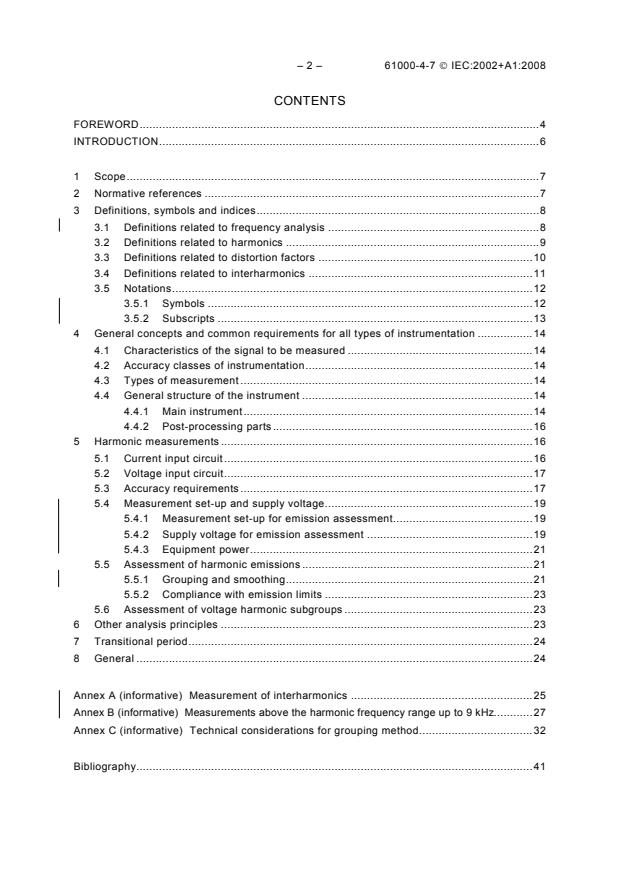
CONTENTS
FOREWORD.4
INTRODUCTION.6
1 Scope.7
2 Normative references .7
3 Definitions, symbols and indices.8
3.1 Definitions related to frequency analysis .8
3.2 Definitions related to harmonics .9
3.3 Definitions related to distortion factors .10
3.4 Definitions related to interharmonics .11
3.5 Notations.12
3.5.1 Symbols .12
3.5.2 Subscripts .13
4 General concepts and common requirements for all types of instrumentation .14
4.1 Characteristics of the signal to be measured .14
4.2 Accuracy classes of instrumentation.14
4.3 Types of measurement .14
4.4 General structure of the instrument .14
4.4.1 Main instrument.14
4.4.2 Post-processing parts.16
5 Harmonic measurements .16
5.1 Current input circuit.16
5.2 Voltage input circuit.17
5.3 Accuracy requirements.17
5.4 Measurement set-up and supply voltage.19
5.4.1 Measurement set-up for emission assessment.19
5.4.2 Supply voltage for emission assessment .19
5.4.3 Equipment power.21
5.5 Assessment of harmonic emissions .21
5.5.1 Grouping and smoothing.21
5.5.2 Compliance with emission limits .23
5.6 Assessment of voltage harmonic subgroups .23
6 Other analysis principles .23
7 Transitional period.24
8 General .24
Annex A (informative) Measurement of interharmonics .25
Annex B (informative) Measurements above the harmonic frequency range up to 9 kHz.27
Annex C (informative) Technical considerations for grouping method.32
Bibliography.41
61000-4-7 © IEC:2002+A1:2008 – 3 –
Figure 1 – General structure of the measuring instrument .15
Figure 2 – Measurement set-up for single-phase emission measurement.19
Figure 3 – Measurement set-up for three-phase emission measurements .19
Figure 4 – Illustration of harmonic and interharmonic groups
(here shown for a 50-Hz supply) .21
–1
Figure 5 – Realization of a digital low-pass filter: z designates a window width delay,
α and β are the filter coefficients (see Table 2 for values) .22
Figure 6 – Illustration of a harmonic subgroup and an interharmonic centred subgroup
(here shown for a 50 Hz supply) .23
Figure B.1 – Illustration of frequency bands for measurement in the range
th
harmonic order for 50 Hz power system up to 9 kHz .28
above the 40
Figure B.2 – General measurement setup .29
Figure B.3 – Artificial mains network for 16-A current and below.30
Figure B.4 – Artificial mains network impedance viewed by the EUT .31
Figure C.1 – Large 5th harmonic current fluctuation.35
Figure C.2 – Large 5th harmonic voltage fluctuation .35
Figure C.3 – Fluctuating 3rd harmonic current of a micro-wave appliance .36
Figure C.4 – Communication signal of 178 Hz together with 3rd and 5th harmonics .37
Figure C.5 – Interharmonic at 287 Hz, 5th and 6th harmonic.37
Figure C.6 – Modulated 5th harmonic and interharmonic at 287 Hz.39
Figure C.7 – Component vectors at frequencies of 245 Hz and 255Hz .40
Table 1 – Accuracy requirements for current, voltage and power measurements.18
Table 2 – Smoothing filter coefficients according to the window width.22
– 4 – 61000-4-7 © IEC:2002+A1:2008
INTERNATIONAL ELECTROTECHNICAL COMMISSION
____________
ELECTROMAGNETIC COMPATIBILITY (EMC) –
Part 4-7: Testing and measurement techniques –
General guide on harmonics and interharmonics measurements and
instrumentation, for power supply systems and
equipment connected thereto
FOREWORD
1) The International Electrotechnical Commission (IEC) is a worldwide organization for standardization comprising
all national electrotechnical committees (IEC National Committees). The object of IEC is to promote
international co-operation on all questions concerning standardization in the electrical and electronic fields. To
this end and in addition to other activities, IEC publishes International Standards, Technical Specifications,
Technical Reports, Publicly Available Specifications (PAS) and Guides (hereafter referred to as “IEC
Publication(s)”). Their preparation is entrusted to technical committees; any IEC National Committee interested
in the subject dealt with may participate in this preparatory work. International, governmental and non-
governmental organizations liaising with the IEC also participate in this preparation. IEC collaborates closely
with the International Organization for Standardization (ISO) in accordance with conditions determined by
agreement between the two organizations.
2) The formal decisions or agreements of IEC on technical matters express, as nearly as possible, an international
consensus of opinion on the relevant subjects since each technical committee has representation from all
interested IEC National Committees.
3) IEC Publications have the form of recommendations for international use and are accepted by IEC National
Committees in that sense. While all reasonable efforts are made to ensure that the technical content of IEC
Publications is accurate, IEC cannot be held responsible for the way in which they are used or for any
misinterpretation by any end user.
4) In order to promote international uniformity, IEC National Committees undertake to apply IEC Publications
transparently to the maximum extent possible in their national and regional publications. Any divergence
between any IEC Publication and the corresponding national or regional publication shall be clearly indicated in
the latter.
5) IEC itself does not provide any attestation of conformity. Independent certification bodies provide conformity
assessment services and, in some areas, access to IEC marks of conformity. IEC is not responsible for any
services carried out by independent certification bodies.
6) All users should ensure that they have the latest edition of this publication.
7) No liability shall attach to IEC or its directors, employees, servants or agents including individual experts and
members of its technical committees and IEC National Committees for any personal injury, property damage or
other damage of any nature whatsoever, whether direct or indirect, or for costs (including legal fees) and
expenses arising out of the publication, use of, or reliance upon, this IEC Publication or any other IEC
Publications.
8) Attention is drawn to the Normative references cited in this publication. Use of the referenced publications is
indispensable for the correct application of this publication.
9) Attention is drawn to the possibility that some of the elements of this IEC Publication may be the subject of
patent rights. IEC shall not be held responsible for identifying any or all such patent rights.
International Standard IEC 61000-4-7 has been prepared by subcommittee 77A: Low
frequency phenomena, of IEC technical committee 77: Electromagnetic compatibility.
This consolidated version of IEC 61000-4-7 consists of the second edition (2002) [documents
77A/382/FDIS and 77A/387/RVD], its amendment 1 (2008) [documents 77A/645/FDIS and
77A/651/RVD] and its corrigendum of July 2004.
The technical content is therefore identical to the base edition and its amendment and has
been prepared for user convenience.
It bears the edition number 2.1.
61000-4-7 © IEC:2002+A1:2008 – 5 –
A vertical line in the margin shows where the base publication has been modified by
amendment 1.
This standard forms part 4-7 of IEC 61000. It has the status of a basic EMC publication in
accordance with IEC Guide 107.
Annexes A, B and C are for information only.
The committee has decided that the contents of the base publication and its amendments will
remain unchanged until the maintenance result date indicated on the IEC web site under
"http://webstore.iec.ch" in the data related to the specific publication. At this date,
the publication will be
• reconfirmed,
• withdrawn,
• replaced by a revised edition, or
• amended.
IMPORTANT – The “colour inside” logo on the cover page of this publication indicates
that it contains colours which are considered to be useful for the correct understanding
of its contents. Users should therefore print this publication using a colour printer.
– 6 – 61000-4-7 © IEC:2002+A1:2008
INTRODUCTION
IEC 61000 is published in separate parts, according to the following structure:
Part 1: General
General considerations (introduction, fundamental principles)
Definitions, terminology
Part 2: Environment
Description of the environment
Classification of the environment
Compatibility levels
Part 3: Limits
Emission limits
Immunity limits (in so far as they do not fall under the responsibility of the product
committees)
Part 4: Testing and measurement techniques
Measurement techniques
Testing techniques
Part 5: Installation and mitigation guidelines
Installation guidelines
Mitigation methods and devices
Part 6: Generic standards
Part 9: Miscellaneous
Each part is further subdivided into several parts, published either as International Standards
or as technical specifications or technical reports, some of which have already been published
as sections. Other will be published with the part number followed by a dash and a second
number identifying the subdivision (example: 61000-6-1).
These publications will be published in chronological order and numbered accordingly.
This part is an International Standard for the measurement of harmonic currents and voltages
in power supply systems and harmonic currents emitted by equipment. It also specifies the
performance of a standard measuring instrument.
61000-4-7 © IEC:2002+A1:2008 – 7 –
ELECTROMAGNETIC COMPATIBILITY (EMC) –
Part 4-7: Testing and measurement techniques –
General guide on harmonics and interharmonics measurements and
instrumentation, for power supply systems and
equipment connected thereto
1 Scope
This part of IEC 61000 is applicable to instrumentation intended for measuring spectral
components in the frequency range up to 9 kHz which are superimposed on the fundamental
of the power supply systems at 50 Hz and 60 Hz. For practical considerations, this standard
distinguishes between harmonics, interharmonics and other components above the harmonic
frequency range, up to 9 kHz.
This standard defines the measurement instrumentation intended for testing individual items
of equipment in accordance with emission limits given in certain standards (for example,
harmonic current limits as given in IEC 61000-3-2) as well as for the measurement of
harmonic currents and voltages in actual supply systems. Instrumentation for measurements
above the harmonic frequency range, up to 9 kHz is tentatively defined (see Annex B).
NOTE 1 This document deals in detail with instruments based on the discrete Fourier transform.
NOTE 2 The description of the functions and structure of the measuring instruments in this standard is very
explicit and meant to be taken literally. This is due to the necessity of having reference instruments with
reproducible results irrespective of the characteristics of the input signals.
NOTE 3 The instrument is defined to accommodate measurements of harmonics up to the 50th order.
2 Normative references
The following referenced documents are indispensable for the application of this document.
For dated references, only the edition cited applies. For undated references, the latest edition
of the referenced document (including any amendments) applies.
IEC 60038, IEC standard voltages
IEC 60050-161, International Electrotechnical Vocabulary – Chapter 161: Electromagnetic
compatibility
IEC 61000-2-2, Electromagnetic compatibility (EMC) – Part 2-2: Environment – Compatibility
levels for low-frequency conducted disturbances and signalling in public low-voltage power
supply systems
IEC 61000-3-2, Electromagnetic compatibility (EMC) – Part 3-2: Limits – Limits for harmonic
current emissions (equipment input current ≤16 A per phase)
IEC 61000-3-12, Electromagnetic compatibility (EMC) – Part 3-12: Limits – Limits for
harmonic currents produced by equipment connected to public low-voltage systems with input
current >16 A and ≤75 A per phase
– 8 – 61000-4-7 © IEC:2002+A1:2008
3 Definitions, symbols and indices
For the purposes of this part of IEC 61000, the definitions given in IEC 60050-161 (IEV) and
the following, apply.
3.1 Definitions related to frequency analysis
Notations: The following notations are used in the present guide for the Fourier series
development because it is easier to measure phase angles by observations of the zero
crossings:
∞
⎛ k ⎞
f()t = c + c sin ω t + ϕ (1)
⎜ ⎟
0 ∑ k 1 k
N
⎝ ⎠
k =1
⎧
2 2
c = b + ja = a + b
k k k
⎪
k k
⎪
c
k
⎪
Y =
C,k
⎪
⎪
⎛ ⎞ ⎛ ⎞
a a
⎪
k k
⎜ ⎟ ⎜ ⎟
ϕ =π + arctan if b < 0 ϕ = arctan if b > 0
k k k k
⎪ ⎜ ⎟ ⎜ ⎟
b b
k k
⎝ ⎠ ⎝ ⎠
⎪
⎨
with: (2)
π π
⎪
ϕ = if b = 0 and a > 0 ϕ = − if b = 0 and a < 0
k k k k k k
⎪ 2 2
⎪
ϕ = 0 if b ≤ ε and a ≤ ε,
k k k
⎪
⎪
with ε = 0,05 % U and ε = 0,15 % I
nom nom
⎪
or ε = 0,15 % U and ε = 0,5 % I
⎪
nom nom
⎪
respectively, see table 1 in IEC 61000-4-7
⎩
T
⎧
N
2 k
⎛ ⎞
⎪
b = f()t × sin ω t dt
⎜ ⎟
k 1
∫
⎪
T N
⎝ ⎠
N
⎪ 0
⎪
T
N
⎪
2 k
⎛ ⎞
a = f()t × cos ⎜ ω t⎟ dt
⎨ k 1
and: (3)
∫
T N
⎝ ⎠
N
⎪
⎪
T
N
⎪
⎪
()
c = f t dt
∫
⎪
T
N
⎩
NOTE 1 The above definition setting φ to zero for the cases where b and a have very small values provides
k k k
guidance to instrument manufacturers, as phase measurements of very small amplitudes may result in very large
deviations, hence there is no requirement to measure phase for such small signals.
ω is the angular frequency of the fundamental (ω = 2πf );
1 1 H,1
T is the width (or duration) of the time window; the time window is that time span of a time
N
function over which the Fourier transform is performed;
c is the d.c. component;
61000-4-7 © IEC:2002+A1:2008 – 9 –
k
c is the amplitude of the component with frequency f = f ;
k C,k H,1
N
Y is the r.m.s. value of component c ;
C,k k
f is the fundamental frequency of the power system;
H,1
k is the ordinal number (order of the spectral component) related to the frequency resolution
⎛ ⎞
f = ;
⎜ ⎟
C,1
T
N
⎝ ⎠
N is the number of fundamental periods within the window width;
ϕ is the phase angle of spectral line k.
k
NOTE 2 Strictly speaking these definitions apply to steady-state signals only. The Fourier series is actually in
most cases performed digitally, i.e. as a Discrete Fourier Transform DFT, or a variant thereof, being the FFT.
The analogue signal f(t) which has to be analyzed is sampled, A/D-converted and stored. Each group of M samples
forms a time window on which DFT is performed. According to the principles of Fourier series expansion, the
window width T determines the frequency resolution f = 1/T (i.e. the frequency separation of the spectral
N C,1 N
components) for the analysis. Therefore the window width T must be an integer multiple N of the fundamental
N
of the system voltage: T = N × T . The sampling rate is in this case f = M/(NT ) (where M = number of
period T 1
1 N 1 s
samples within T ).
N
Before DFT-processing, the samples in the time window are often weighted by multiplying them with a special
symmetrical function ('windowing function'). However, for periodic signals and synchronous sampling it is
preferable to use a rectangular weighting window which multiplies each sample by unity.
The DFT-processor yields the orthogonal Fourier-coefficients ak and bk of the corresponding spectral-component
frequencies f = k/T , k = 0, 1, 2 . M-1. However, only k values up to and including half of the maximum value are
C,k N
useful, the other half just duplicates them.
Under synchronized conditions, the component of harmonic order h related to the fundamental frequency f
H,1
appears as the spectral component of order k, where k = hN.
NOTE 3 The Fast Fourier Transform FFT is a special algorithm allowing short computation times. It requires that
i
the number of samples M be an integer power of 2, M = 2 , with i ≥ 10 for example.
NOTE 4 The symbol Y is replaced, as required by the symbol I for currents, by the symbol U for voltages. Index C
qualifies the variable as spectral component.
3.2 Definitions related to harmonics
3.2.1
harmonic frequency
f
H,h
frequency which is an integer multiple of the fundamental frequency of the power system
(f = h × f )
H,h H,1
NOTE The harmonic frequency f is identical with the component frequency f with k = h × N.
H,h C,k
3.2.2
harmonic order
h
(integer) ratio of a harmonic frequency to the fundamental frequency of the power system. In
connection with the analysis using DFT and synchronisation between f and f (sampling
H,1 s
rate), the harmonic order h corresponds to the spectral component k = h × N (k = number of
the spectral component, N = number of periods of the fundamental frequency in time window
T )
N
3.2.3
r.m.s. value of a harmonic component
Y
H,h
r.m.s. value of one of the components having a harmonic frequency in the analysis of a non-
sinusoidal waveform
For brevity, such a component may be referred to simply as a “harmonic”
– 10 – 61000-4-7 © IEC:2002+A1:2008
NOTE 1 The harmonic component Y is identical with the spectral component Y with k = h×N;
H,h C,k
(Y = Y ). The symbol Y is replaced, as required by the symbol I for currents, by the symbol U for voltages.
H,h C,h×N
The index H qualifies the variable I or U as harmonic.
NOTE 2 For the purposes of this standard, the time window has a width of N = 10 (50 Hz systems) or N = 12
(60 Hz system) fundamental periods, i.e. approximately 200 ms (see 4.4.1). This yields Y = Y (50 Hz
H,h C,10×h
systems) and Y = Y (60 Hz systems).
H,h C,12×h
3.2.4
r.m.s. value of a harmonic group
Y
g,h
square root of the sum of the squares of the r.m.s. value of a harmonic and the spectral
components adjacent to it within the time window, thus summing the energy contents of the
neighbouring components with that of the harmonic proper. See also equation 8 and Figure 4.
The harmonic order is given by the harmonic considered.
NOTE The symbol Y is replaced, as required by the symbol I for currents, by the symbol U for voltages.
3.2.5
r.m.s. value of a harmonic subgroup
Y
sg,h
square root of the sum of the squares of the r.m.s. value of a harmonic and the two spectral
components immediately adjacent to it. For the purpose of including the effect of voltage
fluctuation during voltage surveys, a subgroup of output components of the DFT is obtained
by summing the energy contents of the frequency components directly adjacent to a harmonic
with that of the harmonic proper. (See also equation 9 and Figure 6.) The harmonic order is
given by the harmonic considered
NOTE The symbol Y is replaced, as required by the symbol I for currents, by the symbol U for voltages.
3.3 Definitions related to distortion factors
3.3.1
total harmonic distortion
THD
THD (symbol)
Y
ratio of the r.m.s. value of the sum of all the harmonic components ( Y ) up to a specified
H,h
order (h ) to the r.m.s. value of the fundamental component (Y ):
max H,1
h
max
⎛ ⎞
Y
H,h
⎜ ⎟
THD = (4)
Y
∑
⎜ ⎟
Y
⎝ ⎠
H,1
h=2
NOTE 1 The symbol Y is replaced, as required, by the symbol I for currents or by the symbol U for voltages.
NOTE 2 The value of h is 40 if no other value is defined in a standard concerned with limits (IEC 61000-3
max
series).
3.3.2
group total harmonic distortion
THDG
THDG (symbol)
Y
ratio of the r.m.s. value of the harmonic groups (Y ) to the r.m.s. value of the group
g,h
associated with the fundamental (Y ):
g,1
h
max
⎛ ⎞
Y
g,h
⎜ ⎟
THDG = where h ≥ 2 (5)
Y ∑ min
⎜ ⎟
Y
⎝ g,1⎠
h=h
min
NOTE 1 The symbol Y is replaced, as required, by the symbol I for currents or by the symbol U for voltages.
NOTE 2 The value of h is 2 and that of h is 40 if no other values are defined in a standard concerned with limits (for example
min max
IEC 61000-3 series).
61000-4-7 © IEC:2002+A1:2008 – 11 –
3.3.3
THDS
subgroup total harmonic distortion
THDS (symbol)
Y
ratio of the r.m.s. value of the harmonic sub-groups (Y ) to the r.m.s. value of the sub-group
sg,h
associated with the fundamental (Y ):
sg,1
h
max
⎛ ⎞
Y
sg,h
⎜ ⎟
THDS = where h ≥ 2 (6)
Y ∑
min
⎜ ⎟
Y
⎝ sg,1⎠
h=h
min
NOTE 1 The symbol Y is replaced, as required, by the symbol I for currents or by the symbol U for voltages.
NOTE 2 The value of h is 2 and that of h is 40 if no other values are defined in a standard concerned with
min max
limits (for example IEC 61000-3 series).
3.3.4
partial weighted harmonic distortion
PWHD
PWHD (symbol)
H,Y
ratio of the r.m.s. value, weighted with the harmonic order h, of a selected group of higher
order harmonics (from the order h to h ) to the r.m.s. value of the fundamental:
min max
h
max
⎛ ⎞
Y
H,h
⎜ ⎟
PWHD = h (7)
H,Y ∑
⎜ ⎟
Y
H,1
⎝ ⎠
h=h
min
NOTE 1 The symbol Y is replaced, as required, by the symbol I for currents or by the symbol U for voltages.
NOTE 2 The concept of partial weighted harmonic distortion is introduced to allow for the possibility of specifying
a single limit for the aggregation of higher order harmonic components. The partial weighted group harmonic
distortion PWHD can be evaluated by replacing the quantity Y by the quantity Y . The partial weighted sub-
g Y H,h g,h
,
group harmonic distortion PWHD can be evaluated by replacing the quantity Y by the quantity Y . The type of
sg,Y H,h sg,h
PWHD (PWHD , PWHD or PWHD ) is defined in each standard which uses the PWHD, for example in standards concerned
H,Y g,Y sg,Y
with limits (IEC 61000-3 series).
NOTE 3 The values of h and h are defined in each standard which uses the PWHD , for example in a standard
min max
Y
concerned with limits (IEC 61000-3 series).
3.4 Definitions related to interharmonics
3.4.1
r.m.s. value of a spectral component
Y
C,k
in the analysis of a waveform, the r.m.s. value of a component whose frequency is a multiple
of the inverse of the duration of the time window
NOTE 1 If the duration of the time window is multiple of the fundamental period, only some of the spectral
components have frequencies which are integer multiples of the fundamental frequency.
NOTE 2 The frequency interval between two consecutive spectral components is the inverse of the width of the
time window, approximately 5 Hz for the purposes of this standard.
NOTE 3 The symbol Y is replaced, as required, by the symbol I for currents or by the symbol U for voltages.
3.4.2
r.m.s. value of an interharmonic component
Y
C,i
r.m.s. value of a spectral component, Y , with a frequency between two consecutive
C,k ≠ h × N
harmonic frequencies (see Figure 4). For brevity, such a component may be referred to simply
as an “interharmonic”.
NOTE 1 The frequency of the interharmonic component is given by the frequency of the spectral line. This
frequency is not an integer multiple of the fundamental frequency.
NOTE 2 A difference is made between an “interharmonic component” produced as a physical component by an
equipment, for example at 183,333 Hz, and a “spectral component” calculated by the instrument as the result of the
waveform analysis e.g. for a 50 Hz system at 185 Hz (the frequency of the FFT bin). The “spectral component” is
also the “harmonic component” for h × N where h is an integer.
– 12 – 61000-4-7 © IEC:2002+A1:2008
3.4.3
r.m.s. value of an interharmonic group
Y
ig,h
r.m.s. value of all spectral components in the interval between two consecutive harmonic
frequencies (see Figure 4).
NOTE 1 For the purpose of this standard, the r.m.s. value of the interharmonic group between the harmonic
orders h and h + 1 is designated as Y , for example the group between h = 5 and h = 6 is designated as Y .
ig,h ig,5
NOTE 2 The symbol Y is replaced, as required, by the symbol I for currents or by the symbol U for voltages.
3.4.4
r.m.s. value of an interharmonic centred subgroup
Y
isg,h
r.m.s. value of all spectral components in the interval between two consecutive harmonic
frequencies, excluding spectral components directly adjacent to the harmonic frequencies
(see Figure 6)
NOTE 1 For the purpose of this standard, the r.m.s. value of the centred subgroup between the harmonic orders h
and h + 1 is designated as Y , for example the centred subgroup between h = 5 and h = 6 is designated as Y .
isg,h isg,5
NOTE 2 The symbol Y is replaced, as required, by the symbol I for currents or by the symbol U for voltages.
3.4.5
interharmonic group frequency
f
ig,h
mean of the two harmonic frequencies between which the group is situated, i.e. f = (f +
ig,h H,h
f )/2.
H,h+1
3.4.6
interharmonic centred subgroup frequency
f
isg,h
mean of the two harmonic frequencies between which the subgroup is situated, i.e. f =
isg,h
(f + f )/2.
H,h H,h+1
3.5 Notations
3.5.1 Symbols
In this standard, voltage and current values are r.m.s. unless otherwise stated.
a amplitude coefficient of a cosine component in a Fourier series
b amplitude coefficient of a sine component in a Fourier series
c amplitude coefficient in a Fourier series
f frequency; function
f
C,k spectral component frequency of order k
f the frequency of the spectral component of order 1. The frequency resolution is equal to this
C,1
frequency
f
g,h harmonic-group frequency of order h
f
sg,h harmonic-subgroup frequency of order h
f
ig,h interharmonic-group frequency of order h
f
isg,h interharmonic centred subgroup frequency of order h
f
H,h harmonic component frequency of order h
f
H,1 fundamental frequency of the power system
f sampling rate
s
h the order of the highest harmonic that is taken into account
max
h the order of the lowest harmonic that is taken into account
min
j −1
61000-4-7 © IEC:2002+A1:2008 – 13 –
t running time
B bandwidth
I current (r.m.s. value)
M integer number; number of samples within the window width
N number of power supply periods within the window width
P power
T time interval
T fundamental period of the power supply system
T window width comprising N fundamental periods
N
U voltage (r.m.s. value)
Y Variable replaceable by I, U
Y r.m.s. value of the spectral component of order k
C,k
Y r.m.s. value of harmonic group
g,h
Y r.m.s. value of the harmonic component of order h
H,h
Y r.m.s. value of interharmonic group
ig,h
Y r.m.s. value of interharmonic centred subgroup
isg,h
Y r.m.s. value of harmonic subgroup
sg,h
ω angular frequency
ω angular frequency of the power supply
ϕ phase angle
3.5.2 Subscripts
b centre-band frequency
h running-integer number for harmonic orders
k running-integer number for spectral components
m measured value
max maximum value
min minimum value
o smoothed value
g grouped value
sg sub-grouped value
i interharmonic value
g,h harmonic group associated with harmonic order h
sg,h harmonic subgroup associated with harmonic order h
ig,h interharmonic group above harmonic order h
isg,h interharmonic centred sub-group above harmonic order h
og,h smoothed harmonic group of order h
nom nominal value
s sampled
C value related to spectral component
H harmonic
f frequency
0 d.c. related
– 14 – 61000-4-7 © IEC:2002+A1:2008
4 General concepts and common requirements for all types of instrumentation
4.1 Characteristics of the signal to be measured
Instruments for the following types of measurement are considered:
a) harmonic emission measurement,
b) interharmonic emission measurement,
c) measurements above harmonic frequency range up to 9 kHz.
Strictly speaking the (Fast) Fourier Transform produces accurate results for steady state
signals only. Signals whose amplitudes vary with time cannot be described correctly by their
harmonic components only. In order to obtain reproducible harmonic emission analysis results
when measuring products with fluctuating power, and thus fluctuating fundamental current
and possibly fluctuating harmonic current levels, a combination of averaging techniques and
sufficiently long measurement cycles can be used. This standard therefore provides a
simplified method employing specific averaging methods (see 5.5.1). Furthermore, a test
observation period, long enough to obtain successive measurement results that are within
acceptable tolerance levels is specified in the harmonic emission standards referring to this
standard.
4.2 Accuracy classes of instrumentation
Two classes of accuracy (I and II) are considered, to permit the use of simple and low-cost
instruments, consistent with the requirements of the application. For emission tests, the upper
class I is required if the emissions are near to the limit values (see also note 2 of table 1).
4.3 Types of measurement
Requirements for harmonic and interharmonic measurements are given. Measurements in the
frequency range up to 9 kHz are also considered.
4.4 General structure of the instrument
New designs of instrument are likely to use the discrete Fourier transform (DFT), normally
using a fast algorithm called fast Fourier transform (FFT). Therefore this standard considers
only this architecture but does not exclude other analysis principles (see clause 6).
The general structure is represented in figure 1. An instrument may or may not comprise all
the blocks and outputs given.
4.4.1 Main instrument
The main instrument comprises
– input circuits with anti-aliasing filter,
– A/D-converter including sample-and-hold unit,
– synchronisation and window-shaping unit if necessary,
– DFT-processor providing the Fourier coefficients a and b ("OUT 1").
k k
It is complemented by the special parts devoted to current assessment and/or voltage
assessment.
NOTE 1 For further details, see 5.5.
NOTE 2 For the analysis of harmonics and interharmonics, the signal f(t) which has to be analysed is pre-treated
to eliminate frequencies higher than the operating range of the instrument.
61000-4-7 © IEC:2002+A1:2008 – 15 –
The window width shall be 10 (50 Hz systems) or 12 (60 Hz systems) fundamental periods (T
N
= [10 or 12] × T ≈ 200ms) with rectangular weighting, synchronized to the fundamental
frequency of the power system. Hanning weighting is allowed only in the case of loss of
synchronisation. The loss of synchronization shall be indicated on the instrument display and
the data so acquired shall be flagged and shall not be used for the purpose of determining
compliance, but may be used for other purposes.
The time window shall be synchronised with each group of 10 or 12 cycles according to the
power system frequency of 50 Hz or 60 Hz. The time between the leading edge of the first
sampling pulse and the leading edge of the (M+1)th sampling pulse (where M is the number of
samples; see 3.5.1) shall be equal to the duration of the specified number of cycles of the
power system, with a maximum permissible error of ±0,03%. Instruments including a phase-
locked loop or other synchronisation means shall meet the requirements for accuracy and
synchronisation for measuring at any signal frequency within a range of at least ±5% of the
nominal system frequency. However, for instruments having integrated supply sources, so
that the source and measurement systems are inherently synchronised, the requirement for a
working input frequency range does not apply, provided the requirements for synchronisation
and frequency accuracy are met.
The output OUT 1 (see Figure 1) shall provide the individual coefficients a and b of the DFT
k k
as well as Y , for the current or voltage, i.e. the value of each frequency component
C,k
calculated.
Sampling
frequency
generation
Input
Preprocessing
voltage
Sampling &
Main instrument
DFT
OUT 1 (a , b , Y )
k k C,k
Conversion
Input
Preprocessing
current
Grouping
Input for Active Power
see notes 3 and 4
OUT 2a (Y )
g,h
Smoothing
OUT 2b (Y )
og,h
Check for
Compliance
OUT 3 (pass or fail)
IEC 858/08
Figure 1 – General structure of the measuring instrument
– 16 – 61000-4-7 © IEC:2002+A1:2008
A further output, not necessarily from the DFT, shall provide the active power P evaluated
over the same time window used for the harmonics. For the harmonic emission measurements
according to IEC 61000-3-2, this power shall not include the d.c. component.
NOTE 3 The active power P is provided as input to the smoothing process, not to the grouping process.
NOTE 4 Measurement of the d.c. components and of the power associated with them may be included as an
option but is not required by this standard.
4.4.2 Post-processing parts
As required by emission standards, additional operations on the raw data like smoothing and
weighing of the raw results are performed in successive parts of the instrument.
If output values are to be related to a corresponding value (fundamental, declared or nominal
values), this normalization shall be performed only after these additional smoothing
procedures.
5 Harmonic measurements
5.1 Current input circuit
The input circuit shall be suitable for the currents to be analysed. It shall provide a direct
measurement of the harmonic currents and, in addition, should have a low-voltage high-
impedance voltage input which may be associated with external resistive shunts (or a
combination of current transformers with resistive shunts). Appropriate input circuit
sensitivities range from 0,1 V to 10 V, with 0,1 V being the preferred value, provided they
comply with the requirements given in 5.3.
NOTE For current measurements directly in the circuit, it may be advisable, but is not required, to provide the
following nominal r.m.s. input current measurement ranges I : 0,1 A ; 0,2 A ; 0,5 A ; 1 A ; 2 A ; 5 A ; 10 A ; 20 A ;
nom
50 A ; 100 A.
The power absorption of the current input circuit shall not exceed 3 VA for class II
instrumentation. For class I instrumentation, the r.m.s. input voltage drop shall not exceed
0,15 V.
Each current input circuit shall be able to be
...