

IEC 62899-505:2020
(Main)Printed electronics - Part 505: Quality assessment - Flexible gas sensor - Mechanical and thermal testing
General Information
- Abstract
IEC 62899-505:2020(E) specifies mechanical and thermal test methods for the determination of the reliability characteristics of a printed flexible gas sensor, which is operated at relatively low temperature and is composed of a flexible substrate, electrode, and gas sensing layer. The examples of target gas include in-door air pollutants, combustion gas from a fire situation, and industrial flue gas.
- Status
- Published
- Publication Date
- 15-Jun-2020
- Technical Committee
- TC 119 - Printed Electronics
- Drafting Committee
- WG 5 - TC 119/WG 5
- Current Stage
- PPUB - Publication issued
- Start Date
- 16-Jun-2020
- Completion Date
- 10-Jul-2020
Overview
IEC 62899-505:2020 is an international standard that defines mechanical and thermal test methods for assessing the reliability of printed flexible gas sensors. It targets sensors built by printed-electronics techniques (flexible substrate, printed electrode and sensing layer) that operate at relatively low temperatures and are used to detect gases such as indoor air pollutants, combustion products (fire scenarios) and industrial flue gases. The standard helps unify test procedures for qualification of flexible and wearable gas-sensing products.
Key topics and requirements
- Scope of tests
- Mechanical durability: bending, torsion and stretching tests tailored to the sensor’s flexibility and intended application.
- Thermal durability: temperature cycling (upper/lower temperature extremes, conditioning, and defined severities) to evaluate thermal stress effects on sensing performance.
- Gas sensing performance measurement
- Performance is measured before/after and at defined points during tests; results are reported as a consistency percentage between the actual test-gas concentration and the sensor reading.
- Exposure sequence: clean air followed by test gas after stabilization; measurements taken at the end of each exposure.
- Controlled environmental conditions
- Temperature controlled to ±2 °C during tests.
- Relative humidity controlled to ±5 % RH unless otherwise specified.
- Atmospheric pressure range specified: 86 kPa to 106 kPa.
- Test gas delivered as a known mixture with clean air (N2/O2 mix); volume fraction uncertainty of the test gas component to be within ±2 % of nominal.
- Reporting
- Test method descriptions, tolerances, conditioning procedures, test cycles and severities must be documented; results reported in accordance with the standard’s clauses.
Applications and who uses it
- Product manufacturers of printed and wearable gas sensors seeking consistent qualification procedures for device reliability.
- R&D teams developing flexible sensor substrates, printed electrodes, and sensing inks who need to validate mechanical and thermal robustness.
- Independent test laboratories and QA teams performing acceptance, batch or type testing.
- PPE and wearable-system integrators (e.g., firefighter garments, industrial workwear) requiring validated gas-sensing performance under mechanical deformation and thermal stress.
- Certification and regulatory bodies seeking harmonized test methods for device claims.
Related standards (normative references)
- IEC 60068-2-14 (environmental testing: change of temperature)
- IEC 60721-3-7 (classification of environmental parameters – portable use)
- IEC 62899-201 (printed electronics – materials: substrates)
- IEC 62899-501-1 and IEC 62899-502-1 (related printed-electronics quality assessment parts)
- ISO 11999-3 (PPE for firefighters – test methods for clothing)
This standard is essential for ensuring reliable printed flexible gas sensors used in wearable, portable and safety-critical environments, promoting consistent test methods and clear reporting of mechanical and thermal durability.
Get Certified
Connect with accredited certification bodies for this standard

CIS Institut d.o.o.
Personal Protective Equipment (PPE) certification body. Notified Body NB-2890 for EU Regulation 2016/425 PPE.

Kiwa BDA Testing
Building and construction product certification.
Kmetijski inštitut Slovenije
Agricultural Institute of Slovenia. Soil testing, plant health, agricultural product analysis.
Sponsored listings
Frequently Asked Questions
IEC 62899-505:2020 is a standard published by the International Electrotechnical Commission (IEC). Its full title is "Printed electronics - Part 505: Quality assessment - Flexible gas sensor - Mechanical and thermal testing". This standard covers: IEC 62899-505:2020(E) specifies mechanical and thermal test methods for the determination of the reliability characteristics of a printed flexible gas sensor, which is operated at relatively low temperature and is composed of a flexible substrate, electrode, and gas sensing layer. The examples of target gas include in-door air pollutants, combustion gas from a fire situation, and industrial flue gas.
IEC 62899-505:2020(E) specifies mechanical and thermal test methods for the determination of the reliability characteristics of a printed flexible gas sensor, which is operated at relatively low temperature and is composed of a flexible substrate, electrode, and gas sensing layer. The examples of target gas include in-door air pollutants, combustion gas from a fire situation, and industrial flue gas.
IEC 62899-505:2020 is classified under the following ICS (International Classification for Standards) categories: 13.220.01 - Protection against fire in general. The ICS classification helps identify the subject area and facilitates finding related standards.
IEC 62899-505:2020 is available in PDF format for immediate download after purchase. The document can be added to your cart and obtained through the secure checkout process. Digital delivery ensures instant access to the complete standard document.
Standards Content (Sample)
IEC 62899-505 ®
Edition 1.0 2020-06
INTERNATIONAL
STANDARD
Printed electronics –
Part 505: Quality assessment – Flexible gas sensor – Mechanical and thermal
testing
All rights reserved. Unless otherwise specified, no part of this publication may be reproduced or utilized in any form
or by any means, electronic or mechanical, including photocopying and microfilm, without permission in writing from
either IEC or IEC's member National Committee in the country of the requester. If you have any questions about IEC
copyright or have an enquiry about obtaining additional rights to this publication, please contact the address below or
your local IEC member National Committee for further information.
IEC Central Office Tel.: +41 22 919 02 11
3, rue de Varembé info@iec.ch
CH-1211 Geneva 20 www.iec.ch
Switzerland
About the IEC
The International Electrotechnical Commission (IEC) is the leading global organization that prepares and publishes
International Standards for all electrical, electronic and related technologies.
About IEC publications
The technical content of IEC publications is kept under constant review by the IEC. Please make sure that you have the
latest edition, a corrigendum or an amendment might have been published.
IEC publications search - webstore.iec.ch/advsearchform Electropedia - www.electropedia.org
The advanced search enables to find IEC publications by a The world's leading online dictionary on electrotechnology,
variety of criteria (reference number, text, technical containing more than 22 000 terminological entries in English
committee,…). It also gives information on projects, replaced and French, with equivalent terms in 16 additional languages.
and withdrawn publications. Also known as the International Electrotechnical Vocabulary
(IEV) online.
IEC Just Published - webstore.iec.ch/justpublished
Stay up to date on all new IEC publications. Just Published IEC Glossary - std.iec.ch/glossary
details all new publications released. Available online and 67 000 electrotechnical terminology entries in English and
once a month by email. French extracted from the Terms and Definitions clause of
IEC publications issued since 2002. Some entries have been
IEC Customer Service Centre - webstore.iec.ch/csc collected from earlier publications of IEC TC 37, 77, 86 and
If you wish to give us your feedback on this publication or CISPR.
need further assistance, please contact the Customer Service
Centre: sales@iec.ch.
IEC 62899-505 ®
Edition 1.0 2020-06
INTERNATIONAL
STANDARD
Printed electronics –
Part 505: Quality assessment – Flexible gas sensor – Mechanical and thermal
testing
INTERNATIONAL
ELECTROTECHNICAL
COMMISSION
ICS 13.220.01 ISBN 978-2-8322-8490-2
– 2 – IEC 62899-505:2020 © IEC 2020
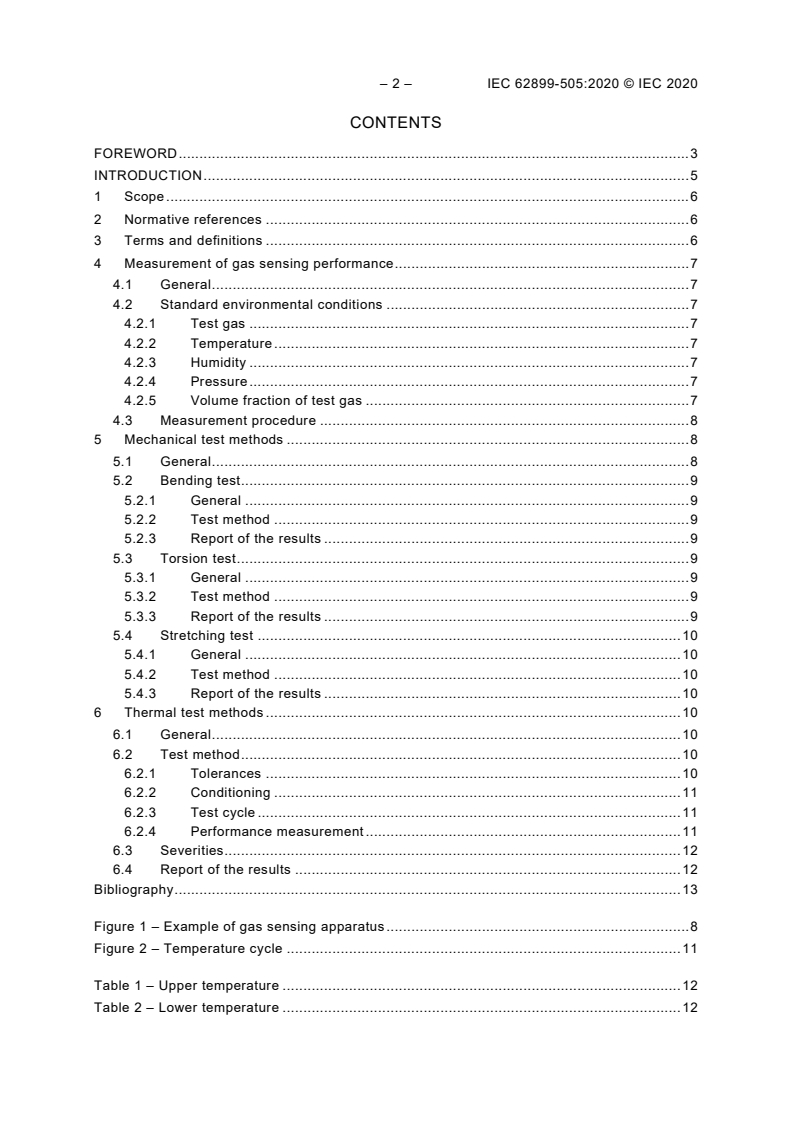
CONTENTS
FOREWORD . 3
INTRODUCTION . 5
1 Scope . 6
2 Normative references . 6
3 Terms and definitions . 6
4 Measurement of gas sensing performance . 7
4.1 General . 7
4.2 Standard environmental conditions . 7
4.2.1 Test gas . 7
4.2.2 Temperature . 7
4.2.3 Humidity . 7
4.2.4 Pressure . 7
4.2.5 Volume fraction of test gas . 7
4.3 Measurement procedure . 8
5 Mechanical test methods . 8
5.1 General . 8
5.2 Bending test . 9
5.2.1 General . 9
5.2.2 Test method . 9
5.2.3 Report of the results . 9
5.3 Torsion test . 9
5.3.1 General . 9
5.3.2 Test method . 9
5.3.3 Report of the results . 9
5.4 Stretching test . 10
5.4.1 General . 10
5.4.2 Test method . 10
5.4.3 Report of the results . 10
6 Thermal test methods . 10
6.1 General . 10
6.2 Test method . 10
6.2.1 Tolerances . 10
6.2.2 Conditioning . 11
6.2.3 Test cycle . 11
6.2.4 Performance measurement . 11
6.3 Severities . 12
6.4 Report of the results . 12
Bibliography . 13
Figure 1 – Example of gas sensing apparatus . 8
Figure 2 – Temperature cycle . 11
Table 1 – Upper temperature . 12
Table 2 – Lower temperature . 12
INTERNATIONAL ELECTROTECHNICAL COMMISSION
____________
PRINTED ELECTRONICS –
Part 505: Quality assessment – Flexible gas sensor –
Mechanical and thermal testing
FOREWORD
1) The International Electrotechnical Commission (IEC) is a worldwide organization for standardization comprising
all national electrotechnical committees (IEC National Committees). The object of IEC is to promote
international co-operation on all questions concerning standardization in the electrical and electronic fields. To
this end and in addition to other activities, IEC publishes International Standards, Technical Specifications,
Technical Reports, Publicly Available Specifications (PAS) and Guides (hereafter referred to as “IEC
Publication(s)”). Their preparation is entrusted to technical committees; any IEC National Committee interested
in the subject dealt with may participate in this preparatory work. International, governmental and non-
governmental organizations liaising with the IEC also participate in this preparation. IEC collaborates closely
with the International Organization for Standardization (ISO) in accordance with conditions determined by
agreement between the two organizations.
2) The formal decisions or agreements of IEC on technical matters express, as nearly as possible, an international
consensus of opinion on the relevant subjects since each technical committee has representation from all
interested IEC National Committees.
3) IEC Publications have the form of recommendations for international use and are accepted by IEC National
Committees in that sense. While all reasonable efforts are made to ensure that the technical content of IEC
Publications is accurate, IEC cannot be held responsible for the way in which they are used or for any
misinterpretation by any end user.
4) In order to promote international uniformity, IEC National Committees undertake to apply IEC Publications
transparently to the maximum extent possible in their national and regional publications. Any divergence
between any IEC Publication and the corresponding national or regional publication shall be clearly indicated in
the latter.
5) IEC itself does not provide any attestation of conformity. Independent certification bodies provide conformity
assessment services and, in some areas, access to IEC marks of conformity. IEC is not responsible for any
services carried out by independent certification bodies.
6) All users should ensure that they have the latest edition of this publication.
7) No liability shall attach to IEC or its directors, employees, servants or agents including individual experts and
members of its technical committees and IEC National Committees for any personal injury, property damage or
other damage of any nature whatsoever, whether direct or indirect, or for costs (including legal fees) and
expenses arising out of the publication, use of, or reliance upon, this IEC Publication or any other IEC
Publications.
8) Attention is drawn to the Normative references cited in this publication. Use of the referenced publications is
indispensable for the correct application of this publication.
9) Attention is drawn to the possibility that some of the elements of this IEC Publication may be the subject of
patent rights. IEC shall not be held responsible for identifying any or all such patent rights.
International Standard IEC 62899-505 has been prepared by IEC technical committee 119:
Printed Electronics.
The text of this International Standard is based on the following documents:
FDIS Report on voting
119/305/FDIS 119/309/RVD
Full information on the voting for the approval of this International Standard can be found in
the report on voting indicated in the above table.
This document has been drafted in accordance with the ISO/IEC Directives, Part 2.
– 4 – IEC 62899-505:2020 © IEC 2020
A list of all parts in the IEC 62899 series, published under the general title Printed electronics,
can be found on the IEC website.
The committee has decided that the contents of this document will remain unchanged until the
stability date indicated on the IEC website under "http://webstore.iec.ch" in the data related to
the specific document. At this date, the document will be
• reconfirmed,
• withdrawn,
• replaced by a revised edition, or
• amended.
INTRODUCTION
There is an increasing worldwide demand for flexible and/or wearable gas sensors for fire
fighter’s garment, industrial workwear, wearable patch, etc. In recent years, many efforts have
been spent to develop and commercialize flexible and/or wearable gas sensors composed of
a flexible substrate, electrode, and gas sensing layer. These printed flexible gas sensors
should provide information about the level of gases in the surrounding environment regardless
of mechanical deformations, which might happen for a flexible movement. Further, the
surrounding temperature and humidity have a crucial effect on the performance of the gas
sensor, since the sensing parts face directly outwards to detect gaseous molecules. However,
these mechanical and thermal durabilities have been treated only to a minor extent. This
document helps to unify the testing and qualification of printed flexible gas sensors
manufactured usin
...