


IEC 60770-3:2014
(Main)Transmitters for use in industrial-process control systems - Part 3: Methods for performance evaluation of intelligent transmitters
General Information
- Abstract
IEC 60770-3:2014 specifies methods for:
- assessment of the functionality of intelligent transmitters;
- testing the operational behaviour, as well as the static and dynamic performance of an intelligent transmitter and methodologies for determining the reliability and diagnostic features used to detect malfunctions;
- determining the communication capabilities of the intelligent transmitters in a communication network. This second edition cancels and replaces the first edition published in 2006 and constitutes a technical revision. It includes the following changes:
- Introduction.
- Terms and definitions: all definitions already present in IEC 60050 and in IEC 61298 have been deleted.
- All parts: added concept of wireless transmitters.
- Status
- Replaced
- Publication Date
- 22-May-2014
- Technical Committee
- SC 65B - Measurement and control devices
- Drafting Committee
- WG 6 - TC 65/SC 65B/WG 6
- Current Stage
- DELPUB - Deleted Publication
- Start Date
- 18-Aug-2020
- Completion Date
- 28-Aug-2026

Relations
- Effective Date
- 05-Sep-2023
- Effective Date
- 05-Sep-2023
- Effective Date
- 05-Sep-2023
- Effective Date
- 05-Sep-2023
- Effective Date
- 05-Sep-2023
- Effective Date
- 05-Sep-2023
Get Certified
Connect with accredited certification bodies for this standard

DVS-ZERT GmbH
German welding certification society.

ANCE
Mexican certification and testing association.
CARES (UK Certification Authority for Reinforcing Steels)
UK certification for reinforcing steels and construction.
Sponsored listings
Frequently Asked Questions
IEC 60770-3:2014 is a standard published by the International Electrotechnical Commission (IEC). Its full title is "Transmitters for use in industrial-process control systems - Part 3: Methods for performance evaluation of intelligent transmitters". This standard covers: IEC 60770-3:2014 specifies methods for: - assessment of the functionality of intelligent transmitters; - testing the operational behaviour, as well as the static and dynamic performance of an intelligent transmitter and methodologies for determining the reliability and diagnostic features used to detect malfunctions; - determining the communication capabilities of the intelligent transmitters in a communication network. This second edition cancels and replaces the first edition published in 2006 and constitutes a technical revision. It includes the following changes: - Introduction. - Terms and definitions: all definitions already present in IEC 60050 and in IEC 61298 have been deleted. - All parts: added concept of wireless transmitters.
IEC 60770-3:2014 specifies methods for: - assessment of the functionality of intelligent transmitters; - testing the operational behaviour, as well as the static and dynamic performance of an intelligent transmitter and methodologies for determining the reliability and diagnostic features used to detect malfunctions; - determining the communication capabilities of the intelligent transmitters in a communication network. This second edition cancels and replaces the first edition published in 2006 and constitutes a technical revision. It includes the following changes: - Introduction. - Terms and definitions: all definitions already present in IEC 60050 and in IEC 61298 have been deleted. - All parts: added concept of wireless transmitters.
IEC 60770-3:2014 is classified under the following ICS (International Classification for Standards) categories: 25.040.40 - Industrial process measurement and control; 33.060.30 - Radio relay and fixed satellite communications systems. The ICS classification helps identify the subject area and facilitates finding related standards.
IEC 60770-3:2014 has the following relationships with other standards: It is inter standard links to IEC 62828-4:2020, IEC 62828-3:2018, IEC 62828-2:2017, IEC 62828-1:2017, IEC 62828-5:2020, IEC 60770-3:2006. Understanding these relationships helps ensure you are using the most current and applicable version of the standard.
IEC 60770-3:2014 is available in PDF format for immediate download after purchase. The document can be added to your cart and obtained through the secure checkout process. Digital delivery ensures instant access to the complete standard document.
Standards Content (Sample)
IEC 60770-3 ®
Edition 2.0 2014-05
INTERNATIONAL
STANDARD
NORME
INTERNATIONALE
colour
inside
Transmitters for use in industrial-process control systems –
Part 3: Methods for performance evaluation of intelligent transmitters
Transmetteurs utilisés dans les systèmes de commande des processus
industriels –
Partie 3: Méthodes d’évaluation des performances des transmetteurs intelligents
All rights reserved. Unless otherwise specified, no part of this publication may be reproduced or utilized in any form
or by any means, electronic or mechanical, including photocopying and microfilm, without permission in writing from
either IEC or IEC's member National Committee in the country of the requester. If you have any questions about IEC
copyright or have an enquiry about obtaining additional rights to this publication, please contact the address below or
your local IEC member National Committee for further information.
Droits de reproduction réservés. Sauf indication contraire, aucune partie de cette publication ne peut être reproduite
ni utilisée sous quelque forme que ce soit et par aucun procédé, électronique ou mécanique, y compris la photocopie
et les microfilms, sans l'accord écrit de l'IEC ou du Comité national de l'IEC du pays du demandeur. Si vous avez des
questions sur le copyright de l'IEC ou si vous désirez obtenir des droits supplémentaires sur cette publication, utilisez
les coordonnées ci-après ou contactez le Comité national de l'IEC de votre pays de résidence.
IEC Central Office Tel.: +41 22 919 02 11
3, rue de Varembé Fax: +41 22 919 03 00
CH-1211 Geneva 20 info@iec.ch
Switzerland www.iec.ch
About the IEC
The International Electrotechnical Commission (IEC) is the leading global organization that prepares and publishes
International Standards for all electrical, electronic and related technologies.
About IEC publications
The technical content of IEC publications is kept under constant review by the IEC. Please make sure that you have the
latest edition, a corrigenda or an amendment might have been published.
IEC Catalogue - webstore.iec.ch/catalogue Electropedia - www.electropedia.org
The stand-alone application for consulting the entire The world's leading online dictionary of electronic and
bibliographical information on IEC International Standards, electrical terms containing more than 30 000 terms and
Technical Specifications, Technical Reports and other definitions in English and French, with equivalent terms in 14
documents. Available for PC, Mac OS, Android Tablets and additional languages. Also known as the International
iPad. Electrotechnical Vocabulary (IEV) online.
IEC publications search - www.iec.ch/searchpub IEC Glossary - std.iec.ch/glossary
The advanced search enables to find IEC publications by a More than 55 000 electrotechnical terminology entries in
variety of criteria (reference number, text, technical English and French extracted from the Terms and Definitions
committee,…). It also gives information on projects, replaced clause of IEC publications issued since 2002. Some entries
and withdrawn publications. have been collected from earlier publications of IEC TC 37,
77, 86 and CISPR.
IEC Just Published - webstore.iec.ch/justpublished
Stay up to date on all new IEC publications. Just Published IEC Customer Service Centre - webstore.iec.ch/csc
details all new publications released. Available online and If you wish to give us your feedback on this publication or
also once a month by email. need further assistance, please contact the Customer Service
Centre: csc@iec.ch.
A propos de l'IEC
La Commission Electrotechnique Internationale (IEC) est la première organisation mondiale qui élabore et publie des
Normes internationales pour tout ce qui a trait à l'électricité, à l'électronique et aux technologies apparentées.
A propos des publications IEC
Le contenu technique des publications IEC est constamment revu. Veuillez vous assurer que vous possédez l’édition la
plus récente, un corrigendum ou amendement peut avoir été publié.
Catalogue IEC - webstore.iec.ch/catalogue Electropedia - www.electropedia.org
Application autonome pour consulter tous les renseignements
Le premier dictionnaire en ligne de termes électroniques et
bibliographiques sur les Normes internationales,
électriques. Il contient plus de 30 000 termes et définitions en
Spécifications techniques, Rapports techniques et autres
anglais et en français, ainsi que les termes équivalents dans
documents de l'IEC. Disponible pour PC, Mac OS, tablettes
14 langues additionnelles. Egalement appelé Vocabulaire
Android et iPad.
Electrotechnique International (IEV) en ligne.
Recherche de publications IEC - www.iec.ch/searchpub
Glossaire IEC - std.iec.ch/glossary
La recherche avancée permet de trouver des publications IEC Plus de 55 000 entrées terminologiques électrotechniques, en
en utilisant différents critères (numéro de référence, texte, anglais et en français, extraites des articles Termes et
comité d’études,…). Elle donne aussi des informations sur les Définitions des publications IEC parues depuis 2002. Plus
projets et les publications remplacées ou retirées. certaines entrées antérieures extraites des publications des
CE 37, 77, 86 et CISPR de l'IEC.
IEC Just Published - webstore.iec.ch/justpublished
Service Clients - webstore.iec.ch/csc
Restez informé sur les nouvelles publications IEC. Just
Published détaille les nouvelles publications parues. Si vous désirez nous donner des commentaires sur cette
Disponible en ligne et aussi une fois par mois par email. publication ou si vous avez des questions contactez-nous:
csc@iec.ch.
IEC 60770-3 ®
Edition 2.0 2014-05
INTERNATIONAL
STANDARD
NORME
INTERNATIONALE
colour
inside
Transmitters for use in industrial-process control systems –
Part 3: Methods for performance evaluation of intelligent transmitters
Transmetteurs utilisés dans les systèmes de commande des processus
industriels –
Partie 3: Méthodes d’évaluation des performances des transmetteurs intelligents
INTERNATIONAL
ELECTROTECHNICAL
COMMISSION
COMMISSION
ELECTROTECHNIQUE
PRICE CODE
INTERNATIONALE
CODE PRIX XA
ICS 25.040.40 ISBN 978-2-8322-1629-3
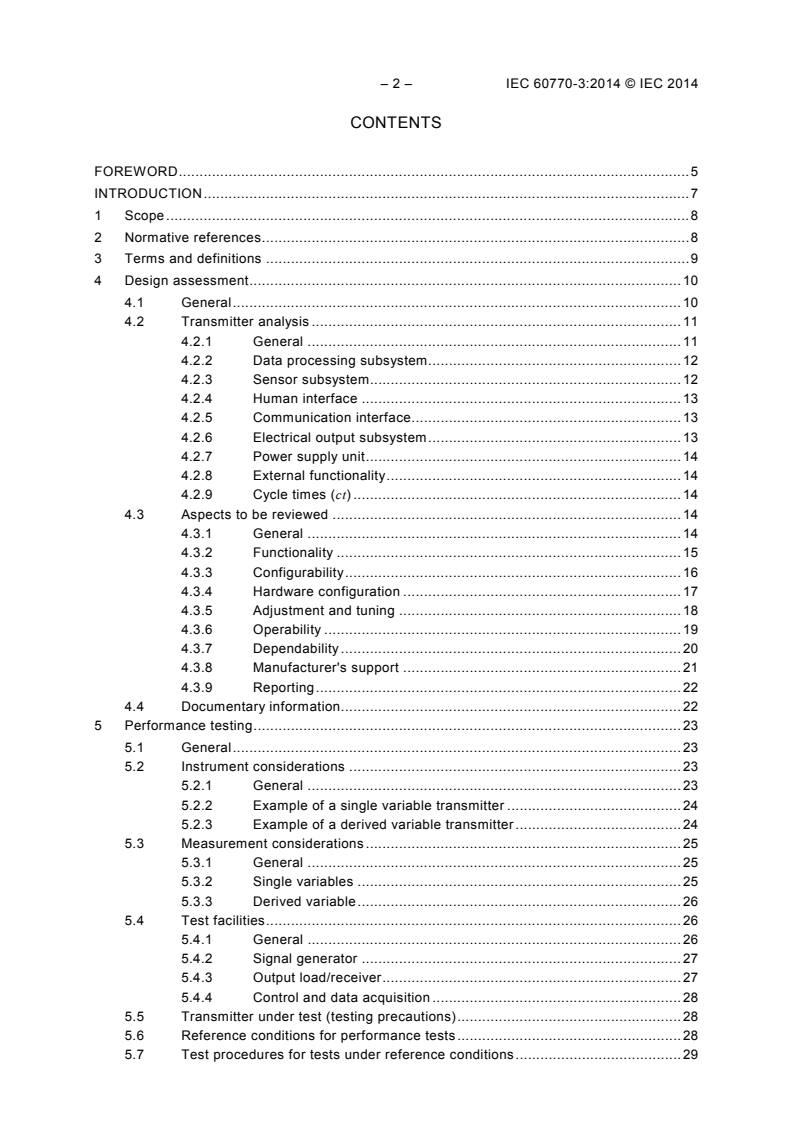
– 2 – IEC 60770-3:2014 © IEC 2014
CONTENTS
FOREWORD . 5
INTRODUCTION . 7
1 Scope . 8
2 Normative references . 8
3 Terms and definitions . 9
4 Design assessment . 10
4.1 General . 10
4.2 Transmitter analysis . 11
4.2.1 General . 11
4.2.2 Data processing subsystem. 12
4.2.3 Sensor subsystem. 12
4.2.4 Human interface . 13
4.2.5 Communication interface . 13
4.2.6 Electrical output subsystem . 13
4.2.7 Power supply unit . 14
4.2.8 External functionality . 14
4.2.9 Cycle times (ct) . 14
4.3 Aspects to be reviewed . 14
4.3.1 General . 14
4.3.2 Functionality . 15
4.3.3 Configurability . 16
4.3.4 Hardware configuration . 17
4.3.5 Adjustment and tuning . 18
4.3.6 Operability . 19
4.3.7 Dependability . 20
4.3.8 Manufacturer's support . 21
4.3.9 Reporting . 22
4.4 Documentary information . 22
5 Performance testing . 23
5.1 General . 23
5.2 Instrument considerations . 23
5.2.1 General . 23
5.2.2 Example of a single variable transmitter . 24
5.2.3 Example of a derived variable transmitter . 24
5.3 Measurement considerations . 25
5.3.1 General . 25
5.3.2 Single variables . 25
5.3.3 Derived variable . 26
5.4 Test facilities . 26
5.4.1 General . 26
5.4.2 Signal generator . 27
5.4.3 Output load/receiver . 27
5.4.4 Control and data acquisition . 28
5.5 Transmitter under test (testing precautions) . 28
5.6 Reference conditions for performance tests . 28
5.7 Test procedures for tests under reference conditions . 29
5.8 Test procedures for determination of the effects of influence quantities . 32
5.8.1 General . 32
5.8.2 Process domain . 34
5.8.3 Utility domain . 39
5.8.4 Environmental domain . 41
5.8.5 Time domain . 43
6 Other considerations . 43
6.1 Safety . 43
6.2 Degree of protection provided by enclosures . 43
6.3 Electromagnetic emission . 44
6.4 Variants . 44
7 Evaluation report. 44
Annex A (informative) Dependability testing . 45
A.1 General . 45
A.2 Design analysis . 45
A.3 Reference conditions . 45
A.4 Fault injection test for internal instrument failures . 47
A.5 Observations . 47
A.5.1 General . 47
A.5.2 Reporting and ranking of fault behaviour . 48
A.6 Human faults . 50
A.6.1 Mis-operation test . 50
A.6.2 Maintenance error test . 51
A.6.3 Expectations and reporting . 51
Annex B (informative) Throughput testing . 52
B.1 General . 52
B.2 Transmitter throughput (stand-alone) . 53
B.2.1 Reference conditions . 53
B.2.2 Test conditions . 53
B.2.3 Observations and measurements . 54
B.3 Throughput in a fieldbus configuration . 54
B.3.1 Reference conditions . 54
B.3.2 Test conditions . 54
B.3.3 Observations and measurements . 55
B.3.4 Precautions. 55
Annex C (informative) Function block testing . 56
C.1 General . 56
C.2 General qualitative checks . 56
C.3 Time-dependent function blocks . 56
C.4 Time-independent function blocks . 56
Bibliography . 57
Figure 1 – Intelligent transmitter model . 12
Figure 2 – Basic test set-up . 27
Figure 3 – Examples of step responses of electrical outputs of transmitters . 31
Figure A.1 – Example schematic of a transmitter . 46
Figure A.2 – Test tool for low impedance circuits and shared circuits . 47
– 4 – IEC 60770-3:2014 © IEC 2014
Figure A.3 – Matrix for reporting fault behaviour . 49
Figure A.4 – Ranking of various types of failure modes . 50
Figure B.1 – Transmitter in stand-alone configuration . 52
Figure B.2 – Transmitter as a participant in a fieldbus installation . 53
Table 1 – Checklist for mapping functionality . 15
Table 2 – Checklist for mapping configurability . 16
Table 3 – Checklist for mapping hardware-configuration . 17
Table 4 – Checklist for mapping adjustment and tuning procedures . 18
Table 5 – Checklist for mapping operability . 19
Table 6 – Checklist for mapping dependability . 20
Table 7 – Checklist for mapping manufacturer’s support . 21
Table 8 – Reporting format for design review . 22
Table 9 – Checklist on available documentation . 22
Table 10 – Listing of functions of a single variable transmitter. 24
Table 11 – Listing of functions of derived variable transmitter . 25
Table 12 – Reference environmental and operational test conditions . 29
Table 13 – Procedures for tests under reference conditions . 29
Table 14 – Methods for testing immunity to sensor disturbances – Matrix of instrument
properties and tests . 35
Table 15 – Methods for testing immunity to wiring disturbances . 37
Table 16 – Methods for testing the immunity to disturbances of the power utilities . 39
Table 17 – Methods for testing the immunity to environmental disturbances . 41
Table 18 – Methods for testing the immunity to degradation in time . 43
INTERNATIONAL ELECTROTECHNICAL COMMISSION
___________
TRANSMITTERS FOR USE IN INDUSTRIAL-PROCESS
CONTROL SYSTEMS –
Part 3: Methods for performance evaluation
of intelligent transmitters
FOREWORD
1) The International Electrotechnical Commission (IEC) is a worldwide organization for standardization comprising
all national electrotechnical committees (IEC National Committees). The object of IEC is to promote
international co-operation on all questions concerning standardization in the electrical and electronic fields. To
this end and in addition to other activities, IEC publishes International Standards, Technical Specifications,
Technical Reports, Publicly Available Specifications (PAS) and Guides (hereafter referred to as “IEC
Publication(s)”). Their preparation is entrusted to technical committees; any IEC National Committee interested
in the subject dealt with may participate in this preparatory work. International, governmental and non-
governmental organizations liaising with the IEC also participate in this preparation. IEC collaborates closely
with the International Organization for Standardization (ISO) in accordance with conditions determined by
agreement between the two organizations.
2) The formal decisions or agreements of IEC on technical matters express, as nearly as possible, an international
consensus of opinion on the relevant subjects since each technical committee has representation from all
interested IEC National Committees.
3) IEC Publications have the form of recommendations for international use and are accepted by IEC National
Committees in that sense. While all reasonable efforts are made to ensure that the technical content of IEC
Publications is accurate, IEC cannot be held responsible for the way in which they are used or for any
misinterpretation by any end user.
4) In order to promote international uniformity, IEC National Committees undertake to apply IEC Publications
transparently to the maximum extent possible in their national and regional publications. Any divergence
between any IEC Publication and the corresponding national or regional publication shall be clearly indicated in
the latter.
5) IEC itself does not provide any attestation of conformity. Independent certification bodies provide conformity
assessment services and, in some areas, access to IEC marks of conformity. IEC is not responsible for any
services carried out by independent certification bodies.
6) All users should ensure that they have the latest edition of this publication.
7) No liability shall attach to IEC or its directors, employees, servants or agents including individual experts and
members of its technical committees and IEC National Committees for any personal injury, property damage or
other damage of any nature whatsoever, whether direct or indirect, or for costs (including legal fees) and
expenses arising out of the publication, use of, or reliance upon, this IEC Publication or any other IEC
Publications.
8) Attention is drawn to the Normative references cited in this publication. Use of the referenced publications is
indispensable for the correct application of this publication.
9) Attention is drawn to the possibility that some of the elements of this IEC Publication may be the subject of
patent rights. IEC shall not be held responsible for identifying any or all such patent rights.
The International Standard IEC 60770-3 has been prepared by subcommittee 65B:
Measurement and control devices, of IEC technical committee 65: Industrial-process
measurement, control and automation.
This second edition cancels and replaces the first edition published in 2006. This edition
constitutes a technical revision.
This edition includes the following significant technical changes with respect to the previous
edition:
a) Introduction.
b) Terms and definitions: all definitions already present in IEC 60050 and in IEC 61298 have
been deleted.
c) All parts: added concept of wireless transmitters.
– 6 – IEC 60770-3:2014 © IEC 2014
The text of this standard is based on the following documents:
FDIS Report on voting
65B/917/FDIS 65B/930/RVD
Full information on the voting for the approval of this standard can be found in the report on
voting indicated in the above table.
This publication has been drafted in accordance with the ISO/IEC Directives, Part 2.
A list of all parts in the IEC 60770, published under the general title Transmitters for use in
industrial-process control systems, can be found on the IEC website.
The committee has decided that the contents of this publication will remain unchanged until the
stability date indicated on the IEC web site under "http://webstore.iec.ch" in the data related to
the specific publication. At this date, the publication will be
• reconfirmed,
• withdrawn,
• replaced by a revised edition, or
• amended.
IMPORTANT – The 'colour inside' logo on the cover page of this publication indicates
that it contains colours which are considered to be useful for the correct understanding
of its contents. Users should therefore print this document using a colour printer.
INTRODUCTION
New transmitters for use in industrial process control systems are now equipped with micro-
processors which utilise digital data processing and communication methods, auxiliary sensors
and artificial intelligence. This makes them more complex than conventional analogue
transmitters and gives them considerable added value.
An intelligent transmitter is an instrument that uses digital data processing and communication
methods for performing its functions and for safeguarding and communicating data and
information on its operation. It may be equipped with additional sensors and functionality which
support the main function of the intelligent transmitter. The variety of added functionality can
for instance enhance accuracy and rangeability, self-test capabilities, and alarm and condition
monitoring. Therefore accuracy-related performance testing, although still a major tool for
evaluation, is no longer sufficient to show the flexibility, capability and other features with
respect to engineering, installation, maintainability, reliability and operability.
Because of the complexity of intelligent transmitters, a close collaboration should be
maintained between the evaluating body and the manufacturer during the evaluation. Note
should be taken of the manufacturer's specifications for the instrument, when the test
programme is being decided, and the manufacturer should be invited to comment on both the
test programme and the results. His comments on the results should be included in any report
produced by the testing organisation.
This part of IEC 60770 addresses, in its main body, structured and mandatory methods for a
design review and performance testing of intelligent transmitters. Intelligent transmitters will, in
many cases, also have the capacity to be integrated into digital communication (bus) systems,
where they have to co-operate with a variety of devices. In this case, dependability,
(inter)operability and real-time behaviour are important issues. The testing of these aspects
depends largely on the internal structure and organisation of the intelligent transmitter and the
architecture and size of the bus system. The Annexes A, B and C give a non-mandatory
methodology and framework for designing specific evaluation procedures for dependability and
throughput testing and function block testing in a specific case.
When a full evaluation, in accordance with this part of IEC 60770, is not required or possible,
those tests which are required, should be performed and the results reported in accordance
with the relevant parts of this standard. In such cases, the test report should state that it does
not cover the full number of tests specified herein. Furthermore, the items omitted should be
mentioned, in order to give the reader of the report a clear overview.
The structure of this part of IEC 60770 largely follows the framework of IEC 62098. For
performance testing, the IEC 61298 series should also be consulted. A number of tests
described there are still valid for intelligent transmitters. Further reading of the IEC 61069
series is recommended, as some notions in this part of IEC 60770 are based on concepts
brought forward therein.
– 8 – IEC 60770-3:2014 © IEC 2014
TRANSMITTERS FOR USE IN INDUSTRIAL-PROCESS
CONTROL SYSTEMS –
Part 3: Methods for performance evaluation
of intelligent transmitters
1 Scope
This part of IEC 60770 specifies the following methods.
• Methods for
– assessment of the functionality of intelligent transmitters;
– testing the operational behaviour, as well as the static and dynamic performance of an
intelligent transmitter.
• Methodologies for
– determining the reliability and diagnostic features used to detect malfunctions;
– determining the communication capabilities of the intelligent transmitters in a
communication network.
The methods and methodologies are applicable to intelligent transmitters, which convert one or
more physical, chemical or electrical quantities into digital signals for use in a communication
network (as specified in the IEC 61158 series or others) or into analogue electrical signals (as
specified in the IEC 60381 series).
The methods and methodologies listed in this part of IEC 60770 are intended for use by:
– manufacturers to determine the performance of their products, and
– users or independent testing laboratories to verify equipment performance specifications.
Manufacturers of intelligent transmitters are urged to apply this part of IEC 60770 at an early
stage of development.
This standard is intended to provide guidance for designing evaluations of intelligent
transmitters by providing:
– a checklist for reviewing the hardware and software design in a structured way;
– test methods for measuring and qualifying the performance, dependability and operability
under various environmental and operational conditions;
– methods for reporting the data obtained.
2 Normative references
The following documents, in whole or in part, are normatively referenced in this document and
are indispensable for its application. For dated references, only the edition cited applies. For
undated references, the latest edition of the referenced document (including any amendments)
applies.
IEC 60050 (all parts), International Electrotechnical Vocabulary (available at
http://www.electropedia.org)
IEC 60381 (all parts), Analogue signals for process control systems
IEC 60529, Degree of protection provided by enclosures (IP Code)
IEC 60721-3 (all parts), Classification of environmental conditions – Part 3: Classification of
groups of environmental parameters and their severities
IEC 61010-1, Safety requirements for electrical equipment for measurement, control, and
laboratory use – Part 1: General requirements
IEC 61032, Protection of persons and equipment by enclosures – Probes for verification
IEC 61158 (all parts), Industrial communication networks – Fieldbus specifications
IEC 61298 (all parts), Process measurement and control devices – General methods and
procedures for evaluating performance
IEC 61298-1:2008, Process measurement and control devices – General methods and
procedures for evaluating performance – Part 1: General considerations
IEC 61298-2:2008, Process measurement and control devices – General methods and
procedures for evaluating performance – Part 2: Tests under reference conditions
IEC 61298-3:2008, Process measurement and control devices – General methods and
procedures for evaluating performance – Part 3: Tests for the effects of influence quantities
IEC 61298-4, Process measurement and control devices – General methods and procedures
for evaluating performance – Part 4: Evaluation report content
IEC 61326 (all parts), Electrical equipment for measurement, control and laboratory use – EMC
requirements
IEC 61326-1, Electrical equipment for measurement, control and laboratory use – EMC
requirements – Part 1: General requirements
IEC 61499 (all parts), Function blocks
IEC 61804 (all parts), Function blocks (FB) for process control
CISPR 11, Industrial, scientific and medical equipment – Radio-frequency disturbance
characteristics – Limits and methods of measurement
3 Terms and definitions
For the purposes of this document, the terms and definitions given in IEC 60050-300, in the
IEC 61298 series and the following apply.
3.1
intelligent transmitter
transmitter provided with means for bi-directional communication with external systems and
human operators for sending measurement and status information and receiving and
processing external commands
3.2
single variable transmitter
transmitter that measures one single physical quantity
– 10 – IEC 60770-3:2014 © IEC 2014
3.3
multivariable transmitter
transmitter that measures two or more identical or different physical quantities
3.4
adjustment
set of operations carried out on a measuring instrument in order that it provides given
indications corresponding to given values of the measurand
Note 1 to entry: When the instrument is made to give a null indication corresponding to a null value of the
measurand, the set of operations is called zero adjustment.
Note 2 to entry: Many manufacturers use the term calibration for adjustment of zero, span and linearity or
conformity.
3.5
tuning
process of adjusting the various instrument parameters, required for obtaining a stable and
optimal measurement
Note 1 to entry: This can range from "trial and error" to an automatic proprietary procedure provided by the
manufacturer.
3.6
configuring
process of implementing the functionality required for a certain application
3.7
configurability
extent to which an intelligent transmitter can be provided with functions to control various
applications
3.8
set-up
process of configuring, calibrating and tuning a transmitter for optimal measurement
3.9
operating mode
selected method of operation of a transmitter
4 Design assessment
4.1 General
The design review is meant to identify and make explicit, in a structured way, the functionality
and capabilities of the intelligent transmitter under consideration. As stated in the introduction,
intelligent transmitters appear in a great variety of designs. A design review is the necessary
tool for showing the details of:
– the physical structure,
– the functional structure.
Subclause 4.2 guides the evaluator through the process of describing the physical structure of
intelligent transmitters by identifying the hardware modules and the inputs and outputs to the
operational and environmental domains. Thereafter, the functional structure can be described,
using the checklist of 4.3. The checklist gives a framework of the relevant issues, which need
to be addressed by the evaluator, mainly through adequate qualitative and quantitative
experiments.
4.2 Transmitter analysis
4.2.1 General
Two different types of transmitters can be identified:
• Single variable transmitter. The measured value (output) represents one single physical
quantity measured by one type of sensor.
• Multivariable transmitter. This type of transmitters appears in two versions:
– An instrument providing a variety of measured values (outputs), each of which is related
to a measurement of one distinct input quantity with a specific sensor.
– An instrument providing derived measured values resulting from the measurement of
more than one quantity through more than one type of sensor and processed through a
distinct algorithm (e.g. flow computer, mechanical power meter). In many cases, the
individual measured variables are also available to the user.
Each type of intelligent transmitter may be equipped with independent auxiliary sensors and
auxiliary (mainly digital) outputs, which are not involved in the primary measurement process.
The generic transmitter model of Figure 1 gives a maximum configuration and is a tool for
setting up a block scheme and concise description of the transmitter to be evaluated. It is also
important for defining the functions to be considered in the performance tests (see Clause 5).
Functionally, a transmitter is an information transformer. Data enters and then exits the
instrument through the various (external) domains given in Figure 1, following distinct data flow
paths. The following paths can be defined, but are not always resident in a specific transmitter
under consideration:
• Sensors (process domain) to external systems (remote data processing systems).
• Sensors (process domain) to operator displays (human domain).
• Sensors (process domain) to external systems (electrical outputs).
• Operator commands through local keyboard (human domain) to data processing
subsystem, consequently affecting the above-mentioned data flows to external systems
(remote data processing systems and electrical outputs).
• Remote commands (from external remote data processing systems) to the instrument’s
data processing subsystem, consequently affecting the above-mentioned data flows to
external systems (electrical outputs) and local operator displays (human domain).
A block scheme and description shall be included in the evaluation report and may be
enhanced with photographs or drawings of important details.
– 12 – IEC 60770-3:2014 © IEC 2014
Utility domain
Supply voltage
ct
To external system
External system domain
Power supply
Communication
unit
interface
Analog
output (mA)
Main sensor(s)
ct
Data
Electrical
Sensor Digital
processing
output
communication
subsystem
Auxiliary sensors
subsystem
subsystem
ct
Binary
output (relay)
ct
Process domain
Human
interface
To human operator
Human domain
IEC 1827/14
Key
ct cycle time
Figure 1 – Intelligent transmitter model
For an intelligent transmitter, the main physical modules and provisions for connection to
external systems and human operators are defined in 4.2.2 to 4.2.9.
4.2.2 Data processing subsystem
The data processing subsystem is the heart of an intelligent transmitter. Its main function is to
provide and process the measured quantity(ies) for further real-time use by the human and
communication interfaces and/or at the electrical output subsystem. Many transmitters
measure one quantity by means of one (main) sensor, but derived measured values such as
heat or mass flow and mechanical power require more sensors.
Besides the main measurement function, a transmitter may be equipped with a number of
additional functions that can vary considerably from make to make. Amongst the additional
functions that may be resident in a transmitter are:
– configuration;
– adjustment and tuning;
– self-testing, diagnostics, condition monitoring;
– external process control function;
– trending and data storage.
Part of the functionality may be located in external devices that are temporarily or continuously
connected to the communication interface (e.g. configuring, trending).
4.2.3 Sensor subsystem
The sensor subsystem converts the physical or chemical quantity(ies) to be measured into
electrical signals that are conditioned and digitised for use by the data processing unit. The
subsystem may also be equipped with electrical circuits for sensing binary signals (e.g. change
measurement range on an external command), or auxiliary sensors of a different type (e.g.
auxiliary for compensation or internal diagnostics and condition monitoring purposes).
The sensor and sensor subsystem may be integrated with the other modules in one enclosure.
The sensor can also be located remotely (e.g. densitometer, thermocouple transmitter). Certain
transmitters (e.g. thermocouple and resistance thermometer detector (RTD)) utilise
standardised (third party) sensors that provide an electric signal. In such a case, it may be
agreed to perform the evaluation with an acceptable simulator instead of the application of the
actual quantity.
Depending on the measurement principle used, the sensor may not require auxiliary (external)
power (e.g. thermocouples) or it may require auxiliary power (e.g. strain gauges) or a
specifically characterised power source (e.g. electromagnetic and Coriolis flowmeters).
Sensors are, in general, incorporated in the process installations and in many cases, they may
also be in direct contact with the process medium. As such, medium properties, medium
conditions and installation conditions may adversely influence them. As a remote unit, the
sensor may also be subjected to more severe environmental conditions than the other
subsystems. Moreover, it shall also be considered whether it is necessary to apply combined
environmental and process conditions during an evaluation.
As part of the design review, a list of the types of sensors that are provided and their
measuring ranges shall be compiled.
4.2.4 Human interface
The human interface is an important tool for direct interaction and communication with the
human operator. It consists of integral means at the instrument for reading out data (local
display) and provisions for entering and requesting data (local pushbuttons). Instruments may
be provided that are not equipped with a human interface. Access to the database is then
provided via the communication interface and the external system or a handheld terminal.
A list of the measurement data that can be shown on the display and the refresh rates, as well
as the status data that can either automatically or on request be made available to the operator
shall be tabulated. In addition, a summary of the functions and facilities for access and data
presentation shall be made.
4.2.5 Communication interface
Transmitter intelligence is supported by the communication interface, which connects the
instrument to external systems. Through the interface (wired or wireless), measurement and
control data are transferred and access is also provided to the instrument's configuration data.
In the case of hybrid (SMART) instruments, the digital signal is superimposed on an analogue
current signal and it is made available at the electrical output subsystem. There may be
instruments which do not have a communication interface. Then configuration and read-out of
data may take place via the human interface
A list of the measurement data that can be transferred to a host and the refresh rates should
be compiled. A summary of the status data that can either automatically or on request be
transferred to the host shall also be listed. The functions and facilities for access and data
presentation shall also be indicated.
4.2.6 Electrical output subsystem
Instruments suitable for connection to a fieldbus (or wireless) need not necessarily be provided
with an electrical output subsystem.
The electrical output subsystem primarily converts digital information provided by the data
processing subsystem into one or more analogue electrical signals. It may also be equipped
– 14 – IEC 60770-3:2014 © IEC 2014
with one or more binary (digital) electrical outputs. For these purposes, the instrument may
require an additional power supply source.
A list of the measured variables assignable to each electrical output shall be tabulated. The
analogue signal types and ranges (e.g. 4 mA to 20 mA or 1 V d.c.to 5 V d.c., etc.) shall also be
included. A summary of the status data that can be made available at the binary (digital) output
terminals shall be compiled.
4.2.7 Power supply unit
Many instruments still require a separate connection to an a.c. or d.c. mains supply. However
more instruments are nowadays, "loop powered" which means that they receive power through
the signal transmission line or electrical signal output line. While in wir
...