

IEC 62828-5:2020
(Main)Reference conditions and procedures for testing industrial and process measurement transmitters - Part 5: Specific procedures for flow transmitters
General Information
- Abstract
IEC 62828-5:2020 establishes specific procedures for testing flow transmitters used in measuring and control systems for industrial process and for machinery control systems. For general test procedures, reference is to be made to IEC 62828-1:2017, applicable to all types of industrial and process measurement transmitters.
This document – together with IEC 62828-1:2017 – is the reference standard for testing every type of flow transmitter, not only for liquids but also for gases and for steam.
In this document, "industrial flow transmitters" consistently covers all types of flow transmitters used in measuring and control systems for industrial process and for machinery.
- Status
- Published
- Publication Date
- 17-Aug-2020
- Technical Committee
- SC 65B - Measurement and control devices
- Drafting Committee
- WG 6 - TC 65/SC 65B/WG 6
- Current Stage
- PPUB - Publication issued
- Start Date
- 18-Aug-2020
- Completion Date
- 11-Sep-2020
Buy Documents
IEC 62828-5:2020 - Reference conditions and procedures for testing industrial and process measurement transmitters - Part 5: Specific procedures for flow transmitters Released:8/18/2020
Overview
IEC 62828-5:2020, titled Reference conditions and procedures for testing industrial and process measurement transmitters – Part 5: Specific procedures for flow transmitters, is an international standard developed by the International Electrotechnical Commission (IEC). This standard defines precise testing procedures for flow transmitters utilized in industrial process control and machinery control systems. Flow transmitters covered by this standard include devices that measure liquids, gases, and steam in various industrial applications.
This document supplements the general testing guidelines found in IEC 62828-1:2017, which applies broadly to industrial and process measurement transmitters. Together, these standards offer comprehensive, unified testing protocols ensuring the accuracy, reliability, and performance of flow transmitters across diverse industrial environments.
Key Topics
Scope and Terms: IEC 62828-5 focuses exclusively on flow transmitters used in industrial processes, defining terminology related to flow measurement, velocity, and device types such as differential pressure, velocity, volumetric, and mass flowmeters.
Reference Test Conditions: The standard establishes rigorous baseline conditions and service environments for conducting flow transmitter tests, ensuring consistency and repeatability in assessments.
Test Procedures: It includes detailed methodologies for evaluating flow transmitters under various conditions:
- Accuracy and related performance factors under both standard and operating conditions
- Dynamic and static behavior tests to evaluate response and stability
- Type and routine tests to ensure conformity and long-term reliability
- Acceptance, integration, and maintenance testing for operational assurance
Calibration Guidelines: Annexes provide normative and informative guidance on proper calibration techniques including gravimetric, volumetric, and master meter methods, with detailed procedures and calibration reporting formats.
Documentation: The standard mandates thorough documentation of test outcomes and methods for estimating total probable error (TPE), facilitating transparent quality control and traceability.
Applications
IEC 62828-5:2020 is essential for manufacturers, quality control personnel, and users of flow transmitters in industrial and process automation sectors. Typical applications include:
Industrial Process Control: Ensuring accurate flow measurement in chemical plants, oil and gas processing, water treatment facilities, and power generation to optimize process efficiency and safety.
Machinery Control Systems: Reliable flow measurement for monitoring and controlling fluid dynamics in manufacturing equipment and automated machinery.
Calibration Laboratories: Standardizing calibration practices for flow transmitters to maintain traceable accuracy consistent with international benchmarks.
Quality Assurance: Facilitation of type testing and routine testing protocols to verify conformity to performance specifications before deployment or after maintenance.
Related Standards
IEC 62828-1:2017: Provides general test conditions and procedures applicable to all industrial and process measurement transmitters, forming the foundational framework coupled with Part 5.
IEC 60770 Series: Previously replaced by IEC 62828 series, these earlier standards addressed similar measurement transmitter testing.
IEC 61298 Series: Superseded and revised by IEC 62828 to encompass updated testing methods for digital and modern instrumentation.
International Electrotechnical Vocabulary (IEV): Accessible via Electropedia, providing standardized terminology correlating to the IEC 62828 series.
Practical Value
By adhering to IEC 62828-5:2020, organizations achieve:
Consistency in Flow Measurement Testing: Unified procedures promote comparability of results across different manufacturers and industries.
Enhanced Reliability and Safety: Accurate flow data underpins critical control decisions, directly influencing operational safety and efficiency.
Efficient Regulatory Compliance: Conformance with internationally recognized standards eases certification and acceptance in global markets.
Improved Device Performance Understanding: Comprehensive test regimes covering dynamic and static characteristics aid in selecting and maintaining optimal instruments.
For professionals involved in industrial measurement, IEC 62828-5:2020 is a vital resource to ensure high-performance flow transmitters that support reliable industrial process control and automation. Access the latest edition directly from the IEC webstore to leverage standardized testing procedures and promote operational excellence in your flow measurement systems.
Relations
- Effective Date
- 05-Sep-2023
- Effective Date
- 05-Sep-2023
- Effective Date
- 05-Sep-2023
Buy Documents
IEC 62828-5:2020 - Reference conditions and procedures for testing industrial and process measurement transmitters - Part 5: Specific procedures for flow transmitters Released:8/18/2020
Get Certified
Connect with accredited certification bodies for this standard

DVS-ZERT GmbH
German welding certification society.
BSMI (Bureau of Standards, Metrology and Inspection)
Taiwan's standards and inspection authority.
CARES (UK Certification Authority for Reinforcing Steels)
UK certification for reinforcing steels and construction.
Sponsored listings
Frequently Asked Questions
IEC 62828-5:2020 is a standard published by the International Electrotechnical Commission (IEC). Its full title is "Reference conditions and procedures for testing industrial and process measurement transmitters - Part 5: Specific procedures for flow transmitters". This standard covers: IEC 62828-5:2020 establishes specific procedures for testing flow transmitters used in measuring and control systems for industrial process and for machinery control systems. For general test procedures, reference is to be made to IEC 62828-1:2017, applicable to all types of industrial and process measurement transmitters. This document – together with IEC 62828-1:2017 – is the reference standard for testing every type of flow transmitter, not only for liquids but also for gases and for steam. In this document, "industrial flow transmitters" consistently covers all types of flow transmitters used in measuring and control systems for industrial process and for machinery.
IEC 62828-5:2020 establishes specific procedures for testing flow transmitters used in measuring and control systems for industrial process and for machinery control systems. For general test procedures, reference is to be made to IEC 62828-1:2017, applicable to all types of industrial and process measurement transmitters. This document – together with IEC 62828-1:2017 – is the reference standard for testing every type of flow transmitter, not only for liquids but also for gases and for steam. In this document, "industrial flow transmitters" consistently covers all types of flow transmitters used in measuring and control systems for industrial process and for machinery.
IEC 62828-5:2020 is classified under the following ICS (International Classification for Standards) categories: 17.200.20 - Temperature-measuring instruments; 25.040.40 - Industrial process measurement and control. The ICS classification helps identify the subject area and facilitates finding related standards.
IEC 62828-5:2020 has the following relationships with other standards: It is inter standard links to IEC 60770-1:2010, IEC 60770-3:2014, IEC 60770-2:2010. Understanding these relationships helps ensure you are using the most current and applicable version of the standard.
IEC 62828-5:2020 is available in PDF format for immediate download after purchase. The document can be added to your cart and obtained through the secure checkout process. Digital delivery ensures instant access to the complete standard document.
Standards Content (Sample)
IEC 62828-5 ®
Edition 1.0 2020-08
INTERNATIONAL
STANDARD
NORME
INTERNATIONALE
Reference conditions and procedures for testing industrial and process
measurement transmitters –
Part 5: Specific procedures for flow transmitters
Conditions de référence et procédures pour l'essai des transmetteurs
de mesure industriels et de processus –
Partie 5: Procédures spécifiques pour les transmetteurs de débit
All rights reserved. Unless otherwise specified, no part of this publication may be reproduced or utilized in any form
or by any means, electronic or mechanical, including photocopying and microfilm, without permission in writing from
either IEC or IEC's member National Committee in the country of the requester. If you have any questions about IEC
copyright or have an enquiry about obtaining additional rights to this publication, please contact the address below or
your local IEC member National Committee for further information.
Droits de reproduction réservés. Sauf indication contraire, aucune partie de cette publication ne peut être reproduite
ni utilisée sous quelque forme que ce soit et par aucun procédé, électronique ou mécanique, y compris la photocopie
et les microfilms, sans l'accord écrit de l'IEC ou du Comité national de l'IEC du pays du demandeur. Si vous avez des
questions sur le copyright de l'IEC ou si vous désirez obtenir des droits supplémentaires sur cette publication, utilisez
les coordonnées ci-après ou contactez le Comité national de l'IEC de votre pays de résidence.
IEC Central Office Tel.: +41 22 919 02 11
3, rue de Varembé info@iec.ch
CH-1211 Geneva 20 www.iec.ch
Switzerland
About the IEC
The International Electrotechnical Commission (IEC) is the leading global organization that prepares and publishes
International Standards for all electrical, electronic and related technologies.
About IEC publications
The technical content of IEC publications is kept under constant review by the IEC. Please make sure that you have the
latest edition, a corrigendum or an amendment might have been published.
IEC publications search - webstore.iec.ch/advsearchform Electropedia - www.electropedia.org
The advanced search enables to find IEC publications by a The world's leading online dictionary on electrotechnology,
variety of criteria (reference number, text, technical containing more than 22 000 terminological entries in English
committee,…). It also gives information on projects, replaced and French, with equivalent terms in 16 additional languages.
and withdrawn publications. Also known as the International Electrotechnical Vocabulary
(IEV) online.
IEC Just Published - webstore.iec.ch/justpublished
Stay up to date on all new IEC publications. Just Published IEC Glossary - std.iec.ch/glossary
details all new publications released. Available online and 67 000 electrotechnical terminology entries in English and
once a month by email. French extracted from the Terms and Definitions clause of
IEC publications issued since 2002. Some entries have been
IEC Customer Service Centre - webstore.iec.ch/csc collected from earlier publications of IEC TC 37, 77, 86 and
If you wish to give us your feedback on this publication or CISPR.
need further assistance, please contact the Customer Service
Centre: sales@iec.ch.
A propos de l'IEC
La Commission Electrotechnique Internationale (IEC) est la première organisation mondiale qui élabore et publie des
Normes internationales pour tout ce qui a trait à l'électricité, à l'électronique et aux technologies apparentées.
A propos des publications IEC
Le contenu technique des publications IEC est constamment revu. Veuillez vous assurer que vous possédez l’édition la
plus récente, un corrigendum ou amendement peut avoir été publié.
Recherche de publications IEC - Electropedia - www.electropedia.org
webstore.iec.ch/advsearchform Le premier dictionnaire d'électrotechnologie en ligne au
La recherche avancée permet de trouver des publications IEC monde, avec plus de 22 000 articles terminologiques en
en utilisant différents critères (numéro de référence, texte, anglais et en français, ainsi que les termes équivalents dans
comité d’études,…). Elle donne aussi des informations sur les 16 langues additionnelles. Egalement appelé Vocabulaire
projets et les publications remplacées ou retirées. Electrotechnique International (IEV) en ligne.
IEC Just Published - webstore.iec.ch/justpublished Glossaire IEC - std.iec.ch/glossary
Restez informé sur les nouvelles publications IEC. Just 67 000 entrées terminologiques électrotechniques, en anglais
Published détaille les nouvelles publications parues. et en français, extraites des articles Termes et Définitions des
Disponible en ligne et une fois par mois par email. publications IEC parues depuis 2002. Plus certaines entrées
antérieures extraites des publications des CE 37, 77, 86 et
Service Clients - webstore.iec.ch/csc CISPR de l'IEC.
Si vous désirez nous donner des commentaires sur cette
publication ou si vous avez des questions contactez-nous:
sales@iec.ch.
IEC 62828-5 ®
Edition 1.0 2020-08
INTERNATIONAL
STANDARD
NORME
INTERNATIONALE
Reference conditions and procedures for testing industrial and process
measurement transmitters –
Part 5: Specific procedures for flow transmitters
Conditions de référence et procédures pour l'essai des transmetteurs
de mesure industriels et de processus –
Partie 5: Procédures spécifiques pour les transmetteurs de débit
INTERNATIONAL
ELECTROTECHNICAL
COMMISSION
COMMISSION
ELECTROTECHNIQUE
INTERNATIONALE
ICS 17.200.20; 25.040.40 ISBN 978-2-8322-8758-3
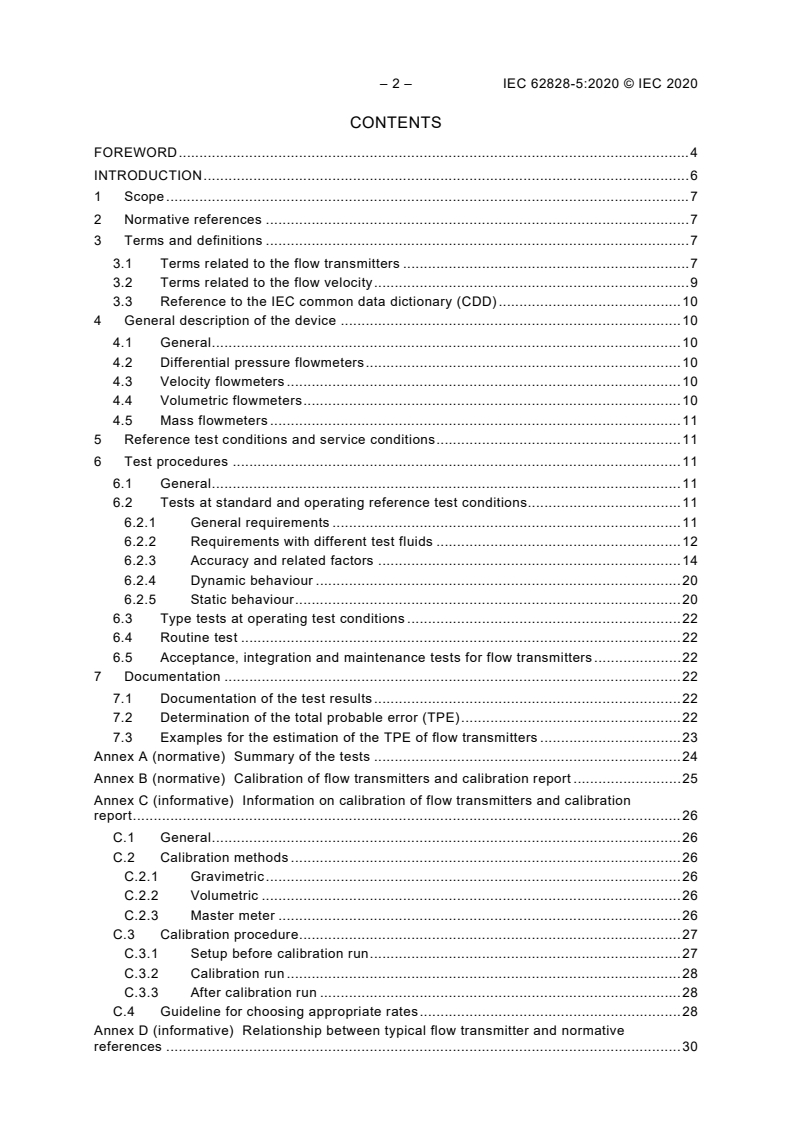
– 2 – IEC 62828-5:2020 © IEC 2020
CONTENTS
FOREWORD . 4
INTRODUCTION . 6
1 Scope . 7
2 Normative references . 7
3 Terms and definitions . 7
3.1 Terms related to the flow transmitters . 7
3.2 Terms related to the flow velocity . 9
3.3 Reference to the IEC common data dictionary (CDD) . 10
4 General description of the device . 10
4.1 General . 10
4.2 Differential pressure flowmeters . 10
4.3 Velocity flowmeters . 10
4.4 Volumetric flowmeters . 10
4.5 Mass flowmeters . 11
5 Reference test conditions and service conditions . 11
6 Test procedures . 11
6.1 General . 11
6.2 Tests at standard and operating reference test conditions. 11
6.2.1 General requirements . 11
6.2.2 Requirements with different test fluids . 12
6.2.3 Accuracy and related factors . 14
6.2.4 Dynamic behaviour . 20
6.2.5 Static behaviour . 20
6.3 Type tests at operating test conditions . 22
6.4 Routine test . 22
6.5 Acceptance, integration and maintenance tests for flow transmitters . 22
7 Documentation . 22
7.1 Documentation of the test results . 22
7.2 Determination of the total probable error (TPE) . 22
7.3 Examples for the estimation of the TPE of flow transmitters . 23
Annex A (normative) Summary of the tests . 24
Annex B (normative) Calibration of flow transmitters and calibration report . 25
Annex C (informative) Information on calibration of flow transmitters and calibration
report . 26
C.1 General . 26
C.2 Calibration methods . 26
C.2.1 Gravimetric . 26
C.2.2 Volumetric . 26
C.2.3 Master meter . 26
C.3 Calibration procedure . 27
C.3.1 Setup before calibration run . 27
C.3.2 Calibration run . 28
C.3.3 After calibration run . 28
C.4 Guideline for choosing appropriate rates . 28
Annex D (informative) Relationship between typical flow transmitter and normative
references . 30
Annex E (informative) Cautions and notes for the acceptance tests on the site or at
the factory . 31
E.1 General . 31
E.2 Cautions and notes . 31
E.2.1 Power supply for flow transmitters, pump and the flow generating unit . 31
E.2.2 Flow condition . 31
E.2.3 Temperature of the measurand . 31
E.2.4 Material selection . 31
E.2.5 Accuracy comparing with the other value . 32
Bibliography . 33
Figure C.1 – Example of calibration methods . 27
Figure C.2 – Example of the calibration/test flow . 29
Table 1 – Stability requirements during the measurement . 12
Table 2 – Reference conditions for TPE determination . 22
Table A.1 – Overview of the required tests for different measurement principles . 24
Table D.1 – Relationship between typical flow transmitter and normative references . 30
– 4 – IEC 62828-5:2020 © IEC 2020
INTERNATIONAL ELECTROTECHNICAL COMMISSION
____________
REFERENCE CONDITIONS AND PROCEDURES FOR TESTING
INDUSTRIAL AND PROCESS MEASUREMENT TRANSMITTERS –
Part 5: Specific procedures for flow transmitters
FOREWORD
1) The International Electrotechnical Commission (IEC) is a worldwide organization for standardization comprising
all national electrotechnical committees (IEC National Committees). The object of IEC is to promote international
co-operation on all questions concerning standardization in the electrical and electronic fields. To this end and
in addition to other activities, IEC publishes International Standards, Technical Specifications, Technical Reports,
Publicly Available Specifications (PAS) and Guides (hereafter referred to as "IEC Publication(s)"). Their
preparation is entrusted to technical committees; any IEC National Committee interested in the subject dealt with
may participate in this preparatory work. International, governmental and non-governmental organizations liaising
with the IEC also participate in this preparation. IEC collaborates closely with the International Organization for
Standardization (ISO) in accordance with conditions determined by agreement between the two organizations.
2) The formal decisions or agreements of IEC on technical matters express, as nearly as possible, an international
consensus of opinion on the relevant subjects since each technical committee has representation from all
interested IEC National Committees.
3) IEC Publications have the form of recommendations for international use and are accepted by IEC National
Committees in that sense. While all reasonable efforts are made to ensure that the technical content of IEC
Publications is accurate, IEC cannot be held responsible for the way in which they are used or for any
misinterpretation by any end user.
4) In order to promote international uniformity, IEC National Committees undertake to apply IEC Publications
transparently to the maximum extent possible in their national and regional publications. Any divergence between
any IEC Publication and the corresponding national or regional publication shall be clearly indicated in the latter.
5) IEC itself does not provide any attestation of conformity. Independent certification bodies provide conformity
assessment services and, in some areas, access to IEC marks of conformity. IEC is not responsible for any
services carried out by independent certification bodies.
6) All users should ensure that they have the latest edition of this publication.
7) No liability shall attach to IEC or its directors, employees, servants or agents including individual experts and
members of its technical committees and IEC National Committees for any personal injury, property damage or
other damage of any nature whatsoever, whether direct or indirect, or for costs (including legal fees) and
expenses arising out of the publication, use of, or reliance upon, this IEC Publication or any other IEC Publications.
8) Attention is drawn to the Normative references cited in this publication. Use of the referenced publications is
indispensable for the correct application of this publication.
9) Attention is drawn to the possibility that some of the elements of this IEC Publication may be the subject of patent
rights. IEC shall not be held responsible for identifying any or all such patent rights.
International Standard IEC 62828-5 has been prepared by subcommittee 65B: Measurement
and control devices, of IEC technical committee 65: Industrial-process measurement, control
and automation.
The IEC 62828 series cancels and replaces the IEC 60770 series and proposes revisions for
the IEC 61298 series.
The text of this International Standard is based on the following documents:
FDIS Report on voting
65B/1179/FDIS 65B/1181/RVD
Full information on the voting for the approval of this International Standard can be found in the
report on voting indicated in the above table.
This document has been drafted in accordance with the ISO/IEC Directives, Part 2.
This International Standard is to be used in conjunction with IEC 62828-1:2017.
A list of all parts in the IEC 62828 series, published under the general title Reference conditions
and procedures for testing industrial and process measurement transmitters, can be found on
the IEC website.
The committee has decided that the contents of this document will remain unchanged until the
stability date indicated on the IEC website under "http://webstore.iec.ch" in the data related to
the specific document. At this date, the document will be
• reconfirmed,
• withdrawn,
• replaced by a revised edition, or
• amended.
– 6 – IEC 62828-5:2020 © IEC 2020
INTRODUCTION
Most of the current IEC standards on industrial measurement transmitters are rather old and
were developed having in mind devices based on analogue technologies. Today's digital
industrial and process measurement transmitters are quite different from those analogue
transmitters: they include more functions and newer interfaces, both towards the computing
section (mostly digital) and towards the measuring section (mostly mechanical). Even if some
standards dealing with digital transmitters already exist, they are not sufficient, since some
aspects of the performance are not covered by appropriate test methods.
In addition, the existing IEC test standards for industrial and process measurement transmitters
are spread over many documents, so that for manufacturers and users it was difficult,
impractical and time-consuming to identify and select all the standards to be applied to a device
measuring a specific process quantity (pressure, temperature, level, flow, etc.).
To help the manufacturers and users, it was decided to review, complete and reorganize the
existing IEC standards on the industrial and process measurement transmitters and to create a
more suitable, effective and comprehensive standard series that provides, in a systematic way,
all the needed specifications and tests for the different industrial and process measurement
transmitters.
To solve the issues mentioned above and to provide an added value for the stakeholders, the
new standard series on industrial and process measurement transmitters covers the following
main aspects:
• applicable normative references;
• specific terms and definitions;
• typical configurations and architectures for the various types of industrial and measurement
transmitters;
• hardware and software aspects;
• interfaces (to the process, to the operator, to the other measurement and control devices);
• physical, mechanical and electrical requirements and relevant tests; clear definition of the
test categories: type tests, acceptance tests and routine tests;
• performances (their specification, tests and verification);
• environmental protection, hazardous areas application, functional safety, etc.;
• structure of the technical documentation.
To cover in a systematic way all the topics to be addressed, the standard series is organized in
several parts. At the time of publication of this document, IEC 62828 consists of the following
parts:
• IEC 62828-1: General procedures for all types of transmitters
• IEC 62828-2: Specific procedures for pressure transmitters
• IEC 62828-3: Specific procedures for temperature transmitters
• IEC 62828-4: Specific procedures for level transmitters
• IEC 62828-5: Specific procedures for flow transmitters
In preparing the IEC 62828 series (all parts), many test procedures were taken, with the
necessary improvements, from the IEC 61298 series. Because the IEC 61298 series is currently
applicable to all process measurement and control devices, when the IEC 62828 series is
completed, the IEC 61298 series will be revised to harmonize it with the IEC 62828 series,
taking out from its scope the industrial and process measurement transmitters. During the time
when the scope of the IEC 61298 series is being updated, the new IEC 62828 series takes
precedence for industrial and process measurement transmitters.
When the IEC 62828 series is published, the IEC 60770 series will be withdrawn.
REFERENCE CONDITIONS AND PROCEDURES FOR TESTING
INDUSTRIAL AND PROCESS MEASUREMENT TRANSMITTERS –
Part 5: Specific procedures for flow transmitters
1 Scope
This part of IEC 62828 establishes specific procedures for testing flow transmitters used in
measuring and control systems for industrial process and for machinery control systems. For
general test procedures, reference is to be made to IEC 62828-1:2017, applicable to all types
of industrial and process measurement transmitters.
This document – together with IEC 62828-1:2017 – is the reference standard for testing every
type of flow transmitter, not only for liquids but also for gases and for steam.
In this document, "industrial flow transmitters" consistently covers all types of flow transmitters
used in measuring and control systems for industrial process and for machinery.
2 Normative references
The following documents are referred to in the text in such a way that some or all of their content
constitutes requirements of this document. For dated references, only the edition cited applies.
For undated references, the latest edition of the referenced document (including any
amendments) applies.
IEC 62828-1:2017, Reference conditions and procedures for testing industrial and process
measurement transmitters – Part 1: General procedures for all types of transmitters
IEC 61987-12, Industrial-process measurement and control – Data structures and elements in
process equipment catalogues – Part 12: Lists of properties (LOPs) for flow measuring
equipment for electronic data exchange
ISO 4185, Measurement of liquid flow in closed conduits – Weighing method
ISO 17025, General requirements for the competence of testing and calibration laboratories
3 Terms and definitions
For the purposes of this document, the terms and definitions given in IEC 62828-1 and the
following apply.
ISO and IEC maintain terminological databases for use in standardization at the following
addresses:
• IEC Electropedia: available at http://www.electropedia.org/
• ISO Online browsing platform: available at http://www.iso.org/obp
3.1 Terms related to the flow transmitters
3.1.1
adjustment
properties characterizing the means provided for the adjustment of a device
[SOURCE: Identifier ABC081 in the IEC common data dictionary]
– 8 – IEC 62828-5:2020 © IEC 2020
3.1.2
calibration
operation that, under specified conditions, in a first step, establishes a relation between the
quantity values with measurement uncertainties provided by measurement standards and
corresponding indications with associated measurement uncertainties and, in a second step,
uses this information to establish a relation for obtaining a measurement result from an
indication
Note 1 to entry: Calibration may be expressed by a statement, calibration function, calibration diagram, calibration
curve, or calibration table. In some cases, it may consist of an additive or multiplicative correction of the indication
with associated measurement uncertainty.
Note 2 to entry: Calibration should not be confused with adjustment of a measuring system, often mistakenly called
"self-calibration", nor with verification of calibration.
Note 3 to entry: Often, the first step alone in the above definition is perceived as being calibration.
[SOURCE: ISO/IEC Guide 99:2007, 2.39]
3.1.3
fluid
general category for gases, steams and liquids, which are substances that continuously deform
under the action of shear stress and at rest cannot withstand shear stress
3.1.4
maximum flow rate
corresponds to maximum measurand regarding flow rate Q , and this Q can be also the
max max
maximum working flow
3.1.5
minimum flow rate
corresponds to minimum measurand regarding flow rate Q , and this Q can be the minimum
min min
working flow
3.1.6
nominal range
range of indications obtainable with a particular setting of the controls of a measuring instrument
Note 1 to entry: The nominal range is normally stated in terms of its lower and upper limits. Where the lower limit
is zero, the nominal range is commonly stated solely in terms of its upper limit.
[SOURCE: IEC 60050-311:2001, 311-03-14]
3.1.7
pressure loss
static pressure difference between the inlet and the outlet of a flow meter or flow meter package
(consisting of flow meter, inlet/outlet pipe sections and flow straightener or any other flow
conditioning device), to be given as function of flow rate and viscosity
3.1.8
Reynolds number
dimensionless quantity characterizing the flow of a fluid in a given configuration characterized
by a specified length l, defined by Re = ρvl / η = vl / γ, where the fluid is described by its mass
density ρ, velocity v, dynamic viscosity η, and kinematic viscosity γ
[SOURCE: IEC 60050-113:2011, 113-03-36, modified – In the definition, "quantity of
dimension 1" replaced by "dimensionless".]
3.1.9
zero and span adjustment
means provided for adjusting the zero and span
[SOURCE: IEC 61987, ABA896 modified]
3.1.10
viscosity
for a fluid with laminar flow in x-direction, thus for which v = v = 0 and v = v (z) ≥ 0, where x,
y z x x
y, z are Cartesian coordinates, scalar quantity characterizing internal friction
Note 1 to entry: The coherent SI unit of dynamic viscosity is pascal second, Pa·s.
[SOURCE: IEC 60050-113:2011, 113-03-34, modified – The end of the definition has been
omitted.]
3.1.11
voltage fluctuation
series of voltage changes or a continuous variation of the RMS or peak value of the voltage
[SOURCE: IEC 60050-161:1990, 161-08-05, modified – The note has been omitted.]
3.2 Terms related to the flow velocity
3.2.1
assigned flow velocity range
properties characterizing a range configured at the factory for flow velocity
[SOURCE: IEC 61987, ABD493]
3.2.2
maximum flow velocity
highest flow velocity for which a device is or must be designed to operate within its specified
limits
[SOURCE: IEC 61987, ABF560]
3.2.3
span for flow velocity
difference between the upper and lower range of flow velocity to which a flow velocity
measurement instrument is adjusted.
[SOURCE: IEC 61987, ABD435]
3.2.4
line-pack effect
uncertainty contribution due to the compressibility and the time delay at flowing pressure and
temperature in pipelines
Note 1 to entry: A pipeline, particularly in the oil and gas industry is used to transport natural gas over long distances
and can also be used to store that gas before and during transportation. Noteworthy, the compressibility of the gas
allows the storing of gas in pipelines to be performed temporarily. This technique is called "line packing", i.e. a
method used for providing short-term gas storage in which natural gas is compressed in transmission lines, providing
additional amounts of gas to meet limited peak demand.
– 10 – IEC 62828-5:2020 © IEC 2020
3.3 Reference to the IEC common data dictionary (CDD)
The IEC common data dictionary (CDD) contains a classification of measuring devices with lists
of properties for the device types most often met in practice. These properties can be used to
describe the performance of a device, the effect of any quantities influencing its performance
as well as the reference standards against which it was tested with test results.
Each property has a unique identifier, e.g. ABB551, which is quoted in this document as
appropriate. By entering the appropriate properties in the LOPs, it is possible to exchange test
results electronically between interested parties. The CDD is to be found at the following
address: http://std.iec.ch/cdd/iec61987/cdddev.nsf.
The various measuring devices are to be found in the domain "Process automation (IEC 61987
series)"; ABA000 – Equipment for industrial-process automation; ABV000 – Characterization;
ABA001 – Measuring Instruments. The device characterization is also to be found in
IEC 61987-11.
4 General description of the device
4.1 General
As flow transmitters have many kinds of classified types and various features, more detailed
type and feature information of flow transmitters can be found in IEC 61987-12 (see flow
Process Measurement Transmitter (PMT)). Table D.1 in Annex D is a summary of the flow PMT
described in IEC 61987-12.
4.2 Differential pressure flowmeters
All flowmeters that use differential pressure to calculate flow rate, i.e. Venturi tubes, Venturi
nozzles, orifice plates, nozzles, pitot tubes. These meters constrict the flow in the pipe by using
some form of primary element.
The relationship between measured differential pressure and flow rate is a function of:
– tap location,
– primary element design,
– up-stream and down-stream piping, and
– discharge coefficient, which minimizes effects of actual flow rate against theoretically
calculated flow rate.
The output of the flowmeters is the flow velocity, which is proportional to the square root of the
differential pressure divided by the fluid density.
4.3 Velocity flowmeters
All flowmeters where the velocity of the fluid inside the meter is the basis for the calculation of
flow, i.e. turbine, electromagnetic, vortex, ultrasonic, variable area meter.
The output of the flowmeters is proportional to the flow velocity and the pipe cross section. The
relationship between the change of velocity and flow rate is approximately linear.
4.4 Volumetric flowmeters
All flowmeters where the output corresponds directly to a certain volume of fluid passing through
the inside of the meter, i.e. positive displacement meter.
The output of the flowmeters is proportional to the displaced volume.
4.5 Mass flowmeters
This includes all flowmeters where the output corresponds directly to a certain mass of fluid
passing through the inside of the meter, i.e. Coriolis mass flowmeters, thermal mass flowmeters.
5 Reference test conditions and service conditions
The corresponding clause of IEC 62828-1:2017 applies in full, both for reference test conditions
and for service conditions.
6 Test procedures
6.1 General
Clause 6 of IEC 62828-1:2017 applies, with the following additional requirements, applicable to
any fluids: liquid, gas and steam.
There are several methods used for flow calibration and testing: comparison against a reference
meter is one of them. For more accurate measurements, primary methods such as gravimetric,
or pressure-based or volume-based references shall be preferred.
Table A.1 in Annex A summarizes all the tests for different measurement principles at the
reference and service conditions.
Annex B and Annex C describe the methods and the requirements for the calibration and
verification of flow transmitters and for preparing a test report.
Acceptance tests are typically defined and agreed specifically between the manufacturer and
the user in accordance with Annex E. Nevertheless, all tests in this document can also be used
as the basis for any acceptance tests.
6.2 Tests at standard and operating reference test conditions
6.2.1 General requirements
For the majority of the tests on every type of flow transmitters, the corresponding clause of
IEC 62828-1:2017 applies, in particular see:
– Annex B in IEC 62828-1:2017 for the summary of the tests at the standard reference
conditions, and
– Annex C in IEC 62828-1:2017 for the summary of the tests at the operating reference
conditions.
All tests shall be carried out under the installation conditions (straight sections of piping
upstream and downstream of the flow transmitter, flow conditioners, etc.) stipulated by the
supplier of the type of flow transmitter to be tested.
During the tests, corrections shall be made for temperature and pressure differences between
the flow transmitter under test and the reference standard; otherwise, these differences have
to be taken into account in the uncertainty calculations.
The temperature and pressure measurements have to be performed at a representative position
on the flow transmitter under test and on the reference standard meter.
After settling or plumbing the reference flow transmitter and the testing flow transmitter to the
prescribed portion on the facility, the measurand is flowed in the plumbing or the pipe fittings.
– 12 – IEC 62828-5:2020 © IEC 2020
When the measurand is a liquid, the facility needs an air bleeding capability at the high point in
the line to release trapped vapors to fill the measurand in the plumbing or the pipe fittings. Prior
to testing, confirm the status of the plumbing or the pipe fittings for additional potential sources
that can introduce error, such as vibration or leakage. If the status requires amending, it shall
address these matters. Depending on the measuring principle, further properties of the test fluid
(e.g. density, viscosity, conductivity) that can have a significant influence on the flow transmitter
behaviour shall be considered in the test procedures.
If not stated otherwise in the uncertainty examination document of the test bench, the stability
requirements of Table 1 shall be respected.
Table 1 – Stability requirements during the measurement
For gases For liquids
Stability of the instantaneous flow rate ≤ 3 % ≤ 3 %
Static medium pressure drift ≤ 0,2 % within 100 s ≤ 5 % within 100 s
Medium temperature range for inaccuracy test 10 °C to 40 °C 10 °C to 40 °C
Medium temperature drift during the measurement of single ≤ 0,2 K ≤ 0,5 K
test flow rate
Medium temperature drift over the entire tests ≤ 2 K ≤ 5 K
NOTE Greater pressure variations are allowed if the line-pack effect (see 3.2.4) is corrected and the uncertainty
examination of the test facility shows that the above-mentioned requirements have been fulfilled.
If these conditions are not satisfied during the measurement of a test point, the measurement
result is to be rejected and the measurement has to be repeated.
In addition, the specific tests of 6.2, 6.3, 6.4 and 6.5 apply to flow transmitters.
6.2.2 Requirements with different test fluids
6.2.2.1 Test gases (applies to flow transmitters for gas only)
a) Required gases for type evaluation tests
All the tests may be performed with air or any other gas as specified by the manufacturer
under the rated operating conditions stated in Clause 5. For the temperature tests, it is
important that the gas be dry.
Flow transmitters intended to measure different gases are to be evaluated with the gases
specified by the manufacturer.
b) Evaluation for the use of an alternative test gas during verification
When flow transmitters are to be verified (at initial or subsequent verification) with air, the
type evaluation test as stated in 6.2.3.15 shall include air.
When flow transmitters are to be verified with a type of gas different from that at operating
conditions, the type evaluation test as stated in 6.2.3.15 shall include such a type of gas.
In both cases mentioned, the maximum differences between the error curves of the intended
test gas and the gas in-use are calculated and the need to use correction factors during the
verification test is established as follows:
• If these differences stay within 1/3 of the measurement uncertainty of the stated inaccuracy,
the initial or subsequent verification may be performed with the alternative gas.
• If these differences exceed 1/3 of the measurement uncertainty of the stated inaccuracy,
the initial or subsequent verification may only be performed with the alternative gas if a
correction for the differences is applied.
It shall be documented whether the initial or subsequent verification may be performed with air
(or the other gas(-es)) and whether correction factors shall be applied.
6.2.2.2 Test liquids (applies to flow transmitters for liquid only)
a) Required liquids for type test evaluations
All the tests may be performed with water or any other liquid as specified by the
manufacturer under the rated operating conditions stated in Clause 5.
Flow transmitters intended to measure different liquids are to be tested with the liquids
specified by the manufacturer.
As viscosity and density of the fluid can influence the flow transmitter performance, these
values have to be monitored, directly or indirectly, during the tests and are to be documented.
When flow transmitters are to be verified with test liquids different from the specified liquid,
the maximum differences between the meter characteristics with the intended test liquid and
the liquid in-use are calculated and the need to use correction factors during verification
test is established as follows:
• If these differences stay within 1/3 of the measurement uncertainty of the stated
inaccuracy, the initial or subsequent verification may be performed with the alternative
liquid.
• If these differences exceed 1/3 of the measurement uncertainty of the stated inaccuracy,
the initial or subsequent verification may only be performed with the alternative liquid if
a suitable correction for the differences is applied. This correction and its uncertainty
have to be documented.
b) Complete filling of the measuring system
The flow transmitter and the pipework between the transmitter and the other components of
the test bench shall be kept full of liquid during measurement and during shutdown periods.
c) Elimination of air or gases
Measuring systems shall incorporate a gas elimination device for the proper elimination of
any air or undissolved gases which can be contained in the liquid before it enters the flow
transmitter. Gas elimination devices shall be installed in accordance with the manufacturer's
instructions.
In the case that neither air intake nor gas release will occur in the liquid upstream of the
flow transmitter, a gas elimination device is not required.
d) Control and closing mechanisms
If there is a risk that the supply conditions can generate overload pressure or flow in the
pipeline at the flow transmitter, a flow-limiting device should be provided. This device needs
be installed downstream of the transmitter. Such a device shall allow the flow transmitter to
be isolated from the test loop.
6.2.2.3 Test steam (applies to flow transmitters for steam only)
As steam neither can be classified as a gas nor a liquid, to verify the specifications of a flow
transmitter for steam applications, special test procedures are required.
There are three conditions of steam:
• wet steam;
• saturated steam;
• overheated steam.
Because there is a lack of test stands for steam, it is acceptable to perform tests with dry
gas/water. In these cases, it is necessary to add uncertainty contributions to the measurement
error. In particular, influences of temperature, pressure and steam humidity have to be
considered.
– 14 – IEC 62828-5:2020 © IEC 2020
Because flow transmitters in steam applications are used to measure the useable energy
content, special attention shall be given to the fact that variable steam humidity has a significant
effect on energy content measurements.
6.2.3 Accuracy and related factors
6.2.3.1 General requirements
The accuracy related factors shall be determined in accordance with IEC 62828-1:2017, 6.2.2.4.
Initially, an input signal (flow rate) equal to the maximum flow rate (Q , see Annex C and
max
Figure C.2) is generated, and the value of the corresponding input and output signal is noted
after a sufficient stabilization period (e.g. reaching a steady state). Then, the input signal is
slowly (the rate of change depends on the DUT) decreased to reach the next test point. After a
sufficient stabilization period, the value of the corresponding input and output signal is recorded
again.
The operation is repeated for all the predetermined values down to the lower range value of the
input span. After measurement at this point, the input signal is slowly brought up, without
overshoot, to the test value directly the lower range value, and then to all other values in turn
up to 100 % of input span, thus closing the measurement cycle.
6.2.3.2 Processing of the measured values
The difference between the output signal values obtained at the test points for each upscale
and downscale traverse and the corresponding ideal values are recorded and their algebraic
differences are reported as measured errors.
Differing from the requirement in IEC 62828-1:2017, 6.2.2.4, the errors generally shall be
expressed as percent of the measured value.
6.2.3.3 Non-repeatability
The non-repeatability shall be calculated in accordance with the procedure described in
IEC 62828-1:2017, 6.2.2.4.7. The non-repeatability at each flow rate shall be determined.
For flow transmitters that are intended to be used at high pressures, this test may be performed
at the lowest operating pressure.
6.2.3.4 Duration of a measurement
The duration of a measurement (one single flow rate) shall be large enough to reduce the effects
of random processes and displays with limited resolution to negligible proportions. The duration
of a measurement (one single flow rate), its result and the experimental uncertainty of the
measured value shall be recorded.
6.2.3.5 Zero flow stability
The test procedure shall include the following elements as a minimum:
• it has to be ensured that, during the test procedure, the flow rate is absolutely zero;
• fluid pressure and temperature shall be homogeneous and stable;
• the duration of a measurement shall be long enough to reduce the effects of random
processes and displays with limited resolution to negligible proportions;
• the properties of the test fluid and test conditions shall be documented.
6.2.3.6 Flow rates
The input-output characteristic shall be measured in one measurement cycle, traversing the full
range in each direction. The flow rates at which the errors of the flow transmitter need to be
determined shall be
...