

IEC 60352-5:2012
(Main)Solderless connections - Part 5: Press-in connections - General requirements, test methods and practical guidance
General Information
- Abstract
IEC 60352-5:2012 is applicable to solderless press-in connections for use in telecommunication equipment and in electronic devices employing similar techniques. The press-in connection consists of a termination having a suitable press-in zone which is inserted into a plated-through hole of a double-sided or multilayer printed board. Information on materials and data from industrial experience is included in addition to the test procedures to provide electrically stable connections under prescribed environmental conditions. The object of this part of IEC 60352 is to determine the suitability of press-in connections under mechanical, electrical and atmospheric conditions as specified by the manufacturer of the press-in termination and to provide a means of comparing test results when the tools used to make the connections are of different designs or manufacture. This fourth edition cancels and replaces the third edition published in 2008. This edition constitutes a technical revision. This edition includes the following significant technical changes with respect to the previous edition:
- enhancement of Annex A and further application remarks are added;
- editorial changes throughout the standard to prevent the document from being misunderstood as specification for establishing press-in connection in total;
- deletion of all tables with hole dimensions. Historically the hole dimensions were constrained because of the dimensions of the wire wrap and clip connections posts. Since these connection technologies are no longer commonly used, the design requirements are no longer practical;
- inclusion of additional figures and one table in 4.4.4 to define tolerance ranges for holes in test-boards and to illustrate them;
- inclusion of a requirement for the thickness of the test-board in 4.4. The contents of the corrigendum of September 2014 have been included in this copy.
- Status
- Published
- Publication Date
- 21-Feb-2012
- Technical Committee
- SC 48B - Electrical connectors
- Drafting Committee
- WG 6 - TC 48/SC 48B/WG 6
- Current Stage
- DELPUB - Deleted Publication
- Start Date
- 22-Jul-2020
- Completion Date
- 26-Jan-2018
Overview
IEC 60352-5:2012 is an international standard developed by the International Electrotechnical Commission (IEC) that sets the general requirements, test methods, and practical guidance for solderless press-in connections used primarily in telecommunication equipment and similar electronic devices. This edition, the fourth, updates and replaces the previous 2008 version by refining application guidance, updating testing methodologies, and revising design specifications to align with modern electronic manufacturing practices.
The standard focuses on press-in connections, which involve inserting a termination with a specific press-in zone into a plated-through hole on a double-sided or multilayer printed circuit board (PCB). The primary objectives of IEC 60352-5:2012 are to ensure electrically stable, mechanically sound, and environmentally reliable connections while providing consistent evaluation methods regardless of the tool design used in making these connections.
Key Topics
Scope and Application
Applies to solderless press-in terminations for telecommunication and electronics equipment involving similar termination techniques.Materials and Dimensions
Specifies requirements for termination materials, dimensions of press-in zones, and plated-through holes. Includes guidance on surface finishes to optimize contact reliability.Test Boards Specifications
Details materials, thickness, and tolerance ranges for test boards used during qualification and application testing to ensure repeatable results.Tools and Evaluation
Defines requirements for the tools used in making press-in connections and establishes methods to evaluate their effectiveness in producing reliable terminations.Mechanical, Electrical, and Climatic Tests
Introduces comprehensive testing procedures for mechanical strength, electrical performance, and environmental resistance of press-in connections under typical use conditions.Qualification and Application Test Schedules
Provides structured test plans for individual terminations (qualification) and for terminations implemented within components (application), ensuring consistent validation.Practical Guidance and Annexes
Includes annexes with practical advice on implementation and additional application notes to assist manufacturers and engineers in adopting best practices.
Applications
IEC 60352-5:2012 is highly relevant for:
Telecommunication Equipment Manufacturers
Ensures reliable signal and power transmission through solderless board-level press-in connections, critical for connectivity devices.Electronic Device Fabricators
Supports the design and manufacturing of high-performance multi-layer PCB assemblies using solderless terminations for improved production efficiency and connection reliability.Connector Designers and Suppliers
Provides guidance for designing press-in terminations that meet global quality standards and withstand mechanical and environmental challenges.Quality Assurance and Testing Labs
Enables standardized testing methodologies for verifying the performance and durability of solderless press-in connections to industry benchmarks.
By adhering to IEC 60352-5:2012, users can achieve enhanced connection integrity without solder, reduce production complexity, and ensure compliance with international quality and safety norms.
Related Standards
IEC 60352 Series – Covers solderless connections broadly, including other parts that address different termination techniques and connection types.
IEC 60512 Series – Pertains to connectors’ test and measurement methods, which complement the testing requirements for press-in connections.
ISO/IEC 17025 – Though general, this standard for testing and calibration laboratories supports the testing frameworks referenced for evaluation consistency.
IPC Standards (e.g., IPC-A-600, IPC-610) – Industry standards related to PCB acceptability and electronic assembly workmanship, useful for practical adherence alongside IEC 60352-5.
Implementing IEC 60352-5:2012 within the framework of these related standards delivers a robust approach to solderless connection design, testing, and quality assurance in modern electronic manufacturing.
Relations
- Effective Date
- 05-Sep-2023
- Effective Date
- 05-Sep-2023
- Effective Date
- 05-Sep-2023
Frequently Asked Questions
IEC 60352-5:2012 is a standard published by the International Electrotechnical Commission (IEC). Its full title is "Solderless connections - Part 5: Press-in connections - General requirements, test methods and practical guidance". This standard covers: IEC 60352-5:2012 is applicable to solderless press-in connections for use in telecommunication equipment and in electronic devices employing similar techniques. The press-in connection consists of a termination having a suitable press-in zone which is inserted into a plated-through hole of a double-sided or multilayer printed board. Information on materials and data from industrial experience is included in addition to the test procedures to provide electrically stable connections under prescribed environmental conditions. The object of this part of IEC 60352 is to determine the suitability of press-in connections under mechanical, electrical and atmospheric conditions as specified by the manufacturer of the press-in termination and to provide a means of comparing test results when the tools used to make the connections are of different designs or manufacture. This fourth edition cancels and replaces the third edition published in 2008. This edition constitutes a technical revision. This edition includes the following significant technical changes with respect to the previous edition: - enhancement of Annex A and further application remarks are added; - editorial changes throughout the standard to prevent the document from being misunderstood as specification for establishing press-in connection in total; - deletion of all tables with hole dimensions. Historically the hole dimensions were constrained because of the dimensions of the wire wrap and clip connections posts. Since these connection technologies are no longer commonly used, the design requirements are no longer practical; - inclusion of additional figures and one table in 4.4.4 to define tolerance ranges for holes in test-boards and to illustrate them; - inclusion of a requirement for the thickness of the test-board in 4.4. The contents of the corrigendum of September 2014 have been included in this copy.
IEC 60352-5:2012 is applicable to solderless press-in connections for use in telecommunication equipment and in electronic devices employing similar techniques. The press-in connection consists of a termination having a suitable press-in zone which is inserted into a plated-through hole of a double-sided or multilayer printed board. Information on materials and data from industrial experience is included in addition to the test procedures to provide electrically stable connections under prescribed environmental conditions. The object of this part of IEC 60352 is to determine the suitability of press-in connections under mechanical, electrical and atmospheric conditions as specified by the manufacturer of the press-in termination and to provide a means of comparing test results when the tools used to make the connections are of different designs or manufacture. This fourth edition cancels and replaces the third edition published in 2008. This edition constitutes a technical revision. This edition includes the following significant technical changes with respect to the previous edition: - enhancement of Annex A and further application remarks are added; - editorial changes throughout the standard to prevent the document from being misunderstood as specification for establishing press-in connection in total; - deletion of all tables with hole dimensions. Historically the hole dimensions were constrained because of the dimensions of the wire wrap and clip connections posts. Since these connection technologies are no longer commonly used, the design requirements are no longer practical; - inclusion of additional figures and one table in 4.4.4 to define tolerance ranges for holes in test-boards and to illustrate them; - inclusion of a requirement for the thickness of the test-board in 4.4. The contents of the corrigendum of September 2014 have been included in this copy.
IEC 60352-5:2012 is classified under the following ICS (International Classification for Standards) categories: 31.220.10 - Plug-and-socket devices. Connectors; 31.240 - Mechanical structures for electronic equipment. The ICS classification helps identify the subject area and facilitates finding related standards.
IEC 60352-5:2012 has the following relationships with other standards: It is inter standard links to IEC 60352-5:2012/COR1:2014, IEC 60352-5:2008, IEC 60352-5:2020. Understanding these relationships helps ensure you are using the most current and applicable version of the standard.
IEC 60352-5:2012 is available in PDF format for immediate download after purchase. The document can be added to your cart and obtained through the secure checkout process. Digital delivery ensures instant access to the complete standard document.
Standards Content (Sample)
IEC 60352-5 ®
Edition 4.0 2012-02
INTERNATIONAL
STANDARD
NORME
INTERNATIONALE
Solderless connections –
Part 5: Press-in connections – General requirements, test methods and practical
guidance
Connexions sans soudure –
Partie 5: Connexions insérées à force – Exigences générales, méthodes d’essai
et guide pratique
All rights reserved. Unless otherwise specified, no part of this publication may be reproduced or utilized in any form
or by any means, electronic or mechanical, including photocopying and microfilm, without permission in writing from
either IEC or IEC's member National Committee in the country of the requester.
If you have any questions about IEC copyright or have an enquiry about obtaining additional rights to this publication,
please contact the address below or your local IEC member National Committee for further information.
Droits de reproduction réservés. Sauf indication contraire, aucune partie de cette publication ne peut être reproduite ni
utilisée sous quelque forme que ce soit et par aucun procédé, électronique ou mécanique, y compris la photocopie et les
microfilms, sans l'accord écrit de la CEI ou du Comité national de la CEI du pays du demandeur.
Si vous avez des questions sur le copyright de la CEI ou si vous désirez obtenir des droits supplémentaires sur cette
publication, utilisez les coordonnées ci-après ou contactez le Comité national de la CEI de votre pays de résidence.
IEC Central Office Tel.: +41 22 919 02 11
3, rue de Varembé Fax: +41 22 919 03 00
CH-1211 Geneva 20 info@iec.ch
Switzerland www.iec.ch
About the IEC
The International Electrotechnical Commission (IEC) is the leading global organization that prepares and publishes
International Standards for all electrical, electronic and related technologies.
About IEC publications
The technical content of IEC publications is kept under constant review by the IEC. Please make sure that you have the
latest edition, a corrigenda or an amendment might have been published.
Useful links:
IEC publications search - www.iec.ch/searchpub Electropedia - www.electropedia.org
The advanced search enables you to find IEC publications The world's leading online dictionary of electronic and
by a variety of criteria (reference number, text, technical electrical terms containing more than 30 000 terms and
committee,…). definitions in English and French, with equivalent terms in
It also gives information on projects, replaced and additional languages. Also known as the International
withdrawn publications. Electrotechnical Vocabulary (IEV) on-line.
IEC Just Published - webstore.iec.ch/justpublished Customer Service Centre - webstore.iec.ch/csc
Stay up to date on all new IEC publications. Just Published If you wish to give us your feedback on this publication
details all new publications released. Available on-line and or need further assistance, please contact the
also once a month by email. Customer Service Centre: csc@iec.ch.
A propos de la CEI
La Commission Electrotechnique Internationale (CEI) est la première organisation mondiale qui élabore et publie des
Normes internationales pour tout ce qui a trait à l'électricité, à l'électronique et aux technologies apparentées.
A propos des publications CEI
Le contenu technique des publications de la CEI est constamment revu. Veuillez vous assurer que vous possédez
l’édition la plus récente, un corrigendum ou amendement peut avoir été publié.
Liens utiles:
Recherche de publications CEI - www.iec.ch/searchpub Electropedia - www.electropedia.org
La recherche avancée vous permet de trouver des Le premier dictionnaire en ligne au monde de termes
publications CEI en utilisant différents critères (numéro de électroniques et électriques. Il contient plus de 30 000
référence, texte, comité d’études,…). termes et définitions en anglais et en français, ainsi que
Elle donne aussi des informations sur les projets et les les termes équivalents dans les langues additionnelles.
publications remplacées ou retirées. Egalement appelé Vocabulaire Electrotechnique
International (VEI) en ligne.
Just Published CEI - webstore.iec.ch/justpublished
Service Clients - webstore.iec.ch/csc
Restez informé sur les nouvelles publications de la CEI.
Just Published détaille les nouvelles publications parues. Si vous désirez nous donner des commentaires sur
Disponible en ligne et aussi une fois par mois par email. cette publication ou si vous avez des questions
contactez-nous: csc@iec.ch.
IEC 60352-5 ®
Edition 4.0 2012-02
INTERNATIONAL
STANDARD
NORME
INTERNATIONALE
Solderless connections –
Part 5: Press-in connections – General requirements, test methods and practical
guidance
Connexions sans soudure –
Partie 5: Connexions insérées à force – Exigences générales, méthodes d’essai
et guide pratique
INTERNATIONAL
ELECTROTECHNICAL
COMMISSION
COMMISSION
ELECTROTECHNIQUE
PRICE CODE
INTERNATIONALE
CODE PRIX V
ICS 31.220.10 ISBN 978-2-88912-919-5
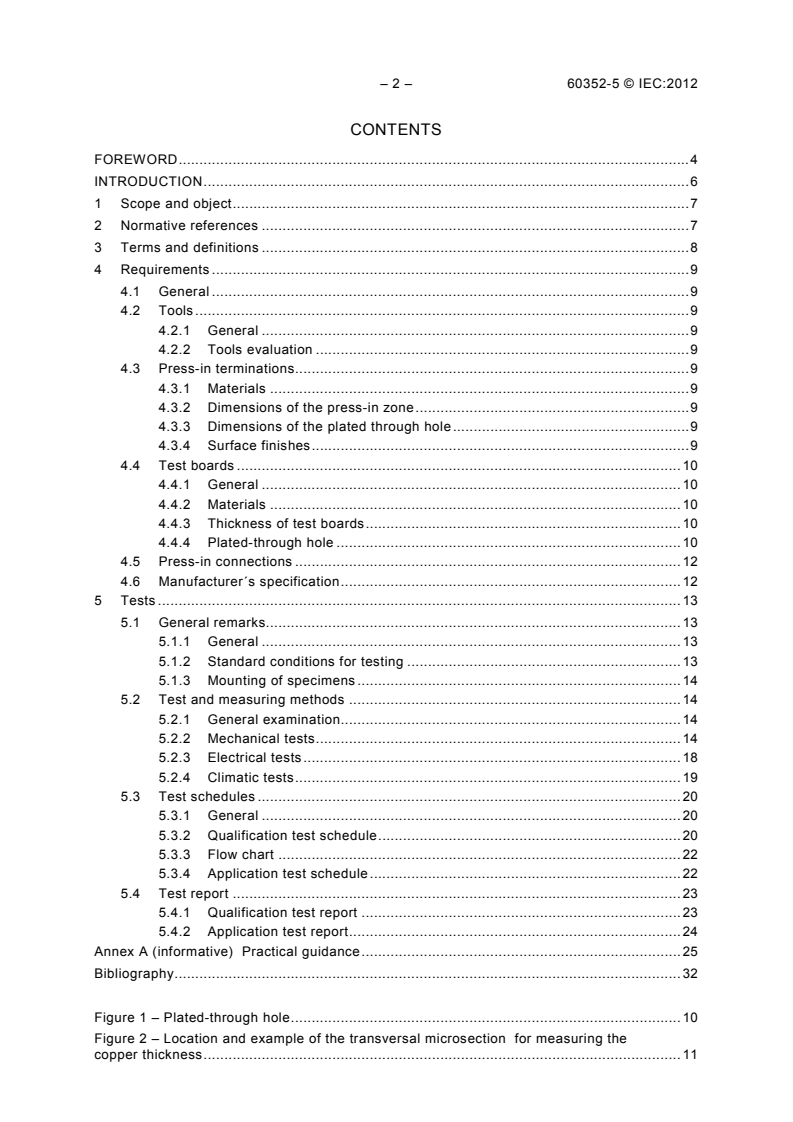
– 2 – 60352-5 © IEC:2012
CONTENTS
FOREWORD . 4
INTRODUCTION . 6
1 Scope and object . 7
2 Normative references . 7
3 Terms and definitions . 8
4 Requirements . 9
4.1 General . 9
4.2 Tools . 9
4.2.1 General . 9
4.2.2 Tools evaluation . 9
4.3 Press-in terminations. 9
4.3.1 Materials . 9
4.3.2 Dimensions of the press-in zone . 9
4.3.3 Dimensions of the plated through hole . 9
4.3.4 Surface finishes . 9
4.4 Test boards . 10
4.4.1 General . 10
4.4.2 Materials . 10
4.4.3 Thickness of test boards . 10
4.4.4 Plated-through hole . 10
4.5 Press-in connections . 12
4.6 Manufacturer´s specification . 12
5 Tests . 13
5.1 General remarks. 13
5.1.1 General . 13
5.1.2 Standard conditions for testing . 13
5.1.3 Mounting of specimens . 14
5.2 Test and measuring methods . 14
5.2.1 General examination. 14
5.2.2 Mechanical tests . 14
5.2.3 Electrical tests . 18
5.2.4 Climatic tests . 19
5.3 Test schedules . 20
5.3.1 General . 20
5.3.2 Qualification test schedule . 20
5.3.3 Flow chart . 22
5.3.4 Application test schedule . 22
5.4 Test report . 23
5.4.1 Qualification test report . 23
5.4.2 Application test report . 24
Annex A (informative) Practical guidance . 25
Bibliography . 32
Figure 1 – Plated-through hole . 10
Figure 2 – Location and example of the transversal microsection for measuring the
copper thickness . 11
60352-5 © IEC:2012 – 3 –
Figure 3 – Example of hole ranges . 12
Figure 4 – Test arrangement, bending . 15
Figure 5 – Test arrangement – push-out force . 16
Figure 6 – Transverse section of a press-in connection . 17
Figure 7 – Longitudinal section of a press-in connection . 18
Figure 8 – Test arrangement for contact resistance . 19
Figure 9 – Qualification test schedule . 22
Figure A.1 – Example of a termination removal tool . 29
Figure A.2 – Conceptual composition of a four-layer printed circuit-board . 30
Table 1 – Plated-through hole requirements for test boards . 11
Table 2 – Vibration, preferred test severities . 17
Table 3 – Qualification test schedule – Test group A. 20
Table 4 – Qualification test schedule – Test group B. 21
Table 5 – Qualification test schedule – Test group C . 21
Table 6 – Application test schedule – Test group D . 23
Table A.1 – Example for dimensioning the hole . 31
– 4 – 60352-5 © IEC:2012
INTERNATIONAL ELECTROTECHNICAL COMMISSION
____________
SOLDERLESS CONNECTIONS –
Part 5: Press-in connections –
General requirements, test methods and practical guidance
FOREWORD
1) The International Electrotechnical Commission (IEC) is a worldwide organization for standardization comprising
all national electrotechnical committees (IEC National Committees). The object of IEC is to promote
international co-operation on all questions concerning standardization in the electrical and electronic fields. To
this end and in addition to other activities, IEC publishes International Standards, Technical Specifications,
Technical Reports, Publicly Available Specifications (PAS) and Guides (hereafter referred to as “IEC
Publication(s)”). Their preparation is entrusted to technical committees; any IEC National Committee interested
in the subject dealt with may participate in this preparatory work. International, governmental and non-
governmental organizations liaising with the IEC also participate in this preparation. IEC collaborates closely
with the International Organization for Standardization (ISO) in accordance with conditions determined by
agreement between the two organizations.
2) The formal decisions or agreements of IEC on technical matters express, as nearly as possible, an international
consensus of opinion on the relevant subjects since each technical committee has representation from all
interested IEC National Committees.
3) IEC Publications have the form of recommendations for international use and are accepted by IEC National
Committees in that sense. While all reasonable efforts are made to ensure that the technical content of IEC
Publications is accurate, IEC cannot be held responsible for the way in which they are used or for any
misinterpretation by any end user.
4) In order to promote international uniformity, IEC National Committees undertake to apply IEC Publications
transparently to the maximum extent possible in their national and regional publications. Any divergence
between any IEC Publication and the corresponding national or regional publication shall be clearly indicated in
the latter.
5) IEC itself does not provide any attestation of conformity. Independent certification bodies provide conformity
assessment services and, in some areas, access to IEC marks of conformity. IEC is not responsible for any
services carried out by independent certification bodies.
6) All users should ensure that they have the latest edition of this publication.
7) No liability shall attach to IEC or its directors, employees, servants or agents including individual experts and
members of its technical committees and IEC National Committees for any personal injury, property damage or
other damage of any nature whatsoever, whether direct or indirect, or for costs (including legal fees) and
expenses arising out of the publication, use of, or reliance upon, this IEC Publication or any other IEC
Publications.
8) Attention is drawn to the Normative references cited in this publication. Use of the referenced publications is
indispensable for the correct application of this publication.
9) Attention is drawn to the possibility that some of the elements of this IEC Publication may be the subject of
patent rights. IEC shall not be held responsible for identifying any or all such patent rights.
International Standard IEC 60352-5 has been prepared by subcommittee 48B: Connectors, of
IEC technical committee 48: Electromechanical components and mechanical structures for
electronic equipment.
This fourth edition cancels and replaces the third edition published in 2008. This edition
constitutes a technical revision.
This edition includes the following significant technical changes with respect to the previous
edition:
a) Enhancement of Annex A and further application remarks are added.
b) Editorial changes throughout the standard to prevent the document from being
misunderstood as specification for establishing press-in connection in total.
c) Deletion of all tables with hole dimensions. Historically the hole dimensions were
constrained because of the dimensions of the wire wrap and clip connections posts. Since
60352-5 © IEC:2012 – 5 –
these connection technologies are no longer commonly used, the design requirements are
no longer practical.
d) Inclusion of additional figures and one table in 4.4.4 to define tolerance ranges for holes in
test-boards and to illustrate them.
e) Inclusion of a requirement for the thickness of the test-board in 4.4.
The text of this standard is based on the following documents:
FDIS Report on voting
48B/2276/FDIS 48B/2286/RVD
Full information on the voting for the approval of this standard can be found in the report on
voting indicated in the above table.
This publication has been drafted in accordance with the ISO/IEC Directives, Part 2.
The committee has decided that the contents of this publication will remain unchanged until
the stability date indicated on the IEC web site under "http://webstore.iec.ch" in the data
related to the specific publication. At this date, the publication will be
• reconfirmed,
• withdrawn,
• replaced by a revised edition, or
• amended.
The contents of the corrigendum of September 2014 have been included in this copy.
– 6 – 60352-5 © IEC:2012
INTRODUCTION
This part of IEC 60352 includes requirements, tests and practical guidance information.
Two test schedules are provided.
a) The qualification test schedule applies to individual press-in connections (press-in zone).
They are tested to the specification provided by the manufacturer of the press-in
termination (see 4.6) taking into account the requirements of Clause 4.
The qualification is independent of the application of the press-in zone in a component.
b) The application test schedule applies to press-in connections which are part of a
component and are already qualified to the qualification test schedule.
Test sequences focus on the performance of the press-in connection which is affected by
the implementation in a component.
As the manufacturer of the press-in termination has to provide the main part of the information
needed for qualification, the word "manufacturer" is used throughout this standard for
simplicity.
IEC Guide 109 advocates the need to minimise the impact of a product on the natural
environment throughout the product life cycle.
60352-5 © IEC:2012 – 7 –
SOLDERLESS CONNECTIONS –
Part 5: Press-in connections –
General requirements, test methods and practical guidance
1 Scope and object
This part of IEC 60352 is applicable to solderless press-in connections for use in tele-
communication equipment and in electronic devices employing similar techniques.
The press-in connection consists of a termination having a suitable press-in zone which is
inserted into a plated-through hole of a double-sided or multilayer printed board.
Information on materials and data from industrial experience is included in addition to the test
procedures to provide electrically stable connections under prescribed environmental
conditions.
The object of this part of IEC 60352 is to determine the suitability of press-in connections
under mechanical, electrical and atmospheric conditions as specified by the manufacturer of
the press-in termination and to provide a means of comparing test results when the tools used
to make the connections are of different designs or manufacture.
2 Normative references
The following documents, in whole or in part, are normatively referenced in this document and
are indispensable for its application. For dated references, only the edition cited applies. For
undated references, the latest edition of the referenced document (including any
amendments) applies.
IEC 60050(581):2008, International Electrotechnical Vocabulary (IEV) – Part 581:
Electromechanical components for electronic equipment
IEC 60068-1:1988, Environmental testing – Part 1: General and guidance
Amendment 1 (1992)
IEC 60352-1:1997, Solderless connections – Part 1: Wrapped connections – General require-
ments, test methods and practical guidance
IEC 60512 (all parts), Connectors for electronic equipment – Tests and measurements
IEC 60512-1-100, Connectors for electronic equipment – Tests and measurements –
Part 1-100: General – Applicable publications
IEC 61188-5-1: Printed boards and printed board assemblies – Design and use – Part 5-1:
Attachment (land/joint) considerations – Generic requirements
IEC 61249 (all parts), Materials for printed boards and other interconnecting structures
IEC 62326-4:1996, Printed boards – Part 4: Rigid multilayer printed boards with interlayer
connections – Sectional specification
– 8 – 60352-5 © IEC:2012
3 Terms and definitions
For the purposes of this document, the terms and definitions of IEC 60050(581) and
IEC 60512-1 as well as the following apply.
3.1
press-in connection
solderless connection made by inserting a press-in termination into a plated-through hole of a
printed board
[IEC 60050-581: 2008, 581-03-46]
3.2
press-in termination (press-in post)
termination having a specially shaped zone suitable to provide for a solderless press-in
connection
[IEC 60050-581: 2008, 581-03-39]
3.2.1
solid press-in termination
press-in termination having a solid press-in zone which behaves primarily rigid and induces a
elastoplastic deflection of the through hole
[IEC 60050-581: 2008, 581-03-40]
3.2.2
compliant press-in termination
press-in termination having a compliant press-in zone which causes a limited elastoplastic
deflection of the through hole and a elastoplastic deformation of the press-in zone
[IEC 60050-581: 2008, 581-03-41, modified]
3.3
press-in zone
specially shaped section of a press-in termination which is suitable to provide for the press-in
connection
[IEC 60050-581: 2008, 581-03-52]
3.4
termination insertion tool
device used to insert press-in terminations or components equipped with press-in
terminations into a printed board
[IEC 60050-581: 2008, 581-05-22]
3.5
termination removal tool
device for removing a press-in termination from a printed board
[IEC 60050-581: 2008, 581-05-23]
3.6
set of parts
one press-in termination and a test-board with one or more plated-through holes. The press-in
termination is not mounted in the printed board
60352-5 © IEC:2012 – 9 –
3.7
specimen
printed board, or a part of a printed board, with a mounted press-in termination, with or
without a component housing
3.8
manufacturer
manufacturer of the press-in termination, who performs the tests according to this standard
using a test board
4 Requirements
4.1 General
The connections shall be processed in a careful and workmanlike manner, in accordance with
best practice.
4.2 Tools
4.2.1 General
Tools shall be used and inspected according to the instructions and dimensions provided by
the manufacturer.
The tools shall be capable of making uniformly reliable connections.
The tools shall be so designed that they do not damage the press-in termination or the printed
board when correctly operated.
4.2.2 Tools evaluation
Tools are evaluated for performance by testing the connections made by them and carrying
out tests according to 4.5 and 5.1.2. They shall meet the requirements of 4.6d) and 5.2.1.3.
4.3 Press-in terminations
4.3.1 Materials
Material used in the press-in zone shall be specified by the manufacturer.
For information on materials, see A.4.3.
4.3.2 Dimensions of the press-in zone
The performance of a press-in connection depends on the dimensions of the specially shaped
press-in zone and the materials used for the press-in termination together with the dimensions
and materials of the plated-through hole in the printed board.
4.3.3 Dimensions of the plated through hole
The minimum thickness of copper plating of the printed circuit board shall be 25 µm. The
shape and dimensions including the tolerances of the plated through hole shall be specified
by the manufacturer.
4.3.4 Surface finishes
The press-in zone of the press-in termination shall be either unplated or plated. The surface
finish shall be specified by the manufacturer.
– 10 – 60352-5 © IEC:2012
The surface shall be free of detrimental contamination or corrosion.
4.4 Test boards
4.4.1 General
For test purposes test boards according to IEC 61188-5-1 and IEC 62326-4 or to a
specification given by the manufacturer shall be used.
Four layer printed circuit test boards shall be used for testing unless otherwise specified in
the component specification or in the manufacturer’s specification.
4.4.2 Materials
The manufacturer shall specify the types of base material for which the press-in zone is
designed.
Examples of base materials may be found in IEC 61249.
4.4.3 Thickness of test boards
The thickness of the test-board shall be that for which the press-in connection is designed.
When a press-in connection is designed to be used with different board thicknesses, the test
board selected shall be of the thinnest nominal thickness for which the press-in connection is
intended to be used.
NOTE If a press-in connection is designed for board sizes of 1,6 mm to 2,4 mm, a test board with a nominal
thickness of 1,6 mm (within tolerance range) is used.
4.4.4 Plated-through hole
The minimum and the maximum plated hole diameter the press-in connection is intended for
shall be defined by the manufacturer. The tolerance range is then the range between the
minimum and the maximum plated hole diameter.
e
h
f
g
IEC 162/12
Figure 1 – Plated-through hole
The plated-through holes shall fulfil the requirements according to Table 1, where the item
definition follows Figure 1.
60352-5 © IEC:2012 – 11 –
Table 1 – Plated-through hole requirements for test boards
Item according to Description Requirement
Figure 1
Min. hole tolerance range (range a) lower 30 % of the tolerance range
e
Max. hole tolerance range (range b) upper 30 % of the tolerance range
f copper thickness of the tube
min. 25 µm, max. 35 µm
g final plating for information see A.4.3
h pad width min. 0,15 mm
The thickness of the copper tube shall be measured by a transversal microsection through the
hole according to Figure 2. The values of f1 and f2 shall be in the required range of f
according to Table 1.
f2
Location of the microsection
f1
=
=
IEC 163/12
Key
f1 maximal measured value of the copper thickness
f2 minimal measured value of the copper thickness
Figure 2 – Location and example of the transversal microsection
for measuring the copper thickness
NOTE It is important that all holes of a test board have the same thickness of copper plating. The difference of
diameters has therefore to be made via different diameters of the drill tools respective holes in injection moulded
boards. It is recommended to manufacture test boards having both minimal and maximal holes on it, because then
it can be excluded that the holes have different thicknesses of the copper plating under ordinary manufacturing
conditions.
The plated hole tolerance range is the difference between the minimum and the maximum
diameter of the plated hole. For testing of the quality of the termination itself, it is necessary
to perform tests of the contact close to the maximal hole and close to the minimal hole as
well. Measure the holes in the test board and identify which hole diameters are within range a
and also the hole diameters within range b of Figure 3.
The hole diameter ranging is shown in Figure 3.
– 12 – 60352-5 © IEC:2012
Tolerance range
Length scale
Range a ≤ 30 % Range b ≤ 30 %
IEC 164/12
Dimensions in millimetres
NOTE not to scale
Figure 3 – Example of hole ranges
Further plating requirements shall be specified by the manufacturer.
4.5 Press-in connections
a) The combination of press-in termination, printed board and termination insertion tool shall
be compatible and specified by the manufacturer.
b) The press-in termination shall be correctly mounted in the plated-through hole of the
printed board as specified in the specification of the manufacturer.
c) The press-in operation may result in deformation of the plated-through hole. The limits of
deformation shall be according to 5.2.2.5.
d) The press-in termination shall not be damaged (e.g. cracked or bent).
e) There shall be no deformation of the printed conductor and/or the plating of the plated-
through hole caused by the termination insertion tool or device.
f) There shall be no lands fractured or lifted.
g) There shall be no delamination, blistering or cracking of layers.
h) After the press-in operation, no detrimental plating particle chips shall be visible.
i) At the opposite side of the press-in direction, no plating of the plated-through hole shall be
loosened.
4.6 Manufacturer´s specification
The following information shall be supplied by the manufacturer of the press-in zone and/or
the component:
a) Printed board and hole information
– printed board material;
– maximum number of conductive layers;
– printed board minimum and maximum thickness;
– printed board plating materials;
– finished plated-through hole dimensions, including tolerances;
Lower limit
Range a limit
Range b limit
Upper limit
60352-5 © IEC:2012 – 13 –
– hole dimension prior to plating.
b) Press-in zone information
– material of the press-in termination;
– plating.
c) Information on the application
– straight or right angle termination;
– rear plug up;
– wrapped connection;
– individual press-in termination;
– connector with pre-assembled press-in terminations.
d) Instructions and tools for the press-in operation
– tools to be used;
– number of replacements with a new press-in termination.
e) Forces
– maximum press-in force per termination;
– minimum push-out force per termination after tests.
f) Any other significant information.
5 Tests
5.1 General remarks
5.1.1 General
As explained in the introduction, there are two test schedules which shall be applied
according to the following conditions.
a) Press-in connections, according to the requirements in Clause 4 and the requirements in
the manufacturer’s specification, shall be tested in accordance with the qualification test
schedule in 5.3.2.
This test schedule is intended to be applied on individual press-in terminations without
component housing.
b) Press-in connections which are part of a component and already qualified to the
qualification test schedule shall be tested in accordance with the application test schedule
in 5.3.4.
This test schedule is intended to be applied on complete components consisting of
multiple press-in terminations mounted in a component housing.
The application test schedule shall be implemented in the detail standard of the component in
such a way that the duplication of tests may be avoided.
Therefore, the test phases in test group D (see 5.3.4.1) may be inserted in any test group of
the component specification, as long as the sequence, conditioning and environment comply
with the requirements of this standard.
5.1.2 Standard conditions for testing
5.1.2.1 General
Unless otherwise specified, all tests shall be carried out under standard conditions for testing
as specified in IEC 60512-1.
– 14 – 60352-5 © IEC:2012
The ambient temperature and the relative humidity at which the measurements are made shall
be stated in the test report.
In case of dispute about test results, the test shall be repeated at one of the referee
conditions of IEC 60068-1.
5.1.2.2 Preconditioning
Unless otherwise specified, the connections shall be preconditioned under standard
conditions for testing in accordance with the requirements of IEC 60512-1 for a minimum
period of 24 h.
5.1.2.3 Recovery
Unless otherwise specified, the specimens shall be allowed to recover under standard
conditions for testing for a period of a minimum of 2 h after conditioning.
5.1.3 Mounting of specimens
For the qualification test schedule, the sets of parts consist of press-in terminations and a test
board with plated-through holes. When mounting is required in a test, the parts shall be
mounted using the mounting method described in the manufacturer’s specification.
For the application test schedule, complete components shall be pressed on a printed board,
using the normal mounting method, unless otherwise specified in the component specification
or in the manufacturer’s specification.
NOTE For the definitions of sets of parts and specimen, see 3.6 and 3.7.
5.2 Test and measuring methods
NOTE As far as test methods are described in this subclause, it is intended that the description be replaced by a
reference to IEC 60512 as soon as the relevant test method is included in IEC 60512.
5.2.1 General examination
5.2.1.1 Visual examination of parts and specimens
The test shall be carried out in accordance with IEC 60512, test 1a. Magnification shall be five
times, and all parts and specimens shall be examined to ensure that the applicable
requirements of 4.5 have been met.
5.2.1.2 Examination of dimensions
The test shall be carried out in accordance with IEC 60512, test 1b. All parts shall be
examined to ensure that the applicable requirements of 4.3 to 4.6 have been met.
5.2.1.3 Inspection of tools
The tools shall be inspected and controlled according to the manufacturer’s instructions and
specifications to be sure that the applicable requirements of 4.2 and 4.6 have been met.
5.2.2 Mechanical tests
5.2.2.1 Bending
This test is only applicable to press-in terminations having a free post length of ≥10 mm
protruding from the board.
60352-5 © IEC:2012 – 15 –
The object of this test is to assess the ability of a press-in connection to withstand the
mechanical stress caused by an unintentional bending of the free length of the termination
and following adjustment.
The test specimen shall consist of a printed board or a part of a printed board, with an
inserted press-in termination having a free post length of ≥ 10 mm for bending.
15°
15°
IEC 165/12
Figure 4 – Test arrangement, bending
The free end of one press-in termination shall be bent in one direction and the free end of a
second press-in termination shall be bent in the perpendicular direction. Bending over
distances 1, 2 and 3 shall be considered to be one cycle as shown in Figure 4.
Test severity: One cycle shall be carried out unless otherwise specified by the manufacturer.
5.2.2.2 Press-in force
The upper limit of the press-in force shall be specified by the manufacturer.
The recommended speed for application of the press-in force during measurement shall be
25 mm/min to 50 mm/min unless otherwise specified by the manufacturer.
5.2.2.3 Push-out force
This test is only applicable in the qualification test schedule.
The object of this test is to check the minimum value and assess the ability of a press-in
connection to withstand the mechanical stress caused by a force acting along the longitudinal
axis of the press-in termination.
The test specimen shall consist of a test-board with a press-in termination inserted as shown
in Figure 5.
After the press-in operation and before carrying out the push-out test, the test specimens
shall be allowed to recover for a period of at least 24 h.
– 16 – 60352-5 © IEC:2012
Printed board
Push-out device
Press-in termination
F
Push-out direction Press-in direction
IEC 166/12
Figure 5 – Test arrangement – push-out force
A force F shall be applied to the press-in termination against the press-in direction.
A suitable device shall be used, for example a tensile testing machine. The head of the tensile
testing machine shall travel steadily at a speed < 12 mm/min.
The specimen shall be tested until the press-in termination moves in the plated-through hole
of the printed board. The ultimate load shall be measured.
Where, for technical reasons, when carrying out the push-out test, the push-out operation
cannot be applied, a pull-out operation may be applied.
For information on additional mechanical stresses acting on the press-in termination due to
the application of the press-in connection, see A.6.1.
5.2.2.4 Vibration
This test is only applicable in the application test schedule.
The test shall be carried out in accordance with IEC 60512, test 6d.
The test specimens shall be firmly held on a vibration table.
A suitable test arrangement for testing press-in connections shall be defined in the component
specification.
Preferred severities are given in Table 2.
Contact disturbance shall be monitored during vibration test in accordance with IEC 60512,
test 2e.
Requirement: No contact disturbance exceeding 1 µs unless otherwise specified in the
applicable detail standard of the component.
60352-5 © IEC:2012 – 17 –
Table 2 – Vibration, preferred test severities
Range of frequency 10 Hz to 55 Hz 10 Hz to 500 Hz 10 Hz to 2 000 Hz
Full duration +5 +5 +5
2 h min 6 h min 6 h min
0 0 0
Displacement amplitude below
0,35 mm 0,35 mm 1,5 mm
the cross-over frequency
Acceleration amplitude above
2 2
– 50 m/s 200 m/s
the cross-over frequency
Directions Three axes Three axes Three axes
Number of sweep cycles per direction 8 10 8
Unless otherwise specified in the relevant component detail standard, the 10 Hz to 500 Hz
range shall be carried out.
5.2.2.5 Microsectioning
5.2.2.5.1 General
The test shall be carried out in accordance with IEC 61188-5-1.
5.2.2.5.2 Transverse sectioning
The deformation "a" of the drilled hole contour in the plated-through hole shall be smaller than
70 µm.
The minimum remaining thickness "b" of the plating shall be more than 8 µm. There shall be
no cracks in the plating of the through hole. See Figure 6. Compliance is checked by
inspection and measurement.
Press-in
b
direction
Measurement of
the deformation
Location of the
microsection
a
Original hole
contour
IEC 167/12
Dimensions in millimetres
Figure 6 – Transverse section of a press-in connection
5.2.2.5.3 Longitudinal sectioning
The deformation "c" of the connected pattern to the plated-through hole shall be not more
than 50 µm (see Figure 7).
Neither the plating of the plated-through hole nor the conductor may have cracks ("d"). For
double-sided printed boards, these requirements are applicable to the outer layers.
+0,2
0,3
–0,1
– 18 – 60352-5 © IEC:2012
Compliance is checked by inspection, measurement and visual examination according to
5.2.1.1. The measurement shall be recorded.
Press-in zone
d
Printed board
IEC 168/12
Figure 7 – Longitudinal section of a press-in connection
The area of contact between the press-in zone and the hole shall be appropriate to carry the
specified current.
5.2.2.6 Replacement (repairing)
The manufacturer shall specify if replacement is allowed and, if so, the number of replace-
ments allowed. The test of the ability of a press-in zone to withstand replacement and its
possibility to show equal performance is made by having a part of the press-in zone replaced.
Replacement is always carried out with new press-in terminations, using the tools specified by
the manufacturer. All requirements are identical to those applicable to the first press-in cycle.
The repaired sets of parts shall be inspected. No loose parts of metal or cracks in the board
layer or conductors shall be visible.
If the component allows the replacement of the press-in termination, the operation and the
tools shall be specified by the manufacturer of the component or a detail standard.
5.2.3 Electrical tests
5.2.3.1 Contact resistance
The contact resistance test shall be carried out in accordance with IEC 60512, test 2a. Care
shall be taken regarding the resolution of the micro-voltmeter as well as corrections for
thermo-electrical voltage. The measuring points should be made as close as possible to
minimize the bulk resistance.
Figure 8 shows an example of the test arrangement.
c
60352-5 © IEC:2012 – 19 –
Press-in zone Printed board
µV mA
IEC 169/12
Figure 8 – Test arrangement for contact resistance
Requirements after mechanical, electrical or climatic conditioning:
a) Qualification test schedule: The maximum change of contact resistance shall be less
than 0,5 mΩ for each test phase.
b) Application test schedule: The maximum change of contact resistance shall be
specified in the component detail standard, if any, or in the
manufacturer’s specification.
If necessary, when direct measurement of press-in connection is not possible, an overall
measurement of contact resistance shall be specified and the requirement for the press-in
connection shall be included in the value required for the component.
5.2.4 Climatic tests
5.2.4.1 General
The detail standard of the component, if any, or the manufacturer’s specification shall
prescribe the upper category temperature (UCT) and the lower category temperature (LCT)
which shall be used in the following tests.
When the printed board associated with this component has a different temperature category,
the climatic test shall be carried out with the temperature category either of the component, or
the printed board, whichever is the less severe.
5.2.4.2 Rapid change of temperature
The test shall be carried out in accordance with IEC 60512, test 11d. Unless otherwise
specified by the manufacturer of the component or a detail standard, the following details
shall apply:
– low temperature T –40 °C (LCT)
A
– high temperature T 85 °C (UCT)
B
– duration of exposure t 30 min
– number of cycles 10
5.2.4.3 Climatic sequence
The test shall be carried out in accordance with IEC 60512, test 11a. Unless otherwise
specified by the manufacturer of the component or a detail standard, the following details
shall apply:
– dry heat, test temperature 85 °C (UCT)
– cold, test temperature –40 °C (LCT)
– damp heat, cyclic, remaining cycles 5
– 20 – 60352-5 © IEC:2012
5.2.4.4 Dry heat
The test shall be carried out in accordance with IEC 60512, test 11i. Unless otherwise
specified by the manufacturer of the component or a detail standard, the following details
shall apply:
– test temperature 85 °C (UCT)
– test duration 1 000 h
5.3 Test schedules
5.3.1 General
If the press-in zone shall be qualified for more than one type of printed board (see 4.4.2),
there shall be one complete set of specimens for each type.
Samples shall be subjected to usual manufacturing processes an
...