


IEC 60050-393:2003
(Main)International Electrotechnical Vocabulary (IEV) - Part 393: Nuclear instrumentation - Physical phenomena and basic concepts
General Information
- Abstract
Gives the general terminology used in physical phenomena and basic concepts of nuclear instrumentation. It has the status of a horizontal standard in accordance with IEC Guide 108.
- Status
- Replaced
- Publication Date
- 18-Aug-2003
- Technical Committee
- TC 1 - Terminology
- Drafting Committee
- AG 1 - TC 1/AG 1
- Current Stage
- DELPUB - Deleted Publication
- Start Date
- 31-Mar-2014
- Completion Date
- 28-Aug-2026

Relations
- Effective Date
- 05-Sep-2023
- Effective Date
- 25-Aug-2026
- Effective Date
- 10-Feb-2026
- Effective Date
- 10-Feb-2026
- Effective Date
- 10-Feb-2026
- Effective Date
- 10-Feb-2026
- Effective Date
- 10-Feb-2026
- Effective Date
- 10-Feb-2026
- Effective Date
- 10-Feb-2026
- Effective Date
- 10-Feb-2026
- Effective Date
- 10-Feb-2026
- Referred By
EN 60861:2008 - Equipment for monitoring of radionuclides in liquid effluents and surface waters - Effective Date
- 10-Feb-2026
- Effective Date
- 10-Feb-2026
- Effective Date
- 10-Feb-2026
- Effective Date
- 10-Feb-2026
Get Certified
Connect with accredited certification bodies for this standard

IMQ S.p.A. (Certification)
Italian electrical product certification.

SLG Prüf- und Zertifizierungs GmbH
German testing and certification body.

UL Solutions
Global safety science company with testing, inspection and certification.
Sponsored listings
Frequently Asked Questions
IEC 60050-393:2003 is a standard published by the International Electrotechnical Commission (IEC). Its full title is "International Electrotechnical Vocabulary (IEV) - Part 393: Nuclear instrumentation - Physical phenomena and basic concepts". This standard covers: Gives the general terminology used in physical phenomena and basic concepts of nuclear instrumentation. It has the status of a horizontal standard in accordance with IEC Guide 108.
Gives the general terminology used in physical phenomena and basic concepts of nuclear instrumentation. It has the status of a horizontal standard in accordance with IEC Guide 108.
IEC 60050-393:2003 is classified under the following ICS (International Classification for Standards) categories: 01.040.17 - Metrology and measurement. Physical phenomena (Vocabularies); 17.240 - Radiation measurements; 29.020 - Electrical engineering in general. The ICS classification helps identify the subject area and facilitates finding related standards.
IEC 60050-393:2003 has the following relationships with other standards: It is inter standard links to IEC 60050-395:2014, EN 13477-2:2010, EN 62533:2016, EN 61577-4:2014, EN 62694:2016, EN 61526:2007, EN 62618:2016, EN 62534:2015, EN 62387-1:2012, EN 61526:2013, EN 61098:2007, EN 60861:2008, EN 62484:2015, EN 62244:2011, EN 62467-1:2015. Understanding these relationships helps ensure you are using the most current and applicable version of the standard.
IEC 60050-393:2003 is available in PDF format for immediate download after purchase. The document can be added to your cart and obtained through the secure checkout process. Digital delivery ensures instant access to the complete standard document.
Standards Content (Sample)
NORME CEI
INTERNATIONALE IEC
60050-393
INTERNATIONAL
Deuxième édition
STANDARD
Second edition
2003-08
Vocabulaire Electrotechnique International
Partie 393:
Instrumentation nucléaire –
Phénomènes physiques et notions fondamentales
International Electrotechnical Vocabulary
Part 393:
Nuclear instrumentation –
Physical phenomena and basic concepts
Numéro de référence
Reference number
CEI/IEC 60050-393:2003
NORME CEI
INTERNATIONALE IEC
60050-393
INTERNATIONAL
Deuxième édition
STANDARD
Second edition
2003-08
Vocabulaire Electrotechnique International
Partie 393:
Instrumentation nucléaire –
Phénomènes physiques et notions fondamentales
International Electrotechnical Vocabulary
Part 393:
Nuclear instrumentation –
Physical phenomena and basic concepts
IEC 2003 Droits de reproduction réservés Copyright - all rights reserved
Aucune partie de cette publication ne peut être reproduite ni No part of this publication may be reproduced or utilized in any
utilisée sous quelque forme que ce soit et par aucun procédé, form or by any means, electronic or mechanical, including
électronique ou mécanique, y compris la photocopie et les photocopying and microfilm, without permission in writing from
microfilms, sans l'accord écrit de l'éditeur. the publisher.
International Electrotechnical Commission, 3, rue de Varembé, PO Box 131, CH-1211 Geneva 20, Switzerland
Telephone: +41 22 919 02 11 Telefax: +41 22 919 03 00 E-mail: inmail@iec.ch Web: www.iec.ch
CODE PRIX
Commission Electrotechnique Internationale PRICE CODE XH
International Electrotechnical Commission
Международная Электротехническая Комиссия
Pour prix, voir catalogue en vigueur
For price, see current catalogue
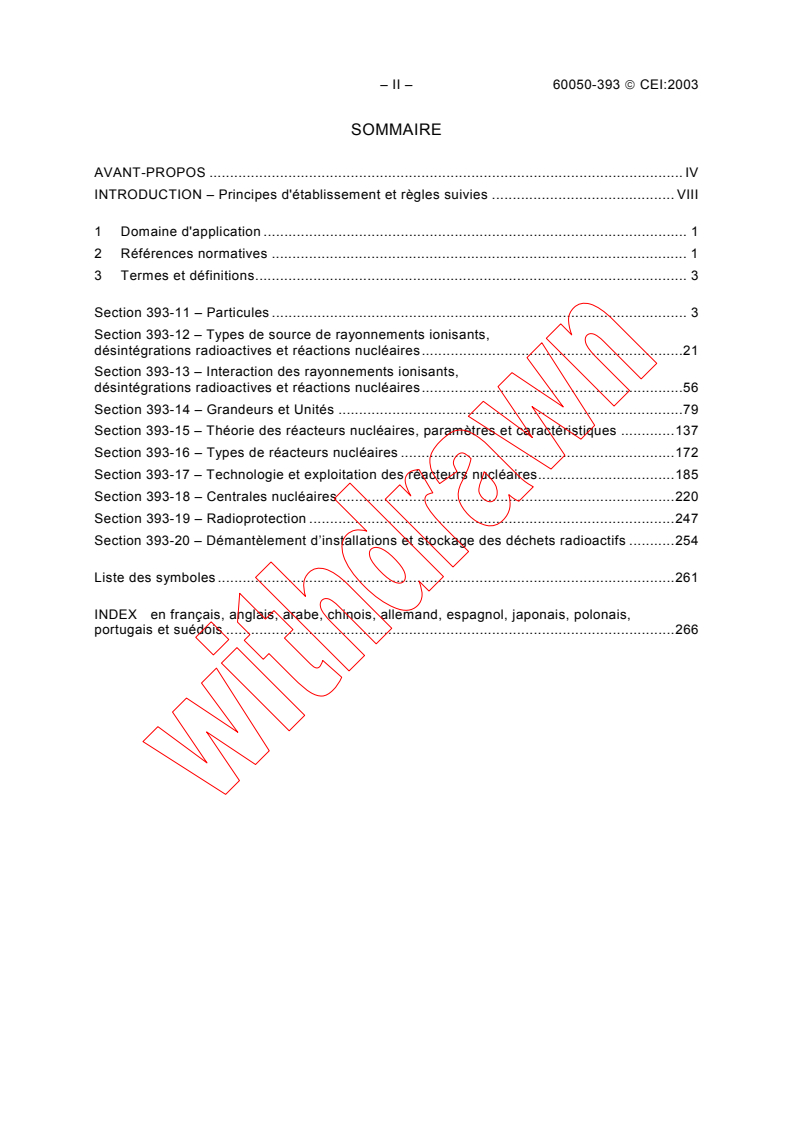
– II – 60050-393 CEI:2003
SOMMAIRE
AVANT-PROPOS . IV
INTRODUCTION – Principes d'établissement et règles suivies . VIII
1 Domaine d'application . 1
2 Références normatives . 1
3 Termes et définitions. 3
Section 393-11 – Particules . 3
Section 393-12 – Types de source de rayonnements ionisants,
désintégrations radioactives et réactions nucléaires.21
Section 393-13 – Interaction des rayonnements ionisants,
désintégrations radioactives et réactions nucléaires.56
Section 393-14 – Grandeurs et Unités .79
Section 393-15 – Théorie des réacteurs nucléaires, paramètres et caractéristiques .137
Section 393-16 – Types de réacteurs nucléaires .172
Section 393-17 – Technologie et exploitation des réacteurs nucléaires.185
Section 393-18 – Centrales nucléaires.220
Section 393-19 – Radioprotection .247
Section 393-20 – Démantèlement d’installations et stockage des déchets radioactifs .254
Liste des symboles .261
INDEX en français, anglais, arabe, chinois, allemand, espagnol, japonais, polonais,
portugais et suédois .266
60050-393 IEC:2003 – III –
CONTENTS
FOREWORD . V
INTRODUCTION – Principles and rules followed. IX
1 Scope . 2
2 Normative references. 2
3 Terms and definitions. 3
Section 393-11 – Particles .3
Section 393-12 – Types of sources of ionizing radiation,
radioactive disintegrations and nuclear reactions .21
Section 393-13 – Interaction of ionizing radiation,
radioactive disintegrations and nuclear reactions .56
Section 393-14 – Quantities and Units .79
Section 393-15 – Nuclear reactor theory, parameters and characteristics .137
Section 393-16 – Types of nuclear reactors .172
Section 393-17 – Technology and operation of nuclear reactors .185
Section 393-18 – Nuclear power plants .220
Section 393-19 – Radiation protection.247
Section 393-20 – Dismantling of installations and radioactive waste storage.254
List of symbols .261
INDEX in French, English, Arabic, Chinese, German, Spanish, Japanese, Polish,
Portuguese and Swedish .266
– IV – 60050-393 CEI:2003
COMMISSION ÉLECTROTECHNIQUE INTERNATIONALE
____________
VOCABULAIRE ÉLECTROTECHNIQUE INTERNATIONAL
PARTIE 393: INSTRUMENTATION NUCLÉAIRE –
PHÉNOMÈNES PHYSIQUES ET NOTIONS FONDAMENTALES
AVANT-PROPOS
1) La Commission Electrotechnique Internationale (CEI) est une organisation mondiale de normalisation composée
de l'ensemble des comités électrotechniques nationaux (Comités nationaux de la CEI). La CEI a pour objet de
favoriser la coopération internationale pour toutes les questions de normalisation dans les domaines de
l'électricité et de l'électronique. A cet effet, la CEI – entre autres activités – publie des Normes internationales,
des Spécifications techniques, des Rapports techniques et des Guides (ci-après dénommés "Publication(s) de
la CEI"). Leur élaboration est confiée à des comités d'études, aux travaux desquels tout Comité national
intéressé par le sujet traité peut participer. Les organisations internationales, gouvernementales et non
gouvernementales, en liaison avec la CEI, participent également aux travaux. La CEI collabore étroitement avec
l'Organisation Internationale de Normalisation (ISO), selon des conditions fixées par accord entre les deux
organisations.
2) Les décisions ou accords officiels de la CEI concernant les questions techniques représentent, dans la mesure
du possible, un accord international sur les sujets étudiés, étant donné que les Comités nationaux de la CEI
intéressés sont représentés dans chaque comité d’études.
3) Les Publications de la CEI se présentent sous la forme de recommandations internationales et sont agréées
comme telles par les Comités nationaux de la CEI. Tous les efforts raisonnables sont entrepris afin que la CEI
s'assure de l'exactitude du contenu technique de ses publications; la CEI ne peut pas être tenue responsable de
l'éventuelle mauvaise utilisation ou interprétation qui en est faite par un quelconque utilisateur final.
4) Dans le but d'encourager l'uniformité internationale, les Comités nationaux de la CEI s'engagent, dans toute la
mesure possible, à appliquer de façon transparente les Publications de la CEI dans leurs publications
nationales et régionales. Toutes divergences entre toutes Publications de la CEI et toutes publications
nationales ou régionales correspondantes doivent être indiquées en termes clairs dans ces dernières.
5) La CEI n’a prévu aucune procédure de marquage valant indication d’approbation et n'engage pas sa
responsabilité pour les équipements déclarés conformes à une de ses Publications.
6) Tous les utilisateurs doivent s'assurer qu'ils sont en possession de la dernière édition de cette publication.
7) Aucune responsabilité ne doit être imputée à la CEI, à ses administrateurs, employés, auxiliaires ou
mandataires, y compris ses experts particuliers et les membres de ses comités d'études et des Comités
nationaux de la CEI, pour tout préjudice causé en cas de dommages corporels et matériels, ou de tout autre
dommage de quelque nature que ce soit, directe ou indirecte, ou pour supporter les coûts (y compris les frais
de justice) et les dépenses découlant de la publication ou de l'utilisation de cette Publication de la CEI ou de
toute autre Publication de la CEI, ou au crédit qui lui est accordé.
8) L'attention est attirée sur les références normatives citées dans cette publication. L'utilisation de publications
référencées est obligatoire pour une application correcte de la présente publication.
9) L’attention est attirée sur le fait que certains des éléments de la présente Publication de la CEI peuvent faire
l’objet de droits de propriété intellectuelle ou de droits analogues. La CEI ne saurait être tenue pour
responsable de ne pas avoir identifié de tels droits de propriété et de ne pas avoir signalé leur existence.
La Norme internationale CEI 60050-393 a été établie par le groupe de travail 1: Terminologie –
Classification, du comité d'études 45 de la CEI: Instrumentation nucléaire, sous la
responsabilité du comité d'études 1 de la CEI: Terminologie.
Cette deuxième édition annule et remplace la première édition parue en 1996 et son
amendement 1 (2000).
60050-393 IEC:2003 – V –
INTERNATIONAL ELECTROTECHNICAL COMMISSION
____________
INTERNATIONAL ELECTROTECHNICAL VOCABULARY
PART 393: NUCLEAR INSTRUMENTATION –
PHYSICAL PHENOMENA AND BASIC CONCEPTS
FOREWORD
1) The International Electrotechnical Commission (IEC) is a worldwide organization for standardization comprising
all national electrotechnical committees (IEC National Committees). The object of IEC is to promote
international co-operation on all questions concerning standardization in the electrical and electronic fields. To
this end and in addition to other activities, IEC publishes International Standards, Technical Specifications,
Technical Reports, and Guides (hereafter referred to as “IEC Publication(s)”). Their preparation is entrusted to
technical committees; any IEC National Committee interested in the subject dealt with may participate in this
preparatory work. International, governmental and non-governmental organizations liaising with the IEC also
participate in this preparation. IEC collaborates closely with the International Organization for Standardization
(ISO) in accordance with conditions determined by agreement between the two organizations.
2) The formal decisions or agreements of IEC on technical matters express, as nearly as possible, an international
consensus of opinion on the relevant subjects since each technical committee has representation from all
interested IEC National Committees.
3) IEC Publications have the form of recommendations for international use and are accepted by IEC National
Committees in that sense. While all reasonable efforts are made to ensure that the technical content of IEC
Publications is accurate, IEC cannot be held responsible for the way in which they are used or for any
misinterpretation by any end user.
4) In order to promote international uniformity, IEC National Committees undertake to apply IEC Publications
transparently to the maximum extent possible in their national and regional publications. Any divergence
between any IEC Publication and the corresponding national or regional publication shall be clearly indicated in
the latter.
5) IEC provides no marking procedure to indicate its approval and cannot be rendered responsible for any
equipment declared to be in conformity with an IEC Publication.
6) All users should ensure that they have the latest edition of this publication.
7) No liability shall attach to IEC or its directors, employees, servants or agents including individual experts and
members of its technical committees and IEC National Committees for any personal injury, property damage or
other damage of any nature whatsoever, whether direct or indirect, or for costs (including legal fees) and
expenses arising out of the publication, use of, or reliance upon, this IEC Publication or any other IEC
Publications.
8) Attention is drawn to the Normative references cited in this publication. Use of the referenced publications is
indispensable for the correct application of this publication.
9) Attention is drawn to the possibility that some of the elements of this IEC Publication may be the subject of
patent rights. IEC shall not be held responsible for identifying any or all such patent rights.
International Standard IEC 60050-393 has been prepared by working group 1: Classification –
Terminology, of IEC technical committee 45: Nuclear instrumentation, under the responsibility
of IEC technical committee 1: Terminology.
This second edition cancels and replaces the first edition published in 1996 and its amendment 1
(2000).
– VI – 60050-393 CEI:2003
Le texte de cette norme est issu des documents suivants:
FDIS Rapport de vote
1/1881/FDIS 1/1889/RVD
Le rapport de vote indiqué dans le tableau ci-dessus donne toute information sur le vote ayant
abouti à l'approbation de cette norme.
Cette publication a été rédigée selon les Directives ISO/CEI, Partie 2.
Dans la présente partie du VEI les termes et définitions sont donnés en français et en anglais:
de plus, les termes sont indiqués en arabe (ar), chinois (cn), allemand (de), espagnol (es),
japonais (ja), polonais (pl), portugais (pt) et suédois (sv).
Le comité a décidé que le contenu de cette publication ne sera pas modifié avant 2008. A cette
date, la publication sera
• reconduite;
• supprimée;
• remplacée par une édition révisée, ou
• amendée.
60050-393 IEC:2003 – VII –
The text of this standard is based on the following documents:
FDIS Report on voting
1/1881/FDIS 1/1889/RVD
Full information on the voting for the approval of this standard can be found in the report on
voting indicated in the above table.
This publication has been drafted in accordance with the ISO/IEC Directives, Part 2.
In this part of IEV, the terms and definitions are written in French and English; in addition the terms
are given in Arabic (ar), Chinese (cn), German (de), Spanish (es), Japanese (ja), Polish (pl),
Portuguese (pt) and Swedish (sv).
The committee has decided that the contents of this publication will remain unchanged until 2008.
At this date, the publication will be
• reconfirmed;
• withdrawn;
• replaced by a revised edition, or
• amended.
– VIII – 60050-393 CEI:2003
INTRODUCTION
Principes d'établissement et règles suivies
Généralités
Le VEI (série CEI 60050) est un vocabulaire multilingue à usage général couvrant le champ de
l'électrotechnique, de l'électronique et des télécommunications. Il comprend des articles
terminologiques correspondant chacun à une notion. Ces articles sont répartis dans des
parties, chacune correspondant à un domaine donné.
Exemples:
Partie 161 (CEI 60050-161): Compatibilité électromagnétique
Partie 411 (CEI 60050-411): Machines tournantes
Les articles suivent un schéma de classification hiérarchique Partie/Section/Notion, les notions
étant, au sein des sections, classées par ordre systématique.
Les termes, définitions et notes des articles sont en anglais et en français. Voire également
en russe et en espagnol dans quelques parties.
Dans chaque article, les termes seuls sont également donnés, si disponibles, dans les langues
additionnelles du VEI: l'arabe, le chinois, l'allemand, l'espagnol, l'italien, le japonais, le
néerlandais, le polonais, le portugais, le russe et le suédois.
De plus, chaque partie comprend un index alphabétique des termes inclus dans cette partie,
et ce pour chacune des langues du VEI.
Constitution d'un article terminologique
Chacun des articles correspond à une notion, et comprend:
– un numéro d'article,
– éventuellement un symbole littéral de grandeur ou d'unité,
puis, pour chaque langue principale du VEI:
– le terme désignant la notion, appelé «terme privilégié», éventuellement accompagné de
synonymes et d'abréviations,
–la définition de la notion,
– éventuellement la source,
– éventuellement des notes,
et enfin, pour les langues additionnelles du VEI, les termes seuls.
Numéro d'article
Le numéro d'article comprend trois éléments, séparés par des traits d'union:
– Numéro de partie: 3 chiffres,
– Numéro de section: 2 chiffres,
– Numéro de la notion: 2 chiffres (01 à 99).
Exemple: 151-13-82
60050-393 IEC:2003 – IX –
INTRODUCTION
Principles and rules followed
General
The IEV (IEC 60050 series) is a general-purpose multilingual vocabulary covering the field of
electrotechnology, electronics and telecommunication. It comprises terminological entries, each
corresponding to a concept. These entries are distributed in several parts, each part
corresponding to a given field.
Examples:
Part 161 (IEC 60050-161): Electromagnetic compatibility
Part 411 (IEC 60050-411): Rotating machines
The entries follow a hierarchical classification scheme Part/Section/Concept, the concepts
being, within the sections, organized in a systematic order.
The terms, definitions and notes in the entries are given in English and French. Some are also
available in Russian and Spanish.
In each entry the terms alone are also given in the additional IEV languages, wherever available:
Arabic, Chinese, German, Spanish, Italian, Japanese, Dutch, Polish, Portuguese, Russian and
Swedish.
In addition, each part comprises an alphabetical index of the terms included in that part, for
each of the IEV languages.
Organization of a terminological entry
Each of the entries corresponds to a concept, and comprises:
– an entry number,
– possibly a letter symbol for quantity or unit,
then, for each of the principal IEV languages:
– the term designating the concept, called "preferred term", possibly accompanied by
synonyms and abbreviations,
– the definition of the concept,
– possibly the source,
– possibly notes,
and finally, for the additional IEV languages, the terms alone.
Entry number
The entry number is comprised of three elements, separated by hyphens:
– Part number: 3 digits,
– Section number: 2 digits,
– Concept number: 2 digits (01 to 99).
Example: 151-13-82
– X – 60050-393 CEI:2003
Symboles littéraux de grandeurs et unités
Ces symboles, indépendants de la langue, sont donnés sur une ligne séparée suivant le
numéro d'article.
Exemple:
131-11-22
symb.: R
résistance, f
Terme privilégié et synonymes
Le terme privilégié est le terme qui figure en tête d'un article; il peut être suivi de synonymes. Il
est imprimé en gras.
Synonymes:
Les synonymes sont imprimés sur des lignes séparées sous le terme privilégié: ils sont
également imprimés en gras, sauf les synonymes déconseillés, qui sont imprimés en maigre,
et suivis par l'attribut «(déconseillé)».
Parties pouvant être omises:
Certaines parties d'un terme peuvent être omises, soit dans le domaine considéré, soit dans un
contexte approprié. Ces parties sont alors imprimées en gras, entre parenthèses:
Exemple: émission (électromagnétique)
Absence de terme approprié:
Lorsqu'il n'existe pas de terme approprié dans une langue, le terme privilégié est remplacé par
cinq points, comme ceci:
.....
« » (et il n'y a alors bien entendu pas de synonymes).
Attributs
Chaque terme (ou synonyme) peut être suivi d'attributs donnant des informations supplé-
mentaires; ces attributs sont imprimés en maigre, à la suite de ce terme, et sur la même ligne.
Exemples d'attributs:
– spécificité d'utilisation du terme:
rang (d'un harmonique)
– variante nationale:
unité de traitement CA
– catégorie grammaticale:
électronique, adj
électronique, f
– abréviation: CEM (abréviation)
– déconseillé: déplacement (terme déconseillé)
60050-393 IEC:2003 – XI –
Letter symbols for quantities and units
These symbols, which are language independent, are given on a separate line following the
entry number.
Example:
131-11-22
symb.: R
resistance
Preferred term and synonyms
The preferred term is the term that heads a terminological entry; it may be followed by
synonyms. It is printed in boldface.
Synonyms:
The synonyms are printed on separate lines under the preferred term: they are also printed in
boldface, excepted for deprecated synonyms, which are printed in lightface, and followed by
the attribute "(deprecated)".
Parts that may be omitted:
Some parts of a term may be omitted, either in the field under consideration or in an
appropriate context. Such parts are printed in boldface type, and placed in parentheses:
Example: (electromagnetic) emission
Absence of an appropriate term:
When no adequate term exists in a given language, the preferred term is replaced by five dots,
like this:
.....
" " (and there are of course no synonyms).
Attributes
Each term (or synonym) may be followed by attributes giving additional information, and printed
on the same line as the corresponding term, following this term.
Examples of attributes:
– specific use of the term:
transmission line (in electric power systems)
– national variant: lift GB
– grammatical information:
thermoplastic, noun
AC, qualifier
– abbreviation: EMC (abbreviation)
– deprecated: choke (deprecated)
– XII – 60050-393 CEI:2003
Source
Dans certains cas il a été nécessaire d'inclure dans une partie du VEI une notion prise dans
une autre partie du VEI, ou dans un autre document de terminologie faisant autorité
(VIM, ISO/CEI 2382, etc.), dans les deux cas avec ou sans modification de la définition
(ou éventuellement du terme).
Ceci est indiqué par la mention de cette source, imprimée en maigre, et placée entre crochets
à la fin de la définition:
Exemple: [131-03-13 MOD]
(MOD indique que la définition a été modifiée)
Termes dans les langues additionnelles du VEI
Ces termes sont placés à la fin de l'article, sur des lignes séparées (une ligne par langue),
précédés par le code alpha-2 de la langue, défini dans l'ISO 639, et dans l'ordre alphabétique
de ce code. Les synonymes sont séparés par des points-virgules.
60050-393 IEC:2003 – XIII –
Source
In some cases, it has been necessary to include in an IEV part a concept taken from another
IEV part, or from another authoritative terminology document (VIM, ISO/IEC 2382, etc.), in both
cases with or without modification to the definition (and possibly to the term).
This is indicated by the mention of this source, printed in lightface, and placed between square
brackets at the end of the definition.
Example: [131-03-13 MOD]
(MOD indicates that the definition has been modified)
Terms in additional IEV languages
These terms are placed at the end of the entry, on separate lines (one single line for each
language), preceded by the alpha-2 code for the language defined in ISO 639, and in the
alphabetic order of this code. Synonyms are separated by semicolons.
– 1 – 60050-393 CEI:2003
VOCABULAIRE ÉLECTROTECHNIQUE INTERNATIONAL
PARTIE 393: INSTRUMENTATION NUCLÉAIRE –
PHÉNOMÈNES PHYSIQUES ET NOTIONS FONDAMENTALES
1 Domaine d'application
Cette partie de la CEI 60050 donne la terminologie générale utilisée dans le domaine des
phénomènes physiques et notions fondamentales en instrumentation nucléaire. La terminologie
relative aux instruments (en instrumentation nucléaire) est développée dans une autre partie
du VEI.
Cette terminologie est en accord avec la terminologie figurant dans les autres parties
spécialisées du VEI.
2 Références normatives
Les documents de référence suivants sont indispensables pour l'application du présent
document. Pour les références datées, seule l'édition citée s'applique. Pour les références non
datées, la dernière édition du document de référence s'applique (y compris les éventuels
amendements).
CEI 60027-1:1992, Symboles littéraux à utiliser en électrotechnique – Partie 1: Généralités
CEI 60050-111:1996, Vocabulaire Électrotechnique International – Partie 111: Physique et
chimie
CEI 60050-531:1974, Vocabulaire Électrotechnique International – Partie 531: Tubes électroniques
CEI 60050-881:1983, Vocabulaire Électrotechnique International – Partie 881: Radiologie et
physique radiologique
ISO 31:1992, Grandeurs et unités
ISO 921:1997, Energie nucléaire – Vocabulaire
IAEA_1: Safety of nuclear requirements: Safety Standards Series N° NS-R-1
IAEA_2: Instrumentation and control systems important to safety in NPP. Working ID NS 252
November 1999
IAEA_3: Terminology used in Nuclear, Radiation, Radioactive Waste and Transport Safety
Version 1.0 – April 2000
60050-393 IEC:2003 – 2 –
INTERNATIONAL ELECTROTECHNICAL VOCABULARY
PART 393: NUCLEAR INSTRUMENTATION –
PHYSICAL PHENOMENA AND BASIC CONCEPTS
1 Scope
This part of IEC 60050 gives the general terminology used in physical phenomena and basic
concepts of nuclear instrumentation. The terminology related to instruments (in nuclear
instrumentation) is developed in another part of IEV.
This terminology is consistent with the terminology developed in other specialized parts of the
IEV.
2 Normative references
The following referenced documents are indispensable for the application of this document. For
dated references, only the edition cited applies. For undated references, the latest edition of
the referenced document (including any amendments) applies.
IEC 60027-1:1992, Letter symbols to be used in electrical technology – Part 1: General
IEC 60050-111:1996, International Electrotechnical Vocabulary – Part 111: Physics and
chemistry
IEC 60050-531:1974, International Electrotechnical Vocabulary – Part 531: Electronic tubes
IEC 60050-881:1983, International Electrotechnical Vocabulary – Part 881: Radiology and
radiological physics
ISO 31:1992, Quantities and units
ISO 921:1997, Nuclear energy – Vocabulary
IAEA_1: Safety of nuclear requirements: Safety Standards Series N° NS-R-1
IAEA_2: Instrumentation and control systems important to safety in NPP. Working ID NS 252
November 1999
IAEA_3: Terminology used in Nuclear, Radiation, Radioactive Waste and Transport Safety
Version 1.0 – April 2000
– 3 – 60050-393 CEI:2003
3 Termes et définitions
3 Terms and definitions
Section 393-11 – Particules
Section 393-11 – Particles
393-11-01
particule, f
partie infime de matière ou d’énergie
[111-14-01]
particle
very small portion of matter or energy
[111-14-01]
ar ﻢﻴ���ﺴﺟ
cn 粒子粒子粒子粒子
de Teilchen, n
es partícula
ja 粒子粒粒子粒子子(1)
pl cząstka
pt partícula
sv partikel
393-11-02
particule élémentaire, f
particule actuellement considérée comme une entité non dissociable, par opposition à celles
qui sont considérées comme des assemblages
[111-14-02] [ISO 921/868]
NOTE Des exemples de particules élémentaires sont l’électron, le positon et le photon. Des exemples
d’assemblages sont les noyaux atomiques et les ions.
elementary particle
particle presently considered to be a non-dissociable entity, as opposed to those which are
considered to be assemblies
[111-14-02] [ISO 921/868]
NOTE Examples of elementary particles are electrons, positrons and photons. Examples of
assemblies are atomic nuclei and ions.
ar ﻲﻟوأ ﻢﻴ��ﺴﺟ
cn 基本粒子基本粒子
基本粒子基本粒子
de Elementarteilchen, n
es partícula elemental
ja 素粒子素粒子素粒子素粒子
pl cząstka elementarna
pt partícula elementar
sv elementarpartikel
60050-393 IEC:2003 – 4 –
393-11-03
antiparticule, f
particule élémentaire ayant la même masse et le même spin que la particule élémentaire
considérée, un nombre quantique opposé et si elle est chargée, une charge électrique de signe
contraire
NOTE 1 Particule élémentaire et antiparticule s'annihilent mutuellement lors d’une interaction.
NOTE 2 Chaque type de particule élémentaire possède son antiparticule, excepté le photon.
antiparticle
elementary particle having the same mass and spin as the given elementary particle, an oppo-
site quantum number, and an electric charge, if it is charged, that is opposite in sign
NOTE 1 Elementary particle and antiparticle annihilate each other when they interact.
NOTE 2 Every type of elementary particle has an antiparticle, except the photon.
ar ﻢﻴﺴﺠﻟا دﺎ���ﻀ ﻣ
cn 反粒子反粒子反粒子反粒子
de Antiteilchen, n
es antipartícula
ja 反粒子反粒子反粒子反粒子
pl przeciwcząstka
pt antipartícula
sv antipartikel
393-11-04
corpuscule, m
particule ayant une masse au repos non nulle
[111-14-03]
corpuscle
particle having a non-zero rest mass
[111-14-03]
ar ﻢﻴ���ﺴﺟ
cn 微粒子微粒子微粒子微粒子
de Korpuskel, n
es corpúsculo
ja 粒子粒粒子粒子子(2)
pl korpuskuła; cząstka (materialna)
pt corpúsculo
sv korpuskel
– 5 – 60050-393 CEI:2003
393-11-05
quantum, m
la plus petite valeur observable physiquement d’une grandeur qui varie d’une façon discrète
selon des multiples de cette valeur
[111-14-04]
quantum
smallest physically observable value of a quantity that changes in a discrete manner by
multiples of the value
[111-14-04]
ar ﻢآ
cn 量子量子量子量子
de Quant, n
es cuanto
ja 量子量子量子量子
pl kwant
pt quantum
sv kvantum
393-11-06
photon, m
quantum de rayonnement électromagnétique, assimilable à une particule élémentaire d’énergie
hν, h étant la constante de Planck et ν la fréquence du rayonnement
[111-14-06] [ISO 921/884]
NOTE Un photon est une particule élémentaire de spin 1 et de masse au repos nulle.
photon
quantum of electromagnetic radiation considered as an elementary particle of energy hν, where
h is the Planck constant and ν the frequency of the radiation
[111-14-06] [ISO 921/884]
NOTE A photon is an elementary particle of spin 1 and having zero rest mass.
ar نﻮ�ﺗﻮ ��ﻓ
cn 光子光子光子光子
de Photon, n
es fotón
ja 光子光子光子光子
pl foton
pt fotão
sv foton
60050-393 IEC:2003 – 6 –
393-11-07
électron, m
particule élémentaire stable de charge électrique négative égale à –e et de masse au repos
–4
égale approximativement à «5,485 8 × 10 u» (1996)
[111-14-11 MOD] [ISO 921/391]
NOTE Charge électrique élémentaire (e) (voir 393-14-07), unité unifiée de masse atomique (u)
(voir 393-14-09).
electron
stable elementary particle with one negative electric charge of –e and a rest mass of
–4
approximately "5,485 8 × 10 u" (1996)
[111-14-11 MOD] [ISO 921/391]
NOTE Elementary electric charge (e) (see 393-14-07), unified atomic mass unit (u) (see 393-14-09).
نوﺮﺘ�ﻜ �ﻟ إ
ar
cn 电子电子
电子电子
de Elektron, n
es electrón
ja 電子電子電子電子
pl elektron
pt electrão
sv elektron
393-11-08
positon, m
particule élémentaire de charge électrique positive égale à +e et de même masse au repos que
l’électron
[111-14-12] [ISO 921/910 MOD]
positron
elementary particle with one positive electric charge of +e and the same rest mass as the
electron
[111-14-12] [ISO 921/910 MOD]
ar نوﺮ�ﺗزﻮ� ﺑ
cn 正电子正电子正电子正电子
de Positron, n
es positrón
ja 陽電子陽電子陽電子陽電子
pl pozyton
pt positrão
sv positron
– 7 – 60050-393 CEI:2003
393-11-09
neutrino, m
particule élémentaire stable, de charge nulle, de spin ½, et de masse au repos nulle ou
inférieure au millième de celle de l’électron
[ISO 921/782 MOD]
neutrino
stable elementary particle with zero charge, spin ½, and rest mass zero or less than one
thousandth of that of the electron
[ISO 921/782 MOD]
ar ﻮﻨ��ﻳﺮ��ﺗ ﻮﻴ����ﻧ
cn 中微子中微子中微子中微子
de Neutrino, n
es neutrino
ja ニュニュニュニュ----トリノトリノトリノトリノ
pl neutrino
pt neutrino
sv neutrino
393-11-10
proton, m
particule élémentaire stable de charge électrique positive égale à +e et une masse au repos
égale à «1,007 595 u» (1996)
[111-14-13 MOD]
NOTE Charge électrique élémentaire (e) (voir 393-14-07), unité unifiée de masse atomique (voir 393-14-09).
proton
stable elementary particle having one positive electric charge of +e and a rest mass of
"1,007 595 u" (1996)
[111-14-13 MOD]
NOTE Elementary electric charge (e) (see 394-14-07), unified atomic mass unit (see 393-14-09).
ar نﻮﺗوﺮ��ﺑ
cn 质子质子质子质子
de Proton, n
es protón
ja 陽子陽子陽子陽子
pl proton
pt protão
sv proton
60050-393 IEC:2003 – 8 –
393-11-11
neutron, m
particule élémentaire, électriquement neutre, ayant une masse au repos d‘approximativement
«1,008 982 u» et une vie moyenne à l‘état libre d‘approximativement 890 s
[111-14-15 MOD] [ISO 921/783]
NOTE u: unité unifiée de masse atomique (voir 393-14-09).
neutron
elementary particle, electrically neutral, having a rest mass of approximately "1,008 982 u" and
a mean life in the free state of approximately 890 s
[111-14-15 MOD] [ISO 921/783]
NOTE u: unified atomic mass (see 393-14-09).
ar نوﺮ�ﺗﻮﻴ ���ﻧ
cn 中子中子
中子中子
de Neutron, n
es neutrón
ja 中性子中性子中性子中性子
pl neutron
pt neutrão
sv neutron
393-11-12
nucléon, m
constituant du noyau atomique, proton ou neutron
[111-14-16] [ISO 921/845 MOD]
NOTE Le proton et le neutron, tous deux de spin ½, ont approximativement la même masse au repos
et peuvent se transformer l’un en l’autre par interaction faible.
nucleon
constituent of an atomic nucleus, either proton or neutron
[111-14-16] [ISO 921/845 MOD]
NOTE The proton and the neutron, both of spin ½, have approximately the same rest mass and can
transform into each other through weak interaction.
ar يوﻮﻧ ﻢﻴ��ﺴﺟ
cn 核子核子
核子核子
de Nukleon, n
es nucleón
ja 核子核子核子核子
pl nukleon
pt nucleão
sv nukleon
– 9 – 60050-393 CEI:2003
393-11-13
symb.: μ
muon, m
méson (déconseillé)
particule élémentaire chargée, de vie courte, ayant une masse au repos approximativement
égale à 207 fois celle de l’électron, un spin ½ et une vie moyenne de 2,2 μs
+ –
NOTE 1 Il y a deux muons μ et μ , de charge électrique respective +e et –e.
NOTE 2 Les muons ne sont pas classés comme mésons puisqu’ils sont de spin ½.
NOTE 3 Charge élémentaire électrique (e) (voir 393-14-07).
muon
meson (deprecated)
elementary, short-lived charged particle, having a rest mass approximately 207 times that of
the electron, spin ½, and mean life of 2,2 μs
+ –
NOTE 1 There are two muons μ and μ , with electric charge +e and –e, respectively.
NOTE 2 Muons are not classified as mesons since having spin ½.
NOTE 3 Electric elementary charge (e) (see 393-14-07).
ar نﻮﻴﻣ
cn µ子;子;子;子;µ介子,介子,介子,介子,(拒用)
de Myon, n; Meson (abgelehnt)
es muón; mesón (desaconsejado)
ja μ粒子μ粒子μ粒子μ粒子
pl mion
pt muão
sv myon
393-11-14
méson, m
particule élémentaire, chargée électriquement ou non, de vie très courte, dont la masse au
repos est intermédiaire entre celle de l’électron et celle du proton et qui est produite lors de
réactions nucléaires de haute énergie
NOTE Il convient de limiter le terme aux particules élémentaires de spin zéro.
meson
very short-lived elementary particle, with or without electric charge, with rest mass between
that of the electron and that of the proton and which is produced in high energy nuclear
reactions
NOTE The term should be limited to elementary particles having a zero spin.
ar نوﺰﻴﻣ
cn 介子介子
介子介子
de Meson, n
es mesón
ja 中間子中間子中間子中間子
pl mezon
pt mesão
sv meson
60050-393 IEC:2003 – 10 –
393-11-15
pion, m
méson ππ, m
ππ
méson ayant une masse au repos approximativement égale à 270 fois celle de l’électron,
un spin zéro et une charge électrique égale à +e, –e ou zéro
NOTE Charge élémentaire électrique (e) (voir 393-14-07).
pion
ππ meson
ππ
meson having a rest mass approximately 270 times that of the electron, zero spin and an
electric charge equal to +e, –e, or to zero
NOTE Electric elementary charge (e) (see 393-14-07).
ar ﺮﻤﻌﻟا ﺮﻴﺼﻗ نوﺰﻴ���ﻣ; نﻮﻴ���ﺑ
cn ππππ介子介子介子介子
de Pion, n; ππ-Meson, n
ππ
es pión; mesón ππππ
ja π中間子π中間子π中間子π中間子
pl mezon ππππ; pion
pt pião; mesão ππππ
sv pimeson; pion
393-11-16
symb.: K
kaon, m
méson K, m
méson dont la masse au repos est approximativement 978 fois la masse au repos de l’électron
kaon
K meson
meson with rest mass approximately 978 times the rest mass of the electron
ar نوﺰﻴﻣ ك ; نﻮﻴ��آ
cn K 介子介子介子介子
de Kaon, n; K-Meson, n
es kaón; mesón K
ja K中間子K中間子
K中間子K中間子
pl mezon K; kaon
pt kaão; mesão K
sv K-meson; kaon
– 11 – 60050-393 CEI:2003
393-11-17
hypéron, m
particule élémentaire, chargée électriquement ou non, de vie très courte, de spin ½ ou / et de
masse au repos supérieure à celle du neutron
hyperon
very short-lived elementary particle, with or without electric charge, of spin ½ or / , of rest
mass greater than that of the neutron
ar نوﺮﺒﻴ� ه
cn 超子超子
超子超子
de Hyperon, n
es hiperón
ja ハイペロンハイペロンハイペロンハイペロン
pl hiperon
pt hiperão
sv hyperon
393-11-18
atome, m
particule composée d’un assemblage de protons et de neutrons entouré d’un nombre
d’électrons égal au nombre de protons
[111-14-09 MOD] [ISO 921/53]
atom
particle consisting of an assembly of neutrons and protons surrounded by a number of
electrons equal to the number of protons
[111-14-09 MOD] [ISO 921/53]
ar ةرذ
cn 原子原子
原子原子
de Atom, n
es átomo
ja 原子原子原子原子
pl atom
pt átomo
sv atom
60050-393 IEC:2003 – 12 –
393-11-19
nucléide, m
espèce atomique caractérisée par son nombre de nucléons et son nombre de protons
[111-14-19 MOD] [ISO 921/847 MOD]
NOTE Un nucléide peut aussi être caractérisé par son état d’énergie nucléaire, sous réserve que la
vie moyenne dans cet état soit assez longue pour pouvoir être observée.
nuclide
species of atom characterized by its nucleon number and proton number
[111-14-19 MOD] [ISO 921/847 MOD]
NOTE A nuclide may also be characterized by its nuclear energy state, provided that the mean life in
that state is long enough to be observable.
ar ةﺪ�ﻳﻮ� ﻧ
cn 核素核素核素核素
de Nuklid, n
es nucleido
ja 核種核種核種核種
pl nuklid
pt nuclídeo; núclido
sv nuklid
393-11-20
noyau (atomique), m
partie centrale d’un atome composée de protons et de neutrons, ayant une charge électrique
positive et presque toute la masse de l’atome
[111-14-10 MOD] [ISO 921/846 MOD]
(atomic) nucleus
central part of an atom, composed of protons and neutrons, having a positive electric charge
and nearly all the mass of the atom
[111-14-10 MOD] [ISO 921/846 MOD]
ar ( يرذ)ةاﻮﻧ
cn (原子)核(原子)核(原子)核(原子)核
de Atomkern, m; Kern, m
es núcleo (atómico)
ja (原子)核(原子)核
(原子)核(原子)核
pl jądro (atomowe)
pt núcleo (atómico)
sv atomkärna
– 13 – 60050-393 CEI:2003
393-11-21
isotope, m
un des nucléides d’un ensemble de nucléides ayant le même nombre de protons mais des
nombres de masse différents
[111-14-20 MOD] [ISO 921/639 MOD]
isotope
one of a set of nuclides having the same proton number but different mass numbers
[111-14-20 MOD] [ISO 921/639 MOD]
ar ﺮ�ﻴ� ﻈﻧ
cn 同位素同位素同位素同位素
de Isotop, n
es isótopo
ja 同位体同位体同位体同位体
pl izotop
pt isótopo
sv isotop
393-11-22
isobare, m
un des nucléides d’un ensemble de nucléides ayant le même nombre de nucléons mais des
nombres de protons différents
isobar
one of a set of nuclides having the same nucleon number but different proton numbers
ar يرﺬﻟا نزﻮﻟا يوﺎﺴﺘﻣ
cn 同量异位素同量异位素
同量异位素同量异位素
de Isobar, n
es isóbaro
ja 同重体同重体同重体同重体
pl izobar
pt isóbaro
sv (kärn)isobar
393-11-23
isotone, m
un des nucléides d’un ensemble de nucléides ayant le même nombre de neutrons dans leurs
noyaux atomiques
[ISO 921/636 MOD]
isotone
one of a set of nuclides with the same number of neutrons in their atomic nuclei
[ISO 921/636 MOD]
ar تﺎﻧوﺮﺗﻮﻴ�ﻨ ي�ﻟوﺎا�ﺴﺘ ���ﻣ
cn 同中子(异位)素同中子(异位)素同中子(异位)素同中子(异位)素
de Isoton, n
es isótono
ja 同中性子体同中性子体
同中性子体同中性子体
pl izoton
pt isótono
sv (kärn)isoton
60050-393 IEC:2003 – 14 –
393-11-24
nucléide fertile, m
nucléide susceptible d’être transformé par capture de neutrons, directement ou indirectement,
en un nucléide fissile en un nucléide fissile
[ISO 921/453] [ISO 921/483]
fertile nuclide
nuclide, capable of being transformed by neutron capture, directly or indirectly, into a fissile
nuclide
[ISO 921/453] [ISO 921/483]
ar ﺔﺒ��ﺼ ةﺪﻳﻮ�ﺧ �ﻧ
cn 可转换核素可转换核素可转换核素可转换核素
de brütbares Nuklid, n
es nucleido fértil
ja 燃料親核種燃料親核種燃料親核種燃料親核種
pl nuklid paliworodny
pt nuclídeo fértil
sv fertil nuklid
393-11-25
matière fertile, f
substance contenant un ou plusieurs nucléides fertiles
[ISO 921/454]
fertile material
material containing one or more fertile nuclides
[ISO 921/454]
ar ةدﺎﻣ ﺔﺒ��ﺼ ﺧ
cn 可转换材料可转换材料可转换材料可转换材料
de brütbares Material, n
es material fértil
ja 燃料親物質燃料親物質
燃料親物質燃料親物質
pl materiał paliworodny
pt matéria fértil
sv fertilt material
393-11-26
nucléide fissile, m
nucléide susceptible de subir une fission nucléaire par interaction avec des neutrons lents
[ISO 921/471]
fissile nuclide
nuclide capable of undergoing nuclear fission by interaction with slow neutrons
[ISO 921/471]
ar ةﺪ�ﻳﻮ� ﺔﻳرﺎﻧﻄ��ﺸﻧ ا
cn 易裂变核素易裂变核素易裂变核素易裂变核素
de spaltbares Nuklid, n
es nucleido fisible
ja 核分裂性核種核分裂性核種核分裂性核種核分裂性核種
pl nuklid rozszczepiany (powolnymi neutronami)
pt nuclídeo físsil
sv fissil nuklid
– 15 – 60050-393 CEI:2003
393-11-27
substance fissile, f
substance contenant un ou plusieurs nucléides fissiles
[ISO 921/470]
fissile material
material containing one or more fissile nuclides
[ISO 921/470]
ar ةدﺎﻣ ﺔﻳرﺎﻄ��ﺸﻧ ا
cn 易裂变材料易裂变材料易裂变材料易裂变材料
de spaltbares Material, n
es material fisible
ja 核分裂性物質核分裂性物質
核分裂性物質核分裂性物質
pl materiał rozszczepialny
pt substância físsil
sv fissilt material
393-11-28
nucléide fissionnable, m
nucléide susceptible de subir une fission nucléaire
fissionable nuclide
nuclide capable of undergoing nuclear fission
ar رﺎﻄ��ﺸﻧ ﺔ�ﻼﻟﻠﺑﺎﻗ ةﺪﻳﻮ����ﻧ
cn 可裂变核素可裂变核素可裂变核素可裂变核素
de spaltbares Nuklid, n
es nucleido fisionable
ja 核分裂可能核種核分裂可能核種核分裂可能核種核分裂可能核種
pl nuklid rozszczepialny
pt nuclídeo fissível; nuclídeo cindível (desaconselhado)
sv klyvbar nuklid
393-11-29
deutéron, m
noyau atomique de l’isotope de nombre de masse 2 de l’hydrogène
[ISO 921/311]
NOTE L'isotope de nombre de masse 2 de l'hydrogène est appelé deutérium.
deuteron
atomic nucleus of the hydrogen isotope with mass number 2
[ISO 921/311]
NOTE Hydrogen isotope with mass number 2 is called deuterium.
ar ( مﻮﻳﺮ�ﺗﻮﻳﺪﻟا ةرذ ةاﻮ�) نوﺮ�ﻧ ﺗﻮﻳد
cn 氘核氘核
氘核氘核
de Deuteron, n
es deuterón
ja 重陽子重陽子重陽子重陽子
pl deuteron
pt deuterão
sv deutron
60050-393 IEC:2003 – 16 –
393-11-30
triton, m
noyau atomique de l’isotope de nombre de masse 3 de l’hydrogène
[ISO 921/1276]
NOTE L'isotope de nombre de masse 3 de l'hydrogène est appelé tritium.
triton
atomic nucleus of the hydrogen isotope with m
...