


IEC TR 61000-2-5:2011
(Main)Electromagnetic compatibility (EMC) - Part 2-5: Environment - Description and classification of electromagnetic environments
Electromagnetic compatibility (EMC) - Part 2-5: Environment - Description and classification of electromagnetic environments
IEC/TR 61000-2-5:2011 is a Technical Report intended for guidance for those who are in charge of considering and developing immunity requirements. It also gives basic guidance for the selection of immunity levels. The data are applicable to any item of electrical or electronic equipment, sub-system or system that operates in one of the locations as considered in this Technical Report. It has the status of a basic EMC publication in accordance with IEC Guide 107. Knowledge of the electromagnetic environment that exists at locations where electrical and electronic equipment and systems are intended to be operated is an essential precondition in the process of achieving electromagnetic compatibility. This knowledge can be obtained by various approaches, including a site survey of an intended location, the technical assessment of the equipment and system as well as the general literature. This Technical Report provides the following:
- introduces the concept of disturbance degrees and defines these for each electromagnetic phenomena;
- classifies into various location classes and describes them by means of attributes;
- provides background information on the different electromagnetic phenomena that may exist within the environment and;
- compiles tables of compatibility levels for electromagnetic phenomena that are considered to be relevant for those location classes. This second edition cancels and replaces the first edition published in 1995 and constitutes a technical revision. The significant technical changes with respect to the previous edition are the following:
- the description of the radiated electromagnetic environment has been done in more detail and the considered interference sources have been updated;
- the concept of location classes has been reviewed and modified;
- the disturbance levels for the various location classes have been reviewed, modified and the phenomena have been described in more detail.
Compatibilité électromagnétique (CEM) - Partie 2-5: Environnement Description et classification des environnements électromagnétiques
La CEI/TR 61000-2-5:2011 est un Rapport Technique destiné à servir de guide à l'attention des personnes chargées de considérer et de développer les exigences relatives à l'immunité. Il donne également des conseils élémentaires concernant le choix des niveaux d'immunité. Les informations présentées sont applicables à tout appareil, sous-système ou système électrique ou électronique fonctionnant dans l'un des environnements évoqués dans le présent Rapport Technique. Il a le statut de publication fondamentale en CEM, conformément au Guide CEI 107. Avoir connaissance de l'environnement électromagnétique qui existe aux emplacements où il est prévu que des appareils et systèmes électriques et électroniques seront utilisés est une condition préalable essentielle au processus visant à obtenir la compatibilité électromagnétique. On peut parvenir à cette connaissance par différentes approches, notamment par une étude de site portant sur l'emplacement prévu, une évaluation technique de l'appareil et du système, ainsi qu'en consultant des ouvrages généraux. Ce Rapport Technique fournit les éléments suivants:
- présente le concept de degrés de perturbation et définit ceux-ci pour chacun des phénomènes électromagnétiques;
- présente les différentes classes d'emplacements et les décrit au moyen d'attributs;
- fournit des informations générales sur les différents phénomènes électromagnétiques que l'on peut rencontrer dans l'environnement et compile des tableaux de niveaux de compatibilité pour les phénomènes électromagnétiques que l'on considère être liés à ces classes d'emplacement. Cette deuxième édition annule et remplace la première édition parue en 1995 et constitue une révision technique. Les modifications techniques majeures par rapport à l'édition précédente sont énumérées comme suit:
- La description de l'environnement électromagnétique émis a été faite plus en détail et les sources d'interférence considérées ont été mises à jour;
- Le concept de classes d'emplacements a été passé en revue et modifié;
- Les niveaux de perturbation pour les classes d'emplacements diverses ont été passés en revue, modifiés et les phénomènes ont été décrits plus en détail.
General Information
- Status
- Published
- Publication Date
- 25-May-2011
- Technical Committee
- TC 77 - Electromagnetic compatibility
- Drafting Committee
- WG 13 - TC 77/WG 13
- Current Stage
- DELPUB - Deleted Publication
- Start Date
- 19-Jan-2017
- Completion Date
- 26-Oct-2025
Relations
- Effective Date
- 05-Sep-2023
Overview
IEC TR 61000-2-5:2011 is a technical report published by the International Electrotechnical Commission (IEC) focused on electromagnetic compatibility (EMC). This standard provides comprehensive guidance on the description, classification, and understanding of electromagnetic environments. It is primarily designed for professionals responsible for developing immunity requirements of electrical and electronic equipment and systems. The report establishes a clear methodology to assess and define the electromagnetic disturbance levels at different types of locations where equipment operates.
The document addresses both radiated and conducted electromagnetic phenomena at low and high frequencies, offering a systematic framework that classifies environments by disturbance degrees and location classes. This approach supports the identification of compatibility levels, essential for ensuring equipment can operate reliably within its intended electromagnetic environment.
Key Topics
Electromagnetic Environment Concepts
Defines electromagnetic disturbance phenomena such as harmonics, voltage fluctuations, magnetic and electric fields, conducted and radiated high-frequency disturbances, and electrostatic discharges (ESD). Introduces the concept of disturbance degrees to quantify the severity of these phenomena.Classification of Environments
Establishes classification of electromagnetic environments into location classes including residential, commercial/public, and industrial areas. Each class is described according to its unique electromagnetic attributes, interference sources, and typical equipment found therein.Disturbance Levels and Compatibility Tables
Provides detailed tables outlining compatibility levels for various electromagnetic phenomena relevant to each location class. These tables serve as baseline references for immunity requirements and assist in equipment design and EMC testing.Immunity Level Selection Principles
Offers methodologies for selecting suitable immunity levels, factoring in uncertainties in both testing and the application environment. It addresses mitigation strategies and criteria for critical electromagnetic disturbance levels affecting equipment performance.Updated Radiated Electromagnetic Environment Description
The 2011 edition provides more detailed descriptions of radiated electromagnetic disturbances and updates interference source considerations compared to the previous 1995 edition.
Applications
IEC TR 61000-2-5:2011 is crucial for:
Designers and manufacturers of electrical and electronic equipment
To develop products with appropriate immunity levels that ensure reliable operation in real-world electromagnetic environments.EMC engineers and consultants
To perform site surveys and determine the expected electromagnetic stresses that equipment will encounter.Standardization bodies and regulatory agencies
For defining basic EMC requirements and limits that safeguard against electromagnetic interference in various environments.Industrial facility planners and IT infrastructure managers
To evaluate environmental electromagnetic conditions and implement measures minimizing equipment malfunctions and downtime.Development of immunity testing protocols
Enabling realistic simulation of electromagnetic environments based on classification and disturbance degree data, ensuring rigorous and relevant EMC testing.
Related Standards
IEC 61000 series
The TR 61000-2-5 report is part of the broader IEC 61000 series addressing electromagnetic compatibility, including immunity test methods (Part 4) and generic EMC standards.IEC Guide 107
Recognizes this Technical Report as a basic EMC publication, aligning with the general principles for EMC covered in the IEC Guide 107.Power Line Telecommunications (PLT) Standards
Annex E provides insights into PLT within EMC contexts, relevant to standards governing power line communication technologies and their electromagnetic compatibility.Electrostatic Discharge Immunity Standards (IEC 61000-4-2)
Complements the ESD phenomenology described within IEC TR 61000-2-5 and supports development of immunity testing based on realistic environmental conditions.
IEC TR 61000-2-5:2011 remains an essential reference for understanding and managing electromagnetic environments to ensure the robust operation of electrical and electronic systems across diverse application areas. Its classification framework and disturbance characterization facilitate the development of compatible, reliable products and infrastructure aligned with international EMC standards.
IEC TR 61000-2-5:2011 - Electromagnetic compatibility (EMC) - Part 2-5: Environment - Description and classification of electromagnetic environments Released:5/26/2011 Isbn:9782889125210
IEC TR 61000-2-5:2011 - Electromagnetic compatibility (EMC) - Part 2-5: Environment - Description and classification of electromagnetic environments Released:5/26/2011
Frequently Asked Questions
IEC TR 61000-2-5:2011 is a technical report published by the International Electrotechnical Commission (IEC). Its full title is "Electromagnetic compatibility (EMC) - Part 2-5: Environment - Description and classification of electromagnetic environments". This standard covers: IEC/TR 61000-2-5:2011 is a Technical Report intended for guidance for those who are in charge of considering and developing immunity requirements. It also gives basic guidance for the selection of immunity levels. The data are applicable to any item of electrical or electronic equipment, sub-system or system that operates in one of the locations as considered in this Technical Report. It has the status of a basic EMC publication in accordance with IEC Guide 107. Knowledge of the electromagnetic environment that exists at locations where electrical and electronic equipment and systems are intended to be operated is an essential precondition in the process of achieving electromagnetic compatibility. This knowledge can be obtained by various approaches, including a site survey of an intended location, the technical assessment of the equipment and system as well as the general literature. This Technical Report provides the following: - introduces the concept of disturbance degrees and defines these for each electromagnetic phenomena; - classifies into various location classes and describes them by means of attributes; - provides background information on the different electromagnetic phenomena that may exist within the environment and; - compiles tables of compatibility levels for electromagnetic phenomena that are considered to be relevant for those location classes. This second edition cancels and replaces the first edition published in 1995 and constitutes a technical revision. The significant technical changes with respect to the previous edition are the following: - the description of the radiated electromagnetic environment has been done in more detail and the considered interference sources have been updated; - the concept of location classes has been reviewed and modified; - the disturbance levels for the various location classes have been reviewed, modified and the phenomena have been described in more detail.
IEC/TR 61000-2-5:2011 is a Technical Report intended for guidance for those who are in charge of considering and developing immunity requirements. It also gives basic guidance for the selection of immunity levels. The data are applicable to any item of electrical or electronic equipment, sub-system or system that operates in one of the locations as considered in this Technical Report. It has the status of a basic EMC publication in accordance with IEC Guide 107. Knowledge of the electromagnetic environment that exists at locations where electrical and electronic equipment and systems are intended to be operated is an essential precondition in the process of achieving electromagnetic compatibility. This knowledge can be obtained by various approaches, including a site survey of an intended location, the technical assessment of the equipment and system as well as the general literature. This Technical Report provides the following: - introduces the concept of disturbance degrees and defines these for each electromagnetic phenomena; - classifies into various location classes and describes them by means of attributes; - provides background information on the different electromagnetic phenomena that may exist within the environment and; - compiles tables of compatibility levels for electromagnetic phenomena that are considered to be relevant for those location classes. This second edition cancels and replaces the first edition published in 1995 and constitutes a technical revision. The significant technical changes with respect to the previous edition are the following: - the description of the radiated electromagnetic environment has been done in more detail and the considered interference sources have been updated; - the concept of location classes has been reviewed and modified; - the disturbance levels for the various location classes have been reviewed, modified and the phenomena have been described in more detail.
IEC TR 61000-2-5:2011 is classified under the following ICS (International Classification for Standards) categories: 29.180 - Transformers. Reactors; 33.100.20 - Immunity. The ICS classification helps identify the subject area and facilitates finding related standards.
IEC TR 61000-2-5:2011 has the following relationships with other standards: It is inter standard links to IEC TR 61000-2-5:2017. Understanding these relationships helps ensure you are using the most current and applicable version of the standard.
IEC TR 61000-2-5:2011 is available in PDF format for immediate download after purchase. The document can be added to your cart and obtained through the secure checkout process. Digital delivery ensures instant access to the complete standard document.
Standards Content (Sample)
IEC/TR 61000-2-5 ®
Edition 2.0 2011-05
TECHNICAL
REPORT
RAPPORT
TECHNIQUE
colour
inside
BASIC EMC PUBLICATION
PUBLICATION FONDAMENTALE EN CEM
Electromagnetic compatibility (EMC) –
Part 2-5: Environment – Description and classification of electromagnetic
environments
Compatibilité électromagnétique (CEM) –
Partie 2-5: Environnement – Description et classification des environnements
électromagnétiques
IEC/TR 61000-2-5:2011
All rights reserved. Unless otherwise specified, no part of this publication may be reproduced or utilized in any form or by
any means, electronic or mechanical, including photocopying and microfilm, without permission in writing from either IEC or
IEC's member National Committee in the country of the requester.
If you have any questions about IEC copyright or have an enquiry about obtaining additional rights to this publication,
please contact the address below or your local IEC member National Committee for further information.
Droits de reproduction réservés. Sauf indication contraire, aucune partie de cette publication ne peut être reproduite
ni utilisée sous quelque forme que ce soit et par aucun procédé, électronique ou mécanique, y compris la photocopie
et les microfilms, sans l'accord écrit de la CEI ou du Comité national de la CEI du pays du demandeur.
Si vous avez des questions sur le copyright de la CEI ou si vous désirez obtenir des droits supplémentaires sur cette
publication, utilisez les coordonnées ci-après ou contactez le Comité national de la CEI de votre pays de résidence.
IEC Central Office
3, rue de Varembé
CH-1211 Geneva 20
Switzerland
Email: inmail@iec.ch
Web: www.iec.ch
About the IEC
The International Electrotechnical Commission (IEC) is the leading global organization that prepares and publishes
International Standards for all electrical, electronic and related technologies.
About IEC publications
The technical content of IEC publications is kept under constant review by the IEC. Please make sure that you have the
latest edition, a corrigenda or an amendment might have been published.
Catalogue of IEC publications: www.iec.ch/searchpub
The IEC on-line Catalogue enables you to search by a variety of criteria (reference number, text, technical committee,…).
It also gives information on projects, withdrawn and replaced publications.
IEC Just Published: www.iec.ch/online_news/justpub
Stay up to date on all new IEC publications. Just Published details twice a month all new publications released. Available
on-line and also by email.
Electropedia: www.electropedia.org
The world's leading online dictionary of electronic and electrical terms containing more than 20 000 terms and definitions
in English and French, with equivalent terms in additional languages. Also known as the International Electrotechnical
Vocabulary online.
Customer Service Centre: www.iec.ch/webstore/custserv
If you wish to give us your feedback on this publication or need further assistance, please visit the Customer Service
Centre FAQ or contact us:
Email: csc@iec.ch
Tel.: +41 22 919 02 11
Fax: +41 22 919 03 00
A propos de la CEI
La Commission Electrotechnique Internationale (CEI) est la première organisation mondiale qui élabore et publie des
normes internationales pour tout ce qui a trait à l'électricité, à l'électronique et aux technologies apparentées.
A propos des publications CEI
Le contenu technique des publications de la CEI est constamment revu. Veuillez vous assurer que vous possédez
l’édition la plus récente, un corrigendum ou amendement peut avoir été publié.
Catalogue des publications de la CEI: www.iec.ch/searchpub/cur_fut-f.htm
Le Catalogue en-ligne de la CEI vous permet d’effectuer des recherches en utilisant différents critères (numéro de référence,
texte, comité d’études,…). Il donne aussi des informations sur les projets et les publications retirées ou remplacées.
Just Published CEI: www.iec.ch/online_news/justpub
Restez informé sur les nouvelles publications de la CEI. Just Published détaille deux fois par mois les nouvelles
publications parues. Disponible en-ligne et aussi par email.
Electropedia: www.electropedia.org
Le premier dictionnaire en ligne au monde de termes électroniques et électriques. Il contient plus de 20 000 termes et
définitions en anglais et en français, ainsi que les termes équivalents dans les langues additionnelles. Egalement appelé
Vocabulaire Electrotechnique International en ligne.
Service Clients: www.iec.ch/webstore/custserv/custserv_entry-f.htm
Si vous désirez nous donner des commentaires sur cette publication ou si vous avez des questions, visitez le FAQ du
Service clients ou contactez-nous:
Email: csc@iec.ch
Tél.: +41 22 919 02 11
Fax: +41 22 919 03 00
IEC/TR 61000-2-5 ®
Edition 2.0 2011-05
TECHNICAL
REPORT
RAPPORT
TECHNIQUE
colour
inside
BASIC EMC PUBLICATION
PUBLICATION FONDAMENTALE EN CEM
Electromagnetic compatibility (EMC) –
Part 2-5: Environment – Description and classification of electromagnetic
environments
Compatibilité électromagnétique (CEM) –
Partie 2-5: Environnement – Description et classification des environnements
électromagnétiques
INTERNATIONAL
ELECTROTECHNICAL
COMMISSION
COMMISSION
ELECTROTECHNIQUE
PRICE CODE
INTERNATIONALE
CODE PRIX XF
ICS 33.100.20 ISBN 978-2-88912-521-0
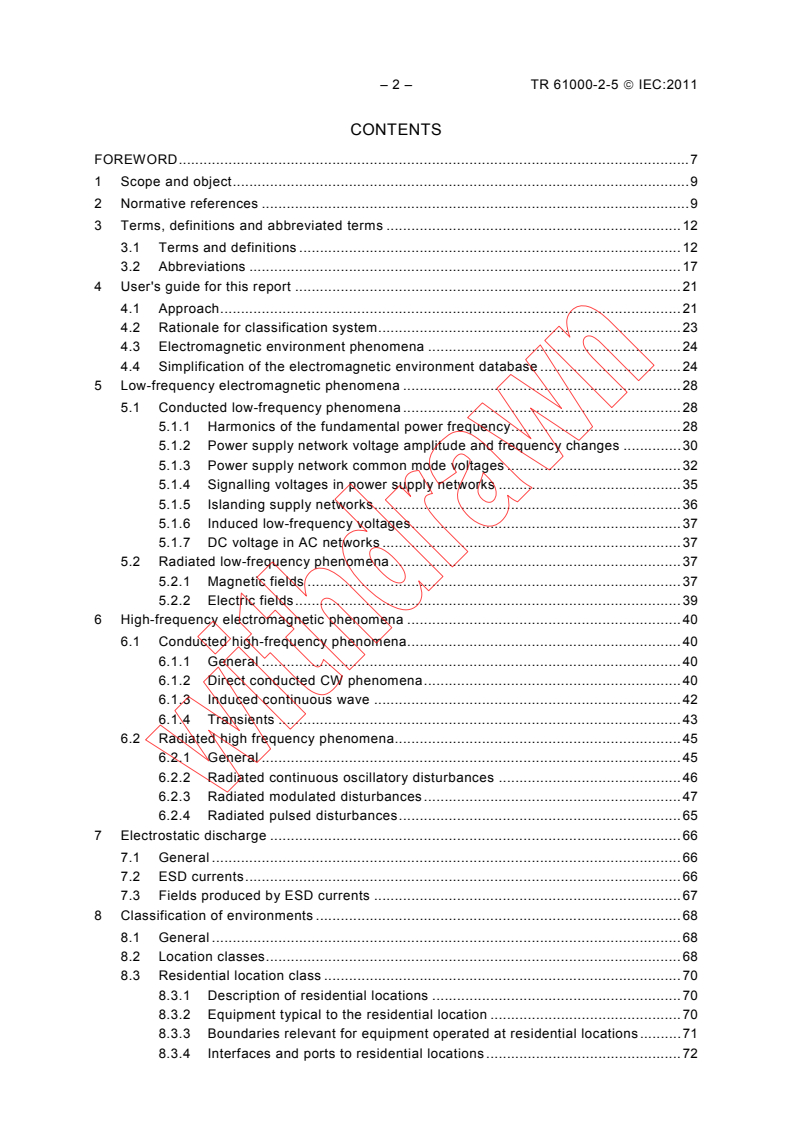
– 2 – TR 61000-2-5 IEC:2011
CONTENTS
FOREWORD . 7
1 Scope and object . 9
2 Normative references . 9
3 Terms, definitions and abbreviated terms . 12
3.1 Terms and definitions . 12
3.2 Abbreviations . 17
4 User's guide for this report . 21
4.1 Approach . 21
4.2 Rationale for classification system . 23
4.3 Electromagnetic environment phenomena . 24
4.4 Simplification of the electromagnetic environment database . 24
5 Low-frequency electromagnetic phenomena . 28
5.1 Conducted low-frequency phenomena . 28
5.1.1 Harmonics of the fundamental power frequency. 28
5.1.2 Power supply network voltage amplitude and frequency changes . 30
5.1.3 Power supply network common mode voltages . 32
5.1.4 Signalling voltages in power supply networks . 35
5.1.5 Islanding supply networks . 36
5.1.6 Induced low-frequency voltages . 37
5.1.7 DC voltage in AC networks . 37
5.2 Radiated low-frequency phenomena . 37
5.2.1 Magnetic fields . 37
5.2.2 Electric fields . 39
6 High-frequency electromagnetic phenomena . 40
6.1 Conducted high-frequency phenomena. 40
6.1.1 General . 40
6.1.2 Direct conducted CW phenomena . 40
6.1.3 Induced continuous wave . 42
6.1.4 Transients . 43
6.2 Radiated high frequency phenomena. 45
6.2.1 General . 45
6.2.2 Radiated continuous oscillatory disturbances . 46
6.2.3 Radiated modulated disturbances . 47
6.2.4 Radiated pulsed disturbances . 65
7 Electrostatic discharge . 66
7.1 General . 66
7.2 ESD currents . 66
7.3 Fields produced by ESD currents . 67
8 Classification of environments . 68
8.1 General . 68
8.2 Location classes . 68
8.3 Residential location class . 70
8.3.1 Description of residential locations . 70
8.3.2 Equipment typical to the residential location . 70
8.3.3 Boundaries relevant for equipment operated at residential locations . 71
8.3.4 Interfaces and ports to residential locations . 72
TR 61000-2-5 IEC:2011 – 3 –
8.3.5 Attributes of residential locations . 73
8.4 Commercial/public location class . 74
8.4.1 Description of commercial/public locations . 74
8.4.2 Equipment and interference sources existent in commercial/public
locations . 74
8.4.3 Boundaries relevant for equipment operated at commercial/public
locations . 74
8.4.4 Interfaces and ports to commercial/public locations . 75
8.4.5 Attributes of commercial/public locations . 75
8.5 Industrial location class . 77
8.5.1 Description of industrial locations . 77
8.5.2 Equipment and interference sources existent in industrial locations . 78
8.5.3 Boundaries relevant for equipment operated at industrial locations . 78
8.5.4 Interfaces and ports to industrial locations . 79
8.5.5 Attributes of industrial locations . 79
8.6 Types of power supply networks . 81
8.7 Alterations in electromagnetic environments . 83
8.8 Further conducted electromagnetic phenomena . 83
8.8.1 Description of conducted phenomena other than in Clauses 4 and 5 . 83
8.8.2 REIN . 84
8.8.3 SHINE . 85
8.9 Mitigation aspects . 85
8.10 Description of location classes with regard to the requirements of EMC basic
standards . 86
9 Principles of the selection of immunity levels . 88
9.1 Approach . 88
9.2 Uncertainties . 89
9.2.1 Uncertainties in the test situation . 89
9.2.2 Uncertainties in the application situation . 89
9.2.3 Dealing with uncertainties . 89
9.3 Dealing with high density sources. 89
9.4 Criticality criteria . 90
10 Disturbance levels of the various location classes . 91
Annex A (informative) Compatibility levels/disturbance levels for location classes . 92
Annex B (informative) Radiated continuous disturbances . 102
Annex C (informative) Review of the historical assignment of radiated disturbance
degrees . 109
Annex D (informative) Radiated pulsed disturbances . 115
Annex E (informative) Power line telecommunications (PLT) . 120
Bibliography . 122
Figure 1 – Schematic of the two-step approach used for classification with
phenomenon-oriented input tables and location-oriented output tables . 22
Figure 2 – Ports of entry (POEs) of electromagnetic disturbances into equipment . 23
Figure 3 – Typical voltage waveforms for dip and interruption (10 ms/horizontal
division) . 31
Figure 4 – Typical configuration of the converter in a PDS . 33
Figure 5 – Voltage and current waveforms of each PDS portion (1 ms/horizontal
division) . 34
– 4 – TR 61000-2-5 IEC:2011
Figure 6 – Measured common-mode voltage at the input terminal of a converter . 34
Figure 7 – Concept of location classes . 69
Figure 8 – Situation for TN-C power installation systems . 82
Figure 9 – Situation for TN-S power installation systems. 83
Figure B.1 – Typical waveforms for radiated disturbances . 102
Figure C.1 – Problem Geometry . 110
Figure D.1 – The measured electric field and the electric field derivative from a cloud
to ground lightning strike measured at a distance of 30 m . 115
Figure D.2 – The measured electric field from an electrostatic discharge event at a
distance of 0,1 m . 116
Figure D.3 – The measured magnetic field (two measurements) from an electrostatic
discharge event at a distance of 0,1 m . 116
Figure D.4 – The measured electric field in kV/m vs. time in microseconds in a 500 kV
power substation. 117
Table 1 – Principal phenomena causing electromagnetic disturbances . 25
Table 2 – Disturbance degrees and levels for harmonic voltages in power supply
networks (in percentage to fundamental voltage, U /U ) . 30
n 1
Table 3 – Disturbance degrees and levels for voltage changes within normal operating
range . 31
Table 4 – Disturbance degrees and levels for voltage unbalance . 32
Table 5 – Disturbance degrees and levels for power frequency variation . 32
Table 6 – Disturbance degrees and levels for common mode voltages . 35
Table 7 – Disturbance degrees and levels for signalling voltages in power systems (in
per cent of nominal voltage) . 36
Table 8 – Disturbance degrees and levels for low-frequency, common mode induced
voltages in signal and control cables . 37
Table 9 – Disturbance degrees and levels for low-frequency magnetic fields at various
frequencies . 38
Table 10 – Disturbance degrees and levels for low-frequency electric fields . 39
Table 11 – Disturbance degrees and levels of induced CW voltages with respect to
reference ground . 42
Table 12 – Disturbance degrees and levels for conducted unidirectional transients in
low-voltage AC power systems . 44
Table 13 – Disturbance degrees and levels for conducted oscillatory transients in low-
voltage AC power systems . 45
Table 14 – Radiation sources . 46
Table 15 – Disturbance degrees and levels for radiated continuous oscillatory
disturbances (in V/m, rms) and distance to source (in m) . 47
Table 16 – Disturbance degrees and levels for modulated radiation disturbances (in
V/m, rms) and distance to source (in m), Amateur radio bands below 30 MHz . 48
Table 17 – Disturbance degrees and levels for modulated radiation disturbances (in
V/m, rms) and distance to source (in m), 27 MHz CB band . 49
Table 18 – Disturbance degrees and levels for analogue communication services
below 30 MHz . 50
Table 19 – Disturbance degrees and levels for modulated radiation (analogue
communication services above 30 MHz) disturbances (in V/m) and distance to source (m) . 51
Table 20 – Disturbance degrees and levels for modulated radiation (mobile and
portable phones) disturbances (in V/m, rms) and distance to source (in m) . 52
TR 61000-2-5 IEC:2011 – 5 –
Table 21 – Disturbance degrees and levels for modulated radiation (base stations)
disturbances (in V/m, rms) and distance to source (in m) . 53
Table 22 – Disturbance degrees and levels for modulated radiation (medical and
biological telemetry items) disturbances (in V/m, rms) and distance to source (in m) . 54
Table 23 – Disturbance degrees and levels for modulated radiation (unlicensed radio
services) disturbances (in V/m, rms) and distance to source (in m) (1) . 55
Table 24 – Disturbance degrees and levels for modulated radiation (unlicensed radio
services) disturbances (in V/m, rms) and distance to source (in m) (2) . 56
Table 25 – Disturbance degrees and levels for modulated radiation (amateur radio
bands above 30 MHz) disturbances (in V/m, rms) and distance to source (in m) . 57
Table 26 – Disturbance degrees and levels for modulated radiation (paging service
base station) disturbances (in V/m, rms) and distance to source (in m) . 58
Table 27 – Disturbance degrees and levels for modulated radiation (other RF items)
disturbances (in V/m, rms) and distance to source (in m) (1) . 58
Table 28 – Disturbance degrees and levels for modulated radiation (other RF items)
disturbances (in V/m, rms) and distance to source (in m) (2) . 59
Table 29 – Disturbance degrees and levels for modulated radiation (other RF items)
disturbances (in V/m, rms) and distance to source (in m) (3) . 59
Table 30 – Disturbance degrees and levels for modulated radiation (other RF items)
disturbances (in V/m, rms) and distance to source (in m) (4) . 60
Table 31 – Disturbance degrees and levels for modulated radiation (other RF items)
disturbances (in V/m, rms) and distance to source (in m) (5) . 61
Table 32 – Disturbance degrees and levels for modulated radiation (other RF items)
disturbances (in V/m, Pk) and distance to source (in m) (6) . 62
Table 33 – Disturbance degrees and levels for modulated radiation (RFID and railway
transponder systems) disturbances (electric field in V/m, rms) and distance to source
(in m) . 63
Table 34 – Disturbance degrees and levels for modulated radiation (RFID and railway
transponder systems) disturbances (magnetic field in µA/m, rms) and distance to
source (in m) . 64
Table 35 – Disturbance degrees and levels for radiated pulsed disturbances (rate of
rise) and distance to source (in m) . 65
Table 36 – Disturbance degrees and levels for pulsed radiation (RADAR systems)
disturbances (electric field in V/m, Pk) and distance to source (in m) . 66
Table 37 – Disturbance degrees and levels for pulsed disturbances (rate of rise)
caused by ESD . 67
Table 38 – Disturbance degrees and levels for radiated field gradients caused by ESD . 67
Table 39 – Exemplary equipment present in the Residential location class . 71
Table 40 – Attributes of the residential location class . 73
Table 41 – Attributes of various types of the commercial/public location class . 76
Table 42 – Attributes of various types of the industrial location class . 80
Table 43 – Overview of phenomena versus basic standard, related table and chapter . 87
Table A.1 – Disturbance levels in the residential location class . 93
Table A.2 – Disturbance levels in the commercial/public location class . 96
Table A.3 – Disturbance levels in the industrial location class . 99
Table B.1 – Examples of field strengths from authorized transmitters. 103
Table B.2 – Specifications of mobile and portable units . 104
Table B.3 – Specifications of base stations . 104
Table B.4 – Specification of other typical RF items . 105
– 6 – TR 61000-2-5 IEC:2011
Table B.5 – Data regarding RFID technology . 105
Table B.6 – Frequency allocations of TETRA system (in Europe) . 106
Table B.7 – Amateur radiofrequencies (ITU region 1-3). 106
Table C.1 – Radiated disturbance degrees defined in Edition 1 . 109
Table D.1 – Data regarding RADAR systems . 118
Table D.2 – Examples for civil RADAR systems . 119
TR 61000-2-5 IEC:2011 – 7 –
INTERNATIONAL ELECTROTECHNICAL COMMISSION
____________
ELECTROMAGNETIC COMPATIBILITY (EMC) –
Part 2-5: Environment –
Description and classification of electromagnetic environments
FOREWORD
1) The International Electrotechnical Commission (IEC) is a worldwide organization for standardization comprising
all national electrotechnical committees (IEC National Committees). The object of IEC is to promote
international co-operation on all questions concerning standardization in the electrical and electronic fields. To
this end and in addition to other activities, IEC publishes International Standards, Technical Specifications,
Technical Reports, Publicly Available Specifications (PAS) and Guides (hereafter referred to as “IEC
Publication(s)”). Their preparation is entrusted to technical committees; any IEC National Committee interested
in the subject dealt with may participate in this preparatory work. International, governmental and non-
governmental organizations liaising with the IEC also participate in this preparation. IEC collaborates closely
with the International Organization for Standardization (ISO) in accordance with conditions determined by
agreement between the two organizations.
2) The formal decisions or agreements of IEC on technical matters express, as nearly as possible, an international
consensus of opinion on the relevant subjects since each technical committee has representation from all
interested IEC National Committees.
3) IEC Publications have the form of recommendations for international use and are accepted by IEC National
Committees in that sense. While all reasonable efforts are made to ensure that the technical content of IEC
Publications is accurate, IEC cannot be held responsible for the way in which they are used or for any
misinterpretation by any end user.
4) In order to promote international uniformity, IEC National Committees undertake to apply IEC Publications
transparently to the maximum extent possible in their national and regional publications. Any divergence
between any IEC Publication and the corresponding national or regional publication shall be clearly indicated in
the latter.
5) IEC itself does not provide any attestation of conformity. Independent certification bodies provide conformity
assessment services and, in some areas, access to IEC marks of conformity. IEC is not responsible for any
services carried out by independent certification bodies.
6) All users should ensure that they have the latest edition of this publication.
7) No liability shall attach to IEC or its directors, employees, servants or agents including individual experts and
members of its technical committees and IEC National Committees for any personal injury, property damage or
other damage of any nature whatsoever, whether direct or indirect, or for costs (including legal fees) and
expenses arising out of the publication, use of, or reliance upon, this IEC Publication or any other IEC
Publications.
8) Attention is drawn to the Normative references cited in this publication. Use of the referenced publications is
indispensable for the correct application of this publication.
9) Attention is drawn to the possibility that some of the elements of this IEC Publication may be the subject of
patent rights. IEC shall not be held responsible for identifying any or all such patent rights.
The main task of IEC technical committees is to prepare International Standards. However, a
technical committee may propose the publication of a Technical Report when it has collected
data of a different kind from that which is normally published as an International Standard, for
example "state of the art".
IEC 61000-2-5, which is a technical report, has been prepared by technical committee 77:
Electromagnetic compatibility.
It has the status of a basic EMC publication in accordance with IEC Guide 107.
This second edition cancels and replaces the first edition published in 1995 and constitutes a
technical revision.
The significant technical changes with respect to the previous edition are the following:
– 8 – TR 61000-2-5 IEC:2011
– the description of the radiated electromagnetic environment has been done in more
detail and the considered interference sources have been updated;
– the concept of location classes has been reviewed and modified;
– the disturbance levels for the various location classes have been reviewed, modified
and the phenomena have been described in more detail.
The text of this Technical Report is based on the following documents:
Enquiry draft Report on voting
77/385/DTR 77/390/RVC
Full information on the voting for the approval of this Technical Report can be found in the
report on voting indicated in the above table.
This publication has been drafted in accordance with the ISO/IEC Directives, Part 2.
The committee has decided that the contents of this publication will remain unchanged until
the stability date indicated on the IEC web site under "http://webstore.iec.ch" in the data
related to the specific publication. At this date, the publication will be
• reconfirmed,
• withdrawn,
• replaced by a revised edition, or
• amended.
IMPORTANT – The 'colour inside' logo on the cover page of this publication indicates
that it contains colours which are considered to be useful for the correct
understanding of its contents. Users should therefore print this document using a
colour printer.
TR 61000-2-5 IEC:2011 – 9 –
ELECTROMAGNETIC COMPATIBILITY (EMC) –
Part 2-5: Environment –
Description and classification of electromagnetic environments
1 Scope and object
Knowledge of the electromagnetic environment that exists at locations where electrical and
electronic equipment and systems are intended to be operated is an essential precondition in
the process of achieving electromagnetic compatibility. This knowledge can be obtained by
various approaches, including a site survey of an intended location, the technical assessment
of the equipment and system as well as the general literature.
This part of IEC 61000
– introduces the concept of disturbance degrees and defines these for each
electromagnetic phenomena,
– classifies into various location classes and describes them by means of attributes,
– provides background information on the different electromagnetic phenomena that may
exist within the environment and
– compiles tables of compatibility levels for electromagnetic phenomena that are
considered to be relevant for those location classes.
This part of IEC 61000 is intended for guidance for those who are in charge of considering
and developing immunity requirements. It also gives basic guidance for the selection of
immunity levels. The data are applicable to any item of electrical or electronic equipment,
sub-system or system that operates in one of the locations as considered in this Technical
Report.
NOTE 1 It should be noted that immunity requirements and immunity levels determined for items of equipment
which are intended to be used at a certain location class are not inevitably bound to the electromagnetic
environment present at the location, but also to requirements of the equipment itself and the application in which it
is used (e.g. when taking into account requirements regarding availability, reliability or safety). These could lead to
more stringent requirements with respect to immunity levels or with respect to applicable performance criteria.
These levels may also be established for more general purposes such as in generic and product standards, taking
into account statistical and economic aspects as well as common experience in certain application fields.
NOTE 2 Electromagnetic phenomena in general show a broad range of parameters and characteristics and hence
cannot be related one-to-one to standardized immunity tests which basically reflect the impact of electromagnetic
phenomena by a well described test set-up. Nonetheless, this report follows an approach to correlate
electromagnetic phenomena and standardized immunity tests up to a certain extent. This might allow users of this
report to partly take into account standardized immunity tests such as given for example in the IEC 61000-4 series,
when specifying immunity requirements.
The descriptions of electromagnetic environments in this report are predominantly generic
ones, taking into account the characteristics of the location classes under consideration.
Hence, it should be kept in mind that there might be locations for which a more specific
description is required in order to conclude on immunity requirements applicable for those
specific locations.
2 Normative references
The following referenced documents are indispensable for the application of this document.
For dated references, only the edition cited applies. For undated references, the latest edition
of the referenced document (including any amendments) applies.
– 10 – TR 61000-2-5 IEC:2011
IEC 60050(161):1990, International Electrotechnical Vocabulary – Chapter 161: Electro-
magnetic compatibility
Amendment 1 (1997)
Amendment 2 (1998)
IEC 60118-4:2006, Electroacoustics – Hearing aids – Part 4: Induction loop systems for
hearing aid purposes – Magnetic field strength
IEC 60364-4-44:2007, Low-voltage electrical installations – Part 4-44: Protection for safety –
Protection against voltage disturbances and electromagnetic disturbances
IEC/TR 61000-1-4:2005, Electromagnetic compatibility (EMC) – Part 1-4: General – Historical
rationale for the limitation of power-frequency conducted harmonic current emissions from
equipment, in the frequency range up to 2 kHz
IEC 61000-2-2:2002, Electromagnetic compatibility (EMC) – Part 2-2: Environment –
Compatibility levels for low-frequency conducted disturbances and signalling in public low-
voltage power supply systems
IEC 61000-2-3:1992, Electromagnetic compatibility (EMC) – Part 2: Environment –
Section 3: Description of the environment – Radiated and non-network-frequency-related
conducted phenomena
IEC 61000-2-4:2002, Electromagnetic compatibility (EMC) – Part 2-4: Environment –
Compatibility levels in industrial plants for low-frequency conducted disturbances
IEC 61000-2-8:2002, Electromagnetic compatibility (EMC) – Part 2-8: Environment – Voltage
dips and short interruptions on public electric power supply systems with statistical
measurement results
IEC 61000-2-9:1996, Electromagnetic compatibility (EMC) – Part 2: Environment –
Section 9: Description of HEMP environment – Radiated disturbance
IEC 61000-2-12:2003, Electromagnetic compatibility (EMC) – Part 2-12: Environment –
Compatibility levels for low-frequency conducted disturbances and signalling in public
medium-voltage power supply systems
IEC 61000-2-13:2005, Electromagnetic compatibility (EMC) – Part 2-13: Environment –
High-power electromagnetic (HPEM) environments – Radiated and conducted
IEC 61000-3-12:2004, Electromagnetic compatibility (EMC) – Part 3-12: Limits – Limits for
harmonic currents produced by equipment connected to public low-voltage systems with input
current >16 A and ≤75 A per phase
IEC 61000-4-2:2008, Electromagnetic compatibility (EMC) – Part 4-2: Testing and
measurement techniques – Electrostatic discharge immunity test
IEC 61000-4-3:2006, Electromagnetic compatibility (EMC) – Part 4-3: Testing and
measurement techniques – Radiated, radio-frequency, electromagnetic field immunity test
Amendment 1 (2007)
Amendment 2 (2010)
IEC 61000-4-4:2004, Electromagnetic compatibility (EMC) – Part 4-4: Testing and
measurement techniques – Electrical fast transient/burst immunity test
Amendment 1 (2010)
TR 61000-2-5 IEC:2011 – 11 –
IEC 61000-4-5:2005, Electromagnetic compatibility (EMC) – Part 4-5: Testing and
measurement techniques – Surge immunity test
IEC 61000-4-6:2008, Electromagnetic compatibility (EMC) – Part 4-6: Testing and
measurement techniques – Immunity to conducted disturbances, induced by radio-frequency
fields
IEC 61000-4-8:2009, Electromagnetic compatibility (EMC) – Part 4-8: Testing and
measurement techniques – Power frequency magnetic field immunity test
IEC 61000-4-9:1993, Electromagnetic compatibility (EMC) – Part 4-9: Testing and
measurement techniques – Pulse magnetic field immunity test
Amendment 1 (2000)
IEC 61000-4-10:1993, Electromagnetic compatibility (EMC) – Part 4-10: Testing and
measurement techniques – Damped oscillatory magnetic field immunity test
Amendment 1 (2000)
IEC 61000-4-11:2004, Electromagnetic compatibility (EMC) – Part 4-11: Testing and
measurement techniques – Voltage dips, short interruptions and voltage variations immunity
tests
IEC 61000-4-12:2006, Electromagnetic compatibility (EMC) – Part 4-12: Testing and
measurement techniques – Ring wave immunity test
IEC 61000-4-13:2002, Electromagnetic compatibility (EMC) – Part 4-13: Testing and
measurement techniques – Harmonics and interharmonics including mains signalling at a.c.
power port, low frequency immunity tests
Amendment 1 (2009)
IEC 61000-4-14:1999, Electromagnetic compatibility (EMC) – Part 4-14: Testing and
measurement techniques – Voltage fluctuation immunity test for equipment with input current
not exceeding 16 A per phase
Amendment 1 (2001)
Amendment 2 (2009)
IEC 61000-4-16:1998, Electromagnetic compatibility (EMC) – Part 4-16: Testing and
measurement techniques – Test for immunity to conducted, common mode disturbances in
the frequency range 0 Hz to 150 kHz
Amendment 1 (2001)
Amendment 2 (2009)
IEC 61000-4-18:2006, Electromagnetic compatibility (EMC) – Part 4-18: Testing and
measurement techniques – Damped oscillatory wave immunity test
Amendment 1 (2010)
IEC 61000-4-27:2000, Electromagnetic compatibility (EMC) – Part 4-27: Testing and
measurement techniques – Unbalance, immunity test for equipment with input current not
exceeding 16 A per phase
Amendment 1 (2009)
IEC 61000-4-28:1999, Electromagnetic compatibility (EMC) – Part 4-28: Testing and
measurement techniques – Variation of power frequency, immunity test for equipment with
input current not exceeding 16 A per phase
Amendment 1 (2001)
Amendment 2 (2009)
– 12 – TR 61000-2-5 IEC:2011
CISPR/TR 16-4-1:2009, Specification for radio disturbance and immunity measuring
apparatus and methods – Part 4-1: Uncertainties, statistics and limit modelling – Uncertainties
in standardized EMC tests
3 Terms, definitions and abbreviated terms
3.1 Terms and definitions
For the purposes of this document the terms and definitions given in IEC 60050(161) as well
as the following apply
NOTE For brevity, instead of repeating the wording "device, equipment or system", the term "item" is used in this
report.
3.1.1
blackout
cutoff of electrical power, especially as a result of a shortage, a mechanical failure, or
overuse by consumers
NOTE A power cut due to a short or long-term electric power loss in an area.
3.1.2
brownout
reduction or cutback in electric power, especially as a result of a shortage, a mechanical
failure, or overuse by consumers
NOTE Reduction in the voltage of commercially supplied power. It is caused by the failure of the generation,
transmission, or distribution system, or deliberately by the power utility when demand exceeds supply. The
consumer may or may not notice the difference. In the worst case, damage may result.
3.1.3
burst
sequence of a limited number of distinct pulses or an oscillation of limited duration
[IEC 60050-161:1990, 161-02-07]
3.1.4
burst (in TDMA)
signals transmitted by a terminal in the form of a block of predetermined structure during a
time interval allotted to the terminal by a TDMA protocol
[IEC 60050-725:1994, 725-14-15]
3.1.5
characteristic impedance of a medium
wave impedance for a travelling wave in a specific medium
[IEC 60050-705:1995, 705-03-23, modified]
NOTE The characteristic impedance of a homogeneous isotropic medium is given by η = sqrt (µ/ε),
ι
where
µ is the permeability of the homogeneous isotropic medium, and
ε is the permittivity of the homogeneous isotropic medium.
TR 61000-2-5 IEC:2011 – 13 –
3.1.6
(electromagnetic) compatibility level
specified electromagnetic disturbance level used as a reference level for co-ordination in the
setting of emission and immunity limits
[IEC 60050-161:1990, 161-03-10]
NOTE 1 By convention, the compatibility level is chosen so that there is only a small probability that it will be
exceeded by the actual disturbance level. However, electromagnetic compatibility is achieved only if emission and
immunity levels are controlled such that, at each location, the disturbance level resulting from the cumulative
emissions is lower than the mmunity level for each device, equipment and system situated at this same location.
NOTE 2 The compatibility level may be phenomenon, time or location dependent.
3.1.7
disturbance degree
specified, quanti
...
IEC/TR 61000-2-5 ®
Edition 2.0 2011-05
TECHNICAL
REPORT
RAPPORT
TECHNIQUE
colour
inside
BASIC EMC PUBLICATION
PUBLICATION FONDAMENTALE EN CEM
Electromagnetic compatibility (EMC) –
Part 2-5: Environment – Description and classification of electromagnetic
environments
Compatibilité électromagnétique (CEM) –
Partie 2-5: Environnement – Description et classification des environnements
électromagnétiques
IEC/TR 61000-2-5:2011
All rights reserved. Unless otherwise specified, no part of this publication may be reproduced or utilized in any form or by
any means, electronic or mechanical, including photocopying and microfilm, without permission in writing from either IEC or
IEC's member National Committee in the country of the requester.
If you have any questions about IEC copyright or have an enquiry about obtaining additional rights to this publication,
please contact the address below or your local IEC member National Committee for further information.
Droits de reproduction réservés. Sauf indication contraire, aucune partie de cette publication ne peut être reproduite
ni utilisée sous quelque forme que ce soit et par aucun procédé, électronique ou mécanique, y compris la photocopie
et les microfilms, sans l'accord écrit de la CEI ou du Comité national de la CEI du pays du demandeur.
Si vous avez des questions sur le copyright de la CEI ou si vous désirez obtenir des droits supplémentaires sur cette
publication, utilisez les coordonnées ci-après ou contactez le Comité national de la CEI de votre pays de résidence.
IEC Central Office
3, rue de Varembé
CH-1211 Geneva 20
Switzerland
Email: inmail@iec.ch
Web: www.iec.ch
About the IEC
The International Electrotechnical Commission (IEC) is the leading global organization that prepares and publishes
International Standards for all electrical, electronic and related technologies.
About IEC publications
The technical content of IEC publications is kept under constant review by the IEC. Please make sure that you have the
latest edition, a corrigenda or an amendment might have been published.
Catalogue of IEC publications: www.iec.ch/searchpub
The IEC on-line Catalogue enables you to search by a variety of criteria (reference number, text, technical committee,…).
It also gives information on projects, withdrawn and replaced publications.
IEC Just Published: www.iec.ch/online_news/justpub
Stay up to date on all new IEC publications. Just Published details twice a month all new publications released. Available
on-line and also by email.
Electropedia: www.electropedia.org
The world's leading online dictionary of electronic and electrical terms containing more than 20 000 terms and definitions
in English and French, with equivalent terms in additional languages. Also known as the International Electrotechnical
Vocabulary online.
Customer Service Centre: www.iec.ch/webstore/custserv
If you wish to give us your feedback on this publication or need further assistance, please visit the Customer Service
Centre FAQ or contact us:
Email: csc@iec.ch
Tel.: +41 22 919 02 11
Fax: +41 22 919 03 00
A propos de la CEI
La Commission Electrotechnique Internationale (CEI) est la première organisation mondiale qui élabore et publie des
normes internationales pour tout ce qui a trait à l'électricité, à l'électronique et aux technologies apparentées.
A propos des publications CEI
Le contenu technique des publications de la CEI est constamment revu. Veuillez vous assurer que vous possédez
l’édition la plus récente, un corrigendum ou amendement peut avoir été publié.
Catalogue des publications de la CEI: www.iec.ch/searchpub/cur_fut-f.htm
Le Catalogue en-ligne de la CEI vous permet d’effectuer des recherches en utilisant différents critères (numéro de référence,
texte, comité d’études,…). Il donne aussi des informations sur les projets et les publications retirées ou remplacées.
Just Published CEI: www.iec.ch/online_news/justpub
Restez informé sur les nouvelles publications de la CEI. Just Published détaille deux fois par mois les nouvelles
publications parues. Disponible en-ligne et aussi par email.
Electropedia: www.electropedia.org
Le premier dictionnaire en ligne au monde de termes électroniques et électriques. Il contient plus de 20 000 termes et
définitions en anglais et en français, ainsi que les termes équivalents dans les langues additionnelles. Egalement appelé
Vocabulaire Electrotechnique International en ligne.
Service Clients: www.iec.ch/webstore/custserv/custserv_entry-f.htm
Si vous désirez nous donner des commentaires sur cette publication ou si vous avez des questions, visitez le FAQ du
Service clients ou contactez-nous:
Email: csc@iec.ch
Tél.: +41 22 919 02 11
Fax: +41 22 919 03 00
IEC/TR 61000-2-5 ®
Edition 2.0 2011-05
TECHNICAL
REPORT
RAPPORT
TECHNIQUE
colour
inside
BASIC EMC PUBLICATION
PUBLICATION FONDAMENTALE EN CEM
Electromagnetic compatibility (EMC) –
Part 2-5: Environment – Description and classification of electromagnetic
environments
Compatibilité électromagnétique (CEM) –
Partie 2-5: Environnement – Description et classification des environnements
électromagnétiques
INTERNATIONAL
ELECTROTECHNICAL
COMMISSION
COMMISSION
ELECTROTECHNIQUE
PRICE CODE
INTERNATIONALE
CODE PRIX XF
ICS 33.100.20 ISBN 978-2-88912-521-0
– 2 – TR 61000-2-5 IEC:2011
CONTENTS
FOREWORD . 7
1 Scope and object . 9
2 Normative references . 9
3 Terms, definitions and abbreviated terms . 12
3.1 Terms and definitions . 12
3.2 Abbreviations . 17
4 User's guide for this report . 21
4.1 Approach . 21
4.2 Rationale for classification system . 23
4.3 Electromagnetic environment phenomena . 24
4.4 Simplification of the electromagnetic environment database . 24
5 Low-frequency electromagnetic phenomena . 28
5.1 Conducted low-frequency phenomena . 28
5.1.1 Harmonics of the fundamental power frequency. 28
5.1.2 Power supply network voltage amplitude and frequency changes . 30
5.1.3 Power supply network common mode voltages . 32
5.1.4 Signalling voltages in power supply networks . 35
5.1.5 Islanding supply networks . 36
5.1.6 Induced low-frequency voltages . 37
5.1.7 DC voltage in AC networks . 37
5.2 Radiated low-frequency phenomena . 37
5.2.1 Magnetic fields . 37
5.2.2 Electric fields . 39
6 High-frequency electromagnetic phenomena . 40
6.1 Conducted high-frequency phenomena. 40
6.1.1 General . 40
6.1.2 Direct conducted CW phenomena . 40
6.1.3 Induced continuous wave . 42
6.1.4 Transients . 43
6.2 Radiated high frequency phenomena. 45
6.2.1 General . 45
6.2.2 Radiated continuous oscillatory disturbances . 46
6.2.3 Radiated modulated disturbances . 47
6.2.4 Radiated pulsed disturbances . 65
7 Electrostatic discharge . 66
7.1 General . 66
7.2 ESD currents . 66
7.3 Fields produced by ESD currents . 67
8 Classification of environments . 68
8.1 General . 68
8.2 Location classes . 68
8.3 Residential location class . 70
8.3.1 Description of residential locations . 70
8.3.2 Equipment typical to the residential location . 70
8.3.3 Boundaries relevant for equipment operated at residential locations . 71
8.3.4 Interfaces and ports to residential locations . 72
TR 61000-2-5 IEC:2011 – 3 –
8.3.5 Attributes of residential locations . 73
8.4 Commercial/public location class . 74
8.4.1 Description of commercial/public locations . 74
8.4.2 Equipment and interference sources existent in commercial/public
locations . 74
8.4.3 Boundaries relevant for equipment operated at commercial/public
locations . 74
8.4.4 Interfaces and ports to commercial/public locations . 75
8.4.5 Attributes of commercial/public locations . 75
8.5 Industrial location class . 77
8.5.1 Description of industrial locations . 77
8.5.2 Equipment and interference sources existent in industrial locations . 78
8.5.3 Boundaries relevant for equipment operated at industrial locations . 78
8.5.4 Interfaces and ports to industrial locations . 79
8.5.5 Attributes of industrial locations . 79
8.6 Types of power supply networks . 81
8.7 Alterations in electromagnetic environments . 83
8.8 Further conducted electromagnetic phenomena . 83
8.8.1 Description of conducted phenomena other than in Clauses 4 and 5 . 83
8.8.2 REIN . 84
8.8.3 SHINE . 85
8.9 Mitigation aspects . 85
8.10 Description of location classes with regard to the requirements of EMC basic
standards . 86
9 Principles of the selection of immunity levels . 88
9.1 Approach . 88
9.2 Uncertainties . 89
9.2.1 Uncertainties in the test situation . 89
9.2.2 Uncertainties in the application situation . 89
9.2.3 Dealing with uncertainties . 89
9.3 Dealing with high density sources. 89
9.4 Criticality criteria . 90
10 Disturbance levels of the various location classes . 91
Annex A (informative) Compatibility levels/disturbance levels for location classes . 92
Annex B (informative) Radiated continuous disturbances . 102
Annex C (informative) Review of the historical assignment of radiated disturbance
degrees . 109
Annex D (informative) Radiated pulsed disturbances . 115
Annex E (informative) Power line telecommunications (PLT) . 120
Bibliography . 122
Figure 1 – Schematic of the two-step approach used for classification with
phenomenon-oriented input tables and location-oriented output tables . 22
Figure 2 – Ports of entry (POEs) of electromagnetic disturbances into equipment . 23
Figure 3 – Typical voltage waveforms for dip and interruption (10 ms/horizontal
division) . 31
Figure 4 – Typical configuration of the converter in a PDS . 33
Figure 5 – Voltage and current waveforms of each PDS portion (1 ms/horizontal
division) . 34
– 4 – TR 61000-2-5 IEC:2011
Figure 6 – Measured common-mode voltage at the input terminal of a converter . 34
Figure 7 – Concept of location classes . 69
Figure 8 – Situation for TN-C power installation systems . 82
Figure 9 – Situation for TN-S power installation systems. 83
Figure B.1 – Typical waveforms for radiated disturbances . 102
Figure C.1 – Problem Geometry . 110
Figure D.1 – The measured electric field and the electric field derivative from a cloud
to ground lightning strike measured at a distance of 30 m . 115
Figure D.2 – The measured electric field from an electrostatic discharge event at a
distance of 0,1 m . 116
Figure D.3 – The measured magnetic field (two measurements) from an electrostatic
discharge event at a distance of 0,1 m . 116
Figure D.4 – The measured electric field in kV/m vs. time in microseconds in a 500 kV
power substation. 117
Table 1 – Principal phenomena causing electromagnetic disturbances . 25
Table 2 – Disturbance degrees and levels for harmonic voltages in power supply
networks (in percentage to fundamental voltage, U /U ) . 30
n 1
Table 3 – Disturbance degrees and levels for voltage changes within normal operating
range . 31
Table 4 – Disturbance degrees and levels for voltage unbalance . 32
Table 5 – Disturbance degrees and levels for power frequency variation . 32
Table 6 – Disturbance degrees and levels for common mode voltages . 35
Table 7 – Disturbance degrees and levels for signalling voltages in power systems (in
per cent of nominal voltage) . 36
Table 8 – Disturbance degrees and levels for low-frequency, common mode induced
voltages in signal and control cables . 37
Table 9 – Disturbance degrees and levels for low-frequency magnetic fields at various
frequencies . 38
Table 10 – Disturbance degrees and levels for low-frequency electric fields . 39
Table 11 – Disturbance degrees and levels of induced CW voltages with respect to
reference ground . 42
Table 12 – Disturbance degrees and levels for conducted unidirectional transients in
low-voltage AC power systems . 44
Table 13 – Disturbance degrees and levels for conducted oscillatory transients in low-
voltage AC power systems . 45
Table 14 – Radiation sources . 46
Table 15 – Disturbance degrees and levels for radiated continuous oscillatory
disturbances (in V/m, rms) and distance to source (in m) . 47
Table 16 – Disturbance degrees and levels for modulated radiation disturbances (in
V/m, rms) and distance to source (in m), Amateur radio bands below 30 MHz . 48
Table 17 – Disturbance degrees and levels for modulated radiation disturbances (in
V/m, rms) and distance to source (in m), 27 MHz CB band . 49
Table 18 – Disturbance degrees and levels for analogue communication services
below 30 MHz . 50
Table 19 – Disturbance degrees and levels for modulated radiation (analogue
communication services above 30 MHz) disturbances (in V/m) and distance to source (m) . 51
Table 20 – Disturbance degrees and levels for modulated radiation (mobile and
portable phones) disturbances (in V/m, rms) and distance to source (in m) . 52
TR 61000-2-5 IEC:2011 – 5 –
Table 21 – Disturbance degrees and levels for modulated radiation (base stations)
disturbances (in V/m, rms) and distance to source (in m) . 53
Table 22 – Disturbance degrees and levels for modulated radiation (medical and
biological telemetry items) disturbances (in V/m, rms) and distance to source (in m) . 54
Table 23 – Disturbance degrees and levels for modulated radiation (unlicensed radio
services) disturbances (in V/m, rms) and distance to source (in m) (1) . 55
Table 24 – Disturbance degrees and levels for modulated radiation (unlicensed radio
services) disturbances (in V/m, rms) and distance to source (in m) (2) . 56
Table 25 – Disturbance degrees and levels for modulated radiation (amateur radio
bands above 30 MHz) disturbances (in V/m, rms) and distance to source (in m) . 57
Table 26 – Disturbance degrees and levels for modulated radiation (paging service
base station) disturbances (in V/m, rms) and distance to source (in m) . 58
Table 27 – Disturbance degrees and levels for modulated radiation (other RF items)
disturbances (in V/m, rms) and distance to source (in m) (1) . 58
Table 28 – Disturbance degrees and levels for modulated radiation (other RF items)
disturbances (in V/m, rms) and distance to source (in m) (2) . 59
Table 29 – Disturbance degrees and levels for modulated radiation (other RF items)
disturbances (in V/m, rms) and distance to source (in m) (3) . 59
Table 30 – Disturbance degrees and levels for modulated radiation (other RF items)
disturbances (in V/m, rms) and distance to source (in m) (4) . 60
Table 31 – Disturbance degrees and levels for modulated radiation (other RF items)
disturbances (in V/m, rms) and distance to source (in m) (5) . 61
Table 32 – Disturbance degrees and levels for modulated radiation (other RF items)
disturbances (in V/m, Pk) and distance to source (in m) (6) . 62
Table 33 – Disturbance degrees and levels for modulated radiation (RFID and railway
transponder systems) disturbances (electric field in V/m, rms) and distance to source
(in m) . 63
Table 34 – Disturbance degrees and levels for modulated radiation (RFID and railway
transponder systems) disturbances (magnetic field in µA/m, rms) and distance to
source (in m) . 64
Table 35 – Disturbance degrees and levels for radiated pulsed disturbances (rate of
rise) and distance to source (in m) . 65
Table 36 – Disturbance degrees and levels for pulsed radiation (RADAR systems)
disturbances (electric field in V/m, Pk) and distance to source (in m) . 66
Table 37 – Disturbance degrees and levels for pulsed disturbances (rate of rise)
caused by ESD . 67
Table 38 – Disturbance degrees and levels for radiated field gradients caused by ESD . 67
Table 39 – Exemplary equipment present in the Residential location class . 71
Table 40 – Attributes of the residential location class . 73
Table 41 – Attributes of various types of the commercial/public location class . 76
Table 42 – Attributes of various types of the industrial location class . 80
Table 43 – Overview of phenomena versus basic standard, related table and chapter . 87
Table A.1 – Disturbance levels in the residential location class . 93
Table A.2 – Disturbance levels in the commercial/public location class . 96
Table A.3 – Disturbance levels in the industrial location class . 99
Table B.1 – Examples of field strengths from authorized transmitters. 103
Table B.2 – Specifications of mobile and portable units . 104
Table B.3 – Specifications of base stations . 104
Table B.4 – Specification of other typical RF items . 105
– 6 – TR 61000-2-5 IEC:2011
Table B.5 – Data regarding RFID technology . 105
Table B.6 – Frequency allocations of TETRA system (in Europe) . 106
Table B.7 – Amateur radiofrequencies (ITU region 1-3). 106
Table C.1 – Radiated disturbance degrees defined in Edition 1 . 109
Table D.1 – Data regarding RADAR systems . 118
Table D.2 – Examples for civil RADAR systems . 119
TR 61000-2-5 IEC:2011 – 7 –
INTERNATIONAL ELECTROTECHNICAL COMMISSION
____________
ELECTROMAGNETIC COMPATIBILITY (EMC) –
Part 2-5: Environment –
Description and classification of electromagnetic environments
FOREWORD
1) The International Electrotechnical Commission (IEC) is a worldwide organization for standardization comprising
all national electrotechnical committees (IEC National Committees). The object of IEC is to promote
international co-operation on all questions concerning standardization in the electrical and electronic fields. To
this end and in addition to other activities, IEC publishes International Standards, Technical Specifications,
Technical Reports, Publicly Available Specifications (PAS) and Guides (hereafter referred to as “IEC
Publication(s)”). Their preparation is entrusted to technical committees; any IEC National Committee interested
in the subject dealt with may participate in this preparatory work. International, governmental and non-
governmental organizations liaising with the IEC also participate in this preparation. IEC collaborates closely
with the International Organization for Standardization (ISO) in accordance with conditions determined by
agreement between the two organizations.
2) The formal decisions or agreements of IEC on technical matters express, as nearly as possible, an international
consensus of opinion on the relevant subjects since each technical committee has representation from all
interested IEC National Committees.
3) IEC Publications have the form of recommendations for international use and are accepted by IEC National
Committees in that sense. While all reasonable efforts are made to ensure that the technical content of IEC
Publications is accurate, IEC cannot be held responsible for the way in which they are used or for any
misinterpretation by any end user.
4) In order to promote international uniformity, IEC National Committees undertake to apply IEC Publications
transparently to the maximum extent possible in their national and regional publications. Any divergence
between any IEC Publication and the corresponding national or regional publication shall be clearly indicated in
the latter.
5) IEC itself does not provide any attestation of conformity. Independent certification bodies provide conformity
assessment services and, in some areas, access to IEC marks of conformity. IEC is not responsible for any
services carried out by independent certification bodies.
6) All users should ensure that they have the latest edition of this publication.
7) No liability shall attach to IEC or its directors, employees, servants or agents including individual experts and
members of its technical committees and IEC National Committees for any personal injury, property damage or
other damage of any nature whatsoever, whether direct or indirect, or for costs (including legal fees) and
expenses arising out of the publication, use of, or reliance upon, this IEC Publication or any other IEC
Publications.
8) Attention is drawn to the Normative references cited in this publication. Use of the referenced publications is
indispensable for the correct application of this publication.
9) Attention is drawn to the possibility that some of the elements of this IEC Publication may be the subject of
patent rights. IEC shall not be held responsible for identifying any or all such patent rights.
The main task of IEC technical committees is to prepare International Standards. However, a
technical committee may propose the publication of a Technical Report when it has collected
data of a different kind from that which is normally published as an International Standard, for
example "state of the art".
IEC 61000-2-5, which is a technical report, has been prepared by technical committee 77:
Electromagnetic compatibility.
It has the status of a basic EMC publication in accordance with IEC Guide 107.
This second edition cancels and replaces the first edition published in 1995 and constitutes a
technical revision.
The significant technical changes with respect to the previous edition are the following:
– 8 – TR 61000-2-5 IEC:2011
– the description of the radiated electromagnetic environment has been done in more
detail and the considered interference sources have been updated;
– the concept of location classes has been reviewed and modified;
– the disturbance levels for the various location classes have been reviewed, modified
and the phenomena have been described in more detail.
The text of this Technical Report is based on the following documents:
Enquiry draft Report on voting
77/385/DTR 77/390/RVC
Full information on the voting for the approval of this Technical Report can be found in the
report on voting indicated in the above table.
This publication has been drafted in accordance with the ISO/IEC Directives, Part 2.
The committee has decided that the contents of this publication will remain unchanged until
the stability date indicated on the IEC web site under "http://webstore.iec.ch" in the data
related to the specific publication. At this date, the publication will be
• reconfirmed,
• withdrawn,
• replaced by a revised edition, or
• amended.
IMPORTANT – The 'colour inside' logo on the cover page of this publication indicates
that it contains colours which are considered to be useful for the correct
understanding of its contents. Users should therefore print this document using a
colour printer.
TR 61000-2-5 IEC:2011 – 9 –
ELECTROMAGNETIC COMPATIBILITY (EMC) –
Part 2-5: Environment –
Description and classification of electromagnetic environments
1 Scope and object
Knowledge of the electromagnetic environment that exists at locations where electrical and
electronic equipment and systems are intended to be operated is an essential precondition in
the process of achieving electromagnetic compatibility. This knowledge can be obtained by
various approaches, including a site survey of an intended location, the technical assessment
of the equipment and system as well as the general literature.
This part of IEC 61000
– introduces the concept of disturbance degrees and defines these for each
electromagnetic phenomena,
– classifies into various location classes and describes them by means of attributes,
– provides background information on the different electromagnetic phenomena that may
exist within the environment and
– compiles tables of compatibility levels for electromagnetic phenomena that are
considered to be relevant for those location classes.
This part of IEC 61000 is intended for guidance for those who are in charge of considering
and developing immunity requirements. It also gives basic guidance for the selection of
immunity levels. The data are applicable to any item of electrical or electronic equipment,
sub-system or system that operates in one of the locations as considered in this Technical
Report.
NOTE 1 It should be noted that immunity requirements and immunity levels determined for items of equipment
which are intended to be used at a certain location class are not inevitably bound to the electromagnetic
environment present at the location, but also to requirements of the equipment itself and the application in which it
is used (e.g. when taking into account requirements regarding availability, reliability or safety). These could lead to
more stringent requirements with respect to immunity levels or with respect to applicable performance criteria.
These levels may also be established for more general purposes such as in generic and product standards, taking
into account statistical and economic aspects as well as common experience in certain application fields.
NOTE 2 Electromagnetic phenomena in general show a broad range of parameters and characteristics and hence
cannot be related one-to-one to standardized immunity tests which basically reflect the impact of electromagnetic
phenomena by a well described test set-up. Nonetheless, this report follows an approach to correlate
electromagnetic phenomena and standardized immunity tests up to a certain extent. This might allow users of this
report to partly take into account standardized immunity tests such as given for example in the IEC 61000-4 series,
when specifying immunity requirements.
The descriptions of electromagnetic environments in this report are predominantly generic
ones, taking into account the characteristics of the location classes under consideration.
Hence, it should be kept in mind that there might be locations for which a more specific
description is required in order to conclude on immunity requirements applicable for those
specific locations.
2 Normative references
The following referenced documents are indispensable for the application of this document.
For dated references, only the edition cited applies. For undated references, the latest edition
of the referenced document (including any amendments) applies.
– 10 – TR 61000-2-5 IEC:2011
IEC 60050(161):1990, International Electrotechnical Vocabulary – Chapter 161: Electro-
magnetic compatibility
Amendment 1 (1997)
Amendment 2 (1998)
IEC 60118-4:2006, Electroacoustics – Hearing aids – Part 4: Induction loop systems for
hearing aid purposes – Magnetic field strength
IEC 60364-4-44:2007, Low-voltage electrical installations – Part 4-44: Protection for safety –
Protection against voltage disturbances and electromagnetic disturbances
IEC/TR 61000-1-4:2005, Electromagnetic compatibility (EMC) – Part 1-4: General – Historical
rationale for the limitation of power-frequency conducted harmonic current emissions from
equipment, in the frequency range up to 2 kHz
IEC 61000-2-2:2002, Electromagnetic compatibility (EMC) – Part 2-2: Environment –
Compatibility levels for low-frequency conducted disturbances and signalling in public low-
voltage power supply systems
IEC 61000-2-3:1992, Electromagnetic compatibility (EMC) – Part 2: Environment –
Section 3: Description of the environment – Radiated and non-network-frequency-related
conducted phenomena
IEC 61000-2-4:2002, Electromagnetic compatibility (EMC) – Part 2-4: Environment –
Compatibility levels in industrial plants for low-frequency conducted disturbances
IEC 61000-2-8:2002, Electromagnetic compatibility (EMC) – Part 2-8: Environment – Voltage
dips and short interruptions on public electric power supply systems with statistical
measurement results
IEC 61000-2-9:1996, Electromagnetic compatibility (EMC) – Part 2: Environment –
Section 9: Description of HEMP environment – Radiated disturbance
IEC 61000-2-12:2003, Electromagnetic compatibility (EMC) – Part 2-12: Environment –
Compatibility levels for low-frequency conducted disturbances and signalling in public
medium-voltage power supply systems
IEC 61000-2-13:2005, Electromagnetic compatibility (EMC) – Part 2-13: Environment –
High-power electromagnetic (HPEM) environments – Radiated and conducted
IEC 61000-3-12:2004, Electromagnetic compatibility (EMC) – Part 3-12: Limits – Limits for
harmonic currents produced by equipment connected to public low-voltage systems with input
current >16 A and ≤75 A per phase
IEC 61000-4-2:2008, Electromagnetic compatibility (EMC) – Part 4-2: Testing and
measurement techniques – Electrostatic discharge immunity test
IEC 61000-4-3:2006, Electromagnetic compatibility (EMC) – Part 4-3: Testing and
measurement techniques – Radiated, radio-frequency, electromagnetic field immunity test
Amendment 1 (2007)
Amendment 2 (2010)
IEC 61000-4-4:2004, Electromagnetic compatibility (EMC) – Part 4-4: Testing and
measurement techniques – Electrical fast transient/burst immunity test
Amendment 1 (2010)
TR 61000-2-5 IEC:2011 – 11 –
IEC 61000-4-5:2005, Electromagnetic compatibility (EMC) – Part 4-5: Testing and
measurement techniques – Surge immunity test
IEC 61000-4-6:2008, Electromagnetic compatibility (EMC) – Part 4-6: Testing and
measurement techniques – Immunity to conducted disturbances, induced by radio-frequency
fields
IEC 61000-4-8:2009, Electromagnetic compatibility (EMC) – Part 4-8: Testing and
measurement techniques – Power frequency magnetic field immunity test
IEC 61000-4-9:1993, Electromagnetic compatibility (EMC) – Part 4-9: Testing and
measurement techniques – Pulse magnetic field immunity test
Amendment 1 (2000)
IEC 61000-4-10:1993, Electromagnetic compatibility (EMC) – Part 4-10: Testing and
measurement techniques – Damped oscillatory magnetic field immunity test
Amendment 1 (2000)
IEC 61000-4-11:2004, Electromagnetic compatibility (EMC) – Part 4-11: Testing and
measurement techniques – Voltage dips, short interruptions and voltage variations immunity
tests
IEC 61000-4-12:2006, Electromagnetic compatibility (EMC) – Part 4-12: Testing and
measurement techniques – Ring wave immunity test
IEC 61000-4-13:2002, Electromagnetic compatibility (EMC) – Part 4-13: Testing and
measurement techniques – Harmonics and interharmonics including mains signalling at a.c.
power port, low frequency immunity tests
Amendment 1 (2009)
IEC 61000-4-14:1999, Electromagnetic compatibility (EMC) – Part 4-14: Testing and
measurement techniques – Voltage fluctuation immunity test for equipment with input current
not exceeding 16 A per phase
Amendment 1 (2001)
Amendment 2 (2009)
IEC 61000-4-16:1998, Electromagnetic compatibility (EMC) – Part 4-16: Testing and
measurement techniques – Test for immunity to conducted, common mode disturbances in
the frequency range 0 Hz to 150 kHz
Amendment 1 (2001)
Amendment 2 (2009)
IEC 61000-4-18:2006, Electromagnetic compatibility (EMC) – Part 4-18: Testing and
measurement techniques – Damped oscillatory wave immunity test
Amendment 1 (2010)
IEC 61000-4-27:2000, Electromagnetic compatibility (EMC) – Part 4-27: Testing and
measurement techniques – Unbalance, immunity test for equipment with input current not
exceeding 16 A per phase
Amendment 1 (2009)
IEC 61000-4-28:1999, Electromagnetic compatibility (EMC) – Part 4-28: Testing and
measurement techniques – Variation of power frequency, immunity test for equipment with
input current not exceeding 16 A per phase
Amendment 1 (2001)
Amendment 2 (2009)
– 12 – TR 61000-2-5 IEC:2011
CISPR/TR 16-4-1:2009, Specification for radio disturbance and immunity measuring
apparatus and methods – Part 4-1: Uncertainties, statistics and limit modelling – Uncertainties
in standardized EMC tests
3 Terms, definitions and abbreviated terms
3.1 Terms and definitions
For the purposes of this document the terms and definitions given in IEC 60050(161) as well
as the following apply
NOTE For brevity, instead of repeating the wording "device, equipment or system", the term "item" is used in this
report.
3.1.1
blackout
cutoff of electrical power, especially as a result of a shortage, a mechanical failure, or
overuse by consumers
NOTE A power cut due to a short or long-term electric power loss in an area.
3.1.2
brownout
reduction or cutback in electric power, especially as a result of a shortage, a mechanical
failure, or overuse by consumers
NOTE Reduction in the voltage of commercially supplied power. It is caused by the failure of the generation,
transmission, or distribution system, or deliberately by the power utility when demand exceeds supply. The
consumer may or may not notice the difference. In the worst case, damage may result.
3.1.3
burst
sequence of a limited number of distinct pulses or an oscillation of limited duration
[IEC 60050-161:1990, 161-02-07]
3.1.4
burst (in TDMA)
signals transmitted by a terminal in the form of a block of predetermined structure during a
time interval allotted to the terminal by a TDMA protocol
[IEC 60050-725:1994, 725-14-15]
3.1.5
characteristic impedance of a medium
wave impedance for a travelling wave in a specific medium
[IEC 60050-705:1995, 705-03-23, modified]
NOTE The characteristic impedance of a homogeneous isotropic medium is given by η = sqrt (µ/ε),
ι
where
µ is the permeability of the homogeneous isotropic medium, and
ε is the permittivity of the homogeneous isotropic medium.
TR 61000-2-5 IEC:2011 – 13 –
3.1.6
(electromagnetic) compatibility level
specified electromagnetic disturbance level used as a reference level for co-ordination in the
setting of emission and immunity limits
[IEC 60050-161:1990, 161-03-10]
NOTE 1 By convention, the compatibility level is chosen so that there is only a small probability that it will be
exceeded by the actual disturbance level. However, electromagnetic compatibility is achieved only if emission and
immunity levels are controlled such that, at each location, the disturbance level resulting from the cumulative
emissions is lower than the mmunity level for each device, equipment and system situated at this same location.
NOTE 2 The compatibility level may be phenomenon, time or location dependent.
3.1.7
disturbance degree
specified, quanti
...
Questions, Comments and Discussion
Ask us and Technical Secretary will try to provide an answer. You can facilitate discussion about the standard in here.
Loading comments...