

IEC TR 63439-1-2:2026
(Main)Robotics for electricity generation, transmission and distribution systems - Part 1-2: State-of-the art and standardization roadmap for electric power system robots
- Abstract
IEC TR 63439-1-2:2026 specifies a comprehensive study of the robotic technologies in power systems, including generation, transmission, and distribution. The primary objectives are:
a) System overview and classification
Analyze current robotic applications across all power system segments (generation, transmission, and distribution), developing a comprehensive classification framework that categorizes robots by operational scenarios (substations, power lines), functional roles (inspection, repair), and environmental conditions (high-voltage zones, confined spaces).
b) Core technology assessment
Evaluate fundamental robotic technologies encompassing mobility platforms (ground robots, drones, remotely operated vehicles (ROVs), navigation systems (GPS, LiDAR, vision-based), and communication networks (wired/wireless/hybrid); assess functional capabilities through multi-sensor inspection (visual, thermal, ultrasonic) and maintenance operations (live-line work, cleaning, debris removal), and examine integration aspects with power grid management systems including data protocols and cybersecurity requirements.
c) Testing and validation framework
Establish performance benchmarks for core robotic functions including autonomous navigation, inspection accuracy, and operational efficiency, while developing reliability testing methods that incorporate failure mode analysis (FMEA/FMECA) and environmental stress testing under extreme conditions.
d) Standardization roadmap
Conduct a gap analysis of current power robotics standards (including IEC/TC129) to identify deficiencies, while systematically mapping stakeholder requirements to prioritize standardization needs across hardware, software interfaces, and safety protocols; develop the roadmap with clear timelines for creating new standards, facilitating adoption, and ensuring compliance verification across the industry.
- Status
- Published
- Publication Date
- 01-Jun-2026
- Current Stage
- PPUB - Publication issued
- Start Date
- 02-Jun-2026
- Completion Date
- 05-Jun-2026
Buy Documents
IEC TR 63439-1-2:2026 - Robotics for electricity generation, transmission and distribution systems - Part 1-2: State-of-the art and standardization roadmap for electric power system robots
IEC TR 63439-1-2:2026 is an IEC Technical Report from the International Electrotechnical Commission on robotics for electricity generation, transmission and distribution systems. It surveys the state of the art for electric power system robots and maps out standardization needs for their design, testing, interfaces, safety and deployment. It is written for organizations that develop, buy, test, operate or standardize robots used in power networks.
What does IEC TR 63439-1-2:2026 specify?
IEC TR 63439-1-2:2026 specifies a comprehensive study of robotic technologies in power systems across generation, transmission and distribution. It is organized to help readers understand current applications, the main technology blocks, how these robots are evaluated, and where new standards are needed.
The document is structured in Clauses 1 to 8, followed by two informative annexes.
| Annex | What it covers |
|---|---|
| Annex A | Use cases, including a hydropower penstock inspection robot, a UAS for transporting materials to a transmission tower, and a live-line work support robot for distribution lines |
| Annex B | Related standardization organizations and related documents for robotics applied in electric power systems |
Clause 4 gives an overview of robots applied in electric power systems, including application status, classification, system configuration and operating modes. Clause 5 covers basic technologies such as mobile platforms, positioning and navigation, communication and network security, and control backend software. Clause 6 addresses functional technologies for inspection, recognition, detection, operation and maintenance. Clause 7 covers testing and evaluation. Clause 8 sets out standards demand analysis and a standardization roadmap.
What are the key requirements of IEC TR 63439-1-2:2026?
IEC TR 63439-1-2:2026 does not set product requirements in the style of a prescriptive product standard. Instead, it provides the technical structure that future standards and implementations should follow: classification, core technologies, evaluation methods and roadmap planning.
1. Classify power robots by scenario, function and environment
Clause 4.3 classifies power robots by application scenario, function and operating environment. The report distinguishes robots used in substations, power lines and other power-system settings, and it separates inspection from repair roles. In practice, this helps buyers and designers compare robots that serve very different jobs and operating conditions.
2. Describe the system architecture of power robotic systems
Clause 4.4 breaks the robot system into the mobile platform, task-specific subsystems, control and interaction subsystems, communication module and auxiliary facilities. Figure 1 shows the overall architecture. This matters because power robots are not just a machine body - they also depend on control software, communications and support equipment.
3. Distinguish three operating modes
Clause 4.5 describes fully autonomous, semi-autonomous and human-robot collaboration modes. The report links these modes to examples such as autonomous substation inspection robots, semi-autonomous UAS inspection systems and live-line distribution robots that still need human assistance. This is useful when deciding how much operator involvement a system should require in the field.
4. Cover the main mobility platforms and navigation methods
Clause 5 reviews ground mobile platforms, UAS-based platforms and underwater remotely operated vehicles (ROVs), then covers GPS and IMU positioning and navigation, LiDAR-based navigation, vision-based navigation, ground beacon-based navigation and path planning. For users, this is the core design space for choosing how the robot moves and how it knows where it is in a power facility.
5. Address communication, cyber security and backend software
Clause 5.3 covers wired, wireless and cyber security topics, while Clause 5.4 covers control backend software, integration with power systems, and data analysis and intelligent decision-making. This is important because power robots are only useful when they can exchange data reliably, integrate with power-system management, and protect control links and data against misuse.
6. Cover multi-modal inspection and maintenance functions
Clause 6.1 includes visible image and video defect recognition, infrared thermal defect detection, voiceprint-based diagnostics, partial discharge detection, magnetic-based insulation detection and X-ray-based flaw detection. Clause 6.2 covers electrical equipment operations, foreign object removal, equipment cleaning and live-line maintenance. In practice, this shows the types of sensing and task execution a power robot may need to support.
7. Define evaluation topics for performance, reliability and environment
Clause 7 separates performance evaluation, reliability testing, environmental adaptability and cyber security. It specifically addresses autonomous mobility performance, routine inspection performance, operation-specific performance, communication performance, software testing, reliability indicators, FMEA/FMECA, operating environment simulation, EMC standards and testing procedures, and safety distance and insulation. This gives test teams a framework for deciding what to measure before deployment.
8. Map standards demand and a roadmap for future work
Clause 8 identifies standardization objectives, stakeholder analysis, and the needs of power robot technologies, products, applications, interfaces and data analysis. It also reviews existing IEC/TC 129 work and outlines a roadmap and standardization plan. For readers, this is the section that shows where the industry is headed and which areas are intended for future standardization.
What terms does IEC TR 63439-1-2:2026 define?
IEC TR 63439-1-2:2026 does not list its own terms and definitions, but it uses a number of key technical terms and abbreviations throughout the report.
- UAS (unmanned aircraft systems) - aerial robot systems used for inspection and other tasks in overhead power environments.
- ROVs (remotely operated vehicles) - underwater robot platforms used for submerged inspection tasks such as cable or tank inspection.
- O&M (operation and maintenance) - the field work the report focuses on, including inspection, repair, cleaning and live-line tasks.
- FMEA/FMECA - reliability analysis methods used in Clause 7 to study failure modes and criticality for robot systems.
- EMC (electromagnetic compatibility) - a test area in Clause 7 for checking whether robots can operate in electrically noisy environments.
- IEC/TC129 - the IEC technical committee responsible for Robotics for electricity generation, transmission and distribution systems.
Who uses IEC TR 63439-1-2:2026?
IEC TR 63439-1-2:2026 is used by power utilities, robot developers, system integrators, test laboratories, and standards developers. It is relevant to generation plants, transmission operators, substations and distribution networks.
In practice, engineers can use it to compare platform types, sensing methods and operating modes. Quality managers and test teams can use it to plan performance, reliability, environmental and cyber security evaluation. Buyers and asset managers can use it to understand what functions to ask for in inspection, maintenance and live-line robots.
Which standards are used with IEC TR 63439-1-2:2026?
IEC TR 63439-1-2:2026 refers readers to a mix of IEC, ISO and related documents that support robotics in power systems.
- IEC 63439-1-1:2025 - provides the terminology for electric power robots.
- IEC TR 62210:2003 - covers data and communication security for power system control and associated communications.
- ISO 12100:2010 - supports safety-of-machinery risk assessment and risk reduction.
- IEC 61000-4-2, IEC 61000-4-3, IEC 61000-4-5, IEC 61000-4-8, IEC 61000-4-9 - support EMC immunity testing relevant to robot electronics in power environments.
- IEC 60529:1989 - gives the IP Code for enclosure protection, useful where dust or water exposure matters.
- ISO 21384-2, ISO 21384-3, ISO 21384-4, ISO 21895, ISO 23665, ISO 4358, ISO 5332, ISO 5286 - support UAS components, procedures, vocabulary, classification and test methods.
- ISO/IEC 25010:2023 and ISO/IEC 25051:2014 - support software quality evaluation and testing of robot software.
- ISO 8373, ISO 9787, ISO 19649, ISO/TS 15066, ISO/TR 9241-810 - provide robotics vocabulary, coordinate and motion terms, collaborative robot guidance, and human-system interaction context.
What does the IEC TR 63439-1-2:2026 document contain?
IEC TR 63439-1-2:2026 contains an overview of robot use across generation, transmission and distribution, with tables showing application status in different countries and scenarios. It includes figures for robot platforms, navigation methods, inspection functions, maintenance systems and the IEC/TC 129 work structure.
The document also contains use cases in Annex A, including a penstock inspection robot, UAS-based material transport to a transmission tower, and a live-line work support robot for distribution lines. Annex B lists standardization organizations and related documents that frame the roadmap work.
Clause 7 is the main place for evaluation content, with topics covering mobility, inspection, operations, communications, software, reliability, environment and cyber security. Clause 8 then turns that technical picture into a standards roadmap for products, applications and data interfaces.
Buy Documents
IEC TR 63439-1-2:2026 - Robotics for electricity generation, transmission and distribution systems - Part 1-2: State-of-the art and standardization roadmap for electric power system robots
Get Certified
Connect with accredited certification bodies for this standard

DVS-ZERT GmbH
German welding certification society.
CARES (UK Certification Authority for Reinforcing Steels)
UK certification for reinforcing steels and construction.
EWF/IIW (European/International Welding Federation)
International welding personnel certification.
Sponsored listings
Frequently Asked Questions
IEC TR 63439-1-2:2026 is a technical report published by the International Electrotechnical Commission (IEC). Its full title is "Robotics for electricity generation, transmission and distribution systems - Part 1-2: State-of-the art and standardization roadmap for electric power system robots". This standard covers: IEC TR 63439-1-2:2026 specifies a comprehensive study of the robotic technologies in power systems, including generation, transmission, and distribution. The primary objectives are: a) System overview and classification Analyze current robotic applications across all power system segments (generation, transmission, and distribution), developing a comprehensive classification framework that categorizes robots by operational scenarios (substations, power lines), functional roles (inspection, repair), and environmental conditions (high-voltage zones, confined spaces). b) Core technology assessment Evaluate fundamental robotic technologies encompassing mobility platforms (ground robots, drones, remotely operated vehicles (ROVs), navigation systems (GPS, LiDAR, vision-based), and communication networks (wired/wireless/hybrid); assess functional capabilities through multi-sensor inspection (visual, thermal, ultrasonic) and maintenance operations (live-line work, cleaning, debris removal), and examine integration aspects with power grid management systems including data protocols and cybersecurity requirements. c) Testing and validation framework Establish performance benchmarks for core robotic functions including autonomous navigation, inspection accuracy, and operational efficiency, while developing reliability testing methods that incorporate failure mode analysis (FMEA/FMECA) and environmental stress testing under extreme conditions. d) Standardization roadmap Conduct a gap analysis of current power robotics standards (including IEC/TC129) to identify deficiencies, while systematically mapping stakeholder requirements to prioritize standardization needs across hardware, software interfaces, and safety protocols; develop the roadmap with clear timelines for creating new standards, facilitating adoption, and ensuring compliance verification across the industry.
IEC TR 63439-1-2:2026 specifies a comprehensive study of the robotic technologies in power systems, including generation, transmission, and distribution. The primary objectives are: a) System overview and classification Analyze current robotic applications across all power system segments (generation, transmission, and distribution), developing a comprehensive classification framework that categorizes robots by operational scenarios (substations, power lines), functional roles (inspection, repair), and environmental conditions (high-voltage zones, confined spaces). b) Core technology assessment Evaluate fundamental robotic technologies encompassing mobility platforms (ground robots, drones, remotely operated vehicles (ROVs), navigation systems (GPS, LiDAR, vision-based), and communication networks (wired/wireless/hybrid); assess functional capabilities through multi-sensor inspection (visual, thermal, ultrasonic) and maintenance operations (live-line work, cleaning, debris removal), and examine integration aspects with power grid management systems including data protocols and cybersecurity requirements. c) Testing and validation framework Establish performance benchmarks for core robotic functions including autonomous navigation, inspection accuracy, and operational efficiency, while developing reliability testing methods that incorporate failure mode analysis (FMEA/FMECA) and environmental stress testing under extreme conditions. d) Standardization roadmap Conduct a gap analysis of current power robotics standards (including IEC/TC129) to identify deficiencies, while systematically mapping stakeholder requirements to prioritize standardization needs across hardware, software interfaces, and safety protocols; develop the roadmap with clear timelines for creating new standards, facilitating adoption, and ensuring compliance verification across the industry.
IEC TR 63439-1-2:2026 is classified under the following ICS (International Classification for Standards) categories: 01.040.25 - Manufacturing engineering (Vocabularies); 25.040.01 - Industrial automation systems in general. The ICS classification helps identify the subject area and facilitates finding related standards.
IEC TR 63439-1-2:2026 is available in PDF format for immediate download after purchase. The document can be added to your cart and obtained through the secure checkout process. Digital delivery ensures instant access to the complete standard document.
Standards Content (Sample)
IEC TR 63439-1-2 ®
Edition 1.0 2026-06
TECHNICAL
REPORT
Robotics for electricity generation, transmission and distribution systems –
Part 1-2: State-of-the art and standardization roadmap for electric power system
robots
ICS 01.040.25; 25.040.01 ISBN 978-2-8327-1240-5
All rights reserved. Unless otherwise specified, no part of this publication may be reproduced or utilized in any form or
by any means, electronic or mechanical, including photocopying and microfilm, without permission in writing from either
IEC or IEC's member National Committee in the country of the requester. If you have any questions about IEC copyright
or have an enquiry about obtaining additional rights to this publication, please contact the address below or your local
IEC member National Committee for further information.
IEC Secretariat Tel.: +41 22 919 02 11
3, rue de Varembé info@iec.ch
CH-1211 Geneva 20 www.iec.ch
Switzerland
About the IEC
The International Electrotechnical Commission (IEC) is the leading global organization that prepares and publishes
International Standards for all electrical, electronic and related technologies.
About IEC publications
The technical content of IEC publications is kept under constant review by the IEC. Please make sure that you have the
latest edition, a corrigendum or an amendment might have been published.
IEC publications search - IEC Products & Services Portal - products.iec.ch
webstore.iec.ch/advsearchform Discover our powerful search engine and read freely all the
The advanced search enables to find IEC publications by a publications previews, graphical symbols and the glossary.
variety of criteria (reference number, text, technical With a subscription you will always have access to up to date
committee, …). It also gives information on projects, content tailored to your needs.
replaced and withdrawn publications.
Electropedia - www.electropedia.org
The world's leading online dictionary on electrotechnology,
IEC Just Published - webstore.iec.ch/justpublished
Stay up to date on all new IEC publications. Just Published containing more than 22 500 terminological entries in English
details all new publications released. Available online and and French, with equivalent terms in 25 additional languages.
once a month by email. Also known as the International Electrotechnical Vocabulary
(IEV) online.
IEC Customer Service Centre - webstore.iec.ch/csc
If you wish to give us your feedback on this publication or
need further assistance, please contact the Customer
Service Centre: sales@iec.ch.
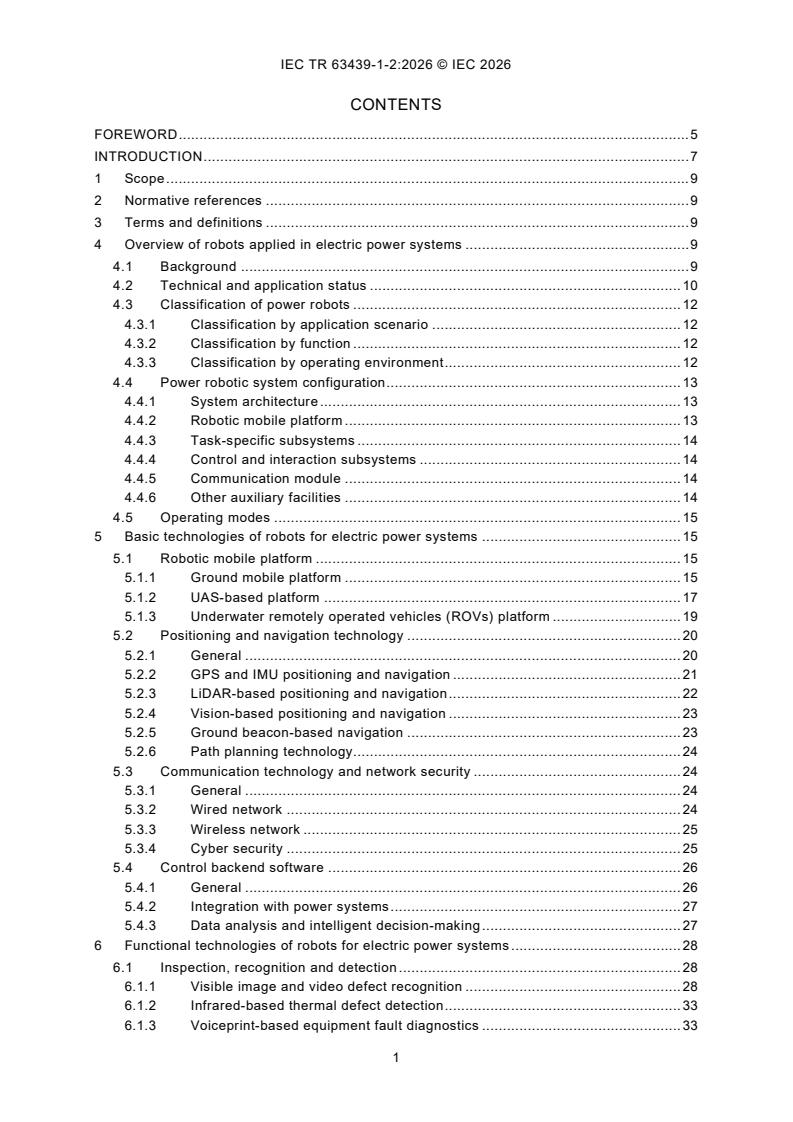
CONTENTS
FOREWORD . 5
INTRODUCTION . 7
1 Scope . 9
2 Normative references . 9
3 Terms and definitions . 9
4 Overview of robots applied in electric power systems . 9
4.1 Background . 9
4.2 Technical and application status . 10
4.3 Classification of power robots . 12
4.3.1 Classification by application scenario . 12
4.3.2 Classification by function . 12
4.3.3 Classification by operating environment . 12
4.4 Power robotic system configuration . 13
4.4.1 System architecture . 13
4.4.2 Robotic mobile platform . 13
4.4.3 Task-specific subsystems . 14
4.4.4 Control and interaction subsystems . 14
4.4.5 Communication module . 14
4.4.6 Other auxiliary facilities . 14
4.5 Operating modes . 15
5 Basic technologies of robots for electric power systems . 15
5.1 Robotic mobile platform . 15
5.1.1 Ground mobile platform . 15
5.1.2 UAS-based platform . 17
5.1.3 Underwater remotely operated vehicles (ROVs) platform . 19
5.2 Positioning and navigation technology . 20
5.2.1 General . 20
5.2.2 GPS and IMU positioning and navigation . 21
5.2.3 LiDAR-based positioning and navigation . 22
5.2.4 Vision-based positioning and navigation . 23
5.2.5 Ground beacon-based navigation . 23
5.2.6 Path planning technology. 24
5.3 Communication technology and network security . 24
5.3.1 General . 24
5.3.2 Wired network . 24
5.3.3 Wireless network . 25
5.3.4 Cyber security . 25
5.4 Control backend software . 26
5.4.1 General . 26
5.4.2 Integration with power systems . 27
5.4.3 Data analysis and intelligent decision-making . 27
6 Functional technologies of robots for electric power systems . 28
6.1 Inspection, recognition and detection . 28
6.1.1 Visible image and video defect recognition . 28
6.1.2 Infrared-based thermal defect detection . 33
6.1.3 Voiceprint-based equipment fault diagnostics . 33
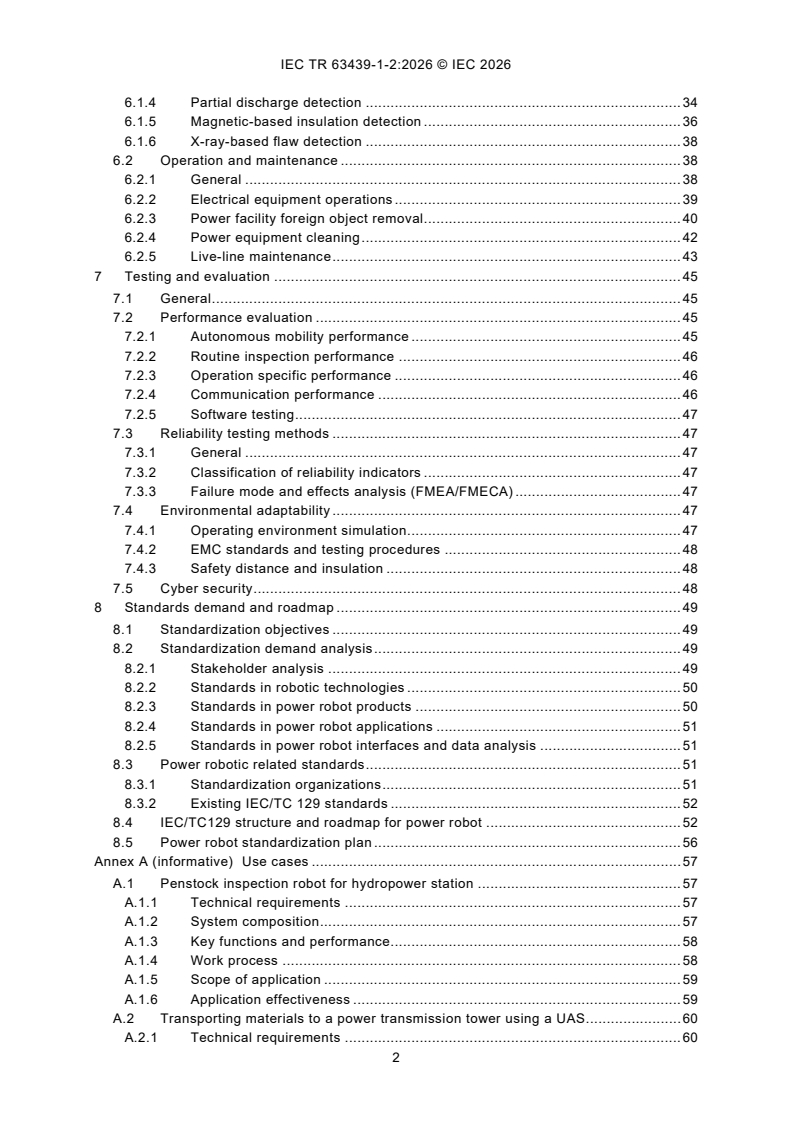
6.1.4 Partial discharge detection . 34
6.1.5 Magnetic-based insulation detection . 36
6.1.6 X-ray-based flaw detection . 38
6.2 Operation and maintenance . 38
6.2.1 General . 38
6.2.2 Electrical equipment operations . 39
6.2.3 Power facility foreign object removal . 40
6.2.4 Power equipment cleaning . 42
6.2.5 Live-line maintenance . 43
7 Testing and evaluation . 45
7.1 General . 45
7.2 Performance evaluation . 45
7.2.1 Autonomous mobility performance . 45
7.2.2 Routine inspection performance . 46
7.2.3 Operation specific performance . 46
7.2.4 Communication performance . 46
7.2.5 Software testing . 47
7.3 Reliability testing methods . 47
7.3.1 General . 47
7.3.2 Classification of reliability indicators . 47
7.3.3 Failure mode and effects analysis (FMEA/FMECA) . 47
7.4 Environmental adaptability . 47
7.4.1 Operating environment simulation . 47
7.4.2 EMC standards and testing procedures . 48
7.4.3 Safety distance and insulation . 48
7.5 Cyber security . 48
8 Standards demand and roadmap . 49
8.1 Standardization objectives . 49
8.2 Standardization demand analysis . 49
8.2.1 Stakeholder analysis . 49
8.2.2 Standards in robotic technologies . 50
8.2.3 Standards in power robot products . 50
8.2.4 Standards in power robot applications . 51
8.2.5 Standards in power robot interfaces and data analysis . 51
8.3 Power robotic related standards . 51
8.3.1 Standardization organizations . 51
8.3.2 Existing IEC/TC 129 standards . 52
8.4 IEC/TC129 structure and roadmap for power robot . 52
8.5 Power robot standardization plan . 56
Annex A (informative) Use cases . 57
A.1 Penstock inspection robot for hydropower station . 57
A.1.1 Technical requirements . 57
A.1.2 System composition . 57
A.1.3 Key functions and performance. 58
A.1.4 Work process . 58
A.1.5 Scope of application . 59
A.1.6 Application effectiveness . 59
A.2 Transporting materials to a power transmission tower using a UAS . 60
A.2.1 Technical requirements . 60
A.2.2 System composition . 60
A.2.3 Key functions . 60
A.2.4 Work process . 60
A.2.5 Application effectiveness . 60
A.2.6 Scope of applications . 60
A.3 Live-line work support robot for power distribution lines . 61
A.3.1 Technical requirements . 61
A.3.2 System composition . 61
A.3.3 Key functions . 61
A.3.4 Work process . 62
A.3.5 Application effectiveness . 62
A.3.6 Scope of application . 63
Annex B (informative) List of existing standards, documents or development projects . 64
B.1 Related standardization organizations . 64
B.2 Related standards . 67
Bibliography . 68
Figure 1 – Architecture of the robotic system . 13
Figure 2 – A type of rail-guided robot . 16
Figure 3 – A type of wheeled robot . 16
Figure 4 – A type of tracked mobile robotic platform . 17
Figure 5 – A type of quadruped robotic platform . 17
Figure 6 – A type of multi-copter UAS . 18
Figure 7 – A type of fixed-wing UAS. 19
Figure 8 – A type of inspection ROV . 20
Figure 9 – Submarine cable inspection ROV . 20
Figure 10 – Illustration of GPS and IMU system . 21
Figure 11 – Principle of LiDAR-based navigation system . 22
Figure 12 – LiDAR constructed 500 kV substation . 23
Figure 13 – An example of vision based robotic navigation . 23
Figure 14 – Control software architecture . 27
Figure 15 – Improved centering effect by automatic offset servo control . 29
Figure 16 – Improved region-specific focus effect by applying servo control. 29
Figure 17 – Improved exposure by applying servo control . 29
Figure 18 – Transmission line equipment defect recognition . 30
Figure 19 – Automatic meter reading . 31
Figure 20 – Switch status recognition . 31
Figure 21 – Typical defects detection in substation facilities . 31
Figure 22 – Typical defects recognition in distribution network . 32
Figure 23 – Smoke and fire detection . 32
Figure 24 – Infrared detection results. 33
Figure 25 – PV panel defects inspection . 33
Figure 26 – Typical voiceprint signals for transformer anomalies . 34
Figure 27 – UV detection . 35
Figure 28 – Ultrasound-based PD detection . 35
Figure 29 – Transmission line insulator inspection robots . 36
Figure 30 – A UAS-based insulator inspection robot . 37
Figure 31 – X-ray inspection robot and fault detection. 38
Figure 32 – Multi-axis arm based switchgear operation robot . 39
Figure 33 – Transformer oil sampling robot . 40
Figure 34 – Overhead line de-icing robot . 41
Figure 35 – Substation live line water washing robot . 42
Figure 36 – Live insulation coating robot . 43
Figure 37 – Remote operation of live line maintenance robot . 44
Figure 38 – IEC/TC129 work structure . 53
Figure A.1 – Penstock inspection robot . 57
Figure A.2 – Inspection operation example of penstock inspection robot . 59
Figure A.3 – Example of transporting the extension cable . 61
Figure A.4 – Moving six-axis with a single-arm operation . 63
Figure A.5 – Example of using assist arm at work . 63
Figure A.6 – Example of wire insulation stripping . 63
Table 1 – Application of robots in power generation . 11
Table 2 – Application of robots in power transmission . 11
Table 3 – Application of robots in distribution . 12
Table 4 – Stakeholders of power robots . 49
Table 5 – ISO current standards for robotics . 52
Table 6 – IEC/TC 129 existing standards for robotics . 52
Table 7 – List of IEC projects . 54
Table B.1 – Standardization organizations . 64
Table B.2 – Related documents . 67
INTERNATIONAL ELECTROTECHNICAL COMMISSION
____________
Robotics for electricity generation, transmission
and distribution systems -
Part 1-2: State-of-the art and standardization roadmap for
electric power system robots
FOREWORD
1) The International Electrotechnical Commission (IEC) is a worldwide organization for
standardization comprising all national electrotechnical committees (IEC National Committees).
The object of IEC is to promote international co-operation on all questions concerning
standardization in the electrical and electronic fields. To this end and in addition to other
activities, IEC publishes International Standards, Technical Specifications, Technical Reports,
Publicly Available Specifications (PAS) and Guides (hereafter referred to as "IEC
Publication(s)"). Their preparation is entrusted to technical committees; any IEC National
Committee interested in the subject dealt with may participate in this preparatory work.
International, governmental and non-governmental organizations liaising with the IEC also
participate in this preparation. IEC collaborates closely with the International Organization for
Standardization (ISO) in accordance with conditions determined by agreement between the two
organizations.
2) The formal decisions or agreements of IEC on technical matters express, as nearly as
possible, an international consensus of opinion on the relevant subjects since each technical
committee has representation from all interested IEC National Committees.
3) IEC Publications have the form of recommendations for international use and are accepted
by IEC National Committees in that sense. While all reasonable efforts are made to ensure that
the technical content of IEC Publications is accurate, IEC cannot be held responsible for the
way in which they are used or for any misinterpretation by any end user.
4) In order to promote international uniformity, IEC National Committees undertake to apply IEC
Publications transparently to the maximum extent possible in their national and regional
publications. Any divergence between any IEC Publication and the corresponding national or
regional publication shall be clearly indicated in the latter.
5) IEC itself does not provide any attestation of conformity. Independent certification bodies
provide conformity assessment services and, in some areas, access to IEC marks of conformity.
IEC is not responsible for any services carried out by independent certification bodies.
6) All users should ensure that they have the latest edition of this publication.
7) No liability shall attach to IEC or its directors, employees, servants or agents including
individual experts and members of its technical committees and IEC National Committees for
any personal injury, property damage or other damage of any nature whatsoever, whether direct
or indirect, or for costs (including legal fees) and expenses arising out of the publication, use
of, or reliance upon, this IEC Publication or any other IEC Publications.
8) Attention is drawn to the Normative references cited in this publication. Use of the referenced
publications is indispensable for the correct application of this publication.
9) IEC draws attention to the possibility that the implementation of this document may involve
the use of (a) patent(s). IEC takes no position concerning the evidence, validity or applicability
of any claimed patent rights in respect thereof. As of the date of publication of this document,
IEC had not received notice of (a) patent(s), which may be required to implement this document.
However, implementers are cautioned that this may not represent the latest information, which
may be obtained from the patent database available at https://patents.iec.ch. IEC shall not be
held responsible for identifying any or all such patent rights.
IEC TR 63439-1-2 has been prepared by IEC technical committee 129: Robotics for electricity
generation, transmission and distribution systems. It is a Technical Report.
The text of this Technical Report is based on the following documents:
Draft Report on voting
129/59/DTR 129/64/RVDTR
Full information on the voting for its approval can be found in the report on voting indicated in
the above table.
The language used for the development of this Technical Report is English.
This document was drafted in accordance with ISO/IEC Directives, Part 2, and developed in
accordance with ISO/IEC Directives, Part 1 and ISO/IEC Directives, IEC Supplement, available
at www.iec.ch/members_experts/refdocs. The main document types developed by IEC are
described in greater detail at www.iec.ch/publications.
A list of all parts in the IEC 63439 series, published under the general title Robotics for electricity
generation, transmission and distribution systems, can be found on the IEC website.
The committee has decided that the contents of this document will remain unchanged until the
stability date indicated on the IEC website under webstore.iec.ch in the data related to the
specific document. At this date, the document will be
– reconfirmed,
– withdrawn, or
– revised.
INTRODUCTION
With the continuous advancement of automation, digitalization, and artificial intelligence, more
than 20 countries worldwide - including Canada, China, Japan, New Zealand, the United States,
etc. - have actively pursued research and application of power robotics technologies. The global
demand for robotic solutions in the power sector is substantial and presents significant growth
potential.
Currently, robots carrying out tasks such as patrol, inspection, detection, and maintenance are
already widely adopted across power generation, transmission, substation, and distribution
systems. Meanwhile, specialized robots - such as those for gas-insulated switchgear (GIS)
diagnostics and live working in substations - are under development. These applications have
driven new technical requirements for robotic systems designed to assist or replace manual
field inspections.
However, the absence of unified international standards has led to significant variations in robot
functionality and performance across different countries, resulting in limited interoperability and
compatibility. There is a clear need to establish international standards to achieve consensus
on functionality, performance, safety, and operational efficiency.
This report encompasses the entire power system workflow and addresses applications such
as inspection, maintenance, operation, and emergency response. Both indoor and outdoor high-
voltage environments are considered, as well as diverse geographical and climatic conditions.
Key factors in adopting power robotics are investigated, including safety issues, human-
machine collaboration, system reliability, and cybersecurity. The report also analyses
standardization needs based on current applications and proposes a roadmap for
standardization. The purpose of this report is to offer guidance for advancing related
technologies and products while serving as a reference for developing international standards
in the field of power robotics.
This document mainly consists of five parts. Clause 4 provides an overview of power robotics,
covering their current applications, technical status, classification methods, system
architecture, key components, and operating modes in electric power systems. Clause 5
outlines the key technologies of power robotics, including mobile platforms,
positioning/navigation systems, communication networks and cybersecurity. Clause 6 details
the core functional technologies of power robots, covering multi-modal inspection capabilities
and critical maintenance operations for electric power systems. Clause 7 presents testing
frameworks for power robots, ensuring operational effectiveness across all critical system
parameters. Finally, Clause 8 outlines the standardization framework for power robotics,
reviews existing standards and organizations, and presents the IEC/TC129 structure with a
comprehensive roadmap and implementation plan for future standardization efforts.
Further reading:
IEC 60050-191:1990, International Electrotechnical Vocabulary (IEV) - Part 161:
Electromagnetic compatibility IEC 60050-161:1990 [1]
IEC 60050-192:2015, International Electrotechnical Vocabulary (IEV) - Part 192: Dependability
IEC 60050-192:2015 [2]
IEC 60050-195:2021, International Electrotechnical Vocabulary (IEV) - Part 195: Earthing and
protection against electric shock IEC 60050-195:2021 [3]
IEC 60050-300:2001, International Electrotechnical Vocabulary (IEV) - Part 300: Electrical and
electronic measurements and measuring instruments - Part 311: General terms relating to
measurements - Part 312: General terms relating to electrical measurements - Part 313: Types
of electrical measuring instruments - Part 314: Specific terms according to the type of
instrument IEC 60050-300:2001 [4]
IEC 60050-651:2014, International Electrotechnical Vocabulary (IEV) - Part 651: Live working
IEC 60050-651:2014 [5]
IEC TR 62210:2003, Power system control and associated communications - Data and
communication security IEC TR 62210:2003 [6]
ISO 12100:2010, Safety of machinery - General principles for design - Risk assessment and
risk reduction ISO 12100:2010 [7]
ISO 18257:2016, Space systems - Semiconductor integrated circuits for space applications -
Design requirements ISO 18257:2016 [8]
ISO 19092:2008, Financial services - Biometrics - Security framework ISO 19092:2008 [9]
ISO/TS 27790:2009, Health informatics - Document registry framework ISO/TS 27790:2009 [10]
1 Scope
This part of IEC 63439, which is a Technical Report, specifies a comprehensive study of the
robotic technologies in power systems, including generation, transmission, and distribution. The
primary objectives are:
a) System overview and classification
Analyze current robotic applications across all power system segments (generation,
transmission, and distribution), developing a comprehensive classification framework that
categorizes robots by operational scenarios (substations, power lines), functional roles
(inspection, repair), and environmental conditions (high-voltage zones, confined spaces).
b) Core technology assessment
Evaluate fundamental robotic technologies encompassing mobility platforms (ground robots,
drones, remotely operated vehicles (ROVs)), navigation systems (GPS, LiDAR, vision-
based), and communication networks (wired/wireless/hybrid); assess functional capabilities
through multi-sensor inspection (visual, thermal, ultrasonic) and maintenance operations
(live-line work, cleaning, debris removal), and examine integration aspects with power grid
management systems including data protocols and cybersecurity requirements.
c) Testing and validation framework
Establish performance benchmarks for core robotic functions including autonomous
navigation, inspection accuracy, and operational efficiency, while developing reliability
testing methods that incorporate failure mode analysis (FMEA/FMECA) and environmental
stress testing under extreme conditions.
d) Standardization roadmap
Conduct a gap analysis of current power robotics standards (including IEC/TC129) to
identify deficiencies, while systematically mapping stakeholder requirements to prioritize
standardization needs across hardware, software interfaces, and safety protocols; develop
the roadmap with clear timelines for creating new standards, facilitating adoption, and
ensuring compliance verification across the industry.
2 Normative references
There are no normative references in this document.
3 Terms and definitions
No terms and definitions are listed in this document.
ISO and IEC maintain terminology databases for use in standardization at the following
addresses:
– IEC Electropedia: available at https://www.electropedia.org/
– ISO Online browsing platform: available at https://www.iso.org/obp
4 Overview of robots applied in electric power systems
4.1 Background
With the rapid development of the economy and society, electricity demand has continued to
grow, leading to a significant increase in facilities across power generation, transmission, and
distribution. As a result, operation and maintenance (O&M) tasks for power systems have
become more intensive, with high workloads and elevated risks, creating a growing demand for
highly skilled personnel. There is an urgent need for new technologies to replace or assist
manual O&M work, especially with the increase of the following challenges.
a) Harsh environments
Many transmission and transformation facilities are located in remote outdoor areas with
severe natural conditions, making manual inspection difficult.
b) Maintenance of newly deployed facilities
With the development of ultra-high voltage (UHV) AC/DC power grids, components such as
converter valve halls and UHV insulator strings have been introduced. Due to installation
constraints and surrounding conditions, conventional manual maintenance is inadequate.
c) Unattended substations and transmission facilities
Labour shortages and advances in intelligent technologies have driven demand for
unmanned substation operations. The development of smart substations imposes new
requirements on O&M management models. At the same time, there is a growing shortage
of live-line O&M personnel for transmission lines and distribution networks.
d) Routine inspection and maintenance tasks
Repetitive and labour-intensive tasks - especially under adverse weather conditions - imply
that there is a need to reduce manual workload and improve operational efficiency and
effectiveness.
With ongoing advancements in robotics, artificial intelligence, and information processing
technologies, the use of robots, drones, and similar systems to replace humans in complex,
hazardous, and highly repetitive tasks has become a solution. This shift is particularly evident
with :
e) Enhanced personnel safety
Power equipment typically operates under high voltage conditions, posing significant risks
to workers. By reducing the need for on-site human presence, robotics can improve
operational safety. Robots can be deployed to perform tasks in high-risk environments,
minimizing direct human exposure.
f) Reduced operation and maintenance (O&M) costs
For repetitive inspection tasks in power facilities, automation and remote operation via
robots can significantly lower O&M expenditures.
g) Increased inspection frequency and improved system stability
Enhanced inspection coverage and accuracy through robotic deployment enable more
effective preventive and condition-based maintenance, reducing the probability of
emergencies and improving the overall stability of power system operations.
h) Improved asset management
Robots provide new sources of equipment data, enabling a more comprehensive
understanding of asset conditions. This supports better health monitoring and helps prevent
catastrophic failures.
4.2 Technical and application status
At present, ground inspection robots have been deployed in the power generation sector -
including hydropower stations and photovoltaic (PV) plants - for equipment inspection using
visual and infrared technologies. Unmanned Aircraft Systems (UAS) inspection systems are
also utilized for routine inspections of external plant infrastructure.
Specialized detection robots, such as generator inspection robots, dam inspection robots, and
wind turbine inspection robots, have been put into operational use. Additionally, maintenance
robots - such as PV module cleaning robots - are being widely promoted and adopted across
power generation facilities. The application status of robots in the power generation sector is
shown in Table 1.
Table 1 – Application of robots in power generation
Scenarios Robots in use Countries
Hydro plants Underwater inspection robots Canada, China, France, Italy, Venezuela, Thailand
Wind farms Wind turbine inspection robots China, Germany, United States
PV plants PV panel cleaning robots China, Japan, Switzerland
Overhead transmission line inspection robots include UAS-based systems that leverage image
analysis for precise defect detection. Line-following inspection robots are capable of insulator
insulation performance assessment and X-ray-based defect detection. Submarine cable
inspection robots utilize sonar imaging to identify cable conditions. Robots can also be used for
device-specific inspection such as insulator inspection. Live-line maintenance robots are used
for tasks such as strand repair on lines and towers, while de-icing robots are deployed for
removing ice accumulation on transmission lines.
In substations, wheeled inspection robots are employed for on-site operations. These robots
integrate multiple diagnostic technologies - such as high-definition image acquisition and
analysis, infrared thermography, ultraviolet imaging, and ultrasound detection - to enable
automated equipment status recognition, thermal defect detection, sound/noise measurement,
and partial discharge detection. For more details, please refer to CIGRE TB 807:2020 [11].
Valve hall inspection robots are specifically designed for the unique electromagnetic
environment of UHV converter valve halls. These robots operate during live conditions to
provide imaging that identifies leakage or hot spots, enabling predictive maintenance planning
for the next scheduled outage.
Transformer internal inspection robots have been developed to perform inspections without
requiring oil drainage. For maintenance applications, live-line water-washing and cleaning
robots are in use. Switchgear operation robots have entered partial deployment, while
firefighting robots for emergency response are currently in the trial phase. The application
status of robots in the power transmission sector is shown in Table 2.
Table 2 – Application of robots in power transmission
Applications Robots in use Countries
UAS -based robots for Transmission line China, France, United Kingdom,
Inspection United States, Peru
Transmission line Inspection robots Canada, China, Japan, South Africa,
Overhead transmission lines
New Zealand, United States, Peru
Transmission line De-icing robots China, Spain, United States
Insulator inspection robots China, South Korea, United States
Submarine cables Cable inspection robots China
Tunnel cable Tunnel ground inspection robots China, United States
Substation wheeled inspection robots China, Japan, France, United States
Substation Gear operation robots China, United States
Valve hall ground inspection robots China, Germany
In distribution systems, UAS-based robots have been adopted to inspect the operational status
of distribution network lines. Live-line operation robots are used to perform tasks such as
insulation stripping, bolt tightening, replacement of anti-fall devices, and live disconnection or
connection of leads. Overhead line insulation coating robots for distribution networks are
capable of automatically applying insulating materials to enhance line insulation performance.
The application status of robots in the distribution sector is shown in Table 3.
Table 3 – Application of robots in distribution
Applications Robots in use Countries
Overhead line tower Live line operation robots China, Japan, United States, Peru
Distribution control centre Distribution control operation robots China
4.3 Classification of power robots
4.3.1 Classification by application scenario
Power system scenarios are diverse and complex, imposing varying functional requirements on
robots across different scenarios. Currently, robotic systems have been deployed across
multiple domains of the power system. Based on application scenarios, power robots can be
classified as follows:
a) Robots applied in electricity generation scenarios
Applied in power generation environments such as thermal power, hydropower, and wind
power plants.
b) Robots applied in electricity transmission scenarios
Used in scenarios including overhead transmission lines and submarine cable transmission.
c) Robots applied in electricity substation scenarios
Deployed in both outdoor and indoor environments of substations.
d) Robots applied in electricity distribution scenarios
Utilized in distribution network scenarios, including overhead lines, poles and towers, and
distribution rooms.
4.3.2 Classification by function
Robots in the power sector can be categorized by their functional roles as follows:
a) Robots applied for electric power facilities construction
Used throughout various stages of power infrastructure development, including surveying,
design, and construction.
b) Robots applied for electric power facilities inspection
Employed for routine inspection and condition monitoring of power equipment. Functions
include equipment status recognition, meter reading, infrared temperature measurement,
and partial discharge detection.
c) Robots applied for electric power facilities operation/maintenance
Designed to perform operational and maintenance tasks on power facilities, such as water
washing, cleaning, and switchgear operation.
d) Robots applied for electric power facilities emergency
Intended for emergency response involving power infrastructure, including firefighting
robots, confined-space emergency UAS, and search-and-rescue drones.
4.3.3 Classification by operating environment
Robots in the power sector can also be classified according to their operating space as follows:
a) Ground mobile robots
Operating on the ground or equipment surfaces
...