

ISO/IEC TR 63306-1:2020
(Main)Smart manufacturing standards map (SM2) - Part 1: Framework
General Information
- Abstract
ISO/IEC TR 63306-1:2020 This document describes the framework and the vocabulary that are used for the development of entries in the Smart Manufacturing Standards Map Catalogue. These enable the mapping and linking of standards and standard projects related to various aspects of smart manufacturing (product, production, supply chain, industrial services ...).
- Status
- Published
- Publication Date
- 15-Dec-2020
- Technical Committee
- SyC SM - Smart Manufacturing
- Current Stage
- PPUB - Publication issued
- Start Date
- 16-Dec-2020
- Completion Date
- 20-Jan-2021
Overview
ISO/IEC TR 63306-1:2020 - Smart Manufacturing Standards Map (SM2) - Part 1: Framework describes the framework and controlled vocabulary used to build the Smart Manufacturing Standards Map Catalogue. The technical report defines how to map, classify and link standards and standards projects across smart manufacturing domains (product, production, supply chain, industrial services, etc.). It provides the structural blocks, characteristics and qualifiers needed to create consistent catalogue entries and graphical representations for standards discovery and analysis.
Key topics and technical scope
The report focuses on a standardized information model and vocabulary for cataloguing standards. Key topics include:
- SM2 Framework & Catalogue: principles for the SM2 Catalogue structure and graphical views that support mapping and navigation.
- Vocabulary and Characteristics: common terms, characteristic values and qualifiers used to describe standards entries consistently.
- Identification block: metadata such as status, standard/project number, edition, publication date, owner, ICS classification and title.
- Object and Type blocks: classification of the type of standard and the manufacturing object or process it covers (product, production, supply chain).
- Hierarchy and Life cycle: equipment and functional hierarchies, and multiple life cycle perspectives (product, instance, production system).
- Interoperability: approaches, concerns and layers relevant to smart manufacturing interoperability.
- System engineering processes: agreement, organizational, technical management and technical processes to link standards to engineering activities.
- Relevance & Validation: relevance levels, motivation and validation metadata for catalogue entries.
- Informative annexes: compiled definitions of smart manufacturing, life cycle models and referenced hierarchies.
Practical applications and users
ISO/IEC TR 63306-1 is intended for:
- Standards bodies and technical committees creating or cataloguing standards for smart manufacturing.
- Manufacturers and system integrators seeking to identify applicable standards across product, production and supply chain domains.
- Tool vendors and registry operators building standards catalogues, discovery portals or interoperability registries.
- Procurement, compliance and R&D teams mapping standards to projects, identifying gaps, and planning standard adoption. Benefits include improved standards discovery, consistent metadata for comparison and linkage, support for interoperability assessments, and clearer guidance for standards-based digital transformation.
Related standards (examples)
- IEC/ISO classification systems referenced in the report (ICS)
- Equipment and functional hierarchy standards such as IEC 62264-1 and IEC 61512-1
- Architectural models cited in annexes: RAMI 4.0, SGAM, IMSA
Keywords: ISO/IEC TR 63306-1:2020, Smart Manufacturing Standards Map, SM2, standards catalogue, smart manufacturing standards, interoperability, life cycle, equipment hierarchy.
Get Certified
Connect with accredited certification bodies for this standard

DVS-ZERT GmbH
German welding certification society.
CARES (UK Certification Authority for Reinforcing Steels)
UK certification for reinforcing steels and construction.
EWF/IIW (European/International Welding Federation)
International welding personnel certification.
Sponsored listings
Frequently Asked Questions
ISO/IEC TR 63306-1:2020 is a technical report published by the International Electrotechnical Commission (IEC). Its full title is "Smart manufacturing standards map (SM2) - Part 1: Framework". This standard covers: ISO/IEC TR 63306-1:2020 This document describes the framework and the vocabulary that are used for the development of entries in the Smart Manufacturing Standards Map Catalogue. These enable the mapping and linking of standards and standard projects related to various aspects of smart manufacturing (product, production, supply chain, industrial services ...).
ISO/IEC TR 63306-1:2020 This document describes the framework and the vocabulary that are used for the development of entries in the Smart Manufacturing Standards Map Catalogue. These enable the mapping and linking of standards and standard projects related to various aspects of smart manufacturing (product, production, supply chain, industrial services ...).
ISO/IEC TR 63306-1:2020 is classified under the following ICS (International Classification for Standards) categories: 01.040.25 - Manufacturing engineering (Vocabularies); 25.040.01 - Industrial automation systems in general; 25.060.01 - Machine tool systems in general. The ICS classification helps identify the subject area and facilitates finding related standards.
ISO/IEC TR 63306-1:2020 is available in PDF format for immediate download after purchase. The document can be added to your cart and obtained through the secure checkout process. Digital delivery ensures instant access to the complete standard document.
Standards Content (Sample)
ISO/IEC TR 63306-1
Edition 1.0 2020-12
TECHNICAL
REPORT
colour
inside
Smart manufacturing standards map (SM2) –
Part 1: Framework
All rights reserved. Unless otherwise specified, no part of this publication may be reproduced or utilized in any form
or by any means, electronic or mechanical, including photocopying and microfilm, without permission in writing from
either IEC or IEC's member National Committee in the country of the requester. If you have any questions about
ISO/IEC copyright or have an enquiry about obtaining additional rights to this publication, please contact the address
below or your local IEC member National Committee for further information.
IEC Central Office Tel.: +41 22 919 02 11
3, rue de Varembé info@iec.ch
CH-1211 Geneva 20 www.iec.ch
Switzerland
About the IEC
The International Electrotechnical Commission (IEC) is the leading global organization that prepares and publishes
International Standards for all electrical, electronic and related technologies.
About IEC publications
The technical content of IEC publications is kept under constant review by the IEC. Please make sure that you have the
latest edition, a corrigendum or an amendment might have been published.
IEC publications search - webstore.iec.ch/advsearchform Electropedia - www.electropedia.org
The advanced search enables to find IEC publications by a The world's leading online dictionary on electrotechnology,
variety of criteria (reference number, text, technical containing more than 22 000 terminological entries in English
committee,…). It also gives information on projects, replaced and French, with equivalent terms in 16 additional languages.
and withdrawn publications. Also known as the International Electrotechnical Vocabulary
(IEV) online.
IEC Just Published - webstore.iec.ch/justpublished
Stay up to date on all new IEC publications. Just Published IEC Glossary - std.iec.ch/glossary
details all new publications released. Available online and 67 000 electrotechnical terminology entries in English and
once a month by email. French extracted from the Terms and Definitions clause of
IEC publications issued since 2002. Some entries have been
IEC Customer Service Centre - webstore.iec.ch/csc collected from earlier publications of IEC TC 37, 77, 86 and
If you wish to give us your feedback on this publication or CISPR.
need further assistance, please contact the Customer Service
Centre: sales@iec.ch.
ISO/IEC TR 63306-1
Edition 1.0 2020-12
TECHNICAL
REPORT
colour
inside
Smart manufacturing standards map (SM2) –
Part 1: Framework
INTERNATIONAL
ELECTROTECHNICAL
COMMISSION
ICS 25.040.01; 25.060.01; 01.040.25 ISBN 978-2-8322-9199-3
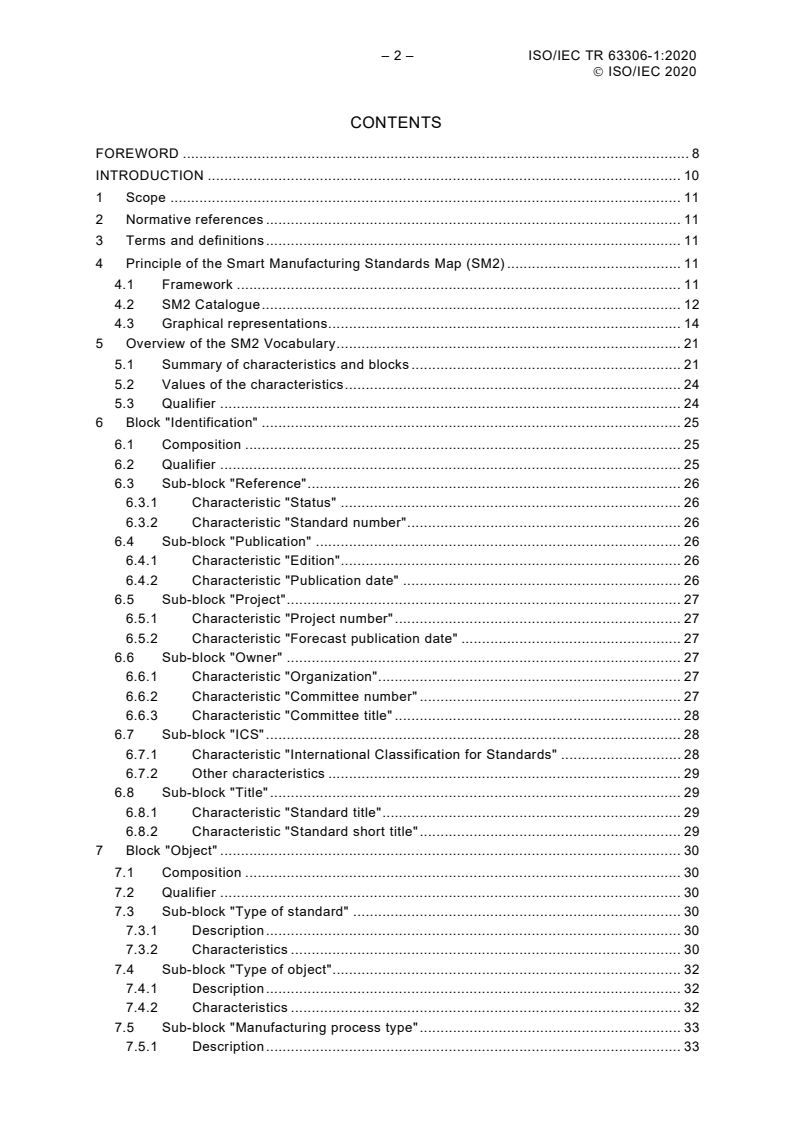
– 2 – ISO/IEC TR 63306-1:2020
ISO/IEC 2020
CONTENTS
FOREWORD . 8
INTRODUCTION . 10
1 Scope . 11
2 Normative references . 11
3 Terms and definitions . 11
4 Principle of the Smart Manufacturing Standards Map (SM2) . 11
4.1 Framework . 11
4.2 SM2 Catalogue . 12
4.3 Graphical representations . 14
5 Overview of the SM2 Vocabulary . 21
5.1 Summary of characteristics and blocks . 21
5.2 Values of the characteristics . 24
5.3 Qualifier . 24
6 Block "Identification" . 25
6.1 Composition . 25
6.2 Qualifier . 25
6.3 Sub-block "Reference" . 26
6.3.1 Characteristic "Status" . 26
6.3.2 Characteristic "Standard number" . 26
6.4 Sub-block "Publication" . 26
6.4.1 Characteristic "Edition" . 26
6.4.2 Characteristic "Publication date" . 26
6.5 Sub-block "Project" . 27
6.5.1 Characteristic "Project number" . 27
6.5.2 Characteristic "Forecast publication date" . 27
6.6 Sub-block "Owner" . 27
6.6.1 Characteristic "Organization" . 27
6.6.2 Characteristic "Committee number" . 27
6.6.3 Characteristic "Committee title" . 28
6.7 Sub-block "ICS" . 28
6.7.1 Characteristic "International Classification for Standards" . 28
6.7.2 Other characteristics . 29
6.8 Sub-block "Title" . 29
6.8.1 Characteristic "Standard title" . 29
6.8.2 Characteristic "Standard short title" . 29
7 Block "Object" . 30
7.1 Composition . 30
7.2 Qualifier . 30
7.3 Sub-block "Type of standard" . 30
7.3.1 Description . 30
7.3.2 Characteristics . 30
7.4 Sub-block "Type of object" . 32
7.4.1 Description . 32
7.4.2 Characteristics . 32
7.5 Sub-block "Manufacturing process type" . 33
7.5.1 Description . 33
ISO/IEC 2020
7.5.2 Characteristics . 34
8 Block "Hierarchy" . 34
8.1 Composition . 34
8.2 Qualifier . 35
8.3 Sub-block "Equipment hierarchy" . 35
8.3.1 Description . 35
8.3.2 Characteristics . 35
8.4 Sub-block "Functional hierarchy" . 37
8.4.1 Description . 37
8.4.2 Characteristics . 37
9 Block "Life cycle" . 38
9.1 Composition . 38
9.2 Qualifier . 39
9.3 Sub-block "Product type life cycle" . 39
9.3.1 Description . 39
9.3.2 Characteristics . 40
9.4 Sub-block "Product instance life cycle" . 41
9.4.1 Description . 41
9.4.2 Characteristics . 41
9.5 Sub-block "Production system life cycle" . 41
9.5.1 Description . 41
9.5.2 Characteristics . 42
10 Block "Interoperability" . 42
10.1 General . 42
10.2 Composition . 43
10.3 Qualifier . 43
10.4 Sub-block "Interoperability approach" . 43
10.4.1 Description . 43
10.4.2 Characteristics . 43
10.5 Sub-block "Interoperability concern" . 45
10.5.1 Description . 45
10.5.2 Characteristics . 45
10.6 Sub-block "Interoperability layer" . 46
10.6.1 Description . 46
10.6.2 Characteristics . 46
11 Block "System engineering process" . 46
11.1 General . 46
11.2 Composition . 47
11.3 Qualifier . 48
11.4 Sub-block "Agreement processes" . 48
11.4.1 Description . 48
11.4.2 Characteristics . 48
11.5 Sub-block "Organizational project-enabling processes" . 49
11.5.1 Description . 49
11.5.2 Characteristics . 49
11.6 Sub-block "Technical management processes" . 49
11.6.1 Description . 49
11.6.2 Characteristics . 49
– 4 – ISO/IEC TR 63306-1:2020
ISO/IEC 2020
11.7 Sub-block "Technical processes" . 50
11.7.1 Description . 50
11.7.2 Characteristics . 50
12 Block "Relevance to SM" . 51
12.1 Composition . 51
12.2 Qualifier . 52
12.3 Characteristic "Relevance level" . 52
12.4 Characteristic "Motivation" . 52
13 Block "Validation" . 52
13.1 Composition . 52
13.2 Qualifier . 53
13.3 Characteristics specification . 53
Annex A (informative) Compilation of definitions of smart manufacturing . 54
A.1 Objective . 54
A.2 Definition . 54
A.3 Complements to the definition . 54
A.4 Vision . 55
A.5 Difference from the manufacturing to date . 56
A.6 New technologies for smart manufacturing . 57
Annex B (informative) Life cycles. 60
B.1 General . 60
B.2 Product life cycle . 60
B.3 Production system life cycle . 62
B.4 Supply chain life cycle . 64
B.5 Characteristic "RAMI4.0 Life cycle". 65
B.5.1 Description . 65
B.5.2 Possible values . 65
B.6 Characteristic "IMSA Life cycle" . 66
B.6.1 Description . 66
B.6.2 Possible values . 66
Annex C (informative) Hierarchies . 67
C.1 General . 67
C.2 Characteristic "Equipment hierarchy" of IEC 62264-1 and IEC 61512-1 . 67
C.2.1 Description . 67
C.2.2 Possible values . 67
C.3 Characteristic "Functional hierarchy" of IEC 62264-1 . 68
C.3.1 Description . 68
C.3.2 Possible values . 68
C.4 Characteristic "SGAM Zones" . 69
C.4.1 Description . 69
C.4.2 Possible values . 69
C.5 Characteristic "RAMI4.0 Hierarchy levels" . 70
C.5.1 Description . 70
C.5.2 Possible values . 70
C.6 Characteristic "IMSA System hierarchy" . 71
C.6.1 Description . 71
C.6.2 Possible values . 71
C.7 Mapping legacy hierarchies on the equipment hierarchy . 71
ISO/IEC 2020
C.8 Mapping on legacy hierarchies on the functional hierarchy . 73
Annex D (informative) Interoperability . 74
D.1 General . 74
D.2 Big Picture characteristic "Interoperability barrier" . 74
D.2.1 Description . 74
D.2.2 Possible values . 74
D.2.3 Comments . 74
D.3 Characteristic "SGAM Interoperability Layers" . 76
D.3.1 Description . 76
D.3.2 Possible values . 77
D.4 Characteristic "RAMI4.0 Layer". 78
D.4.1 Description . 78
D.4.2 Possible values . 78
D.5 Characteristic "IMSA Intelligent characteristics" . 80
D.5.1 Description . 80
D.5.2 Possible values . 80
Annex E (informative) Big Picture history . 82
Bibliography . 85
Figure 1 – Principle of the SM2 Framework . 12
Figure 2 – Example of populated SM2 Catalogue . 13
Figure 3 – Example mapping of product catalogue data standards. 15
Figure 4 – Example mapping structure for production system standards . 16
Figure 5 – Example chart "Production system cube" with standard numbers . 17
Figure 6 – Example chart "Production system cube" with short title . 18
Figure 7 – Example 2D chart with standard numbers . 19
Figure 8 – Example 2D chart with short title. 20
Figure 9 – Product type life cycle . 40
Figure 10 – GERA life cycle phases . 42
Figure B.1 – Product type life cycle . 60
Figure B.2 – Versions of a product type . 61
Figure B.3 – Product type improvement . 61
Figure B.4 – Product instance life time . 62
Figure B.5 – Product instance and product type. 62
Figure B.6 – Production system life cycle . 63
Figure B.7 – The user and the external actors . 63
Figure B.8 – From the design to maintenance . 63
Figure B.9 – Spare component discontinued . 64
Figure B.10 – Supply chain life cycle . 64
Figure C.1 – RAMI4.0 Hierarchy . 70
Figure D.1 – Grouping into interoperability layers . 77
Figure E.1 – Standards landscape . 82
Figure E.2 – History of the Big Picture project . 84
– 6 – ISO/IEC TR 63306-1:2020
ISO/IEC 2020
Table 1 – Block "Identification": sub-blocks and characteristics . 21
Table 2 – Block "Object": sub-blocks and characteristics . 21
Table 3 – Block "Hierarchy": sub-blocks and characteristics . 22
Table 4 – Block "Life cycle": sub-blocks and characteristics . 22
Table 5 – Block "Interoperability": sub-blocks and characteristics . 23
Table 6 – Block "System engineering process": sub-blocks and characteristics . 23
Table 7 – Block "Relevance to SM": sub-blocks and characteristics . 24
Table 8 – Block "Validation": sub-blocks and characteristics . 24
Table 9 – Composition of the block "Identification" . 25
Table 10 – Possible values of "Status" . 26
Table 11 – Composition of the block "Object" . 30
Table 12 – Characteristics of "Type of standard" . 31
Table 13 – Characteristics of "Type of object" . 32
Table 14 – Characteristics of "Manufacturing process type" . 34
Table 15 – Composition of the block "Hierarchy" . 35
Table 16 – Characteristics of "Equipment hierarchy". 35
Table 17 – Characteristics of "Functional hierarchy" . 38
Table 18 – Composition of the block "Life cycle" . 39
Table 19 – Characteristics of "Product type life cycle" . 41
Table 20 – Characteristics of "Product instance life cycle" . 41
Table 21 – Characteristics of "Production system life cycle" . 42
Table 22 – Composition of the block "Interoperability" . 43
Table 23 – Characteristics of "Interoperability approach" . 44
Table 24 – Characteristics of "Interoperability concern" . 45
Table 25 – Characteristics of "Interoperability layer" . 46
Table 26 – Composition of the block "System engineering process" . 47
Table 27 – Characteristics of "Agreement processes" . 48
Table 28 – Characteristics of "Organizational project-enabling processes" . 49
Table 29 – Characteristics of "Technical management processes" . 50
Table 30 – Characteristics of "Technical processes" . 51
Table 31 – Composition of the block "Relevance to SM" . 52
Table 32 – Possible values of "Relevance level" . 52
Table 33 – Composition of the block "Validation" . 53
Table B.1 – Possible values of "RAMI4.0 Life cycle" . 65
Table B.2 – Possible values of "IMSA Life cycle" . 66
Table C.1 – Possible values of "Equipment hierarchy" . 67
Table C.2 – Possible values of "Functional hierarchy" . 68
Table C.3 – Possible values of "SGAM Zones" . 69
Table C.4 – Possible values of "RAMI4.0 Hierarchy level" . 70
Table C.5 – Possible values of "IMSA System hierarchy" . 71
Table C.6 – Mapping on legacy hierarchies on the equipment hierarchy . 72
Table C.7 – Mapping on legacy hierarchies on the equipment hierarchy . 73
Table D.1 – Possible values of "Interoperability barrier" . 74
ISO/IEC 2020
Table D.2 – Interoperability categories defined by GWAC . 76
Table D.3 – Possible values of "SGAM Interoperability Layers" . 77
Table D.4 – Possible values of "RAMI4.0 Layer" . 78
Table D.5 – Possible values of "IMSA Intelligent characteristics" . 81
– 8 – ISO/IEC TR 63306-1:2020
ISO/IEC 2020
SMART MANUFACTURING STANDARDS MAP (SM2) –
Part 1: Framework
FOREWORD
1) ISO (the International Organization for Standardization) and IEC (the International Electrotechnical Commission)
form the specialized system for worldwide standardization. National bodies that are members of ISO or IEC
participate in the development of International Standards through technical committees established by the
respective organization to deal with particular fields of technical activity. ISO and IEC technical committees
collaborate in fields of mutual interest. Other international organizations, governmental and non-governmental,
in liaison with ISO and IEC, also take part in the work.
2) The formal decisions or agreements of IEC and ISO on technical matters express, as nearly as possible, an
international consensus of opinion on the relevant subjects since each technical committee has representation
from all interested IEC and ISO National bodies.
3) IEC and ISO documents have the form of recommendations for international use and are accepted by IEC and
ISO National bodies in that sense. While all reasonable efforts are made to ensure that the technical content of
IEC and ISO documents is accurate, IEC and ISO cannot be held responsible for the way in which they are used
or for any misinterpretation by any end user.
4) In order to promote international uniformity, IEC and ISO National bodies undertake to apply IEC and ISO
documents transparently to the maximum extent possible in their national and regional publications. Any
divergence between any IEC and ISO document and the corresponding national or regional publication shall be
clearly indicated in the latter.
5) IEC and ISO do not provide any attestation of conformity. Independent certification bodies provide conformity
assessment services and, in some areas, access to IEC and ISO marks of conformity. IEC and ISO are not
responsible for any services carried out by independent certification bodies.
6) All users should ensure that they have the latest edition of this document.
7) No liability shall attach to IEC and ISO or their directors, employees, servants or agents including individual
experts and members of its technical committees and IEC and ISO National bodies for any personal injury,
property damage or other damage of any nature whatsoever, whether direct or indirect, or for costs (including
legal fees) and expenses arising out of the publication, use of, or reliance upon, this ISO/IEC document or any
other IEC and ISO documents.
8) Attention is drawn to the Normative references cited in this document. Use of the referenced publications is
indispensable for the correct application of this document.
9) Attention is drawn to the possibility that some of the elements of this ISO/IEC document may be the subject of
patent rights. IEC and ISO shall not be held responsible for identifying any or all such patent rights.
This document has been prepared by IEC systems committee SM: Smart Manufacturing, in
collaboration with ISO technical committee 184: Automation systems and integration.
The text of this Technical Report is based on the following documents:
Draft Report on voting
SyCSM/42/DTR SyCSM/46/RVDTR
Full information on the voting for its approval can be found in the report on voting indicated in
the above table.
The language used for the development of this Technical Report is English.
This document was drafted in accordance with ISO/IEC Directives, Part 2, and developed in
accordance with ISO/IEC Directives, Part 1 and ISO/IEC Directives, IEC Supplement, available
at www.iec.ch/members_experts/refdocs.
ISO/IEC 2020
In this document, the following print types are used.
– The font colour of the committee mandatory characteristics is red.
– The font colour of the committee conditional characteristics is purple.
A list of all parts in the ISO/IEC 63306 series, published under the general title Smart
Manufacturing Standards Map (SM2), can be found on the IEC and ISO websites.
IMPORTANT – The 'colour inside' logo on the cover page of this publication indicates that it
contains colours which are considered to be useful for the correct understanding of its
contents. Users should therefore print this document using a colour printer.
– 10 – ISO/IEC TR 63306-1:2020
ISO/IEC 2020
INTRODUCTION
International and regional standards developing organizations (SDOs), as well as consortia
and national initiatives, identified the need for clarifying the standards landscape of thousands
of publications related to manufacturing in general and more specifically to smart
manufacturing.
On this matter, the "Big Picture" project initiated by ISO/TC 184 "Automation systems and
.
integration" in 2001 is notable. It resulted in the publication of ISO/TR 23087:2018 [1]
The other important contributions are:
– NISTIR 8107, Current Standards Landscape for Smart Manufacturing Systems [2], 2016;
– VDI/VDE and ZVEI, Reference Architecture Model Industrie 4.0 (RAMI4.0) [3], 2015;
– final report of ISO/TMB Strategic Advisory Group Industry 4.0/Smart manufacturing, 2016.
The Smart Manufacturing Standards Map (SM2) project was initiated by ISO and IEC in order
to provide a credible, central, and neutral repository of information about standards related to
smart manufacturing.
NOTE Standards is a generic term covering international and national standards, specifications, technical reports,
technical specifications, white papers and other similar deliverables provided by standards developing organizations
(SDO) or consortia.
The goals of this project are to provide a systematic and reliable classification method
(vocabulary and catalogue), and in the future a central repository with visualization tools for
sorting, classifying and comparing standards.
These tools are intended to support SDOs, their officers and experts in the following tasks:
– identify standards that apply to their own domain;
– examine the main features of selected standards;
– generate comparisons between the relative positioning of different standards in their
domain or other domains.
These tools should also serve standards users in the following tasks:
– identify the relevant standards for their activity;
– evaluate their activity in terms of the standards and the standardization projects;
– build their product development roadmap in accordance with the standards landscape.
These tools and the information contained in the repository are updated frequently to reflect
new standards and the need for new ways to characterize standards as technology advances.
Numbers in square brackets refer to the Bibliography.
ISO/IEC 2020
SMART MANUFACTURING STANDARDS MAP (SM2) –
Part 1: Framework
1 Scope
This document describes the framework and the vocabulary that are used for the development
of entries in the Smart Manufacturing Standards Map Catalogue. These enable the mapping
and linking of standards and standard projects related to various aspects of smart
manufacturing (product, production, supply chain, industrial services .).
The framework applies to international standards, de facto standards and consortium
specifications; publications or projects; thereafter named "standards".
The framework part (Clauses 4) briefly describes the principle of structuring the standards
catalogue and its use for analysing the standards landscape.
The vocabulary part (Clauses 5 to 13) specifies the characteristics that are used for the
classification of standards.
NOTE The vocabulary is not universal but is the best effort to name the concepts used in different domains.
2 Normative references
There are no normative references in this document.
3 Terms and definitions
No terms and definitions are listed in this document.
ISO and IEC maintain terminological databases for use in standardization at the following
addresses:
• IEC Electropedia: available at http://www.electropedia.org/
• ISO Online browsing platform: available at http://www.iso.org/obp
4 Principle of the Smart Manufacturing Standards Map (SM2)
4.1 Framework
The framework for the Smart Manufacturing Standards Map (SM2) enables the standardization
stakeholders to identify, for each concerned standard, the characteristics related to its potential
role and the impact of its use in the industry. These characteristics are defined in the SM2
Vocabulary.
Figure 1 shows the principle of this framework.
– 12 – ISO/IEC TR 63306-1:2020
ISO/IEC 2020
Figure 1 – Principle of the SM2 Framework
4.2 SM2 Catalogue
In the SM2 Catalogue, relevant standards and standardization projects are depicted in terms
of the characteristics (properties of standards) organized in blocks and sub-blocks of
characteristics as described in this document.
NOTE The reference model for the Smart Manufacturing Standards Map is based on ISO/TR 23087:2018 [1], which
is intended to monitor the consistency of the published standards and the current or future standardization projects
(see Annex E).
Each characteristic has a format, possible values and a qualifier.
The qualifier specifies which entity is expected to provide the value for the characteristic.
From the filtering of the SM2 Catalogue, different graphical representations can be built to
facilitate understanding of the issues and decision making.
Figure 2 shows an example of a populated SM2 Catalogue.
ISO/IEC 2020
Figure 2 – Example of populated SM2 Catalogue
– 14 – ISO/IEC TR 63306-1:2020
ISO/IEC 2020
4.3 Graphical representations
The standard mapping is necessarily linked with graphical representations that are essential
for a human understanding.
Different graphical representations can be generated from the SM2 Catalogue. The type of
graphical representation depends on the viewpoint that is selected for the investigation of
stakeholder concerns.
For example, system integrators are typically involved in the production system life cycle and
therefore need to consider the various product type life cycles. A representation as shown in
Figure 3 can assist system integrators in the analysis of the relevant product catalogue data
standards by showing in which phases of the life cycle(s) these standards can be used.
Figure 4 shows a possible structure for the mapping of relevant production system standards,
along the axes "Interoperability layers", "Production system life cycle" and "Functional
hierarchy".
The generation of graphical charts may be based on templates (like "Cube" or "2D Chart") and
the configuration of chart parameters.
For example, in Figure 5, a 3D template was selected, and only standard numbers of
international standards are displayed while in Figure 6 short titles are displayed.
In Figure 7 and Figure 8, a 2D template option display is selected; the search options selected
are process instruments ec@talogue and ISO and IEC standards. In Figure 7, the display
option standard number is selected, while in Figure 8 the standard short title option is selected.
ISO/IEC 2020
Figure 3 – Example mapping of product catalogue data standards
– 16 – ISO/IEC TR 63306-1:2020
ISO/IEC 2020
Figure 4 – Example mapping structure for production system standards
ISO/IEC 2020
Figure 5 – Example chart "Production system cube" with standard numbers
– 18 – ISO/IEC TR 63306-1:2020
ISO/IEC 2020
Figure 6 – Example chart "Production system cube" with short title
ISO/IEC 2020
Figure 7 – Example 2D chart with standard numbers
– 20 – ISO/IEC TR 63306-1:2020
ISO/IEC 2020
Figure 8 – Example 2D chart with short title
ISO/IEC 2020
5 Overview of the SM2 Vocabulary
5.1 Summary of characteristics and blocks
The classification scheme uses the term "block" to indicate a top-level classifier and "sub-block"
as a second level classifier for characteristics.
NOTE The term "block" is adopted from IEC 61360:2017 [4].
Table 1 to Table 8 depict this classification. This structure is used for the SM2 Catalogue. The
following clauses (Clause 6 to Clause 13) specify the block, sub-block, characteristics and their
attributes (data type, possible values and qualifier).
Table 1 – Block "Identification": sub-blocks and characteristics
Block Sub-block Characteristic
Status
Reference
Standard number
Edition
Publication
P
...