

IEC TR 63676-1:2026
(Main)Multimedia systems and equipment for vehicles - External visual systems of external human-machine interfaces (eHMI) for automated vehicles - Part 1: General
- Abstract
IEC TR 63676-1:2026 describes the system overview of external visual systems of external human - machine interfaces (eHMIs). These systems are specifically designed for use in automated vehicles. It provides an introduction and background information on the concept of eHMIs, highlighting their significance in the context of automated vehicles. Additionally, it describes the architecture and key components of external visual systems used in eHMI multimedia systems.
It does not deal with:
a) external display usage scenario;
b) UX and UI of external display;
c) hardware performance of eHMI;
d) eHMI regulation of automated vehicle;
e) special vehicle conditions that use eHMI external displays, such as trucks, ambulances, fire engines, buses, and taxis.
- Status
- Published
- Publication Date
- 04-Oct-2026
- Technical Committee
- TA 17 - Multimedia systems and equipment for vehicles
- Drafting Committee
- PT 100-37 - TC 100/TA 17/PT 100-37
- Current Stage
- PPUB - Publication issued
- Start Date
- 05-Oct-2026
- Completion Date
- 06-Nov-2026
Buy Documents

IEC TR 63676-1:2026 - Multimedia systems and equipment for vehicles - External visual systems of external human-machine interfaces (eHMI) for automated vehicles - Part 1: General
IEC TR 63676-1:2026 is an IEC Technical Report on multimedia systems and equipment for vehicles, focused on external visual systems of external human-machine interfaces (eHMI) for automated vehicles. It gives a system overview, background, architecture, component types, and performance considerations for external displays and lighting used to communicate with pedestrians and other road users.
It is Part 1: General of the series and introduces the eHMI concept for engineers, vehicle OEMs, and HMI teams working on automated-vehicle communication.
What does IEC TR 63676-1:2026 specify?
IEC TR 63676-1:2026 describes the system overview of external visual eHMI systems intended for automated vehicles. It explains the concept, the main architectures, and the key components used to present visual messages outside the vehicle.
The document excludes usage scenarios for the external display, UX and UI of the external display, hardware performance of eHMI, regulation of automated vehicles, and special vehicle conditions such as trucks, ambulances, fire engines, buses, and taxis.
The document is organized into these main clauses:
- Clause 1 - Scope
- Clause 2 - Normative references
- Clause 3 - Terms, definitions and abbreviated terms
- Clause 4 - Overview
- Clause 5 - External display types
- Clause 6 - Multimedia performance required by external display
- Clause 7 - Potential new work items
- Bibliography
What are the key requirements of IEC TR 63676-1:2026?
IEC TR 63676-1:2026 is mainly descriptive, but it gives practical technical guidance on how external visual eHMI systems are presented, evaluated, and discussed. The most useful points are the display concepts, colour choices, and the performance factors that affect readability outside the vehicle.
External visual communication in automated vehicles
Clause 4 explains that external displays and LED lighting systems are used to communicate with pedestrians, cyclists, and other road users when there is no human driver to provide eye contact, gestures, or facial cues. In practice, this means the vehicle needs a visible way to show intent, status, or warnings.
Clause 4.2.1 covers visual display panels and modules such as LED, OLED, and LCD displays, plus projections and message displays on the front grille, side panels, rear window, or bumper. The practical point is placement and content must work from different angles and distances.
Clause 4.2.2 describes LED stripe lighting systems and notes both their visibility and the risk of confusing them with other vehicle signals. This matters because an eHMI signal must stand out without being mistaken for ordinary lighting.
Clause 4.3 discusses external lighting colours and compares options such as red, green, yellow, purple, mint-green, and turquoise. The document highlights turquoise as the best-rated colour in the cited evaluation, which helps designers choose a colour that is visible and less likely to be confused with existing traffic or emergency signals.
External display types
Clause 5.1 describes dynamic segment lights, including sequential turn indicators, road projections, and pixelated rear lights. In practice, these can communicate turning, braking, and other vehicle actions with motion rather than static light.
Clause 5.2 covers a transparent rear-window display with configurable messages and automatic luminance adjustment from an illuminance sensor. This means the display is meant to stay readable while preserving the driver’s field of vision.
Clause 5.3 and 5.4 describe front-board or bumper displays and projection displays. These are intended to communicate vehicle condition or intent to pedestrians and nearby road users.
Display performance
Clause 6 focuses on brightness, contrast ratio, colour gamut, grey scale, and viewing angle. In practice, the display must remain legible in bright sunlight, low light, and from oblique viewing positions.
What terms does IEC TR 63676-1:2026 define?
- external human-machine interface (eHMI) - A vehicle interface that communicates with people outside the vehicle.
- automated driving system (ADS) - The automated driving function referenced in the document’s abbreviations.
- colour vision deficiency (CVD) - A condition considered when evaluating how well colours are distinguished.
- centre high-mounted stop light (CHMSL) - A rear vehicle light referenced in the discussion of lighting systems.
- rear combination lights (RCL) - Combined rear lighting units that may include dynamic lighting segments.
- vehicle to pedestrian (V2P) - A communication context between the vehicle and pedestrians.
- viewing angle - The maximum angle at which the screen can be viewed with acceptable visual performance.
Who uses IEC TR 63676-1:2026?
IEC TR 63676-1:2026 is used by teams developing external communication systems for automated vehicles. That includes automotive OEMs, lighting and display engineers, multimedia system designers, HMI specialists, and development teams evaluating visibility and message clarity.
The foreword also points to involvement from compliance managers, data protection experts, and ethics experts in the development and approval of the lighting concepts discussed in the document.
Which standards are used with IEC TR 63676-1:2026?
IEC TR 63676-1:2026 lists no normative references.
The document does cite related publications for context, including ISO/PAS 23735 for ergonomic design guidance on external visual communication from automated vehicles to other road users and SAE J3134 for ADS marker lamps. The introduction also frames the report as the first part of a planned series, with later parts intended to address system process and human factors.
What does the IEC TR 63676-1:2026 document contain?
The document contains an overview of external display panels, LED lighting systems, colour evaluation, and projection-based communication methods for automated vehicles. It uses tables and figures to illustrate example eHMI types for V2P scenarios, colour assessment results, sequential turn signals, light positions, rear-window displays, front-bumper displays, and road projection concepts.
It also discusses multimedia performance topics such as brightness, contrast ratio, colour gamut, grey scale, and viewing angle. Clause 7 adds potential new work items, including display size and location, readability and luminance, and measurement methods for luminance, contrast ratio, viewing angle, and reflection under ambient conditions.
Buy Documents
IEC TR 63676-1:2026 - Multimedia systems and equipment for vehicles - External visual systems of external human-machine interfaces (eHMI) for automated vehicles - Part 1: General
Get Certified
Connect with accredited certification bodies for this standard

ANCE
Mexican certification and testing association.

Intertek Slovenia
Intertek testing, inspection, and certification services in Slovenia.

LNE (Laboratoire National de Métrologie et d'Essais)
French national laboratory for metrology and testing.
Sponsored listings
Frequently Asked Questions
IEC TR 63676-1:2026 is a technical report published by the International Electrotechnical Commission (IEC). Its full title is "Multimedia systems and equipment for vehicles - External visual systems of external human-machine interfaces (eHMI) for automated vehicles - Part 1: General". This standard covers: IEC TR 63676-1:2026 describes the system overview of external visual systems of external human - machine interfaces (eHMIs). These systems are specifically designed for use in automated vehicles. It provides an introduction and background information on the concept of eHMIs, highlighting their significance in the context of automated vehicles. Additionally, it describes the architecture and key components of external visual systems used in eHMI multimedia systems. It does not deal with: a) external display usage scenario; b) UX and UI of external display; c) hardware performance of eHMI; d) eHMI regulation of automated vehicle; e) special vehicle conditions that use eHMI external displays, such as trucks, ambulances, fire engines, buses, and taxis.
IEC TR 63676-1:2026 describes the system overview of external visual systems of external human - machine interfaces (eHMIs). These systems are specifically designed for use in automated vehicles. It provides an introduction and background information on the concept of eHMIs, highlighting their significance in the context of automated vehicles. Additionally, it describes the architecture and key components of external visual systems used in eHMI multimedia systems. It does not deal with: a) external display usage scenario; b) UX and UI of external display; c) hardware performance of eHMI; d) eHMI regulation of automated vehicle; e) special vehicle conditions that use eHMI external displays, such as trucks, ambulances, fire engines, buses, and taxis.
IEC TR 63676-1:2026 is classified under the following ICS (International Classification for Standards) categories: 33.160.60 - Multimedia systems and teleconferencing equipment. The ICS classification helps identify the subject area and facilitates finding related standards.
IEC TR 63676-1:2026 is available in PDF format for immediate download after purchase. The document can be added to your cart and obtained through the secure checkout process. Digital delivery ensures instant access to the complete standard document.
Standards Content (Sample)
IEC TR 63676-1 ®
Edition 1.0 2026-10
TECHNICAL
REPORT
Multimedia systems and equipment for vehicles - External visual systems of
external human-machine interfaces (eHMI) for automated vehicles -
Part 1: General
ICS 33.160.60 ISBN 978-2-8327-1547-5
All rights reserved. Unless otherwise specified, no part of this publication may be reproduced or utilized in any form or
by any means, electronic or mechanical, including photocopying and microfilm, without permission in writing from either
IEC or IEC's member National Committee in the country of the requester. If you have any questions about IEC copyright
or have an enquiry about obtaining additional rights to this publication, please contact the address below or your local
IEC member National Committee for further information.
IEC Secretariat Tel.: +41 22 919 02 11
3, rue de Varembé info@iec.ch
CH-1211 Geneva 20 www.iec.ch
Switzerland
About the IEC
The International Electrotechnical Commission (IEC) is the leading global organization that prepares and publishes
International Standards for all electrical, electronic and related technologies.
About IEC publications
The technical content of IEC publications is kept under constant review by the IEC. Please make sure that you have the
latest edition, a corrigendum or an amendment might have been published.
IEC publications search - IEC Products & Services Portal - products.iec.ch
webstore.iec.ch/advsearchform Discover our powerful search engine and read freely all the
The advanced search enables to find IEC publications by a publications previews, graphical symbols and the glossary.
variety of criteria (reference number, text, technical With a subscription you will always have access to up to date
committee, …). It also gives information on projects, content tailored to your needs.
replaced and withdrawn publications.
Electropedia - www.electropedia.org
The world's leading online dictionary on electrotechnology,
IEC Just Published - webstore.iec.ch/justpublished
Stay up to date on all new IEC publications. Just Published containing more than 22 500 terminological entries in English
details all new publications released. Available online and and French, with equivalent terms in 25 additional languages.
once a month by email. Also known as the International Electrotechnical Vocabulary
(IEV) online.
IEC Customer Service Centre - webstore.iec.ch/csc
If you wish to give us your feedback on this publication or
need further assistance, please contact the Customer
Service Centre: sales@iec.ch.
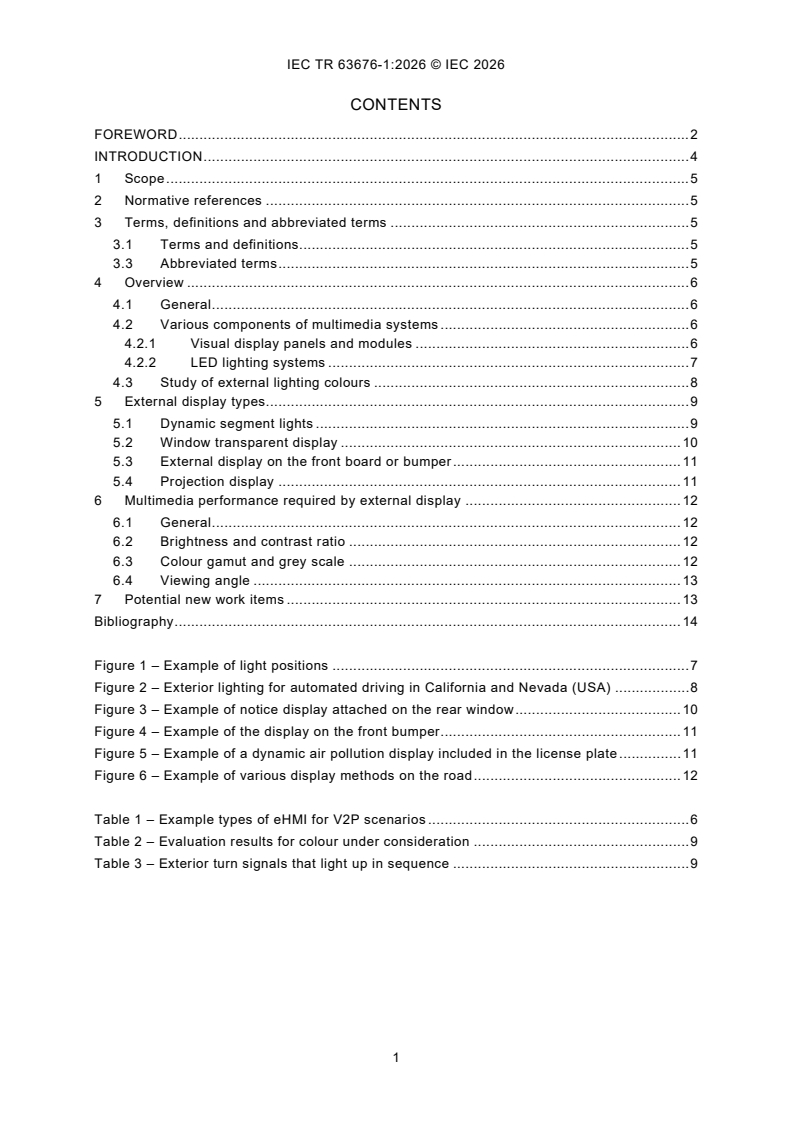
CONTENTS
FOREWORD . 2
INTRODUCTION . 4
1 Scope . 5
2 Normative references . 5
3 Terms, definitions and abbreviated terms . 5
3.1 Terms and definitions. 5
3.3 Abbreviated terms . 5
4 Overview . 6
4.1 General . 6
4.2 Various components of multimedia systems . 6
4.2.1 Visual display panels and modules . 6
4.2.2 LED lighting systems . 7
4.3 Study of external lighting colours . 8
5 External display types. 9
5.1 Dynamic segment lights . 9
5.2 Window transparent display . 10
5.3 External display on the front board or bumper . 11
5.4 Projection display . 11
6 Multimedia performance required by external display . 12
6.1 General . 12
6.2 Brightness and contrast ratio . 12
6.3 Colour gamut and grey scale . 12
6.4 Viewing angle . 13
7 Potential new work items . 13
Bibliography . 14
Figure 1 – Example of light positions . 7
Figure 2 – Exterior lighting for automated driving in California and Nevada (USA) . 8
Figure 3 – Example of notice display attached on the rear window . 10
Figure 4 – Example of the display on the front bumper . 11
Figure 5 – Example of a dynamic air pollution display included in the license plate . 11
Figure 6 – Example of various display methods on the road . 12
Table 1 – Example types of eHMI for V2P scenarios . 6
Table 2 – Evaluation results for colour under consideration . 9
Table 3 – Exterior turn signals that light up in sequence . 9
INTERNATIONAL ELECTROTECHNICAL COMMISSION
____________
Multimedia systems and equipment for vehicles - External visual systems
of external human-machine interfaces (eHMI) for automated vehicles -
Part 1: General
FOREWORD
1) The International Electrotechnical Commission (IEC) is a worldwide organization for standardization comprising
all national electrotechnical committees (IEC National Committees). The object of IEC is to promote international
co-operation on all questions concerning standardization in the electrical and electronic fields. To this end and
in addition to other activities, IEC publishes International Standards, Technical Specifications, Technical Reports,
Publicly Available Specifications (PAS) and Guides (hereafter referred to as "IEC Publication(s)"). Their
preparation is entrusted to technical committees; any IEC National Committee interested in the subject dealt with
may participate in this preparatory work. International, governmental and non-governmental organizations liaising
with the IEC also participate in this preparation. IEC collaborates closely with the International Organization for
Standardization (ISO) in accordance with conditions determined by agreement between the two organizations.
2) The formal decisions or agreements of IEC on technical matters express, as nearly as possible, an international
consensus of opinion on the relevant subjects since each technical committee has representation from all
interested IEC National Committees.
3) IEC Publications have the form of recommendations for international use and are accepted by IEC National
Committees in that sense. While all reasonable efforts are made to ensure that the technical content of IEC
Publications is accurate, IEC cannot be held responsible for the way in which they are used or for any
misinterpretation by any end user.
4) In order to promote international uniformity, IEC National Committees undertake to apply IEC Publications
transparently to the maximum extent possible in their national and regional publications. Any divergence between
any IEC Publication and the corresponding national or regional publication shall be clearly indicated in the latter.
5) IEC itself does not provide any attestation of conformity. Independent certification bodies provide conformity
assessment services and, in some areas, access to IEC marks of conformity. IEC is not responsible for any
services carried out by independent certification bodies.
6) All users should ensure that they have the latest edition of this publication.
7) No liability shall attach to IEC or its directors, employees, servants or agents including individual experts and
members of its technical committees and IEC National Committees for any personal injury, property damage or
other damage of any nature whatsoever, whether direct or indirect, or for costs (including legal fees) and
expenses arising out of the publication, use of, or reliance upon, this IEC Publication or any other IEC
Publications.
8) Attention is drawn to the Normative references cited in this publication. Use of the referenced publications is
indispensable for the correct application of this publication.
9) IEC draws attention to the possibility that the implementation of this document may involve the use of (a)
patent(s). IEC takes no position concerning the evidence, validity or applicability of any claimed patent rights in
respect thereof. As of the date of publication of this document, IEC had not received notice of (a) patent(s), which
may be required to implement this document. However, implementers are cautioned that this may not represent
the latest information, which may be obtained from the patent database available at https://patents.iec.ch and
www.iso.org/patents. IEC shall not be held responsible for identifying any or all such patent rights.
IEC TR 63676-1 has been prepared by IEC technical committee 100: Audio, video and
multimedia systems and equipment. It is a Technical Report.
The text of this Technical Report is based on the following documents:
Draft Report on voting
100/4530/DTR 100/4583/RVDTR
Full information on the voting for its approval can be found in the report on voting indicated in
the above table.
The language used for the development of this Technical Report is English.
This document was drafted in accordance with ISO/IEC Directives, Part 2, and developed in
accordance with ISO/IEC Directives, Part 1 and ISO/IEC Directives, IEC Supplement, available
at https://www.iec.ch/members_experts/refdocs. The main document types developed by IEC
are described in greater detail at https://www.iec.ch/publications.
The committee has decided that the contents of this document will remain unchanged until the
stability date indicated on the IEC website under https://webstore.iec.ch in the data related to
the specific document. At this date, the document will be
– reconfirmed,
– withdrawn, or
– revised.
INTRODUCTION
The concept of an external human-machine interface (eHMI) multimedia system in automated
vehicles involves using external displays or communication channels to interact with
pedestrians or other road users. The eHMI aims to enhance communication, safety, and mutual
understanding between automated vehicles and their surroundings.
An example of an eHMI multimedia system could be external displays on the vehicle's exterior,
such as LED panels, OLED displays, LCDs, or projection systems, to convey messages or
signals to pedestrians. For instance, an automated vehicle might display a message or
animation on its external display, indicating that it has detected other road users and will yield
the right of way. This helps pedestrians and road users understand the vehicle’s intentions and
facilitates safer interactions on the road.
It is intended that this series of documents consist of the following parts:
1. Overview of the eHMI for automated vehicles as a first part and it is a Technical Report:
This document introduces the eHMI concept and its importance in the context of automated
vehicles. It highlights the major components of the system and discusses the performance of
implementing external visual systems in such vehicles.
2. Multimedia system process as a second part:
It is intended that this part describes the architecture of external visual systems used in the
eHMI multimedia systems. This could involve discussing the integration of external displays,
LED panels, OLED displays, LCDs, projection systems, and other visual communication
methods into vehicle design.
3. Multimedia system requirements for human factors and user experience as a third part:
It is intended that this part addresses human factors considerations, such as the legibility,
visibility, and comprehension of the displayed information by pedestrians and other road users.
It discusses design principles and guidelines to ensure effective communication and user-
friendly experiences.
Overall, eHMI multimedia systems in automated vehicles aim to build trust, enhance
communication, and improve safety between vehicles and their external environment by using
visual, auditory, or other interactive means to convey information effectively.
This document introduces various external visual systems for multimedia services in automated
vehicles, explains how to assess the impact during development, and summarises new work
items in the near future.
1 Scope
This document describes the system overview of external visual systems of external human-
machine interfaces (eHMIs). These systems are specifically designed for use in automated
vehicles. It provides an introduction and background information on the concept of eHMIs,
highlighting their significance in the context of automated vehicles. Additionally, it describes the
architecture and key components of external visual systems used in eHMI multimedia systems.
It does not deal with:
a) external display usage scenario;
b) UX and UI of external display;
c) hardware performance of eHMI;
d) eHMI regulation of automated vehicle;
e) special vehicle conditions that use eHMI external displays, such as trucks, ambulances, fire
engines, buses, and taxis.
2 Normative references
There are no normative references in this document.
3 Terms, definitions and abbreviated terms
3.1 Terms and definitions
For the purposes of this document, the following terms and definitions apply.
ISO and IEC maintain terminological databases for use in standardization at the following
addresses:
– IEC Electropedia: available at https://www.electropedia.org
– ISO Online browsing platform: available at https://www.iso.org/obp
3.2
viewing angle
maximum angle at which the screen can be viewed with acceptable visual performance
3.3 Abbreviated terms
eHMI external human-machine interface
ADS automated driving system
CVD colour vision deficiency
CHMSL centre high-mounted stop light
LED light-emitting diode
RCL rear combination lights
SAE Society of Automotive Engineers
SDV software defined vehicle
UNECE United Nations Economic Commission for Europe
V2P vehicle to pedestrian
4 Overview
4.1 General
External displays or LED-based lighting systems on automated vehicles can be vital for
enhancing communication with pedestrians, cyclists, and other road users. These systems are
designed to ensure mutual understanding and safe interaction, compensating for the lack of
human drivers who typically communicate intentions through eye contact, gestures, or facial
expressions. The performance of external displays and LED lighting systems is intended to
provide clear, intuitive signals that help road users anticipate and understand the vehicle’s next
move, fostering a sense of trust and predictability. Displays and LEDs are not a standalone
system, but parts of an integrated multimedia setup designed to convey communication content
effectively. Multimedia systems combine clear feedback to ensure clear, reliable
communication.
4.2 Various components of multimedia systems
4.2.1 Visual display panels and modules
External displays can be LED displays, OLED displays, and LCDs strategically positioned on
the front grille, side panels, or rear window of the vehicle. Designs vary greatly, i
...