

IEC TR 63614-3:2026
(Main)Multimedia systems and equipment for metaverse - Part 3: Gap analysis
General Information
- Abstract
IEC TR 63614-3:2026 describes the gap analysis for metaverse systems and equipment, including examination of existing standards and services/applications within the metaverse domain. The analysis includes a comprehensive review of developments in various Standards Development Organizations (SDOs) and the relevant industry.
- Status
- Published
- Publication Date
- 09-Mar-2026
- Technical Committee
- TC 100 - Audio, video and multimedia systems and equipment
- Drafting Committee
- WG 12 - TC 100/WG 12
- Current Stage
- PPUB - Publication issued
- Start Date
- 10-Mar-2026
- Completion Date
- 20-Feb-2026

Overview
IEC TR 63614-3:2026, titled Multimedia systems and equipment for metaverse - Part 3: Gap analysis, is a comprehensive technical report developed by the International Electrotechnical Commission (IEC). This report systematically evaluates the current landscape of standards relevant to metaverse systems and equipment, focusing on gap analysis across content, platforms, networks, and devices. By aligning with the activities of various Standards Development Organizations (SDOs) such as IEC, ISO, ISO/IEC JTC 1, ITU, IEEE SA, and IETF, it identifies both the progress made and the outstanding requirements for robust, interoperable metaverse infrastructures.
Key Topics
Metaverse Classification (CPND model): The report adopts the CPND framework - Content, Platform, Network, and Device - to organize the landscape of existing standards and identify gaps effectively.
- Content: Covers immersive experiences, 3D environments, user-generated materials, virtual and augmented reality elements, and AI-driven interactions.
- Platform: Reviews metaverse environments enabling interaction, development, and content sharing, emphasizing openness and collaboration.
- Network: Assesses network technologies (such as 5G, 6G) vital for real-time connectivity, ensuring smooth interactions and secure data transfer between virtual and physical domains.
- Device: Explores a range of hardware including VR/AR headsets, wearables, and sensors, examining usability and interoperability within diverse metaverse experiences.
Industry and SDO Analysis: IEC TR 63614-3 reviews 131 existing and emerging standards across six major global standardization bodies, mapping them to the CPND model for a structured gap analysis.
Privacy and Security: Highlights the importance of secure networks, data protection, blockchain for digital assets, and transparent transactions.
Interoperability and Asset Management: Considers open APIs, SDKs, blockchain/NFT use, and standardized asset creation and trading tools crucial for evolving metaverse services.
Candidate Work Items: Summarizes ongoing and future work within IEC Technical Committee 100, pinpointing strategic areas for standard development.
Applications
The findings and guidance within IEC TR 63614-3:2026 are highly valuable to:
- Developers and Engineers: To align their metaverse platforms, content, and devices with international standards, ensuring interoperability, security, and scalability.
- Manufacturers: To identify where harmonized standards exist or are lacking, helping inform product development for VR/AR hardware, wearables, and related equipment.
- Content Creators: To adopt best practices and tools for digital assets, virtual environments, and interactive multimedia experiences that fit within recognized frameworks.
- Telecommunications Providers: To support robust, low-latency network solutions required for immersive, real-time metaverse applications.
- Standardization Stakeholders: To prioritize work in areas with the largest standardization gaps, accelerating market growth and industry collaboration.
By providing a structured overview of current standards and pinpointing areas needing development, this report supports strategic decision-making and innovation across the digital and multimedia technology ecosystem.
Related Standards
Organizations and standards significant to the findings in IEC TR 63614-3:2026 include:
IEC 63614 Series:
- Part 1: General considerations for metaverse standardization
- Part 2: Classification of metaverse systems by content, platform, network, and device (CPND)
ISO Standards:
- Digital fitting and simulation (e.g., ISO 18163, ISO/TS 3736-1/2)
- Digital twin frameworks (e.g., ISO 23247 series)
- VR/MR/AR education and visualization (e.g., ISO/IEC 9234)
ISO/IEC JTC 1 Standards:
- Mixed/augmented reality content models (e.g., ISO/IEC 3721)
- Benchmarking and data models for VR/AR/MR (e.g., ISO/IEC 18520)
ITU, IEEE SA, and IETF Activities:
- Multimedia coding, immersive scene description, and network infrastructure standards.
By integrating these standards and recognizing current gaps, stakeholders can accelerate the development of secure, interoperable, and user-centric metaverse systems and equipment.
Keywords: IEC TR 63614-3:2026, metaverse gap analysis, multimedia systems, VR standards, AR hardware, digital twin, network security, interoperability, standardization, CPND model, SDOs, virtual reality equipment, blockchain in metaverse.
Get Certified
Connect with accredited certification bodies for this standard

ANCE
Mexican certification and testing association.

Intertek Slovenia
Intertek testing, inspection, and certification services in Slovenia.

LNE (Laboratoire National de Métrologie et d'Essais)
French national laboratory for metrology and testing.
Sponsored listings
Frequently Asked Questions
IEC TR 63614-3:2026 is a technical report published by the International Electrotechnical Commission (IEC). Its full title is "Multimedia systems and equipment for metaverse - Part 3: Gap analysis". This standard covers: IEC TR 63614-3:2026 describes the gap analysis for metaverse systems and equipment, including examination of existing standards and services/applications within the metaverse domain. The analysis includes a comprehensive review of developments in various Standards Development Organizations (SDOs) and the relevant industry.
IEC TR 63614-3:2026 describes the gap analysis for metaverse systems and equipment, including examination of existing standards and services/applications within the metaverse domain. The analysis includes a comprehensive review of developments in various Standards Development Organizations (SDOs) and the relevant industry.
IEC TR 63614-3:2026 is classified under the following ICS (International Classification for Standards) categories: 33.160.60 - Multimedia systems and teleconferencing equipment. The ICS classification helps identify the subject area and facilitates finding related standards.
IEC TR 63614-3:2026 is available in PDF format for immediate download after purchase. The document can be added to your cart and obtained through the secure checkout process. Digital delivery ensures instant access to the complete standard document.
Standards Content (Sample)
IEC TR 63614-3 ®
Edition 1.0 2026-03
TECHNICAL
REPORT
Multimedia systems and equipment for metaverse -
Part 3: Gap analysis
ICS 33.160.60 ISBN 978-2-8327-1082-1
All rights reserved. Unless otherwise specified, no part of this publication may be reproduced or utilized in any form or
by any means, electronic or mechanical, including photocopying and microfilm, without permission in writing from either
IEC or IEC's member National Committee in the country of the requester. If you have any questions about IEC copyright
or have an enquiry about obtaining additional rights to this publication, please contact the address below or your local
IEC member National Committee for further information.
IEC Secretariat Tel.: +41 22 919 02 11
3, rue de Varembé info@iec.ch
CH-1211 Geneva 20 www.iec.ch
Switzerland
About the IEC
The International Electrotechnical Commission (IEC) is the leading global organization that prepares and publishes
International Standards for all electrical, electronic and related technologies.
About IEC publications
The technical content of IEC publications is kept under constant review by the IEC. Please make sure that you have the
latest edition, a corrigendum or an amendment might have been published.
IEC publications search - IEC Products & Services Portal - products.iec.ch
webstore.iec.ch/advsearchform Discover our powerful search engine and read freely all the
The advanced search enables to find IEC publications by a publications previews, graphical symbols and the glossary.
variety of criteria (reference number, text, technical With a subscription you will always have access to up to date
committee, …). It also gives information on projects, content tailored to your needs.
replaced and withdrawn publications.
Electropedia - www.electropedia.org
The world's leading online dictionary on electrotechnology,
IEC Just Published - webstore.iec.ch/justpublished
Stay up to date on all new IEC publications. Just Published containing more than 22 500 terminological entries in English
details all new publications released. Available online and and French, with equivalent terms in 25 additional languages.
once a month by email. Also known as the International Electrotechnical Vocabulary
(IEV) online.
IEC Customer Service Centre - webstore.iec.ch/csc
If you wish to give us your feedback on this publication or
need further assistance, please contact the Customer
Service Centre: sales@iec.ch.
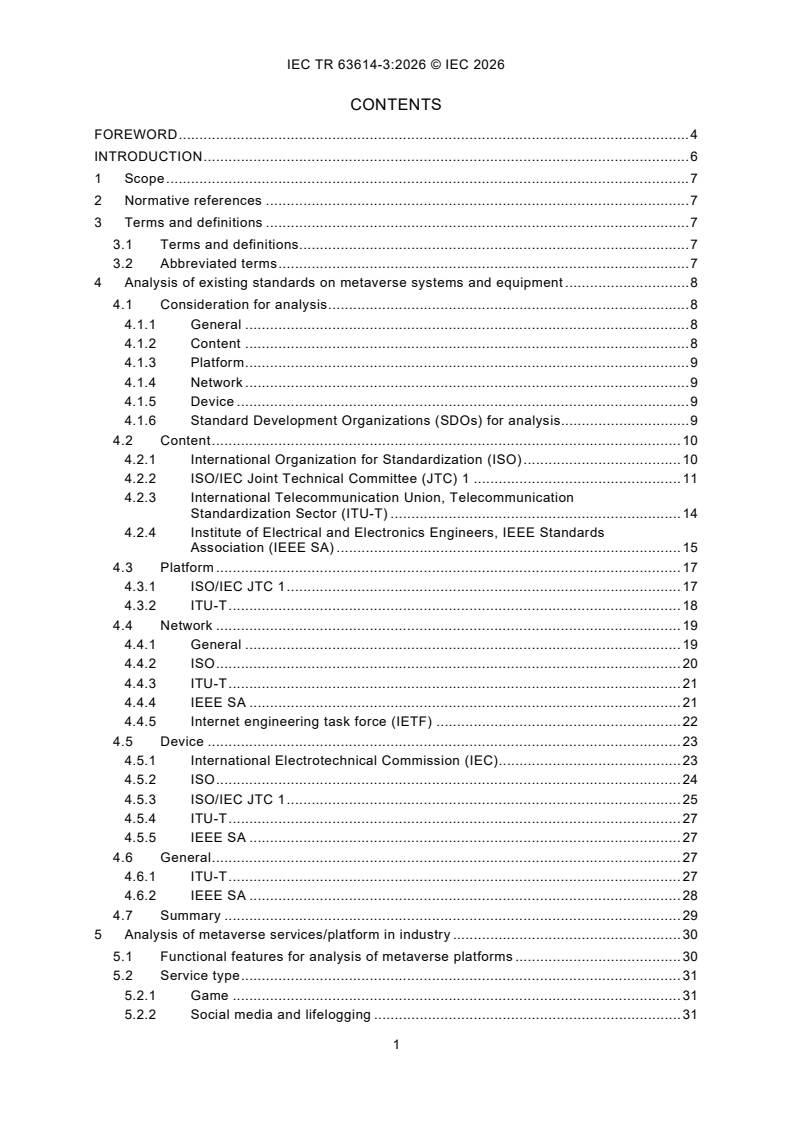
CONTENTS
FOREWORD . 4
INTRODUCTION . 6
1 Scope . 7
2 Normative references . 7
3 Terms and definitions . 7
3.1 Terms and definitions. 7
3.2 Abbreviated terms . 7
4 Analysis of existing standards on metaverse systems and equipment . 8
4.1 Consideration for analysis . 8
4.1.1 General . 8
4.1.2 Content . 8
4.1.3 Platform . 9
4.1.4 Network . 9
4.1.5 Device . 9
4.1.6 Standard Development Organizations (SDOs) for analysis. 9
4.2 Content . 10
4.2.1 International Organization for Standardization (ISO) . 10
4.2.2 ISO/IEC Joint Technical Committee (JTC) 1 . 11
4.2.3 International Telecommunication Union, Telecommunication
Standardization Sector (ITU-T) . 14
4.2.4 Institute of Electrical and Electronics Engineers, IEEE Standards
Association (IEEE SA) . 15
4.3 Platform . 17
4.3.1 ISO/IEC JTC 1 . 17
4.3.2 ITU-T . 18
4.4 Network . 19
4.4.1 General . 19
4.4.2 ISO . 20
4.4.3 ITU-T . 21
4.4.4 IEEE SA . 21
4.4.5 Internet engineering task force (IETF) . 22
4.5 Device . 23
4.5.1 International Electrotechnical Commission (IEC). 23
4.5.2 ISO . 24
4.5.3 ISO/IEC JTC 1 . 25
4.5.4 ITU-T . 27
4.5.5 IEEE SA . 27
4.6 General . 27
4.6.1 ITU-T . 27
4.6.2 IEEE SA . 28
4.7 Summary . 29
5 Analysis of metaverse services/platform in industry . 30
5.1 Functional features for analysis of metaverse platforms . 30
5.2 Service type . 31
5.2.1 Game . 31
5.2.2 Social media and lifelogging . 31
5.2.3 Customer support services . 31
5.2.4 Education and counselling . 32
5.2.5 Workspace and collaboration . 32
5.3 Immersive . 32
5.3.1 General . 32
5.3.2 eXtended reality (XR) . 33
5.3.3 Augmented reality (AR) . 33
5.3.4 Mixed reality (MR) . 33
5.3.5 Virtual reality (VR) . 34
5.3.6 Binaural audio . 34
5.4 Interoperability . 34
5.4.1 General . 34
5.4.2 Video coding and modelling . 34
5.4.3 Open API . 35
5.4.4 Software development kit (SDK) . 35
5.4.5 Blockchain/NFT . 35
5.5 Asset management . 35
5.5.1 Asset creating tools . 35
5.5.2 Asset trading system . 36
5.6 Analysis and comparison . 36
6 Work items for standardization in IEC Technical Committee 100 . 37
6.1 Observations . 37
6.2 Candidate work items for standardization . 40
Bibliography . 42
Figure 1 – Classification of standards on metaverse by many SDOs . 10
Figure 2 – Categorized metaverse standards based on CPND . 29
Table 1 – Metaverse Content classification standards developed by ISO . 11
Table 2 – Metaverse Content classification standards developed by JTC1 . 13
Table 3 – ITU-T FG-MV structure . 14
Table 4 – Metaverse Content classification standards developed by ITU-T . 15
Table 5 – Metaverse Content classification standards developed by IEEE SA . 16
Table 6 – Metaverse Platform classification standards developed by JTC 1 . 18
Table 7 – Metaverse Platform classification standards developed by ITU-T . 19
Table 8 – Metaverse Network classification standards developed by ISO . 20
Table 9 – Metaverse Network classification standards developed by ITU-T . 21
Table 10 – Metaverse Network classification standards developed by IEEE SA . 21
Table 11 – Metaverse Network classification standards developed by IETF . 22
Table 12 – Metaverse Device classification standards developed by IEC . 24
Table 13 – Metaverse Device classification standards developed by ISO . 25
Table 14 – Metaverse Device classification standards developed by JTC 1 . 26
Table 15 – Metaverse Device classification standards developed by ITU-T . 27
Table 16 – Metaverse Device classification standards developed by IEEE SA . 27
Table 17– Metaverse General classification standards developed by ITU-T . 28
Table 18 – Metaverse General classification standards developed by IEEE SA . 29
Table 19 – Summary of distinctive feature of metaverse . 31
Table 20 – Existing metaverse platforms categorized according to distinctive features . 37
Table 21 – Status of metaverse standards development within IEC TC 100 Working
Groups. 38
Table 22 – Work items for standardization in IEC TC 100 . 40
INTERNATIONAL ELECTROTECHNICAL COMMISSION
____________
Multimedia systems and equipment for metaverse -
Part 3: Gap analysis
FOREWORD
1) The International Electrotechnical Commission (IEC) is a worldwide organization for standardization comprising
all national electrotechnical committees (IEC National Committees). The object of IEC is to promote international
co-operation on all questions concerning standardization in the electrical and electronic fields. To this end and
in addition to other activities, IEC publishes International Standards, Technical Specifications, Technical Reports,
Publicly Available Specifications (PAS) and Guides (hereafter referred to as "IEC Publication(s)"). Their
preparation is entrusted to technical committees; any IEC National Committee interested in the subject dealt with
may participate in this preparatory work. International, governmental and non-governmental organizations liaising
with the IEC also participate in this preparation. IEC collaborates closely with the International Organization for
Standardization (ISO) in accordance with conditions determined by agreement between the two organizations.
2) The formal decisions or agreements of IEC on technical matters express, as nearly as possible, an international
consensus of opinion on the relevant subjects since each technical committee has representation from all
interested IEC National Committees.
3) IEC Publications have the form of recommendations for international use and are accepted by IEC National
Committees in that sense. While all reasonable efforts are made to ensure that the technical content of IEC
Publications is accurate, IEC cannot be held responsible for the way in which they are used or for any
misinterpretation by any end user.
4) In order to promote international uniformity, IEC National Committees undertake to apply IEC Publications
transparently to the maximum extent possible in their national and regional publications. Any divergence between
any IEC Publication and the corresponding national or regional publication shall be clearly indicated in the latter.
5) IEC itself does not provide any attestation of conformity. Independent certification bodies provide conformity
assessment services and, in some areas, access to IEC marks of conformity. IEC is not responsible for any
services carried out by independent certification bodies.
6) All users should ensure that they have the latest edition of this publication.
7) No liability shall attach to IEC or its directors, employees, servants or agents including individual experts and
members of its technical committees and IEC National Committees for any personal injury, property damage or
other damage of any nature whatsoever, whether direct or indirect, or for costs (including legal fees) and
expenses arising out of the publication, use of, or reliance upon, this IEC Publication or any other IEC
Publications.
8) Attention is drawn to the Normative references cited in this publication. Use of the referenced publications is
indispensable for the correct application of this publication.
9) IEC draws attention to the possibility that the implementation of this document may involve the use of (a)
patent(s). IEC takes no position concerning the evidence, validity or applicability of any claimed patent rights in
respect thereof. As of the date of publication of this document, IEC had not received notice of (a) patent(s), which
may be required to implement this document. However, implementers are cautioned that this may not represent
the latest information, which may be obtained from the patent database available at https://patents.iec.ch. IEC
shall not be held responsible for identifying any or all such patent rights.
IEC TR 63614-3 has been prepared by IEC technical committee TC 100: Audio, video and
multimedia systems and equipment. It is a Technical Report.
The text of this Technical Report is based on the following documents:
Draft Report on voting
100/4408/DTR 100/4437/RVDTR
Full information on the voting for its approval can be found in the report on voting indicated in
the above table.
The language used for the development of this Technical Report is English.
A list of all parts in the IEC 63614 series, published under the general title Multimedia systems
and equipment for metaverse, can be found on the IEC website.
This document was drafted in accordance with ISO/IEC Directives, Part 2, and developed in
accordance with ISO/IEC Directives, Part 1 and ISO/IEC Directives, IEC Supplement, available
at www.iec.ch/members_experts/refdocs. The main document types developed by IEC are
described in greater detail at www.iec.ch/publications.
The committee has decided that the contents of this document will remain unchanged until the
stability date indicated on the IEC website under webstore.iec.ch in the data related to the
specific document. At this date, the document will be
– reconfirmed,
– withdrawn, or
– revised.
INTRODUCTION
The term "metaverse" originated from the science fiction novel "Snow Crash," combining "meta"
and "universe." It refers to a digital-based virtual world that extends the boundaries of the real
world, allowing users to engage in various activities, including imagination and fantasy, within
the virtual space. In the viewpoint of content/platform/network/device, the metaverse can also
be defined as a technology in which a user (using a metaverse device) can access (through
network) a virtual space (a metaverse platform) and experience all activities (metaverse
contents) through an avatar.
At the time of writing, the global industrial metaverse market is experiencing significant growth.
It is noted that the metaverse can be implemented and realized with multimedia systems and
equipment. Accordingly, there is a crucial need for standardization on the subject of metaverse
in IEC TC 100 as a leading standardization group in the area of multimedia systems and
equipment.
The IEC 63614 series consists of the following parts:
– Part 1: General;
– Part 2: Classification; and
– Part 3: Gap analysis.
IEC TR 63614-1 describes general considerations to be taken for standardization on
multimedia systems and equipment for metaverse.
IEC TS 63614-2 describes the classification of metaverse in terms of C (contents), P (platform),
N (network), D (device).
IEC TR 63614-3 (this document) describes the gap analysis for the existing standards on
metaverse and the services/products in the metaverse-related industry.
___________
Under preparation. Stage at time of publication: IEC DTR 63614-1:2025
Under consideration.
1 Scope
This document describes the gap analysis for metaverse systems and equipment, including
examination of existing standards and services/applications within the metaverse domain. The
analysis includes a comprehensive review of developments in various Standards Development
Organizations (SDOs) and the relevant industry.
2 Normative references
There are no normative references in this document.
3 Terms and definitions
No terms and definitions are listed in this document.
ISO and IEC maintain terminology databases for use in standardization at the following
addresses:
– IEC Electropedia: available at https://www.electropedia.org/
– ISO Online browsing platform: available at https://www.iso.org/obp
3.1 Terms and definitions
No terms and definitions are listed in this document.
3.2 Abbreviated terms
AI Artificial intelligence
AR Augmented reality
API Application programming interface
CPND Content, Platform, Network, Device
DLT Distributed ledger technology
glTF Graphics Library Transmission format
HMD Head-mounted display
ICT Information and communication technology
IIDL Interaction Information Description Language
IoT Internet of Things
LAE Live actor and entity
MAR Mixed and augmented reality
MMORPG Massively multiplayer online role-playing games
MR Mixed reality
MTP Motion to photon
NFT Non-fungible token
NPC Non-player character
OME Object management entity
QoE Quality of experience
SDK Software development kit
SDO Standard Development Organization
UI/UX User interface/User experience
USD Universal Scene Description
VR Virtual reality
VRM Virtual reality modelling
vSRT Vision-based spatial registration and tracking
4 Analysis of existing standards on metaverse systems and equipment
4.1 Consideration for analysis
4.1.1 General
In this document, the CPND concept, one of the classifications of IEC TS 63614-2 , is adopted
to classify existing standards related to the metaverse. In the CPND concept, Content, Platform,
Network, and Device each have the following meanings:
– Content: Within the metaverse, content refers to various experiences, environments, and
services available to users. This spans the spectrum, encompassing user-generated content
to a myriad of activities and services seamlessly offered within virtual worlds.
– Platform: The metaverse platform seamlessly consolidates content hosting, service delivery,
and development tools, offering a comprehensive ecosystem. These platforms prioritize
openness, ensuring flexibility and accessibility for both creators and users, thereby
cultivating an environment that frequently sparks innovation and collaboration.
– Network: At the heart of the metaverse lies a high-speed, seamless communication network,
constituting the essential foundation. This necessitates real-time connectivity bridging the
virtual and physical realms, demanding cutting-edge communication technologies such as
5G or 6G to facilitate swift and efficient data transfer and interaction.
– Device: Within the realm of metaverse, devices encompass a diverse array of hardware,
ranging from wearables to conventional virtual reality (VR) and augmented reality (AR)
devices. This assortment of devices simplifies the user experience, providing effortless
access and interaction with the expansive metaverse landscape.
4.1.2 Content
Content comprises technical elements aimed at delivering diverse virtual experiences and
interactions to users in the metaverse. This encompasses not only content provided by service
providers within virtual worlds but also user-generated content, spanning various forms of
media, data, and interactions. Key technologies driving metaverse content include VR and AR,
3D modelling and animation, artificial intelligence (AI) and machine learning, user-generated
content, distributed ledgers, and blockchain. These technologies, coupled with real-time
communication, form the technological backbone of metaverse content.
VR and AR emerge as pivotal technologies within the metaverse, seamlessly blending the real
and virtual worlds to offer users unparalleled experiences unattainable in reality. VR immerses
users in entirely virtual worlds, achieved through VR headsets or bodysuits that block out the
surroundings. On the other hand, AR enhances reality by overlaying virtual information or
content onto the real world. Users typically engage with AR through smartphones, AR devices,
or smart glasses. This synthesis of technologies underscores the dynamic landscape where the
metaverse unfolds.
___________
Under consideration
4.1.3 Platform
Platform serves as a technological ecosystem where users engage in virtual interactions, share
content, and play a pivotal role in delivering diverse services and experiences within the
metaverse. This platform shapes the metaverse environment by seamlessly integrating
functions such as hosting metaverse content, service provision, and user-customizable
development tools. Facilitating a collaborative atmosphere, the open metaverse platform
accommodates various content types, ranging from 3D models to virtual worlds and user-
generated content.
Emphasizing openness and characteristics conducive to collaboration, the metaverse platform
enables the active participation of developers and content creators, fostering the creation of
novel ideas and experiences. This inclusivity extends beyond the offerings of the platform
company, allowing users to immerse themselves in creative content generated by a multitude
of contributors. To facilitate such creativity, the metaverse platform would aspire to offer an
array of development tools and APIs, supporting content creators in the seamless development
and integration of their contributions.
4.1.4 Network
Network infrastructure associated with the metaverse serves as a critical component, facilitating
real-time connections between the virtual and real worlds. These networks play a pivotal role
in enabling users to seamlessly engage, share content, and access a myriad of services within
the virtual worlds. The metaverse demands a high-speed network environment, with a specific
emphasis on advanced communication technologies like 5G and 6G. These technologies are
instrumental in supporting rapid data transmission and fostering real-time interactions across
the virtual and physical realms.
Security and personal information protection emerge as paramount considerations within the
metaverse network. Given that users participate in social activities involving the exchange or
sale of personal digital assets, safeguarding user data becomes imperative. Robust security
technologies and encryption play a pivotal role in this endeavour, with blockchain technology
being actively employed to fortify the protection of user data through its inherent security
features. In pursuit of transparency and effective management of content ownership and
transactions, some platforms leverage distributed ledgers and blockchain technology. These
innovations provide a clear and secure framework for tracking ownership and facilitating
transactions within the dynamic metaverse landscape.
4.1.5 Device
Devices for the metaverse encompass the hardware essential for users to partake in VR and
AR experiences, serving as conduits to transmit users' senses into the virtual world and
facilitate interaction. This category comprises VR, AR, and mixed reality (MR) equipment,
alongside an array of wearable devices and full-body VR equipment. VR equipment serves to
immerse users in the virtual world by isolating them from the real world, while AR equipment
overlays virtual information onto the real world, aiding users in navigating their surroundings.
Users engage with the metaverse by manipulating virtual objects within the real world. Notably,
several gaming companies have introduced full-body VR devices, enhancing immersion through
comprehensive tracking and reflection of the user's entire body movements. The utilization of
sensors, cameras, and body suits is common in this setup, ensuring accurate tracking of the
entire body for a heightened and immersive experience.
4.1.6 Standard Development Organizations (SDOs) for analysis
This document comprehensively addresses 131 metaverse-related standards, either published
or in progress, across 6 Standard Development Organizations (SDOs): IEC, ISO,
ISO/IEC JTC 1, ITU, IEEE SA, and IETF. As illustrated in Figure 1, using the CPND
classification to analyse these standards, the findings reveal that 52 standards fall under
Contents, 12 under Platform, 24 under Network, and 33 under Device. Additionally, there are
10 inclusive standards that align with general categories.
Figure 1 – Classification of standards on metaverse by many SDOs
4.2 Content
4.2.1 International Organization for Standardization (ISO)
ISO primarily focuses on developing standards for content applicable within the metaverse,
rather than directly addressing metaverse-related standards. Notable instances include ongoing
virtual simulation work within TC 8/SC 1 and TC 22/SC 36, along with the prominent
development of digital fitting standards within TC 133.
Digital fitting, a key outcome of the efforts of TC 133, involves leveraging digital technology to
virtually try on or create items like clothing and accessories. This innovative technology
seamlessly merges the conventional in-store shopping experience with a digital realm, allowing
consumers to preview the fit and style of a product in a virtual space beforehand. Within TC 133,
various terms essential to digital fitting systems are defined, encompassing virtual fabric
simulations, virtual fabric properties, virtual clothing patterns, virtual clothing pattern properties,
virtual seam lines, virtual clothing, and virtual human body models for conformity evaluation.
Furthermore, TC 133 provides valuable guidance for establishing service processes, catering
to both online and offline retailers and 3D shopping platform developers, facilitating the
distribution of digital fitting experiences.
The ISO 23247 series, originating from TC 184/SC 4, establishes a comprehensive digital twin
framework tailored for the manufacturing sector. This series features a well-defined reference
architecture incorporating both domain and entity perspectives. Within this framework,
functional entities are presented, underpinned by a meticulously designed entity-based
reference model, providing clarity and structure. The series further outlines essential
information properties for object management entities (OMEs), offering practical examples and
encompassing relevant standards. Additionally, it pinpoints precise technical requirements for
information exchange across diverse networks within its purview, including user, service,
access, and proximity networks. These networks intricately connect entities within the digital
twin framework, ensuring a seamless and interconnected ecosystem. Table 1 presents a list of
standard documents on metaverse content developed by ISO.
Table 1 – Metaverse Content classification standards developed by ISO
No. TC Document Title
Ships and marine technology - Virtual reality and simulation
1 TC 8/SC 1 ISO 5476
training systems for lifesaving appliances and arrangements
Road vehicles - Prospective safety performance assessment of
2 TC 22/SC 36 ISO/TR 21934-1 pre-crash technology by virtual simulation - Part 1: State-of-the-
art and general method overview
Clothing - Digital fittings - Vocabulary and terminology used for
3 TC 133 ISO 18163
the virtual garment
Clothing - Digital fittings - Part 1: Vocabulary and terminology
4 TC 133 ISO 18825-1
used for the virtual human body
5 TC 133 ISO 18831 Clothing - Digital fittings - Attributes of virtual garments
Digital fitting - Service process - Part 1: Ready-to-wear clothing
6 TC 133 ISO/TS 3736-1
online and offline
Digital fitting - Service process - Part 2: Customized clothing
7 TC 133 ISO/TS 3736-2
online and offline
Performance evaluation protocol for digital fitting systems –
8 TC 133 ISO 20947-1
Part 1: Accuracy of virtual human body representation
Performance evaluation protocol for digital fitting systems –
9 TC 133 ISO 20947-2
Part 2: Virtual garment
Performance evaluation protocol for digital fitting systems –
10 TC 133 ISO 20947-3
Part 3: Digital fitting performance - Gap
Automation systems and integration - Digital twin framework for
11 TC 184/SC 4 ISO 23247-1
manufacturing - Part 1: Overview and general principles
Automation systems and integration - Digital twin framework for
12 TC 184/SC 4 ISO 23247-2
manufacturing - Part 2: Reference architecture
Automation systems and integration - Digital twin framework for
13 TC 184/SC 4 ISO 23247-3 manufacturing - Part 3: Digital representation of manufacturing
elements
Automation systems and integration - Digital twin framework for
14 TC 184/SC 4 ISO 23247-4
manufacturing - Part 4: Information exchange
15 TC 184/SC 4 ISO/TR 24464 Visualization elements of digital twin – Visualization fidelity
4.2.2 ISO/IEC Joint Technical Committee (JTC) 1
ISO/IEC JTC 1/SC 24 establishes standards for "Computer graphics, image processing, and
environmental data representation," with a scope that encompasses computer graphics, image
processing, virtual reality, augmented reality, mixed reality, environmental data representation,
and information visualization and interaction.
ISO/IEC 3721 specifically defines the information model for mixed and augmented reality
content – core objects and attributes. ISO/IEC 3721 encompasses a virtual reality scene graph,
physical objects designed for augmentation, and constructs for expressing associations
between physical and virtual objects in the mixed and augmented reality (MAR) scene.
ISO/IEC 9234 outlines guidelines for developing education and training systems utilizing
virtual reality (VR), augmented reality (AR), and mixed reality (MR) technologies. It establishes
an information modelling framework for VR/AR/MR-based systems and provides procedures
compliant with ISO/IEC JTC 1 standards for developing 3D VR/AR/MR-based education and
training systems.
ISO/IEC 18520 defines a reference framework for benchmarking mixed and augmented reality
(MAR) vision-based spatial registration and tracking (vSRT) methods.
defines a human information data model tailored for VR-based smart cities. It
ISO/IEC 20538
incorporates concepts, data models, and integration methods for combining sensor-related
information from individuals with a 3D virtual world. ISO/IEC 21145 focuses on the visual
augmentation style in MAR, defining various styles of augmentation and presentation, with a
specific emphasis on visual style in this context.
ISO/IEC 23488 introduces an image-based representation model meticulously designed for
accurately and efficiently representing target objects or environments in graphics, virtual reality,
and mixed reality applications. It encompasses terms for image-based representation and 3D
reconstruction techniques, outlines essential elements for image-based representation, and
details a method for representing the real world in virtual space using images.
ISO/IEC JTC 1/SC 29 focuses on the "Coding of audio, picture, multimedia, and hypermedia
information" and develops standards pertaining to the efficient coding of digital representations
of images, audio, and moving pictures, as well as the efficient coding of other digital information
and digital information support. Notably, standards relevant to the metaverse within this scope
encompass ISO/IEC 23000-13, ISO/IEC 23090-14, and ISO/IEC 23090-24. These International
Standards articulate an extension to the existing scene description format, specifically tailored
to support MPEG media for immersive metaverse content.
Moreover, ISO/IEC JTC 1/SC 36 is actively progressing on a standard related to Information
Technology for learning, education, and training. The objective is to delineate considerations
for using and creating content in virtual reality, alongside presenting a catalogue model for
virtual, augmented, and mixed reality content. Simultaneously, ISO/IEC JTC 1/SC 41 primarily
specializes in developing standards for digital twin technology, a cornerstone element of the
metaverse. Table 2 presents standard documents related to metaverse content developed by
ISO/IEC JTC 1.
___________
Under preparation. Stage at time of publication: ISO/IEC FDIS 9234:2025.
Under preparation. Stage at time of publication: ISO/IEC FDIS 20538:2025.
Table 2 – Metaverse Content classification standards developed by JTC1
No. SC Document Title
Information technology - Computer graphics, image processing
and environmental data representation - Information model for
1 JTC 1/SC 24 ISO/IEC 3721
mixed and augmented reality content - Core objects and
attributes
Information technology - Information modelling for VR/AR/MR
2 JTC 1/SC 24 ISO/IEC 9234
based education and training systems
Information technology - Computer graphics, image processing
and environmental data representation - Benchmarking of vision-
3 JTC 1/SC 24 ISO/IEC 18520
based spatial registration and tracking methods for mixed and
augmented reality (MAR)
4 JTC 1/SC 24 Human information data model for VR smart cities
ISO/IEC 20538
Information technology - Computer graphics, image processing
5 JTC 1/SC 24 ISO/IEC 21145 and environmental data representation - Style representation for
mixed and augmented reality
Information technology - Computer graphics, image processing
and environment data representation - Object/environmental
6 JTC 1/SC 24 ISO/IEC 23488
representation for image-based rendering in virtual/mixed and
augmented reality (VR/MAR)
Information technology - Multimedia application format (MPEG-A)
7 JTC 1/SC 29 ISO/IEC 23000-13
- Part 13: Augmented reality application format
Information technology - Coded representation of immersive
media - Part 14: Scene description - Amendment 2: Support for
8 JTC 1/SC 29 ISO/IEC 23090-14
haptics, augmented reality, avatars, Interactivity, MPEG-I audio,
and lighting
Information technology - Coded representation of immersive
media - Part 24: Conformance and reference software for scene
9 JTC 1/SC 29 ISO/IEC 23090-24 description - Amendment 1: Conformance and reference software
for scene description on haptics, augmented reality, avatars,
interactivity and lighting
Information technology - Learning, education and training -
10 JTC 1/SC 36 ISO/IEC TR 18121
Virtual experiment framework
Information technology for learning, education and training -
11 JTC 1/SC 36 ISO/IEC TR 23842-1 Human factor guidelines for virtual reality content - Part 1:
Considerations when using VR content
Information technology for learning, education, and training -
12 JTC 1/SC 36 ISO/IEC TR 23842-2 Human factor guidelines for virtual reality content - Part 2:
Considerations when making VR content
Information technology for learning, education and training -
13 JTC 1/SC 36 ISO/IEC TR 23843
Catalogue model for virtual, augmented and mixed reality content
Information technology for learning, education, and training -
14 JTC 1/SC 36 ISO/IEC TR 23844
Immersive content and technology
15 JTC 1/SC 41 ISO/IEC TR 30172 Internet of Things (IoT) - Digital Twin - Use cases
16 JTC 1/SC 41 ISO/IEC 30173 Digital Twin - Concepts and terminology
___________
Under preparation. Stage at time of publication: ISO/IEC DIS 20538:2025.
4.2.3 International Telecommunication Union, Telecommunication Standardization
Sector (ITU-T)
ITU-T has instituted the Metaverse Focus Group (FG-MV) with the primary objective of delving
into the terminology, concepts, vision, and ecosystem associated with the metaverse. FG-MV
is actively engaged in comprehensive research and information gathering to formulate a pre-
standardization roadmap. Simultaneously, it is fostering a community of experts and
practitioners to seamlessly integrate metaverse concepts, cultivating a shared understanding
that will be beneficial for the global community. Table 3 presents the working group structure
of ITU-T FG-MV.
Table 3 – ITU-T FG-MV structure
WG Title Scope
Roadmap, overall concepts, service model, related technologies of
WG1 General
metaverse platforms and services
Use cases and high-level requirements for supporting related use
WG2 Applications & Services
cases for specific applications and services
Architectures, functionalities, interfaces, intelligent management
WG3 Architecture & infrastructure mechanisms, connectivity technologies, APIs, and QoS/QoE,
performance
WG4 Virtual/Real World Integration Applications and services integration between virtual and real worlds
Functional architecture and interfaces for cross-platform
WG5 Interoperability
interoperability
Security, Data & Personally Security of networks and technology underpinning the metaverse
WG6 identifiable information (PII) platform, including cybersecurity and identity management
Protection
Economic, regulatory & Metaverse value chain: main agents' role and interactions
WG7
competition aspects
Impact on the climate changes, Environmental Sustainability related
Sustainability, Accessibility &
WG8 issues, Accessibility related issues, Social considerations, Diversity,
Inclusion
equity and inclusion
Promote more active collaboration with other SDOs by setting up a
WG9 Collaboration close liaison relationship, including the appointment of an FG-MV
liaison rapporteur to other relevant SDOs
A digital twin is a digital representation of a physical object, enabling real-time monitoring,
predictive maintenance, and optimization throughout its life cycle. To address complex cross-
domain problems in smart cities, digital twins from various domains can be federated to collect,
analyse, and simulate data for comprehensive solutions. Recommendation ITU-T Y.4224
requires specific processes like registration, discovery, and connection of digital twins, with
defined requirements to support these functions.
Recommendation ITU-T Y.4224 outlines the requirements for digital twin federation. Building
on these requirements, it specifies the reference architecture for digital twin federation, detailing
the functionalities of each entity and the interfaces between them. Additionally, it addresses the
operational workflows of digital twin federation across various scenarios.
Technical specification FGMV-22 outlines the impact of generative AI on immersive and
interactive experiences within the metaverse. Generative AI offers numerous applications for
metaverse services, such as creating personalized avatars and environments, and enhancing
intelligent and tailored services. This technical specification examines the potential benefits and
challenges of integrating generative AI into the metaverse, focusing on enhancing user
experience, improving content creation, and enabling personalized interactions.
...