

IEC 60204-31:2013
(Main)Safety of machinery - Electrical equipment of machines - Part 31: Particular safety and EMC requirements for sewing machines, units and systems
General Information
- Abstract
IEC 60204-31:2013 applies to electrical and electronic equipment, sewing machines, units and systems, designed specifically for professional use in the sewing industry. It is applicable to the electrical equipment or parts of the electrical equipment which operate with nominal supply voltages not exceeding 1 000 V for alternating current and not exceeding 1 500 V for direct current, and with nominal frequencies not exceeding 200 Hz. This fourth edition cancels and replaces the third edition, published in 2001 and constitutes a technical revision. It includes the following changes:
- Alignment of the normative references;
- Alignment of titles and subtitles to the IEC 60204-1;
- Revision of Annex AA to align this annex with the relevant IEC standards.
This publication is to be read in conjunction with IEC 60204-1:2009.
- Status
- Published
- Publication Date
- 22-Apr-2013
- Technical Committee
- TC 44 - Safety of machinery - Electrotechnical aspects
- Drafting Committee
- MT 60204-31 - TC 44/MT 60204-31
- Current Stage
- PPUB - Publication issued
- Start Date
- 23-Apr-2013
- Completion Date
- 30-Apr-2013
Buy Documents
IEC 60204-31:2013 - Safety of machinery - Electrical equipment of machines - Part 31: Particular safety and EMC requirements for sewing machines, units and systems Released:4/23/2013
Overview
The IEC 60204-31:2013 standard, issued by the International Electrotechnical Commission (IEC), addresses the safety and electromagnetic compatibility (EMC) requirements specific to the electrical and electronic equipment of sewing machines, units, and systems designed for professional use in the sewing industry. This part 31 of IEC 60204 series ensures safe operation and electrical compliance for professional-grade sewing machines operating at nominal voltages up to 1,000 V AC and 1,500 V DC, with frequencies not exceeding 200 Hz.
This fourth edition revises and replaces the previous 2001 edition, aligning references and terminology with IEC 60204-1 and updating Annex AA in line with relevant IEC standards. It complements IEC 60204-1 and focuses on electrical hazards while considering EMC to avoid interference with other equipment.
Key Topics
Scope and Applicability
Applicable to professional sewing machines, units, and systems used in dry, clean industrial environments. It excludes household sewing machines and non-electrical hazards such as mechanical guarding and noise emission.Electrical Safety Requirements
Ensures protection against electric shock, proper wiring, equipotential bonding, and secure termination of supply conductors with disconnecting devices for safe maintenance and operation.Control and Operator Interfaces
Specifies requirements for control circuits, machine-mounted control devices, and operator interfaces for safe and reliable operation.Electromagnetic Compatibility (EMC)
Includes comprehensive EMC requirements (Annex AA) covering emission limits and immunity tests for radiated disturbances, conducted disturbances, surges, electrostatic discharge, and voltage variations, ensuring machines operate reliably without causing or suffering interference.Marking and Documentation
Emphasizes the need for clear marking, warning signs, and technical documentation to support safe installation, operation, and maintenance.Technical Revisions
Updates normative references, harmonizes chapter titles and subtitles with IEC 60204-1, and revises Annex AA to align with industry EMC standards.
Applications
IEC 60204-31:2013 is essential for manufacturers, designers, and safety engineers involved with:
Professional Sewing Machinery
Industrial sewing machines and sewing units tailored for textile manufacturing, garment production, and related sectors.Sewing Systems Integration
Multi-unit sewing systems where electrical equipment must comply with both safety and EMC requirements to form a safe production line.Electrical Safety Compliance
Ensuring that sewing machines meet international safety standards by addressing shock hazards, proper wiring, and control safety functions.Regulatory and Compliance Testing
Assists in preparing machines for certification and legal compliance in global markets, focusing on electrical safety and EMC performance.Maintenance and Inspection Protocols
Guides the verification and inspection of electrical equipment on sewing machines to maintain ongoing safety and performance.
Related Standards
IEC 60204-1:2005 / Amend.1:2008 – General requirements for electrical equipment of machines, harmonized with this standard.
IEC 60335-2-28 – Safety requirements for household and similar electrical sewing machines.
IEC 61000 Series – Comprehensive EMC standards covering emission and immunity testing (Parts 3 and 4).
IEC 60947-1 – Low-voltage switchgear and controlgear general rules.
IEC 60364-4-41 – Protection against electric shock in low-voltage electrical installations.
CISPR 11:2009 – Limits and measurement methods for radio-frequency disturbances from industrial equipment.
Together, these related standards form a comprehensive framework to ensure the electrical safety, functional reliability, and electromagnetic compatibility of sewing machines and related equipment across the professional textile manufacturing industry.
Keywords: IEC 60204-31, safety of machinery, electrical equipment, professional sewing machines, sewing units, electrical safety, EMC requirements, electromagnetic compatibility, industrial sewing machines, electrical hazards, control circuits, equipment marking, technical documentation, low-voltage machinery, machine safety standards.
Relations
- Effective Date
- 05-Sep-2023
Buy Documents
IEC 60204-31:2013 - Safety of machinery - Electrical equipment of machines - Part 31: Particular safety and EMC requirements for sewing machines, units and systems Released:4/23/2013
Get Certified
Connect with accredited certification bodies for this standard

CIS Institut d.o.o.
Personal Protective Equipment (PPE) certification body. Notified Body NB-2890 for EU Regulation 2016/425 PPE.

Kiwa BDA Testing
Building and construction product certification.
Kmetijski inštitut Slovenije
Agricultural Institute of Slovenia. Soil testing, plant health, agricultural product analysis.
Sponsored listings
Frequently Asked Questions
IEC 60204-31:2013 is a standard published by the International Electrotechnical Commission (IEC). Its full title is "Safety of machinery - Electrical equipment of machines - Part 31: Particular safety and EMC requirements for sewing machines, units and systems". This standard covers: IEC 60204-31:2013 applies to electrical and electronic equipment, sewing machines, units and systems, designed specifically for professional use in the sewing industry. It is applicable to the electrical equipment or parts of the electrical equipment which operate with nominal supply voltages not exceeding 1 000 V for alternating current and not exceeding 1 500 V for direct current, and with nominal frequencies not exceeding 200 Hz. This fourth edition cancels and replaces the third edition, published in 2001 and constitutes a technical revision. It includes the following changes: - Alignment of the normative references; - Alignment of titles and subtitles to the IEC 60204-1; - Revision of Annex AA to align this annex with the relevant IEC standards. This publication is to be read in conjunction with IEC 60204-1:2009.
IEC 60204-31:2013 applies to electrical and electronic equipment, sewing machines, units and systems, designed specifically for professional use in the sewing industry. It is applicable to the electrical equipment or parts of the electrical equipment which operate with nominal supply voltages not exceeding 1 000 V for alternating current and not exceeding 1 500 V for direct current, and with nominal frequencies not exceeding 200 Hz. This fourth edition cancels and replaces the third edition, published in 2001 and constitutes a technical revision. It includes the following changes: - Alignment of the normative references; - Alignment of titles and subtitles to the IEC 60204-1; - Revision of Annex AA to align this annex with the relevant IEC standards. This publication is to be read in conjunction with IEC 60204-1:2009.
IEC 60204-31:2013 is classified under the following ICS (International Classification for Standards) categories: 01 - GENERALITIES. TERMINOLOGY. STANDARDIZATION. DOCUMENTATION; 13.110 - Safety of machinery; 61.080 - Sewing machines and other equipment for the clothing industry. The ICS classification helps identify the subject area and facilitates finding related standards.
IEC 60204-31:2013 has the following relationships with other standards: It is inter standard links to IEC 60204-31:2001. Understanding these relationships helps ensure you are using the most current and applicable version of the standard.
IEC 60204-31:2013 is available in PDF format for immediate download after purchase. The document can be added to your cart and obtained through the secure checkout process. Digital delivery ensures instant access to the complete standard document.
Standards Content (Sample)
IEC 60204-31 ®
Edition 4.0 2013-04
INTERNATIONAL
STANDARD
NORME
INTERNATIONALE
Safety of machinery – Electrical equipment of machines –
Part 31: Particular safety and EMC requirements for sewing machines, units and
systems
Sécurité des machines – Équipement électrique des machines –
Partie 31: Exigences particulières de sécurité et de CEM pour machines à
coudre, unités et systèmes de couture
All rights reserved. Unless otherwise specified, no part of this publication may be reproduced or utilized in any form
or by any means, electronic or mechanical, including photocopying and microfilm, without permission in writing from
either IEC or IEC's member National Committee in the country of the requester.
If you have any questions about IEC copyright or have an enquiry about obtaining additional rights to this publication,
please contact the address below or your local IEC member National Committee for further information.
Droits de reproduction réservés. Sauf indication contraire, aucune partie de cette publication ne peut être reproduite ni
utilisée sous quelque forme que ce soit et par aucun procédé, électronique ou mécanique, y compris la photocopie et les
microfilms, sans l'accord écrit de la CEI ou du Comité national de la CEI du pays du demandeur.
Si vous avez des questions sur le copyright de la CEI ou si vous désirez obtenir des droits supplémentaires sur cette
publication, utilisez les coordonnées ci-après ou contactez le Comité national de la CEI de votre pays de résidence.
IEC Central Office Tel.: +41 22 919 02 11
3, rue de Varembé Fax: +41 22 919 03 00
CH-1211 Geneva 20 info@iec.ch
Switzerland www.iec.ch
About the IEC
The International Electrotechnical Commission (IEC) is the leading global organization that prepares and publishes
International Standards for all electrical, electronic and related technologies.
About IEC publications
The technical content of IEC publications is kept under constant review by the IEC. Please make sure that you have the
latest edition, a corrigenda or an amendment might have been published.
Useful links:
IEC publications search - www.iec.ch/searchpub Electropedia - www.electropedia.org
The advanced search enables you to find IEC publications The world's leading online dictionary of electronic and
by a variety of criteria (reference number, text, technical electrical terms containing more than 30 000 terms and
committee,…). definitions in English and French, with equivalent terms in
It also gives information on projects, replaced and additional languages. Also known as the International
withdrawn publications. Electrotechnical Vocabulary (IEV) on-line.
IEC Just Published - webstore.iec.ch/justpublished Customer Service Centre - webstore.iec.ch/csc
Stay up to date on all new IEC publications. Just Published If you wish to give us your feedback on this publication
details all new publications released. Available on-line and or need further assistance, please contact the
also once a month by email. Customer Service Centre: csc@iec.ch.
A propos de la CEI
La Commission Electrotechnique Internationale (CEI) est la première organisation mondiale qui élabore et publie des
Normes internationales pour tout ce qui a trait à l'électricité, à l'électronique et aux technologies apparentées.
A propos des publications CEI
Le contenu technique des publications de la CEI est constamment revu. Veuillez vous assurer que vous possédez
l’édition la plus récente, un corrigendum ou amendement peut avoir été publié.
Liens utiles:
Recherche de publications CEI - www.iec.ch/searchpub Electropedia - www.electropedia.org
La recherche avancée vous permet de trouver des Le premier dictionnaire en ligne au monde de termes
publications CEI en utilisant différents critères (numéro de électroniques et électriques. Il contient plus de 30 000
référence, texte, comité d’études,…). termes et définitions en anglais et en français, ainsi que
Elle donne aussi des informations sur les projets et les les termes équivalents dans les langues additionnelles.
publications remplacées ou retirées. Egalement appelé Vocabulaire Electrotechnique
International (VEI) en ligne.
Just Published CEI - webstore.iec.ch/justpublished
Service Clients - webstore.iec.ch/csc
Restez informé sur les nouvelles publications de la CEI.
Just Published détaille les nouvelles publications parues. Si vous désirez nous donner des commentaires sur
Disponible en ligne et aussi une fois par mois par email. cette publication ou si vous avez des questions
contactez-nous: csc@iec.ch.
IEC 60204-31 ®
Edition 4.0 2013-04
INTERNATIONAL
STANDARD
NORME
INTERNATIONALE
Safety of machinery – Electrical equipment of machines –
Part 31: Particular safety and EMC requirements for sewing machines, units and
systems
Sécurité des machines – Équipement électrique des machines –
Partie 31: Exigences particulières de sécurité et de CEM pour machines à
coudre, unités et systèmes de couture
INTERNATIONAL
ELECTROTECHNICAL
COMMISSION
COMMISSION
ELECTROTECHNIQUE
PRICE CODE
INTERNATIONALE
CODE PRIX T
ICS 13.110; 61.080 ISBN 978-2-83220-749-9
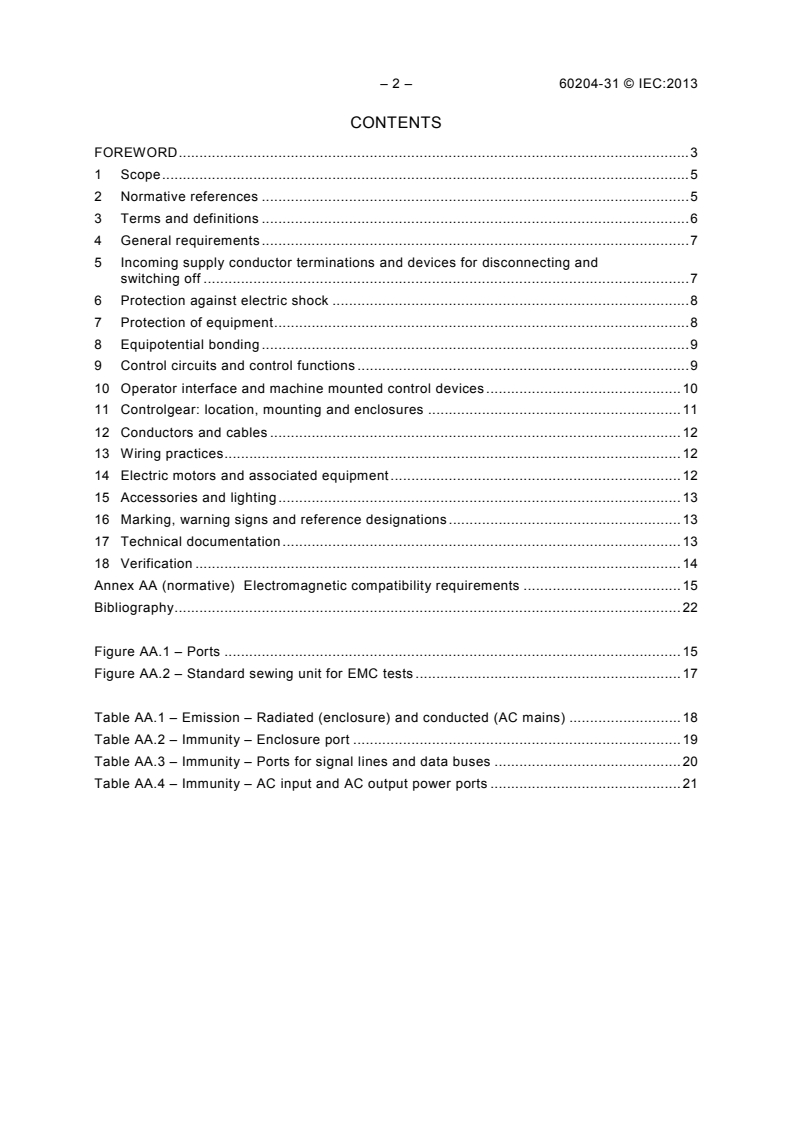
– 2 – 60204-31 © IEC:2013
CONTENTS
FOREWORD . 3
1 Scope . 5
2 Normative references . 5
3 Terms and definitions . 6
4 General requirements . 7
5 Incoming supply conductor terminations and devices for disconnecting and
switching off . 7
6 Protection against electric shock . 8
7 Protection of equipment . 8
8 Equipotential bonding . 9
9 Control circuits and control functions . 9
10 Operator interface and machine mounted control devices . 10
11 Controlgear: location, mounting and enclosures . 11
12 Conductors and cables . 12
13 Wiring practices . 12
14 Electric motors and associated equipment . 12
15 Accessories and lighting . 13
16 Marking, warning signs and reference designations . 13
17 Technical documentation . 13
18 Verification . 14
Annex AA (normative) Electromagnetic compatibility requirements . 15
Bibliography . 22
Figure AA.1 – Ports . 15
Figure AA.2 – Standard sewing unit for EMC tests . 17
Table AA.1 – Emission – Radiated (enclosure) and conducted (AC mains) . 18
Table AA.2 – Immunity – Enclosure port . 19
Table AA.3 – Immunity – Ports for signal lines and data buses . 20
Table AA.4 – Immunity – AC input and AC output power ports . 21
60204-31 © IEC:2013 – 3 –
INTERNATIONAL ELECTROTECHNICAL COMMISSION
____________
SAFETY OF MACHINERY –
ELECTRICAL EQUIPMENT OF MACHINES –
Part 31: Particular safety and EMC requirements
for sewing machines, units and systems
FOREWORD
1) The International Electrotechnical Commission (IEC) is a worldwide organization for standardization comprising
all national electrotechnical committees (IEC National Committees). The object of IEC is to promote
international co-operation on all questions concerning standardization in the electrical and electronic fields. To
this end and in addition to other activities, IEC publishes International Standards, Technical Specifications,
Technical Reports, Publicly Available Specifications (PAS) and Guides (hereafter referred to as “IEC
Publication(s)”). Their preparation is entrusted to technical committees; any IEC National Committee interested
in the subject dealt with may participate in this preparatory work. International, governmental and non-
governmental organizations liaising with the IEC also participate in this preparation. IEC collaborates closely
with the International Organization for Standardization (ISO) in accordance with conditions determined by
agreement between the two organizations.
2) The formal decisions or agreements of IEC on technical matters express, as nearly as possible, an international
consensus of opinion on the relevant subjects since each technical committee has representation from all
interested IEC National Committees.
3) IEC Publications have the form of recommendations for international use and are accepted by IEC National
Committees in that sense. While all reasonable efforts are made to ensure that the technical content of IEC
Publications is accurate, IEC cannot be held responsible for the way in which they are used or for any
misinterpretation by any end user.
4) In order to promote international uniformity, IEC National Committees undertake to apply IEC Publications
transparently to the maximum extent possible in their national and regional publications. Any divergence
between any IEC Publication and the corresponding national or regional publication shall be clearly indicated in
the latter.
5) IEC itself does not provide any attestation of conformity. Independent certification bodies provide conformity
assessment services and, in some areas, access to IEC marks of conformity. IEC is not responsible for any
services carried out by independent certification bodies.
6) All users should ensure that they have the latest edition of this publication.
7) No liability shall attach to IEC or its directors, employees, servants or agents including individual experts and
members of its technical committees and IEC National Committees for any personal injury, property damage or
other damage of any nature whatsoever, whether direct or indirect, or for costs (including legal fees) and
expenses arising out of the publication, use of, or reliance upon, this IEC Publication or any other IEC
Publications.
8) Attention is drawn to the Normative references cited in this publication. Use of the referenced publications is
indispensable for the correct application of this publication.
9) Attention is drawn to the possibility that some of the elements of this IEC Publication may be the subject of
patent rights. IEC shall not be held responsible for identifying any or all such patent rights.
International Standard IEC 60204-31 has been prepared by IEC technical committee 44:
Safety of machinery – Electrotechnical aspects.
This fourth edition cancels and replaces the third edition, published in 2001. This edition
constitutes a technical revision.
This edition includes the following significant technical changes with respect to the previous
edition:
a) Alignment of the normative references;
b) Alignment of titles and subtitles to the IEC 60204-1;
c) Revision of Annex AA to align this annex with the relevant IEC standards.
– 4 – 60204-31 © IEC:2013
The text of this standard is based on the following documents:
FDIS Report on voting
44/685/FDIS 44/687/RVD
Full information on the voting for the approval of this standard can be found in the report on
voting indicated in the above table.
This publication has been drafted in accordance with the ISO/IEC Directives, Part 2.
This International Standard is to be used in conjunction with IEC 60204-1:2005 and its
Amendment 1:2008.
This part supplements or modifies the corresponding clauses in IEC 60204-1 so as to convert
that publication into the IEC standard dealing with requirements for the electrical equipment of
sewing machines, units and systems.
Where a particular subclause of Part 1 is not mentioned in this part, that subclause applies as
far as is reasonable. Where this part states "addition", "modification" or "replacement" the
relevant text in Part 1 is adapted accordingly.
The Annex which is additional to those in Part 1 is lettered AA.
A list of all the parts in the IEC 60204 series, published under the general title Safety of
machinery – Electrical equipment of machines, can be found on the IEC website.
The committee has decided that the contents of this publication will remain unchanged until
the stability date indicated on the IEC web site under "http://webstore.iec.ch" in the data
related to the specific publication. At this date, the publication will be
• reconfirmed,
• withdrawn,
• replaced by a revised edition, or
• amended.
60204-31 © IEC:2013 – 5 –
SAFETY OF MACHINERY –
ELECTRICAL EQUIPMENT OF MACHINES –
Part 31: Particular safety and EMC requirements
for sewing machines, units and systems
1 Scope
This clause of Part 1 is replaced by:
This part of IEC 60204 applies to the application of electrical and electronic equipment to
sewing machines, units and systems, designed specifically for professional use in the sewing
industry.
NOTE The requirements for sewing machines for household and similar use can be found in IEC 60335-2-28.
The equipment covered by this part commences at the point of connection of the supply to the
electrical equipment of the machine (see 5.1). This part is applicable to the electrical
equipment or parts of the electrical equipment which operate with nominal supply voltages not
exceeding 1 000 V for alternating current and not exceeding 1 500 V for direct current, and
with nominal frequencies not exceeding 200 Hz.
It does not cover all the requirements (e.g. guarding, interlocking, control) that are necessary
to safeguard persons from hazards other than electrical hazards and which are specified in
other standards.
This part applies to sewing units and systems which are installed in dry and well-kept clean
locations and which process dry sewing material, as in the clothing industry. Where sewing
units and systems are used in other than dry and well-kept clean locations, more stringent
measures can be necessary, which need to be agreed between manufacturer and customer.
The noise emission of electrical and electronic equipment for sewing machines is not
considered to be a relevant hazard. Therefore this standard does not contain any specific
requirements on noise.
2 Normative references
This clause of Part 1 is applicable except as follows:
Additional references:
IEC 60204-1:2005, Safety of machinery – Electrical equipment of machines – Part 1: General
requirements
Amendment 1:2008
IEC 60364-4-41, Low-voltage electrical installations – Part 4-41: Protection for safety –
Protection against electric shock
IEC 60664-1:2007, Insulation coordination for equipment within low-voltage systems – Part 1:
Principles, requirements and tests
– 6 – 60204-31 © IEC:2013
IEC 60721-3-3, Classification of environmental conditions – Part 3: Classification of groups of
environmental parameters and their severities – Section 3: Stationary use at
weatherprotected locations
IEC 60947-1:2007, Low-voltage switchgear and controlgear – Part 1: General rules
Amendment 1:2010
IEC 61000-3-2, Electromagnetic compatibility (EMC) – Part 3-2: Limits – Limits for harmonic
current emissions (equipment input current ≤ 16 A per phase)
IEC 61000-3-3, Electromagnetic compatibility (EMC) – Part 3-3: Limits – Limitation of voltage
changes, voltage fluctuations and flicker in public low-voltage supply systems, for equipment
with rated current ≤ 16 A per phase and not subject to conditional connection
IEC 61000-4-2, Electromagnetic compatibility (EMC) – Part 4-2: Testing and measurement
techniques – Electrostatic discharge immunity test
IEC 61000-4-3, Electromagnetic compatibility (EMC) – Part 4-3: Testing and measurement
techniques – Radiated, radio-frequency, electromagnetic field immunity test
IEC 61000-4-4, Electromagnetic compatibility (EMC) – Part 4-4: Testing and measurement
techniques – Electrical fast transient/burst immunity test
IEC 61000-4-5:2005, Electromagnetic compatibility (EMC) – Part 4-5: Testing and
measurement techniques – Surge immunity test
IEC 61000-4-6, Electromagnetic compatibility (EMC) – Part 4-6: Testing and measurement
techniques – Immunity to conducted disturbances, induced by radio-frequency fields
IEC 61000-4-11, Electromagnetic compatibility (EMC) – Part 4-11: Testing and measurement
techniques – Voltage dips, short interruptions and voltage variations immunity tests
IEC 61058-1, Switches for appliances – Part 1: General requirements
IEC 61558-1, Safety of power transformers, power supplies, reactors and similar products –
Part 1: General requirements and tests
CISPR 11:2009, Industrial, scientific and medical equipment – Radio-frequency disturbance
characteristics – Limits and methods of measurement
Amendment 1:2010
ENV 50204, Radiated electromagnetic field from digital radio telephones – Immunity test
3 Terms and definitions
This clause of Part 1 is applicable except as follows:
Additional definitions:
3.101
sewing machine
machine designed to produce one or more stitch types with one or more sewing threads
Note 1 to entry: Previously, the term “sewing machine head” was used instead of “sewing machine”.
Note 2 to entry: Stitch types are defined in ISO 4915.
60204-31 © IEC:2013 – 7 –
Note 3 to entry: Seam types are defined in ISO 4916.
Note 4 to entry: In producing a seam, the machine can perform one or more sewing functions.
3.102
sewing machine stand
item, for example designed as a table, on which the sewing machine is arranged to enable
optimum operation
3.103
sewing machine drive
equipment that drives a sewing machine, such as an electric motor, which is speed-controlled
by electrical and/or mechanical means with or without a positioning device and with or without
control of machine functions
3.104
sewing unit
equipment consisting of at least a sewing machine, a sewing machine stand and a sewing
machine drive
Note 1 to entry: One or several devices incorporated in and/or attached to the sewing machine or sewing unit, for
example for sewing, cutting, feeding, etc. the sewing material, as well as the sewing machine itself, are controlled
by the operator or automatically.
3.105
sewing system
equipment consisting of at least two sewing units or parts of them, which are functionally
interlinked
4 General requirements
This clause of Part 1 is applicable except as follows:
4.4.2 Electromagnetic compatibility (EMC)
Replacement:
Replace this subclause with Annex AA.
4.4.4 Humidity
Modification:
Instead of the first paragraph, the following applies:
The electrical equipment shall be capable of operating in the intended manner in the humidity
conditions covered by class 3K3 as specified in IEC 60721-3-3.
5 Incoming supply conductor terminations and devices for disconnecting
and switching off
This clause of Part 1 is applicable except as follows:
5.1 Incoming supply conductor terminations
Modification:
– 8 – 60204-31 © IEC:2013
Add after the first sentence of the first paragraph:
Each sewing unit shall have only one incoming supply connection.
Each sewing system consisting of at least two sewing units that are not interlinked by means
of control systems may have its own incoming supply connection for each sewing unit;
however, if a failure of one sewing unit can cause a hazard, the sewing system shall have
only one incoming supply connection.
5.3 Supply disconnecting (isolating) device
5.3.1 General
Addition:
When sewing units are interconnected by means of control systems to form a sewing system,
only one supply disconnecting device shall be provided.
5.3.2 Type
Addition to item d):
On sewing units and systems which are started and stopped by actuating a hold-to-run control
device (e.g. pedal), an isolating switch according to IEC 60947-3 for utilization categories
AC-3 or DC-3, or a incorporated switch according to IEC 61058-1, shall be used.
5.3.4 Operating means
Addition:
For seated positions the operating handle of the ON/OFF switch shall be mounted between
0,5 m and 1,5 m above the servicing level.
6 Protection against electric shock
This clause of Part 1 is applicable except as follows:
6.1 General
Addition:
This can also be achieved by the application of SELV according to IEC 60364-4-41.
7 Protection of equipment
This clause of Part 1 is applicable except as follows:
7.5 Protection against supply interruption or voltage reduction and subsequent
restoration
Addition:
On sewing units and systems, which are started by actuating a hold-to-run control device
(such as a pedal), and stopped by releasing it, the provision of a device for avoiding an
unintentional restart after a supply interruption or voltage reduction and subsequent
restoration is not necessary.
60204-31 © IEC:2013 – 9 –
8 Equipotential bonding
This clause of Part 1 is applicable except as follows:
8.2.5 Parts that need not be connected to the protective bonding circuit
Addition:
It is not necessary to connect sewing machine stands or their accessible conducting parts
when:
– they do not carry electrical equipment; or
– they carry electrical equipment operated at SELV and/or PELV only (see IEC 60364-4-41).
9 Control circuits and control functions
This clause of Part 1 is applicable except as follows:
9.1.1 Control circuit supply
Replacement:
Control circuits of sewing units and systems shall meet requirements for PELV (see 6.4) or
SELV (see IEC 60364-4-41). The transformers supplying these circuits shall meet the
requirements of IEC 61558-1.
9.2.5.2 Start
Addition:
The requirements of 9.2.5.2 do not apply to:
– sewing units and systems, which are started by actuating a hold-to-run control device
(such as a pedal).
9.2.5.3 Stop
Addition:
The stop function required for sewing units and systems is met by a hold-to-run control
devices (such as a pedal). On sewing units and systems for automatic bar tacking, sewing of
buttonholes, fastening of buttons, etc., which have a short sewing cycle, the required function
is met by an ON/OFF switch according to IEC 60947-3 or IEC 61058-1.
9.4 Control functions in the event of failure
9.4.1 General requirements
Addition:
NOTE On sewing units and systems on which the hazardous movement of parts is protected by fixed guards,
interlocking of the guard with the electrical circuit is not necessary.
9.4.2.2 Provisions of partial or complete redundancy
Addition:
NOTE On sewing units and systems on which the hazardous movement of parts is limited to parts of the sewing
machine itself, for example stitch forming elements, feed, etc., use of redundancy is not necessary.
– 10 – 60204-31 © IEC:2013
9.4.2.3 Provision of diversity
Addition:
NOTE On sewing units and systems on which the hazardous movement of parts is limited to parts of the sewing
machine itself, for example stitch forming elements, feed, etc., use of diversity is not necessary.
9.4.3.1 Earth faults
Addition:
On sewing units and systems, a particularly safe installation of those conductors that in the
case of an earth fault could cause unintended starting, or hazardous movement of a machine,
or could prevent its stopping, may be used instead of connecting the control circuits to the
protective bonding circuit or providing an insulation monitoring device.
A particularly safe installation can be achieved, for example, by:
– enclosure of insulated conductors in ducts of insulating material;
– use of double insulation techniques; or
– encapsulation of components and devices.
10 Operator interface and machine mounted control devices
This clause of Part 1 is applicable except as follows:
10.1.2 Location and mounting
Modification:
Replace the first dashed indent of the second paragraph by the following:
– those used for normal operation are not less than 0,5 m above the servicing level and are
within easy reach from the normal working position of the operator (but see also 5.3.4 of
this part);
– those used for adjustment and maintenance are not less than 0,3 m above the servicing
level and so installed that they cannot be actuated during normal operation for example by
position, locking, etc.
10.1.3 Protection
Replacement:
Where mounted as intended, operator interface and machine mounted control devices shall
withstand the stresses of the expected use and shall have a minimum degree of protection of
at least IP40 (see IEC 60529). IP40 is considered to be sufficient when sewing units and
sewing systems are operated in an environment in which the effects of aggressive fluids,
vapours and contamination by coarse dust and chips are not to be expected.
10.2 Push-buttons
10.2.1 Colours
Modification:
Instead of the first paragraph, the following applies:
60204-31 © IEC:2013 – 11 –
As far as is practicable, push-button actuators shall be colour-coded in accordance with
Table 2; limitations of the practicability are sizes of actuators, built-in casing and design of
actuators.
10.3 Indicator lights and displays
10.3.2 Colours
Modification:
Instead of the first sentence, the following applies:
As far as is practicable, indicator light lenses shall be colour-coded, with respect to the
condition (status) of the machine in accordance with Table 4; limitations of the practicability
are sizes of actuators, built-in casing and design of actuators.
10.4 Illuminated push-buttons
Modification:
Instead of the first sentence, the following applies:
As far as is practicable, illuminated push-buttons shall be colour-coded in accordance with
Tables 2 and 4; limitations of the practicability are sizes of actuators, built-in casing and
design of actuators.
10.7.4 Local operation of the supply disconnecting device to effect emergency stop
Addition:
On automatically controlled sewing units and systems for which emergency stop devices
according to 10.7.2 are considered to be unnecessary, the supply disconnecting device shall
fulfil the function of the emergency stop device.
On sewing units and systems which are started by actuating a hold-to-run control device
(such as a pedal), an emergency stop device is not required. Moreover, an emergency stop
device is not necessary on automatically controlled sewing units and systems for automatic
bar tacking, sewing of buttonholes, fastening of buttons, etc., which have only a short
automatic sewing process.
These sewing units and systems may be equipped with a device according to IEC 60947-3 or
IEC 61058-1 for switching ON and OFF.
11 Controlgear: location, mounting and enclosures
This clause of Part 1 is applicable except as follows:
11.2 Location and mounting
11.2.1 Accessibility and maintenance
Modification:
Instead of the second paragraph, the following applies:
Where access is required for regular maintenance or adjustment, the relevant devices shall be
arranged between 0,3 m and 2,0 m above the servicing level.
– 12 – 60204-31 © IEC:2013
11.2.2 Physical separation or grouping
Addition:
In enclosures according to 6.2.1, the distances between the protective enclosure and live
parts shall be not less than the clearance and creepage distances given in Table 13 Case A
and Table 15 of IEC 60947-1:2007, Amendment 1:2010, pollution degree 2 shall apply.
For printed circuit assemblies and all other electrical equipment and devices (such as
switches, motors), IEC 60664-1:2007, Table F.4, pollution degree 2 shall apply.
11.3 Degrees of protection
Replacement:
The minimum degree of protection shall be IP40 for enclosures of switching devices of sewing
units and systems. Exception: if all the circuits used in and with the devices meet the
requirements of 6.1 of this part of IEC 60204, IP20 is permitted as the minimum degree of
protection.
12 Conductors and cables
This clause of Part 1 is applicable.
13 Wiring practices
This clause of Part 1 is applicable except as follows:
13.2.4 Identification by colour
Addition:
Conductors used for functional earthing shall be identified by the colour GREY.
Common conductors, for example for eliminating static charges, shall be identified by the
colour GREY.
13.5.8 Connection boxes and other boxes
Modification:
Instead of the second sentence of the first paragraph, the following applies:
IP40 (see IEC 60529) shall be the minimum degree of protection for connection and through
boxes of sewing units and systems. Exception: if all the circuits used in and with the devices
meet the requirements of 6.1 of this part of IEC 60204, IP20 is permitted as the minimum
degree of protection.
14 Electric motors and associated equipment
This clause of Part 1 is applicable except as follows:
14.1 General requirements
Addition:
60204-31 © IEC:2013 – 13 –
Voltage transformation for the purpose of feeding external consumers (loads) by tapping the
stator winding of motors is not permitted.
14.2 Motor enclosures
Addition:
The minimum degree of protection of the sewing machine drive (including the control device
possibly attached to it) shall be IP40.
14.3 Motor dimensions
Addition:
The dimensions of sewing machine drives need not correspond to IEC 60072-1 and
IEC 60072-2.
15 Accessories and lighting
This clause of Part 1 is applicable except as follows:
15.2 Local lighting of the machine and equipment
15.2.1 General
Addition:
For local lighting (sewing lamps) of sewing units and systems up to a rated voltage of 50 V
a.c., the ON/OFF switch may be incorporated in the flexible connecting cords.
15.2.2 Supply
Addition:
Low-voltage sewing lamps shall be supplied either by built-in transformers or by external
extra-low voltage transformers according to IEC 61558-1.
Circuits for local lighting (sewing lamps) intended for use, for example threading, replacing
sewing implements, maintenance work, shall be connected to the incoming supply side of the
device for switching ON and OFF the sewing unit or system.
16 Marking, warning signs and reference designations
This clause of Part 1 is applicable.
17 Technical documentation
This clause of Part 1 is applicable except as follows:
17.7 Operating manual
Addition:
– 14 – 60204-31 © IEC:2013
The instructions shall draw attention to the need always to switch off the sewing unit or
system, for example by actuating the ON/OFF switch or by disconnecting the plug from the
incoming supply, when:
– sewing implements (such as sewing machine needle, presser foot, bobbin or needle plate)
have to be replaced;
– threading a needle, looper, spreader, etc. is required;
– the workplace is left unattended;
– maintenance work has to be performed.
18 Verification
This clause of Part 1 is applicable except as follows:
18.1 General
Addition:
The tests of 18.2, 18.3, 18.4 and 18.7 are routine tests.
The tests of 18.5 and 18.6 are type tests.
18.3 Insulation resistance tests
Addition:
Control and signal circuits containing electronic devices shall be connected to the protective
conductor while the other circuits are tested. After disconnecting the protective conductor
connection mentioned above, the insulation resistance to earth shall be measured in a second
test with at least 100 V d.c. The test voltage shall not be applied suddenly in order to avoid
any damage to the electronic circuit.
18.4 Voltage tests
Addition:
Such disconnected components include rectifiers, capacitors, electronic devices and motors
up to a rated power of 1 kW.
Motors shall be tested according to IEC 60034-1. Electronic circuits of below 50 V rated
voltage shall not be subjected to a voltage test.
If the electrical equipment of the machine contains surge protection devices which are likely
to operate during the test, it is permitted to either:
– disconnect these devices, or
– reduce the test voltage to a value lower than the voltage protection level of the search
protection devices, but not lower than the peak value of the upper limit of the supply
(phase to neutral) voltage.
Annexes
The annexes of Part 1 are applicable except as follows:
Addition:
60204-31 © IEC:2013 – 15 –
Annex AA
(normative)
Electromagnetic compatibility requirements
AA.1 General
The objective of this annex is to define limits for sewing units, sewing systems and their
equipment, e.g. sewing machine drives, controls, etc., in relation to electromagnetic
emissions which may cause interference in other equipment, and in relation to continuous and
transient, conducted and radiated disturbances, including electrostatic discharges.
AA.2 Electromagnetic compatibility test levels
The ports which can be influenced by electromagnetic phenomena are:
Encolusre port
AC power port
Signal port
DC power port
Machine,
equipment
Process measurement
and control port
IEC 692/13
Figure AA.1 – Ports
The limits of electromagnetic compatibility specified in Tables AA.1 to AA.4 are effective:
a) in the case of emission limits, for foreseeable use in a residential environment; and
b) in the case of immunity, for use in the industrial environment characteristic of the sewing
industry;
and therefore covers foreseeable use in all environments of the sewing industry.
AA.3 Emission
The electrical disturbances generated by the machine or by the equipment shall not exceed
the levels specified in Table AA.1.
Measurement of interference voltages is not required on shielded lines which connect
shielded parts of equipment. The shields shall be connected together.
Measurement of the interference voltages is not required on lines connecting parts of
equipment which are less than 2 m in length and which cannot be extended.
AA.4 Immunity
Where electronic equipment is used, it shall be designed to withstand at least the test values
specified in Tables AA.2 to AA.4.
The immunity test requirements for machines and equipment covered by this part of
IEC 60204 are on a port to port basis.
– 16 – 60204-31 © IEC:2013
AA.5 Performance criteria
Machines and equipment shall not become hazardous as a result of the application of the
tests defined in this part of IEC 60204.
A functional description and a definition of performance criteria, during or as a consequence
of the EMC testing, shall be noted in the test report, based on the following:
– performance criterion A: the machines and equipment shall continue to operate in the
intended manner. No degradation of performance or loss of function is allowed below a
performance level specified by the manufacturer, when the machines and equipment are
used as intended. In some cases, the performance level may be replaced by a permissible
loss of performance;
– performance criterion B: the machines and equipment shall continue to operate in the
intended manner after the test. No degradation of performance or loss of function is
allowed below a performance level specified by the manufacturer, when the machines and
equipment are used as intended. In some cases, the performance level may be replaced
by a permissible loss of performance. During the test, degradation of performance is
however allowed. No change of actual operating state or stored data is allowed.
– performance criterion C: a temporary malfunction is permissible, if the function is self-
recovering or recoverable by activation of the operating and/or setting elements.
If either the minimum performance level or the permissible performance loss is not specified
by the supplier, then either of these may be derived from the product description and
documentation and what the user may reasonably expect from the machines and equipment
when used in the intended manner.
AA.6 Electromagnetic compatibility tests
AA.6.1 General electromagnetic compatibility (EMC) test conditions
The EMC tests shall be carried out:
– within the specified operating conditions for sewing units and systems or equipment and
its nominal supply voltage;
– on completely equipped and ready-for-use sewing units and systems or, for sewing
systems, on the individual machines in working order which build the entirety of the
system;
– on sewing units and systems or equipment arranged in their maximum extension (for
example controls with the maximum number of inputs/outputs and functions, all machines
and equipment with minor configurations being considered to be in accordance with this
part of IEC 60204);
– as single tests in sequence, the sequence of the test being optional.
The configuration and mode of operation during the test shall be precisely noted in the test
report.
It is not always possible to test every function of the machine, and in such cases the most
critical mode of operation shall be selected.
It may be determined, from consideration of the electrical characteristics and usage of
particular machines and equipment, that some of the tests are inappropriate and are therefore
unnecessary. In such a case, the decision not to test shall be recorded in the test report.
The sewing machine drive and additional equipment shall be tested on a standard sewing unit
equipped as shown in Figure AA.1.
60204-31 © IEC:2013 – 17 –
The sewing machine drives and equipment thus tested will be regarded as EMC-prepared.
Specific test measures shall be agreed upon with the suppliers involved.
NOTE EMC-prepared equipment cannot guarantee solely the EMC-compatibility of the sewing unit or sewing
system.
Measurements shall be performed under well-defined and reproducible conditions for each
type of EMC phenomenon.
AA.6.2 EMC test conditions for emission
The description of the test and the test equipment shall be as given in Clauses 7 and 8 of
CISPR 11:2009, Amendment 1:2010.
The test shall be carried out using the test set-up shown in Figure AA.2, except that the
requirements for the ground plane shall be according to Clause 8 of CISPR 11:2009,
Amendment 1:2010.
AA.6.3 EMC test conditions for immunity
The description of the test, the test methods and test equipment are given in the standards
listed in Tables AA.2 to AA.4.
The test shall be carried out using the test set-up shown in Figure AA.2.
The test for sewing systems may differ from this test set-up.
Additional
equipment
Sewing machine
drive
≥0,1 m
≥0,1 m
≥0,1 m
≥0,1 m
Insulating
0,1 m
Ground plane
Ground
IEIECC 693 398//1963
Figure AA.2 – Standard sewing unit for EMC tests
– 18 – 60204-31 © IEC:2013
Table AA.1 – Emission – Radiated (enclosure) and conducted (AC mains)
Port Frequency range Limits Basic standard Applicability Note
30 MHz – 230 MHz 30 dB(µV/m) quasi-peak, measured at 10 m distance
Enclosure See Note 1
230 MHz – 1 000 MHz 37 dB(µV/m) quasi-peak, measured at 10 m distance
150 kHz – 0,5 MHz
66 dB(µV) to 56 dB(µV) quasi-peak
See Notes 2, 3 and 4
56 dB(µV) to 46 dB(µV) average decreasing
linearly with the logarithm of the frequency CISPR 11
AC mains 0,5 MHz – 5 MHz 56 dB(µV) quasi-peak
See Notes 2, 3 and 4
46 dB(µV) average
5 MHz – 30 MHz
60 dB(µV) quasi-peak
See Notes 2, 3 and 4
50 dB(µV) average
NOTE 1 In situ measurements are excluded from this standard.
NOTE 2 Impulse noise (clicks) which occurs less than five times per minute is not considered. For clicks appearing more often than 30 times per minute, the limits of
Table AA.1 apply. For clicks appearing between five and 30 times per minute, a relaxation of 20 log 30/N dB of the limits of Table AA.1 is allowed (where N is the number of
clicks per minute).
NOTE 3 Applies only to machine and equipment operating at less than 1 000 V RMS (Root Mean Square).
NOTE 4 These values are part of CISPR 11.
The requirements of IEC 61000-3-2 and IEC 61000-3-3 shall apply.
60204-31 © IEC:2013 – 19 –
Table AA.2 – Immunity – Enclosure port
Environmental Test Units Basic Remarks Performance
phenomena specification standard criteria
1.1 The test is to be executed according
to the power supply frequency.
Equipment (company equipment,
50, 60 Hz
b
Magnetic field at power frequency IEC 61000-4-8 devices) that is intended to be used A
30 A/m
in regions that are only supplied by
one of these frequencies have to be
a
tested at this frequency only .
1.2 electromagnetic 80 – 1 000 MHz
The specified test level
HF-field, amplitude 10 V/m IEC 61000-4-3
A
c
is the RMS prior to modulation
modulated 80 % AM (1 kHz)
1.3 electromagnetic 1.4 to 2.0 GHz
The specified test level
HF-field, amplitude 3 V/m IEC 61000-4-3 A
d
is the RMS prior to modulation
modulated 80 % AM (1 kHz)
1.4 electromagnetic 1.4 to 2.7 GHz
The specified test level
HF-field, amplitude 1 V/m IEC 61000-4-3 A
d
is the RMS prior to modulation
modulated 80 % AM (1 kHz)
Contact ±4 (charge
kV B
Discharging
discharge voltage)
See basic standard for applicability of
1.5 static IEC 61000-4-2
contact and/or air discharge test
electricity ±8 (charge
Air discharge kV B
voltage)
a
Only for company equipment (devices) which contain devices (components) that are sensitive to magnetic fields.
b
For monitors with cathode ray tubes the acceptable jitter depends on the font size and is calculated for a test level of 1 A/m according to: J ≤ (3C + 1)/40. The jitter J and the
font size C is in mm. As the jitter is linearly proportional to the magnetic field strength, tests may be carried out with other test levels, whereas the maximum jitter has to be
extrapolated.
c Except for the ITU broadcast frequency bands: 87 MHz – 108 MHz, 174 MHz – 230 MHz and 470 MHz – 790 MHz, where the level is 3 V/m.
d
The frequency ranges have been selected so that frequencies with the hig
...