

CEN/TR 15628:2007
(Main)Maintenance - Qualification of Maintenance personnel
- Abstract
The scope of this document is to report about the current situation for defining the competence levels for personnel operating in maintenance and the knowledge levels required to be addressed to carry out those competencies.
- Status
- Withdrawn
- Publication Date
- 24-Jul-2007
- Withdrawal Date
- 06-Oct-2026
- Technical Committee
- CEN/TC 319 - Maintenance
- Drafting Committee
- CEN/TC 319/WG 9 - Qualification of personnel
- Current Stage
- 9960 - Withdrawal effective - Withdrawal
- Start Date
- 13-Aug-2014
- Completion Date
- 07-Oct-2026

Relations
- Effective Date
- 08-Jun-2022
- Effective Date
- 17-Sep-2026
- Effective Date
- 22-Apr-2026
- Effective Date
- 28-Jan-2026
- Effective Date
- 28-Jan-2026
- Effective Date
- 28-Jan-2026
- Effective Date
- 28-Jan-2026
- Effective Date
- 28-Jan-2026
- Effective Date
- 28-Jan-2026
- Effective Date
- 28-Jan-2026
- Effective Date
- 28-Jan-2026
Get Certified
Connect with accredited certification bodies for this standard

BSI Group
BSI (British Standards Institution) is the business standards company that helps organizations make excellence a habit.

Bureau Veritas
Bureau Veritas is a world leader in laboratory testing, inspection and certification services.

DNV
DNV is an independent assurance and risk management provider.
Sponsored listings
Frequently Asked Questions
CEN/TR 15628:2007 is a technical report published by the European Committee for Standardization (CEN). Its full title is "Maintenance - Qualification of Maintenance personnel". This standard covers: The scope of this document is to report about the current situation for defining the competence levels for personnel operating in maintenance and the knowledge levels required to be addressed to carry out those competencies.
The scope of this document is to report about the current situation for defining the competence levels for personnel operating in maintenance and the knowledge levels required to be addressed to carry out those competencies.
CEN/TR 15628:2007 is classified under the following ICS (International Classification for Standards) categories: 03.100.30 - Management of human resources. The ICS classification helps identify the subject area and facilitates finding related standards.
CEN/TR 15628:2007 has the following relationships with other standards: It is inter standard links to EN 15628:2014, EN ISO 9001:2026, EN ISO 14001:2026, EN ISO 14935:1998, EN 15341:2019+A1:2022, EN 13269:2016, EN ISO 9000:2005, EN 13306:2001, EN ISO 9001:2015, EN ISO 14001:2015, EN 13460:2009. Understanding these relationships helps ensure you are using the most current and applicable version of the standard.
CEN/TR 15628:2007 is available in PDF format for immediate download after purchase. The document can be added to your cart and obtained through the secure checkout process. Digital delivery ensures instant access to the complete standard document.
Standards Content (Sample)
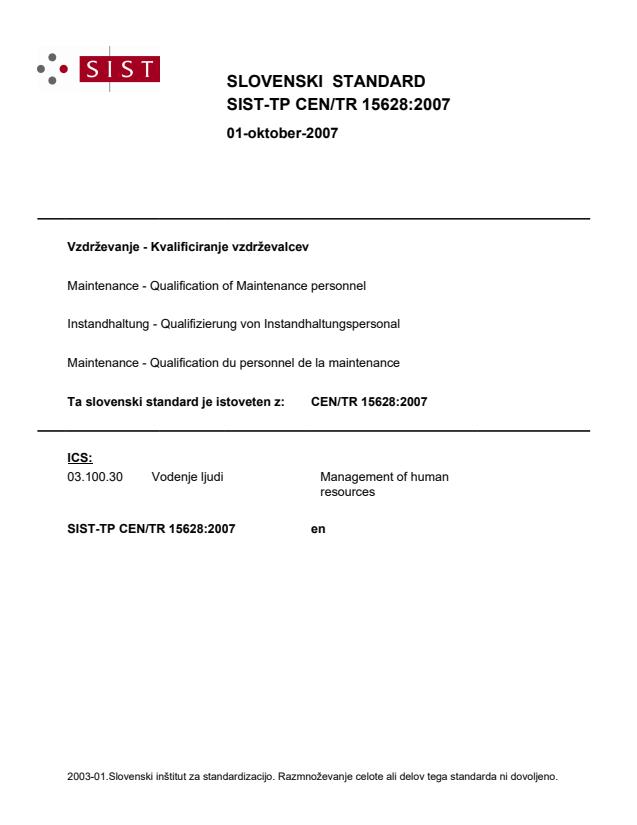
SLOVENSKI STANDARD
01-oktober-2007
Vzdrževanje - Kvalificiranje vzdrževalcev
Maintenance - Qualification of Maintenance personnel
Instandhaltung - Qualifizierung von Instandhaltungspersonal
Maintenance - Qualification du personnel de la maintenance
Ta slovenski standard je istoveten z: CEN/TR 15628:2007
ICS:
03.100.30 Vodenje ljudi Management of human
resources
2003-01.Slovenski inštitut za standardizacijo. Razmnoževanje celote ali delov tega standarda ni dovoljeno.
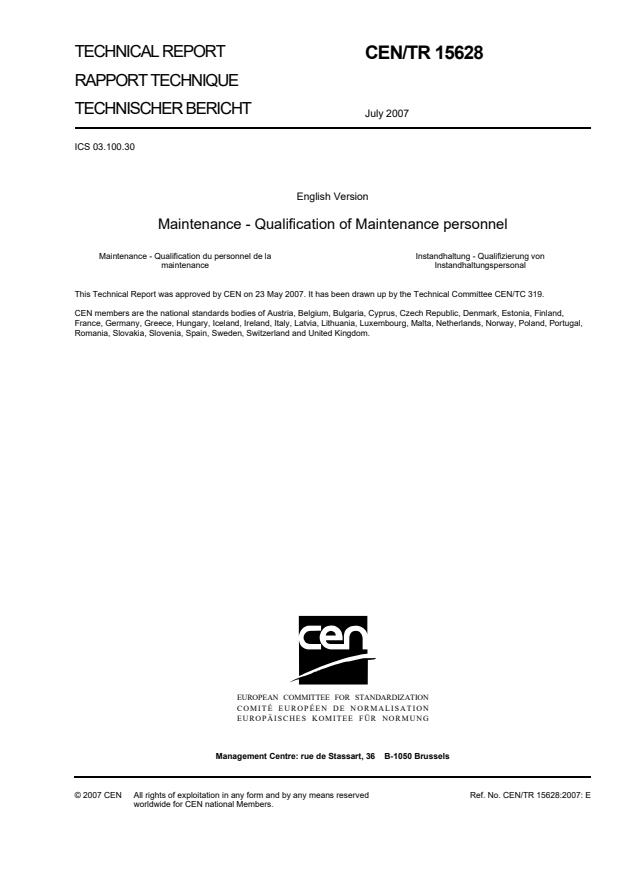
TECHNICAL REPORT
CEN/TR 15628
RAPPORT TECHNIQUE
TECHNISCHER BERICHT
July 2007
ICS 03.100.30
English Version
Maintenance - Qualification of Maintenance personnel
Maintenance - Qualification du personnel de la Instandhaltung - Qualifizierung von
maintenance Instandhaltungspersonal
This Technical Report was approved by CEN on 23 May 2007. It has been drawn up by the Technical Committee CEN/TC 319.
CEN members are the national standards bodies of Austria, Belgium, Bulgaria, Cyprus, Czech Republic, Denmark, Estonia, Finland,
France, Germany, Greece, Hungary, Iceland, Ireland, Italy, Latvia, Lithuania, Luxembourg, Malta, Netherlands, Norway, Poland, Portugal,
Romania, Slovakia, Slovenia, Spain, Sweden, Switzerland and United Kingdom.
EUROPEAN COMMITTEE FOR STANDARDIZATION
COMITÉ EUROPÉEN DE NORMALISATION
EUROPÄISCHES KOMITEE FÜR NORMUNG
Management Centre: rue de Stassart, 36 B-1050 Brussels
© 2007 CEN All rights of exploitation in any form and by any means reserved Ref. No. CEN/TR 15628:2007: E
worldwide for CEN national Members.
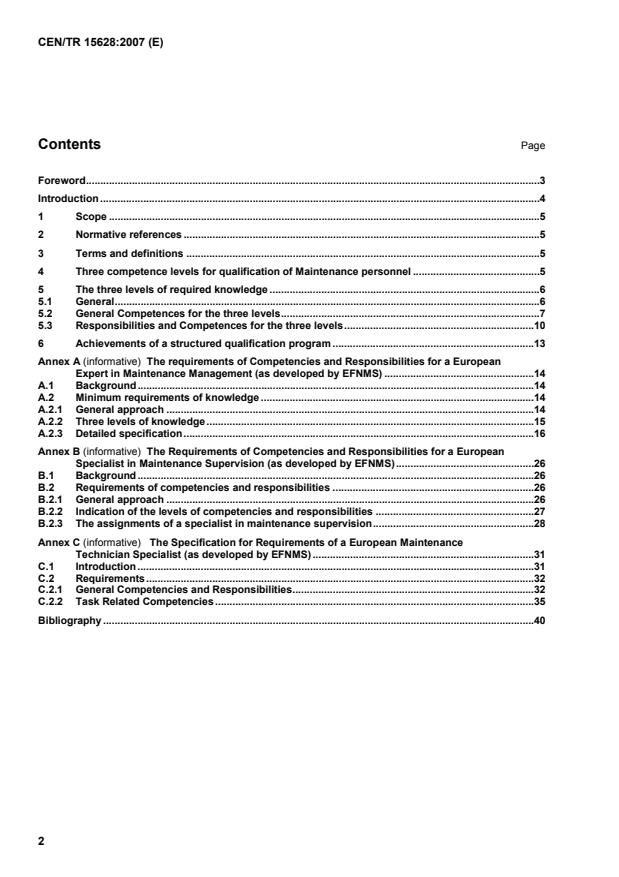
Contents Page
Foreword.3
Introduction .4
1 Scope.5
2 Normative references.5
3 Terms and definitions .5
4 Three competence levels for qualification of Maintenance personnel .5
5 The three levels of required knowledge .6
5.1 General.6
5.2 General Competences for the three levels.7
5.3 Responsibilities and Competences for the three levels.10
6 Achievements of a structured qualification program .13
Annex A (informative) The requirements of Competencies and Responsibilities for a European
Expert in Maintenance Management (as developed by EFNMS) .14
A.1 Background.14
A.2 Minimum requirements of knowledge .14
A.2.1 General approach.14
A.2.2 Three levels of knowledge .15
A.2.3 Detailed specification.16
Annex B (informative) The Requirements of Competencies and Responsibilities for a European
Specialist in Maintenance Supervision (as developed by EFNMS).26
B.1 Background.26
B.2 Requirements of competencies and responsibilities .26
B.2.1 General approach.26
B.2.2 Indication of the levels of competencies and responsibilities .27
B.2.3 The assignments of a specialist in maintenance supervision.28
Annex C (informative) The Specification for Requirements of a European Maintenance
Technician Specialist (as developed by EFNMS).31
C.1 Introduction.31
C.2 Requirements.32
C.2.1 General Competencies and Responsibilities.32
C.2.2 Task Related Competencies .35
Bibliography .40
Foreword
This document (CEN/TR 15628:2007) has been prepared by Technical Committee CEN/TC 319
“Maintenance”, the secretariat of which is held by UNI.
Attention is drawn to the possibility that some of the elements of this document may be the subject of patent
rights. CEN [and/or CENELEC] shall not be held responsible for identifying any or all such patent rights.
Introduction
At the time of the publication of this report, there are more than twenty Maintenance Societies in Europe, and
each of them is active in education and training on a national level. In view of the ongoing developments in
European integration, training and qualification of maintenance personnel should be carried out within a more
structured framework of mutually accepted European guidelines.
In the last years of the 20th century an initiative was taken to develop European guidelines for qualifying
maintenance personnel at a management level. This project is still progressing with great success. One of the
reasons for this success is that the qualification procedure has no link with any national school system
hindering the initiative. In fact all individuals have a right to make an application to enter the examinations
arranged by the National Member Societies.
At the beginning of the 1990s, the Societies decided uniformly, to categorize the European maintenance
personnel into three levels and to link these levels to national school systems.
The following three levels were described:
The European Maintenance Technician.
The European Maintenance Supervisor.
The European Maintenance Manager.
The European Maintenance Technician is a craft person with at least two years of practical experience in
maintenance and sufficient theoretical knowledge to independently perform and coordinate maintenance
activities (responsible for short term decisions and communication).
The European Maintenance Supervisor is a person with at least two years of practical experience in
maintenance and possesses sufficient theoretical knowledge to independently perform and coordinate
maintenance projects (responsible for medium term decisions).
The European Maintenance Manager is a person with an approved engineering background and sufficient
theoretical knowledge to perform and co-ordinate maintenance.
Each country has to apply its National regulations.
1 Scope
The scope of this document is to report about the current situation for defining the competence levels for
personnel operating in maintenance and the knowledge levels required to be addressed to carry out those
competencies.
2 Normative references
The following referenced documents are indispensable for the application of this document. For dated
references, only the edition cited applies. For undated references, the latest edition of the referenced
document (including any amendments) applies.
EN 13269, Maintenance - Guideline on preparation of maintenance contracts
EN 13306:2001, Maintenance terminology
EN 13460, Maintenance – Documents for maintenance
EN 15341, Maintenance – Maintenance Key Performance Indicators
EN ISO 9000:2005, Quality management systems - Fundamentals and vocabulary (ISO 9000:2005)
EN ISO 9001, Quality management systems – Requirements (ISO 9001:2000)
EN ISO 14001, Environmental management systems - Requirements with guidance for use (ISO 14001:2004)
IEC 60050-191:1990, International electrotechnical vocabulary; chapter 191: dependability and quality of
service
3 Terms and definitions
For the purposes of this document, the terms and definitions given in EN 13306:2001, IEC 60050-191:1990
and EN ISO 9000:2005 apply.
4 Three competence levels for qualification of Maintenance personnel
This document lists the knowledge requirements proposed to be incorporated within maintenance training.
There are three proposed levels of competence. The knowledge requirements are typically covered within the
following education systems, see Table 1:
Table 1- Example of the three levels for qualification of maintenance personnel
Title European Maintenance European Maintenance European Maintenance
Manager Supervisor Technician
Qualification document Bachelor degree or
Postgraduate diploma / e. g. National diploma e. g. National diploma
Master degree
Education system / Technical university National school for National school for
school Private schools or improving theoretical improving theoretical
courses knowledge knowledge
Craft person with at least
Starting conditions Baccalaureate or Person with at least two
two years of practical
Bachelor or perhaps years of practical
experience in
European Maintenance experience in
maintenance
Supervisor maintenance or
European Maintenance
Technician
Requirements See Annex A See Annex B See Annex C
(informative) (informative) (informative)
NOTE 1 The three competence levels described should be integrated in the lifelong learning programs of the EU in accordance with
the Bologna and Copenhagen declarations.
NOTE 2 At the Maintenance Manager level, the education should be integrated into Bachelor or Master education syllabuses.
5 The three levels of required knowledge
5.1 General
Requirements have been set out under 5.2 and 5.3. These sub-clauses have sub-readings in each syllabus
area with the level of required knowledge specified.
The three levels of required knowledge are:
Level 1: Very good knowledge, ability to lead change and handle special tasks;
Level 2: Good knowledge, ability to understand the implications of change and making the correct
decisions;
Level 3: Understanding, ability to participate in decision making within the team and carry out the tasks.
In each syllabus the overall approach is to ensure that maintenance tasks are:
a) carried out in a safe manner;
b) carried out in a correct manner first time: and
c) carried out on time and cost effectively.
5.2 General Competences for the three levels
LEVEL OF REQUIRED KNOWLEDGE
Maintenance Maintenance Maintenance
Manager Supervisor Technician
5.2.0 Corporate/Company Environment 1 2
Has knowledge to Has good knowledge
5.2.0.1 Corporate/company situation
impact on of social/economic
5.2.0.2
Corporate/company organization
social/economic impact of own
impact of own organization/
5.2.0.3
Departmental organization
organization/ enterprise.
5.2.0.4
Costs
enterprise.
5.2.1 Work Planning 1 1 1
5.2.1.1 Planning
Has very good Does preparation and Does preparation
Maintenance request/Process
knowledge for reporting on team and reporting on
sheet/ Job ticket
organizing all maintenance tasks own maintenance
maintenance and is supervising tasks and on some
Personnel planning
team jobs. Plans
activities, how to some team jobs.
Equipment planning
choose a suitable Carries out planning own work and
Time sheet
organization and of shutdowns, and suppliers'/
assure the right group planning contractors' work.
Control and reporting
5.2.1.2
competence within coordination.
the organization.
5.2.2 Team Working and Communication 1 1 1
Has very good Has ability to create Reports orally and
knowledge in project and communicate in writing within a
5.2.2.1 Authority and Responsibility
team. Has social
management. Has procedures and
social capability to systems. Reports capability to
5.2.2.2 Basic Management Techniques
lead and orally and in writing communicate with
Personnel Management
communicate with within a team and to people in and
Reporting Techniques
people in and outside the management. outside the team,
Team organization techniques
the team, such as in Has social capability such as in the
the production, with to communicate with production, with
contractors, suppliers, people in and outside contractors,
etc. Has good
the team, such as in suppliers, etc.
knowledge about the production, with
human reliability. contractors, suppliers,
etc.
5.2.3 English Language 1 2 3
Has good knowledge Is able to understand Is able to
Technical English
about the instructions in understand
maintenance terms in technical English and instructions in
the English language, to make a summary technical English.
in order to be able to
in the national
handle international language. Is able to
maintenance conduct a
management matters conversation in
English. Is able to
within Europe.
write a case-study
report in English.
5.2.4 Information Technology 1 2 2
5.2.4.1 Basics of Electronic Data Processing (EDP)
Knows how to Uses the information Uses the
related to maintenance management
specify the system for entering information system
5.2.4.2
Processing/calculation techniques
requirements for an and collecting data. for entering and
Data base handling information system. Has good knowledge collecting data.
Has good knowledge Has the basic
to use the system
Computation of tables
5.2.4.3
about the use of an interactively for knowledge to use
The PC-Work station
information system. tactical purposes. the system
Organization of the PC-Work
interactively.
station
Use of networks
1 1 2
5.2.5 Training and Instructions
5.2.5.1 Basics of the Learning Process
Has very good Has very good Has the basic
5.2.5.2 Basics of Training Strategies
knowledge for knowledge needed knowledge needed
5.2.5.3 Basics of Planning a Lecture
defining and for training and for training and
5.2.5.4 Training facilities
implementing human instructing team instructing team
resources members. Is familiar members. Is
development policy. with training facilities familiar with
Has very good in and outside the training facilities in
knowledge needed organization. and outside the
for training and organization.
instructing. Is familiar
with training facilities
in and outside the
organization.
5.2.6 Quality Assurance (Systems) 1 1 2
5.2.6.1 Scope and objectives of Quality Assurance Has very good Has very good Has basic
(QA) knowledge about the knowledge of the knowledge of the
relationship between impact of impact of
QA Standards (see EN ISO 9000 maintenance and maintenance on maintenance on
quality assurance. product quality. Is product quality. Is
series), Terminology
5.2.6.2 able to act as an able to act as an
Elements of QA systems (see EN
5.2.6.3
ISO 9001) active member of a active member of a
quality team. quality team.
Basics of Quality Assurance
QA techniques and procedures
Concepts
Definitions
QA techniques and
procedures
5.2.7 Environment 1 1 1
5.2.7.1
Scope and objectives of Environmental Has very good Has very good Has basic
Management (see EN ISO 14001) knowledge and knowledge of the knowledge of the
impacts on impact of impact of
5.2.7.2 Influence on the environment environmental issues. maintenance on maintenance on
Has very good environmental issues. environmental
knowledge of the Is able to act as an issues. Is able to
environmental active member of an act as an active
consequences of environmental team. member of an
carrying out and not environmental
carrying out team.
maintenance.
5.2.8 Automation 1 1 2
5.2.8.1 Basics of Process Control
Has very good Has very good Has general
5.2.8.2 Basics of machine automation
knowledge of knowledge of knowledge of
5.2.8.3 Common system design
systems at present. systems at present. systems.
Understands the
principles of design of
modern automation
systems.
5.2.9 Occupational Health and Safety 1 1 1
5.2.9.1 Scope and objectives of Health and Safety Has very good Has very good Has knowledge of
Management knowledge and knowledge of the the consequences
5.2.9.2 Influence on health and safety. impacts on health and impact of of maintenance on
safety issues. Has
maintenance on health and safety
very good knowledge health and safety issues, and of
issues. Is able to act
of the health and protection devices
safety consequences as an active member and their use. Has
of carrying out of a health and safety good knowledge
maintenance. Has team. of procedures and
knowledge of working
hazards, and instructions, the
protection and requirements and
prevention the purpose. Has
techniques. good knowledge
of handling
potentially
hazardous
materials. Is able
to act as an active
member of a
health and safety
team.
5.3 Responsibilities and Competences for the three levels
LEVEL OF REQUIRED KNOWLEDGE
Maintenance Maintenance Maintenance
Manager Supervisor Technician
5.3.1 Maintenance Objectives, Policies and 3
1 2
Strategies Understands the
Knows well the Knows the
importance of
importance and importance of
Corporate Maintenance Engineering maintenance
consequences of maintenance
Objectives, Tasks, Significance objectives and
maintenance objectives and
Policies on maintenance policies.
policies. Knows the
objectives, policies
Investment considerations, Life Cycle Understands the
and strategies. consequential impact
Cost (LCC) consequential impact
Knows the economic
of maintenance and
of maintenance and
Key Performance Indicators (KPIs)
impact of the importance of
and key targets (see EN 15341) the importance of
maintenance and the operation and capital
operation and capital
importance of costs within the
costs within the
operation and capital framework of asset
framework of asset
costs within the asset management.
management.
management
framework. Has an
impact on design
aspects from a
maintenance point of
view. Knows
different methods of
life extensions.
Knows how to
formulate the
maintenance needs
and goals. Knows
key-figures for
maintenance control.
5.3.2
Maintenance Concepts and
1 1 1
Methodologies
Applies the concepts Knows and Carries out the
5.3.2.1
All maintenance procedures and systems
and methods related recommends the collection and
5.3.2.2
Reliability and Maintainability principles
to the collection and principles of the assessment of data
5.3.2.3
Maintenance Asset Strategies (e.g.
evaluation of preventive, corrective and information, and
preventive, corrective)
information, the and opportunity practices the
5.3.2.4
Condition Based Maintenance (see 5.3.7)
principles of based maintenance, concepts and
maintenance asset including condition methodologies
strategy monitoring. developed.
development, and its
implementation and
impact.
5.3.3 Restoration Techniques 1 1 1
5.3.3.1 Basis of Technology Knows the different Knows general Knows specific
Mechanical Technology/ restoration restoration principles restoration principles
mechanical equipment techniques. Knows and is able to apply and is able to apply
Electrical Technology/ electrical how to implement them in practice. them in practice.
them.
equipment
PLC's (Programmable Logic
Controllers) and PC's
applications
Hydraulics and Pneumatics
Building
5.3.3.2
Repair techniques
5.3.4 Maintenance Terminology 1 1 1
Terminology (See EN 13306 and IEC Knows and Knows and Knows and
60050-191) manages the understands understands
implementation of the maintenance maintenance
correct general and terminologies, terminologies,
specific maintenance understands them understands them
and is able to use and is able to use
terminologies,
understands them them actively. them actively.
and is able to use
them effectively.
5.3.5 Partnering and Contracting
1 1 1
5.3.5.1 Basics of Contractual Law
Knows the principles Knows the Knows the
5.3.5.2 The CEN Maintenance Contract (See EN
of partnering and requirements and requirements and
13269)
contracting. Knows
scope to which a scope to which a
5.3.5.3 Guidelines
well the laws, contractor should contractor should
Practical applications comply. Is able to comply. Is able to
regulations, and
procedures regarding instruct and instruct and
human resources, supervise contractors supervise contractors
liability, guarantee, on maintenance jobs. on maintenance jobs.
environment, and
energy, etc.
5.3.6 Laws and Regulations
1 2 2
5.3.6.1 Basics of Human Resources
Knows and can Knows all relevant Knows all relevant
5.3.6.2 Law and regulations on Health Care &
ensure laws, regulations, and laws and regulations
Safety
implementation of all training procedures concerning job
5.3.6.3 Laws and regulations on environmental
functions, laws and concerning job safety, fire protection
protection
regulations related to safety, fire protection and environment.
5.3.6.4 Safety practice
maintenance and environment.
First aid training
management.
Preventive health protection and
safety measures
Equipment Safety Systems
5.3.6.5
All Laws and Regulations concerning the
5.3.6.6
maintenance function
5.3.7 Condition Based Maintenance (CBM) 1 1 2
5.3.7.1 Significance of CBM in maintenance Knows, and can Knows the most Knows the most
5.3.7.2 CBM procedures and techniques apply economically,
common condition common condition
5.3.7.3 Measuring Techniques different types of monitoring methods monitoring methods
Calibration of measuring tools and
condition monitoring and devices and is and devices and is
instruments systems, familiar with their use familiar with their use
in practice. Can
Disturbance, interference and noise measurement in practice.
techniques and other project manage and
suitable inspection assure the correct.
systems. Knows how
to implement them.
5.3.8 Fault Finding Techniques 1 1 1
5.3.8.1 Root Cause Analysis
Knows different fault Understands Understands the
Analysis of functions
finding methods (e.g. different methods for appropriate methods
Analysis of design faults
5.3.8.2
Finding Techniques FMEA, Fault-tree). systematic fault for systematic fault
Knows when they finding and is familiar finding and is familiar
can be applied, and with their use and with their use and
how to use them. practice. Knows how practice.
Knows how to
to describe the
manage the different causes for a
implications of fault (e g
different causes of a specification, design,
fault (e g installation,
specification, design, operation,
installation, maintenance).
operation,
maintenance).
5.3.9 Improvement Concepts and 1 1 2
Techniques
Knows the different Knows improvement Has basic knowledge
5.3.9.1 Concept, definitions, scope improvement techniques and is of improvement
concepts (e.g. Total familiar with their use techniques and under
Small Scale Activities
and practice. Knows
Productive direction is familiar
Continuous improvement
5.3.9.2 Maintenance TPM, how to specify, plan, with their use and
Workshop practice
practice. Can identify
Reliability Centered control and follow up
Determination of weak points
Maintenance RCM, improvements. and report areas for
Elimination of weak points
etc), and different improvement.
improvement
methods according to
the maintenance
requirements.
Understands and is
able to discuss the
financial aspects of
asset life, and the
associated
development and
procurement of new
assets.
5.3.10 Documentation Management (see EN 1 1 2
13460)
Has very good Understands all Understands all
5.3.10.1 Basics of Engineering Drawings
knowledge for documentation documentation
Mechanical design specifying the (instructions, (instructions,
Wiring and piping diagrams requirements for a drawings, etc.) drawings, etc.)
documentation related to the related to the
Electrical and electronic
diagrams system (e g maintenance job and maintenance job and
5.3.10.2 maintenance can, if necessary, can, if necessary,
Organization and use
instructions, propose propose
Filing
equipment lists, improvements and improvements and
Retrieving
drawings, spare part apply document handle non-
Marking up
lists, education / control procedures. conformance.
personnel
information,
handbooks) and
document control
procedures.
5.3.11 Spare Parts Management 1 1 1
5.3.11.1 Administration of spare parts Has very good Has very good Has basic knowledge
Planning and organization of knowledge of knowledge of the of the storing of spare
storing facilities logistics support, storing of spare parts. parts. Knows the
Knows the practical
Cost accounting material and store practical routine of
5.3.11.2 handling, methods for routine of storing and storing and retrieval
Documentation
spare part retrieval of spare of spare parts.
management. parts.
5.3.12 Materials Technology 1 1 2
5.3.12.1 Materials Technology
Has very good Has basic knowledge Has basic knowledge
Metals
knowledge of of material of material
Synthetic materials
material technology technology and technology and
Ceramics
and application, application, material application, material
Glass
material deterioration deterioration and deterioration and
Building materials
and protective protective methods. protective methods.
Others
5.3.12.2
methods as well as
Wear and Tear Mechanisms
Non destructive
Corrosion
Testing methods.
Fatigue
Stress
Friction
Others
5.3.12.3
Protective Methods
Coating techniques
Tribology / lubrication
5.3.12.4
Non-destructive Testing methods
6 Achievements of a structured qualification program
A structured qualification program can result in:
consistency in the development of maintenance personnel on all three levels;
structured European educational programs;
common umbrella for competence in maintenance;
focus on industrial requirements, including safety and environment;
improved relationships between industry and training/education.
Annex A
(informative)
The requirements of Competencies and Responsibilities for a European
Expert in Maintenance Management (as developed by EFNMS)
A.1 Background
To become competent to manage and develop the maintenance activities and to run a modern cost-effective
maintenance organization, there are several areas of knowledge that are to be assimilated.
The European Federation of National Maintenance Societies, EFNMS, has developed a specification for the
minimum knowledge requirements for an Expert in Maintenance Management.
The EFNMS will also certify those individuals in Europe who can prove to be competent enough (to have the
required theoretical knowledge and practical experience) to become a Certified European Expert in
Maintenance Management.
The aim has been to specify the theoretical knowledge and practical experience to be held by a maintenance
manager, thereby assuring that the maintenance activities can be organized and performed in the best
possible way in each company.
The objective is a competence assurance of the maintenance activities within Europe.
This annex includes the EFNMS minimum Requirements of knowledge for an Expert in Maintenance
Management.
Any individual or organization is free to use these requirements as a base for their training programs.
NOTE 1 All individuals have the right to apply for the EFNMS Certificate and to join the examinations of the theoretical
knowledge that are arranged by a National Member Society of the EFNMS.
NOTE 2 These requirements and rules were accepted by the EFNMS Council on the 17th of April 1993 and amended
by the EFNMS Council on the 30th of May 1998.
A.2 Minimum requirements of knowledge
A.2.1 General approach
This annex contains the minimum requirements of the theoretical knowledge for a maintenance manager in
general. Special requirements for maintenance managers in electrical, mechanical, chemical industries or
others, are not covered. However, this annex aims to fulfil the intention to be comprehensive enough and
include the essential and fundamental knowledge that any expert in maintenance management needs to have,
regardless of which company or in which country he or she is working. The requirements cover the following
areas:
Management and organization:
goal, strategies, results;
organization, competence;
procurement, selling of service;
guiding, control, analysis;
economical control, Life Cycle Cost (LCC), Life Cycle Planning (LCP);
material handling, logistics.
Reliability performance of production plants:
definitions;
measurements, mathematical formulas;
requirements, control, analysis;
design, procurement, operation;
laws, regulations.
Maintenance information systems:
planning, ordering, analysis;
documentation;
information systems;
technical/economical analysis.
Maintenance methods and techniques:
remote control, condition monitoring;
preventive activities;
repair techniques and methods.
The required knowledge mentioned above is general for an Expert in Maintenance Management in any
European country. To be able to achieve the EFNMS Certificate the requirements also include:
Maintenance terms in the English language.
A.2.2 Three levels of knowledge
In the detailed specification the requirements of knowledge have been described in three levels:
Level 1: Very good knowledge, ability to handle the special tasks that belong to a maintenance
manager.
Level 2: Good knowledge, enough knowledge to be able to manage and develop these activities.
Level 3: Understanding, enough understanding to be able to make the right decisions and to have an
insight of the total implications of the maintenance activities inside and outside a company.
A.2.3 Detailed specification
NOTE The information given within brackets ( ) is to clarify the ideas behind the requirements in this annex and
should be considered as examples. The level of knowledge of some aspects of the listed main entries could be lower. In
such cases the level of knowledge is indicated in square brackets as [Good Knowledge] and [Understanding].
A.2.3.1 Management and Organisation
Within this area it is essential to have a very good knowledge about the importance of maintenance for the
economy in the company, for achieving production goals and for the quality of the product, and so on. It is
important to have good knowledge of how maintenance activities are organised, therefore the following
knowledge is necessary:
Very good knowledge in:
How to set up a company management policy to be able to participate in its definition as far as
maintenance is concerned to:
describe why a policy has to be set up and what the requirements are for that policy;
give examples on in which way the maintenance aspects are in a company management policy.
How to formulate the maintenance policy within a company to:
give an example of a maintenance policy;
describe the requirements for a maintenance policy;
describe the process of the development of a maintenance policy.
How to formulate the maintenance goals to:
describe the general requirements for maintenance goals;
describe the process of the development of maintenance goals;
give examples of maintenance goals;
describe the relationship between goals and policy.
Different maintenance strategies and how to choose the right strategy to:
formulate different maintenance strategies;
describe the reasons behind the choice of a certain strategy.
How to specify the requirements for the maintenance activities to:
describe the different maintenance activities;
describe different requirements for the maintenance activities;
describe the process of the identification, the formulation and the communication of the requirements.
How to organize the maintenance activities, how to choose a suitable organisation and assure the right
competence within the organisation to:
describe different types of maintenance organizations (e.g. centralized, decentralized, co-operation
with the equipment supplier and/or servicing companies and integration with the production);
describe the advantages and the disadvantages with the different types of organizations and the
combination of them;
describe how to develop the competence in all the different types of organizations.
How to determine the human and material resources in order to implement the organisation to:
state the different types of maintenance resources (e.g. tools, material, personnel, transportation,
documentation, shops);
describe how to develop and optimize the maintenance resources (personnel and material), their
location, quality and quantity.
How to assure (by maintenance activities) the health and safety and the right environment conditions
(inside and outside the company) to:
describe different conditions in the production equipment that may cause risks for health, safety and
the environment (inside and outside the company);
describe the possibility to prevent such incidents by maintenance activities, including co-operation
with other departments in the company and external parties;
How to guide, control and analyse the maintenance activities to:
describe different methods and techniques to achieve an optimized result for the company by the
maintenance activities, including the economical and safety aspects for these methods and
techniques;
describe different general aspects that are to be taken into account for analysis;
describe the methods and techniques for analysing and the betterment process;
describe different methods to control the maintenance activities;
understand the different maintenance concepts (e.g. TPM, RCM).
How to develop and use key-figures for the economical control to:
describe how to use the key-figures in the control and development of the maintenance activities;
describe what the fundamental requirements are for key-figures;
describe the most useful key figures for different maintenance organizations.
LCC/LCP techniques/methods to:
describe the methods of LCC and LCP, and when they can be used;
be able to make some fundamental calculations of LCC and LCP;
describe how to organize the work when using the concepts of LCC and LCP;
describe how the concepts of LCC and LCP can be used in different situations;
describe how to specify the LCC requirements in a procurement process [Good Knowledge];
describe how to verify the LCC values and the consequences if the verified result is not in
accordance with the specified requirements [Good Knowledge].
Logistics support, material and store handling, methods for spare part calculations to:
describe the different factors that will have an influence on an optimized organisation of the spare
part consumption (e.g. cost for lack of spare parts, cost for storage, cost for interest);
describe routines and organization for an optimized logistic support of spare parts (e.g. purchasing,
quality control, delivery systems inside the maintenance organization);
describe different ways of organizing the spare part store (e.g. centralized, decentralized, at the
supplier);
describe how to calculate the total amount of spare parts and how many of each type, inclusive the
typical mathematical formulas for this purpose [Good Knowledge].
How to measure and analyse the results of the maintenance activities, e.g. efficiency and economy to:
describe different methods to measure the result of the maintenance activities, the advantages and
disadvantages with the methods and their handling of the economical aspects;
describe what is not covered by these methods;
understand different economical models regarding maintenance and understand the fundamental
principles regarding the economical results for a company;
be able to develop a model for measurement and analysis of the maintenance activities.
The maintenance activities in the development and procurement of new production equipment to:
be able to transfer production requirements into functional requirements (e.g. equipment
dependability) and into quantitative and qualitative maintenance requirements (e.g. reliability and
maintainability) and optimize the resources;
understand the importance for maintenance of taking part in the development phase;
describe how the maintenance experience can be used during the design phase.
How to define the future maintenance needs of a company to:
understand which factors that are important for the need of maintenance activities and how they
might be changed in the future (e.g. new requirements regarding goals, strategies and results);
understand the future needs of maintenance and its influence on the actual activities in the long run
(e.g. work load, type of work, quality and quantity);
be able to describe different future scenarios.
Good knowledge in:
How to define and implement human resources development policy to:
describe why a human resources development policy has to be set up and what the fundamental
requirements are for such a policy;
give an example of a human resources development policy;
describe the process of the development of a human resources development policy.
Understanding in:
Actual European standards within maintenance;
Laws and regulations regarding labour, liability, guarantee environment, energy, etc.
describe different methods to measure the fulfilment of the laws and regulations with respect to
labour, liability, guarantee, environment, energy, etc.;
describe what is not covered by these methods;
know the different unions in the country and the agreed commitments.
The essential contribution from the maintenance activities to achieve good product quality and good
production performance is to:
understand the maintenance contribution.
A.2.3.2 Availability Performance of Production Plants
Within this area it is essential to have knowledge about how to guide, control and develop the availability
performance activities, in order to assure the performance of the production, the quality of the products, the
safety regulations and the environment conditions. It is important to have good knowledge of all availability
performance activities that shall be taken care of during the entire life cycle of a production system, e.g. during
development, procurement, operation and displacement of production equipment. Therefore the following
knowledge is necessary:
Very good knowledge in:
Reliability
understand that this has to do with the number of failures and the disabled states due to
maintenance activities;
be able to define reliability;
describe some different measures of reliability (e.g. MTBF, MTTF);
be able to calculate the reliability;
be able to describe the mechanism that causes the failures;
describe the different redundancies [Understanding];
be able to draw a reliability block diagram with serial and parallel systems and for active and passive
redundancies[Understanding];
be able to calculate the reliability probability for a serial and parallel system and for active and
passive redundancies [Understanding];
be aware of the different statistical distributions for failures (e.g. Exponential, Lognormal, Weibull)
[Understanding].
Maintainability
understand that this has to do with active time for maintenance;
be able to define maintainability;
describe some different measures of maintainability (e.g. MTTR);
be able to calculate the maintainability;
describe which time elements that are included and not included in the calculation (e.g. preparation
time, functional check out, waiting for resources) [Good Knowledge];
be able to analyse what causes the length of active maintenance times.
Supportability
understand that this has to do with waiting times for maintenance resources;
be able to define supportability;
describe some different measures of supportability (e.g. Maintenance Logistics Delay Time (MLDT),
Maintenance of Wakefulness Test (MWT));
be able to calculate the supportability;
be able to analyse what causes the length of the waiting times.
Availability
understand that this has to do with the time of the ready state for the equipment;
be able to define availability;
describe the connection and differences between dependability, availability, reliability, maintainability
and supportability;
be able to calculate the availability with respect to down time, running time, operational cycles,
production, calendar time, etc [Good Knowledge];
be able to analyse what causes low availability [Good Knowledge];
understand the influence of availability on the production [Good Knowledge].
Improvements of the availability performance
understand in the different ways it is possible to improve the availability;
understand in which different ways it is possible to improve the reliability (e.g. the choice of
components, redundancies, design, preventive maintenance, better operational use);
understand in which different wa
...