

EN ISO 9000:2005
(Main)Quality management systems - Fundamentals and vocabulary (ISO 9000:2005)
- Abstract
ISO 9000:2005 describes fundamentals of quality management systems, which form the subject of the ISO 9000 family, and defines related terms.
It is applicable to the following:
a) organizations seeking advantage through the implementation of a quality management system;
b) organizations seeking confidence from their suppliers that their product requirements will be satisfied;
c) users of the products;
d) those concerned with a mutual understanding of the terminology used in quality management (e.g. suppliers, customers, regulators);
e) those internal or external to the organization who assess the quality management system or audit it for conformity with the requirements of ISO 9001 (e.g. auditors, regulators, certification/registration bodies);
f) those internal or external to the organization who give advice or training on the quality management system appropriate to that organization;
g) developers of related standards.
- Status
- Withdrawn
- Publication Date
- 14-Sep-2005
- Withdrawal Date
- 06-Oct-2026
- Technical Committee
- CEN/SS F20 - Quality assurance
- Drafting Committee
- CEN/SS F20 - Quality assurance
- Current Stage
- 9960 - Withdrawal effective - Withdrawal
- Start Date
- 15-Sep-2015
- Completion Date
- 07-Oct-2026



Relations
- Effective Date
- 22-Dec-2008
- Replaced By
EN ISO 9000:2015 - Quality management systems - Fundamentals and vocabulary (ISO 9000:2015) - Effective Date
- 21-May-2014
- Effective Date
- 09-Feb-2026
- Effective Date
- 09-Feb-2026
- Effective Date
- 09-Feb-2026
- Effective Date
- 09-Feb-2026
- Effective Date
- 09-Feb-2026
- Effective Date
- 09-Feb-2026
- Referred By
EN 60393-1:2009 - Potentiometers for use in electronic equipment - Part 1: Generic specification - Effective Date
- 09-Feb-2026
- Effective Date
- 09-Feb-2026
- Referred By
EN 60079-19:2007 - Explosive atmospheres - Part 19: Equipment repair, overhaul and reclamation - Effective Date
- 09-Feb-2026
- Effective Date
- 09-Feb-2026
- Effective Date
- 09-Feb-2026
- Effective Date
- 09-Feb-2026
- Referred By
EN 60384-1:2009 - Fixed capacitors for use in electronic equipment - Part 1: Generic specification - Effective Date
- 09-Feb-2026
Get Certified
Connect with accredited certification bodies for this standard

BSI Group
BSI (British Standards Institution) is the business standards company that helps organizations make excellence a habit.

Bureau Veritas
Bureau Veritas is a world leader in laboratory testing, inspection and certification services.

DNV
DNV is an independent assurance and risk management provider.
Sponsored listings
Frequently Asked Questions
EN ISO 9000:2005 is a standard – translation published by the European Committee for Standardization (CEN). Its full title is "Quality management systems - Fundamentals and vocabulary (ISO 9000:2005)". This standard covers: ISO 9000:2005 describes fundamentals of quality management systems, which form the subject of the ISO 9000 family, and defines related terms. It is applicable to the following: a) organizations seeking advantage through the implementation of a quality management system; b) organizations seeking confidence from their suppliers that their product requirements will be satisfied; c) users of the products; d) those concerned with a mutual understanding of the terminology used in quality management (e.g. suppliers, customers, regulators); e) those internal or external to the organization who assess the quality management system or audit it for conformity with the requirements of ISO 9001 (e.g. auditors, regulators, certification/registration bodies); f) those internal or external to the organization who give advice or training on the quality management system appropriate to that organization; g) developers of related standards.
ISO 9000:2005 describes fundamentals of quality management systems, which form the subject of the ISO 9000 family, and defines related terms. It is applicable to the following: a) organizations seeking advantage through the implementation of a quality management system; b) organizations seeking confidence from their suppliers that their product requirements will be satisfied; c) users of the products; d) those concerned with a mutual understanding of the terminology used in quality management (e.g. suppliers, customers, regulators); e) those internal or external to the organization who assess the quality management system or audit it for conformity with the requirements of ISO 9001 (e.g. auditors, regulators, certification/registration bodies); f) those internal or external to the organization who give advice or training on the quality management system appropriate to that organization; g) developers of related standards.
EN ISO 9000:2005 is classified under the following ICS (International Classification for Standards) categories: 01.040.03 - Services. Company organization, management and quality. Administration. Transport. Sociology. (Vocabularies); 03.100.70 - Management systems; 03.120.10 - Quality management and quality assurance. The ICS classification helps identify the subject area and facilitates finding related standards.
EN ISO 9000:2005 has the following relationships with other standards: It is inter standard links to EN ISO 9000:2000, EN ISO 9000:2015, EN 61249-4-1:2008, EN 61249-4-18:2013, EN 61193-3:2013, EN 61249-2-42:2010, EN 61249-2-38:2009, EN 61249-2-41:2010, EN 60393-1:2009, EN 60966-3:2009, EN 60079-19:2007, EN 62343-2:2011, EN 61249-4-19:2013, EN 61249-2-36:2009, EN 60384-1:2009. Understanding these relationships helps ensure you are using the most current and applicable version of the standard.
EN ISO 9000:2005 is associated with the following European legislation: EU Directives/Regulations: 765/2008; Standardization Mandates: M/417. When a standard is cited in the Official Journal of the European Union, products manufactured in conformity with it benefit from a presumption of conformity with the essential requirements of the corresponding EU directive or regulation.
EN ISO 9000:2005 is available in PDF format for immediate download after purchase. The document can be added to your cart and obtained through the secure checkout process. Digital delivery ensures instant access to the complete standard document.
Standards Content (Sample)
SLOVENSKI SIST EN ISO 9000
STANDARD
december 2005
Sistemi vodenja kakovosti – Osnove in slovar (ISO 9000:2005)
(istoveten EN ISO 9000:2005)
Quality management systems – Fundamentals and vocabulary (ISO 9000:2005)
Systèmes de management de la qualité – Principes essentiels et vocabulaire
(ISO 9000:2005)
Qualitätsmanagementsysteme – Grundlagen und Begriffe (ISO 9000:2005)
Referenčna oznaka
ICS 01.040.03; 03.120.10 SIST EN ISO 9000:2005 (sl, en)
Nadaljevanje na strani II in III ter od 1 do 53
© 2005-03. Standard je izdal Slovenski inštitut za standardizacijo. Razmnoževanje celote ali delov tega standarda ni dovoljeno.
SIST EN ISO 9000 : 2005
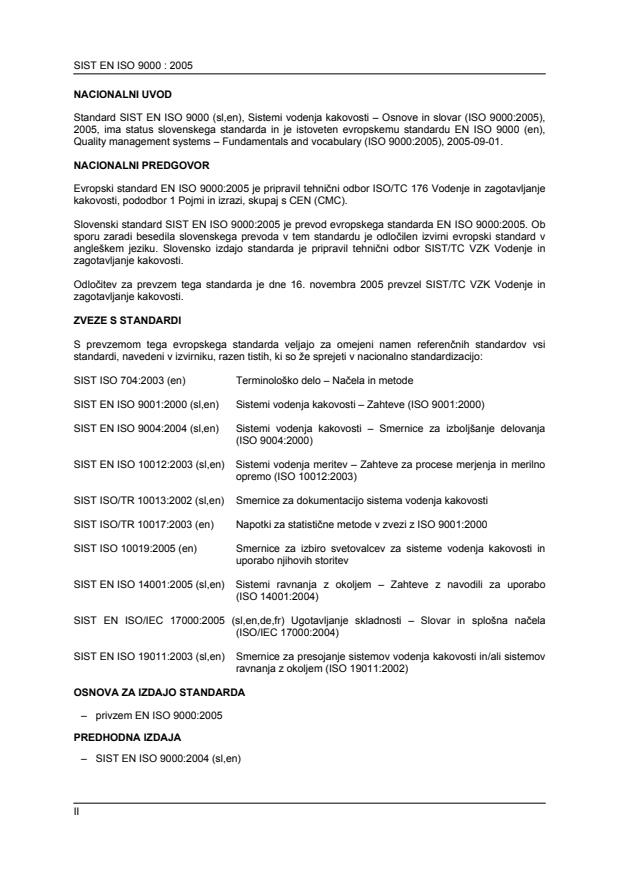
NACIONALNI UVOD
Standard SIST EN ISO 9000 (sl,en), Sistemi vodenja kakovosti – Osnove in slovar (ISO 9000:2005),
2005, ima status slovenskega standarda in je istoveten evropskemu standardu EN ISO 9000 (en),
Quality management systems – Fundamentals and vocabulary (ISO 9000:2005), 2005-09-01.
NACIONALNI PREDGOVOR
Evropski standard EN ISO 9000:2005 je pripravil tehnični odbor ISO/TC 176 Vodenje in zagotavljanje
kakovosti, pododbor 1 Pojmi in izrazi, skupaj s CEN (CMC).
Slovenski standard SIST EN ISO 9000:2005 je prevod evropskega standarda EN ISO 9000:2005. Ob
sporu zaradi besedila slovenskega prevoda v tem standardu je odločilen izvirni evropski standard v
angleškem jeziku. Slovensko izdajo standarda je pripravil tehnični odbor SIST/TC VZK Vodenje in
zagotavljanje kakovosti.
Odločitev za prevzem tega standarda je dne 16. novembra 2005 prevzel SIST/TC VZK Vodenje in
zagotavljanje kakovosti.
ZVEZE S STANDARDI
S prevzemom tega evropskega standarda veljajo za omejeni namen referenčnih standardov vsi
standardi, navedeni v izvirniku, razen tistih, ki so že sprejeti v nacionalno standardizacijo:
SIST ISO 704:2003 (en) Terminološko delo – Načela in metode
SIST EN ISO 9001:2000 (sl,en) Sistemi vodenja kakovosti – Zahteve (ISO 9001:2000)
SIST EN ISO 9004:2004 (sl,en) Sistemi vodenja kakovosti – Smernice za izboljšanje delovanja
(ISO 9004:2000)
SIST EN ISO 10012:2003 (sl,en) Sistemi vodenja meritev – Zahteve za procese merjenja in merilno
opremo (ISO 10012:2003)
SIST ISO/TR 10013:2002 (sl,en) Smernice za dokumentacijo sistema vodenja kakovosti
SIST ISO/TR 10017:2003 (en) Napotki za statistične metode v zvezi z ISO 9001:2000
SIST ISO 10019:2005 (en) Smernice za izbiro svetovalcev za sisteme vodenja kakovosti in
uporabo njihovih storitev
SIST EN ISO 14001:2005 (sl,en) Sistemi ravnanja z okoljem – Zahteve z navodili za uporabo
(ISO 14001:2004)
SIST EN ISO/IEC 17000:2005 (sl,en,de,fr) Ugotavljanje skladnosti – Slovar in splošna načela
(ISO/IEC 17000:2004)
SIST EN ISO 19011:2003 (sl,en) Smernice za presojanje sistemov vodenja kakovosti in/ali sistemov
ravnanja z okoljem (ISO 19011:2002)
OSNOVA ZA IZDAJO STANDARDA
– privzem EN ISO 9000:2005
PREDHODNA IZDAJA
– SIST EN ISO 9000:2004 (sl,en)
II
SIST EN ISO 9000 : 2005
OPOMBE
– Nacionalni uvod in nacionalni predgovor nista sestavni del standarda.
– Povsod, kjer se v besedilu standarda uporablja izraz “evropski standard” ali »mednarodni
standard«, v SIST EN ISO 9000:2005 to pomeni “slovenski standard”.
– Ta nacionalni dokument je istoveten EN ISO 9000:2005 in je objavljen z dovoljenjem
CEN
Rue de Stassart, 36
1050 Bruxelles
Belgija
This national document is identical with EN ISO 9000:2005 and is published with the permission of
CEN
Rue de Stassart, 36
1050 Bruxelles
Belgium
III
SIST EN ISO 9000 : 2005
(Prazna stran)
IV
EVROPSKI STANDARD EN ISO 9000:2005
EUROPEAN STANDARD
EUROPÄISCHE NORM
NORME EUROPÉENNE september 2005
ICS: 03.120.10; 01.040.03 Nadomešča EN ISO 9000:2000
Slovenska izdaja
Sistemi vodenja kakovosti – Osnove in slovar
(ISO 9000:2005)
Quality management systems – Systèmes de management de la Qualitätsmanagementsysteme
Fundamentals and vocabulary qualité – Principes essentiels et – Grundlagen und Begriffe
(ISO 9000:2005) vocabulaire (ISO 9000:2005)
(ISO 9000:2005)
Ta evropski standard je CEN sprejel dne 2005-09-12.
Člani CEN morajo izpolnjevati določila notranjih predpisov CEN/CENELEC, s katerim je predpisano,
da mora biti ta standard brez kakršnihkoli sprememb sprejet kot nacionalni standard. Seznami
najnovejših izdaj teh nacionalnih standardov in njihovi bibliografski podatki so na voljo pri centralnem
sekretariatu ali članih CEN.
Ta evropski standard obstaja v treh uradnih izdajah (angleški, francoski in nemški,). Izdaje v drugih
jezikih, ki jih člani CEN na lastno odgovornost prevedejo in izdajo ter prijavijo pri centralnem
sekretariatu CEN, veljajo kot uradne izdaje.
Člani CEN so nacionalni organi za standarde Avstrije, Belgije, Cipra, Češke republike, Danske,
Estonije, Finske, Francije, Grčije, Irske, Islandije, Italije, Latvije, Litve, Luksemburga, Madžarske,
Malte, Nemčije, Nizozemske, Norveške, Poljske, Portugalske, Slovaške, Slovenije, Španije, Švedske,
Švice in Združenega kraljestva.
CEN
Evropski komite za standardizacijo
European Committee for Standardization
Europäisches Komitee für Normung
Comité Européen de Normalisation
Upravni center: Rue de Stassart 36, B-1050 Bruselj
© 2005 CEN. Lastnice avtorskih pravic so vse države članice CEN Ref. št. EN ISO 9000:2005 E
SIST EN ISO 9000 : 2005
VSEBINA Stran CONTENTS Page
Predgovor.3 Foreword.3
Uvod.4 Introduction.4
1 Predmet standarda. 6 1 Scope .6
2 Temelji sistemov vodenja 2 Fundamentals of quality management
kakovosti . 6 systems .6
2.1 Utemeljitev sistemov vodenja 2.1 Rationale for quality management
kakovosti. 6 systems .6
2.2 Zahteve za sisteme vodenja kakovosti 2.2 Requirements for quality management
in zahteve za proizvode . 7 systems and requirements for products.7
2.3 Pristop na podlagi sistemov vodenja 2.3 Quality management systems
kakovosti . 7 approach .7
2.4 Procesni pristop. 8 2.4 The process approach .8
2.5 Politika kakovosti in cilji kakovosti. 9 2.5 Quality policy and quality objectives .9
2.6 Vloga najvišjega vodstva znotraj 2.6 Role of top management within the
sistema vodenja kakovosti . 9 quality management system .9
2.7 Dokumentacija. 10 2.7 Documentation .10
2.8 Vrednotenje sistemov vodenja 2.8 Evaluating quality management
kakovosti. 11 systems .11
2.9 Nenehno izboljševanje . 13 2.9 Continual improvement .13
2.10 Vloga statističnih metod . 13 2.10 Role of statistical techniques.13
2.11 Osredotočenost sistemov vodenja 2.11 Quality management systems and
kakovosti in drugih sistemov vodenja. 14 other management system focuses.14
2.12 Razmerje med sistemi 2.12 Relationship between quality
vodenja kakovosti in modeli management systems and excellence
odličnosti . 14 models.14
3 Izrazi in definicije . 15 3 Terms and definitions.15
3.1 Izrazi v zvezi s kakovostjo .16 3.1 Terms relating to quality.16
3.2 Izrazi v zvezi z vodenjem . 17 3.2 Terms relating to management .17
3.3 Izrazi v zvezi z organizacijo.19 3.3 Terms relating to organization.19
3.4 Izrazi v zvezi s procesom in 3.4 Terms relating to process
proizvodom. 21 and product .21
3.5 Izrazi v zvezi s karakteristikami . 23 3.5 Terms relating to characteristics .23
3.6 Izrazi v zvezi s skladnostjo . 24 3.6 Terms relating to conformity.24
3.7 Izrazi v zvezi z dokumentacijo. 26 3.7 Terms relating to documentation.26
3.8 Izrazi v zvezi s preiskovanjem. 27 3.8 Terms relating to examination.27
3.9 Izrazi v zvezi s presojo . 28 3.9 Terms relating to audit .28
3.10 Izrazi v zvezi z vodenjem 3.10 Terms relating to quality management
kakovosti za procese merjenja . 31 for measurement processes .31
Dodatek A (informativni): Metodologija, Annex A (informative) Methodology
uporabljena pri razvoju used in the development of the
slovarja .32 vocabulary.33
Bibliografija .50 Bibliography.51
Abecedni seznam slovenskih izrazov. 52
Abecedni seznam angleških izrazov.53
SIST EN ISO 9000 : 2005
Predgovor Foreword
Mednarodna organizacija za standardizacijo ISO (the International Organization for
(ISO) je svetovna zveza nacionalnih organov za Standardization) is a worldwide federation of
standarde (članov ISO). Mednarodne standarde national standards bodies (ISO member bodies).
ponavadi pripravljajo tehnični odbori ISO. Vsak The work of preparing International Standards is
član, ki želi delovati na določenem področju, za normally carried out through ISO technical
katero je bil ustanovljen tehnični odbor, ima committees. Each member body interested in a
pravico biti zastopan v tem odboru. Pri delu subject for which a technical committee has been
sodelujejo tudi vladne in nevladne mednarodne established has the right to be represented on
organizacije, povezane z ISO. V vseh zadevah, that committee. International organizations,
ki so povezane s standardizacijo na področju governmental and non-governmental, in liaison
elektrotehnike, ISO tesno sodeluje z with ISO, also take part in the work. ISO
Mednarodno elektrotehniško komisijo (IEC). collaborates closely with the International
Electrotechnical Commission (IEC) on all matters
of electrotechnical standardization.
Osnutki mednarodnih standardov so pripravljeni International Standards are drafted in
v skladu s pravili, podanimi v 2. delu Direktiv accordance with the rules given in the ISO/IEC
ISO/IEC. Directives, Part 2.
Poglavitna naloga tehničnih odborov je priprava The main task of technical committees is to
mednarodnih standardov. Osnutki mednarodnih prepare International Standards. Draft
standardov, ki jih sprejmejo tehnični odbori, se International Standards adopted by the technical
pošljejo vsem članom v glasovanje. Za objavo committees are circulated to the member bodies
mednarodnega standarda je treba pridobiti for voting. Publication as an International
soglasje najmanj 75 odstotkov članov, ki se Standard requires approval by at least 75 % of the
udeležijo glasovanja. member bodies casting a vote.
Opozoriti je treba na možnost, da so nekateri Attention is drawn to the possibility that some of
elementi tega mednarodnega standarda lahko the elements of this document may be the
predmet patentnih pravic. ISO ne prevzema subject of patent rights. ISO shall not be held
odgovornosti za identifikacijo katerihkoli ali vseh responsible for identifying any or all such patent
takih patentnih pravic. rights.
Mednarodni standard ISO 9000 je pripravil ISO 9000 was prepared by Technical
tehnični odbor ISO/TC 176 Vodenje in Committee ISO/TC 176, Quality management
zagotavljanje kakovosti, pododbor SC1 Pojmi in and quality assurance, Subcommittee SC 1,
izrazi. Concepts and terminology.
Ta, tretja izdaja preklicuje in nadomešča drugo This third edition cancels and replaces the
izdajo (ISO 9000:2000). Vanjo so vključene second edition (ISO 9000:2000). It includes the
spremembe, ki so bile sprejete v osnutku changes accepted in the Draft Amendment
dopolnila ISO/DAM 9000:2004. ISO/DAM 9000:2004.
Dodatek A vsebuje pojmovne diagrame, ki Annex A includes concept diagrams that
grafično ponazarjajo razmerja med izrazi na provide a graphical representation of the
specifičnih področjih v zvezi s sistemi vodenja relationships between terms in specific fields
kakovosti. relative to quality management systems.
SIST EN ISO 9000 : 2005
Uvod Introduction
0.1 Splošno 0.1 General
V nadaljevanju našteta skupina standardov ISO The ISO 9000 family of standards listed below
9000 je bila razvita z namenom, da pomaga has been developed to assist organizations, of
organizacijam vseh vrst in velikosti pri vzpostavitvi all types and sizes, to implement and operate
in izvajanju uspešnih sistemov vodenja kakovosti. effective quality management systems.
– ISO 9000 opisuje osnove sistemov – ISO 9000 describes fundamentals of
vodenja kakovosti in specificira izraze za quality management systems and specifies
sisteme vodenja kakovosti. the terminology for quality management
systems.
– ISO 9001 specificira zahteve za sisteme – ISO 9001 specifies requirements for a
vodenja kakovosti v primerih, ko mora quality management system where an
organizacija izkazati svojo zmožnost organization needs to demonstrate its
dobavljati proizvode, ki izpolnjujejo zahteve ability to provide products that fulfil
odjemalcev in zahteve ustrezne regulative, customer and applicable regulatory
in ko si organizacija prizadeva za večje requirements and aims to enhance
zadovoljstvo odjemalcev. customer satisfaction.
– ISO 9004 podaja smernice, ki se nanašajo – ISO 9004 provides guidelines that consider
tako na uspešnost kot na učinkovitost both the effectiveness and efficiency of the
sistema vodenja kakovosti. Namen tega quality management system. The aim of
standarda je izboljšati delovanje this standard is improvement of the
organizacije ter povečati zadovoljstvo performance of the organization and
odjemalcev in drugih zainteresiranih strani. satisfaction of customers and other
interested parties.
– ISO 19011 podaja napotke za presojanje – ISO 19011 provides guidance on auditing
sistemov vodenja kakovosti in sistemov quality and environmental management
ravnanja z okoljem. systems.
Skupaj tvorijo skladno celoto standardov za Together they form a coherent set of quality
sistem vodenja kakovosti, ki omogoča in management system standards facilitating
podpira medsebojno razumevanje v nacionalni mutual understanding in national and
in mednarodni trgovini. international trade.
0.2 Načela vodenja kakovosti 0.2 Quality management principles
Za uspešno vodenje in delovanje je treba To lead and operate an organization successfully,
organizacijo usmerjati in obvladovati na it is necessary to direct and control it in a
sistematičen in pregleden način. Uspeh je lahko systematic and transparent manner. Success can
rezultat izvajanja in vzdrževanja sistema result from implementing and maintaining a
vodenja, zasnovanega tako, da nenehno management system that is designed to
izboljšuje delovanje ob upoštevanju potreb vseh continually improve performance while addressing
zainteresiranih strani. Vodenje organizacije the needs of all interested parties. Managing an
obsega med drugimi področji vodenja tudi organization encompasses quality management
vodenje kakovosti. amongst other management disciplines.
Identificiranih je osem načel vodenja kakovosti, Eight quality management principles have been
ki jih lahko uporablja najvišje vodstvo zato, da identified that can be used by top management
vodi organizacijo k izboljšanemu delovanju. in order to lead the organization towards
improved performance.
a) Osredotočenost na odjemalce a) Customer focus
Organizacije so odvisne od svojih Organizations depend on their customers
odjemalcev, zato bi morale razumeti njihove and therefore should understand current
SIST EN ISO 9000 : 2005
trenutne in prihodnje potrebe, izpolnjevati and future customer needs, should meet
njihove zahteve in si prizadevati presegati customer requirements and strive to
njihova pričakovanja. exceed customer expectations.
b) Voditeljstvo b) Leadership
Vodje poenotijo namen in usmeritev Leaders establish unity of purpose and
organizacije. Ustvarijo in vzdržujejo naj direction of the organization. They should
tako notranje okolje, v katerem se lahko create and maintain the internal
zaposleni popolnoma vključijo v doseganje environment in which people can become
ciljev organizacije. fully involved in achieving the
organization's objectives.
c) Vključenost zaposlenih c) Involvement of people
Zaposleni na vseh ravneh so jedro People at all levels are the essence of an
organizacije in njihova popolna vključenost organization and their full involvement
omogoča, da se njihove sposobnosti enables their abilities to be used for the
uporabijo v korist organizacije. organization's benefit.
d) Procesni pristop d) Process approach
Želeni rezultat se doseže uspešneje, kadar A desired result is achieved more
se aktivnosti in z njimi povezani viri vodijo efficiently when activities and related
kot proces. resources are managed as a process.
e) Sistemski pristop k vodenju e) System approach to management
Identificiranje, razumevanje in vodenje Identifying, understanding and managing
med seboj povezanih procesov kot sistem interrelated processes as a system
pripomorejo k uspešnosti in učinkovitosti contributes to the organization's
organizacije pri doseganju njenih ciljev. effectiveness and efficiency in achieving its
objectives.
f) Nenehno izboljševanje f) Continual improvement
Nenehno izboljševanje celotnega Continual improvement of the
delovanja organizacije naj bo stalen cilj organization's overall performance should
organizacije. be a permanent objective of the
organization.
g) Odločanje na podlagi dejstev g) Factual approach to decision making
Učinkovite odločitve temeljijo na analizi Effective decisions are based on the
podatkov in informacij. analysis of data and information.
h) Vzajemno koristni odnosi z dobavitelji h) Mutually beneficial supplier relationships
Organizacija in njeni dobavitelji so med An organization and its suppliers are
seboj odvisni in vzajemno koristen odnos interdependent and a mutually beneficial
povečuje zmožnost obeh strani za relationship enhances the ability of both to
ustvarjanje vrednosti. create value.
Teh osem načel vodenja kakovosti tvori These eight quality management principles
podlago za standarde sistemov vodenja form the basis for the quality management
kakovosti znotraj skupine standardov ISO 9000. system standards within the ISO 9000 family.
SIST EN ISO 9000 : 2005
Sistemi vodenja kakovosti – Quality management systems –
Osnove in slovar Fundamentals and vocabulary
1 Predmet standarda 1 Scope
Mednarodni standard ISO 9000 opisuje temelje This International Standard describes
sistemov vodenja kakovosti, ki so predmet fundamentals of quality management systems,
skupine standardov ISO 9000, in opredeljuje which form the subject of the ISO 9000 family,
izraze v zvezi s tem. and defines related terms.
Ta mednarodni standard lahko uporabljajo: This International Standard is applicable to the
following:
a) organizacije, ki si z uvedbo sistema a) organizations seeking advantage through the
vodenja kakovosti prizadevajo za prednost; implementation of a quality management
system;
b) organizacije, ki želijo zaupati svojim b) organizations seeking confidence from
dobaviteljem, da bodo njihove zahteve za their suppliers that their product
proizvod izpolnjene; requirements will be satisfied;
c) uporabniki proizvodov; c) users of the products;
d) tisti, ki se morajo med seboj sporazumeti o d) those concerned with a mutual
izrazih, ki se uporabljajo pri vodenju understanding of the terminology used in
kakovosti (npr. dobavitelji, odjemalci, quality management (e.g. suppliers,
zakonodajalci); customers, regulators);
e) tisti znotraj ali zunaj organizacije, ki e) those internal or external to the
ocenjujejo sistem vodenja kakovosti ali organization who assess the quality
presojajo njegovo skladnost z zahtevami management system or audit it for
ISO 9001 (npr. presojevalci, zakonodajalci, conformity with the requirements of ISO
certifikacijski oziroma registracijski organi); 9001 (e.g. auditors, regulators,
certification/registration bodies);
f) tisti znotraj ali zunaj organizacije, ki f) those internal or external to the organization
svetujejo ali usposabljajo za sistem vodenja who give advice or training on the quality
kakovosti, primeren za organizacijo; management system appropriate to that
organization;
g) razvijalci sorodnih standardov. g) developers of related standards.
2 Temelji sistemov vodenja kakovosti 2 Fundamentals of quality management
systems
2.1 Utemeljitev sistemov vodenja kakovosti 2.1 Rationale for quality management
systems
Sistemi vodenja kakovosti lahko pomagajo Quality management systems can assist or-
organizacijam pri povečevanju zadovoljstva ganizations in enhancing customer satisfaction.
odjemalcev.
Odjemalci zahtevajo proizvode s karakteristikami, Customers require products with characteristics
ki zadovoljujejo njihove potrebe in pričakovanja. that satisfy their needs and expectations. These
Te potrebe in pričakovanja so izraženi v needs and expectations are expressed in product
specifikacijah proizvodov in jih skupno specifications and collectively referred to as
imenujemo zahteve odjemalcev. Zahteve customer requirements. Customer requirements
odjemalcev lahko določi odjemalec v pogodbi, may be specified contractually by the customer or
lahko pa jih določi organizacija sama. V vsakem may be determined by the organization itself. In
primeru je odjemalec tisti, ki dokončno odloči o either case, the customer ultimately determines
sprejemljivosti proizvoda. Zaradi spreminjanja the acceptability of the product. Because
SIST EN ISO 9000 : 2005
potreb in pričakovanj odjemalcev ter zaradi customer needs and expectations are changing,
pritiska konkurence in tehničnega napredka so and because of competitive pressures and
organizacije prisiljene, da svoje proizvode in technical advances, organizations are driven to
procese nenehno izboljšujejo. improve continually their products and processes.
Sistem vodenja kakovosti spodbuja The quality management system approach
organizacije, da analizirajo zahteve odjemalcev, encourages organizations to analyse customer
določijo procese, ki pripomorejo k realizaciji za requirements, define the processes that contribute
odjemalca sprejemljivega proizvoda, in da te to the achievement of a product which is
procese obvladujejo. Sistem vodenja kakovosti acceptable to the customer, and keep these
lahko daje okvir za nenehno izboljševanje, s processes under control. A quality management
čimer se povečuje verjetnost večanja system can provide the framework for continual
zadovoljstva odjemalcev in zadovoljstva drugih improvement to increase the probability of
zainteresiranih strani. Organizaciji in njenim enhancing customer satisfaction and the
odjemalcem vzbuja zaupanje, da je organizacija satisfaction of other interested parties. It provides
sposobna zagotoviti proizvode, ki dosledno confidence to the organization and its customers
izpolnjujejo zahteve. that it is able to provide products that consistently
fulfil requirements.
2.2 Zahteve za sisteme vodenja kakovosti 2.2 Requirements for quality management
in zahteve za proizvode systems and requirements for products
Skupina ISO 9000 razlikuje med zahtevami za The ISO 9000 family distinguishes between
sisteme vodenja kakovosti in zahtevami za requirements for quality management systems
proizvode. and requirements for products.
Zahteve za sisteme vodenja kakovosti so Requirements for quality management systems
specificirane v ISO 9001. Zahteve za sisteme are specified in ISO 9001. Requirements for
vodenja kakovosti so splošne in uporabne za quality management systems are generic and
organizacije v katerikoli industrijski ali applicable to organizations in any industry or
gospodarski panogi ne glede na kategorijo economic sector regardless of the offered
ponujenega proizvoda. ISO 9001 ne postavlja product category. ISO 9001 itself does not
zahtev za proizvode. establish requirements for products.
Zahteve za proizvode lahko določijo odjemalci Requirements for products can be specified by
ali organizacija sama ob predvidevanju zahtev customers or by the organization in anticipation
odjemalcev ali pa regulativa. Zahteve za of customer requirements, or by regulation. The
proizvode in v nekaterih primerih za pripadajoče requirements for products and in some cases
procese so lahko vsebovane na primer v associated processes can be contained in, for
tehničnih specifikacijah, standardih za example, technical specifications, product
proizvode, standardih za procese, pogodbenih standards, process standards, contractual
dogovorih in v zahtevah regulative. agreements and regulatory requirements.
2.3 Pristop na podlagi sistemov vodenja 2.3 Quality management systems approach
kakovosti
Pristop k razvoju in izvajanju sistema vodenja An approach to developing and implementing a
kakovosti sestavlja več korakov, vključno z quality management system consists of several
naslednjimi: steps including the following:
a) ugotavljanje potreb in pričakovanj a) determining the needs and expectations of
odjemalcev in drugih zainteresiranih strani; customers and other interested parties;
b) vzpostavljanje politike kakovosti in ciljev b) establishing the quality policy and quality
kakovosti organizacije; objectives of the organization;
c) določanje procesov in odgovornosti, c) determining the processes and
potrebnih za doseganje ciljev kakovosti; responsibilities necessary to attain the
quality objectives;
SIST EN ISO 9000 : 2005
d) določanje in zagotavljanje virov, potrebnih d) determining and providing the resources
za doseganje ciljev kakovosti; necessary to attain the quality objectives;
e) vzpostavljanje metod za merjenje uspešnosti e) establishing methods to measure the
in učinkovitosti vsakega procesa; effectiveness and efficiency of each
process;
f) uporaba teh merjenj za ugotavljanje f) applying these measures to determine the
uspešnosti in učinkovitosti vsakega procesa; effectiveness and efficiency of each
process;
g) določanje načinov preprečevanja g) determining means of preventing
neskladnosti in odpravljanja njihovih nonconformities and eliminating their
vzrokov; causes;
h) vzpostavljanje in uporaba procesa za h) establishing and applying a process for
nenehno izboljševanje sistema vodenja continual improvement of the quality
kakovosti. management system.
Takšen pristop je mogoče uporabiti tudi pri Such an approach is also applicable to
vzdrževanju in izboljševanju obstoječega maintaining and improving an existing quality
sistema vodenja kakovosti. management system.
Organizacija, ki sprejme gornji pristop, ustvari An organization that adopts the above
zaupanje v sposobnost svojih procesov in approach creates confidence in the capability of
kakovost svojih proizvodov ter zagotovi temelje its processes and the quality of its products,
za nenehno izboljševanje. To lahko vodi k and provides a basis for continual improvement.
povečanemu zadovoljstvu odjemalcev in drugih This can lead to increased satisfaction of
zainteresiranih strani ter k uspehu organizacije. customers and other interested parties and to
the success of the organization.
2.4 Procesni pristop 2.4 The process approach
Vsaka aktivnost ali skupek aktivnosti, ki Any activity, or set of activities, that uses
uporablja vire za pretvorbo vhodov v izhode, se resources to transform inputs to outputs can be
lahko obravnava kot proces. considered as a process.
Da bo organizacija lahko učinkovito delovala, For organizations to function effectively, they
mora prepoznavati in obvladovati številne have to identify and manage numerous
medsebojno povezane in vplivajoče procese. interrelated and interacting processes. Often,
Pogosto je izhod iz enega procesa neposredno the output from one process will directly form
vhod v naslednji proces. Sistematično the input into the next process. The systematic
prepoznavanje in obvladovanje procesov, identification and management of the processes
uporabljenih v organizaciji, in zlasti medsebojno employed within an organization and
vplivanje med takimi procesi imenujemo particularly the interactions between such
“procesni pristop”. processes is referred to as the "process
approach".
Namen tega mednarodnega standarda je The intent of this International Standard is to
spodbujati privzem procesnega pristopa za encourage the adoption of the process
vodenje organizacije. approach to manage an organization.
Slika 1 ponazarja na procesih temelječ sistem Figure 1 illustrates the process-based quality
vodenja kakovosti, opisan v skupini standardov management system described in the ISO 9000
ISO 9000. Ta ponazoritev kaže, da igrajo family of standards. This illustration shows that
zainteresirane strani pomembno vlogo pri interested parties play a significant role in
opredelitvi vhodov za organizacijo. Spremljanje providing inputs to the organization. Monitoring
zadovoljstva zainteresiranih strani terja the satisfaction of interested parties requires
vrednotenje informacij o tem, kako the evaluation of information relating to the
zainteresirane strani dojemajo, v kolikšnem perception of interested parties as to the extent
obsegu so bile izpolnjene njihove potrebe in to which their needs and expectations have
SIST EN ISO 9000 : 2005
pričakovanja. Model na sliki 1 procesov ne kaže been met. The model shown in Figure 1 does
v podrobnosti. not show processes at a detailed level.
2.5 Politika kakovosti in cilji kakovosti 2.5 Quality policy and quality objectives
Politika kakovosti in cilji kakovosti se postavijo Quality policy and quality objectives are
zato, da organizacija ve, kam naj se usmeri. established to provide a focus to direct the
Oboje določa želene rezultate in pomaga organization. Both determine the desired results
organizaciji uporabiti njene vire za doseganje and assist the organization to apply its
teh rezultatov. Politika kakovosti daje okvir za resources to achieve these results. The quality
določanje in pregledovanje ciljev kakovosti. Cilji policy provides a framework for establishing
kakovosti morajo biti skladni s politiko kakovosti and reviewing quality objectives. The quality
in zavezanostjo nenehnemu izboljševanju, objectives need to be consistent with the quality
njihovo doseganje pa mora biti merljivo. policy and the commitment to continual
Doseganje ciljev kakovosti lahko pozitivno improvement, and their achievement needs to
vpliva na kakovost proizvodov, uspešnost be measurable. The achievement of quality
delovanja in finančno delovanje ter s tem na objectives can have a positive impact on
zadovoljstvo in zaupanje zainteresiranih strani. product quality, operational effectiveness and
financial performance and thus on the
satisfaction and confidence of interested
parties.
Nenehno izboljševanje Continual improvement of
sistema vodenja kakovosti the quality management system
Odgovornost
Management
vodstva
responsibility
Odjemalci Customers
(in druge (and other
zainteresirane interested
Odjemalci
strani) parties
Customers
(in druge
(and other
zainteresirane
Merjenje, Measurement,
Vodenje Resource
interested
strani) analiza in analysis and Satisfaction
Zadovoljstvo
virov management
izboljševanje improvement
parties
Vhod Izhod
Input Output
Product
Zahteve Realizacija
Proizvod Requirements Product
realization
proizvoda
Legenda Key
Aktivnosti, ki dodajajo vrednost Value-adding activities
Pretok informacij Information flow
OPOMBA: Besedilo v oklepaju se ne nanaša na ISO NOTE Statements in parentheses do not apply to
9001. ISO 9001.
Slika 1: Model na procesih temelječega Figure 1 - Model of a process-based quality
sistema vodenja kakovosti management system
2.6 Vloga najvišjega vodstva znotraj 2.6 Role of top management within the
sistema vodenja kakovosti quality management system
Z voditeljstvom in ukrepi lahko najvišje vodstvo Through leadership and actions, top
ustvari okolje, v katerem so zaposleni management can create an environment where
popolnoma vključeni in v katerem lahko sistem people are fully involved and in which a quality
vodenja kakovosti učinkovito deluje. Načela management system can operate effectively.
vodenja kakovosti (glej 0.2) lahko najvišje The quality management principles (see 0.2)
vodstvo uporabi kot podlago za svojo vlogo, ki can be used by top management as the basis
je naslednja: of its role, which is as follows:
a) vzpostaviti in vzdrževati politiko kakovosti a) to establish and maintain the quality policy
in cilje kakovosti organizacije; and quality objectives of the organization;
SIST EN ISO 9000 : 2005
b) propagirati politiko kakovosti in cilje b) to promote the quality policy and quality
kakovosti v celotni organizaciji, da bi se objectives throughout the organization to
povečale zavest, motivacija in vključenost; increase awareness, motivation and
involvement;
c) v celotni organizaciji zagotoviti osredo- c) to ensure focus on customer requirements
točenost na zahteve odjemalcev; throughout the organization;
d) zagotoviti, da se izvajajo ustrezni procesi, d) to ensure that appropriate processes are
ki omogočajo izpolnjevanje zahtev implemented to enable requirements of
odjemalcev in drugih zainteresiranih strani customers and other interested parties to
ter doseganje ciljev kakovosti; be fulfilled and quality objectives to be
achieved;
e) zagotoviti, da je vzpostavljen uspešen in e) to ensure that an effective and efficient
učinkovit sistem vodenja kakovosti, ki se quality management system is established,
izvaja in vzdržuje za doseganje teh ciljev implemented and maintained to achieve
kakovosti; these quality objectives;
f) zagotoviti, da so na voljo potrebni viri; f) to ensure the availability of necessary
resources;
g) periodično pregledovati sistem vodenja g) to review the quality management system
kakovosti; periodically;
h) odločati o ukrepih glede politike kakovosti h) to decide on actions regarding the quality
in ciljev kakovosti; policy and quality objectives;
i) odločati o ukrepih za izboljševanje sistema i) to decide on actions for improvement of
vodenja kakovosti. the quality management system.
2.7 Dokumentacija 2.7 Documentation
2.7.1 Pomen dokumentacije 2.7.1 Value of documentation
Dokumentacija omogoča sporočanje namena in Documentation enables communication of
konsistentnost ukrepa. Njena uporaba pripomore intent and consistency of action. Its use
k: contributes to
a) doseganju skladnosti z zahtevami a) achievement of conformity to customer
odjemalcev in izboljševanju kakovosti; requirements and quality improvement,
b) zagotavljanju ustreznega usposabljanja; b) provision of appropriate training,
c) ponovljivosti in sledljivosti; c) repeatability and traceability,
d) preskrbi objektivnih dokazov; d) provision of objective evidence, and
e) vrednotenju uspešnosti in trajne e) evaluation of the effectiveness and
ustreznosti sistema vodenja kakovosti. continuing suitability of the quality
management system.
Izdelava dokumentacije naj ne bo sama sebi Generation of documentation should not be an
namen, temveč naj bo aktivnost, ki dodaja end in itself but should be a value-adding
vrednost. activity.
2.7.2 Vrste dokumentov, ki se uporabljajo v 2.7.2 Types of document used in quality
sistemih vodenja kakovosti management systems
V sistemih vodenja kakovosti se uporabljajo The following types of document are used in
naslednje vrste dokumentov: quality management systems:
a) dokumenti, ki tako navznoter kot tudi a) documents that provide consistent
navzven podajajo konsistentne informacije information, both internally and externally,
o sistemu vodenja kakovosti organizacije; about the organization's quality management
SIST EN ISO 9000 : 2005
taki dokumenti se imenujejo poslovniki system; such documents are referred to as
kakovosti; quality manuals;
b) dokumenti, ki opisujejo, kako se sistem b) documents that describe how the quality
vodenja kakovosti uporablja pri management system is applied to a
specifičnem proizvodu, projektu ali specific product, project or contract; such
pogodbi; taki dokumenti se imenujejo plani documents are referred to as quality plans;
kakovosti;
c) dokumenti, ki navajajo zahteve; taki c) documents stating requirements; such
dokumenti se imenujejo specifikacije; documents are referred to as
specifications;
d) dokumenti, ki navajajo priporočila ali d) documents stating recommendations or
predloge; taki dokumenti se imenujejo suggestions; such documents are referred
smernice; to as guidelines;
e) dokumenti, ki podajajo informacije o tem, e) documents that provide information about
kako konsistentno izvajati aktivnosti in how to perform activities and processes
procese; taki dokumenti lahko vključujejo consistently; such documents can include
dokumentirane postopke, delovna navodila documented procedures, work instructions
in risbe; and drawings;
f) dokumenti, ki podajajo objektivne dokaze o f) documents that provide objective evidence
izvedenih aktivnostih ali o doseženih of activities performed or results achieved;
rezultatih; taki dokumenti se imenujejo such documents are referred to as
zapisi. records.
Vsaka organizacija določi obseg potrebne Each organization determines the extent of
dokumentacije in medij, ki ga bo uporabljala. To documentation required and the media to be
je odvisno od dejavnikov, kot so vrsta in velikost used. This depends on factors such as the type
organizacije, kompleksnost in medsebojno and size of the organization, the complexity and
vplivanje procesov, kompleksnost proizvodov, interaction of processes, the complexity of
zahteve odjemalcev, zahteve ustrezne products, customer requirements, the
regulative, izkazane zmožnosti osebja in applicable regulatory requirements, the
obsega, v katerem je treba izkazovati demonstrated ability of personnel, and the
izpolnjevanje zahtev sistema vodenja kakovosti. extent to which it is necessary to demonstrate
fulfilment of quality management system
requirements.
2.8 Vrednotenje sistemov vodenja kakovosti 2.8 Evaluating quality management systems
2.8.1 Vrednotenje procesov znotraj sistema 2.8.1 Evaluating processes within the
vodenja kakovosti quality management system
Pri vrednotenju sistemov vodenja kakovosti si je When evaluating quality management systems,
o vsakem procesu, ki se vrednoti, treba there are four basic questions that should be
zastaviti štiri osnovna vprašanja. asked in relation to every process being
evaluated.
a) Ali je proces prepoznan in primerno a) Is the process identified and appropriately
opredeljen? defined?
b) Ali so odgovornosti določene? b) Are responsibilities assigned?
c) Ali se postopki izvajajo in vzdržujejo? c) Are the procedures implemented and
maintained?
d) Ali je proces učinkovit pri doseganju d) Is the process effective in achieving the
zahtevanih rezultatov? required results?
Odgovori na gornja vprašanja skupaj lahko The collective answers to the above questions
določijo rezultat vrednotenja. Obseg vrednotenja can determine the result of the evaluation.
SIST EN ISO 9000 : 2005
sistema vodenja kakovosti se lahko spreminja in Evaluation of a quality management system can
lahko obsega vrsto aktivnosti, kot so presojanje vary in scope and encompass a range of
in pregledovanje sistema vodenja kakovosti ter activities, such as auditing and reviewing the
samoocenjevanje. quality management system, and self-
assessments.
2.8.2 Presojanje sistema vodenja kakovosti 2.8.2 Auditing the quality management
system
Presoje se uporabljajo za ugotavljanje, v Audits are used to determine the extent to
kolikšnem obsegu so izpolnjene zahteve which the quality management system
sistema vodenja kakovosti. Ugotovitve presoj requirements are fulfilled. Audit findings are
se uporabljajo za ocenjevanje uspešnosti used to assess the effectiveness of the quality
sistema vodenja kakovosti in za prepoznavanje management system and to identify
priložnosti za izboljšanje. opportunities for improvement.
Presoje kot prva stranka izvaja organizacija First-party audits are conducted by, or on behalf
sama ali nekdo v njenem imenu v interne of, the organization itself for internal purposes
namene in so lahko podlaga za lastno izjavo and can form the basis for an organization's
organizacije o skladnosti. self-declaration of conformity.
Kot druga stranka izvajajo presoje odjemalci Second-party audits are conducted by
organizacije ali druge osebe v imenu customers of the organization or by other
odjemalca. persons on behalf of the customer.
Kot tretja stranka izvajajo presoje zunanje Third-party audits are conducted by external
neodvisne organizacije. Take organizacije, ki so independent organizations. Such organizations,
ponavadi akreditirane, izstavijo certifikat ali usually accredited, provide certification or
registracijo o skladnosti z zahtevami, kot so na registration of conformity with requirements
primer zahteve ISO 9001. such as those of ISO 9001.
ISO 19011 podaja napotke za izvajanje presoj. ISO 19011 provides guidance on auditing.
2.8.3 Pregledovanje sistema vodenja 2.8.3 Reviewing the quality management
kakovosti system
Ena izmed vlog najvišjega vodstva je v tem, da One role of top management is to carry out
redno sistematično vrednoti primernost, regular systematic evaluations of the suitability,
ustreznost, uspešnost in učinkovitost sistema adequacy, effectiveness and efficiency of the
vodenja kakovosti glede na politiko in cilje quality management system with respect to the
kakovosti. Ta pregled lahko vključuje premislek quality policy and quality objectives. This review
o potrebi po prilagoditvi politike in ciljev can include consideration of the need to adapt
kakovosti kot odgovor na spreminjajoče se the quality policy and objectives in response to
potrebe in pričakovanja zainteresiranih strani. changing needs and expectations of interested
Pregled vključuje tudi določitev potrebnih parties. The review includes determination of
ukrepov. the need for actions.
Med drugimi viri informacij se za pregled Amongst other sources of information, audit
sistema vodenja kakovosti uporabljajo tudi reports are used for review of the quality
poročila o presojah. management system.
...