

EN 1673:2000+A1:2009
(Main + Amendment)Food processing machinery - Rotary rack ovens - Safety and hygiene requirements
- Abstract
This standard specifies safety and hygiene requirements for the design and manufacture of rotary rack ovens with one or more rotary racks.
These ovens are used in the food industry and shops (bakeries, pastry-making, etc.) for the batch baking of foodstuffs containing flour, water and other additives. This standard applies to ovens used only for food products except for those containing volatile flammable ingredients.
The control of the humidity of the air in the baking chamber is by the production and introduction of steam around normal atmospheric pressure.
The following machines are excluded:
- experimental and testing machines under development by the manufacturer;
- domestic appliances.
This standard covers the technical safety requirements for the installation, cleaning and maintenance of these machines as defined in 3.12 of EN 292-1:1991 and in the manufacturer's instruction handbook.
The significant hazards covered by this standard are mechanical (shearing, trapping, impact, loss of stability), electrical, thermal, ergonomic and those resulting from lack of hygiene. They are specifically listed in 4. Noise is not considered to be a significant hazard from rotary rack ovens. This does not mean that the manufacturer of the machine is absolved from reducing noise and making a noise declaration. Therefore a noise test code is proposed in Annex B.
The hazards from the use of gaseous fuel by gas appliances are not covered by this standard.
This standard applies only to machines manufactured after the date of issue of the standard.
- Status
- Withdrawn
- Publication Date
- 01-Dec-2009
- Withdrawal Date
- 06-Oct-2026
- Technical Committee
- CEN/TC 153 - Food processing machinery - Safety and hygiene specifications
- Drafting Committee
- CEN/TC 153/WG 1 - Bakery equipment
- Current Stage
- 9960 - Withdrawal effective - Withdrawal
- Start Date
- 02-Dec-2020
- Completion Date
- 07-Oct-2026
- Directive
- 2006/42/EC - Directive 2006/42/EC of the European Parliament and of the Council of 17 May 2006 on machinery, and amending Directive 95/16/EC (recast)OJ Ref: C, C 136 OJ Date: 26-May-2010

Relations
- Merged From
EN 1673:2000 - Food processing machinery - Rotary rack ovens - Safety and hygiene requirements - Effective Date
- 03-Oct-2009
- Replaced By
EN 1673:2020 - Food processing machinery - Rotary rack ovens - Safety and hygiene requirements - Effective Date
- 09-Dec-2020
- Effective Date
- 25-Aug-2026
- Effective Date
- 09-Feb-2026
- Effective Date
- 28-Jan-2026
- Effective Date
- 28-Jan-2026
- Effective Date
- 28-Jan-2026
- Effective Date
- 28-Jan-2026
- Effective Date
- 28-Jan-2026
- Effective Date
- 28-Jan-2026
- Effective Date
- 28-Jan-2026
- Effective Date
- 28-Jan-2026
- Effective Date
- 28-Jan-2026
- Effective Date
- 28-Jan-2026
- Effective Date
- 28-Jan-2026
Get Certified
Connect with accredited certification bodies for this standard

BSI Group
BSI (British Standards Institution) is the business standards company that helps organizations make excellence a habit.

Bureau Veritas
Bureau Veritas is a world leader in laboratory testing, inspection and certification services.

DNV
DNV is an independent assurance and risk management provider.
Sponsored listings
Frequently Asked Questions
EN 1673:2000+A1:2009 is a standard published by the European Committee for Standardization (CEN). Its full title is "Food processing machinery - Rotary rack ovens - Safety and hygiene requirements". This standard covers: This standard specifies safety and hygiene requirements for the design and manufacture of rotary rack ovens with one or more rotary racks. These ovens are used in the food industry and shops (bakeries, pastry-making, etc.) for the batch baking of foodstuffs containing flour, water and other additives. This standard applies to ovens used only for food products except for those containing volatile flammable ingredients. The control of the humidity of the air in the baking chamber is by the production and introduction of steam around normal atmospheric pressure. The following machines are excluded: - experimental and testing machines under development by the manufacturer; - domestic appliances. This standard covers the technical safety requirements for the installation, cleaning and maintenance of these machines as defined in 3.12 of EN 292-1:1991 and in the manufacturer's instruction handbook. The significant hazards covered by this standard are mechanical (shearing, trapping, impact, loss of stability), electrical, thermal, ergonomic and those resulting from lack of hygiene. They are specifically listed in 4. Noise is not considered to be a significant hazard from rotary rack ovens. This does not mean that the manufacturer of the machine is absolved from reducing noise and making a noise declaration. Therefore a noise test code is proposed in Annex B. The hazards from the use of gaseous fuel by gas appliances are not covered by this standard. This standard applies only to machines manufactured after the date of issue of the standard.
This standard specifies safety and hygiene requirements for the design and manufacture of rotary rack ovens with one or more rotary racks. These ovens are used in the food industry and shops (bakeries, pastry-making, etc.) for the batch baking of foodstuffs containing flour, water and other additives. This standard applies to ovens used only for food products except for those containing volatile flammable ingredients. The control of the humidity of the air in the baking chamber is by the production and introduction of steam around normal atmospheric pressure. The following machines are excluded: - experimental and testing machines under development by the manufacturer; - domestic appliances. This standard covers the technical safety requirements for the installation, cleaning and maintenance of these machines as defined in 3.12 of EN 292-1:1991 and in the manufacturer's instruction handbook. The significant hazards covered by this standard are mechanical (shearing, trapping, impact, loss of stability), electrical, thermal, ergonomic and those resulting from lack of hygiene. They are specifically listed in 4. Noise is not considered to be a significant hazard from rotary rack ovens. This does not mean that the manufacturer of the machine is absolved from reducing noise and making a noise declaration. Therefore a noise test code is proposed in Annex B. The hazards from the use of gaseous fuel by gas appliances are not covered by this standard. This standard applies only to machines manufactured after the date of issue of the standard.
EN 1673:2000+A1:2009 is classified under the following ICS (International Classification for Standards) categories: 67.260 - Plants and equipment for the food industry; 97.040.20 - Cooking ranges, working tables, ovens and similar appliances. The ICS classification helps identify the subject area and facilitates finding related standards.
EN 1673:2000+A1:2009 has the following relationships with other standards: It is inter standard links to EN 1673:2000, EN 1673:2020, ISO 8598:1996, EN 60529:1991, EN ISO 4871:1996, EN ISO 13732-1:2008, EN 2286:1989, EN ISO 4287:1998, EN ISO 13849-1:2008, EN 1088:1995, EN ISO 12100-2:2003, EN 614-1:2006, EN 954-1:1996, EN ISO 3744:1995, EN ISO 12100-1:2003. Understanding these relationships helps ensure you are using the most current and applicable version of the standard.
EN 1673:2000+A1:2009 is associated with the following European legislation: EU Directives/Regulations: 2006/42/EC, 98/37/EC; Standardization Mandates: M/079, M/396. When a standard is cited in the Official Journal of the European Union, products manufactured in conformity with it benefit from a presumption of conformity with the essential requirements of the corresponding EU directive or regulation.
EN 1673:2000+A1:2009 is available in PDF format for immediate download after purchase. The document can be added to your cart and obtained through the secure checkout process. Digital delivery ensures instant access to the complete standard document.
Standards Content (Sample)
2003-01.Slovenski inštitut za standardizacijo. Razmnoževanje celote ali delov tega standarda ni dovoljeno.]DKWHYHNahrungsmittelmaschinen - Stikken-Backöfen - Sicherheits- und HygieneanforderungenMachines pour les produits alimentaires - Fours à chariot rotatif - Prescriptions relatives à la sécurité et l'hygièneFood processing machinery - Rotary rack ovens - Safety and hygiene requirements97.040.20Cooking ranges, working tables, ovens and similar appliances67.260Tovarne in oprema za živilsko industrijoPlants and equipment for the food industryICS:Ta slovenski standard je istoveten z:EN 1673:2000+A1:2009SIST EN 1673:2002+A1:2010en,fr01-marec-2010SIST EN 1673:2002+A1:2010SLOVENSKI
STANDARD
EUROPEAN STANDARD NORME EUROPÉENNE EUROPÄISCHE NORM
EN 1673:2000+A1
December 2009 ICS 67.260; 97.040.20 Supersedes EN 1673:2000English Version
Food processing machinery - Rotary rack ovens - Safety and hygiene requirements
Machines pour les produits alimentaires - Fours à chariot rotatif - Prescriptions relatives à la sécurité et l'hygiène
Nahrungsmittelmaschinen - Stikken-Backöfen - Sicherheits- und Hygieneanforderungen This European Standard was approved by CEN on 11 June 2000 and includes Amendment 1 approved by CEN on 24 October 2009.
CEN members are bound to comply with the CEN/CENELEC Internal Regulations which stipulate the conditions for giving this European Standard the status of a national standard without any alteration. Up-to-date lists and bibliographical references concerning such national standards may be obtained on application to the CEN Management Centre or to any CEN member.
This European Standard exists in three official versions (English, French, German). A version in any other language made by translation under the responsibility of a CEN member into its own language and notified to the CEN Management Centre has the same status as the official versions.
CEN members are the national standards bodies of Austria, Belgium, Bulgaria, Cyprus, Czech Republic, Denmark, Estonia, Finland, France, Germany, Greece, Hungary, Iceland, Ireland, Italy, Latvia, Lithuania, Luxembourg, Malta, Netherlands, Norway, Poland, Portugal, Romania, Slovakia, Slovenia, Spain, Sweden, Switzerland and United Kingdom.
EUROPEAN COMMITTEE FOR STANDARDIZATION
COMITÉ EUROPÉEN DE NORMALISATION EUROPÄISCHES KOMITEE FÜR NORMUNG
Management Centre:
Avenue Marnix 17,
B-1000 Brussels © 2009 CEN All rights of exploitation in any form and by any means reserved worldwide for CEN national Members. Ref. No. EN 1673:2000+A1:2009: ESIST EN 1673:2002+A1:2010
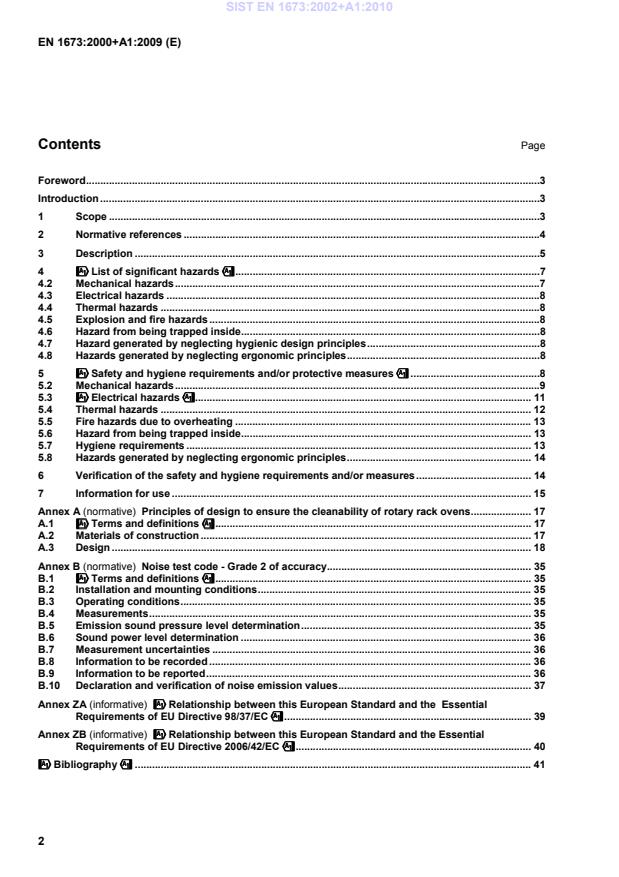
Principles of design to ensure the cleanability of rotary rack ovens . 17A.1!!!!Terms and definitions"""" . 17A.2Materials of construction . 17A.3Design . 18Annex B (normative)
Noise test code - Grade 2 of accuracy. 35B.1!!!!Terms and definitions"""" . 35B.2Installation and mounting conditions . 35B.3Operating conditions . 35B.4Measurements . 35B.5Emission sound pressure level determination . 35B.6Sound power level determination . 36B.7Measurement uncertainties . 36B.8Information to be recorded . 36B.9Information to be reported . 36B.10Declaration and verification of noise emission values . 37Annex ZA (informative)
!!!!Relationship between this European Standard and the
Essential Requirements of EU Directive 98/37/EC"""" . 39Annex ZB (informative)
!!!!Relationship between this European Standard and the Essential Requirements of EU Directive 2006/42/EC"""" . 40!!!!Bibliography"""" . 41 SIST EN 1673:2002+A1:2010
!". This European Standard has been prepared under a mandate given to CEN by the European Commission and the European Free Trade Association, and supports essential requirements of EU Directive(s). !For relationship with EU Directive(s), see informative Annexes ZA and ZB, which are integral parts of this document." According to the CEN/CENELEC Internal Regulations, the national standards organizations of the following countries are bound to implement this European Standard: Austria, Belgium, Bulgaria, Cyprus, Czech Republic, Denmark, Estonia, Finland, France, Germany, Greece, Hungary, Iceland, Ireland, Italy, Latvia, Lithuania, Luxembourg, Malta, Netherlands, Norway, Poland, Portugal, Romania, Slovakia, Slovenia, Spain, Sweden, Switzerland and the United Kingdom. Introduction !This European Standard is a type C standard as stated in EN ISO 12100. The machinery concerned and the extend to which hazards, hazardous situations and events are covered are indicated in the scope of this European Standard. When provisions of this type C standard are different from those which are stated in type A or B standards, the provisions of this type C standard take precedence over the provisions of the other standards, for machines that have been designed and built according to the provisions of this type C standard." 1 Scope This standard specifies safety and hygiene requirements for the design and manufacture of rotary rack ovens with one or more rotary racks. SIST EN 1673:2002+A1:2010
experimental and testing machines under development by the manufacturer; domestic appliances. !This standard covers the technical safety requirements for the transport, installation, operation, cleaning and maintenance of these machines (see 5.2 and 5.3 of EN 12100-1:2003)." This document deals with all significant hazards, hazardous situations and events relevant to rotary rack ovens, when they are used as intended and under conditions of misuse which are reasonably foreseeable by the manufacturer (see Clause 4). Noise is not considered to be a significant hazard. This does not mean that the manufacturer is absolved from reducing noise and making a noise declaration. Therefore a noise test code is given in Annex B." The hazards from the use of gaseous fuel by gas appliances are not covered by this standard. !This standard is not applicable to rotary rack ovens which are manufactured before the date of its publication as EN." 2 !!!!Normative references The following referenced documents are indispensable for the application of this document. For dated references, only the edition cited applies. For undated references, the latest edition of the referenced document (including any amendments) applies. EN 294:1992, Safety of machinery — Safety distances to prevent danger zones being reached by the upper limbs EN 614-1:2006, Safety of machinery — Ergonomic design principles — Part 1: Terminology and general principles EN 953:1997, Safety of machinery - Guards - General requirements for the design and construction of fixed and movable guards EN 954-1:1996, Safety of machinery — Safety related parts of control systems — Part 1: General principles for design EN 1088:1995, Safety of machinery — Interlocking devices associated with guards — Principles for design and selection EN 1672-2:2005, Food processing machinery — Basic concepts — Part 2: Hygiene requirements EN 60204-1:2006, Safety of machinery — Electrical equipment of machines — Part 1: General requirements (IEC 60204:2005, modified) EN 60529:1991, Degrees of protection provided by enclosures (IP code) (IEC 60529:1989) SIST EN 1673:2002+A1:2010
(ISO 3744:1994) EN ISO 4287:1998, Geometrical Product Specifications (GPS) — Surface texture: Profile method — Terms, definitions and surface texture parameters (ISO 4287:1997) EN ISO 4871:1996, Acoustics — Declaration and verification of noise emission values of machinery and equipment (ISO 4871:1996) EN ISO 11201:1995, Acoustics — Noise emitted by machinery and equipment — Measurement of emission sound pressure levels at a work station and at other specified positions — Engineering method in an essentially free field over a reflecting plane (ISO 11201:1995) EN ISO 11688-1:1998, Acoustics — Recommended practice for the design of low-noise machinery and equipment — Part 1: Planning (ISO/TR 11688-1:1995) EN ISO 12001:1996, Acoustics — Noise emitted by machinery and equipment — Rules for the drafting and presentation of a noise test code (ISO 12001:1996) EN ISO 12100-1:2003, Safety of machinery — Basic concepts, general principles for design — Part 1: Basic terminology, methodology (ISO 12100-1:2003) EN ISO 12100-2:2003, Safety of machinery — Basic concepts, general principles for design — Part 2: Technical principles (ISO 12100-2:2003) EN ISO 13732-1:2008, Ergonomics of the thermal environment — Methods for the assessment of human responses to contact with surfaces — Part 1: Hot surfaces (ISO 13732-1:2006) EN ISO 13849-1:2008, Safety of machinery — Safety related parts of control systems — Part 1: General principles for design (ISO 13849-1:2006)" 3 Description A rotary rack oven usually consists of the following parts (see figure.1): a) container built with insulated panels; b) baking chamber with access door; c) heat production unit; d) hot air circulation system; e) rack and trays; f) drive unit for rack rotation; g) steam generator; h) steam extractor; i) control panel; SIST EN 1673:2002+A1:2010
Figure 1 — Parts of a rotary rack oven SIST EN 1673:2002+A1:2010
4 !!!!List of significant hazards 4.1 General This clause contains all the significant hazards, hazardous situations and events, as far as they are dealt with in this Standard, identified by risk assessment as significant for this type of machinery, and which require action to eliminate or reduce the risk." 4.2 Mechanical hazards The significant mechanical hazards are: shearing hazard; trapping hazard; impact hazard; loss of stability. The example in figure 2 shows the danger zones: Zone 1: rotation of the rack inside the oven
hazards of shearing, trapping, impact; Zone 2: drive mechanism
hazards of shearing, trapping; Zone 3: space between the rack and the door frame
hazards of shearing, trapping, impact; All zones: sharp corners and edges on touchable parts hazards of cutting.
Figure 2 — Danger zones of a rotary rack oven SIST EN 1673:2002+A1:2010
In addition, the machine shall be designed according to the principles of EN ISO 12100-2 for relevant but not significant hazards, which are not dealt with by this document. For hazards which are to be reduced by the application of the type B-standards such as EN 294, EN 614-1, EN 953, EN 954-1, EN 1088, EN 60204-1, EN 60529, EN ISO 12100 and EN ISO 13849-1, the manufacturer shall carry out a risk assessment to establish the requirements of the type B-standard. This specific risk assessment shall be part of the general risk assessment of the machine. Interlocking guards shall be at least interlocking without guard locking as defined in EN 1088:1995, 4.2.1 and they shall comply with EN 1088:1995, Clauses 5 and 6. SIST EN 1673:2002+A1:2010
Figure 3 a) — Rotating platform with ramp Figure 3 b) — Rotating system lift hook The rack is manually pushed onto the rotating platform. The rack is manually engaged and lifted onto the rotating system.
Figure 3 c) — Automatic lifting unit The rack is manually engaged onto the lifting system and automatically lifted when the door is closed. Figure 3 - Examples of rotary rack coupling systems
The machines shall have sufficient immunity to electromagnetic disturbances to enable them to operate safely as intended and not fail to danger when exposed to the levels and types of disturbances intended by the manufacturer. The manufacturer of the machines shall design, install and wire the equipment and sub-assemblies taking into account the recommendations of the suppliers of these sub-assemblies. 5.3.3 Protection against electric shock The electrical equipment shall comply with Clause 6 of EN 60204-1:2006. 5.3.4 Power circuits Devices for detection and interruption of over-current shall be applied to each live conductor in compliance with 7.2.3 of EN 60204-1:2006. In case of single phase machines, no such device is required for the earthed neutral conductor. 5.3.5 Protection against earth faults in control circuits For machinery supplied from a single-phase conductor and an earthed neutral conductor, there is no requirement for double pole interruption of the control circuit. The single pole interruption shall be in the phase conductor (see 9.4.3.1 of EN 60204-1:2006). SIST EN 1673:2002+A1:2010
5.3.6 Emergency stop Machines shall be fitted with at least one emergency stop (see 10.7 of EN 60204-1:2006), as far as the risk assessment carried out by the manufacturer doesn't allow to establish that such a device would not reduce the stopping time, or would not enable the special measures, required to deal with the risk, to be taken. In general no emergency stop is required for rotary rack ovens. In this case particular attention shall be given to the accessibility of the normal OFF switch from the operator position. 5.3.7 Motor enclosures Where a motor has a degree of protection lower than IP23 (see EN 60529:1991) it shall be mounted inside an enclosure (see 14.2 of EN 60204-1:2006) that guarantees a minimum degree of protection of IP23 (see
EN 60529:1991)." 5.4 Thermal hazards 5.4.1 Escape of steam Escape of steam shall be prevented by suitable means, for example by an extractor when opening the door. A special warning on an indelible plate, that cannot be removed, shall be affixed to the front of the door stating that "the door shall be opened with care". When opening the door of the baking chamber: the extractor shall be switched on automatically; the water feeding device to produce steam, if it is automatic, shall be switched off automatically; the air circulation inside the oven shall be switched off automatically. 5.4.2 Hot external surfaces To prevent injury from hot external surfaces, the oven shall be provided with insulation so that the temperature of front metal surfaces does not exceed the 70 °C according to !EN ISO 13732-1:2006", 10 minutes after the door is closed. 5.4.3 Manual controls External crank handles, handles and similar manual controls which in ordinary use are held in the hand for up to 3 s, shall not exceed the temperature limit value of 65 °C for an uncoated metal handle. For other materials, see !EN ISO 13732-1:2006". SIST EN 1673:2002+A1:2010
...