

EN 437:2003+A1:2009
(Main + Amendment)Test gases - Test pressures - Appliance categories
- Abstract
This standard specifies the test gases, test pressures and categories of appliances relative to the use of gaseous fuels of the first, second and third families. It serves as a reference document in the specific standards for appliances that fall within the scope of the Council Directive on the approximation of the laws of Member States concerning gas appliances (90/396/EC).
The standard makes recommendations for the use of the gases and pressures to be applied for the tests. The full procedure will be given in the corresponding appliance standards.
NOTE The test gases and the test pressures specified in this standard are in principle intended to be used with all the appliances in order to establish conformity with the corresponding standards.
However, the use of some test gases and test pressures may not be appropriate in the following cases:
- appliances with nominal heat input greater than 300 kW;
- appliances constructed on site;
- appliances in which the final design is influenced by the user;
- appliances constructed for use with high supply pressures (notably direct use of the saturated vapour pressure).
In these cases, the specific appliance standards may specify other test conditions in order to establish compliance with their requirements.
- Status
- Withdrawn
- Publication Date
- 17-Mar-2009
- Withdrawal Date
- 06-Oct-2026
- Technical Committee
- CEN/TC 238 - Test gases, test pressures and categories of appliances
- Drafting Committee
- CEN/TC 238/WG 1 - EN 437
- Current Stage
- 9960 - Withdrawal effective - Withdrawal
- Start Date
- 28-Nov-2018
- Completion Date
- 07-Oct-2026
- Directive
- 2009/142/EC - Appliances burning gaseous fuelsOJ Ref: C, C 349 OJ Date: 22-Dec-2010
90/396/EEC - Appliances burning gaseous fuelsOJ Ref: C, C 278 OJ Date: 18-Nov-2009



Relations
- Effective Date
- 20-Jan-2009
- Effective Date
- 20-Jan-2009
- Effective Date
- 05-Dec-2018
- Effective Date
- 28-Jan-2026
- Effective Date
- 28-Jan-2026
- Referred By
EN 30-1-1:2008+A2:2010 - Domestic cooking appliances burning gas - Part 1-1: Safety - General - Effective Date
- 28-Jan-2026
- Effective Date
- 28-Jan-2026
- Effective Date
- 28-Jan-2026
- Referred By
EN 15502-1:2012+A1:2015 - Gas-fired heating boilers - Part 1: General requirements and tests - Effective Date
- 28-Jan-2026
- Effective Date
- 28-Jan-2026
- Effective Date
- 28-Jan-2026
- Effective Date
- 28-Jan-2026
- Effective Date
- 28-Jan-2026
- Effective Date
- 28-Jan-2026
- Effective Date
- 28-Jan-2026
Get Certified
Connect with accredited certification bodies for this standard

DNV
DNV is an independent assurance and risk management provider.

Lloyd's Register
Lloyd's Register is a global professional services organisation specialising in engineering and technology.

DIBt (Deutsches Institut für Bautechnik)
German Institute for Building Technology.
Sponsored listings
Frequently Asked Questions
EN 437:2003+A1:2009 is a standard published by the European Committee for Standardization (CEN). Its full title is "Test gases - Test pressures - Appliance categories". This standard covers: This standard specifies the test gases, test pressures and categories of appliances relative to the use of gaseous fuels of the first, second and third families. It serves as a reference document in the specific standards for appliances that fall within the scope of the Council Directive on the approximation of the laws of Member States concerning gas appliances (90/396/EC). The standard makes recommendations for the use of the gases and pressures to be applied for the tests. The full procedure will be given in the corresponding appliance standards. NOTE The test gases and the test pressures specified in this standard are in principle intended to be used with all the appliances in order to establish conformity with the corresponding standards. However, the use of some test gases and test pressures may not be appropriate in the following cases: - appliances with nominal heat input greater than 300 kW; - appliances constructed on site; - appliances in which the final design is influenced by the user; - appliances constructed for use with high supply pressures (notably direct use of the saturated vapour pressure). In these cases, the specific appliance standards may specify other test conditions in order to establish compliance with their requirements.
This standard specifies the test gases, test pressures and categories of appliances relative to the use of gaseous fuels of the first, second and third families. It serves as a reference document in the specific standards for appliances that fall within the scope of the Council Directive on the approximation of the laws of Member States concerning gas appliances (90/396/EC). The standard makes recommendations for the use of the gases and pressures to be applied for the tests. The full procedure will be given in the corresponding appliance standards. NOTE The test gases and the test pressures specified in this standard are in principle intended to be used with all the appliances in order to establish conformity with the corresponding standards. However, the use of some test gases and test pressures may not be appropriate in the following cases: - appliances with nominal heat input greater than 300 kW; - appliances constructed on site; - appliances in which the final design is influenced by the user; - appliances constructed for use with high supply pressures (notably direct use of the saturated vapour pressure). In these cases, the specific appliance standards may specify other test conditions in order to establish compliance with their requirements.
EN 437:2003+A1:2009 is classified under the following ICS (International Classification for Standards) categories: 27.060.20 - Gas fuel burners; 91.140.40 - Gas supply systems. The ICS classification helps identify the subject area and facilitates finding related standards.
EN 437:2003+A1:2009 has the following relationships with other standards: It is inter standard links to EN 437:2003/prA1, EN 437:2003, EN 437:2018, EN ISO 6976:2005, EN ISO 3166-1:2006, EN 30-1-1:2008+A2:2010, EN 13278:2013, EN 15502-2-2:2014, EN 15502-1:2012+A1:2015, EN 203-1:2014, EN 15502-2-1:2012+A1:2016, EN 14543:2017, EN 15502-1:2012, EN 17175:2019, EN 15502-2-1:2012. Understanding these relationships helps ensure you are using the most current and applicable version of the standard.
EN 437:2003+A1:2009 is associated with the following European legislation: EU Directives/Regulations: 2009/142/EC, 90/396/EEC; Standardization Mandates: M/131, M/BC/CEN/89/6. When a standard is cited in the Official Journal of the European Union, products manufactured in conformity with it benefit from a presumption of conformity with the essential requirements of the corresponding EU directive or regulation.
EN 437:2003+A1:2009 is available in PDF format for immediate download after purchase. The document can be added to your cart and obtained through the secure checkout process. Digital delivery ensures instant access to the complete standard document.
Standards Content (Sample)
2003-01.Slovenski inštitut za standardizacijo. Razmnoževanje celote ali delov tega standarda ni dovoljeno.Prüfgase - Prüfdrücke - GerätekategorienGaz d'essais - Pressions d'essais - Catégories d'appareilsTest gases - Test pressures - Appliance categories91.140.40Sistemi za oskrbo s plinomGas supply systems27.060.20Plinski gorilnikiGas fuel burnersICS:Ta slovenski standard je istoveten z:EN 437:2003+A1:2009SIST EN 437:2005+A1:2009en,fr,de01-september-2009SIST EN 437:2005+A1:2009SLOVENSKI
STANDARDSIST EN 437:20051DGRPHãþD
EUROPEAN STANDARD NORME EUROPÉENNE EUROPÄISCHE NORM
EN 437:2003+A1
March 2009 ICS 27.060.20; 91.140.40 Supersedes EN 437:2003English Version
Test gases - Test pressures - Appliance categories
Gaz d'essais - Pressions d'essais - Catégories d'appareils Prüfgase - Prüfdrücke - Gerätekategorien This European Standard was approved by CEN on 6 December 2002 and includes Amendment 1 approved by CEN on 10 January 2009.
CEN members are bound to comply with the CEN/CENELEC Internal Regulations which stipulate the conditions for giving this European Standard the status of a national standard without any alteration. Up-to-date lists and bibliographical references concerning such national standards may be obtained on application to the CEN Management Centre or to any CEN member.
This European Standard exists in three official versions (English, French, German). A version in any other language made by translation under the responsibility of a CEN member into its own language and notified to the CEN Management Centre has the same status as the official versions.
CEN members are the national standards bodies of Austria, Belgium, Bulgaria, Cyprus, Czech Republic, Denmark, Estonia, Finland, France, Germany, Greece, Hungary, Iceland, Ireland, Italy, Latvia, Lithuania, Luxembourg, Malta, Netherlands, Norway, Poland, Portugal, Romania, Slovakia, Slovenia, Spain, Sweden, Switzerland and United Kingdom.
EUROPEAN COMMITTEE FOR STANDARDIZATION
COMITÉ EUROPÉEN DE NORMALISATION EUROPÄISCHES KOMITEE FÜR NORMUNG
Management Centre:
Avenue Marnix 17,
B-1000 Brussels © 2009 CEN All rights of exploitation in any form and by any means reserved worldwide for CEN national Members. Ref. No. EN 437:2003+A1:2009: ESIST EN 437:2005+A1:2009
2 Contents
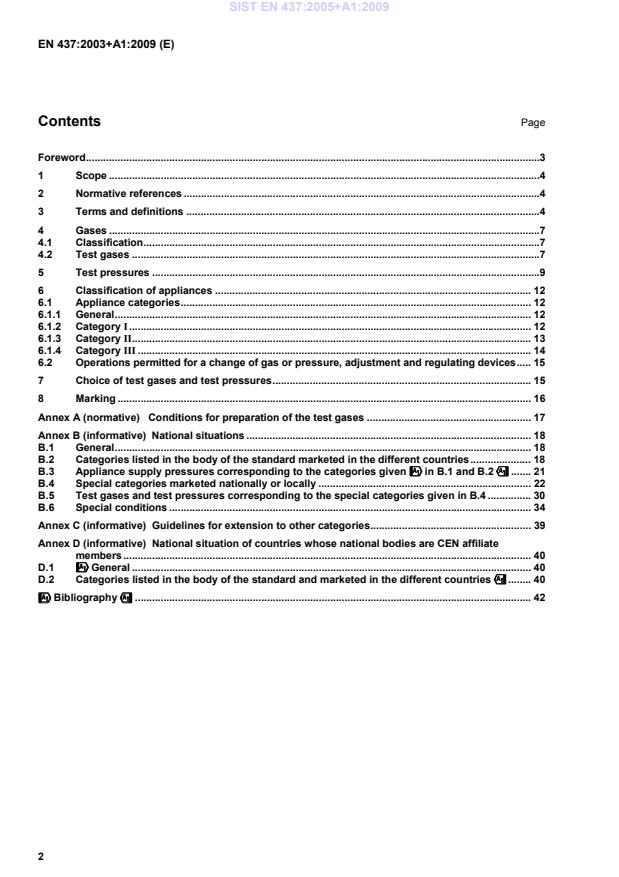
Page Foreword .31Scope .42Normative references .43Terms and definitions .44Gases .74.1Classification .74.2Test gases .75Test pressures .96Classification of appliances . 126.1Appliance categories . 126.1.1General . 126.1.2Category I . 126.1.3Category II . 136.1.4Category III . 146.2Operations permitted for a change of gas or pressure, adjustment and regulating devices . 157Choice of test gases and test pressures . 158Marking . 16Annex A (normative)
Conditions for preparation of the test gases . 17Annex B (informative)
National situations . 18B.1General . 18B.2Categories listed in the body of the standard marketed in the different countries . 18B.3Appliance supply pressures corresponding to the categories given !!!!in B.1 and B.2"""" . 21B.4Special categories marketed nationally or locally . 22B.5Test gases and test pressures corresponding to the special categories given in B.4 . 30B.6Special conditions . 34Annex C (informative)
Guidelines for extension to other categories . 39Annex D (informative)
National situation of countries whose national bodies are CEN affiliate members . 40D.1!!!!General . 40D.2Categories listed in the body of the standard and marketed in the different countries"""" . 40!!!!Bibliography"""" . 42 SIST EN 437:2005+A1:2009
3 Foreword This document (EN 437:2003+A1:2009) has been prepared by Technical Committee CEN/TC 238 “Test gases, test pressures and categories of appliances”, the secretariat of which is held by AFNOR. This European Standard shall be given the status of a national standard, either by publication of an identical text or by endorsement, at the latest by September 2009, and conflicting national standards shall be withdrawn at the latest by September 2009. This document replaces !EN 437:2003". This document includes Amendment 1, approved by CEN on 2009-01-10. The start and finish of text introduced or altered by amendment is indicated in the text by tags !". This document has been prepared under a mandate given to CEN by the European Commission and the European Free Trade Association, and supports the requirements of 2.2 of the "Gas Appliances" Directive (90/396/EEC). Annex A is normative. Annexes B, C and D are informative. EN 437 is intended to provide all the CEN Technical Committees preparing standards on gas appliances with definitions for test gases, test pressures and categories of appliances for use by these committees within the limits of the scope defined in clause 1. Similarly, it is emphasized that distributors of 2nd family gases using pressure couples should restrict themselves to their use in the normal manner but may, in exceptional circumstances and for short periods, use gases of the lowest Wobbe index at the lowest pressure, under conditions in which the safety of the appliance has to be ensured. The standard seeks to clarify the present situation with respect to test gases, test pressures and appliance categories. The concern for clarity has led to the elucidation of numerous categories and national situations or conditions. The complexity of the standard is likely to increase as new members join the Union. This revised standard incorporates the two previously published amendments and includes new appliance categories, the reason for which does not lie essentially with new gas resources but with new technical developments for appliances. !This standard can be considered as an important stage in the harmonization of test gases, test pressures and appliance categories and the quality of information on gas usage in Europe. The standard also applies to Albania, Croatia, Republic of Macedonia and Turkey, countries whose national standardisation body is affiliate member of CEN (see Annex D). Annex B gives national situations relating to gases, gas pressures and appliance categories that apply nationally or locally. The information provided is included under the responsibility of the national standardisation bodies. The tables give the available information." According to the CEN/CENELEC Internal Regulations, the national standards organizations of the following countries are bound to implement this European Standard: Austria, Belgium, Bulgaria, Cyprus, Czech Republic, Denmark, Estonia, Finland, France, Germany, Greece, Hungary, Iceland, Ireland, Italy, Latvia, Lithuania, Luxembourg, Malta, Netherlands, Norway, Poland, Portugal, Romania, Slovakia, Slovenia, Spain, Sweden, Switzerland and the United Kingdom.
1 Scope This standard specifies the test gases, test pressures and categories of appliances relative to the use of !gaseous fuels" of the first, second and third families. It serves as a reference document in the specific standards for appliances that fall within the scope of the Council Directive on the approximation of the laws of Member States concerning gas appliances (90/396/EC). The standard makes recommendations for the use of the gases and pressures to be applied for the tests. The full procedure will be given in the corresponding appliance standards. NOTE The test gases and the test pressures specified in this standard are in principle intended to be used with all the appliances in order to establish conformity with the corresponding standards. However, the use of some test gases and test pressures may not be appropriate in the following cases: appliances with nominal heat input greater than 300 kW; appliances constructed on site; appliances in which the final design is influenced by the user; appliances constructed for use with high supply pressures (notably direct use of the saturated vapour pressure). In these cases, the specific appliance standards may specify other test conditions in order to establish compliance with their requirements. 2 Normative references !The following referenced documents are indispensable for the application of this European Standard. For dated references, only the edition cited applies. For undated references, the latest edition of the referenced document (including any amendments) applies." !EN ISO 3166-1:2006, Codes for the representation of names of countries and their subdivisions – Part 1: Country codes (ISO 3166-1:2006)" !EN ISO 6976:2005, Natural gas – Calculation of calorific values, density, relative density and Wobbe index from composition (ISO 6976:1995 including Corrigendum 1:1997, Corrigendum 2:1997 and Corrigendum 3:1999)" 3 Terms and definitions For the purposes of this standard, the following terms and definitions apply: 3.1 gas appliance appliance burning !gaseous fuels" !NOTE For the purposes of this standard the term "gaseous fuels" means any fuel that is in the gaseous state at a temperature of 15 °C, and under a pressure of 1 bar." 3.2 test gases gases intended for the verification of the operational characteristics of !gas appliances". They consist of reference gases and limit gases 3.3 reference gases test gases with which appliances operate under nominal conditions when they are supplied at the corresponding normal pressure SIST EN 437:2005+A1:2009
5 3.4 limit gases test gases representative of the extreme variations in the characteristics of the gases for which appliances have been designed 3.5 test pressures gas pressures used to verify the operational characteristics of !gas appliances". They consist of normal and limit pressures NOTE The gas pressures used are expressed in millibars (mbar) 1 mbar = 102 Pa 3.6 normal pressure pn pressure under which the appliances operate in nominal conditions when they are supplied with the corresponding reference gas
3.7 limit pressures maximum pressure: pmax; minimum pressure: pmin pressures representative of the extreme variations in the appliance supply conditions
3.8 pressure couple combination of two distinct gas distribution pressures applied by reason of the significant difference existing between the Wobbe indices within a single family or group in which the higher pressure corresponds only to gases of low Wobbe index ; the lower pressure corresponds to gases of high Wobbe index. 3.9 reference conditions these correspond to 15 °C, 1 013, 25 mbar, unless otherwise specified 3.10 relative density d ratio of the masses of equal volumes of dry gas and dry air under the same conditions of temperature and pressure: 15 °C or 0 °C and 1 013, 25 mbar
3.11 calorific value quantity of heat produced by the complete combustion, at a constant pressure equal to 1 013,25 mbar, of a unit volume or mass of gas, the constituents of the combustible mixture being taken at reference conditions and the products of combustion being brought back to the same conditions A distinction is made between: the gross calorific value Hs: the water produced by combustion is assumed to be condensed; the net calorific value Hi: the water produced by combustion is assumed to be in the vapour state NOTE The calorific value is expressed: either in megajoules
per cubic metre (MJ/m3) of dry gas under the reference conditions; or in megajoules per kilogram (MJ/kg) of dry gas. 3.12 Wobbe index gross Wobbe index Ws; net Wobbe index Wi
ratio of the calorific value of a gas per unit volume and the square root of its relative density under the same reference conditions. The Wobbe index is said to be gross or net according to whether the calorific value used is the gross or net calorific value
NOTE The Wobbe indices are expressed - either in megajoules per cubic metre (MJ/m3) of dry gas under the reference conditions or in megajoules per kilogram (MJ/kg) of dry gas. 3.13 heat input Q quantity of energy used in unit time corresponding to the volumetric or mass flow rates, the calorific value used being either the net or gross calorific value
NOTE The heat input is expressed in kilowatts (kW) 3.14 nominal heat input Qn value of the heat input declared by the manufacturer
3.15 mass flow rate M mass of gas consumed by the appliance in unit time during continuous operation
NOTE The mass flow rate is expressed in kilograms per hour (kg/h) or grams per hour (g/h) 3.16 volume flow rate V volume of gas consumed by the appliance in unit time during continuous operation
NOTE The volume flow rate is expressed in cubic metres per hour (m3/h), litres per minute (l/min), cubic decimetres per hour (dm3/h) or cubic decimetres per second (dm3/s). 3.17 gas family group of !gaseous fuels" with similar burning behaviour linked together by a range of Wobbe indices (see Table 1) 3.18 gas group specified range of Wobbe index within that of the family concerned (see Table 1); this range is determined on the general principle that appliances utilising this gas group would operate safely when burning all gases within this range without adjustments. NOTE Adjustment of the appliance may be permitted in accordance with the special national or local conditions that apply in some countries (see B.4).
For gases corresponding to national or local conditions, see Tables B.5 and D.5 3.19 appliance category means of identifying the gas families and/or gas groups that a gas appliance is designed to utilize safely and to the desired performance level (see individual appliance standards). NOTE General appliance categories are described in 6.1. Special appliance categories marketed nationally or locally are described in B.4 and annex D. SIST EN 437:2005+A1:2009
7 4 Gases 4.1 Classification Gases are classified into three families, each family may be divided into groups, (themselves being divided into ranges, see annex B), as a function of the Wobbe index, according to the values given in Table 1. Table 1 – Summary of gas families and groups as a function of the Wobbe indices Gas families and groups Gross Wobbe index at 15 °C and 1 013,25 mbar MJ/m3
minimum maximum First family
Group a 22,4 24,8 Second family 39,1 54,7 Group H 45,7 54,7 Group L 39,1 44,8 Group E 40,9 54,7 Third family 72,9 87,3 Group B/P 72,9 87,3 Group P 72,9 76,8 Group B 81,8 87,3
4.2 Test gases The composition and principal characteristics of the different test gases corresponding to the gas families or groups are given in Tables 2 and 3. In particular cases specified in the individual appliance standards, gas G 24, whose characteristics are given in Table 3, may be used but only at the normal test pressure. The calorific values of the third family gases, expressed in megajoules per cubic metre in Table 2, may also be expressed in megajoules per kilogram of dry gas, as shown in Table 3. !The values in Tables 2 and 3, measured and expressed at 15 °C, are derived from EN ISO 6976:2005." The conditions for the preparation of the test gases are given in annex A. SIST EN 437:2005+A1:2009
8 !!!!Table 2 – Characteristics of the test gases a for the first and second families, gas dry at 15 °C and 1 013,25 mbar Gas family and Group Test gases DesignationComposition by volume Wi Hi Ws Hs d
% c MJ/m3 MJ/m3 MJ/m3 MJ/m3
Gases of the first family b Group a Reference gas G 110 CH4 = 26
Incomplete combustion, flame lift and sooting limit gas
H2 = 50 21,76 13,95 24,75 15,87 0,411
N2 = 24
Light back limit gas G 112 CH4 = 17
H2 = 59 19,48 11,81 22,36 13,56 0,367
N2 = 24
Gases of the second family b Group H Reference gas G 20 CH4 = 100 45,67 34,02 50,72 37,78 0,555 Incomplete combustion and sooting limit gas G 21 CH4 = 87 49,60 41,01 54,76 45,28 0,684
C3H8 = 13
Light back limit gas G 222 CH4 = 77 42,87 28,53 47,87 31,86 0,443
H2 = 23
Flame lift limit gas G 23 CH4 = 92,5 41,11 31,46 45,66 34,95 0,586
N2 = 7,5
Over heating limit gas d
G 24 CH4 = 68 47,01 35,70 52,09 39,55 0,577
C3H8 = 12
H2 = 20
Group L Reference gas light back limit gas G 25 CH4 = 86 37,38 29,25 41,52 32,49 0,612
N2 = 14
Incomplete combustion and sooting limit gas G 26 CH4 = 80
C3H8 = 7 40,52 33,36 44,83 36,91 0,678
N2 = 13
Flame lift limit gas G 27 CH4 = 82 35,17 27,89 39,06 30,98 0,629
N2 = 18
Group E
Reference gas G 20 CH4 = 100 45,67 34,02 50,72 37,78 0,555
G 21 CH4 = 87 49,60 41,01 54,76 45,28 0,684 Incomplete combustion and sooting limit gas
C3H8 = 13
Light back limit gas G 222 CH4 = 77 42,87 28,53 47,87 31,86 0,443
H2 = 23
Flame lift limit gas G 231 CH4 = 85 36,82 28,91 40,90 32,11 0,617
N2 = 15
Over heating limit gas d G 24 CH4 = 68 47,01 35,70 52,09 39,55 0,577
C3H8 = 12
H2 = 20
a For gases used nationally or locally, see B.5. b For other groups, see B.5. c See also Annex A. d Limit gas used only for certain types of appliance, specified in the individual appliance standards. "!deleted text" SIST EN 437:2005+A1:2009
9 !!!!Table 3
- Characteristics of the test gases a for the third family,
gas dry at 15 °C and 1 013,25 mbar Gas family and Group Test gases Designation Composition by volume Wi Hi Ws Hs d
% d MJ/m3MJ/m3MJ/kg MJ/m3 MJ/m3MJ/kg Gases of the third family b
Third family
and
Reference gas
n-C4H10 = 50 80,58 116,0945,65 87,33 125,8149,472,075Groups B/ P Incomplete combustion and sooting limit gas G 30 i- C4H10 = 50
Flame lift limit gas G 31 C3H8 = 100 70,69 88,00 46,34 76,84 95,65 50,371,550and B Light back limit gas G 32 C3H6 = 100 68,14 82,78 45,77 72,86 88,52 48,941,476Group P Reference gas,
Incomplete combustion, flame lift and sooting c limit gas G 31 C3H8 = 100 70,69 88,00 46,34 76,84 95,65 50,371,550 Light back and sooting limit gas c G 32 C3H6 = 100 68,14 82,78 45,77 72,86 88,52 48,941,476a For gases used nationally or locally, see B.5. b For other groups, see B.5. c The appliance standards may only specify one sooting limit gas. d See also Annex A. " !NOTE The characteristics for second family gases at reference conditions other than 15 °C for metering and 15 °C for combustion can be calculated using the coefficients given in EN ISO 13443:2005, Annex A (normative). As an example the characteristics of the reference gases of the second family at 0 °C for metering and for combustion and 1 013,25 mbar (dry gas) are given in Table 4." !!!!Table 4"""" – Characteristics of the reference gases of the second family at 0 °C and 1 013,25 mbar Gas group Test gas Designation Composition by volume Wi Hi Ws Hs
% MJ/m3 MJ/m3 MJ/m3 MJ/m3 d Group H
Reference gas G 20 CH4 = 100 48,20 35,90 53,61 39,94 0,555 Group L
Reference gas, light back limit gas G 25 CH4 = 86 39,45 30,87 43,88 34,34 0,613
N2 = 14
Group E Reference gas G 20 CH4 = 100 48,20 35,90 53,61 39,94 0,555 5 Test pressures The values of the test pressures, i.e. the static pressure to be applied at the gas inlet connection to the appliance whilst in operation, are given in Tables 6 and 7. NOTE For Tables 6 and 7, the test conditions will be specified in the individual appliance standards.
However: SIST EN 437:2005+A1:2009
10 for the combustion test in still air with G 21 the appliance is first adjusted on G 20 to give an increase of 5 % in the nominal heat input where a gas pressure governor exists, and an increase of 7,5 % in the absence of a governor. Gas G 21 is then substituted for G 20 without altering this adjustment; tests for ignition and crosslighting should be carried out at an inlet pressure of 0,7 times the normal pressure (pn) using the reference gas(es) for the first and second families. SIST EN 437:2005+A1:2009
11 !!!!Table 5"""" – Test pressures where no pressure couple existsa Pressures in millibars Appliance categories having as index Test gas Pn pmin pmax 1st family 1a G 110 8 6 15
G 112
2nd family G 20, G 21, 20 17 25 2H G 222, G 23
2nd family G 25, G 26, 25 20 30 2L G 27
2nd family G 20, G 21, 20 17 25 2E G 222, G 231
G 20, G 21, 20 17 30 2nd family G 222, G 231,
G 25, G 26,
G 27a
2N d G 25, G 26, 25 20 30
G 27
G 30, G 31, 29 b 25 35 3rd family G 32
3B/P G 30, G 31, 50 42,5 57,5
G 32
!3rd family, 3P G 31, G 32 30 25 35" 3rd family G 31, G 32 37 25 45 3P G 31, G 32 50 42,5 57,5 3rd family G 30, G 31, 29 20 35 3B c G 32
a For test pressures corresponding to gases distributed nationally or locally, refer to Table B.5. b Appliances of this category may be used, without adjustment, at the specified supply pressures of 28 mbar to 30 mbar. c The tests with G 31 and G 32 are carried out at the normal pressure only (pn = 29 mbar), these test gases being more severe than any gas distributed. This condition covers the normal variations in the gas supply. d See definition in 6.1.2.2. SIST EN 437:2005+A1:2009
12 !!!!Table 6"""" – Test pressures where a pressure couple exists Pressures in millibars !!!!Appliance categories having as index Test gas pn Pmin
pmax 2nd family : G 20, G 21, 20 17
G 222
2E+ G 231 (25) a 17 b 30 3rd family : 3+ G 30 29 c 20 35 (28-30''''37 couple) G 31, G 32 37 25 45 3rd family : 3+ G 30 50 42,5 57,5 (50''''67 couple) G 31, G 32 67 50 80 3rd family : 3+ G 30 112 60 140 (112''''148 couple)" G 31, G32 148 100 180 a This pressure corresponds to the use of low Wobbe index gas but in principle no test is carried out at this pressure. b
See B.6. c
Appliances of this category may be used without adjustment at the specified supply pressures of 28 mbar to 30 mbar. 6 Classification of appliances 6.1 Appliance categories 6.1.1 General Appliances are classified into categories defined according to the gases and the pressures for which they are designed. The definition of the categories follows from 6.1.2, 6.1.3 and 6.1.4. In each country, taking account of the local gas distribution conditions (gas composition and supply pressures), only some of the categories defined in 6.1.2, 6.1.3 and 6.1.4 are marketed. In addition, some of these categories are used only for certain types of appliance as specified in the individual standards. The conditions concerning the marketing of these appliance categories in each country and the corresponding supply pressures are given in Tables B.1, B.2 and B.3 (see also B.4 for the categories marketed locally and nationally, corresponding to the gases and specific supply pressures given in Table B.5; B.6 gives the particular conditions specific to certain countries). NOTE See also annex C: Guidelines for extension to other categories. 6.1.2 Category I Appliances of category I are designed exclusively for the use of gases of a single family or of a single group. 6.1.2.1 Appliances designed for use on first family gases only Category I1a: appliances using only gases of group a of the first family at the prescribed supply pressure (this category is not used). 6.1.2.2 Appliances designed for use on second family gases only Category I2H: appliance using only gases of group H of the second family at the prescribed supply pressure. Category I2L: appliances using only gases of group L of the second family at the prescribed supply pressure. SIST EN 437:2005+A1:2009
13 Category I2E: appliances using only gases of group E of the second family at the prescribed supply pressure. Category I2E+: appliances using only gases of group E of the second family, and operating with a pressure couple without adjustment on the appliance. The appliance gas pressure regulating device, if it exists, is not operative at pressures in between the two normal pressures of the pressure couple. Category I2N: appliances using only second family gases at the prescribed supply pressure and that automatically adapt to all gases of the second family. !Category I2R: appliances having a pressure regulator which can be manually adjusted in order to utilize each of the following gas groups: H, E, L and LL (see Table B.6)." 6.1.2.3 Appliances designed for use on 3rd family gases only Category I3B/P: appliances capable of using the third family gases (propane and butane) at the prescribed supply pressure. Category I3+: appliances capable of using gases of the third family (propane and butane) and operating with a pressure couple without adjustment of the appliance. However, for certain types of appliance specified in the particular standards, adjustment of the primary combustion air may be permitted when changing from propane to butane and vice versa. No gas pressure regulating device is permitted on the appliance. Category I3P: appliances using only gases of group P of the third family (propane) at the prescribed supply pressure. Category I3B: appliances using only gases of group B of the third family (butane) at the prescribed supply pressure. Category I3R: appliances having a pressure governor using all the gases of the third family which can be adjusted manually in order to utilize the various gases of a group of the third family under the local condition of distribution (see Table B.7). 6.1.3 Category II Appliances of category II are designed for use on gases of two families. 6.1.3.1 Appliances designed for use on gases of the first and second families Category II1a2H: appliances capable of using gases of group a of the first family and gases of group H of the second family. The first family gases are used under the same conditions as for category I1a. The second family gases are used under the same conditions as for category I2H. 6.1.3.2 Appliances designed for use on gases of the second and third families Category II2H3B/P: appliances capable of using gases of group H of the second family and gases of the third family. The second family gases are used under the same conditions as for category I2H. The third family gases are used under the same conditions as for category I3B/P. Category II2H3+: appliances capable of using gases of group H of the second family and gases of the third family. The second family gases are used under the same conditions as for category I2H.The third family gases are used under the same conditions as for category I3+. Category II2H3P: appliances capable of using gases of group H of the second family and gases of group P of the third family. The second family gases are used under the same conditions as for category I2H. The third family gases are used under the same conditions as for category I3P. Category II2L3B/P: appliances capable of using gases of group L of the second family and gases of the third family. The second family gases are used under the same conditions as for category I2L. The third family gases are used under the same conditions as for category I3B/P. SIST EN 437:2005+A1:2009
14 Category II2L3P: appliances capable of using the gases of group L of the second family and gases of Group P of the third family. The second family gases are under the same conditions as for category I2L. The third family gases are used under the same conditions as for category I3P. Category II2E3B/P: appliances capable of using gases of group E of the second family and gases of the third family. The second family gases are used under the same conditions as for category I2E. The third family gases are used under the same conditions as for category I3B/P. Category II2E+3B/P: appliances capable of using gases of group E of the second family and gases of the third family. The second family gases are used under the same conditions as for category I2E+. The third family gases are used under the same conditions as for category I3B/P. Category II2E+3+: appliances capable of using gases of Group E of the second family and gases of the third family. The second family gases are used under the same conditions as for category I2E+. The third family gases are used under the same conditions as for category I3+. Category II2E+3P: appliances capable of using gases of group E of the second family and gases of group P the third family. The second family gases are used under the same conditions as for category I2E+. The third family gases are used under the same conditions as for category I3P. Category II2R3R: appliances having a pressure governor using all the gases of the second family and/or gases linked to the second family and all the gases of the third family which can be adjusted manually in order to utilize the various gases of a group of the second family under the local conditions of distribution. The second family gases are used under the same conditions as for category I2R. The third family gases are used under the same conditions as for category I3R (see Tables B.6 to B.8) 6.1.4 Category III Appliances of category III are designed for use on gases of three families. This category is not in general use. The categories III accepted in specific countries are given in annex B (see B.4). SIST EN 437:2005+A1:2009
15 6.2 Operations permitted for a change of gas or pressure, adjustment and regulating devices The individual appliance standards will specify the operations permitted for a change of gas or of pressure ; NOTE As far as possible the permitted conversion operations should be limited so as to ensure that the conversion may be effected without difficulty. the conditions applicable to adjustment and regulation devices. 7 Choice of test gases and test pressures According to the appliance category. the tests are carried out with the gases given in Table 7; the test pressures are chosen from Tables 5 and 6, as appropriate, as a function of the test gas and in accordance with the requirements given in the individual appliance standards. SIST EN 437:2005+A1:2009
16 !!!!Table 7"""" – Test gases corresponding to the appliance categoriesa b Category Reference gas Incomplete combustion limit gas Light back limit gas Lift limit gas Sooting limit gas I2H G 20 G 21 G 222 G 23 G 21 I2L G 25 G 26 G 25 G 27 G 26 I2E,I2E++++ G 20 G 21 G 222 G 231 G 21 I2N G 20 c d G 25 c d G 21 d G 26 d G 222 d G 25 d G 231 d G 27 d G 21 d G 26 d I3B/P,I3++++ G 30 G 30 G 32 G 31 G 30 I3P G 31 G 31 G 32 G 31 G 31,G 32 I3B G 30 G 30 G 32 G 31 G 30 II1a2H G 110,G 20 G 21 G 112 G 23 G 21 II2H3B/P, G 20,G 30 G 21 G 222, G 23, G 31 G 30 II2H3+
G 32
II2H3P G 20, G 31 G 21 G 222, G 23, G 31 G 31, G 32
G 32
II2L3B/P G 25, G 30 G 26 G 32 G 27, G 31 G 30 II2L3P G 25, G 31 G 26 G 32 G 27, G 31 G 31, G 32 II2E3B/P, G 20, G 30 G 21 G 222, G 231, G 31 G 30 II2E+3B/P II2E+3+
G 32
II2E+3P G 20, G 31 G 21 G 222, G 231, G 31 G 31, G 32
G 32
a For the test gases corresponding to the categories marketed nationally or locally, see Table B.4. b Tests with the limit gases are carried out with the injector and adjustment corresponding to the reference gas of the group to which limit gas used for the test belongs. c The heat inputs shall be equivalent and within the tolerances specified in the appliance standards d Since the adjustment of the burner changes automatically when the appliance is supplied with different test gases, it may be necessary to examine all phenomena (e.g. incomplete combustion, sooting, light back, flame lift) with all the test gases 8 Marking The marking of a category comprises: in Roman numerals, the number of utilizable gas families; in an Arabic numeral suffix, the number assigned to the gas family considered, i.e. 1 for the first family, 2 for the second and 3 for the third; in the suffix following that numeral, the capital letter or letters designating the utilizable gas group or groups, respectively. The suffix to the Roman numeral denotes all the families with all the gas groups usable by the appliance, with or without making adjustments and/or adaptations appropriate to each group. In cases where the appliance is capable of using gases belonging to one of the groups E or B/P that completely or partially encompass more restricted groups, the breadth of which is expressed by a Wobbe number range, the supply pressure may be set according to the pressure couple principle. This supply condition for the gas group considered is symbolised by the "+" sign following the letter E or the digit 3 for group B/P; in the latter case, the symbol for the group itself is replaced by the digit 3, which denotes the third family. SIST EN 437:2005+A1:2009
17 Annex A (normative)
Conditions for preparation of the test gases The composition of the gases used for the tests shall be as close as possible to that in !Table 2". For the preparation of these gases, the following rules shall be observed: the Wobbe index of the gas used shall be within ± 2 % of the value indicated in the table for the corresponding test gas (this tolerance includes the error due to measuring instruments) ; the constituents used for the preparation of the mixtures shall have at least the following purity: nitrogen N2 99 %
hydrogen H2 99 %
methane CH4 95 % with a total content of hydrogen, carbon monoxide and oxygen below 1 % and a total content of nitrogen and carbon dioxide below 2 % propene C3H6 95 % propane C3H8 95 % butane1) C4H10 95 %
However, these conditions are not mandatory for each of the components if the final mixture has a composition identical to that of a mixture which would have been made from components satisfying the preceding conditions. Therefore, in order to make up a mixture, it is possible to start with a gas already containing, in suitable proportions, several components of the final mixture. However, for gases of the 2nd family: for the tests carried out with reference gases G 20 or G 25, a gas belonging respectively to either group H or group L or group E, may be used even if its composition does not satisfy the above conditions, provided that after the addition of either propane or nitrogen as appropriate, the final mixture has a Wobbe index within ± 2 % of the value given in the table for the corresponding reference gas;
for preparation of the limit gases another gas may be used as the base gas instead of methane for limit gases G 21, G 222, G 23 and G 24, a natural gas of group H may be used; for limit gases G 27 and G 231, a natural gas of group H , L or E may be used; for the limit gas G 26, a natural gas of group L may be used. In all cases the final mixture obtained by adding propane or nitrogen shall have a Wobbe index within ± 2 % of the value given in !Table 2" for the corresponding limit gas and the hydrogen content of the final mixture shall be as given in !Table 2".
1) A mixture of iso/n butane is permitted. Appliance standards may be more precise on the composition of the mixture and the purity of the gases. SIST EN 437:2005+A1:2009
18 Annex B (informative)
National situations B.1 General In each country in which this standard applies, appliances may be marketed only if they comply with the particular national supply conditions of that country. In order to permit, both at the time of testing the appliance and at the time of its sale, the correct choice to be made from all the situations covered, the various national situations are summarized in Tables B.1, B.2, B.3, B.4 and B.5. In accordance with !EN ISO 3166-1:2006", the names of countries shall be represented by the following codes: ! AT Austria IE Ireland BE Belgium IS Iceland BG Bulgaria IT Italy CH Switzerland LT Lithuania CY Cyprus LU Luxembourg CZ Czech Republic LV Latvia DE Germany MT Malta DK Denmark NL Netherlands EE Estonia NO Norway ES Spain PL Poland FI Finland PT Portugal FR France RO Romania GB United Kingdom SE Sweden GR Greece SI Slovenia HU Hungary SK Slovakia"
B.2 Categories listed in the body of the standard marketed in the different countries Tables B.1.and B.2 give the national situations concerning the marketing in the various countries of the appliance categories listed in the body of the standard. The information given in these tables indicates only that these categories may be sold throughout the whole of the country concerned and B.4 has to be consulted for confirmation. In all cases of doubt, the local gas supplier should be consulted in order to identify the precise category applicable. SIST EN 437:2005+A1:2009
!!!!Table B.1 – Category I (single categories) marketed
Country code I2H I2L I2E I2E+ I2N I2R a I3B/P I3+ I3P a I3B a I3R a AT x
x
x
BE
x x
xd x x x
BG
CH x
x x x
CY
x x
x
CZ x
X x x x
x DE
x
x a c Xc x
x
xc DK x
x
EE x
X x
x ES x
x a X
x x x x FI x
x
FR xb xb
x x a Xc x a x x x x GB x
X x d x x x x GR
x
x a X x x x x x HU xc
x
x x
IE x
x x x
IS (?)
IT x
X x x x
x LT x
x x x
x LU (?)
x
LV x
MT
NL
xb x
x
x
NO
x
X x
x PL
x
x
x
PT x
x a X x x x x x RO x xc x
x
x
SE x
x
SI x
x a x x x x
x SK x
x
x a Categories applicable only to certain types of appliances, specified in the individual appliance standards. b Categories applicable only to certain types of appliance, submitted to the on site EC verification procedure; Annex II, article 6 of the gas appliance Directive (90/396/CEE)]. c See B.6. d Category applicable only for appliances installed in Touring and Motoring Caravans. The symbol (?) placed alongside the names of the countries means that the country concerned has not indicated its choice of category. "SIST EN 437:2005+A1:2009
20 !!!!Table B.2 – Category II (double categories) marketed
Country code II1a2H II2H3B/P II2H3+ II2H3P a II2L3B/P II2L3Pa II2R3Ra II2E3B/PII2E+3B/P II2E+3+ II2E+3PaAT
x
x
BE
x a x BG
CH
x x x
CY
x x
CZ
x x x
X
DE
X x
DK x x
EE
x
X
ES
x c x
X
FI
x
FR
x b
x b X
xa x x GB
x x
GR
x x x
X
HU
IE
x x
IS
IT x x x x
X
LT
x x x
LU
LV
MT
NL
x x
NO
x
X
PL
x
PT
x x
X
RO
x
x x x
x
SE x x
SI
x x x
x
SK
x x x
a Categories applicable only to certain types of appliance, specified in the individual standards. b Categories applicable only to certain types of appliance, submitted to the on site EC verification procedure ; [Annexe II, article 6 of the gas appliance Directive (90/396/ EEC)]. c Appliances of this category set for group H gases of the second family may use air and commercial propane gas mixtures where the gross Wobbe index (at 15 °C and 1 013,25 mbar) is between 46 MJ/m3 and 51,5 MJ/m3, at the same supply pressure, without additional tests. The symbol (?) placed alongside the names of the countries means that the country concerned has not indicated its choice of category. "
21 B.3 Appliance supply pressures corresponding to the categories given !!!!in B.1 and B.2"""" Table B.3 gives the conditions in the various countries concerning the supply pressures to appliances in the categories given !in B.1 and B.2". The normal pressures are identified by the reference gas or gases of the gas group. For the first family, the normal pressure is identified by the sole reference gas G 110 !!!!Table B.3 – Normal supply pressures
Category index 1a 2H
2E 2L 2E+ 3B 3P 3B/P 3+ Reference gas G 110 G 20 G 20 G 25 G 20'G 25 G 30 G 31 G 30 G 30'G 31 Pressure
(mbar) 8 20 20 25 20''''25 30 28-30 50 30 37 50 30 50 28-30''''37 50''''67 112''''148Country code
AT
x
xe
x xe x
BE g
x x
x xb x
x
BG
CH
x
x x
x x
CY
x
x xbc
x xbc x xbc
CZ
x
x xd
xd x
DE g h
x
xe
x xe x
DK g x x
x
EE
x
x
ES
x
x
x xb
x
FI
x
x
x
FR g h
xf
xf x x xb
x xb x x x
xb GB
x a
x
x xb x
x
GR
x
x x
x x? x?
x
HU g h
(xi)
x
IE
x
x
x
x
IS
IT g x x
x
x
x
LT
x
x
x
x
LU
x
LV
x
MT
x?
NL
xf
x
x x x x
NO
x
x?
PL g h
x
x
xj
PT
x
x
x
x x
RO
x x (xi)
x
x
SE g h x x
x
SI
x
x
x
x
SK
x
x x x x x
a For certain non-domestic appliances :
17,5 mbar. b Only for certain types of non-domestic appliance.
c For certain types of industrial appliances. d For certain types of appliances. e Only for gas appliances in boats and leisure accommodation vehicles. f Categories applicable only to certain types of appliance, submitted to the on site EC verification procedure; [Annex II, article 6 of the Gas Appliance Directive (90/396/CEE)]. g See also B.4 for specific national categories. h See also B.5 for specific national groups and pressures. i See B.6 that gives the specific national pressures. j Caution for appliances of category I3P(B/P) group B/P is used with pressure range according to B.6. The symbol (?) placed alongside the names of the countries means that the country concerned has not indicated its choice of category. " SIST EN 437:2005+A1:2009
22 B.4 Special categories marketed nationally or locally B.4.1 The national or local conditions of gas distribution (gas composition and supply pressures) lead to the definition of the special categories of B.4.2 that are marketed nationally or locally in certain countries. Table B.4 gives these categories for each country together with the corresponding test gases. Table B.5 gives the characteristics of these test gases and the corresponding test pressures. !!!!Table B.4 – Test gases corresponding to categories marketed nationally or locally Category Reference gas Incomplete combustion gas Light back limit gas Lift limit gas Sooting limit gas Country I2E(S)a G 20 G 21 G 222 G 231 G 21 BE I2E(R)a G 20 G 21 G 222 G 231 G 21 BE I2ELL G 20, G 25 G 21 G 222 G 231, G 271 G 21 DE I2Esia G 20, G 25 G 21 G 222 G 231 G 21 FR I2Era G 20, G 25 G 21 G 222 G 231 G 21 FR I2Hb G 20 G 21 G 222 G 23 G 21 HU I2HSb G 20, G 25.1 G 21, G 26.1 G 222 G 23, G 27.1 G 21, G 26.1 HU I2HM G20, G230 G 21 G 222, G 232 G 23, G 230 G 21 IT I2ELw G 20, G,27 G 21 G 222 G 2.412 G 21 PL I2ELs G 20,
G 2.350 G 21 G 222 G 2.352 G 21 PL I2ELn G 20 G 2.300 G 21 G 222 G 2.302 G 21 PL I2ELwLs G 20, G,27,
G 2.350 G 21 G 222 G 2.352 G 21 PL I2ELwLsLn G 20, G 27,
G 2.350,
G 2.300 G 21 G 222
G 2.302 G 21 PL I3P(B/P)bd
G 31,
G 30 G 31 G 30 G 32,
G 31,
G 30 ? PL II1c2E G 130, G 20 G 21 G 132, G 222 G 231 G 21 FR II1c2E+ G 130, G 20 G 21 G 132, G 222 G 231 G 21 FR II1c2Esia G 130, G 20 G 25 G 21 G 132, G 222 G 231 G 21 FR II1c2Era G
...