

EN 15502-2-2:2014
(Main)Gas-fired central heating boilers - Part 2-2: Specific standard for type B1 appliances
- Abstract
This European Standard specifies, the requirements and test methods concerning, in particular the construction, safety, fitness for purpose, and rational use of energy, as well as the classification and marking of gas-fired central heating boilers that are fitted with atmospheric burners, fan assisted atmospheric burners and are hereafter referred to as boilers.
Where the word boiler is used, this is to be read as the boiler including its connecting ducts, ducts and terminals, if any.
This European Standard covers gas-fired central heating boilers type B11, B11BS, B12, B12BS, B13, B13BS according to the classification in CEN/TR 1749:2009:
a) that have a nominal heat input (on the basis of net calorific value) not exceeding 70 kW;
b) that use one or more combustible gases of the three gas families at the pressures stated in EN 437;
c) where the temperature of the heat transfer fluid does not exceed 105 °C during normal operation;
d) where the maximum operating pressure in the water circuit does not exceed 6 bar;
e) which are declared in the technical instructions to be either a low temperature boiler or a standard boiler. If no declaration is given the boiler is to be considered a standard boiler;
f) which are intended to be installed either indoors or in a partially protected place;
g) which are either not intended to produce hot water, or are intended to produce hot water either by the instantaneous or storage principle, the whole being marketed as a single unit.
h) which are designed for either sealed water systems or for open water systems.
This European Standard is to be used in conjunction with the General Requirements Standard EN 15502 1.
For applications within the scope of the PED further requirements may be necessary (e.g. situations where the maximum allowable temperature exceeds 110 °C, or where volume times maximum allowable pressure is over 50 bar x litres).
This standard provides requirements for boilers with known constructions. For boilers with any alternative constructions, which might not fully be covered by this standard, the risk associated with this alternative construction shall be assessed.
An example of an assessment methodology, based upon risk assessment and which covers the essential requirements of the Gas Appliance Directive, is given in Clause 11.
This standard does not cover all the requirements for:
i) appliances that are intended to be connected to gas grids where the quality of the distributed gas is likely to vary to a large extent over the lifetime of the appliance (see Annex DD of EN 15502 2 1:2012);
j) appliances using flue dampers;
k) appliances that have a nominal heat input (on the basis of net calorific value) exceeding 70 kW;
l) appliances of the types A, B14, B2, B3, B4, B5 and C;
m) appliances intended to be connected to a (common) flue having mechanical extraction;
n) appliances with gas/air ratio control;
o) modular boilers;
p) boilers which can give rise to condensation under certain circumstances;
q) boilers intended to be installed in a room with a foreseeable negative pressure relative to the pressure in the flue system.
NOTE Negative pressure relative to the pressure in the flue system can for example be caused by mechanical or thermal ventilation in airtight buildings.
- Status
- Withdrawn
- Publication Date
- 29-Jul-2014
- Withdrawal Date
- 06-Oct-2026
- Technical Committee
- CEN/TC 109 - Central heating boilers using gaseous fuels
- Drafting Committee
- CEN/TC 109/WG 1 - Domestic central heating boilers using gaseous fuels
- Current Stage
- 9960 - Withdrawal effective - Withdrawal
- Start Date
- 24-Jul-2024
- Completion Date
- 07-Oct-2026

Relations
- Effective Date
- 08-Jun-2022
- Effective Date
- 06-Aug-2014
- Effective Date
- 06-Aug-2014
- Effective Date
- 06-Aug-2014
- Effective Date
- 06-Aug-2014
- Effective Date
- 06-Aug-2014
- Effective Date
- 06-Aug-2014
- Effective Date
- 06-Aug-2014
- Effective Date
- 06-Aug-2014
- Effective Date
- 08-Oct-2012
- Effective Date
- 22-Dec-2021
- Effective Date
- 07-Jul-2026
- Effective Date
- 09-Feb-2026
- Effective Date
- 28-Jan-2026
- Effective Date
- 28-Jan-2026
Get Certified
Connect with accredited certification bodies for this standard

DNV
DNV is an independent assurance and risk management provider.

Lloyd's Register
Lloyd's Register is a global professional services organisation specialising in engineering and technology.

DIBt (Deutsches Institut für Bautechnik)
German Institute for Building Technology.
Sponsored listings
Frequently Asked Questions
EN 15502-2-2:2014 is a standard published by the European Committee for Standardization (CEN). Its full title is "Gas-fired central heating boilers - Part 2-2: Specific standard for type B1 appliances". This standard covers: This European Standard specifies, the requirements and test methods concerning, in particular the construction, safety, fitness for purpose, and rational use of energy, as well as the classification and marking of gas-fired central heating boilers that are fitted with atmospheric burners, fan assisted atmospheric burners and are hereafter referred to as boilers. Where the word boiler is used, this is to be read as the boiler including its connecting ducts, ducts and terminals, if any. This European Standard covers gas-fired central heating boilers type B11, B11BS, B12, B12BS, B13, B13BS according to the classification in CEN/TR 1749:2009: a) that have a nominal heat input (on the basis of net calorific value) not exceeding 70 kW; b) that use one or more combustible gases of the three gas families at the pressures stated in EN 437; c) where the temperature of the heat transfer fluid does not exceed 105 °C during normal operation; d) where the maximum operating pressure in the water circuit does not exceed 6 bar; e) which are declared in the technical instructions to be either a low temperature boiler or a standard boiler. If no declaration is given the boiler is to be considered a standard boiler; f) which are intended to be installed either indoors or in a partially protected place; g) which are either not intended to produce hot water, or are intended to produce hot water either by the instantaneous or storage principle, the whole being marketed as a single unit. h) which are designed for either sealed water systems or for open water systems. This European Standard is to be used in conjunction with the General Requirements Standard EN 15502 1. For applications within the scope of the PED further requirements may be necessary (e.g. situations where the maximum allowable temperature exceeds 110 °C, or where volume times maximum allowable pressure is over 50 bar x litres). This standard provides requirements for boilers with known constructions. For boilers with any alternative constructions, which might not fully be covered by this standard, the risk associated with this alternative construction shall be assessed. An example of an assessment methodology, based upon risk assessment and which covers the essential requirements of the Gas Appliance Directive, is given in Clause 11. This standard does not cover all the requirements for: i) appliances that are intended to be connected to gas grids where the quality of the distributed gas is likely to vary to a large extent over the lifetime of the appliance (see Annex DD of EN 15502 2 1:2012); j) appliances using flue dampers; k) appliances that have a nominal heat input (on the basis of net calorific value) exceeding 70 kW; l) appliances of the types A, B14, B2, B3, B4, B5 and C; m) appliances intended to be connected to a (common) flue having mechanical extraction; n) appliances with gas/air ratio control; o) modular boilers; p) boilers which can give rise to condensation under certain circumstances; q) boilers intended to be installed in a room with a foreseeable negative pressure relative to the pressure in the flue system. NOTE Negative pressure relative to the pressure in the flue system can for example be caused by mechanical or thermal ventilation in airtight buildings.
This European Standard specifies, the requirements and test methods concerning, in particular the construction, safety, fitness for purpose, and rational use of energy, as well as the classification and marking of gas-fired central heating boilers that are fitted with atmospheric burners, fan assisted atmospheric burners and are hereafter referred to as boilers. Where the word boiler is used, this is to be read as the boiler including its connecting ducts, ducts and terminals, if any. This European Standard covers gas-fired central heating boilers type B11, B11BS, B12, B12BS, B13, B13BS according to the classification in CEN/TR 1749:2009: a) that have a nominal heat input (on the basis of net calorific value) not exceeding 70 kW; b) that use one or more combustible gases of the three gas families at the pressures stated in EN 437; c) where the temperature of the heat transfer fluid does not exceed 105 °C during normal operation; d) where the maximum operating pressure in the water circuit does not exceed 6 bar; e) which are declared in the technical instructions to be either a low temperature boiler or a standard boiler. If no declaration is given the boiler is to be considered a standard boiler; f) which are intended to be installed either indoors or in a partially protected place; g) which are either not intended to produce hot water, or are intended to produce hot water either by the instantaneous or storage principle, the whole being marketed as a single unit. h) which are designed for either sealed water systems or for open water systems. This European Standard is to be used in conjunction with the General Requirements Standard EN 15502 1. For applications within the scope of the PED further requirements may be necessary (e.g. situations where the maximum allowable temperature exceeds 110 °C, or where volume times maximum allowable pressure is over 50 bar x litres). This standard provides requirements for boilers with known constructions. For boilers with any alternative constructions, which might not fully be covered by this standard, the risk associated with this alternative construction shall be assessed. An example of an assessment methodology, based upon risk assessment and which covers the essential requirements of the Gas Appliance Directive, is given in Clause 11. This standard does not cover all the requirements for: i) appliances that are intended to be connected to gas grids where the quality of the distributed gas is likely to vary to a large extent over the lifetime of the appliance (see Annex DD of EN 15502 2 1:2012); j) appliances using flue dampers; k) appliances that have a nominal heat input (on the basis of net calorific value) exceeding 70 kW; l) appliances of the types A, B14, B2, B3, B4, B5 and C; m) appliances intended to be connected to a (common) flue having mechanical extraction; n) appliances with gas/air ratio control; o) modular boilers; p) boilers which can give rise to condensation under certain circumstances; q) boilers intended to be installed in a room with a foreseeable negative pressure relative to the pressure in the flue system. NOTE Negative pressure relative to the pressure in the flue system can for example be caused by mechanical or thermal ventilation in airtight buildings.
EN 15502-2-2:2014 is classified under the following ICS (International Classification for Standards) categories: 27.060.30 - Boilers and heat exchangers; 91.140.10 - Central heating systems. The ICS classification helps identify the subject area and facilitates finding related standards.
EN 15502-2-2:2014 has the following relationships with other standards: It is inter standard links to EN 15417:2006, EN 297:1994/A3:1996, EN 297:1994/A5:1998, EN 297:1994/A2:1996, EN 297:1994/A6:2003, EN 297:1994/A2:1996/AC:2006, EN 297:1994/A4:2004, EN 297:1994, EN 625:1995, EN 677:1998, EN 15502-2-2:2024, EN IEC 60730-2-9:2026, EN IEC 60730-2-9:2019, EN 14459:2007, EN 15502-1:2012. Understanding these relationships helps ensure you are using the most current and applicable version of the standard.
EN 15502-2-2:2014 is associated with the following European legislation: EU Directives/Regulations: 2009/142/EC, 92/42/EEC; Standardization Mandates: M/066, M/BC/CEN/89/6. When a standard is cited in the Official Journal of the European Union, products manufactured in conformity with it benefit from a presumption of conformity with the essential requirements of the corresponding EU directive or regulation.
EN 15502-2-2:2014 is available in PDF format for immediate download after purchase. The document can be added to your cart and obtained through the secure checkout process. Digital delivery ensures instant access to the complete standard document.
Standards Content (Sample)
2003-01.Slovenski inštitut za standardizacijo. Razmnoževanje celote ali delov tega standarda ni dovoljeno.Heizkessel für gasförmige Brennstoffe - Teil 2-2: Heizkessel der Bauart B1 mit einer Nennwärmebelastung nicht größer als 70 kWGas-fired central heating boilers - Part 2-2: Specific standard for type B1 appliances of a nominal heat input not exceeding 70 kW97.100.20Plinski grelnikiGas heaters91.140.10Sistemi centralnega ogrevanjaCentral heating systemsICS:Ta slovenski standard je istoveten z:EN 15502-2-2:2014SIST EN 15502-2-2:2014en,fr,de01-oktober-2014SIST EN 15502-2-2:2014SLOVENSKI
STANDARDSIST EN 297:1997/A6:2004SIST EN 297:1997/A5:1999SIST EN 677:1999SIST EN 625:1997SIST EN 297:1997/A4:2005SIST EN 297:1997/A2:1997SIST EN 297:1997SIST EN 297:1997/A3:1997SIST EN 297:1997/A2:1997/AC:20061DGRPHãþD
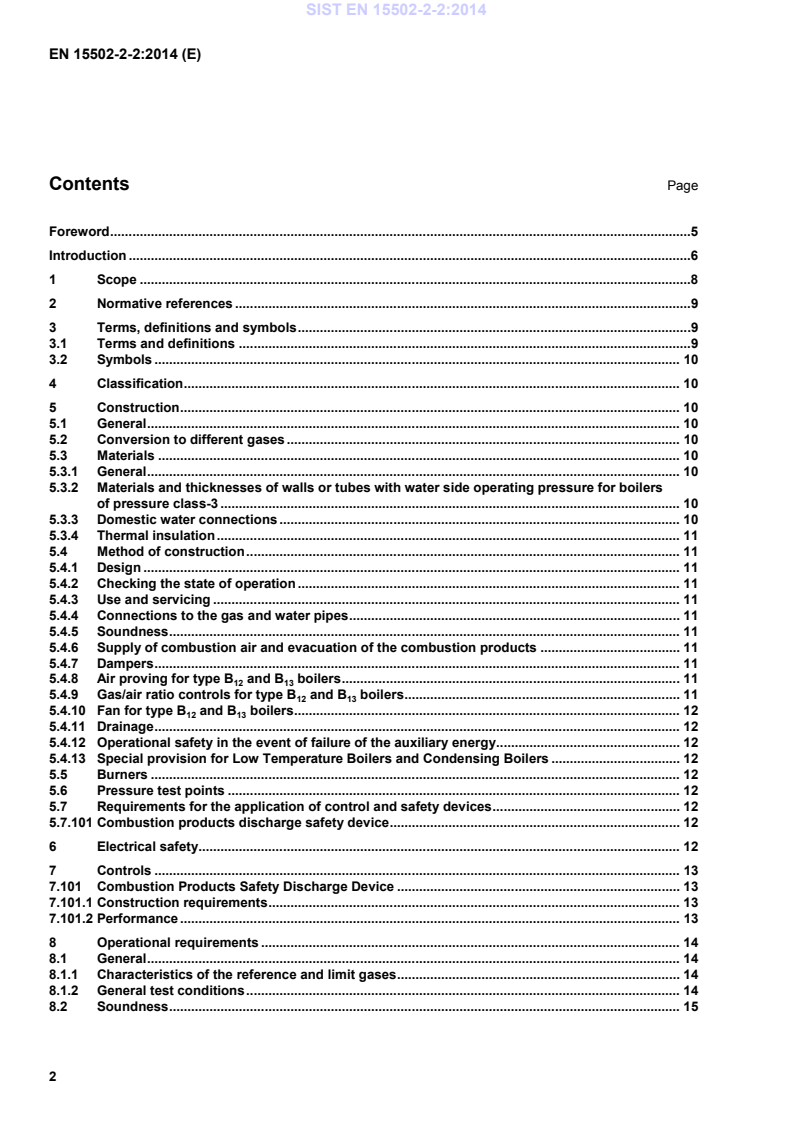
EUROPEAN STANDARD NORME EUROPÉENNE EUROPÄISCHE NORM
EN 15502-2-2
July 2014 ICS 27.060.30; 91.140.10 Supersedes EN 15417:2006, EN 297:1994, EN 625:1995, EN 677:1998English Version
Gas-fired central heating boilers - Part 2-2: Specific standard for type B1 appliances
Chaudières de chauffage central utilisant les combustibles gazeux - Partie 2-2: Norme spécifique pour les appareils de type B1
Heizkessel für gasförmige Brennstoffe - Teil 2-2: Heizkessel der Bauart B1 This European Standard was approved by CEN on 28 May 2014.
CEN members are bound to comply with the CEN/CENELEC Internal Regulations which stipulate the conditions for giving this European Standard the status of a national standard without any alteration. Up-to-date lists and bibliographical references concerning such national standards may be obtained on application to the CEN-CENELEC Management Centre or to any CEN member.
This European Standard exists in three official versions (English, French, German). A version in any other language made by translation under the responsibility of a CEN member into its own language and notified to the CEN-CENELEC Management Centre has the same status as the official versions.
CEN members are the national standards bodies of Austria, Belgium, Bulgaria, Croatia, Cyprus, Czech Republic, Denmark, Estonia, Finland, Former Yugoslav Republic of Macedonia, France, Germany, Greece, Hungary, Iceland, Ireland, Italy, Latvia, Lithuania, Luxembourg, Malta, Netherlands, Norway, Poland, Portugal, Romania, Slovakia, Slovenia, Spain, Sweden, Switzerland, Turkey and United Kingdom.
EUROPEAN COMMITTEE FOR STANDARDIZATION
COMITÉ EUROPÉEN DE NORMALISATION EUROPÄISCHES KOMITEE FÜR NORMUNG
CEN-CENELEC Management Centre:
Avenue Marnix 17,
B-1000 Brussels © 2014 CEN All rights of exploitation in any form and by any means reserved worldwide for CEN national Members. Ref. No. EN 15502-2-2:2014 ESIST EN 15502-2-2:2014
Compilation of the test conditions for the various gas families . 37 Annex V (informative)
Standards replaced by this standard in combination with EN 15502-1 . 40 Annex ZA (informative)
Clauses of this European Standard addressing essential requirements or provisions of EU Directive 2009/142/EC, “Directive relating to appliances burning gaseous fuels (codified version)” (GAD) . 42 Annex ZB (informative)
Clauses of this European standard addressing the methods for the verification of the efficiency of the EU Directive 92/42/EEC, relating to the efficiency of new hot boilers with an output of 4 kW – 400 kW . 45 Bibliography . 46
safety; d)
rational use of energy; e)
fitness for purpose. Matters related to quality assurance systems, tests during production, and certificates of conformity of auxiliary devices are not dealt with in this series of European Standards Relation between this standard and EN 15502-1: This European Standard will be used in conjunction with EN 15502-1:2012 and follows the numbering structure of EN 15502-1:2012. This European standard refers to clauses of EN 15502-1:2012 or adapts clauses by stating in the corresponding clause: - "Shall be according to EN 15502-1:2012, [clause number] with the following modification"; - "Shall be according to EN 15502-1:2012, [clause number] with the following addition". - "EN 15502-1:2012, [clause number] is replaced by the following"; - "EN 15502-1:2012, [clause number] is not applicable". This European Standard adds clauses or subclauses to the structure of EN 15502-1:2012 which are particular to this standard. It should be noted that these clauses and subclauses are not indicated as an addition. Clauses, subclauses and annexes which are additional to those in EN 15502-1:2012 are numbered starting from 101, respectively are designated as Annex AA, BB, CC, etc. SIST EN 15502-2-2:2014
for a boiler having a flue outlet with a horizontal axis, from this axis; b)
for a boiler having a flue outlet with a vertical axis, from the plane of the flue outlet. The test is carried out with one of the reference gases, or a gas actually distributed, for the category concerned at nominal heat input. The combustion products are sampled at a point in the flue 0,15 m from the top, using the probe shown in Figures 101 or 102. SIST EN 15502-2-2:2014
...