

EN 15502-2-1:2022+A1:2023
(Main + Amendment)Gas-fired central heating boilers - Part 2-1: Specific standard for type C appliances and type B2, B3 and B5 appliances of a nominal heat input not exceeding 1 000 kW
- Abstract
This document specifies the requirements and test methods, as well as the classification and marking of gas-fired central heating boilers that are fitted with atmospheric burners, fan assisted atmospheric burners or fully premixed burners, and are hereafter referred to as "boilers".
This document is intended to be used in conjunction with EN 15502-1:2021.
This document covers gas-fired central heating boilers from the types C1 up to C(11) and the types B2, B3 and B5:
NOTE 1 For further background information on appliance types see EN 1749:2020.
a) that have a nominal heat input (on the basis of net calorific value) not exceeding 1 000 kW;
b) that use one or more combustible gases of the three gas families at the pressures stated in EN 437:2021;
c) where the temperature of the heat transfer fluid does not exceed 105 °C during normal operation;
d) where the maximum operating pressure in the water circuit does not exceed 6 bar;
e) which can give rise to condensation under certain circumstances;
f) which are declared in the instructions for installation to be either a "condensing" boiler or a "low temperature boiler" or a "standard boiler"; if no declaration is given the boiler is to be considered a "standard boiler";
g) which are intended to be installed inside a building or in a partially protected place;
h) which are intended to produce also hot water either by the instantaneous or storage principle as a single unit;
i) which are designed for either sealed water systems or for open water systems;
j) which are either modular boilers, or non-modular boilers.
k) which are from the types C(10) that are equipped with a gas-air ratio control and that have a ∆pmax, saf(min) of 25 Pa, and C(11) that have condensing boiler modules that are equipped with a gas-air ratio control and that have a ∆pmax, saf(min) of 25 Pa.
NOTE 2 This document provides requirements for boilers with known constructions. For boilers with any alternative constructions, which might not fully be covered by this standard, the risk associated with this alternative construction needs to be assessed.
An example of an assessment methodology, based upon risk assessment, is given in Clause 11.
This document does not cover all the requirements for:
aa) appliances above 1 000 kW;
ab) appliances that are intended to be connected to gas grids where the quality of the distributed gas is likely to vary to a large extent over the lifetime of the appliance (see Annex AB of EN 15502-1:2021);
ac) appliances using flue dampers;
ad) appliances of the types B21, B31, B51, C21, C41, C51, C61, C71, C81, C(12) and C(13);
ae) C7 appliances that have a nominal heat input (on the basis of net calorific value) exceeding 70 kW;
af) appliances incorporating flexible plastic flue liners;
ag) C(10) boilers:
1) without a gas-air ratio control, or
2) which are non-condensing appliances, or
3) which have a maximum safety pressure difference at minimum heat input not equal to 25 Pa (∆pmax, saf(min));
ah) C(11) boilers that have boiler modules:
1) without a gas-air ratio control, or
2) which are non-condensing appliances, or
3) which have a maximum safety pressure difference at minimum heat input not equal to 25 Pa (∆pmax, saf(min));
ai) appliances intended to be connected to a flue having mechanical extraction;
aj) surface temperatures of external parts particular to children and elderly people;
ak) appliances that are intended to burn natural gases of the second family where hydrogen is added to the natural gas;
al) appliances equipped with an adaptive combustion control function (ACCF);
am) boilers intended to be installed in areas accessible to elderly people and children.
- Status
- Published
- Publication Date
- 12-Dec-2023
- Technical Committee
- CEN/TC 109 - Central heating boilers using gaseous fuels
- Drafting Committee
- CEN/TC 109/WG 1 - Domestic central heating boilers using gaseous fuels
- Current Stage
- 6060 - Definitive text made available (DAV) - Publishing
- Start Date
- 13-Dec-2023
- Completion Date
- 13-Dec-2023
- Directive
- 2016/426 - REGULATION (EU) 2016/426 OF THE EUROPEAN PARLIAMENT AND OF THE COUNCIL of 9 March 2016 on appliances burning gaseous fuels and repealing Directive 2009/142/ECOJ Ref: 2024/2944, OJ L, OJ L, 2024/2944 OJ Date: 02-Dec-2024

Overview
EN 15502-2-1:2022+A1:2023 specifies safety, performance and testing requirements for gas-fired central heating boilers of types C and B2, B3, B5 with a nominal heat input up to 1 000 kW. Used together with EN 15502-1:2021, it covers construction, classification, marking and test methods for boilers fitted with atmospheric, fan-assisted atmospheric or fully premixed burners. The standard applies to boilers using gases in the three gas families at pressures in EN 437:2021 and addresses condensing, low-temperature and standard boilers designed for indoor or partially protected installation.
Key topics and technical requirements
- Scope limits: nominal heat input ≤ 1 000 kW; heat transfer fluid temperature ≤ 105 °C; maximum water circuit pressure ≤ 6 bar.
- Appliance types covered: type C1 to C(11) and types B2, B3, B5; specific provisions for C(10) and C(11) modules with gas‑air ratio control and ∆pmax,saf(min) = 25 Pa.
- Construction and materials: design, materials, connections, soundness of gas/combustion/water circuits, and modular vs non‑modular boilers.
- Combustion and flue systems: requirements for supply of combustion air, evacuation of combustion products, flue terminals, ducts and mechanical strength, plus rules for condensate formation and temperature of combustion products.
- Controls and safety devices: ignition, flame supervision, gas pressure regulation, pre‑purge, air proving, control and safety device limits, and resistance to auxiliary energy failure.
- Operational tests & emissions: heat input/output testing, carbon monoxide and NOx considerations, soot/sooting checks and special tests for condensing/low‑temperature boilers.
- Special provisions & exclusions: clause for risk assessment of alternative constructions (Clause 11). The standard excludes appliances > 1 000 kW, certain appliance types (e.g., C12/C13, B21 family), flue dampers, ACCF-equipped boilers, and appliances for variable-quality gas grids.
Practical applications - who uses this standard
- Boiler manufacturers: design verification, compliance, product marking and type testing for CE / regulatory conformity.
- Test laboratories and certification bodies: test methods, measurement procedures and pass/fail criteria.
- Installers, system designers and HVAC engineers: installation limits, flue and combustion air guidance, and compatibility with system pressures and temperatures.
- Regulators and compliance officers: normative references and harmonized requirements for market surveillance and safety assessments.
- Risk assessors: methodology for alternative constructions and modular systems.
Related standards
- EN 15502-1:2021 (general requirements - to be used in conjunction)
- EN 437:2021 (reference gases and pressures)
- EN 1749:2020 (background on appliance types)
Keywords: EN 15502-2-1:2022+A1:2023, gas-fired central heating boilers, condensing boilers, type C boilers, boiler safety, boiler test methods, EN 15502.
Relations
- Effective Date
- 18-Oct-2023
- Effective Date
- 25-Aug-2026
- Effective Date
- 25-Aug-2026
- Effective Date
- 25-Aug-2026
- Effective Date
- 25-Aug-2026
- Effective Date
- 09-Feb-2026
- Refers
ISO 188:2011 - Rubber, vulcanized or thermoplastic — Accelerated ageing and heat resistance tests - Effective Date
- 09-Feb-2026
- Effective Date
- 09-Feb-2026
- Effective Date
- 09-Feb-2026
- Effective Date
- 09-Feb-2026
- Effective Date
- 28-Jan-2026
- Refers
CEN/TS 16134:2011 - Chimney terminals - General requirements and material independent test methods - Effective Date
- 28-Jan-2026
- Effective Date
- 28-Jan-2026
- Effective Date
- 28-Jan-2026
- Effective Date
- 28-Jan-2026
Get Certified
Connect with accredited certification bodies for this standard

DNV
DNV is an independent assurance and risk management provider.

Lloyd's Register
Lloyd's Register is a global professional services organisation specialising in engineering and technology.

DIBt (Deutsches Institut für Bautechnik)
German Institute for Building Technology.
Sponsored listings
Frequently Asked Questions
EN 15502-2-1:2022+A1:2023 is a standard published by the European Committee for Standardization (CEN). Its full title is "Gas-fired central heating boilers - Part 2-1: Specific standard for type C appliances and type B2, B3 and B5 appliances of a nominal heat input not exceeding 1 000 kW". This standard covers: This document specifies the requirements and test methods, as well as the classification and marking of gas-fired central heating boilers that are fitted with atmospheric burners, fan assisted atmospheric burners or fully premixed burners, and are hereafter referred to as "boilers". This document is intended to be used in conjunction with EN 15502-1:2021. This document covers gas-fired central heating boilers from the types C1 up to C(11) and the types B2, B3 and B5: NOTE 1 For further background information on appliance types see EN 1749:2020. a) that have a nominal heat input (on the basis of net calorific value) not exceeding 1 000 kW; b) that use one or more combustible gases of the three gas families at the pressures stated in EN 437:2021; c) where the temperature of the heat transfer fluid does not exceed 105 °C during normal operation; d) where the maximum operating pressure in the water circuit does not exceed 6 bar; e) which can give rise to condensation under certain circumstances; f) which are declared in the instructions for installation to be either a "condensing" boiler or a "low temperature boiler" or a "standard boiler"; if no declaration is given the boiler is to be considered a "standard boiler"; g) which are intended to be installed inside a building or in a partially protected place; h) which are intended to produce also hot water either by the instantaneous or storage principle as a single unit; i) which are designed for either sealed water systems or for open water systems; j) which are either modular boilers, or non-modular boilers. k) which are from the types C(10) that are equipped with a gas-air ratio control and that have a ∆pmax, saf(min) of 25 Pa, and C(11) that have condensing boiler modules that are equipped with a gas-air ratio control and that have a ∆pmax, saf(min) of 25 Pa. NOTE 2 This document provides requirements for boilers with known constructions. For boilers with any alternative constructions, which might not fully be covered by this standard, the risk associated with this alternative construction needs to be assessed. An example of an assessment methodology, based upon risk assessment, is given in Clause 11. This document does not cover all the requirements for: aa) appliances above 1 000 kW; ab) appliances that are intended to be connected to gas grids where the quality of the distributed gas is likely to vary to a large extent over the lifetime of the appliance (see Annex AB of EN 15502-1:2021); ac) appliances using flue dampers; ad) appliances of the types B21, B31, B51, C21, C41, C51, C61, C71, C81, C(12) and C(13); ae) C7 appliances that have a nominal heat input (on the basis of net calorific value) exceeding 70 kW; af) appliances incorporating flexible plastic flue liners; ag) C(10) boilers: 1) without a gas-air ratio control, or 2) which are non-condensing appliances, or 3) which have a maximum safety pressure difference at minimum heat input not equal to 25 Pa (∆pmax, saf(min)); ah) C(11) boilers that have boiler modules: 1) without a gas-air ratio control, or 2) which are non-condensing appliances, or 3) which have a maximum safety pressure difference at minimum heat input not equal to 25 Pa (∆pmax, saf(min)); ai) appliances intended to be connected to a flue having mechanical extraction; aj) surface temperatures of external parts particular to children and elderly people; ak) appliances that are intended to burn natural gases of the second family where hydrogen is added to the natural gas; al) appliances equipped with an adaptive combustion control function (ACCF); am) boilers intended to be installed in areas accessible to elderly people and children.
This document specifies the requirements and test methods, as well as the classification and marking of gas-fired central heating boilers that are fitted with atmospheric burners, fan assisted atmospheric burners or fully premixed burners, and are hereafter referred to as "boilers". This document is intended to be used in conjunction with EN 15502-1:2021. This document covers gas-fired central heating boilers from the types C1 up to C(11) and the types B2, B3 and B5: NOTE 1 For further background information on appliance types see EN 1749:2020. a) that have a nominal heat input (on the basis of net calorific value) not exceeding 1 000 kW; b) that use one or more combustible gases of the three gas families at the pressures stated in EN 437:2021; c) where the temperature of the heat transfer fluid does not exceed 105 °C during normal operation; d) where the maximum operating pressure in the water circuit does not exceed 6 bar; e) which can give rise to condensation under certain circumstances; f) which are declared in the instructions for installation to be either a "condensing" boiler or a "low temperature boiler" or a "standard boiler"; if no declaration is given the boiler is to be considered a "standard boiler"; g) which are intended to be installed inside a building or in a partially protected place; h) which are intended to produce also hot water either by the instantaneous or storage principle as a single unit; i) which are designed for either sealed water systems or for open water systems; j) which are either modular boilers, or non-modular boilers. k) which are from the types C(10) that are equipped with a gas-air ratio control and that have a ∆pmax, saf(min) of 25 Pa, and C(11) that have condensing boiler modules that are equipped with a gas-air ratio control and that have a ∆pmax, saf(min) of 25 Pa. NOTE 2 This document provides requirements for boilers with known constructions. For boilers with any alternative constructions, which might not fully be covered by this standard, the risk associated with this alternative construction needs to be assessed. An example of an assessment methodology, based upon risk assessment, is given in Clause 11. This document does not cover all the requirements for: aa) appliances above 1 000 kW; ab) appliances that are intended to be connected to gas grids where the quality of the distributed gas is likely to vary to a large extent over the lifetime of the appliance (see Annex AB of EN 15502-1:2021); ac) appliances using flue dampers; ad) appliances of the types B21, B31, B51, C21, C41, C51, C61, C71, C81, C(12) and C(13); ae) C7 appliances that have a nominal heat input (on the basis of net calorific value) exceeding 70 kW; af) appliances incorporating flexible plastic flue liners; ag) C(10) boilers: 1) without a gas-air ratio control, or 2) which are non-condensing appliances, or 3) which have a maximum safety pressure difference at minimum heat input not equal to 25 Pa (∆pmax, saf(min)); ah) C(11) boilers that have boiler modules: 1) without a gas-air ratio control, or 2) which are non-condensing appliances, or 3) which have a maximum safety pressure difference at minimum heat input not equal to 25 Pa (∆pmax, saf(min)); ai) appliances intended to be connected to a flue having mechanical extraction; aj) surface temperatures of external parts particular to children and elderly people; ak) appliances that are intended to burn natural gases of the second family where hydrogen is added to the natural gas; al) appliances equipped with an adaptive combustion control function (ACCF); am) boilers intended to be installed in areas accessible to elderly people and children.
EN 15502-2-1:2022+A1:2023 is classified under the following ICS (International Classification for Standards) categories: 27.060.30 - Boilers and heat exchangers; 91.140.10 - Central heating systems. The ICS classification helps identify the subject area and facilitates finding related standards.
EN 15502-2-1:2022+A1:2023 has the following relationships with other standards: It is inter standard links to EN 15502-2-1:2022, ISO 815-2:2019, ISO 1817:2015, ISO 6914:2013, ISO 815-1:2019, ISO 48-4:2018, ISO 188:2011, ISO 48-5:2018, ISO 2781:2018, ISO 37:2017, EN ISO 179-1:2010, CEN/TS 16134:2011, EN 14241-1:2013, EN ISO 9969:2016, FprEN 14363-3. Understanding these relationships helps ensure you are using the most current and applicable version of the standard.
EN 15502-2-1:2022+A1:2023 is associated with the following European legislation: EU Directives/Regulations: 2016/426, 811/2013, 813/2013, 92/42/EEC; Standardization Mandates: M/066, M/535, M/595. When a standard is cited in the Official Journal of the European Union, products manufactured in conformity with it benefit from a presumption of conformity with the essential requirements of the corresponding EU directive or regulation.
EN 15502-2-1:2022+A1:2023 is available in PDF format for immediate download after purchase. The document can be added to your cart and obtained through the secure checkout process. Digital delivery ensures instant access to the complete standard document.
Standards Content (Sample)
SLOVENSKI STANDARD
01-december-2024
Nadomešča:
SIST EN 15502-2-1:2022
Plinski kotli za centralno ogrevanje - 2-1. del: Poseben standard za tip kotlov C in
tipe kotlov B2, B3 in B5 z nazivno močjo do vključno 1000 kW
Gas-fired central heating boilers - Part 2-1: Specific standard for type C appliances and
type B2, B3 and B5 appliances of a nominal heat input not exceeding 1 000 kW
Heizkessel für gasförmige Brennstoffe - Teil 2-1: Heizkessel der Bauart C und
Heizkessel der Bauarten B2, B3 und B5 mit einer Nennwärmebelastung nicht größer als
1 000 kW
Chaudières de chauffage central utilisant les combustibles gazeux - Partie 2-1 : Norme
spécifique pour les appareils de type C et les appareils de types B2, B3 et B5 dont le
débit calorifique nominal est inférieur ou égal à 1 000 kW
Ta slovenski standard je istoveten z: EN 15502-2-1:2022+A1:2023
ICS:
27.060.30 Grelniki vode in prenosniki Boilers and heat exchangers
toplote
91.140.10 Sistemi centralnega Central heating systems
ogrevanja
97.100.20 Plinski grelniki Gas heaters
2003-01.Slovenski inštitut za standardizacijo. Razmnoževanje celote ali delov tega standarda ni dovoljeno.
EN 15502-2-1:2022+A1
EUROPEAN STANDARD
NORME EUROPÉENNE
December 2023
EUROPÄISCHE NORM
ICS 27.060.30; 91.140.10 Supersedes EN 15502-2-1:2022
English Version
Gas-fired central heating boilers - Part 2-1: Specific
standard for type C appliances and type B2, B3 and B5
appliances of a nominal heat input not exceeding 1 000 kW
Chaudières de chauffage central utilisant les Heizkessel für gasförmige Brennstoffe - Teil 2-1:
combustibles gazeux - Partie 2-1 : Norme spécifique Heizkessel der Bauart C und Heizkessel der Bauarten
pour les appareils de type C et les appareils de types B2, B3 und B5 mit einer Nennwärmebelastung nicht
B2, B3 et B5 dont le débit calorifique nominal est größer als 1 000 kW
inférieur ou égal à 1 000 kW
This European Standard was approved by CEN on 24 July 2022 and includes Amendment approved by CEN on 11 October 2023.
CEN members are bound to comply with the CEN/CENELEC Internal Regulations which stipulate the conditions for giving this
European Standard the status of a national standard without any alteration. Up-to-date lists and bibliographical references
concerning such national standards may be obtained on application to the CEN-CENELEC Management Centre or to any CEN
member.
This European Standard exists in three official versions (English, French, German). A version in any other language made by
translation under the responsibility of a CEN member into its own language and notified to the CEN-CENELEC Management
Centre has the same status as the official versions.
CEN members are the national standards bodies of Austria, Belgium, Bulgaria, Croatia, Cyprus, Czech Republic, Denmark, Estonia,
Finland, France, Germany, Greece, Hungary, Iceland, Ireland, Italy, Latvia, Lithuania, Luxembourg, Malta, Netherlands, Norway,
Poland, Portugal, Republic of North Macedonia, Romania, Serbia, Slovakia, Slovenia, Spain, Sweden, Switzerland, Türkiye and
United Kingdom.
EUROPEAN COMMITTEE FOR STANDARDIZATION
COMITÉ EUROPÉEN DE NORMALISATION
EUROPÄISCHES KOMITEE FÜR NORMUNG
CEN-CENELEC Management Centre: Rue de la Science 23, B-1040 Brussels
© 2023 CEN All rights of exploitation in any form and by any means reserved Ref. No. EN 15502-2-1:2022+A1:2023 E
worldwide for CEN national Members.
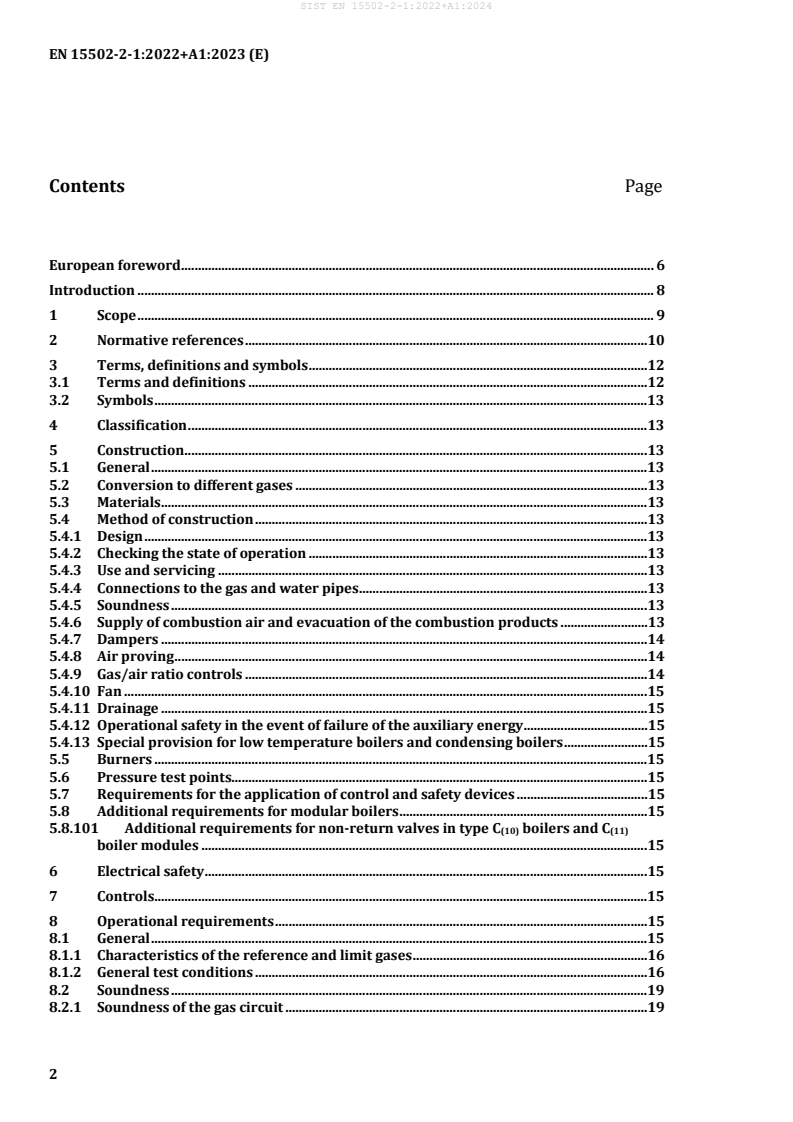
Contents Page
European foreword . 6
Introduction . 8
1 Scope . 9
2 Normative references .10
3 Terms, definitions and symbols .12
3.1 Terms and definitions .12
3.2 Symbols .13
4 Classification .13
5 Construction .13
5.1 General .13
5.2 Conversion to different gases .13
5.3 Materials .13
5.4 Method of construction .13
5.4.1 Design .13
5.4.2 Checking the state of operation .13
5.4.3 Use and servicing .13
5.4.4 Connections to the gas and water pipes .13
5.4.5 Soundness .13
5.4.6 Supply of combustion air and evacuation of the combustion products .13
5.4.7 Dampers .14
5.4.8 Air proving .14
5.4.9 Gas/air ratio controls .14
5.4.10 Fan .15
5.4.11 Drainage .15
5.4.12 Operational safety in the event of failure of the auxiliary energy .15
5.4.13 Special provision for low temperature boilers and condensing boilers .15
5.5 Burners .15
5.6 Pressure test points.15
5.7 Requirements for the application of control and safety devices .15
5.8 Additional requirements for modular boilers .15
5.8.101 Additional requirements for non-return valves in type C boilers and C
(10) (11)
boiler modules .15
6 Electrical safety .15
7 Controls .15
8 Operational requirements .15
8.1 General .15
8.1.1 Characteristics of the reference and limit gases .16
8.1.2 General test conditions .16
8.2 Soundness .19
8.2.1 Soundness of the gas circuit .19
8.2.2 Soundness of the combustion circuit . 19
8.2.3 Soundness of the water circuit . 23
8.2.4 Soundness of the domestic water circuit . 23
8.3 Hydraulic resistance . 23
8.4 Heat inputs and heat outputs . 23
8.4.101 Additional operational requirements for type C and C boiler modules . 24
(10) (11)
8.5 Limiting temperatures . 24
8.5.1 General . 24
8.5.2 Limiting temperatures of the adjusting, control and safety devices . 24
8.5.3 Limiting temperatures of the side walls, the front and the top . 25
8.5.4 Limiting temperature of the test panels and the floor . 25
8.5.101 External temperature of the ducts where the ducts are in contact with and or
passing through a wall . 25
8.6 Ignition, cross lighting, flame stability . 25
8.6.1 General . 25
8.6.2 Limit conditions . 25
8.6.3 Special flue conditions . 26
8.6.4 Reduction of the gas rate of the ignition burner . 28
8.6.101 Resistance to draught for type B boilers . 29
8.7 Reduction of the gas pressure . 29
8.8 Defective closure of the gas valve immediately upstream of the main burner . 29
8.9 Pre-purge . 29
8.9.101 General . 29
8.9.102 Tests and test conditions for pre-purging . 31
8.9.103 Requirements for verification of the protected nature of a combustion chamber
8.9.104 Test conditions for verification of the protected nature of a combustion
chamber . 31
8.9.105 Requirements for verification of normal ignition in a combustible air/gas
mixture for type C boilers incorporating a fan . 31
8.9.106 Test conditions for verification of normal ignition in a combustible air/gas
mixture for type C boilers incorporating a fan . 32
8.10 Functioning of a permanent ignition burner when the fan stops during the standby
time . 32
8.11 Adjustment, control and safety devices . 32
8.11.1 General . 32
8.11.2 Boilers intended to be installed in a partially protected place . 32
8.11.3 Combination boilers . 32
8.11.4 Control devices . 32
8.11.5 Ignition devices . 32
8.11.6 Flame supervision device . 32
8.11.7 Gas pressure regulator . 33
8.11.8 Thermostats and water temperature limiting devices . 33
8.11.101 Air proving . 33
8.12 Carbon monoxide . 36
8.12.1 General . 36
8.12.2 Limit conditions . 36
8.12.3 Special conditions . 37
8.12.4 Sooting . 40
8.12.5 Supplementary test for low temperature boilers and condensing boilers . 40
8.13 NO . 40
x
8.14 Special provisions for boilers intended to be installed in a partially protected place
................................................................................................................................................................... 40
8.15 Formation of condensate .40
8.16 Temperature of combustion products .40
8.16.101 General .40
8.16.102 Designation and measurement of reference temperatures of flue systems .41
8.17 Sound power level .41
8.101 Mechanical resistance and stability of ducts, terminal and fitting pieces .41
8.101.1 General requirement .41
8.101.2 Compressive strength .41
8.101.3 Lateral strength .42
8.101.4 Flexible metallic liners .43
8.102 Requirements for plastic in the combustion product evacuation ducts, terminals and
fitting pieces of boilers .43
8.102.1 Thermal resistance .43
8.102.2 Materials .43
8.103 Requirements for elastomeric seals and elastomeric sealants in the combustion
product evacuation ducts, terminals and fitting pieces .49
8.103.1 Characterization .49
8.103.2 Long-term resistance to thermal load .50
8.103.3 Long-term resistance to condensate exposure .51
8.103.4 Cyclic condensate resistance test .52
8.103.5 Relaxation behaviour .52
8.103.6 Compression set .53
8.103.7 Low temperature resistance .53
8.103.8 Joints in elastomeric seals .53
8.104 Additional requirements for non-return valve for type C boilers and C boiler
(10) (11)
modules .53
8.104.1 General .53
8.104.2 Nominal working temperature at the position of the non-return valve .54
8.104.3 Leak tightness of the non-return valve .54
8.104.4 Functional durability of the non-return valve .54
8.104.5 Safety of boilers in case of a failing non-return valve .55
8.105 Additional requirements for the evaluation of the maximum heat input of the
common duct system of type C boilers.56
(11)
8.105.1 Requirements of common duct system without wind conditions .56
8.105.2 Additional requirements of common duct system due to wind influence .57
9 Useful efficiencies .58
10 Electric auxiliary energy .58
11 Risk assessment .58
12 Marking and instructions .58
12.1 Boiler marking .58
12.2 Instructions .58
12.2.1 Instructions for installation .58
12.2.2 Instructions for use and servicing .64
12.3 Presentation .64
Annex A A (normative) Test apparatus for type C boilers .78
Annex X B (normative) Test methods to determine the effects of long-term thermal load,
long-term condensate exposure, condensing/non-condensing cycling and resistance
to UV radiation .79
Annex Y C (informative) This annex is empty on purpose .80
Annex Z D (informative) Example on calculation of common duct system for type C
(11)
boilers . 81
Annex ZA (informative) Left empty on purpose . 83
Annex ZB (informative) Clauses of this European Standard addressing the methods for the
verification of the efficiency of the EU Directive 92/42/EEC, relating to the efficiency
of new hot boilers with an output of (4 – 400) kW . 84
Annex ZC (informative) Relationship between this European Standard and the ecodesign
requirements of Commission Regulation (EU) No 813/2013 L 239/136 aimed to be
covered . 85
Annex ZD (informative) Relationship between this European Standard and the energy
labelling requirements of Commission Delegated Regulation (EU) No
811/2013 L 239/1 aimed to be covered . 88
Annex ZE (informative) Relationship between this European Standard and the essential
requirements of Regulation (EU) 2016/426 of the European Parliament and of the
Council of 9 March 2016 on appliances burning gaseous fuels and repealing
Directive 2009/142/EC aimed to be covered . 91
Bibliography . 105
European foreword
This document (EN 15502-2-1:2022+A1:2023) has been prepared by Technical Committee CEN/TC 109
“Central heating boilers using gaseous fuels”, the secretariat of which is held by NEN.
This European Standard shall be given the status of a national standard, either by publication of an
identical text or by endorsement, at the latest by June 2024, and conflicting national standards shall be
withdrawn at the latest by June 2024.
Attention is drawn to the possibility that some of the elements of this document may be the subject of
patent rights. CEN shall not be held responsible for identifying any or all such patent rights.
This document supersedes !EN 15502-2-1:2022".
This document includes Amendment 1, approved by CEN on 2023-10-11.
The start and finish of text introduced or altered by amendment is indicated in the text by tags !"
!deleted paragraphs"
EN 15502 consists of the following parts under the general title “Gas-fired heating boilers”:
— Part 1: General requirements and tests;
— Part 2-1: Specific standard for type C appliances and type B2, B3 and B5 appliances of a nominal heat
input not exceeding 1 000 kW (this document);
—
Part 2-2: Specific standard for type B1 appliances.
Relationship between this document and EN 15502-1, Gas-fired heating boilers — Part 1: General
requirements and tests:
This document is to be used in conjunction with EN 15502-1:2021 and follows the numbering structure
of EN 15502-1:2021.
Where this European Standard states:
— shall be according to EN 15502-1:2021, (clause number) with the following modification;
— shall be according to EN 15502-1:2021, (clause number) with the following addition;
— EN 15502-1:2021, (clause number) is replaced by the following;
— EN 15502-1:2021, (clause number) is not applicable;
the relevant text of EN 15502-1:2021 is to be adapted accordingly.
This document adds clauses or subclauses to the structure of EN 15502-1:2021 which are particular to
this Part 2 standard. It should be noted that these clauses and subclauses are not indicated as an addition.
Clauses, subclauses and annexes which are additional to those in EN 15502-1:2021 are numbered
starting from 101, or designated as Annex XA, XB, XC, etc.
This document has been prepared under mandates M89/6 and M066, given to CEN by the European
Commission and the European Free Trade Association, and supports essential requirements as meant in
article 3 of EU Directive 2009/142/EC, relating to appliances burning gaseous fuels and the verification
methods valid for production and measurements, as meant in article 5.2 of EU Directive 92/42/EEC,
relating to the efficiency requirements for new hot water boilers fired with liquid or gaseous fuels, with
an output of 4 – 400 kW.
This document has been prepared under the mandates M/534 and M/535, given to CEN by the European
Commission and the European Free Trade Association to provide a means of conforming to:
— requirements of Commission Regulation (EC) No 813/2013 of 2 August 2013 implementing Directive
2009/125/EC of the European Parliament and of the Council with regard to ecodesign requirements
for space heaters and combination heaters;
— requirements of Commission Delegated Regulation (EC) No 811/2013 of 18 February 2013
supplementing Directive 2010/30/EC of the European Parliament and of the Council with regard to
energy labelling of space heaters, combination heaters, packages of space heater, temperature
control and solar device and packages of combination heater, temperature control and solar device.
For relationship with EU Directive(s) / Regulation(s), see informative Annexes ZB, ZC, ZD and ZE which
are integral parts of this document.
Any feedback and questions on this document should be directed to the users’ national standards body.
A complete listing of these bodies can be found on the CEN website.
According to the CEN-CENELEC Internal Regulations, the national standards organisations of the
following countries are bound to implement this European Standard: Austria, Belgium, Bulgaria, Croatia,
Cyprus, Czech Republic, Denmark, Estonia, Finland, France, Germany, Greece, Hungary, Iceland, Ireland,
Italy, Latvia, Lithuania, Luxembourg, Malta, Netherlands, Norway, Poland, Portugal, Republic of North
Macedonia, Romania, Serbia, Slovakia, Slovenia, Spain, Sweden, Switzerland, Türkiye and the United
Kingdom.
Introduction
The basic function of gas-fired heating boiler is to generate heat by direct heat transfer in a heat
exchanger, from the combustion gasses to the water.
The boiler can include in one design more than one function. It can include for example:
— a sanitary hot water function;
— a function to supply the combustion air from the outside/open air;
— a function to dispose the combustion products to the outside/open air.
The boiler can be supplied to the market in more than one part. If the boiler is supplied to the market in
multiple parts, the boiler is the assembly of various parts according to the instructions for installation.
Boilers can be designed to be connected to specific parts of a building. Connection to a chimney and the
means of combustion air supply is particularly relevant.
Matters related to quality assurance systems, tests during production, and certificates of conformity of
auxiliary devices are not dealt with in this series of European Standards.
1 Scope
This document specifies the requirements and test methods, as well as the classification and marking of
gas-fired central heating boilers that are fitted with atmospheric burners, fan assisted atmospheric
burners or fully premixed burners, and are hereafter referred to as “boilers”.
This document is intended to be used in conjunction with EN 15502-1:2021.
This document covers gas-fired central heating boilers from the types C up to C and the types B , B
1 (11) 2 3
and B :
NOTE 1 For further background information on appliance types see EN 1749:2020.
a) that have a nominal heat input (on the basis of net calorific value) not exceeding 1 000 kW;
b) that use one or more combustible gases of the three gas families at the pressures stated in
EN 437:2021;
c) where the temperature of the heat transfer fluid does not exceed 105 °C during normal operation;
d) where the maximum operating pressure in the water circuit does not exceed 6 bar;
e) which can give rise to condensation under certain circumstances;
f) which are declared in the instructions for installation to be either a “condensing” boiler or a “low
temperature boiler” or a “standard boiler”; if no declaration is given the boiler is to be considered a
“standard boiler”;
g) which are intended to be installed inside a building or in a partially protected place;
h) which are intended to produce also hot water either by the instantaneous or storage principle as a
single unit;
i) which are designed for either sealed water systems or for open water systems;
j) which are either modular boilers, or non-modular boilers.
k) which are from the types C that are equipped with a gas-air ratio control and that have a ∆p
(10) max,
of 25 Pa, and C that have condensing boiler modules that are equipped with a gas-air ratio
saf(min) (11)
control and that have a ∆p of 25 Pa.
max, saf(min)
NOTE 2 This document provides requirements for boilers with known constructions. For boilers with any
alternative constructions, which might not fully be covered by this standard, the risk associated with this alternative
construction needs to be assessed.
An example of an assessment methodology, based upon risk assessment, is given in Clause 11.
This document does not cover all the requirements for:
aa) appliances above 1 000 kW;
ab) appliances that are intended to be connected to gas grids where the quality of the distributed gas is
likely to vary to a large extent over the lifetime of the appliance (see Annex AB of EN 15502-1:2021);
ac) appliances using flue dampers;
ad) appliances of the types B , B , B , C , C , C , C , C , C , C and C ;
21 31 51 21 41 51 61 71 81 (12) (13)
ae) C appliances that have a nominal heat input (on the basis of net calorific value) exceeding 70 kW;
af) appliances incorporating flexible plastic flue liners;
ag) C boilers:
(10)
1) without a gas-air ratio control, or
2) which are non-condensing appliances, or
3) which have a maximum safety pressure difference at minimum heat input not equal to 25 Pa
(∆p );
max, saf(min)
ah) C boilers that have boiler modules:
(11)
1) without a gas-air ratio control, or
2) which are non-condensing appliances, or
3) which have a maximum safety pressure difference at minimum heat input not equal to 25 Pa
(∆p );
max, saf(min)
ai) appliances intended to be connected to a flue having mechanical extraction;
aj) surface temperatures of external parts particular to children and elderly people;
ak) appliances that are intended to burn natural gases of the second family where hydrogen is added to
the natural gas;
al) appliances equipped with an adaptive combustion control function (ACCF);
am) boilers intended to be installed in areas accessible to elderly people and children.
2 Normative references
The following documents are referred to in the text in such a way that some or all of their content
constitutes requirements of this document. For dated references, only the edition cited applies. For
undated references, the latest edition of the referenced document (including any amendments) applies.
In this standard the normative references of Part 1 are valid. Furthermore, the following normative
references are valid:
EN 513:2018, Plastics — Poly(vinyl chloride) (PVC) based profiles — Determination of the resistance to
artificial weathering
EN 1856-2:2009, Chimneys — Requirements for metal chimneys — Part 2: Metal flue liners and connecting
flue pipes
EN 1749:2020, Classification of gas appliances according to the method of supplying combustion air and of
evacuation of the combustion products (types)
EN 13216-1:2019, Chimneys — Test methods for system chimneys — Part 1: General test methods
EN 13501-1:2018, Fire classification of construction products and building elements — Part 1:
Classification using data from reaction to fire tests
EN 14241-1:2013, Chimneys — Elastomeric seals and elastomeric sealants — Material requirements and
test methods — Part 1: Seals in flue liners
EN 14471:2013+A1:2015, Chimneys — System chimneys with plastic flue liners — Requirements and test
methods
EN 14989-1:2007, Chimneys — Requirements and test methods for metal chimneys and material
independent air supply ducts for roomsealed heating applications — Part 1: Vertical air/flue terminals for
C6-type appliances
EN 15502-1:2021, Gas-fired heating boilers — Part 1: General requirements and tests
CEN/TS 16134:2011, Chimney terminals — General requirements and material independent test methods
EN ISO 178:2019, Plastics — Determination of flexural properties (ISO 178:2019)
EN ISO 179-1:2010, Plastics — Determination of Charpy impact properties — Part 1: Non-instrumented
impact test (ISO 179-1:2010)
EN ISO 527-1:2019, Plastics — Determination of tensile properties — Part 1: General principles (ISO 527-
1:2019)
EN ISO 527-2:2012, Plastics — Determination of tensile properties — Part 2: Test conditions for moulding
and extrusion plastics (ISO 527-2:2012)
EN ISO 1183-1:2019, Plastics — Methods for determining the density of non-cellular plastics — Part 1:
Immersion method, liquid pycnometer method and titration method (ISO 1183-1:2019, Corrected version
2019-05)
EN ISO 1183-2:2019, Plastics — Methods for determining the density of non-cellular plastics — Part 2:
Density gradient column method (ISO 1183-2:2019)
EN ISO 1183-3:1999, Plastics — Methods for determining the density of non-cellular plastics — Part 3: Gas
pyknometer method (ISO 1183-3:1999)
EN ISO 9969:2016, Thermoplastics pipes — Determination of ring stiffness (ISO 9969:2016)
ISO 37:2017, Rubber, vulcanized or thermoplastic — Determination of tensile stress-strain properties
ISO 188:2011, Rubber, vulcanized or thermoplastic — Accelerated ageing and heat resistance tests
ISO 815-1:2019, Rubber, vulcanized or thermoplastic — Determination of compression set — Part 1: At
ambient or elevated temperatures
ISO 815-2:2019, Rubber, vulcanized or thermoplastic — Determination of compression set — Part 2: At low
temperatures
ISO 1817:2015, Rubber, vulcanized or thermoplastic — Determination of the effect of liquids
ISO 2781:2018, Rubber, vulcanized or thermoplastic — Determination of density
ISO 6914:2014, Rubber, vulcanized or thermoplastic — Determination of ageing characteristics by
measurement of stress relaxation in tension
ISO 48-4:2018, Rubber, vulcanized or thermoplastic — Determination of hardness — Part 4: Indentation
hardness by durometer method (Shore hardness)
ISO 48-5:2018, Rubber, vulcanized or thermoplastic — Determination of hardness — Part 5: Indentation
hardness by IRHD pocket meter method
3 Terms, definitions and symbols
3.1 Terms and definitions
For the purposes of this document, the terms and definitions given in EN 15502-1:2021 and the following
apply. They are numbered in accordance with the specific groups they belong to.
EN 15502-1:2021, 3.1.3.11 is replaced by the following:
3.1.3.11
fitting piece
device that is part of the gas appliance, which allows connection of the appliance to ducts that are not
part of the appliance
Note 1 to entry: Some examples of connections are:
a) the air supply and combustion products evacuation ducts to a single common duct for type C2 boilers;
b) the air supply and combustion products evacuation ducts to two ducts of a common duct system for type C
and C(10) boilers”;
c) type C6 boilers to a system for air supply and combustion products evacuation that is approved and marketed
independently from the boiler;
d) the combustion products evacuation duct to a chimney that is part of the building for type C boilers;
e) the air supply duct to a chimney that is part of the building for type C9 boilers;
f) type B2 boilers to a system for combustion products evacuation that is approved and marketed independently
from the boiler;
g) the combustion products evacuation duct to a shared duct system for type B3 boilers
EN 15502-1:2021, 3.1.3.21 is replaced by the following:
3.1.3.21
common duct
duct to which multiple boilers or boiler modules are connected
Note 1 to entry: A common duct to connect boiler modules of a modular boiler (3.1.10.10) is part of the modular
boiler. A common duct to connect multiple boilers is not part of the boilers but part of the building.
Add the following definitions at the end of EN 15502-1:2021, 3.1.14:
3.1.14.101
declared maximum pressure differences
maximum values of the pressure differences between the combustion products outlet and air inlet at the
end of the fitting pieces where these are connected to the common duct system
3.1.14.102
declared minimum pressure differences
minimum values of the pressure differences between the combustion products outlet and air inlet at the
end of the fitting pieces where these are connected to the common duct system
3.1.14.103
non-return valve
one-way valve that allows fluids to flow through it in only one direction
3.2 Symbols
Shall be according to EN 15502-1:2021, 3.2.
4 Classification
Shall be according to EN 15502-1:2021, Clause 4.
5 Construction
5.1 General
Shall be according to EN 15502-1:2021, 5.1.
5.2 Conversion to different gases
Shall be according to EN 15502-1:2021, 5.2.
5.3 Materials
Shall be according to EN 15502-1:2021, 5.3.
5.4 Method of construction
5.4.1 Design
Shall be according to EN 15502-1:2021, 5.4.1.
5.4.2 Checking the state of operation
Shall be according to EN 15502-1:2021, 5.4.2.
5.4.3 Use and servicing
Shall be according to EN 15502-1:2021, 5.4.3.
5.4.4 Connections to the gas and water pipes
Shall be according to EN 15502-1:2021, 5.4.4.
5.4.5 Soundness
Shall be according to EN 15502-1:2021, 5.4.5.
5.4.6 Supply of combustion air and evacuation of the combustion products
EN 15502-1:2021, 5.4.6 is replaced by the following:
5.4.6.101 General
The boiler shall be so designed that there is an adequate supply of combustion air during ignition and
over the whole range of possible heat inputs stated. A gas/air ratio control is permitted.
Fan assisted boilers may be fitted with a means of adjustment in the combustion circuit intended to adapt
the boiler to the pressure losses in the installed ducts either by restrictors or by setting the means of
adjustment to predetermined positions in accordance with the instructions for installation.
NOTE See the definition of boiler in 3.1.10.2.
5.4.6.102 Air supply and combustion products evacuation ducts
The assembly of the various parts during installation shall be such that no work is necessary other than
adjusting the length of the air supply and combustion products evacuation ducts.
Such adaptation shall not impair the correct operation of the boiler.
It shall be possible to connect the boiler, the air supply and combustion products evacuation ducts and
the terminal or fitting piece using ordinary tools.
The terminal inlets/outlets from separate combustion and air supply circuits for the supply of
combustion air and the evacuation of combustion products:
a) shall fit inside a square of 50 cm × 50 cm for type C and C boilers, for boilers up to 70 kW;
1 3
b) shall fit inside a square of 100 cm × 100 cm for type C and C boilers, for boilers above 70 kW;
1 3
c) may terminate in zones of different pressure for type C boilers, but not on different walls of the
building.
5.4.6.103 Terminal
Terminals on appliances without a fan shall prevent the intrusion of external objects by having no
opening in the external surfaces of the terminal allowing the entry of a 16 mm diameter ball when applied
with a force of 5 N.
Any horizontal terminal for non-condensing boilers shall be designed in such a way that any condensate
which may form is discharged away from the surface of the wall to which the terminal is fitted.
Any horizontal terminal for condensing boilers shall be designed in such a way that condensate is directed
towards the appliance.
5.4.6.104 Terminal guard
If the
...