

EN 14214:2026
(Main)Liquid petroleum products - Fatty acid methyl esters (FAME) for use in diesel engines and heating applications - Requirements and test methods
- Abstract
This document specifies requirements and test methods for marketed and delivered fatty acid methyl esters (hereafter known as FAME) to be used either as fuel for diesel engines and for heating applications at 100 % concentration, or as a blend component for fuel for diesel engines and heating applications in accordance with the requirements of appropriate standards. At 100 % concentration it is applicable to fuel for use in diesel engines and in heating applications designed or subsequently adapted to run on 100 % FAME.
NOTE For the purposes of this document, the terms “% (m/m)” and “% (V/V)” are used to represent respectively the mass fraction, µ, and the volume fraction, φ.
- Status
- Published
- Publication Date
- 30-May-2024
- Technical Committee
- CEN/TC 19 - Gaseous and liquid fuels, lubricants and related products of petroleum, synthetic and biological origin
- Drafting Committee
- CEN/TC 19/WG 24 - Specification of distillate fuels
- Current Stage
- 6060 - Definitive text made available (DAV) - Publishing
- Start Date
- 30-Sep-2026
- Due Date
- 31-May-2024
- Completion Date
- 31-May-2024

EN 14214:2026 is a CEN European Standard for fatty acid methyl esters (FAME) used in diesel engines and heating applications. It specifies requirements, test methods, climate-dependent grades and dispute procedures for marketed and delivered FAME used neat at 100% or as a blend component, so producers, blenders, laboratories and buyers can check whether a batch is fit for its intended fuel use.
The standard is written for practical quality control. It uses % (m/m) for mass fraction and % (V/V) for volume fraction.
What does EN 14214:2026 specify?
EN 14214:2026 specifies the product characteristics, test methods and climate-related grades for FAME used either on its own or as a component in diesel fuel and heating fuel. For neat use, it applies to fuels designed or adapted to run on 100% FAME. For blend use, it sets the requirements for the FAME component that must then meet the relevant fuel standard.
The document is organized into:
- Clause 1 - Scope
- Clause 2 - Normative references
- Clause 3 - Terms and definitions
- Clause 4 - Sampling
- Clause 5 - Pump marking
- Clause 6 - Requirements and test methods
- Annexes A to D - calculation aids, background information and additional guidance
| Annex | What it covers |
|---|---|
| Annex A | Correction factor for calculating FAME density at 15 °C |
| Annex B | Background for choosing national climate grades |
| Annex C | Additional information on oxidation stability at 120 °C |
| Annex D | Calculation of FAME content average molecular weight |
What are the key requirements of EN 14214:2026?
EN 14214:2026 combines product limits, climate-dependent grades and dispute methods. In practice, the standard is used to decide whether delivered FAME can be released for use, blended, stored or marked as suitable for a specific fuel application.
Sampling, marking and additives
Clause 4 requires sampling in accordance with EN ISO 3170 or EN ISO 3171. This matters because many of the tests are sensitive to contamination and sample handling, so the sample has to represent the product in storage or in a pipeline.
Clause 5 requires marking on dispensing pumps and nozzles used for FAME fuel for diesel engines in accordance with EN 16942. That helps users identify the fuel at the point of delivery.
Clause 6.1 allows dyes or markers only if they do not interfere with legally required dyes or markers in finished fuels. Clause 6.2 allows additives for performance quality, and it strongly recommends oxidation stability enhancing additives at production and before storage. Clause 6.2.3 does not allow adding diesel or other hydrocarbons before compliance testing. In practice, that means compliance checks must be done on the FAME material itself, not on a diluted mixture.
General product requirements
Clause 6.3 and Table 1 set the general requirements for FAME. They cover FAME content, density, viscosity, flash point, cetane number, oxidation stability, acid value, iodine value, linolenic acid methyl ester, polyunsaturated esters, methanol, mono-, di- and triglycerides, free and total glycerol, water, total contamination, sulfur, Group I metals, Group II metals, phosphorus and saturated monoglycerides.
Several items are reporting criteria rather than pass-fail limits. That includes FAME content average molecular weight, phosphorus content by EN 14538, and saturated monoglycerides (SMG) by EN 17057. These reporting items give extra data on composition and contamination risk, which is useful for product development and for tracking whether the measured values support future limit setting.
Clause 6.3.3 requires the FAME to be free from adulterants or contaminants that would make it unacceptable for diesel engine vehicles or heating applications. Clause 6.3.4 sets a minimum net calorific value for heating use. In practice, that ensures the fuel delivers usable energy for heating applications, not just chemical conformity.
Climate-dependent grades
Clause 6.4 allows climate-dependent requirements to be defined nationally. For neat FAME, Table 2 provides CFPP grades that national annexes can select from. For FAME used as a blend component, Tables 3 and 4 provide grade options for cloud point, CFPP and monoglycerides content.
This matters because cold flow performance changes with climate and blending. The standard therefore expects National Standardization Bodies to define summer and winter grades, and possibly intermediate or regional grades, based on national meteorological data. For blend use, the climate grades are chosen before cold flow additives are applied, so the base FAME has to be suitable on its own.
Precision and disputes
Clause 6.5 says that all listed methods include precision statements and that disputes are resolved using EN ISO 4259-2. It also assigns arbitration methods for specific properties such as density, viscosity, flash point, cetane number, oxidation stability, iodine value, free glycerol, sulfur, metals, phosphorus, cloud point and CFPP.
That is important for contracts and acceptance testing. If buyer and supplier obtain different results, the standard tells them which method controls the final decision and how to handle bias correction.
What terms does EN 14214:2026 define?
- FAME - fatty acid methyl ester, defined as an ester made by transesterification or esterification of fats and oils of vegetal or animal origin.
- CFPP - cold filter plugging point, a low-temperature property used to judge whether fuel can pass through filters in cold conditions.
- SMG - saturated monoglycerides, a reported property linked in the document to cold-flow behavior in FAME blends.
- BHT - 2,6-di-tert-butyl-4-hydroxytoluene, cited as an example of an oxidation stability enhancing additive.
- DCN - derived cetane number, an ignition-quality indicator used for diesel-type fuels.
- ICN - indicated cetane number, another ignition-quality indicator used in one of the cited test methods.
Who uses EN 14214:2026?
EN 14214:2026 is used by FAME producers, fuel blenders, storage and distribution operators, testing laboratories, quality managers, purchasers and fuel-specification writers. They use it to sample material, test batch quality, define supply contracts, choose climate grades, mark dispensing equipment and resolve disputes over conformity. National Standardization Bodies also use it when creating national normative annexes for seasonal fuel grades.
What changed in EN 14214:2026 from the previous edition?
EN 14214:2026 supersedes EN 14214:2012+A2:2019. The foreword states these main technical changes:
- normative references were updated to undated versions
- the scope wording was clarified
- the BHT example was moved into a note
- information on net calorific values for heating applications was added
- FAME content average molecular weight became a reporting criterion
- the copper corrosion and sulfated ash requirements were deleted
- the limits for Group I metals and Group II metals were reduced
- phosphorus content and saturated monoglycerides were added as reporting criteria
- climate-dependent requirements were reworked as a recommendation for national normative annexes
- EN 23015 was replaced by EN ISO 3015 for cloud point, and EN ISO 22995 was added as an alternative cloud point method
- EN 12662 was replaced by EN 12662-2 for total contamination
- EN ISO 18335 was added as an alternative viscosity method
- EN ISO 20884 was removed as an arbitration method for sulfur
Which standards are used with EN 14214:2026?
| Standard | What it contributes |
|---|---|
| EN ISO 3170 | Manual sampling |
| EN ISO 3171 | Automatic pipeline sampling |
| EN 116 | CFPP method and dispute method |
| EN 12662-2 | Total contamination method |
| EN 14103 | FAME content, linolenic acid methyl ester content and data for average molecular weight |
| EN 14104 | Acid value |
| EN 14105 | Free and total glycerol, mono-, di- and triglycerides; also free glycerol dispute method |
| EN 14106 | Free glycerol |
| EN 14107 | Phosphorus content; dispute method for phosphorus |
| EN 14108 / EN 14109 | Sodium and potassium content |
| EN 14110 | Methanol content |
| EN 14111 | Iodine value; dispute method |
| EN 14112 | Oxidation stability at 110 °C |
| EN 14538 | Ca, Mg, Na, K and P by ICP OES; dispute method for metals and phosphorus |
| EN 15195 | Ignition delay and derived cetane number |
| EN 15751 | Oxidation stability by accelerated oxidation method at 110 °C; dispute method |
| EN 15779 | Polyunsaturated fatty acid methyl esters |
| EN 16294 | Phosphorus content by ICP OES |
| EN 16300 | Iodine value by calculation from gas chromatographic data |
| EN 16329 | CFPP by linear cooling bath |
| EN 16715 | Ignition delay and combustion delay method |
| EN 16942 | Fuel identification and pump marking |
| EN 17057 | Saturated monoglycerides content |
| EN 17155 | Indicated cetane number |
| EN ISO 2719 | Flash point, Pensky-Martens method |
| EN ISO 3015 | Cloud point; dispute method for cloud point |
| EN ISO 3104 | Kinematic viscosity; dispute method for viscosity |
| EN ISO 3675 / EN ISO 12185 | Density methods; EN ISO 12185 is the dispute method |
| EN ISO 3679 | Flash point dispute method |
| EN ISO 4259-2 | Precision interpretation and dispute resolution |
| EN ISO 5165 | Cetane engine method; dispute method for cetane number |
| EN ISO 12937 | Water content |
| EN ISO 13032 | Low sulfur by X-ray fluorescence |
| EN ISO 18335 | Alternative viscosity method |
| EN ISO 20846 | Sulfur content; dispute method |
| EN ISO 22995 | Alternative cloud point method |
| EN ISO 23581 | Alternative viscosity method |
| EN 14331 | Identification of FAME in hydrocarbon blends |
| EN 14078 | FAME content in middle distillates |
| EN 16568:2023 | Oxidation stability at 120 °C, discussed in Annex C |
| EN 590 | Diesel fuel specification referenced for blend context |
| EN 16934 | Steryl glycosides method, cited in the background material |
| CEN/TR 15367-1 | Good housekeeping guidance for diesel fuels |
| CEN/TR 16884 | Cold operability testing and fuel performance correlation |
| CEN/TR 16982 | Cold filterability issues |
| EN 14103:2020 | Current version cited for Annex D calculations |
| EN ISO 20846:2019 / EN ISO 20884:2019 | Current versions cited in the bibliography for sulfur methods |
What does the EN 14214:2026 document contain?
EN 14214:2026 contains one general requirements table, three climate-related grade tables, dispute-method rules and four informative or normative annexes. It also includes a calculation note for density correction and a worked calculation approach for average molecular weight in Annex D. For users, the document is mainly a specification-and-test package: it tells them what to measure, which method to use, and how to interpret conflicting results.
Relations
- Effective Date
- 18-Jan-2023
- Effective Date
- 21-Oct-2026
- Effective Date
- 21-Oct-2026
- Effective Date
- 21-Oct-2026
- Effective Date
- 21-Oct-2026
- Effective Date
- 21-Oct-2026
- Effective Date
- 21-Oct-2026
- Effective Date
- 21-Oct-2026
- Effective Date
- 21-Oct-2026
- Effective Date
- 21-Oct-2026
- Effective Date
- 21-Oct-2026
- Effective Date
- 21-Oct-2026
- Effective Date
- 21-Oct-2026
- Effective Date
- 21-Oct-2026
- Effective Date
- 21-Oct-2026
Get Certified
Connect with accredited certification bodies for this standard

Element Materials Technology
Materials testing and product certification.

ABS Group Brazil
ABS Group certification services in Brazil.

ABS Quality Evaluations Inc.
American Bureau of Shipping quality certification.
Sponsored listings
Frequently Asked Questions
EN 14214:2026 is a standard published by the European Committee for Standardization (CEN). Its full title is "Liquid petroleum products - Fatty acid methyl esters (FAME) for use in diesel engines and heating applications - Requirements and test methods". This standard covers: This document specifies requirements and test methods for marketed and delivered fatty acid methyl esters (hereafter known as FAME) to be used either as fuel for diesel engines and for heating applications at 100 % concentration, or as a blend component for fuel for diesel engines and heating applications in accordance with the requirements of appropriate standards. At 100 % concentration it is applicable to fuel for use in diesel engines and in heating applications designed or subsequently adapted to run on 100 % FAME. NOTE For the purposes of this document, the terms “% (m/m)” and “% (V/V)” are used to represent respectively the mass fraction, µ, and the volume fraction, φ.
This document specifies requirements and test methods for marketed and delivered fatty acid methyl esters (hereafter known as FAME) to be used either as fuel for diesel engines and for heating applications at 100 % concentration, or as a blend component for fuel for diesel engines and heating applications in accordance with the requirements of appropriate standards. At 100 % concentration it is applicable to fuel for use in diesel engines and in heating applications designed or subsequently adapted to run on 100 % FAME. NOTE For the purposes of this document, the terms “% (m/m)” and “% (V/V)” are used to represent respectively the mass fraction, µ, and the volume fraction, φ.
EN 14214:2026 is classified under the following ICS (International Classification for Standards) categories: 75.160.40 - Biofuels. The ICS classification helps identify the subject area and facilitates finding related standards.
EN 14214:2026 has the following relationships with other standards: It is inter standard links to EN 14214:2012+A2:2019, EN ISO 18335:2024, EN ISO 20846:2026, EN 16300:2024, EN 17155:2018, EN ISO 3170:2025, EN ISO 12185:2024, EN ISO 13032:2024, EN 14108:2003, EN 12662-2:2024, EN 16294:2012, EN 14107:2003, EN 14109:2003, EN ISO 3171:1999, EN ISO 5165:2020. Understanding these relationships helps ensure you are using the most current and applicable version of the standard.
EN 14214:2026 is associated with the following European legislation: EU Directives/Regulations: 2014/94/EU, 98/70/EC; Standardization Mandates: M/245. When a standard is cited in the Official Journal of the European Union, products manufactured in conformity with it benefit from a presumption of conformity with the essential requirements of the corresponding EU directive or regulation.
EN 14214:2026 is available in PDF format for immediate download after purchase. The document can be added to your cart and obtained through the secure checkout process. Digital delivery ensures instant access to the complete standard document.
Standards Content (Sample)
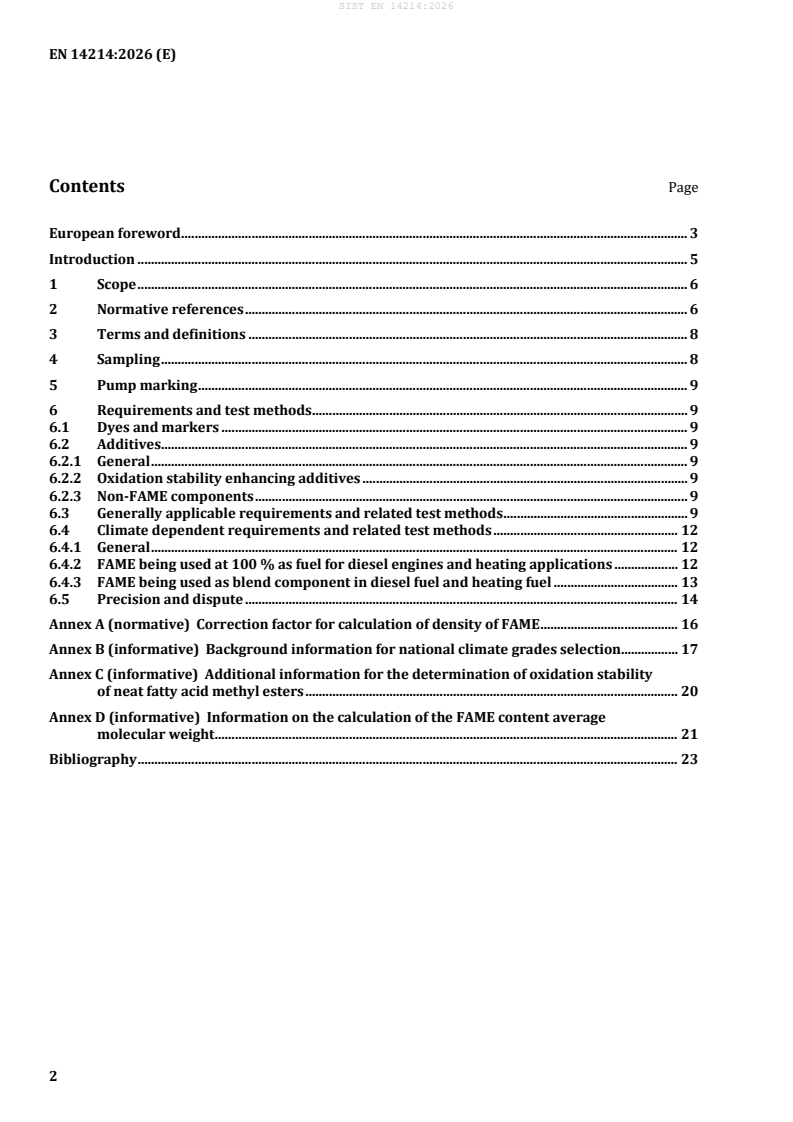
Contents
- Introduction
- 1 Scope
- 2 Normative references
- 3 Terms and definitions
- 3.1 fatty acid methyl ester
- 4 Sampling
- 5 Pump marking
- 6 Requirements and test methods
- 6.1 Dyes and markers
- 6.2 Additives
- 6.3 Generally applicable requirements and related test methods
- 6.4 Climate dependent requirements and related test methods
- 6.5 Precision and dispute
- Annex A
- Annex B
- Annex C
- Annex D
- Bibliography
Introduction
This document gives all relevant characteristics, requirements and test methods for fatty acid methyl esters (FAME), which are known at this time to be necessary to define the product for use in diesel engines and in heating applications.
Many of the test methods included in this document have been the subject of several interlaboratory testing to determine their applicability and their precision in relation to different sources of FAME. Subclause 6.4 gives climate-dependent requirements with options for grades suitable under certain environmental temperatures. To guide the user in the choice of relevant grades, the definition of a national normative annex is strongly recommended. National Standardization Bodies are responsible for adding a national normative annex to this document. Users should contact their National Standardization Body in case a national normative annex is missing.
Concerning cold temperature properties of diesel blends related to the quality of the FAME used as a blending component, strong indications towards the relationship with saturated monoglycerides (SMG) and steryl-glycosides (SG) have become known. As no test methods to detect those components separately were available in the past, an interim solution in setting cold filter plugging point (CFPP) and cloud point (CP) limitations has been included in EN 14214:2012 and its subsequent editions (see Table 3).
With EN 17057, a suitable test method for the direct determination of the content of saturated monoglycerides in FAME is now available. To gain experience in all CEN member countries with SMG, the parameter has been introduced as a reporting parameter in Table 1 of this document. The information gained will be used for consideration for future limit setting. Since EN 16934 [1] was published in 2017, data gathered for Europe have shown very low levels of SG below the detection limit and there have been no reported problems in the field that have been attributed to SG content. It is therefore not currently possible to determine an appropriate limit for SG. The situation and data will continue to be monitored.
In order to improve the lifetime of the exhaust aftertreatment system, lowering of the phosphorus limit is under investigation. EN 14538 for the determination of phosphorus has improved precision compared to EN 14107 and EN 16294 and is implemented as a reporting criterion to be able to collect data on phosphorus content in the future.
SIST EN 14214:2026 EN 14214:2026 (E)
1 Scope
This document specifies requirements and test methods for marketed and delivered fatty acid methyl esters (hereafter known as FAME) to be used either as fuel for diesel engines and for heating applications at 100 % concentration, or as a blend component for fuel for diesel engines and heating applications in accordance with the requirements of appropriate standards. At 100 % concentration it is applicable to fuel for use in diesel engines and in heating applications designed or subsequently adapted to run on 100 % FAME.
NOTE For the purposes of this document, the terms “% (m/m)” and “% (V/V)” are used to represent respectively the mass fraction, µ, and the volume fraction, φ.
2 Normative references
The following documents are referred to in the text in such a way that some or all of their content constitutes requirements of this document. For dated references, only the edition cited applies. For undated references, the latest edition of the referenced document (including any amendments) applies. EN 116, Diesel and domestic heating fuels — Determination of cold filter plugging point — Stepwise cooling bath method EN 12662-2, Liquid petroleum products — Determination of total contamination — Part 2: Fatty acid methyl esters EN 14103, Fat and oil derivatives — Fatty Acid Methyl Esters (FAME) — Determination of ester and linolenic acid methyl ester contents EN 14104, Fat and oil derivates — Fatty acid methyl ester (FAME) — Determination of acid value EN 14105, Fat and oil derivatives — Fatty Acid Methyl Esters (FAME) — Determination of free and total glycerol and mono-, di-, triglyceride contents EN 14106, Fat and oil derivatives — Fatty Acid Methyl Esters (FAME) — Determination of free glycerol content EN 14107, Fat and oil derivatives — Fatty Acid Methyl Esters (FAME) — Determination of phosphorus content by inductively coupled plasma (ICP) emission spectrometry EN 14108, Fat and oil derivatives — Fatty Acid Methyl Esters (FAME) — Determination of sodium content by atomic absorption spectrometry EN 14109, Fat and oil derivatives — Fatty Acid Methyl Esters (FAME) — Determination of potassium content by atomic absorption spectrometry EN 14110, Fat and oil derivatives — Fatty Acid Methyl Esters (FAME) — Determination of methanol content EN 14111, Fat and oil derivatives — Fatty Acid Methyl Esters (FAME) — Determination of iodine value EN 14112, Fat and oil derivatives — Fatty Acid Methyl Esters (FAME) — Determination of oxidation stability (accelerated oxidation test) EN 14538, Fat and oil derivatives — Fatty acid methyl ester (FAME) — Determination of Ca, Mg, Na, K and P content by optical emission spectral analysis with inductively coupled plasma (ICP OES)
SIST EN 14214:2026 EN 14214:2026 (E) EN 15195, Liquid petroleum products — Determination of ignition delay and derived cetane number (DCN) of middle distillate fuels by combustion in a constant volume chamber EN 15751, Automotive fuels — Fatty acid methyl ester (FAME) fuel and blends with diesel fuel — Determination of oxidation stability by accelerated oxidation method at 110 °C EN 15779, Petroleum products and fat and oil derivates — Fatty acid methyl esters (FAME) for diesel engines — Determination of polyunsaturated (≥4 double bonds) fatty acid methyl esters (PUFA) by gas chromatography EN 16294, Petroleum products and fat and oil derivatives — Determination of phosphorus content in fatty acid methyl esters (FAME) — Optical emission spectral analysis with inductively coupled plasma (ICP OES) EN 16300, Automotive fuels — Determination of iodine value in fatty acid methyl esters (FAME) — Calculation method from gas chromatographic data EN 16329, Diesel and domestic heating fuels — Determination of cold filter plugging point — Linear cooling bath method EN 16715, Liquid petroleum products — Determination of ignition delay and derived cetane number (DCN) of middle distillate fuels — Ignition delay and combustion delay determination using a constant volume combustion chamber with direct fuel injection EN 16942, Fuels — Identification of vehicle compatibility — Graphical expression for consumer information EN 17057, Automotive fuels and fat and oil derivates — Determination of saturated monoglycerides content in Fatty Acid Methyl Esters (FAME) — Method by GC-FID EN 17155, Liquid petroleum products — Determination of indicated cetane number (ICN) of middle distillate fuels — Primary reference fuels calibration method using a constant volume combustion chamber EN ISO 2719, Determination of flash point — Pensky-Martens closed cup method (ISO 2719) EN ISO 3015, Petroleum and related products from natural or synthetic sources — Determination of cloud point (ISO 3015) EN ISO 3104, Petroleum products — Transparent and opaque liquids — Determination of kinematic viscosity and calculation of dynamic viscosity (ISO 3104) EN ISO 3170, Hydrocarbon Liquids — Manual Sampling (ISO 3170) EN ISO 3171, Petroleum liquids — Automatic pipeline sampling (ISO 3171) EN ISO 3675, Crude petroleum and liquid petroleum products — Laboratory determination of density — Hydrometer method (ISO 3675) EN ISO 3679, Determination of flash point — Method for flash no-flash and flash point by small scale closed cup tester (ISO 3679) EN ISO 4259-2, Petroleum and related products — Precision of measurement methods and results — Part 2: Interpretation and application of precision data in relation to methods of test (ISO 4259-2) EN ISO 5165, Petroleum products — Determination of the ignition quality of diesel fuels — Cetane engine method (ISO 5165)
SIST EN 14214:2026 EN 14214:2026 (E) EN ISO 12185, Crude petroleum, petroleum products and related products — Determination of density — Laboratory density meter with an oscillating U-tube sensor (ISO 12185) EN ISO 12937, Petroleum products — Determination of water — Coulometric Karl Fischer titration method (ISO 12937) EN ISO 13032, Petroleum and related products — Determination of low concentration of sulfur in automotive fuels — Energy-dispersive X-ray fluorescence spectrometric method (ISO 13032) EN ISO 18335, Petroleum products and related products — Determination of kinematic viscosity by calculation from the measured dynamic viscosity and density — Method by constant pressure viscometer (ISO 18335) EN ISO 20846, Petroleum products — Determination of sulfur content of automotive fuels — Ultraviolet fluorescence method (ISO 20846) EN ISO 20884, Petroleum products — Determination of sulfur content of automotive fuels — Wavelengthdispersive X-ray fluorescence spectrometry (ISO 20884) EN ISO 22995, Petroleum products — Determination of cloud point — Automated step-wise cooling method (ISO 22995) EN ISO 23581, Petroleum products and related products — Determination of kinematic viscosity —Method by Stabinger type viscometer (ISO 23581)
3 Terms and definitions
For the purposes of this document, the following terms and definitions apply. ISO and IEC maintain terminological databases for use in standardization at the following addresses:
- ISO Online browsing platform: available at https://www.iso.org/obp
- IEC Electropedia: available at https://www.electropedia.org/
3.1 fatty acid methyl ester
FAME ester derived by transesterification or esterification of fats and oils of vegetal or animal origin
4 Sampling
Samples shall be taken in accordance with EN ISO 3170 or EN ISO 3171 for the sampling of automotive diesel fuel or heating fuel.
NOTE National standards or regulations can apply. The national requirements can be set out in a national annex to this document, either in detail or by reference only. In view of the sensitivity of some of the test methods referred to in this document, particular attention shall be paid to compliance with any guidance on sampling containers, which is included in the respective test method standard.
SIST EN 14214:2026 EN 14214:2026 (E)
5 Pump marking
Information to be marked on dispensing pumps and nozzles used for delivering FAME fuel to be used as fuel in diesel engines, and the dimensions of the mark shall be in accordance with EN 16942.
6 Requirements and test methods
6.1 Dyes and markers
The use of dyes or markers is allowed provided they do not affect the performance of legally required dyes or markers in finished fuels.
6.2 Additives
6.2.1 General
In order to improve and/or maintain the performance quality, the use of additives is allowed. Suitable fuel additives without known harmful side effects are recommended in the appropriate amount, to help avoid deterioration of driveability and emissions control durability. Other technical means with equivalent effect may also be used.
NOTE At the time of publication of this document, deposit forming tendency test methods suitable for routine control purposes have not yet been identified and developed.
6.2.2 Oxidation stability enhancing additives
In order to improve the oxidation stability of FAME, it is strongly recommended to add oxidation stability enhancing additives to FAME at the production stage and before storage. NOTE The use of 1 000 mg/kg of 2,6-di-tert-butyl-4-hydroxytoluene (BHT) has proven to be effective, although the resulting oxidation stability varies depending on the FAME feedstocks. CAUTION — There is a potential risk of precipitate formation with oxidation stability enhancing additives at low temperatures in low aromatic arctic fuel. Caution should therefore be taken in the choice of oxidation stability enhancing additives to arctic grade FAME.
6.2.3 Non-FAME components
The addition of non-FAME components (other than additives) such as diesel or other hydrocarbons prior to testing FAME for compliance with the EN 14214 specification is not permitted.
6.3 Generally applicable requirements and related test methods
6.3.1 When tested by the methods indicated in Table 1, FAME shall be in accordance with the limits specified in Table 1. The test methods listed in Table 1 have been shown to be applicable to FAME in an interlaboratory test programme.
6.3.2 In case of a need for identification of FAME in a hydrocarbon blend, the recommended method based on separation and characterization of FAME by LC/GC is EN 14331 [2]. 6.3.3 FAME shall be free from any adulterant or contaminant that may render the fuel unacceptable for use in diesel engine vehicles and heating applications.
NOTE For further information on preventing contamination by water or sediment that can occur in the supply chain, see CEN/TR 15367-1 [3].
...