

EN 12680-3:2025
(Main)Founding - Ultrasonic testing - Part 3: Spheroidal graphite cast iron castings
- Abstract
This document specifies the requirements for the ultrasonic testing of spheroidal graphite cast iron castings and the techniques for determining internal discontinuities by the pulse-echo technique.
This document does not apply to ultrasonic testing of the nodularity of spheroidal graphite cast irons.
This document does not apply to phased array technique and to transmission technique.
NOTE The transmission technique has insufficient sensitivity to detect the discontinuities found in spheroidal graphite cast iron castings and is used in exceptional cases only.
- Status
- Published
- Publication Date
- 18-Nov-2025
- Technical Committee
- CEN/TC 190 - Foundry technology
- Drafting Committee
- CEN/TC 190/WG 10 - Inner defects
- Current Stage
- 6060 - Definitive text made available (DAV) - Publishing
- Start Date
- 19-Nov-2025
- Due Date
- 21-Nov-2025
- Completion Date
- 19-Nov-2025

Overview
EN 12680-3:2025 - Founding - Ultrasonic testing - Part 3: Spheroidal graphite cast iron castings is a CEN standard that specifies requirements and techniques for the ultrasonic (pulse-echo) inspection of spheroidal graphite (ductile) cast iron castings. The document defines how to detect and evaluate internal discontinuities using conventional ultrasonic testing (UT), clarifies what is excluded (nodularity testing, phased array and transmission techniques) and sets the basis for consistent, reproducible non-destructive testing (NDT) of cast components.
Key topics and technical requirements
- Scope and exclusions: Applies to pulse-echo ultrasonic testing of spheroidal graphite cast iron castings. Does not cover nodularity inspection, phased array UT, or transmission technique (noted as generally insufficiently sensitive).
- Order and test planning: Specifies required order information (areas and percentage of castings to be tested, severity levels, written procedure, machining allowance).
- Wall-section zoning: Defines rim zone and core zone for acceptance criteria; special rules when discontinuities span zones.
- Severity and acceptance: Maximum acceptable sizes of discontinuities are governed by prescribed severity levels (tables referenced in standard); parties may agree on levels.
- Personnel qualification: UT shall be performed by qualified personnel (e.g., EN ISO 9712 or equivalent).
- Equipment requirements:
- Instruments per EN ISO 22232‑1 with range 10 mm to 2 m (steel equivalent), gain span ≥80 dB in ≤2 dB steps, time-base/vertical linearity inaccuracy <5%.
- Probe selection per EN ISO 22232‑2/3: dual‑element and single‑element compression probes for general use; dual‑element preferred for near-surface detection.
- Angle‑beam probes allowed for special geometries (nominal angles ~45°–70°, sound path ≈100 mm), frequency range 0.5–5 MHz; higher frequencies for thin sections (<20 mm) or surface-near features.
- Testability and sensitivity:
- Material suitability assessed using back-wall echo and noise level; reference echo must be at least 6 dB above noise.
- Distance-Gain-Size (DGS) techniques and reference reflectors are used to verify detection capability.
- Procedure and reporting: Contains requirements on surface preparation, scanning vs. point testing, indication evaluation, sizing/characterization and test reporting.
Applications - who uses it
- Foundry quality managers and process engineers for acceptance criteria of ductile iron castings.
- NDT technicians and inspection laboratories performing UT on automotive, heavy equipment, pump and valve, and industrial castings.
- Purchasers, OEMs and procurement teams specifying inspection and contractual testing requirements.
Related standards
- EN 12680-1, EN 12680-2, EN 12680-4 (other parts of the founding - ultrasonic testing series)
- EN ISO 16810, EN ISO 16811, EN ISO 16827, EN ISO 5577, EN ISO 2400, EN ISO 22232‑1/2/3, EN ISO 7963, EN ISO 9712
Keywords: EN 12680-3:2025, ultrasonic testing, spheroidal graphite cast iron, pulse-echo, non-destructive testing, foundry, dual-element probe, DGS, UT acceptance criteria.
Relations
- Replaces
EN 12680-3:2011 - Founding - Ultrasonic testing - Part 3: Spheroidal graphite cast iron castings - Effective Date
- 16-Aug-2023
- Effective Date
- 28-Jan-2026
- Effective Date
- 28-Jan-2026
- Effective Date
- 28-Jan-2026
- Effective Date
- 28-Jan-2026
- Effective Date
- 28-Jan-2026
- Effective Date
- 28-Jan-2026
- Effective Date
- 28-Jan-2026
- Effective Date
- 28-Jan-2026
- Effective Date
- 28-Jan-2026
- Effective Date
- 28-Jan-2026
- Effective Date
- 28-Jan-2026
Get Certified
Connect with accredited certification bodies for this standard

Element Materials Technology
Materials testing and product certification.

Inštitut za kovinske materiale in tehnologije
Institute of Metals and Technology. Materials testing, metallurgical analysis, NDT.
Sponsored listings
Frequently Asked Questions
EN 12680-3:2025 is a standard published by the European Committee for Standardization (CEN). Its full title is "Founding - Ultrasonic testing - Part 3: Spheroidal graphite cast iron castings". This standard covers: This document specifies the requirements for the ultrasonic testing of spheroidal graphite cast iron castings and the techniques for determining internal discontinuities by the pulse-echo technique. This document does not apply to ultrasonic testing of the nodularity of spheroidal graphite cast irons. This document does not apply to phased array technique and to transmission technique. NOTE The transmission technique has insufficient sensitivity to detect the discontinuities found in spheroidal graphite cast iron castings and is used in exceptional cases only.
This document specifies the requirements for the ultrasonic testing of spheroidal graphite cast iron castings and the techniques for determining internal discontinuities by the pulse-echo technique. This document does not apply to ultrasonic testing of the nodularity of spheroidal graphite cast irons. This document does not apply to phased array technique and to transmission technique. NOTE The transmission technique has insufficient sensitivity to detect the discontinuities found in spheroidal graphite cast iron castings and is used in exceptional cases only.
EN 12680-3:2025 is classified under the following ICS (International Classification for Standards) categories: 77.040.20 - Non-destructive testing of metals; 77.140.80 - Iron and steel castings. The ICS classification helps identify the subject area and facilitates finding related standards.
EN 12680-3:2025 has the following relationships with other standards: It is inter standard links to EN 12680-3:2011, EN ISO 5577:2025, EN ISO 16811:2025, EN ISO 22232-3:2020, EN ISO 16810:2024, EN ISO 2400:2025, EN ISO 16827:2025, EN ISO 22232-2:2020, EN ISO 22232-1:2020, EN ISO 7963:2022, EN 15776:2011, EN 1559-3:2011. Understanding these relationships helps ensure you are using the most current and applicable version of the standard.
EN 12680-3:2025 is available in PDF format for immediate download after purchase. The document can be added to your cart and obtained through the secure checkout process. Digital delivery ensures instant access to the complete standard document.
Standards Content (Sample)
SLOVENSKI STANDARD
01-januar-2026
Livarstvo - Ultrazvočno preskušanje - 3. del: Ulitki iz sive litine s kroglastim
grafitom
Founding - Ultrasonic testing - Part 3: Spheroidal graphite cast iron castings
Gießereiwesen - Ultraschallprüfung - Teil 3: Gussstücke aus Gusseisen mit Kugelgraphit
Fonderie - Contrôle par ultrasons - Partie 3: Pièces moulées en fonte à graphite
sphéroïdal
Ta slovenski standard je istoveten z: EN 12680-3:2025
ICS:
77.040.20 Neporušitveno preskušanje Non-destructive testing of
kovin metals
77.140.80 Železni in jekleni ulitki Iron and steel castings
2003-01.Slovenski inštitut za standardizacijo. Razmnoževanje celote ali delov tega standarda ni dovoljeno.
EN 12680-3
EUROPEAN STANDARD
NORME EUROPÉENNE
November 2025
EUROPÄISCHE NORM
ICS 77.040.20; 77.140.80 Supersedes EN 12680-3:2011
English Version
Founding - Ultrasonic testing - Part 3: Spheroidal graphite
cast iron castings
Fonderie - Contrôle par ultrasons - Partie 3: Pièces Gießereiwesen - Ultraschallprüfung - Teil 3:
moulées en fonte à graphite sphéroïdal Gussstücke aus Gusseisen mit Kugelgraphit
This European Standard was approved by CEN on 22 September 2025.
CEN members are bound to comply with the CEN/CENELEC Internal Regulations which stipulate the conditions for giving this
European Standard the status of a national standard without any alteration. Up-to-date lists and bibliographical references
concerning such national standards may be obtained on application to the CEN-CENELEC Management Centre or to any CEN
member.
This European Standard exists in three official versions (English, French, German). A version in any other language made by
translation under the responsibility of a CEN member into its own language and notified to the CEN-CENELEC Management
Centre has the same status as the official versions.
CEN members are the national standards bodies of Austria, Belgium, Bulgaria, Croatia, Cyprus, Czech Republic, Denmark, Estonia,
Finland, France, Germany, Greece, Hungary, Iceland, Ireland, Italy, Latvia, Lithuania, Luxembourg, Malta, Netherlands, Norway,
Poland, Portugal, Republic of North Macedonia, Romania, Serbia, Slovakia, Slovenia, Spain, Sweden, Switzerland, Türkiye and
United Kingdom.
EUROPEAN COMMITTEE FOR STANDARDIZATION
COMITÉ EUROPÉEN DE NORMALISATION
EUROPÄISCHES KOMITEE FÜR NORMUNG
CEN-CENELEC Management Centre: Rue de la Science 23, B-1040 Brussels
© 2025 CEN All rights of exploitation in any form and by any means reserved Ref. No. EN 12680-3:2025 E
worldwide for CEN national Members.
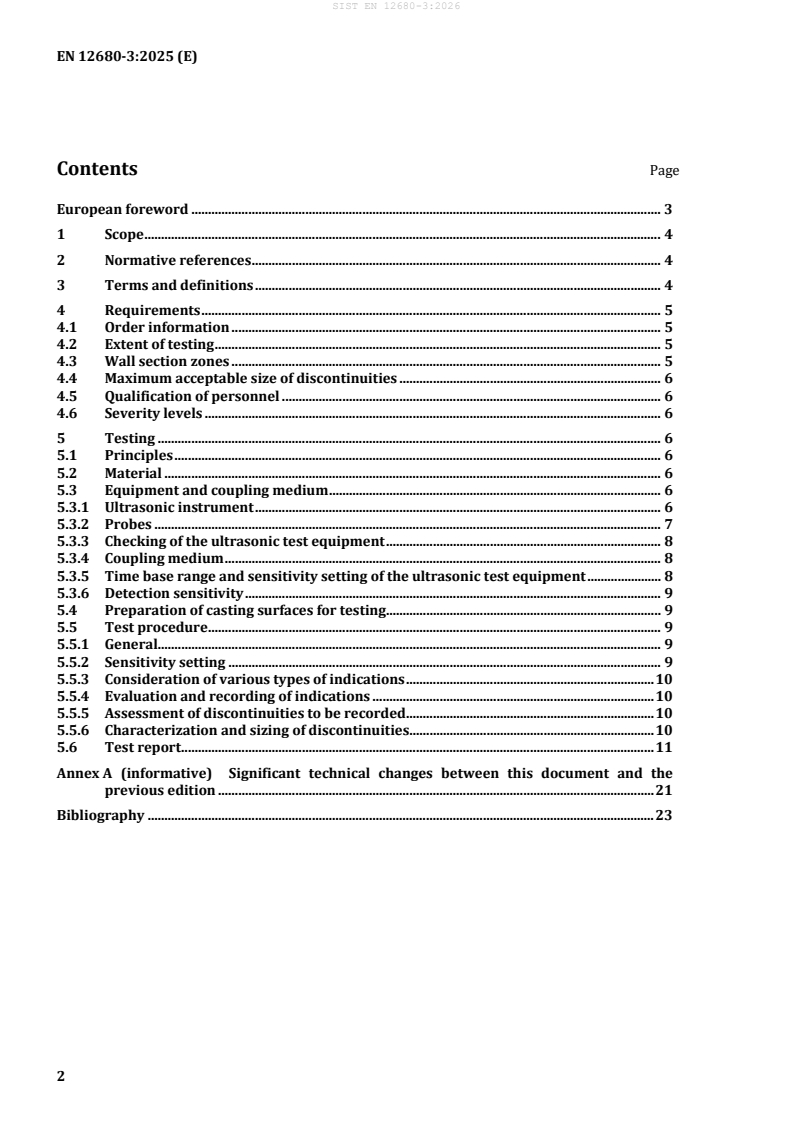
Contents Page
European foreword . 3
1 Scope . 4
2 Normative references . 4
3 Terms and definitions . 4
4 Requirements . 5
4.1 Order information . 5
4.2 Extent of testing . 5
4.3 Wall section zones . 5
4.4 Maximum acceptable size of discontinuities . 6
4.5 Qualification of personnel . 6
4.6 Severity levels . 6
5 Testing . 6
5.1 Principles . 6
5.2 Material . 6
5.3 Equipment and coupling medium . 6
5.3.1 Ultrasonic instrument . 6
5.3.2 Probes . 7
5.3.3 Checking of the ultrasonic test equipment . 8
5.3.4 Coupling medium . 8
5.3.5 Time base range and sensitivity setting of the ultrasonic test equipment . 8
5.3.6 Detection sensitivity . 9
5.4 Preparation of casting surfaces for testing. 9
5.5 Test procedure . 9
5.5.1 General. 9
5.5.2 Sensitivity setting . 9
5.5.3 Consideration of various types of indications . 10
5.5.4 Evaluation and recording of indications . 10
5.5.5 Assessment of discontinuities to be recorded . 10
5.5.6 Characterization and sizing of discontinuities . 10
5.6 Test report . 11
Annex A (informative) Significant technical changes between this document and the
previous edition . 21
Bibliography . 23
European foreword
This document (EN 12680-3:2025) has been prepared by Technical Committee CEN/TC 190 “Foundry
technology”, the secretariat of which is held by DIN.
This European Standard shall be given the status of a national standard, either by publication of an
identical text or by endorsement, at the latest by May 2026, and conflicting national standards shall be
withdrawn at the latest by May 2026.
Attention is drawn to the possibility that some of the elements of this document may be the subject of
patent rights. CEN shall not be held responsible for identifying any or all such patent rights.
This document supersedes EN 12680-3:2011.
Annex A provides details of significant technical changes between EN 12680-3:2025 and
EN 12680 3:2011.
This is one of four European Standards for ultrasonic testing. The other standards are:
— EN 12680-1, Founding — Ultrasonic testing — Part 1: Steel castings for general purposes
— EN 12680-2, Founding — Ultrasonic testing — Part 2: Steel castings for highly stressed components
— EN 12680-4, Founding — Ultrasonic testing — Part 4: Phased array ultrasonic testing of steel castings
Any feedback and questions on this document should be directed to the users’ national standards body.
A complete listing of these bodies can be found on the CEN website.
According to the CEN-CENELEC Internal Regulations, the national standards organisations of the
following countries are bound to implement this European Standard: Austria, Belgium, Bulgaria, Croatia,
Cyprus, Czech Republic, Denmark, Estonia, Finland, France, Germany, Greece, Hungary, Iceland, Ireland,
Italy, Latvia, Lithuania, Luxembourg, Malta, Netherlands, Norway, Poland, Portugal, Republic of North
Macedonia, Romania, Serbia, Slovakia, Slovenia, Spain, Sweden, Switzerland, Türkiye and the United
Kingdom.
1 Scope
This document specifies the requirements for the ultrasonic testing of spheroidal graphite cast iron
castings and the techniques for determining internal discontinuities by the pulse-echo technique.
This document does not apply to ultrasonic testing of the nodularity of spheroidal graphite cast irons.
This document does not apply to phased array technique and to transmission technique.
NOTE The transmission technique has insufficient sensitivity to detect the discontinuities found in spheroidal
graphite cast iron castings and is used in exceptional cases only.
2 Normative references
The following documents, in whole or in part, are normatively referenced in this document and are
indispensable for its application. For dated references, only the edition cited applies. For undated
references, the latest edition of the referenced document (including any amendments) applies.
EN ISO 16810, Non-destructive testing — Ultrasonic testing — General principles (ISO 16810)
EN ISO 16811, Non-destructive testing — Ultrasonic testing — Sensitivity and range setting (ISO 16811)
EN ISO 16827, Non-destructive testing — Ultrasonic testing — Characterization and sizing of
discontinuities (ISO 16827)
EN ISO 5577, Non-destructive testing — Ultrasonic testing — Vocabulary (ISO 5577)
EN ISO 2400, Non-destructive testing — Ultrasonic testing — Specification for standard block No. 1
(ISO 2400)
EN ISO 22232-1, Non-destructive testing — Characterization and verification of ultrasonic test equipment
— Part 1: Instruments (ISO 22232-1)
EN ISO 22232-2, Non-destructive testing — Characterization and verification of ultrasonic test equipment
— Part 2: Probes (ISO 22232-2)
EN ISO 22232-3, Non-destructive testing — Characterization and verification of ultrasonic test equipment
— Part 3: Combined equipment (ISO 22232-3)
EN ISO 7963, Non-destructive testing — Ultrasonic testing — Specification for calibration block No. 2
(ISO 7963)
3 Terms and definitions
For the purposes of this document, the terms and definitions given in EN ISO 5577 and the following
apply.
ISO and IEC maintain terminology databases for use in standardization at the following addresses:
— ISO Online browsing platform: available at https://www.iso.org/obp/
— IEC Electropedia: available at https://www.electropedia.org/
3.1
rim zone
1/5 of the through-wall thickness from the surface with a minimum of 5 mm and a maximum of 30 mm
thickness in through-wall direction
3.2
dross
accumulation of fine slag particles (oxides, sulphides, etc.) in the rim zone of castings
Note 1 to entry: In smaller castings dross is usually not detected by ultrasonic testing.
4 Requirements
4.1 Order information
The following information shall be available at the time of enquiry and order (see also EN ISO 16810):
a) the areas of the casting and the number or percentage of castings to which the ultrasonic testing
requirements apply.
b) the severity levels for small castings in accordance with Table 1 and if applicable Table 3, or for large
castings Table 2 and if applicable Table 4, to be applied to the various areas of the casting.
c) requirements for a written test procedure.
d) the customer should inform the supplier about the required amount of machining.
e) whether there are any additional requirements.
NOTE 1 Severity levels in Tables 1 and 3 as well as in Tables 2 and 4 can be chosen differently.
NOTE 2 Small castings are typically produced under serial conditions, e.g. automatic moulding lines, with a mass
up to 200 kg.
NOTE 3 Large castings are typically hand moulded, with a mass higher than 200 kg.
4.2 Extent of testing
The areas of the casting to be tested shall be agreed. This agreement shall state how these areas are to be
tested, i.e. point testing or scanning, and in which directions.
These areas should be preferably indicated on the casting drawing.
4.3 Wall section zones
The wall section shall be divided into core and rim zones as shown in Figure 1. For wall thickness equal
to or less than 10 mm the total wall thickness shall be considered as rim zone.
These zones relate to the dimensions of the casting ready for assembly (“finish machined”). If the foundry
does not know the final condition of the casting, the test result applies to the condition “as delivered”.
NOTE An acceptable discontinuity in the core zone in the raw casting condition can be shifted to the rim zone
after final machining by the customer and can become unacceptable.
When a discontinuity is located simultaneously in both, the rim zone and the core zone, the following
applies:
— if equal or more than 20 % of the area of the discontinuity is located in rim zone, the complete
discontinuity is to be considered as a rim zone discontinuity;
— if less than 20 % of the area of the discontinuity is located in rim zone, the complete discontinuity is
to be considered as a core zone discontinuity.
4.4 Maximum acceptable size of discontinuities
Unless otherwise agreed between the parties concerned, the maximum acceptable sizes of discontinuities
shall not exceed those of the severity level given in either Table 1 or 2 and Table 3 or 4.
4.5 Qualification of personnel
Ultrasonic testing shall be performed by qualified personnel. Qualification of personnel can be in
accordance with EN ISO 9712 or other equivalent recognized standards.
4.6 Severity levels
If the purchaser specifies different severity levels in different areas of the same casting, all of these areas
shall be clearly identified and shall include:
a) all necessary dimensions for accurate location of zones.
b) the full extent of all weld preparations and the thickness of any special rim zone.
5 Testing
5.1 Principles
The principles given in EN ISO 16810, EN ISO 16811 and EN ISO 16827 shall apply.
5.2 Material
The suitability of a material for ultrasonic testing is assessed by comparison with the echo height of a
reference reflector (usually the first back-wall echo) and the noise level. This assessment shall be carried
out on selected casting areas which are representative of the surface finish and of the total thickness
range of the objects to be tested. The assessment areas shall have parallel surfaces.
The reference echo height shall be at least 6 dB above the noise level. If the echo height of this smallest
detectable flat-bottomed or equivalent side-drilled hole diameter at the end of the test range to be
assessed is less than 6 dB above the noise level, then the ultrasonic testability is reduced. In this case, the
flat-bottomed or side-drilled hole diameter which can be detected with a signal-to-noise ratio of at least
6 dB shall be noted in the test report and the additional procedure shall be agreed between the
manufacturer and the purchaser.
If a distance-gain-size diagram (DGS) is available, the suitability of castings for ultrasonic testing with
normal-beam probes can be determined for example as follows: with the suppression switched off, the
back-wall echo is brought to any reference level desired. The amplification according to the DGS diagram
is then increased so that the echo signal height from the reference reflector according to 5.3.5.3 reaches
the reference level. If the amplification is further increased by 6 dB the background noise level should not
exceed the reference height. If necessary, a reference reflector can be used to determine the testing
suitability in areas without the back-wall echo.
5.3 Equipment and coupling medium
5.3.1 Ultrasonic instrument
The ultrasonic instrument shall meet the requirements given in EN ISO 22232-1 and shall have the
following characteristics:
a) range setting capability, from at least 10 mm to 2 m continuously selectable, for longitudinal and
transverse waves transmitted in steel;
b) gain span, adjustable in 2 dB maximum steps over a range of at least 80 dB with a measuring
accuracy of 1 dB;
c) inaccuracy of time-base and vertical linearities less than 5 % of the adjustment range of the
screen;
d) operating in combined transmitter-receiver mode or in separate transmitter-receiver-mode;
e) suitability at least for nominal frequencies from 0,5 MHz up to and including 5 MHz in pulse-echo
technique with dual-element probe and single-element probe.
5.3.2 Probes
The probes shall meet the requirements as given in EN ISO 22232-2 and EN ISO 22232-3 with the
following exceptions:
a) to cover the range of discontinuity types to be detected, the casting can be tested using compression-
wave dual-element probe or single-element probe.
Dual-element probe should be used for the testing of areas close to the test surface.
b) for special geometrical conditions, angle-beam probes can be used up to a sound path length of about
100 mm, preferably with nominal angles between 45° and 70°. The frequency value shall be selected
to suit the test and shall be within the range 0,5 MHz to 5 MHz. Higher frequencies can be used for
testing wall thicknesses of less than 20 mm or areas close to the surface.
For the detection of near-surface discontinuities, the use of dual-element and/or angle probes is
recommended.
NOTE 1 Since sound travels at different velocities in steel and spheroidal graphite cast iron, the actual angle of
refraction deviates from the nominal angle of the probe for steel.
If the sound velocity of spheroidal graphite cast iron is known, the angle of refraction of the probe can be
determined from the sound velocity according to Figure 2.
Figure 3 shows how the angle of refraction can be determined to an accuracy sufficient for practical
purposes using two probes of the same type. The sound velocity of spheroidal graphite cast iron can also
be determined from the angle of refraction α, see Formula (1):
sinα
c
C 3 255× (1)
c
sinα
s
where
C is the sound velocity of transverse waves in the casting in metres per
c
second;
3 255 is the sound velocity of transverse waves for steel in metres per second,
α is the angle of refraction in the casting in degrees;
c
α is the angle of refraction in steel in degrees.
s
NOTE 2 For special cases, longitudinal wave angle beam probes can be used.
NOTE 3 The longitudinal wave velocity for spheroidal graphite cast iron is equal to or above 5 500 m/s. After
heat treatments it can be lower.
=
5.3.3 Checking of the ultrasonic test equipment
The ultrasonic test equipment shall be checked regularly by the operator according to EN ISO 22232-3.
5.3.4 Coupling medium
A coupling medium in accordance with EN ISO 16810 shall be used. The coupling medium shall wet the
test area to ensure satisfactory sound transmission. The same coupling medium shall be used for the
setting and all subseq
...