

EN 15776:2011
(Main)Unfired pressure vessels - Requirements for the design and fabrication of pressure vessels and pressure parts constructed from cast iron with an elongation after fracture equal or less than 15 %
- Abstract
This European Standard specifies requirements for the design, material, manufacturing and testing of pressure vessels and pressure vessel parts made from materials for which details are specified from the following material standards for specific grades which meet the criterion of an elongation after fracture less than or equal to 15 %:
- EN 1561, Founding - Grey cast irons;
- EN 1563, Founding - Spheroidal graphite cast irons;
- EN 13835, Founding - Austenitic cast irons.
The allowed content of the vessel or pressure part is a fluid of group 2 only, according to the Directive 97/23/EC.
- Status
- Withdrawn
- Publication Date
- 15-Feb-2011
- Withdrawal Date
- 06-Oct-2026
- Technical Committee
- CEN/TC 54 - Unfired pressure vessels
- Drafting Committee
- CEN/TC 54/WG 58 - G - Nodular cast iron vessels
- Current Stage
- 9960 - Withdrawal effective - Withdrawal
- Start Date
- 21-Oct-2015
- Completion Date
- 07-Oct-2026
- Directive
- 97/23/EC - Pressure equipmentOJ Ref: C, C 266 OJ Date: 09-Sep-2011

Relations
- Effective Date
- 19-Jan-2023
- Effective Date
- 02-Sep-2026
- Effective Date
- 28-Jan-2026
- Effective Date
- 28-Jan-2026
- Effective Date
- 28-Jan-2026
- Refers
EN 764-5:2002 - Pressure Equipment - Part 5: Compliance and Inspection Documentation of Materials - Effective Date
- 28-Jan-2026
- Effective Date
- 28-Jan-2026
- Effective Date
- 28-Jan-2026
- Effective Date
- 28-Jan-2026
- Effective Date
- 28-Jan-2026
- Effective Date
- 28-Jan-2026
- Effective Date
- 28-Jan-2026
- Refers
EN 12680-3:2025 - Founding - Ultrasonic testing - Part 3: Spheroidal graphite cast iron castings - Effective Date
- 28-Jan-2026
- Effective Date
- 28-Jan-2026
- Effective Date
- 28-Jan-2026
Get Certified
Connect with accredited certification bodies for this standard

Institut za varilstvo d.o.o. (Welding Institute)
Slovenia's leading welding institute since 1952. ISO 3834, EN 1090, pressure equipment certification, NDT personnel, welder qualification. Only IIW Au
Sponsored listings
Frequently Asked Questions
EN 15776:2011 is a standard published by the European Committee for Standardization (CEN). Its full title is "Unfired pressure vessels - Requirements for the design and fabrication of pressure vessels and pressure parts constructed from cast iron with an elongation after fracture equal or less than 15 %". This standard covers: This European Standard specifies requirements for the design, material, manufacturing and testing of pressure vessels and pressure vessel parts made from materials for which details are specified from the following material standards for specific grades which meet the criterion of an elongation after fracture less than or equal to 15 %: - EN 1561, Founding - Grey cast irons; - EN 1563, Founding - Spheroidal graphite cast irons; - EN 13835, Founding - Austenitic cast irons. The allowed content of the vessel or pressure part is a fluid of group 2 only, according to the Directive 97/23/EC.
This European Standard specifies requirements for the design, material, manufacturing and testing of pressure vessels and pressure vessel parts made from materials for which details are specified from the following material standards for specific grades which meet the criterion of an elongation after fracture less than or equal to 15 %: - EN 1561, Founding - Grey cast irons; - EN 1563, Founding - Spheroidal graphite cast irons; - EN 13835, Founding - Austenitic cast irons. The allowed content of the vessel or pressure part is a fluid of group 2 only, according to the Directive 97/23/EC.
EN 15776:2011 is classified under the following ICS (International Classification for Standards) categories: 23.020.30 - Pressure vessels, gas cylinders. The ICS classification helps identify the subject area and facilitates finding related standards.
EN 15776:2011 has the following relationships with other standards: It is inter standard links to EN 15776:2011+A1:2015, EN 1370:2026, EN 13445-6:2009, EN 13835:2012, EN 1563:2018, EN 764-5:2002, EN 13445-5:2009, EN 1561:2023, EN 1559-1:2011, EN 1559-3:2011, EN 1370:2011, EN ISO 8062-3:2023, EN 12680-3:2025, EN 1371-1:1997, EN 13445-3:2009. Understanding these relationships helps ensure you are using the most current and applicable version of the standard.
EN 15776:2011 is associated with the following European legislation: EU Directives/Regulations: 97/23/EC; Standardization Mandates: M/071. When a standard is cited in the Official Journal of the European Union, products manufactured in conformity with it benefit from a presumption of conformity with the essential requirements of the corresponding EU directive or regulation.
EN 15776:2011 is available in PDF format for immediate download after purchase. The document can be added to your cart and obtained through the secure checkout process. Digital delivery ensures instant access to the complete standard document.
Standards Content (Sample)
2003-01.Slovenski inštitut za standardizacijo. Razmnoževanje celote ali delov tega standarda ni dovoljeno.Unbefeuerte Druckbehälter - Zusätzliche Anforderungen an die Konstruktion und Herstellung von Druckbehältern und Druckbehälterteilen aus Gusseisen mit einer Dehnungseigenschaft von 15% oder wenigerRécipients sous pression non soumis à la flamme - Exigences supplémentaires pour la conception et la fabrication des récipients sous pression et des parties sous pression moulés en fonte à allongement inférieur ou égal à 15 %Unfired pressure vessels - Requirements for the design and fabrication of pressure vessels and pressure parts constructed from cast iron with an elongation after fracture equal or less than 15 %23.020.30MHNOHQNHPressure vessels, gas cylindersICS:Ta slovenski standard je istoveten z:EN 15776:2011SIST EN 15776:2011en,fr,de01-november-2011SIST EN 15776:2011SLOVENSKI
STANDARD
EUROPEAN STANDARD NORME EUROPÉENNE EUROPÄISCHE NORM
EN 15776
February 2011 ICS 23.020.30 English Version
Unfired pressure vessels - Requirements for the design and fabrication of pressure vessels and pressure parts constructed from cast iron with an elongation after fracture equal or less than 15 %
Récipients sous pression non soumis à la flamme - Exigences pour la conception et la fabrication des récipients sous pression et des parties sous pression moulés en fonte
à allongement après rupture inférieur ou égal à 15 %
Unbefeuerte Druckbehälter - Anforderungen an die Konstruktion und Herstellung von Druckbehältern und Druckbehälterteilen aus Gusseisen mit einer Bruchdehnung von 15 % oder weniger This European Standard was approved by CEN on 1 January 2011.
CEN members are bound to comply with the CEN/CENELEC Internal Regulations which stipulate the conditions for giving this European Standard the status of a national standard without any alteration. Up-to-date lists and bibliographical references concerning such national standards may be obtained on application to the CEN-CENELEC Management Centre or to any CEN member.
This European Standard exists in three official versions (English, French, German). A version in any other language made by translation under the responsibility of a CEN member into its own language and notified to the CEN-CENELEC Management Centre has the same status as the official versions.
CEN members are the national standards bodies of Austria, Belgium, Bulgaria, Croatia, Cyprus, Czech Republic, Denmark, Estonia, Finland, France, Germany, Greece, Hungary, Iceland, Ireland, Italy, Latvia, Lithuania, Luxembourg, Malta, Netherlands, Norway, Poland, Portugal, Romania, Slovakia, Slovenia, Spain, Sweden, Switzerland and United Kingdom.
EUROPEAN COMMITTEE FOR STANDARDIZATION
COMITÉ EUROPÉEN DE NORMALISATION EUROPÄISCHES KOMITEE FÜR NORMUNG
Management Centre:
Avenue Marnix 17,
B-1000 Brussels © 2011 CEN All rights of exploitation in any form and by any means reserved worldwide for CEN national Members. Ref. No. EN 15776:2011: ESIST EN 15776:2011
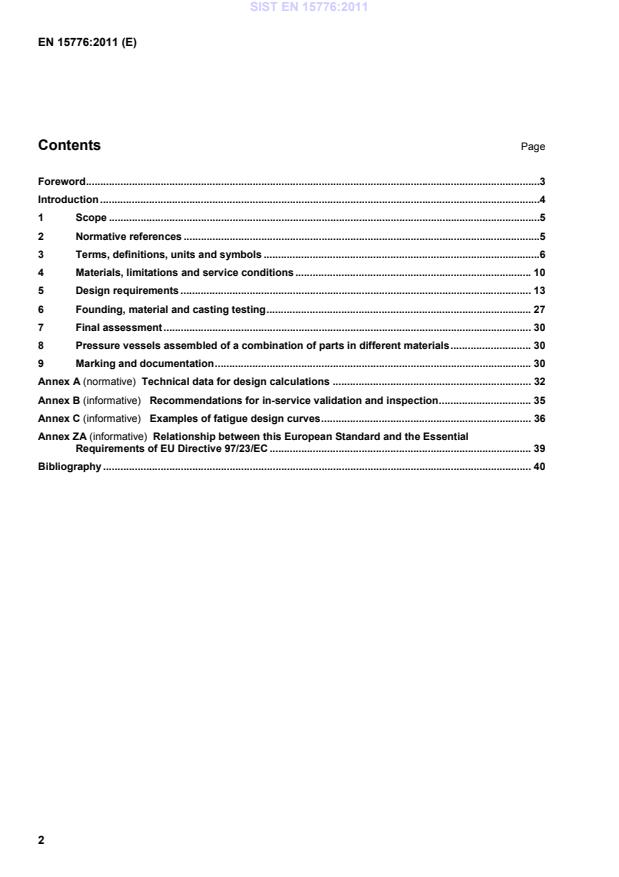
Technical data for design calculations . 32Annex B (informative)
Recommendations for in-service validation and inspection . 35Annex C (informative)
Examples of fatigue design curves . 36Annex ZA (informative)
Relationship between this European Standard and the Essential Requirements of EU Directive 97/23/EC . 39Bibliography . 40 SIST EN 15776:2011
Cast iron with elongation after fracture equal or less than 15 % may only be used for pressure equipment when operational and technical advantages are dictating its use instead of the cast iron grades given in EN 13445-6 with elongation after fracture higher than 15 %. SIST EN 15776:2011
sharp edges; —
sharp radii; —
peak stresses; —
bending stresses; —
stresses due to other than membrane stress; —
changes in curvature. NOTE 2
A critical zone is analysed by any appropriate method, e.g. holographic, interferometric method, strain gauge methods, burst test, fatigue testing, FEM analysis, etc. NOTE 3 Additionally, thermal gradients and thermal stresses due to different operating wall temperatures are to be considered in defining critical zones. SIST EN 15776:2011
3.1.7 manufacturer individual or organisation responsible for the design, fabrication, testing, inspection, installation of pressure equipment and assemblies where relevant NOTE 1 The manufacturer may subcontract one or more of the above mentioned tasks under its responsibility. 3.1.8 casting manufacturer subcontractor that produces the castings used in the manufacture of pressure equipment 3.1.9 temperature factor reduction factor applied to the 0,2 % proof strength to take account of temperature influence 3.1.10 wall thickness factor reduction factor applied to the nominal design stress to take account of reduced mechanical properties 3.1.11 stress factor ratio of peak stress to total stress 3.1.12 total stress total stress in a design model which includes all stress concentration effects, non-local and local 3.2 Symbols For the purposes of this document, symbols used in EN 13445-6:2009 are listed in Table 1. Table 1 — Symbols Symbol Quantity Unit c corrosion allowance mm e required thickness mm ea analysis thickness
mm eact actual thickness mm emax maximum local thickness at the location of a possible fatigue crack initiation mm emin minimum thickness as specified on drawing mm SIST EN 15776:2011
fm mean stress correction factor
ftest nominal design stress for testing condition
MPa fT temperature correction factor
fs surface finish correction factor
mC exponent in equation of fatigue design curve
n shell shape factor
neq number of equivalent full pressure cycles
T,Tc calculation temperature °C A, A5 minimum elongation after fracture % CC coefficient in equation of fatigue design curve
Ce wall thickness reduction factor
CT temperature reduction factor
E modulus of elasticity MPa F test factor used in experimental fatigue assessment
Keff effective stress concentration factor
Kt theoretical elastic stress concentration factor
M mean stress sensitivity factor MPa mc value from appropriate Tables 10, 11, 13, 14 in the appropriate number of cycle number range used in fatigue calculations
N total number of envisaged types of pressure cycles with different amplitude
Nall allowable number of cycles obtained from the fatigue design curve
Nmin minimum number of cycles obtained in experimental fatigue assessment
ni number of cycles with amplitude ∆Pi
PC,pc calculation pressure MPa a Pb burst test pressure MPa a Pb,act actual burst test pressure MPa a SIST EN 15776:2011
bar a PT, pt test pressure b MPa Rm minimum tensile strength MPa R*m average tensile strength of three test bars taken from the same cast for design according to DBE route MPa Rp0,2 minimum 0,2 % - proof strength MPa Rp0,2/T minimum 0,2 % - proof strength at temperature T in degrees Celsius MPa Rz surface roughness parameter – peak – to - valley height µm RM material strength parameter MPa S safety factor
TSmax, TSmin maximum / minimum allowable temperature °C V volume L ∆P pressure range MPa a ∆Pi pressure cycle amplitude
∆σ allowable stress range MPa ∆σ* pseudo elastic stress range MPa ∆σCut cut-off limit MPa ∆σD endurance limit MPa ∆σeq,struc structural stress range MPa ∆σR stress range in fatigue design curve MPa δ casting tolerance mm 0 extra thickness due to casting process mm γR partial safety factor
η Stress factor
ν Poisson’s ratio
σe nominal design stress for external pressure MPa a MPa for calculation purposes only, otherwise the unit shall be bar (1 MPa = 10 bar). b See also EN 13445-3:2009, Table 4-1.
Key e required thickness ea analysis thickness emin minimum thickness including corrosion allowance as indicated on drawings eact
actual
thickness c corrosion allowance ε extra thickness due to casting process δ casting tolerance Figure 1 4 Materials, limitations and service conditions 4.1 Materials and limitations on temperature, maximum allowable pressure and energy content All material grades subject to internal or external pressure shall comply with EN 1561 for grey cast iron, EN 1563 for spheroidal graphite cast iron and EN 13835 for austenitic cast iron. The material grades and corresponding limitations are given in Table 2 and Table 3.
Maximum allowable pressure PS
Maximum energy content PS × V for a single casting Symbol Number °C bar Lbar⋅ EN 1561 EN-GJL-200 EN-JL1030 - 10 ≤ T ≤ 200 25 65 000 EN-GJL-250 EN-JL1040 EN-GJL-300 EN-JL1050 - 10 ≤ T ≤ 200 EN-GJL-350 EN-JL1060 EN 13835 EN-GJLA-XNiCuCr15-6-2EN-JL3011 - 10 ≤ T ≤ 200 EN-GJLA-XNiMn13-7 EN-JL3021
The product PS × V and the design temperature limit of Table 2 for a single casting may be exceeded when all the following conditions are met: maximum allowable temperature TSmax ≤ 300 °C; maximum allowable pressure PS ≤ 15 bar; material grades shall be limited to EN-GJL-300 or EN-GJL-350; documented stress factor ≤ 2 throughout the casting; stress relief heat treatment is carried out when the maximum cooling rate in the mould exceeds 30 °C/h for the temperature range from 600 °C decreasing to 150 °C. NOTE An in-service inspection to Annex B of this standard may be considered to be mentioned in the operating instructions of the part or vessel.
The applicable requirements for the delivery conditions, given in EN 1559-1 and EN 1559-3, shall also apply. 4.2 Cyclic loading Lamellar and spheroidal graphite cast iron pressure vessels and vessel parts can be used for cyclic operation. A fatigue analysis shall be performed if the service conditions require more than the maximum number of full pressure cycles as given in Table 4, or more than an equivalent number of cycles neq with smaller amplitude according to Equation (1). Table 4 — Full pressure cycle number for dynamic loading consideration Material grade Maximum number of full pressure cycles without mandatory fatigue analysis according to Equation (1)
(if stress factor η ≤ 3) Grades according to Table 2 8 000 Grades according to Table 3 50 000
The calculation of an equivalent number of full pressure cycles neq when the operating pressure is less than the maximum pressure shall be calculated according to Equation (1): SIST EN 15776:2011
is the total number of envisaged types of pressure cycles with different amplitude;
ni
is the number of cycles with amplitude iP∆; iP∆ is the pressure cycle amplitude; maxP is the maximum permissible pressure, as defined in EN 13445-3:2009, 3.16; mC
is the value from Table 10 (lamellar graphite cast iron grades) or Table 11 (spheroidal graphite cast iron grades) in the appropriate number of cycle range value for 103 < N < 106 or 106 < N < 108
whichever is the case. NOTE A stress factor – defined in 3.1.11 (ratio of peak stress to total stress-defined in 3.1.12) − greater than 3, determined by any of the design methods given in 5.8, can be the result of inappropriate design. By enlarging radii or other small changes, an acceptable design may be generated. It is recommended to carry out a finite element analysis to determine areas with possible excessive stress concentrations. 5 Design requirements 5.1 Design principle The loadings to be accounted for shall be in accordance with EN 13445-3:2009, Clause 5. The materials, limitations and service conditions of Clause 4 of this standard shall be considered. Design methods shall be in accordance with this European Standard and, when indicated in a clause of this standard, with the relevant clauses of EN 13445-6:2009. If the geometry of the component or the loading case does not allow calculation by the formulas given in EN 13445-3:2009, design by analysis (DBA) or design by experiment (DBE) shall be applied. Depending on the complexity of the component, the loading conditions and the level of NDT, the designer may choose one of the following available design methods mentioned below. Correlation between safety factor, testing factor and the method to assess dynamic loading is given in Table 5. 5.2 Conceptual design and construction drawings The manufacturer analysis of hazards identifying those which apply to the pressure vessel on account of pressure shall be documented and be of sufficient detail. Details of the conceptual design including the design methods adopted, performance criteria and construction drawings shall be provided. Guidance about the detailed dimensional information that shall be provided is given in Annex B of EN 13445-5:2009. Process diagrams, sub-assemblies or other data relevant to conceptual design shall also be maintained. SIST EN 15776:2011
Item Material grades
according to
Table 3
Material grades according to
Table 2 Grade according to As cast Stress relieve annealed Safety factor S
−⋅+=1A155,075,3S EN 1561 S = 9 S = 7 EN 13835 S = 8 * S = 6 Nominal design stress f SCCRfeT2,0p⋅⋅= SRfm= where
CT is defined in 5.4;
Ce is defined in 5.5;
Rm
is the tensile strength value for a given wall thickness according to Table A.1;
Rp0,2 is 0,2 % proof strength value according to Table A.4
where A5 is the elongation after fracture in percent according to EN 1563 and EN 13835. * If a risk of stress corrosion cracking may exist, especially for austenitic grades at higher temperatures, a stress relief heat treatment is beneficial depending on the service conditions but is left to the agreement between the parties concerned.
5.3.3 Design by analysis (DBA) a) Decide whether the direct route (limit load, EN 13445-3:2009, Annex B) or the stress categorization method (EN 13445-3:2009, Annex C) will be followed. Decide whether linear or non-linear approach will be used; b) base modelling and interpretation of calculation results shall be based on analysis thickness (ea) and material characteristics at operation temperature; SIST EN 15776:2011
For grey cast iron material grades according to EN 1561 and austenitic lamellar graphite cast iron material grades according to EN 13835 mechanical properties shall be considered to remain constant for the temperature range - 10 °C up to 200 °C. For spheroidal graphite cast iron material grades according to EN 1563: CT = 1 for T ≤ 20 °C (2) CT = 1 – 0,001(T - 20) for 20 °C < T ≤ 300 °C 1)
(3) For austenitic spheroidal graphite cast iron material grades according to EN 13835: CT = 1 for T ≤ 20 °C (4) CT = 1 – 0, 000 5 (T - 20) for 20 °C < T ≤ 540 °C (5) 5.5 Wall thickness reduction factor For spheroidal graphite cast iron material grades according to EN 1563 and EN 13835: Ce = 1 for emin ≤ 60 mm (6) Ce = 0,8 for 60 mm < emin ≤ 200 mm (7) NOTE The wall thickness reduction factor for lamellar graphite cast iron grades according to EN 1561 is already included in Table A.1 in this standard and needs no extra
thickness correction factor. 5.6 Design for external pressure Design for external pressure shall be carried out according to EN 13445-3:2009, Clause 8, with the following modifications: Replace Equations 8.4.2-1, 8.4.2-2, 8.4.3-1, 8.4.3-2 by:
1) See Bibliography ref. [13]. SIST EN 15776:2011
S = (safety factor according to Table 5) + 0,5 (10) 5.7 Testing conditions The test pressure may exceed the value given in Equation (15) either intentionally or occasionally. However, the nominal design stress for testing conditions, ftest shall not exceed the following values. For material grades according to Table 2: 2mtestRf= (11) For material grades according to Table 3: 33,1/2,0eTtestptestCRf⋅= (12) 5.8 Design methods 5.8.1 General Design methods shall be in accordance with this standard and, when indicated in the clauses of this standard, with the clauses of EN 13445-6. 5.8.2 Static loading 5.8.2.1 General In order to design the part for static loading, the following options can be considered by the designer. 5.8.2.2 Design by formula (DBF) Formulas for the calculation of the various components of the pressure part are given in EN 13445-3. 5.8.2.3 Design by analysis (DBA) For cast iron pressure vessels the general procedures and corresponding rules are covered by EN 13445-6:2009, Annex E "Design by analysis for castings" with the following modifications: additional to EN 13445-6:2009, Annex E.2.1 "Design checks for normal operating load cases" Material strength parameters (RM) and partial safety factors (γR) shall be as given in Table 6: SIST EN 15776:2011
additional to EN 13445-6:2009, Annex E.2.2 "Design checks for testing load cases" RM and γR shall be as given in Table 7 and Table 8: Table 7 — RM and γγγγR for test load case lamellar cast iron grades Material grade RM γγγγR According to Table 2 Rm 2,0
Table 8 — RM and γγγγR
for test load case spheroidal graphite cast iron grades Material grade RM γγγγR According to Table 3 Rp0,2/Ttest 1,33/Ce
5.8.2.4 Design by experiment (DBE) Design by experiment shall be carried out according to EN 13445-6:2009, 5.2.2.1.5, where: for material grades according to Table 2 of this standard, the following formula applies: 2/1,)3(⋅⋅⋅⋅=mactbmactaRPRPSSee (13) for material grades according to Table 3 of this standard, the following formula applies: neTpactbmactaCCRPRPSSee/12,0,)3(⋅⋅⋅⋅⋅⋅= (14) where n = 1 for curved surfaces (cylinders, spheres) or cones with angles α ≤ 60°, stayed surfaces and stressed parts when it can be shown that the bending stress is less than 2/3 of the total stress; n = 2 for all other surfaces except when it can be shown that the bending stress is less than 2/3 of the total stress. 5.8.2.5 R*m Determination and general test requirements For determining R*m three tensile test specimen shall be performed in accordance with EN 1561, EN 1563 or EN 13835 material standards for each of the required positions taken from the same cast. SIST EN 15776:2011
The position on the casting from where the sample is cut shall be in an area where the casting wall thickness is close to the relevant wall thickness of the casting. For the purpose of determining the size of the test pieces to be used, the purchaser shall, by the time of acceptance of the order, indicate to the manufacturer which are the important sections. In the absence of any direction by the purchaser, the manufacturer may choose the size of the test piece to be used according the relevant standard. No specimen may show a lower value than the minimum value of Rm stated in the respective material standards of the material grade under investigation, taking into account the corresponding thickness. The preferred test piece diameter is 14 mm, but, for technical reasons and for test pieces machined from castings, it is permitted to use a test piece of different diameter or equivalent diameter. Retesting shall be carried out if a test is not valid. A test is not valid if there is:
a faulty mounting of the test piece or defective operation of the test machine;
a defective test piece because of incorrect pouring or incorrect machining;
a fracture of the tensile test piece outside the gauge length;
a casting defect in the test piece, evident after fracture. In all cases, a new test piece shall be taken from the same sample or a duplicate sample cast at the same time. The result of the retest shall be used. 5.8.2.6 Determination of the minimum hydraulic burst pressure and maximum allowable pressure for static loading For the purposes of this standard the methods given in EN 13445-6:2009, 5.2.2.1.6 to determine the minimum hydraulic burst pressure and maximum allowable pressure for static loading apply with the following modification: Replace in formulae 5-3 and 5-4 n as follows: for material grades given in Table 2, n = 2 applies in all cases of curvature of the pressure part; for material grades given in Table 3, see 5.2.2.1.6 of EN 13445-6:2009. 5.8.3 Dynamic loading 5.8.3.1 General If the number of full pressure cycles or equivalent full pressure cycles according to Equation (1) exceeds the number of full pressure cycles for static loading considered in Table 4, a fatigue assessment of the complete
2) When taking values after burst testing these may show lower tensile strength properties for some grades and should only be used with caution in exceptional cases (single part or very large part, etc.). SIST EN 15776:2011
a detailed fatigue assessment (maximum allowable number of equivalent pressure fluctuations using detailed stress analysis which is less conservative than the simplified method). 5.8.3.2 Simplified fatigue assessment (SFA) A simplified fatigue assessment will give a maximum allowable number of equivalent pressure fluctuations under service conditions. The assessment shall be per
...