

EN 13445-8:2021
(Main)Unfired pressure vessels - Part 8: Additional requirements for pressure vessels of aluminium and aluminium alloys
- Abstract
This document specifies requirements for unfired pressure vessels and their parts made of aluminium and aluminium alloys in addition to the general requirements for unfired pressure vessels under EN 13445:2019 Parts 1 to 5. This document specifies unfired pressure vessels for loads up to 500 full cycles.
NOTE Cast materials are not included in this version. Details regarding cast materials will be subject to an amendment to or a revision of this document.
- Status
- Withdrawn
- Publication Date
- 11-May-2021
- Withdrawal Date
- 06-Oct-2026
- Technical Committee
- CEN/TC 54 - Unfired pressure vessels
- Drafting Committee
- CEN/TC 54/WG 60 - Aluminium
- Current Stage
- 9020 - Submission to 2 Year Review Enquiry - Review Enquiry
- Start Date
- 15-Jul-2026
- Completion Date
- 15-Jul-2026



Overview
EN 13445-8:2021 - "Unfired pressure vessels - Part 8: Additional requirements for pressure vessels of aluminium and aluminium alloys" (CEN) provides the specific, supplementary requirements for designing, manufacturing and testing unfired pressure vessels made from aluminium and aluminium alloys. It is intended to be used alongside the general rules in EN 13445:2021 Parts 1–5 and applies to vessels subjected to loads up to 500 full cycles. Cast aluminium materials are excluded from this edition.
Key Topics
This part of EN 13445 addresses aluminium-specific aspects of pressure vessel engineering, including:
- Materials: selection, chemical composition references, elongation after fracture and material grouping for aluminium and wrought alloys (normative references such as EN 485‑2, EN 573‑3, EN 755 series apply).
- Design: temperature-dependent properties, time‑independent nominal design stress, fatigue design for cyclic loading (up to 500 full cycles), thick-walled and small bore considerations, lapped/joggle/permanent-backing joints and flat ends.
- Manufacture: tolerances, forming and heat treatment after forming, welding procedure specification (WPS), qualification of welding procedures (WPQR) and personnel, preheat and PWHT where relevant.
- Inspection & Testing: non-destructive testing (NDT) selection and acceptance criteria (RT, PT, VT, ultrasonic, etc.), extent of testing, hydrostatic and pneumatic tests, production test criteria and serial production model approval.
- Annexes: includes Annex A (allowable design strength values), Annex Y (history/changes from prior edition) and Annex ZA (relationship to EU Directive 2014/68/EU).
Applications
EN 13445-8:2021 is applied where unfired pressure vessels and their components are fabricated from aluminium or aluminium alloys, for industries such as:
- Chemical and process plants
- Food and beverage and pharmaceutical equipment (where aluminium is used for corrosion or weight advantages)
- Cryogenic and low-temperature applications when compatible alloys are selected
- Lightweight pressure containers in specialised industrial equipment
Typical users:
- Pressure vessel designers and structural engineers specifying aluminium materials and fatigue criteria
- Fabricators and welding engineers preparing WPS/WPQR and quality control plans
- Inspection bodies and quality assurance teams performing NDT, hydrostatic/pneumatic tests and conformity assessment
- Certification authorities assessing compliance with the Pressure Equipment Directive (PED) / EU Directive 2014/68/EU
Related Standards
This Part is to be used together with EN 13445 Parts 1–5 (general requirements, materials, design, fabrication and inspection) and referenced aluminium product standards such as:
- EN 13445-1:2021 (General)
- EN 485‑2, EN 573‑3, EN 755 series (aluminium material/product specifications)
- EN 10204, EN 764‑5 (material inspection documentation)
For implementers, follow EN 13445-8 together with the other EN 13445 Parts to ensure full compliance for aluminium unfired pressure vessels.
Relations
- Effective Date
- 08-Jun-2022
- Effective Date
- 19-May-2021
- Effective Date
- 29-Apr-2026
- Effective Date
- 13-Feb-2026
- Effective Date
- 28-Jan-2026
- Effective Date
- 28-Jan-2026
- Effective Date
- 28-Jan-2026
- Effective Date
- 28-Jan-2026
- Effective Date
- 28-Jan-2026
- Effective Date
- 28-Jan-2026
- Effective Date
- 28-Jan-2026
- Effective Date
- 28-Jan-2026
- Effective Date
- 28-Jan-2026
- Effective Date
- 28-Jan-2026
- Effective Date
- 28-Jan-2026
Get Certified
Connect with accredited certification bodies for this standard

Institut za varilstvo d.o.o. (Welding Institute)
Slovenia's leading welding institute since 1952. ISO 3834, EN 1090, pressure equipment certification, NDT personnel, welder qualification. Only IIW Au
Sponsored listings
Frequently Asked Questions
EN 13445-8:2021 is a standard published by the European Committee for Standardization (CEN). Its full title is "Unfired pressure vessels - Part 8: Additional requirements for pressure vessels of aluminium and aluminium alloys". This standard covers: This document specifies requirements for unfired pressure vessels and their parts made of aluminium and aluminium alloys in addition to the general requirements for unfired pressure vessels under EN 13445:2019 Parts 1 to 5. This document specifies unfired pressure vessels for loads up to 500 full cycles. NOTE Cast materials are not included in this version. Details regarding cast materials will be subject to an amendment to or a revision of this document.
This document specifies requirements for unfired pressure vessels and their parts made of aluminium and aluminium alloys in addition to the general requirements for unfired pressure vessels under EN 13445:2019 Parts 1 to 5. This document specifies unfired pressure vessels for loads up to 500 full cycles. NOTE Cast materials are not included in this version. Details regarding cast materials will be subject to an amendment to or a revision of this document.
EN 13445-8:2021 is classified under the following ICS (International Classification for Standards) categories: 23.020.30 - Pressure vessels, gas cylinders. The ICS classification helps identify the subject area and facilitates finding related standards.
EN 13445-8:2021 has the following relationships with other standards: It is inter standard links to EN 13445-8:2014, EN 13445-8:2014/A1:2014, EN 13445-8:2026, ISO 857-1:1998, EN ISO 17637:2011, EN 755-1:2016, EN ISO 10042:2005, EN 13445-5:2021, EN ISO 17636-1:2013, EN ISO 3452-1:2013, EN ISO 17640:2010, EN ISO 14732:2013, EN 12392:2000, EN 755-2:2016, EN ISO 6520-1:2007. Understanding these relationships helps ensure you are using the most current and applicable version of the standard.
EN 13445-8:2021 is associated with the following European legislation: EU Directives/Regulations: 2014/68/EU; Standardization Mandates: M/071. When a standard is cited in the Official Journal of the European Union, products manufactured in conformity with it benefit from a presumption of conformity with the essential requirements of the corresponding EU directive or regulation.
EN 13445-8:2021 is available in PDF format for immediate download after purchase. The document can be added to your cart and obtained through the secure checkout process. Digital delivery ensures instant access to the complete standard document.
Standards Content (Sample)
SLOVENSKI STANDARD
01-september-2021
Nadomešča:
SIST EN 13445-8:2014
SIST EN 13445-8:2014/A1:2015
Nekurjene tlačne posode - 8. del: Dodatne zahteve za tlačne posode iz aluminija in
aluminijevih zlitin
Unfired pressure vessels - Part 8: Additional requirements for pressure vessels of
aluminium and aluminium alloys
Unbefeuerte Druckbehälter - Teil 8: Zusätzliche Anforderungen an Druckbehälter aus
Aluminium und Aluminiumlegierungen
Récipients sous pression non soumis à la flamme - Partie 8: Exigences complémentaires
pour les récipients sous pression en aluminium et alliages d'aluminium
Ta slovenski standard je istoveten z: EN 13445-8:2021
ICS:
23.020.32 Tlačne posode Pressure vessels
77.150.10 Aluminijski izdelki Aluminium products
2003-01.Slovenski inštitut za standardizacijo. Razmnoževanje celote ali delov tega standarda ni dovoljeno.
EN 13445-8
EUROPEAN STANDARD
NORME EUROPÉENNE
May 2021
EUROPÄISCHE NORM
ICS 23.020.30 Supersedes EN 13445-8:2014
English Version
Unfired pressure vessels - Part 8: Additional requirements
for pressure vessels of aluminium and aluminium alloys
Récipients sous pression non soumis à la flamme - Unbefeuerte Druckbehälter - Teil 8: Zusätzliche
Partie 8: Exigences complémentaires pour les Anforderungen an Druckbehälter aus Aluminium und
récipients sous pression en aluminium et alliages Aluminiumlegierungen
d'aluminium
This European Standard was approved by CEN on 24 February 2021.
CEN members are bound to comply with the CEN/CENELEC Internal Regulations which stipulate the conditions for giving this
European Standard the status of a national standard without any alteration. Up-to-date lists and bibliographical references
concerning such national standards may be obtained on application to the CEN-CENELEC Management Centre or to any CEN
member.
This European Standard exists in three official versions (English, French, German). A version in any other language made by
translation under the responsibility of a CEN member into its own language and notified to the CEN-CENELEC Management
Centre has the same status as the official versions.
CEN members are the national standards bodies of Austria, Belgium, Bulgaria, Croatia, Cyprus, Czech Republic, Denmark, Estonia,
Finland, France, Germany, Greece, Hungary, Iceland, Ireland, Italy, Latvia, Lithuania, Luxembourg, Malta, Netherlands, Norway,
Poland, Portugal, Republic of North Macedonia, Romania, Serbia, Slovakia, Slovenia, Spain, Sweden, Switzerland, Turkey and
United Kingdom.
EUROPEAN COMMITTEE FOR STANDARDIZATION
COMITÉ EUROPÉEN DE NORMALISATION
EUROPÄISCHES KOMITEE FÜR NORMUNG
CEN-CENELEC Management Centre: Rue de la Science 23, B-1040 Brussels
© 2021 CEN All rights of exploitation in any form and by any means reserved Ref. No. EN 13445-8:2021 E
worldwide for CEN national Members.
Issue 1 (2021-05)
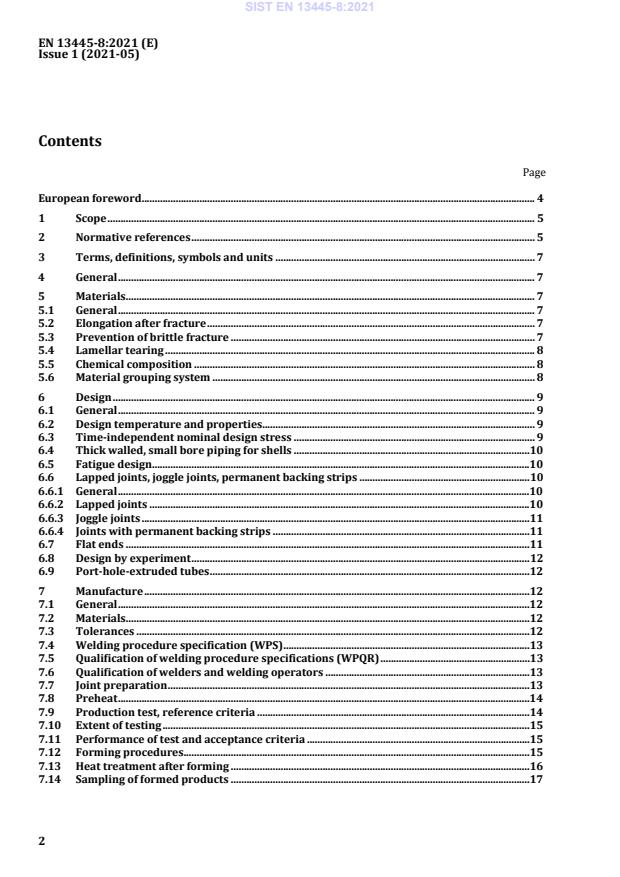
Contents
Page
European foreword . 4
1 Scope . 5
2 Normative references . 5
3 Terms, definitions, symbols and units . 7
4 General . 7
5 Materials . 7
5.1 General . 7
5.2 Elongation after fracture . 7
5.3 Prevention of brittle fracture . 7
5.4 Lamellar tearing . 8
5.5 Chemical composition . 8
5.6 Material grouping system . 8
6 Design . 9
6.1 General . 9
6.2 Design temperature and properties. 9
6.3 Time-independent nominal design stress . 9
6.4 Thick walled, small bore piping for shells .10
6.5 Fatigue design .10
6.6 Lapped joints, joggle joints, permanent backing strips .10
6.6.1 General .10
6.6.2 Lapped joints .10
6.6.3 Joggle joints .11
6.6.4 Joints with permanent backing strips .11
6.7 Flat ends .11
6.8 Design by experiment .12
6.9 Port-hole-extruded tubes .12
7 Manufacture .12
7.1 General .12
7.2 Materials .12
7.3 Tolerances .12
7.4 Welding procedure specification (WPS) .13
7.5 Qualification of welding procedure specifications (WPQR) .13
7.6 Qualification of welders and welding operators .13
7.7 Joint preparation .13
7.8 Preheat .14
7.9 Production test, reference criteria .14
7.10 Extent of testing .15
7.11 Performance of test and acceptance criteria .15
7.12 Forming procedures .15
7.13 Heat treatment after forming .16
7.14 Sampling of formed products .17
Issue 1 (2021-05)
7.15 Tests . 18
7.15.1 Base material . 18
7.15.2 Butt welds . 18
7.16 Post weld heat treatment (PWHT) . 18
8 Inspection and testing . 18
8.1 General . 18
8.2 Non-destructive testing of welded joints . 19
8.2.1 General . 19
8.2.2 Demonstration of satisfactory experience for testing group 2 . 20
8.2.3 Symbols . 20
8.3 Determination of extent of non destructive testing . 20
8.4 Applicable non-destructive testing techniques . 23
8.4.1 NDT methods . 23
8.4.2 Acceptance criteria for radiographic testing (RT) . 24
8.4.3 Acceptance criteria for visual and surface penetrant testing . 24
8.4.4 Acceptance criteria for penetrant testing (PT) . 25
8.5 Selection of non-destructive testing methods for internal imperfections. 25
8.6 Standard hydrostatic test . 26
8.7 Pneumatic testing . 26
9 Inspection and testing of serially produced pressure vessels — Model approval . 26
9.1 General . 26
9.2 Inspection and testing of pressure vessels subject to cyclic loads . 26
Annex A (normative) Allowable design strength values . 27
A.1 General . 27
A.2 Extruded rod/bar, tube and profile . 27
A.3 Cold drawn rod/bar and tube . 29
A.4 Forgings . 30
Annex Y (informative) History of EN 13445-8 . 34
Y.1 Differences between EN 13445-8:2014 and EN 13445-8:2021 . 34
Annex ZA (informative) Relationship between this European Standard and the essential
requirements of Directive 2014/68/EU aimed to be covered . 35
Bibliography . 37
Issue 1 (2021-05)
European foreword
This document (EN 13445-8:2021) has been prepared by Technical Committee CEN/TC 54 “Unfired pressure
vessels”, the secretariat of which is held by BSI.
This European Standard shall be given the status of a national standard, either by publication of an identical
text or by endorsement, at the latest by November 2021, and conflicting national standards shall be withdrawn
at the latest by November 2021.
Attention is drawn to the possibility that some of the elements of this document may be the subject of patent
rights. CEN shall not be held responsible for identifying any or all such patent rights.
This document has been prepared under a standardization request given to CEN by the European Commission
and the European Free Trade Association, and supports essential requirements of EU Directive(s).
For relationship with EU Directive(s), see informative Annex ZA, which is an integral part of this document.
list of all parts in the EN 13445 series can be found on the CEN website.
Although these Parts may be obtained separately, it should be recognised that the Parts are inter-dependant.
As such the manufacture of unfired pressure vessels requires the application of all the relevant Parts in order
for the requirements of the Standard to be satisfactorily fulfilled.
Corrections to the standard interpretations where several options seem possible are conducted through the
Migration Help Desk (MHD). Information related to the Help Desk can be found at http://www.unm.fr
(en13445@unm.fr). A form for submitting questions can be downloaded from the link to the MHD website.
After subject experts have agreed an answer, the answer will be communicated to the questioner. Corrected
pages will be given specific issue number and issued by CEN according to CEN Rules. Interpretation sheets
will be posted on the website of the MHD.
This document supersedes EN 13445-8:2014. This new edition incorporates the Amendments which have
been approved previously by CEN members, and the corrected pages up to Issue 5 without any further
technical change. Annex Y provides details of significant technical changes between this European Standard
and the previous edition.
Amendments to this new edition may be issued from time to time and then used immediately as alternatives
to rules contained herein. It is intended to deliver a new Issue of EN 13445:2021 each year, starting with the
precedent as Issue 1, consolidating these Amendments and including other identified corrections.
According to the CEN-CENELEC Internal Regulations, the national standards organizations of the following
countries are bound to implement this European Standard: Austria, Belgium, Bulgaria, Croatia, Cyprus, Czech
Republic, Denmark, Estonia, Finland, Former Yugoslav Republic of Macedonia, France, Germany, Greece,
Hungary, Iceland, Ireland, Italy, Latvia, Lithuania, Luxembourg, Malta, Netherlands, Norway, Poland, Portugal,
Romania, Serbia, Slovakia, Slovenia, Spain, Sweden, Switzerland, Turkey and the United Kingdom.
Issue 1 (2021-05)
1 Scope
This document specifies requirements for unfired pressure vessels and their parts made of aluminium and
aluminium alloys in addition to the general requirements for unfired pressure vessels under EN 13445:2021
Parts 1 to 5. This document specifies unfired pressure vessels for loads up to 500 full cycles.
NOTE Cast materials are not included in this version. Details regarding cast materials will be subject to an
amendment to or a revision of this document.
2 Normative references
The following documents are referred to in the text in such a way that some or all of their content constitutes
requirements of this document. For dated references, only the edition cited applies. For undated references,
the latest edition of the referenced document (including any amendments) applies.
EN 485-2:2013, Aluminium and aluminium alloys — Sheet, strip and plate — Part 2: Mechanical properties
EN 573-3:2013, Aluminium and aluminium alloys — Chemical composition and form of wrought products —
Part 3: Chemical composition and form of products
EN 586-2:1994, Aluminium and aluminium alloys — Forgings — Part 2: Mechanical properties and additional
property requirements
EN 754-2:2013, Aluminium and aluminium alloys — Cold drawn rod/bar and tube — Part 2: Mechanical
properties
EN 755-1:2016, Aluminium and aluminium alloys — Extruded rod/bar, tube and profiles — Part 1: Technical
conditions for inspection and delivery
EN 755-2:2016, Aluminium and aluminium alloys — Extruded rod/bar, tube and profiles — Part 2: Mechanical
properties
EN 755-8:2016, Aluminium and aluminium alloys — Extruded rod/bar, tube and profiles — Part 8: Porthole
tubes, tolerances on dimensions and form
EN 764-5:2014, Pressure Equipment — Part 5: Inspection documentation of metallic materials and compliance
with the material specification
EN 10204:2004, Metallic products — Types of inspection documents
EN 12392:2000, Aluminium and aluminium alloys — Wrought products — Special requirements for products
intended for the production of pressure equipment
EN 13445-1:2021, Unfired pressure vessels — Part 1: General
EN 13445-2:2021, Unfired pressure vessels — Part 2: Materials
EN 13445-3:2021, Unfired pressure vessels — Part 3: Design
EN 13445-4:2021, Unfired pressure vessels — Part 4: Fabrication
EN 13445-5:2021, Unfired pressure vessels — Part 5: Inspection and testing
Issue 1 (2021-05)
EN ISO 3452-1:2013, Non-destructive testing — Penetrant testing — Part 1: General principles (ISO 3452-
1:2013)
EN ISO 3834-2:2005, Quality requirements for fusion welding of metallic materials — Part 2: Comprehensive
quality requirements (ISO 3834-2:2005)
EN ISO 3834-3:2005, Quality requirements for fusion welding of metallic materials — Part 3: Standard quality
requirements (ISO 3834-3:2005)
EN ISO 4063:2010, Welding and allied processes — Nomenclature of processes and reference numbers (ISO
4063:2009, Corrected version 2010-03-01)
EN ISO 6520-1:2007, Welding and allied processes — Classification of geometric imperfections in metallic
materials — Part 1: Fusion welding (ISO 6520-1:2007)
EN ISO 9606-2:2004, Qualification test of welders — Fusion welding — Part 2: Aluminium and aluminium alloys
(ISO 9606-2:2004)
EN ISO 10042:2005, Welding — Arc-welded joints in aluminium and its alloys — Quality levels for imperfections
(ISO 10042:2005)
EN ISO 11666:2010, Non-destructive testing of welds — Ultrasonic testing — Acceptance levels (ISO
11666:2010)
EN ISO 14732:2013, Welding personnel — Qualification testing of welding operators and weld setters for
mechanized and automatic welding of metallic materials (ISO 14732:2013)
EN ISO 15614-2:2005, Specification and qualification of welding procedures for metallic materials — Welding
procedure test — Part 2: Arc welding of aluminium and its alloys (ISO 15614-2:2005)
EN ISO 16826:2014, Non-destructive testing — Ultrasonic testing — Examination for discontinuities
perpendicular to the surface (ISO 16826:2012)
EN ISO 17635:2016, Non-destructive testing of welds — General rules for metallic materials (ISO 17635:2016)
EN ISO 17636-1:2013, Non-destructive testing of welds — Radiographic testing — Part 1: X- and gamma-ray
techniques with film (ISO 17636-1:2013)
EN ISO 17636-2:2013, Non-destructive testing of welds — Radiographic testing — Part 2: X- and gamma-ray
techniques with digital detectors (ISO 17636-2:2013)
EN ISO 17637:2011, Non-destructive testing of welds — Visual testing of fusion-welded joints (ISO 17637:2003)
EN ISO 17640:2010, Non-destructive testing of welds — Ultrasonic testing — Techniques, testing levels, and
assessment (ISO 17640:2010)
EN ISO 23277:2009, Non-destructive testing of welds — Penetrant testing of welds — Acceptance levels
(ISO 23277:2006)
CR ISO/TR 15608:2013, Welding — Guidelines for a metallic materials grouping system (ISO/TR 15608:2013)
ISO 857-1:1998, Welding and allied processes — Vocabulary — Part 1: Metal welding processes
Issue 1 (2021-05)
3 Terms, definitions, symbols and units
For the purposes of this document, the terms, definitions, symbols and units given in EN 13445:2021 Parts 1
to 5 apply.
ISO and IEC maintain terminological databases for use in standardization at the following addresses:
— IEC Electropedia: available at http://www.electropedia.org/
— ISO Online browsing platform: available at http://www.iso.org/obp
NOTE Further symbols are listed in 8.2.3.
4 General
EN 13445-1:2021 applies.
5 Materials
5.1 General
Materials for pressure-bearing parts compliant with the requirements of this document shall be accompanied
by inspection documents in accordance with EN 10204:2004.
The type of inspection document shall be in accordance with EN 764-5:2014 and include a declaration of
compliance to the material specification.
The requirements of EN 13445-2:2021 shall apply with the following additions/exclusions.
5.2 Elongation after fracture
NOTE Also see 4.1.4 of EN 13445-2:2021.
Aluminium and aluminium alloys used for welded parts of pressure vessels that are subjected to cold forming
(e.g. rolled shells and heads) shall have a specified minimum elongation after fracture measured on a gauge
length
L = 5,65 S (5.2-1)
o o
that is ≥ 14 % in the longitudinal or transverse direction as defined by the material specification.
Aluminium and aluminium alloys used for parts of pressure vessels that are not subject to cold forming (e.g.
straight flanges and nozzles) shall have a specified minimum elongation after fracture of ≥ 10 % in the
longitudinal or transverse direction as defined by the material specification, measured on a gauge length as
defined in Formula (5.2-1).
5.3 Prevention of brittle fracture
EN 13445-2:2021, Annex B, is not applicable. All materials of Table 5.6-1 are suitable for any minimum metal
temperature without impact testing.
NOTE See also EN 1252-1 and EN 12392:2000, 8.4.
Issue 1 (2021-05)
5.4 Lamellar tearing
NOTE Also see EN 13445-2:2021, 4.2.1.2.
Specific requirements of lamellar tearing for pressure vessels of aluminium and its alloys are not applicable.
5.5 Chemical composition
The chemical composition shall be in accordance with the material specification.
It is recommended that the material to be used for welded components be produced from rolling or extrusion
ingots with hydrogen level no greater than 0,2 ml per 100 g aluminium, measured on liquid metal during
casting (see EN 12392:2000, 5.1.3).
EN 12392:2000, 4.1, recommends a maximum lead content not exceeding 150 μg/g.
5.6 Material grouping system
Annex A of EN 13445-2:2021 is not applicable for pressure vessels of aluminium and its alloys. The allowable
materials for the construction of aluminium alloy pressure vessels shall be according to Table 5.6-1 below.
Any product form available in EN 12392:2000 for a material in Table 5.6-1 at an acceptable temper is
acceptable for construction to this document, as long as the requirements of 5.2 and 5.5 are fulfilled. Other
materials not defined here may be used by agreement by the parties concerned (see EN 13445-2:2021, 4.1.4)
if they meet the requirements of 5.2 and 5.5 and a particular material appraisal is produced (see
EN 764-4:2002).
Table 5.6-1 — Grouping system based on CR ISO/TR 15608:2013 and allowable materials of
construction based on EN 12392:2000 using the EN AW numbers according to EN 573-3:2013
Designation
Sub Type of aluminium and
Group
group aluminium alloys
EN AW number Chemical symbol Temper
21 Pure aluminium with ≤ 1 % EN AW — 1050A EN AW-Al 99,5 O, H111, H112
impurities or alloy content EN AW — 1070A EN AW-Al 99,7 O, H111, H112
EN AW — 1080A EN AW-Al 99,8(A) O, H111, H112
22 Non heat treatable alloys
22.1 Aluminium-manganese alloys EN AW — 3003 EN AW-Al Mn1Cu O, H111, H112
EN AW — 3103 EN AW-Al Mn1 O, H111, H112
EN AW — 3105 EN AW-Al Mn0,5Mg0,5 O, H111
22.2 Aluminium-magnesium alloys EN AW — 5005 EN AW-Al Mg1(B) O, H111, H112
with Mg ≤ 1,5 % EN AW — 5005A EN AW-Al Mg1(C) O, H111, H112
EN AW — 5050 EN AW-Al Mg1,5(C) O, H111
22.3 Aluminium-magnesium alloys EN AW — 5049 EN AW-Al Mg2Mn0,8 O, H111, H112
with 1,5 % < Mg ≤ 3,5 % EN AW — 5052 EN AW-Al Mg2,5 O, H111, H112
EN AW — 5154A EN AW-Al Mg3,5(A) O, H111, H112
EN AW — 5251 EN AW-Al Mg2 O, H111, H112
EN AW — 5454 EN AW-Al Mg3Mn(A) O, H111, H112
EN AW — 5754 EN AW-Al Mg3 O, H111, H112
22.4 Aluminium-magnesium alloys EN AW — 5083 EN AW-Al Mg4,5Mn0,7 O, H111, H112
with Mg > 3,5 %
EN AW — 5086 EN AW-Al Mg4 O, H111
23 Heat treatable alloys
a
23.1 Aluminium-magnesium-silicon EN AW — 6060 EN AW-Al MgSi
T4
alloys EN AW — 6061 EN AW-Al Mg1SiCu
b c
T4 , T6
a
for profiles only
b
for seamless pipes and flanges only
c
for flanges only
Issue 1 (2021-05)
6 Design
6.1 General
The requirements of EN 13445-3:2021 shall apply with the following additions/exclusions.
6.2 Design temperature and properties
NOTE 1 Also see EN 13445-2:2021, 4.2.2.
nd
EN 13445-2:2021, 4.2.2.1, 2 paragraph, is not applicable for aluminium and its alloys.
Design strength values are given in Tables A.2 to A.5 in Annex A. Design temperatures that exceed the
respective temperature limit in Annex A are not permitted.
For materials of group 22.4 temperatures above 80 °C may result in grain boundary precipitation of Al -Mg .
3 2
These materials may be used at temperatures above 80 °C up to 200 °C only for non-corrosive service.
NOTE 2 For further material properties see EN 12392:2000.
For welded parts and heat-treated parts after forming only the values equivalent to the O temper shall be used
for design when 6 000 series flanges, etc. are welded. These values are not quoted in EN 12392:2000 and so
the tabulated values for f shown in Table 6.3-2 shall be used for design. The weld area shall be based on the O
temper but the flange strength away from the weld (2t) may be based on the actual temper (T4 or T6).
For aluminium and aluminium alloys values of 0,2 % proof stress (or 1 % proof stress for material
group 21-1 000 series aluminium) for temperatures above 20 °C shall be established by linear interpolation
between two adjacent values in Annex A or in EN 12392:2000 except that for alloys 5083 and 5086 the
respective value at 50 °C may be used for 65 °C.
For material of group 22.4: For short periods, higher temperatures (e.g. when defrosting refrigerating plant)
up to 150 °C are permissible provided that the pressure is reduced to half the working pressure for a period
up to 8 h and to atmospheric pressure for a period up to 24 h.
6.3 Time-independent nominal design stress
The design stress for aluminium and aluminium alloy materials shall be in accordance with the Table 6.3-1.
Table 6.3-1 — Design Stresses for aluminium and aluminium alloy material
Group
Design stresses at Design stresses at
according to
design condition test condition
Table 5.6-1
21 f = [R / 1,5] f = [R / 1,05]
p1,0,T test p1,0, 20
22 f = min ( [Rp0,2,T / 1,5]; [Rm,20 / 2,4] ) ftest = [Rp0,2, 20 / 1,05]
23 f = min ( [Rp0,2,T / 1,5]; [Rm,20 / 3] ftest = [Rp0,2, 20 / 1,05]
Issue 1 (2021-05)
Table 6.3-2 — Allowable Design Stress values for 6000 series
aluminium alloys in the welded condition (see 6.2)
Material Value of f for design temperature (°C) not exceeding
designation to
50 75 100 125 150 175 200
EN 12392:2000
EN AW 6060 40 40 40 38 36 22 14
EN AW 6061 55 55 55 54 51 43 32
6.4 Thick walled, small bore piping for shells
Formulae (6.4-1) and (6.4-2) may be used as an alternative to Annex B and C in EN 13445-3:2021 for thick-
walled piping of aluminium and aluminium alloy materials, i.e. for piping with e/D > 0,16 and DN ≤ 50. The
e
maximum allowable pressure shall be used for design.
Limit Load Procedure
p < PS (6.4-1)
d
This maximum allowable pressure can be determined as follows:
D
O
PS= ⋅R ⋅ln /1,5
(6.4-2)
p0,2
D
i
NOTE The method proposed is the standard design method for vaporisers upstream a cryogenic pressure tank.
These vaporisers are small bore piping (DN ≤ 50) with comparable thick wall thickness (e/D typically ranges from 0,23
e
to 0,33 or D /D from 2,7 to 1,8).
e i
6.5 Fatigue design
Fatigue design for over 500 full equivalent pressure cycles is not covered by this Part 8 for aluminium and
aluminium alloy pressure vessels. For the determination of 500 full equivalent pressure cycles see
EN 13445-3:2021, 5.4.2
NOTE This will be subject to a future revision of or an amendment to this Part 8.
6.6 Lapped joints, joggle joints, permanent backing strips
6.6.1 General
The requirements of 5.7.4 in EN 13445-3:2021 are not applicable for pressure vessels of aluminium and
aluminium alloys, and 5.7.4.1, 5.7.4.2, and 5.7.4.3.1 shall be replaced with the following 6.6.2, 6.6.3, and 6.6.4,
respectively.
6.6.2 Lapped joints
Lapped joints with fillet welds shall be used only when all of the following conditions are fulfilled:
a) only testing group 4 is permitted;
b) the materials are limited to material groups 21, 22.1, 22.2, 22.3, 22.4;
c) for circumferential joints of shell to head only;
d) the nominal wall thickness of the thickest pressure part does not exceed 8 mm;
Issue 1 (2021-05)
e) the overlap shall be minimum 4e, where e represents the nominal thickness of the thickest pressure part;
f) both sides of the lap are welded;
g) the maximum vessel diameter does not exceed 1 600 mm;
h) non-corrosive conditions only are permitted.
6.6.3 Joggle joints
Joggle joints shall be used only when all of the following conditions are fulfilled:
a) the materials are limited to material groups 21, 22.1, 22.2, 22.3, and 22.4 (except 5454);
b) for circumferential joints of shell to head only;
c) the nominal wall thickness of the thickest pressure part does not exceed 12 mm;
d) the inside of the vessel is not subject to corrosion;
e) the intersections between longitudinal and circumferential joints shall be radiographed and found to be
free of unacceptable imperfections;
f) the maximum vessel diameter does not exceed 1 600 mm.
6.6.4 Joints with permanent backing strips
Permanent backing strips shall not be used for longitudinal seams.
Permanent backing strips are permitted for circumferential seams and for shell or head closure plates (see
EN 13445-3:2021, Table A, reference E 7) only under the following conditions:
a) materials are limited to material groups 21, 22.1 to 22.4 and 23.1;
b) non–destructive examination is carried out in accordance with the design/joint efficiency to the same
quality and acceptance criteria as a single-sided butt weld;
c) the inside of the vessel is not subject to corrosion;
d) backing strip material shall be of the same aluminium sub group as the vessel unless the combination of
other backing strip material has been proven by a WPQR according to EN ISO 15614-2:2005.
6.7 Flat ends
The requirements of Clause 10 of EN 13445-3:2021 shall apply with the following additions/exclusions:
— Joint types E 5 and E 14 in Table A-3 of EN 13445-3:2021:
Only the first term of Formula (10.4-10) shall be considered.
Issue 1 (2021-05)
— Joint types E 6, E 7, and E 15 in Table A-3 of EN 13445-3:2021:
For values of C and C higher than 0,45 in Formula (10.4-10) the value of 0,45 may be taken.
1 2
— Joint types E 10, E 11, E 17, and E 19 in Table A-3 of EN 13445-3:2021:
For values of C and C higher than 0,5 in Formula (10.4-10) the value of 0,5 may be taken.
1 2
6.8 Design by experiment
— When a plate-and-fin structure is to be designed by experimental method, the procedure shall be based
on the principles laid down in Annex T of EN 13445-3:2021, however, with the following modifications:
— A test piece shall be subject to a pressure load until the required pressure P is reached or the test piece
B
is destroyed.
— PS shall be determined by P , divided by 4.
B
6.9 Port-hole-extruded tubes
Port-hole-extruded tubes in accordance with the EN 755-series may be used up to and including DN 25,
provided that a joint efficiency of 0,7 is applied. When these tubes are subject to a combined pressure-leak-
test for the entire length the joint efficiency may be set to a factor of 1. If this test is carried out:
by the tube manufacturer, the test pressure shall be
e
n
P = ⋅0,95⋅R
(6.9-1)
T px
D
e
by the pressure vessel manufacturer, the test pressure shall be
P =1,43⋅PS (6.9-2)
T
The combined pressure-leak test for achieving a joint efficiency factor of 1 is to be carried out before
integration in the piping system either using helium or a gas mixture containing helium, depending on the
application. It does not replace the pressure test as specified in Clauses 8.6 and 8.7.
7 Manufacture
7.1 General
The requirements of EN 13445-4:2021 shall apply with the following additions/exclusions.
7.2 Materials
Aluminium and aluminium alloy materials and their grouping shall be in accordance with 5.6.
7.3 Tolerances
The requirements of EN 13445-4:2021, 6.4, shall apply with the following modification:
For the dished end tolerances of the circumference C the following limit deviations are applicable:
— for outer diameters D ≤ 300 mm: +/- 4 mm;
e
Issue 1 (2021-05)
— for outer diameters D with 300 mm < D ≤ 4000 mm: +/- 10 mm;
e e
— for outer diameters D > 4000 mm the tolerance shall be +/- 10 mm or more if agreed before
e
fabrication commences.
7.4 Welding procedure specification (WPS)
NOTE Also see 8.2 of EN 13445-4:2021.
Gas welding according to EN ISO 4063:2010 is not permitted.
7.5 Qualification of welding procedure specifications (WPQR)
The requirements in 8.3 of EN 13445-4:2021 shall apply with the following modifications:
a) replace reference to EN ISO 15614-1 with EN ISO 15614-2:2005, except for radiographic acceptance
which shall be in accordance with Clause 8;
b) furthermore, impact testing is not applicable for pressure vessels of aluminium and aluminium alloys.
For pressure retaining welds of pressure vessels in the categories II, III and IV, the examiner / examining body
in charge of the WPS qualification shall be a competent third-party organisation.
7.6 Qualification of welders and welding operators
Welders shall be qualified to EN ISO 9606-2:2004, and welding operators shall be qualified according to
EN ISO 14732:2013.
For pressure retaining welds of pressure equipment in categories II, III and IV the examiner/examining body
in accordance with EN ISO 9606-2:2004, 3.2 and 3.3, and with EN ISO 14732, 3.12 and 3.13, is a competent
third party organisation. For pressure equipment of categories II, III and IV the re-validation in accordance
with EN ISO 14732:2013, 5.3 c), is not permitted.
NOTE The training, supervision and control of welders and welding operators is the responsibility of the
manufacturer.
An up-to-date list of welders and welding operators together with records of their qualification test shall be
maintained by the manufacturer.
Any welders not in the employ of the manufacturer may be used provided they are under the full technical
control of the manufacturer and work to the manufacturer’s requirements.
7.7 Joint preparation
In addition to the requirements of 8.6 in EN 13445-4:2021 the following shall apply for pressure vessels of
aluminium and its alloys:
a) aluminium and its alloys shall be cut to size and shape preferably by machining or by thermal cutting
process, e.g. plasma arc cutting, or by a combination of both. Additionally, hydro-mechanical methods of
edge preparation are acceptable;
Issue 1 (2021-05)
b) for plates of ≤ 25 mm thickness cold shearing is permissible. Edges that are cut by thermal process or by
cold shearing shall be dressed back by machining unless the manufacturer can demonstrate that the
material and the weldability have not been adversely affected by the cutting process;
c) the aluminium surface to be welded shall be thoroughly cleaned of aluminium oxide traces and greases
by mechanical means or by pickling. Chloride-containing detergents are prohibited (also see EN 13445-
4:2021, Clause 5).
7.8 Preheat
In addition to the requirements of EN 13445-4:2021, 8.9, the following shall apply for pressure vessels of
aluminium and its alloys:
a) preheating of aluminium and aluminium alloys is not required for metallurgical reasons and is therefore
not mandatory. Preheating may be applied by the manufacturer for practical reasons, e.g. a heating at
about 50 °C may facilitate the elimination of traces of water;
b) for aluminium alloys containing 3,0 % or more magnesium an extended preheating and interpass time at
temperatures of 150 °C and above shall not be permitted as it may result in grain boundary precipitation
of Al -Mg and disintegration in weld areas.
3 2
7.9 Production test, reference criteria
The requirements in EN 13445-4:2021, 9.2, are not applicable.
Production test plates are required for pressure vessels manufactured according to this document in the case
of a joint coefficient z of 0,85 < z ≤ 1,0. If a joint coefficient of 0,85 or less is specified by the designer no
production test plates are required.
Requirements for impact testing are not relevant to aluminium materials.
a) There is a strict relationship between the WPS and the mechanical properties obtained in the procedure
approval test for aluminium materials 21, 22.1, 22.3 and 22.4. Because of the tolerance of these
aforementioned aluminium materials to weld procedural variables, production tests are not required if
all of the following conditions are met:
— The quality requirements for welding according to EN ISO 3834-2:2005 or EN ISO 3834-3:2005 are
fulfilled.
— The welding process is fully mechanised (see ISO 857-1) ensuring that the welding procedure is
applied consistently.
— There is no requirement in the WPS for preheating or post weld heat treatment (PWHT).
— The wall thickness e ≤ 30 mm.
n
b) Otherwise, for vessels made of aluminium permitted by Clause 5 of this standard, the following shall
apply:
1) for longitudinal welds, one test plate per vessel in the case of joint coefficient 1,0;
2) one test plate per 200 m of longitudinal welds in hemispherical heads in the case of joint coefficient
1,0;
Issue 1 (2021-05)
3) one test plate per year where the circumferential welds are welded to a procedure involving joggle
joints or permanent backing strips.
After 10 consecutive test plates have successfully passed the tests, testing may be reduced to the following:
4) one test plate per 200 m of longitudinal welds in the case of joint coefficient 1,0;
5) one test plate per 1500 m of longitudinal welds in hemispherical heads in the case of joint coefficient
1,0;
6) one test plate per year where the circumferential welds are welded to a procedure involving joggle
joints or permanent backing strips.
The testing of the production test plate shall consider the parameters for the post-weld heat treatment(s) of
the pressure vessel.
7.10 Extent of testing
EN 13445-4:2021, Table 9.3-1, is not applicable for pressure vessels of aluminium and its alloys. For
aluminium materials the following Table 7.10-1 shall apply:
Table 7.10-1 — Testing of production test plates
a b
Material group Nominal thickness e (mm) Test specimens
n
1 FB, 1 RB (or 2 SB for e > 12 mm),
≤ 35
1 TT, 1 Ma
21, 22.1, 22.2, 22.3, 22.4, 23.1
2 SB,
> 35
c
1 TT, 1 Ma, 1 LT
a
Thinner plate thickness.
b
For symbols see EN 13445-4:2021, Table 9.3-2.
c
For information for LT see EN 13445-4:2021, 9.4.3.
7.11 Performance of test and acceptance criteria
The requirements in EN 13445-4:2021, 9.4.2, 9.4.3, 9.4.5 and 9.4.6, shall apply subject to the replacement of
reference to EN ISO 15614-1 with EN ISO 15614-2:2005. The requirements in EN 13445-4:2021, 9.4.1, 9.4.9
and 9.4.10 shall apply. The requirements in EN 13445-4:2021, 9.4.7 and 9.4.8, shall not apply.
For the requirements on WPQR, see 7.5 of this standard.
7.12 Forming procedures
7.12.1 As to cold forming the requirements in EN 13445-4:2021, 10.3.1, shall apply with the following
modification:
a) cold forming of material groups 21 and 22.1 to 22.4 shall be carried out at temperatures below 200 °C;
b) cold forming of material 23.1 is not allowed (T4 and T6).
7.12.2 As to hot forming the requirements in EN 13445-4:2021, 10.3.2, are not applicable for pressure vessels
of aluminium and its alloys.
Issue 1 (2021-05)
Hot forming of aluminium and its alloys shall be carried out in a temperature range of 320 °C to 420 °C. The
last stage of the hot forming process shall be completed above 300 °C, otherwise a subsequent heat treatment
to achieve the O Temper is required.
7.13 Heat treatment after forming
7.13.1 For heat treatment of flat products after cold forming the requirements in EN 13445-4:2021, 10.4.2,
are not applicable for pressure vessels of aluminium and its alloys. For aluminium and its alloys the heat
treatment shall be carried out in accordance with Table 7.13-1.
Table 7.
...