

EN 13445-3:2009
(Main)Unfired pressure vessels - Part 3: Design
- Abstract
This Part of this European Standard specifies requirements for the design of unfired pressure vessels covered by
EN 13445-1:2009 and constructed of steels in accordance with EN 13445-2:2009.
EN 13445-5:2009, Annex C specifies requirements for the design of access and inspection openings, closing
mechanisms and special locking elements.
NOTE This Part applies to design of vessels before putting into service. It may be used for in service calculation or analysis
subject to appropriate adjustment.
- Status
- Withdrawn
- Publication Date
- 28-Jul-2009
- Withdrawal Date
- 06-Oct-2026
- Technical Committee
- CEN/TC 54 - Unfired pressure vessels
- Drafting Committee
- CEN/TC 54/WG 53 - C - Design methods
- Current Stage
- 9960 - Withdrawal effective - Withdrawal
- Start Date
- 10-Sep-2014
- Completion Date
- 07-Oct-2026
- Directive
- 97/23/EC - Pressure equipmentOJ Ref: C, C 309 OJ Date: 18-Dec-2009

Relations
- Effective Date
- 08-Jun-2022
- Effective Date
- 08-Jun-2022
- Effective Date
- 08-Jun-2022
- Effective Date
- 08-Jun-2022
- Effective Date
- 01-Aug-2009
- Effective Date
- 01-Aug-2009
- Effective Date
- 01-Aug-2009
- Effective Date
- 01-Aug-2009
- Effective Date
- 01-Aug-2009
- Effective Date
- 25-Jul-2009
- Effective Date
- 22-Dec-2008
- Effective Date
- 22-Dec-2008
- Effective Date
- 17-Sep-2014
- Effective Date
- 25-Aug-2026
- Effective Date
- 28-Jan-2026
Get Certified
Connect with accredited certification bodies for this standard

Institut za varilstvo d.o.o. (Welding Institute)
Slovenia's leading welding institute since 1952. ISO 3834, EN 1090, pressure equipment certification, NDT personnel, welder qualification. Only IIW Au
Sponsored listings
Frequently Asked Questions
EN 13445-3:2009 is a standard published by the European Committee for Standardization (CEN). Its full title is "Unfired pressure vessels - Part 3: Design". This standard covers: This Part of this European Standard specifies requirements for the design of unfired pressure vessels covered by EN 13445-1:2009 and constructed of steels in accordance with EN 13445-2:2009. EN 13445-5:2009, Annex C specifies requirements for the design of access and inspection openings, closing mechanisms and special locking elements. NOTE This Part applies to design of vessels before putting into service. It may be used for in service calculation or analysis subject to appropriate adjustment.
This Part of this European Standard specifies requirements for the design of unfired pressure vessels covered by EN 13445-1:2009 and constructed of steels in accordance with EN 13445-2:2009. EN 13445-5:2009, Annex C specifies requirements for the design of access and inspection openings, closing mechanisms and special locking elements. NOTE This Part applies to design of vessels before putting into service. It may be used for in service calculation or analysis subject to appropriate adjustment.
EN 13445-3:2009 is classified under the following ICS (International Classification for Standards) categories: 23.020.30 - Pressure vessels, gas cylinders. The ICS classification helps identify the subject area and facilitates finding related standards.
EN 13445-3:2009 has the following relationships with other standards: It is inter standard links to EN 13445-3:2002/A5:2006, EN 13445-3:2002/A1:2007, EN 13445-3:2002/A8:2006, EN 13445-3:2002/A3:2007, EN 13445-3:2002/A11:2006, EN 13445-3:2002/A16:2008, EN 13445-3:2002/A6:2006, EN 13445-3:2002/A4:2005, EN 13445-3:2002/A2:2007, EN 13445-3:2002, EN 13445-3:2002/A10:2008, EN 13445-3:2002/A17:2007, EN 13445-3:2014, ISO 261:1998, EN 1708-1:1999. Understanding these relationships helps ensure you are using the most current and applicable version of the standard.
EN 13445-3:2009 is associated with the following European legislation: EU Directives/Regulations: 97/23/EC; Standardization Mandates: M/071. When a standard is cited in the Official Journal of the European Union, products manufactured in conformity with it benefit from a presumption of conformity with the essential requirements of the corresponding EU directive or regulation.
EN 13445-3:2009 is available in PDF format for immediate download after purchase. The document can be added to your cart and obtained through the secure checkout process. Digital delivery ensures instant access to the complete standard document.
Standards Content (Sample)
2003-01.Slovenski inštitut za standardizacijo. Razmnoževanje celote ali delov tega standarda ni dovoljeno.Unbefeuerte Druckbehälter - Teil 3: KonstruktionRécipients sous pression non soumis à la flamme - Partie 3 : conceptionUnfired pressure vessels - Part 3: Design23.020.30MHNOHQNHPressure vessels, gas cylindersICS:Ta slovenski standard je istoveten z:EN 13445-3:2009SIST EN 13445-3:2009en,fr,de01-november-2009SIST EN 13445-3:2009SLOVENSKI
STANDARDSIST EN 13445-3:2002/A4:2005SIST EN 13445-3:2002/A3:2009SIST EN 13445-3:2002/A5:2006SIST EN 13445-3:2002/A8:2006SIST EN 13445-3:2002/A6:2006SIST EN 13445-3:2002/A2:2009SIST EN 13445-3:2002/A10:2008SIST EN 13445-3:2002/A1:2009SIST EN 13445-3:2002/A11:2007SIST EN 13445-3:2002/A17:2008SIST EN 13445-3:2002/A16:20091DGRPHãþD
EUROPEAN STANDARDNORME EUROPÉENNEEUROPÄISCHE NORMEN 13445-3July 2009ICS 23.020.30Supersedes EN 13445-3:2002
English VersionUnfired pressure vessels - Part 3: DesignRécipients sous pression non soumis à la flamme - Partie 3: conceptionUnbefeuerte Druckbehälter - Teil 3: KonstruktionThis European Standard was approved by CEN on 30 June 2009.CEN members are bound to comply with the CEN/CENELEC Internal Regulations which stipulate the conditions for giving this EuropeanStandard the status of a national standard without any alteration. Up-to-date lists and bibliographical references concerning such nationalstandards may be obtained on application to the CEN Management Centre or to any CEN member.This European Standard exists in three official versions (English, French, German). A version in any other language made by translationunder the responsibility of a CEN member into its own language and notified to the CEN Management Centre has the same status as theofficial versions.CEN members are the national standards bodies of Austria, Belgium, Bulgaria, Cyprus, Czech Republic, Denmark, Estonia, Finland,France, Germany, Greece, Hungary, Iceland, Ireland, Italy, Latvia, Lithuania, Luxembourg, Malta, Netherlands, Norway, Poland, Portugal,Romania, Slovakia, Slovenia, Spain, Sweden, Switzerland and United Kingdom.EUROPEAN COMMITTEE FOR STANDARDIZATIONCOMITÉ EUROPÉEN DE NORMALISATIONEUROPÄISCHES KOMITEE FÜR NORMUNGManagement Centre:
Avenue Marnix 17,
B-1000 Brussels© 2009 CENAll rights of exploitation in any form and by any means reservedworldwide for CEN national Members.Ref. No. EN 13445-3:2009: ESIST EN 13445-3:2009
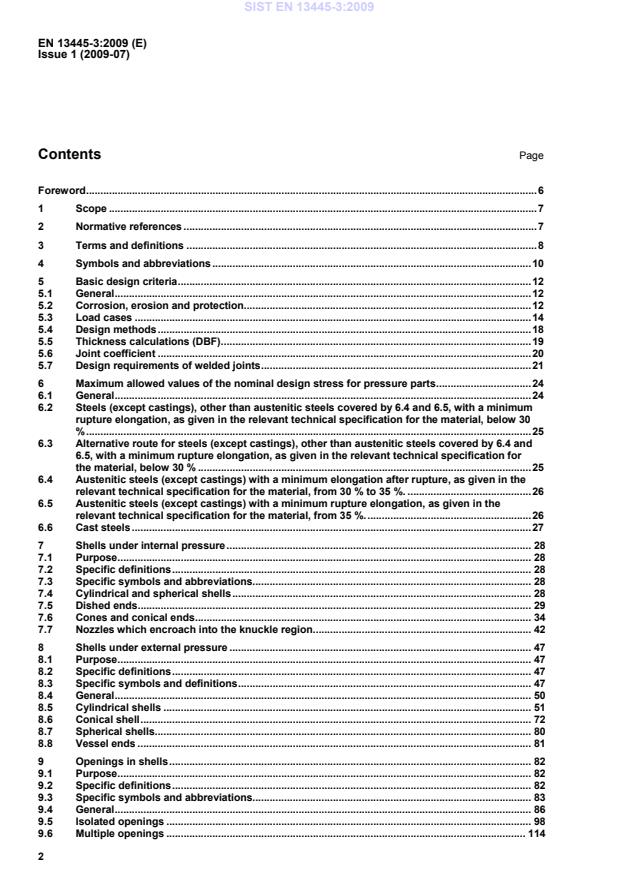
Issue 1 (2009-07) 3 9.7 Openings close to a shell discontinuity.124 10 Flat ends.132 10.1 Purpose.132 10.2 Specific definitions.132 10.3 Specific symbols and abbreviations.132 10.4 Unpierced circular flat ends welded to cylindrical shells.134 10.5 Unpierced bolted circular flat ends.141 10.6 Pierced circular flat ends.145 10.7 Flat ends of non-circular or annular shape.149 11 Flanges.153 11.1 Purpose.153 11.2 Specific definitions.153 11.3 Specific symbols and abbreviations.153 11.4 General.156 11.5 Narrow face gasketed flanges.160 11.6 Full face flanges with soft ring type gaskets.175 11.7 Seal welded flanges.178 11.8 Reverse narrow face flanges.178 11.9 Reverse full face flanges.181 11.10 Full face flanges with metal to metal contact.185 12 Bolted domed ends.188 12.1 Purpose.188 12.2 Specific definitions.188 12.3 Specific symbols and abbreviations.188 12.4 General.188 12.5 Bolted domed ends with narrow face gaskets.188 12.6 Bolted domed ends with full face joints.190 13 Heat Exchanger Tubesheets.192 13.1 Purpose.192 13.2 Specific definitions.192 13.3 Specific symbols and abbreviations.192 13.4 U-tube tubesheet heat exchangers.195 13.5 Fixed tubesheet heat exchangers.209 13.6 Floating tubesheet heat exchangers.237 13.7 Tubesheet characteristics.254 13.8 Maximum permissible tube to tubesheet joint stress.261 13.9 Maximum permissible longitudinal compressive stress for tubes.262 13.10 Design of tubesheet flange extension with a narrow face gasket.265 13.11 Design of tubesheet flange extension with a full face gasket.268 13.12 Special tube-to-tubesheet welded joints.271 14 Expansion bellows.274 14.1 Purpose.274 14.2 Specific definitions.274 14.3 Specific symbols and abbreviations.276 14.4 Conditions of applicability.278 14.5 U-shaped unreinforced bellows.280 14.6 U-shaped reinforced bellows.294 14.7 Toroidal bellows.302 14.8 Fabrication.309 14.9 Inspection and testing.311 14.10 Bellows subjected to axial, lateral or angular displacements.313 15 Pressure vessels of rectangular section.318 15.1 Purpose.318 15.2 Specific definitions.318 15.3 Specific symbols and abbreviations.318 15.4 General.319 15.5 Unreinforced vessels.319 15.6 Reinforced vessels.325 15.7 Openings.332 SIST EN 13445-3:2009
Issue 1 (2009-07) 5 21.3 Specific symbols and abbreviations.521 21.4 Ends without additional peripheral bending moment.522 21.5 Ends with additional peripheral bending moment.524 21.6 Openings.526 21.7 Welds.526 21.8 Central Ring.527 Annex A (normative)
Design requirements for pressure bearing welds.528 Annex B (normative)
Design by Analysis – Direct Route.552 Annex C (normative)
Design by analysis - Method based on stress categories.582 Annex D (informative)
Verification of the shape of vessels subject to external pressure.601 Annex E (normative)
Procedure for calculating the departure from the true circle of cylinders and cones.608 Annex F (normative)
Allowable external pressure for vessels outside circularity tolerance.611 Annex G (normative)
Alternative design rules for flanges and gasketed flange connections.613 Annex GA (informative)
Alternative design rules for flanges and gasketed flange connections.660 Annex H (informative)
Gasket factors m and y.723 Annex I (informative)
Additional information on heat exchanger tubesheet design.726 Annex J (normative)
Alternative method for the design of heat exchanger tubesheets.730 Annex K (informative)
Additional information on expansion bellows design.775 Annex L (informative)
Basis for design rules related to additional non-pressure loads.781 Annex M (informative)
In service monitoring of vessels operating in fatigue or creep.783 Annex N (informative)
Bibliography to clause 18.786 Annex O (informative)
Physical properties of steels.787 Annex P (normative)
Classification of weld details to be assessed using principal stresses.795 Annex Q
(normative)
Simplified procedure for the fatigue assessment of unwelded zones.808 Annex R (informative)
Coefficients for creep-rupture model equations for extrapolation of creep-rupture strength.809 Annex S (informative)
Extrapolation of the nominal design stress based on time-independent behaviour in the creep range.813 Annex T (normative)
Design by experimental methods.819 Annex Y (informative)
Differences between EN 13445-3:2002 and EN 13445-3:2009.832 Annex ZA (informative)
Relationship between this European Standard and the Essential Requirements of the EU Pressure Equipment Directive 97/23/EC.833
Issue 1 (2009-07) 7 1 Scope This Part of this European Standard specifies requirements for the design of unfired pressure vessels covered by EN 13445-1:2009 and constructed of steels in accordance with EN 13445-2:2009.
EN 13445-5:2009, Annex C specifies requirements for the design of access and inspection openings, closing mechanisms and special locking elements. NOTE This Part applies to design of vessels before putting into service. It may be used for in service calculation or analysis subject to appropriate adjustment. 2 Normative references This European Standard incorporates by dated or undated reference, provisions from other publications. These normative references are cited at the appropriate places in the text and the publications are listed hereafter. For dated references, subsequent amendments to or revisions of any of these publications apply to this European Standard only when incorporated in it by amendment or revision. For undated references, the latest edition of the publication referred to applies (including amendments). EN 286-2:1992, Simple unfired pressure vessels designed to contain air or nitrogen — Part 2: Pressure vessels for air braking and auxiliary systems for motor vehicles and their trailers. EN 764-1:2004, Pressure equipment — Terminology — Part 1: Pressure, temperature, volume, nominal size. EN 764-2:2002, Pressure equipment — Part 2: Quantities, symbols and units. EN 764-3:2002, Pressure equipment — Part 3: Definition of parties involved. EN 837-1:1996, Pressure gauges — Part 1: Bourdon tube pressure gauges — Dimensions, metrology, requirements and testing. EN 837-3:1996, Pressure gauges — Part 3: Diaphragm and capsule pressure gauges — Dimensions, metrology, requirements and testing. EN 1092-1:2007, Flanges and their joints — Circular flanges for pipes, valves, fittings and accessories, PN-designated. EN 1591-1:2001, Flanges and their joints — Design rules for gasketed circular flange connections — Calculation method. EN 1708-1:1999, EN 1708-1:1999/A1:2003, Welding — Basic weld joint details in steel — Part 1: Pressurized components. EN 10222-1:1998, EN 10222-1:1998/A1:2002, Steel forgings for pressure purposes — Part 1: General requirements for open die forgings. EN 13445-1:2009, Unfired pressure vessels — Part 1: General. EN 13445-2:2009, Unfired pressure vessels — Part 2: Materials. EN 13445-4:2009, Unfired pressure vessels — Part 4: Fabrication. EN 13445-5:2009, Unfired pressure vessels — Part 5: Inspection and testing. EN 13445-8:2009, Unfired pressure vessels — Part 8: Additional requirements for pressure vessels of aluminium and aluminium alloys. EN ISO 4014:2000, Hexagon head bolts — Product grades A and B (ISO 4014:1999). SIST EN 13445-3:2009
Issue 1 (2009-07) 9 3.10 design pressure pressure at the top of each chamber of the pressure equipment chosen for the derivation of the calculation pressure of each component [EN 764-1:2004] NOTE Any other location may be specified. 3.11 design temperature temperature chosen for the derivation of the calculation temperature of each component [EN 764-1:2004] 3.12 differential pressure pressure which algebraic value is equal to the pressure difference on either side of a separation wall
[EN 764-1:2004] 3.13 governing weld joint main full penetration butt joint the design of which, as a result of membrane stresses, governs the thickness of the component 3.14 load case combination of coincident actions 3.15 main joint weld joint assembling main pressure bearing parts 3.16 maximum permissible pressure
maximum pressure obtained from the design by formulae or relevant procedures of EN 13445-3:2009 for a given compoment in a given load case, or for the whole pressure vessel the minimum of these maximum permissible pressures of all compoments NOTE 1 The differences of the nominal design stress f, the analysis thickness ea and the joint coefficient z for the calculation of the maximum permissible pressure in different load cases are specified in 5.3.2. NOTE 2 If no explicit formula is given for the maximum permissible pressure Pmax then Pmax may be calculated as pressure which gives the required thickness equal to the analysis thickness. NOTE 3 The maximum permissible pressure Pmax used for the simplified assessment of fatigue life in clause 17 and for the calculation of the equivalent full pressure in 5.4.2 is calculated for normal operating load cases. 3.17 minimum possible fabrication thickness minimum possible thickness after fabrication 3.18 nominal design stress stress value to be used in the formulae for the calculation of pressure components 3.19 nominal thickness thickness as specified on the drawings SIST EN 13445-3:2009
[EN 764-1:2004] 3.23 weld throat thickness of a fillet weld height of the inscribed isosceles triangle measured from the theoretical root point 4 Symbols and abbreviations For the purposes of this Part of this European Standard, the general symbols and abbreviations shall be in accordance with EN 13445-1:2009, EN 13445-2:2009 and Table 4-1: SIST EN 13445-3:2009
Issue 1 (2009-07) 11 Table 4-1 — Symbols, quantities and units c Symbol Quantity Unit a weld throat thickness mm e required thickness mm en nominal thickness mm emin minimum possible fabrication thickness mm ea analysis thickness mm c corrosion allowance mm f nominal design stress MPa
ƒd
maximum value of the nominal design stress for normal operating load cases MPa
ƒexp
maximum value of the nominal design stress for exceptional load cases MPa
ƒtest
maximum value of the nominal design stress for testing load cases MPa
ηeq
number of equivalent full pressure cycles (see 5.4.2) - P calculation pressure MPa a Pd design pressure MPa a Pmax
maximum permissible pressure MPa a PS, Ps maximum allowable pressure MPa a Ptest
test pressure MPa a ReH upper yield strength MPa
Rm
tensile strength MPa
Rm/T
tensile strength at temperature T
MPa
Rp0,2 0,2 % proof strength MPa
Rp0,2/T 0,2 % proof strength at temperature T MPa
Rp1,0 1,0 % proof strength MPa
Rp1,0/T 1,0 % proof strength at temperature T MPa
T calculation temperature °C Td design temperature °C Ttest test temperature °C minmax,TSTS maximum/minimum allowable temperatures °C V volume
mm3
b z ν=join≥=coefficien≥=PoissonΔs=ra≥io=—=—=a=MPa=for=calcula≥ion=purpose=only,=o≥herwise=≥he=uni≥=may=be=bar=(1=MPa===10=bar).=b=mm3=for=calcula≥ion=purpose=only,=o≥herwise=≥he=uni≥=shoul≤=be=li≥re.=c=Formulae=use≤=in=≥his=s≥an≤ar≤=are=≤imensional.
The material strength characteristics used shall be related to the specified lifetimes in the various creep load cases 5.2 Corrosion, erosion and protection 5.2.1 General Whenever the word "corrosion" is used in this standard it shall be taken to mean corrosion, oxidation, scaling, abrasion, erosion and all other forms of wastage. NOTE 1 Stress corrosion cracking may occur under certain conditions of temperature and environment. A corrosion allowance is not an appropriate way of dealing with stress corrosion. Under such conditions, consideration shall be given to the materials used and the residual stresses in the fabricated vessel.
NOTE 2 It is impossible to lay down definite precautionary guidelines to safeguard against the effects of corrosion owing to the complex nature of corrosion itself, which may occur in many forms, including but not limited to the following: ⎯ chemical attack where the metal is dissolved by the reagents. It may be general over the whole surface or localized (causing pitting) or a combination of the two; ⎯ rusting caused by the combined action of moisture and air; ⎯ erosion corrosion where a reagent otherwise innocuous flows over the surface at velocity greater than some critical value;
⎯ high temperature oxidation (scaling).
Consideration should be given to the effect which corrosion (both internal and external) may have upon the useful life of the vessel. When in doubt, corrosion tests should be undertaken. These should be carried out on the actual metal (including welds or combination of metals) under exposure to the actual chemicals used in service. Corrosion tests should be continued for a sufficiently long period to determine the trend of any change in the rate of corrosion with respect to time. NOTE 3
It is very dangerous to assume that the major constituent of a mixture
...