


EN 1127-1:1997
(Main)Explosive atmospheres - Explosion prevention and protection - Part 1: Basic concepts and methodology
Explosive atmospheres - Explosion prevention and protection - Part 1: Basic concepts and methodology
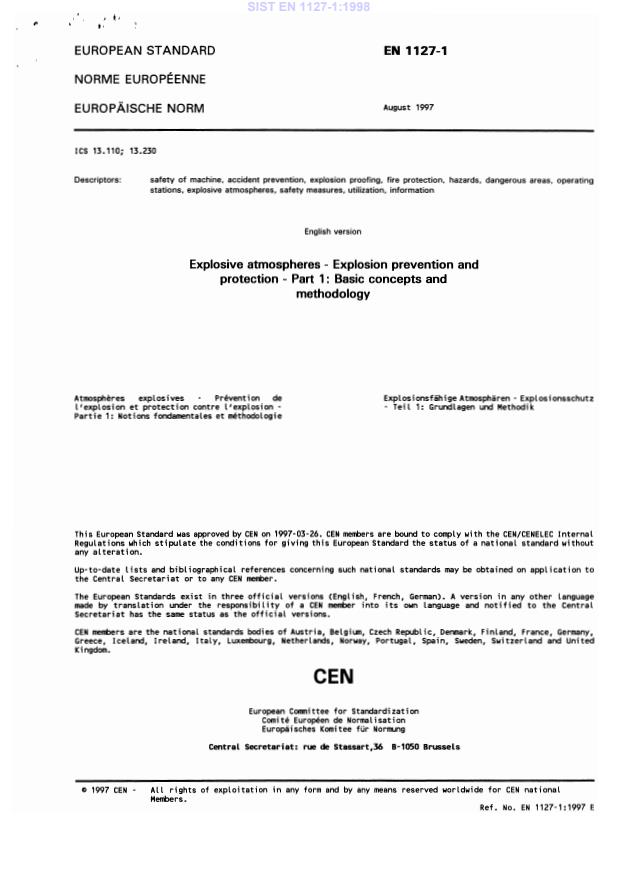
This European Standard specifies methods for the identification of hazardous situations leading to explosion and the design and construction measures appropriate for the required safety. This is achieved by: - hazard identification; - risk assessment; - elimination or minimization of risk; - information for use. The safety of equipment, protective systems, and components can be achieved, as described in 5.7 of EN 414:1992, by removal of hazards and/or limiting the risk, i.e. a) by design without using safeguarding; b) by safeguarding;
Explosionsfähige Atmosphären - Explosionsschutz - Teil 1: Grundlagen und Methodik
Diese Europäische Norm legt Methoden zum Erkennen und Beurteilen von Gefähr- nlichen Situationen, die zu Expolosionen führen können fest und beschreibt geeignete Planungs- und Fertigungsmaßnahmen, um die erforderliche Sicherheit zu erreichen. Dies wird erreicht durch - Erkennen von Gefährdungen; -Beurteilendes Risikos; -Beseitigen oder Verringern des Risikos; - Benutzerinformation Die Sicherheit von Geräten, Schutzsystement und Komponenten kann, wie in 5.7 von EN 414:1992 beschrieben, durch das Beseitigen von Gefährdungen und/oder die Begrenzung des Risikos erreicht werden.
Atmosphères explosives - Prévention de l'explosion et protection contre l'explosion - Partie 1: Notions fondamentales et méthodologie
Cette norme européenne spécifie des méthodes d'identification et d'appréciation des situations dangereuses conduisant à l'explosion et des mesures de conception et de construction appropriées pour la sécurité requise. Ceci est obtenu par: -l'identification du phénomène dangereux, -l'appréciation des risques, -la suppression ou la réduction du risque, - des information pour l'utilisation. La sécurité des appareils, système de protection et composants peut être atteinte par l'élimination des phénomènes dangereux et/ou la limitation du risque tel qu'il est indiqué au 5.7 dans l'EN 414:1992.
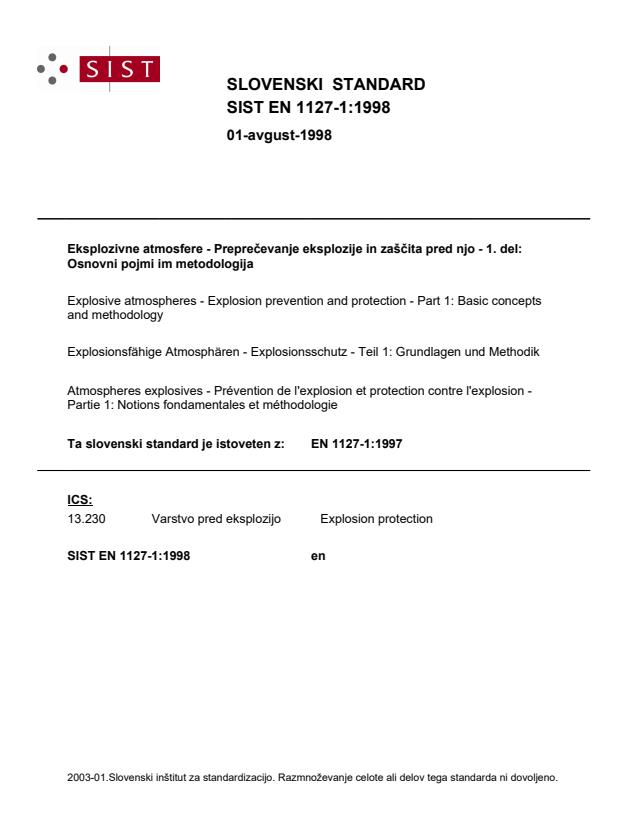
Eksplozivne atmosfere - Preprečevanje eksplozije in zaščita pred njo - 1. del: Osnovni pojmi im metodologija
General Information
- Status
- Withdrawn
- Publication Date
- 19-Aug-1997
- Withdrawal Date
- 27-Nov-2007
- Technical Committee
- CEN/TC 114 - Safety of machinery
- Drafting Committee
- CEN/TC 114/WG 16 - Fire and explosion
- Current Stage
- 9960 - Withdrawal effective - Withdrawal
- Start Date
- 28-Nov-2007
- Completion Date
- 28-Nov-2007
- Directive
- 89/392/EEC - Machinery - Safety of machinery: general essential health and safety requirements
- Directive
- 98/37/EC - Machinery
Relations
- Effective Date
- 22-Dec-2008
- Effective Date
- 28-Jan-2026
- Effective Date
- 28-Jan-2026
- Effective Date
- 28-Jan-2026
- Effective Date
- 28-Jan-2026
- Effective Date
- 28-Jan-2026
- Effective Date
- 28-Jan-2026
- Effective Date
- 28-Jan-2026
- Effective Date
- 28-Jan-2026
- Effective Date
- 28-Jan-2026
- Effective Date
- 28-Jan-2026
- Effective Date
- 28-Jan-2026
- Effective Date
- 28-Jan-2026
- Effective Date
- 28-Jan-2026
- Effective Date
- 28-Jan-2026

Get Certified
Connect with accredited certification bodies for this standard

NSF International
Global independent organization facilitating standards development and certification.

CIS Institut d.o.o.
Personal Protective Equipment (PPE) certification body. Notified Body NB-2890 for EU Regulation 2016/425 PPE.

Kiwa BDA Testing
Building and construction product certification.
Sponsored listings
Frequently Asked Questions
EN 1127-1:1997 is a standard published by the European Committee for Standardization (CEN). Its full title is "Explosive atmospheres - Explosion prevention and protection - Part 1: Basic concepts and methodology". This standard covers: This European Standard specifies methods for the identification of hazardous situations leading to explosion and the design and construction measures appropriate for the required safety. This is achieved by: - hazard identification; - risk assessment; - elimination or minimization of risk; - information for use. The safety of equipment, protective systems, and components can be achieved, as described in 5.7 of EN 414:1992, by removal of hazards and/or limiting the risk, i.e. a) by design without using safeguarding; b) by safeguarding;
This European Standard specifies methods for the identification of hazardous situations leading to explosion and the design and construction measures appropriate for the required safety. This is achieved by: - hazard identification; - risk assessment; - elimination or minimization of risk; - information for use. The safety of equipment, protective systems, and components can be achieved, as described in 5.7 of EN 414:1992, by removal of hazards and/or limiting the risk, i.e. a) by design without using safeguarding; b) by safeguarding;
EN 1127-1:1997 is classified under the following ICS (International Classification for Standards) categories: 13.110 - Safety of machinery; 13.230 - Explosion protection. The ICS classification helps identify the subject area and facilitates finding related standards.
EN 1127-1:1997 has the following relationships with other standards: It is inter standard links to EN 1127-1:2007, EN 692:2005+A1:2009, EN 693:2001+A2:2011, EN 13736:2003+A1:2009, EN 14986:2007, EN 12981:2005+A1:2009, EN 13218:2002+A1:2008, EN 14373:2005, EN 13463-6:2005, EN 12717:2001+A1:2009, EN 14958:2006+A1:2009, EN 1834-1:2000, EN 618:2002+A1:2010, EN 14994:2007, EN 13852-1:2004. Understanding these relationships helps ensure you are using the most current and applicable version of the standard.
EN 1127-1:1997 is associated with the following European legislation: EU Directives/Regulations: 89/392/EEC, 94/9/EC, 98/37/EC; Standardization Mandates: M/BC/CEN/88/13, M/BC/CEN/92/46. When a standard is cited in the Official Journal of the European Union, products manufactured in conformity with it benefit from a presumption of conformity with the essential requirements of the corresponding EU directive or regulation.
EN 1127-1:1997 is available in PDF format for immediate download after purchase. The document can be added to your cart and obtained through the secure checkout process. Digital delivery ensures instant access to the complete standard document.
Standards Content (Sample)
2003-01.Slovenski inštitut za standardizacijo. Razmnoževanje celote ali delov tega standarda ni dovoljeno.Explosionsfähige Atmosphären - Explosionsschutz - Teil 1: Grundlagen und MethodikAtmospheres explosives - Prévention de l'explosion et protection contre l'explosion - Partie 1: Notions fondamentales et méthodologieExplosive atmospheres - Explosion prevention and protection - Part 1: Basic concepts and methodology13.230Varstvo pred eksplozijoExplosion protectionICS:Ta slovenski standard je istoveten z:EN 1127-1:1997SIST EN 1127-1:1998en01-avgust-1998SIST EN 1127-1:1998SLOVENSKI
STANDARD
...
Questions, Comments and Discussion
Ask us and Technical Secretary will try to provide an answer. You can facilitate discussion about the standard in here.
Loading comments...