

EN 13736:2003+A1:2009
(Main + Amendment)Safety of machine tools - Pneumatic presses
- Abstract
1.1 This European Standard specifies technical safety requirements and protective measures to be adopted by persons undertaking the design as defined in 3.11 of EN 292-1:1991, manufacture and supply of pneumatic presses the intended use of which is the cold working of metal or material partly of metal as defined in 3.1.13 and hereafter referred as machines.
This standard also applies to machines which are integrated into an automatic production line where the hazards and risk arising are comparable to those of machines working separately.
1.2 This standard also covers pneumatic presses:
whose primary intended use is the cold working of metal, which are to be used in the same way to work other sheet materials (e.g. cardboard, plastic, rubber, leather) and metal powder;
with an intermediate pneumatic/hydraulic intensifier.
1.3 The requirements in this standard take account of intended use, as defined in 3.12 of EN 292-1:1991. This standard presumes access to the press from all directions, deals with the hazards described in clause 4, and specifies the safety measures for both the operator and other exposed persons.
1.4 This standard also applies to ancillary devices which are an integral part of the press. This standard also applies to machines which are integrated into an automatic production line where the hazards and risk arising are comparable to those of machines working separately.
1.5 This standard does not cover machines whose principal designed purpose is:
a) sheet metal cutting by guillotine;
b) bending or folding by pneumatic press brakes or folding machines;
c) spot welding;
d) tube bending;
e) straightening;
f) drop stamping;
g) working by pneumatic hammer;
h) compaction of metal powder.
Special pneumatic machines for assemblying or calibrating are not covered but this standard may be used as a basis for there machines.
1.6 This standard does not cover the safety requirements related to the use of PES or PPS. They will be dealt with a
- Status
- Withdrawn
- Publication Date
- 10-Feb-2009
- Withdrawal Date
- 06-Oct-2026
- Technical Committee
- CEN/TC 143 - Machine tools - Safety
- Drafting Committee
- CEN/TC 143/WG 1 - Metal forming machine tools - Safety
- Current Stage
- 9960 - Withdrawal effective - Withdrawal
- Start Date
- 07-Feb-2018
- Completion Date
- 07-Oct-2026
- Directive
- 2006/42/EC - Directive 2006/42/EC of the European Parliament and of the Council of 17 May 2006 on machinery, and amending Directive 95/16/EC (recast)OJ Ref: C, C 214 OJ Date: 08-Sep-2009

Relations
- Effective Date
- 19-Jan-2023
- Effective Date
- 18-Jan-2023
- Effective Date
- 08-Jun-2022
- Effective Date
- 08-Jun-2022
- Effective Date
- 09-Feb-2026
- Effective Date
- 09-Feb-2026
- Effective Date
- 09-Feb-2026
- Effective Date
- 09-Feb-2026
- Effective Date
- 28-Jan-2026
- Effective Date
- 28-Jan-2026
- Effective Date
- 28-Jan-2026
- Effective Date
- 28-Jan-2026
- Effective Date
- 28-Jan-2026
- Effective Date
- 28-Jan-2026
- Effective Date
- 28-Jan-2026
Get Certified
Connect with accredited certification bodies for this standard

DVS-ZERT GmbH
German welding certification society.
CARES (UK Certification Authority for Reinforcing Steels)
UK certification for reinforcing steels and construction.
EWF/IIW (European/International Welding Federation)
International welding personnel certification.
Sponsored listings
Frequently Asked Questions
EN 13736:2003+A1:2009 is a standard published by the European Committee for Standardization (CEN). Its full title is "Safety of machine tools - Pneumatic presses". This standard covers: 1.1 This European Standard specifies technical safety requirements and protective measures to be adopted by persons undertaking the design as defined in 3.11 of EN 292-1:1991, manufacture and supply of pneumatic presses the intended use of which is the cold working of metal or material partly of metal as defined in 3.1.13 and hereafter referred as machines. This standard also applies to machines which are integrated into an automatic production line where the hazards and risk arising are comparable to those of machines working separately. 1.2 This standard also covers pneumatic presses: whose primary intended use is the cold working of metal, which are to be used in the same way to work other sheet materials (e.g. cardboard, plastic, rubber, leather) and metal powder; with an intermediate pneumatic/hydraulic intensifier. 1.3 The requirements in this standard take account of intended use, as defined in 3.12 of EN 292-1:1991. This standard presumes access to the press from all directions, deals with the hazards described in clause 4, and specifies the safety measures for both the operator and other exposed persons. 1.4 This standard also applies to ancillary devices which are an integral part of the press. This standard also applies to machines which are integrated into an automatic production line where the hazards and risk arising are comparable to those of machines working separately. 1.5 This standard does not cover machines whose principal designed purpose is: a) sheet metal cutting by guillotine; b) bending or folding by pneumatic press brakes or folding machines; c) spot welding; d) tube bending; e) straightening; f) drop stamping; g) working by pneumatic hammer; h) compaction of metal powder. Special pneumatic machines for assemblying or calibrating are not covered but this standard may be used as a basis for there machines. 1.6 This standard does not cover the safety requirements related to the use of PES or PPS. They will be dealt with a
1.1 This European Standard specifies technical safety requirements and protective measures to be adopted by persons undertaking the design as defined in 3.11 of EN 292-1:1991, manufacture and supply of pneumatic presses the intended use of which is the cold working of metal or material partly of metal as defined in 3.1.13 and hereafter referred as machines. This standard also applies to machines which are integrated into an automatic production line where the hazards and risk arising are comparable to those of machines working separately. 1.2 This standard also covers pneumatic presses: whose primary intended use is the cold working of metal, which are to be used in the same way to work other sheet materials (e.g. cardboard, plastic, rubber, leather) and metal powder; with an intermediate pneumatic/hydraulic intensifier. 1.3 The requirements in this standard take account of intended use, as defined in 3.12 of EN 292-1:1991. This standard presumes access to the press from all directions, deals with the hazards described in clause 4, and specifies the safety measures for both the operator and other exposed persons. 1.4 This standard also applies to ancillary devices which are an integral part of the press. This standard also applies to machines which are integrated into an automatic production line where the hazards and risk arising are comparable to those of machines working separately. 1.5 This standard does not cover machines whose principal designed purpose is: a) sheet metal cutting by guillotine; b) bending or folding by pneumatic press brakes or folding machines; c) spot welding; d) tube bending; e) straightening; f) drop stamping; g) working by pneumatic hammer; h) compaction of metal powder. Special pneumatic machines for assemblying or calibrating are not covered but this standard may be used as a basis for there machines. 1.6 This standard does not cover the safety requirements related to the use of PES or PPS. They will be dealt with a
EN 13736:2003+A1:2009 is classified under the following ICS (International Classification for Standards) categories: 25.120.10 - Forging equipment. Presses. Shears. The ICS classification helps identify the subject area and facilitates finding related standards.
EN 13736:2003+A1:2009 has the following relationships with other standards: It is inter standard links to EN 13736:2003/AC:2004, EN 13736:2003, EN ISO 16092-4:2020, EN ISO 16092-1:2018, EN 60529:1991, ISO 3287:1999, EN 61496-1:1997, EN 60204-1:1997, EN 349:1993, EN 574:1996, EN 1837:1999, EN 614-1:2006+A1:2009, EN 292-1:1991, EN 292-2:1991/A1:1995, EN ISO 11688-1:1998. Understanding these relationships helps ensure you are using the most current and applicable version of the standard.
EN 13736:2003+A1:2009 is associated with the following European legislation: EU Directives/Regulations: 2006/42/EC, 98/37/EC; Standardization Mandates: M/079, M/396. When a standard is cited in the Official Journal of the European Union, products manufactured in conformity with it benefit from a presumption of conformity with the essential requirements of the corresponding EU directive or regulation.
EN 13736:2003+A1:2009 is available in PDF format for immediate download after purchase. The document can be added to your cart and obtained through the secure checkout process. Digital delivery ensures instant access to the complete standard document.
Standards Content (Sample)
2003-01.Slovenski inštitut za standardizacijo. Razmnoževanje celote ali delov tega standarda ni dovoljeno.Varnost obdelovalnih strojev - Pnevmatske stiskalniceSicherheit von Werkzeugmaschinen - Pneumatische PressenSécurité des machines-outils - Presses pneumatiquesSafety of machine tools - Pneumatic presses25.120.10Kovaški stroji. Stiskalnice. ŠkarjeForging equipment. Presses. ShearsICS:Ta slovenski standard je istoveten z:EN 13736:2003+A1:2009SIST EN 13736:2003+A1:2009en,fr01-maj-2009SIST EN 13736:2003+A1:2009SLOVENSKI
STANDARD
EUROPEAN STANDARD NORME EUROPÉENNE EUROPÄISCHE NORM
EN 13736:2003+A1
February 2009 ICS 25.120.10 Supersedes EN 13736:2003English Version
Safety of machine tools - Pneumatic presses
Sécurité des machines-outils - Presses pneumatiques
Sicherheit von Werkzeugmaschinen - Pneumatische Pressen This European Standard was approved by CEN on 15 November 2002 and includes Corrigendum 1 issued by CEN on 21 July 2004 and Amendment 1 approved by CEN on 29 December 2008.
CEN members are bound to comply with the CEN/CENELEC Internal Regulations which stipulate the conditions for giving this European Standard the status of a national standard without any alteration. Up-to-date lists and bibliographical references concerning such national standards may be obtained on application to the CEN Management Centre or to any CEN member.
This European Standard exists in three official versions (English, French, German). A version in any other language made by translation under the responsibility of a CEN member into its own language and notified to the CEN Management Centre has the same status as the official versions.
CEN members are the national standards bodies of Austria, Belgium, Bulgaria, Cyprus, Czech Republic, Denmark, Estonia, Finland, France, Germany, Greece, Hungary, Iceland, Ireland, Italy, Latvia, Lithuania, Luxembourg, Malta, Netherlands, Norway, Poland, Portugal, Romania, Slovakia, Slovenia, Spain, Sweden, Switzerland and United Kingdom.
EUROPEAN COMMITTEE FOR STANDARDIZATION
COMITÉ EUROPÉEN DE NORMALISATION EUROPÄISCHES KOMITEE FÜR NORMUNG
Management Centre:
Avenue Marnix 17,
B-1000 Brussels © 2009 CEN All rights of exploitation in any form and by any means reserved worldwide for CEN national Members. Ref. No. EN 13736:2003+A1:2009: ESIST EN 13736:2003+A1:2009
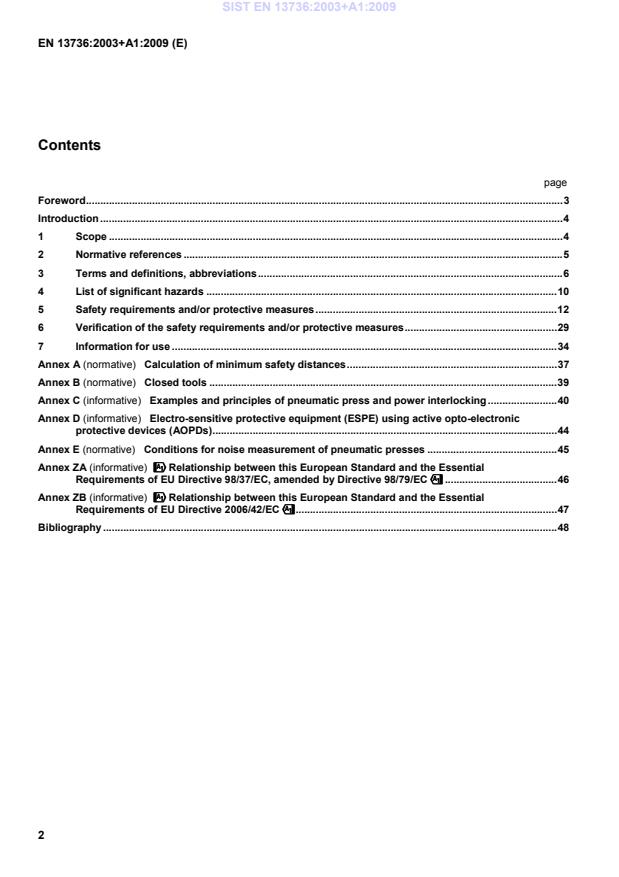
Calculation of minimum safety distances . 37 Annex B (normative)
Closed tools . 39 Annex C (informative)
Examples and principles of pneumatic press and power interlocking . 40 Annex D (informative)
Electro-sensitive protective equipment (ESPE) using active opto-electronic protective devices (AOPDs) . 44 Annex E (normative)
Conditions for noise measurement of pneumatic presses . 45 Annex ZA (informative)
!!!!Relationship between this European Standard and the Essential Requirements of EU Directive 98/37/EC, amended by Directive 98/79/EC"""" . 46 Annex ZB (informative)
!!!!Relationship between this European Standard and the Essential Requirements of EU Directive 2006/42/EC"""" . 47 Bibliography . 48
Figure 1 — Example of a down-stroking pneumatic press 3.2 Abbreviations 3.2.1 M Monitoring (see 3.1.8) 3.2.2 R Redundancy (see 3.1.15) 3.2.3 S Single system
3.2.4 BDC Bottom dead centre (see 3.1.5) 3.2.5 TDC Top dead centre (see 3.1.5) 3.2.6 PES Programmable electronic systems 3.2.7 PPS Programmable pneumatic systems 3.2.8 AOPD Active opto-electronic protective devices 3.2.9 ESPE Electro-sensitive protective equipment 3.2.10 THCD Two-hand control device SIST EN 13736:2003+A1:2009
EN 292-1: 1991 Preventive measures: relevant clauses in this standard 1.0 Mechanical hazards generated by: machine parts or work-pieces Tools and associated area: – between tools, – moving slide/ram – between the moving and the fixed parts of the pneumatic press 1.3 (except 1.3.6)4.2 5.1, 5.3 to 5.5
accumulation of energy inside machinery caused, for example, by: – elastic elements (springs) – liquids and gases under pressure – moving die cushions – moving work-piece ejectors – moving guards 1.5.3, 1.6.1, 1.6.3 4.2 5.8.2 1.1 Crushing hazard Outside tools area: – from hazardous situation of falling objects 1.3 (except 1.3.6) 4.2.1 5.2.1, 5.2.2, 5.3 to 5.6
1.2 Shearing hazard
1.4 (except
1.3 Cutting or severing hazard
1.4.2.3)
1.4 Entanglement hazard
1.5.14
1.5 Drawing-in or trapping hazard
1.6 Impact hazard Moving parts of electrical, hydraulic and pneumatic equipment Mechanical handling device 1.3 4.2.1 5.6 1.9 High pressure fluid injection or ejection hazard Pneumatic system,Hydraulic system 1.3.2 4.2.1 5.2.3.4, 5.6.5, 5.8.2 2.0 Electrical hazards due to:
2.1 Contact of persons with live parts (direct contact) Electrical equipment 1.5.1, 1.6.3 4.3 5.8.1 2.2 Contact of persons with parts which have become live under faulty conditions (indirect contact) Electrical equipment 1.5.1
5.8.1 4.0 Noise hazards
4.1 Hazards generated by noise resulting in hearing losses (deafness) Any area at the pneumatic press where there is a risk to hearing
1.5.8 4.5 5.8.3 8.0 Hazards generated by neglecting ergonomic principles in machinery design, as e.g. from: 8.1 Unhealthy postures or excessive effort The working position and any area for controls, setting, 1.1.2 d), 1.1.5, 1.6.2, 1.6.4 4.9 5.8.5 8.2 Inadequate consideration of hand-arm foot-leg anatomy maintenance and handling 1.1.2 d), 2.2
8.4 Inadequate local lighting
1.1.4
5.8.5.3,
7.2.2 e) 8.6 Human error, human behaviour
1.1.2 d), 1.2.2, 1.2.5, 1.2.8, 1.5.4, 1.7 4.9 5.4.4, 5.4.6.1, 5.4.6.5, 5.4.7 8.7 Inadequate design, location or identification of manual controls
1.2.2
5.4.6, 5.8.5.2 8.8 Inadequate design or location of visual display units
1.7.1
5.8.5.2 (continued) SIST EN 13736:2003+A1:2009
5.2 to 5.5 10.2 Restoration of the energy supply after an interruption – moving slide/ram
– between the moving and the fixed parts of the pneumatic press, – moving die cushions 1.2.6
5.4.1.1 10.3 External influences on electrical equipment – moving work-piece ejectors – moving guards 1.2.1, 1.5.11
5.4.1 10.5 Errors in the software
1.2.1
5.4.3 10.6 Errors made by the operator (due to mismatch of machinery with human characteristics and abilities, see 8.6 of Table 1)
Outside tools area: – from hazardous situation of falling objects 1.1.2 d), 1.2.2, 1.2.5, 1.2.8, 1.5.4, 1.7 4.9 5.3, 7.2.2 13 Failure of the power supply
1.2.6
5.4.1.1 14 Failure of the control circuit
1.2.1, 1.2.3, 1.2.4, 1.2.5, 1.2.7, 1.6.3
5.2 to 5.5 15 Errors of fitting tools 1.5.4 4.9 5.3.17 16 Break-up during operation Mechanical, electrical, hydraulic and pneumatic equipment 1.3.2 4.2.2 5.2.3.4, 5.2.3.7,5.2.3.8, 5.2.3.9, 5.4.5 17 Falling or ejected objects or fluids Machine components Work-pieces and tools 1.3.3
5.3.17, 5.3.17.119 Slip, trip and fall of persons (related to machinery) All access and/or work at heights Floor area around the pneumatic press 1.5.15 4.2.3 5.7
5 Safety requirements and/or protective measures 5.1 Introduction Pneumatic presses shall comply with the safety requirements and/or protective measures of this clause. In addition, the pneumatic press shall be designed according to the principles of EN 292 for hazards relevant but not significant which are not dealt with by this standard. The methods or measures to be implemented to eliminate the significant hazards or reduce their associated risks are detailed in this clause in the following manner: basic design considerations for major press components or systems (see 5.2); SIST EN 13736:2003+A1:2009
292-1:1991 and 4.2.2.5 of EN 292-2:1991(see also 5.4.1.7). 5.3.9 The guards mentioned in 5.3.8 shall be provided: a) either with guard locking, to prevent the opening of the guard gate until any hazardous movement in the tools area has ceased; b) or without guard locking but designed to bring the hazardous movement to a stop before the danger zone can be reached. 5.3.10 Where an interlocking guard or a control guard has an early opening feature, it shall function as an early opening interlocking guard (see 3.1.7). 5.3.11 Using an interlocking guard as a control guard, it shall not be possible to stand between the guard and the danger zone. This can be prevented using additional safeguarding means. These additional safeguarding means shall either be an AOPD (type 4) or a fixed guard kept in place permanently (e.g. by welding) or an interlocking guard in accordance with 6.2.1 of EN 1088:1995. Control guards shall only be used when the opening stroke length is equal to or less than 600 mm and the depth of the press table is equal to or less than 1 000 mm. These restrictions do not apply when the control guard is controlled by a hold-to-run control device. The control guard(s) shall be securely held open (e.g. by spring or counterweight) to avoid gravity fall which can cause unintended cycle initiation. 5.3.12 ESPE using AOPDs in the form of light curtains shall comply with the following: a) AOPDs shall conform to Type 4 of EN 61496-1, and be designed and constructed according to prEN 61496-2; b) access to the danger zone shall only be possible through the detection zone of the AOPD (detection capability, see annex A). Additional safeguarding shall prevent access to the danger zone from any other direction; the remaining openings shall follow the corresponding values of EN 294 (see annex D); c) where it is possible to stand in a position between a light curtain and the danger zone of the press, additional means, for example further beams, shall be provided to detect a person standing there. The maximum permissible undetected gap shall be equal to or less than 75 mm; d) it shall not be possible to initiate any hazardous movement while any part of the body is interrupting the AOPD; e) the means of resetting shall be so positioned that, from that position, there is a clear view of the danger zone. There shall not be more than one reset control device for each detection zone. If the press is safeguarded by means of side and back AOPDs, a reset control device shall be provided on each detection zone; f) the press manufacturer may provide options operable only by the use of a selector switch: i) AOPD operating by reflecting the transmitted light beam back along its own path comprising an additional reflector(s) (blanking reflector) placed in the detection zone; additional safeguarding e.g. fixed guard(s); the blanking reflector and additional safeguarding mounting. SIST EN 13736:2003+A1:2009
Key 1 Retro-reflective AOPD
5Blank object (workpiece carrier)
2 Detection zone
6Blanking reflector
3 Reflector
7Height
4 Additional safeguarding means
8Width
Figure 2 — Retro-reflective AOPD ii) non retro-reflective AOPD with blanking zone comprising: additional safeguarding e.g. fixed guards; the additional safeguarding mounting. In both options the configuration of the additional reflector(s)/blanking zone shall not allow an item of thickness equal to or greater than the specified test piece size (see 4.1.2 of prEN 61496-2:1997) to be undetected by the AOPD within the whole of the detection zone. In addition the additional safeguarding shall be so designed and positioned that it is not possible to reach the danger zone without detection. SIST EN 13736:2003+A1:2009
Key 1 Emitter
4Additional safeguarding means
2 Detection zone
5Blank object(work-piece carrier)
3 Reciever
Figure 3 — AOPD with blanking zone g) where the AOPD is also used for cycle initiation, either single or double break (see also annex A): i) the height of the press table shall be equal to or more than 750 mm above the standing level of the operator; If the table is less than 750 mm in height, this height shall be achieved by the use of an additional guard(s); this guard and all other guards preventing access to the tools area shall be kept in place permanently, e.g. by welding, or by the use of an interlocking guard. It shall not be possible to stand between the physical barrier and the table or tools, or beside the table or tools. ii) the opening stroke length shall be equal to or less than 600 mm and the depth of the press table shall be equal to or less than 1 000 mm; iii) the detection capability shall not exceed 30 mm (see Table A.1); iv) before the first cycle initiation, the reset function(s) shall be actuated (e.g. push button, foot pedal); v) the facility to initiate the press motion upon clearing of the AOPD shall be limited to the pre-set time. This pre-set time shall not be capable of exceeding 30 s starting from the end of the previous operating cycle. The AOPD shall be required to be manually reset, if the pre-set time has been exceeded; SIST EN 13736:2003+A1:2009
...