

EN 16500:2014
(Main)Machines for compacting waste materials or recyclable fractions - Vertical baling presses - Safety requirements
- Abstract
This European Standard specifies the safety requirements for the design, manufacture and information for safe use of vertical baling presses for compacting waste material or recyclable fractions (e. g. paper, plastics, textiles, cans, cardboard, mixed waste), hereafter referred to as materials.
This standard covers vertical baling presses:
- that are manually or mechanically fed; and
- with fixed enclosed baling chambers (single or multiple chamber presses); and
- with a mechanically, hydraulically or pneumatically operated compacting equipment; and
- where the compacted bale is tied manually in the baling chamber; and
- with manual unloading or mechanical ejection of the compacted bale.
The scope of this standard includes any mechanical feed equipment, such as belt type conveyors or bin lifts, forming an integral part of the baling press assembly. It also includes integral material flow control equipment.
This standard does not apply to:
- vertical baling presses without fixed enclosed baling chamber(s); or
- round balers or roll baling machines; or
- machines where the compressed material is bagged; or
- pneumatic conveying systems; or
- equipment for transporting the balers; or
- local exhaust ventilation for the removal of dusts or vapours; or
- hazards arising from any integral pre-conditioning equipment; or
- hazards arising from the materials being processed (e.g. asbestos, clinical waste, flammable or explosive materials, unhealthy or poisonous waste).
This standard does not apply to cranes, lift trucks or other mobile plant used to load materials into the feed opening. Nor does it apply to hazards arising from loading materials into the feed opening using cranes, lift trucks or other mobile plant.
This standard does not include requirements to meet the specifications of the ATEX Directive 94/9/EC.
All hazards mentioned in Clause 4 are dealt with in this European Standard.
This European Standard is not applicable for vertical baling presses which are manufactured before the date of its publication as an EN.
- Status
- Published
- Publication Date
- 05-Aug-2014
- Withdrawal Date
- 27-Feb-2015
- Technical Committee
- CEN/TC 397 - Project Committee - Baling presses - Safety requirements
- Drafting Committee
- CEN/TC 397 - Project Committee - Baling presses - Safety requirements
- Current Stage
- 9093 - Decision to confirm - Review Enquiry
- Start Date
- 03-Sep-2025
- Completion Date
- 30-Sep-2026
- Directive
- 2006/42/EC - Directive 2006/42/EC of the European Parliament and of the Council of 17 May 2006 on machinery, and amending Directive 95/16/EC (recast)OJ Ref: C, C 14 OJ Date: 15-Jan-2016

Overview
EN 16500:2014 is the CEN European Standard that specifies safety requirements for vertical baling presses used to compact waste materials or recyclable fractions (e.g. paper, plastics, textiles, cans, cardboard, mixed waste). It covers presses with fixed enclosed baling chambers (single or multiple), mechanically/hydraulically/pneumatically operated compacting units, manual bale tying, and manual or mechanical bale ejection. The standard addresses design, manufacture and information for safe use and is a Type C machinery standard referenced to the Machinery Directive (see Annex ZA).
Key topics and requirements
- Scope & exclusions
- Applies to manually or mechanically fed vertical baling presses and integral feed equipment (belt conveyors, bin lifts, flow control).
- Excludes round balers, roll baling machines, bagging machines, pneumatic conveying systems, transport equipment for bales, exhaust ventilation, ATEX requirements, and hazards from certain processed materials (e.g. asbestos, clinical or explosive wastes). It also excludes hazards from cranes/lift trucks used to load the feed opening.
- Mechanical safety
- Requirements for guarding of feed, baling chamber and ejection areas; prevention of crushing, shearing and entanglement.
- Protection of moving compacting equipment and mechanical feed devices.
- Control systems
- Design and placement of control actuators, prevention of unintended start-up, emergency stop requirements and specification of required performance levels (PL) for safety-related functions.
- Two-hand control and interlocking measures where applicable.
- Hydraulic & pneumatic hazards
- Safety rules for hydraulic/pneumatic components, hot surfaces and control systems.
- Electrical safety
- Conformance with electrical machine safety standards for wiring, enclosures and protection.
- Noise & ergonomics
- Measures for noise reduction at source, information and testing procedures (noise test code in Annex A), and ergonomic design to reduce operator risk.
- Verification & information
- Verification procedures for safety requirements and mandatory information for safe operation, maintenance, inspection and marking.
Applications - who uses EN 16500
- Machine designers and manufacturers of vertical baling presses
- Safety engineers, compliance officers and CE marking teams
- Facility managers and recyclers specifying safe baling equipment
- Test laboratories and notified bodies assessing machine conformity
- Procurement and maintenance teams seeking safety and operational guidance
Related standards (selected)
- EN 60204-1 - Electrical equipment of machines
- EN 574 - Two‑hand control devices
- EN 953 - Machine guarding
- EN ISO 3744 / 3746 / 3747 - Acoustics (noise measurement)
- EN ISO 4413 - Hydraulic systems
Using EN 16500 helps ensure vertical baling presses meet recognized European safety practices for design, control, maintenance and operator information, reducing risk in waste compaction and recycling operations.
Relations
- Effective Date
- 25-Aug-2026
- Effective Date
- 09-Feb-2026
- Effective Date
- 09-Feb-2026
- Effective Date
- 09-Feb-2026
- Effective Date
- 09-Feb-2026
- Effective Date
- 09-Feb-2026
- Effective Date
- 09-Feb-2026
- Effective Date
- 28-Jan-2026
- Effective Date
- 28-Jan-2026
- Effective Date
- 28-Jan-2026
- Effective Date
- 28-Jan-2026
- Effective Date
- 28-Jan-2026
- Effective Date
- 28-Jan-2026
- Effective Date
- 28-Jan-2026
- Effective Date
- 28-Jan-2026
Get Certified
Connect with accredited certification bodies for this standard

DVS-ZERT GmbH
German welding certification society.
CARES (UK Certification Authority for Reinforcing Steels)
UK certification for reinforcing steels and construction.
CIS Institut d.o.o.
Personal Protective Equipment (PPE) certification body. Notified Body NB-2890 for EU Regulation 2016/425 PPE.
Sponsored listings
Frequently Asked Questions
EN 16500:2014 is a standard published by the European Committee for Standardization (CEN). Its full title is "Machines for compacting waste materials or recyclable fractions - Vertical baling presses - Safety requirements". This standard covers: This European Standard specifies the safety requirements for the design, manufacture and information for safe use of vertical baling presses for compacting waste material or recyclable fractions (e. g. paper, plastics, textiles, cans, cardboard, mixed waste), hereafter referred to as materials. This standard covers vertical baling presses: - that are manually or mechanically fed; and - with fixed enclosed baling chambers (single or multiple chamber presses); and - with a mechanically, hydraulically or pneumatically operated compacting equipment; and - where the compacted bale is tied manually in the baling chamber; and - with manual unloading or mechanical ejection of the compacted bale. The scope of this standard includes any mechanical feed equipment, such as belt type conveyors or bin lifts, forming an integral part of the baling press assembly. It also includes integral material flow control equipment. This standard does not apply to: - vertical baling presses without fixed enclosed baling chamber(s); or - round balers or roll baling machines; or - machines where the compressed material is bagged; or - pneumatic conveying systems; or - equipment for transporting the balers; or - local exhaust ventilation for the removal of dusts or vapours; or - hazards arising from any integral pre-conditioning equipment; or - hazards arising from the materials being processed (e.g. asbestos, clinical waste, flammable or explosive materials, unhealthy or poisonous waste). This standard does not apply to cranes, lift trucks or other mobile plant used to load materials into the feed opening. Nor does it apply to hazards arising from loading materials into the feed opening using cranes, lift trucks or other mobile plant. This standard does not include requirements to meet the specifications of the ATEX Directive 94/9/EC. All hazards mentioned in Clause 4 are dealt with in this European Standard. This European Standard is not applicable for vertical baling presses which are manufactured before the date of its publication as an EN.
This European Standard specifies the safety requirements for the design, manufacture and information for safe use of vertical baling presses for compacting waste material or recyclable fractions (e. g. paper, plastics, textiles, cans, cardboard, mixed waste), hereafter referred to as materials. This standard covers vertical baling presses: - that are manually or mechanically fed; and - with fixed enclosed baling chambers (single or multiple chamber presses); and - with a mechanically, hydraulically or pneumatically operated compacting equipment; and - where the compacted bale is tied manually in the baling chamber; and - with manual unloading or mechanical ejection of the compacted bale. The scope of this standard includes any mechanical feed equipment, such as belt type conveyors or bin lifts, forming an integral part of the baling press assembly. It also includes integral material flow control equipment. This standard does not apply to: - vertical baling presses without fixed enclosed baling chamber(s); or - round balers or roll baling machines; or - machines where the compressed material is bagged; or - pneumatic conveying systems; or - equipment for transporting the balers; or - local exhaust ventilation for the removal of dusts or vapours; or - hazards arising from any integral pre-conditioning equipment; or - hazards arising from the materials being processed (e.g. asbestos, clinical waste, flammable or explosive materials, unhealthy or poisonous waste). This standard does not apply to cranes, lift trucks or other mobile plant used to load materials into the feed opening. Nor does it apply to hazards arising from loading materials into the feed opening using cranes, lift trucks or other mobile plant. This standard does not include requirements to meet the specifications of the ATEX Directive 94/9/EC. All hazards mentioned in Clause 4 are dealt with in this European Standard. This European Standard is not applicable for vertical baling presses which are manufactured before the date of its publication as an EN.
EN 16500:2014 is classified under the following ICS (International Classification for Standards) categories: 13.030.40 - Installations and equipment for waste disposal and treatment; 25.120.10 - Forging equipment. Presses. Shears. The ICS classification helps identify the subject area and facilitates finding related standards.
EN 16500:2014 has the following relationships with other standards: It is inter standard links to ISO 8598:1996, CLC/TS 61496-3:2008, EN 61496-1:2004, EN 82079-1:2012, CLC/TS 61496-2:2006, EN 60529:1991, EN 62262:2002, EN ISO 13856-2:2013, EN ISO 14122-1:2001, EN 1005-4:2005+A1:2008, EN 1037:1995+A1:2008, EN 574:1996+A1:2008, EN ISO 13857:2008, EN 953:1997+A1:2009, EN ISO 3744:2010. Understanding these relationships helps ensure you are using the most current and applicable version of the standard.
EN 16500:2014 is associated with the following European legislation: EU Directives/Regulations: 2006/42/EC; Standardization Mandates: M/396. When a standard is cited in the Official Journal of the European Union, products manufactured in conformity with it benefit from a presumption of conformity with the essential requirements of the corresponding EU directive or regulation.
EN 16500:2014 is available in PDF format for immediate download after purchase. The document can be added to your cart and obtained through the secure checkout process. Digital delivery ensures instant access to the complete standard document.
Standards Content (Sample)
2003-01.Slovenski inštitut za standardizacijo. Razmnoževanje celote ali delov tega standarda ni dovoljeno.Stroji za stiskanje odpadkov ali reciklirnih materialov - Stiskalnice za bale - Varnostne zahteveMaschinen zum Verdichten von Abfällen oder recyclebaren Materialien - Vertikal arbeitende Ballenpressen - SicherheitsanforderungenMachines à compactage pour déchets ou matières recylcables - Presses à balles verticales - Prescriptions de sécuritéMachines for compacting waste materials or recyclable fractions - Vertical baling presses - Safety requirements25.120.10Kovaški stroji. Stiskalnice. ŠkarjeForging equipment. Presses. Shears13.030.40Naprave in oprema za odstranjevanje in obdelavo odpadkovInstallations and equipment for waste disposal and treatmentICS:Ta slovenski standard je istoveten z:EN 16500:2014SIST EN 16500:2014en,fr,de01-oktober-2014SIST EN 16500:2014SLOVENSKI
STANDARD
EUROPEAN STANDARD NORME EUROPÉENNE EUROPÄISCHE NORM
EN 16500
August 2014 ICS 13.030.40; 25.120.10 English Version
Machines for compacting waste materials or recyclable fractions - Vertical baling presses - Safety requirements
Machines de compactage pour déchets ou matières recyclables - Presses à balles verticales - Prescriptions de sécurité
Maschinen zum Verdichten von Abfällen oder recyclebaren Materialien - Vertikale Ballenpressen - Sicherheitsanforderungen This European Standard was approved by CEN on 14 June 2014.
CEN members are bound to comply with the CEN/CENELEC Internal Regulations which stipulate the conditions for giving this European Standard the status of a national standard without any alteration. Up-to-date lists and bibliographical references concerning such national standards may be obtained on application to the CEN-CENELEC Management Centre or to any CEN member.
This European Standard exists in three official versions (English, French, German). A version in any other language made by translation under the responsibility of a CEN member into its own language and notified to the CEN-CENELEC Management Centre has the same status as the official versions.
CEN members are the national standards bodies of Austria, Belgium, Bulgaria, Croatia, Cyprus, Czech Republic, Denmark, Estonia, Finland, Former Yugoslav Republic of Macedonia, France, Germany, Greece, Hungary, Iceland, Ireland, Italy, Latvia, Lithuania, Luxembourg, Malta, Netherlands, Norway, Poland, Portugal, Romania, Slovakia, Slovenia, Spain, Sweden, Switzerland, Turkey and United Kingdom.
EUROPEAN COMMITTEE FOR STANDARDIZATION
COMITÉ EUROPÉEN DE NORMALISATION EUROPÄISCHES KOMITEE FÜR NORMUNG
CEN-CENELEC Management Centre:
Avenue Marnix 17,
B-1000 Brussels © 2014 CEN All rights of exploitation in any form and by any means reserved worldwide for CEN national Members. Ref. No. EN 16500:2014 ESIST EN 16500:2014
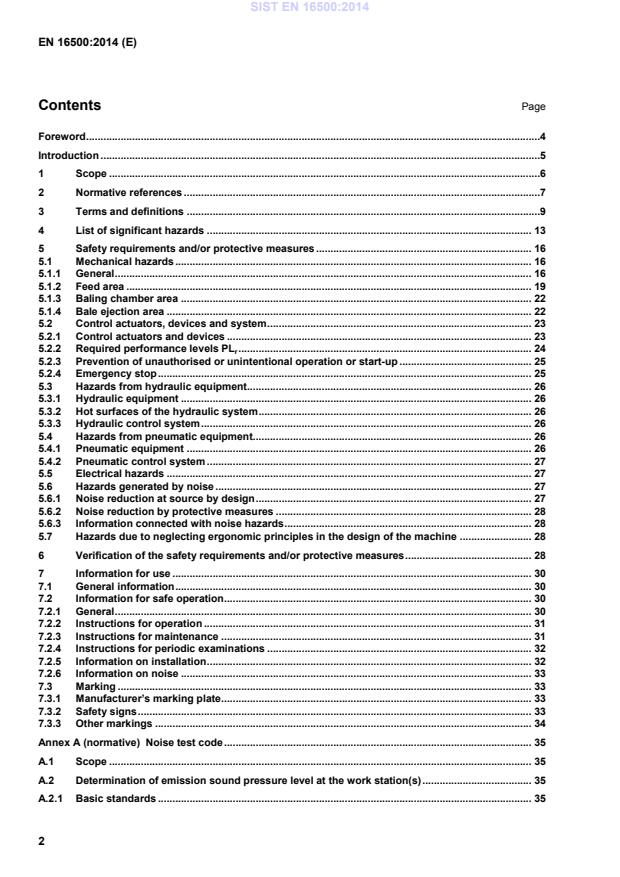
Noise test code . 35 A.1 Scope . 35 A.2 Determination of emission sound pressure level at the work station(s) . 35 A.2.1 Basic standards . 35 SIST EN 16500:2014
Relationship between this European Standard and the Essential Requirements of EU Directive 2006/42/EC . 39 Bibliography . 40
a) Front/ side -loaded single chamber baling presses with fixed position compacting head
b) Top-loaded multi chamber baling press with moveable position compacting head c) Front-loaded multi chamber baling press with fixed position compacting head Figure 1 — Examples of vertical baling presses SIST EN 16500:2014
Key 1 hydraulic cylinder 2 integrated power unit 3 control station 4 door locking device 5 bale ejection area 6 bale ejection device 7 compression plate 8 area for installing wires or ties 9 feed door 10 baling chamber 11 discharge door Figure 2 — Principle drawing of a vertical baling press 3.1 vertical baling press machine intended for compacting loose materials into a bale where the compacting pressure is applied vertically and downward from the feed opening and the bale is subsequently tied by strings, straps or wires Note 1 to entry: A vertical baling press may consist of one or more baling chambers, a control system and control station, a compacting equipment, equipment for manually binding the bale and equipment for ejection of the bale. SIST EN 16500:2014
Significant hazards Applicable subclauses 4.1 Mechanical hazards 5.1 4.1.1 Common for all areas 5.1.1, 5.2.2, 5.5, 7.2.5
Hazards caused by inadequate mechanical strength (e.g. impact by ejected machine parts).
Crushing and shearing caused by the opening or closing movement of power operated doors/guards.
Impact or crushing caused by overturning of the baling press due to instability.
Crushing, shearing, trapping, impact, puncture or drawing in caused by creeping movement of parts when the machine is not operating (e. g. movement of parts due to release of trapped air in pneumatic systems or due to movement of oil in hydraulic systems).
Slips, trips and falls.
Hazard by improper installation (e.g. crushing between doors and building installations).
Hazards caused by outdoor climate conditions. (e. g. rain, frost).
4.1.2 Feed area 5.1.2, 5.2.2, 7.2.5
Impact from moving parts of the compacting equipment.
Impact by the power operated feed door. SIST EN 16500:2014
Trapping, crushing or shearing between the power operated feed door and the machine frame.
Impact or crushing by a hinged lid, bottom hinged feed door or vertically sliding feed door.
Crushing, shearing, drawing-in or impact by integral material flow control equipment in the feed opening.
Impact, shearing and crushing by a movable position compacting head.
Crushing and shearing between the frame of the feed opening and the upper side of the compression plate moving upwards.
Crushing and shearing between the underside of the compression plate moving downwards and the bale or the frame of the feed opening.
Drawing-in by strings, sheets or other material pulled by the movement of the compression plate.
Crushing and shearing by moving parts of conveyors when stepping onto conveyors.
Falling onto the conveyor.
Falling when walking on conveyors.
Drawing-in and crushing at in-running nips between the conveyor belt and the head and tail drums and between the conveyor belt and tensioning rollers.
Drawing-in and crushing between moving transmission parts of the conveyor.
Being struck by material falling from the conveyor.
Impact, crushing and shearing between the bin lift mechanism and fixed parts of the bin lift or baling press, or being picked up by moving parts of the bin lift mechanism.
Drawing-in and crushing between moving transmission parts of the bin lift.
Being struck by the bin in the event of it falling off the bin lift while in a raised position. Being struck by material falling from the bin when it is in a raised position.
4.1.3 Baling chamber area 5.1.3, 5.2.2, 5.3.3, 5.4.2, 5.5, 7.2.2
Impact and crushing by unintentional movement of the compression plate due to pressure or back pressure of the compressed material or due to failure of electrical, hydraulic, pneumatic or mechanical components.
Crushing or shearing by the powered or unexpected movement of the compacting equipment after accessing the baling chamber for tying or unloading bales or for maintenance.
Impact by the fall or descent of the compression plate.
Impact between parts of any hand tools provided for clearing channels or threading bale wires and fixed parts of the baling press resulting in injuries to the hands and arms.
Punctures or impact caused by the ends of metallic wires inserted into the vertical baling press. SIST EN 16500:2014
Impact, trapping, crushing and/or shearing between the discharge door and fixed parts of the machine.
Whiplash by a broken string, strap or wire after bale ejection.
Squeezing by mechanical parts of the bale-ejection device.
Impact or crushing by an overturning bale.
Impact and/or crushing by the overturning baling press, when unloading a bale by a fork-lift truck or trolley.
Crushing and shearing by the upward movement of the compression plate during bale ejection or maintenance.
Impact by the discharge door flying open in an uncontrolled manner due to high internal pressure from material.
4.2 Hazards due to failures in the control system 5.2.2, 5.2.3
Failure of safety functions.
Unexpected start-up.
4.3 Hazards from hydraulic equipment 5.3
Injuries caused by unintentional release of fluids under pressure.
Injuries caused by inadequate mechanical strength.
Scalding by hot hydraulic oil.
Impact from a loosened hydraulic hose.
Injury to the eyes or skin as a result of injection of hydraulic fluid under pressure.
Burns caused by contact to hot surfaces.
4.4 Hazards from pneumatic equipment 5.4
Injuries caused by inadequate pneumatic equipment.
Injuries caused by sudden release of accumulated potential energy.
Injuries resulting from unexpected start or impeded stopping or malfunction of a protective device due to a failure in supply of compressed air.
Injuries resulting from unexpected ascending or descending movements of moving parts.
Injuries resulting from unexpected movements of hazardous parts due to a lack of means to adequately isolate the pneumatic air source.
4.5 Electrical hazards 5.5
Electrical shock or burns due to direct or indirect contact with live parts.
4.6 Hazards generated by noise 5.6, 7.2.6, Annex A
Hearing loss, tinnitus, physiological disorders, loss of balance or awareness, tiredness, accidents due to interference with auditory signals and poor speech communication due to generated noise. SIST EN 16500:2014
Musculoskeletal disorders resulting from repeated efforts of:
— manually loading materials through the feed opening
— opening and closing doors
— tying and manually discharging bales
— moving movable compacting heads by hand.
5 Safety requirements and/or protective measures 5.1 Mechanical hazards 5.1.1 General 5.1.1.1 Basic requirements Vertical baling presses shall comply with the safety requirements and/or protective measures of this clause. In addition, the machines shall be designed in accordance with the principles of EN ISO 12100:2010 for relevant but not significant hazards which are not dealt with by this document (e. g. sharp edges). The design of the baling press shall ensure that wherever possible crushing, shearing, impact, puncture and drawing-in points are eliminated. Moving parts shall be either non-hazardous by design or safeguarded. A moving part can be considered non-hazardous by design provided: — the maximum force exerted by the moving part does not exceed 75 N; and — the maximum pressure the moving part exerts against an object is less than 25 N/cm2; and — the maximum dynamic energy of the moving part is less than 4 J; and — moving parts shall not have sharp edges that may cause cutting or puncturing injuries and shall not create shearing hazards. Hazardous moving parts shall be safeguarded in accordance with 5.1.1.2 5.1.1.2 Safeguards To prevent injury when operating the baling press one or a combination of the following safeguards shall be used: — fixed guards; — movable interlocking guards — sensitive protective equipment (SPE); — two-hand control devices. Fixed guards shall be in accordance with EN 953:1997+A1:2009. Movable interlocking guards shall be in accordance with EN 953:1997+A1:2009 and EN ISO 14119:2013. The following shall also apply to movable interlocking guards: SIST EN 16500:2014
...