

EN 13463-6:2005
(Main)Non-electrical equipment for use in potentially explosive atmospheres - Part 6: Protection by control of ignition source 'b'
- Abstract
This EN specifies a type of protection for non-electrical equipment which can be applied to equipment of categories 2 and 1. By means of mechanical or electrical operating control or monitoring devices, effective ignition sources are avoided. The standard covers the basic requirements for the design and the concept of application of this type of protection.
- Status
- Withdrawn
- Publication Date
- 19-Apr-2005
- Withdrawal Date
- 29-Sep-2026
- Current Stage
- 9960 - Withdrawal effective - Withdrawal
- Start Date
- 06-Apr-2016
- Completion Date
- 30-Sep-2026
- Directive
- 2014/34/EU - Directive 2014/34/EU Of The European Parliament And Of The Council of 26 February 2014 on the harmonisation of the laws of the Member States relating to equipment and protective systems intended for use in potentially explosive atmospheres (recast)OJ Ref: C, C 126, HARMONIZIRAN OJ Date: 08-Apr-2016
94/9/EC - Equipment and protective systems intended for use in potentially explosive atmospheres (ATEX)OJ Ref: C 300, C 57 OJ Date: 30-Nov-2005

Relations
- Effective Date
- 13-Apr-2016
- Refers
EN 60079-0:2004 - Electrical apparatus for explosive gas atmospheres - Part 0: General requirements - Effective Date
- 09-Feb-2026
- Effective Date
- 28-Jan-2026
- Effective Date
- 28-Jan-2026
- Effective Date
- 28-Jan-2026
- Effective Date
- 28-Jan-2026
- Effective Date
- 28-Jan-2026
- Effective Date
- 28-Jan-2026
Get Certified
Connect with accredited certification bodies for this standard

CIS Institut d.o.o.
Personal Protective Equipment (PPE) certification body. Notified Body NB-2890 for EU Regulation 2016/425 PPE.

Kiwa BDA Testing
Building and construction product certification.
Kmetijski inštitut Slovenije
Agricultural Institute of Slovenia. Soil testing, plant health, agricultural product analysis.
Sponsored listings
Frequently Asked Questions
EN 13463-6:2005 is a standard published by the European Committee for Standardization (CEN). Its full title is "Non-electrical equipment for use in potentially explosive atmospheres - Part 6: Protection by control of ignition source 'b'". This standard covers: This EN specifies a type of protection for non-electrical equipment which can be applied to equipment of categories 2 and 1. By means of mechanical or electrical operating control or monitoring devices, effective ignition sources are avoided. The standard covers the basic requirements for the design and the concept of application of this type of protection.
This EN specifies a type of protection for non-electrical equipment which can be applied to equipment of categories 2 and 1. By means of mechanical or electrical operating control or monitoring devices, effective ignition sources are avoided. The standard covers the basic requirements for the design and the concept of application of this type of protection.
EN 13463-6:2005 is classified under the following ICS (International Classification for Standards) categories: 13.230 - Explosion protection. The ICS classification helps identify the subject area and facilitates finding related standards.
EN 13463-6:2005 has the following relationships with other standards: It is inter standard links to EN ISO 80079-37:2016, EN 60079-0:2004, EN ISO 13849-1:2023, EN 1127-2:2002, EN 1127-1:1997, EN 13463-1:2001, EN 13463-1:2009, EN 13463-5:2011. Understanding these relationships helps ensure you are using the most current and applicable version of the standard.
EN 13463-6:2005 is associated with the following European legislation: EU Directives/Regulations: 2014/34/EU, 94/9/EC; Standardization Mandates: M/BC/CEN/92/46. When a standard is cited in the Official Journal of the European Union, products manufactured in conformity with it benefit from a presumption of conformity with the essential requirements of the corresponding EU directive or regulation.
EN 13463-6:2005 is available in PDF format for immediate download after purchase. The document can be added to your cart and obtained through the secure checkout process. Digital delivery ensures instant access to the complete standard document.
Standards Content (Sample)
2003-01.Slovenski inštitut za standardizacijo. Razmnoževanje celote ali delov tega standarda ni dovoljeno.Non-electrical equipment for use in potentially explosive atmospheres - Part 6: Protection by control of ignition source 'b'Appareils non électriques destinés a etre utilisés en atmospheres explosibles - Partie 6: Protection par contrôle de la source d'inflammation 'b'Nicht-elektrische Geräte für den Einsatz in explosionsgefährdeten Bereichen - Teil 6: Schutz durch Zündquellenüberwachung 'b'13.230Varstvo pred eksplozijoExplosion protectionICS:SIST EN 13463-6:2005enTa slovenski standard je istoveten z:EN 13463-6:200501-julij-2005SIST EN 13463-6:2005SLOVENSKI
STANDARD
EUROPEAN STANDARDNORME EUROPÉENNEEUROPÄISCHE NORMEN 13463-6April 2005ICS 13.230English versionNon-electrical equipment for use in potentially explosiveatmospheres - Part 6: Protection by control of ignition source 'b'Appareils non électriques destinés à être utilisés enatmosphères explosibles - Partie 6: Protection par contrôlede la source d'inflammation 'b'Nicht-elektrische Geräte für den Einsatz inexplosionsgefährdeten Bereichen - Teil 6: Schutz durchZündquellenüberwachung 'b'This European Standard was approved by CEN on 15 March 2005.CEN members are bound to comply with the CEN/CENELEC Internal Regulations which stipulate the conditions for giving this EuropeanStandard the status of a national standard without any alteration. Up-to-date lists and bibliographical references concerning such nationalstandards may be obtained on application to the Central Secretariat or to any CEN member.This European Standard exists in three official versions (English, French, German). A version in any other language made by translationunder the responsibility of a CEN member into its own language and notified to the Central Secretariat has the same status as the officialversions.CEN members are the national standards bodies of Austria, Belgium, Cyprus, Czech Republic, Denmark, Estonia, Finland, France,Germany, Greece, Hungary, Iceland, Ireland, Italy, Latvia, Lithuania, Luxembourg, Malta, Netherlands, Norway, Poland, Portugal, Slovakia,Slovenia, Spain, Sweden, Switzerland and United Kingdom.EUROPEAN COMMITTEE FOR STANDARDIZATIONCOMITÉ EUROPÉEN DE NORMALISATIONEUROPÄISCHES KOMITEE FÜR NORMUNGManagement Centre: rue de Stassart, 36
B-1050 Brussels© 2005 CENAll rights of exploitation in any form and by any means reservedworldwide for CEN national Members.Ref. No. EN 13463-6:2005: E
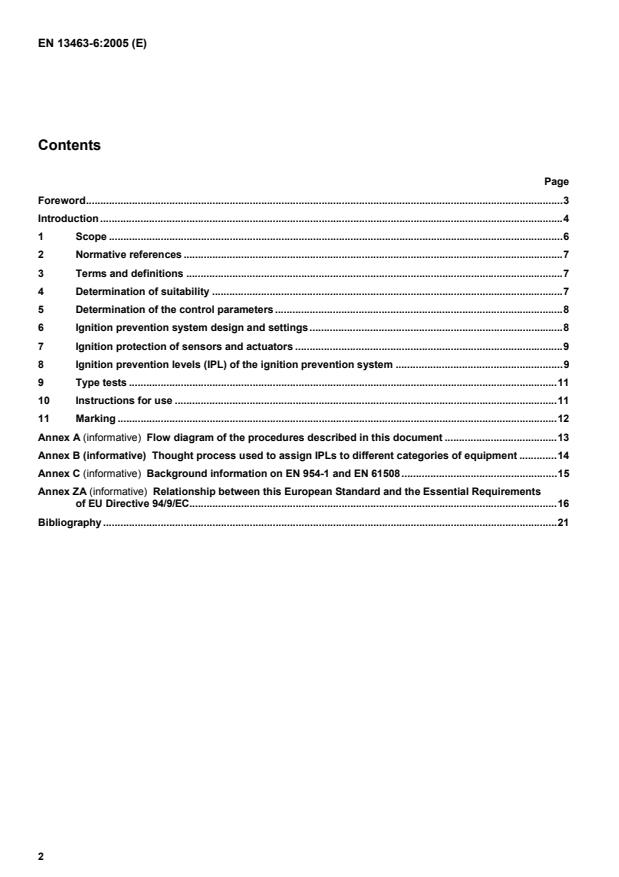
Flow diagram of the procedures described in this document.13 Annex B (informative)
Thought process used to assign IPLs to different categories of equipment.14 Annex C (informative)
Background information on EN 954-1 and EN 61508.15 Annex ZA (informative)
Relationship between this European Standard and the Essential Requirements of EU Directive 94/9/EC.16 Bibliography.21
An example of this is a fan, having high speed rotating blades fixed to a shaft, supported on rolling element bearings, inside a stator. In normal operation, no frictional ignition sources should be present. However, because the clearances between the rotor and stator are very small, malfunctions such as the collapse of a shaft bearing, distortion of a rotating blade, build up of foreign material on a rotating blade, etc. could cause the clearance to be reduced and frictional sparking, or hot surfaces, to occur.
To prevent potential ignition sources from becoming effective during normal operation, malfunction and rare malfunction, it is possible to incorporate sensors into the equipment to detect impending dangerous conditions and initiate control measures at an early stage of deterioration before the potential sources are converted into effective sources. The control measures applied, may be initiated automatically, via direct connections between the sensors and the ignition prevention system, or manually, by providing a warning to the equipment operator (With the intention of the operator applying the ignition prevention measures e.g. by stopping the equipment). In this document, the incorporation of such sensors and their associated automatic/manual ignition prevention measures, to prevent potential ignition sources becoming effective ignition sources, is known as protection by “Control of ignition source ‘b’ ” This type of ignition protection, and the devices used to achieve it, can take many forms. In practice, they may be mechanical, electrical, optical, visual or a combination of all of these. Although this document deals with the ignition protection of non-electrical equipment, it nevertheless has to take account of the fact that an increasing amount of non-electrical equipment makes use of electrical sensors to detect and initiate the ignition prevention measures. It is therefore impossible to produce a non-electrical equipment protection standard without making reference to the use of electrical sensors and their associated ignition prevention system circuits. Some examples of mechanical sensor / actuator devices are: a) fuseable plugs (as used in fluid couplings), that melt to release the energy contained in the power transmission fluid before the temperature of ignition capable parts exceed allowable limits; b) centrifugal speed governors, that directly control the power throttle and prevent rotating parts attaining frictional ignition capable rotational speeds; c) thermostatic valves, that close to reduce the input energy, or open to increase the amount of coolant, thereby preventing ignition capable temperatures being attained; d) pressure relief valves (using springs or weights), that open to limit pressure levels and consequent temperature rise during gas compression. Alternatively, to protect against catastrophic failure leading to the exposure of unintended hot surfaces. Some examples of combined electro-mechanical sensor / actuator devices are: e) temperature, flow and level monitoring/control devices, that detect temperature / flow / level and initiate a solenoid valve to reduce the input energy, or increase the amount of coolant, f) optical pulse counters, that sense abnormal rotational speeds on the teeth of gears and send signals to a speed controller, g) vibration sensors, that detect abnormal vibration, from e.g. rolling element bearings, before they fail (usually indicated by high frequency vibrations), or rotating parts that are becoming out of dynamic balance (usually indicated by low frequency vibrations),
Such sensor / actuator control devices may be either, continuously active in normal operation of the equipment (e.g. to control the temperature of category 3 equipment), or be arranged so that they only detect abnormal operation (e.g. to detect impending dangerous over-temperature in category 2 equipment).
As malfunction of any of the above sensors / actuator control devices, may result in failure to apply the appropriate ignition prevention measure, they are critical to the ignition safety related parts of the equipment. This ignition protection standard therefore calls for them to be assessed and suggests a minimum quality for such devices in the form of an ignition prevention level (IPL) that the equipment manufacturer must attempt to achieve.
Thus, to meet the requirements of this document, the non-electrical equipment manufacturer is required to perform both the ignition hazard assessment (required by EN 13463-1), and additionally, an evaluation, to determine the ignition prevention level (IPL) necessary to ensure that the sensors / ignition prevention system function when they are called upon to contain the ignition risk within tolerable limits. A flow diagram is provided at Annex A (Figure A.1) to assist the non-electrical equipment manufacturer follow the procedural stages described in this document.
1 Scope This document specifies the requirements for the design and construction of equipment, intended for use in potentially explosive atmospheres, protected by the type of protection: Control of ignition source "b". This document supplements the requirements in EN 13463-1, the contents of which also apply in full to equipment constructed in accordance with this document. Equipment conforming with the relevant clauses of this document meet the requirements for the following categories: Equipment Group I Category M2 – that does not contain an ignition source arising from severe operating conditions, in particular arising from rough handling and changing environmental conditions in mines; Equipment Group II category 3 – that does not contain an ignition source in normal operation; Equipment Group II category 2G or 2D – that does not contain an ignition source arising as a result of foreseeable malfunctions; Equipment Group II category 1G or 1D – that does not contain an ignition source in normal operation, or under foreseeable malfunctions, or under rare malfunctions. NOTE The requirements for Group I, Category M1 equipment, are given in EN 50303, which specifies the requirements for both electrical and non-electrical equipment This type of protection can be used to produce category 3 equipment which otherwise would have an ignition source in normal operation, i.e. it is not able to conform with EN 13463-1 The type of ignition protection described in the standard can be used either on its own or in combination with other types of ignition protection to meet the requirements for equipment of Group I category M2, or Group II categories 1, 2 and 3 depending on the ignition hazard assessment in EN 13463-1.
This document does not apply to:
control devices which are not intended to provide ignition protection; the ignition protection of electrical equipment; equipment shut down systems, initiated by flammable gas detectors, explosive atmosphere detectors, carbon monoxide, fire, or smoke detectors. NOTE This is because this document deals only with the detection and control of impending ignition sources in equipment, not the detection of explosive atmospheres surrounding it. Ignition protection systems conforming to the relevant clauses of this document are not intended to be autonomous protective systems.
2 Normative references The following referenced documents are indispensable for the application of this document. For dated references, only the edition cited applies. For undated references, the latest edition of the referenced document (including any amendments) applies. EN 954-1, Safety of Machinery — Safety-related parts of control systems — Part 1: General principles for design. EN 1127-1:1997, Explosive atmospheres — Explosion prevention and protection — Part 1: Basic concepts and methodology. EN 1127-2:2002, Explosive atmospheres — Explosion prevention and protection — Part 2: Basic concepts and methodology for mining. EN 13463-1:2001, Non-electrical equipment for potentially explosive atmospheres — Part 1: Basic method and requirements. EN 60079-0:2004, Electrical apparatus for explosive gas atmospheres — Part 0: General requirements. 3 Terms and definitions For the purposes of this document, the terms and definitions, specific to the type of protection by “Control of ignition source ‘b’”, and given in EN 13463-1:2001, EN 60079-0:2004, EN 1127-1:1997 and EN 1127-2:2002 and the following apply. 3.1 protection by control of ignition source 'b' device in non-electrical equipment, whereby (an) integral sensor(s) detect(s) impending operation likely to cause an ignition of the surrounding atmosphere and initiate either automatic or manual ignition control measures to prevent a potential ignition source becoming an effective ignition source. 3.2 automatic control measure action taken without manual intervention, to prevent a potential ignition source from becoming an effective ignition source 3.3 manual control measure action taken by a person as a result of a warning, indication, or alarm, to prevent a potential ignition source from becoming an effective ignition source 3.4 ignition prevention system (IPS) arrangement that converts signals from one or more sensors into an action, or indication, to prevent a potential ignition source becoming an effective ignition source
3.5 ignition prevention level (IPL) level assigned to the ignition prevention system characterized by its reliability 4 Determination of suitability Before a decision is made to protect equipment, including interconnecting parts, by the measures described in this document, it shall be subjected to the ignition hazard assessment in accordance with EN 13463-1.
5.1 Where the ignition hazard assessment described in Clause 4 has revealed potential ignition sources and the manufacturer has decided to prevent them from becoming effective by the application of the protection described in this document, the equipment manufacturer shall determine, by calculation or type tests, the control parameters associated with those potential ignition sources.
5.2 Each control parameter (e.g temperature, T, speed, S and pressure, P) shall be expressed as a value in normal operation (e.g. Tnorm, Snorm, Pnorm) and a value in mal-operation that does not result in the potential ignition source becoming effective (e.g. Tcrit, Scrit, Pcrit). NOTE Examples of the above control parameters are the determination of the: a) normal operating temperature (Tnorm) and the maximum allowable hot surface temperatures (Tcrit) arising from abnormal frictional heating; b) normal operating speed (Snorm) and the maximum allowable over-speed (Scrit) just before that which produces ignition capable frictional sparking; c) normal operating pressure (Pnorm) and maximum allowable over-pressure (Pcrit) just before that which produces an ignition capable hot surface; d) normal and maximum allowable vibration, before clearances between fixed and moving parts are reduced to ignition capable levels; e) maximum allowable amount of wear on brake linings / clutch linings before slippage or frictional rubbing results in an ignition capable hot surface; f) normal amount of coolant and the minimum flow of coolant needed to keep hot surfaces below the ignition temperature of the atmosphere; g) normal level of lubricant and the minimum level of lubricant needed to prevent ignition capable frictional heating; h) normal alignment and maximum allowable mis-alignment to prevent moving parts making contact with fixed parts. 6 Ignition prevention system design and settings 6.1 The manufacturer shall specify the settings, or operating characteristics (e.g. if the device is a fuseable plug), of the ignition prevention system intended to be used in the equipment, taking into account among others of the: speed of change of the potential source becoming an effective source; response time of the sensor / detector; response time of the ignition prevention system; difference in level between the potential source and effective source (e.g. Tnorm to Tcrit); safety factor considered necessary. NOTE Some industries require the ignition prevention detection system to have at least two levels. The first, to provide a warning to the operator and a second, to actuate the system. In some cases the warning can be used to prevent spurious activation. Equipment manufacturers might need to take this into account when designing their control of ignition prevention system.
6.2 The settings of the ignition prevention system specified by the manufacturer shall be included in the instructions given to the user.
6.3 Where the ignition prevention system is a safety related device it shall operate independently of the normal operating controls of the equipment being protected by it.
NOTE Normally, the instructions will specify that such faults need to be remedied before the equipment is put back into service. 8.2 Ignition prevention level 2 An ignition prevention system of level 2 shall meet the requirements of 8.1 and in addition shall comprise well tried components having proven history of reliability, assembled and installed in accordance with any relevant standards, adopting well tried safety principles, able to withstand expected influences during operation of the system and so arranged that: – if a control parameter critical value (e.g. Pcrit, Tcrit etc.) is exceeded, the ignition source is prevented from becoming effective; – if a single fault occurs in the ignition prevention system it does not lead to loss of the prevention system safety function.
1) Routine checking systems are usually based on the user simulating operation of the protection system and checking the response. This may be achieved in simple systems, by the user operating the limit switch / limiting device and noting if the ignition prevention system responds accordingly. In more complicated systems, by injecting a signal into the ignition prevention system to simulate an abnormal condition and noting if it produces the desired action/ reaction. Alternatively (but less reliable), by increasing / lowering the sensor setting to produce an action output level under normal healthy conditions and noting the response (then making sure then sensor is reset it back to its original protective setting, as recommended by the
...