

EN 1127-1:2019
(Main)Explosive atmospheres - Explosion prevention and protection - Part 1: Basic concepts and methodology
- Abstract
This document specifies methods for the identification and assessment of hazardous situations leading to explosion and the design and construction measures appropriate for the required safety. This is achieved by:
- risk assessment;
- risk reduction.
The safety of equipment, protective systems and components can be achieved by eliminating hazards and/or limiting the risk, i.e. by:
a) appropriate design (without using safeguarding);
b) safeguarding;
c) information for use;
d) any other preventive measures.
Measures in accordance with a) (prevention) and b) (protection) against explosions are dealt with in Clause 6, measures according to c) against explosions are dealt with in Clause 7. Measures in accordance with d) are not specified in this document. They are dealt with in EN ISO 12100:2010, Clause 6.
The preventive and protective measures described in this document will not provide the required level of safety unless the equipment, protective systems and components are operated within their intended use and are installed and maintained according to the relevant codes of practice or requirements.
This document specifies general design and construction methods to help designers and manufacturers in achieving explosion safety in the design of equipment, protective systems and components.
This document is applicable to any equipment, protective systems and components intended to be used in potentially explosive atmospheres, under atmospheric conditions. These atmospheres can arise from flammable/combustible substances processed, used or released by the equipment, protective systems and components or from materials in the vicinity of the equipment, protective systems and components and/or from the materials of construction of the equipment, protective systems and components.
This document is applicable to equipment, protective systems and components at all stages of its use.
This document is only applicable to equipment group II which is intended for use in other places than underground parts of mines and those parts of surface installations of such mines endangered by firedamp and/or combustible dust.
This document is not applicable to:
1) medical devices intended for use in a medical environment;
2) equipment, protective systems and components where the explosion hazard results exclusively from the presence of explosive substances or unstable chemical substances;
3) equipment, protective systems and components where the explosion can occur by reaction of substances with other oxidizers than atmospheric oxygen or by other hazardous reactions or by other than atmospheric conditions;
4) equipment intended for use in domestic and non-commercial environments where potentially explosive atmospheres may only rarely be created, solely as a result of the accidental leakage of fuel gas;
5) personal protective equipment covered by Regulation (EU) 2016/425;
6) seagoing vessels and mobile offshore units together with equipment on board such vessels or units;
7) means of transport, i.e. vehicles and their trailers intended solely for transporting passengers by air or by road, rail or water networks, as well as means of transport insofar as such means are designed for transporting goods by air, by public road or rail networks or by water; vehicles intended for use in a potentially explosive atmosphere shall not be excluded;
8) the design and construction of systems containing desired, controlled combustion processes, unless they can act as ignition sources in potentially explosive atmospheres.
- Status
- Published
- Publication Date
- 13-Aug-2019
- Withdrawal Date
- 27-Feb-2022
- Technical Committee
- CEN/TC 305 - Potentially explosive atmospheres - Explosion prevention and protection
- Drafting Committee
- CEN/TC 305/WG 4 - Terminology and Methodology
- Current Stage
- 6060 - Definitive text made available (DAV) - Publishing
- Start Date
- 14-Aug-2019
- Due Date
- 24-Dec-2019
- Completion Date
- 14-Aug-2019
- Directive
- 2006/42/EC - Directive 2006/42/EC of the European Parliament and of the Council of 17 May 2006 on machinery, and amending Directive 95/16/EC (recast)OJ Ref: L 102, L 102/6 OJ Date: 02-Apr-2020
2014/34/EU - Directive 2014/34/EU Of The European Parliament And Of The Council of 26 February 2014 on the harmonisation of the laws of the Member States relating to equipment and protective systems intended for use in potentially explosive atmospheres (recast)OJ Ref: L 54/, L 54/33 OJ Date: 26-Feb-2020



Overview
EN 1127-1:2019 - Explosive atmospheres: Explosion prevention and protection - Part 1: Basic concepts and methodology is a European standard published by CEN that defines methods for identifying and assessing hazardous situations leading to explosions and for selecting appropriate design and construction measures to achieve the required safety. The standard emphasizes risk assessment and risk reduction for equipment, protective systems and components intended for use in potentially explosive atmospheres under atmospheric conditions. It applies to equipment group II (non‑mining environments) and supports conformity with relevant EU directives.
Key topics and requirements
- Risk assessment methodology: systematic identification of explosion and ignition hazards, estimation of likelihood and consequence, and assessment of hazardous explosive atmospheres (see Clause 4).
- Ignition source identification: detailed consideration of possible ignition sources (hot surfaces, flames, electrical equipment, static electricity, RF/EM fields, ultrasonic, shock waves, self‑heating dusts, etc.) (Clause 5).
- Risk reduction principles: hierarchy of measures including prevention by design, safeguarding, information for use, and other preventive measures (Clause 6). Prevention (design) and protection (safeguarding) measures are covered in Clause 6; information for safe use, commissioning and maintenance is covered in Clause 7.
- Design and construction guidance: general methods to help designers and manufacturers achieve explosion safety; requirements to avoid effective ignition sources and to limit explosion effects (Clauses 6.4–6.5).
- Operational limits and maintenance: stresses that preventive/protective measures are effective only when equipment is used, installed and maintained according to intended use and codes of practice.
- Supporting annexes: informative and normative annexes (tools in explosive atmospheres, equipment tightness, verification procedures, and changes from the previous edition), plus Annexes ZA/ZB linking the standard to EU directives.
Practical applications
- Use EN 1127-1:2019 to perform explosion risk assessments, identify hazardous areas, and define design requirements for plant equipment and protective systems.
- Apply the standard when designing or selecting motors, enclosures, process vessels, dust‑handling equipment, control systems and other components to be used where flammable gases, vapours or combustible dusts may be present.
- Integrate the standard into safety documentation for procurement, CE/ATEX conformity, commissioning, maintenance planning and operator training.
Who should use this standard
- Designers and manufacturers of equipment for potentially explosive atmospheres
- Safety engineers, process engineers and facility managers in chemical, petrochemical, pharmaceutical, food/grain handling, paint/coatings and related industries
- Compliance officers preparing technical documentation for EU Directive conformity
Related standards
- EN ISO 12100:2010 - General principles for risk assessment and risk reduction (referenced for additional preventive measures)
- Annexes ZA/ZB in EN 1127-1:2019 describe relationships to EU Directive 2014/34/EU (ATEX) and Directive 2006/42/EC (Machinery)
Using EN 1127-1:2019 helps organizations systematically reduce explosion risk and demonstrate compliance when operating in potentially explosive atmospheres.
Relations
- Effective Date
- 21-Aug-2019
- Effective Date
- 28-Jan-2026
- Effective Date
- 28-Jan-2026
- Effective Date
- 28-Jan-2026
- Effective Date
- 28-Jan-2026
- Effective Date
- 28-Jan-2026
- Effective Date
- 28-Jan-2026
- Effective Date
- 28-Jan-2026
- Effective Date
- 28-Jan-2026
- Effective Date
- 28-Jan-2026
- Effective Date
- 28-Jan-2026
- Effective Date
- 28-Jan-2026
- Effective Date
- 28-Jan-2026
- Effective Date
- 28-Jan-2026
- Referred By
EN 1012-2:1996+A1:2009 - Compressors and vacuum pumps - Safety requirements - Part 2: Vacuum pumps - Effective Date
- 28-Jan-2026
Get Certified
Connect with accredited certification bodies for this standard

CIS Institut d.o.o.
Personal Protective Equipment (PPE) certification body. Notified Body NB-2890 for EU Regulation 2016/425 PPE.

Kiwa BDA Testing
Building and construction product certification.
Kmetijski inštitut Slovenije
Agricultural Institute of Slovenia. Soil testing, plant health, agricultural product analysis.
Sponsored listings
Frequently Asked Questions
EN 1127-1:2019 is a standard published by the European Committee for Standardization (CEN). Its full title is "Explosive atmospheres - Explosion prevention and protection - Part 1: Basic concepts and methodology". This standard covers: This document specifies methods for the identification and assessment of hazardous situations leading to explosion and the design and construction measures appropriate for the required safety. This is achieved by: - risk assessment; - risk reduction. The safety of equipment, protective systems and components can be achieved by eliminating hazards and/or limiting the risk, i.e. by: a) appropriate design (without using safeguarding); b) safeguarding; c) information for use; d) any other preventive measures. Measures in accordance with a) (prevention) and b) (protection) against explosions are dealt with in Clause 6, measures according to c) against explosions are dealt with in Clause 7. Measures in accordance with d) are not specified in this document. They are dealt with in EN ISO 12100:2010, Clause 6. The preventive and protective measures described in this document will not provide the required level of safety unless the equipment, protective systems and components are operated within their intended use and are installed and maintained according to the relevant codes of practice or requirements. This document specifies general design and construction methods to help designers and manufacturers in achieving explosion safety in the design of equipment, protective systems and components. This document is applicable to any equipment, protective systems and components intended to be used in potentially explosive atmospheres, under atmospheric conditions. These atmospheres can arise from flammable/combustible substances processed, used or released by the equipment, protective systems and components or from materials in the vicinity of the equipment, protective systems and components and/or from the materials of construction of the equipment, protective systems and components. This document is applicable to equipment, protective systems and components at all stages of its use. This document is only applicable to equipment group II which is intended for use in other places than underground parts of mines and those parts of surface installations of such mines endangered by firedamp and/or combustible dust. This document is not applicable to: 1) medical devices intended for use in a medical environment; 2) equipment, protective systems and components where the explosion hazard results exclusively from the presence of explosive substances or unstable chemical substances; 3) equipment, protective systems and components where the explosion can occur by reaction of substances with other oxidizers than atmospheric oxygen or by other hazardous reactions or by other than atmospheric conditions; 4) equipment intended for use in domestic and non-commercial environments where potentially explosive atmospheres may only rarely be created, solely as a result of the accidental leakage of fuel gas; 5) personal protective equipment covered by Regulation (EU) 2016/425; 6) seagoing vessels and mobile offshore units together with equipment on board such vessels or units; 7) means of transport, i.e. vehicles and their trailers intended solely for transporting passengers by air or by road, rail or water networks, as well as means of transport insofar as such means are designed for transporting goods by air, by public road or rail networks or by water; vehicles intended for use in a potentially explosive atmosphere shall not be excluded; 8) the design and construction of systems containing desired, controlled combustion processes, unless they can act as ignition sources in potentially explosive atmospheres.
This document specifies methods for the identification and assessment of hazardous situations leading to explosion and the design and construction measures appropriate for the required safety. This is achieved by: - risk assessment; - risk reduction. The safety of equipment, protective systems and components can be achieved by eliminating hazards and/or limiting the risk, i.e. by: a) appropriate design (without using safeguarding); b) safeguarding; c) information for use; d) any other preventive measures. Measures in accordance with a) (prevention) and b) (protection) against explosions are dealt with in Clause 6, measures according to c) against explosions are dealt with in Clause 7. Measures in accordance with d) are not specified in this document. They are dealt with in EN ISO 12100:2010, Clause 6. The preventive and protective measures described in this document will not provide the required level of safety unless the equipment, protective systems and components are operated within their intended use and are installed and maintained according to the relevant codes of practice or requirements. This document specifies general design and construction methods to help designers and manufacturers in achieving explosion safety in the design of equipment, protective systems and components. This document is applicable to any equipment, protective systems and components intended to be used in potentially explosive atmospheres, under atmospheric conditions. These atmospheres can arise from flammable/combustible substances processed, used or released by the equipment, protective systems and components or from materials in the vicinity of the equipment, protective systems and components and/or from the materials of construction of the equipment, protective systems and components. This document is applicable to equipment, protective systems and components at all stages of its use. This document is only applicable to equipment group II which is intended for use in other places than underground parts of mines and those parts of surface installations of such mines endangered by firedamp and/or combustible dust. This document is not applicable to: 1) medical devices intended for use in a medical environment; 2) equipment, protective systems and components where the explosion hazard results exclusively from the presence of explosive substances or unstable chemical substances; 3) equipment, protective systems and components where the explosion can occur by reaction of substances with other oxidizers than atmospheric oxygen or by other hazardous reactions or by other than atmospheric conditions; 4) equipment intended for use in domestic and non-commercial environments where potentially explosive atmospheres may only rarely be created, solely as a result of the accidental leakage of fuel gas; 5) personal protective equipment covered by Regulation (EU) 2016/425; 6) seagoing vessels and mobile offshore units together with equipment on board such vessels or units; 7) means of transport, i.e. vehicles and their trailers intended solely for transporting passengers by air or by road, rail or water networks, as well as means of transport insofar as such means are designed for transporting goods by air, by public road or rail networks or by water; vehicles intended for use in a potentially explosive atmosphere shall not be excluded; 8) the design and construction of systems containing desired, controlled combustion processes, unless they can act as ignition sources in potentially explosive atmospheres.
EN 1127-1:2019 is classified under the following ICS (International Classification for Standards) categories: 13.230 - Explosion protection. The ICS classification helps identify the subject area and facilitates finding related standards.
EN 1127-1:2019 has the following relationships with other standards: It is inter standard links to EN 1127-1:2011, EN ISO 12100:2010, EN ISO 80079-36:2016, EN 13237:2012, EN 17348:2022, EN ISO 20257-1:2020, EN 13617-4:2021, EN 13617-3:2012, EN 13617-3:2021, EN 1034-1:2000+A1:2010, EN 12952-9:2022, EN 14677:2008, EN 13852-1:2025, EN ISO 11111-1:2016, EN 1012-2:1996+A1:2009. Understanding these relationships helps ensure you are using the most current and applicable version of the standard.
EN 1127-1:2019 is associated with the following European legislation: EU Directives/Regulations: 2006/42/EC, 2014/34/EU, 94/9/EC; Standardization Mandates: M/396, M/BC/CEN/92/46. When a standard is cited in the Official Journal of the European Union, products manufactured in conformity with it benefit from a presumption of conformity with the essential requirements of the corresponding EU directive or regulation.
EN 1127-1:2019 is available in PDF format for immediate download after purchase. The document can be added to your cart and obtained through the secure checkout process. Digital delivery ensures instant access to the complete standard document.
Standards Content (Sample)
SLOVENSKI STANDARD
01-december-2019
Nadomešča:
SIST EN 1127-1:2011
Eksplozivne atmosfere - Protieksplozijska zaščita - 1. del: Osnovni pojmi in
metodologija
Explosive atmospheres - Explosion prevention and protection - Part 1: Basic concepts
and methodology
Explosionsfähige Atmosphären - Explosionsschutz - Teil 1: Grundlagen und Methodik
Atmosphères explosives - Prévention de l'explosion et protection contre l'explosion -
Partie 1 : Notions fondamentales et méthodologie
Ta slovenski standard je istoveten z: EN 1127-1:2019
ICS:
13.230 Varstvo pred eksplozijo Explosion protection
2003-01.Slovenski inštitut za standardizacijo. Razmnoževanje celote ali delov tega standarda ni dovoljeno.
EN 1127-1
EUROPEAN STANDARD
NORME EUROPÉENNE
August 2019
EUROPÄISCHE NORM
ICS 13.230 Supersedes EN 1127-1:2011
English Version
Explosive atmospheres - Explosion prevention and
protection - Part 1: Basic concepts and methodology
Atmosphères explosives - Prévention de l'explosion et Explosionsfähige Atmosphären - Explosionsschutz -
protection contre l'explosion - Partie 1 : Notions Teil 1: Grundlagen und Methodik
fondamentales et méthodologie
This European Standard was approved by CEN on 3 June 2019.
CEN members are bound to comply with the CEN/CENELEC Internal Regulations which stipulate the conditions for giving this
European Standard the status of a national standard without any alteration. Up-to-date lists and bibliographical references
concerning such national standards may be obtained on application to the CEN-CENELEC Management Centre or to any CEN
member.
This European Standard exists in three official versions (English, French, German). A version in any other language made by
translation under the responsibility of a CEN member into its own language and notified to the CEN-CENELEC Management
Centre has the same status as the official versions.
CEN members are the national standards bodies of Austria, Belgium, Bulgaria, Croatia, Cyprus, Czech Republic, Denmark, Estonia,
Finland, France, Germany, Greece, Hungary, Iceland, Ireland, Italy, Latvia, Lithuania, Luxembourg, Malta, Netherlands, Norway,
Poland, Portugal, Republic of North Macedonia, Romania, Serbia, Slovakia, Slovenia, Spain, Sweden, Switzerland, Turkey and
United Kingdom.
EUROPEAN COMMITTEE FOR STANDARDIZATION
COMITÉ EUROPÉEN DE NORMALISATION
EUROPÄISCHES KOMITEE FÜR NORMUNG
CEN-CENELEC Management Centre: Rue de la Science 23, B-1040 Brussels
© 2019 CEN All rights of exploitation in any form and by any means reserved Ref. No. EN 1127-1:2019 E
worldwide for CEN national Members.
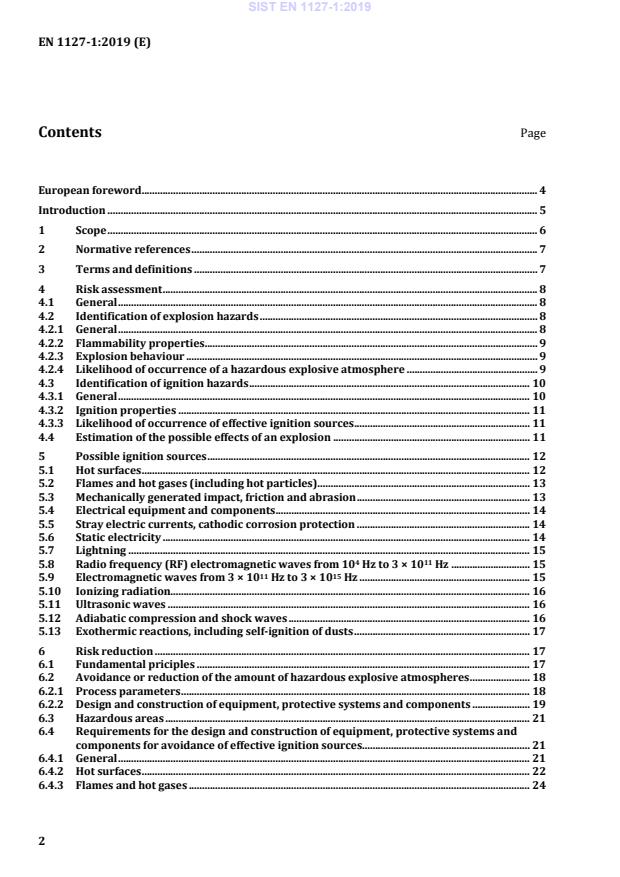
Contents Page
European foreword . 4
Introduction . 5
1 Scope . 6
2 Normative references . 7
3 Terms and definitions . 7
4 Risk assessment . 8
4.1 General . 8
4.2 Identification of explosion hazards . 8
4.2.1 General . 8
4.2.2 Flammability properties . 9
4.2.3 Explosion behaviour . 9
4.2.4 Likelihood of occurrence of a hazardous explosive atmosphere . 9
4.3 Identification of ignition hazards . 10
4.3.1 General . 10
4.3.2 Ignition properties . 11
4.3.3 Likelihood of occurrence of effective ignition sources . 11
4.4 Estimation of the possible effects of an explosion . 11
5 Possible ignition sources . 12
5.1 Hot surfaces . 12
5.2 Flames and hot gases (including hot particles) . 13
5.3 Mechanically generated impact, friction and abrasion . 13
5.4 Electrical equipment and components . 14
5.5 Stray electric currents, cathodic corrosion protection . 14
5.6 Static electricity . 14
5.7 Lightning . 15
4 11
5.8 Radio frequency (RF) electromagnetic waves from 10 Hz to 3 × 10 Hz . 15
11 15
5.9 Electromagnetic waves from 3 × 10 Hz to 3 × 10 Hz . 15
5.10 Ionizing radiation. 16
5.11 Ultrasonic waves . 16
5.12 Adiabatic compression and shock waves . 16
5.13 Exothermic reactions, including self-ignition of dusts . 17
6 Risk reduction . 17
6.1 Fundamental priciples . 17
6.2 Avoidance or reduction of the amount of hazardous explosive atmospheres . 18
6.2.1 Process parameters . 18
6.2.2 Design and construction of equipment, protective systems and components . 19
6.3 Hazardous areas . 21
6.4 Requirements for the design and construction of equipment, protective systems and
components for avoidance of effective ignition sources. 21
6.4.1 General . 21
6.4.2 Hot surfaces . 22
6.4.3 Flames and hot gases . 24
6.4.4 Mechanically generated impact, friction and grinding . 24
6.4.5 Electrical equipment and components . 25
6.4.6 Stray electric currents and cathodic corrosion protection . 25
6.4.7 Static electricity . 26
6.4.8 Lightning . 26
4 11
6.4.9 Radio frequency (RF) electromagnetic waves from 10 Hz to 3 × 10 Hz . 27
11 15
6.4.10 Electromagnetic waves from 3 × 10 Hz to 3 × 10 Hz . 28
6.4.11 Ionizing radiation . 28
6.4.12 Ultrasonic waves . 29
6.4.13 Adiabatic compression and shock waves . 30
6.4.14 Exothermic reactions, including self-ignition of dusts . 31
6.5 Requirements for the design and construction of equipment, protective systems and
components to reduce the explosion effects . 31
6.6 Provisions for emergency measures . 32
6.7 Principles of measuring and control systems for explosion prevention and
protection . 32
7 Information for use . 33
7.1 General . 33
7.2 Information for commissioning, maintenance and repair to prevent explosion . 34
7.3 Qualifications and training . 34
Annex A (informative) Information for the use of tools in potentially explosive
atmospheres . 35
Annex B (informative) Tightness of equipment . 36
B.1 General . 36
B.2 Normal tightness . 36
B.3 Enhanced tightness . 37
Annex C (normative) Verification procedure for the threshold limit of ultrasound in liquids . 38
Annex D (informative) Significant technical changes between this document and the
previous edition of this document. 40
Annex ZA (informative) Relationship between this European Standard and the essential
requirements of EU Directive 2014/34/EU aimed to be covered . 42
Annex ZB (informative) Relationship between This document and the essential
requirements of Directive 2006/42/EC aimed to be covered . 43
Bibliography . 44
European foreword
This document (EN 1127-1:2019) has been prepared by Technical Committee CEN/TC 305 “Potentially
explosive atmospheres - Explosion prevention and protection”, the secretariat of which is held by DIN.
This European Standard shall be given the status of a national standard, either by publication of an
identical text or by endorsement, at the latest by February 2020, and conflicting national standards
shall be withdrawn at the latest by February 2022.
Attention is drawn to the possibility that some of the elements of this document may be the subject of
patent rights. CEN shall not be held responsible for identifying any or all such patent rights.
This document supersedes EN 1127-1:2011.
Annex D provides details of significant technical changes between this document and the previous
edition EN 1127-1:2011.
This document has been prepared under a standardization request given to CEN by the European
Commission and the European Free Trade Association, and supports essential requirements of
EU Directives.
For relationship with EU Directives, see informative Annex ZA and ZB, which are integral parts of this
document.
According to the CEN-CENELEC Internal Regulations, the national standards organisations of the
following countries are bound to implement this European Standard: Austria, Belgium, Bulgaria,
Croatia, Cyprus, Czech Republic, Denmark, Estonia, Finland, France, Germany, Greece, Hungary, Iceland,
Ireland, Italy, Latvia, Lithuania, Luxembourg, Malta, Netherlands, Norway, Poland, Portugal, Republic of
North Macedonia, Romania, Serbia, Slovakia, Slovenia, Spain, Sweden, Switzerland, Turkey and the
United Kingdom.
Introduction
CEN and CENELEC are producing a set of standards to assist designers, manufacturers and other
interested bodies to interpret the essential safety requirements in order to achieve conformity with
European Legislation. Within this series of standards CEN has undertaken to draw up a standard to give
guidance in the field of explosion prevention and protection, as hazards from explosions are intended to
be considered in accordance with EN ISO 12100:2010.
In accordance with EN ISO 12100:2010, it is a type B standard.
This standard describes the basic concepts and methodology of explosion prevention and protection.
CEN/TC 305 has a mandate in this area to produce B-type, and C-type standards, which will allow
verification of conformity with the essential safety requirements.
Explosions can occur from:
a) materials processed or used by the equipment, protective systems and components;
b) materials released by the equipment, protective systems and components;
c) materials in the vicinity of the equipment, protective systems and components;
d) materials of construction of the equipment, protective systems and components.
Since safety depends not only on equipment, protective systems and components but also on the
material being handled and its use, this standard includes aspects related to the intended use and
foreseeable misuse, i.e. the manufacturer should consider in which way and for which purpose the
equipment, protective systems and components will be used and take this into account during its design
and construction. This is the only way hazards inherent in equipment, protective systems and
components can be reduced.
NOTE This standard can also serve as a guide for users of equipment, protective systems and components
when assessing the risk of explosion in the workplace and selecting the appropriate equipment, protective
systems and components.
1 Scope
This document specifies methods for the identification and assessment of hazardous situations leading
to explosion and the design and construction measures appropriate for the required safety. This is
achieved by:
— risk assessment;
— risk reduction.
The safety of equipment, protective systems and components can be achieved by eliminating hazards
and/or limiting the risk, i.e. by:
a) appropriate design (without using safeguarding);
b) safeguarding;
c) information for use;
d) any other preventive measures.
Measures in accordance with a) (prevention) and b) (protection) against explosions are dealt with in
Clause 6, measures according to c) against explosions are dealt with in Clause 7. Measures in
accordance with d) are not specified in this document. They are dealt with in
EN ISO 12100:2010, Clause 6.
The preventive and protective measures described in this document will not provide the required level
of safety unless the equipment, protective systems and components are operated within their intended
use and are installed and maintained according to the relevant codes of practice or requirements.
This document specifies general design and construction methods to help designers and manufacturers
in achieving explosion safety in the design of equipment, protective systems and components.
This document is applicable to any equipment, protective systems and components intended to be used
in potentially explosive atmospheres, under atmospheric conditions. These atmospheres can arise from
flammable/combustible substances processed, used or released by the equipment, protective systems
and components or from materials in the vicinity of the equipment, protective systems and components
and/or from the materials of construction of the equipment, protective systems and components.
This document is applicable to equipment, protective systems and components at all stages of its use.
This document is only applicable to equipment group II which is intended for use in other places than
underground parts of mines and those parts of surface installations of such mines endangered by
firedamp and/or combustible dust.
This document is not applicable to:
1) medical devices intended for use in a medical environment;
2) equipment, protective systems and components where the explosion hazard results exclusively
from the presence of explosive substances or unstable chemical substances;
3) equipment, protective systems and components where the explosion can occur by reaction of
substances with other oxidizers than atmospheric oxygen or by other hazardous reactions or by
other than atmospheric conditions;
4) equipment intended for use in domestic and non-commercial environments where potentially
explosive atmospheres may only rarely be created, solely as a result of the accidental leakage of fuel
gas;
5) personal protective equipment covered by Regulation (EU) 2016/425;
6) seagoing vessels and mobile offshore units together with equipment on board such vessels or units;
7) means of transport, i.e. vehicles and their trailers intended solely for transporting passengers by air
or by road, rail or water networks, as well as means of transport insofar as such means are
designed for transporting goods by air, by public road or rail networks or by water; vehicles
intended for use in a potentially explosive atmosphere shall not be excluded;
8) the design and construction of systems containing desired, controlled combustion processes, unless
they can act as ignition sources in potentially explosive atmospheres.
2 Normative references
The following documents are referred to in the text in such a way that some or all of their content
constitutes requirements of this document. For dated references, only the edition cited applies. For
undated references, the latest edition of the referenced document (including any amendments) applies.
EN 13237:2012, Potentially explosive atmospheres — Terms and definitions for equipment and protective
systems intended for use in potentially explosive atmospheres
EN 15198:2007, Methodology for the risk assessment of non-electrical equipment and components for
intended use in potentially explosive atmospheres
EN ISO 12100:2010, Safety of machinery — General principles for design — Risk assessment and risk
reduction
EN ISO 80079-36:2016, Explosive atmospheres — Part 36: Non-electrical equipment for explosive
atmospheres — Basic method and requirements
3 Terms and definitions
For the purposes of this document, the terms and definitions given in EN 13237:2012 and the following
apply.
ISO and IEC maintain terminological databases for use in standardization at the following addresses:
• IEC Electropedia: available at http://www.electropedia.org/
• ISO Online browsing platform: available at http://www.iso.org/obp
3.1
normal tightness
absence of leakage when any of the tightness tests or tightness monitorings appropriate for the
application does not reveal any hazardous leaks during normal operation
3.2
enhanced tightness
absence of leakage when due to the design and measures of maintenance any of the tightness tests or
tightness monitorings appropriate for the application does not reveal any hazardous leaks during
normal operations and expected malfunctions
4 Risk assessment
4.1 General
For non-electrical equipment, components, protective systems, devices and assemblies of these non-
electrical products, which have their own potential ignition sources and are intended for use in
explosive atmospheres, risk assessment shall be carried out according to EN ISO 80079-36:2016. For
other situations, risk assessment shall be carried out in accordance with EN ISO 12100:2010 and/or
EN 15198:2007 unless other standards can be identified as being more appropriate, considering the
following:
a) identification of explosion hazards and determination of the likelihood of occurrence of a
hazardous explosive atmosphere (see 4.2);
b) identification of ignition hazards and determination of the likelihood of occurrence of potential
ignition sources (see 4.3);
c) estimation of the possible effects of an explosion in case of ignition (see 4.4);
d) evaluation of the risk and whether the intended level of protection has been achieved;
NOTE The intended level of protection is defined by at least legal requirements and, if necessary, additional
requirements specified by the user.
e) consideration of measures to reduce of the risks (see Clause 6).
A comprehensive approach shall be taken, especially for complex equipment, protective systems and
components, plants comprising individual units and, above all, for extended plants. This risk assessment
shall take into account the ignition and explosion hazard from:
1) the equipment, protective systems and components themselves;
2) the interaction between the equipment, protective systems and components and the substances
being handled;
3) the particular process performed in the equipment, protective systems and components;
4) the surroundings of the equipment, protective systems and components and possible interaction
with neighbouring processes.
4.2 Identification of explosion hazards
4.2.1 General
The explosion hazard is generally related to the materials and substances processed, used or released
by equipment, protective systems and components and materials used to construct equipment,
protective systems and components. Some of these released substances can undergo combustion
processes in air. These processes are often accompanied by the release of considerable amounts of heat
and can be associated with a pressure build-up and the release of hazardous materials. In contrast to
burning in a fire, an explosion is essentially a self-sustained propagation of the reaction zone (flame)
through the hazardous explosive atmosphere. This potential hazard associated with the hazardous
explosive atmosphere is released when ignited by an effective ignition source.
The safety characteristics listed in 4.2.2 and 4.2.3 describe safety relevant properties of
flammable/combustible substances. The material properties and the safety characteristics are used for
the identification of the explosion hazard.
It is necessary to bear in mind that such safety characteristics are not constants but depend for instance
on the techniques used for their measurement. Also, for dusts, tabulated safety data are for guidance
only because the values depend on particle size and shape, moisture content and the presence of
additives even in trace concentrations. For a specific application, samples of the dust present in the
equipment should be tested and the data obtained used in the hazard identification.
4.2.2 Flammability properties
Since in this context it is not the material itself that represents the potential hazard but its contact or
mixing with air, the properties of the mixture of the flammable/combustible substance with air shall be
determined. These properties give information about a substance's burning behaviour and whether it
could give rise to fire or explosions. Relevant data are e.g.:
a) lower explosion point (see EN 15794), that can be substituted by flash point (with a safety factor), if
lower explosion point is not available;
b) explosion limits (LEL, UEL) (see EN 14034-3 and EN 1839);
NOTE Lower explosion limit (LEL) and upper explosion limit (UEL) are named lower flammability limit (LFL)
and upper flammability limit (UFL) in EN ISO/IEC 80079-20-1.
c) limiting oxygen concentration (LOC) (see EN 14034-4 and EN 1839).
4.2.3 Explosion behaviour
The behaviour of the explosive atmosphere after ignition shall be characterized by data such as:
a) maximum explosion pressure (p ) (see EN 14034-1, EN 14034-4 and EN 15967);
max
b) maximum rate of explosion pressure rise ((d /d ) ) (see EN 14034-2, EN 14491 and EN 15967);
p t max
c) maximum experimental safe gap (MESG) (see EN 60079-20-1).
4.2.4 Likelihood of occurrence of a hazardous explosive atmosphere
The likelihood of occurrence of a hazardous explosive atmosphere depends on the following:
— presence of a flammable/combustible substance;
— degree of dispersion of the flammable/combustible substance (e.g. gases, vapours, mists, dusts);
— concentration of the flammable/combustible substance in air within the explosion range;
— amount of explosive atmosphere sufficient to cause injury or damage in case of ignition.
In assessment of the likelihood of occurrence of a hazardous explosive atmosphere, possible formation
of the hazardous explosive atmosphere through chemical reactions, pyrolysis and biological processes
from the materials present shall be taken into account.
If it is impossible to estimate the likelihood of occurrence of a hazardous explosive atmosphere, the
assumption shall be made that such an atmosphere is always present.
a) Presence of a flammable/combustible substance
Flammable/combustible substances shall be considered as materials which can form a hazardous
explosive atmosphere unless an investigation of their properties has shown that in mixtures with air
they are incapable of self-sustained propagation of an explosion. In assessment of the likelihood of
occurrence of a hazardous explosive atmosphere, possible formation of the hazardous explosive
atmosphere through chemical reactions, pyrolysis and biological processes from the materials present
shall be taken into account.
b) Degree of dispersion of flammable/combustible substances
By their very nature, gases, vapours and mists have a degree of dispersion high enough to produce a
hazardous explosive atmosphere. For dusts the occurrence of a hazardous explosive atmosphere can be
assumed if the particle size fractions are equal or less than 0,5 mm.
NOTE 1 Numerous mists, aerosols and types of dusts that occur in actual practice have particle sizes between
0,001 mm and 0,1 mm.
NOTE 2 Combustible flyings are a type of dust (group III A, see EN IEC 60079-0), including fibres (e.g.
cotton/carbon/jute fibres), where one dimension is greater than 0,5 mm and which may form with air a
hazardous explosive atmosphere.
Attention shall be paid to the fact that explosions can occur in hybrid mixtures though none of the
flammable/combustible substances of the mixture is individually within the explosion range.
c) Concentration of flammable/combustible substances
An explosion is possible when the concentration of the dispersed flammable/combustible substance in
air achieves a minimum value (lower explosion limit). An explosion will not occur when the
concentration exceeds a maximum value (upper explosion limit).
NOTE 3 Some chemically unstable substances, e.g. acetylene and ethylene oxide, can undergo exothermic
reactions even in the absence of oxygen and have an upper explosion limit of 100 %.
The explosion limits vary with pressure and temperature. As a rule, the concentration range between
the explosion limits increases with increasing pressure and temperature. In the case of mixtures with
oxygen, the upper explosion limits are far higher than for mixtures with air.
If the surface temperature of a combustible liquid exceeds the lower explosion point, a hazardous
explosive atmosphere can be formed (see 6.2.1.2).
NOTE 4 Hybrid mixtures, e.g. aerosols and mists, can become an explosive mixture at temperatures that are far
below the lower explosion point (LEP).
The explosion limits for dusts do not have the same significance as those for gases and vapours. Dust
clouds are usually inhomogeneous. The dust concentration can fluctuate greatly due to dust depositing
and dispersion into the atmosphere. Consideration shall always be given to the possible formation of
hazardous explosive atmospheres when deposits of combustible dust are present.
d) Amount of hazardous explosive atmosphere
The assessment whether an explosive atmosphere is present in a hazardous amount depends on the
possible effects of the explosion (see 4.4).
4.3 Identification of ignition hazards
4.3.1 General
At first it shall be determined which types of ignition sources are possible and which are related to the
equipment (or components or protective systems). The different ignition sources are considered in
Clause 5. The significance of all ignition sources that could come into contact with the hazardous
explosive atmosphere shall be assessed.
The ignition capability of all equipment related ignition sources shall then be compared with the
ignition properties of the flammable/combustible substance (see 4.3.2).
This step shall result in a complete list of all potential ignition sources of the equipment, component or
protective system. Afterwards the likelihood of occurrence of the potential ignition sources to become
effective shall be assessed, taking also into account those that can be introduced e.g. by maintenance
and cleaning activities.
4.3.2 Ignition properties
The ignition properties of the hazardous explosive atmosphere shall be determined. Relevant data are,
e.g.:
a) minimum ignition energy (see EN ISO/IEC 80079-20-2);
b) minimum ignition temperature of an explosive dust atmosphere (see EN ISO/IEC 80079-20-2);
c) auto-ignition temperature of an explosive gas atmosphere (see EN ISO/IEC 80079-20-1).
4.3.3 Likelihood of occurrence of effective ignition sources
The potential ignition sources shall be classified according to the likelihood to become effective in the
following manner:
a) ignition sources which can occur continuously or frequently;
b) ignition sources which can occur in rare situations;
c) ignition sources which can occur in very rare situations;
In terms of the equipment, protective systems and components used this classification shall be
considered equivalent to:
d) ignition sources which can occur during normal operation;
e) ignition sources which can occur solely as a result of malfunctions;
f) ignition sources which can occur solely as a result of rare malfunctions.
NOTE Protective measures can be used to make the ignition source non-effective (see 6.4).
If the likelihood of occurrence of an effective ignition source cannot be estimated, the assumption shall
be made that the ignition source is present at all times.
4.4 Estimation of the possible effects of an explosion
To estimate the possible effects of an explosion the following shall be considered, e.g.:
— pressure waves;
— flames and hot gases;
— thermal radiation;
— flying debris;
— hazardous releases of materials.
The consequences of the above are related to the:
— chemical and physical properties of the flammable/combustible substances;
— quantity and confinement of the hazardous explosive atmosphere;
— geometry of the surroundings taking into account obstacles;
— strength of enclosure and supporting structures;
— protective equipment worn by the endangered personnel;
— physical properties of the endangered objects.
Information on the consequences of an explosion is required for the estimation of the expected injury to
persons, domestic animals or properties and the size of the endangered place by the user. Appropriate
information shall be part of the user instructions.
NOTE This procedure can also serve as a guide for users of equipment, protective systems and components
when assessing the risk of explosion in the workplace and selecting the appropriate equipment, protective
systems and components.
5 Possible ignition sources
5.1 Hot surfaces
If an explosive atmosphere comes into contact with a heated surface ignition can occur. Not only a hot
surface itself can act as an ignition source, but a dust layer or a combustible solid in contact with a hot
surface and ignited by the hot surface can also act as an ignition source for an explosive atmosphere
(see 5.2).
The capability of a heated surface to cause ignition depends on the type and concentration of the
particular substance in the mixture with air. This capability becomes greater with increasing
temperature and increasing surface area. Moreover, the temperature that triggers ignition depends on
the size and shape of the heated body, on the concentration gradient in the vicinity of the surface, the
flow velocity of the explosive atmosphere around the hot surface and, to a certain extent, also on the
surface material. Thus, for example, an explosive gas or vapour atmosphere inside fairly large heated
spaces (approximately 1 l or more) can be ignited by surface temperatures lower than those measured
in accordance with EN ISO/IEC 80079-20-1 or by other equivalent methods. On the other hand, in the
case of heated bodies with convex rather than concave surfaces, a higher surface temperature is
necessary for ignition; the minimum ignition temperature increases, for example, with spheres or pipes
as the diameter decreases. When an explosive atmosphere flows past heated surfaces, a higher surface
temperature could be necessary for ignition owing to the brief contact time.
If the explosive atmosphere remains in contact with the hot surface for a relatively long time,
preliminary reactions can occur, e.g. cool flames, so that more easily ignitable decomposition products
are formed, which promote the ignition of the original atmospheres.
In addition to easily recognizable hot surfaces such as radiators, drying cabinets, heating coils and
others, mechanical and machining processes can also lead to hazardous temperatures. These processes
also include equipment, protective systems and components which convert mechanical energy into
heat, i.e. all kinds of friction clutches and mechanically operating brakes (e.g. on vehicles and
centrifuges). Furthermore, all moving parts in bearings, shaft passages, glands, etc. can become ignition
sources if they are not sufficiently lubricated. In tight housings of moving parts, the ingress of foreign
bodies or shifting of the axis can also lead to friction which, in turn, can lead to high surface
temperatures, in some cases quite rapidly.
Hot surfaces can also occur by heating absorbers created by other ignition sources, e.g. electromagnetic
waves (see 5.8 and 5.9) and ultrasonic waves (see 5.11).
Consideration shall also be given to temperature increases due to chemical reactions (e.g. with
lubricants and cleaning solvents).
For ignition hazards in welding and cutting work, see 5.2.
For protective measures against ignition hazards from hot surfaces, see 6.4.2. Where hot surfaces are
wholly or partly covered more specifically by other clauses these clauses shall apply, see 6.4.4, 6.4.9,
6.4.10, 6.4.12.
5.2 Flames and hot gases (including hot particles)
Flames are associated with combustion reactions at temperatures of typically more than 1 000 °C. Hot
gases are produced as reaction products and, in the case of dusty and/or sooty flames, glowing solid
particles are also produced. Flames, their hot reaction products or otherwise (without combustion)
highly heated gases can ignite an explosive atmosphere. Flames, even very small ones, are among the
most effective ignition sources.
If an explosive atmosphere is present inside as well as outside an equipment, protective system or
component or in adjacent parts of the installation and if ignition occurs in one of these places, the flame
can spread to the other places through openings such as ventilation ducts. The prevention of flame
propagation calls for specially designed protective measures (see 6.5).
Welding beads that occur when welding or cutting is carried out are sparks with a very large surface
and therefore they are among the most effective ignition sources.
For protective measures against ignition hazards due to flames and hot gases, see 6.4.3.
5.3 Mechanically generated impact, friction and abrasion
As a result of friction, impact or abrasion processes such as grinding, particles can become separated
from solid materials and become hot owing to the energy used in the separation process. If these
particles consist of oxidizable substances, for example iron or steel, they can undergo an oxidation
process, thus reaching even higher temperatures. These particles (sparks) can ignite flammable gases
and certain dust/air-mixtures (especially metal dust/air mixtures). In deposited dust, smouldering can
be caused by the sparks and this can be an ignition source for an explosive atmosphere.
The ingress of foreign materials to equipment, protective systems and components, e.g. stones or tramp
metals, as a cause of sparking shall be considered.
Rubbing friction, even between similar ferrous metals and between certain ceramics, can generate hot
spots and sparks similar to grinding sparks. These can cause ignition of explosive atmospheres.
When stainless steel is involved in impact, friction or grinding it will easily produce hot surfaces which
may become an effective ignition source. Applying high contact pressure in case of friction or grinding a
burst of sparks will be created additionally.
Impacts involving rust and light metals (e.g. aluminium and magnesium) and their alloys can initiate a
thermite reaction which can cause ignition of explosive atmospheres.
The light metals titanium and zirconium can also form incendive sparks under impact or friction against
any sufficiently hard material, even in the absence of rust.
For ignition hazards in welding and cutting work, see 5.2.
For protective measures against ignition hazards due to mechanically generated sparks, see 6.4.4.
5.4 Electrical equipment and components
In the case of electrical equipment and components, electric sparks and hot surfaces (see 5.1) can occur
as ignition sources. Electric sparks and hot surfaces can be generated, e.g.:
— when electric circuits are opened and closed;
— by loose connections;
— by stray currents (see 5.5);
— by overload or insufficient cooling;
— by short circuits.
It is pointed out explicitly that an extra low voltage (ELV, e.g. less than 50 V) is designed for personal
protection against electric shock and is not a measure aimed at explosion protection. However, voltages
lower than this can still produce sufficient energy to ignite an explosive atmosphere.
For protective measures against ignition hazards due to electrical equipment and components,
see 6.4.5.
5.5 Stray electric currents, cathodic corrosion protection
Stray currents can flow in electrically conductive systems or parts of systems as:
— return currents in power generating systems — especially in the vicinity of electric railways and
large welding systems — when, for example, conductive electrical system components such as rails
and cable sheathing laid underground lower the resistance of this return current path;
— a result of a short-circuit or of an earth fault owing to faults in the electrical installations;
— a result of magnetic induction (e.g. near electrical installations with high currents or radio
frequencies, see also 5.8); and
— a result of lightning (see 5.7).
If parts of a system able to carry stray currents are disconnected, connected or bridged — even in the
case of slight potential differences — an explosive atmosphere can be ignited as a result of electric
sparks and/or arcs. Moreover, ignition can also occur due to the heating up of these current paths.
When impressed current cathodic corrosion protection is used, the above-mentioned ignition risks are
also possible. However, if sacrificial anodes are used, ignition risks due to electric sparks are unlikely,
unless the anodes are aluminium or magnesium.
For protective measures against ignition hazards due to stray electric currents and cathodic corrosion
protection, see 6.4.6.
5.6 Static electricity
Incendive discharges of static electricity can occur under certain conditions (see CLC/TR 60079-32-1).
The discharge of charged, insulated conductive parts can easily lead to incendive sparks. With charged
parts made of non-conductive materials, and these include most plastics as well as some other
materials, brush discharges and, in special cases, during fast separation processes (e.g. films moving
over rollers, drive belts, or by combination of conductive and non-conduc
...