


EN 60079-0:2004
(Main)Electrical apparatus for explosive gas atmospheres - Part 0: General requirements
General Information
- Abstract
Supersedes EN 50014:1997 + A1:1999 + A2:1999 * Corrigendum to EN issued April 2004 * Superseded by EN 60079-0:2006
- Status
- Withdrawn
- Publication Date
- 14-Mar-2004
- Withdrawal Date
- 28-Feb-2007
- Technical Committee
- CLC/TC 31 - Electrical apparatus for explosive atmospheres - General requirements
- Drafting Committee
- IEC/TC 31 - Electrical apparatus for potentially explosive atmospheres
- Parallel Committee
- IEC/TC 31 - Electrical apparatus for potentially explosive atmospheres
- Current Stage
- 9960 - Withdrawal effective - Withdrawal
- Start Date
- 01-Oct-2008
- Completion Date
- 01-Oct-2008

Relations
- Effective Date
- 29-Jan-2023
- Replaces
EN 50014:1997 - Electrical apparatus for potentially explosive atmospheres - General requirements - Effective Date
- 29-Jan-2023
- Effective Date
- 29-Jan-2023
- Replaced By
EN 60079-0:2006 - Electrical apparatus for explosive gas atmospheres - Part 0: General requirements - Effective Date
- 29-Jan-2023
- Effective Date
- 20-Feb-2026
- Effective Date
- 20-Feb-2026
- Effective Date
- 10-Feb-2026
- Refers
ISO 262:1998 - ISO general purpose metric screw threads — Selected sizes for screws, bolts and nuts - Effective Date
- 10-Feb-2026
- Effective Date
- 10-Feb-2026
- Refers
IEC 60095-1:2000 - Lead-acid starter batteries - Part 1: General requirements and methods of test - Effective Date
- 10-Feb-2026
- Effective Date
- 10-Feb-2026
- Effective Date
- 09-Feb-2026
- Effective Date
- 09-Feb-2026
- Effective Date
- 09-Feb-2026
- Effective Date
- 09-Feb-2026
Get Certified
Connect with accredited certification bodies for this standard

IMQ S.p.A. (Certification)
Italian electrical product certification.

SLG Prüf- und Zertifizierungs GmbH
German testing and certification body.

UL Solutions
Global safety science company with testing, inspection and certification.
Sponsored listings
Frequently Asked Questions
EN 60079-0:2004 is a standard published by CLC. Its full title is "Electrical apparatus for explosive gas atmospheres - Part 0: General requirements". This standard covers: Supersedes EN 50014:1997 + A1:1999 + A2:1999 * Corrigendum to EN issued April 2004 * Superseded by EN 60079-0:2006
Supersedes EN 50014:1997 + A1:1999 + A2:1999 * Corrigendum to EN issued April 2004 * Superseded by EN 60079-0:2006
EN 60079-0:2004 is classified under the following ICS (International Classification for Standards) categories: 29.260.20 - Electrical apparatus for explosive atmospheres. The ICS classification helps identify the subject area and facilitates finding related standards.
EN 60079-0:2004 has the following relationships with other standards: It is inter standard links to EN 50014:1997/A2:1999, EN 50014:1997, EN 50014:1997/A1:1999, EN 60079-0:2006, ISO 1817:1999, ISO 965-1:1998, ISO 179:1993, ISO 262:1998, ISO 48:1994, IEC 60095-1:2000, ISO 178:1993, EN 20273:1991, EN 24017:1991, EN ISO 527-2:1996, EN 20286-2:1993. Understanding these relationships helps ensure you are using the most current and applicable version of the standard.
EN 60079-0:2004 is available in PDF format for immediate download after purchase. The document can be added to your cart and obtained through the secure checkout process. Digital delivery ensures instant access to the complete standard document.
Standards Content (Sample)
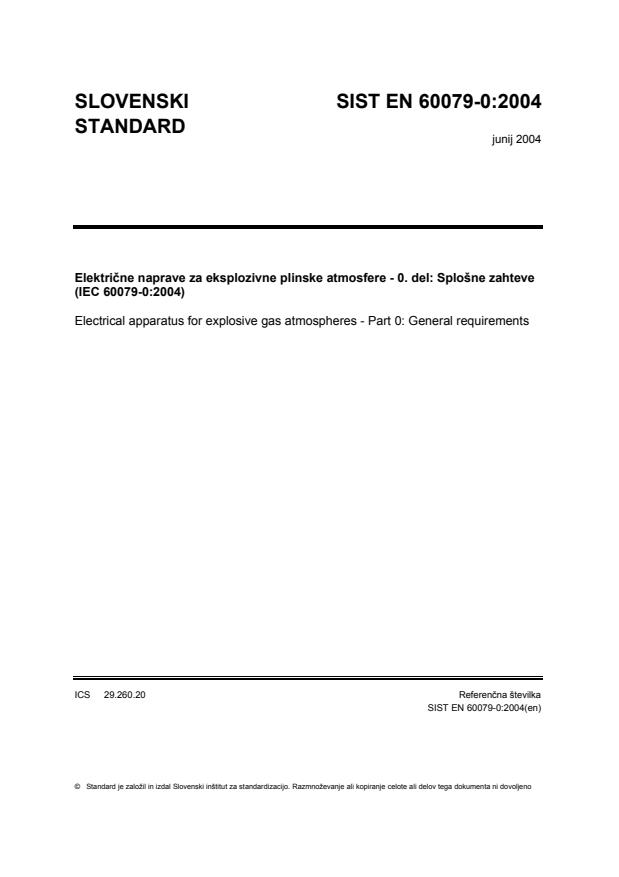
SLOVENSKI SIST EN 60079-0:2004
STANDARD
junij 2004
Električne naprave za eksplozivne plinske atmosfere - 0. del: Splošne zahteve
(IEC 60079-0:2004)
Electrical apparatus for explosive gas atmospheres - Part 0: General requirements
ICS 29.260.20 Referenčna številka
© Standard je založil in izdal Slovenski inštitut za standardizacijo. Razmnoževanje ali kopiranje celote ali delov tega dokumenta ni dovoljeno
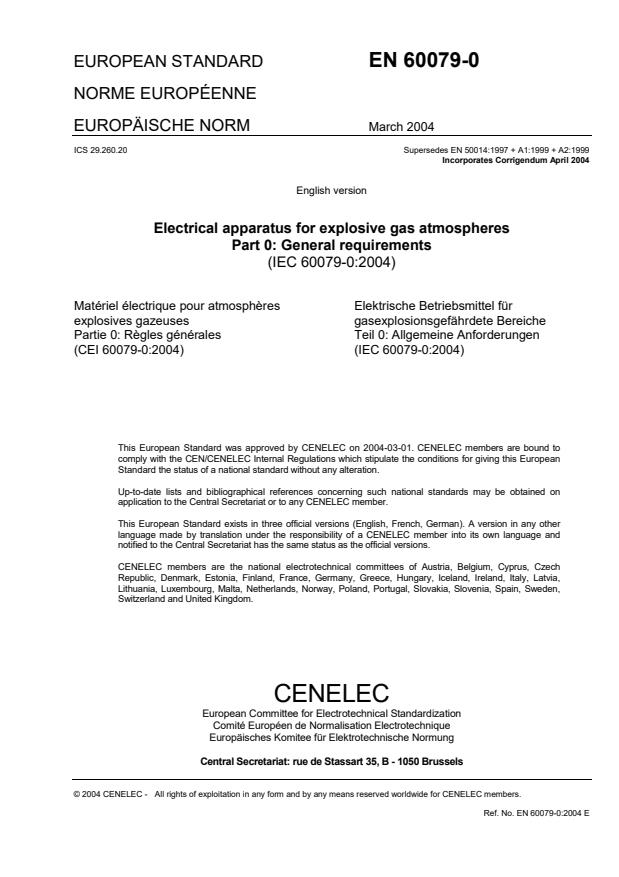
EUROPEAN STANDARD EN 60079-0
NORME EUROPÉENNE
EUROPÄISCHE NORM March 2004
ICS 29.260.20 Supersedes EN 50014:1997 + A1:1999 + A2:1999
Incorporates Corrigendum April 2004
English version
Electrical apparatus for explosive gas atmospheres
Part 0: General requirements
(IEC 60079-0:2004)
Matériel électrique pour atmosphères Elektrische Betriebsmittel für
explosives gazeuses gasexplosionsgefährdete Bereiche
Partie 0: Règles générales Teil 0: Allgemeine Anforderungen
(CEI 60079-0:2004) (IEC 60079-0:2004)
This European Standard was approved by CENELEC on 2004-03-01. CENELEC members are bound to
comply with the CEN/CENELEC Internal Regulations which stipulate the conditions for giving this European
Standard the status of a national standard without any alteration.
Up-to-date lists and bibliographical references concerning such national standards may be obtained on
application to the Central Secretariat or to any CENELEC member.
This European Standard exists in three official versions (English, French, German). A version in any other
language made by translation under the responsibility of a CENELEC member into its own language and
notified to the Central Secretariat has the same status as the official versions.
CENELEC members are the national electrotechnical committees of Austria, Belgium, Cyprus, Czech
Republic, Denmark, Estonia, Finland, France, Germany, Greece, Hungary, Iceland, Ireland, Italy, Latvia,
Lithuania, Luxembourg, Malta, Netherlands, Norway, Poland, Portugal, Slovakia, Slovenia, Spain, Sweden,
Switzerland and United Kingdom.
CENELEC
European Committee for Electrotechnical Standardization
Comité Européen de Normalisation Electrotechnique
Europäisches Komitee für Elektrotechnische Normung
Central Secretariat: rue de Stassart 35, B - 1050 Brussels
© 2004 CENELEC - All rights of exploitation in any form and by any means reserved worldwide for CENELEC members.
Ref. No. EN 60079-0:2004 E
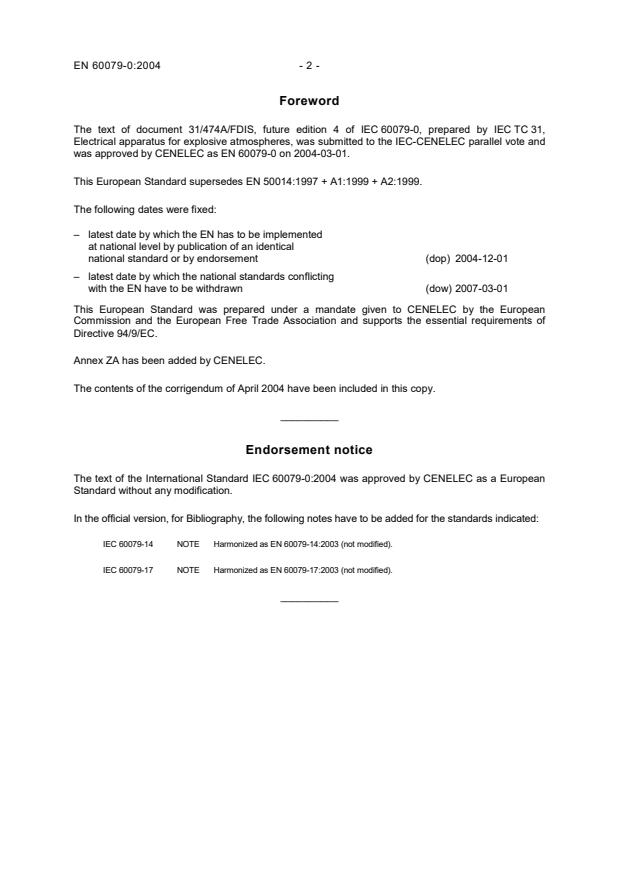
Foreword
The text of document 31/474A/FDIS, future edition 4 of IEC 60079-0, prepared by IEC TC 31,
Electrical apparatus for explosive atmospheres, was submitted to the IEC-CENELEC parallel vote and
was approved by CENELEC as EN 60079-0 on 2004-03-01.
This European Standard supersedes EN 50014:1997 + A1:1999 + A2:1999.
The following dates were fixed:
– latest date by which the EN has to be implemented
at national level by publication of an identical
national standard or by endorsement (dop) 2004-12-01
– latest date by which the national standards conflicting
with the EN have to be withdrawn (dow) 2007-03-01
This European Standard was prepared under a mandate given to CENELEC by the European
Commission and the European Free Trade Association and supports the essential requirements of
Directive 94/9/EC.
Annex ZA has been added by CENELEC.
The contents of the corrigendum of April 2004 have been included in this copy.
__________
Endorsement notice
The text of the International Standard IEC 60079-0:2004 was approved by CENELEC as a European
Standard without any modification.
In the official version, for Bibliography, the following notes have to be added for the standards indicated:
IEC 60079-14 NOTE Harmonized as EN 60079-14:2003 (not modified).
IEC 60079-17 NOTE Harmonized as EN 60079-17:2003 (not modified).
__________
- 3 - EN 60079-0:2004
Annex ZA
(normative)
Normative references to international publications
with their corresponding European publications
The following referenced documents are indispensable for the application of this document. For dated
references, only the edition cited applies. For undated references, the latest edition of the referenced
document (including any amendments) applies.
NOTE When an international publication has been modified by common modifications, indicated by (mod), the relevant
EN/HD applies.
Publication Year Title EN/HD Year
1) 2)
IEC 60034-5 - Rotating electrical machines EN 60034-5 2001
Part 5: Degrees of protection provided
by the integral design of rotating
electrical machines (IP code) –
Classification
1) 2)
IEC 60079-1 - Electrical apparatus for explosive gas EN 60079-1 2004
atmospheres
Part 1: Flameproof enclosures 'd'
1)
IEC 60079-2 - Part 2: Pressurized enclosures "p" - -
1)
IEC 60079-4 - Part 4: Method of test for ignition - -
temperature
1)
IEC 60079-5 - Part 5: Powder filling 'q' - -
1)
IEC 60079-6 - Part 6: Oil-immersion "o" - -
1) 2)
IEC 60079-7 - Part 7: Increased safety "e" EN 60079-7 2003
1) 2)
IEC 60079-10 - Part 10: Classification of hazardous EN 60079-10 2003
areas
1)
IEC 60079-11 - Part 11: Intrinsic safety "i" - -
1) 2)
IEC 60079-15 - Part 15: Type of protection "n" EN 60079-15 2003
(mod)
1)
IEC 60079-18 - Part 18: Encapsulation "m" - -
1) 2)
IEC 60079-25 - Part 25: Intrinsically safe systems EN 60079-25 2004
3)
IEC 60079-26 - Part 26: Construction, test and marking - -
of Group II Zone 0 electrical apparatus
1) 2)
IEC 60086-1 - Primary batteries EN 60086-1 2001
Part 1: General
1)
Undated reference.
2)
Valid edition at date of issue.
3)
To be published.
Publication Year Title EN/HD Year
1) 2)
IEC 60095-1 - Lead-acid starter batteries EN 60095-1 1993
(mod) Part 1: General requirements and
methods of test
1) 2)
IEC 60192 - Low pressure sodium vapour lamps - EN 60192 2001
Performance specifications
1) 2)
IEC 60216-1 - Electrical insulating materials - EN 60216-1 2001
Properties of thermal endurance
Part 1: Ageing procedures and
evaluation of test results
1) 2)
IEC 60216-2 - Part 2: Choice of test criteria HD 611.2 S1 1992
1) 2)
IEC 60423 (mod) - Conduits for electrical purposes - EN 60423 1994
Outside diameters of conduits for
electrical installations and threads for
conduits and fittings
1) 2)
IEC 60529 - Degrees of protection provided by EN 60529 1991
enclosures (IP Code)
1) 2)
IEC 60622 - Secondary cells and batteries EN 60622 2003
containing alkaline or other non-acid
electrolytes - Sealed nickel-cadmium
prismatic rechargeable single cells
1) 2)
IEC 60623 - Secondary cells and batteries EN 60623 2001
containing alkaline or other non-acid
electrolytes - Vented nickel-cadmium
prismatic rechargeable single cells
1) 2)
IEC 60662 - High-pressure sodium vapour lamps EN 60662 1993
1) 2)
IEC 60947-1 - Low-voltage switchgear and controlgear EN 60947-1 1999
(mod) Part 1: General rules
1) 2)
IEC 61056-1 - General purpose lead-acid batteries EN 61056-1 2003
(valve regulated types)
Part 1: General requirements, functional
characteristics - Methods of test
1) 2)
IEC 61150 - Alkaline secondary cells and batteries - EN 61150 1993
Sealed nickel-cadmium rechargeable
monobloc batteries in button cell design
1) 2)
IEC 61436 - Secondary cells and batteries EN 61436 1998
containing alkaline or other non-acid
electrolytes - Sealed nickel-metal
hydride rechargeable single cells
1) 2)
IEC 61951-1 - Secondary cells and batteries EN 61951-1 2003
containing alkaline or other non-acid
electrolytes - Portable sealed
rechargeable single cells
Part 1: Nickel-cadmium
- 5 - EN 60079-0:2004
Publication Year Title EN/HD Year
1) 2)
IEC 62013-1 - Caplights for use in mines susceptible EN 62013-1 2002
(mod) to firedamp
Part 1: General requirements -
Construction and testing in relation to
the risk of explosion
1)
IEC 62086-1 - Electrical apparatus for explosive gas - -
atmospheres - Electrical resistance
trace heating - Part 1: General and
testing requirements
1)
ISO 48 - Rubber, vulcanized or thermoplastic - -
Determination of hardness (hardness
between 10 IRHD and 100 IRHD)
1) 2)
ISO 178 - Plastics - Determination of flexural EN ISO 178 1996
properties
1) 2)
ISO 179 - Plastics - Determination of Charpy EN ISO 179 1996
impact strength
1)
ISO 262 - ISO general-purpose metric screw -
threads
Selected sizes for screws, bolts and
nuts
1) 2)
ISO 273 - Fasteners - Clearance holes for bolts EN 20273 1991
and screws
1) 2)
ISO 286-2 - ISO system of limits and fits EN 20286 1993
Part 2: Tables of standard tolerance
grades and limit deviations for holes
and shafts
1) 2)
ISO 527-2 - Plastics - Determination of tensile EN ISO 527-2 1996
properties
Part 2: Test conditions for moulding and
extrusion plastics
1)
ISO 965-1 - ISO general-purpose metric screw - -
threads - Tolerances
Part 1: Principles and basic data
1)
ISO 965-3 - ISO general purpose metric screw - -
threads - Tolerances - Part 3:
Deviations for constructional threads
1)
ISO 1817 - Rubber, vulcanized - Determination of - -
the effect of liquids
1) 2)
ISO 4014 - Hexagon head bolts - Product grades A EN ISO 4014 2000
and B
1) 2)
ISO 4017 - Hexagon head screws - Product grades EN ISO 4017 2000
A and B
1) 2)
ISO 4026 - Hexagon socket set screws with flat EN ISO 4026 2003
point
Publication Year Title EN/HD Year
1) 2)
ISO 4027 - Hexagon socket set screws with cone EN ISO 4027 2003
point
1) 2)
ISO 4028 - Hexagon socket set screws with dog EN ISO 4028 2003
point
1) 2)
ISO 4029 - Hexagon socket set screws with cup EN ISO 4029 2003
point
1) 2)
ISO 4032 - Hexagon nuts, style 1 - Product grades EN ISO 4032 2000
A and B
1) 2)
ISO 4762 - Hexagon socket head cap screws - EN ISO 4762 1997
Product grade A
1) 2)
ISO 4892-1 - Plastics - Methods of exposure to EN ISO 4892-1 2000
laboratory light sources
Part 1: General guidance
1)
ANSI/UL 746B - Polymeric Materials - Long-Term - -
Property Evaluations
INTERNATIONAL IEC
STANDARD 60079-0
Fourth edition
2004-01
Electrical apparatus for explosive
gas atmospheres –
Part 0:
General requirements
© IEC 2004 Copyright - all rights reserved
No part of this publication may be reproduced or utilized in any form or by any means, electronic or mechanical,
including photocopying and microfilm, without permission in writing from the publisher.
International Electrotechnical Commission, 3, rue de Varembé, PO Box 131, CH-1211 Geneva 20, Switzerland
Telephone: +41 22 919 02 11 Telefax: +41 22 919 03 00 E-mail: inmail@iec.ch Web: www.iec.ch
PRICE CODE
Commission Electrotechnique Internationale XB
International Electrotechnical Commission
Международная Электротехническая Комиссия
For price, see current catalogue
60079-0 IEC:2004 – 3 –
CONTENTS
FOREWORD.11
INTRODUCTION.17
1 Scope.19
2 Normative references.21
3 Terms and definitions .27
4 Apparatus grouping and temperature classification.39
4.1 Apparatus grouping.39
4.2 Group II.39
5 Temperatures.39
5.1 Environmental influences.39
5.2 Service temperature.41
5.3 Maximum surface temperature.41
5.4 Surface temperature and ignition temperature .43
5.5 Small components.43
6 Requirements for all electrical apparatus.45
6.1 General.45
6.2 Mechanical strength of apparatus.45
6.3 Opening times.45
6.4 Circulating currents.47
6.5 Gasket retention.47
7 Non-metallic enclosures and non-metallic parts of enclosures .47
7.1 General.47
7.2 Thermal endurance.49
7.3 Electrostatic charges on external non-metallic materials of enclosures.49
7.4 Threaded holes.51
8 Enclosures containing light metals.53
8.1 Material composition.53
8.2 Threaded holes.53
Fasteners .53
9.1 General.53
9.2 Special fasteners.55
9.3 Holes for special fasteners .55
10 Interlocking devices.59
11 Bushings.59
12 Materials used for cementing.59
13 Ex components.59
13.1 General.59
13.2 Mounting internal to apparatus .59
13.3 Mounting external to apparatus .61
14 Connection facilities and terminal compartments .61
14.1 General.61
14.2 Connection space.61
14.3 Type of protection.61
14.4 Creepage and clearance.61
60079-0 IEC:2004 – 5 –
15 Connection facilities for earthing or bonding conductors .61
15.1 Internal.61
15.2 External.61
15.3 Apparatus not requiring earthing .63
15.4 Size of conductor connection.63
15.5 Protection against corrosion.63
15.6 Secureness.63
16 Entries into enclosures .65
16.1 General.65
16.2 Identification of entries.65
16.3 Cable glands.65
16.4 Blanking elements.65
16.5 Conductor temperature.65
17 Supplementary requirements for rotating electrical machines .67
17.1 Fans and fan hoods.67
17.2 Ventilation openings for external fans.67
17.3 Construction and mounting of the ventilating systems .69
17.4 Clearances for the ventilating system .69
17.5 Materials for external fans and fan hoods .69
17.6 Equipotential bonding conductors.69
18 Supplementary requirements for switchgear .69
18.1 Flammable dielectric.69
18.2 Disconnectors.71
18.3 Group I – Provisions for locking.71
18.4 Doors and covers.71
19 Supplementary requirements for fuses .73
20 Supplementary requirements for plugs and sockets .73
20.1 Interlocking.73
20.2 Energized plugs.73
21 Supplementary requirements for luminaires .73
21.1 General.73
21.2 Covers.75
21.3 Special lamps.75
22 Supplementary requirements for caplights and handlights .75
22.1 Group I caplights and handlights .75
22.2 Group II caplights and handlights .75
23 Apparatus incorporating cells and batteries .77
23.1 Batteries.77
23.2 Cell types.77
23.3 Cells in a battery .79
23.4 Ratings of batteries .79
23.5 Mixture of cells.79
23.6 Interchangeability.79
23.7 Charging of primary batteries .79
23.8 Leakage.79
60079-0 IEC:2004 – 7 –
23.9 Connections.81
23.10 Orientation.81
23.11 Replacement of cells or batteries.81
24 Documentation.81
25 Compliance of prototype or sample with documents .81
26 Type tests.81
26.1 General.81
26.2 Test configuration.81
26.3 Tests in explosive test mixtures .81
26.4 Tests of enclosures.83
26.5 Thermal tests.91
26.6 Torque test for bushings .93
26.7 Non-metallic enclosures or non-metallic parts of enclosures .95
26.8 Thermal endurance to heat .95
26.9 Thermal endurance to cold .97
26.10 Resistance to light .97
26.11 Resistance to chemical agents for Group I electrical apparatus .99
26.12 Earth continuity.99
26.13 Surface resistance test of parts of enclosures of non-metallic materials.101
26.14 Charging tests.103
26.15 Measurement of capacitance .111
27 Routine verifications and tests.111
28 Manufacturer's responsibility.111
28.1 Certificate.111
28.2 Responsibility for marking.111
29 Marking.111
29.1 Location.113
29.2 General.113
29.3 Different types of protection.115
29.4 Order of marking.117
29.5 Ex components.117
29.6 Small apparatus and Ex components .117
29.7 Extremely small apparatus and Ex components .117
29.8 Warning markings.117
29.9 Cells and batteries.119
29.10 Examples of marking.119
30 Instructions.121
30.1 General.121
30.2 Cells and batteries.123
Annex A (normative) Ex cable glands.125
Annex B (normative) Requirements for Ex components.139
Annex C (informative) Example of rig for resistance to impact test.143
Bibliography.145
60079-0 IEC:2004 – 9 –
Figure 1 – Tolerances and clearance for threaded fasteners .57
Figure 2 – Contact surface under head of fastener with a reduced shank.57
Figure 3 – Illustration of entry points and branching points .67
Figure 4 – Assembly of test sample for earth-continuity test.101
Figure 5 – Test piece with painted electrodes .103
Figure 6 – Rubbing with a pure nylon cloth .107
Figure 7 – Discharging of a container with a probe connected to earth via a 0,1 μF
capacitor.109
Figure 8 – Charging by influence with a d.c. voltage power supply.109
Figure A.1 – Illustration of the terms used for cable glands .125
Figure A.2 – Rounded edge of the point of entry of the flexible cable .129
Figure C.1 – Example of rig for resistance to impact test .143
Table 1 – Ambient temperatures in service and additional marking .41
Table 2 – Classification of maximum surface temperatures for Group II electrical
apparatus .43
Table 3 – Assessment for T4 classification according to component size and ambient
temperature .43
Table 4 – Limitations of areas .51
Table 5 – Minimum cross-sectional area of protective conductors .63
Table 6 – Primary cells .77
Table 7 – Secondary cells.79
Table 8 – Tests for resistance to impact.87
Table 9 – Torque to be applied to the stem of bushing used for connection facilities.95
Table 10 − Text of warning markings .119
Table B.1 – Clauses with which Ex components shall comply .139
60079-0 IEC:2004 – 11 –
INTERNATIONAL ELECTROTECHNICAL COMMISSION
__________
ELECTRICAL APPARATUS FOR EXPLOSIVE
GAS ATMOSPHERES –
Part 0: General requirements
FOREWORD
1) The International Electrotechnical Commission (IEC) is a worldwide organization for standardization comprising
all national electrotechnical committees (IEC National Committees). The object of IEC is to promote
international co-operation on all questions concerning standardization in the electrical and electronic fields. To
this end and in addition to other activities, IEC publishes International Standards, Technical Specifications,
Technical Reports, Publicly Available Specifications (PAS) and Guides (hereafter referred to as “IEC
Publication(s)”). Their preparation is entrusted to technical committees; any IEC National Committee interested
in the subject dealt with may participate in this preparatory work. International, governmental and non-
governmental organizations liaising with the IEC also participate in this preparation. IEC collaborates closely
with the International Organization for Standardization (ISO) in accordance with conditions determined by
agreement between the two organizations.
2) The formal decisions or agreements of IEC on technical matters express, as nearly as possible, an international
consensus of opinion on the relevant subjects since each technical committee has representation from all
interested IEC National Committees.
3) IEC Publications have the form of recommendations for international use and are accepted by IEC National
Committees in that sense. While all reasonable efforts are made to ensure that the technical content of IEC
Publications is accurate, IEC cannot be held responsible for the way in which they are used or for any
misinterpretation by any end user.
4) In order to promote international uniformity, IEC National Committees undertake to apply IEC Publications
transparently to the maximum extent possible in their national and regional publications. Any divergence
between any IEC Publication and the corresponding national or regional publication shall be clearly indicated in
the latter.
5) IEC provides no marking procedure to indicate its approval and cannot be rendered responsible for any
equipment declared to be in conformity with an IEC Publication.
6) All users should ensure that they have the latest edition of this publication.
7) No liability shall attach to IEC or its directors, employees, servants or agents including individual experts and
members of its technical committees and IEC National Committees for any personal injury, property damage or
other damage of any nature whatsoever, whether direct or indirect, or for costs (including legal fees) and
expenses arising out of the publication, use of, or reliance upon, this IEC Publication or any other IEC
Publications.
8) Attention is drawn to the Normative references cited in this publication. Use of the referenced publications is
indispensable for the correct application of this publication.
9) Attention is drawn to the possibility that some of the elements of this IEC Publication may be the subject of
patent rights. IEC shall not be held responsible for identifying any or all such patent rights.
International Standard IEC 60079-0 has been prepared by technical committee 31: Electrical
apparatus for explosive atmospheres.
This fourth edition cancels and replaces the third edition, published in 1998, and constitutes a
full technical revision.
The significant changes with respect to the previous edition are listed below:
• Standard atmospheric conditions re-introduced
• All requirements for third-party certification removed
• New type of protection “n” introduced
• New apparatus standards for caplights, intrinsically safe systems, Zone 0 apparatus, and
trace heating introduced
• Clarification of the status of symbol “s”
• Definitions for symbols “U” and “X” revised to align with current usage
60079-0 IEC:2004 – 13 –
• Definition for Ex component transferred from IEC 60079-18
• New definitions drafted for “energy limited” parameters to allow common usage by types of
protection “i” and “n”
• New definitions for batteries transferred from IEC 60079-7
• Definition added for ambient temperature
• Definition added for continuous operating temperature (COT)
• Definition for certificate transferred from IEC 60079-15 and revised based on
ISO/IEC 17000
• Definition added for cable gland
• Clause 5 for temperature re-written to address the influences of ambient temperature,
internal sources of heat, and external sources of heating or cooling
• Small component ignition test transferred from IEC 60079-11 and IEC 60079-15
• Requirements for bonding transferred from IEC 60079-7 and IEC 60079-15
• Requirements for gasket retention transferred from IEC 60079-15 for wider applicability
• Relative thermal index (RTI) added as an alternative to thermal index (TI)
• Electrostatic requirements transferred and rationalized from IEC 60079-15 and IEC 60079-
26 to apply to all of Group I and Group II
• Introduction of two additional test methods to evaluate the use of non-metallic materials
with respect to the storage of electrostatic charges
• Light metal requirements transferred and rationalized from IEC 60079-15 and IEC 60079-
26 to apply to all of Group I and Group II
• Introduction of an existing test to evaluate the use of a non-metallic enclosure wall in an
earth bonding connection
• Clause 16 rewritten to align with industry usage of the terms cable gland and conduit
entry.
• Equipotential bonding requirements for machines transferred from IEC 60079-7 and
IEC 60079-15
• Requirement for disconnectors in switchgear and luminaires revised to provide IP20
protection for live parts and include additional marking
• General requirements for cells and batteries transferred from IEC 60079-7 and IEC 60079-
• Impact test revised to specify drop height in lieu of energy
• Clarification of application of 5 °C and 10 °C temperature margins to type-tested samples
• Clarification of order of tests for metallic materials
• Clarification of number of samples and order of tests for non-metallic materials
• Clarification of order of marking
• Clarification of marking details for associated apparatus
• Clarification of marking of specific gases
• Clarification of marking of temperature class
• Clarification of usage of compulsory certificate number
60079-0 IEC:2004 – 15 –
• Clarification of marking of small apparatus
• Compilation of all warning markings into a table
• Clarification of marking examples
• Addition of a clause on instructions
• Deletion of Annex A as information is available in more appropriate standards (IEC 60079-
20)
• Revision and clarification of Annex A (previously Annex B) to accommodate term cable
gland
The text of this standard is based on the following documents:
FDIS Report on voting
31/474A/FDIS 31/487/RVD
Full information on the voting for the approval of this standard can be found in the report on
voting indicated in the above table.
This publication has been drafted in accordance with the ISO/IEC Directives, Part 2.
The committee has decided that the contents of this publication will remain unchanged until
2008. At this date, the publication will be
• reconfirmed;
• withdrawn;
• replaced by a revised edition, or
• amended.
60079-0 IEC:2004 – 17 –
INTRODUCTION
It is acknowledged that, with developments in technology, it will be possible to achieve the
objectives of the IEC 60079 series of standards in respect of explosion prevention by methods
that are not yet fully defined. Where a manufacturer wishes to take advantage of such
developments, this International Standard, as well as other standards in the IEC 60079 series,
may be applied in part. It is intended that the manufacturer prepare documentation that clearly
defines how the IEC 60079 series of standards has been applied, together with a full
explanation of the additional techniques employed. In this case, the letter “s” has been
reserved to indicate a method of protection that is not fully defined in the standards.
Compliance with this standard cannot be claimed in these circumstances.
60079-0 IEC:2004 – 19 –
ELECTRICAL APPARATUS FOR EXPLOSIVE
GAS ATMOSPHERES –
Part 0: General requirements
1 Scope
This part of IEC 60079 specifies the general requirements for construction, testing and
marking of electrical apparatus and Ex components intended for use in explosive gas
atmospheres.
Unless modified by one of the parts in the IEC 60079 series, electrical apparatus complying
with this standard is intended for use in hazardous areas in which explosive gas atmospheres,
caused by mixtures of air and gases, vapours or mists, exist under normal atmospheric
conditions of
• temperature –20 °C to +60 °C;
• pressure 80 kPa (0,8 bar) to 110 kPa (1,1 bar); and
• air with normal oxygen content, typically 21 % v/v.
The application of electrical apparatus in atmospheric conditions outside this range may need
special consideration.
NOTE 1 The determination of the maximum surface temperature is based on an operational ambient temperature
of –20 °C to +40 °C, if not otherwise specified by the manufacturer. See also 5.1.1.
NOTE 2 In designing apparatus for operation in explosive gas atmospheres under conditions other than the
atmospheric conditions given above, this standard may be used as a guide. However, additional testing related
specifically to the intended conditions of use is recommended. This is particularly important when the types of
protection ‘flameproof enclosures “d”’ (IEC 60079-1) and ‘intrinsic safety “i”’ (IEC 60079-11) are applied.
NOTE 3 Requirements given in this standard result from an ignition hazard assessment made on electrical
equipment. The ignition sources taken into account are those found associated with this type of equipment, such as
hot surfaces, mechanically generated sparks, thermite reactions, electrical arcing and static electric discharge in
normal industrial environments. For other ignition sources like adiabatic compression, shock waves, exothermic
chemical reaction, self ignition of dust, naked flames, hot gases/liquids the apparatus are subjected to a hazard
analysis that identifies and lists all of the potential sources of ignition by the electrical apparatus and the measures
to be applied to prevent them becoming effective.
This standard does not specify requirements for safety, other than those directly related to the
explosion risk.
This standard is supplemented or modified by the following parts of IEC 60079 concerning
specific types of protection:
– IEC 60079-1: Flameproof enclosures "d";
– IEC 60079-2: Pressurized enclosures "p";
– IEC 60079-5: Powder filling "q";
– IEC 60079-6: Oil immersion "o";
– IEC 60079-7: Increased safety "e";
– IEC 60079-11: Intrinsic safety "i";
– IEC 60079-15: Type of protection “n”;
– IEC 60079-18: Encapsulation "m".
60079-0 IEC:2004 – 21 –
This standard is supplemented or modified by the following apparatus standards:
– IEC 60079-25
– IEC 60079-26
– IEC 62013-1
– IEC 62086-1.
This part of IEC 60079, along with other parts in the IEC 60079 series and the additional
standards mentioned above, is not applicable to the construction of electromedical apparatus,
shot-firing exploders, test devices for exploders and for shot-firing circuits.
2 Normative references
The following referenced documents are indispensable for the application of this document.
For dated references, only the edition cited applies. For undated references, the latest edition
of the referenced document (including any amendments) applies.
IEC 60034-5, Rotating electrical machines – Part 5: Degrees of protection provided by the
integral design of rotating electrical machines (IP code) – Classification
IEC 60079-1, Electrical apparatus for explosive gas atmospheres – Part 1: Flameproof
enclosures ”d”
IEC 60079-2, Electrical apparatus for explosive gas atmospheres – Part 2: Pressurized
enclosures "p"
IEC 60079-4, Electrical apparatus for explosive gas atmospheres – Part 4: Method of test
for ignition temperature
IEC 60079-5, Electrical apparatus for explosive gas atmospheres – Part 5: Powder filling "q"
IEC 60079-6, Electrical apparatus for explosive gas atmospheres – Part 6: Oil-immersion "o"
IEC 60079-7, Electrical apparatus for explosive gas atmospheres – Part 7: Increased safety "e"
IEC 60079-10, Electrical apparatus for explosive gas atmospheres – Part 10: Classification of
hazardous areas
IEC 60079-11, Electrical apparatus for explosive gas atmospheres – Part 11: Intrinsic safety "i"
IEC 60079-15, Electrical apparatus for explosive gas atmospheres – Part 15: Type of
protection "n"
IEC 60079-18, Electrical apparatus for explosive gas atmospheres – Part 18: Encapsulation "m"
60079-0 IEC:2004 – 23 –
IEC 60079-25: Electrical apparatus for explosive gas atmospheres – Part 25: Intrinsically safe
systems
IEC 60079-26: Electrical apparatus for explosive gas atmospheres – Part 26: Construction,
test and marking of zone 0 electrical apparatus
IEC 60086-1, Primary batteries – Part 1: General
IEC 60095-1, Lead-acid starter batteries – Part 1: General requirements and methods of test
IEC 60192, Low-pressure sodium vapour lamps – Performance specifications
IEC 60216-1, Electrical insulating materials – Properties of thermal endurance – Part 1: Ageing
procedures and evaluation of test results
IEC 60216-2, Guide for the determination of thermal endurance properties of electrical
insulating materials – Part 2: Choice of test criteria
IEC 60423, Conduits for electrical purposes – Outside diameters of conduits for electrical
installations and threads for conduits and fittings
I
...