

ASTM A370-24
(Test Method)Standard Test Methods and Definitions for Mechanical Testing of Steel Products
General Information
- Abstract
SIGNIFICANCE AND USE
4.1 The primary use of these test methods is testing to determine the specified mechanical properties of steel, stainless steel, and related alloy products for the evaluation of conformance of such products to a material specification under the jurisdiction of ASTM Committee A01 and its subcommittees as designated by a purchaser in a purchase order or contract.
4.1.1 These test methods may be and are used by other ASTM Committees and other standards writing bodies for the purpose of conformance testing.
4.1.2 The material condition at the time of testing, sampling frequency, specimen location and orientation, reporting requirements, and other test parameters are contained in the pertinent material specification or in a general requirement specification for the particular product form.
4.1.3 Some material specifications require the use of additional test methods not described herein; in such cases, the required test method is described in that material specification or by reference to another appropriate test method standard.
4.2 These test methods are also suitable to be used for testing of steel, stainless steel and related alloy materials for other purposes, such as incoming material acceptance testing by the purchaser or evaluation of components after service exposure.
4.2.1 As with any mechanical testing, deviations from either specification limits or expected as-manufactured properties can occur for valid reasons besides deficiency of the original as-fabricated product. These reasons include, but are not limited to: subsequent service degradation from environmental exposure (for example, temperature, corrosion); static or cyclic service stress effects, mechanically-induced damage, material inhomogeneity, anisotropic structure, natural aging of select alloys, further processing not included in the specification, sampling limitations, and measuring equipment calibration uncertainty. There is statistical variation in all aspects of mechanical testin...
SCOPE
1.1 These test methods2 cover procedures and definitions for the mechanical testing of steels, stainless steels, and related alloys. The various mechanical tests herein described are used to determine properties required in the product specifications. Variations in testing methods are to be avoided, and standard methods of testing are to be followed to obtain reproducible and comparable results. In those cases in which the testing requirements for certain products are unique or at variance with these general procedures, the product specification testing requirements shall control.
1.2 The following mechanical tests are described:
Sections
Tension
7 to 14
Bend
15
Hardness
16
Brinell
17
Rockwell
18
Portable
19
Impact
20 to 30
Keywords
32
1.3 Annexes covering details peculiar to certain products are appended to these test methods as follows:
Annex
Bar Products
Annex A1
Tubular Products
Annex A2
Fasteners
Annex A3
Round Wire Products
Annex A4
Significance of Notched-Bar Impact Testing
Annex A5
Converting Percentage Elongation of Round Specimens to
Equivalents for Flat Specimens
Annex A6
Testing Multi-Wire Strand
Annex A7
Rounding of Test Data
Annex A8
Methods for Testing Steel Reinforcing Bars
Annex A9
Procedure for Use and Control of Heat-cycle Simulation
Annex A10
1.4 The values stated in inch-pound units are to be regarded as standard. The values given in parentheses are mathematical conversions to SI units that are provided for information only and are not considered standard.
1.5 When these test methods are referenced in a metric product specification, the yield and tensile values may be determined in inch-pound (ksi) units then converted into SI (MPa) units. The elongation determined in inch-pound gauge lengths of 2 in. or 8 in. may be report...
- Status
- Published
- Publication Date
- 29-Feb-2024
- Technical Committee
- A01 - Steel, Stainless Steel and Related Alloys
Buy Documents
ASTM A370-24 - Standard Test Methods and Definitions for Mechanical Testing of Steel Products
REDLINE ASTM A370-24 - Standard Test Methods and Definitions for Mechanical Testing of Steel Products
Overview
ASTM A370-24: Standard Test Methods and Definitions for Mechanical Testing of Steel Products is an essential international standard developed by ASTM International. This standard provides comprehensive procedures and definitions for mechanical testing of steels, stainless steels, and related alloys. It is widely recognized by manufacturers, purchasers, and regulatory bodies for determining whether steel products comply with specific mechanical property requirements outlined in relevant product specifications. ASTM A370-24 ensures accuracy, reproducibility, and comparability in test results, making it central to the quality assurance and conformance processes in the steel industry.
Key Topics
ASTM A370-24 covers a broad set of mechanical testing methodologies for steel and its alloys, including but not limited to:
- Tension Testing: Evaluates the strength and ductility of steel products.
- Bend Testing: Measures flexibility and resistance to cracking.
- Hardness Testing: Includes Brinell, Rockwell, and portable hardness methods to assess material hardness.
- Impact Testing: Determines the material’s toughness, especially in notched conditions.
- Definitions and Terminology: Clarifies terms specific to mechanical testing of steel products for uniform understanding.
- Sampling and Specimen Orientation: Details requirements for specimen preparation, selection, and orientation (longitudinal, transverse, radial, and tangential).
- Reporting and Interpretation: Directions for reporting test results, including dealing with deviations due to material condition, service exposure, and statistical variation.
The standard also includes annexes that address product-specific concerns such as bar, tubular, fastener, wire, and reinforcing bar testing, as well as notched-bar impact significance and methods for converting elongation values.
Applications
ASTM A370-24 has broad practical applications across numerous sectors:
- Quality Control: Ensures steel products meet required mechanical properties before delivery or fabrication.
- Material Certification: Provides test methods for compliance with steel product specifications as required by contracts or purchase orders.
- Supplier Qualification: Used by purchasers to assess incoming materials for acceptance.
- Post-Service Evaluation: Used in assessing steel components after exposure to service conditions, such as in maintenance or failure analysis.
- Regulatory Compliance: Referenced by multiple ASTM committees, ASME Boiler and Pressure Vessel Code, and other standards organizations.
- Product Development and R&D: A crucial tool for engineers and metallurgists in developing or improving steel grades.
Laboratories and organizations performing testing under ASTM A370-24 benefit by adhering to widely recognized best practices and are better positioned for accreditation, such as under ISO/IEC 17025.
Related Standards
ASTM A370-24 references and is closely associated with several standards and codes, including:
- ASTM E8/E8M - Tension Testing of Metallic Materials
- ASTM E10 - Brinell Hardness of Metallic Materials
- ASTM E18 - Rockwell Hardness of Metallic Materials
- ASTM E23 - Notched Bar Impact Testing of Metallic Materials
- ASTM A1058 - Mechanical Testing of Steel Products-Metric
- ISO/IEC 17025 - General Requirements for Testing and Calibration Laboratories
- ASME Boiler and Pressure Vessel Code, Section II - For test requirements related to pressure vessels
Adopting ASTM A370-24 supports global commonality in mechanical testing, helping companies and laboratories meet international customer and regulatory expectations regarding steel product quality and performance.
Keywords: ASTM A370-24, mechanical testing, steel products, tension test, hardness test, impact test, stainless steel, alloy quality control, material compliance, steel standards.
Relations
- Replaces
ASTM A370-23 - Standard Test Methods and Definitions for Mechanical Testing of Steel Products - Effective Date
- 01-Mar-2024
- Effective Date
- 01-Apr-2024
- Effective Date
- 01-Mar-2023
- Effective Date
- 01-Mar-2024
- Effective Date
- 01-Mar-2024
- Effective Date
- 01-Mar-2024
- Referred By
ASTM A421/A421M-21 - Standard Specification for Stress-Relieved Steel Wire for Prestressed Concrete - Effective Date
- 01-Mar-2024
- Effective Date
- 01-Mar-2024
- Effective Date
- 01-Mar-2024
- Referred By
ASTM C915-79(2018) - Standard Specification for Precast Reinforced Concrete Crib Wall Members - Effective Date
- 01-Mar-2024
- Effective Date
- 01-Mar-2024
- Effective Date
- 01-Mar-2024
- Effective Date
- 01-Mar-2024
- Effective Date
- 01-Mar-2024
- Effective Date
- 01-Mar-2024
Buy Documents
ASTM A370-24 - Standard Test Methods and Definitions for Mechanical Testing of Steel Products
REDLINE ASTM A370-24 - Standard Test Methods and Definitions for Mechanical Testing of Steel Products
Get Certified
Connect with accredited certification bodies for this standard

Element Materials Technology
Materials testing and product certification.

Inštitut za kovinske materiale in tehnologije
Institute of Metals and Technology. Materials testing, metallurgical analysis, NDT.
Sponsored listings
Frequently Asked Questions
ASTM A370-24 is a standard published by ASTM International. Its full title is "Standard Test Methods and Definitions for Mechanical Testing of Steel Products". This standard covers: SIGNIFICANCE AND USE 4.1 The primary use of these test methods is testing to determine the specified mechanical properties of steel, stainless steel, and related alloy products for the evaluation of conformance of such products to a material specification under the jurisdiction of ASTM Committee A01 and its subcommittees as designated by a purchaser in a purchase order or contract. 4.1.1 These test methods may be and are used by other ASTM Committees and other standards writing bodies for the purpose of conformance testing. 4.1.2 The material condition at the time of testing, sampling frequency, specimen location and orientation, reporting requirements, and other test parameters are contained in the pertinent material specification or in a general requirement specification for the particular product form. 4.1.3 Some material specifications require the use of additional test methods not described herein; in such cases, the required test method is described in that material specification or by reference to another appropriate test method standard. 4.2 These test methods are also suitable to be used for testing of steel, stainless steel and related alloy materials for other purposes, such as incoming material acceptance testing by the purchaser or evaluation of components after service exposure. 4.2.1 As with any mechanical testing, deviations from either specification limits or expected as-manufactured properties can occur for valid reasons besides deficiency of the original as-fabricated product. These reasons include, but are not limited to: subsequent service degradation from environmental exposure (for example, temperature, corrosion); static or cyclic service stress effects, mechanically-induced damage, material inhomogeneity, anisotropic structure, natural aging of select alloys, further processing not included in the specification, sampling limitations, and measuring equipment calibration uncertainty. There is statistical variation in all aspects of mechanical testin... SCOPE 1.1 These test methods2 cover procedures and definitions for the mechanical testing of steels, stainless steels, and related alloys. The various mechanical tests herein described are used to determine properties required in the product specifications. Variations in testing methods are to be avoided, and standard methods of testing are to be followed to obtain reproducible and comparable results. In those cases in which the testing requirements for certain products are unique or at variance with these general procedures, the product specification testing requirements shall control. 1.2 The following mechanical tests are described: Sections Tension 7 to 14 Bend 15 Hardness 16 Brinell 17 Rockwell 18 Portable 19 Impact 20 to 30 Keywords 32 1.3 Annexes covering details peculiar to certain products are appended to these test methods as follows: Annex Bar Products Annex A1 Tubular Products Annex A2 Fasteners Annex A3 Round Wire Products Annex A4 Significance of Notched-Bar Impact Testing Annex A5 Converting Percentage Elongation of Round Specimens to Equivalents for Flat Specimens Annex A6 Testing Multi-Wire Strand Annex A7 Rounding of Test Data Annex A8 Methods for Testing Steel Reinforcing Bars Annex A9 Procedure for Use and Control of Heat-cycle Simulation Annex A10 1.4 The values stated in inch-pound units are to be regarded as standard. The values given in parentheses are mathematical conversions to SI units that are provided for information only and are not considered standard. 1.5 When these test methods are referenced in a metric product specification, the yield and tensile values may be determined in inch-pound (ksi) units then converted into SI (MPa) units. The elongation determined in inch-pound gauge lengths of 2 in. or 8 in. may be report...
SIGNIFICANCE AND USE 4.1 The primary use of these test methods is testing to determine the specified mechanical properties of steel, stainless steel, and related alloy products for the evaluation of conformance of such products to a material specification under the jurisdiction of ASTM Committee A01 and its subcommittees as designated by a purchaser in a purchase order or contract. 4.1.1 These test methods may be and are used by other ASTM Committees and other standards writing bodies for the purpose of conformance testing. 4.1.2 The material condition at the time of testing, sampling frequency, specimen location and orientation, reporting requirements, and other test parameters are contained in the pertinent material specification or in a general requirement specification for the particular product form. 4.1.3 Some material specifications require the use of additional test methods not described herein; in such cases, the required test method is described in that material specification or by reference to another appropriate test method standard. 4.2 These test methods are also suitable to be used for testing of steel, stainless steel and related alloy materials for other purposes, such as incoming material acceptance testing by the purchaser or evaluation of components after service exposure. 4.2.1 As with any mechanical testing, deviations from either specification limits or expected as-manufactured properties can occur for valid reasons besides deficiency of the original as-fabricated product. These reasons include, but are not limited to: subsequent service degradation from environmental exposure (for example, temperature, corrosion); static or cyclic service stress effects, mechanically-induced damage, material inhomogeneity, anisotropic structure, natural aging of select alloys, further processing not included in the specification, sampling limitations, and measuring equipment calibration uncertainty. There is statistical variation in all aspects of mechanical testin... SCOPE 1.1 These test methods2 cover procedures and definitions for the mechanical testing of steels, stainless steels, and related alloys. The various mechanical tests herein described are used to determine properties required in the product specifications. Variations in testing methods are to be avoided, and standard methods of testing are to be followed to obtain reproducible and comparable results. In those cases in which the testing requirements for certain products are unique or at variance with these general procedures, the product specification testing requirements shall control. 1.2 The following mechanical tests are described: Sections Tension 7 to 14 Bend 15 Hardness 16 Brinell 17 Rockwell 18 Portable 19 Impact 20 to 30 Keywords 32 1.3 Annexes covering details peculiar to certain products are appended to these test methods as follows: Annex Bar Products Annex A1 Tubular Products Annex A2 Fasteners Annex A3 Round Wire Products Annex A4 Significance of Notched-Bar Impact Testing Annex A5 Converting Percentage Elongation of Round Specimens to Equivalents for Flat Specimens Annex A6 Testing Multi-Wire Strand Annex A7 Rounding of Test Data Annex A8 Methods for Testing Steel Reinforcing Bars Annex A9 Procedure for Use and Control of Heat-cycle Simulation Annex A10 1.4 The values stated in inch-pound units are to be regarded as standard. The values given in parentheses are mathematical conversions to SI units that are provided for information only and are not considered standard. 1.5 When these test methods are referenced in a metric product specification, the yield and tensile values may be determined in inch-pound (ksi) units then converted into SI (MPa) units. The elongation determined in inch-pound gauge lengths of 2 in. or 8 in. may be report...
ASTM A370-24 is classified under the following ICS (International Classification for Standards) categories: 77.040.10 - Mechanical testing of metals; 77.140.01 - Iron and steel products in general. The ICS classification helps identify the subject area and facilitates finding related standards.
ASTM A370-24 has the following relationships with other standards: It is inter standard links to ASTM A370-23, ASTM E23-24, ASTM E23-23a, ASTM A673/A673M-17, ASTM A957/A957M-21, ASTM A582/A582M-22, ASTM A421/A421M-21, ASTM A923-23, ASTM A600-92a(2024), ASTM C915-79(2018), ASTM A691/A691M-19, ASTM A726-18, ASTM A470/A470M-05(2020), ASTM A542/A542M-19, ASTM A1077/A1077M-21. Understanding these relationships helps ensure you are using the most current and applicable version of the standard.
ASTM A370-24 is available in PDF format for immediate download after purchase. The document can be added to your cart and obtained through the secure checkout process. Digital delivery ensures instant access to the complete standard document.
Standards Content (Sample)
This international standard was developed in accordance with internationally recognized principles on standardization established in the Decision on Principles for the
Development of International Standards, Guides and Recommendations issued by the World Trade Organization Technical Barriers to Trade (TBT) Committee.
Designation: A370 − 24
Standard Test Methods and Definitions for
Mechanical Testing of Steel Products
This standard is issued under the fixed designation A370; the number immediately following the designation indicates the year of
original adoption or, in the case of revision, the year of last revision. A number in parentheses indicates the year of last reapproval. A
superscript epsilon (´) indicates an editorial change since the last revision or reapproval.
This standard has been approved for use by agencies of the U.S. Department of Defense.
1. Scope*
Testing Multi-Wire Strand Annex A7
Rounding of Test Data Annex A8
1.1 These test methods cover procedures and definitions
Methods for Testing Steel Reinforcing Bars Annex A9
for the mechanical testing of steels, stainless steels, and related Procedure for Use and Control of Heat-cycle Simulation Annex A10
alloys. The various mechanical tests herein described are used
1.4 The values stated in inch-pound units are to be regarded
to determine properties required in the product specifications.
as standard. The values given in parentheses are mathematical
Variations in testing methods are to be avoided, and standard
conversions to SI units that are provided for information only
methods of testing are to be followed to obtain reproducible
and are not considered standard.
and comparable results. In those cases in which the testing
1.5 When these test methods are referenced in a metric
requirements for certain products are unique or at variance with
these general procedures, the product specification testing product specification, the yield and tensile values may be
requirements shall control. determined in inch-pound (ksi) units then converted into SI
(MPa) units. The elongation determined in inch-pound gauge
1.2 The following mechanical tests are described:
lengths of 2 in. or 8 in. may be reported in SI unit gauge
Sections
lengths of 50 mm or 200 mm, respectively, as applicable.
Tension 7 to 14
Bend 15
Conversely, when these test methods are referenced in an
Hardness 16
inch-pound product specification, the yield and tensile values
Brinell 17
Rockwell 18 may be determined in SI units then converted into inch-pound
Portable 19
units. The elongation determined in SI unit gauge lengths of
Impact 20 to 30
50 mm or 200 mm may be reported in inch-pound gauge
Keywords 32
lengths of 2 in. or 8 in., respectively, as applicable.
1.3 Annexes covering details peculiar to certain products
1.5.1 The specimen used to determine the original units
are appended to these test methods as follows:
must conform to the applicable tolerances of the original unit
Annex
Bar Products Annex A1 system given in the dimension table not that of the converted
Tubular Products Annex A2
tolerance dimensions.
Fasteners Annex A3
Round Wire Products Annex A4
NOTE 1—This is due to the specimen SI dimensions and tolerances
Significance of Notched-Bar Impact Testing Annex A5
being hard conversions when this is not a dual standard. The user is
Converting Percentage Elongation of Round Specimens to Annex A6
directed to Test Methods A1058 if the tests are required in SI units.
Equivalents for Flat Specimens
1.6 Attention is directed to ISO/IEC 17025 when there may
be a need for information on criteria for evaluation of testing
laboratories.
1.7 This standard does not purport to address all of the
safety concerns, if any, associated with its use. It is the
responsibility of the user of this standard to establish appro-
priate safety, health, and environmental practices and deter-
These test methods and definitions are under the jurisdiction of ASTM
mine the applicability of regulatory limitations prior to use.
Committee A01 on Steel, Stainless Steel and Related Alloys and are the direct
1.8 This international standard was developed in accor-
responsibility of Subcommittee A01.13 on Mechanical and Chemical Testing and
dance with internationally recognized principles on standard-
Processing Methods of Steel Products and Processes.
Current edition approved March 1, 2024. Published April 2024. Originally
ization established in the Decision on Principles for the
approved in 1953. Last previous edition approved in 2023 as A370 – 23. DOI:
Development of International Standards, Guides and Recom-
10.1520/A0370-24.
mendations issued by the World Trade Organization Technical
For ASME Boiler and Pressure Vessel Code applications see related Specifi-
cation SA-370 in Section II of that Code. Barriers to Trade (TBT) Committee.
*A Summary of Changes section appears at the end of this standard
Copyright © ASTM International, 100 Barr Harbor Drive, PO Box C700, West Conshohocken, PA 19428-2959. United States
A370 − 24
2. Referenced Documents 3. Terminology
2.1 ASTM Standards: 3.1 Definitions:
A623 Specification for Tin Mill Products, General Require- 3.1.1 For definitions of terms pertaining to mechanical
ments testing of steel products not otherwise listed in this section,
A623M Specification for Tin Mill Products, General Re- reference shall be made to Terminology E6 and Terminology
quirements [Metric] A941.
A833 Test Method for Indentation Hardness of Metallic 3.2 Definitions of Terms Specific to This Standard:
Materials by Comparison Hardness Testers 3.2.1 fixed-location hardness testing machine, n—a hard-
A941 Terminology Relating to Steel, Stainless Steel, Related ness testing machine that is designed for routine operation in a
Alloys, and Ferroalloys fixed-location by the users and is not designed to be
A956/A956M Test Method for Leeb Hardness Testing of transported, or carried, or moved.
Steel Products 3.2.1.1 Discussion—Typically due to its heavy weight and
A1038 Test Method for Portable Hardness Testing by the large size, a fixed-location hardness testing machine is placed
Ultrasonic Contact Impedance Method in one location and not routinely moved.
A1058 Test Methods for Mechanical Testing of Steel
3.2.2 longitudinal test, n—unless specifically defined
Products—Metric
otherwise, signifies that the lengthwise axis of the specimen is
A1061/A1061M Test Methods for Testing Multi-Wire Steel
parallel to the direction of the greatest extension of the steel
Prestressing Strand
during rolling or forging.
E4 Practices for Force Calibration and Verification of Test-
3.2.2.1 Discussion—The stress applied to a longitudinal
ing Machines
tension test specimen is in the direction of the greatest
E6 Terminology Relating to Methods of Mechanical Testing
extension, and the axis of the fold of a longitudinal bend test
E8/E8M Test Methods for Tension Testing of Metallic Ma-
specimen is at right angles to the direction of greatest extension
terials
(see Fig. 1, Fig. 2a, and Fig. 2b).
E10 Test Method for Brinell Hardness of Metallic Materials
3.2.3 portable hardness testing machine, n—a hardness
E18 Test Methods for Rockwell Hardness of Metallic Ma-
testing machine that is designed to be transported, carried, set
terials
up, and that measures hardness in accordance with the test
E23 Test Methods for Notched Bar Impact Testing of Me-
methods in Section 19.
tallic Materials
3.2.4 radial test, n—unless specifically defined otherwise,
E29 Practice for Using Significant Digits in Test Data to
signifies that the lengthwise axis of the specimen is perpen-
Determine Conformance with Specifications
dicular to the axis of the product and coincident with one of the
E83 Practice for Verification and Classification of Exten-
radii of a circle drawn with a point on the axis of the product
someter Systems
as a center (see Fig. 2a).
E110 Test Method for Rockwell and Brinell Hardness of
Metallic Materials by Portable Hardness Testers 3.2.5 tangential test, n—unless specifically defined
E140 Hardness Conversion Tables for Metals Relationship
otherwise, signifies that the lengthwise axis of the specimen
Among Brinell Hardness, Vickers Hardness, Rockwell perpendicular to a plane containing the axis of the product and
Hardness, Superficial Hardness, Knoop Hardness, Sclero-
scope Hardness, and Leeb Hardness
E190 Test Method for Guided Bend Test for Ductility of
Welds
E290 Test Methods for Bend Testing of Material for Ductil-
ity
2.2 ASME Document:
ASME Boiler and Pressure Vessel Code, Section VIII,
Division I, Part UG-8
2.3 ISO Standard:
ISO/IEC 17025 General Requirements for the Competence
of Testing and Calibration Laboratories
For referenced ASTM standards, visit the ASTM website, www.astm.org, or
contact ASTM Customer Service at service@astm.org. For Annual Book of ASTM
Standards volume information, refer to the standard’s Document Summary page on
the ASTM website.
Available from American Society of Mechanical Engineers (ASME), ASME
International Headquarters, Two Park Ave., New York, NY 10016-5990, http://
www.asme.org.
Available from International Organization for Standardization (ISO), ISO
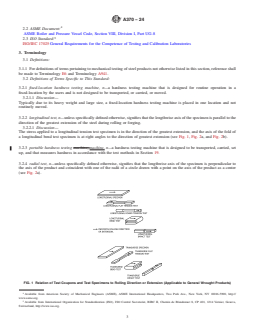
Central Secretariat, BIBC II, Chemin de Blandonnet 8, CP 401, 1214 Vernier, FIG. 1 Relation of Test Coupons and Test Specimens to Rolling
Geneva, Switzerland, http://www.iso.org. Direction or Extension (Applicable to General Wrought Products)
A370 − 24
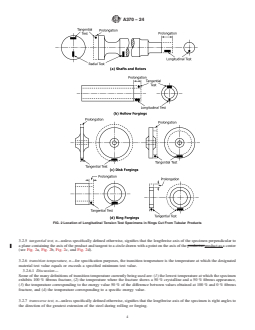
FIG. 2 Location of Longitudinal Tension Test Specimens in Rings Cut From Tubular Products
tangent to a circle drawn with a point on the axis of the product corresponding to the energy value 50 % of the difference
as a center (see Fig. 2a, Fig. 2b, Fig. 2c, and Fig. 2d). between values obtained at 100 % and 0 % fibrous fracture, and
(4) the temperature corresponding to a specific energy value.
3.2.6 transition temperature, n—for specification purposes,
the transition temperature is the temperature at which the 3.2.7 transverse test, n—unless specifically defined
designated material test value equals or exceeds a specified otherwise, signifies that the lengthwise axis of the specimen is
minimum test value. right angles to the direction of the greatest extension of the
3.2.6.1 Discussion—Some of the many definitions of tran- steel during rolling or forging.
sition temperature currently being used are: (1) the lowest 3.2.7.1 Discussion—The stress applied to a transverse ten-
temperature at which the specimen exhibits 100 % fibrous sion test specimen is at right angles to the greatest extension,
fracture, (2) the temperature where the fracture shows a 50 % and the axis of the fold of a transverse bend test specimen is
crystalline and a 50 % fibrous appearance, (3) the temperature parallel to the greatest extension (see Fig. 1).
A370 − 24
3.3 Definition of Terms Specific to the Procedure for Use inhomogeneity, anisotropic structure, natural aging of select
and Control of Heat-cycle Simulation (See Annex A9): alloys, further processing not included in the specification,
3.3.1 master chart, n—a record of the heat treatment re- sampling limitations, and measuring equipment calibration
ceived from a forging essentially identical to the production uncertainty. There is statistical variation in all aspects of
forgings that it will represent. mechanical testing and variations in test results from prior tests
3.3.1.1 Discussion—It is a chart of time and temperature are expected. An understanding of possible reasons for devia-
tion from specified or expected test values should be applied in
showing the output from thermocouples imbedded in the
forging at the designated test immersion and test location or interpretation of test results.
locations.
5. General Precautions
3.3.2 program chart, n—the metallized sheet used to pro-
5.1 Certain methods of fabrication, such as bending,
gram the simulator unit.
forming, and welding, or operations involving heating, may
3.3.2.1 Discussion—Time-temperature data from the master
affect the properties of the material under test. Therefore, the
chart are manually transferred to the program chart.
product specifications cover the stage of manufacture at which
3.3.3 simulator chart, n—a record of the heat treatment that
mechanical testing is to be performed. The properties shown by
a test specimen had received in the simulator unit.
testing prior to fabrication may not necessarily be representa-
3.3.3.1 Discussion—It is a chart of time and temperature
tive of the product after it has been completely fabricated.
and can be compared directly to the master chart for accuracy
5.2 Improperly machined specimens should be discarded
of duplication.
and other specimens substituted.
3.3.4 simulator cycle, n—one continuous heat treatment of a
5.3 Flaws in the specimen may also affect results. If any test
set of specimens in the simulator unit.
specimen develops flaws, the retest provision of the applicable
3.3.4.1 Discussion—The cycle includes heating from
product specification shall govern.
ambient, holding at temperature, and cooling. For example, a
5.4 If any test specimen fails because of mechanical reasons
simulated austenitize and quench of a set of specimens would
such as failure of testing equipment or improper specimen
be one cycle; a simulated temper of the same specimens would
preparation, it may be discarded and another specimen taken.
be another cycle.
6. Orientation of Test Specimens
4. Significance and Use
6.1 The terms “longitudinal test” and “transverse test” are
4.1 The primary use of these test methods is testing to
used only in material specifications for wrought products and
determine the specified mechanical properties of steel, stainless
are not applicable to castings. When such reference is made to
steel, and related alloy products for the evaluation of confor-
a test coupon or test specimen, see Section 3 for terms and
mance of such products to a material specification under the
definitions.
jurisdiction of ASTM Committee A01 and its subcommittees as
designated by a purchaser in a purchase order or contract.
TENSION TEST
4.1.1 These test methods may be and are used by other
7. Description
ASTM Committees and other standards writing bodies for the
7.1 The tension test related to the mechanical testing of steel
purpose of conformance testing.
products subjects a machined or full-section specimen of the
4.1.2 The material condition at the time of testing, sampling
material under examination to a measured load sufficient to
frequency, specimen location and orientation, reporting
cause rupture. The resulting properties sought are defined in
requirements, and other test parameters are contained in the
Terminology E6.
pertinent material specification or in a general requirement
specification for the particular product form.
7.2 In general, the testing equipment and methods are given
4.1.3 Some material specifications require the use of addi-
in Test Methods E8/E8M. However, there are certain excep-
tional test methods not described herein; in such cases, the
tions to Test Methods E8/E8M practices in the testing of steel,
required test method is described in that material specification
and these are covered in these test methods.
or by reference to another appropriate test method standard.
8. Testing Apparatus and Operations
4.2 These test methods are also suitable to be used for
8.1 Loading Systems—There are two general types of load-
testing of steel, stainless steel and related alloy materials for
ing systems, mechanical (screw power) and hydraulic. These
other purposes, such as incoming material acceptance testing
differ chiefly in the variability of the rate of load application.
by the purchaser or evaluation of components after service
The older screw power machines are limited to a small number
exposure.
of fixed free running crosshead speeds. Some modern screw
4.2.1 As with any mechanical testing, deviations from either
power machines, and all hydraulic machines permit stepless
specification limits or expected as-manufactured properties can
variation throughout the range of speeds.
occur for valid reasons besides deficiency of the original
as-fabricated product. These reasons include, but are not 8.2 The tension testing machine shall be maintained in good
limited to: subsequent service degradation from environmental operating condition, used only in the proper loading range, and
exposure (for example, temperature, corrosion); static or cyclic calibrated periodically in accordance with the latest revision of
service stress effects, mechanically-induced damage, material Practices E4.
A370 − 24
NOTE 2—Many machines are equipped with stress-strain recorders for
9. Test Specimen Parameters
autographic plotting of stress-strain curves. It should be noted that some
9.1 Selection—Test coupons shall be selected in accordance
recorders have a load measuring component entirely separate from the
with the applicable product specifications.
load indicator of the testing machine. Such recorders are calibrated
separately.
9.1.1 Wrought Steels—Wrought steel products are usually
tested in the longitudinal direction, but in some cases, where
8.3 Loading—It is the function of the gripping or holding
size permits and the service justifies it, testing is in the
device of the testing machine to transmit the load from the
transverse, radial, or tangential directions (see Figs. 1 and 2).
heads of the machine to the specimen under test. The essential
9.1.2 Forged Steels—For open die forgings, the metal for
requirement is that the load shall be transmitted axially. This
tension testing is usually provided by allowing extensions or
implies that the centers of the action of the grips shall be in
prolongations on one or both ends of the forgings, either on all
alignment, insofar as practicable, with the axis of the specimen
or a representative number as provided by the applicable
at the beginning and during the test and that bending or
product specifications. Test specimens are normally taken at
twisting be held to a minimum. For specimens with a reduced
mid-radius. Certain product specifications permit the use of a
section, gripping of the specimen shall be restricted to the grip
representative bar or the destruction of a production part for
section. In the case of certain sections tested in full size,
test purposes. For ring or disk-like forgings test metal is
nonaxial loading is unavoidable and in such cases shall be
provided by increasing the diameter, thickness, or length of the
permissible.
forging. Upset disk or ring forgings, which are worked or
extended by forging in a direction perpendicular to the axis of
8.4 Speed of Testing—The speed of testing shall not be
the forging, usually have their principal extension along
greater than that at which load and strain readings can be made
concentric circles and for such forgings tangential tension
accurately. In production testing, speed of testing is commonly
specimens are obtained from extra metal on the periphery or
expressed: (1) in terms of free running crosshead speed (rate of
end of the forging. For some forgings, such as rotors, radial
movement of the crosshead of the testing machine when not
tension tests are required. In such cases the specimens are cut
under load), (2) in terms of rate of separation of the two heads
or trepanned from specified locations.
of the testing machine under load, (3) in terms of rate of
stressing the specimen, or (4) in terms of rate of straining the
9.2 Size and Tolerances—Test specimens shall be (1) the
specimen. The following limitations on the speed of testing are
full cross section of material, or (2) machined to the form and
recommended as adequate for most steel products:
dimensions shown in Figs. 3-6. The selection of size and type
of specimen is prescribed by the applicable product specifica-
NOTE 3—Tension tests using closed-loop machines (with feedback
tion. Full cross section specimens shall be tested in 8-in.
control of rate) should not be performed using load control, as this mode
(200 mm) gauge length unless otherwise specified in the
of testing will result in acceleration of the crosshead upon yielding and
elevation of the measured yield strength. product specification.
9.3 Procurement of Test Specimens—Specimens shall be
8.4.1 Any convenient speed of testing may be used up to
extracted by any convenient method taking care to remove all
one half the specified yield point or yield strength. When this
distorted, cold-worked, or heat-affected areas from the edges of
point is reached, the free-running rate of separation of the
1 the section used in evaluating the material. Specimens usually
crossheads shall be adjusted so as not to exceed ⁄16 in. per min
have a reduced cross section at mid-length to ensure uniform
per inch of reduced section, or the distance between the grips
distribution of the stress over the cross section and localize the
for test specimens not having reduced sections. This speed
zone of fracture.
shall be maintained through the yield point or yield strength. In
determining the tensile strength, the free-running rate of
9.4 Aging of Test Specimens—Unless otherwise specified, it
separation of the heads shall not exceed ⁄2 in. per min per inch
shall be permissible to age tension test specimens. The time-
of reduced section, or the distance between the grips for test
temperature cycle employed must be such that the effects of
specimens not having reduced sections. In any event, the
previous processing will not be materially changed. It may be
minimum speed of testing shall not be less than ⁄10 the
accomplished by aging at room temperature 24 h to 48 h, or in
specified maximum rates for determining yield point or yield shorter time at moderately elevated temperatures by boiling in
strength and tensile strength.
water, heating in oil or in an oven.
8.4.2 It shall be permissible to set the speed of the testing
9.5 Measurement of Dimensions of Test Specimens:
machine by adjusting the free running crosshead speed to the
9.5.1 Standard Rectangular Tension Test Specimens—These
above specified values, inasmuch as the rate of separation of
forms of specimens are shown in Fig. 3. To determine the
heads under load at these machine settings is less than the
cross-sectional area, the center width dimension shall be
specified values of free running crosshead speed.
measured to the nearest 0.005 in. (0.13 mm) for the 8-in.
8.4.3 As an alternative, if the machine is equipped with a (200 mm) gauge length specimen and 0.001 in. (0.025 mm) for
device to indicate the rate of loading, the speed of the machine the 2-in. (50 mm) gauge length specimen in Fig. 3. The center
from half the specified yield point or yield strength through the thickness dimension shall be measured to the nearest 0.001 in.
yield point or yield strength may be adjusted so that the rate of for both specimens.
stressing does not exceed 100 000 psi (690 MPa) ⁄min. 9.5.2 Standard Round Tension Test Specimens—These
However, the minimum rate of stressing shall not be less than
forms of specimens are shown in Fig. 4 and Fig. 5. To
10 000 psi (70 MPa)/min. determine the cross-sectional area, the diameter shall be
A370 − 24
DIMENSIONS
Standard Specimens Subsize Specimen
Plate-type,
1 ⁄2-in. (40 mm) Wide
8-in. (200 mm) 2-in. (50 mm) Sheet-type, ⁄2 in. (12.5 mm)
⁄4-in. (6 mm) Wide
Gauge Length Gauge Length Wide
in. mm in. mm in. mm in. mm
G—Gauge length 8.00 ± 0.01 200 ± 0.25 2.000 ± 0.005 50.0 ± 0.10 2.000 ± 0.005 50.0 ± 0.10 1.000 ± 0.003 25.0 ± 0.08
(Notes 1 and 2)
1 1 1 1
W—Width 1 ⁄2 + ⁄8 40 + 3 1 ⁄2 + ⁄8 40 + 3 0.500 ± 0.010 12.5 ± 0.25 0.250 ± 0.002 6.25 ± 0.05
1 1
(Notes 3, 5, and 6) − ⁄4 − 6 − ⁄4 − 6
T—Thickness
Thickness of Material
(Note 7)
1 1 1 1
R—Radius of fillet, min ⁄2 13 ⁄2 13 ⁄2 13 ⁄4 6
(Note 4)
L—Overall length, min 18 450 8 200 8 200 4 100
(Notes 2 and 8)
1 1 1
A—Length of 9 225 2 ⁄4 60 2 ⁄4 60 1 ⁄4 32
reduced section, min
B—Length of grip section, min 3 75 2 50 2 50 1 ⁄4 32
(Note 9)
3 3
C—Width of grip section, approxi- 2 50 2 50 ⁄4 20 ⁄8 10
mate
(Note 4, Note 10, and Note 11)
NOTE 1—For the 1 ⁄2-in. (40 mm) wide specimens, punch marks for measuring elongation after fracture shall be made on the flat or on the edge of
the specimen and within the reduced section. For the 8-in. (200 mm) gauge length specimen, a set of nine or more punch marks 1 in. (25 mm) apart,
or one or more pairs of punch marks 8 in. (200 mm) apart may be used. For the 2-in. (50 mm) gauge length specimen, a set of three or more punch marks
1 in. (25 mm) apart, or one or more pairs of punch marks 2 in. (50 mm) apart may be used.
NOTE 2—For the ⁄2-in. (12.5 mm) wide specimen, punch marks for measuring the elongation after fracture shall be made on the flat or on the edge
of the specimen and within the reduced section. Either a set of three or more punch marks 1 in. (25 mm) apart or one or more pairs of punch marks 2 in.
(50 mm) apart may be used.
NOTE 3—For the four sizes of specimens, the ends of the reduced section shall not differ in width by more than 0.004 in., 0.004 in., 0.002 in., or
0.001 in. (0.10 mm, 0.10 mm, 0.05 mm, or 0.025 mm), respectively. Also, there may be a gradual decrease in width from the ends to the center, but the
width at either end shall not be more than 0.015 in., 0.015 in., 0.005 in., or 0.003 in. (0.40 mm, 0.40 mm, 0.10 mm, or 0.08 mm), respectively, larger
than the width at the center.
NOTE 4—For each specimen type, the radii of all fillets shall be equal to each other with a tolerance of 0.05 in. (1.25 mm), and the centers of curvature
of the two fillets at a particular end shall be located across from each other (on a line perpendicular to the centerline) within a tolerance of 0.10 in.
(2.5 mm).
NOTE 5—For each of the four sizes of specimens, narrower widths (W and C) may be used when necessary. In such cases, the width of the reduced
section should be as large as the width of the material being tested permits; however, unless stated specifically, the requirements for elongation in a product
specification shall not apply when these narrower specimens are used. If the width of the material is less than W, the sides may be parallel throughout
the length of the specimen.
NOTE 6—The specimen may be modified by making the sides parallel throughout the length of the specimen, the width and tolerances being the same
as those specified above. When necessary, a narrower specimen may be used, in which case the width should be as great as the width of the material being
tested permits. If the width is 1 ⁄2 in. (38 mm) or less, the sides may be parallel throughout the length of the specimen.
NOTE 7—The dimension T is the thickness of the test specimen as provided for in the applicable product specification. Minimum nominal thickness
1 3
of 1-in. to 1 ⁄2-in. (40 mm) wide specimens shall be ⁄16 in. (5 mm), except as permitted by the product specification. Maximum nominal thickness of
1 1 1
⁄2-in. (12.5 mm) and ⁄4-in. (6 mm) wide specimens shall be 1 in. (25 mm) and ⁄4 in. (6 mm), respectively.
NOTE 8—To aid in obtaining axial loading during testing of ⁄4-in. (6 mm) wide specimens, the overall length should be as large as the material will
permit.
NOTE 9—It is desirable, if possible, to make the length of the grip section large enough to allow the specimen to extend into the grips a distance equal
1 3
to two thirds or more of the length of the grips. If the thickness of ⁄2-in. (13 mm) wide specimens is over ⁄8 in. (10 mm), longer grips and correspondingly
longer grip sections of the specimen may be necessary to prevent failure in the grip section.
NOTE 10—For standard sheet-type specimens and subsize specimens, the ends of the specimen shall be symmetrical with the center line of the reduced
section within 0.01 in. and 0.005 in. (0.25 mm and 0.13 mm), respectively, except that for steel if the ends of the ⁄2-in. (12.5 mm) wide specimen are
symmetrical within 0.05 in. (1.0 mm), a specimen may be considered satisfactory for all but referee testing.
NOTE 11—For standard plate-type specimens, the ends of the specimen shall be symmetrical with the center line of the reduced section within 0.25 in.
(6.35 mm), except for referee testing in which case the ends of the specimen shall be symmetrical with the center line of the reduced section within 0.10 in.
(2.5 mm).
FIG. 3 Rectangular Tension Test Specimens
A370 − 24
DIMENSIONS
Standard Specimen Small-size Specimens Proportional to Standard
Nominal Diameter in. mm in. mm in. mm in. mm in. mm
0.500 12.5 0.350 8.75 0.250 6.25 0.160 4.00 0.113 2.50
G—Gauge length 2.00 ± 50.0 ± 1.400 ± 35.0 ± 1.000 ± 25.0 ± 0.640 ± 16.0 ± 0.450 ± 10.0 ±
0.005 0.10 0.005 0.10 0.005 0.10 0.005 0.10 0.005 0.10
D—Diameter (Note 1) 0.500 ± 12.5 ± 0.350 ± 8.75 ± 0.250 ± 6.25 ± 0.160 ± 4.00 ± 0.113 ± 2.50 ±
0.010 0.25 0.007 0.18 0.005 0.12 0.003 0.08 0.002 0.05
3 1 3 5 3
R—Radius of fillet, min ⁄8 10 ⁄4 6 ⁄16 5 ⁄32 4 ⁄32 2
1 3 1 3 5
A—Length of reduced section, min 2 ⁄4 60 1 ⁄4 45 1 ⁄4 32 ⁄4 20 ⁄8 16
(Note 2)
NOTE 1—The reduced section may have a gradual taper from the ends toward the center, with the ends not more than 1 % larger in diameter than the
center (controlling dimension).
NOTE 2—If desired, the length of the reduced section may be increased to accommodate an extensometer of any convenient gauge length. Reference
marks for the measurement of elongation should, nevertheless, be spaced at the indicated gauge length.
NOTE 3—The gauge length and fillets shall be as shown, but the ends may be of any form to fit the holders of the testing machine in such a way that
the load shall be axial (see Fig. 9). If the ends are to be held in wedge grips it is desirable, if possible, to make the length of the grip section great enough
to allow the specimen to extend into the grips a distance equal to two thirds or more of the length of the grips.
NOTE 4—On the round specimens in Fig. 5 and Fig. 6, the gauge lengths are equal to four times the nominal diameter. In some product specifications
other specimens may be provided for, but unless the 4-to-1 ratio is maintained within dimensional tolerances, the elongation values may not be comparable
with those obtained from the standard test specimen.
NOTE 5—The use of specimens smaller than 0.250-in. (6.25 mm) diameter shall be restricted to cases when the material to be tested is of insufficient
size to obtain larger specimens or when all parties agree to their use for acceptance testing. Smaller specimens require suitable equipment and greater
skill in both machining and testing.
NOTE 6—Five sizes of specimens often used have diameters of approximately 0.505 in., 0.357 in., 0.252 in., 0.160 in., and 0.113 in., the reason being
2 2 2
to permit easy calculations of stress from loads, since the corresponding cross sectional areas are equal or close to 0.200 in. , 0.100 in. , 0.0500 in. ,
2 2
0.0200 in. , and 0.0100 in. , respectively. Thus, when the actual diameters agree with these values, the stresses (or strengths) may be computed using the
simple multiplying factors 5, 10, 20, 50, and 100, respectively. (The metric equivalents of these fixed diameters do not result in correspondingly
convenient cross sectional area and multiplying factors.)
FIG. 4 Standard 0.500-in. (12.5 mm) Round Tension Test Specimen With 2-in. (50 mm) Gauge Length and Examples of Small-size Speci-
mens Proportional to Standard Specimens
(200 mm) gauge length specimen of Fig. 3 may be used for sheet and strip
measured at the center of the gauge length to the nearest
material.
0.001 in. (0.025 mm) (see Table 1).
11. Sheet-type Specimen
9.6 General—Test specimens shall be either substantially
full size or machined, as prescribed in the product specifica-
11.1 The standard sheet-type test specimen is shown in Fig.
tions for the material being tested.
3. This specimen is used for testing metallic materials in the
9.6.1 It is desirable to have the cross-sectional area of the
form of sheet, plate, flat wire, strip, band, and hoop ranging in
specimen smallest at the center of the gauge length to ensure
nominal thickness from 0.005 in. to 1 in. (0.13 mm to 25 mm).
fracture within the gauge length. This is provided for by the
When product specifications so permit, other types of speci-
taper in the gauge length permitted for each of the specimens
mens may be used, as provided in Section 10 (see Note 4).
described in the following sections.
9.6.2 For brittle materials it is desirable to have fillets of 12. Round Specimens
large radius at the ends of the gauge length.
12.1 The standard 0.500-in. (12.5 mm) diameter round test
specimen shown in Fig. 4 is frequently used for testing metallic
10. Plate-type Specimens
materials.
10.1 The standard plate-type test specimens are shown in
12.2 Fig. 4 also shows small size specimens proportional to
Fig. 3. Such specimens are used for testing metallic materials
the standard specimen. These may be used when it is necessary
in the form of plate, structural and bar-size shapes, and flat
to test material from which the standard specimen or specimens
material having a nominal thickness of ⁄16 in. (5 mm) or over.
shown in Fig. 3 cannot be prepared. Other sizes of small round
When product specifications so permit, other types of speci-
specimens may be used. In any such small size specimen it is
mens may be used.
important that the gauge length for measurement of elongation
NOTE 4—When called for in the product specification, the 8-in. be four times the diameter of the specimen (see Note 5, Fig. 4).
A370 − 24
DIMENSIONS
Specimen 1 Specimen 2 Specimen 3 Specimen 4 Specimen 5
in. mm in. mm in. mm in. mm in. mm
G—Gauge length 2.000 ± 50.0 ± 2.000 ± 50.0 ± 2.000 ± 50.0 ± 2.000 ± 50.0 ± 2.00 ± 50.0 ±
0.005 0.10 0.005 0.10 0.005 0.10 0.005 0.10 0.005 0.10
D—Diameter (Note 1) 0.500 ± 12.5 ± 0.500 ± 12.5 ± 0.500 ± 12.5 ± 0.500 ± 12.5 ± 0.500 ± 12.5 ±
0.010 0.25 0.010 0.25 0.010 0.25 0.010 0.25 0.010 0.25
3 3 1 3 3
R—Radius of fillet, min ⁄8 10 ⁄8 10 ⁄16 2 ⁄8 10 ⁄8 10
1 1 1 1
A—Length of reduced 2 ⁄4, min 60, min 2 ⁄4, min 60, min 4, ap- 100, ap- 2 ⁄4, min 60, min 2 ⁄4, min 60, min
section proxi- proxi-
mately mately
1 1 3 1
L—Overall length, approximate 5 125 5 ⁄2 140 5 ⁄2 140 4 ⁄4 120 9 ⁄2 240
3 3 1
B—Grip section 1 ⁄8, ap- 35, ap- 1, ap- 25, ap- ⁄4, ap- 20, ap- ⁄2, ap- 13, ap- 3, min 75, min
(Note 2) proxi- proxi- proxi- proxi- proxi- proxi- proxi- proxi-
mately mately mately mately mately mately mately mately
3 3 23 7 3
C—Diameter of end section ⁄4 20 ⁄4 20 ⁄32 18 ⁄8 22 ⁄4 20
5 3 5
E—Length of shoulder and . . . . . . ⁄8 16 . . . . . . ⁄4 20 ⁄8 16
fillet section, approximate
5 5 19
F—Diameter of shoulder . . . . . . ⁄8 16 . . . . . . ⁄8 16 ⁄32 15
NOTE 1—The reduced section may have a gradual taper from the ends toward the center with the ends not more than 0.005 in. (0.10 mm) larger in
diameter than the center.
NOTE 2—On Specimen 5 it is desirable, if possible, to make the length of the grip section great enough to allow the specimen to extend into the grips
a distance equal to two thirds or more of the length of the grips.
NOTE 3—The types of ends shown are applicable for the standard 0.500-in. round tension test specimen; similar types can be used for subsize
3 1 3 1
specimens. The use of UNF series of threads ( ⁄4 by 16, ⁄2 by 20, ⁄8 by 24, and ⁄4 by 28) is suggested for high-strength brittle materials to avoid fracture
in the thread portion.
FIG. 5 Suggested Types of Ends for Standard Round Tension Test Specimens
DIMENSIONS
Specimen 1 Specimen 2 Specimen 3
in. mm in. mm in. mm
G—Length of parallel Shall be equal to or greater than diameter D
D—Diameter 0.500 ± 0.010 12.5 ± 0.25 0.750 ± 0.015 20.0 ± 0.40 1.25 ± 0.025 30.0 ± 0.60
R—Radius of fillet, min 1 25 1 25 2 50
1 1 1
A—Length of reduced section, min 1 ⁄4 32 1 ⁄2 38 2 ⁄4 60
3 3
L—Over-all length, min 3 ⁄4 95 4 100 6 ⁄8 160
B—Grip section, approximate 1 25 1 25 1 ⁄4 45
3 1 7
C—Diameter of end section, approximate ⁄4 20 1 ⁄8 30 1 ⁄8 48
1 1 5
E—Length of shoulder, min ⁄4 6 ⁄4 6 ⁄16 8
5 1 15 1 7 1
F—Diameter of shoulder ⁄8 ± ⁄64 16.0 ± 0.40 ⁄16 ± ⁄64 24.0 ± 0.40 1 ⁄16 ± ⁄64 36.5 ± 0.40
NOTE 1—The reduced section and shoulders (dimensions A, D, E, F, G, and R) shall be shown, but the ends may be of any form to fit the holders of
the testing machine in such a way that the load shall be axial. Commonly the ends are threaded and have the dimensions B and C given above.
FIG. 6 Standard Tension Test Specimens for Cast Iron
A370 − 24
TABLE 1 Multiplying Factors to Be Used for Various Diameters of Round Test Specimens
Standard Specimen Small Size Specimens Proportional to Standard
0.500 in. Round 0.350 in. Round 0.250 in. Round
Actual Actual Actual
Area, Multiplying Area, Multiplying Area, Multiplying
Diameter, Diameter, Diameter,
2 2 2
in. Factor in. Factor in. Factor
in. in. in.
0.490 0.1886 5.30 0.343 0.0924 10.82 0.245 0.0471 21.21
0.491 0.1893 5.28 0.344 0.0929 10.76 0.246 0.0475 21.04
0.492 0.1901 5.26 0.345 0.0935 10.70 0.247 0.0479 20.87
0.493 0.1909 5.24 0.346 0.0940 10.64 0.248 0.0483 20.70
0.494 0.1917 5.22 0.347 0.0946 10.57 0.249 0.0487 20.54
0.495 0.1924 5.20 0.348 0.0951 10.51 0.250 0.0491 20.37
0.496 0.1932 5.18 0.349 0.0957 10.45 0.251 0.0495 20.21
A A
(0.05) (20.0)
0.497 0.1940 5.15 0.350 0.0962 10.39 0.252 0.0499 20.05
A A
(0.05) (20.0)
0.498 0.1948 5.13 0.351 0.0968 10.33 0.253 0.0503 19.89
A A
(0.05) (20.0)
0.499 0.1956 5.11 0.352 0.0973 10.28 0.254 0.0507 19.74
0.500 0.1963 5.09 0.353 0.0979 10.22 0.255 0.0511 19.58
0.501 0.1971 5.07 0.354 0.0984 10.16 . . . . . . . . .
0.502 0.1979 5.05 0.355 0.0990 10.10 . . . . . . . . .
0.503 0.1987 5.03 0.356 0.0995 10.05 . . . . . . . . .
A A
(0.1) (10.0) . . . . . . . . .
0.504 0.1995 5.01 0.357 0.1001 9.99 . . . . . . . . .
A A A A
(0.2) (5.0) (0.1) (10.0) . . . . . . . . .
0.505 0.2003 4.99 . . . . . . . . . . . . . . . . . .
A A
(0.2) (5.0)
0.506 0.2011 4.97 . . . . . . . . . . . . . . . . . .
A A
(0.2) (5.0)
0.507 0.2019 4.95 . . . . . . . . . . . . . . . . . .
0.508 0.2027 4.93 . . . . . . . . . . . . . . . . . .
0.509 0.2035 4.91 . . . . . . . . . . . . . . . . . .
0.510 0.2043 4.90 . . . . . . . . . . . . . . . . . .
A
The values in parentheses may be used for ease in calculation of stresses, in pounds per square inch, as permitted in Note 5 of Fig. 4.
12.3 The type of specimen ends outside of the gauge length set must be approximately centered in the reduced section.
shall accommodate the shape of the product tested, and shall These same precautions shall be observed when the test
properly fit the holders or grips of the testing machine so that specimen is full section.
axial loads are applied with a minimum of load eccentricity and
14. Determination of Tensile Properties
slippage. Fig. 5 shows specimens with various types of ends
that have given satisfactory results.
14.1 Yield Point—Yield point is the first stress in a material,
less than the maximum obtainable stress, at which an increase
13. Gauge Marks
in strain occurs without an increase in stress. Yield point is
13.1 The specimens shown in Figs. 3-6 shall be gauge intended for application only for materials that may exhibit the
marked with a center punch, scribe marks, multiple device, or unique characteristic of showing an increase in strain without
drawn with ink. The purpose of these gauge marks is to an increase in stress. The stress-strain diagram is characterized
determine the percent elongation. Punch marks shall be light, by a sharp knee or discontinuity. Determine yield point by one
sharp, and accurately spaced. The localization of stress at the of the following methods:
marks makes a hard specimen susceptible to starting fracture at 14.1.1 Drop of Beam or Halt of Pointer Method—In this
the punch marks. The gauge marks for measuring elongation method, apply an increasing load to the specimen at a uniform
after fracture shall be made on the flat or on the edge of the flat rate. When a lever and poise machine is used, keep the beam in
tension test specimen and within the parallel section; for the balance by running out the poise at approximately a steady
8-in. gauge length specimen, Fig. 3, one or more sets of 8-in. rate. When the yield point of the material is reached, the
gauge marks may be used, intermediate marks within the gauge increase of the load will stop, but run the poise a trifle beyond
length being optional. Rectangular 2-in. gauge length the balance position, and the beam of the machine will drop for
specimens, Fig. 3, and round specimens, Fig. 4, are gauge a brief but appreciable interval of time. When a machine
marked with a double-pointed center punch or scribe marks. equipped with a load-indicating dial is used there is a halt or
One or more sets of gauge marks may be used; however, one hesitation of the load-indicating pointer corresponding to the
A370 − 24
drop of the beam. Note the load at the “drop of the beam” or Yield strength 0.2 % offset 5 52 000 psi 360 MPa (1)
~ ! ~ !
the “halt of the pointer” and record the corresponding stress as
When the offset is 0.2 % or larger, the extensometer used
the yield point.
shall qualify as a Class B2 device over a strain range of 0.05 %
14.1.2 Autographic Diagram Method—When a sharp-kneed
to 1.0 %. If a smaller offset is specified, it may be necessary to
stress-strain diagram is obtained by an autographic recording
specify a more accurate device (that is, a Class B1 device) or
device, take the stress corresponding to the top of the knee
reduce the lower limit of the strain range (for example, to
(Fig. 7), or the stress at which the curve drops as the yield
0.01 %) or both. See also Note 10 for automatic devices.
point.
NOTE 9—For stress-strain diagrams not containing a distinct modulus,
14.1.3 Total Extension Under Load Method—When testing
such as for some cold-worked materials, it is recommended that the
material for yield point and the test specimens may not exhibit
extension under load method be utilized. If the offset method is used for
a well-defined disproportionate deformation that characterizes
materials without a distinct modulus, a modulus value appropriate for the
a yield point as measured by the drop of the beam, halt of the
material being tested should be used: 30 000 000 psi (207 000 MPa) for
pointer, or autographic diagram methods described in 14.1.1
carbon steel; 29 000 000 psi (200 000 MPa) for ferritic stainless steel;
28 000 000 psi (193 000 MPa) for austenitic stainless steel. For special
and 14.1.2, a value equivalent to the yield point in its practical
alloys, the producer should be contacted to discuss appropriate modulus
significance may be determined by the following method and
values.
may be recorded as yield point: Attach a Class C or better
14.2.2 Extension Under Load Method—For tests to deter-
extensometer (Notes 5 and 6) to the specimen. When the load
mine the acceptance or rejection of material whose stress-strain
producing a specified extension (Note 7) is reached record the
characteristics are well known from previous tests of similar
stress corresponding to the load as the yield point (Fig. 8).
material in which stress-strain diagrams were plotted, the total
NOTE 5—Automatic devices are available that determine the load at the
strain corresponding to the stress at which the specified offset
specified total extension without plotting a stress-strain curve. Such
(see Notes 10 and 11) occurs will be known within satisfactory
devices may be used if their accuracy has been demonstrated. Multiplying
limits. The stress on the specimen, when this total strain is
calipers and other such devices are acceptable for use provided their
accuracy has been demonstrated as equivalent to a Class C extensometer.
reached, is the value of the yield strength. In recording values
NOTE 6—Reference should be made to Practice E83.
of yield strength obtained by this method, the value of
NOTE 7—For steel with a yield point specified not over 80 000 psi
“extension” specified or used, or both, shall be stated in
(550 MPa), an appropriate value is 0.005 in./in. of gauge length. For
parentheses after the term yield strength, for example:
values above 80 000 psi, this method is not valid unless the limiting total
extension is increased.
Yield strength 0.5 % EUL 5 52 000 psi 360 MPa (2)
~ ! ~ !
NOTE 8—The shape of the initial portion of an autographically
determined stress-strain (or a load-elongation) curve may be influenced by
The total strain can be obtained satisfactorily by use of a
numerous factors such as the seating of the specimen in the grips, the
Class B1 extensometer (Note 5, Note 6, and Note 8).
straighteni
...
This document is not an ASTM standard and is intended only to provide the user of an ASTM standard an indication of what changes have been made to the previous version. Because
it may not be technically possible to adequately depict all changes accurately, ASTM recommends that users consult prior editions as appropriate. In all cases only the current version
of the standard as published by ASTM is to be considered the official document.
Designation: A370 − 23 A370 − 24
Standard Test Methods and Definitions for
Mechanical Testing of Steel Products
This standard is issued under the fixed designation A370; the number immediately following the designation indicates the year of
original adoption or, in the case of revision, the year of last revision. A number in parentheses indicates the year of last reapproval. A
superscript epsilon (´) indicates an editorial change since the last revision or reapproval.
This standard has been approved for use by agencies of the U.S. Department of Defense.
1. Scope*
1.1 These test methods cover procedures and definitions for the mechanical testing of steels, stainless steels, and related alloys.
The various mechanical tests herein described are used to determine properties required in the product specifications. Variations
in testing methods are to be avoided, and standard methods of testing are to be followed to obtain reproducible and comparable
results. In those cases in which the testing requirements for certain products are unique or at variance with these general
procedures, the product specification testing requirements shall control.
1.2 The following mechanical tests are described:
Sections
Tension 7 to 14
Bend 15
Hardness 16
Brinell 17
Rockwell 18
Portable 19
Impact 20 to 30
Keywords 32
1.3 Annexes covering details peculiar to certain products are appended to these test methods as follows:
Annex
Bar Products Annex A1
Tubular Products Annex A2
Fasteners Annex A3
Round Wire Products Annex A4
Significance of Notched-Bar Impact Testing Annex A5
Converting Percentage Elongation of Round Specimens to Annex A6
Equivalents for Flat Specimens
These test methods and definitions are under the jurisdiction of ASTM Committee A01 on Steel, Stainless Steel and Related Alloys and are the direct responsibility of
Subcommittee A01.13 on Mechanical and Chemical Testing and Processing Methods of Steel Products and Processes.
Current edition approved Sept. 15, 2023March 1, 2024. Published September 2023April 2024. Originally approved in 1953. Last previous edition approved in 20222023
as A370 – 22.A370 – 23. DOI: 10.1520/A0370-23.10.1520/A0370-24.
For ASME Boiler and Pressure Vessel Code applications see related Specification SA-370 in Section II of that Code.
*A Summary of Changes section appears at the end of this standard
Copyright © ASTM International, 100 Barr Harbor Drive, PO Box C700, West Conshohocken, PA 19428-2959. United States
A370 − 24
Testing Multi-Wire Strand Annex A7
Rounding of Test Data Annex A8
Methods for Testing Steel Reinforcing Bars Annex A9
Procedure for Use and Control of Heat-cycle Simulation Annex A10
1.4 The values stated in inch-pound units are to be regarded as standard. The values given in parentheses are mathematical
conversions to SI units that are provided for information only and are not considered standard.
1.5 When these test methods are referenced in a metric product specification, the yield and tensile values may be determined in
inch-pound (ksi) units then converted into SI (MPa) units. The elongation determined in inch-pound gauge lengths of 2 in. or 8 in.
may be reported in SI unit gauge lengths of 50 mm or 200 mm, respectively, as applicable. Conversely, when these test methods
are referenced in an inch-pound product specification, the yield and tensile values may be determined in SI units then converted
into inch-pound units. The elongation determined in SI unit gauge lengths of 50 mm or 200 mm may be reported in inch-pound
gauge lengths of 2 in. or 8 in., respectively, as applicable.
1.5.1 The specimen used to determine the original units must conform to the applicable tolerances of the original unit system given
in the dimension table not that of the converted tolerance dimensions.
NOTE 1—This is due to the specimen SI dimensions and tolerances being hard conversions when this is not a dual standard. The user is directed to Test
Methods A1058 if the tests are required in SI units.
1.6 Attention is directed to ISO/IEC 17025 when there may be a need for information on criteria for evaluation of testing
laboratories.
1.7 This standard does not purport to address all of the safety concerns, if any, associated with its use. It is the responsibility
of the user of this standard to establish appropriate safety, health, and environmental practices and determine the applicability of
regulatory limitations prior to use.
1.8 This international standard was developed in accordance with internationally recognized principles on standardization
established in the Decision on Principles for the Development of International Standards, Guides and Recommendations issued
by the World Trade Organization Technical Barriers to Trade (TBT) Committee.
2. Referenced Documents
2.1 ASTM Standards:
A623 Specification for Tin Mill Products, General Requirements
A623M Specification for Tin Mill Products, General Requirements [Metric]
A833 Test Method for Indentation Hardness of Metallic Materials by Comparison Hardness Testers
A941 Terminology Relating to Steel, Stainless Steel, Related Alloys, and Ferroalloys
A956/A956M Test Method for Leeb Hardness Testing of Steel Products
A1038 Test Method for Portable Hardness Testing by the Ultrasonic Contact Impedance Method
A1058 Test Methods for Mechanical Testing of Steel Products—Metric
A1061/A1061M Test Methods for Testing Multi-Wire Steel Prestressing Strand
E4 Practices for Force Calibration and Verification of Testing Machines
E6 Terminology Relating to Methods of Mechanical Testing
E8/E8M Test Methods for Tension Testing of Metallic Materials
E10 Test Method for Brinell Hardness of Metallic Materials
E18 Test Methods for Rockwell Hardness of Metallic Materials
E23 Test Methods for Notched Bar Impact Testing of Metallic Materials
E29 Practice for Using Significant Digits in Test Data to Determine Conformance with Specifications
E83 Practice for Verification and Classification of Extensometer Systems
E110 Test Method for Rockwell and Brinell Hardness of Metallic Materials by Portable Hardness Testers
E140 Hardness Conversion Tables for Metals Relationship Among Brinell Hardness, Vickers Hardness, Rockwell Hardness,
Superficial Hardness, Knoop Hardness, Scleroscope Hardness, and Leeb Hardness
E190 Test Method for Guided Bend Test for Ductility of Welds
E290 Test Methods for Bend Testing of Material for Ductility
For referenced ASTM standards, visit the ASTM website, www.astm.org, or contact ASTM Customer Service at service@astm.org. For Annual Book of ASTM Standards
volume information, refer to the standard’s Document Summary page on the ASTM website.
A370 − 24
2.2 ASME Document:
ASME Boiler and Pressure Vessel Code, Section VIII, Division I, Part UG-8
2.3 ISO Standard:
ISO/IEC 17025 General Requirements for the Competence of Testing and Calibration Laboratories
3. Terminology
3.1 Definitions:
3.1.1 For definitions of terms pertaining to mechanical testing of steel products not otherwise listed in this section, reference shall
be made to Terminology E6 and Terminology A941.
3.2 Definitions of Terms Specific to This Standard:
3.2.1 fixed-location hardness testing machine, n—a hardness testing machine that is designed for routine operation in a
fixed-location by the users and is not designed to be transported, or carried, or moved.
3.2.1.1 Discussion—
Typically due to its heavy weight and large size, a fixed-location hardness testing machine is placed in one location and not
routinely moved.
3.2.2 longitudinal test, n—unless specifically defined otherwise, signifies that the lengthwise axis of the specimen is parallel to the
direction of the greatest extension of the steel during rolling or forging.
3.2.2.1 Discussion—
The stress applied to a longitudinal tension test specimen is in the direction of the greatest extension, and the axis of the fold of
a longitudinal bend test specimen is at right angles to the direction of greatest extension (see Fig. 1, Fig. 2a, and Fig. 2b).
3.2.3 portable hardness testing machine,,machine, n—a hardness testing machine that is designed to be transported, carried, set
up, and that measures hardness in accordance with the test methods in Section 19.
3.2.4 radial test, n—unless specifically defined otherwise, signifies that the lengthwise axis of the specimen is perpendicular to
the axis of the product and coincident with one of the radii of a circle drawn with a point on the axis of the product as a center
(see Fig. 2a).
FIG. 1 Relation of Test Coupons and Test Specimens to Rolling Direction or Extension (Applicable to General Wrought Products)
Available from American Society of Mechanical Engineers (ASME), ASME International Headquarters, Two Park Ave., New York, NY 10016-5990, http://
www.asme.org.
Available from International Organization for Standardization (ISO), ISO Central Secretariat, BIBC II, Chemin de Blandonnet 8, CP 401, 1214 Vernier, Geneva,
Switzerland, http://www.iso.org.
A370 − 24
FIG. 2 Location of Longitudinal Tension Test Specimens in Rings Cut From Tubular Products
3.2.5 tangential test, n—unless specifically defined otherwise, signifies that the lengthwise axis of the specimen perpendicular to
a plane containing the axis of the product and tangent to a circle drawn with a point on the axis of the productas product as a center
(see Fig. 2a, Fig. 2b, Fig. 2c, and Fig. 2d).
3.2.6 transition temperature, n—for specification purposes, the transition temperature is the temperature at which the designated
material test value equals or exceeds a specified minimum test value.
3.2.6.1 Discussion—
Some of the many definitions of transition temperature currently being used are: (1) the lowest temperature at which the specimen
exhibits 100 % fibrous fracture, (2) the temperature where the fracture shows a 50 % crystalline and a 50 % fibrous appearance,
(3) the temperature corresponding to the energy value 50 % of the difference between values obtained at 100 % and 0 % fibrous
fracture, and (4) the temperature corresponding to a specific energy value.
3.2.7 transverse test, n—unless specifically defined otherwise, signifies that the lengthwise axis of the specimen is right angles to
the direction of the greatest extension of the steel during rolling or forging.
A370 − 24
3.2.7.1 Discussion—
The stress applied to a transverse tension test specimen is at right angles to the greatest extension, and the axis of the fold of a
transverse bend test specimen is parallel to the greatest extension (see Fig. 1).
A370 − 24
3.3 Definition of Terms Specific to the Procedure for Use and Control of Heat-cycle Simulation (See Annex A9):
3.3.1 master chart, n—a record of the heat treatment received from a forging essentially identical to the production forgings that
it will represent.
3.3.1.1 Discussion—
It is a chart of time and temperature showing the output from thermocouples imbedded in the forging at the designated test
immersion and test location or locations.
3.3.2 program chart, n—the metallized sheet used to program the simulator unit.
3.3.2.1 Discussion—
Time-temperature data from the master chart are manually transferred to the program chart.
3.3.3 simulator chart, n—a record of the heat treatment that a test specimen had received in the simulator unit.
3.3.3.1 Discussion—
It is a chart of time and temperature and can be compared directly to the master chart for accuracy of duplication.
3.3.4 simulator cycle, n—one continuous heat treatment of a set of specimens in the simulator unit.
3.3.4.1 Discussion—
The cycle includes heating from ambient, holding at temperature, and cooling. For example, a simulated austenitize and quench
of a set of specimens would be one cycle; a simulated temper of the same specimens would be another cycle.
4. Significance and Use
4.1 The primary use of these test methods is testing to determine the specified mechanical properties of steel, stainless steel, and
related alloy products for the evaluation of conformance of such products to a material specification under the jurisdiction of
ASTM Committee A01 and its subcommittees as designated by a purchaser in a purchase order or contract.
4.1.1 These test methods may be and are used by other ASTM Committees and other standards writing bodies for the purpose of
conformance testing.
4.1.2 The material condition at the time of testing, sampling frequency, specimen location and orientation, reporting requirements,
and other test parameters are contained in the pertinent material specification or in a general requirement specification for the
particular product form.
4.1.3 Some material specifications require the use of additional test methods not described herein; in such cases, the required test
method is described in that material specification or by reference to another appropriate test method standard.
4.2 These test methods are also suitable to be used for testing of steel, stainless steel and related alloy materials for other purposes,
such as incoming material acceptance testing by the purchaser or evaluation of components after service exposure.
4.2.1 As with any mechanical testing, deviations from either specification limits or expected as-manufactured properties can occur
for valid reasons besides deficiency of the original as-fabricated product. These reasons include, but are not limited to: subsequent
service degradation from environmental exposure (for example, temperature, corrosion); static or cyclic service stress effects,
mechanically-induced damage, material inhomogeneity, anisotropic structure, natural aging of select alloys, further processing not
included in the specification, sampling limitations, and measuring equipment calibration uncertainty. There is statistical variation
in all aspects of mechanical testing and variations in test results from prior tests are expected. An understanding of possible reasons
for deviation from specified or expected test values should be applied in interpretation of test results.
5. General Precautions
5.1 Certain methods of fabrication, such as bending, forming, and welding, or operations involving heating, may affect the
properties of the material under test. Therefore, the product specifications cover the stage of manufacture at which mechanical
testing is to be performed. The properties shown by testing prior to fabrication may not necessarily be representative of the product
after it has been completely fabricated.
5.2 Improperly machined specimens should be discarded and other specimens substituted.
A370 − 24
5.3 Flaws in the specimen may also affect results. If any test specimen develops flaws, the retest provision of the applicable
product specification shall govern.
5.4 If any test specimen fails because of mechanical reasons such as failure of testing equipment or improper specimen
preparation, it may be discarded and another specimen taken.
6. Orientation of Test Specimens
6.1 The terms “longitudinal test” and “transverse test” are used only in material specifications for wrought products and are not
applicable to castings. When such reference is made to a test coupon or test specimen, see Section 3 for terms and definitions.
TENSION TEST
7. Description
7.1 The tension test related to the mechanical testing of steel products subjects a machined or full-section specimen of the material
under examination to a measured load sufficient to cause rupture. The resulting properties sought are defined in Terminology E6.
7.2 In general, the testing equipment and methods are given in Test Methods E8/E8M. However, there are certain exceptions to
Test Methods E8/E8M practices in the testing of steel, and these are covered in these test methods.
8. Testing Apparatus and Operations
8.1 Loading Systems—There are two general types of loading systems, mechanical (screw power) and hydraulic. These differ
chiefly in the variability of the rate of load application. The older screw power machines are limited to a small number of fixed
free running crosshead speeds. Some modern screw power machines, and all hydraulic machines permit stepless variation
throughout the range of speeds.
8.2 The tension testing machine shall be maintained in good operating condition, used only in the proper loading range, and
calibrated periodically in accordance with the latest revision of Practices E4.
NOTE 2—Many machines are equipped with stress-strain recorders for autographic plotting of stress-strain curves. It should be noted that some recorders
have a load measuring component entirely separate from the load indicator of the testing machine. Such recorders are calibrated separately.
8.3 Loading—It is the function of the gripping or holding device of the testing machine to transmit the load from the heads of the
machine to the specimen under test. The essential requirement is that the load shall be transmitted axially. This implies that the
centers of the action of the grips shall be in alignment, insofar as practicable, with the axis of the specimen at the beginning and
during the test and that bending or twisting be held to a minimum. For specimens with a reduced section, gripping of the specimen
shall be restricted to the grip section. In the case of certain sections tested in full size, nonaxial loading is unavoidable and in such
cases shall be permissible.
8.4 Speed of Testing—The speed of testing shall not be greater than that at which load and strain readings can be made accurately.
In production testing, speed of testing is commonly expressed: (1) in terms of free running crosshead speed (rate of movement of
the crosshead of the testing machine when not under load), (2) in terms of rate of separation of the two heads of the testing machine
under load, (3) in terms of rate of stressing the specimen, or (4) in terms of rate of straining the specimen. The following limitations
on the speed of testing are recommended as adequate for most steel products:
NOTE 3—Tension tests using closed-loop machines (with feedback control of rate) should not be performed using load control, as this mode of testing
will result in acceleration of the crosshead upon yielding and elevation of the measured yield strength.
8.4.1 Any convenient speed of testing may be used up to one half the specified yield point or yield strength. When this point is
reached, the free-running rate of separation of the crossheads shall be adjusted so as not to exceed ⁄16 in. per min per inch of
reduced section, or the distance between the grips for test specimens not having reduced sections. This speed shall be maintained
through the yield point or yield strength. In determining the tensile strength, the free-running rate of separation of the heads shall
A370 − 24
not exceed ⁄2 in. per min per inch of reduced section, or the distance between the grips for test specimens not having reduced
sections. In any event, the minimum speed of testing shall not be less than ⁄10 the specified maximum rates for determining yield
point or yield strength and tensile strength.
8.4.2 It shall be permissible to set the speed of the testing machine by adjusting the free running crosshead speed to the above
specified values, inasmuch as the rate of separation of heads under load at these machine settings is less than the specified values
of free running crosshead speed.
8.4.3 As an alternative, if the machine is equipped with a device to indicate the rate of loading, the speed of the machine from
half the specified yield point or yield strength through the yield point or yield strength may be adjusted so that the rate of stressing
does not exceed 100 000 psi (690 MPa) ⁄min. However, the minimum rate of stressing shall not be less than 10 000 psi (70
MPa)/min.
9. Test Specimen Parameters
9.1 Selection—Test coupons shall be selected in accordance with the applicable product specifications.
9.1.1 Wrought Steels—Wrought steel products are usually tested in the longitudinal direction, but in some cases, where size
permits and the service justifies it, testing is in the transverse, radial, or tangential directions (see Figs. 1 and 2).
9.1.2 Forged Steels—For open die forgings, the metal for tension testing is usually provided by allowing extensions or
prolongations on one or both ends of the forgings, either on all or a representative number as provided by the applicable product
specifications. Test specimens are normally taken at mid-radius. Certain product specifications permit the use of a representative
bar or the destruction of a production part for test purposes. For ring or disk-like forgings test metal is provided by increasing the
diameter, thickness, or length of the forging. Upset disk or ring forgings, which are worked or extended by forging in a direction
perpendicular to the axis of the forging, usually have their principal extension along concentric circles and for such forgings
tangential tension specimens are obtained from extra metal on the periphery or end of the forging. For some forgings, such as
rotors, radial tension tests are required. In such cases the specimens are cut or trepanned from specified locations.
9.2 Size and Tolerances—Test specimens shall be (1) the full cross section of material, or (2) machined to the form and dimensions
shown in Figs. 3-6. The selection of size and type of specimen is prescribed by the applicable product specification. Full cross
section specimens shall be tested in 8-in. (200 mm) gauge length unless otherwise specified in the product specification.
9.3 Procurement of Test Specimens—Specimens shall be extracted by any convenient method taking care to remove all distorted,
cold-worked, or heat-affected areas from the edges of the section used in evaluating the material. Specimens usually have a reduced
cross section at mid-length to ensure uniform distribution of the stress over the cross section and localize the zone of fracture.
9.4 Aging of Test Specimens—Unless otherwise specified, it shall be permissible to age tension test specimens. The
time-temperature cycle employed must be such that the effects of previous processing will not be materially changed. It may be
accomplished by aging at room temperature 24 h to 48 h, or in shorter time at moderately elevated temperatures by boiling in water,
heating in oil or in an oven.
9.5 Measurement of Dimensions of Test Specimens:
9.5.1 Standard Rectangular Tension Test Specimens—These forms of specimens are shown in Fig. 3. To determine the
cross-sectional area, the center width dimension shall be measured to the nearest 0.005 in. (0.13 mm) for the 8-in. (200 mm) gauge
length specimen and 0.001 in. (0.025 mm) for the 2-in. (50 mm) gauge length specimen in Fig. 3. The center thickness dimension
shall be measured to the nearest 0.001 in. for both specimens.
9.5.2 Standard Round Tension Test Specimens—These forms of specimens are shown in Fig. 4 and Fig. 5. To determine the
cross-sectional area, the diameter shall be measured at the center of the gauge length to the nearest 0.001 in. (0.025 mm) (see Table
1).
9.6 General—Test specimens shall be either substantially full size or machined, as prescribed in the product specifications for the
material being tested.
A370 − 24
DIMENSIONS
Standard Specimens Subsize Specimen
Plate-type,
11 ⁄2-in. (40 mm) Wide
8-in. (200 mm) 2-in. (50 mm) Sheet-type, ⁄2
⁄4-in. (6 mm) Wide
Gauge Length Gauge Length in. in. (12.5 mm) Wide
in. mm in. mm in. mm in. mm
G—Gauge length 8.00 ± 0.01 200 ± 0.25 2.000 ± 0.005 50.0 ± 0.10 2.000 ± 0.005 50.0 ± 0.10 1.000 ± 0.003 25.0 ± 0.08
(Notes 1 and 2)
1 1 1 1
W—Width 1 ⁄2 + ⁄8 40 + 3 1 ⁄2 + ⁄8 40 + 3 0.500 ± 0.010 12.5 ± 0.25 0.250 ± 0.002 6.25 ± 0.05
1 1
(Notes 3, 5, and 6) − ⁄4 −6 − ⁄4 −6
1 1 1 1
W—Width 1 ⁄2 + ⁄8 40 + 3 1 ⁄2 + ⁄8 40 + 3 0.500 ± 0.010 12.5 ± 0.25 0.250 ± 0.002 6.25 ± 0.05
1 1
(Notes 3, 5, and 6) − ⁄4 − 6 − ⁄4 − 6
T—Thickness
Thickness of Material
(Note 7)
1 1 1 1
R—Radius of fillet, min ⁄2 13 ⁄2 13 ⁄2 13 ⁄4 6
(Note 4)
L—Overall length, min 18 450 8 200 8 200 4 100
(Notes 2 and 8)
1 1 1
A—Length of 9 225 2 ⁄4 60 2 ⁄4 60 1 ⁄4 32
reduced section, min
1 1 1
A—Length of 9 225 2 ⁄4 60 2 ⁄4 60 1 ⁄4 32
reduced section, min
B—Length of grip section, min 3 75 2 50 2 50 1 ⁄4 32
(Note 9)
B—Length of grip section, min 3 75 2 50 2 50 1 ⁄4 32
(Note 9)
3 3
C—Width of grip section, approxi- 2 50 2 50 ⁄4 20 ⁄8 10
mate
(Note 4, Note 10, and Note 11)
NOTE 1—For the 11 ⁄2-in. (40 mm) wide specimens, punch marks for measuring elongation after fracture shall be made on the flat or on the edge of
the specimen and within the reduced section. For the 8-in. (200 mm) gauge length specimen, a set of nine or more punch marks 1 in. (25 mm) apart,
or one or more pairs of punch marks 8 in. (200 mm) apart may be used. For the 2-in. (50 mm) gauge length specimen, a set of three or more punch marks
1 in. (25 mm) apart, or one or more pairs of punch marks 2 in. (50 mm) apart may be used.
NOTE 2—For the ⁄2-in. (12.5 mm) wide specimen, punch marks for measuring the elongation after fracture shall be made on the flat or on the edge
of the specimen and within the reduced section. Either a set of three or more punch marks 1 in. (25 mm) apart or one or more pairs of punch marks 2 in.
(50 mm) apart may be used.
NOTE 3—For the four sizes of specimens, the ends of the reduced section shall not differ in width by more than 0.004 in., 0.004 in., 0.002 in., or
0.001 in. (0.10 mm, 0.10 mm, 0.05 mm, or 0.025 mm), respectively. Also, there may be a gradual decrease in width from the ends to the center, but the
width at either end shall not be more than 0.015 in., 0.015 in., 0.005 in., or 0.003 in. (0.40 mm, 0.40 mm, 0.10 mm, or 0.08 mm), respectively, larger
than the width at the center.
NOTE 4—For each specimen type, the radii of all fillets shall be equal to each other with a tolerance of 0.05 in. (1.25 mm), and the centers of curvature
of the two fillets at a particular end shall be located across from each other (on a line perpendicular to the centerline) within a tolerance of 0.10 in.
(2.5 mm).
NOTE 5—For each of the four sizes of specimens, narrower widths (W and C) may be used when necessary. In such cases, the width of the reduced
section should be as large as the width of the material being tested permits; however, unless stated specifically, the requirements for elongation in a product
specification shall not apply when these narrower specimens are used. If the width of the material is less than W, the sides may be parallel throughout
the length of the specimen.
NOTE 6—The specimen may be modified by making the sides parallel throughout the length of the specimen, the width and tolerances being the same
as those specified above. When necessary, a narrower specimen may be used, in which case the width should be as great as the width of the material being
tested permits. If the width is 11 ⁄2 in. (38 mm) or less, the sides may be parallel throughout the length of the specimen.
NOTE 7—The dimension T is the thickness of the test specimen as provided for in the applicable product specification. Minimum nominal thickness
1 3
of 1 in. to 11-in. to 1 ⁄2-in. (40 mm) wide specimens shall be ⁄16 in. (5 mm), except as permitted by the product specification. Maximum nominal thickness
1 1 1
of ⁄2-in. (12.5 mm) and ⁄4-in. (6 mm) wide specimens shall be 1 in. (25 mm) and ⁄4 in. (6 mm), respectively.
NOTE 8—To aid in obtaining axial loading during testing of ⁄4-in. (6 mm) wide specimens, the overall length should be as large as the material will
permit.
NOTE 9—It is desirable, if possible, to make the length of the grip section large enough to allow the specimen to extend into the grips a distance equal
1 3
to two thirds or more of the length of the grips. If the thickness of ⁄2-in. (13 mm) wide specimens is over ⁄8 in. (10 mm), longer grips and correspondingly
longer grip sections of the specimen may be necessary to prevent failure in the grip section.
A370 − 24
NOTE 10—For standard sheet-type specimens and subsize specimens, the ends of the specimen shall be symmetrical with the center line of the reduced
section within 0.01 in. and 0.005 in. (0.25 mm and 0.13 mm), respectively, except that for steel if the ends of the ⁄2-in. (12.5 mm) wide specimen are
symmetrical within 0.05 in. (1.0 mm), a specimen may be considered satisfactory for all but referee testing.
NOTE 11—For standard plate-type specimens, the ends of the specimen shall be symmetrical with the center line of the reduced section within 0.25 in.
(6.35 mm), except for referee testing in which case the ends of the specimen shall be symmetrical with the center line of the reduced section within 0.10 in.
(2.5 mm).
FIG. 3 Rectangular Tension Test Specimens
DIMENSIONS
Standard Specimen Small-size Specimens Proportional to Standard
Nominal Diameter in. mm in. mm in. mm in. mm in. mm
0.500 12.5 0.350 8.75 0.250 6.25 0.160 4.00 0.113 2.50
G—Gauge length 2.00± 50.0 ± 1.400± 35.0 ± 1.000± 25.0 ± 0.640± 16.0 ± 0.450± 10.0 ±
0.005 0.10 0.005 0.10 0.005 0.10 0.005 0.10 0.005 0.10
G—Gauge length 2.00 ± 50.0 ± 1.400 ± 35.0 ± 1.000 ± 25.0 ± 0.640 ± 16.0 ± 0.450 ± 10.0 ±
0.005 0.10 0.005 0.10 0.005 0.10 0.005 0.10 0.005 0.10
D—Diameter (Note 1) 0.500± 12.5± 0.350± 8.75 ± 0.250± 6.25 ± 0.160± 4.00 ± 0.113± 2.50 ±
0.010 0.25 0.007 0.18 0.005 0.12 0.003 0.08 0.002 0.05
D—Diameter (Note 1) 0.500 ± 12.5 ± 0.350 ± 8.75 ± 0.250 ± 6.25 ± 0.160 ± 4.00 ± 0.113 ± 2.50 ±
0.010 0.25 0.007 0.18 0.005 0.12 0.003 0.08 0.002 0.05
3 1 3 5 3
R—Radius of fillet, min ⁄8 10 ⁄4 6 ⁄16 5 ⁄32 4 ⁄32 2
1 3 1 3 5
A—Length of reduced section, min 2 ⁄4 60 1 ⁄4 45 1 ⁄4 32 ⁄4 20 ⁄8 16
(Note 2)
1 3 1 3 5
A—Length of reduced section, min 2 ⁄4 60 1 ⁄4 45 1 ⁄4 32 ⁄4 20 ⁄8 16
(Note 2)
NOTE 1—The reduced section may have a gradual taper from the ends toward the center, with the ends not more than 1 % larger in diameter than the
center (controlling dimension).
NOTE 2—If desired, the length of the reduced section may be increased to accommodate an extensometer of any convenient gauge length. Reference
marks for the measurement of elongation should, nevertheless, be spaced at the indicated gauge length.
NOTE 3—The gauge length and fillets shall be as shown, but the ends may be of any form to fit the holders of the testing machine in such a way that
the load shall be axial (see Fig. 9). If the ends are to be held in wedge grips it is desirable, if possible, to make the length of the grip section great enough
to allow the specimen to extend into the grips a distance equal to two thirds or more of the length of the grips.
NOTE 4—On the round specimens in Fig. 5 and Fig. 6, the gauge lengths are equal to four times the nominal diameter. In some product specifications
other specimens may be provided for, but unless the 4-to-1 ratio is maintained within dimensional tolerances, the elongation values may not be comparable
with those obtained from the standard test specimen.
NOTE 5—The use of specimens smaller than 0.250-in. (6.25 mm) diameter shall be restricted to cases when the material to be tested is of insufficient
size to obtain larger specimens or when all parties agree to their use for acceptance testing. Smaller specimens require suitable equipment and greater
skill in both machining and testing.
NOTE 6—Five sizes of specimens often used have diameters of approximately 0.505 in., 0.357 in., 0.252 in., 0.160 in., and 0.113 in., the reason being
2 2 2
to permit easy calculations of stress from loads, since the corresponding cross sectional areas are equal or close to 0.200 in. , 0.100 in. , 0.0500 in. ,
2 2
0.0200 in. , and 0.0100 in. , respectively. Thus, when the actual diameters agree with these values, the stresses (or strengths) may be computed using the
simple multiplying factors 5, 10, 20, 50, and 100, respectively. (The metric equivalents of these fixed diameters do not result in correspondingly
convenient cross sectional area and multiplying factors.)
FIG. 4 Standard 0.500-in. (12.5 mm) Round Tension Test Specimen With 2-in. (50 mm) Gauge Length and Examples of Small-size Speci-
mens Proportional to Standard Specimens
9.6.1 It is desirable to have the cross-sectional area of the specimen smallest at the center of the gauge length to ensure fracture
within the gauge length. This is provided for by the taper in the gauge length permitted for each of the specimens described in the
following sections.
9.6.2 For brittle materials it is desirable to have fillets of large radius at the ends of the gauge length.
10. Plate-type Specimens
10.1 The standard plate-type test specimens are shown in Fig. 3. Such specimens are used for testing metallic materials in the form
A370 − 24
DIMENSIONS
Specimen 1 Specimen 2 Specimen 3 Specimen 4 Specimen 5
in. mm in. mm in. mm in. mm in. mm
G—Gauge length 2.000± 50.0 ± 2.000± 50.0 ± 2.000± 50.0 ± 2.000± 50.0 ± 2.00± 50.0 ±
0.005 0.10 0.005 0.10 0.005 0.10 0.005 0.10 0.005 0.10
G—Gauge length 2.000 ± 50.0 ± 2.000 ± 50.0 ± 2.000 ± 50.0 ± 2.000 ± 50.0 ± 2.00 ± 50.0 ±
0.005 0.10 0.005 0.10 0.005 0.10 0.005 0.10 0.005 0.10
D—Diameter (Note 1) 0.500 ± 12.5± 0.500 ± 12.5± 0.500 ± 12.5± 0.500 ± 12.5± 0.500± 12.5 ±
0.010 0.25 0.010 0.25 0.010 0.25 0.010 0.25 0.010 0.25
D—Diameter (Note 1) 0.500 ± 12.5 ± 0.500 ± 12.5 ± 0.500 ± 12.5 ± 0.500 ± 12.5 ± 0.500 ± 12.5 ±
0.010 0.25 0.010 0.25 0.010 0.25 0.010 0.25 0.010 0.25
3 3 1 3 3
R—Radius of fillet, min ⁄8 10 ⁄8 10 ⁄16 2 ⁄8 10 ⁄8 10
1 1 1 1
A—Length of reduced 2 ⁄4, min 60, min 2 ⁄4, min 60, min 4, ap- 100, ap- 2 ⁄4, min 60, min 2 ⁄4, min 60, min
section proxi- proxi-
mately mately
1 1 1 1
A—Length of reduced 2 ⁄4, min 60, min 2 ⁄4, min 60, min 4, ap- 100, ap- 2 ⁄4, min 60, min 2 ⁄4, min 60, min
section proxi- proxi-
mately mately
1 1 3 1
L—Overall length, approximate 5 125 5 ⁄2 140 5 ⁄2 140 4 ⁄4 120 9 ⁄2 240
1 1 3 1
L—Overall length, approximate 5 125 5 ⁄2 140 5 ⁄2 140 4 ⁄4 120 9 ⁄2 240
3 3 1
B—Grip section 1 ⁄8, ap- 35, ap- 1, ap- 25, ap- ⁄4, ap- 20, ap- ⁄2, ap- 13, ap- 3, min 75, min
(Note 2) proxi- proxi- proxi- proxi- proxi- proxi- proxi- proxi-
mately mately mately mately mately mately mately mately
3 3 1
B—Grip section 1 ⁄8, ap- 35, ap- 1, ap- 25, ap- ⁄4, ap- 20, ap- ⁄2, ap- 13, ap- 3, min 75, min
(Note 2) proxi- proxi- proxi- proxi- proxi- proxi- proxi- proxi-
mately mately mately mately mately mately mately mately
3 3 23 7 3
C—Diameter of end section ⁄4 20 ⁄4 20 ⁄32 18 ⁄8 22 ⁄4 20
5 3 5
E—Length of shoulder and . . . . . . ⁄8 16 . . . . . . ⁄4 20 ⁄8 16
fillet section, approximate
5 5 19
F—Diameter of shoulder . . . . . . ⁄8 16 . . . . . . ⁄8 16 ⁄32 15
NOTE 1—The reduced section may have a gradual taper from the ends toward the center with the ends not more than 0.005 in. (0.10 mm) larger in
diameter than the center.
NOTE 2—On Specimen 5 it is desirable, if possible, to make the length of the grip section great enough to allow the specimen to extend into the grips
a distance equal to two thirds or more of the length of the grips.
NOTE 3—The types of ends shown are applicable for the standard 0.500-in. round tension test specimen; similar types can be used for subsize
3 1 3 1
specimens. The use of UNF series of threads ( ⁄4 by 16, ⁄2 by 20, ⁄8 by 24, and ⁄4 by 28) is suggested for high-strength brittle materials to avoid fracture
in the thread portion.
FIG. 5 Suggested Types of Ends for Standard Round Tension Test Specimens
of plate, structural and bar-size shapes, and flat material having a nominal thickness of ⁄16 in. (5 mm) or over. When product
specifications so permit, other types of specimens may be used.
NOTE 4—When called for in the product specification, the 8-in. (200 mm) gauge length specimen of Fig. 3 may be used for sheet and strip material.
11. Sheet-type Specimen
11.1 The standard sheet-type test specimen is shown in Fig. 3. This specimen is used for testing metallic materials in the form of
sheet, plate, flat wire, strip, band, and hoop ranging in nominal thickness from 0.005 in. to 1 in. (0.13 mm to 25 mm). When product
specifications so permit, other types of specimens may be used, as provided in Section 10 (see Note 4).
A370 − 24
DIMENSIONS
Specimen 1 Specimen 2 Specimen 3
in. mm in. mm in. mm
G—Length of parallel Shall be equal to or greater than diameter D
D—Diameter 0.500 ± 0.010 12.5± 0.25 0.750 ± 0.015 20.0 ± 0.40 1.25 ± 0.025 30.0 ± 0.60
D—Diameter 0.500 ± 0.010 12.5 ± 0.25 0.750 ± 0.015 20.0 ± 0.40 1.25 ± 0.025 30.0 ± 0.60
R—Radius of fillet, min 1 25 1 25 2 50
1 1 1
A—Length of reduced section, min 1 ⁄4 32 1 ⁄2 38 2 ⁄4 60
1 1 1
A—Length of reduced section, min 1 ⁄4 32 1 ⁄2 38 2 ⁄4 60
3 3
L—Over-all length, min 3 ⁄4 95 4 100 6 ⁄8 160
3 3
L—Over-all length, min 3 ⁄4 95 4 100 6 ⁄8 160
B—Grip section, approximate 1 25 1 25 1 ⁄4 45
B—Grip section, approximate 1 25 1 25 1 ⁄4 45
3 1 7
C—Diameter of end section, approximate ⁄4 20 1 ⁄8 30 1 ⁄8 48
3 1 7
C—Diameter of end section, approximate ⁄4 20 1 ⁄8 30 1 ⁄8 48
1 1 5
E—Length of shoulder, min ⁄4 6 ⁄4 6 ⁄16 8
5 1 15 1 7 1
F—Diameter of shoulder ⁄8 ± ⁄64 16.0 ± 0.40 ⁄16 ± ⁄64 24.0 ± 0.40 1 ⁄16 ± ⁄64 36.5 ± 0.40
5 1 15 1 7 1
F—Diameter of shoulder ⁄8 ± ⁄64 16.0 ± 0.40 ⁄16 ± ⁄64 24.0 ± 0.40 1 ⁄16 ± ⁄64 36.5 ± 0.40
NOTE 1—The reduced section and shoulders (dimensions A, D, E, F, G, and R) shall be shown, but the ends may be of any form to fit the holders of
the testing machine in such a way that the load shall be axial. Commonly the ends are threaded and have the dimensions B and C given above.
FIG. 6 Standard Tension Test Specimens for Cast Iron
12. Round Specimens
12.1 The standard 0.500-in. (12.5 mm) diameter round test specimen shown in Fig. 4 is frequently used for testing metallic
materials.
12.2 Fig. 4 also shows small size specimens proportional to the standard specimen. These may be used when it is necessary to
test material from which the standard specimen or specimens shown in Fig. 3 cannot be prepared. Other sizes of small round
specimens may be used. In any such small size specimen it is important that the gauge length for measurement of elongation be
four times the diameter of the specimen (see Note 5, Fig. 4).
12.3 The type of specimen ends outside of the gauge length shall accommodate the shape of the product tested, and shall properly
fit the holders or grips of the testing machine so that axial loads are applied with a minimum of load eccentricity and slippage.
Fig. 5 shows specimens with various types of ends that have given satisfactory results.
13. Gauge Marks
13.1 The specimens shown in Figs. 3-6 shall be gauge marked with a center punch, scribe marks, multiple device, or drawn with
ink. The purpose of these gauge marks is to determine the percent elongation. Punch marks shall be light, sharp, and accurately
spaced. The localization of stress at the marks makes a hard specimen susceptible to starting fracture at the punch marks. The gauge
marks for measuring elongation after fracture shall be made on the flat or on the edge of the flat tension test specimen and within
the parallel section; for the 8-in. gauge length specimen, Fig. 3, one or more sets of 8-in. gauge marks may be used, intermediate
marks within the gauge length being optional. Rectangular 2-in. gauge length specimens, Fig. 3, and round specimens, Fig. 4, are
gauge marked with a double-pointed center punch or scribe marks. One or more sets of gauge marks may be used; however, one
set must be approximately centered in the reduced section. These same precautions shall be observed when the test specimen is
full section.
14. Determination of Tensile Properties
14.1 Yield Point—Yield point is the first stress in a material, less than the maximum obtainable stress, at which an increase in strain
occurs without an increase in stress. Yield point is intended for application only for materials that may exhibit the unique
A370 − 24
TABLE 1 Multiplying Factors to Be Used for Various Diameters of Round Test Specimens
Standard Specimen Small Size Specimens Proportional to Standard
0.500 in. Round 0.350 in. Round 0.250 in. Round
Actual Actual Actual
Area, Multiplying Area, Multiplying Area, Multiplying
Diameter, Diameter, Diameter,
2 2 2
in. Factor in. Factor in. Factor
in. in. in.
0.490 0.1886 5.30 0.343 0.0924 10.82 0.245 0.0471 21.21
0.491 0.1893 5.28 0.344 0.0929 10.76 0.246 0.0475 21.04
0.492 0.1901 5.26 0.345 0.0935 10.70 0.247 0.0479 20.87
0.493 0.1909 5.24 0.346 0.0940 10.64 0.248 0.0483 20.70
0.494 0.1917 5.22 0.347 0.0946 10.57 0.249 0.0487 20.54
0.495 0.1924 5.20 0.348 0.0951 10.51 0.250 0.0491 20.37
0.496 0.1932 5.18 0.349 0.0957 10.45 0.251 0.0495 20.21
A A
(0.05) (20.0)
0.497 0.1940 5.15 0.350 0.0962 10.39 0.252 0.0499 20.05
A A
(0.05) (20.0)
0.498 0.1948 5.13 0.351 0.0968 10.33 0.253 0.0503 19.89
A A
(0.05) (20.0)
0.499 0.1956 5.11 0.352 0.0973 10.28 0.254 0.0507 19.74
0.500 0.1963 5.09 0.353 0.0979 10.22 0.255 0.0511 19.58
0.501 0.1971 5.07 0.354 0.0984 10.16 . . . . . . . . .
0.502 0.1979 5.05 0.355 0.0990 10.10 . . . . . . . . .
0.503 0.1987 5.03 0.356 0.0995 10.05 . . . . . . . . .
A A
(0.1) (10.0) . . . . . . . . .
0.504 0.1995 5.01 0.357 0.1001 9.99 . . . . . . . . .
A A A A
(0.2) (5.0) (0.1) (10.0) . . . . . . . . .
0.505 0.2003 4.99 . . . . . . . . . . . . . . . . . .
A A
(0.2) (5.0)
0.506 0.2011 4.97 . . . . . . . . . . . . . . . . . .
A A
(0.2) (5.0)
0.507 0.2019 4.95 . . . . . . . . . . . . . . . . . .
0.508 0.2027 4.93 . . . . . . . . . . . . . . . . . .
0.509 0.2035 4.91 . . . . . . . . . . . . . . . . . .
0.510 0.2043 4.90 . . . . . . . . . . . . . . . . . .
A
The values in parentheses may be used for ease in calculation of stresses, in pounds per square inch, as permitted in Note 5 of Fig. 4.
characteristic of showing an increase in strain without an increase in stress. The stress-strain diagram is characterized by a sharp
knee or discontinuity. Determine yield point by one of the following methods:
14.1.1 Drop of Beam or Halt of Pointer Method—In this method, apply an increasing load to the specimen at a uniform rate. When
a lever and poise machine is used, keep the beam in balance by running out the poise at approximately a steady rate. When the
yield point of the material is reached, the increase of the load will stop, but run the poise a trifle beyond the balance position, and
the beam of the machine will drop for a brief but appreciable interval of time. When a machine equipped with a load-indicating
dial is used there is a halt or hesitation of the load-indicating pointer corresponding to the drop of the beam. Note the load at the
“drop of the beam” or the “halt of the pointer” and record the corresponding stress as the yield point.
14.1.2 Autographic Diagram Method—When a sharp-kneed stress-strain diagram is obtained by an autographic recording device,
take the stress corresponding to the top of the knee (Fig. 7), or the stress at which the curve drops as the yield point.
14.1.3 Total Extension Under Load Method—When testing material for yield point and the test specimens may not exhibit a
well-defined disproportionate deformation that characterizes a yield point as measured by the drop of the beam, halt of the pointer,
or autographic diagram methods described in 14.1.1 and 14.1.2, a value equivalent to the yield point in its practical significance
may be determined by the following method and may be recorded as yield point: Attach a Class C or better extensometer (Notes
5 and 6) to the specimen. When the load producing a specified extension (Note 7) is reached record the stress corresponding to
the load as the yield point (Fig. 8).
NOTE 5—Automatic devices are available that determine the load at the specified total extension without plotting a stress-strain curve. Such devices may
be used if their accuracy has been demonstrated. Multiplying calipers and other such devices are acceptable for use provided their accuracy has been
demonstrated as equivalent to a Class C extensometer.
NOTE 6—Reference should be made to Practice E83.
A370 − 24
NOTE 7—For steel with a yield point specifie
...