

ASTM A600-92a(2024)
(Specification)Standard Specification for Tool Steel High Speed
General Information
- Abstract
ABSTRACT
This specification covers seven tungsten-type (types T1, T2, T4, T5, T6, T8, and T15) and nineteen molybdenum-type high-speed steels (types M1, M2, M3, M4, M6, M7, M10, M30, M33, M34, M36, M41, M42, M43, M44, M46, M47, M48, and M62) in the form of annealed, hot-rolled bars, forgings, plate, sheet, or strip, and annealed, cold-finished bars or forgings used primarily in the fabrication of tools. Two intermediate high speed tool steels designated as M50 and M52 are also covered. Unless otherwise specified, material shall be made by an electric melting process. A chemical analysis of each heat of steel shall be made to determine the percentage of the elements specified (including carbon, manganese, phosphorus, sulfur, silicon, chromium, vanadium, tungsten, molybdenum, and cobalt) and these values shall conform to the requirements as to the prescribed chemical composition. Requirements for: (1) heat treatment such as austenitizing, quenching, and tempering, (2) hardness testing (3) macrostructure and macroetch standard for porosity and ingot pattern, and (4) decarburization determination are detailed. The maximum Brinell hardness and minimum Rockwell C hardness for the tool steels are given.
SCOPE
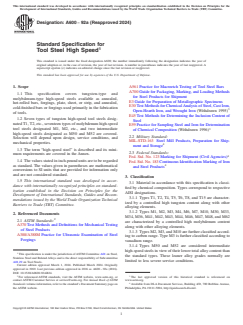
1.1 This specification covers tungsten-type and molybdenum-type high-speed steels available as annealed, hot-rolled bars, forgings, plate, sheet, or strip, and annealed, cold-finished bars or forgings used primarily in the fabrication of tools.
1.2 Seven types of tungsten high-speed tool steels designated T1, T2, etc., seventeen types of molybdenum high-speed tool steels designated M1, M2, etc., and two intermediate high-speed steels designated as M50 and M52 are covered. Selection will depend upon design, service conditions, and mechanical properties.
1.3 The term “high-speed steel” is described and its minimum requirements are covered in the Annex.
1.4 The values stated in inch-pound units are to be regarded as standard. The values given in parentheses are mathematical conversions to SI units that are provided for information only and are not considered standard.
1.5 This international standard was developed in accordance with internationally recognized principles on standardization established in the Decision on Principles for the Development of International Standards, Guides and Recommendations issued by the World Trade Organization Technical Barriers to Trade (TBT) Committee.
- Status
- Published
- Publication Date
- 29-Feb-2024
- Technical Committee
- A01 - Steel, Stainless Steel and Related Alloys
- Drafting Committee
- A01.29 - Tool Steels
Overview
ASTM A600-92a(2024) - Standard Specification for Tool Steel High Speed provides comprehensive requirements for the chemical composition, heat treatment, hardness, macrostructure, and surface quality of high-speed tool steels. Developed by ASTM International, this standard applies to seven tungsten-type (T1, T2, T4, T5, T6, T8, T15) and nineteen molybdenum-type (M1, M2, M3, M4, M6, M7, M10, M30, M33, M34, M36, M41, M42, M43, M44, M46, M47, M48, M62) steels, as well as two intermediate high-speed tool steels (M50, M52). The specification covers these alloys in various forms including bars, forgings, plates, sheets, and strips, supplied mainly in the annealed condition for tool manufacturing.
ASTM A600-92a(2024) is internationally recognized and conforms to the World Trade Organization principles for standardization, making it a key reference for global steel producers, tool manufacturers, and procurement professionals.
Key Topics
- High-Speed Tool Steel Types:
- Tungsten-type steels (T-series): Known for high tungsten content and cutting performance.
- Molybdenum-type steels (M-series): Utilize molybdenum as primary alloying element, offering a balance of toughness and red-hardness.
- Intermediate types (M50, M52): Lower alloy content for less demanding applications.
- Product Forms:
- Annealed, hot-rolled, or cold-finished bars
- Forgings
- Plates, sheets, and strips
- Chemical Composition:
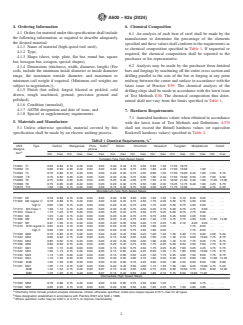
- Strict limits on carbon, manganese, phosphorus, sulfur, silicon, chromium, vanadium, tungsten, molybdenum, cobalt, and other elements for each steel grade.
- Heat Treatment:
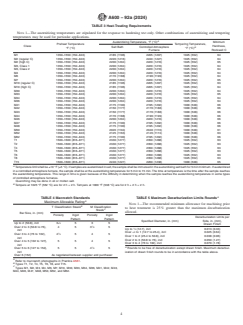
- Requirements for austenitizing, quenching, tempering, and double/triple tempering cycles, ensuring proper hardness and toughness.
- Mechanical Properties:
- Maximum Brinell and minimum Rockwell C hardness values
- Macrostructure standards for porosity, inclusions, and segregation
- Surface Quality and Tolerances:
- Specifications for decarburization, scale, surface finish, straightness, and dimensional tolerances
- Testing and Inspection:
- Methods for chemical analysis and macroetch testing
- Procedures for hardness determination and decarburization limits
Applications
ASTM A600-92a(2024) is critical for:
- Tool Manufacturing:
- Used in the production of cutting tools (drills, taps, milling cutters, saw blades) where high wear resistance, hardness, and heat resistance are essential.
- Manufacturing and Fabrication:
- Employed in blanks, dies, broaches, and various precision components demanding high stability at elevated temperatures.
- Aerospace and Automotive Industries:
- Chosen for its reliable mechanical properties in demanding machining and processing applications.
- General Engineering:
- Specified wherever tool steels are required to withstand high-speed operation, repeated impact, and heavy loads.
- Procurement and Quality Control:
- Provides assurances for specifiers and buyers regarding consistent composition, processing, and performance.
Implementing ASTM A600-92a(2024) ensures production of high-quality, high-speed tool steel products that meet stringent international requirements, supporting efficient, long-lasting, and precise machining operations.
Related Standards
Referencing and compliance may also involve the following standards:
- ASTM A370 - Test Methods and Definitions for Mechanical Testing of Steel Products
- ASTM A388/A388M - Ultrasonic Examination of Steel Forgings
- ASTM A561 - Practice for Macroetch Testing of Tool Steel Bars
- ASTM A700 - Guide for Packaging, Marking, and Loading Methods for Steel Products for Shipment
- ASTM E3 - Guide for Preparation of Metallographic Specimens
- ASTM E45 - Test Methods for Determining the Inclusion Content of Steel
- MIL-STD-163 - Preparation for Shipment and Storage (military)
- Federal Standard No. 123 & 183 - Marking and identification for shipment and steel products
For global compliance, always ensure alignment with current editions of referenced standards and local regulatory requirements.
Keywords: ASTM A600, high-speed tool steel, tungsten steel, molybdenum steel, tool steel specification, heat treatment, tool steels, hardness testing, steel macrostructure, decarburization limits, tool manufacturing standards.
Relations
- Effective Date
- 01-Mar-2024
- Effective Date
- 01-Mar-2024
- Effective Date
- 15-Sep-2023
- Effective Date
- 01-Mar-2024
- Effective Date
- 01-Mar-2024
Get Certified
Connect with accredited certification bodies for this standard

Element Materials Technology
Materials testing and product certification.

Inštitut za kovinske materiale in tehnologije
Institute of Metals and Technology. Materials testing, metallurgical analysis, NDT.
Sponsored listings
Frequently Asked Questions
ASTM A600-92a(2024) is a technical specification published by ASTM International. Its full title is "Standard Specification for Tool Steel High Speed". This standard covers: ABSTRACT This specification covers seven tungsten-type (types T1, T2, T4, T5, T6, T8, and T15) and nineteen molybdenum-type high-speed steels (types M1, M2, M3, M4, M6, M7, M10, M30, M33, M34, M36, M41, M42, M43, M44, M46, M47, M48, and M62) in the form of annealed, hot-rolled bars, forgings, plate, sheet, or strip, and annealed, cold-finished bars or forgings used primarily in the fabrication of tools. Two intermediate high speed tool steels designated as M50 and M52 are also covered. Unless otherwise specified, material shall be made by an electric melting process. A chemical analysis of each heat of steel shall be made to determine the percentage of the elements specified (including carbon, manganese, phosphorus, sulfur, silicon, chromium, vanadium, tungsten, molybdenum, and cobalt) and these values shall conform to the requirements as to the prescribed chemical composition. Requirements for: (1) heat treatment such as austenitizing, quenching, and tempering, (2) hardness testing (3) macrostructure and macroetch standard for porosity and ingot pattern, and (4) decarburization determination are detailed. The maximum Brinell hardness and minimum Rockwell C hardness for the tool steels are given. SCOPE 1.1 This specification covers tungsten-type and molybdenum-type high-speed steels available as annealed, hot-rolled bars, forgings, plate, sheet, or strip, and annealed, cold-finished bars or forgings used primarily in the fabrication of tools. 1.2 Seven types of tungsten high-speed tool steels designated T1, T2, etc., seventeen types of molybdenum high-speed tool steels designated M1, M2, etc., and two intermediate high-speed steels designated as M50 and M52 are covered. Selection will depend upon design, service conditions, and mechanical properties. 1.3 The term “high-speed steel” is described and its minimum requirements are covered in the Annex. 1.4 The values stated in inch-pound units are to be regarded as standard. The values given in parentheses are mathematical conversions to SI units that are provided for information only and are not considered standard. 1.5 This international standard was developed in accordance with internationally recognized principles on standardization established in the Decision on Principles for the Development of International Standards, Guides and Recommendations issued by the World Trade Organization Technical Barriers to Trade (TBT) Committee.
ABSTRACT This specification covers seven tungsten-type (types T1, T2, T4, T5, T6, T8, and T15) and nineteen molybdenum-type high-speed steels (types M1, M2, M3, M4, M6, M7, M10, M30, M33, M34, M36, M41, M42, M43, M44, M46, M47, M48, and M62) in the form of annealed, hot-rolled bars, forgings, plate, sheet, or strip, and annealed, cold-finished bars or forgings used primarily in the fabrication of tools. Two intermediate high speed tool steels designated as M50 and M52 are also covered. Unless otherwise specified, material shall be made by an electric melting process. A chemical analysis of each heat of steel shall be made to determine the percentage of the elements specified (including carbon, manganese, phosphorus, sulfur, silicon, chromium, vanadium, tungsten, molybdenum, and cobalt) and these values shall conform to the requirements as to the prescribed chemical composition. Requirements for: (1) heat treatment such as austenitizing, quenching, and tempering, (2) hardness testing (3) macrostructure and macroetch standard for porosity and ingot pattern, and (4) decarburization determination are detailed. The maximum Brinell hardness and minimum Rockwell C hardness for the tool steels are given. SCOPE 1.1 This specification covers tungsten-type and molybdenum-type high-speed steels available as annealed, hot-rolled bars, forgings, plate, sheet, or strip, and annealed, cold-finished bars or forgings used primarily in the fabrication of tools. 1.2 Seven types of tungsten high-speed tool steels designated T1, T2, etc., seventeen types of molybdenum high-speed tool steels designated M1, M2, etc., and two intermediate high-speed steels designated as M50 and M52 are covered. Selection will depend upon design, service conditions, and mechanical properties. 1.3 The term “high-speed steel” is described and its minimum requirements are covered in the Annex. 1.4 The values stated in inch-pound units are to be regarded as standard. The values given in parentheses are mathematical conversions to SI units that are provided for information only and are not considered standard. 1.5 This international standard was developed in accordance with internationally recognized principles on standardization established in the Decision on Principles for the Development of International Standards, Guides and Recommendations issued by the World Trade Organization Technical Barriers to Trade (TBT) Committee.
ASTM A600-92a(2024) is classified under the following ICS (International Classification for Standards) categories: 77.140.10 - Heat-treatable steels. The ICS classification helps identify the subject area and facilitates finding related standards.
ASTM A600-92a(2024) has the following relationships with other standards: It is inter standard links to ASTM A600-92a(2016), ASTM A370-24, ASTM A370-23, ASTM A681-08(2022), ASTM D3336-20b. Understanding these relationships helps ensure you are using the most current and applicable version of the standard.
ASTM A600-92a(2024) is available in PDF format for immediate download after purchase. The document can be added to your cart and obtained through the secure checkout process. Digital delivery ensures instant access to the complete standard document.
Standards Content (Sample)
This international standard was developed in accordance with internationally recognized principles on standardization established in the Decision on Principles for the
Development of International Standards, Guides and Recommendations issued by the World Trade Organization Technical Barriers to Trade (TBT) Committee.
Designation: A600 − 92a (Reapproved 2024)
Standard Specification for
Tool Steel High Speed
This standard is issued under the fixed designation A600; the number immediately following the designation indicates the year of
original adoption or, in the case of revision, the year of last revision. A number in parentheses indicates the year of last reapproval. A
superscript epsilon (´) indicates an editorial change since the last revision or reapproval.
This standard has been approved for use by agencies of the U.S. Department of Defense.
1. Scope A561 Practice for Macroetch Testing of Tool Steel Bars
A700 Guide for Packaging, Marking, and Loading Methods
1.1 This specification covers tungsten-type and
for Steel Products for Shipment
molybdenum-type high-speed steels available as annealed,
E3 Guide for Preparation of Metallographic Specimens
hot-rolled bars, forgings, plate, sheet, or strip, and annealed,
E30 Test Methods for Chemical Analysis of Steel, Cast Iron,
cold-finished bars or forgings used primarily in the fabrication
Open-Hearth Iron, and Wrought Iron (Withdrawn 1995)
of tools.
E45 Test Methods for Determining the Inclusion Content of
1.2 Seven types of tungsten high-speed tool steels desig-
Steel
nated T1, T2, etc., seventeen types of molybdenum high-speed
E59 Practice for Sampling Steel and Iron for Determination
tool steels designated M1, M2, etc., and two intermediate
of Chemical Composition (Withdrawn 1996)
high-speed steels designated as M50 and M52 are covered.
2.2 Military Standard:
Selection will depend upon design, service conditions, and
MIL-STD-163 Steel Mill Products, Preparation for Ship-
mechanical properties.
ment and Storage
1.3 The term “high-speed steel” is described and its mini-
2.3 Federal Standards:
mum requirements are covered in the Annex.
Fed. Std. No. 123 Marking for Shipment (Civil Agencies)
1.4 The values stated in inch-pound units are to be regarded
Fed. Std. No. 183 Continuous Identification Marking of Iron
as standard. The values given in parentheses are mathematical
and Steel Products
conversions to SI units that are provided for information only
and are not considered standard.
3. Classification
1.5 This international standard was developed in accor-
3.1 Material in accordance with this specification is classi-
dance with internationally recognized principles on standard-
fied by chemical composition. Types correspond to respective
ization established in the Decision on Principles for the
AISI designations.
Development of International Standards, Guides and Recom-
3.1.1 Types T1, T2, T4, T5, T6, T8, and T15 are character-
mendations issued by the World Trade Organization Technical
ized by a controlled high tungsten content along with other
Barriers to Trade (TBT) Committee.
alloying elements.
3.1.2 Types M1, M2, M3, M4, M6, M7, M10, M30, M33,
2. Referenced Documents
M34, M36, M41, M42, M43, M44, M46, M47, M48, and M62
2.1 ASTM Standards:
are characterized by a controlled high molybdenum content
A370 Test Methods and Definitions for Mechanical Testing
along with other alloying elements.
of Steel Products
3.1.3 Types M2, M3, and M10 are further classified accord-
A388/A388M Practice for Ultrasonic Examination of Steel
ing to carbon range. Type M3 is further classified according to
Forgings
vanadium range.
3.1.4 Types M50 and M52 are considered intermediate
high-speed steels in view of their lower total alloy content than
This specification is under the jurisdiction of ASTM Committee A01 on Steel,
the standard types. These leaner alloy grades normally are
Stainless Steel and Related Alloys and is the direct responsibility of Subcommittee
limited to less severe service conditions.
A01.29 on Tool Steels.
Current edition approved March 1, 2024. Published March 2024. Originally
approved in 1969. Last previous edition approved in 2016 as A600 – 92a (2016).
DOI: 10.1520/A0600-92AR24.
2 3
For referenced ASTM standards, visit the ASTM website, www.astm.org, or The last approved version of this historical standard is referenced on
contact ASTM Customer Service at service@astm.org. For Annual Book of ASTM www.astm.org.
Standards volume information, refer to the standard’s Document Summary page on Available from DLA Document Services, Building 4/D, 700 Robbins Avenue,
the ASTM website. Philadelphia, PA 19111-5094, http://quicksearch.dla.mil.
Copyright © ASTM International, 100 Barr Harbor Drive, PO Box C700, West Conshohocken, PA 19428-2959. United States
A600 − 92a (2024)
4. Ordering Information 6. Chemical Composition
4.1 Orders for material under this specification shall include
6.1 An analysis of each heat of steel shall be made by the
the following information, as required to describe adequately
manufacturer to determine the percentage of the elements
the desired material:
specified and these values shall conform to the requirements as
4.1.1 Name of material (high-speed tool steel),
to chemical composition specified in Table 1. If requested or
4.1.2 Type,
required, the chemical composition shall be reported to the
4.1.3 Shape (sheet, strip, plate, flat bar, round bar, square
purchaser or his representative.
bar, hexagon bar, octagon, special shapes),
6.2 Analysis may be made by the purchaser from finished
4.1.4 Dimensions (thickness, width, diameter, length) (For
bars and forgings by machining off the entire cross section and
coils, include the minimum inside diameter or inside diameter
range, the maximum outside diameter, and maximum or drilling parallel to the axis of the bar or forging at any point
minimum coil weight if required. (Minimum coil weights are midway between the center and surface in accordance with the
subject to negotiation.)),
latest issue of Practice E59. The chemical analysis of the
4.1.5 Finish (hot rolled, forged, blasted or pickled, cold
drilling chips shall be made in accordance with the latest issue
drawn, rough machined, ground, precision ground and
of Test Methods E30. The chemical composition thus deter-
polished),
mined shall not vary from the limits specified in Table 1.
4.1.6 Condition (annealed),
4.1.7 ASTM designation and date of issue, and
7. Hardness Requirements
4.1.8 Special or supplementary requirements.
7.1 Annealed hardness values when obtained in accordance
5. Materials and Manufacture
with the latest issue of Test Methods and Definitions A370
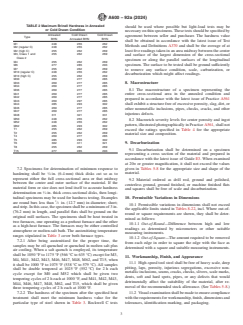
5.1 Unless otherwise specified, material covered by this shall not exceed the Brinell hardness values (or equivalent
specification shall be made by an electric melting process. Rockwell hardness values) specified in Table 2.
A
TABLE 1 Chemical Requirements, %
C
UNS Type Carbon Manganese Phos- Sulfur Silicon Chromium Vanadium Tungsten Molybdenum Cobalt
Designa- phorus
B
tion
min max min max max max min max min max min max min max min max min max
Tungsten-Type High-Speed Steels
T12001 T1 0.65 0.80 0.10 0.40 0.03 0.03 0.20 0.40 3.75 4.50 0.90 1.30 17.25 18.75 . . . . . . . . . . . .
T12002 T2 0.80 0.90 0.20 0.40 0.03 0.03 0.20 0.40 3.75 4.50 1.80 2.40 17.50 19.00 . . . 1.00 . . . . . .
T12004 T4 0.70 0.80 0.10 0.40 0.03 0.03 0.20 0.40 3.75 4.50 0.80 1.20 17.50 19.00 0.40 1.00 4.25 5.75
T12005 T5 0.75 0.85 0.20 0.40 0.03 0.03 0.20 0.40 3.75 5.00 1.80 2.40 17.50 19.00 0.50 1.25 7.00 9.50
T12006 T6 0.75 0.85 0.20 0.40 0.03 0.03 0.20 0.40 4.00 4.75 1.50 2.10 18.50 21.00 0.40 1.00 11.00 13.00
T12008 T8 0.75 0.85 0.20 0.40 0.03 0.03 0.20 0.40 3.75 4.50 1.80 2.40 13.25 14.75 0.40 1.00 4.25 5.75
T12015 T15 1.50 1.60 0.15 0.40 0.03 0.03 0.15 0.40 3.75 5.00 4.50 5.25 11.75 13.00 . . . 1.00 4.75 5.25
Molybdenum-Type High-Speed Steels
T11301 M1 0.78 0.88 0.15 0.40 0.03 0.03 0.20 0.50 3.50 4.00 1.00 1.35 1.40 2.10 8.20 9.20 . . . . . .
T11302 M2 regular C 0.78 0.88 0.15 0.40 0.03 0.03 0.20 0.45 3.75 4.50 1.75 2.20 5.50 6.75 4.50 5.50 . . . . . .
high C 0.95 1.05 0.15 0.40 0.03 0.03 0.20 0.45 3.75 4.50 1.75 2.20 5.50 6.75 4.50 5.50 . . . . . .
T11313 M3 Class 1 1.00 1.10 0.15 0.40 0.03 0.03 0.20 0.45 3.75 4.50 2.25 2.75 5.00 6.75 4.75 6.50 . . . . . .
T11323 Class 2 1.15 1.25 0.15 0.40 0.03 0.03 0.20 0.45 3.75 4.50 2.75 3.25 5.00 6.75 4.75 6.50 . . . . . .
T11304 M4 1.25 1.40 0.15 0.40 0.03 0.03 0.20 0.45 3.75 4.75 3.75 4.50 5.25 6.50 4.25 5.50 . . . . . .
T11306 M6 0.75 0.85 0.15 0.40 0.03 0.03 0.20 0.45 3.75 4.50 1.30 1.70 3.75 4.75 4.50 5.50 11.00 13.00
T11307 M7 0.97 1.05 0.15 0.40 0.03 0.03 0.20 0.55 3.50 4.00 1.75 2.25 1.40 2.10 8.20 9.20 . . . . . .
T11310 M10 regular C 0.84 0.94 0.10 0.40 0.03 0.03 0.20 0.45 3.75 4.50 1.80 2.20 . . . . . . 7.75 8.50 . . . . . .
high C 0.95 1.05 0.10 0.40 0.03 0.03 0.20 0.45 3.75 4.50 1.80 2.20 . . . . . . 7.75 8.50 . . . . . .
T11330 M30 0.75 0.85 0.15 0.40 0.03 0.03 0.20 0.45 3.50 4.25 1.00 1.40 1.30 2.30 7.75 9.00 4.50 5.50
T11333 M33 0.85 0.92 0.15 0.40 0.03 0.03 0.15 0.50 3.50 4.00 1.00 1.35 1.30 2.10 9.00 10.00 7.75 8.75
T11334 M34 0.85 0.92 0.15 0.40 0.03 0.03 0.20 0.45 3.50 4.00 1.90 2.30 1.40 2.10 7.75 9.20 7.75 8.75
T11336 M36 0.80 0.90 0.15 0.40 0.03 0.03 0.20 0.45 3.75 4.50 1.75 2.25 5.50 6.50 4.50 5.50 7.75 8.75
T11341 M41 1.05 1.15 0.20 0.60 0.03 0.03 0.15 0.50 3.75 4.50 1.75 2.25 6.25 7.00 3.25 4.25 4.75 5.75
T11342 M42 1.05 1.15 0.15 0.40 0.03 0.03 0.15 0.65 3.50 4.25 0.95 1.35 1.15 1.85 9.00 10.00 7.75 8.75
T11343 M43 1.15 1.25 0.20 0.40 0.03 0.03 0.15 0.65 3.50 4.25 1.50 1.75 2.25 3.00 7.50 8.50 7.75 8.75
T11344 M44 1.10 1.20 0.20 0.40 0.03 0.03 0.30 0.55 4.00 4.75 1.85 2.20 5.00 5.75 6.00 7.00 11.00 12.25
T11346 M46 1.22 1.30 0.20 0.40 0.03 0.03 0.40 0.65 3.70 4.20 3.00 3.30 1.90 2.20 8.00 8.50 7.80 8.80
T11347 M47 1.05 1.15 0.15 0.40 0.03 0.03 0.20 0.45 3.50 4.00 1.15 1.35 1.30 1.80 9.25 10.00 4.75 5.25
. . . M48 1.42 1.52 0.15 0.40 0.03 0.07 0.15 0.40 3.50 4.00 2.75 3.25 9.50 10.50 4.75 5.50 8.00 10.00
. . . M62 1.25 1.35 0.15 0.40 0.03 0.07 0.15 0.40 3.50 4.00 1.80 2.10 5.75 6.50 10.00 11.00 . . . . . .
Intermediate High Speed Steels
T11350 M50 0.78 0.88 0.15 0.45 0.03 0.03 0.20 0.60 3.75 4.50 0.80 1.25 . . . . . . 3.90 4.75 . . . . . .
T11352 M52 0.85 0.95 0.15 0.45 0.03 0.03 0.20 0.60 3.50 4.30 1.65 2.25 0.75 1.50 4.00 4.90 . . . . . .
A
Chemistry limits include product analysis tolerances. Unless otherwise specified, nickel plus copper equals 0.75 % max for all types.
B
New designation established in accordance with Practice E527 and SAE J 1086.
C
Where specified, sulfur may be 0.06 % to 0.15 % to improve machinability.
A600 − 92a (2024)
TABLE 2 Maximum Brinell Hardness in Annealed
should be used where possible but light-load tests may be
or Cold Drawn Condition
necessary on thin specimens. These tests should be specified by
Annealed Cold Drawn Cold Drawn
agreement between seller and purchaser. The hardness value
Type
BHN Annealed BHN BHN
shall be obtained in accordance with the latest issue of Test
M1 248 255 262
Methods and Definitions A370 and shall be the average of at
M2 (regular C) 248 255 262
M2 (high C) 255 262 269 least five readings taken in an area midway between the center
M3, Class 1 and 255 262 269
and surface of the largest dimension of the cross-sectional
Class 2
specimen or along the parallel surfaces of the longitudinal
M4 255 262 269
specimen. The surface to be tested shall be ground sufficiently
M6 277 285 293
M7 255 262 269
to remove any surface condition, scale, carburization, or
M10 (regular C) 248 255 262
decarburization which might affect readings.
M10 (high C) 255 262 269
M30 269 277 285
M33 269 277 285
8. Macrostructure
M34 269 277 285
8.1 The macrostructure of a specimen representing the
M36 269 277 285
M41 269 277 285
entire cross-sectional area in the annealed condition and
M42 269 277 285
prepared in accordance with the latest issue of Practice A561
M43 269 297 285
shall exhibit a structure free of excessive porosity, slag, dirt, or
M44 285 293 302
M46 269 277 285
other nonmetallic inclusions, pipes, checks, cracks, and other
M47 269 277 285
injurious defects.
M48 311 321 331
M50 248 255 262
8.2 Macroetch severity levels for center porosity and ingot
M52 248 255 262
pattern, illustrated photographically in Practice A561, shall not
M62 285 293 302
T1 255 262 269
exceed the ratings specified in Table 4 for the appropriate
T2 255 262 269
material size and composition.
T4 269 277 285
T5 285 293 302
9. Decarburization
T6 302 311 321
T8 255 262 269
9.1 Decarburization shall be determined on a specimen
T15 277 285 293
representing a cross section of the material and prepared in
accordance with the latest issue of Guide E3. When examined
at 20× or greater magnification, it shall not exceed the values
given in Tables 5-8 for the appropriate size and shape of the
7.2 Specimens for determination of minimum response to
material.
hardening shall be ⁄4 in. (6.4 mm) thick disks cut so as to
represent either the full cross-sectional area or that midway
9.2 Material ordered as drill rod, ground and polished,
between the center and outer surface of the material. If the
centerless ground, ground finished, or machine finished flats
material form or size does not lend itself to accurate hardness
and squares shall be free of scale and decarburization.
determination on ⁄4 in. thick cross-sectional disks, then longi-
tudinal specimens may be used for hardness testing. Examples
10. Permissible Variations in Dimensions
are round bars less than ⁄2 in. (12.7 mm) in diameter; sheet;
10.1 Permissible variations in dimensions shall not exceed
and strip. In this case, the specimen shall be a minimum of 3 in.
the applicable limits stated in Tables 8-22, incl. Where out-of-
(76.2 mm) in length, and parallel flats shall be ground on the
round or square requirements are shown, they shall be deter-
original mill surfaces. The specimens shall be heat treated in
mined as follows:
two furnaces, one operating as a preheat furnace and the other
10.1.1 Out-of-Round—Difference between high and low
as a high-heat furnace. The furnaces may be either controlled
readings as determined by micrometers or other suitable
atmosphere or molten-salt bath. The austenitizing temperature
measuring instruments.
ranges stipulated in Table 3 cover both furnace types.
10.1.2 Out-of-Square—The amount required to be removed
7.2.1 After being austenitized for the proper time, the
from each edge in order to square the edge with the face as
samples may be oil quenched or quenched in molten salt plus
determined with a square and suitable measuring instruments.
air cooling. When a salt quench is employed, its temperature
shall be 1050 °F to 1175 °F (566 °C to 635 °C) except for M3,
11. Workmanship, Finish, and Appearance
M4, M41, M42, M43, M46, M47, M48, M62, and T15, when
11.1 High-speed tool steel shall be free of heavy scale, deep
it shall be 1000 °F to 1075 °F (538 °C to 579 °C). All samples
pitting, laps, porosity, injurious segregations, excessive non-
shall be double tempered at 1025 °F (552 °C) for 2 h each
metallic inclusions, seams, cracks, checks, slivers, scale marks,
cycle except for M0 and M52 which shall be given two
dents, soft and hard spots, pipes, or any defects that would
tempering cycles of 2 h each at 1000 °F, and M41, M42, M43,
detrimentally affect the suitability of the material, after re-
M44, M46, M47, M48, M62, and T15, which shall be given
moval of the recommended stock allowance. (See Tables 5-8.)
three tempering cycles of 2 h each at 1000 °F.
7.2.2 The hardness of the specimen after the specified heat 11.2 Visual examination shall be made to ensure compliance
treatment shall meet the minimum hardness value for the with the requirements for workmanship, finish, dimensions and
particular type of steel shown in Table 3. Rockwell C tests tolerances, identification marking, and packaging.
A600 − 92a (2024)
TABLE 3 Heat-Treating Requirements
NOTE 1—The austenitizing temperatures are stipulated for the response to hardening test only. Other combinations of austenitizing and tempering
temperatures may be used for particular applications.
A
Austenitizing Temperature, °F (°C)
Minimum
Preheat Temperature Tempering Temperature,
Class Hardness,
Salt Bath Controlled Atmosphere B
°F (°C) °F (°C)
Rockwell C
Furnace
M1 1350–1550 (732–843) 2185 (1196) 2205 (1207) 1025 (552) 64
M2 (regular C) 1350–1550 (732–843) 2220 (1216) 2240 (1227) 1025 (552) 64
M2 (high C) 1350–1550 (732–843) 2200 (1204) 2220 (1216) 1025 (552) 65
M3, Class 1 1350–1550 (732–843) 2200 (1204) 2220 (1216) 1025 (552) 64
M3, Class 2 1350–1550 (732–843) 2200 (1204) 2220 (1216) 1025 (552) 64
M4 1350–1550 (732–843) 2200 (1204) 2220 (1216) 1025 (552) 64
M6 1350–1550 (732–843) 2170 (1188) 2190 (1199) 1025 (552) 64
M7 1350–1550 (732–843) 2200 (1204) 2220 (1216) 1025 (552) 65
M10 (regular C) 1350–1550 (732–843) 2185 (1196) 2205 (1207) 1025 (552) 63
M10 (high C) 1350–1550 (732–843) 2185 (1196) 2205 (1207) 1025 (552) 64
M30 1350–1550 (732–843) 2200 (1204) 2220 (1216) 1025 (552) 64
M33 1350–1550 (732–843) 2200 (1204) 2220 (1216) 1025 (552) 65
M34 1350–1550 (732–843) 2200 (1204) 2220 (1216) 1025 (552) 64
M36 1350–1550 (732–843) 2200 (1204) 2220 (1216) 1025 (552) 64
M41 1350–1550 (732–843) 2175 (1190) 2195 (1202) 1000 (538) 66
M42 1350–1550 (732–843) 2150 (1177) 2170 (1188) 1000 (538) 66
M43 1350–1550 (732–843) 2150 (1177) 2170 (1188) 1000 (538) 66
M44 1350–1550 (732–843) 2170 (1188) 2190 (1199) 1000 (538) 66
M46 1350–1550 (732–843) 2200 (1204) 2220 (1216) 1000 (538) 66
M47 1350–1550 (732–843) 2175 (1190) 2195 (1202) 1000 (538) 66
M48 1350–1550 (732–843) 2175 (1190) 2195 (1202) 1000 (538) 66
M50 1350–1550 (732–843) 2020 (1104) 2040 (1116) 1000 (538) 61
M52 1350–1550 (732–843) 2125 (1163) 2145 (1174) 1000 (538) 63
M62 1350–1550 (732–843) 2175 (1190) 2195 (1202) 1000 (538) 66
T1 1500–1600 (816–871) 2330 (1277) 2350 (1288) 1025 (552) 63
T2 1500–1600 (816–871) 2330 (1277) 2350 (1288) 1025 (552) 63
T4 1500–1600 (816–871) 2330 (1277) 2350 (1288) 1025 (552) 63
T5 1500–1600 (816–871) 2330 (1277) 2350 (1288) 1025 (552) 63
T6 1500–1600 (816–871) 2330 (1277) 2350 (1288) 1025 (552) 63
T8 1500–1600 (816–871) 2330 (1277) 2350 (1288) 1025 (552) 63
T15 1500–1600 (816–871) 2240 (1227) 2260 (1238) 1000 (538) 65
A
Temperature limit shall be ±10 °F (±5 °C). If samples are austenitized in salt, the sample shall be immersed in the austenitizing salt bath for 5 min minimum. If austenitized
in a controlled atmosphere furnace, the sample shall be at the austenitizing temperature for 5 min to 15 min. The time at temperature is the time after the sample reaches
the austenitizing temperature. This range in time is given because of the difficulty in determining when the sample reaches the austenitizing temperature in some types
of controlled atmosphere furnaces.
Quenching may be done in oil or molten salt.
B
Tempers at 1025 °F (552 °C) are for 2 h + 2 h. Tempers at 1000 °F (538 °C) are for 2 h + 2 h + 2 h.
A
TABLE 4 Macroetch Standards TABLE 5 Maximum Decarburization Limits Rounds
A
Maximum Allowable Rating
NOTE 1—The recommended minimum allowance for machining prior
B
T Classification Steels M Classification
to heat treatment is 25 % greater than the maximum decarburization
C
Steels
allowed.
Bar Size, in. (mm)
Porosity Ingot Porosity Ingot
Decarburization Limits per
Pattern Pattern
Specified Diameter, in. (mm) Side, in. (mm),
Up to 2 (50.8), incl 3 ⁄2 5 3 5
Drawn Finish
Over 2 to 3 (50.8 to 76), 4 5 3 ⁄2 5
Up to ⁄2 (12.7), incl 0.013 (0.33)
incl
Over ⁄2 to 1 (12.7 to 25.4), incl 0.025 (0.64)
Over 3 to 4 (76 to 102), 4 ⁄2 5 4 5
Over 1 to 2 (25.4 to 50.8), incl 0.038 (0.96)
incl
Over 2 to 3 (50.8 to 76), incl 0.050 (1.27)
Over 4 to 5 (102 to 127), 5 5 4 5
Over 3 to 4 (76 to 102), incl 0.070 (1.78)
incl
1 A
Over 5 to 6 (127 to 152), 5 5 4 ⁄2 5 Rounds to be free of decarburization except drawn finish. Maximum decarbur-
incl
ization of drawn finish rounds to be in accordance with the table above.
Over 6 (152) As negotiated between supplier and purchaser
A
Refer to macroetch photographs in Practice A561.
B
Types T1, T2, T4, T5, T6, T8, and T15.
C
Types M1, M2, M3, M4, M6, M7, M10, M30, M33, M34, M36, M41, M42, M43,
M44, M46, M47, M48, M50, M52, and M62.
A600 − 92a (2024)
TABLE 6 Maximum Decarburization Limits
Hot Rolled Square and Flat Bars
Maximum Limit Per Side
NOTE 1—The recommended minimum allowance for machining prior to heat treatment is 25 % greater than the maximum decarburization allowed.
Specified Widths, in. (mm)
1 1
Specified Thickness, 0 to ⁄2 Over ⁄2 to 1 Over 1 to 2 Over 2 to 3 Over 3 to 4 Over 4 to 5 Over 5 to 6 Over 6 to 7 Over 7 to 8 Over 8 to 9 Over 9 to 12
in. (mm) (0 to 12.7) (12.7 to 25.4), (25.4 to 50.8), (50.8 to 76), (76 to 102), (102 to 127), (127 to 152), (152 to 178), (178 to 203), (203 to 229), (229 to 304),
incl. incl incl incl incl incl incl incl incl incl incl
0 to ⁄2 (0 to 12.7), A 0.020 (0.51) 0.020 (0.51) 0.024 (0.61) 0.028 (0.71) 0.032 (0.81) 0.036 (0.91) 0.040 (1.02) 0.044 (1.12) 0.048 (1.22) 0.048 (1.22) 0.048 (1.22)
incl B 0.020 (0.51) 0.026 (0.66) 0.032 (0.81) 0.038 (0.97) 0.044 (1.12) 0.054 (1.37) 0.062 (1.57) 0.066 (1.68) 0.078 (1.98) 0.082 (2.08) 0.096 (2.44)
Over ⁄2 to 1 (12.7 to A . 0.036 (0.91) 0.036 (0.91) 0.036 (0.91) 0.040 (1.02) 0.044 (1.12) 0.052 (1.32) 0.056 (1.42) 0.060 (1.52) 0.060 (1.52) 0.060 (1.52)
25.4), incl B . 0.036 (0.91) 0.042 (1.07) 0.046 (1.17) 0.056 (1.42) 0.064 (1.63) 0.082 (2.08) 0.090 (2.29) 0.098 (2.49) 0.102 (2.59) 0.108 (2.74)
Over 1 to 2 (25.4 A . . 0.052 (1.32) 0.052 (1.32) 0.056 (1.42) 0.056 (1.42) 0.060 (1.52) 0.060 (1.52) 0.064 (1.63) 0.068 (1.73) 0.072 (1.83)
to 50.8), incl B . . 0.052 (1.32) 0.056 (1.42) 0.060 (1.52) 0.072 (1.83) 0.086 (2.18) 0.098 (2.49) 0.112 (2.84) 0.118 (3.00) 0.122 (3.10)
Over 2 to 3 (50.8 A . . . 0.064 (1.63) 0.064 (1.63) 0.068 (1.73) 0.068 (1.73) 0.072 (1.83) 0.072 (1.83) 0.080 (2.03) 0.080 (2.03)
to 76), incl B . . . 0.064 (1.63) 0.072 (1.83) 0.082 (2.08) 0.094 (2.39) 0.110 (2.79) 0.122 (3.10) 0.130 (3.30) 0.136 (3.45)
Over 3 to 4 (76 to A . . . . 0.080 (2.03) 0.080 (2.03) 0.086 (2.18) 0.092 (2.34) 0.094 (2.39) 0.100 (2.54) 0.100 (2.54)
to 102), incl B . . . . 0.080 (2.03) 0.090 (2.29) 0.100 (2.54) 0.120 (3.05) 0.132 (3.35) 0.132 (3.35) 0.150 (3.81)
A600 − 92a (2024)
TABLE 7 Maximum Decarburization Limits
Forged Square and Flat Bars
Maximum Limit Per Side
NOTE 1—The recommended minimum allowance for machining prior to heat treatment is 25 % greater than the maximum decarburization allowed.
Specified Width, Inches (mm)
...