

ASTM A649/A649M-10(2020)
(Specification)Standard Specification for Forged Steel Rolls Used for Corrugating Paper Machinery
General Information
- Abstract
ABSTRACT
This specification deals with the standard requirements for premium quality alloy steel semifinished rolled or forged blooms and billets for reforging into aircraft and aerospace critical parts such as landing-gear forgings. Covered here are three basic classifications of steel, namely: Class I, steel manufactured by vacuum-induction melting or consumable-electrode vacuum melting process; Class II, air-melted steel manufactured by electric-furnace vacuum degassing process; Class III, air-melted steel manufactured by electric-furnace ladle refining and vacuum degassing processes. Steel materials shall be heat-treated and hot-worked by either hot rolling or forging. Alloy steels shall be examined by heat and product analyses and hardenability tests, and shall conform to chemical composition and maximum annealed Brinell hardness requirements. Quality evaluation tests, such as macrotech, microcleanliness, and nondestructive ultrasonic (both immersion and contact examination) inspection, shall be performed as well.
SCOPE
1.1 This specification2 covers two kinds of rolls used in machinery for producing corrugated paperboard. Rolls are fabricated of forged bodies and trunnions. The trunnions may be bolted or shrink assembled on one or both ends of the body. A seal weld may be made at the body/trunnion interface. Roll shells are made of carbon/manganese, or low alloy steel as hereinafter described, and are heat treated prior to assembly. Pressure rolls may be ordered surface hardened as Condition H, or without surface hardening as Condition S. Provision is made in Supplementary Requirements S1 and S3 for the optional surface hardening of corrugating rolls.
1.2 Corrugating and pressure rolls made to this specification shall not exceed 30 in. [760 mm] in inside diameter. The wall thickness of the roll body shall not be less than 1/12 of the inside diameter or 1 in. [25 mm], whichever is greater, but shall not exceed 4 in. [100 mm]. The wall thickness of the corrugating roll is measured at the bottom of the corrugations in the location of the trunnion fit. The maximum design temperature (MDT) of the roll is 600 °F [315 °C] and the maximum allowable working pressure (MAWP) is 250 psi [1.7 MPa]. The minimum design temperature shall be 40 °F [4 °C] for roll wall thicknesses up to 3 in. [75 mm]. For roll wall thicknesses over 3 in. [75 mm] to 4 in. [100 mm], the minimum design temperature shall be 120 °F [50 °C]. The maximum stresses on the roll bodies from the combined internal and external loading are limited to 18 750 psi [129 MPa] for the Class 2 pressure roll bodies, and 20 000 psi [138 MPa] for Class 1A, 1B, or 5 pressure or corrugating roll bodies in Grades 1 or 2. For the trunnions, the maximum stresses from the combined internal and external loading are limited to 15 000 psi [103.4 MPa] for Classes 3 or 4, or 20 000 psi [138 MPa] for Classes 1A, 1B, or 5 in Grade 2 only. The Grade 1 strength level is not permissible for trunnions.
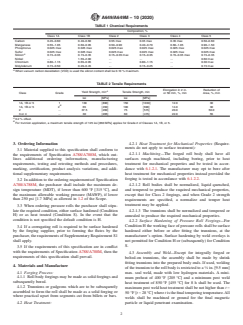
1.3 Referring to Table 1, material to Classes 1A, 1B, or 5 shall be used for the manufacture of corrugating or pressure roll shells, and Class 2 shall be used only for pressure roll shells. Trunnions shall be made from forgings in Classes 1A, 1B, or 5 in Grade 2 strength level as restricted by Footnote B in Table 2 or in forgings in either Class 3 or 4.
1.4 The values stated in either SI units or inch-pound units are to be regarded separately as standard. The values stated in each system are not necessarily exact equivalents; therefore, to ensure conformance with the standard, each system shall be used independently of the other, and values from the two systems shall not be combined.
1.5 Unless the order specifies the applicable “M” specification designation, the material shall be furnished to the inch-pound units.
1.6 Except as specifically required in this standard, all of the provisions of Specification A788/A788M apply.
1.7 This international standard was de...
- Status
- Published
- Publication Date
- 29-Feb-2020
- Technical Committee
- A01 - Steel, Stainless Steel and Related Alloys
- Drafting Committee
- A01.06 - Steel Forgings and Billets

Overview
ASTM A649/A649M-10(2020) is the standard specification developed by ASTM International for forged steel rolls used in corrugating paper machinery. This document details the requirements for two types of rolls-corrugating and pressure rolls-essential for the efficient production of corrugated paperboard. These components are designed with forged bodies and trunnions, ensuring robust performance under specific temperature and pressure conditions. By adhering to this standard, manufacturers and users can ensure product reliability, safety, and consistent quality within the paper machinery industry.
Key Topics
- Roll Construction: The standard specifies that both corrugating and pressure rolls must be fabricated from forged carbon/manganese or low alloy steel. Roll bodies are heat treated before assembly, and trunnions can be either bolted or shrink-fitted at the ends.
- Dimensional Requirements: The maximum inside diameter of the rolls is 30 inches (760 mm). Roll body wall thickness ranges from a minimum of 1/12 the inside diameter or 1 inch (25 mm), to a maximum of 4 inches (100 mm).
- Temperature and Pressure Limits: The rolls are designed for a maximum design temperature of 600 °F (315 °C) and a maximum allowable working pressure of 250 psi (1.7 MPa).
- Mechanical Properties: The rolls and trunnions must meet specific tensile strength, yield strength, hardness, and elongation requirements, defined according to steel class and grade.
- Surface Hardening Options: Pressure rolls may be ordered as surface-hardened (Condition H) or without surface hardening (Condition S). Supplementary requirements also allow additional hardening options for corrugating rolls, including laser hardening of flute tips.
- Quality and Inspection: The standard enforces thorough non-destructive testing such as magnetic particle inspection and liquid penetrant examination. Mechanical and chemical properties are verified through standardized tests.
Applications
ASTM A649/A649M-10(2020) applies to the manufacturing and use of forged steel rolls critical for corrugated paperboard production. Practical uses and benefits include:
- Paper Machinery Industry: Ensures the production of high-quality corrugated rolls with predictable mechanical performance for use in high-speed and high-pressure environments.
- Customization and Safety: Allows users to specify roll dimensions, mechanical properties, and surface conditions tailored to application-specific requirements (e.g., high-temperature or high-pressure operations).
- Durability and Performance: By adhering to this standard, manufacturers can guarantee roll longevity, minimize downtime, and avoid premature failures due to improper material selection or inadequate heat treatment.
- International Trade and Compliance: Following ASTM A649/A649M streamlines procurement and quality assurance processes, facilitating global trade and regulatory acceptance.
Related Standards
ASTM A649/A649M-10(2020) is closely related to a number of other industry standards, including:
- ASTM A788/A788M: Provides general requirements for steel forgings, covering ordering, manufacturing, and testing procedures.
- ASTM A275/A275M: Standard practice for magnetic particle examination of steel forgings.
- ASTM A370: Test methods and definitions for mechanical testing of steel products.
- ASME Boiler and Pressure Vessel Code, Section II: For similar applications requiring compliance with ASME codes.
- ASTM E165/E165M: Practice for liquid penetrant testing for general industry applications.
Conclusion
Implementing ASTM A649/A649M-10(2020) ensures forged steel rolls in corrugating paper machinery deliver optimal safety, structural integrity, and performance. By specifying rigorous dimensional, metallurgical, and mechanical requirements, this standard plays an essential role in supporting the global paper manufacturing industry's needs for reliable, durable, and standardized components. For best results, organizations should always reference this and related standards when sourcing, manufacturing, or auditing forged steel rolls for corrugating applications.
Relations
- Effective Date
- 01-Mar-2020
- Effective Date
- 01-Mar-2024
- Effective Date
- 01-Nov-2023
- Effective Date
- 01-Jul-2019
- Effective Date
- 01-May-2019
- Effective Date
- 01-Nov-2018
- Effective Date
- 01-Sep-2018
- Effective Date
- 01-Mar-2018
- Refers
ASTM A370-17a - Standard Test Methods and Definitions for Mechanical Testing of Steel Products - Effective Date
- 15-Nov-2017
- Effective Date
- 01-Nov-2017
- Effective Date
- 01-May-2017
- Effective Date
- 01-Jan-2017
- Effective Date
- 01-Dec-2016
- Effective Date
- 01-Nov-2015
- Effective Date
- 01-May-2015
Get Certified
Connect with accredited certification bodies for this standard

Element Materials Technology
Materials testing and product certification.

Inštitut za kovinske materiale in tehnologije
Institute of Metals and Technology. Materials testing, metallurgical analysis, NDT.
Sponsored listings
Frequently Asked Questions
ASTM A649/A649M-10(2020) is a technical specification published by ASTM International. Its full title is "Standard Specification for Forged Steel Rolls Used for Corrugating Paper Machinery". This standard covers: ABSTRACT This specification deals with the standard requirements for premium quality alloy steel semifinished rolled or forged blooms and billets for reforging into aircraft and aerospace critical parts such as landing-gear forgings. Covered here are three basic classifications of steel, namely: Class I, steel manufactured by vacuum-induction melting or consumable-electrode vacuum melting process; Class II, air-melted steel manufactured by electric-furnace vacuum degassing process; Class III, air-melted steel manufactured by electric-furnace ladle refining and vacuum degassing processes. Steel materials shall be heat-treated and hot-worked by either hot rolling or forging. Alloy steels shall be examined by heat and product analyses and hardenability tests, and shall conform to chemical composition and maximum annealed Brinell hardness requirements. Quality evaluation tests, such as macrotech, microcleanliness, and nondestructive ultrasonic (both immersion and contact examination) inspection, shall be performed as well. SCOPE 1.1 This specification2 covers two kinds of rolls used in machinery for producing corrugated paperboard. Rolls are fabricated of forged bodies and trunnions. The trunnions may be bolted or shrink assembled on one or both ends of the body. A seal weld may be made at the body/trunnion interface. Roll shells are made of carbon/manganese, or low alloy steel as hereinafter described, and are heat treated prior to assembly. Pressure rolls may be ordered surface hardened as Condition H, or without surface hardening as Condition S. Provision is made in Supplementary Requirements S1 and S3 for the optional surface hardening of corrugating rolls. 1.2 Corrugating and pressure rolls made to this specification shall not exceed 30 in. [760 mm] in inside diameter. The wall thickness of the roll body shall not be less than 1/12 of the inside diameter or 1 in. [25 mm], whichever is greater, but shall not exceed 4 in. [100 mm]. The wall thickness of the corrugating roll is measured at the bottom of the corrugations in the location of the trunnion fit. The maximum design temperature (MDT) of the roll is 600 °F [315 °C] and the maximum allowable working pressure (MAWP) is 250 psi [1.7 MPa]. The minimum design temperature shall be 40 °F [4 °C] for roll wall thicknesses up to 3 in. [75 mm]. For roll wall thicknesses over 3 in. [75 mm] to 4 in. [100 mm], the minimum design temperature shall be 120 °F [50 °C]. The maximum stresses on the roll bodies from the combined internal and external loading are limited to 18 750 psi [129 MPa] for the Class 2 pressure roll bodies, and 20 000 psi [138 MPa] for Class 1A, 1B, or 5 pressure or corrugating roll bodies in Grades 1 or 2. For the trunnions, the maximum stresses from the combined internal and external loading are limited to 15 000 psi [103.4 MPa] for Classes 3 or 4, or 20 000 psi [138 MPa] for Classes 1A, 1B, or 5 in Grade 2 only. The Grade 1 strength level is not permissible for trunnions. 1.3 Referring to Table 1, material to Classes 1A, 1B, or 5 shall be used for the manufacture of corrugating or pressure roll shells, and Class 2 shall be used only for pressure roll shells. Trunnions shall be made from forgings in Classes 1A, 1B, or 5 in Grade 2 strength level as restricted by Footnote B in Table 2 or in forgings in either Class 3 or 4. 1.4 The values stated in either SI units or inch-pound units are to be regarded separately as standard. The values stated in each system are not necessarily exact equivalents; therefore, to ensure conformance with the standard, each system shall be used independently of the other, and values from the two systems shall not be combined. 1.5 Unless the order specifies the applicable “M” specification designation, the material shall be furnished to the inch-pound units. 1.6 Except as specifically required in this standard, all of the provisions of Specification A788/A788M apply. 1.7 This international standard was de...
ABSTRACT This specification deals with the standard requirements for premium quality alloy steel semifinished rolled or forged blooms and billets for reforging into aircraft and aerospace critical parts such as landing-gear forgings. Covered here are three basic classifications of steel, namely: Class I, steel manufactured by vacuum-induction melting or consumable-electrode vacuum melting process; Class II, air-melted steel manufactured by electric-furnace vacuum degassing process; Class III, air-melted steel manufactured by electric-furnace ladle refining and vacuum degassing processes. Steel materials shall be heat-treated and hot-worked by either hot rolling or forging. Alloy steels shall be examined by heat and product analyses and hardenability tests, and shall conform to chemical composition and maximum annealed Brinell hardness requirements. Quality evaluation tests, such as macrotech, microcleanliness, and nondestructive ultrasonic (both immersion and contact examination) inspection, shall be performed as well. SCOPE 1.1 This specification2 covers two kinds of rolls used in machinery for producing corrugated paperboard. Rolls are fabricated of forged bodies and trunnions. The trunnions may be bolted or shrink assembled on one or both ends of the body. A seal weld may be made at the body/trunnion interface. Roll shells are made of carbon/manganese, or low alloy steel as hereinafter described, and are heat treated prior to assembly. Pressure rolls may be ordered surface hardened as Condition H, or without surface hardening as Condition S. Provision is made in Supplementary Requirements S1 and S3 for the optional surface hardening of corrugating rolls. 1.2 Corrugating and pressure rolls made to this specification shall not exceed 30 in. [760 mm] in inside diameter. The wall thickness of the roll body shall not be less than 1/12 of the inside diameter or 1 in. [25 mm], whichever is greater, but shall not exceed 4 in. [100 mm]. The wall thickness of the corrugating roll is measured at the bottom of the corrugations in the location of the trunnion fit. The maximum design temperature (MDT) of the roll is 600 °F [315 °C] and the maximum allowable working pressure (MAWP) is 250 psi [1.7 MPa]. The minimum design temperature shall be 40 °F [4 °C] for roll wall thicknesses up to 3 in. [75 mm]. For roll wall thicknesses over 3 in. [75 mm] to 4 in. [100 mm], the minimum design temperature shall be 120 °F [50 °C]. The maximum stresses on the roll bodies from the combined internal and external loading are limited to 18 750 psi [129 MPa] for the Class 2 pressure roll bodies, and 20 000 psi [138 MPa] for Class 1A, 1B, or 5 pressure or corrugating roll bodies in Grades 1 or 2. For the trunnions, the maximum stresses from the combined internal and external loading are limited to 15 000 psi [103.4 MPa] for Classes 3 or 4, or 20 000 psi [138 MPa] for Classes 1A, 1B, or 5 in Grade 2 only. The Grade 1 strength level is not permissible for trunnions. 1.3 Referring to Table 1, material to Classes 1A, 1B, or 5 shall be used for the manufacture of corrugating or pressure roll shells, and Class 2 shall be used only for pressure roll shells. Trunnions shall be made from forgings in Classes 1A, 1B, or 5 in Grade 2 strength level as restricted by Footnote B in Table 2 or in forgings in either Class 3 or 4. 1.4 The values stated in either SI units or inch-pound units are to be regarded separately as standard. The values stated in each system are not necessarily exact equivalents; therefore, to ensure conformance with the standard, each system shall be used independently of the other, and values from the two systems shall not be combined. 1.5 Unless the order specifies the applicable “M” specification designation, the material shall be furnished to the inch-pound units. 1.6 Except as specifically required in this standard, all of the provisions of Specification A788/A788M apply. 1.7 This international standard was de...
ASTM A649/A649M-10(2020) is classified under the following ICS (International Classification for Standards) categories: 77.140.10 - Heat-treatable steels. The ICS classification helps identify the subject area and facilitates finding related standards.
ASTM A649/A649M-10(2020) has the following relationships with other standards: It is inter standard links to ASTM A649/A649M-10(2015), ASTM A370-24, ASTM A275/A275M-23, ASTM A370-19, ASTM A788/A788M-19, ASTM A788/A788M-18b, ASTM A788/A788M-18a, ASTM A788/A788M-18, ASTM A370-17a, ASTM A788/A788M-17a, ASTM A788/A788M-17, ASTM A370-17, ASTM A788/A788M-16a, ASTM A370-15, ASTM A788/A788M-15. Understanding these relationships helps ensure you are using the most current and applicable version of the standard.
ASTM A649/A649M-10(2020) is available in PDF format for immediate download after purchase. The document can be added to your cart and obtained through the secure checkout process. Digital delivery ensures instant access to the complete standard document.
Standards Content (Sample)
This international standard was developed in accordance with internationally recognized principles on standardization established in the Decision on Principles for the
Development of International Standards, Guides and Recommendations issued by the World Trade Organization Technical Barriers to Trade (TBT) Committee.
Designation:A649/A649M −10 (Reapproved 2020)
Standard Specification for
Forged Steel Rolls Used for Corrugating Paper Machinery
This standard is issued under the fixed designationA649/A649M; the number immediately following the designation indicates the year
of original adoption or, in the case of revision, the year of last revision.Anumber in parentheses indicates the year of last reapproval.
A superscript epsilon (´) indicates an editorial change since the last revision or reapproval.
1. Scope roll shells, and Class 2 shall be used only for pressure roll
shells. Trunnions shall be made from forgings in Classes 1A,
1.1 This specification covers two kinds of rolls used in
1B, or 5 in Grade 2 strength level as restricted by Footnote B
machinery for producing corrugated paperboard. Rolls are
in Table 2 or in forgings in either Class 3 or 4.
fabricated of forged bodies and trunnions. The trunnions may
be bolted or shrink assembled on one or both ends of the body.
1.4 The values stated in either SI units or inch-pound units
A seal weld may be made at the body/trunnion interface. Roll
are to be regarded separately as standard. The values stated in
shells are made of carbon/manganese, or low alloy steel as
each system are not necessarily exact equivalents; therefore, to
hereinafter described, and are heat treated prior to assembly.
ensure conformance with the standard, each system shall be
Pressure rolls may be ordered surface hardened as Condition
used independently of the other, and values from the two
H, or without surface hardening as Condition S. Provision is
systems shall not be combined.
made in Supplementary Requirements S1 and S3 for the
1.5 Unless the order specifies the applicable “M” specifica-
optional surface hardening of corrugating rolls.
tion designation, the material shall be furnished to the inch-
1.2 Corrugatingandpressurerollsmadetothisspecification
pound units.
shall not exceed 30 in. [760 mm] in inside diameter. The wall
1.6 Exceptasspecificallyrequiredinthisstandard,allofthe
thicknessoftherollbodyshallnotbelessthan ⁄12oftheinside
provisions of Specification A788/A788M apply.
diameter or 1 in. [25 mm], whichever is greater, but shall not
1.7 This international standard was developed in accor-
exceed 4 in. [100 mm]. The wall thickness of the corrugating
dance with internationally recognized principles on standard-
roll is measured at the bottom of the corrugations in the
ization established in the Decision on Principles for the
location of the trunnion fit. The maximum design temperature
Development of International Standards, Guides and Recom-
(MDT) of the roll is 600°F [315°C] and the maximum
mendations issued by the World Trade Organization Technical
allowableworkingpressure(MAWP)is250psi[1.7MPa].The
Barriers to Trade (TBT) Committee.
minimumdesigntemperatureshallbe40°F[4°C]forrollwall
thicknesses up to 3 in. [75 mm]. For roll wall thicknesses over
2. Referenced Documents
3 in. [75 mm] to 4 in. [100 mm], the minimum design
temperatureshallbe120°F[50°C].Themaximumstresseson
2.1 ASTM Standards:
therollbodiesfromthecombinedinternalandexternalloading
A275/A275MPracticeforMagneticParticleExaminationof
are limited to 18 750 psi [129 MPa] for the Class 2 pressure
Steel Forgings
roll bodies, and 20 000 psi [138 MPa] for Class 1A, 1B, or 5
A370Test Methods and Definitions for Mechanical Testing
pressure or corrugating roll bodies in Grades 1 or 2. For the
of Steel Products
trunnions, the maximum stresses from the combined internal
A788/A788MSpecification for Steel Forgings, General Re-
andexternalloadingarelimitedto15 000psi[103.4MPa]for
quirements
Classes3or4,or20 000psi[138MPa]forClasses1A,1B,or
E165/E165MPractice for Liquid Penetrant Testing for Gen-
5inGrade2only.TheGrade1strengthlevelisnotpermissible
eral Industry
for trunnions.
2.2 ASME Code:
1.3 Referring to Table 1, material to Classes 1A, 1B, or 5
ASMEBoiler and Pressure Vessel Code
shall be used for the manufacture of corrugating or pressure
This specification is under the jurisdiction ofASTM Committee A01 on Steel,
Stainless Steel and RelatedAlloys and is the direct responsibility of Subcommittee For referenced ASTM standards, visit the ASTM website, www.astm.org, or
A01.06 on Steel Forgings and Billets. contact ASTM Customer Service at service@astm.org. For Annual Book of ASTM
Current edition approved March 1, 2020. Published March 2020. Originally Standards volume information, refer to the standard’s Document Summary page on
approved in 1971. Last previous edition approved in 2015 as A649/A649M–10 the ASTM website.
(2015). DOI: 10.1520/A0649_A0649M–10R20. Available from American Society of Mechanical Engineers (ASME), ASME
For ASME Boiler and Pressure Vessel Code applications, see related Specifi- International Headquarters, Two Park Ave., New York, NY 10016-5990, http://
cation SA-649/SA-649M in Section II of that Code. www.asme.org.
Copyright © ASTM International, 100 Barr Harbor Drive, PO Box C700, West Conshohocken, PA 19428-2959. United States
A649/A649M−10 (2020)
TABLE 1 Chemical Requirements
Composition, %
Class 1A Class 1B Class 2 Class 3 Class 4 Class 5
Carbon 0.45–0.60 0.40–0.60 0.55 max 0.35 max 0.35 max 0.50–0.60
Manganese 0.55–1.05 0.60–0.95 0.50–0.90 0.40–0.70 0.60–1.05 0.90–1.50
Phosphorus 0.025 max 0.025 max 0.025 max 0.025 max 0.025 max 0.025 max
Sulfur 0.025 max 0.025 max 0.025 max 0.025 max 0.025 max 0.025 max
A
Silicon 0.15–0.35 0.15–0.35 0.15–0.35 max 0.15–0.35 0.15–0.35 max 0.15–0.35
Nickel . 1.55–2.00 . . . 0.60 max
Chromium 0.80–1.15 0.65–0.95 . 0.80–1.15 . 0.30 max
Molybdenum 0.15–0.50 0.20–0.45 . 0.15–0.25 . 0.15 max
A
When vacuum carbon deoxidation (VCD) is used the silicon content shall be 0.10 % maximum.
TABLE 2 Tensile Requirements
Elongation in 2 in. Reduction of
A
Yield Strength, min Tensile Strength, min
Class Grade or 50 mm, %, min Area, %, min
ksi [MPa] ksi [MPa]
1A, 1B or 5 1 130 [890] 150 [1030] 12.0 30
B
1A, 1B or 5 2 65 [450] 100 [690] 14.0 30
2 . 37.5 [260] 75 [515] 20.0 50.0
3 or 4 . 30 [205] 60 [415] 22.0 55
A
0.2 % offset.
B
For trunnion application, a maximum tensile strength of 125 ksi [860 MPa] applies for Grade 2 of Classes 1A, 1B, or 5.
3. Ordering Information 4.2.1 Heat Treatment for Mechanical Properties (Require-
ments do not apply to surface treatment):
3.1 Material supplied to this specification shall conform to
4.2.1.1 Machining—The forged roll body shall have all
the requirements of Specification A788/A788M, which out-
surfaces rough machined, including boring, prior to heat
lines additional ordering information, manufacturing
requirements, testing and retesting methods and procedures, treatment for mechanical properties and be tested in accor-
marking, certification, product analysis variations, and addi-
dance with 6.1.2.1. The manufacturer may opt to bore after
tional supplementary requirements.
heat treatment for mechanical properties instead provided the
forging is tested in accordance with 6.1.2.2.
3.2 In addition to the ordering requirementsof Specification
A788/A788M, the purchaser shall include the maximum de- 4.2.1.2 Roll bodies shall be normalized, liquid quenched,
sign temperature (MDT), if lower than 600°F [315°C], and
and tempered to produce the required mechanical properties,
the maximum allowable working pressure (MAWP), if lower
except that for Class 2 forgings, and when Grade 2 strength
than 250 psi [1.7 MPa] as allowed in 1.2 of the Scope.
requirements are specified, a normalize and temper heat
treatment may be applied.
3.3 When ordering pressure rolls the purchaser shall stipu-
late the required condition, either surface hardened (Condition 4.2.1.3 The trunnions shall be normalized and tempered or
H) or as heat treated (Condition S). In the event that the annealed to produce the required mechanical properties.
condition is not specified the default condition is H.
4.2.2 Surface Hardening of Pressure Roll Forgings—For
Condition H the working face of pressure rolls shall be surface
3.4 If a corrugating roll is required to be surface hardened
by the forging supplier, prior to forming the flutes by the hardened either before or after fitting the trunnions, at the
purchaser, the requirements of Supplementary Requirement S1 manufacturer’s option. Surface hardening by weld overlays is
shall apply.
not permitted for Condition H or (subsequently) for Condition
S.
3.5 If the requirements of th
...