

ASTM A709/A709M-21
(Specification)Standard Specification for Structural Steel for Bridges
General Information
- Abstract
ABSTRACT
This specification covers carbon and high-strength low alloy steel structural shapes, plates and bars, and quenched and tempered alloy steel for structural plates intended for use in bridges. Heat analysis shall be used to determine the percentage of carbon, manganese, phosphorus, sulfur, silicon, and copper for the required chemical composition. A tension test shall be used to determine the required tensile properties such as tensile strength, yield strength, and elongation. Materials shall undergo: (1) an impact test for non-fracture critical and fracture critical members; and (2) a Brinell hardness test for Grades 100 and 100W. Atmospheric corrosion resistance shall also be determined.
SCOPE
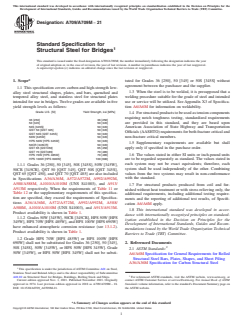
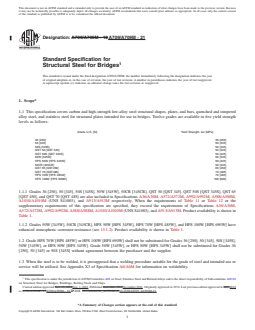
1.1 This specification covers carbon and high-strength low-alloy steel structural shapes, plates, and bars, quenched and tempered alloy steel, and stainless steel for structural plates intended for use in bridges. Twelve grades are available in five yield strength levels as follows:
Grade U.S. [SI]
Yield Strength, ksi [MPa]
36 [250]
36 [250]
50 [345]
50 [345]
50S [345S]
50 [345]
QST 50 [QST 345]
50 [345]
QST 50S [QST 345S]
50 [345]
50W [345W]
50 [345]
HPS 50W [HPS 345W]
50 [345]
50CR [345CR]
50 [345]
QST 65 [QST450]
65 [450]
QST 70 [QST485]
70 [485]
HPS 70W [HPS 485W]
70 [485]
HPS 100W [HPS 690W]
100 [690]
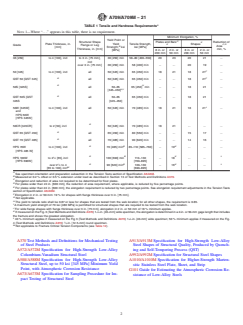
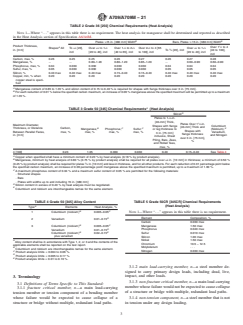
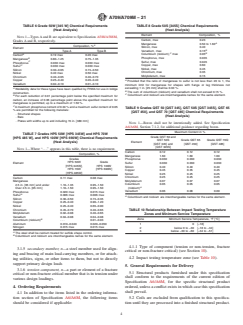
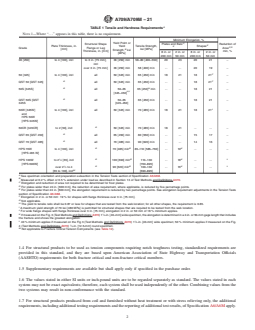
1.1.1 Grades 36 [250], 50 [345], 50S [345S], 50W [345W], 50CR [345CR], QST 50 [QST 345], QST 50S [QST 345S], QST 65 [QST 450], and QST 70 [QST 485] are also included in Specifications A36/A36M, A572/A572M, A992/A992M, A588/A588M, A1010/A1010M (UNS S41003), and A913/A913M respectively. When the requirements of Table 11 or Table 12 or the supplementary requirements of this specification are specified, they exceed the requirements of Specifications A36/A36M, A572/A572M, A992/A992M, A588/A588M, A1010/A1010M (UNS S41003), and A913/A913M. Product availability is shown in Table 1.
1.1.2 Grades 50W [345W], 50CR [345CR], HPS 50W [HPS 345W], HPS 70W [HPS 485W], and HPS 100W [HPS 690W] have enhanced atmospheric corrosion resistance (see 13.1.2). Product availability is shown in Table 1.
1.2 Grade HPS 70W [HPS 485W] or HPS 100W [HPS 690W] shall not be substituted for Grades 36 [250], 50 [345], 50S [345S], 50W [345W], or HPS 50W [HPS 345W]. Grade 50W [345W], or HPS 50W [HPS 345W] shall not be substituted for Grades 36 [250], 50 [345] or 50S [345S] without agreement between the purchaser and the supplier.
1.3 When the steel is to be welded, it is presupposed that a welding procedure suitable for the grade of steel and intended use or service will be utilized. See Appendix X3 of Specification A6/A6M for information on weldability.
1.4 For structural products to be used as tension components requiring notch toughness testing, standardized requirements are provided in this standard, and they are based upon American Association of State Highway and Transportation Officials (AASHTO) requirements for both fracture critical and non-fracture critical members.
1.5 Supplementary requirements are available but shall apply only if specified in the purchase order.
1.6 The values stated in either SI units or inch-pound units are to be regarded separately as standard. The values stated in each system may not be exact equivalents; therefore, each system shall be used independently of the other. Combining values from the two systems may result in non-conformance with the standard.
1.7 For structural products produced from coil and furnished without heat treatment or with stress relieving only, the additional requirements, including additional testing requirements and the reporting of additional test results, of Specification A6/A6M apply.
1.8 This international standard was developed in accordance with internationally recognized principles on standardizati...
- Status
- Published
- Publication Date
- 31-Oct-2021
- Technical Committee
- A01 - Steel, Stainless Steel and Related Alloys
Overview
ASTM A709/A709M-21: Standard Specification for Structural Steel for Bridges is a widely recognized standard developed by ASTM for specifying the requirements of carbon and high-strength, low-alloy steel products intended for use in bridge construction. This specification covers a variety of structural shapes, plates, and bars, including quenched and tempered alloy steel and stainless steel for structural plates. Its requirements address chemical composition, mechanical properties, atmospheric corrosion resistance, and suitability for welded and non-welded applications. The standard is essential for ensuring the quality, safety, and durability of modern steel bridge structures.
Key Topics
- Steel Grades and Yield Strength: ASTM A709/A709M-21 includes twelve steel grades, each with different yield strength levels (from 36 ksi [250 MPa] up to 100 ksi [690 MPa]). This range allows engineers flexibility in design and material selection.
- Mechanical Properties: The standard mandates tension tests for properties such as tensile strength, yield strength, and elongation. For certain grades, impact toughness and hardness tests are also required.
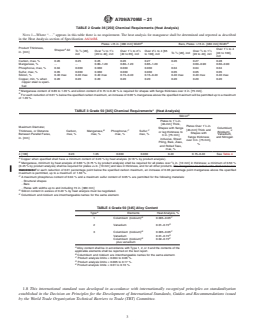
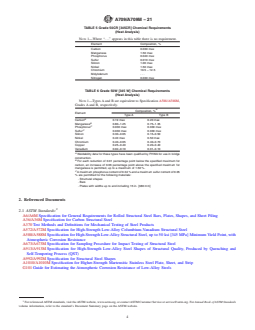
- Chemical Composition: The specification defines strict limits on carbon, manganese, phosphorus, sulfur, silicon, and copper content, among other alloying elements, ensuring consistent material performance.
- Atmospheric Corrosion Resistance: Specific grades (e.g., 50W, HPS 50W, 70W, 100W, and 50CR) are formulated for enhanced resistance to atmospheric corrosion, making them suitable for use in bare, unpainted bridge components.
- Weldability and Testing: The standard presumes weldable steel grades when proper welding procedures are employed. It outlines requirements for additional testing (notch toughness), especially for fracture critical and non-fracture critical members.
- Supplementary Requirements: Additional, optional requirements can be specified, such as ultrasonic examination, single heat bundles, and increased tension testing frequency, adding further quality assurance.
Applications
ASTM A709/A709M-21 is crucial for a variety of bridge-related engineering and construction projects:
- Bridge Superstructures and Substructures: Used in main load-carrying members, tension and compression components, and secondary support structures.
- Highway and Railway Bridges: Applicable in both vehicular and rail bridge construction, meeting safety and durability requirements under dynamic loads and harsh environments.
- Bare and Painted Applications: Corrosion-resistant grades can be used without protective coatings, reducing long-term maintenance costs.
- Fracture-Critical Zones: The standard supports the design and fabrication of members with rigorous testing requirements for safety-critical locations in a bridge.
- Tension Components and Welded Assemblies: Clearly defined requirements facilitate the use of these steels in welded assemblies, ensuring structural integrity over the lifespan of bridges.
Related Standards
ASTM A709/A709M-21 references and aligns with several other key steel standards, which are often used in conjunction with bridge projects:
- ASTM A6/A6M: General Requirements for Rolled Structural Steel Bars, Plates, Shapes, and Sheet Piling
- ASTM A36/A36M: Carbon Structural Steel
- ASTM A572/A572M: High-Strength Low-Alloy Columbium-Vanadium Structural Steel
- ASTM A588/A588M: High-Strength Low-Alloy Structural Steel with Atmospheric Corrosion Resistance
- ASTM A992/A992M: Structural Steel Shapes
- ASTM A1010/A1010M: Higher-Strength Martensitic Stainless Steel Plate
- ASTM A913/A913M: High-Strength Low-Alloy Steel Shapes via Quenching and Self-Tempering Process
- ASTM G101: Guide for Estimating the Atmospheric Corrosion Resistance of Low-Alloy Steels
ASTM A709/A709M-21 sets the industry benchmark for specifying structural steel in bridges, supporting safe, reliable, and durable infrastructure worldwide. For bridge design and fabrication professionals, compliance guarantees material performance and regulatory acceptance.
Relations
- Effective Date
- 01-Mar-2024
- Effective Date
- 01-Mar-2024
- Effective Date
- 01-Mar-2024
- Effective Date
- 01-Nov-2023
- Effective Date
- 01-Jul-2019
- Effective Date
- 01-Nov-2018
- Effective Date
- 15-Nov-2017
- Refers
ASTM A370-17a - Standard Test Methods and Definitions for Mechanical Testing of Steel Products - Effective Date
- 15-Nov-2017
- Effective Date
- 01-Nov-2017
- Effective Date
- 01-Jan-2017
- Effective Date
- 15-Nov-2016
- Effective Date
- 01-May-2016
- Effective Date
- 01-Nov-2015
- Effective Date
- 15-May-2014
- Effective Date
- 15-May-2014
Get Certified
Connect with accredited certification bodies for this standard

Element Materials Technology
Materials testing and product certification.

Inštitut za kovinske materiale in tehnologije
Institute of Metals and Technology. Materials testing, metallurgical analysis, NDT.
Sponsored listings
Frequently Asked Questions
ASTM A709/A709M-21 is a technical specification published by ASTM International. Its full title is "Standard Specification for Structural Steel for Bridges". This standard covers: ABSTRACT This specification covers carbon and high-strength low alloy steel structural shapes, plates and bars, and quenched and tempered alloy steel for structural plates intended for use in bridges. Heat analysis shall be used to determine the percentage of carbon, manganese, phosphorus, sulfur, silicon, and copper for the required chemical composition. A tension test shall be used to determine the required tensile properties such as tensile strength, yield strength, and elongation. Materials shall undergo: (1) an impact test for non-fracture critical and fracture critical members; and (2) a Brinell hardness test for Grades 100 and 100W. Atmospheric corrosion resistance shall also be determined. SCOPE 1.1 This specification covers carbon and high-strength low-alloy steel structural shapes, plates, and bars, quenched and tempered alloy steel, and stainless steel for structural plates intended for use in bridges. Twelve grades are available in five yield strength levels as follows: Grade U.S. [SI] Yield Strength, ksi [MPa] 36 [250] 36 [250] 50 [345] 50 [345] 50S [345S] 50 [345] QST 50 [QST 345] 50 [345] QST 50S [QST 345S] 50 [345] 50W [345W] 50 [345] HPS 50W [HPS 345W] 50 [345] 50CR [345CR] 50 [345] QST 65 [QST450] 65 [450] QST 70 [QST485] 70 [485] HPS 70W [HPS 485W] 70 [485] HPS 100W [HPS 690W] 100 [690] 1.1.1 Grades 36 [250], 50 [345], 50S [345S], 50W [345W], 50CR [345CR], QST 50 [QST 345], QST 50S [QST 345S], QST 65 [QST 450], and QST 70 [QST 485] are also included in Specifications A36/A36M, A572/A572M, A992/A992M, A588/A588M, A1010/A1010M (UNS S41003), and A913/A913M respectively. When the requirements of Table 11 or Table 12 or the supplementary requirements of this specification are specified, they exceed the requirements of Specifications A36/A36M, A572/A572M, A992/A992M, A588/A588M, A1010/A1010M (UNS S41003), and A913/A913M. Product availability is shown in Table 1. 1.1.2 Grades 50W [345W], 50CR [345CR], HPS 50W [HPS 345W], HPS 70W [HPS 485W], and HPS 100W [HPS 690W] have enhanced atmospheric corrosion resistance (see 13.1.2). Product availability is shown in Table 1. 1.2 Grade HPS 70W [HPS 485W] or HPS 100W [HPS 690W] shall not be substituted for Grades 36 [250], 50 [345], 50S [345S], 50W [345W], or HPS 50W [HPS 345W]. Grade 50W [345W], or HPS 50W [HPS 345W] shall not be substituted for Grades 36 [250], 50 [345] or 50S [345S] without agreement between the purchaser and the supplier. 1.3 When the steel is to be welded, it is presupposed that a welding procedure suitable for the grade of steel and intended use or service will be utilized. See Appendix X3 of Specification A6/A6M for information on weldability. 1.4 For structural products to be used as tension components requiring notch toughness testing, standardized requirements are provided in this standard, and they are based upon American Association of State Highway and Transportation Officials (AASHTO) requirements for both fracture critical and non-fracture critical members. 1.5 Supplementary requirements are available but shall apply only if specified in the purchase order. 1.6 The values stated in either SI units or inch-pound units are to be regarded separately as standard. The values stated in each system may not be exact equivalents; therefore, each system shall be used independently of the other. Combining values from the two systems may result in non-conformance with the standard. 1.7 For structural products produced from coil and furnished without heat treatment or with stress relieving only, the additional requirements, including additional testing requirements and the reporting of additional test results, of Specification A6/A6M apply. 1.8 This international standard was developed in accordance with internationally recognized principles on standardizati...
ABSTRACT This specification covers carbon and high-strength low alloy steel structural shapes, plates and bars, and quenched and tempered alloy steel for structural plates intended for use in bridges. Heat analysis shall be used to determine the percentage of carbon, manganese, phosphorus, sulfur, silicon, and copper for the required chemical composition. A tension test shall be used to determine the required tensile properties such as tensile strength, yield strength, and elongation. Materials shall undergo: (1) an impact test for non-fracture critical and fracture critical members; and (2) a Brinell hardness test for Grades 100 and 100W. Atmospheric corrosion resistance shall also be determined. SCOPE 1.1 This specification covers carbon and high-strength low-alloy steel structural shapes, plates, and bars, quenched and tempered alloy steel, and stainless steel for structural plates intended for use in bridges. Twelve grades are available in five yield strength levels as follows: Grade U.S. [SI] Yield Strength, ksi [MPa] 36 [250] 36 [250] 50 [345] 50 [345] 50S [345S] 50 [345] QST 50 [QST 345] 50 [345] QST 50S [QST 345S] 50 [345] 50W [345W] 50 [345] HPS 50W [HPS 345W] 50 [345] 50CR [345CR] 50 [345] QST 65 [QST450] 65 [450] QST 70 [QST485] 70 [485] HPS 70W [HPS 485W] 70 [485] HPS 100W [HPS 690W] 100 [690] 1.1.1 Grades 36 [250], 50 [345], 50S [345S], 50W [345W], 50CR [345CR], QST 50 [QST 345], QST 50S [QST 345S], QST 65 [QST 450], and QST 70 [QST 485] are also included in Specifications A36/A36M, A572/A572M, A992/A992M, A588/A588M, A1010/A1010M (UNS S41003), and A913/A913M respectively. When the requirements of Table 11 or Table 12 or the supplementary requirements of this specification are specified, they exceed the requirements of Specifications A36/A36M, A572/A572M, A992/A992M, A588/A588M, A1010/A1010M (UNS S41003), and A913/A913M. Product availability is shown in Table 1. 1.1.2 Grades 50W [345W], 50CR [345CR], HPS 50W [HPS 345W], HPS 70W [HPS 485W], and HPS 100W [HPS 690W] have enhanced atmospheric corrosion resistance (see 13.1.2). Product availability is shown in Table 1. 1.2 Grade HPS 70W [HPS 485W] or HPS 100W [HPS 690W] shall not be substituted for Grades 36 [250], 50 [345], 50S [345S], 50W [345W], or HPS 50W [HPS 345W]. Grade 50W [345W], or HPS 50W [HPS 345W] shall not be substituted for Grades 36 [250], 50 [345] or 50S [345S] without agreement between the purchaser and the supplier. 1.3 When the steel is to be welded, it is presupposed that a welding procedure suitable for the grade of steel and intended use or service will be utilized. See Appendix X3 of Specification A6/A6M for information on weldability. 1.4 For structural products to be used as tension components requiring notch toughness testing, standardized requirements are provided in this standard, and they are based upon American Association of State Highway and Transportation Officials (AASHTO) requirements for both fracture critical and non-fracture critical members. 1.5 Supplementary requirements are available but shall apply only if specified in the purchase order. 1.6 The values stated in either SI units or inch-pound units are to be regarded separately as standard. The values stated in each system may not be exact equivalents; therefore, each system shall be used independently of the other. Combining values from the two systems may result in non-conformance with the standard. 1.7 For structural products produced from coil and furnished without heat treatment or with stress relieving only, the additional requirements, including additional testing requirements and the reporting of additional test results, of Specification A6/A6M apply. 1.8 This international standard was developed in accordance with internationally recognized principles on standardizati...
ASTM A709/A709M-21 is classified under the following ICS (International Classification for Standards) categories: 77.140.10 - Heat-treatable steels. The ICS classification helps identify the subject area and facilitates finding related standards.
ASTM A709/A709M-21 has the following relationships with other standards: It is inter standard links to ASTM A1010/A1010M-24, ASTM A370-24, ASTM A6/A6M-24, ASTM A6/A6M-23, ASTM A370-19, ASTM A1010/A1010M-13(2018), ASTM A673/A673M-17, ASTM A370-17a, ASTM A6/A6M-17a, ASTM A370-17, ASTM A6/A6M-16a, ASTM A6/A6M-16, ASTM A370-15, ASTM A370-14, ASTM A913/A913M-14a. Understanding these relationships helps ensure you are using the most current and applicable version of the standard.
ASTM A709/A709M-21 is available in PDF format for immediate download after purchase. The document can be added to your cart and obtained through the secure checkout process. Digital delivery ensures instant access to the complete standard document.
Standards Content (Sample)
This international standard was developed in accordance with internationally recognized principles on standardization established in the Decision on Principles for the
Development of International Standards, Guides and Recommendations issued by the World Trade Organization Technical Barriers to Trade (TBT) Committee.
Designation:A709/A709M −21
Standard Specification for
Structural Steel for Bridges
This standard is issued under the fixed designationA709/A709M; the number immediately following the designation indicates the year
of original adoption or, in the case of revision, the year of last revision. A number in parentheses indicates the year of last reapproval.
A superscript epsilon (´) indicates an editorial change since the last revision or reapproval.
1. Scope* tuted for Grades 36 [250], 50 [345] or 50S [345S] without
agreement between the purchaser and the supplier.
1.1 This specification covers carbon and high-strength low-
1.3 When the steel is to be welded, it is presupposed that a
alloy steel structural shapes, plates, and bars, quenched and
welding procedure suitable for the grade of steel and intended
tempered alloy steel, and stainless steel for structural plates
use or service will be utilized. See Appendix X3 of Specifica-
intended for use in bridges. Twelve grades are available in five
tion A6/A6M for information on weldability.
yield strength levels as follows:
Grade U.S. [SI] Yield Strength, ksi [MPa]
1.4 Forstructuralproductstobeusedastensioncomponents
requiring notch toughness testing, standardized requirements
36 [250] 36 [250]
are provided in this standard, and they are based upon
50 [345] 50 [345]
50S [345S] 50 [345]
American Association of State Highway and Transportation
QST 50 [QST 345] 50 [345]
Officials(AASHTO)requirementsforbothfracturecriticaland
QST 50S [QST 345S] 50 [345]
non-fracture critical members.
50W [345W] 50 [345]
HPS 50W [HPS 345W] 50 [345]
1.5 Supplementary requirements are available but shall
50CR [345CR] 50 [345]
QST 65 [QST450] 65 [450] apply only if specified in the purchase order.
QST 70 [QST485] 70 [485]
1.6 The values stated in either SI units or inch-pound units
HPS 70W [HPS 485W] 70 [485]
HPS 100W [HPS 690W] 100 [690]
are to be regarded separately as standard. The values stated in
each system may not be exact equivalents; therefore, each
1.1.1 Grades 36 [250], 50 [345], 50S [345S], 50W [345W],
system shall be used independently of the other. Combining
50CR [345CR], QST 50 [QST 345], QST 50S [QST 345S],
values from the two systems may result in non-conformance
QST 65 [QST 450], and QST 70 [QST 485] are also included
with the standard.
in Specifications A36/A36M, A572/A572M, A992/A992M,
A588/A588M, A1010/A1010M (UNS S41003), and A913/
1.7 For structural products produced from coil and fur-
A913M respectively. When the requirements of Table 11 or
nished without heat treatment or with stress relieving only, the
Table 12 or the supplementary requirements of this specifica-
additional requirements, including additional testing require-
tion are specified, they exceed the requirements of Specifica-
ments and the reporting of additional test results, of Specifi-
tions A36/A36M, A572/A572M, A992/A992M, A588/
cation A6/A6M apply.
A588M, A1010/A1010M (UNS S41003), and A913/A913M.
1.8 This international standard was developed in accor-
Product availability is shown in Table 1.
dance with internationally recognized principles on standard-
1.1.2 Grades50W[345W],50CR[345CR],HPS50W[HPS
ization established in the Decision on Principles for the
345W], HPS 70W [HPS 485W], and HPS 100W [HPS 690W]
Development of International Standards, Guides and Recom-
have enhanced atmospheric corrosion resistance (see 13.1.2).
mendations issued by the World Trade Organization Technical
Product availability is shown in Table 1.
Barriers to Trade (TBT) Committee.
1.2 Grade HPS 70W [HPS 485W] or HPS 100W [HPS
2. Referenced Documents
690W] shall not be substituted for Grades 36 [250], 50 [345],
50S [345S], 50W [345W], or HPS 50W [HPS 345W]. Grade
2.1 ASTM Standards:
50W [345W], or HPS 50W [HPS 345W] shall not be substi-
A6/A6M Specification for General Requirements for Rolled
Structural Steel Bars, Plates, Shapes, and Sheet Piling
A36/A36M Specification for Carbon Structural Steel
This specification is under the jurisdiction ofASTM Committee A01 on Steel,
Stainless Steel and Related Alloys and is the direct responsibility of Subcommittee
A01.02 on Structural Steel for Bridges, Buildings, Rolling Stock and Ships. For referenced ASTM standards, visit the ASTM website, www.astm.org, or
Current edition approved Nov. 1, 2021. Published November 2021. Originally contact ASTM Customer Service at service@astm.org. For Annual Book of ASTM
approved in 1974. Last previous edition approved in 2018 as A709/A709M – 18. Standards volume information, refer to the standard’s Document Summary page on
DOI: 10.1520/A0709_A0709M-21. the ASTM website.
*A Summary of Changes section appears at the end of this standard
Copyright © ASTM International, 100 Barr Harbor Drive, PO Box C700, West Conshohocken, PA 19428-2959. United States
A709/A709M−21
A
TABLE 1 Tensile and Hardness Requirements
NOTE 1—Where “. . .” appears in this table, there is no requirement.
Minimum Elongation, %
Yield Point or
C,
Structural Shape Plates and Bars Reduction of
E
Plate Thickness, in. Tensile Strength, Shapes
Yield E
C,D
Grade Flange or Leg
Area
B
[mm] ksi [MPa]
Strength, ksi
min, %
Thickness, in. [mm]
8 in. or 2 in. or 8 in. or 2 in. or
[MPa]
200 mm 50 mm 200 mm 50 mm
36 [250] to 4 [100], incl to 3 in. [75 mm], 36 [250] min 58–80 [400–550] 20 23 20 21 .
incl
over 3 in. [75 mm] 36 [250] min 58 [400] min . . 20 19 .
F
50 [345] to 4 [100], incl all 50 [345] min 65 [450] min 18 21 18 21 .
G F
QST 50 [QST 345] all 50 [345] min 65 [450] min . . 18 21 .
G H
50S [345S] all 50–65 65 [450] min . . 18 21 .
H,I
[345–450]
G
QST 50S [QST all 50–65 65 [450] min . . 18 21 .
345S [345–450]
J
50W [345W] to 4 [100], incl all 50 [345] min 70 [485] min 18 21 18 21 .
and
HPS 50W
[HPS 345W]
G
50CR [345CR] to 2 [50], incl 50 [345] min 70 [485] min 18 21 . . .
G
QST 65 [QST 450] all 65 [450] min 80 [550] min . . 15 17 .
G
QST 70 [QST 485] all 70 [485] min 90 [620] min . . 14 16 .
G B K
HPS 70W to 4 [100], incl 70 [485] min 85–110 [585–760] . 19 . . .
[HPS 485 W]
G B K L
HPS 100W to 2 ⁄2 [65], incl 100 [690] min 110–130 . 18 . .
[HPS 690W] [760–895]
G B K L
over 2 ⁄2 to 4 90 [620] min 100–130 . 16 . .
M
[65 to 100], incl [690–895]
A
See specimen orientation and preparation subsection in the Tension Tests section of Specification A6/A6M.
B
Measured at 0.2 % offset or 0.5 % extension under load as described in Section 13 of Test Methods and Definitions A370.
C
Elongation and reduction of area not required to be determined for floor plates.
D
For plates wider than 24 in. [600 mm], the reduction of area requirement, where applicable, is reduced by five percentage points.
E
For plates wider than 24 in. [600 mm], the elongation requirement is reduced by two percentage points. See elongation requirement adjustments in the Tension Tests
section of Specification A6/A6M.
F
Elongation in 2 in. or 50 mm: 19 % for shapes with flange thickness over 3 in. [75 mm].
G
Not applicable.
H
The yield to tensile ratio shall be 0.87 or less for shapes that are tested from the web location; for all other shapes, the requirement is 0.85.
I
A maximum yield strength of 70 ksi [480 MPa] is permitted for structural shapes that are required to be tested from the web location.
J
For wide flange shapes with flange thickness over 3 in. [75 mm], elongation in 2 in. or 50 mm of 18 % minimum applies.
K
If measured on the Fig. 3 (Test Methods and Definitions A370)1 ⁄2-in. [40–mm] wide specimen, the elongation is determined in a 2-in. or 50-mm gage length that includes
the fracture and shows the greatest elongation.
L
40 % minimum applies if measured on the Fig 3 (Test Methods and Definitions A370)1 ⁄2-in. [40-mm] wide specimen; 50 % minimum applies if measured on the Fig.
4 (Test Methods and Definitions A370) ⁄2-in. [12.5-mm] round specimen.
M
Not applicable to Fracture Critical Tension Components (see Table 12).
A370 Test Methods and Definitions for Mechanical Testing A913/A913M Specification for High-Strength Low-Alloy
of Steel Products Steel Shapes of Structural Quality, Produced by Quench-
A572/A572M Specification for High-Strength Low-Alloy
ing and Self-Tempering Process (QST)
Columbium-Vanadium Structural Steel
A992/A992M Specification for Structural Steel Shapes
A588/A588M Specification for High-Strength Low-Alloy
A1010/A1010M Specification for Higher-Strength Marten-
Structural Steel, up to 50 ksi [345 MPa] Minimum Yield
sitic Stainless Steel Plate, Sheet, and Strip
Point, with Atmospheric Corrosion Resistance
G101 Guide for Estimating the Atmospheric Corrosion Re-
A673/A673M Specification for Sampling Procedure for Im-
sistance of Low-Alloy Steels
pact Testing of Structural Steel
A709/A709M−21
TABLE 2 Grade 36 [250] Chemical Requirements (Heat Analysis)
NOTE 1—Where “. . .” appears in this table there is no requirement. The heat analysis for manganese shall be determined and reported as described
in the Heat Analysis section of Specification A6/A6M.
B B
Plates >15 in. [380 mm] Width Bars, Plates#15 in. [380 mm] Width
Product Thickness,
A Over 1 ⁄2 to 4
Shapes All 3 3 1 1 1 1 3 1
To ⁄4 [20], Over ⁄4 to 1 ⁄2 Over 1 ⁄2 to 2 ⁄2 Over 2 ⁄2 to4[65 Over ⁄4 to 1 ⁄2
in. [mm] 3
To ⁄4 [20], incl [40 to 100],
incl [20 to 40], incl [40 to 65], incl to 100], incl [20 to 40], incl
incl
Carbon, max, % 0.26 0.25 0.25 0.26 0.27 0.26 0.27 0.28
Manganese, % . . 0.80–1.20 0.80–1.20 0.85–1.20 . 0.60–0.90 0.60–0.90
Phosphorus, max, % 0.04 0.030 0.030 0.030 0.030 0.04 0.04 0.04
Sulfur, max, % 0.05 0.030 0.030 0.030 0.030 0.05 0.05 0.05
Silicon, % 0.40 max 0.40 max 0.40 max 0.15–0.40 0.15–0.40 0.40 max 0.40 max 0.40 max
Copper, min, % when 0.20 0.20 0.20 0.20 0.20 0.20 0.20 0.20
copper steel is speci-
fied
A
Manganese content of 0.85 to 1.35 % and silicon content of 0.15 to 0.40 % is required for shapes with flange thickness over 3 in. [75 mm].
B
For each reduction of 0.01 % below the specified carbon maximum, an increase of 0.06 % manganese above the specified maximum will be permitted up to a maximum
of 1.35 %.
A
TABLE 3 Grade 50 [345] Chemical Requirements (Heat Analysis)
D
Silicon
Plates to 1 ⁄2-in.
[40-mm] Thick,
Plates Over 1 ⁄2-in.
Maximum Diameter,
Shapes with flange Columbium
[40-mm] Thick and
B C C
E
Thickness, or Distance Carbon,
Manganese, Phosphorus, Sulfur, or leg thickness to (Niobium),
Shapes with
Between Parallel Faces, max, % max, % max, % max, % Vanadium,
3 in. [75 mm]
flange thickness
and Nitrogen
in. [mm]
inclusive, Sheet
over 3 in. [75 mm],
Piling, Bars, Zees,
%
and Rolled Tees,
max, %
4 [100] 0.23 1.35 0.030 0.030 0.40 0.15–0.40 See Table 4
A
Copper when specified shall have a minimum content of 0.20 % by heat analysis (0.18 % by product analysis).
B
Manganese, minimum by heat analysis of 0.80 % (0.75 % by product analysis) shall be required for all plates over ⁄8 in. [10 mm] in thickness; a minimum of 0.50 %
(0.45 % by product analysis) shall be required for plates ⁄8 in. [10 mm] and less in thickness, and for all other products. For each reduction of 0.01 percentage point below
the specified carbon maximum, an increase of 0.06 percentage point manganese above the specified maximum is permitted, up to a maximum of 1.60 %.
C
A maximum phosphorus content of 0.04 % and a maximum sulfur content of 0.05 % are permitted for the following materials:
· Structural shapes
· Bars
· Plates with widths up to and including 15 in. [380 mm]
D
Silicon content in excess of 0.40 % by heat analysis must be negotiated.
E
Columbium and niobium are interchangeable names for the same element.
TABLE 4 Grade 50 [345] Alloy Content TABLE 5 Grade 50CR [345CR] Chemical Requirements
A (Heat Analysis)
Type Elements Heat Analysis, %
B C
1 Columbium (niobium) 0.005–0.05
NOTE 1—Where “. . .” appears in this table there is no requirement.
Element Composition, %
D
2 Vanadium 0.01–0.15
Carbon 0.030 max
B C
Manganese 1.50 max
3 Columbium (niobium) 0.005–0.05
D
Vanadium 0.01–0.15 Phosphorus 0.040 max
B E
Sulfur 0.010 max
Columbium (niobium) 0.02–0.15
plus vanadium
Silicon 1.00 max
Nickel 1.50 max
A
Alloy content shall be in accordance with Type 1, 2, or 3 and the contents of the
Chromium 10.5 – 12.5
applicable elements shall be reported on the test report.
B Molybdenum . . .
Columbium and niobium are interchangeable names for the same element.
C Nitrogen 0.030 max
Product analysis limits = 0.004 to 0.06 %.
D
Product analysis limits = 0.005 to 0.17 %.
E
Product analysis limits = 0.01 to 0.16 %.
3.1.2 main load-carrying member, n—a steel member de-
signed to carry primary design loads, including dead, live,
impact, and other loads.
3. Terminology
3.1.3 non-fracture critical member, n—a main load-carrying
3.1 Definitions of Terms Specific to This Standard:
member whose failure would not be expected to cause collapse
3.1.1 fracture critical member, n—a main load-carrying
of a structure or bridge with multiple, redundant load paths.
tension member or tension component of a bending member
whose failure would be expected to cause collapse of a 3.1.4 non-tension component, n—a steel member that is not
structure or bridge without multiple, redundant load paths. in tension under any design loading.
A709/A709M−21
TABLE 6 Grade 50W [345 W] Chemical Requirements TABLE 8 Grade 50S [345S] Chemical Requirements
(Heat Analysis) (Heat Analysis)
Element Composition, %
NOTE 1—Types A and B are equivalent to Specification A588/A588M,
Carbon, max 0.23
Grades A and B, respectively.
A
Manganese 0.50 to 1.60
A
Composition, %
Silicon, max 0.40
Element
B
Type A Type B
Vanadium, max 0.15
C B
B Columbium (niobium), max 0.05
Carbon 0.19 max 0.20 max
B
Phosphorus, max 0.035
Manganese 0.80–1.25 0.75–1.35
C Sulfur, max 0.045
Phosphorus 0.030 max 0.030 max
C
Copper, max 0.60
Sulfur 0.030 max 0.030 max
Nickel, max 0.45
Silicon 0.30–0.65 0.15–0.50
Chromium, max 0.35
Nickel 0.40 max 0.50 max
Molybdenum, max 0.15
Chromium 0.40–0.65 0.40–0.70
A
Copper 0.25–0.40 0.20–0.40
Provided that the ratio of manganese to sulfur is not less than 20 to 1, the
Vanadium 0.02–0.10 0.01–0.10
minimum limit for manganese for shapes with flange or leg thickness not
A exceeding 1 in. [25 mm] shall be 0.30 %.
Weldability data for these types have been qualified by FHWA for use in bridge
B
The sum of columbium (niobium) and vanadium shall not exceed 0.15 %.
construction.
C
B Columbium and niobium are interchangeable names for the same element.
For each reduction of 0.01 percentage point below the specified maximum for
carbon, an increase of 0.06 percentage point above the specified maximum for
manganese is permitted, up to a maximum of 1.50 %.
C
A maximum phosphorus content of 0.04 % and a maximum sulfur content of 0.05
TABLE 9 Grades QST 50 [QST 345], QST 50S [QST 345S], QST 65
% are permitted for the following materials:
[QST 450], and QST 70 [QST 485] Chemical Requirements
· Structural shapes
(Heat Analysis)
· Bars
· Plates with widths up to and including 15 in. [380 mm]
NOTE 1—Boron shall not be intentionally added. See Specification
A6/A6M, Section 7.1.2, for additional guidance regarding boron.
Maximum Content in %
TABLE 7 Grades HPS 50W [HPS 345W] and HPS 70W
Grade QST 50 and
[HPS 485 W], and HPS 100W [HPS 690W] Chemical Requirements
QST 50S Grade QST 65 Grade QST 70Q
(Heat Analysis) Element
[QST 345] and [QST 450] [QST 485]
[QST 345S]
NOTE 1—Where “. . .” appears in this table, there is no requirement.
Carbon 0.12 0.12 0.12
Composition, %
Manganese 1.60 1.60 1.60
Grades
Phosphorus 0.030 0.030 0.030
HPS 50W Grade
Sulfur 0.030 0.030 0.030
Element
[HPS 345W], HPS 100W
Silicon 0.40 0.40 0.40
HPS 70W [HPS 690W]
Copper 0.45 0.35 0.45
[HPS 485W]
Nickel 0.25 0.25 0.25
Chromium 0.25 0.25 0.25
Carbon 0.11 max 0.08 max
Molybdenum 0.07 0.07 0.07
Manganese
Columbium 0.05 0.05 0.05
2.5 in. [65 mm] and under 1.10–1.35 0.95–1.50
A
(niobium)
Over 2.5 in. [65 mm] 1.10–1.50 0.95–1.50
Vanadium 0.06 0.08 0.09
Phosphorus 0.020 max 0.015 max
A
Sulfur 0.006 max 0.006 max A
Columbium and niobium are interchangeable names for the same element.
Silicon 0.30–0.50 0.15–0.35
Copper 0.25–0.40 0.90–1.20
Nickel 0.25–0.40 0.65–0.90
Chromium 0.45–0.70 0.40–0.65
TABLE 10 Relationship Between Impact Testing Temperature
Molybdenum 0.02–0.08 0.40–0.65
Zones and Minimum Service Temperature
Vanadium 0.04–0.08 0.04–0.08
B Zone Minimum Service Temperature, °F [°C]
Columbium (niobium) . . . 0.01–0.03
Aluminum 0.010–0.040 0.020–0.050
1 0 [−18]
Nitrogen 0.015 max 0.015 max 2 below 0 to −30 [−18 to −34]
3 below −30 to −60 [−34 to −51]
A
The steel shall be calcium treated for sulfide shape control.
B
Columbium and niobium are interchangeable names for the same element.
4.1.1 Type of component (tension or non-tension, fracture
3.1.5 secondary member, n—a steel member used for align-
critical or non-fracture critical) (see Section 10).
ing and bracing of main load-carrying members, or for attach-
4.2 Impact testing temperature zone (see Table 10).
ing utilities, signs, or other items to them, but not to directly
support primary design loads
5. General Requirements for Delivery
3.1.6 tension component, n—a part or element of a fracture
5.1 Structural products furnished under this specification
critical or non-fracture critical member that is in tension under
shall conform to the requirements of the current edition of
various design loadings.
Specification A6/A6M, for the specific structural product
4. Ordering Requirements ordered, unless a conflict exists in which case this specification
shall prevail.
4.1 In addition to the items listed in the ordering informa-
tion section of Specification A6/A6M, the following items 5.2 Coils are excluded from qualification to this specifica-
should be considered if applicable: tion until they are processed into a finished structural product.
A709/A709M−21
TABLE 11 Non-Fracture Critical Tension Component Impact Test Requirements
Minimum Average Energy, ft·lbf [J]
Thickness,
Grade
in. [mm]
Zone 1 Zone 2 Zone 3
A
36T [250T] to 4 [100] incl 15 [20] at 70°F [21°C] 15 [20] at 40°F [4°C] 15 [20] at 10°F [−12°C]
A, B
50T [345T] to 2 [50] incl 15 [20] at 70°F [21°C] 15 [20] at 40°F [4°C] 15 [20] at 10°F [−12°C]
A, B
50ST [345ST]
over 2 to 4 [50 to 100] incl 20 [27] at 70°F [21°C] 20 [27] at 40°F [4°C] 20 [27] at 10°F [−12°C]
A, B
50WT [345WT]
B, D
QST 50T [QST 345T] to 2 [50] incl 15 [20] at 70°F [21°C] 15 [20] at 40°F [4°C] 15 [20] at 10°F [–12°C]
D
QST 50ST [QST 345ST]
over 2 to 4 [50 to 100] incl 20 [27] at 70°F [21°C] 20 [27] at 40°F [4°C] 20 [27] at 10°F [–12°C]
A, B
50CRT [345CRT] to 2 [50] incl 15 [20] at 70°F [21°C] 15 [20] at 40°F [4°C] 15 [20] at 10°F [–12°C]
HPS 50WT to 4 [100] incl 20 [27] at 10°F [–12°C] 20 [27] at 10°F [–12°C] 20 [27] at 10°F [–12°C]
A, B
[HPS 345WT]
B, D
QST 65T [QST 450T] to 2 [50] incl 20 [27] at 50°F [10°C] 20 [27] at 20°F [–7°C] 20 [27] at -10°F [–23°C]
over 2 to 4 [50 to 100] incl 25 [34] at 50°F [10°C] 25 [34] at 20°F [–7°C] 25 [34] at -10°F [–23°C]
B, D
QST 70T [QST 485T] to 2 [50] incl 20 [27] at 50°F [10°C] 20 [27] at 20°F [–7°C] 20 [27] at -10°F [–23°C]
over 2 to 4 [50 to 100] incl 25 [34] at 50°F [10°C] 25 [34] at 20°F [–7°C] 25 [34] at -10°F [–23°C]
HPS 70WT to 4 [100] incl 25 [34] at –10°F [–23°C] 25 [34] at –10°F [–23°C] 25 [34] at –10°F [–23°C]
B, D
[HPS 485WT]
HPS 100WT to 2 ⁄2 [65] incl 25 [34] at –30°F [−34°C] 25 [34] at –30°F [−34°C] 25 [34] at –30°F [−34°C]
D
[HPS 690WT] over 2 ⁄2 to 4 [65 to 100] incl 35 [48] at –30°F [–34°C] 35 [48] at –30°F [–34°C] 35 [48] at –30°F
...
This document is not an ASTM standard and is intended only to provide the user of an ASTM standard an indication of what changes have been made to the previous version. Because
it may not be technically possible to adequately depict all changes accurately, ASTM recommends that users consult prior editions as appropriate. In all cases only the current version
of the standard as published by ASTM is to be considered the official document.
Designation: A709/A709M − 18 A709/A709M − 21
Standard Specification for
Structural Steel for Bridges
This standard is issued under the fixed designation A709/A709M; the number immediately following the designation indicates the year
of original adoption or, in the case of revision, the year of last revision. A number in parentheses indicates the year of last reapproval.
A superscript epsilon (´) indicates an editorial change since the last revision or reapproval.
1. Scope*
1.1 This specification covers carbon and high-strength low-alloy steel structural shapes, plates, and bars, quenched and tempered
alloy steel, and stainless steel for structural plates intended for use in bridges. Twelve grades are available in five yield strength
levels as follows:
Grade U.S. [SI] Yield Strength, ksi [MPa]
36 [250] 36 [250]
50 [345] 50 [345]
50S [345S] 50 [345]
QST 50 [QST 345] 50 [345]
QST 50S [QST 345S] 50 [345]
50W [345W] 50 [345]
HPS 50W [HPS 345W] 50 [345]
50CR [345CR] 50 [345]
QST 65 [QST450] 65 [450]
QST 70 [QST485] 70 [485]
HPS 70W [HPS 485W] 70 [485]
HPS 100W [HPS 690W] 100 [690]
1.1.1 Grades 36 [250], 50 [345], 50S [345S], 50W [345W], 50CR [345CR], QST 50 [QST 345], QST 50S [QST 345S], QST 65
[QST 450], and QST 70 [QST 485] are also included in Specifications A36/A36M, A572/A572M, A992/A992M, A588/A588M,
A1010/A1010M (UNS S41003), and A913/A913M respectively. When the requirements of Table 11 or Table 12 or the
supplementary requirements of this specification are specified, they exceed the requirements of Specifications A36/A36M,
A572/A572M, A992/A992M, A588/A588M, A1010/A1010M (UNS S41003), and A913/A913M. Product availability is shown in
Table 1.
1.1.2 Grades 50W [345W], 50CR [345CR], HPS 50W [HPS 345W], HPS 70W [HPS 485W], and HPS 100W [HPS 690W] have
enhanced atmospheric corrosion resistance (see 13.1.2). Product availability is shown in Table 1.
1.2 Grade HPS 70W [HPS 485W] or HPS 100W [HPS 690W] shall not be substituted for Grades 36 [250], 50 [345], 50S [345S],
50W [345W], or HPS 50W [HPS 345W]. Grade 50W [345W], or HPS 50W [HPS 345W] shall not be substituted for Grades 36
[250], 50 [345] or 50S [345S] without agreement between the purchaser and the supplier.
1.3 When the steel is to be welded, it is presupposed that a welding procedure suitable for the grade of steel and intended use or
service will be utilized. See Appendix X3 of Specification A6/A6M for information on weldability.
This specification is under the jurisdiction of ASTM Committee A01 on Steel, Stainless Steel and Related Alloys and is the direct responsibility of Subcommittee A01.02
on Structural Steel for Bridges, Buildings, Rolling Stock and Ships.
Current edition approved Nov. 15, 2018Nov. 1, 2021. Published December 2018November 2021. Originally approved in 1974. Last previous edition approved in 20172018
ɛ1
as A709/A709M – 17A709/A709M – 18. . DOI: 10.1520/A0709_A0709M-18.10.1520/A0709_A0709M-21.
*A Summary of Changes section appears at the end of this standard
Copyright © ASTM International, 100 Barr Harbor Drive, PO Box C700, West Conshohocken, PA 19428-2959. United States
A709/A709M − 21
A
TABLE 1 Tensile and Hardness Requirements
NOTE 1—Where “. . .” appears in this table, there is no requirement.
Minimum Elongation, %
Yield Point or
C,
Structural Shape Plates and Bars Reduction of
E
Plate Thickness, in. Tensile Strength, Shapes
Yield E
C,D
Grade Flange or Leg
Area
B
[mm] ksi [MPa]
Strength, ksi
min, %
Thickness, in. [mm]
8 in. or 2 in. or 8 in. or 2 in. or
[MPa]
200 mm 50 mm 200 mm 50 mm
36 [250] to 4 [100], incl to 3 in. [75 mm], 36 [250] min 58–80 [400–550] 20 23 20 21 .
incl
over 3 in. [75 mm] 36 [250] min 58 [400] min . . 20 19 .
F
50 [345] to 4 [100], incl all 50 [345] min 65 [450] min 18 21 18 21 .
G F
QST 50 [QST 345] all 50 [345] min 65 [450] min . . 18 21 .
G H
50S [345S] all 50–65 65 [450] min . . 18 21 .
H,I
[345–450]
G
QST 50S [QST all 50–65 65 [450] min . . 18 21 .
345S [345–450]
J
50W [345W] to 4 [100], incl all 50 [345] min 70 [485] min 18 21 18 21 .
and
HPS 50W
[HPS 345W]
G
50CR [345CR] to 2 [50], incl 50 [345] min 70 [485] min 18 21 . . .
G
QST 65 [QST 450] all 65 [450] min 80 [550] min . . 15 17 .
G
QST 70 [QST 485] all 70 [485] min 90 [620] min . . 14 16 .
G B K
HPS 70W to 4 [100], incl 70 [485] min 85–110 [585–760] . 19 . . .
[HPS 485 W]
G B K L
HPS 100W to 2 ⁄2 [65], incl 100 [690] min 110–130 . 18 . .
[HPS 690W] [760–895]
G B K L
over 2 ⁄2 to 4 90 [620] min 100–130 . 16 . .
M
[65 to 100], incl [690–895]
A
See specimen orientation and preparation subsection in the Tension Tests section of Specification A6/A6M.
B
Measured at 0.2 % offset or 0.5 % extension under load as described in Section 13 of Test Methods and Definitions A370.
C
Elongation and reduction of area not required to be determined for floor plates.
D
For plates wider than 24 in. [600 mm], the reduction of area requirement, where applicable, is reduced by five percentage points.
E
For plates wider than 24 in. [600 mm], the elongation requirement is reduced by two percentage points. See elongation requirement adjustments in the Tension Tests
section of Specification A6/A6M.
F
Elongation in 2 in. or 50 mm: 19 % for shapes with flange thickness over 3 in. [75 mm].
G
Not applicable.
H
The yield to tensile ratio shall be 0.87 or less for shapes that are tested from the web location; for all other shapes, the requirement is 0.85.
I
A maximum yield strength of 70 ksi [480 MPa] is permitted for structural shapes that are required to be tested from the web location.
J
For wide flange shapes with flange thickness over 3 in. [75 mm], elongation in 2 in. or 50 mm of 18 % minimum applies.
K
If measured on the Fig. 3 (Test Methods and Definitions A370) 1 ⁄2-in. [40–mm] wide specimen, the elongation is determined in a 2-in. or 50-mm gage length that includes
the fracture and shows the greatest elongation.
L
40 % minimum applies if measured on the Fig 3 (Test Methods and Definitions A370) 1 ⁄2-in. [40-mm] wide specimen; 50 % minimum applies if measured on the Fig.
4 (Test Methods and Definitions A370) ⁄2-in. [12.5-mm] round specimen.
M
Not applicable to Fracture Critical Tension Components (see Table 12).
1.4 For structural products to be used as tension components requiring notch toughness testing, standardized requirements are
provided in this standard, and they are based upon American Association of State Highway and Transportation Officials
(AASHTO) requirements for both fracture critical and non-fracture critical members.
1.5 Supplementary requirements are available but shall apply only if specified in the purchase order.
1.6 The values stated in either SI units or inch-pound units are to be regarded separately as standard. The values stated in each
system may not be exact equivalents; therefore, each system shall be used independently of the other. Combining values from the
two systems may result in non-conformance with the standard.
1.7 For structural products produced from coil and furnished without heat treatment or with stress relieving only, the additional
requirements, including additional testing requirements and the reporting of additional test results, of Specification A6/A6M apply.
A709/A709M − 21
TABLE 2 Grade 36 [250] Chemical Requirements (Heat Analysis)
NOTE 1—Where “. . .” appears in this table there is no requirement. The heat analysis for manganese shall be determined and reported as described
in the Heat Analysis section of Specification A6/A6M.
B B
Plates >15 in. [380 mm] Width Bars, Plates #15 in. [380 mm] Width
Product Thickness, 1
A Over 1 ⁄2 to 4
Shapes All 3 3 1 1 1 1 3 1
To ⁄4 [20], Over ⁄4 to 1 ⁄2 Over 1 ⁄2 to 2 ⁄2 Over 2 ⁄2 to 4 [65 Over ⁄4 to 1 ⁄2
in. [mm] 3
To ⁄4 [20], incl [40 to 100],
incl [20 to 40], incl [40 to 65], incl to 100], incl [20 to 40], incl
incl
Carbon, max, % 0.26 0.25 0.25 0.26 0.27 0.26 0.27 0.28
Manganese, % . . 0.80–1.20 0.80–1.20 0.85–1.20 . 0.60–0.90 0.60–0.90
Phosphorus, max, % 0.04 0.030 0.030 0.030 0.030 0.04 0.04 0.04
Sulfur, max, % 0.05 0.030 0.030 0.030 0.030 0.05 0.05 0.05
Silicon, % 0.40 max 0.40 max 0.40 max 0.15–0.40 0.15–0.40 0.40 max 0.40 max 0.40 max
Copper, min, % when 0.20 0.20 0.20 0.20 0.20 0.20 0.20 0.20
copper steel is speci-
fied
A
Manganese content of 0.85 to 1.35 % and silicon content of 0.15 to 0.40 % is required for shapes with flange thickness over 3 in. [75 mm].
B
For each reduction of 0.01 % below the specified carbon maximum, an increase of 0.06 % manganese above the specified maximum will be permitted up to a maximum
of 1.35 %.
A
TABLE 3 Grade 50 [345] Chemical Requirements (Heat Analysis)
D
Silicon
Plates to 1 ⁄2-in.
[40-mm] Thick,
Plates Over 1 ⁄2-in.
Maximum Diameter,
Shapes with flange Columbium
[40-mm] Thick and
B C C
E
Thickness, or Distance Carbon,
Manganese, Phosphorus, Sulfur,
or leg thickness to (Niobium),
Shapes with
max, % max, % max, %
Between Parallel Faces, max, % Vanadium,
3 in. [75 mm]
flange thickness
and Nitrogen
in. [mm]
inclusive, Sheet
over 3 in. [75 mm],
Piling, Bars, Zees,
%
and Rolled Tees,
max, %
4 [100] 0.23 1.35 0.030 0.030 0.40 0.15–0.40 See Table 4
A
Copper when specified shall have a minimum content of 0.20 % by heat analysis (0.18 % by product analysis).
B
Manganese, minimum by heat analysis of 0.80 % (0.75 % by product analysis) shall be required for all plates over ⁄8 in. [10 mm] in thickness; a minimum of 0.50 %
(0.45 % by product analysis) shall be required for plates ⁄8 in. [10 mm] and less in thickness, and for all other products. The manganese to carbon ratio shall not be less
than 2 to 1. For each reduction of 0.01 percentage point below the specified carbon maximum, an increase of 0.06 percentage point manganese above the specified
maximum is permitted, up to a maximum of 1.60 %.
C
A maximum phosphorus content of 0.04 % and a maximum sulfur content of 0.05 % are permitted for the following materials:
· Structural shapes
· Bars
· Plates with widths up to and including 15 in. [380 mm]
D
Silicon content in excess of 0.40 % by heat analysis must be negotiated.
E
Columbium and niobium are interchangeable names for the same element.
TABLE 4 Grade 50 [345] Alloy Content
A
Type Elements Heat Analysis, %
B C
1 Columbium (niobium) 0.005–0.05
D
2 Vanadium 0.01–0.15
B C
3 Columbium (niobium) 0.005–0.05
D
Vanadium 0.01–0.15
B E
Columbium (niobium) 0.02–0.15
plus vanadium
A
Alloy content shall be in accordance with Type 1, 2, or 3 and the contents of the
applicable elements shall be reported on the test report.
B
Columbium and niobium are interchangeable names for the same element.
C
Product analysis limits = 0.004 to 0.06 %.
D
Product analysis limits = 0.005 to 0.17 %.
E
Product analysis limits = 0.01 to 0.16 %.
1.8 This international standard was developed in accordance with internationally recognized principles on standardization
established in the Decision on Principles for the Development of International Standards, Guides and Recommendations issued
by the World Trade Organization Technical Barriers to Trade (TBT) Committee.
A709/A709M − 21
TABLE 5 Grade 50CR [345CR] Chemical Requirements
(Heat Analysis)
NOTE 1—Where “. . .” appears in this table there is no requirement.
Element Composition, %
Carbon 0.030 max
Manganese 1.50 max
Phosphorus 0.040 max
Sulfur 0.010 max
Silicon 1.00 max
Nickel 1.50 max
Chromium 10.5 – 12.5
Molybdenum . . .
Nitrogen 0.030 max
TABLE 6 Grade 50W [345 W] Chemical Requirements
(Heat Analysis)
NOTE 1—Types A and B are equivalent to Specification A588/A588M,
Grades A and B, respectively.
A
Composition, %
Element
Type A Type B
B
Carbon 0.19 max 0.20 max
B
Manganese 0.80–1.25 0.75–1.35
C
Phosphorus 0.030 max 0.030 max
C
Sulfur 0.030 max 0.030 max
Silicon 0.30–0.65 0.15–0.50
Nickel 0.40 max 0.50 max
Chromium 0.40–0.65 0.40–0.70
Copper 0.25–0.40 0.20–0.40
Vanadium 0.02–0.10 0.01–0.10
A
Weldability data for these types have been qualified by FHWA for use in bridge
construction.
B
For each reduction of 0.01 percentage point below the specified maximum for
carbon, an increase of 0.06 percentage point above the specified maximum for
manganese is permitted, up to a maximum of 1.50 %.
C
A maximum phosphorus content of 0.04 % and a maximum sulfur content of 0.05
% are permitted for the following materials:
· Structural shapes
· Bars
· Plates with widths up to and including 15 in. [380 mm]
2. Referenced Documents
2.1 ASTM Standards:
A6/A6M Specification for General Requirements for Rolled Structural Steel Bars, Plates, Shapes, and Sheet Piling
A36/A36M Specification for Carbon Structural Steel
A370 Test Methods and Definitions for Mechanical Testing of Steel Products
A572/A572M Specification for High-Strength Low-Alloy Columbium-Vanadium Structural Steel
A588/A588M Specification for High-Strength Low-Alloy Structural Steel, up to 50 ksi [345 MPa] Minimum Yield Point, with
Atmospheric Corrosion Resistance
A673/A673M Specification for Sampling Procedure for Impact Testing of Structural Steel
A913/A913M Specification for High-Strength Low-Alloy Steel Shapes of Structural Quality, Produced by Quenching and
Self-Tempering Process (QST)
A992/A992M Specification for Structural Steel Shapes
A1010/A1010M Specification for Higher-Strength Martensitic Stainless Steel Plate, Sheet, and Strip
G101 Guide for Estimating the Atmospheric Corrosion Resistance of Low-Alloy Steels
For referenced ASTM standards, visit the ASTM website, www.astm.org, or contact ASTM Customer Service at service@astm.org. For Annual Book of ASTM Standards
volume information, refer to the standard’s Document Summary page on the ASTM website.
A709/A709M − 21
TABLE 7 Grades HPS 50W [HPS 345W] and HPS 70W
[HPS 485 W], and HPS 100W [HPS 690W] Chemical Requirements
(Heat Analysis)
NOTE 1—Where “. . .” appears in this table, there is no requirement.
Composition, %
Grades
HPS 50W Grade
Element
[HPS 345W], HPS 100W
HPS 70W [HPS 690W]
[HPS 485W]
Carbon 0.11 max 0.08 max
Manganese
2.5 in. [65 mm] and under 1.10–1.35 0.95–1.50
Over 2.5 in. [65 mm] 1.10–1.50 0.95–1.50
Phosphorus 0.020 max 0.015 max
A
Sulfur 0.006 max 0.006 max
Silicon 0.30–0.50 0.15–0.35
Copper 0.25–0.40 0.90–1.20
Nickel 0.25–0.40 0.65–0.90
Chromium 0.45–0.70 0.40–0.65
Molybdenum 0.02–0.08 0.40–0.65
Vanadium 0.04–0.08 0.04–0.08
B
Columbium (niobium) . . . 0.01–0.03
Aluminum 0.010–0.040 0.020–0.050
Nitrogen 0.015 max 0.015 max
A
The steel shall be calcium treated for sulfide shape control.
B
Columbium and niobium are interchangeable names for the same element.
TABLE 8 Grade 50S [345S] Chemical Requirements
(Heat Analysis)
Element Composition, %
Carbon, max 0.23
A
Manganese 0.50 to 1.60
Silicon, max 0.40
B
Vanadium, max 0.15
C B
Columbium (niobium), max 0.05
Phosphorus, max 0.035
Sulfur, max 0.045
Copper, max 0.60
Nickel, max 0.45
Chromium, max 0.35
Molybdenum, max 0.15
A
Provided that the ratio of manganese to sulfur is not less than 20 to 1, the
minimum limit for manganese for shapes with flange or leg thickness not
exceeding 1 in. [25 mm] shall be 0.30 %.
B
The sum of columbium (niobium) and vanadium shall not exceed 0.15 %.
C
Columbium and niobium are interchangeable names for the same element.
3. Terminology
3.1 Definitions of Terms Specific to This Standard:
3.1.1 fracture critical member—member, n—a main load-carrying tension member or tension component of a bending member
whose failure would be expected to cause collapse of a structure or bridge without multiple, redundant load paths.
3.1.2 main load-carrying member—member, n—a steel member designed to carry primary design loads, including dead, live,
impact, and other loads.
3.1.3 non-fracture critical member—member, n—a main load-carrying member whose failure would not be expected to cause
collapse of a structure or bridge with multiple, redundant load paths.
3.1.4 non-tension component—component, n—a steel member that is not in tension under any design loading.
3.1.5 secondary member—member, n—a steel member used for aligning and bracing of main load-carrying members, or for
attaching utilities, signs, or other items to them, but not to directly support primary design loads
A709/A709M − 21
TABLE 9 Grades QST 50 [QST 345], QST 50S [QST 345S], QST 65
[QST 450], and QST 70 [QST 485] Chemical Requirements
(Heat Analysis)
NOTE 1—Boron shall not be intentionally added. See Specification
A6/A6M, Section 7.1.2, for additional guidance regarding boron.
Maximum Content in %
Grade QST 50 and
QST 50S Grade QST 65 Grade QST 70Q
Element
[QST 345] and [QST 450] [QST 485]
[QST 345S]
Carbon 0.12 0.12 0.12
Manganese 1.60 1.60 1.60
Phosphorus 0.030 0.030 0.030
Sulfur 0.030 0.030 0.030
Silicon 0.40 0.40 0.40
Copper 0.45 0.35 0.45
Nickel 0.25 0.25 0.25
Chromium 0.25 0.25 0.25
Molybdenum 0.07 0.07 0.07
Columbium 0.05 0.05 0.05
A
(niobium)
Vanadium 0.06 0.08 0.09
A
Columbium and niobium are interchangeable names for the same element.
TABLE 10 Relationship Between Impact Testing Temperature
Zones and Minimum Service Temperature
Zone Minimum Service Temperature, °F [°C]
1 0 [−18]
2 below 0 to −30 [−18 to −34]
3 below −30 to −60 [−34 to −51]
3.1.6 tension component—component, n—a part or element of a fracture critical or non-fracture critical member that is in tension
under various design loadings.
4. Ordering Requirements
4.1 In addition to the items listed in the ordering information section of Specification A6/A6M, the following items should be
considered if applicable:
4.1.1 Type of component (tension or non-tension, fracture critical or non-fracture critical) (see Section 10).
4.2 Impact testing temperature zone (see Table 10).
5. General Requirements for Delivery
5.1 Structural products furnished under this specification shall conform to the requirements of the current edition of Specification
A6/A6M, for the specific structural product ordered, unless a conflict exists in which case this specification shall prevail.
5.2 Coils are excluded from qualification to this specification until they are processed into a finished structural product. Structural
products produced from coil means structural products that have been cut to individual lengths from a coil. The processor directly
controls, or is responsible for, the operations involved in the processing of a coil into a finished structural product. Such operations
include decoiling, leveling or straightening, hot-forming or cold-forming (if applicable), cutting to length, testing, inspection,
conditioning, heat treatment (if applicable), packaging, marking, loading for shipment, and certification.
NOTE 1—For structural products produced from coil and furnished without heat treatment or with stress relieving only, two test results are to be reported
for each qualifying coil. Additional requirements regarding structural products produced from coil are described in Specification A6/A6M.
6. Materials and Manufacture
6.1 For all Grades, the steel shall be killed.
A709/A709M − 21
TABLE 11 Non-Fracture Critical Tension Component Impact Test Requirements
Minimum Average Energy, ft·lbf [J]
Thickness,
Grade
in. [mm]
Zone 1 Zone 2 Zone 3
A
36T [250T] to 4 [100] incl 15 [20] at 70°F [21°C] 15 [20] at 40°F [4°C] 15 [20] at 10°F [−12°C]
A, B
50T [345T] to 2 [50] incl 15 [20] at 70°F [21°C] 15 [20] at 40°F [4°C] 15 [20] at 10°F [−12°C]
A, B
50ST [345ST]
over 2 to 4 [50 to 100] incl 20 [27] at 70°F [21°C] 20 [27] at 40°F [4°C] 20 [27] at 10°F [−12°C]
A, B
50WT [345WT]
B, D
QST 50T [QST 345T] to 2 [50] incl 15 [20] at 70°F [21°C] 15 [20] at 40°F [4°C] 15 [20] at 10°F [–12°C]
D
QST 50ST [QST 345ST]
over 2 to 4 [50 to 100] incl 20 [27] at 70°F [21°C] 20 [27] at 40°F [4°C] 20 [27] at 10°F [–12°C]
A, B
50CRT [345CRT] to 2 [50] incl 15 [20] at 70°F [21°C] 15 [20] at 40°F [4°C] 15 [20] at 10°F [–12°C]
HPS 50WT to 4 [100] incl 20 [27] at 10°F [–12°C] 20 [27] at 10°F [–12°C] 20 [27] at 10°F [–12°C]
A, B
[HPS 345WT]
B, D
QST 65T [QST 450T] to 2 [50] incl 20 [27] at 50°F [10°C] 20 [27] at 20°F [–7°C] 20 [27] at -10°F [–23°C]
over 2 to 4 [50 to 100] incl 25 [34] at 50°F [10°C] 25 [34] at 20°F [–7°C] 25 [3
...