

ASTM A6/A6M-24
(Specification)Standard Specification for General Requirements for Rolled Structural Steel Bars, Plates, Shapes, and Sheet Piling
General Information
- Abstract
ABSTRACT
This specification deals with the general requirements that apply to rolled structural steel bars, plates, shapes, and sheet piling. The steel shall be made in an open-hearth, basic-oxygen, or electric-arc furnace followed by additional refining in a ladle metallurgy furnace, or secondary melting by vacuum-arc remelting or electrostag remelting. The steel products shall undergo heat treatment, structural conditioning, and strand casting in stationary molds. Tension testing and chemical analysis shall be performed wherein the specimens shall conform to the required mechanical properties such as tensile strength, yield strength and elongation, and the required metallurgical structure and composition specifications of the products. Final products shall be legibly marked, bundled, and tagged with the applicable designation, grade, heat number, size and thickness, and name, brand, or trademark of the manufacturer for identification and shipment.
SCOPE
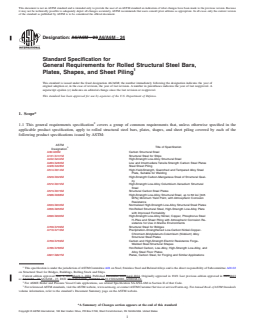
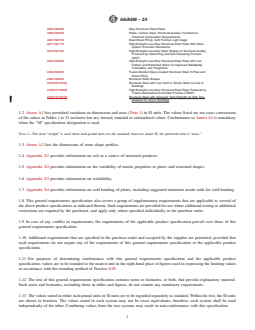
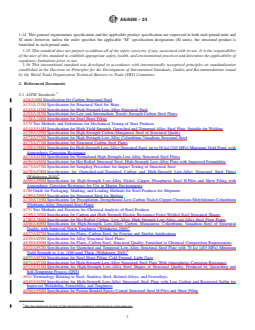
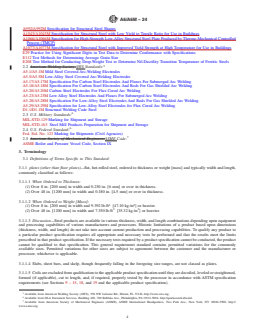
1.1 This general requirements specification2 covers a group of common requirements that, unless otherwise specified in the applicable product specification, apply to rolled structural steel bars, plates, shapes, and sheet piling covered by each of the following product specifications issued by ASTM:
ASTM
Designation3
Title of Specification
A36/A36M
Carbon Structural Steel
A131/A131M
Structural Steel for Ships
A242/A242M
High-Strength Low-Alloy Structural Steel
A283/A283M
Low and Intermediate Tensile Strength Carbon Steel Plates
A328/A328M
Steel Sheet Piling
A514/A514M
High-Yield-Strength, Quenched and Tempered Alloy Steel Plate, Suitable for Welding
A529/A529M
High-Strength Carbon-Manganese Steel of Structural Quality
A572/A572M
High-Strength Low-Alloy Columbium-Vanadium Structural Steel
A573/A573M
Structural Carbon Steel Plates
A588/A588M
High-Strength Low-Alloy Structural Steel, up to 50 ksi [345 MPa] Minimum Yield Point, with Atmospheric Corrosion Resistance
A633/A633M
Normalized High-Strength Low-Alloy Structural Steel Plates
A656/A656M
Hot-Rolled Structural Steel, High-Strength Low-Alloy Plate with Improved Formability
A690/A690M
High-Strength Low-Alloy Nickel, Copper, Phosphorus Steel H-Piles and Sheet Piling with Atmospheric Corrosion Resistance for Use in Marine Environments
A709/A709M
Structural Steel for Bridges
A710/A710M
Precipitation–Strengthened Low-Carbon Nickel-Copper-Chromium-Molybdenum-Columbium (Niobium) Alloy Structural Steel Plates
A769/A769M
Carbon and High-Strength Electric Resistance Forge-Welded Steel Structural Shapes
A786/A786M
Hot-Rolled Carbon, Low-Alloy, High-Strength Low-Alloy, and Alloy Steel Floor Plates
A827/A827M
Plates, Carbon Steel, for Forging and Similar Applications
A829/A829M
Alloy Structural Steel Plates
A830/A830M
Plates, Carbon Steel, Structural Quality, Furnished to Chemical Composition Requirements
A857/A857M
Steel Sheet Piling, Cold Formed, Light Gage
A871/A871M
High-Strength Low-Alloy Structural Steel Plate With Atmospheric Corrosion Resistance
A913/A913M
High-Strength Low-Alloy Steel Shapes of Structural Quality, Produced by Quenching and Self-Tempering Process (QST)
A945/A945M
High-Strength Low-Alloy Structural Steel Plate with Low Carbon and Restricted Sulfur for Improved Weldability, Formability, and Toughness
A950/A950M
Fusion-Bonded Epoxy-Coated Structural Steel H-Piles and Sheet Piling
A992/A992M
Structural Steel Shapes
A1043/A1043M
Structural Steel with Low Yield to Tensile Ratio for Use in Buildings
A1066/A1066M
High-Strength Low-Alloy Structural Steel Plate Produced by Thermo-Mechanical Controlled Process (TMCP)
A1077/A1077M
Structural Steel with improved Yield Strength at High Temperature for Use in Buildings
1.2 Annex A1 lists permitted variations in dimensions and mass (Note 1) in SI units...
- Status
- Published
- Publication Date
- 29-Feb-2024
- Technical Committee
- A01 - Steel, Stainless Steel and Related Alloys
Buy Documents
ASTM A6/A6M-24 - Standard Specification for General Requirements for Rolled Structural Steel Bars, Plates, Shapes, and Sheet Piling
REDLINE ASTM A6/A6M-24 - Standard Specification for General Requirements for Rolled Structural Steel Bars, Plates, Shapes, and Sheet Piling
Overview
ASTM A6/A6M-24: Standard Specification for General Requirements for Rolled Structural Steel Bars, Plates, Shapes, and Sheet Piling is a globally recognized ASTM standard developed for establishing common requirements for rolled structural steel products. This standard is vital for ensuring uniform quality, safety, and performance across a wide range of steel construction elements, including bars, plates, shapes, and sheet piling. Developed in line with international principles for standardization, ASTM A6/A6M-24 is widely referenced in the design and manufacture of structural steel used in infrastructure, buildings, bridges, industrial, and marine environments.
Key Topics
- Product Scope: Covers general requirements for a broad group of structural steel products, including rolled bars, plates, wide-flange shapes, channels, angles, and sheet piling.
- Manufacturing Methods: Steel must be produced using basic-oxygen, electric-arc, or open-hearth furnace, with optional secondary refining processes (like ladle metallurgy or vacuum remelting) to ensure product consistency and quality.
- Testing and Conformance:
- Mechanical properties such as tensile strength, yield strength, and elongation must meet specified requirements.
- Chemical analysis is mandatory to ensure the correct grade and composition.
- Dimensional tolerances and mass variations are specified, with clear guidance on SI and inch-pound measurement systems.
- Heat Treatment and Conditioning: Provides provisions for heat treatment and surface conditioning, ensuring the structural integrity and durability of the finished product.
- Marking and Traceability: Each product must be properly marked and tagged for traceability, including grade, manufacturer’s name, heat number, size, and other key identifiers.
Applications
ASTM A6/A6M-24 is foundational for a wide range of structural steel applications. Its practical value lies in providing a comprehensive, consistent reference applicable to:
- Building Construction: Structural steel plates, wide-flange beams, angles, and bars produced under ASTM A6/A6M-24 form the backbone of commercial, residential, and industrial buildings.
- Bridge Engineering: This standard governs the base requirements for high-strength plates and shapes used in pedestrian and vehicular bridges, ensuring safety and long-term durability.
- Shipbuilding: Many steel grades manufactured according to ASTM A6/A6M-24 are applied in naval and commercial vessels, especially where structural integrity is critical.
- Foundations and Marine Works: Steel sheet piling governed by this standard is essential in retaining walls, waterfront structures, and foundation stabilization projects.
- Specialty Structures: Applicable to towers, pipelines, supports, and other infrastructure where consistent mechanical properties and reliable documentation are required.
Purchasers, fabricators, engineers, and regulatory authorities rely on ASTM A6/A6M-24 to clarify material requirements, test methods, and marking protocols for project specifications and procurement.
Related Standards
ASTM A6/A6M-24 supports and references numerous product-specific ASTM standards to cover various structural steel types. Common related specifications include:
- ASTM A36/A36M: Carbon Structural Steel
- ASTM A992/A992M: Structural Steel Shapes for building framing
- ASTM A572/A572M: High-Strength Low-Alloy Columbium-Vanadium Structural Steel
- ASTM A588/A588M: Weathering Steel with atmospheric corrosion resistance
- ASTM A514/A514M: High-Yield-Strength, Quenched-and-Tempered Alloy Steel Plates
- ASTM A709/A709M: Structural Steel for Bridges
- ASTM A328/A328M: Steel Sheet Piling
- ASTM A131/A131M: Structural Steel for Ships
By aligning with ASTM A6/A6M-24, these standards ensure commonality and compatibility in quality, dimensions, marking, and testing across the wide spectrum of structural steel applications.
Keywords: ASTM A6/A6M-24, rolled structural steel, steel bars, steel plates, steel shapes, sheet piling, structural steel specification, steel standards, building steel requirements, steel product testing, steel heat treatment, steel marking, structural steel applications.
Relations
- Effective Date
- 01-Mar-2024
- Effective Date
- 01-Mar-2024
- Effective Date
- 15-Sep-2023
- Effective Date
- 01-Jun-2018
- Effective Date
- 01-Mar-2024
- Effective Date
- 01-Mar-2024
- Effective Date
- 01-Mar-2024
- Effective Date
- 01-Mar-2024
- Effective Date
- 01-Mar-2024
- Effective Date
- 01-Mar-2024
- Effective Date
- 01-Mar-2024
- Referred By
ASTM F1899-14a(2019) - Standard Specification for Food Waste Pulper Without Waterpress Assembly - Effective Date
- 01-Mar-2024
- Effective Date
- 01-Mar-2024
- Referred By
ASTM A264-12(2019) - Standard Specification for Stainless Chromium-Nickel Steel-Clad Plate - Effective Date
- 01-Mar-2024
- Effective Date
- 01-Mar-2024
Buy Documents
ASTM A6/A6M-24 - Standard Specification for General Requirements for Rolled Structural Steel Bars, Plates, Shapes, and Sheet Piling
REDLINE ASTM A6/A6M-24 - Standard Specification for General Requirements for Rolled Structural Steel Bars, Plates, Shapes, and Sheet Piling
Get Certified
Connect with accredited certification bodies for this standard

Element Materials Technology
Materials testing and product certification.

Inštitut za kovinske materiale in tehnologije
Institute of Metals and Technology. Materials testing, metallurgical analysis, NDT.
Sponsored listings
Frequently Asked Questions
ASTM A6/A6M-24 is a technical specification published by ASTM International. Its full title is "Standard Specification for General Requirements for Rolled Structural Steel Bars, Plates, Shapes, and Sheet Piling". This standard covers: ABSTRACT This specification deals with the general requirements that apply to rolled structural steel bars, plates, shapes, and sheet piling. The steel shall be made in an open-hearth, basic-oxygen, or electric-arc furnace followed by additional refining in a ladle metallurgy furnace, or secondary melting by vacuum-arc remelting or electrostag remelting. The steel products shall undergo heat treatment, structural conditioning, and strand casting in stationary molds. Tension testing and chemical analysis shall be performed wherein the specimens shall conform to the required mechanical properties such as tensile strength, yield strength and elongation, and the required metallurgical structure and composition specifications of the products. Final products shall be legibly marked, bundled, and tagged with the applicable designation, grade, heat number, size and thickness, and name, brand, or trademark of the manufacturer for identification and shipment. SCOPE 1.1 This general requirements specification2 covers a group of common requirements that, unless otherwise specified in the applicable product specification, apply to rolled structural steel bars, plates, shapes, and sheet piling covered by each of the following product specifications issued by ASTM: ASTM Designation3 Title of Specification A36/A36M Carbon Structural Steel A131/A131M Structural Steel for Ships A242/A242M High-Strength Low-Alloy Structural Steel A283/A283M Low and Intermediate Tensile Strength Carbon Steel Plates A328/A328M Steel Sheet Piling A514/A514M High-Yield-Strength, Quenched and Tempered Alloy Steel Plate, Suitable for Welding A529/A529M High-Strength Carbon-Manganese Steel of Structural Quality A572/A572M High-Strength Low-Alloy Columbium-Vanadium Structural Steel A573/A573M Structural Carbon Steel Plates A588/A588M High-Strength Low-Alloy Structural Steel, up to 50 ksi [345 MPa] Minimum Yield Point, with Atmospheric Corrosion Resistance A633/A633M Normalized High-Strength Low-Alloy Structural Steel Plates A656/A656M Hot-Rolled Structural Steel, High-Strength Low-Alloy Plate with Improved Formability A690/A690M High-Strength Low-Alloy Nickel, Copper, Phosphorus Steel H-Piles and Sheet Piling with Atmospheric Corrosion Resistance for Use in Marine Environments A709/A709M Structural Steel for Bridges A710/A710M Precipitation–Strengthened Low-Carbon Nickel-Copper-Chromium-Molybdenum-Columbium (Niobium) Alloy Structural Steel Plates A769/A769M Carbon and High-Strength Electric Resistance Forge-Welded Steel Structural Shapes A786/A786M Hot-Rolled Carbon, Low-Alloy, High-Strength Low-Alloy, and Alloy Steel Floor Plates A827/A827M Plates, Carbon Steel, for Forging and Similar Applications A829/A829M Alloy Structural Steel Plates A830/A830M Plates, Carbon Steel, Structural Quality, Furnished to Chemical Composition Requirements A857/A857M Steel Sheet Piling, Cold Formed, Light Gage A871/A871M High-Strength Low-Alloy Structural Steel Plate With Atmospheric Corrosion Resistance A913/A913M High-Strength Low-Alloy Steel Shapes of Structural Quality, Produced by Quenching and Self-Tempering Process (QST) A945/A945M High-Strength Low-Alloy Structural Steel Plate with Low Carbon and Restricted Sulfur for Improved Weldability, Formability, and Toughness A950/A950M Fusion-Bonded Epoxy-Coated Structural Steel H-Piles and Sheet Piling A992/A992M Structural Steel Shapes A1043/A1043M Structural Steel with Low Yield to Tensile Ratio for Use in Buildings A1066/A1066M High-Strength Low-Alloy Structural Steel Plate Produced by Thermo-Mechanical Controlled Process (TMCP) A1077/A1077M Structural Steel with improved Yield Strength at High Temperature for Use in Buildings 1.2 Annex A1 lists permitted variations in dimensions and mass (Note 1) in SI units...
ABSTRACT This specification deals with the general requirements that apply to rolled structural steel bars, plates, shapes, and sheet piling. The steel shall be made in an open-hearth, basic-oxygen, or electric-arc furnace followed by additional refining in a ladle metallurgy furnace, or secondary melting by vacuum-arc remelting or electrostag remelting. The steel products shall undergo heat treatment, structural conditioning, and strand casting in stationary molds. Tension testing and chemical analysis shall be performed wherein the specimens shall conform to the required mechanical properties such as tensile strength, yield strength and elongation, and the required metallurgical structure and composition specifications of the products. Final products shall be legibly marked, bundled, and tagged with the applicable designation, grade, heat number, size and thickness, and name, brand, or trademark of the manufacturer for identification and shipment. SCOPE 1.1 This general requirements specification2 covers a group of common requirements that, unless otherwise specified in the applicable product specification, apply to rolled structural steel bars, plates, shapes, and sheet piling covered by each of the following product specifications issued by ASTM: ASTM Designation3 Title of Specification A36/A36M Carbon Structural Steel A131/A131M Structural Steel for Ships A242/A242M High-Strength Low-Alloy Structural Steel A283/A283M Low and Intermediate Tensile Strength Carbon Steel Plates A328/A328M Steel Sheet Piling A514/A514M High-Yield-Strength, Quenched and Tempered Alloy Steel Plate, Suitable for Welding A529/A529M High-Strength Carbon-Manganese Steel of Structural Quality A572/A572M High-Strength Low-Alloy Columbium-Vanadium Structural Steel A573/A573M Structural Carbon Steel Plates A588/A588M High-Strength Low-Alloy Structural Steel, up to 50 ksi [345 MPa] Minimum Yield Point, with Atmospheric Corrosion Resistance A633/A633M Normalized High-Strength Low-Alloy Structural Steel Plates A656/A656M Hot-Rolled Structural Steel, High-Strength Low-Alloy Plate with Improved Formability A690/A690M High-Strength Low-Alloy Nickel, Copper, Phosphorus Steel H-Piles and Sheet Piling with Atmospheric Corrosion Resistance for Use in Marine Environments A709/A709M Structural Steel for Bridges A710/A710M Precipitation–Strengthened Low-Carbon Nickel-Copper-Chromium-Molybdenum-Columbium (Niobium) Alloy Structural Steel Plates A769/A769M Carbon and High-Strength Electric Resistance Forge-Welded Steel Structural Shapes A786/A786M Hot-Rolled Carbon, Low-Alloy, High-Strength Low-Alloy, and Alloy Steel Floor Plates A827/A827M Plates, Carbon Steel, for Forging and Similar Applications A829/A829M Alloy Structural Steel Plates A830/A830M Plates, Carbon Steel, Structural Quality, Furnished to Chemical Composition Requirements A857/A857M Steel Sheet Piling, Cold Formed, Light Gage A871/A871M High-Strength Low-Alloy Structural Steel Plate With Atmospheric Corrosion Resistance A913/A913M High-Strength Low-Alloy Steel Shapes of Structural Quality, Produced by Quenching and Self-Tempering Process (QST) A945/A945M High-Strength Low-Alloy Structural Steel Plate with Low Carbon and Restricted Sulfur for Improved Weldability, Formability, and Toughness A950/A950M Fusion-Bonded Epoxy-Coated Structural Steel H-Piles and Sheet Piling A992/A992M Structural Steel Shapes A1043/A1043M Structural Steel with Low Yield to Tensile Ratio for Use in Buildings A1066/A1066M High-Strength Low-Alloy Structural Steel Plate Produced by Thermo-Mechanical Controlled Process (TMCP) A1077/A1077M Structural Steel with improved Yield Strength at High Temperature for Use in Buildings 1.2 Annex A1 lists permitted variations in dimensions and mass (Note 1) in SI units...
ASTM A6/A6M-24 is classified under the following ICS (International Classification for Standards) categories: 77.140.60 - Steel bars and rods. The ICS classification helps identify the subject area and facilitates finding related standards.
ASTM A6/A6M-24 has the following relationships with other standards: It is inter standard links to ASTM A6/A6M-23, ASTM A370-24, ASTM A370-23, ASTM A633/A633M-18, ASTM A1077/A1077M-21, ASTM A572/A572M-21e1, ASTM A709/A709M-21, ASTM F3215-22, ASTM B432-19, ASTM A690/A690M-13a(2018), ASTM A263-12(2019), ASTM F1899-14a(2019), ASTM A1069/A1069M-23, ASTM A264-12(2019), ASTM A573/A573M-20. Understanding these relationships helps ensure you are using the most current and applicable version of the standard.
ASTM A6/A6M-24 is available in PDF format for immediate download after purchase. The document can be added to your cart and obtained through the secure checkout process. Digital delivery ensures instant access to the complete standard document.
Standards Content (Sample)
This international standard was developed in accordance with internationally recognized principles on standardization established in the Decision on Principles for the
Development of International Standards, Guides and Recommendations issued by the World Trade Organization Technical Barriers to Trade (TBT) Committee.
Designation: A6/A6M − 24
Standard Specification for
General Requirements for Rolled Structural Steel Bars,
Plates, Shapes, and Sheet Piling
This standard is issued under the fixed designation A6/A6M; the number immediately following the designation indicates the year of
original adoption or, in the case of revision, the year of last revision. A number in parentheses indicates the year of last reapproval. A
superscript epsilon (´) indicates an editorial change since the last revision or reapproval.
This standard has been approved for use by agencies of the U.S. Department of Defense.
1. Scope*
A827/A827M Plates, Carbon Steel, for Forging and Similar Applications
A829/A829M Alloy Structural Steel Plates
1.1 This general requirements specification covers a group
A830/A830M Plates, Carbon Steel, Structural Quality, Furnished to
of common requirements that, unless otherwise specified in the Chemical Composition Requirements
A857/A857M Steel Sheet Piling, Cold Formed, Light Gage
applicable product specification, apply to rolled structural steel
A871/A871M High-Strength Low-Alloy Structural Steel Plate With Atmo-
bars, plates, shapes, and sheet piling covered by each of the
spheric Corrosion Resistance
following product specifications issued by ASTM: A913/A913M High-Strength Low-Alloy Steel Shapes of Structural Quality,
Produced by Quenching and Self-Tempering Process
ASTM
(QST)
Title of Specification
Designation
A945/A945M High-Strength Low-Alloy Structural Steel Plate with Low
A36/A36M Carbon Structural Steel
Carbon and Restricted Sulfur for Improved Weldability,
A131/A131M Structural Steel for Ships
Formability, and Toughness
A242/A242M High-Strength Low-Alloy Structural Steel
A950/A950M Fusion-Bonded Epoxy-Coated Structural Steel H-Piles and
A283/A283M Low and Intermediate Tensile Strength Carbon Steel Plates
Sheet Piling
A328/A328M Steel Sheet Piling
A992/A992M Structural Steel Shapes
A514/A514M High-Yield-Strength, Quenched and Tempered Alloy Steel
A1043/A1043M Structural Steel with Low Yield to Tensile Ratio for Use in
Plate, Suitable for Welding
Buildings
A529/A529M High-Strength Carbon-Manganese Steel of Structural Qual-
A1066/A1066M High-Strength Low-Alloy Structural Steel Plate Produced by
ity
Thermo-Mechanical Controlled Process (TMCP)
A572/A572M High-Strength Low-Alloy Columbium-Vanadium Structural
A1077/A1077M Structural Steel with improved Yield Strength at High Tem-
Steel
perature for Use in Buildings
A573/A573M Structural Carbon Steel Plates
A588/A588M High-Strength Low-Alloy Structural Steel, up to 50 ksi [345
1.2 Annex A1 lists permitted variations in dimensions and
MPa] Minimum Yield Point, with Atmospheric Corrosion
mass (Note 1) in SI units. The values listed are not exact
Resistance
conversions of the values in Tables 1 to 31 inclusive but are,
A633/A633M Normalized High-Strength Low-Alloy Structural Steel Plates
A656/A656M Hot-Rolled Structural Steel, High-Strength Low-Alloy Plate
instead, rounded or rationalized values. Conformance to Annex
with Improved Formability
A1 is mandatory when the “M” specification designation is
A690/A690M High-Strength Low-Alloy Nickel, Copper, Phosphorus Steel
H-Piles and Sheet Piling with Atmospheric Corrosion Re- used.
sistance for Use in Marine Environments
A709/A709M Structural Steel for Bridges
NOTE 1—The term “weight” is used when inch-pound units are the
A710/A710M Precipitation–Strengthened Low-Carbon Nickel-Copper-
standard; however, under SI, the preferred term is “mass.”
Chromium-Molybdenum-Columbium (Niobium) Alloy
Structural Steel Plates
1.3 Annex A2 lists the dimensions of some shape profiles.
A769/A769M Carbon and High-Strength Electric Resistance Forge-
Welded Steel Structural Shapes
1.4 Appendix X1 provides information on coil as a source
A786/A786M Hot-Rolled Carbon, Low-Alloy, High-Strength Low-Alloy, and
of structural products.
Alloy Steel Floor Plates
1.5 Appendix X2 provides information on the variability of
tensile properties in plates and structural shapes.
This specification is under the jurisdiction of ASTM Committee A01 on Steel,
1.6 Appendix X3 provides information on weldability.
Stainless Steel and Related Alloys and is the direct responsibility of Subcommittee
A01.02 on Structural Steel for Bridges, Buildings, Rolling Stock and Ships.
1.7 Appendix X4 provides information on cold bending of
Current edition approved March 1, 2024. Published April 2024. Originally
approved in 1949. Last previous edition approved in 2023 as A6/A6M – 23. DOI: plates, including suggested minimum inside radii for cold
10.1520/A0006_A0006M-24.
bending.
For ASME Boiler and Pressure Vessel Code applications, see related Specifi-
cation SA-6/SA-6M in Section II of that Code.
1.8 This general requirements specification also covers a
For referenced ASTM standards, visit the ASTM website, www.astm.org, or
group of supplementary requirements that are applicable to
contact ASTM Customer Service at service@astm.org. For Annual Book of ASTM
several of the above product specifications as indicated therein.
Standards volume information, refer to the standard’s Document Summary page on
the ASTM website. Such requirements are provided for use where additional
*A Summary of Changes section appears at the end of this standard
Copyright © ASTM International, 100 Barr Harbor Drive, PO Box C700, West Conshohocken, PA 19428-2959. United States
A6/A6M − 24
testing or additional restrictions are required by the purchaser, A514/A514M Specification for High-Yield-Strength,
and apply only where specified individually in the purchase Quenched and Tempered Alloy Steel Plate, Suitable for
order. Welding
A529/A529M Specification for High-Strength Carbon-
1.9 In case of any conflict in requirements, the requirements
Manganese Steel of Structural Quality
of the applicable product specification prevail over those of this
A572/A572M Specification for High-Strength Low-Alloy
general requirements specification.
Columbium-Vanadium Structural Steel
1.10 Additional requirements that are specified in the pur-
A573/A573M Specification for Structural Carbon Steel
chase order and accepted by the supplier are permitted,
Plates
provided that such requirements do not negate any of the
A588/A588M Specification for High-Strength Low-Alloy
requirements of this general requirements specification or the
Structural Steel, up to 50 ksi [345 MPa] Minimum Yield
applicable product specification.
Point, with Atmospheric Corrosion Resistance
A633/A633M Specification for Normalized High-Strength
1.11 For purposes of determining conformance with this
general requirements specification and the applicable product Low-Alloy Structural Steel Plates
A656/A656M Specification for Hot-Rolled Structural Steel,
specification, values are to be rounded to the nearest unit in the
High-Strength Low-Alloy Plate with Improved Formabil-
right-hand place of figures used in expressing the limiting
ity
values in accordance with the rounding method of Practice
A673/A673M Specification for Sampling Procedure for Im-
E29.
pact Testing of Structural Steel
1.12 The text of this general requirements specification
A678/A678M Specification for Quenched-and-Tempered
contains notes or footnotes, or both, that provide explanatory
Carbon and High-Strength Low-Alloy Structural Steel
material. Such notes and footnotes, excluding those in tables
Plates (Withdrawn 2010)
and figures, do not contain any mandatory requirements.
A690/A690M Specification for High-Strength Low-Alloy
1.13 The values stated in either inch-pound units or SI units
Nickel, Copper, Phosphorus Steel H-Piles and Sheet
are to be regarded separately as standard. Within the text, the
Piling with Atmospheric Corrosion Resistance for Use in
SI units are shown in brackets. The values stated in each
Marine Environments
system may not be exact equivalents; therefore, each system
A700 Guide for Packaging, Marking, and Loading Methods
shall be used independently of the other. Combining values
for Steel Products for Shipment
from the two systems may result in non-conformance with this
A709/A709M Specification for Structural Steel for Bridges
specification.
A710/A710M Specification for Precipitation–Strengthened
Low-Carbon Nickel-Copper-Chromium-Molybdenum-
1.14 This general requirements specification and the appli-
Columbium (Niobium) Alloy Structural Steel Plates
cable product specification are expressed in both inch-pound
A751 Test Methods and Practices for Chemical Analysis of
units and SI units; however, unless the order specifies the
Steel Products
applicable “M” specification designation (SI units), the struc-
A769/A769M Specification for Carbon and High-Strength
tural product is furnished to inch-pound units.
Electric Resistance Forge-Welded Steel Structural Shapes
1.15 This standard does not purport to address all of the
A786/A786M Specification for Hot-Rolled Carbon, Low-
safety concerns, if any, associated with its use. It is the
Alloy, High-Strength Low-Alloy, and Alloy Steel Floor
responsibility of the user of this standard to establish appro-
Plates
priate safety, health, and environmental practices and deter-
A808/A808M Specification for High-Strength, Low-Alloy
mine the applicability of regulatory limitations prior to use.
Carbon, Manganese, Columbium, Vanadium Steel of
1.16 This international standard was developed in accor-
Structural Quality with Improved Notch Toughness (With-
dance with internationally recognized principles on standard-
drawn 2005)
ization established in the Decision on Principles for the
A827/A827M Specification for Plates, Carbon Steel, for
Development of International Standards, Guides and Recom-
Forging and Similar Applications
mendations issued by the World Trade Organization Technical
A829/A829M Specification for Alloy Structural Steel Plates
Barriers to Trade (TBT) Committee.
A830/A830M Specification for Plates, Carbon Steel, Struc-
tural Quality, Furnished to Chemical Composition Re-
2. Referenced Documents
quirements
2.1 ASTM Standards:
A852/A852M Specification for Quenched and Tempered
A36/A36M Specification for Carbon Structural Steel
Low-Alloy Structural Steel Plate with 70 ksi [485 MPa]
A131/A131M Specification for Structural Steel for Ships
Minimum Yield Strength to 4 in. [100 mm] Thick (With-
A242/A242M Specification for High-Strength Low-Alloy
drawn 2010)
Structural Steel
A857/A857M Specification for Steel Sheet Piling, Cold
A283/A283M Specification for Low and Intermediate Ten-
Formed, Light Gage
sile Strength Carbon Steel Plates
A328/A328M Specification for Steel Sheet Piling
A370 Test Methods and Definitions for Mechanical Testing
The last approved version of this historical standard is referenced on
of Steel Products www.astm.org.
A6/A6M − 24
A871/A871M Specification for High-Strength Low-Alloy 2.5 ASME Code:
Structural Steel Plate With Atmospheric Corrosion Resis- ASME Boiler and Pressure Vessel Code, Section IX
tance
A913/A913M Specification for High-Strength Low-Alloy 3. Terminology
Steel Shapes of Structural Quality, Produced by Quench-
3.1 Definitions of Terms Specific to This Standard:
ing and Self-Tempering Process (QST)
3.1.1 plates (other than floor plates)—flat, hot-rolled steel,
A941 Terminology Relating to Steel, Stainless Steel, Related
ordered to thickness or weight [mass] and typically width and
Alloys, and Ferroalloys
length, commonly classified as follows:
A945/A945M Specification for High-Strength Low-Alloy
3.1.1.1 When Ordered to Thickness:
Structural Steel Plate with Low Carbon and Restricted
(1) Over 8 in. [200 mm] in width and 0.230 in. [6 mm] or
Sulfur for Improved Weldability, Formability, and Tough-
over in thickness.
ness
(2) Over 48 in. [1200 mm] in width and 0.180 in. [4.5 mm]
A950/A950M Specification for Fusion-Bonded Epoxy-
or over in thickness.
Coated Structural Steel H-Piles and Sheet Piling
3.1.1.2 When Ordered to Weight [Mass]:
A992/A992M Specification for Structural Steel Shapes
(1) Over 8 in. [200 mm] in width and 9.392 lb ⁄ft
A1043/A1043M Specification for Structural Steel with Low
[47.10 kg ⁄m ] or heavier.
Yield to Tensile Ratio for Use in Buildings
(2) Over 48 in. [1200 mm] in width and 7.350 lb ⁄ft
A1066/A1066M Specification for High-Strength Low-Alloy
[35.32 kg ⁄m ] or heavier.
Structural Steel Plate Produced by Thermo-Mechanical
3.1.1.3 Discussion—Steel products are available in various
Controlled Process (TMCP)
thickness, width, and length combinations depending upon
A1077/A1077M Specification for Structural Steel with Im-
equipment and processing capabilities of various manufactur-
proved Yield Strength at High Temperature for Use in
ers and processors. Historic limitations of a product based upon
Buildings
dimensions (thickness, width, and length) do not take into
E29 Practice for Using Significant Digits in Test Data to
account current production and processing capabilities. To
Determine Conformance with Specifications
qualify any product to a particular product specification re-
E112 Test Methods for Determining Average Grain Size
quires all appropriate and necessary tests be performed and that
E208 Test Method for Conducting Drop-Weight Test to
the results meet the limits prescribed in that product specifi-
Determine Nil-Ductility Transition Temperature of Fer-
cation. If the necessary tests required by a product specification
ritic Steels
cannot be conducted, the product cannot be qualified to that
2.2 AWS Standards:
specification. This general requirement standard contains per-
A5.1/A5.1M Mild Steel Covered Arc-Welding Electrodes
mitted variations for the commonly available sizes. Permitted
A5.5/A5.5M Low-Alloy Steel Covered Arc-Welding Elec-
variations for other sizes are subject to agreement between the
trodes
customer and the manufacturer or processor, whichever is
A5.17/A5.17M Specification For Carbon Steel Electrodes
applicable.
And Fluxes For Submerged Arc Welding
3.1.1.4 Slabs, sheet bars, and skelp, though frequently
A5.18/A5.18M Specification For Carbon Steel Electrodes
falling in the foregoing size ranges, are not classed as plates.
And Rods For Gas Shielded Arc Welding
3.1.1.5 Coils are excluded from qualification to the appli-
A5.20/A5.20M Carbon Steel Electrodes For Flux Cored Arc
cable product specification until they are decoiled, leveled or
Welding
straightened, formed (if applicable), cut to length, and, if
A5.23/A5.23M Low Alloy Steel Electrodes And Fluxes For
required, properly tested by the processor in accordance with
Submerged Arc Welding
ASTM specification requirements (see Sections 9 – 15, 18, and
A5.28/A5.28M Specification For Low-Alloy Steel Elec-
19 and the applicable product specification).
trodes And Rods For Gas Shielded Arc Welding
A5.29/A5.29M Specification for Low-Alloy Steel Elec- 3.1.2 Shapes (Flanged Sections):
trodes for Flux Cored Arc Welding
3.1.2.1 structural-size shapes—rolled flanged sections hav-
D1.1/D1.1M Structural Welding Code Steel
ing at least one dimension of the cross section 3 in. [75 mm] or
greater.
2.3 U.S. Military Standards:
MIL-STD-129 Marking for Shipment and Storage 3.1.2.2 bar-size shapes—rolled flanged sections having a
MIL-STD-163 Steel Mill Products Preparation for Ship- maximum dimension of the cross section less than 3 in.
ment and Storage [75 mm].
3.1.2.3 “W” shapes—doubly-symmetric, wide-flange
2.4 U.S. Federal Standard:
shapes with inside flange surfaces that are substantially paral-
Fed. Std. No. 123 Marking for Shipments (Civil Agencies)
lel.
Available from American Welding Society (AWS), 550 NW LeJeune Rd.,
Miami, FL 33126, http://www.aws.org. Available from American Society of Mechanical Engineers (ASME), ASME
Available from DLA Document Services, Building 4/D, 700 Robbins Ave., International Headquarters, Two Park Ave., New York, NY 10016-5990, http://
Philadelphia, PA 19111-5094, http://quicksearch.dla.mil. www.asme.org.
A6/A6M − 24
3.1.2.4 “HP” shapes—are wide-flange shapes generally 3.1.13 gas cut edge—the edge produced by gas flame
used as bearing piles whose flanges and webs are of the same cutting.
nominal thickness and whose depth and width are essentially
3.1.14 special cut edge—usually the edge produced by gas
the same.
flame cutting involving special practices such as pre-heating or
3.1.2.5 “S” shapes—doubly-symmetric beam shapes with
post-heating, or both, in order to minimize stresses, avoid
inside flange surfaces that have a slope of approximately
thermal cracking and reduce the hardness of the gas cut edge.
16 ⁄3 %.
In special instances, special cut edge is used to designate an
3.1.2.6 “M” shapes—doubly-symmetric shapes that cannot
edge produced by machining.
be classified as “W,” “S,” or “HP” shapes.
3.1.15 sketch—when used to describe a form of plate,
3.1.2.7 “C” shapes—channels with inside flange surfaces
denotes a plate other than rectangular, circular, or semi-
that have a slope of approximately 16 ⁄3 %.
circular.
3.1.2.8 “MC” shapes—channels that cannot be classified as
3.1.16 normalizing—a heat treating process in which a steel
“C” shapes.
plate is reheated to a uniform temperature above the upper
3.1.2.9 “L” shapes—shapes having equal-leg and unequal-
critical temperature and then cooled in air to below the
leg angles.
transformation range.
3.1.3 sheet piling—rolled steel sections that are capable of
3.1.17 plate-as-rolled—when used in relation to the location
being interlocked, forming a continuous wall when individual
and number of tests, the term refers to the unit plate rolled from
pieces are driven side by side.
a slab or directly from an ingot. It does not refer to the
3.1.4 bars—rounds, squares, and hexagons, of all sizes; flats
condition of the plate.
⁄64 in. [0.203 in.] and over [over 5 mm] in specified thickness,
3.1.18 fine grain practice—a steelmaking practice for other
not over 6 in. [150 mm] in specified width; and flats 0.230 in.
than stainless steel that is intended to produce a killed steel that
and over [over 6 mm] in specified thickness, over 6 in. to 8 in.
is capable of meeting the requirements for fine austenite grain
[150 mm to 200 mm] inclusive, in specified width.
size when and if the as-rolled or as-forged product is reheated
3.1.5 exclusive—when used in relation to ranges, as for
to a temperature at or above the transformation temperature,
ranges of thickness in the tables of permissible variations in
Ac3.
dimensions, is intended to exclude only the greater value of the
3.1.18.1 Discussion—When stated as a requirement, fine
range. Thus, a range from 60 in. to 72 in. [1500 mm to
grain practice normally involves the addition of one or more
1800 mm] exclusive includes 60 in. [1500 mm], but does not
austenitic grain refining elements in amounts that have been
include 72 in. [1800 mm].
established by the steel producer as being sufficient. Austenite
3.1.6 rimmed steel—steel containing sufficient oxygen to
grain refining elements include, but are not limited to,
give a continuous evolution of carbon monoxide during
aluminum, columbium (niobium), titanium, and vanadium. A
solidification, resulting in a case or rim of metal virtually free
fine grain practice requirement (1) does not specify a minimum
of voids.
austenite grain refining element addition; (2) does not require
prior austenite grain size testing; (3) does not require meeting
3.1.7 semi-killed steel—incompletely deoxidized steel con-
any prior austenite grain size test result; and (4) does not apply
taining sufficient oxygen to form enough carbon monoxide
to, nor in any way control, the prior austenite grain size or the
during solidification to offset solidification shrinkage.
ferrite grain size of the steel in the as-rolled or as-forged
3.1.8 capped steel—rimmed steel in which the rimming
condition. The prior austenite grain size and the ferrite grain
action is limited by an early capping operation. Capping is
size of as-rolled or as-forged steel products are controlled by
carried out mechanically by using a heavy metal cap on a
the manufacturing process and may be assisted by suitable
bottle-top mold or chemically by an addition of aluminum or
chemistry. The appropriate manufacturing process controls
ferrosilicon to the top of the molten steel in an open-top mold.
needed to meet the mechanical property requirements of the
3.1.9 killed steel—steel deoxidized, either by addition of
specification in the as-rolled or as-forged condition are neither
strong deoxidizing agents or by vacuum treatment, to reduce defined nor implied by the inclusion of a fine grain practice
the oxygen content to such a level that no reaction occurs
requirement.
between carbon and oxygen during solidification.
3.1.19 structural product—a hot-rolled steel plate, shape,
3.1.10 mill edge—the normal edge produced by rolling
sheet piling, or bar.
between horizontal finishing rolls. A mill edge does not
3.1.20 coil—hot-rolled steel in coiled form that is intended
conform to any definite contour. Mill edge plates have two mill
to be processed into a finished structural product.
edges and two trimmed edges.
3.1.21 manufacturer—the organization that directly controls
3.1.11 universal mill edge—the normal edge produced by
the conversion of steel ingots, slabs, blooms, or billets, by
rolling between horizontal and vertical finishing rolls. Univer-
hot-rolling, into an as-rolled structural product or into coil; and
sal mill plates, sometimes designated UM Plates, have two
for structural products produced from as-rolled structural
universal mill edges and two trimmed edges.
products, the organization that directly controls, or is respon-
3.1.12 sheared edge—the normal edge produced by shear- sible for, the operations involved in finishing the structural
ing. Sheared edge plates are trimmed on all edges. product.
A6/A6M − 24
3.1.21.1 Discussion—Such finishing operations include lev- 5. Materials and Manufacture
eling or straightening, hot forming or cold forming (if
5.1 The steel shall be made in a basic-oxygen or electric-arc
applicable), welding (if applicable), cutting to length, testing,
furnace, possibly followed by additional refining in a ladle
inspection, conditioning, heat treatment (if applicable),
metallurgy furnace (LMF) or secondary melting by vacuum-
packaging, marking, loading for shipment, and certification.
arc remelting (VAR) or electroslag remelting (ESR).
3.1.22 processor—the organization that directly controls, or
5.2 The steel shall be killed.
is responsible for, the operations involved in the processing of
5.3 The steel shall be strand cast or cast in stationary molds.
coil into a finished structural product. Such processing opera-
5.3.1 Strand Cast:
tions include decoiling, leveling or straightening, hot-forming
5.3.1.1 When heats of the same nominal chemical compo-
or cold-forming (if applicable), welding (if applicable), cutting
sition are consecutively strand cast at one time, the heat
to length, testing, inspection, conditioning, heat treatment (if
number assigned to the cast product need not be changed until
applicable), packaging, marking, loading for shipment, and
all of the steel in the cast product is from the following heat.
certification.
5.3.1.2 When two consecutively strand cast heats have
3.1.22.1 Discussion—The processing operations need not be
different nominal chemical composition ranges, the manufac-
done by the organization that did the hot rolling of the coil. If
turer shall remove the transition material by an established
only one organization is involved in the hot rolling and
procedure that positively separates the grades.
processing operations, that organization is termed the manu-
5.4 Structural products shall be produced from an as-rolled
facturer for the hot rolling operation and the processor for the
structural product or from coil.
processing operations. If more than one organization is in-
volved in the hot rolling and processing operations, the
5.5 Where part of a heat is rolled into an as-rolled structural
organization that did the hot rolling is termed the manufacturer
product and the balance of the heat is rolled into coil, each part
and an organization that does one or more processing opera-
shall be tested separately.
tions is termed a processor.
5.6 Structural products produced from coil shall not contain
3.2 Refer to Terminology A941 for additional definitions of
splice welds, unless previously approved by the purchaser.
terms used in this standard.
6. Heat Treatment
6.1 Where the structural product is required to be heat
4. Ordering Information
treated, such heat treatment shall be performed by the
4.1 Information items to be considered, if appropriate, for
manufacturer, the processor, or the fabricator, unless otherwise
inclusion in purchase orders are as follows:
specified in the applicable product specification.
4.1.1 ASTM product specification designation (see 1.1) and
NOTE 2—When no heat treatment is required, the manufacturer or
year-date;
processor has the option of heat treating the structural product by
4.1.2 Name of structural product (plate, shape, bar, or sheet
normalizing, stress relieving, or normalizing then stress relieving to meet
piling); the applicable product specification.
4.1.3 Shape designation, or size and thickness or diameter;
6.2 Where the heat treatment is to be performed by other
4.1.4 Grade, class, and type designation, if applicable; than the manufacturer, the order shall so state.
6.2.1 Where the heat treatment is to be performed by other
4.1.5 Condition (see Section 6), if other than as-rolled;
than the manufacturer, the structural products shall be accepted
4.1.6 Quantity (weight [mass] or number of pieces);
on the basis of tests made on test specimens taken from full
4.1.7 Length;
thickness test coupons heat treated in accordance with the
4.1.8 Exclusion of either structural product produced from
requirements specified in the applicable product specification
coil or structural product produced from an as-rolled structural
or in the purchase order. If the heat-treatment temperatures are
product (see 5.4 and Appendix X1), if applicable;
not specified, the manufacturer or processor shall heat treat the
4.1.9 Heat treatment requirements (see 6.2 and 6.3), if any;
test coupons under conditions the manufacturer or processor
4.1.10 Testing for fine austenitic grain size (see 8.3.2);
considers appropriate, provided that the purchaser is informed
4.1.11 Mechanical property test report requirements (see
of the procedure followed in heat treating the test coupons.
Section 14), if any;
6.3 Where the heat treatment is to be performed by the
4.1.12 Special packaging, marking, and loading for ship-
manufacturer or the processor, the structural product shall be
ment requirements (see Section 19), if any;
heat treated as specified in the applicable product specification,
4.1.13 Supplementary requirements, if any, including any
or as specified in the purchase order, provided that the heat
additional requirements called for in the supplementary re-
treatment specified by the purchaser is not in conflict with the
quirements;
requirements of the applicable product specification.
4.1.14 End use, if there are any end-use-specific require-
6.4 Where normalizing is to be performed by the fabricator,
ments (see 18.1, 11.3.4, Table 22 or Table A1.22, and Table 24
the structural product shall be either normalized or heated
or Table A1.24);
uniformly for hot forming, provided that the temperature to
4.1.15 Special requirements (see 1.10), if any; and
which the structural product is heated for hot forming does not
4.1.16 Repair welding requirements (see 9.5), if any. significantly exceed the normalizing temperature.
A6/A6M − 24
6.5 The use of cooling rates that are faster than those 7.4 Grade Substitution—Alloy steel grades that meet the
obtained by cooling in air to improve the toughness shall be chemical requirements of Table 1 of Specification A829/
subject to approval by the purchaser, and structural products so A829M shall not be substituted for carbon steel grades.
treated shall be tempered subsequently in the range from
8. Metallurgical Structure
1100 °F to 1300 °F [595 °C to 705 °C].
8.1 Where austenitic grain size testing is required, such
testing shall be in accordance with Test Methods E112 and at
7. Chemical Analysis
least 70 % of the grains in the area examined shall meet the
7.1 Heat Analysis:
specified grain size requirement.
7.1.1 Sampling for chemical analysis and methods of analy-
8.1.1 Discussion—Austenitic Grain Size—All requirements
sis shall be in accordance with Test Methods, Practices, and
for austenitic grain size control in Section 8, Metallurgical
Terminology A751.
Structure, refer to a size of austenite grains that form when and
7.1.2 For each heat, the heat analysis shall include determi-
if the structural product is reheated to a temperature at or above
nation of the content of carbon, manganese, phosphorus, sulfur,
the transformation temperature, Ac , after the product has
silicon, nickel, chromium, molybdenum, copper, vanadium,
experienced the complete rolling operation and has cooled to
columbium (niobium); any other element that is specified or
ambient temperature. The requirements for austenitic grain size
restricted by the applicable product specification for the
control in Section 8, including the results of the referenced
applicable grade, class, and type; and any austenitic grain
testing methods, do not measure or control the prior austenitic
refining element whose content is to be used in place of
grain size or the ferritic grain size of the structural product in
austenitic grain size testing of the heat (see 8.3.2). Boron shall
the as-rolled condition.
be reported if intentionally added.
8.2 Coarse Austenitic Grain Size—Where coarse austenitic
NOTE 3—For steels that do not have intentional boron additions for
grain size is specified, one austenitic grain size test per heat
hardenability, the boron content will not normally exceed 0.0008 %.
shall be made and the austenitic grain size number so deter-
7.1.3 Except as allowed by 7.1.4 for primary heats, heat
mined shall be in the range of 1 to 5 inclusive.
analyses shall conform to the heat analysis requirements of the
8.3 Fine Austenitic Grain Size:
applicable product specification for the applicable grade, class,
8.3.1 Where fine austenitic grain size is specified, except as
and type.
allowed in 8.3.2, one austenitic grain size test per heat shall be
7.1.4 Where vacuum-arc remelting or electroslag remelting
made and the austenitic grain size number so determined shall
is used, a remelted heat is defined as all ingots remelted from
be 5 or higher.
a single primary heat. If the heat analysis of the primary heat
conforms to the heat analysis requirements of the applicable NOTE 4—Such austenitic grain size numbers may be achieved with
lower contents of austenitic grain refining elements than 8.3.2 requires for
product specification for the applicable grade, class, and type,
austenitic grain size testing to be waived.
the heat analysis for the remelted heat shall be determined from
8.3.2 Unless testing for fine austenitic grain size is specified
one test sample taken from one remelted ingot, or the product
in the purchase order, an austenitic grain size test need not be
of one remelted ingot, from the primary heat. If the heat
made for any heat that has, by heat analysis, one or more of the
analysis of the primary heat does not conform to the heat
following:
analysis requirements of the applicable product specification
8.3.2.1 A total aluminum content of 0.020 % or more.
for the applicable grade, type, and class, the heat analysis for
8.3.2.2 An acid soluble aluminum content of 0.015 % or
the remelted heat shall be determined from one test sample
more.
taken from each remelted ingot, or the product of each
8.3.2.3 A content for an austenitic grain refining element
remelted ingot, from the primary heat.
that exceeds the minimum value agreed to by the purchaser as
7.2 Product Analysis—For each heat, the purchaser shall
being sufficient for austenitic grain size testing to be waived, or
have the option of analyzing representative samples taken from
8.3.2.4 Contents for the combination of two or more auste-
the finished structural product. Sampling for chemical analysis
nitic grain refining elements that exceed the applicable mini-
and methods of analysis shall be in accordance with Test
mum values agreed to by the purchaser as being sufficient for
Methods, Practices, and Terminology A751. The product
austenitic grain size testing to be waived.
analyses so determined shall conform to the heat analysis
requirements of the applicable product specification for the 9. Quality
applicable grade, class, and type, subject to the permitted
9.1 General—Structural products shall be free of injurious
variations in product analysis given in Table A. If a range is
defects and shall have a workmanlike finish.
specified, the determinations of any element in a heat shall not
NOTE 5—Unless otherwise specified, structural products are normally
vary both above and below the specified range. Rimmed or
furnished in the as-rolled condition and are subjected to visual inspection
capped steel is characterized by a lack of homogeneity in its
by the manufacturer or processor. Non-injurious surface or internal
composition, especially for the elements carbon, phosphorus,
imperfections, or both, may be present in the structural product as
and sulfur. Therefore, the limitations for these elements shall
delivered and the structural product may require conditioning by the
purchaser to improve its appearance or in preparation for welding, coating,
not be applicable unless misapplication is clearly indicated.
or other further operations.
7.3 Referee Analysis—For referee purposes, Test Methods,
More restrictive requirements may be specified by invoking supplemen-
Practices, and Terminology A751 shall be used. tary requirements or by agreement between the purchaser and the supplier.
A6/A6M − 24
Structural products that exhibit injurious defects during subsequent
9.3.2.1 The total area of the chipped or ground surface of
fabrication are deemed not to comply with the applicable product
any piece prior to welding shall not exceed 2 % of the total
specification. (See 17.2.) Fabricators should be aware that cracks may
surface area of that piece.
initiate upon bending a sheared or burned edge during the fabrication
process; this is not considered to be a fault of the steel but is rather a 9.3.2.2 The reduction of thickness of the material resulting
function of the induced cold-work or the heat-affected zone.
from removal of imperfections prior to welding shall not
The conditioning requirements in 9.2, 9.3, and 9.4 limit the condition-
exceed 30 % of the nominal thickness at the location of the
ing allowed to be performed by the manufacturer or processor. Condition-
imperfection, nor shall the depth of depression prior to welding
ing of imperfections beyond the limits of 9.2, 9.3, and 9.4 may be
exceed 1 ⁄4 in. [32 mm] in any case except as noted in 9.3.2.3.
performed by parties other than the manufacturer or processor at the
discretion of the purchaser.
9.3.2.3 The deposition of weld metal (see 9.5) following
grinding, chipping, or arc-air gouging of the toes of angles,
9.2 Plate Conditioning:
beams, channels, and zees and the stems and toes of tees shall
9.2.1 The grinding of plates by the manufacturer or proces-
be subject to the limitation that, prior to welding, the depth of
sor to remove imperfections on the top or bottom surface shall
the depression, measured from the toe inward, is not more than
be subject to the limitations that the area ground is well faired
the thickness of the material at the base of the depression or
without abrupt changes in contour and the grinding does not
⁄2 in. [12.5 mm], whichever is the lesser.
reduce the thickness of the plate by (1) more than 7 % under
the nominal thickness for plates ordered to weight per square
9.3.2.4 The deposition of weld metal (see 9.5) and grinding
foot or mass per square metre, but in no case more than ⁄8 in.
to correct or build up the interlock of any sheet piling section
[3 mm]; or (2) below the permissible minimum thickness for
at any location shall be subject to the limitation that the total
plates ordered to thickness in inches or millimetres.
surface area of the weld not exceed 2 % of the total surface
9.2.2 The deposition of weld metal (see 9.5) following the
area of the piece.
removal of imperfections on the top or bottom surface of plates
9.4 Bar Conditioning:
by chipping, grinding, or arc-air gouging shall be subject to the
9.4.1 The conditioning of bars by the manufacturer or
following limiting conditions:
processor to remove imperfections by grinding, chipping, or
9.2.2.1 The chipped, ground, or gouged area shall not
some other means shall be subject to the limitations that the
exceed 2 % of the area of the surface being conditioned.
conditioned area is well faired and the affected sectional area is
9.2.2.2 After removal of any imperfections preparatory to
not reduced by more than the applicable permitted variations
welding, the thickness of the plate at any location shall not be
(see Section 12).
reduced by more than 30 % of the nominal thickness of the
plate. (Specification A131/A131M restricts the reduction in 9.4.2 The deposition of weld metal (see 9.5) following
chipping or grinding to remove imperfections that are greater
thickness to 20 % maximum.)
9.2.3 The deposition of weld metal (see 9.5) following the in depth than the limits listed in 9.4.1 shall be subject to the
following conditions:
removal of injurious imperfections on the edges of plates by
grinding, chipping, or arc-air gouging by the manufacturer or
9.4.2.1 The total area of the chipped or ground surface of
processor shall be subject to the limitation that, prior to
any piece, prior to welding, shall not exceed 2 % of the total
welding, the depth of the depression, measured from the plate
surface area of the piece.
edge inward, is not more than the thickness of the plate or 1 in.
9.4.2.2 The reduction of sectional dimension of a round,
[25 mm], whichever is the lesser.
square, or hexagon bar, or the reduction in thickness of a flat
9.3 Structural Size Shapes, Bar Size Shapes, and Sheet bar, resulting from removal of an imperfection, prior to
welding, shall not exceed 5 % of the nominal dimension or
Piling Conditioning:
9.3.1 The grinding, or chipping and grinding, of structural thickness at the location of the imperfection.
size shapes, bar size shapes, and sheet piling by the manufac-
9.4.2.3 For the edges of flat bars, the depth of the condi-
turer or processor to remove imperfections shall be subject to
tioning depression prior to welding shall be measured from the
the limitations that the area ground is well faired without
edge inward and shall be limited to a maximum depth equal to
abrupt changes in contour and the depression does not extend
the thickness of the flat bar or ⁄2 in. [12.5 mm], whichever is
below the rolled surface by more than (1) ⁄32 in. [1 mm], for
less.
3 1
material less than ⁄8 in. [10 mm] in thickness; (2) ⁄16 in.
9.5 Repair by Welding:
[2 mm], for material ⁄8 in. to 2 in. [10 mm to 50 mm] inclusive
9.5.1 General Requirements:
in thickness; or (3) ⁄8 in. [3 mm], for material over 2 in.
[50 mm] in thickness. 9.5.1.1 Repair by welding shall be in accordance with a
9.3.2 The deposition of weld metal (see 9.5) following welding procedure specification (WPS) using shielded metal
removal of imperfections that are greater in depth than the arc welding (SMAW), gas metal arc welding (GMAW), flux
limits listed in 9.3.1 shall be subject to the following limiting cored arc welding (FCAW), or submerged arc welding (SAW)
processes. Shielding gases used shall be of welding quality.
conditions:
A6/A6M − 24
TABLE A Permitted Variations in Product Analysis
Index to Tables of Permitted Variations
Table
NOTE 1—Where “.” appears in this table, there is no requirement.
Dimension
Inch-Pound
Permitted
SI Units
Units
Variations, %
Upper Limit, or
Camber
Element Maximum Specified
Under Over
Plates, Carbon Steel; Sheared and Gas-Cut 12 A1.12
Value, %
Minimum Maximum
Plates, Carbon Steel; Universal Mill 11 A1.11
Limit Limit
Plates, Other than Carbon Steel; Sheared, 11 A1.11
Carbon to 0.15 incl 0.02 0.03
Gas-Cut and Universal Mill
over 0.15 to 0.40 incl 0.03 0.04
Shapes, Rolled; S, M, C, MC, and L 21 A1.21
over 0.40 to 0.75 incl 0.04 0.05
Shapes, Rolled; W and HP 24 A1.24
over 0.75 0.04 0.06
Shapes, Split; L and T 25 A1.25
Cross Section of Shapes and Bars
A
Manganese to 0.60 incl 0.05 0.06
Flats 26 A1.26
over 0.60 to 0.90 incl 0.06 0.08
Hexagons 28 A1.28
over 0.90 to 1.20 incl 0.08 0.10
Rounds and Squares 27 A1.27
over 1.20 to 1.35 incl 0.09 0.11
Shapes, Rolled; L, Bulb Angles, and Z 17 A1.17
over 1.35 to 1.65 incl 0.09 0.12
Shapes, Rolled; W, HP, S, M, C, and MC 16 A1.16
over 1.65 to 1.95 incl 0.11 0.14
Shapes, Rolled; T 18 A1.18
over 1.95 0.12 0.16
Shapes, Split; L and T 25 A1.25
Diameter
Phosphorus to 0.04 incl . 0.010
Plates, Sheared 6 A1.6
B
over 0.04 to 0.15 incl .
Plates, Other than Alloy Steel, Gas-Cut 7 A1.7
Plates, Alloy Steel, Gas-Cut 10 A1.10
Sulfur to 0.06 incl . 0.010
Rounds 27 A1.27
B B
over 0.06
End Out-of-Square
Shapes, Other than W 20 A1.20
Silicon to 0.30 incl 0.02 0.03
Shapes, W 22 A1.22
over 0.30 to 0.40 incl 0.05 0.05
Shapes, Milled, Other than W 23 A1.23
over 0.40 to 2.20 incl 0.06 0.06
Flatness
Plates, Carbon Steel 13 A1.13
Nickel to 1.00 incl 0.03 0.03
Plates, Other than Carbon Steel 14 A1.14
over 1.00 to 2.00 incl 0.05 0.05
Plates, Restrictive—Carbon Steel S27.1 S27.2
over 2.00 to 3.75 incl 0.07 0.07
Plates, Restrictive—Other than Carbon Steel S27.3 S27.4
over 3.75 to 5.30 incl 0.08 0.08
Length
over 5.30 0.10 0.10
Bars 30 A1.30
Bars, Recut 31 A1.31
Chromium to 0.90 incl 0.04 0.04
Plates, Sheared and Universal Mill 3 A1.3
over 0.90 to 2.00 incl 0.06 0.06
Plates, Other than Alloy Steel, Gas-Cut 9 A1.9
over 2.00 to 10.00 incl 0.10 0.10
Plates, Alloy Steel, Gas-Cut 8 A1.8
over 10.00 to 15.00 incl 0.15 0.15
Plates, Mill Edge 4 A1.4
Shapes, Rolled; Other than W 19 A1.19
Molybdenum to 0.20 incl 0.01 0.01
Shapes, Rolled; W and HP 22 A1.22
over 0.20 to 0.40 incl 0.03 0.03
Shapes, Split; L and T 25 A1.25
over 0.40 to 1.15 incl 0.04 0.04
Shapes, Milled 23 A1.23
Straightness
Copper 0.20 minimum only 0.02 .
Bars 29 A1.29
to 1.00 incl 0.03 0.03
Shapes, Other than W 21 A1.21
over 1.00 to 2.00 incl 0.05 0.05
Sweep
Shapes, W and HP 24 A1.24
C
Titanium to 0.15 incl 0.01 0.01
Thickness
Flats 26 A1.26
C
Vanadium to 0.10 incl 0.01 0.01
Plates, Ordered to Thickness 1 A1.1
over 0.10 to 0.25 incl 0.02 0.02
Waviness
over 0.25 0.02 0.03
Plates 15 A1.15
minimum only specified 0.01 .
Weight [Mass]
Plates, Ordered to Weight [Mass] 2 A1.2
B B
Boron any
Width
Flats 26 A1.26
C
Columbium to 0.10 incl 0.01 0.01
Plates, Sheared 3 A1.3
D
(Niobium)
Plates, Universal Mill 5 A1.5
Plates, Other than Alloy Steel, Gas-Cut 9 A1.9
Zirconium to 0.15 incl 0.03 0.03
Plates, Alloy Steel, Gas-Cut 8 A1.8
Plates, Mill Edge 4 A1.4
Nitrogen to 0.030 incl 0.005 0.005
A
Permitted variations in manganese content for bars and bar size shapes shall be: 9.5.1.2 Electrodes and electrode-flux combinations shall be
to 0.90 incl ±0.03; over 0.90 to 2.20 incl ±0.06.
in accordance with the requirements of AWS Specifications
B
Product analysis not applicable.
C
A5.1/A5.1M, A5.5/A5.5M, A5.17/A5.17M, A5.18/A5.18M,
0.005, if the minimum of the range is 0.01 %.
D
Columbium and niobium are interchangeable names for the same element.
A5.20/A5.20M, A5.23/A5.23M, A5.28/A5.28M, or A5.29/
A6/A6M − 24
A5.29M, whichever is applicable. For SMAW, low hydrogen 9.5.2.3 When weld repairs are to be post-weld heat-treated,
electrodes shall be used. special care shall be exercised in the selection of electrodes to
avoid those compositions that embrittle as a result of such heat
9.5.1.3 Electrodes and electrode-flux combinations shall be
treatment.
selected so that the tensile strength of the deposited weld metal
9.5.2.4 Repairs on structural products that are subsequently
(after any required heat treatment) is consistent with the tensile
heat-treated at the mill shall be inspected after heat treatment;
strength specified for the base metal being repaired.
repairs on structural products that are
...
This document is not an ASTM standard and is intended only to provide the user of an ASTM standard an indication of what changes have been made to the previous version. Because
it may not be technically possible to adequately depict all changes accurately, ASTM recommends that users consult prior editions as appropriate. In all cases only the current version
of the standard as published by ASTM is to be considered the official document.
Designation: A6/A6M − 23 A6/A6M − 24
Standard Specification for
General Requirements for Rolled Structural Steel Bars,
Plates, Shapes, and Sheet Piling
This standard is issued under the fixed designation A6/A6M; the number immediately following the designation indicates the year of
original adoption or, in the case of revision, the year of last revision. A number in parentheses indicates the year of last reapproval. A
superscript epsilon (´) indicates an editorial change since the last revision or reapproval.
This standard has been approved for use by agencies of the U.S. Department of Defense.
1. Scope*
1.1 This general requirements specification covers a group of common requirements that, unless otherwise specified in the
applicable product specification, apply to rolled structural steel bars, plates, shapes, and sheet piling covered by each of the
following product specifications issued by ASTM:
ASTM
Title of Specification
Designation
A36/A36M Carbon Structural Steel
A131/A131M Structural Steel for Ships
A242/A242M High-Strength Low-Alloy Structural Steel
A283/A283M Low and Intermediate Tensile Strength Carbon Steel Plates
A328/A328M Steel Sheet Piling
A514/A514M High-Yield-Strength, Quenched and Tempered Alloy Steel
Plate, Suitable for Welding
A529/A529M High-Strength Carbon-Manganese Steel of Structural Qual-
ity
A572/A572M High-Strength Low-Alloy Columbium-Vanadium Structural
Steel
A573/A573M Structural Carbon Steel Plates
A588/A588M High-Strength Low-Alloy Structural Steel, up to 50 ksi [345
MPa] Minimum Yield Point, with Atmospheric Corrosion
Resistance
A633/A633M Normalized High-Strength Low-Alloy Structural Steel Plates
A656/A656M Hot-Rolled Structural Steel, High-Strength Low-Alloy Plate
with Improved Formability
A690/A690M High-Strength Low-Alloy Nickel, Copper, Phosphorus Steel
H-Piles and Sheet Piling with Atmospheric Corrosion Re-
sistance for Use in Marine Environments
A709/A709M Structural Steel for Bridges
A710/A710M Precipitation–Strengthened Low-Carbon Nickel-Copper-
Chromium-Molybdenum-Columbium (Niobium) Alloy
Structural Steel Plates
A769/A769M Carbon and High-Strength Electric Resistance Forge-
Welded Steel Structural Shapes
A786/A786M Hot-Rolled Carbon, Low-Alloy, High-Strength Low-Alloy, and
Alloy Steel Floor Plates
A827/A827M Plates, Carbon Steel, for Forging and Similar Applications
This specification is under the jurisdiction of ASTM Committee A01 on Steel, Stainless Steel and Related Alloys and is the direct responsibility of Subcommittee A01.02
on Structural Steel for Bridges, Buildings, Rolling Stock and Ships.
Current edition approved Nov. 1, 2023March 1, 2024. Published December 2023April 2024. Originally approved in 1949. Last previous edition approved in 20222023
as A6/A6M – 22.A6/A6M – 23. DOI: 10.1520/A0006_A0006M-23.10.1520/A0006_A0006M-24.
For ASME Boiler and Pressure Vessel Code applications, see related Specification SA-6/SA-6M in Section II of that Code.
For referenced ASTM standards, visit the ASTM website, www.astm.org, or contact ASTM Customer Service at service@astm.org. For Annual Book of ASTM Standards
volume information, refer to the standard’s Document Summary page on the ASTM website.
*A Summary of Changes section appears at the end of this standard
Copyright © ASTM International, 100 Barr Harbor Drive, PO Box C700, West Conshohocken, PA 19428-2959. United States
A6/A6M − 24
A829/A829M Alloy Structural Steel Plates
A830/A830M Plates, Carbon Steel, Structural Quality, Furnished to
Chemical Composition Requirements
A857/A857M Steel Sheet Piling, Cold Formed, Light Gage
A871/A871M High-Strength Low-Alloy Structural Steel Plate With Atmo-
spheric Corrosion Resistance
A913/A913M High-Strength Low-Alloy Steel Shapes of Structural Quality,
Produced by Quenching and Self-Tempering Process
(QST)
A945/A945M High-Strength Low-Alloy Structural Steel Plate with Low
Carbon and Restricted Sulfur for Improved Weldability,
Formability, and Toughness
A950/A950M Fusion-Bonded Epoxy-Coated Structural Steel H-Piles and
Sheet Piling
A992/A992M Structural Steel Shapes
A1043/A1043M Structural Steel with Low Yield to Tensile Ratio for Use in
Buildings
A1066/A1066M High-Strength Low-Alloy Structural Steel Plate Produced by
Thermo-Mechanical Controlled Process (TMCP)
A1077/A1077M Structural Steel with improved Yield Strength at High Tem-
perature for Use in Buildings
1.2 Annex A1 lists permitted variations in dimensions and mass (Note 1) in SI units. The values listed are not exact conversions
of the values in Tables 1 to 31 inclusive but are, instead, rounded or rationalized values. Conformance to Annex A1 is mandatory
when the “M” specification designation is used.
NOTE 1—The term “weight” is used when inch-pound units are the standard; however, under SI, the preferred term is “mass.”
1.3 Annex A2 lists the dimensions of some shape profiles.
1.4 Appendix X1 provides information on coil as a source of structural products.
1.5 Appendix X2 provides information on the variability of tensile properties in plates and structural shapes.
1.6 Appendix X3 provides information on weldability.
1.7 Appendix X4 provides information on cold bending of plates, including suggested minimum inside radii for cold bending.
1.8 This general requirements specification also covers a group of supplementary requirements that are applicable to several of
the above product specifications as indicated therein. Such requirements are provided for use where additional testing or additional
restrictions are required by the purchaser, and apply only where specified individually in the purchase order.
1.9 In case of any conflict in requirements, the requirements of the applicable product specification prevail over those of this
general requirements specification.
1.10 Additional requirements that are specified in the purchase order and accepted by the supplier are permitted, provided that
such requirements do not negate any of the requirements of this general requirements specification or the applicable product
specification.
1.11 For purposes of determining conformance with this general requirements specification and the applicable product
specification, values are to be rounded to the nearest unit in the right-hand place of figures used in expressing the limiting values
in accordance with the rounding method of Practice E29.
1.12 The text of this general requirements specification contains notes or footnotes, or both, that provide explanatory material.
Such notes and footnotes, excluding those in tables and figures, do not contain any mandatory requirements.
1.13 The values stated in either inch-pound units or SI units are to be regarded separately as standard. Within the text, the SI units
are shown in brackets. The values stated in each system may not be exact equivalents; therefore, each system shall be used
independently of the other. Combining values from the two systems may result in non-conformance with this specification.
A6/A6M − 24
1.14 This general requirements specification and the applicable product specification are expressed in both inch-pound units and
SI units; however, unless the order specifies the applicable “M” specification designation (SI units), the structural product is
furnished to inch-pound units.
1.15 This standard does not purport to address all of the safety concerns, if any, associated with its use. It is the responsibility
of the user of this standard to establish appropriate safety, health, and environmental practices and determine the applicability of
regulatory limitations prior to use.
1.16 This international standard was developed in accordance with internationally recognized principles on standardization
established in the Decision on Principles for the Development of International Standards, Guides and Recommendations issued
by the World Trade Organization Technical Barriers to Trade (TBT) Committee.
2. Referenced Documents
2.1 ASTM Standards:
A36/A36M Specification for Carbon Structural Steel
A131/A131M Specification for Structural Steel for Ships
A242/A242M Specification for High-Strength Low-Alloy Structural Steel
A283/A283M Specification for Low and Intermediate Tensile Strength Carbon Steel Plates
A328/A328M Specification for Steel Sheet Piling
A370 Test Methods and Definitions for Mechanical Testing of Steel Products
A514/A514M Specification for High-Yield-Strength, Quenched and Tempered Alloy Steel Plate, Suitable for Welding
A529/A529M Specification for High-Strength Carbon-Manganese Steel of Structural Quality
A572/A572M Specification for High-Strength Low-Alloy Columbium-Vanadium Structural Steel
A573/A573M Specification for Structural Carbon Steel Plates
A588/A588M Specification for High-Strength Low-Alloy Structural Steel, up to 50 ksi [345 MPa] Minimum Yield Point, with
Atmospheric Corrosion Resistance
A633/A633M Specification for Normalized High-Strength Low-Alloy Structural Steel Plates
A656/A656M Specification for Hot-Rolled Structural Steel, High-Strength Low-Alloy Plate with Improved Formability
A673/A673M Specification for Sampling Procedure for Impact Testing of Structural Steel
A678/A678M Specification for Quenched-and-Tempered Carbon and High-Strength Low-Alloy Structural Steel Plates
(Withdrawn 2010)
A690/A690M Specification for High-Strength Low-Alloy Nickel, Copper, Phosphorus Steel H-Piles and Sheet Piling with
Atmospheric Corrosion Resistance for Use in Marine Environments
A700 Guide for Packaging, Marking, and Loading Methods for Steel Products for Shipment
A709/A709M Specification for Structural Steel for Bridges
A710/A710M Specification for Precipitation–Strengthened Low-Carbon Nickel-Copper-Chromium-Molybdenum-Columbium
(Niobium) Alloy Structural Steel Plates
A751 Test Methods and Practices for Chemical Analysis of Steel Products
A769/A769M Specification for Carbon and High-Strength Electric Resistance Forge-Welded Steel Structural Shapes
A786/A786M Specification for Hot-Rolled Carbon, Low-Alloy, High-Strength Low-Alloy, and Alloy Steel Floor Plates
A808/A808M Specification for High-Strength, Low-Alloy Carbon, Manganese, Columbium, Vanadium Steel of Structural
Quality with Improved Notch Toughness (Withdrawn 2005)
A827/A827M Specification for Plates, Carbon Steel, for Forging and Similar Applications
A829/A829M Specification for Alloy Structural Steel Plates
A830/A830M Specification for Plates, Carbon Steel, Structural Quality, Furnished to Chemical Composition Requirements
A852/A852M Specification for Quenched and Tempered Low-Alloy Structural Steel Plate with 70 ksi [485 MPa] Minimum
Yield Strength to 4 in. [100 mm] Thick (Withdrawn 2010)
A857/A857M Specification for Steel Sheet Piling, Cold Formed, Light Gage
A871/A871M Specification for High-Strength Low-Alloy Structural Steel Plate With Atmospheric Corrosion Resistance
A913/A913M Specification for High-Strength Low-Alloy Steel Shapes of Structural Quality, Produced by Quenching and
Self-Tempering Process (QST)
A941 Terminology Relating to Steel, Stainless Steel, Related Alloys, and Ferroalloys
A945/A945M Specification for High-Strength Low-Alloy Structural Steel Plate with Low Carbon and Restricted Sulfur for
Improved Weldability, Formability, and Toughness
A950/A950M Specification for Fusion-Bonded Epoxy-Coated Structural Steel H-Piles and Sheet Piling
The last approved version of this historical standard is referenced on www.astm.org.
A6/A6M − 24
A992/A992M Specification for Structural Steel Shapes
A1043/A1043M Specification for Structural Steel with Low Yield to Tensile Ratio for Use in Buildings
A1066/A1066M Specification for High-Strength Low-Alloy Structural Steel Plate Produced by Thermo-Mechanical Controlled
Process (TMCP)
A1077/A1077M Specification for Structural Steel with Improved Yield Strength at High Temperature for Use in Buildings
E29 Practice for Using Significant Digits in Test Data to Determine Conformance with Specifications
E112 Test Methods for Determining Average Grain Size
E208 Test Method for Conducting Drop-Weight Test to Determine Nil-Ductility Transition Temperature of Ferritic Steels
2.2 American Welding Society AWS Standards:
A5.1/A5.1M Mild Steel Covered Arc-Welding Electrodes
A5.5/A5.5M Low-Alloy Steel Covered Arc-Welding Electrodes
A5.17/A5.17M Specification For Carbon Steel Electrodes And Fluxes For Submerged Arc Welding
A5.18/A5.18M Specification For Carbon Steel Electrodes And Rods For Gas Shielded Arc Welding
A5.20/A5.20M Carbon Steel Electrodes For Flux Cored Arc Welding
A5.23/A5.23M Low Alloy Steel Electrodes And Fluxes For Submerged Arc Welding
A5.28/A5.28M Specification For Low-Alloy Steel Electrodes And Rods For Gas Shielded Arc Welding
A5.29/A5.29M Specification for Low-Alloy Steel Electrodes for Flux Cored Arc Welding
D1.1/D1.1M Structural Welding Code Steel
2.3 U.S. Military Standards:
MIL-STD-129 Marking for Shipment and Storage
MIL-STD-163 Steel Mill Products Preparation for Shipment and Storage
2.4 U.S. Federal Standard:
Fed. Std. No. 123 Marking for Shipments (Civil Agencies)
2.5 American Society of Mechanical Engineers ASME Code:
ASME Boiler and Pressure Vessel Code, Section IX
3. Terminology
3.1 Definitions of Terms Specific to This Standard:
3.1.1 plates (other than floor plates)—flat, hot-rolled steel, ordered to thickness or weight [mass] and typically width and length,
commonly classified as follows:
3.1.1.1 When Ordered to Thickness:
(1) Over 8 in. [200 mm] in width and 0.230 in. [6 mm] or over in thickness.
(2) Over 48 in. [1200 mm] in width and 0.180 in. [4.5 mm] or over in thickness.
3.1.1.2 When Ordered to Weight [Mass]:
2 2
(1) Over 8 in. [200 mm] in width and 9.392 lb ⁄ft [47.10 kg ⁄m ] or heavier.
2 2
(2) Over 48 in. [1200 mm] in width and 7.350 lb ⁄ft [35.32 kg ⁄m ] or heavier.
3.1.1.3 Discussion—Steel products are available in various thickness, width, and length combinations depending upon equipment
and processing capabilities of various manufacturers and processors. Historic limitations of a product based upon dimensions
(thickness, width, and length) do not take into account current production and processing capabilities. To qualify any product to
a particular product specification requires all appropriate and necessary tests be performed and that the results meet the limits
prescribed in that product specification. If the necessary tests required by a product specification cannot be conducted, the product
cannot be qualified to that specification. This general requirement standard contains permitted variations for the commonly
available sizes. Permitted variations for other sizes are subject to agreement between the customer and the manufacturer or
processor, whichever is applicable.
3.1.1.4 Slabs, sheet bars, and skelp, though frequently falling in the foregoing size ranges, are not classed as plates.
3.1.1.5 Coils are excluded from qualification to the applicable product specification until they are decoiled, leveled or straightened,
formed (if applicable), cut to length, and, if required, properly tested by the processor in accordance with ASTM specification
requirements (see Sections 9 – 15, 18, and 19 and the applicable product specification).
Available from American Welding Society (AWS), 550 NW LeJeune Rd., Miami, FL 33126, http://www.aws.org.
Available from DLA Document Services, Building 4/D, 700 Robbins Ave., Philadelphia, PA 19111-5094, http://quicksearch.dla.mil.
Available from American Society of Mechanical Engineers (ASME), ASME International Headquarters, Two Park Ave., New York, NY 10016-5990, http://
www.asme.org.
A6/A6M − 24
3.1.2 Shapes (Flanged Sections):
3.1.2.1 structural-size shapes—rolled flanged sections having at least one dimension of the cross section 3 in. [75 mm] or greater.
3.1.2.2 bar-size shapes—rolled flanged sections having a maximum dimension of the cross section less than 3 in. [75 mm].
3.1.2.3 “W” shapes—doubly-symmetric, wide-flange shapes with inside flange surfaces that are substantially parallel.
3.1.2.4 “HP” shapes—are wide-flange shapes generally used as bearing piles whose flanges and webs are of the same nominal
thickness and whose depth and width are essentially the same.
3.1.2.5 “S” shapes—doubly-symmetric beam shapes with inside flange surfaces that have a slope of approximately 16 ⁄3 %.
3.1.2.6 “M” shapes—doubly-symmetric shapes that cannot be classified as “W,” “S,” or “HP” shapes.
3.1.2.7 “C” shapes—channels with inside flange surfaces that have a slope of approximately 16 ⁄3 %.
3.1.2.8 “MC” shapes—channels that cannot be classified as “C” shapes.
3.1.2.9 “L” shapes—shapes having equal-leg and unequal-leg angles.
3.1.3 sheet piling—rolled steel sections that are capable of being interlocked, forming a continuous wall when individual pieces
are driven side by side.
3.1.4 bars—rounds, squares, and hexagons, of all sizes; flats ⁄64 in. [0.203 in.] and over [over 5 mm] in specified thickness, not
over 6 in. [150 mm] in specified width; and flats 0.230 in. and over [over 6 mm] in specified thickness, over 6 in. to 8 in. [150 mm
to 200 mm] inclusive, in specified width.
3.1.5 exclusive—when used in relation to ranges, as for ranges of thickness in the tables of permissible variations in dimensions,
is intended to exclude only the greater value of the range. Thus, a range from 60 in. to 72 in. [1500 mm to 1800 mm] exclusive
includes 60 in. [1500 mm], but does not include 72 in. [1800 mm].
3.1.6 rimmed steel—steel containing sufficient oxygen to give a continuous evolution of carbon monoxide during solidification,
resulting in a case or rim of metal virtually free of voids.
3.1.7 semi-killed steel—incompletely deoxidized steel containing sufficient oxygen to form enough carbon monoxide during
solidification to offset solidification shrinkage.
3.1.8 capped steel—rimmed steel in which the rimming action is limited by an early capping operation. Capping is carried out
mechanically by using a heavy metal cap on a bottle-top mold or chemically by an addition of aluminum or ferrosilicon to the top
of the molten steel in an open-top mold.
3.1.9 killed steel—steel deoxidized, either by addition of strong deoxidizing agents or by vacuum treatment, to reduce the oxygen
content to such a level that no reaction occurs between carbon and oxygen during solidification.
3.1.10 mill edge—the normal edge produced by rolling between horizontal finishing rolls. A mill edge does not conform to any
definite contour. Mill edge plates have two mill edges and two trimmed edges.
3.1.11 universal mill edge—the normal edge produced by rolling between horizontal and vertical finishing rolls. Universal mill
plates, sometimes designated UM Plates, have two universal mill edges and two trimmed edges.
3.1.12 sheared edge—the normal edge produced by shearing. Sheared edge plates are trimmed on all edges.
3.1.13 gas cut edge—the edge produced by gas flame cutting.
A6/A6M − 24
3.1.14 special cut edge—usually the edge produced by gas flame cutting involving special practices such as pre-heating or
post-heating, or both, in order to minimize stresses, avoid thermal cracking and reduce the hardness of the gas cut edge. In special
instances, special cut edge is used to designate an edge produced by machining.
3.1.15 sketch—when used to describe a form of plate, denotes a plate other than rectangular, circular, or semi-circular.
3.1.16 normalizing—a heat treating process in which a steel plate is reheated to a uniform temperature above the upper critical
temperature and then cooled in air to below the transformation range.
3.1.17 plate-as-rolled—when used in relation to the location and number of tests, the term refers to the unit plate rolled from a
slab or directly from an ingot. It does not refer to the condition of the plate.
3.1.18 fine grain practice—a steelmaking practice for other than stainless steel that is intended to produce a killed steel that is
capable of meeting the requirements for fine austenite grain size when and if the as-rolled or as-forged product is reheated to a
temperature at or above the transformation temperature, Ac3.
3.1.18.1 Discussion—
When stated as a requirement, fine grain practice normally involves the addition of one or more austenitic grain refining elements
in amounts that have been established by the steel producer as being sufficient. Austenite grain refining elements include, but are
not limited to, aluminum, columbium (niobium), titanium, and vanadium. A fine grain practice requirement (1) does not specify
a minimum austenite grain refining element addition; (2) does not require prior austenite grain size testing; (3) does not require
meeting any prior austenite grain size test result; and (4) does not apply to, nor in any way control, the prior austenite grain size
or the ferrite grain size of the steel in the as-rolled or as-forged condition. The prior austenite grain size and the ferrite grain size
of as-rolled or as-forged steel products are controlled by the manufacturing process and may be assisted by suitable chemistry. The
appropriate manufacturing process controls needed to meet the mechanical property requirements of the specification in the
as-rolled or as-forged condition are neither defined nor implied by the inclusion of a fine grain practice requirement.
3.1.19 structural product—a hot-rolled steel plate, shape, sheet piling, or bar.
3.1.20 coil—hot-rolled steel in coiled form that is intended to be processed into a finished structural product.
3.1.21 manufacturer—the organization that directly controls the conversion of steel ingots, slabs, blooms, or billets, by hot-rolling,
into an as-rolled structural product or into coil; and for structural products produced from as-rolled structural products, the
organization that directly controls, or is responsible for, the operations involved in finishing the structural product.
3.1.21.1 Discussion—
Such finishing operations include leveling or straightening, hot forming or cold forming (if applicable), welding (if applicable),
cutting to length, testing, inspection, conditioning, heat treatment (if applicable), packaging, marking, loading for shipment, and
certification.
3.1.22 processor—the organization that directly controls, or is responsible for, the operations involved in the processing of coil
into a finished structural product. Such processing operations include decoiling, leveling or straightening, hot-forming or
cold-forming (if applicable), welding (if applicable), cutting to length, testing, inspection, conditioning, heat treatment (if
applicable), packaging, marking, loading for shipment, and certification.
3.1.22.1 Discussion—
The processing operations need not be done by the organization that did the hot rolling of the coil. If only one organization is
involved in the hot rolling and processing operations, that organization is termed the manufacturer for the hot rolling operation
and the processor for the processing operations. If more than one organization is involved in the hot rolling and processing
operations, the organization that did the hot rolling is termed the manufacturer and an organization that does one or more
processing operations is termed a processor.
3.2 Refer to Terminology A941 for additional definitions of terms used in this standard.
4. Ordering Information
4.1 Information items to be considered, if appropriate, for inclusion in purchase orders are as follows:
A6/A6M − 24
4.1.1 ASTM product specification designation (see 1.1) and year-date;
4.1.2 Name of structural product (plate, shape, bar, or sheet piling);
4.1.3 Shape designation, or size and thickness or diameter;
4.1.4 Grade, class, and type designation, if applicable;
4.1.5 Condition (see Section 6), if other than as-rolled;
4.1.6 Quantity (weight [mass] or number of pieces);
4.1.7 Length;
4.1.8 Exclusion of either structural product produced from coil or structural product produced from an as-rolled structural product
(see 5.4 and Appendix X1), if applicable;
4.1.9 Heat treatment requirements (see 6.2 and 6.3), if any;
4.1.10 Testing for fine austenitic grain size (see 8.3.2);
4.1.11 Mechanical property test report requirements (see Section 14), if any;
4.1.12 Special packaging, marking, and loading for shipment requirements (see Section 19), if any;
4.1.13 Supplementary requirements, if any, including any additional requirements called for in the supplementary requirements;
4.1.14 End use, if there are any end-use-specific requirements (see 18.1, 11.3.4, Table 22 or Table A1.22, and Table 24 or
Table A1.24);
4.1.15 Special requirements (see 1.10), if any; and
4.1.16 Repair welding requirements (see 9.5), if any.
5. Materials and Manufacture
5.1 The steel shall be made in a basic-oxygen or electric-arc furnace, possibly followed by additional refining in a ladle metallurgy
furnace (LMF) or secondary melting by vacuum-arc remelting (VAR) or electroslag remelting (ESR).
5.2 The steel shall be killed.
5.3 The steel shall be strand cast or cast in stationary molds.
5.3.1 Strand Cast:
5.3.1.1 When heats of the same nominal chemical composition are consecutively strand cast at one time, the heat number assigned
to the cast product need not be changed until all of the steel in the cast product is from the following heat.
5.3.1.2 When two consecutively strand cast heats have different nominal chemical composition ranges, the manufacturer shall
remove the transition material by an established procedure that positively separates the grades.
5.4 Structural products shall be produced from an as-rolled structural product or from coil.
5.5 Where part of a heat is rolled into an as-rolled structural product and the balance of the heat is rolled into coil, each part shall
be tested separately.
A6/A6M − 24
5.6 Structural products produced from coil shall not contain splice welds, unless previously approved by the purchaser.
6. Heat Treatment
6.1 Where the structural product is required to be heat treated, such heat treatment shall be performed by the manufacturer, the
processor, or the fabricator, unless otherwise specified in the applicable product specification.
NOTE 2—When no heat treatment is required, the manufacturer or processor has the option of heat treating the structural product by normalizing, stress
relieving, or normalizing then stress relieving to meet the applicable product specification.
6.2 Where the heat treatment is to be performed by other than the manufacturer, the order shall so state.
6.2.1 Where the heat treatment is to be performed by other than the manufacturer, the structural products shall be accepted on the
basis of tests made on test specimens taken from full thickness test coupons heat treated in accordance with the requirements
specified in the applicable product specification or in the purchase order. If the heat-treatment temperatures are not specified, the
manufacturer or processor shall heat treat the test coupons under conditions the manufacturer or processor considers appropriate,
provided that the purchaser is informed of the procedure followed in heat treating the test coupons.
6.3 Where the heat treatment is to be performed by the manufacturer or the processor, the structural product shall be heat treated
as specified in the applicable product specification, or as specified in the purchase order, provided that the heat treatment specified
by the purchaser is not in conflict with the requirements of the applicable product specification.
6.4 Where normalizing is to be performed by the fabricator, the structural product shall be either normalized or heated uniformly
for hot forming, provided that the temperature to which the structural product is heated for hot forming does not significantly
exceed the normalizing temperature.
6.5 The use of cooling rates that are faster than those obtained by cooling in air to improve the toughness shall be subject to
approval by the purchaser, and structural products so treated shall be tempered subsequently in the range from 1100 °F to 1300 °F
[595 °C to 705 °C].
7. Chemical Analysis
7.1 Heat Analysis:
7.1.1 Sampling for chemical analysis and methods of analysis shall be in accordance with Test Methods, Practices, and
Terminology A751.
7.1.2 For each heat, the heat analysis shall include determination of the content of carbon, manganese, phosphorus, sulfur, silicon,
nickel, chromium, molybdenum, copper, vanadium, columbium (niobium); any other element that is specified or restricted by the
applicable product specification for the applicable grade, class, and type; and any austenitic grain refining element whose content
is to be used in place of austenitic grain size testing of the heat (see 8.3.2). Boron shall be reported if intentionally added.
NOTE 3—For steels that do not have intentional boron additions for hardenability, the boron content will not normally exceed 0.0008 %.
7.1.3 Except as allowed by 7.1.4 for primary heats, heat analyses shall conform to the heat analysis requirements of the applicable
product specification for the applicable grade, class, and type.
7.1.4 Where vacuum-arc remelting or electroslag remelting is used, a remelted heat is defined as all ingots remelted from a single
primary heat. If the heat analysis of the primary heat conforms to the heat analysis requirements of the applicable product
specification for the applicable grade, class, and type, the heat analysis for the remelted heat shall be determined from one test
sample taken from one remelted ingot, or the product of one remelted ingot, from the primary heat. If the heat analysis of the
primary heat does not conform to the heat analysis requirements of the applicable product specification for the applicable grade,
type, and class, the heat analysis for the remelted heat shall be determined from one test sample taken from each remelted ingot,
or the product of each remelted ingot, from the primary heat.
A6/A6M − 24
7.2 Product Analysis—For each heat, the purchaser shall have the option of analyzing representative samples taken from the
finished structural product. Sampling for chemical analysis and methods of analysis shall be in accordance with Test Methods,
Practices, and Terminology A751. The product analyses so determined shall conform to the heat analysis requirements of the
applicable product specification for the applicable grade, class, and type, subject to the permitted variations in product analysis
given in Table A. If a range is specified, the determinations of any element in a heat shall not vary both above and below the
specified range. Rimmed or capped steel is characterized by a lack of homogeneity in its composition, especially for the elements
carbon, phosphorus, and sulfur. Therefore, the limitations for these elements shall not be applicable unless misapplication is clearly
indicated.
7.3 Referee Analysis—For referee purposes, Test Methods, Practices, and Terminology A751 shall be used.
7.4 Grade Substitution—Alloy steel grades that meet the chemical requirements of Table 1 of Specification A829/A829M shall
not be substituted for carbon steel grades.
8. Metallurgical Structure
8.1 Where austenitic grain size testing is required, such testing shall be in accordance with Test Methods E112 and at least 70 %
of the grains in the area examined shall meet the specified grain size requirement.
8.1.1 Discussion—Austenitic Grain Size—All requirements for austenitic grain size control in Section 8, Metallurgical Structure,
refer to a size of austenite grains that form when and if the structural product is reheated to a temperature at or above the
transformation temperature, Ac , after the product has experienced the complete rolling operation and has cooled to ambient
temperature. The requirements for austenitic grain size control in Section 8, including the results of the referenced testing methods,
do not measure or control the prior austenitic grain size or the ferritic grain size of the structural product in the as-rolled condition.
8.2 Coarse Austenitic Grain Size—Where coarse austenitic grain size is specified, one austenitic grain size test per heat shall be
made and the austenitic grain size number so determined shall be in the range of 1 to 5 inclusive.
8.3 Fine Austenitic Grain Size:
8.3.1 Where fine austenitic grain size is specified, except as allowed in 8.3.2, one austenitic grain size test per heat shall be made
and the austenitic grain size number so determined shall be 5 or higher.
NOTE 4—Such austenitic grain size numbers may be achieved with lower contents of austenitic grain refining elements than 8.3.2 requires for austenitic
grain size testing to be waived.
8.3.2 Unless testing for fine austenitic grain size is specified in the purchase order, an austenitic grain size test need not be made
for any heat that has, by heat analysis, one or more of the following:
8.3.2.1 A total aluminum content of 0.020 % or more.
8.3.2.2 An acid soluble aluminum content of 0.015 % or more.
8.3.2.3 A content for an austenitic grain refining element that exceeds the minimum value agreed to by the purchaser as being
sufficient for austenitic grain size testing to be waived, or
8.3.2.4 Contents for the combination of two or more austenitic grain refining elements that exceed the applicable minimum values
agreed to by the purchaser as being sufficient for austenitic grain size testing to be waived.
9. Quality
9.1 General—Structural products shall be free of injurious defects and shall have a workmanlike finish.
NOTE 5—Unless otherwise specified, structural products are normally furnished in the as-rolled condition and are subjected to visual inspection by the
manufacturer or processor. Non-injurious surface or internal imperfections, or both, may be present in the structural product as delivered and the structural
A6/A6M − 24
product may require conditioning by the purchaser to improve its appearance or in preparation for welding, coating, or other further operations.
More restrictive requirements may be specified by invoking supplementary requirements or by agreement between the purchaser and the supplier.
Structural products that exhibit injurious defects during subsequent fabrication are deemed not to comply with the applicable product specification. (See
17.2.) Fabricators should be aware that cracks may initiate upon bending a sheared or burned edge during the fabrication process; this is not considered
to be a fault of the steel but is rather a function of the induced cold-work or the heat-affected zone.
The conditioning requirements in 9.2, 9.3, and 9.4 limit the conditioning allowed to be performed by the manufacturer or processor. Conditioning of
imperfections beyond the limits of 9.2, 9.3, and 9.4 may be performed by parties other than the manufacturer or processor at the discretion of the
purchaser.
9.2 Plate Conditioning:
9.2.1 The grinding of plates by the manufacturer or processor to remove imperfections on the top or bottom surface shall be
subject to the limitations that the area ground is well faired without abrupt changes in contour and the grinding does not reduce
the thickness of the plate by (1) more than 7 % under the nominal thickness for plates ordered to weight per square foot or mass
per square metre, but in no case more than ⁄8 in. [3 mm]; or (2) below the permissible minimum thickness for plates ordered to
thickness in inches or millimetres.
9.2.2 The deposition of weld metal (see 9.5) following the removal of imperfections on the top or bottom surface of plates by
chipping, grinding, or arc-air gouging shall be subject to the following limiting conditions:
9.2.2.1 The chipped, ground, or gouged area shall not exceed 2 % of the area of the surface being conditioned.
9.2.2.2 After removal of any imperfections preparatory to welding, the thickness of the plate at any location shall not be reduced
by more than 30 % of the nominal thickness of the plate. (Specification A131/A131M restricts the reduction in thickness to 20 %
maximum.)
9.2.3 The deposition of weld metal (see 9.5) following the removal of injurious imperfections on the edges of plates by grinding,
chipping, or arc-air gouging by the manufacturer or processor shall be subject to the limitation that, prior to welding, the depth
of the depression, measured from the plate edge inward, is not more than the thickness of the plate or 1 in. [25 mm], whichever
is the lesser.
9.3 Structural Size Shapes, Bar Size Shapes, and Sheet Piling Conditioning:
9.3.1 The grinding, or chipping and grinding, of structural size shapes, bar size shapes, and sheet piling by the manufacturer or
processor to remove imperfections shall be subject to the limitations that the area ground is well faired without abrupt changes in
1 3
contour and the depression does not extend below the rolled surface by more than (1) ⁄32 in. [1 mm], for material less than ⁄8 in.
1 3 1
[10 mm] in thickness; (2) ⁄16 in. [2 mm], for material ⁄8 in. to 2 in. [10 mm to 50 mm] inclusive in thickness; or (3) ⁄8 in. [3 mm],
for material over 2 in. [50 mm] in thickness.
9.3.2 The deposition of weld metal (see 9.5) following removal of imperfections that are greater in depth than the limits listed in
9.3.1 shall be subject to the following limiting conditions:
9.3.2.1 The total area of the chipped or ground surface of any piece prior to welding shall not exceed 2 % of the total surface area
of that piece.
9.3.2.2 The reduction of thickness of the material resulting from removal of imperfections prior to welding shall not exceed 30 %
of the nominal thickness at the location of the imperfection, nor shall the depth of depression prior to welding exceed 1 ⁄4 in. [32
mm] in any case except as noted in 9.3.2.3.
9.3.2.3 The deposition of weld metal (see 9.5) following grinding, chipping, or arc-air gouging of the toes of angles, beams,
channels, and zees and the stems and toes of tees shall be subject to the limitation that, prior to welding, the depth of the depression,
measured from the toe inward, is not more than the thickness of the material at the base of the depression or ⁄2 in. in. [12.5 mm],
whichever is the lesser.
9.3.2.4 The deposition of weld metal (see 9.5) and grinding to correct or build up the interlock of any sheet piling section at any
location shall be subject to the limitation that the total surface area of the weld not exceed 2 % of the total surface area of the piece.
9.4 Bar Conditioning:
A6/A6M − 24
9.4.1 The conditioning of bars by the manufacturer or processor to remove imperfections by grinding, chipping, or some other
means shall be subject to the limitations that the conditioned area is well faired and the affected sectional area is not reduced by
more than the applicable permitted variations (see Section 12).
A6/A6M − 24
TABLE A Permitted Variations in Product Analysis
NOTE 1—Where “.” appears in this table, there is no requirement.
Permitted
Variations, %
Upper Limit, or
Element Maximum Specified
Under Over
Value, %
Minimum Maximum
Limit Limit
Carbon to 0.15 incl 0.02 0.03
over 0.15 to 0.40 incl 0.03 0.04
over 0.40 to 0.75 incl 0.04 0.05
over 0.75 0.04 0.06
A
Manganese to 0.60 incl 0.05 0.06
over 0.60 to 0.90 incl 0.06 0.08
over 0.90 to 1.20 incl 0.08 0.10
over 1.20 to 1.35 incl 0.09 0.11
over 1.35 to 1.65 incl 0.09 0.12
over 1.65 to 1.95 incl 0.11 0.14
over 1.95 0.12 0.16
Phosphorus to 0.04 incl . 0.010
B
over 0.04 to 0.15 incl .
Sulfur to 0.06 incl . 0.010
B B
over 0.06
Silicon to 0.30 incl 0.02 0.03
over 0.30 to 0.40 incl 0.05 0.05
over 0.40 to 2.20 incl 0.06 0.06
Nickel to 1.00 incl 0.03 0.03
over 1.00 to 2.00 incl 0.05 0.05
over 2.00 to 3.75 incl 0.07 0.07
over 3.75 to 5.30 incl 0.08 0.08
over 5.30 0.10 0.10
Chromium to 0.90 incl 0.04 0.04
over 0.90 to 2.00 incl 0.06 0.06
over 2.00 to 10.00 incl 0.10 0.10
over 10.00 to 15.00 incl 0.15 0.15
Molybdenum to 0.20 incl 0.01 0.01
over 0.20 to 0.40 incl 0.03 0.03
over 0.40 to 1.15 incl 0.04 0.04
Copper 0.20 minimum only 0.02 .
to 1.00 incl 0.03 0.03
over 1.00 to 2.00 incl 0.05 0.05
C
Titanium to 0.15 incl 0.01 0.01
C
Vanadium to 0.10 incl 0.01 0.01
over 0.10 to 0.25 incl 0.02 0.02
over 0.25 0.02 0.03
minimum only specified 0.01 .
B B
Boron any
C
Columbium to 0.10 incl 0.01 0.01
D
(Niobium)
Zirconium to 0.15 incl 0.03 0.03
Nitrogen to 0.030 incl 0.005 0.005
A
Permitted variations in manganese content for bars and bar size shapes shall be: to 0.90 incl ±0.03; over 0.90 to 2.20 incl ±0.06.
B
Product analysis not applicable.
C
0.005, if the minimum of the range is 0.01 %.
D
Columbium and niobium are interchangeable names for the same element.
A6/A6M − 24
Index to Tables of Permitted Variations
Table
Dimension
Inch-Pound
SI Units
Units
Camber
Plates, Carbon Steel; Sheared and Gas-Cut 12 A1.12
Plates, Carbon Steel; Universal Mill 11 A1.11
Plates, Other than Carbon Steel; Sheared, 11 A1.11
Gas-Cut and Universal Mill
Shapes, Rolled; S, M, C, MC, and L 21 A1.21
Shapes, Rolled; W and HP 24 A1.24
Shapes, Split; L and T 25 A1.25
Cross Section of Shapes and Bars
Flats 26 A1.26
Hexagons 28 A1.28
Rounds and Squares 27 A1.27
Shapes, Rolled; L, Bulb Angles, and Z 17 A1.17
Shapes, Rolled; W, HP, S, M, C, and MC 16 A1.16
Shapes, Rolled; T 18 A1.18
Shapes, Split; L and T 25 A1.25
Diameter
Plates, Sheared 6 A1.6
Plates, Other than Alloy Steel, Gas-Cut 7 A1.7
Plates, Alloy Steel, Gas-Cut 10 A1.10
Rounds 27 A1.27
End Out-of-Square
Shapes, Other than W 20 A1.20
Shapes, W 22 A1.22
Shapes, Milled, Other than W 23 A1.23
Flatness
Plates, Carbon Steel 13 A1.13
Plates, Other than Carbon Steel 14 A1.14
Plates, Restrictive—Carbon Steel S27.1 S27.2
Plates, Restrictive—Other than Carbon Steel S27.3 S27.4
Length
Bars 30 A1.30
Bars, Recut 31 A1.31
Plates, Sheared and Universal Mill 3 A1.3
Plates, Other than Alloy Steel, Gas-Cut 9 A1.9
Plates, Alloy Steel, Gas-Cut 8 A1.8
Plates, Mill Edge 4 A1.4
Shapes, Rolled; Other than W 19 A1.19
Shapes, Rolled; W and HP 22 A1.22
Shapes, Split; L and T 25 A1.25
Shapes, Milled 23 A1.23
Straightness
Bars 29 A1.29
Shapes, Other than W 21 A1.21
Sweep
Shapes, W and HP 24 A1.24
Thickness
Flats 26 A1.26
Plates, Ordered to Thickness 1 A1.1
Waviness
Plates 15 A1.15
Weight [Mass]
Plates, Ordered to Weight [Mass] 2 A1.2
Width
Flats 26 A1.26
Plates, Sheared 3 A1.3
Plates, Universal Mill 5 A1.5
Plates, Other than Alloy Steel, Gas-Cut 9 A1.9
Plates, Alloy Steel, Gas-Cut 8 A1.8
Plates, Mill Edge 4 A1.4
9.4.2 The deposition of weld metal (see 9.5) following chipping or grinding to remove imperfections that are greater in depth than
the limits listed in 9.4.1 shall be subject to the following conditions:
9.4.2.1 The total area of the chipped or ground surface of any piece, prior to welding, shall not exceed 2 % of the total surface
area of the piece.
A6/A6M − 24
9.4.2.2 The reduction of sectional dimension of a round, square, or hexagon bar, or the reduction in thickness of a flat bar, resulting
from removal of an imperfection, prior to welding, shall not exceed 5 % of the nominal dimension or thickness at the location of
the imperfection.
9.4.2.3 For the edges of flat bars, the depth of the conditioning depression prior to welding shall be measured from the edge inward
and shall be limited to a maximum depth equal to the thickness of the flat bar or ⁄2 in. [12.5 mm], whichever is less.
9.5 Repair by Welding:
9.5.1 General Requirements:
9.5.1.1 Repair by welding shall be in accordance with a welding procedure specification (WPS) using shielded metal arc welding
(SMAW), gas metal arc welding (GMAW), flux cored arc welding (FCAW), or submerged arc welding (SAW) processes. Shielding
gases used shall be of welding quality.
A6/A6M − 24
TABLE A Permitted Variations in Product Analysis
NOTE 1—Where “.” appears in this table, there is no requirement.
Permitted
Variations, %
Upper Limit, or
Element Maximum Specified
Under Over
Value, %
Minimum Maximum
Limit Limit
Carbon to 0.15 incl 0.02 0.03
over 0.15 to 0.40 incl 0.03 0.04
over 0.40 to 0.75 incl 0.04 0.05
...