

ASTM A576-23
(Specification)Standard Specification for Steel Bars, Carbon, Hot-Wrought, Special Quality
General Information
- Abstract
ABSTRACT
This specification covers hot-wrought special quality carbon steel bars. Special quality bar applications include forging, heat treating, cold drawing, machining, and many structural uses. The steel shall be made by one or more of the following primary processes: open-hearth, basic-oxygen, or electric furnace. The heat analysis shall conform to the requirements for chemical composition specified.
SCOPE
1.1 This specification covers hot-wrought special quality carbon steel bars. Special quality bar applications include forging, heat treating, cold drawing, machining, and many structural uses. A guide for the selection of steel bars is contained in Practice A400.
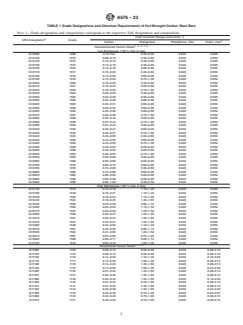
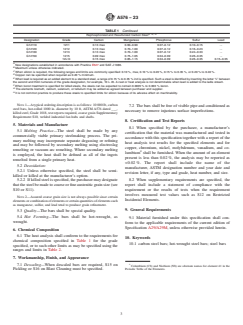
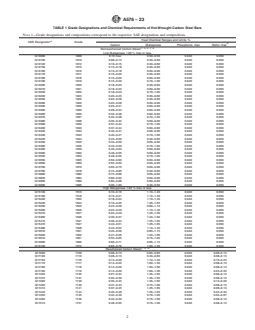
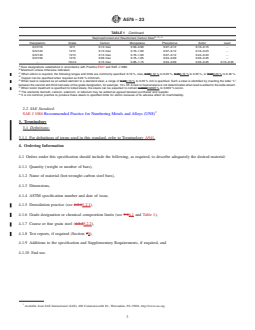
1.2 The bars shall be furnished in the grades specified in Table 1. Sections and sizes of bar steel available are covered in Specification A29/A29M. Hot-wrought special quality carbon steel bars are produced in cut lengths and coils; the manufacturer should be consulted regarding sections and sizes available in coils, produced to a chemical composition.
Rephosphorized and Resulfurized Carbon SteelE, G, H
Designation
Grade
Carbon
Manganese
Phosphorus
Sulfur
Lead
G12110
1211
0.13 max
0.60–0.90
0.07–0.12
0.10–0.15
...
G12120
1212
0.13 max
0.70–1.00
0.07–0.12
0.16–0.23
...
G12130
1213
0.13 max
0.70–1.00
0.07–0.12
0.24–0.33
...
G12150
1215
0.09 max
0.75–1.05
0.04–0.09
0.26–0.35
...
...
12L14
0.15 max
0.85–1.15
0.04–0.09
0.26–0.35
0.15–0.35
1.3 Merchant quality hot-wrought carbon steel bars are covered in Specification A575.
1.4 Some end uses may require superior surface quality, or special chemical restrictions, metallurgical characteristics, heat treatment, or surface finishes which the purchaser may obtain by designating one or more of the available Supplementary Requirements.
1.5 The values stated in inch-pound units are to be regarded as standard.
1.6 This international standard was developed in accordance with internationally recognized principles on standardization established in the Decision on Principles for the Development of International Standards, Guides and Recommendations issued by the World Trade Organization Technical Barriers to Trade (TBT) Committee.
- Status
- Published
- Publication Date
- 31-Oct-2023
- Technical Committee
- A01 - Steel, Stainless Steel and Related Alloys
- Drafting Committee
- A01.15 - Bars
Buy Documents
ASTM A576-23 - Standard Specification for Steel Bars, Carbon, Hot-Wrought, Special Quality
REDLINE ASTM A576-23 - Standard Specification for Steel Bars, Carbon, Hot-Wrought, Special Quality
Overview
ASTM A576-23: Standard Specification for Steel Bars, Carbon, Hot-Wrought, Special Quality defines requirements for hot-wrought special quality carbon steel bars, ensuring consistent performance in demanding applications across industry sectors. This ASTM standard supports manufacturers, suppliers, and end-users by providing criteria on steel bar composition, manufacturing process, and quality. It is recognized internationally and developed in accordance with globally accepted standardization practices.
Hot-wrought special quality carbon steel bars covered by ASTM A576-23 are suitable for processes such as forging, heat treating, cold drawing, machining, and use in structural components. The specification outlines requirements for chemical composition, surface quality, and supplementary options to address stringent application demands. It covers various grades and sizes, with specific requirements for ordering and documentation.
Key Topics
Scope and Steel Types
The specification covers hot-wrought carbon steel bars delivered as cut lengths or coils. Grades covered include nonresulfurized, resulfurized, and rephosphorized/resulfurized steels, each with detailed chemical composition limits.Manufacturing Processes
Acceptable primary steelmaking methods include open-hearth, basic-oxygen, and electric furnace processes. Secondary melting (e.g., electroslag or vacuum arc remelting) is permitted for further refining.Chemical Requirements
ASTM A576-23 prescribes heat chemical ranges and limits for carbon, manganese, phosphorus, sulfur, and additional elements as agreed upon. Leaded grades can be specified for enhanced machinability.Quality and Surface Condition
Bars must be free from significant defects and may require conditioning or descaling (via pickling or blast cleaning). Additional surface, straightness, and soundness requirements can be stipulated.Supplementary Requirements
Supplementary provisions address:- Cold-working and forging quality
- Axle-shaft and nut-manufacturing suitability
- Special surface finish, straightness, and internal soundness
- Annealing, spheroidize annealing, and stress relieving
- Restricted chemical ranges or inclusion content
- Coating specifications
Ordering Information
Orders should include quantity, dimensions, desired grade, specification reference, deoxidation practice, testing, supplementary needs, and end use.
Applications
Hot-wrought special quality carbon steel bars produced to ASTM A576-23 are crucial in:
Forgings
For automotive, aerospace, and industrial machinery components requiring reliable strength and formability.Heat-treated and Machined Parts
Suitable for parts that demand superior mechanical properties or precise machining, such as shafts, gears, and connecting rods.Cold Drawn Products
Used as feedstock for cold drawing operations where surface quality and consistent chemistry are vital.Structural Applications
Ideal for components in construction and infrastructure projects needing dependable performance and compliance with industry standards.Specialized Fasteners and Shafts
Specific grades support the manufacture of axle shafts, nuts, and other hardware with tailored performance criteria.
Related Standards
When using ASTM A576-23, consider these additional standards for full compliance and broader technical context:
- ASTM A29/A29M: General requirements for carbon and alloy steel bars, hot-wrought.
- ASTM A575: Specification for merchant quality hot-wrought carbon steel bars.
- ASTM A400: Practice for steel bars selection guide, composition, and mechanical properties.
- ASTM A941: Terminology relating to steel, stainless steel, and related alloys.
- ASTM E45: Test methods for determining the inclusion content of steel.
- ASTM E527: Practice for numbering metals and alloys in the Unified Numbering System (UNS).
- SAE J1086: Recommended practice for numbering metals and alloys (UNS system).
Keywords: carbon steel bars, hot-wrought steel bars, ASTM A576-23, steel bar specification, special quality steel, steel manufacturing standards, structural steel bars, forging steel, bar steel grades.
Relations
- Effective Date
- 01-Nov-2023
- Effective Date
- 01-Mar-2024
- Effective Date
- 01-Nov-2023
- Effective Date
- 01-Nov-2023
- Effective Date
- 01-May-2023
- Effective Date
- 01-Jun-2018
- Effective Date
- 01-Nov-2017
- Referred By
ASTM C361M-22 - Standard Specification for Reinforced Concrete Low-Head Pressure Pipe (Metric) - Effective Date
- 01-Nov-2023
- Effective Date
- 01-Nov-2023
- Effective Date
- 01-Nov-2023
- Effective Date
- 01-Nov-2023
- Effective Date
- 01-Nov-2023
- Effective Date
- 01-Nov-2023
- Effective Date
- 01-Nov-2023
- Effective Date
- 01-Nov-2023
Buy Documents
ASTM A576-23 - Standard Specification for Steel Bars, Carbon, Hot-Wrought, Special Quality
REDLINE ASTM A576-23 - Standard Specification for Steel Bars, Carbon, Hot-Wrought, Special Quality
Get Certified
Connect with accredited certification bodies for this standard

Element Materials Technology
Materials testing and product certification.

Inštitut za kovinske materiale in tehnologije
Institute of Metals and Technology. Materials testing, metallurgical analysis, NDT.
Sponsored listings
Frequently Asked Questions
ASTM A576-23 is a technical specification published by ASTM International. Its full title is "Standard Specification for Steel Bars, Carbon, Hot-Wrought, Special Quality". This standard covers: ABSTRACT This specification covers hot-wrought special quality carbon steel bars. Special quality bar applications include forging, heat treating, cold drawing, machining, and many structural uses. The steel shall be made by one or more of the following primary processes: open-hearth, basic-oxygen, or electric furnace. The heat analysis shall conform to the requirements for chemical composition specified. SCOPE 1.1 This specification covers hot-wrought special quality carbon steel bars. Special quality bar applications include forging, heat treating, cold drawing, machining, and many structural uses. A guide for the selection of steel bars is contained in Practice A400. 1.2 The bars shall be furnished in the grades specified in Table 1. Sections and sizes of bar steel available are covered in Specification A29/A29M. Hot-wrought special quality carbon steel bars are produced in cut lengths and coils; the manufacturer should be consulted regarding sections and sizes available in coils, produced to a chemical composition. Rephosphorized and Resulfurized Carbon SteelE, G, H Designation Grade Carbon Manganese Phosphorus Sulfur Lead G12110 1211 0.13 max 0.60–0.90 0.07–0.12 0.10–0.15 ... G12120 1212 0.13 max 0.70–1.00 0.07–0.12 0.16–0.23 ... G12130 1213 0.13 max 0.70–1.00 0.07–0.12 0.24–0.33 ... G12150 1215 0.09 max 0.75–1.05 0.04–0.09 0.26–0.35 ... ... 12L14 0.15 max 0.85–1.15 0.04–0.09 0.26–0.35 0.15–0.35 1.3 Merchant quality hot-wrought carbon steel bars are covered in Specification A575. 1.4 Some end uses may require superior surface quality, or special chemical restrictions, metallurgical characteristics, heat treatment, or surface finishes which the purchaser may obtain by designating one or more of the available Supplementary Requirements. 1.5 The values stated in inch-pound units are to be regarded as standard. 1.6 This international standard was developed in accordance with internationally recognized principles on standardization established in the Decision on Principles for the Development of International Standards, Guides and Recommendations issued by the World Trade Organization Technical Barriers to Trade (TBT) Committee.
ABSTRACT This specification covers hot-wrought special quality carbon steel bars. Special quality bar applications include forging, heat treating, cold drawing, machining, and many structural uses. The steel shall be made by one or more of the following primary processes: open-hearth, basic-oxygen, or electric furnace. The heat analysis shall conform to the requirements for chemical composition specified. SCOPE 1.1 This specification covers hot-wrought special quality carbon steel bars. Special quality bar applications include forging, heat treating, cold drawing, machining, and many structural uses. A guide for the selection of steel bars is contained in Practice A400. 1.2 The bars shall be furnished in the grades specified in Table 1. Sections and sizes of bar steel available are covered in Specification A29/A29M. Hot-wrought special quality carbon steel bars are produced in cut lengths and coils; the manufacturer should be consulted regarding sections and sizes available in coils, produced to a chemical composition. Rephosphorized and Resulfurized Carbon SteelE, G, H Designation Grade Carbon Manganese Phosphorus Sulfur Lead G12110 1211 0.13 max 0.60–0.90 0.07–0.12 0.10–0.15 ... G12120 1212 0.13 max 0.70–1.00 0.07–0.12 0.16–0.23 ... G12130 1213 0.13 max 0.70–1.00 0.07–0.12 0.24–0.33 ... G12150 1215 0.09 max 0.75–1.05 0.04–0.09 0.26–0.35 ... ... 12L14 0.15 max 0.85–1.15 0.04–0.09 0.26–0.35 0.15–0.35 1.3 Merchant quality hot-wrought carbon steel bars are covered in Specification A575. 1.4 Some end uses may require superior surface quality, or special chemical restrictions, metallurgical characteristics, heat treatment, or surface finishes which the purchaser may obtain by designating one or more of the available Supplementary Requirements. 1.5 The values stated in inch-pound units are to be regarded as standard. 1.6 This international standard was developed in accordance with internationally recognized principles on standardization established in the Decision on Principles for the Development of International Standards, Guides and Recommendations issued by the World Trade Organization Technical Barriers to Trade (TBT) Committee.
ASTM A576-23 is classified under the following ICS (International Classification for Standards) categories: 77.140.60 - Steel bars and rods. The ICS classification helps identify the subject area and facilitates finding related standards.
ASTM A576-23 has the following relationships with other standards: It is inter standard links to ASTM A576-17, ASTM A941-24, ASTM E45-18a(2023), ASTM A400-23, ASTM A941-23, ASTM E45-18a, ASTM A400-17, ASTM C361M-22, ASTM A920/A920M-14(2019), ASTM A575-20, ASTM C361-22, ASTM A921/A921M-93(2022), ASTM A689-97(2018), ASTM F721-18(2022), ASTM F1387-23. Understanding these relationships helps ensure you are using the most current and applicable version of the standard.
ASTM A576-23 is available in PDF format for immediate download after purchase. The document can be added to your cart and obtained through the secure checkout process. Digital delivery ensures instant access to the complete standard document.
Standards Content (Sample)
This international standard was developed in accordance with internationally recognized principles on standardization established in the Decision on Principles for the
Development of International Standards, Guides and Recommendations issued by the World Trade Organization Technical Barriers to Trade (TBT) Committee.
Designation: A576 − 23
Standard Specification for
Steel Bars, Carbon, Hot-Wrought, Special Quality
This standard is issued under the fixed designation A576; the number immediately following the designation indicates the year of
original adoption or, in the case of revision, the year of last revision. A number in parentheses indicates the year of last reapproval. A
superscript epsilon (´) indicates an editorial change since the last revision or reapproval.
This standard has been approved for use by agencies of the U.S. Department of Defense.
1. Scope* A29/A29M Specification for General Requirements for Steel
Bars, Carbon and Alloy, Hot-Wrought
1.1 This specification covers hot-wrought special quality
A400 Practice for Steel Bars, Selection Guide, Composition,
carbon steel bars. Special quality bar applications include
and Mechanical Properties
forging, heat treating, cold drawing, machining, and many
A575 Specification for Steel Bars, Carbon, Merchant
structural uses. A guide for the selection of steel bars is
Quality, M-Grades
contained in Practice A400.
A941 Terminology Relating to Steel, Stainless Steel, Related
1.2 The bars shall be furnished in the grades specified in
Alloys, and Ferroalloys
Table 1. Sections and sizes of bar steel available are covered in
E45 Test Methods for Determining the Inclusion Content of
Specification A29/A29M. Hot-wrought special quality carbon
Steel
steel bars are produced in cut lengths and coils; the manufac-
E527 Practice for Numbering Metals and Alloys in the
turer should be consulted regarding sections and sizes available
Unified Numbering System (UNS)
in coils, produced to a chemical composition.
2.2 SAE Standard:
1.3 Merchant quality hot-wrought carbon steel bars are
SAE J 1086 Recommended Practice for Numbering Metals
covered in Specification A575.
and Alloys (UNS)
1.4 Some end uses may require superior surface quality, or
3. Terminology
special chemical restrictions, metallurgical characteristics, heat
treatment, or surface finishes which the purchaser may obtain 3.1 Definitions:
by designating one or more of the available Supplementary
3.1.1 For definitions of terms used in this standard, refer to
Requirements.
Terminology A941.
1.5 The values stated in inch-pound units are to be regarded
4. Ordering Information
as standard.
4.1 Orders under this specification should include the
1.6 This international standard was developed in accor-
following, as required, to describe adequately the desired
dance with internationally recognized principles on standard-
material:
ization established in the Decision on Principles for the
4.1.1 Quantity (weight or number of bars),
Development of International Standards, Guides and Recom-
4.1.2 Name of material (hot-wrought carbon steel bars),
mendations issued by the World Trade Organization Technical
4.1.3 Dimensions,
Barriers to Trade (TBT) Committee.
4.1.4 ASTM specification number and date of issue,
2. Referenced Documents 4.1.5 Deoxidation practice (see 5.2.1),
2 4.1.6 Grade designation or chemical composition limits (see
2.1 ASTM Standards:
6.1 and Table 1),
4.1.7 Coarse or fine grain steel (5.2.2),
This specification is under the jurisdiction of ASTM Committee A01 on Steel,
4.1.8 Test reports, if required (Section 8),
Stainless Steel and Related Alloys and is the direct responsibility of Subcommittee
4.1.9 Additions to the specification and Supplementary
A01.15 on Bars.
Requirements, if required, and
Current edition approved Nov. 1, 2023. Published November 2023. Originally
approved in 1967. Last previous edition approved in 2017 as A576 – 17. DOI:
4.1.10 End use.
10.1520/A0576-23.
For referenced ASTM standards, visit the ASTM website, www.astm.org, or
contact ASTM Customer Service at service@astm.org. For Annual Book of ASTM
Standards volume information, refer to the standard’s Document Summary page on Available from SAE International (SAE), 400 Commonwealth Dr., Warrendale,
the ASTM website. PA 15096, http://www.sae.org.
*A Summary of Changes section appears at the end of this standard
Copyright © ASTM International, 100 Barr Harbor Drive, PO Box C700, West Conshohocken, PA 19428-2959. United States
A576 − 23
TABLE 1 Grade Designations and Chemical Requirements of Hot-Wrought Carbon Steel Bars
NOTE 1—Grade designations and compositions correspond to the respective SAE designations and compositions.
Heat Chemical Ranges and Limits, %
A
UNS Designation Grade
B
Carbon Manganese Phosphorus, max Sulfur, max
C, D, E, F, G
Nonresulfurized Carbon Steels
Low Manganese 1.00 % max or less
G10080 1008 0.10 max 0.30–0.50 0.040 0.050
G10100 1010 0.08–0.13 0.30–0.60 0.040 0.050
G10120 1012 0.10–0.15 0.30–0.60 0.040 0.050
G10150 1015 0.13–0.18 0.30–0.60 0.040 0.050
G10160 1016 0.13–0.18 0.60–0.90 0.040 0.050
G10170 1017 0.15–0.20 0.30–0.60 0.040 0.050
G10180 1018 0.15–0.20 0.60–0.90 0.040 0.050
G10190 1019 0.15–0.20 0.70–1.00 0.040 0.050
G10200 1020 0.18–0.23 0.30–0.60 0.040 0.050
G10210 1021 0.18–0.23 0.60–0.90 0.040 0.050
G10220 1022 0.18–0.23 0.70–1.00 0.040 0.050
G10230 1023 0.20–0.25 0.30–0.60 0.040 0.050
G10250 1025 0.22–0.28 0.30–0.60 0.040 0.050
G10260 1026 0.22–0.28 0.60–0.90 0.040 0.050
G10290 1029 0.25–0.31 0.60–0.90 0.040 0.050
G10300 1030 0.28–0.34 0.60–0.90 0.040 0.050
G10350 1035 0.32–0.38 0.60–0.90 0.040 0.050
G10370 1037 0.32–0.38 0.70–1.00 0.040 0.050
G10380 1038 0.35–0.42 0.60–0.90 0.040 0.050
G10390 1039 0.37–0.44 0.70–1.00 0.040 0.050
G10400 1040 0.37–0.44 0.60–0.90 0.040 0.050
G10420 1042 0.40–0.47 0.60–0.90 0.040 0.050
G10430 1043 0.40–0.47 0.70–1.00 0.040 0.050
G10440 1044 0.43–0.50 0.30–0.60 0.040 0.050
G10450 1045 0.43–0.50 0.60–0.90 0.040 0.050
G10460 1046 0.43–0.50 0.70–1.00 0.040 0.050
G10490 1049 0.46–0.53 0.60–0.90 0.040 0.050
G10500 1050 0.48–0.55 0.60–0.90 0.040 0.050
G10530 1053 0.48–0.55 0.70–1.00 0.040 0.050
G10550 1055 0.50–0.60 0.60–0.90 0.040 0.050
G10600 1060 0.55–0.65 0.60–0.90 0.040 0.050
G10700 1070 0.65–0.75 0.60–0.90 0.040 0.050
G10780 1078 0.72–0.85 0.30–0.60 0.040 0.050
G10800 1080 0.75–0.88 0.60–0.90 0.040 0.050
G10840 1084 0.80–0.93 0.60–0.90 0.040 0.050
G10900 1090 0.85–0.98 0.60–0.90 0.040 0.050
G10950 1095 0.90–1.03 0.30–0.50 0.040 0.050
High Manganese 1.65 % max or less
G15130 1513 0.10–0.16 1.10–1.40 0.040 0.050
G15180 1518 0.15–0.21 1.10–1.40 0.040 0.050
G15220 1522 0.18–0.24 1.10–1.40 0.040 0.050
G15240 1524 0.19–0.25 1.35–1.65 0.040 0.050
G15250 1525 0.23–0.29 0.80–1.10 0.040 0.050
G15260 1526 0.22–0.29 1.10–1.40 0.040 0.050
G15270 1527 0.22–0.29 1.20–1.50 0.040 0.050
G15360 1536 0.30–0.37 1.20–1.50 0.040 0.050
G15410 1541 0.36–0.44 1.35–1.65 0.040 0.050
G15470 1547 0.43–0.51 1.35–1.65 0.040 0.050
G15480 1548 0.44–0.52 1.10–1.40 0.040 0.050
G15510 1551 0.45–0.56 0.85–1.15 0.040 0.050
G15520 1552 0.47–0.55 1.20–1.50 0.040 0.050
G15610 1561 0.55–0.65 0.75–1.05 0.040 0.050
G15660 1566 0.60–0.71 0.85–1.15 0.040 0.050
G15720 1572 0.65–0.76 1.00–1.30 0.040 0.050
C, E, G
Resulfurized Carbon Steels
G11090 1109 0.08–0.13 0.60–0.90 0.040 0.08–0.13
G11100 1110 0.08–0.13 0.30–0.60 0.040 0.08–0.13
G11160 1116 0.14–0.20 1.10–1.40 0.040 0.16–0.23
G11170 1117 0.14–0.20 1.00–1.30 0.040 0.08–0.13
G11180 1118 0.14–0.20 1.30–1.60 0.040 0.08–0.13
G11190 1119 0.14–0.20 1.00–1.30 0.040 0.24–0.33
G11320 1132 0.27–0.34 1.35–1.65 0.040 0.08–0.13
G11370 1137 0.32–0.39 1.35–1.65 0.040 0.08–0.13
G11390 1139 0.35–0.43 1.35–1.65 0.040 0.13–0.20
G11400 1140 0.37–0.44 0.70–1.00 0.040 0.08–0.13
G11410 1141 0.37–0.45 1.35–1.65 0.040 0.08–0.13
G11440 1144 0.40–0.48 1.35–1.65 0.040 0.24–0.33
G11450 1145 0.42–0.49 0.70–1.00 0.040 0.04–0.07
G11460 1146 0.42–0.49 0.70–1.00 0.040 0.08–0.13
G11510 1151 0.48–0.55 0.70–1.00 0.040 0.08–0.13
A576 − 23
TABLE 1 Continued
E, G, H
Rephosphorized and Resulfurized Carbon Steel
Designation Grade Carbon Manganese Phosphorus Sulfur Lead
G12110 1211 0.13 max 0.60–0.90 0.07–0.12 0.10–0.15 .
G12120 1212 0.13 max 0.70–1.00 0.07–0.12 0.16–0.23 .
G12130 1213 0.13 max 0.70–1.00 0.07–0.12 0.24–0.33 .
G12150 1215 0.09 max 0.75–1.05 0.04–0.09 0.26–0.35 .
... 12L14 0.15 max 0.85–1.15 0.04–0.09 0.26–0.35 0.15–0.35
A
New designations established in accordance with Practice E527 and SAE J 1086.
B
Maximum unless otherwise indicated.
C
When silicon is required, the following ranges and limits are commonly specified: 0.10 %, max, 0.10 % to 0.20 %, 0.15 % to 0.35 %, or 0.20 % to 0.40 %.
D
Copper can be specified when required as 0.20 % minimum.
E
When lead is required as an added element to a standard steel, a range of 0.15 % to 0.35 % incl is specified. Such a steel is identified by inserting the letter “L” between
the second and third numerals of the grade designation, for example, 10 L 45. A cast or heat analysis is not determinable when lead is added to the ladle stream.
F
When boron treatment is specified for killed steels, the steels can be expected to contain 0.0005 % to 0.003 % boron.
G
The elements bismuth, calcium, selenium, or tellurium may be added as agreed between purchaser and supplier.
H
It is not common practice to produce these steels to specified limits for silicon because of its adverse effect on machinability.
NOTE 1—A typical ordering description is as follows: 10 000 lb, carbon
7.2 The bars shall be free of visible pipe and conditioned as
steel bars, hot-rolled 1000 in. diameter by 10 ft, ASTM A576 dated ___,
necessary to remove injurious surface imperfections.
killed steel, Grade 1018, test reports required, coarse grain Supplementary
Requirement S10, welded industrial fan hubs and shafts.
8. Certification and Test Reports
5. Materials and Manufacture
8.1 When specified by the purchaser, a manufacturer’s
5.1 Melting Practice—The steel shall be made by any
certification that the material was manufactured and tested in
commercially viable primary steelmaking process. The pri-
accordance with this specification together with a report of the
mary melting may incorporate separate degassing or refining
heat analysis test results for the specified elements and for
and may be followed by secondary melting using electroslag
copper, chromium, nickel, molybdenum, vanadium, and co-
remelting or vacuum arc remelting. Where se
...
This document is not an ASTM standard and is intended only to provide the user of an ASTM standard an indication of what changes have been made to the previous version. Because
it may not be technically possible to adequately depict all changes accurately, ASTM recommends that users consult prior editions as appropriate. In all cases only the current version
of the standard as published by ASTM is to be considered the official document.
Designation: A576 − 17 A576 − 23
Standard Specification for
Steel Bars, Carbon, Hot-Wrought, Special Quality
This standard is issued under the fixed designation A576; the number immediately following the designation indicates the year of
original adoption or, in the case of revision, the year of last revision. A number in parentheses indicates the year of last reapproval. A
superscript epsilon (´) indicates an editorial change since the last revision or reapproval.
This standard has been approved for use by agencies of the U.S. Department of Defense.
1. Scope*
1.1 This specification covers hot-wrought special quality carbon steel bars. Special quality bar applications include forging, heat
treating, cold drawing, machining, and many structural uses. A guide for the selection of steel bars is contained in Practice A400.
1.2 The bars shall be furnished in the grades specified in Table 1. Sections and sizes of bar steel available are covered in
Specification A29/A29M. Hot-wrought special quality carbon steel bars are produced in cut lengths and coils; the manufacturer
should be consulted regarding sections and sizes available in coils, produced to a chemical composition.
1.3 Merchant quality hot-wrought carbon steel bars are covered in Specification A575.
1.4 Some end uses may require superior surface quality, or special chemical restrictions, metallurgical characteristics, heat
treatment, or surface finishes which the purchaser may obtain by designating one or more of the available Supplementary
Requirements.
1.5 The values stated in inch-pound units are to be regarded as standard.
1.6 This international standard was developed in accordance with internationally recognized principles on standardization
established in the Decision on Principles for the Development of International Standards, Guides and Recommendations issued
by the World Trade Organization Technical Barriers to Trade (TBT) Committee.
2. Referenced Documents
2.1 ASTM Standards:
A29/A29M Specification for General Requirements for Steel Bars, Carbon and Alloy, Hot-Wrought
A400 Practice for Steel Bars, Selection Guide, Composition, and Mechanical Properties
A575 Specification for Steel Bars, Carbon, Merchant Quality, M-Grades
A941 Terminology Relating to Steel, Stainless Steel, Related Alloys, and Ferroalloys
E45 Test Methods for Determining the Inclusion Content of Steel
E527 Practice for Numbering Metals and Alloys in the Unified Numbering System (UNS)
This specification is under the jurisdiction of ASTM Committee A01 on Steel, Stainless Steel and Related Alloys and is the direct responsibility of Subcommittee A01.15
on Bars.
Current edition approved Nov. 1, 2017Nov. 1, 2023. Published December 2017November 2023. Originally approved in 1967. Last previous edition approved in 20122017
as A576 – 90b (2012).A576 – 17. DOI: 10.1520/A0576-17.10.1520/A0576-23.
For referenced ASTM standards, visit the ASTM website, www.astm.org, or contact ASTM Customer Service at service@astm.org. For Annual Book of ASTM Standards
volume information, refer to the standard’s Document Summary page on the ASTM website.
*A Summary of Changes section appears at the end of this standard
Copyright © ASTM International, 100 Barr Harbor Drive, PO Box C700, West Conshohocken, PA 19428-2959. United States
A576 − 23
TABLE 1 Grade Designations and Chemical Requirements of Hot-Wrought Carbon Steel Bars
NOTE 1—Grade designations and compositions correspond to the respective SAE designations and compositions.
Heat Chemical Ranges and Limits, %
A
UNS Designation Grade
B
Carbon Manganese Phosphorus, max Sulfur, max
C, D, E, F, G
Nonresulfurized Carbon Steels
Low Manganese 1.00 % max or less
G10080 1008 0.10 max 0.30–0.50 0.040 0.050
G10100 1010 0.08–0.13 0.30–0.60 0.040 0.050
G10120 1012 0.10–0.15 0.30–0.60 0.040 0.050
G10150 1015 0.13–0.18 0.30–0.60 0.040 0.050
G10160 1016 0.13–0.18 0.60–0.90 0.040 0.050
G10170 1017 0.15–0.20 0.30–0.60 0.040 0.050
G10180 1018 0.15–0.20 0.60–0.90 0.040 0.050
G10190 1019 0.15–0.20 0.70–1.00 0.040 0.050
G10200 1020 0.18–0.23 0.30–0.60 0.040 0.050
G10210 1021 0.18–0.23 0.60–0.90 0.040 0.050
G10220 1022 0.18–0.23 0.70–1.00 0.040 0.050
G10230 1023 0.20–0.25 0.30–0.60 0.040 0.050
G10250 1025 0.22–0.28 0.30–0.60 0.040 0.050
G10260 1026 0.22–0.28 0.60–0.90 0.040 0.050
G10290 1029 0.25–0.31 0.60–0.90 0.040 0.050
G10300 1030 0.28–0.34 0.60–0.90 0.040 0.050
G10350 1035 0.32–0.38 0.60–0.90 0.040 0.050
G10370 1037 0.32–0.38 0.70–1.00 0.040 0.050
G10380 1038 0.35–0.42 0.60–0.90 0.040 0.050
G10390 1039 0.37–0.44 0.70–1.00 0.040 0.050
G10400 1040 0.37–0.44 0.60–0.90 0.040 0.050
G10420 1042 0.40–0.47 0.60–0.90 0.040 0.050
G10430 1043 0.40–0.47 0.70–1.00 0.040 0.050
G10440 1044 0.43–0.50 0.30–0.60 0.040 0.050
G10450 1045 0.43–0.50 0.60–0.90 0.040 0.050
G10460 1046 0.43–0.50 0.70–1.00 0.040 0.050
G10490 1049 0.46–0.53 0.60–0.90 0.040 0.050
G10500 1050 0.48–0.55 0.60–0.90 0.040 0.050
G10530 1053 0.48–0.55 0.70–1.00 0.040 0.050
G10550 1055 0.50–0.60 0.60–0.90 0.040 0.050
G10600 1060 0.55–0.65 0.60–0.90 0.040 0.050
G10700 1070 0.65–0.75 0.60–0.90 0.040 0.050
G10780 1078 0.72–0.85 0.30–0.60 0.040 0.050
G10800 1080 0.75–0.88 0.60–0.90 0.040 0.050
G10840 1084 0.80–0.93 0.60–0.90 0.040 0.050
G10900 1090 0.85–0.98 0.60–0.90 0.040 0.050
G10950 1095 0.90–1.03 0.30–0.50 0.040 0.050
High Manganese 1.65 % max or less
G15130 1513 0.10–0.16 1.10–1.40 0.040 0.050
G15180 1518 0.15–0.21 1.10–1.40 0.040 0.050
G15220 1522 0.18–0.24 1.10–1.40 0.040 0.050
G15240 1524 0.19–0.25 1.35–1.65 0.040 0.050
G15250 1525 0.23–0.29 0.80–1.10 0.040 0.050
G15260 1526 0.22–0.29 1.10–1.40 0.040 0.050
G15270 1527 0.22–0.29 1.20–1.50 0.040 0.050
G15360 1536 0.30–0.37 1.20–1.50 0.040 0.050
G15410 1541 0.36–0.44 1.35–1.65 0.040 0.050
G15470 1547 0.43–0.51 1.35–1.65 0.040 0.050
G15480 1548 0.44–0.52 1.10–1.40 0.040 0.050
G15510 1551 0.45–0.56 0.85–1.15 0.040 0.050
G15520 1552 0.47–0.55 1.20–1.50 0.040 0.050
G15610 1561 0.55–0.65 0.75–1.05 0.040 0.050
G15660 1566 0.60–0.71 0.85–1.15 0.040 0.050
G15720 1572 0.65–0.76 1.00–1.30 0.040 0.050
C, E, G
Resulfurized Carbon Steels
G11090 1109 0.08–0.13 0.60–0.90 0.040 0.08–0.13
G11100 1110 0.08–0.13 0.30–0.60 0.040 0.08–0.13
G11160 1116 0.14–0.20 1.10–1.40 0.040 0.16–0.23
G11170 1117 0.14–0.20 1.00–1.30 0.040 0.08–0.13
G11180 1118 0.14–0.20 1.30–1.60 0.040 0.08–0.13
G11190 1119 0.14–0.20 1.00–1.30 0.040 0.24–0.33
G11320 1132 0.27–0.34 1.35–1.65 0.040 0.08–0.13
G11370 1137 0.32–0.39 1.35–1.65 0.040 0.08–0.13
G11390 1139 0.35–0.43 1.35–1.65 0.040 0.13–0.20
G11400 1140 0.37–0.44 0.70–1.00 0.040 0.08–0.13
G11410 1141 0.37–0.45 1.35–1.65 0.040 0.08–0.13
G11440 1144 0.40–0.48 1.35–1.65 0.040 0.24–0.33
G11450 1145 0.42–0.49 0.70–1.00 0.040 0.04–0.07
G11460 1146 0.42–0.49 0.70–1.00 0.040 0.08–0.13
G11510 1151 0.48–0.55 0.70–1.00 0.040 0.08–0.13
A576 − 23
TABLE 1 Continued
E, G, H
Rephosphorized and Resulfurized Carbon Steel
Designation Grade Carbon Manganese Phosphorus Sulfur Lead
G12110 1211 0.13 max 0.60–0.90 0.07–0.12 0.10–0.15 .
G12120 1212 0.13 max 0.70–1.00 0.07–0.12 0.16–0.23 .
G12130 1213 0.13 max 0.70–1.00 0.07–0.12 0.24–0.33 .
G12150 1215 0.09 max 0.75–1.05 0.04–0.09 0.26–0.35 .
... 12L14 0.15 max 0.85–1.15 0.04–0.09 0.26–0.35 0.15–0.35
A
New designations established in accordance with Practice E527 and SAE J 1086.
B
Maximum unless otherwise indicated.
C
When silicon is required, the following ranges and limits are commonly specified: 0.10 %, max, 0.100.10 % to 0.20 %, 0.150.15 % to 0.35 %, or 0.200.20 % to 0.40 %.
D
Copper can be specified when required as 0.20 % minimum.
E
When lead is required as an added element to a standard steel, a range of 0.150.15 % to 0.35 % incl is specified. Such a steel is identified by inserting the letter “L”
between the second and third numerals of the grade designation, for example, 10 L 45. A cast or heat analysis is not determinable when lead is added to the ladle stream.
F
When boron treatment is specified for killed steels, the steels can be expected to contain 0.00050.0005 % to 0.003 % boron.
G
The elements bismuth, calcium, selenium, or tellurium may be added as agreed between purchaser and supplier.
H
It is not common practice to produce these steels to specified limits for silicon because of its adverse effect on machinability.
2.2 SAE Standard:
SAE J 1086 Recommended Practice for Numbering Metals and Alloys (UNS)
3. Terminology
3.1 Definitions:
3.1.1 For definitions of terms used in this standard, refer to Terminology A941.
4. Ordering Information
4.1 Orders under this specification should include the following, as required, to describe adequately the desired material:
4.1.1 Quantity (weight or number of bars),
4.1.2 Name of material (hot-wrought carbon steel bars),
4.1.3 Dimensions,
4.1.4 ASTM specification number and date of issue,
4.1.5 Deoxidation practice (see 4.2.15.2.1),
4.1.6 Grade designation or chemical composition limits (see 5.16.1 and Table 1),
4.1.7 Coarse or fine grain steel (4.2.25.2.2),
4.1.8 Test reports, if required (Section 78),
4.1.9 Additions to the specification and Supplementary Requirements, if required, and
4.1.10 End use.
Available from SAE International (SAE), 400 Commonwealth Dr., Warrendale, PA 15096, http://www.sae.org.
A576 − 23
NOTE 1—A typical ordering description is as follows: 10 000 lb, carbon steel bars, hot rolled hot-rolled 1000 in. diameter by 10 ft, ASTM A576 dated
___, killed steel, Grade 1018, test reports required, coarse grain Supplementary Requirement S10, welded industrial fan hubs and shafts.
5. Materials and Manufacture
5.1 Melting Practice—The steel shall be made by any commercially viable primary steelmaking process. The primary melting may
incorporate separate degassing or refining and may be followed by secondary melting using electroslag remelting or vacuum arc
remelting. Where secondary melting is employed, the heat shall be defined as all of the ingots remelted from a single primary heat.
5.2 Deoxidation:
5.2.1 Unless otherwise specified, the steel shall be semi-killed or killed at the manufacturer’s option.
5.2.2 If killed steel is specified, the purchaser may designate that the steel be made to coarse or fine austenitic grain size (see S10
or S11).
NOTE 2—Assured coarse grain
...