

ASTM B432-19
(Specification)Standard Specification for Copper and Copper Alloy Clad Steel Plate
General Information
- Abstract
ABSTRACT
This specification covers plates made of carbon steel or low-alloy steel base, to which a layer of copper or copper-base alloy cladding is integrally and continuously bonded on one or both sides. The material is generally intended for pressure vessel applications, but may be used in other structural applications where corrosion resistance or conductivity of the alloy is of prime importance. The steel shall be primarily made by the open-hearth, electric-furnace (with optional degassing and refining done separately), or basic-oxygen processes. Secondary processes may also be performed, whereby the steel made from the primary processes is remelted using, but not limited to, electroslag remelting or vacuum arc remelting. Materials shall be tested and shall conform to dimensional (thickness, flatness, and outside diameter), mechanical (tensile, shear and bond strengths), and chemical composition requirements. The manufacturer may rework defects in the cladding by repair welding provided specific requirements are met.
SCOPE
1.1 This specification establishes the requirements for plate of a carbon steel or low-alloy steel base to which is integrally and continuously bonded on one or both sides a layer of copper or copper-base alloy. The material is generally intended for pressure vessel use but may be used in other structural applications where corrosion resistance or conductivity of the alloy is of prime importance.
1.2 Units—The values stated in inch-pound units are to be regarded as standard. The values given in parentheses are mathematical conversions to SI units that are provided for information only and are not considered standard.
1.3 This international standard was developed in accordance with internationally recognized principles on standardization established in the Decision on Principles for the Development of International Standards, Guides and Recommendations issued by the World Trade Organization Technical Barriers to Trade (TBT) Committee.
- Status
- Published
- Publication Date
- 31-Mar-2019
- Technical Committee
- B05 - Copper and Copper Alloys
- Drafting Committee
- B05.01 - Plate, Sheet, and Strip
Buy Documents
ASTM B432-19 - Standard Specification for Copper and Copper Alloy Clad Steel Plate
REDLINE ASTM B432-19 - Standard Specification for Copper and Copper Alloy Clad Steel Plate
Overview
ASTM B432-19: Standard Specification for Copper and Copper Alloy Clad Steel Plate outlines the requirements for plates composed of a carbon steel or low-alloy steel base, integrally and continuously bonded with a layer of copper or copper-base alloy on one or both sides. Developed by ASTM International, this specification ensures consistency and quality for clad steel plates primarily intended for pressure vessel applications, but also applicable wherever corrosion resistance or conductivity is crucial. The standard details manufacturing processes, chemical and mechanical requirements, dimensional tolerances, inspection, certification, and repair guidelines relevant to industry needs.
Key Topics
Material Composition
Plates consist of a steel base, either carbon or low-alloy, bonded with copper or copper alloy on one (single-clad) or both sides (double-clad).Manufacturing Methods
Manufacturing can involve processes such as open-hearth, electric-furnace, basic-oxygen, electroslag remelting, or vacuum arc remelting for the base steel. Cladding methods include explosion bonding, roll bonding, and weld overlay.Performance Requirements
- Mechanical Properties: Includes tensile strength for base metal, with optional shear and bond strength tests for cladding.
- Dimensional Tolerances: Addresses thickness and flatness, with permissible variations specified.
- Bond Integrity: Ultrasonic or visual inspection ensures the cladding adheres properly to the base metal.
Testing and Inspection
Requirements for sample sizes, chemical analysis, mechanical testing, ultrasonic examination, and classification of bond quality (Classes A, B, and C).Repair and Rework
Defects in cladding can be repaired by welding under controlled conditions, following proper testing and certification.
Applications
Pressure Vessels
Copper clad steel plate is commonly used in pressure vessel construction, providing strength from the steel and corrosion resistance from the copper or copper alloy.Heat Exchangers and Tubesheets
The standard encompasses the manufacture of tubesheets and components for heat exchangers, maximizing both conductivity and durability.Structural Components
In chemical plants, energy facilities, or marine environments, copper clad steel plates may serve as covers, flanges, or other parts where corrosion resistance is essential.Electrical Applications
Combining the mechanical properties of steel with the electrical conductivity of copper, these plates are suitable for specialized electrical and thermal management uses.
Related Standards
Several standards are referenced within ASTM B432-19, emphasizing its integration within a broader framework of quality and testing protocols:
- ASTM A6/A6M: General Requirements for Rolled Structural Steel Bars, Plates, Shapes, and Sheet Piling
- ASTM A20/A20M: General Requirements for Steel Plates for Pressure Vessels
- ASTM A578/A578M: Straight-Beam Ultrasonic Examination of Rolled Steel Plates
- ASTM B96/B96M: Copper-Silicon Alloy Plate, Sheet, Strip, and Rolled Bar
- ASTM B152/B152M: Copper Sheet, Strip, Plate, and Rolled Bar
- ASTM B171/B171M: Copper-Alloy Plate and Sheet for Pressure Vessels, Condensers, and Heat Exchangers
- ASTM B846: Terminology for Copper and Copper Alloys
- ASME Boiler and Pressure Vessel Code (Sections VIII & IX)
Practical Value
By adhering to ASTM B432-19, manufacturers ensure their copper clad steel plate products meet stringent industry requirements for safety, performance, and long-term reliability. Specifiers, engineers, and procurement professionals can use this standard to confirm essential mechanical properties, proper bonding, and compliance with international codes-streamlining material selection for demanding structural and pressure-bound applications.
Keywords: ASTM B432-19, copper clad steel plate, copper alloy, pressure vessel, corrosion resistance, mechanical testing, bond strength, heat exchangers, structural applications, international standard.
Relations
- Effective Date
- 01-Apr-2019
- Effective Date
- 01-Mar-2024
- Effective Date
- 01-Nov-2023
- Effective Date
- 01-Nov-2023
- Effective Date
- 01-Oct-2019
- Effective Date
- 01-Aug-2019
- Effective Date
- 01-Jan-2019
- Effective Date
- 01-Oct-2018
- Effective Date
- 01-Mar-2018
- Effective Date
- 15-Nov-2017
- Effective Date
- 01-Nov-2017
- Effective Date
- 01-Nov-2017
- Effective Date
- 15-Nov-2016
- Effective Date
- 01-May-2016
- Effective Date
- 01-Nov-2015
Buy Documents
ASTM B432-19 - Standard Specification for Copper and Copper Alloy Clad Steel Plate
REDLINE ASTM B432-19 - Standard Specification for Copper and Copper Alloy Clad Steel Plate
Get Certified
Connect with accredited certification bodies for this standard

Element Materials Technology
Materials testing and product certification.

Inštitut za kovinske materiale in tehnologije
Institute of Metals and Technology. Materials testing, metallurgical analysis, NDT.
Sponsored listings
Frequently Asked Questions
ASTM B432-19 is a technical specification published by ASTM International. Its full title is "Standard Specification for Copper and Copper Alloy Clad Steel Plate". This standard covers: ABSTRACT This specification covers plates made of carbon steel or low-alloy steel base, to which a layer of copper or copper-base alloy cladding is integrally and continuously bonded on one or both sides. The material is generally intended for pressure vessel applications, but may be used in other structural applications where corrosion resistance or conductivity of the alloy is of prime importance. The steel shall be primarily made by the open-hearth, electric-furnace (with optional degassing and refining done separately), or basic-oxygen processes. Secondary processes may also be performed, whereby the steel made from the primary processes is remelted using, but not limited to, electroslag remelting or vacuum arc remelting. Materials shall be tested and shall conform to dimensional (thickness, flatness, and outside diameter), mechanical (tensile, shear and bond strengths), and chemical composition requirements. The manufacturer may rework defects in the cladding by repair welding provided specific requirements are met. SCOPE 1.1 This specification establishes the requirements for plate of a carbon steel or low-alloy steel base to which is integrally and continuously bonded on one or both sides a layer of copper or copper-base alloy. The material is generally intended for pressure vessel use but may be used in other structural applications where corrosion resistance or conductivity of the alloy is of prime importance. 1.2 Units—The values stated in inch-pound units are to be regarded as standard. The values given in parentheses are mathematical conversions to SI units that are provided for information only and are not considered standard. 1.3 This international standard was developed in accordance with internationally recognized principles on standardization established in the Decision on Principles for the Development of International Standards, Guides and Recommendations issued by the World Trade Organization Technical Barriers to Trade (TBT) Committee.
ABSTRACT This specification covers plates made of carbon steel or low-alloy steel base, to which a layer of copper or copper-base alloy cladding is integrally and continuously bonded on one or both sides. The material is generally intended for pressure vessel applications, but may be used in other structural applications where corrosion resistance or conductivity of the alloy is of prime importance. The steel shall be primarily made by the open-hearth, electric-furnace (with optional degassing and refining done separately), or basic-oxygen processes. Secondary processes may also be performed, whereby the steel made from the primary processes is remelted using, but not limited to, electroslag remelting or vacuum arc remelting. Materials shall be tested and shall conform to dimensional (thickness, flatness, and outside diameter), mechanical (tensile, shear and bond strengths), and chemical composition requirements. The manufacturer may rework defects in the cladding by repair welding provided specific requirements are met. SCOPE 1.1 This specification establishes the requirements for plate of a carbon steel or low-alloy steel base to which is integrally and continuously bonded on one or both sides a layer of copper or copper-base alloy. The material is generally intended for pressure vessel use but may be used in other structural applications where corrosion resistance or conductivity of the alloy is of prime importance. 1.2 Units—The values stated in inch-pound units are to be regarded as standard. The values given in parentheses are mathematical conversions to SI units that are provided for information only and are not considered standard. 1.3 This international standard was developed in accordance with internationally recognized principles on standardization established in the Decision on Principles for the Development of International Standards, Guides and Recommendations issued by the World Trade Organization Technical Barriers to Trade (TBT) Committee.
ASTM B432-19 is classified under the following ICS (International Classification for Standards) categories: 77.150.30 - Copper products. The ICS classification helps identify the subject area and facilitates finding related standards.
ASTM B432-19 has the following relationships with other standards: It is inter standard links to ASTM B432-14, ASTM A6/A6M-24, ASTM A578/A578M-17(2023), ASTM A6/A6M-23, ASTM B152/B152M-19, ASTM B846-19a, ASTM B846-19, ASTM B171/B171M-18, ASTM A20/A20M-18, ASTM A20/A20M-17, ASTM A578/A578M-17, ASTM A6/A6M-17a, ASTM A6/A6M-16a, ASTM A6/A6M-16, ASTM A20/A20M-15. Understanding these relationships helps ensure you are using the most current and applicable version of the standard.
ASTM B432-19 is available in PDF format for immediate download after purchase. The document can be added to your cart and obtained through the secure checkout process. Digital delivery ensures instant access to the complete standard document.
Standards Content (Sample)
This international standard was developed in accordance with internationally recognized principles on standardization established in the Decision on Principles for the
Development of International Standards, Guides and Recommendations issued by the World Trade Organization Technical Barriers to Trade (TBT) Committee.
Designation:B432 −19
Standard Specification for
Copper and Copper Alloy Clad Steel Plate
This standard is issued under the fixed designation B432; the number immediately following the designation indicates the year of
original adoption or, in the case of revision, the year of last revision. A number in parentheses indicates the year of last reapproval. A
superscript epsilon (´) indicates an editorial change since the last revision or reapproval.
1. Scope* B171/B171M Specification for Copper-Alloy Plate and
Sheet for Pressure Vessels, Condensers, and Heat Ex-
1.1 This specification establishes the requirements for plate
changers
of a carbon steel or low-alloy steel base to which is integrally
B846 Terminology for Copper and Copper Alloys
andcontinuouslybondedononeorbothsidesalayerofcopper
E29 Practice for Using Significant Digits in Test Data to
or copper-base alloy. The material is generally intended for
Determine Conformance with Specifications
pressure vessel use but may be used in other structural
2.2 ASME Code:
applications where corrosion resistance or conductivity of the
Boiler and Pressure Vessel Code, Section VIII
alloy is of prime importance.
Boiler and Pressure Vessel Code, Section IX
1.2 Units—The values stated in inch-pound units are to be
regarded as standard. The values given in parentheses are
3. Terminology
mathematical conversions to SI units that are provided for
3.1 For definitions of terms related to copper and copper
information only and are not considered standard.
alloys, refer to Terminology B846.
1.3 This international standard was developed in accor-
3.2 Definitions of Terms Specific to This Standard:
dance with internationally recognized principles on standard-
3.2.1 base metal (backing steel), n—component to which
ization established in the Decision on Principles for the
the cladding metal is applied, usually the greater percentage of
Development of International Standards, Guides and Recom-
the composite plate and usually consisting of carbon or
mendations issued by the World Trade Organization Technical
low-alloy steel.
Barriers to Trade (TBT) Committee.
3.2.2 blind flange, n—same as a cover.
2. Referenced Documents
3.2.3 bonding, n—adhesion of one surface to another with-
2.1 ASTM Standards:
out the use of an adhesive as a bonding agent.
A6/A6M Specification for General Requirements for Rolled
3.2.4 cladding metal, n—the copper or copper-base alloy
Structural Steel Bars, Plates, Shapes, and Sheet Piling
component of the composite plate.
A20/A20M SpecificationforGeneralRequirementsforSteel
3.2.5 cover, n—a component with similar features to a
Plates for Pressure Vessels
tubesheet which is used as a closure and which typically
A578/A578M Specification for Straight-Beam Ultrasonic
requires surface machining over part of the face while main-
Examination of Rolled Steel Plates for Special Applica-
taining minimum specified minimum thickness.
tions
B96/B96M Specification for Copper-Silicon Alloy Plate, 3.2.6 double-clad, adj—material is considered as double-
clad when both sides of the steel base metal are covered with
Sheet, Strip, and Rolled Bar for General Purposes and
Pressure Vessels copper cladding.
B152/B152M Specification for Copper Sheet, Strip, Plate,
3.2.7 interface, n—of the clad product, is that region of the
and Rolled Bar
thickness in which the product transitions from essentially
100 % base metal to 100 % cladding metal, also referred to as
the bond or bondzone.
ThisspecificationisunderthejurisdictionofASTMCommitteeB05onCopper
3.2.8 integrally and continuously bonded—a condition in
andCopperAlloysandisthedirectresponsibilityofSubcommitteeB05.01onPlate,
which the cladding metal and base metal are brought together
Sheet, and Strip.
Current edition approved April 1, 2019. Published April 2019. Originally
to form a metallurgical bond at essentially the entire interface
approved in 1966. Last previous edition approved in 2014 as B432–14. DOI:
10.1520/B0432–19.
For referenced ASTM standards, visit the ASTM website, www.astm.org, or
contact ASTM Customer Service at service@astm.org. For Annual Book of ASTM Available from American Society of Mechanical Engineers (ASME), ASME
Standards volume information, refer to the standard’s Document Summary page on International Headquarters, Two Park Ave., New York, NY 10016-5990, http://
the ASTM website. www.asme.org.
*A Summary of Changes section appears at the end of this standard
Copyright © ASTM International, 100 Barr Harbor Drive, PO Box C700, West Conshohocken, PA 19428-2959. United States
B432−19
of the two metals by means other than those processes that do 5.2.1 The cladding metal shall be bonded to the base metal
not produce a homogeneous composite plate. by any cladding operation that will produce a clad product
which will conform to the requirements of this specification.
3.2.9 plate, n—the term plate as used in this specification
Cladding methods are, but not limited to, explosion bonding,
applies to material 0.188 in. (4.78 mm) and over in thickness,
roll bonding, and weld overlay.
and over 10 in. (254 mm) in width.
5.2.2 The cladding metal may be fabricated from multiple
3.2.10 single-clad, adj—material is considered as single-
sheets or plates by edge butt welding prior to the cladding
clad when only one side of the steel base metal is covered with
operation.
copper cladding.
5.2.3 The cladding thickness may consist of multiple layers
3.2.11 tubesheet, n—the term tubesheet as used in this
of the cladding metal.
specification applies to a clad plate, which is used in a heat
5.3 Heat Treatment—Unless otherwise specified or agreed
exchanger to separate the tubeside and shell side components.
upon between the purchaser and the manufacturer, all heat
Typically, but not necessarily, tubesheets are round, relatively
treatments shall be performed as needed in the cladding
thick, and require that the cladding and/or base be machined
operation to assure the following:
flat over part or all of the face while maintaining specified
5.3.1 The cladding metal conforms to the applicable re-
minimum thicknesses.
quirements of the cladding metal specification,
5.3.2 The base metal conforms to the applicable require-
4. Ordering Information
ments of the base metal specification, and
4.1 Include the following specified choices when placing
5.3.3 The clad bond exhibits optimum resistance to dis-
orders for product under this specification, as applicable:
bonding during common fabrication processes.
4.1.1 ASTM designation and year of issue;
4.1.2 Dimensions, including the thickness of the cladding
6. Chemical Composition
alloy and the backing steel, or of the total composite plate, and
6.1 The clad plate shall conform to any combination of base
if more or less restrictive thickness tolerances apply;
metal and cladding metal as described in 6.2 and 6.3, and as
4.1.3 Quantity—total weight or number of pieces of each
agreed upon between the purchaser and the manufacturer.
size;
4.1.4 Cladding metal specification (see Section 6); 6.2 Base Metal—The base metal may be carbon steel or
4.1.5 Base metal specification (see Section 6); low-alloy steel conforming to the ASTM specifications for
4.1.6 Advise if the part is to be used as a tubesheet, cover, steels for either pressure vessels or general structural
or blind flange; applications, or other, as agreed upon by the purchaser and
4.1.7 Restrictions, if required, on repair by welding (see manufacturer. The base metal shall conform to the chemical
Section 11). requirements of the specification to which it is ordered.
4.2 The following options are available but may not be 6.3 Cladding Metal—The copper or copper alloy cladding
metal specified shall conform to the requirements as to
included unless specified at the time of placing of the order
when required: chemical composition prescribed in the respective cladding
metal Specifications B96/B96M, B152/B152M,or B171/
4.2.1 Shear testing requirements if any (see Sections 7 and
8), B171M, or other copper-base alloy specification as agreed
4.2.2 Certification, upon by the purchaser and manufacturer.
4.2.3 Test Report,
7. Mechanical Requirements
4.2.4 OptionspresentedintheSupplementaryRequirements
Section of this specification,
7.1 Tensile Property Requirements:
4.2.5 Additions to the specification or special requirements,
7.1.1 Tensile tests shall be performed on the base metal
4.2.6 The purchaser is referred to the listed supplementary
only.
requirements in this specification and to the detailed require-
7.1.2 Tensile tests shall conform to the requirements of the
ments in Specifications A20/A20M or A6/A6M as applicable.
Base Metal Specification.
If the requirements of this specification are in conflict with the
requirements of Specifications A20/A20M or A6/A6M, the
8. Performance Requirements
requirements of this specification shall prevail.
8.1 Bond Strength Requirements:
8.1.1 Shear Strength Test:
5. Materials and Manufacture
8.1.1.1 Whenspecifiedinthecontractorpurchaseorder,the
5.1 Materials:
minimumshearstrengthoftheinterfaceshallbe12 000psi(84
5.1.1 The base metal shall be manufactured in accordance
MPa). The shear test shall be made in the manner indicated in
with all applicable requirements of the base metal specifica-
Fig. 1. The shear test is not applicable when the specified
tions (see 4.1.5).
minimum cladding thickness is 0.075 in. (1.9 mm) or less.
5.1.2 The cladding metal shall be manufactured in accor-
8.1.2 Alternate Bond Strength Test:
dance with all applicable requirements of the cladding metal
8.1.2.1 As an alternative to the shear strength test provided
specifications (see 4.1.4).
in 8.1.1 or when agreed upon by the purchaser and the
5.2 Manufacture: manufacturer, three bend tests shall be made with the alloy
B432−19
9.3 Permissible variation in thickness when ordered to
nominal thicknesses shall be 0.01 in. (0.25 mm) under each for
backing steel or total composite, and 0.03 in. (0.76 mm) under
for the alloy cladding.
9.4 Permissible variations for excess thickness of the total
composite shall be the greater of 0.125 in. (3.2 mm) or 10 % of
the total composite thickness ordered and may occur in either
backing steel, cladding, or both, provided the minimum for
each is met.
9.5 When the product is specified for use as tubesheets,
covers,orblindflangesintheorderinginformation,theflatness
tolerances of Table 1 shall apply; otherwise flatness shall be in
accordance with Specifications A20/A20M or A6/A6M as
applicable based on the base metal specification.
9.6 When the product is specified for use as tubesheets,
SI Equivalents
covers, or blind flanges in the ordering information and a
in. mm in. mm
0.005 0.127 1 25.4
machined edge condition is specified, the diameter tolerances
1 1
⁄8 3.18 2 ⁄2 63.5
of Table 2 shall apply.
⁄4 19.1 3 76.2
9.7 More restrictive or less restrictive permissible variations
FIG. 1Test Specimen and Method of Making Shear Test
may be agreed upon by the purchaser and the manufacturer.
of Clad Plate
10. Workmanship, Finish and Appearance
cladding in compression to determine the quality of the bond.
10.1 The product shall be free of defects, but blemishes of
These bend tests shall be made using 1.5 in (38 mm) wide by
a nature that do not interfere with the intended application are
full thickness specimens and shall be bent through an angle of
acceptable.
180°tothebenddiametersprovidedforineitherSpecifications
A6/A6M or A20/A20M, in Appendix X4 or equivalent, as
10.2 Unless otherwise specified, the clad surface may be
applicable. At least two of the three tests shall show not more
suppliedas-rolled,ground,blasted(descaledbymeansofsand,
than50 %separationonbothedgesofthebentportion.Greater
grit, shot or wire followed by pickling), or 100 % conditioned.
separation shall be cause for rejection. The bond strength bend
10.3 The cladding metal shall be integrally and continu-
test is generally not recommended for cladding thicknesses
ously bonded to the base metal.
where the shear test is applicable.
8.2 Additional mechanical tests may be performed. See
11. Sampling
Supplementary Requirements.
11.1 The lot size, portion size, and selection of sample
9. Dimensions and Permissible Variations
piecesshallbetakenaccordingtothebasemetalspecifications.
9.1 Unless otherwise specified herein, permissible varia-
11.2 Chemical Analysis—A sample for chemical analysis
tions except for thickness shall be in accordance with Specifi-
from the finished clad product shall not be taken unless
cationsA20/A20MorA6/A6Masapplicablebasedonthebase
specified in the contract or purchase order. The copper sheet or
metal specification.
strip that is used as the cladding for this product is to be
9.2 Minimum thickness of the alloy cladding metal and of sampled and tested as prescribed in its product specification
the backing steel, or of the total composite plate, shall be as (see 6.3). The steel plate that is used as the base metal in this
required by purchase order documents when ordered to mini- product is to be sampled and tested as prescribed in either
mum thickness. Specifications A20/A20M or A6/A6M.
A
TABLE 1 Flatness Tolerances for Tube Sheets, Clad One Side Only
B
Maximum Deviation from True Flatness for a Given Diameter, Width, or Length, in. (mm)
Total Thickness, in. (mm)
Over 48 (1219) Over 72 (1829) Over 96 (2438) Over 120
To 48 (1219)
to 72 (1829) to 96 (2438) to 120 (3048) (3048)
1 1 1 3 1 1
To 2 ⁄2 (63.5) ⁄8 (3.18) ⁄8 (3.18) ⁄16 (4.76) ⁄4 (6.35) ⁄2 (12.7)
1 1 1 1 1 1
Over 2 ⁄2 (63.5) to 4 (102) ⁄8 (3.18) ⁄8 (3.18) ⁄4 (6.35) ⁄2 (12.7) ⁄2 (12.7)
1 1 3 1 1
Over 4 (102) to 6 (152) ⁄8 (3.18) ⁄4 (6.35) ⁄8 (9.52) ⁄2 (12.7) ⁄2 (12.7)
3 3 1 1 1
Over 6 (152) to 8 (203) ⁄16 (4.76) ⁄8 (9.52) ⁄2 (12.7) ⁄2 (12.7) ⁄2 (12.7)
A
Two side clads by special arrangement.
B
Measured distance from an imaginary plane representing the best fit to the part surface. Measurement methods may include, but are not limited to, planar grids, planar
redial wheels, setup on a machining table, or laser surveying.
B432−19
TABLE 2 Outside Diameter Tolerances for Tubesheets, Covers, or
0.063in.(1.6mm).Thematerialshallbecleanedandsufficient
Blind Flanges when a Machined OD is Specified
millings taken to represent the full cross-section of the remain-
Diameter Tolerance, ±
der.
Under 60 in. (1.52 m) 0.06 in. (1.5 mm)
13.1.4 The results of the chemical analysis shall conform to
60.0to84.0in.(1.52to2.14m)
...
This document is not an ASTM standard and is intended only to provide the user of an ASTM standard an indication of what changes have been made to the previous version. Because
it may not be technically possible to adequately depict all changes accurately, ASTM recommends that users consult prior editions as appropriate. In all cases only the current version
of the standard as published by ASTM is to be considered the official document.
Designation: B432 − 14 B432 − 19
Standard Specification for
Copper and Copper Alloy Clad Steel Plate
This standard is issued under the fixed designation B432; the number immediately following the designation indicates the year of
original adoption or, in the case of revision, the year of last revision. A number in parentheses indicates the year of last reapproval. A
superscript epsilon (´) indicates an editorial change since the last revision or reapproval.
1. Scope*
1.1 This specification establishes the requirements for plate of a carbon steel or low-alloy steel base to which is integrally and
continuously bonded on one or both sides a layer of copper or copper-base alloy. The material is generally intended for pressure
vessel use but may be used in other structural applications where corrosion resistance or conductivity of the alloy is of prime
importance.
1.2 Units—The values stated in inch-pound units are to be regarded as standard. The values given in parentheses are
mathematical conversions to SI units that are provided for information only and are not considered standard.
1.3 This international standard was developed in accordance with internationally recognized principles on standardization
established in the Decision on Principles for the Development of International Standards, Guides and Recommendations issued
by the World Trade Organization Technical Barriers to Trade (TBT) Committee.
2. Referenced Documents
2.1 ASTM Standards:
A6/A6M Specification for General Requirements for Rolled Structural Steel Bars, Plates, Shapes, and Sheet Piling
A20/A20M Specification for General Requirements for Steel Plates for Pressure Vessels
A578/A578M Specification for Straight-Beam Ultrasonic Examination of Rolled Steel Plates for Special Applications
B96/B96M Specification for Copper-Silicon Alloy Plate, Sheet, Strip, and Rolled Bar for General Purposes and Pressure Vessels
B152/B152M Specification for Copper Sheet, Strip, Plate, and Rolled Bar
B171/B171M Specification for Copper-Alloy Plate and Sheet for Pressure Vessels, Condensers, and Heat Exchangers
B846 Terminology for Copper and Copper Alloys
E29 Practice for Using Significant Digits in Test Data to Determine Conformance with Specifications
2.2 ASME Code:
Boiler and Pressure Vessel Code, Section VIII
Boiler and Pressure Vessel Code, Section IX
3. Terminology
3.1 For definitions of terms related to copper and copper alloys, refer to Terminology B846.
3.2 Definitions of Terms Specific to This Standard:
3.2.1 base metal (backing steel), n—component to which the cladding metal is applied, usually the greater percentage of the
composite plate and usually consisting of carbon or low-alloy steel.
3.2.2 blind flange, n—same as a cover.
3.2.3 bonding, n—adhesion of one surface to another without the use of an adhesive as a bonding agent.
3.2.4 cladding metal, n—the copper or copper-base alloy component of the composite plate.
3.2.5 cover, n—a component with similar features to a tubesheet which is used as a closure and which typically requires surface
machining over part of the face while maintaining minimum specified minimum thickness.
This specification is under the jurisdiction of ASTM Committee B05 on Copper and Copper Alloys and is the direct responsibility of Subcommittee B05.01 on Plate,
Sheet, and Strip.
Current edition approved Sept. 1, 2014April 1, 2019. Published November 2014April 2019. Originally approved in 1966. Last previous edition approved in 20092014 as
B432 – 09a.B432–14. DOI: 10.1520/B0432-14.10.1520/B0432–19.
For referenced ASTM standards, visit the ASTM website, www.astm.org, or contact ASTM Customer Service at service@astm.org. For Annual Book of ASTM Standards
volume information, refer to the standard’sstandard’s Document Summary page on the ASTM website.
Available from American Society of Mechanical Engineers (ASME), ASME International Headquarters, Two Park Ave., New York, NY 10016-5990, http://
www.asme.org.
*A Summary of Changes section appears at the end of this standard
Copyright © ASTM International, 100 Barr Harbor Drive, PO Box C700, West Conshohocken, PA 19428-2959. United States
B432 − 19
3.2.6 double-clad, n—adj—material is considered as double-clad when both sides of the steel base metal are covered with
copper cladding.
3.2.7 interface, n—of the clad product, is that region of the thickness in which the product transitions from essentially 100 %
base metal to 100 % cladding metal, also referred to as the bond or bondzone.
3.2.8 integrally and continuously bonded, bonded—adv—a condition in which the cladding metal and base metal are brought
together to form a metallurgical bond at essentially the entire interface of the two metals by means other than those processes that
do not produce a homogeneous composite plate.
3.2.9 plate, n—the term plate as used in this specification applies to material 0.188 in. (4.78 mm) and over in thickness, and
over 10 in. (254 mm) in width.
3.2.10 single-clad, n—adj—material is considered as single-clad when only one side of the steel base metal is covered with
copper cladding.
3.2.11 tubesheet, n—the term tubesheet as used in this specification applies to a clad plate, which is used in a heat exchanger
to separate the tubeside and shell side components. Typically, but not necessarily, tubesheets are round, relatively thick, and require
that the cladding and/or base be machined flat over part or all of the face while maintaining specified minimum thicknesses.
4. Ordering Information
4.1 Include the following specified choices when placing orders for product under this specification, as applicable:
4.1.1 ASTM designation and year of issue,issue;
4.1.2 Dimensions, including the thickness of the cladding alloy and the backing steel, or of the total composite plate, and if more
or less restrictive thickness tolerances apply,apply;
4.1.3 Quantity—total weight or number of pieces of each size.size;
4.1.4 Cladding metal specification (see Section 6),);
4.1.5 Base metal specification (see Section 6),);
4.1.6 Advise if the part is to be used as a tubesheet, cover, or blind flange,flange;
4.1.7 Restrictions, if required, on repair by welding (see Section 11).
4.2 The following options are available but may not be included unless specified at the time of placing of the order when
required:
4.2.1 Shear testing requirements if any (see Sections 7 and 8).),
4.2.2 Certification,
4.2.3 Test Report,
4.2.4 Options presented in the Supplementary Requirements Section of this specification,
4.2.5 Additions to the specification or special requirements,
4.2.6 The purchaser is referred to the listed supplementary requirements in this specification and to the detailed requirements
in Specifications A20/A20M or A6/A6M as applicable. If the requirements of this specification are in conflict with the
requirements of Specifications A20/A20M or A6/A6M, the requirements of this specification shall prevail.
5. Materials and Manufacture
5.1 Materials:
5.1.1 The base metal shall be manufactured in accordance with all applicable requirements of the base metal specifications (see
4.1.5).
5.1.2 The cladding metal shall be manufactured in accordance with all applicable requirements of the cladding metal
specifications (see 4.1.4).
5.2 Manufacture:
5.2.1 The cladding metal shall be bonded to the base metal by any cladding operation that will produce a clad product which
will conform to the requirements of this specification. Cladding methods are, but not limited to, explosion bonding, roll bonding,
and weld overlay.
5.2.2 The cladding metal may be fabricated from multiple sheets or plates by edge butt welding prior to the cladding operation.
5.2.3 The cladding thickness may consist of multiple layers of the cladding metal.
5.3 Heat Treatment—Unless otherwise specified or agreed upon between the purchaser and the manufacturer, all heat treatments
shall be performed as needed in the cladding operation to assure the following:
5.3.1 The cladding metal conforms to the applicable requirements of the cladding metal specification.specification,
5.3.2 The base metal conforms to the applicable requirements of the base metal specification, and
5.3.3 The clad bond exhibits optimum resistance to disbonding during common fabrication processes.
B432 − 19
6. Chemical Composition
6.1 The clad plate shall conform to any combination of base metal and cladding metal as described in 6.2 and 6.3, and as agreed
upon between the purchaser and the manufacturer.
6.2 Base Metal—The base metal may be carbon steel or low-alloy steel conforming to the ASTM specifications for steels for
either pressure vessels or general structural applications, or other, as agreed upon by the purchaser and manufacturer. The base
metal shall conform to the chemical requirements of the specification to which it is ordered.
6.3 Cladding Metal—The copper or copper alloy cladding metal specified shall conform to the requirements as to chemical
composition prescribed in the respective cladding metal Specifications B96/B96M, B152/B152M, or B171/B171M, or other
copper-base alloy specification as agreed upon by the purchaser and manufacturer.
7. Mechanical Requirements
7.1 Tensile Property Requirements:
7.1.1 Tensile tests shall be performed on the base metal only.
7.1.2 Tensile tests shall conform to the requirements of the Base Metal Specification.
8. Performance Requirements
8.1 Bond Strength Requirements:
8.1.1 Shear Strength Test:
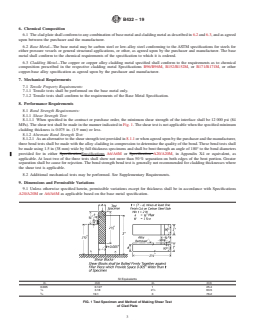
8.1.1.1 When specified in the contract or purchase order, the minimum shear strength of the interface shall be 12 000 psi (84
MPa). The shear test shall be made in the manner indicated in Fig. 1. The shear test is not applicable when the specified minimum
cladding thickness is 0.075 in. (1.9 mm) or less.
8.1.2 Alternate Bond Strength Test:
8.1.2.1 As an alternative to the shear strength test provided in 8.1.1 or when agreed upon by the purchaser and the manufacturer,
three bend tests shall be made with the alloy cladding in compression to determine the quality of the bond. These bend tests shall
be made using 1.5 in (38 mm) wide by full thickness specimens and shall be bent through an angle of 180° to the bend diameters
provided for in either SpecificationSpecifications A6/A6M or Specification A20/A20M, in Appendix X4 or equivalent, as
applicable. At least two of the three tests shall show not more than 50 % separation on both edges of the bent portion. Greater
separation shall be cause for rejection. The bond strength bend test is generally not recommended for cladding thicknesses where
the shear test is applicable.
8.2 Additional mechanical tests may be performed. See Supplementary Requirements.
9. Dimensions and Permissible Variations
9.1 Unless otherwise specified herein, permissible variations except for thickness shall be in accordance with Specifications
A20/A20M or A6/A6M as applicable based on the base metal specification.
SI Equivalents
in. mm in. mm
0.005 0.127 1 25.4
1 1
⁄8 3.18 2 ⁄2 63.5
⁄4 19.1 3 76.2
FIG. 1 Test Specimen and Method of Making Shear Test
of Clad Plate
B432 − 19
9.2 Minimum thickness of the alloy cladding metal and of the backing steel, or of the total composite plate, shall be as required
by purchase order documents when ordered to minimum thickness.
9.3 Permissible variation in thickness when ordered to nominal thicknesses shall be 0.01 in. (0.25 mm) under each for backing
steel or total composite, and 0.03 in. (0.76 mm) under for the alloy cladding.
9.4 Permissible variations for excess thickness of the total composite shall be the greater of 0.125 in. (3.2 mm) or 10 % of the
total composite thickness ordered and may occur in either backing steel, cladding, or both, provided the minimum for each is met.
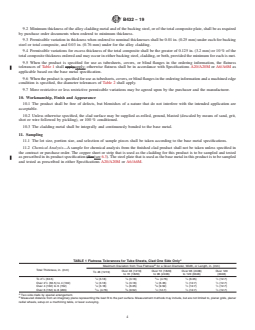
9.5 When the product is specified for use as tubesheets, covers, or blind flanges in the ordering information, the flatness
tolerances of Table 1 shall apply,apply; otherwise flatness shall be in accordance with Specifications A20/A20M or A6/A6M as
applicable based on the base metal specification.
9.6 When the product is specified for use as tubesheets, covers, or blind flanges in the ordering information and a machined edge
condition is specified, the diameter tolerances of Table 2 shall apply.
9.7 More restrictive or less restrictive permissible variations may be agreed upon by the purchaser and the manufacturer.
10. Workmanship, Finish and Appearance
10.1 The product shall be free of defects, but blemishes of a nature that do not interfere with the intended application are
acceptable.
10.2 Unless otherwise specified, the clad surface may be supplied as-rolled, ground, blasted (descaled by means of sand, grit,
shot or wire followed by pickling), or 100 % conditioned.
10.3 The cladding metal shall be integrally and continuously bonded to the base metal.
11. Sampling
11.1 The lot size, portion size, and selection of sample pieces shall be taken according to the base metal specifications.
11.2 Chemical Analysis—A sample for chemical analysis from the finished clad product shall not be taken unless specified in
the contract or purchase order. The copper sheet or strip that is used as the cladding for this product is to be sampled and tested
as prescribed in its product specification (See(see 6.3). The steel plate that is used as the base metal in this product is to be sampled
and tested as prescribed in either Specifications A20/A20M or A6/A6M.
A
TABLE 1 Flatness Tolerances for Tube Sheets, Clad One Side Only
B
Maximum Deviation from True Flatness for a Given Diameter, Width, or Length, in. (mm)
Total Thickness, in. (mm)
Over 48 (1219) Over 72 (1829) Over 96 (2438) Over 120
To 48 (1219)
to 72 (1829) to 96 (2438) to 120 (3048) (3048)
1 1 1 3 1 1
To 2 ⁄2 (63.5) ⁄8 (3.18) ⁄8 (3.18) ⁄16 (4.76) ⁄4 (6.35) ⁄2 (12.7)
1 1 1 1 1 1
Over 2 ⁄2 (63.5) to 4 (102) ⁄8 (3.18) ⁄8 (3.18) ⁄4 (6.35) ⁄2 (12.7) ⁄2 (12.7)
1 1 3 1 1
Over 4 (102) to 6 (152) ⁄8 (3.18) ⁄4 (6.35) ⁄8 (9.52) ⁄2 (12.7) ⁄2 (12.7)
3 3 1 1 1
Over 6 (152) to 8 (203) ⁄16 (4.76) ⁄8 (9.52) ⁄2 (12.7) ⁄2 (12.7) ⁄2 (12.7)
A
Two side clads by special arrangement.
B
Measured distance from an imaginary plane representing the best fit to the part surface. Measurement methods may include, but are not limited to, planar grids, planar
redial wheels, setup on a machining table, or laser surveying.
B432 − 19
TABLE 2 Outside Diameter Tolerances for Tubesheets, Covers, or
Blind Flanges when a Machined OD is Specified
Diameter Tolerance, ±
Under 60 in. (1.52 m) 0.06 in. (1.5 mm)
60.0 to 84.0 in. (1.52 to 2.14 m) 0.12 in. (3.2 mm)
>84.0 in. (>2.13 m) 0.25 in. (6.4 mm)
12. Number of Tests and Retests
12.1 Test:
12.1.1 Chemical Analysis—When specified in the contract or purchase order that a chemical analysis shall be performed on the
cladding metal, the base metal, or both, the tests shall be performed in a
...