

ASTM B249/B249M-23
(Specification)Standard Specification for General Requirements for Wrought Copper and Copper-Alloy Rod, Bar, Shapes and Forgings
General Information
- Abstract
ABSTRACT
This specification establishes the general requirements common to wrought copper and copper alloy rods, bars, shapes, and forgings. Products shall be manufactured by hot working, cold working, or both, and finished by cold working, annealing, or heat treatment and straightening as identified necessary to meet the properties specified. Materials shall be sampled and prepared, then tested accordingly to examine their conformance to dimensional (mass, diameter, length, straightness, and edge contours), mechanical (tensile strength, Rockwell hardness, elongation, and hydrogen embrittlement), electrical resistivity, chemical composition, and grain size requirements. The products shall also meet performance requirements when subjected to residual stress, mercurous nitrate, ammonia vapor, and semiguided bend tests. In the event of conflict between this specification and the individual casting product specifications, the requirements of the casting specification shall take precedence.
SIGNIFICANCE AND USE
12.1 For the purpose of determining compliance with the specified limits for requirements of the properties listed in the following table and for dimensional tolerances, an observed value or a calculated value shall be rounded as indicated in accordance with the rounding method of Practice E29.
Property
Rounded Unit for Observed or
Calculated Value
Chemical composition
Hardness
nearest unit in the last right-hand
Electrical resistivity
significant digit used in expressing the
Electrical conductivity
limiting value
Tensile strength
nearest ksi [5 MPa]
Yield strength
Elongation:
nearest 1 %
Grain size:
Under 0.060 mm
nearest multiple of 0.005 mm
0.060 mm and over
nearest 0.01 mm
SCOPE
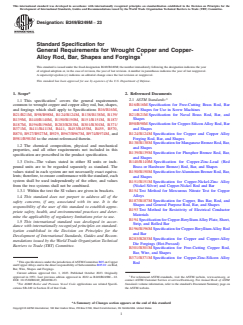
1.1 This specification2 covers the general requirements common to wrought copper and copper alloy rod, bar, shapes, and forgings which shall apply to Specifications B16/B16M, B21/B21M, B98/B98M, B124/B124M, B138/B138M, B139/B139M, B140/B140M, B150/B150M, B151/B151M, B187/B187M, B196/B196M, B283/B283M, B301/B301M, B371/B371M, B411/B411M, B441, B453/B453M, B455, B570, B870, B927/B927M, B929, B967/B967M, B974/B974M, and B981/B981M to the extent referenced therein.
1.2 The chemical composition, physical and mechanical properties, and all other requirements not included in this specification are prescribed in the product specification.
1.3 Units—The values stated in either SI units or inch-pound units are to be regarded separately as standard. The values stated in each system are not necessarily exact equivalents; therefore, to ensure conformance with the standard, each system shall be used independently of the other, and values from the two systems shall not be combined.
1.3.1 Within the text the SI values are given in brackets.
1.4 This standard does not purport to address all of the safety concerns, if any, associated with its use. It is the responsibility of the user of this standard to establish appropriate safety, health, and environmental practices and determine the applicability of regulatory limitations prior to use.
1.5 This international standard was developed in accordance with internationally recognized principles on standardization established in the Decision on Principles for the Development of International Standards, Guides and Recommendations issued by the World Trade Organization Technical Barriers to Trade (TBT) Committee.
- Status
- Published
- Publication Date
- 30-Sep-2023
- Technical Committee
- B05 - Copper and Copper Alloys
- Drafting Committee
- B05.02 - Rod, Bar, Wire, Shapes and Forgings
Buy Documents
ASTM B249/B249M-23 - Standard Specification for General Requirements for Wrought Copper and Copper-Alloy Rod, Bar, Shapes and Forgings
REDLINE ASTM B249/B249M-23 - Standard Specification for General Requirements for Wrought Copper and Copper-Alloy Rod, Bar, Shapes and Forgings
Overview
ASTM B249/B249M-23 is the standard specification for general requirements concerning wrought copper and copper-alloy rod, bar, shapes, and forgings. Developed by ASTM International, this standard outlines the foundational criteria that apply to a broad range of copper and copper-alloy products, ensuring consistency in quality, dimensions, and mechanical properties across the industry. The specification is commonly referenced by numerous product-specific ASTM standards, making it essential for manufacturers, suppliers, and end-users working with copper and copper alloys in various applications.
Key Topics
- Product Scope: Covers wrought copper and copper-alloy rod, bar, shapes, and forgings manufactured through hot working, cold working, or a combination of both, with final treatment processes such as annealing or heat treatment to meet specified properties.
- Dimensional Requirements: Details dimensional tolerances, including mass, diameter, length, straightness, and edge contours, facilitating uniform product characteristics.
- Mechanical and Physical Properties: Sets general guidelines for tensile strength, elongation, Rockwell hardness, electrical resistivity, grain size, and more.
- Performance Criteria: Products must pass tests such as residual stress tests, mercurous nitrate, ammonia vapor tests, and bend tests to ensure reliability in their intended applications.
- Testing and Rounding Methods: Specifies sampling, preparation, and rounding practices for observed or calculated values, referencing ASTM E29 for rounding methods.
- Compliance and Safety: Notes that compliance must be evaluated independently for SI and inch-pound units and highlights the user’s responsibility for addressing safety and regulatory issues.
Applications
ASTM B249/B249M-23 provides a framework for the production and verification of copper and copper-alloy products used in diverse industries, supporting consistent performance in:
- Electrical Components: Ensures consistent mechanical and electrical properties for rods and bars used in busbars, switchgear, connectors, and power transmission systems.
- Machinery and Automotive: Supports manufacturers producing forged and machined components requiring precise alloy composition and mechanical strength.
- Construction and Architecture: Applies to copper products used for structural features, fasteners, architectural details, and decorative elements.
- Marine and Industrial Engineering: Ensures corrosion-resistant and mechanically sound copper-alloy products for marine hardware, heat exchangers, and fluid handling systems.
- General Manufacturing: Serves any sector requiring reliable, quality-controlled copper forgings, shapes, and bars conforming to standard industry tolerances.
Related Standards
ASTM B249/B249M-23 is a base reference for a number of related copper and copper-alloy product specifications, such as:
- ASTM B16/B16M - Free-Cutting Brass Rod, Bar and Shapes
- ASTM B21/B21M - Naval Brass Rod, Bar, and Shapes
- ASTM B98/B98M - Copper-Silicon Alloy Rod, Bar, and Shapes
- ASTM B124/B124M - Copper and Copper Alloy Forging Rod, Bar, and Shapes
- ASTM B138/B138M - Manganese Bronze Rod, Bar, and Shapes
- ASTM B196/B196M - Copper-Beryllium Alloy Rod and Bar
- Numerous Others: Including B140/B140M, B150/B150M, B151/B151M, B187/B187M, B301/B301M, B441, B927/B927M, and more.
Practical Value
By standardizing general requirements for copper and copper-alloy products, ASTM B249/B249M-23:
- Streamlines Procurement: Simplifies specification writing and purchasing across the supply chain.
- Ensures Quality: Promotes uniformity in mechanical and dimensional characteristics, minimizing variations and defects.
- Enhances Safety: Provides a reliable basis for quality control, ensuring that materials meet intended performance and safety requirements.
- Supports Global Trade: Aligns with internationally recognized standardization principles, supporting worldwide commerce and regulatory compliance.
Keywords: ASTM B249/B249M, wrought copper, copper-alloy rod, bar, shapes, forgings, mechanical properties, dimensional tolerances, industry standards, quality assurance, copper alloy specification.
Relations
- Effective Date
- 01-Oct-2023
- Effective Date
- 01-Jan-2024
- Effective Date
- 01-May-2022
- Effective Date
- 01-Apr-2017
- Effective Date
- 01-Oct-2023
- Effective Date
- 01-Oct-2023
- Effective Date
- 01-Oct-2023
- Effective Date
- 01-Oct-2023
- Effective Date
- 01-Oct-2023
- Effective Date
- 01-Oct-2023
- Referred By
ASTM B98/B98M-13(2019) - Standard Specification for Copper-Silicon Alloy Rod, Bar and Shapes - Effective Date
- 01-Oct-2023
- Referred By
ASTM B411/B411M-14(2019) - Standard Specification for Copper-Nickel-Silicon Alloy Rod and Bar - Effective Date
- 01-Oct-2023
- Effective Date
- 01-Oct-2023
- Effective Date
- 01-Oct-2023
- Referred By
ASTM B138/B138M-11(2017) - Standard Specification for Manganese Bronze Rod, Bar, and Shapes - Effective Date
- 01-Oct-2023
Buy Documents
ASTM B249/B249M-23 - Standard Specification for General Requirements for Wrought Copper and Copper-Alloy Rod, Bar, Shapes and Forgings
REDLINE ASTM B249/B249M-23 - Standard Specification for General Requirements for Wrought Copper and Copper-Alloy Rod, Bar, Shapes and Forgings
Get Certified
Connect with accredited certification bodies for this standard

Element Materials Technology
Materials testing and product certification.

Inštitut za kovinske materiale in tehnologije
Institute of Metals and Technology. Materials testing, metallurgical analysis, NDT.
Sponsored listings
Frequently Asked Questions
ASTM B249/B249M-23 is a technical specification published by ASTM International. Its full title is "Standard Specification for General Requirements for Wrought Copper and Copper-Alloy Rod, Bar, Shapes and Forgings". This standard covers: ABSTRACT This specification establishes the general requirements common to wrought copper and copper alloy rods, bars, shapes, and forgings. Products shall be manufactured by hot working, cold working, or both, and finished by cold working, annealing, or heat treatment and straightening as identified necessary to meet the properties specified. Materials shall be sampled and prepared, then tested accordingly to examine their conformance to dimensional (mass, diameter, length, straightness, and edge contours), mechanical (tensile strength, Rockwell hardness, elongation, and hydrogen embrittlement), electrical resistivity, chemical composition, and grain size requirements. The products shall also meet performance requirements when subjected to residual stress, mercurous nitrate, ammonia vapor, and semiguided bend tests. In the event of conflict between this specification and the individual casting product specifications, the requirements of the casting specification shall take precedence. SIGNIFICANCE AND USE 12.1 For the purpose of determining compliance with the specified limits for requirements of the properties listed in the following table and for dimensional tolerances, an observed value or a calculated value shall be rounded as indicated in accordance with the rounding method of Practice E29. Property Rounded Unit for Observed or Calculated Value Chemical composition Hardness nearest unit in the last right-hand Electrical resistivity significant digit used in expressing the Electrical conductivity limiting value Tensile strength nearest ksi [5 MPa] Yield strength Elongation: nearest 1 % Grain size: Under 0.060 mm nearest multiple of 0.005 mm 0.060 mm and over nearest 0.01 mm SCOPE 1.1 This specification2 covers the general requirements common to wrought copper and copper alloy rod, bar, shapes, and forgings which shall apply to Specifications B16/B16M, B21/B21M, B98/B98M, B124/B124M, B138/B138M, B139/B139M, B140/B140M, B150/B150M, B151/B151M, B187/B187M, B196/B196M, B283/B283M, B301/B301M, B371/B371M, B411/B411M, B441, B453/B453M, B455, B570, B870, B927/B927M, B929, B967/B967M, B974/B974M, and B981/B981M to the extent referenced therein. 1.2 The chemical composition, physical and mechanical properties, and all other requirements not included in this specification are prescribed in the product specification. 1.3 Units—The values stated in either SI units or inch-pound units are to be regarded separately as standard. The values stated in each system are not necessarily exact equivalents; therefore, to ensure conformance with the standard, each system shall be used independently of the other, and values from the two systems shall not be combined. 1.3.1 Within the text the SI values are given in brackets. 1.4 This standard does not purport to address all of the safety concerns, if any, associated with its use. It is the responsibility of the user of this standard to establish appropriate safety, health, and environmental practices and determine the applicability of regulatory limitations prior to use. 1.5 This international standard was developed in accordance with internationally recognized principles on standardization established in the Decision on Principles for the Development of International Standards, Guides and Recommendations issued by the World Trade Organization Technical Barriers to Trade (TBT) Committee.
ABSTRACT This specification establishes the general requirements common to wrought copper and copper alloy rods, bars, shapes, and forgings. Products shall be manufactured by hot working, cold working, or both, and finished by cold working, annealing, or heat treatment and straightening as identified necessary to meet the properties specified. Materials shall be sampled and prepared, then tested accordingly to examine their conformance to dimensional (mass, diameter, length, straightness, and edge contours), mechanical (tensile strength, Rockwell hardness, elongation, and hydrogen embrittlement), electrical resistivity, chemical composition, and grain size requirements. The products shall also meet performance requirements when subjected to residual stress, mercurous nitrate, ammonia vapor, and semiguided bend tests. In the event of conflict between this specification and the individual casting product specifications, the requirements of the casting specification shall take precedence. SIGNIFICANCE AND USE 12.1 For the purpose of determining compliance with the specified limits for requirements of the properties listed in the following table and for dimensional tolerances, an observed value or a calculated value shall be rounded as indicated in accordance with the rounding method of Practice E29. Property Rounded Unit for Observed or Calculated Value Chemical composition Hardness nearest unit in the last right-hand Electrical resistivity significant digit used in expressing the Electrical conductivity limiting value Tensile strength nearest ksi [5 MPa] Yield strength Elongation: nearest 1 % Grain size: Under 0.060 mm nearest multiple of 0.005 mm 0.060 mm and over nearest 0.01 mm SCOPE 1.1 This specification2 covers the general requirements common to wrought copper and copper alloy rod, bar, shapes, and forgings which shall apply to Specifications B16/B16M, B21/B21M, B98/B98M, B124/B124M, B138/B138M, B139/B139M, B140/B140M, B150/B150M, B151/B151M, B187/B187M, B196/B196M, B283/B283M, B301/B301M, B371/B371M, B411/B411M, B441, B453/B453M, B455, B570, B870, B927/B927M, B929, B967/B967M, B974/B974M, and B981/B981M to the extent referenced therein. 1.2 The chemical composition, physical and mechanical properties, and all other requirements not included in this specification are prescribed in the product specification. 1.3 Units—The values stated in either SI units or inch-pound units are to be regarded separately as standard. The values stated in each system are not necessarily exact equivalents; therefore, to ensure conformance with the standard, each system shall be used independently of the other, and values from the two systems shall not be combined. 1.3.1 Within the text the SI values are given in brackets. 1.4 This standard does not purport to address all of the safety concerns, if any, associated with its use. It is the responsibility of the user of this standard to establish appropriate safety, health, and environmental practices and determine the applicability of regulatory limitations prior to use. 1.5 This international standard was developed in accordance with internationally recognized principles on standardization established in the Decision on Principles for the Development of International Standards, Guides and Recommendations issued by the World Trade Organization Technical Barriers to Trade (TBT) Committee.
ASTM B249/B249M-23 is classified under the following ICS (International Classification for Standards) categories: 77.150.30 - Copper products. The ICS classification helps identify the subject area and facilitates finding related standards.
ASTM B249/B249M-23 has the following relationships with other standards: It is inter standard links to ASTM B249/B249M-22, ASTM E8/E8M-24, ASTM E8/E8M-22, ASTM B927/B927M-17, ASTM B441-22, ASTM B453/B453M-19, ASTM B950-23, ASTM B927/B927M-23, ASTM B967/B967M-18(2023), ASTM B371/B371M-19, ASTM B98/B98M-13(2019), ASTM B411/B411M-14(2019), ASTM B21/B21M-20, ASTM B570-22, ASTM B138/B138M-11(2017). Understanding these relationships helps ensure you are using the most current and applicable version of the standard.
ASTM B249/B249M-23 is available in PDF format for immediate download after purchase. The document can be added to your cart and obtained through the secure checkout process. Digital delivery ensures instant access to the complete standard document.
Standards Content (Sample)
This international standard was developed in accordance with internationally recognized principles on standardization established in the Decision on Principles for the
Development of International Standards, Guides and Recommendations issued by the World Trade Organization Technical Barriers to Trade (TBT) Committee.
Designation: B249/B249M − 23
Standard Specification for
General Requirements for Wrought Copper and Copper-
Alloy Rod, Bar, Shapes and Forgings
This standard is issued under the fixed designation B249/B249M; the number immediately following the designation indicates the year
of original adoption or, in the case of revision, the year of last revision. A number in parentheses indicates the year of last reapproval.
A superscript epsilon (´) indicates an editorial change since the last revision or reapproval.
This standard has been approved for use by agencies of the U.S. Department of Defense.
1. Scope* 2. Referenced Documents
2.1 ASTM Standards:
1.1 This specification covers the general requirements
B16/B16M Specification for Free-Cutting Brass Rod, Bar
common to wrought copper and copper alloy rod, bar, shapes,
and Shapes for Use in Screw Machines
and forgings which shall apply to Specifications B16/B16M,
B21/B21M Specification for Naval Brass Rod, Bar, and
B21/B21M, B98/B98M, B124/B124M, B138/B138M, B139/
Shapes
B139M, B140/B140M, B150/B150M, B151/B151M, B187/
B98/B98M Specification for Copper-Silicon Alloy Rod, Bar
B187M, B196/B196M, B283/B283M, B301/B301M, B371/
and Shapes
B371M, B411/B411M, B441, B453/B453M, B455, B570,
B124/B124M Specification for Copper and Copper Alloy
B870, B927/B927M, B929, B967/B967M, B974/B974M, and
Forging Rod, Bar, and Shapes
B981/B981M to the extent referenced therein.
B138/B138M Specification for Manganese Bronze Rod, Bar,
1.2 The chemical composition, physical and mechanical
and Shapes
properties, and all other requirements not included in this
B139/B139M Specification for Phosphor Bronze Rod, Bar,
specification are prescribed in the product specification.
and Shapes
1.3 Units—The values stated in either SI units or inch-
B140/B140M Specification for Copper-Zinc-Lead (Red
pound units are to be regarded separately as standard. The
Brass or Hardware Bronze) Rod, Bar, and Shapes
values stated in each system are not necessarily exact equiva-
B150/B150M Specification for Aluminum Bronze Rod, Bar,
lents; therefore, to ensure conformance with the standard, each
and Shapes
system shall be used independently of the other, and values
B151/B151M Specification for Copper-Nickel-Zinc Alloy
from the two systems shall not be combined.
(Nickel Silver) and Copper-Nickel Rod and Bar
1.3.1 Within the text the SI values are given in brackets. B154 Test Method for Mercurous Nitrate Test for Copper
Alloys
1.4 This standard does not purport to address all of the
B187/B187M Specification for Copper, Bus Bar, Rod, and
safety concerns, if any, associated with its use. It is the
Shapes and General Purpose Rod, Bar, and Shapes
responsibility of the user of this standard to establish appro-
B193 Test Method for Resistivity of Electrical Conductor
priate safety, health, and environmental practices and deter-
Materials
mine the applicability of regulatory limitations prior to use.
B194 Specification for Copper-Beryllium Alloy Plate, Sheet,
1.5 This international standard was developed in accor-
Strip, and Rolled Bar
dance with internationally recognized principles on standard-
B196/B196M Specification for Copper-Beryllium Alloy Rod
ization established in the Decision on Principles for the
and Bar
Development of International Standards, Guides and Recom-
B283/B283M Specification for Copper and Copper-Alloy
mendations issued by the World Trade Organization Technical
Die Forgings (Hot-Pressed)
Barriers to Trade (TBT) Committee.
B301/B301M Specification for Free-Cutting Copper Rod,
Bar, Wire, and Shapes
B371/B371M Specification for Copper-Zinc-Silicon Alloy
This specification is under the jurisdiction of ASTM Committee B05 on Copper
Rod
and Copper Alloys and is the direct responsibility of Subcommittee B05.02 on Rod,
Bar, Wire, Shapes and Forgings.
Current edition approved Oct. 1, 2023. Published October 2023. Originally
approved in 1951. Last previous edition approved in 2022 as B249/B249M – 22. For referenced ASTM standards, visit the ASTM website, www.astm.org, or
DOI: 10.1520/B0249_B0249M-23. contact ASTM Customer Service at service@astm.org. For Annual Book of ASTM
For ASME Boiler and Pressure Vessel Code applications see related Specifi- Standards volume information, refer to the standard’s Document Summary page on
cations SB-249 in Section II of that Code. the ASTM website.
*A Summary of Changes section appears at the end of this standard
Copyright © ASTM International, 100 Barr Harbor Drive, PO Box C700, West Conshohocken, PA 19428-2959. United States
B249/B249M − 23
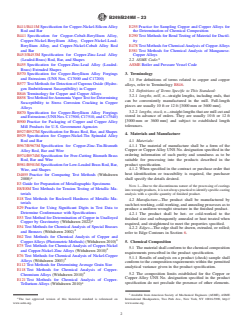
B411/B411M Specification for Copper-Nickel-Silicon Alloy E255 Practice for Sampling Copper and Copper Alloys for
Rod and Bar the Determination of Chemical Composition
B441 Specification for Copper-Cobalt-Beryllium Alloy, E290 Test Methods for Bend Testing of Material for Ductil-
Copper-Nickel-Beryllium Alloy, Copper-Nickel-Lead- ity
Beryllium Alloy, and Copper-Nickel-Cobalt Alloy Rod E478 Test Methods for Chemical Analysis of Copper Alloys
and Bar E581 Test Methods for Chemical Analysis of Manganese-
B453/B453M Specification for Copper-Zinc-Lead Alloy Copper Alloys
(Leaded-Brass) Rod, Bar, and Shapes 2.2 ASME Code:
B455 Specification for Copper-Zinc-Lead Alloy (Leaded-
ASME Boiler and Pressure Vessel Code
Brass) Extruded Shapes
3. Terminology
B570 Specification for Copper-Beryllium Alloy Forgings
and Extrusions (UNS Nos. C17000 and C17200)
3.1 For definitions of terms related to copper and copper
B577 Test Methods for Detection of Cuprous Oxide (Hydro-
alloys, refer to Terminology B846.
gen Embrittlement Susceptibility) in Copper
3.2 Definitions of Terms Specific to This Standard:
B846 Terminology for Copper and Copper Alloys
3.2.1 lengths, mill, n—straight lengths, including ends, that
B858 Test Method for Ammonia Vapor Test for Determining
can be conveniently manufactured in the mill. Full-length
Susceptibility to Stress Corrosion Cracking in Copper
pieces are usually 10 ft or 12 ft [3000 mm or 3600 mm].
Alloys
3.2.2 lengths, stock, n—straight lengths that are mill cut and
B870 Specification for Copper-Beryllium Alloy Forgings
stored in advance of orders. They are usually 10 ft or 12 ft
and Extrusions (UNS Nos. C17500, C17510, and C17540)
[3000 mm or 3600 mm] and subject to established length
B900 Practice for Packaging of Copper and Copper Alloy
tolerances.
Mill Products for U.S. Government Agencies
B927/B927M Specification for Brass Rod, Bar, and Shapes
4. Materials and Manufacture
B929 Specification for Copper-Nickel-Tin Spinodal Alloy
4.1 Materials:
Rod and Bar
4.1.1 The material of manufacture shall be a form of the
B967/B967M Specification for Copper-Zinc-Tin-Bismuth
Copper or Copper Alloy UNS No. designation specified in the
Alloy Rod, Bar and Wire
ordering information of such purity and soundness as to be
B974/B974M Specification for Free-Cutting Bismuth Brass
suitable for processing into the products described in the
Rod, Bar and Wire
product specification.
B981/B981M Specification for Low-Leaded Brass Rod, Bar,
4.1.2 When specified in the contract or purchase order that
Wire, and Shapes
heat identification or traceability is required, the purchaser
D4855 Practice for Comparing Test Methods (Withdrawn
shall specify the details desired.
2008)
E3 Guide for Preparation of Metallographic Specimens
NOTE 1—Due to the discontinuous nature of the processing of castings
E8/E8M Test Methods for Tension Testing of Metallic Ma-
into wrought products, it is not always practical to identify specific casting
terials analysis with a specific quantity of finished product.
E18 Test Methods for Rockwell Hardness of Metallic Ma-
4.2 Manufacture—The product shall be manufactured by
terials
such hot-working, cold-working, and annealing processes as to
E29 Practice for Using Significant Digits in Test Data to
produce a uniform wrought structure in the finished product.
Determine Conformance with Specifications
4.2.1 The product shall be hot- or cold-worked to the
E53 Test Method for Determination of Copper in Unalloyed
finished size and subsequently annealed or heat treated when
Copper by Gravimetry (Withdrawn 2022)
required, and straightened to meet the properties specified.
E54 Test Methods for Chemical Analysis of Special Brasses
4.2.2 Edges—The edge shall be drawn, extruded, or rolled;
and Bronzes (Withdrawn 2002)
refer to Edge Contours in Section 6.
E62 Test Methods for Chemical Analysis of Copper and
Copper Alloys (Photometric Methods) (Withdrawn 2010) 5. Chemical Composition
E75 Test Methods for Chemical Analysis of Copper-Nickel
5.1 The material shall conform to the chemical composition
and Copper-Nickel-Zinc Alloys (Withdrawn 2010)
requirements prescribed in the product specification.
E76 Test Methods for Chemical Analysis of Nickel-Copper
5.1.1 Results of analysis on a product (check) sample shall
Alloys (Withdrawn 2003)
conform to the composition requirements within the permitted
E112 Test Methods for Determining Average Grain Size
analytical variance given in the product specification.
E118 Test Methods for Chemical Analysis of Copper-
5.2 The composition limits established for the Copper or
Chromium Alloys (Withdrawn 2010)
Copper Alloy UNS No. designation specified in the product
E121 Test Methods for Chemical Analysis of Copper-
specification do not preclude the presence of other elements.
Tellurium Alloys (Withdrawn 2010)
Available from American Society of Mechanical Engineers (ASME), ASME
The last approved version of this historical standard is referenced on International Headquarters, Two Park Ave., New York, NY 10016-5990, http://
www.astm.org. www.asme.org.
B249/B249M − 23
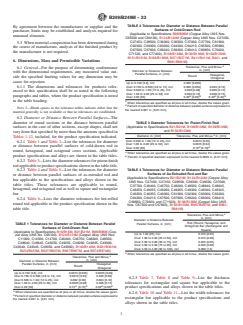
TABLE 2 Tolerances for Diameter or Distance Between Parallel
By agreement between the manufacturer or supplier and the
Surfaces of Cold-Drawn Rod
purchaser, limits may be established and analysis required for
(Applicable to Specifications B98/B98M (Copper Alloy UNS Nos.
unnamed elements.
C65500 and C66100), B124/B124M (Copper Alloy UNS Nos. C27450,
C27453, C28500, C36300, C36500, C37000, C37700, C61900,
5.3 When material composition has been determined during
C62300, C63000, C63200, C64200, C64210, C65500, C65680,
the course of manufacture, analysis of the finished product by
C67500, C67600, C69240, C69300, C69410, C69850, C70620,
the manufacturer is not required.
C71520, and C77400), B138/B138M, B139/B139M, B150/B150M,
B151/B151M, B196/B196M, B371/B371M, B411/B411M, B441, and
6. Dimensions, Mass and Permissible Variations
B981/B981M)
A
Tolerances, Plus and Minus,
6.1 General—For the purpose of determining conformance
in. [mm]
Diameter or Distance Between
with the dimensional requirements, any measured value out-
Parallel Surfaces, in. [mm]
Hexagonal,
Round
side the specified limiting values for any dimension may be
Octagonal
cause for rejection.
Up to 0.150 [3.8], incl 0.002 [0.050] . . .
Over 0.150 to 0.500 [3.8 to 12], incl 0.002 [0.050] 0.004 [0.10]
6.1.1 The dimensions and tolerances for products refer-
Over 0.500 to 1.00 [12 to 25], incl 0.003 [0.08] 0.005 [0.13]
enced to this specification shall be as noted in the following
Over 1.00 to 2.00 [25 to 50], incl 0.004 [0.10] 0.006 [0.15]
B B B B
paragraphs and tables, where the product specification is noted
Over 2.00 [50] 0.20 [0.20] 0.40 [0.40]
in the table heading.
A
When tolerances are specified as all plus or all minus, double the values given.
B
Percent of specified diameter or distance between parallel surfaces expressed to
NOTE 2—Blank spaces in the tolerance tables indicate either that the
the nearest 0.001 in. [0.01 mm].
material generally is not available or that no tolerances are established.
6.2 Diameter or Distance Between Parallel Surfaces—The
diameter of round sections or the distance between parallel TABLE 3 Diameter Tolerances for Piston-Finish Rod
(Applicable to Specifications B21/B21M, B138/B138M, B139/B139M,
surfaces in the case of other sections, except shapes, shall not
and B150/B150M)
vary from that specified by more than the amounts specified in
A
Diameter, in. [mm] Tolerances, Plus and Minus, in. [mm]
Tables 1-12, included, for the product specification indicated.
Over 0.500 to 1.00 [12 to 25], incl 0.0013 [0.35]
6.2.1 Table 1 and Table 2—List the tolerances for diameter
Over 1.00 to 2.00 [25 to 50], incl 0.0015 [0.04]
or distance between parallel surfaces of cold-drawn rod in
B B
Over 2.00 [50] 0.10 [0.10]
round, hexagonal, and octagonal cross sections. Applicable
A
When tolerances are specified as all plus or all minus, double the values given.
B
product specifications and alloys are shown in the table titles.
Percent of specified diameter expressed to the nearest 0.0005 in. [0.01 mm].
6.2.2 Table 3—Lists the diameter tolerances for piston finish
rod applicable to product specifications shown in the table title.
TABLE 4 Tolerances for Diameter or Distance Between Parallel
6.2.3 Table 4 and Table 5—List the tolerances for diameter
Surfaces of As-Extruded Rod and Bar
or distance between parallel surfaces of as-extruded rod and
(Applicable to Specifications B21/B21M, B124/B124M (Copper Alloy
bar applicable to the specifications and alloys shown in the
UNS Nos. C27450, C27453, C28500, C36300, C36500, C37000,
table titles. These tolerances are applicable to round,
C37700, C46400, C46750, C48200, C48500, C48640, C48645,
hexagonal, and octagonal rod as well as square and rectangular C49250, C49255, C49260, C49265, C49300, C49340, C49345,
C49350, C49355, C49360, C61900, C62300, C63000, C63200,
bar.
C64200, C64210, C67500, C67600, C69240, C69300, C69410,
6.2.4 Table 6—Lists the diameter tolerances for hot-rolled
C69850, C70620, and C71520), B138/B138M (Copper Alloy UNS
round rod applicable to the product specification shown in the
Nos. C67500 and C67600), B150/B150M, B967/B967M, and B981/
table title.
B981M)
A
Tolerances, Plus and Minus,
in. [mm]
Diameter or Distance Between
Rod (Round, Hexagonal, and
TABLE 1 Tolerances for Diameter or Distance Between Parallel
Parallel Surfaces, in. [mm]
Octagonal) Bar (Rectangular and
Surfaces of Cold-Drawn Rod
Square)
(Applicable to Specifications B16/B16M, B21/B21M, B98/B98M (Cop-
Up to 1.00 [25], incl 0.010 [0.25]
per Alloy UNS No. C65100), B124/B124M (Copper Alloy UNS Nos.
Over 1.00 to 2.00 [25 to 50], incl 0.015 [0.38]
C11000, C14500, C14700, C46400, C46750, C48200, C48500,
Over 2.00 to 3.00 [50 to 75], incl 0.025 [0.65]
C48640, C48645, C49250, C49255, C49260, C49265, C49300,
Over 3.00 to 3.50 [75 to 90], incl 0.035 [0.90]
C49340, C49345, C49350, and C49360), B140/B140M, B301/B301M,
Over 3.50 to 4.00 [90 to 100], incl 0.060 [1.5]
B453/B453M, B927/B927M, B967/B967M, and B974/B974M)
A
When tolerances are specified as all plus or all minus, double the values given.
A
Tolerances, Plus and Minus,
in. [mm]
Diameter or Distance Between
Parallel Surfaces, in. [mm]
Hexagonal,
Round
Octagonal
Up to 0.150 [3.8], incl 0.0013 [0.035] 0.0025 [0.06]
Over 0.150 to 0.500 [3.8 to 12], incl 0.0015 [0.04] 0.003 [0.08]
6.2.5 Table 7, Table 8 and Table 9—List the thickness
Over 0.500 to 1.00 [12 to 25], incl 0.002 [0.05] 0.004 [0.10]
tolerances for rectangular and square bar applicable to the
Over 1.00 to 2.00 [25 to 50], incl 0.0025 [0.06] 0.005 [0.13]
B B B B
Over 2.00 [50] 0.15 [0.15] 0.30 [0.30]
product specifications and alloys shown in the table titles.
A
When tolerances are specified as all plus or all minus, double the values given.
6.2.6 Table 10 and Table 11—List the width tolerances for
B
Percent of specified diameter or distance between parallel surfaces expressed to
rectangular bar applicable to the product specifications and
the nearest 0.001 in. [0.01 mm].
alloys shown in the table titles.
B249/B249M − 23
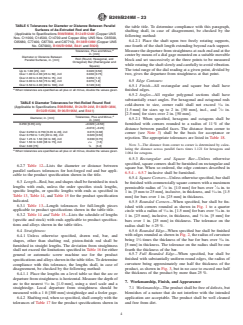
TABLE 5 Tolerances for Diameter or Distance Between Parallel
the table title. To determine compliance with this paragraph,
Surfaces of As-Extruded Rod and Bar
shafting shall, in case of disagreement, be checked by the
(Applicable to Specifications B98/B98M, B124/B124M (Copper UNS
following method:
Nos. C11000, C14500, C14700 and Copper Alloy UNS Nos. C65500,
6.4.2.1 Place the shaft upon two freely rotating supports,
C65680, C77400, C87700, and C87710), B138/B138M (Copper UNS
No. C67000), B196/B196M, B441 and B929) one fourth of the shaft length extending beyond each support.
A
Measure the departure from straightness at each end and at the
Tolerances, Plus and Minus,
in. [mm]
center by means of a dial gage mounted on a suitable movable
Diameter or Distance Between
Rod (Round, Hexagonal, and
Parallel Surfaces, in. [mm] block and set successively at the three points to be measured
Octagonal) Bar (Rectangular and
while rotating the shaft slowly and carefully to avoid vibration.
Square)
The total range of the dial reading at a given point, divided by
Up to 1.00 [25], incl 0.020 [0.50]
Over 1.00 to 2.00 [25 to 50], incl 0.030 [0.75] two, gives the departure from straightness at that point.
Over 2.00 to 3.00 [50 to 75], incl 0.050 [1.3]
6.5 Edge Contours:
Over 3.00 to 3.50 [75 to 90], incl 0.070 [1.8]
Over 3.50 to 4.00 [90 to 100], incl 0.120 [3.0]
6.5.1 Finish—All rectangular and square bar shall have
A
When tolerances are specified as all plus or all minus, double the values given.
finished edges.
6.5.2 Angles—All regular polygonal sections shall have
substantially exact angles. For hexagonal and octagonal rods
TABLE 6 Diameter Tolerances for Hot-Rolled Round Rod 1
cold-drawn to size, corner radii shall not exceed ⁄16 in.
(Applicable to Specifications B98/B98M, B124/B124M, B138/B138M,
[1.5 mm] for sizes up to 2 in. [50 mm], incl., and ⁄32 in.
B150/B150M, B196/B196M, and B441)
[2.5 mm] for sizes over 2 in. [50 mm].
A
Tolerances, Plus and Minus,
Diameter, in. [mm]
6.5.2.1 When specified, hexagons and octagons shall be
in. [mm]
furnished with corners rounded to a radius of 11 % of the
0.250 [6.35] only +0.020 [+0.50]
−0.010 [−0.25]
distance between parallel faces. The distance from corner to
Over 0.250 to 0.750 [6.35 to 20], incl 0.015 [0.38]
corner (see Note 3) shall be the basis for acceptance or
Over 0.750 to 1.25 [20 to 30], incl 0.020 [0.50]
rejection. The appropriate tolerances are listed in Table 18.
Over 1.25 to 1.50 [30 to 38], incl 0.030 [0.75]
Over 1.50 to 3.00 [38 to 75], incl ⁄16 [1.6]
1 NOTE 3—The distance from corner to corner is determined by calcu-
Over 3.00 [75] ⁄8 [3.2]
lating the distance across parallel faces times 1.121 for hexagons and
A
When tolerances are specified as all plus or all minus, double the values given.
1.064 for octagons.
6.5.3 Rectangular and Square Bar—Unless otherwise
specified, square corners shall be furnished on rectangular and
6.2.7 Table 12—Lists the diameter or distance between
square bar. When so ordered, the edge contours described in
parallel surfaces tolerances for hot-forged rod and bar appli-
6.5.4 – 6.5.7 inclusive shall be furnished.
cable to the product specification shown in the title.
6.5.4 Square Corners—Unless otherwise specified, bar shall
6.3 Length—Rod, bar, and shapes shall be furnished in stock
be finished with commercially square corners with a maximum
1 3
lengths with ends, unless the order specifies stock lengths,
permissible radius of ⁄32 in. [1.0 mm] for bars over ⁄16 in. to
specific lengths, or specific lengths with ends as specified in 1
1 in. [5 mm to 25 mm], inclusive, in thickness, and ⁄16 in. [1.5
Table 13, Table 14, and Table 15 for the product specification
mm] for bars over 1 in. [25 mm] in thickness.
indicated.
6.5.5 Rounded Corners—When specified, bar shall be fin-
6.3.1 Table 13—Length tolerances for full-length pieces
ished with corners rounded as shown in Fig. 1 to a quarter
applicable to product specifications shown in the table title. 1 3
circle with a radius of ⁄16 in. [1.5 mm] for bars over ⁄16 in. to
6.3.2 Table 14 and Table 15—Lists the schedule of lengths
1 in. [25 mm], inclusive, in thickness, and ⁄8 in. [5 mm] for
(specific and stock) with ends applicable to product specifica-
bars over 1 in. [25 mm] in thickness. The tolerance on the
tions and alloys shown in the table titles.
radius shall be 625 %.
6.5.6 Rounded Edge—When specified bar shall be finished
6.4 Straightness:
with edges rounded as shown in Fig. 2, the radius of curvature
6.4.1 Unless otherwise specified, drawn rod, bar, and
1 3
being 1 ⁄4 times the thickness of the bar for bars over ⁄16 in.
shapes, other than shafting rod, piston-finish rod shall be
[5 mm] in thickness. The tolerance on the radius shall be one
furnished in straight lengths. The deviation from straightness
fourth the thickness of the bar.
shall not exceed the limitations specified in Table 16 for either
6.5.7 Full Rounded Edge—When specified, bar shall be
general or automatic screw machine use for the product
finished with substantially uniform round edges, the radius of
specifications and alloys shown in the table titles. To determine
curvature being approximately one half the thickness of the
compliance with this tolerance, the lengths shall, in case of
product, as shown in Fig. 3, but in no case to exceed one half
disagreement, be checked by the following method:
the thickness of the product by more than 25 %.
6.4.1.1 Place the lengths on a level table so that the arc or
departure from straightness is horizontal. Measure the depth of
7. Workmanship, Finish, and Appearance
arc to the nearest ⁄32 in. [1.0 mm], using a steel scale and a
straightedge. Local departure from straightness should be 7.1 Workmanship—The product shall be free of defects, but
measured with a 1 ft [300 mm] straightedge and a feeler gage. blemishes of a nature that do not interfere with the intended
6.4.2 Shafting rod, when so specified, shall comply with the application are acceptable. The product shall be well cleaned
tolerances of Table 17 for the product specifications shown in and free from dirt.
B249/B249M − 23
TABLE 7 Thickness Tolerances for Rectangular and Square Bar
(Applicable to Specifications B124/B124M, (Copper Alloy UNS Nos. C11000, C14500, and C14700), B301/B301M, and B974/B974M)
A
Thickness Tolerances, Plus and Minus, in. [mm] for Widths Given in Inches
Thickness, in. [mm] 1 1 1
Over ⁄2 to 1 ⁄4 [12 Over 1 ⁄4 to 2 [30 to Over 2 to 4 [50 to Over 4 to 8 [100 to Over 8 to 12 [200 to
⁄2 [12] and Under
to 30] Incl 50] Incl 100] Incl 200] Incl 300] Incl
Over 0.188 to 0.500 [4.8 to 12], incl 0.003 [0.08] 0.003 [0.08] 0.0035 [0.09] 0.004 [0.10] 0.0045 [0.11] 0.0055 [0.13]
Over 0.500 to 1.00 [12 to 25], incl . 0.004 [0.10] 0.004 [0.10] 0.0045 [0.11] 0.005 [0.13] 0.006 [0.15]
Over 1.00 to 2.00 [25 to 50], incl . 0.0045 [0.11] 0.0045 [0.11] 0.005 [0.13] 0.006 [0.15] .
B
Over 2.00 to 4.00 [50 to 100], incl . . . 0.30 . .
A
When tolerances are specified as all plus or all minus, double the values given.
B
Percent of specified thickness expressed to the nearest 0.001 in. [0.01 mm].
TABLE 8 Thickness Tolerances for Rectangular and Square Bar
(Applicable to Specifications B16/B16M, B21/B21M, B98/B98M, (Copper Alloy UNS No. 65100), B124/B124M (Copper Alloy UNS Nos. C46400,
C46750, C48200, and C48500), B140/B140M, B453/B453M, B927/B927M, and B967/B967M)
A
Thickness Tolerances, Plus and Minus, in. for Widths Given in Inches
Thickness, in. [mm]
1 1 1 1
⁄2 and Under Over ⁄2 to 1 ⁄4 Incl Over 1 ⁄4 to 2 Incl Over 2 to 4 Incl Over 4 to 8 Incl Over 8 to 12 Incl
Over 0.188 to 0.500 [4.8 to 12], incl 0.0035 [0.09] 0.004 [0.10] 0.0045 [0.11] 0.0045 [0.11] 0.006 [0.13] 0.008 [0.20]
Over 0.500 to 1.00 [12 to 25], incl . 0.0045 [0.11] 0.005 [0.13] 0.005 [0.13] 0.007 [0.18] 0.009 [0.23]
Over 1.00 to 2.00 [25 to 50], incl . 0.005 [0.13] 0.005 [0.13] 0.006 [0.15] 0.008 [0.20] .
B
Over 2.00 to 4.00 [50 to 100], incl . . . 0.30 . .
A
When tolerances are specified as all plus or all minus, double the values given.
B
Percent of specified thickness expressed to the nearest 0.001 in. [0.01 mm].
TABLE 9 Thickness Tolerances for Rectangular and Square Bar
(Applicable to Specifications B98/B98M (Copper Alloy UNS Nos. C65500 and C66100), B124/B124M (Copper Alloy UNS Nos. C27450, C27453,
C28500, C36300, C36500, C37000, C37700, C48640, C48645, C65680, C61900, C62300, C63000, C63200, C64200, C64210, C65500,
C67500, C67600, C69240, C69300, C69410, C69850, C70620, C75120, C77400, C87700, and C87710), B138/B138M, B139/B139M, B150/
B150M, B151/B151M, B196/B196M, B411/B411M, B441, B929, and B981/B981M)
A
Thickness Tolerances, Plus and Minus, in. [mm] for Widths Given in Inches
Thickness, in. [mm] 1 1 1
Over ⁄2 to 1 ⁄4 [12 Over 1 ⁄4 to 2 [30 to Over 2 to 4 [50 to Over 4 to 8 [100 to Over 8 to 12 [200 to
⁄2 [12] and Under
to 30] Incl 50] Incl 100] Incl 200] Incl 300] Incl
Over 0.188 to 0.500 [4.8 to 12], incl 0.005 [0.13] 0.005 [0.13] 0.006 [0.15] 0.007 [0.18] 0.009 [0.23] 0.012 [0.30]
Over 0.500 to 1.00 [12 to 25], incl . 0.006 [0.15] 0.007 [0.18] 0.008 [0.20] 0.010 [0.25] 0.013 [0.33]
Over 1.00 to 2.00 [25 to 50], incl . 0.006 [0.15] 0.007 [0.18] 0.009 [0.23] 0.011 [0.28] .
B
Over 2.00 to 4.00 [50 to 100], incl . . . 0.50 . .
A
When tolerances are specified as all plus or all minus, double the values given.
B
Percent of specified thickness expressed to the nearest 0.001 in. [0.1 mm].
TABLE 10 Width Tolerances for Rectangular Bar TABLE 11 Width Tolerances for Rectangular Bar
(Applicable to Specifications B16/B16M, B21/B21M, B98/B98M (Cop- (Applicable to Specifications B98/B98M (Copper Alloy UNS Nos.
per Alloy UNS No. C65100), B124/B124M (Copper Alloy UNS Nos. C65500 and C66100), B124/B124M (Copper Alloy UNS Nos. C27450,
C11000, C14500, C14700, C46400, C46750, C48200, and C48500), C27453, C28500, C36300, C36500, C37000, C37700, C48640,
B140/B140M, B301/B301M, B453/B453M, B927/B927M, B967/B967M C48645, C65680, C61900, C62300, C63000, C63200, C64200,
and B974/B974M) C64210, C65500, C67500, C67600, C69240, C69300, C69410,
C69850, C70620, C75120, C77400, C87700, and C87710), B138/
A
Width, in. [mm] Tolerances, Plus and Minus, in. [mm]
B138M, B139/B139M, B150/B150M, B151/B151M, B196/B196M,
Over 0.188 to 0.500 [4.8 to 12], 0.0035 [0.09]
B411/B411M, B441, B929, and B981/B981M)
incl
A
Over 0.500 to 1.25 [12 to 30], incl 0.005 [0.13] Width, in. [mm] Tolerances, Plus and Minus, in. [mm]
Over 1.25 to 2.00 [30 to 50], incl 0.008 [0.20]
Over 0.188 to 0.500 [4.8 to 12], incl 0.005 [0.13]
B
Over 2.00 to 4.00 [50 to 100], incl 0.012 [0.30]
Over 0.500 to 1.25 [12 to 30], incl 0.007 [0.18]
B
Over 4.00 to 12.00 [100 to 300], 0.30 [0.30]
Over 1.25 to 2.00 [30 to 50], incl 0.010 [0.25]
incl
Over 2.00 to 4.00 [50 to 100], incl 0.015 [0.38]
B B
A
Over 4.00 to 12.00 [100 to 300], incl 0.50 [0.50]
When tolerances are specified as all plus or all minus, double the values given.
B
Percent of specified width expressed to the nearest 0.001 in. [0.01 mm].
A
When tolerances are specified as all plus or all minus, double the values given.
B
Percent of specified width expressed to the nearest 0.001 in. [0.01 mm].
7.3.1 The surface finish and appearance shall be of the
7.2 Finish—A superficial film of residual light lubricant
normal quality for product ordered.
normally is present and is permissible unless otherwise speci-
7.3.2 When intended application information is provided in
fied.
the ordering information of the contract or purchase order, the
7.3 Appearance: surface shall be that normally produced for the application.
B249/B249M − 23
TABLE 12 Diameter Tolerances for Hot-Forged Rod and Bar
8.2.2.2 When samples are taken from semifinished product,
(Applicable to Specification B138/B138M)
a sample shall be taken to represent each 10 000 lb [5000 kg],
Diameter or Distance Between Tolerances, All Plus, in. [mm]
or fraction thereof, except that not more than one sample shall
Parallel Surfaces, in. [mm] As-Forged Rough-Turned
be required per piece.
Over 3.50 [90] 0.125 [3.2] 0.050 [1.3]
8.2.2.3 Only one sample need be taken from the semifin-
ished product of one cast bar from a single melt charge
continuously processed.
TABLE 13 Length Tolerances for Rod, Bar, and Shapes (Full-
Length Pieces Specific and Stock Lengths With or Without Ends)
8.3 Samples for All Other Tests—Samples for all other tests
(Applicable to Specifications B16/B16M, B21/B21M, B98/B98M, B138/
shall be taken from the sample portions selected in 8.1.2 and be
B138M, B139/B139M, B140/B140M, B150/B150M, B151/B151M,
B196/B196M, B301/B301M, B371/B371M, B411/B411M, B441, B453/ of a convenient size to accommodate the test and comply with
B453M, B927/B927M, B929, B967/B967M, B974/B974M, and B981/
the requirements of the appropriate product specification and
B981M)
test method.
NOTE 1—The length tolerances in this table are all plus; if all minus
tolerances are desired, use the same values; if tolerances are desired plus
9. Number of Tests and Retests
and minus, halve the values given.
9.1 Tests:
Tolerances, All Plus, in. [mm]
9.1.1 Chemical Analysis—Chemical composition shall be
Length Classification (Applicable Only to
Full-Length Pieces)
determined as the per element mean of results from at least two
Specific lengths ⁄8 [10]
replicate analyses of the sample(s) and the results of each
Specific lengths with ends 1 [25]
replication shall meet the requirements of the product specifi-
A A
Stock lengths with or without ends 1 [25]
cation.
A
As stock lengths are cut and placed in stock in advance of orders, departure from
9.1.2 Tensile Strength, Grain Size, Electrical Resistivity—
this tolerance is not practicable.
The test results for each individual test specimen shall be
reported as the average of results obtained from specimens
prepared from each of two pieces selected in 8.1.2 and each
specimen must meet the requirements of the product specifi-
7.3.3 Superficial films of discoloration, or lubricants, or
cation. In the case of copper-beryllium alloy, two specimens
tarnish inhibitors are permissible unless otherwise specified.
shall be taken
...
This document is not an ASTM standard and is intended only to provide the user of an ASTM standard an indication of what changes have been made to the previous version. Because
it may not be technically possible to adequately depict all changes accurately, ASTM recommends that users consult prior editions as appropriate. In all cases only the current version
of the standard as published by ASTM is to be considered the official document.
Designation: B249/B249M − 22 B249/B249M − 23
Standard Specification for
General Requirements for Wrought Copper and Copper-
Alloy Rod, Bar, Shapes and Forgings
This standard is issued under the fixed designation B249/B249M; the number immediately following the designation indicates the year
of original adoption or, in the case of revision, the year of last revision. A number in parentheses indicates the year of last reapproval.
A superscript epsilon (´) indicates an editorial change since the last revision or reapproval.
This standard has been approved for use by agencies of the U.S. Department of Defense.
1. Scope*
1.1 This specification establishescovers the general requirements common to wrought copper and copper alloy rod, bar, shapes,
and forgings which shall apply to Specifications B16/B16M, B21/B21M, B98/B98M, B124/B124M, B138/B138M, B139/B139M,
B140/B140M, B150/B150M, B151/B151M, B187/B187M, B196/B196M, B283/B283M, B301/B301M, B371/B371M, B411/
B411M, B441, B453/B453M, B455, B570, B870, B927/B927M, B929, B967/B967M, B974/B974M, and B981/B981M to the
extent referenced therein.
1.2 The chemical composition, physical and mechanical properties, and all other requirements not included in this specification
are prescribed in the product specification.
1.3 Units—The values stated in either SI units or inch-pound units are to be regarded separately as standard. The values stated in
each system are not necessarily exact equivalents; therefore, to ensure conformance with the standard, each system shall be used
independently of the other, and values from the two systems shall not be combined.
1.3.1 Within the text the SI values are given in brackets.
1.4 This standard does not purport to address all of the safety concerns, if any, associated with its use. It is the responsibility
of the user of this standard to establish appropriate safety, health, and environmental practices and determine the applicability of
regulatory limitations prior to use.
1.5 This international standard was developed in accordance with internationally recognized principles on standardization
established in the Decision on Principles for the Development of International Standards, Guides and Recommendations issued
by the World Trade Organization Technical Barriers to Trade (TBT) Committee.
2. Referenced Documents
2.1 ASTM Standards:
B16/B16M Specification for Free-Cutting Brass Rod, Bar and Shapes for Use in Screw Machines
B21/B21M Specification for Naval Brass Rod, Bar, and Shapes
B98/B98M Specification for Copper-Silicon Alloy Rod, Bar and Shapes
This specification is under the jurisdiction of ASTM Committee B05 on Copper and Copper Alloys and is the direct responsibility of Subcommittee B05.02 on Rod,
Bar, Wire, Shapes and Forgings.
Current edition approved Oct. 1, 2022Oct. 1, 2023. Published October 2022October 2023. Originally approved in 1951. Last previous edition approved in 20202022 as
B249/B249MB249/B249M – 22.–20. DOI: 10.1520/B0249_B0249M-22.10.1520/B0249_B0249M-23.
For ASME Boiler and Pressure Vessel Code applications see related Specifications SB-249 in Section II of that Code.
For referenced ASTM standards, visit the ASTM website, www.astm.org, or contact ASTM Customer Service at service@astm.org. For Annual Book of ASTM Standards
volume information, refer to the standard’s Document Summary page on the ASTM website.
*A Summary of Changes section appears at the end of this standard
Copyright © ASTM International, 100 Barr Harbor Drive, PO Box C700, West Conshohocken, PA 19428-2959. United States
B249/B249M − 23
B124/B124M Specification for Copper and Copper Alloy Forging Rod, Bar, and Shapes
B138/B138M Specification for Manganese Bronze Rod, Bar, and Shapes
B139/B139M Specification for Phosphor Bronze Rod, Bar, and Shapes
B140/B140M Specification for Copper-Zinc-Lead (Red Brass or Hardware Bronze) Rod, Bar, and Shapes
B150/B150M Specification for Aluminum Bronze Rod, Bar, and Shapes
B151/B151M Specification for Copper-Nickel-Zinc Alloy (Nickel Silver) and Copper-Nickel Rod and Bar
B154 Test Method for Mercurous Nitrate Test for Copper Alloys
B187/B187M Specification for Copper, Bus Bar, Rod, and Shapes and General Purpose Rod, Bar, and Shapes
B193 Test Method for Resistivity of Electrical Conductor Materials
B194 Specification for Copper-Beryllium Alloy Plate, Sheet, Strip, and Rolled Bar
B196/B196M Specification for Copper-Beryllium Alloy Rod and Bar
B283/B283M Specification for Copper and Copper-Alloy Die Forgings (Hot-Pressed)
B301/B301M Specification for Free-Cutting Copper Rod, Bar, Wire, and Shapes
B371/B371M Specification for Copper-Zinc-Silicon Alloy Rod
B411/B411M Specification for Copper-Nickel-Silicon Alloy Rod and Bar
B441 Specification for Copper-Cobalt-Beryllium Alloy, Copper-Nickel-Beryllium Alloy, Copper-Nickel-Lead-Beryllium Alloy,
and Copper-Nickel-Cobalt Alloy Rod and Bar
B453/B453M Specification for Copper-Zinc-Lead Alloy (Leaded-Brass) Rod, Bar, and Shapes
B455 Specification for Copper-Zinc-Lead Alloy (Leaded-Brass) Extruded Shapes
B570 Specification for Copper-Beryllium Alloy Forgings and Extrusions (UNS Nos. C17000 and C17200)
B577 Test Methods for Detection of Cuprous Oxide (Hydrogen Embrittlement Susceptibility) in Copper
B846 Terminology for Copper and Copper Alloys
B858 Test Method for Ammonia Vapor Test for Determining Susceptibility to Stress Corrosion Cracking in Copper Alloys
B870 Specification for Copper-Beryllium Alloy Forgings and Extrusions (UNS Nos. C17500, C17510, and C17540)
B900 Practice for Packaging of Copper and Copper Alloy Mill Products for U.S. Government Agencies
B927/B927M Specification for Brass Rod, Bar, and Shapes
B929 Specification for Copper-Nickel-Tin Spinodal Alloy Rod and Bar
B967/B967M Specification for Copper-Zinc-Tin-Bismuth Alloy Rod, Bar and Wire
B974/B974M Specification for Free-Cutting Bismuth Brass Rod, Bar and Wire
B981/B981M Specification for Low-Leaded Brass Rod, Bar, Wire, and Shapes
D4855 Practice for Comparing Test Methods (Withdrawn 2008)
E3 Guide for Preparation of Metallographic Specimens
E8/E8M Test Methods for Tension Testing of Metallic Materials
E18 Test Methods for Rockwell Hardness of Metallic Materials
E29 Practice for Using Significant Digits in Test Data to Determine Conformance with Specifications
E53 Test Method for Determination of Copper in Unalloyed Copper by Gravimetry (Withdrawn 2022)
E54 Test Methods for Chemical Analysis of Special Brasses and Bronzes (Withdrawn 2002)
E62 Test Methods for Chemical Analysis of Copper and Copper Alloys (Photometric Methods) (Withdrawn 2010)
E75 Test Methods for Chemical Analysis of Copper-Nickel and Copper-Nickel-Zinc Alloys (Withdrawn 2010)
E76 Test Methods for Chemical Analysis of Nickel-Copper Alloys (Withdrawn 2003)
E112 Test Methods for Determining Average Grain Size
E118 Test Methods for Chemical Analysis of Copper-Chromium Alloys (Withdrawn 2010)
E121 Test Methods for Chemical Analysis of Copper-Tellurium Alloys (Withdrawn 2010)
E255 Practice for Sampling Copper and Copper Alloys for the Determination of Chemical Composition
E290 Test Methods for Bend Testing of Material for Ductility
E478 Test Methods for Chemical Analysis of Copper Alloys
E581 Test Methods for Chemical Analysis of Manganese-Copper Alloys
2.2 ASME Code:
ASME Boiler and Pressure Vessel Code
3. Terminology
3.1 For definitions of terms related to copper and copper alloys, refer to Terminology B846.
3.2 Definitions of Terms Specific to This Standard:
The last approved version of this historical standard is referenced on www.astm.org.
Available from American Society of Mechanical Engineers (ASME), ASME International Headquarters, Two Park Ave., New York, NY 10016-5990, http://
www.asme.org.
B249/B249M − 23
3.2.1 lengths, mill, n—straight lengths, including ends, that can be conveniently manufactured in the mill. Full length Full-length
pieces are usually 10 ft or 12 ft [3000 mm or 3600 mm].10 ft or 12 ft [3000 mm or 3600 mm].
3.2.2 lengths, stock, n—straight lengths that are mill cut and stored in advance of orders. They are usually 10 ft or 12 ft [3000 mm
or 3600 mm] 10 ft or 12 ft [3000 mm or 3600 mm] and subject to established length tolerances.
4. Materials and Manufacture
4.1 Materials:
4.1.1 The material of manufacture shall be a form of the Copper or Copper Alloy UNS No. designation specified in the ordering
information of such purity and soundness as to be suitable for processing into the products described in the product specification.
4.1.2 When specified in the contract or purchase order that heat identification or traceability is required, the purchaser shall specify
the details desired.
NOTE 1—Due to the discontinuous nature of the processing of castings into wrought products, it is not always practical to identify specific casting analysis
with a specific quantity of finished product.
4.2 Manufacture—The product shall be manufactured by such hot-working, cold-working, and annealing processes as to produce
a uniform wrought structure in the finished product.
4.2.1 The product shall be hot- or cold-worked to the finished size and subsequently annealed or heat treated when required, and
straightened to meet the properties specified.
4.2.2 Edges—The edge shall be drawn, extruded, or rolled; refer to Edge Contours in Section 6.
5. Chemical Composition
5.1 The material shall conform to the chemical composition requirements prescribed in the product specification.
5.1.1 Results of analysis on a product (check) sample shall conform to the composition requirements within the permitted
analytical variance given in the product specification.
5.2 The composition limits established for the Copper or Copper Alloy UNS No. designation specified in the product specification
do not preclude the presence of other elements. By agreement between the manufacturer or supplier and the purchaser, limits may
be established and analysis required for unnamed elements.
5.3 When material composition has been determined during the course of manufacture, analysis of the finished product by the
manufacturer is not required.
6. Dimensions, Mass and Permissible Variations
6.1 General—For the purpose of determining conformance with the dimensional requirements, any measured value outside the
specified limiting values for any dimension may be cause for rejection.
6.1.1 The dimensions and tolerances for products referenced to this specification shall be as noted in the following paragraphs and
tables, where the product specification is noted in the table heading.
NOTE 2—Blank spaces in the tolerance tables indicate either that the material generally is not available or that no tolerances are established.
6.2 Diameter or Distance Between Parallel Surfaces—The diameter of round sections or the distance between parallel surfaces
in the case of other sections, except shapes, shall not vary from that specified by more than the amounts specified in Tables 1-12,
included, for the product specification indicated.
B249/B249M − 23
TABLE 1 Tolerances for Diameter or Distance Between Parallel
Surfaces of Cold-Drawn Rod
(Applicable to Specifications B16/B16M, B21/B21M, B98/B98M (Cop-
per Alloy UNS No. C65100), B124/B124M (Copper Alloy UNS Nos.
C11000, C14500, C14700, C46400, C46750, C48200, C48500,
C48640, C48645, C49250, C49255, C49260, C49265, C49300,
C49340, C49345, C49350, and C49360), B140/B140M, B301/B301M,
B453/B453M, B927/B927M, B967/B967M, and B974/B974M)
A
Tolerances, Plus and Minus,
in. [mm]
Diameter or Distance Between
Parallel Surfaces, in. [mm]
Hexagonal,
Round
Octagonal
Up to 0.150 [3.8], incl 0.0013 [0.035] 0.0025 [0.06]
Over 0.150 to 0.500 [3.8 to 12], incl 0.0015 [0.04] 0.003 [0.08]
Over 0.500 to 1.00 [12 to 25], incl 0.002 [0.05] 0.004 [0.10]
Over 1.00 to 2.00 [25 to 50], incl 0.0025 [0.06] 0.005 [0.13]
B B B B
Over 2.00 [50] 0.15 [0.15] 0.30 [0.30]
A
When tolerances are specified as all plus or all minus, double the values given.
B
Percent of specified diameter or distance between parallel surfaces expressed to
the nearest 0.001 in. [0.01 mm].
TABLE 2 Tolerances for Diameter or Distance Between Parallel
Surfaces of Cold-Drawn Rod
(Applicable to Specifications B98/B98M (Copper Alloy UNS Nos.
C65500 and C66100), B124/B124M (Copper Alloy UNS Nos. C27450,
C27453, C28500, C36300, C36500, C37000, C37700, C61900,
C62300, C63000, C63200, C64200, C64210, C65500, C65680,
C67500, C67600, C69240, C69300, C69410, C69850, C70620,
C71520, and C77400), B138/B138M, B139/B139M, B150/B150M,
B151/B151M, B196/B196M, B371/B371M, B411/B411M, B441, and
B981/B981M)
A
Tolerances, Plus and Minus,
in. [mm]
Diameter or Distance Between
Parallel Surfaces, in. [mm] Hexagonal,
Round
Octagonal
Up to 0.150 [3.8], incl 0.002 [0.050] . . .
Over 0.150 to 0.500 [3.8 to 12], incl 0.002 [0.050] 0.004 [0.10]
Over 0.500 to 1.00 [12 to 25], incl 0.003 [0.08] 0.005 [0.13]
Over 1.00 to 2.00 [25 to 50], incl 0.004 [0.10] 0.006 [0.15]
B B B B
Over 2.00 [50] 0.20 [0.20] 0.40 [0.40]
A
When tolerances are specified as all plus or all minus, double the values given.
B
Percent of specified diameter or distance between parallel surfaces expressed to
the nearest 0.001 in. [0.01 mm].
TABLE 3 Diameter Tolerances for Piston-Finish Rod
(Applicable to Specifications B21/B21M, B138/B138M, B139/B139M,
and B150/B150M)
A
Diameter, in. [mm] Tolerances, Plus and Minus, in. [mm]
Over 0.500 to 1.00 [12 to 25], incl 0.0013 [0.35]
Over 1.00 to 2.00 [25 to 50], incl 0.0015 [0.04]
B B
Over 2.00 [50] 0.10 [0.10]
A
When tolerances are specified as all plus or all minus, double the values given.
B
Percent of specified diameter expressed to the nearest 0.0005 in. [0.01 mm].
6.2.1 Table 1 and Table 2—List the tolerances for diameter or distance between parallel surfaces of cold-drawn rod in round,
hexagonal, and octagonal cross sections. Applicable product specifications and alloys are shown in the table titles.
6.2.2 Table 3—Lists the diameter tolerances for piston finish rod applicable to product specifications shown in the table title.
6.2.3 Table 4 and Table 5—List the tolerances for diameter or distance between parallel surfaces of as-extruded rod and bar
applicable to the specifications and alloys shown in the table titles. These tolerances are applicable to round, hexagonal, and
octagonal rod as well as square and rectangular bar.
B249/B249M − 23
TABLE 4 Tolerances for Diameter or Distance Between Parallel
Surfaces of As-Extruded Rod and Bar
(Applicable to Specifications B21/B21M, B124/B124M (Copper Alloy
UNS Nos. C27450, C27453, C28500, C36300, C36500, C37000,
C37700, C46400, C46750, C48200, C48500, C48640, C48645,
C49250, C49255, C49260, C49265, C49300, C49340, C49345,
C49350, C49355, C49360, C61900, C62300, C63000, C63200,
C64200, C64210, C67500, C67600, C69240, C69300, C69410,
C69850, C70620, and C71520), B138/B138M (Copper Alloy UNS
Nos. C67500 and C67600), B150/B150M, B967/B967M, and B981/
B981M)
A
Tolerances, Plus and Minus,
in. [mm]
Diameter or Distance Between
Rod (Round, Hexagonal, and
Parallel Surfaces, in. [mm]
Octagonal) Bar (Rectangular and
Square)
Up to 1.00 [25], incl 0.010 [0.25]
Over 1.00 to 2.00 [25 to 50], incl 0.015 [0.38]
Over 2.00 to 3.00 [50 to 75], incl 0.025 [0.65]
Over 3.00 to 3.50 [75 to 90], incl 0.035 [0.90]
Over 3.50 to 4.00 [90 to 100], incl 0.060 [1.5]
A
When tolerances are specified as all plus or all minus, double the values given.
TABLE 5 Tolerances for Diameter or Distance Between Parallel
Surfaces of As-Extruded Rod and Bar
(Applicable to Specifications B98/B98M, B124/B124M (Copper UNS
Nos. C11000, C14500, C14700 and Copper Alloy UNS Nos. C65500,
C65680, C77400, C87700, and C87710), B138/B138M (Copper UNS
No. C67000), B196/B196M, B441 and B929)
A
Tolerances, Plus and Minus,
in. [mm]
Diameter or Distance Between
Rod (Round, Hexagonal, and
Parallel Surfaces, in. [mm]
Octagonal) Bar (Rectangular and
Square)
Up to 1.00 [25], incl 0.020 [0.50]
Over 1.00 to 2.00 [25 to 50], incl 0.030 [0.75]
Over 2.00 to 3.00 [50 to 75], incl 0.050 [1.3]
Over 3.00 to 3.50 [75 to 90], incl 0.070 [1.8]
Over 3.50 to 4.00 [90 to 100], incl 0.120 [3.0]
A
When tolerances are specified as all plus or all minus, double the values given.
TABLE 6 Diameter Tolerances for Hot-Rolled Round Rod
(Applicable to Specifications B98/B98M, B124/B124M, B138/B138M,
B150/B150M, B196/B196M, and B441)
A
Tolerances, Plus and Minus,
Diameter, in. [mm]
in. [mm]
0.250 [6.35] only +0.020 [+0.50]
−0.010 [−0.25]
Over 0.250 to 0.750 [6.35 to 20], incl 0.015 [0.38]
Over 0.750 to 1.25 [20 to 30], incl 0.020 [0.50]
Over 1.25 to 1.50 [30 to 38], incl 0.030 [0.75]
Over 1.50 to 3.00 [38 to 75], incl ⁄16 [1.6]
Over 3.00 [75] ⁄8 [3.2]
A
When tolerances are specified as all plus or all minus, double the values given.
6.2.4 Table 6—Lists the diameter tolerances for hot-rolled round rod applicable to the product specification shown in the table title.
6.2.5 Table 7, Table 8 and Table 9—List the thickness tolerances for rectangular and square bar applicable to the product
specifications and alloys shown in the table titles.
6.2.6 Table 10 and Table 11—List the width tolerances for rectangular bar applicable to the product specifications and alloys
shown in the table titles.
B249/B249M − 23
TABLE 7 Thickness Tolerances for Rectangular and Square Bar
(Applicable to Specifications B124/B124M, (Copper Alloy UNS Nos. C11000, C14500, and C14700), B301/B301M, and B974/B974M)
A
Thickness Tolerances, Plus and Minus, in. [mm] for Widths Given in Inches
Thickness, in. [mm] 1 1 1
Over ⁄2 to 1 ⁄4 [12 Over 1 ⁄4 to 2 [30 to Over 2 to 4 [50 to Over 4 to 8 [100 to Over 8 to 12 [200 to
⁄2 [12] and Under
to 30] Incl 50] Incl 100] Incl 200] Incl 300] Incl
Over 0.188 to 0.500 [4.8 to 12], incl 0.003 [0.08] 0.003 [0.08] 0.0035 [0.09] 0.004 [0.10] 0.0045 [0.11] 0.0055 [0.13]
Over 0.500 to 1.00 [12 to 25], incl . 0.004 [0.10] 0.004 [0.10] 0.0045 [0.11] 0.005 [0.13] 0.006 [0.15]
Over 1.00 to 2.00 [25 to 50], incl . 0.0045 [0.11] 0.0045 [0.11] 0.005 [0.13] 0.006 [0.15] .
B
Over 2.00 to 4.00 [50 to 100], incl . . . 0.30 . .
A
When tolerances are specified as all plus or all minus, double the values given.
B
Percent of specified thickness expressed to the nearest 0.001 in. [0.01 mm].
TABLE 8 Thickness Tolerances for Rectangular and Square Bar
(Applicable to Specifications B16/B16M, B21/B21M, B98/B98M, (Copper Alloy UNS No. 65100), B124/B124M (Copper Alloy UNS Nos. C46400,
C46750, C48200, and C48500), B140/B140M, B453/B453M, B927/B927M, and B967/B967M)
A
Thickness Tolerances, Plus and Minus, in. for Widths Given in Inches
Thickness, in. [mm]
1 1 1 1
⁄2 and Under Over ⁄2 to 1 ⁄4 Incl Over 1 ⁄4 to 2 Incl Over 2 to 4 Incl Over 4 to 8 Incl Over 8 to 12 Incl
Over 0.188 to 0.500 [4.8 to 12], incl 0.0035 [0.09] 0.004 [0.10] 0.0045 [0.11] 0.0045 [0.11] 0.006 [0.13] 0.008 [0.20]
Over 0.500 to 1.00 [12 to 25], incl . 0.0045 [0.11] 0.005 [0.13] 0.005 [0.13] 0.007 [0.18] 0.009 [0.23]
Over 1.00 to 2.00 [25 to 50], incl . 0.005 [0.13] 0.005 [0.13] 0.006 [0.15] 0.008 [0.20] .
B
Over 2.00 to 4.00 [50 to 100], incl . . . 0.30 . .
A
When tolerances are specified as all plus or all minus, double the values given.
B
Percent of specified thickness expressed to the nearest 0.001 in. [0.01 mm].
TABLE 9 Thickness Tolerances for Rectangular and Square Bar
(Applicable to Specifications B98/B98M (Copper Alloy UNS Nos. C65500 and C66100), B124/B124M (Copper Alloy UNS Nos. C27450, C27453,
C28500, C36300, C36500, C37000, C37700, C48640, C48645, C65680, C61900, C62300, C63000, C63200, C64200, C64210, C65500,
C67500, C67600, C69240, C69300, C69410, C69850, C70620, C75120, C77400, C87700, and C87710), B138/B138M, B139/B139M, B150/
B150M, B151/B151M, B196/B196M, B411/B411M, B441, B929, and B981/B981M)
A
Thickness Tolerances, Plus and Minus, in. [mm] for Widths Given in Inches
Thickness, in. [mm] 1 1 1
Over ⁄2 to 1 ⁄4 [12 Over 1 ⁄4 to 2 [30 to Over 2 to 4 [50 to Over 4 to 8 [100 to Over 8 to 12 [200 to
⁄2 [12] and Under
to 30] Incl 50] Incl 100] Incl 200] Incl 300] Incl
Over 0.188 to 0.500 [4.8 to 12], incl 0.005 [0.13] 0.005 [0.13] 0.006 [0.15] 0.007 [0.18] 0.009 [0.23] 0.012 [0.30]
Over 0.500 to 1.00 [12 to 25], incl . 0.006 [0.15] 0.007 [0.18] 0.008 [0.20] 0.010 [0.25] 0.013 [0.33]
Over 1.00 to 2.00 [25 to 50], incl . 0.006 [0.15] 0.007 [0.18] 0.009 [0.23] 0.011 [0.28] .
B
Over 2.00 to 4.00 [50 to 100], incl . . . 0.50 . .
A
When tolerances are specified as all plus or all minus, double the values given.
B
Percent of specified thickness expressed to the nearest 0.001 in. [0.1 mm].
TABLE 10 Width Tolerances for Rectangular Bar
(Applicable to Specifications B16/B16M, B21/B21M, B98/B98M (Cop-
per Alloy UNS No. C65100), B124/B124M (Copper Alloy UNS Nos.
C11000, C14500, C14700, C46400, C46750, C48200, and C48500),
B140/B140M, B301/B301M, B453/B453M, B927/B927M, B967/B967M
and B974/B974M)
A
Width, in. [mm] Tolerances, Plus and Minus, in. [mm]
Over 0.188 to 0.500 [4.8 to 12], 0.0035 [0.09]
incl
Over 0.500 to 1.25 [12 to 30], incl 0.005 [0.13]
Over 1.25 to 2.00 [30 to 50], incl 0.008 [0.20]
B
Over 2.00 to 4.00 [50 to 100], incl 0.012 [0.30]
B
Over 4.00 to 12.00 [100 to 300], 0.30 [0.30]
incl
A
When tolerances are specified as all plus or all minus, double the values given.
B
Percent of specified width expressed to the nearest 0.001 in. [0.01 mm].
6.2.7 Table 12—Lists the diameter or distance between parallel surfaces tolerances for hot-forged rod and bar applicable to the
product specification shown in the title.
6.3 Length—Rod, bar, and shapes shall be furnished in stock lengths with ends, unless the order specifies stock lengths, specific
lengths, or specific lengths with ends as specified in Table 13, Table 14, and Table 15 for the product specification indicated.
B249/B249M − 23
TABLE 11 Width Tolerances for Rectangular Bar
(Applicable to Specifications B98/B98M (Copper Alloy UNS Nos.
C65500 and C66100), B124/B124M (Copper Alloy UNS Nos. C27450,
C27453, C28500, C36300, C36500, C37000, C37700, C48640,
C48645, C65680, C61900, C62300, C63000, C63200, C64200,
C64210, C65500, C67500, C67600, C69240, C69300, C69410,
C69850, C70620, C75120, C77400, C87700, and C87710), B138/
B138M, B139/B139M, B150/B150M, B151/B151M, B196/B196M,
B411/B411M, B441, B929, and B981/B981M)
A
Width, in. [mm] Tolerances, Plus and Minus, in. [mm]
Over 0.188 to 0.500 [4.8 to 12], incl 0.005 [0.13]
Over 0.500 to 1.25 [12 to 30], incl 0.007 [0.18]
Over 1.25 to 2.00 [30 to 50], incl 0.010 [0.25]
Over 2.00 to 4.00 [50 to 100], incl 0.015 [0.38]
B B
Over 4.00 to 12.00 [100 to 300], incl 0.50 [0.50]
A
When tolerances are specified as all plus or all minus, double the values given.
B
Percent of specified width expressed to the nearest 0.001 in. [0.01 mm].
TABLE 12 Diameter Tolerances for Hot-Forged Rod and Bar
(Applicable to Specification B138/B138M)
Diameter or Distance Between Tolerances, All Plus, in. [mm]
Parallel Surfaces, in. [mm] As-Forged Rough-Turned
Over 3.50 [90] 0.125 [3.2] 0.050 [1.3]
TABLE 13 Length Tolerances for Rod, Bar, and Shapes (Full-
Length Pieces Specific and Stock Lengths With or Without Ends)
(Applicable to Specifications B16/B16M, B21/B21M, B98/B98M, B138/
B138M, B139/B139M, B140/B140M, B150/B150M, B151/B151M,
B196/B196M, B301/B301M, B371/B371M, B411/B411M, B441, B453/
B453M, B927/B927M, B929, B967/B967M, B974/B974M, and B981/
B981M)
NOTE 1—The length tolerances in this table are all plus; if all minus
tolerances are desired, use the same values; if tolerances are desired plus
and minus, halve the values given.
Tolerances, All Plus, in. [mm]
Length Classification (Applicable Only to
Full-Length Pieces)
Specific lengths ⁄8 [10]
Specific lengths with ends 1 [25]
A A
Stock lengths with or without ends 1 [25]
A
As stock lengths are cut and placed in stock in advance of orders, departure from
this tolerance is not practicable.
6.3.1 Table 13—Length tolerances for full-length pieces applicable to product specifications shown in the table title.
6.3.2 Table 14 and Table 15—Lists the schedule of lengths (specific and stock) with ends applicable to product specifications and
alloys shown in the table titles.
6.4 Straightness:
6.4.1 Unless otherwise specified, drawn rod, bar, and shapes, other than shafting rod, piston-finish rod shall be furnished in straight
lengths. The deviation from straightness shall not exceed the limitations specified in Table 16 for either general or automatic screw
machine use for the product specifications and alloys shown in the table titles. To determine compliance with this tolerance, the
lengths shall, in case of disagreement, be checked by the following method:
6.4.1.1 Place the lengths on a level table so that the arc or departure from straightness is horizontal. Measure the depth of arc to
the nearest ⁄32 in. [1.0 mm], using a steel scale and a straightedge. Local departure from straightness should be measured with a
1 ft [300 mm] straightedge and a feeler gage.
B249/B249M − 23
TABLE 14 Schedule of Lengths (Specific and Stock) with Ends for Rod, Bar, and Shapes
(Applicable to Specifications B16/B16M, B21/B21M, B138/B138M (Copper Alloy UNS Nos. C67500 and C67600), B140/B140M, B301/B301M,
B453/B453M, B927/B927M, and B974/B974M)
Diameter or Distance Between Parallel Maximum Permissible
Shortest Permissible
Nominal Length,
A 2 2 B
Surfaces for Round, Hexagonal, and Rectangular Bar, Area, in. [mm ] Weight of Ends, % of
Length, % of
ft [mm]
Nominal Length
Octagonal Rod, and Square Bar, in. [mm] Lot Weight
0.500 [12] and under 0.250 [160] and under 6 to 14 [2000 to 4250], incl 75 20
Over 0.500 to 1.00 [12 to 25], incl over 0.250 to 1.00 [160 to 650], incl 6 to 14 [2000 to 4250], incl 70 30
Over 1.00 to 1.50 [25 to 38], incl over 1.00 to 2.25 [650 to 1500], incl 6 to 12 [2000 to 3750], incl 60 40
Over 1.50 to 2.00 [38 to 50], incl over 2.25 to 4.00 [1500 to 2500], incl 6 to 12 [2000 to 3750], incl 50 45
Over 2.00 to 3.00 [50 to 75], incl over 4.00 to 9.00 [2500 to 5850], incl 6 to 10 [2000 to 3000], incl 40 50
A
Width times thickness, disregarding any rounded corners or edges.
B
Expressed to the nearest ⁄2 ft [150 mm].
TABLE 15 Schedule of Lengths (Specific and Stock) with Ends for Rod, Bar, and Shapes
(Applicable to Specifications B98/B98M, B138/B138M (Copper Alloy UNS No. C67000), B139/B139M, B150/B150M, B151/B151M, B196/B196M,
B371/B371M, B411/B411M, B441, B929, B967/B967M, and B981/B981M)
Diameter or Distance Between Parallel Maximum Permissible
Shortest Permissible
A 2 2
B
Surfaces for Round, Hexagonal, and Rectangular Bar, Area, in. [mm ] Nominal Length, ft [mm] Weight of Ends, % of
Length, % of
Octagonal Rod, and Square Bar, in. [mm] Nominal Length Lot Weight
0.500 [12] and under 0.250 [160] and under 6 to 12 [2000 to 4000], incl 65 30
Over 0.500 to 1.00 [12 to 25], incl over 0.250 to 1.00 [160 to 650], incl 6 to 12 [2000 to 4000], incl 60 40
Over 1.00 to 1.50 [25 to 38], incl over 1.00 to 2.25 [650 to 1500], incl 6 to 10 [2000 to 3000], incl 50 50
Over 1.50 to 2.00 [38 to 50], incl over 2.25 to 4.00 [1500 to 2500], incl 6 to 10 [2000 to 3000], incl 40 60
A
Width times thickness, disregarding any rounded corners or edges.
B
Expressed to the nearest ⁄2 ft [150 mm].
TABLE 16 Straightness Tolerances for Rod, Bar, and Shapes
Form and Size, Maximum Curvature
Length, ft [mm]
in. [mm] (Depth of Arc), in. [mm]
FOR GENERAL USE
(Applicable to Specifications B16/B16M, B21/B21M, B98/B98M, B138/B138M,
B139/B139M, B140/B140M, B150/B150M, B151/B151M, B196/B196M, B301/
B301M, B371/B371M, B411/B411M, B441, B453/B453M, B927/B927M, B929,
B967/B967M, B974/B974M, and B981/B981M)
Rod: drawn up to 2 [600] ⁄32 [0.80]
incl 2 to 5 [600 to 1500] ⁄32 in any 2 ft portion [0.80 in
A
any 600 mm portion]
incl 5 to 10 [1500 to 3000] ⁄8 in any 5 ft portion [3.0 in
A
any 1500 mm portion]
10 [3000] and over ⁄2 in any 10 ft portion [12 in
A
any 3000 mm portion]
Bar and shapes 6 [2000] and over ⁄2 in any 6 ft portion [12 in
A,B
(rolled or drawn) any 2000 mm portion]
DRAWN ROD—FOR AUTOMATIC SCREW MACHINE USE
(Applicable to Specifications B16/B16M,B140/B140M,B301/B301M, B453/
B453M, B974/B974M, and B981/B981M)
Round only:
1 1
Under ⁄4 [6.35] 10 [3000] and over ⁄2 in any 10 ft portion [12 in
A
any 3000 mm portion]
1 1
⁄4 [6.35] and over 10 [3000] and over ⁄4 in any 10 ft portion [6.35
A
in any 3000 mm portion]
Local departure from . ⁄64 in any 1 ft portion of
straightness, ⁄4 the total length [0.40 in any
[6.35] and 300 mm portion of the total
over only length]
Hexagonal and
octagonal:
1 1
Under ⁄4 [6.35] 10 [3000] and over ⁄2 in any 10 ft portion [12.7
A
in any 3000 mm portion]
1 3
⁄4 [6.35] and over 10 [3000] and over ⁄8 in any 10 ft portion [9.5 in
A
any 3000 mm portion]
A
Of total length.
B
Applicable to any longitudinal surface or edge.
6.4.2 Shafting rod, when so specified, shall comply with the tolerances of Table 17 for the product specifications shown in the table
title. To determine compliance with this paragraph, shafting shall, in case of disagreement, be checked by the following method:
B249/B249M − 23
TABLE 17 Straightness Tolerances for Shafting
(Applicable to Specifications B21/B21M, B138/B138M, B139/B139M,
and B150/B150M)
Maximum Permissible
Minimum Diameter
Departure from Straightness
Length of Shaft, ft [mm] Applicable for Length
of Either Center or End
Indicated, in. [mm]
Portions, in. [mm]
Up to 6 [2000], incl 0.005 [0.13] ⁄2 [12]
7 [1750] 0.007 [0.18] ⁄2 [12]
8 [2400] 0.009 [0.23] ⁄2 [12]
9 [2750] 0.012 [0.30] ⁄2 [12]
10 [3050] 0.014 [0.36] ⁄2 [12]
11 [3350] 0.017 [0.43] ⁄2 [12]
12 [3650] 0.020 [0.50] ⁄2 [12]
14 [4250] 0.028 [0.63] ⁄8 [16]
16 [4875] 0.036 [0.91] ⁄4 [20]
18 [5500] 0.045 [1.14] 1 [25]
20 [6100] 0.055 [1.4] 1 ⁄4 [30]
22 [6700] 0.068 [1.73] 1 ⁄2 [40]
24 [7300] 0.078 [2.00] 1 ⁄4 [44]
26 [7900] 0.094 [2.38] 2 [50]
6.4.2.1 Place the shaft upon two freely rotating supports, one fourth of the shaft length extending beyond each support. Measure
the departure from straightness at each end and at the center by means of a dial gage mounted on a suitable movable block and
set successively at the three points to be measured while rotating the shaft slowly and carefully to avoid vibration. The total range
of the dial reading at a given point, divided by two, gives the departure from straightness at that point.
6.5 Edge Contours:
6.5.1 Finish—All rectangular and square bar shall have finished edges.
6.5.2 Angles—All regular polygonal sections shall have substantially exact angles. For hexagonal and octagonal rods cold-drawn
1 3
to size, corner radii shall not exceed ⁄16 in. [1.5 mm] for sizes up to 2 in. [50 mm], incl., and ⁄32 in. [2.5 mm] for sizes over 2
in. [50 mm].
6.5.2.1 When specified, hexagons and octagons shall be furnished with corners rounded to a radius of 11 % of the distance
between parallel faces. The distance from corner to corner (see Note 3) shall be the basis for acceptance or rejection. The
appropriate tolerances are listed in Table 18.
NOTE 3—The distance from corner to corner is determined by calculating the distance across parallel faces times 1.121 for hexagons and 1.064 for
octagons.
6.5.3 Rectangular and Square Bar—Unless otherwise specified, square corners shall be furnished on rectangular and square bar.
When so ordered, the edge contours described in 6.5.4 – 6.5.7 inclusive shall be furnished.
6.5.4 Square Corners—Unless otherwise specified, bar shall be finished with commercially square corners with a maximum
1 3
permissible radius of ⁄32 in. [1.0 mm] for bars over ⁄16 to 1 in. [5 to 25 mm], in. to 1 in. [5 mm to 25 mm], inclusive, in thickness,
and ⁄16 in. in. [1.5 mm] for bars over 1 in. [25 mm] in thickness.
6.5.5 Rounded Corners—When specified, bar shall be finished with corners rounded as shown in Fig. 1 to a quarter circle with
1 3 1
a radius of ⁄16 in. [1.5 mm] for bars over ⁄16 in. to 1 in. [25 mm], inclusive, in thickness, and ⁄8 in. [5 mm] for bars over 1 in.
[25 mm] in thickness. The tolerance on the radius shall be 625 %.
TABLE 18 Tolerances for Rounded Corne
...