

ASTM B453/B453M-19
(Specification)Standard Specification for Copper-Zinc-Lead Alloy (Leaded-Brass) Rod, Bar, and Shapes
General Information
- Abstract
ABSTRACT
This specification establishes the requirements for rods, bars, wires, and shapes of copper-zinc-lead alloys (leaded-brass) with Copper Alloy UNS Nos. C33500, C34000, C34500, C35000, C35300, and C35600. The products to which this specification applies is suitable for applications requiring extensive machining before such cold-forming processes as swaging, flaring, severe knurling, or thread rolling. Products shall be produced in tempers O60 (soft annealed), H01 (1/4 hard), and H02 (1/2 hard). Products shall be tested to examine their conformance to dimensional (diameter, shape, length, and straightness), mechanical (tensile and yield strength, Rockwell hardness, and elongation), and chemical composition requirements.
SCOPE
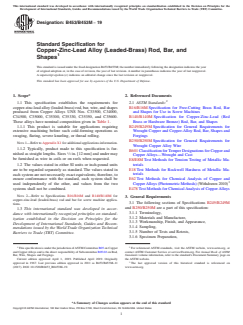
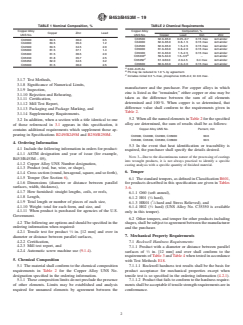
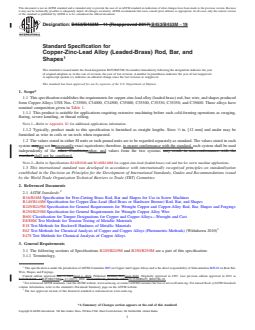
1.1 This specification establishes the requirements for copper-zinc-lead alloy (leaded-brass) rod, bar, wire, and shapes produced from Copper Alloys UNS Nos. C33500, C34000, C34500, C35000, C35300, C35330, C35350, and C35600. These alloys have nominal composition given in Table 1.
1.1.1 This product is suitable for applications requiring extensive machining before such cold-forming operations as swaging, flaring, severe knurling, or thread rolling.
Note 1: Refer to Appendix X1 for additional applications information.
1.1.2 Typically, product made to this specification is furnished as straight lengths. Sizes 1/2 in. [12 mm] and under may be furnished as wire in coils or on reels when requested.
1.2 The values stated in either SI units or inch-pound units are to be regarded separately as standard. The values stated in each system are not necessarily exact equivalents; therefore, to ensure conformance with the standard, each system shall be used independently of the other, and values from the two systems shall not be combined.
Note 2: Refer to Specifications B16/B16M and B140/B140M for copper-zinc-lead (leaded-brass) rod and bar for screw machine applications.
1.3 This international standard was developed in accordance with internationally recognized principles on standardization established in the Decision on Principles for the Development of International Standards, Guides and Recommendations issued by the World Trade Organization Technical Barriers to Trade (TBT) Committee.
- Status
- Published
- Publication Date
- 31-Mar-2019
- Technical Committee
- B05 - Copper and Copper Alloys
- Drafting Committee
- B05.02 - Rod, Bar, Wire, Shapes and Forgings
Buy Documents
ASTM B453/B453M-19 - Standard Specification for Copper-Zinc-Lead Alloy (Leaded-Brass) Rod, Bar, and Shapes
REDLINE ASTM B453/B453M-19 - Standard Specification for Copper-Zinc-Lead Alloy (Leaded-Brass) Rod, Bar, and Shapes
Overview
ASTM B453/B453M-19 is the internationally recognized standard specification for copper-zinc-lead alloy (leaded-brass) rod, bar, wire, and shapes. Developed by ASTM International, this standard outlines the key requirements for products made from copper alloys UNS Nos. C33500, C34000, C34500, C35000, C35300, C35330, C35350, and C35600. ASTM B453/B453M-19 ensures that leaded-brass components meet stringent chemical, mechanical, and dimensional criteria, making them suited for demanding machining and cold-forming applications. This standard is widely used in manufacturing sectors requiring high machinability and precise forming properties.
Key Topics
Material Requirements
- Coverage includes rods, bars, wires, and custom shapes made from designated copper-zinc-lead alloys.
- Chemical composition must conform to specific ranges for copper, zinc, lead, and other elements per the relevant UNS alloy number.
Mechanical Properties
- Products are manufactured in several tempers, including O60 (soft annealed), H01 (1/4 hard), and H02 (1/2 hard), each offering different strength and ductility characteristics.
- Mechanical testing includes requirements for tensile and yield strength, elongation, and Rockwell hardness.
- Both SI and inch-pound units are recognized, but values from the two systems must not be mixed in a single application.
Dimensional and Tolerance Criteria
- Strict guidelines are established for diameter, shape (round, hexagonal, square, etc.), length, and straightness.
- Products are most often furnished in straight lengths, with wires up to 12 mm optionally provided in coils or on reels.
Quality Assurance
- Sampling, testing, inspection, rejection, and certification procedures assure ongoing compliance.
- Purchasers can specify additional requirements for certification, mill test reports, and use with automatic screw machines if desired.
Applications
ASTM B453/B453M-19 products have broad utility wherever copper-zinc-lead alloys are valued for their combination of machinability and strength. Common use cases include:
- Machined Components: High machinability makes these leaded-brass alloys ideal for precision parts requiring extensive turning, milling, or threading.
- Cold Forming: Suitable for operations such as swaging, flaring, severe knurling, and thread rolling after initial machining.
- Plumbing and Electrical Hardware: Used in fittings, connectors, fasteners, and terminals due to good mechanical and corrosion-resistant properties.
- General Industrial Applications: Chosen where the balance between hardness, machinability, and ductility is crucial for performance and longevity.
Alloy and temper selection should consider the desired hardness, machinability, and forming characteristics appropriate to the end-use.
Related Standards
- ASTM B16/B16M - Specification for Free-Cutting Brass Rod, Bar, and Shapes for Screw Machines
- ASTM B140/B140M - Specification for Copper-Zinc-Lead (Red Brass or Hardware Bronze) Rod, Bar, and Shapes
- ASTM B249/B249M - Specification for General Requirements for Wrought Copper and Copper-Alloy Rod, Bar, Shapes, and Forgings
- ASTM B250/B250M - Specification for General Requirements for Wrought Copper Alloy Wire
- ASTM B601 - Classification for Temper Designations for Copper and Copper Alloys
- ASTM E8/E8M - Test Methods for Tension Testing of Metallic Materials
- ASTM E18 - Test Methods for Rockwell Hardness of Metallic Materials
These standards provide supplemental requirements for testing, temper classification, dimensional tolerances, and material characterization, supporting comprehensive quality and compatibility in manufacturing processes using copper-zinc-lead alloys.
Keywords: leaded-brass rod, copper-zinc-lead alloy, ASTM B453, UNS C35300, machinable brass, brass for cold-forming, copper alloy bar, brass wire, industrial brass standard, metal forming, ASTM standards for brasses.
Relations
- Effective Date
- 01-Apr-2019
- Effective Date
- 01-Jan-1996
- Effective Date
- 01-Jan-2024
- Effective Date
- 01-Oct-2023
- Effective Date
- 01-Oct-2019
- Effective Date
- 01-Oct-2019
- Effective Date
- 01-Apr-2019
- Effective Date
- 01-Oct-2018
- Effective Date
- 01-Oct-2018
- Effective Date
- 01-Jul-2018
- Effective Date
- 01-Mar-2018
- Effective Date
- 01-Mar-2018
- Effective Date
- 01-Jul-2017
- Effective Date
- 01-Apr-2017
- Effective Date
- 01-Oct-2016
Buy Documents
ASTM B453/B453M-19 - Standard Specification for Copper-Zinc-Lead Alloy (Leaded-Brass) Rod, Bar, and Shapes
REDLINE ASTM B453/B453M-19 - Standard Specification for Copper-Zinc-Lead Alloy (Leaded-Brass) Rod, Bar, and Shapes
Get Certified
Connect with accredited certification bodies for this standard

Element Materials Technology
Materials testing and product certification.

Inštitut za kovinske materiale in tehnologije
Institute of Metals and Technology. Materials testing, metallurgical analysis, NDT.
Sponsored listings
Frequently Asked Questions
ASTM B453/B453M-19 is a technical specification published by ASTM International. Its full title is "Standard Specification for Copper-Zinc-Lead Alloy (Leaded-Brass) Rod, Bar, and Shapes". This standard covers: ABSTRACT This specification establishes the requirements for rods, bars, wires, and shapes of copper-zinc-lead alloys (leaded-brass) with Copper Alloy UNS Nos. C33500, C34000, C34500, C35000, C35300, and C35600. The products to which this specification applies is suitable for applications requiring extensive machining before such cold-forming processes as swaging, flaring, severe knurling, or thread rolling. Products shall be produced in tempers O60 (soft annealed), H01 (1/4 hard), and H02 (1/2 hard). Products shall be tested to examine their conformance to dimensional (diameter, shape, length, and straightness), mechanical (tensile and yield strength, Rockwell hardness, and elongation), and chemical composition requirements. SCOPE 1.1 This specification establishes the requirements for copper-zinc-lead alloy (leaded-brass) rod, bar, wire, and shapes produced from Copper Alloys UNS Nos. C33500, C34000, C34500, C35000, C35300, C35330, C35350, and C35600. These alloys have nominal composition given in Table 1. 1.1.1 This product is suitable for applications requiring extensive machining before such cold-forming operations as swaging, flaring, severe knurling, or thread rolling. Note 1: Refer to Appendix X1 for additional applications information. 1.1.2 Typically, product made to this specification is furnished as straight lengths. Sizes 1/2 in. [12 mm] and under may be furnished as wire in coils or on reels when requested. 1.2 The values stated in either SI units or inch-pound units are to be regarded separately as standard. The values stated in each system are not necessarily exact equivalents; therefore, to ensure conformance with the standard, each system shall be used independently of the other, and values from the two systems shall not be combined. Note 2: Refer to Specifications B16/B16M and B140/B140M for copper-zinc-lead (leaded-brass) rod and bar for screw machine applications. 1.3 This international standard was developed in accordance with internationally recognized principles on standardization established in the Decision on Principles for the Development of International Standards, Guides and Recommendations issued by the World Trade Organization Technical Barriers to Trade (TBT) Committee.
ABSTRACT This specification establishes the requirements for rods, bars, wires, and shapes of copper-zinc-lead alloys (leaded-brass) with Copper Alloy UNS Nos. C33500, C34000, C34500, C35000, C35300, and C35600. The products to which this specification applies is suitable for applications requiring extensive machining before such cold-forming processes as swaging, flaring, severe knurling, or thread rolling. Products shall be produced in tempers O60 (soft annealed), H01 (1/4 hard), and H02 (1/2 hard). Products shall be tested to examine their conformance to dimensional (diameter, shape, length, and straightness), mechanical (tensile and yield strength, Rockwell hardness, and elongation), and chemical composition requirements. SCOPE 1.1 This specification establishes the requirements for copper-zinc-lead alloy (leaded-brass) rod, bar, wire, and shapes produced from Copper Alloys UNS Nos. C33500, C34000, C34500, C35000, C35300, C35330, C35350, and C35600. These alloys have nominal composition given in Table 1. 1.1.1 This product is suitable for applications requiring extensive machining before such cold-forming operations as swaging, flaring, severe knurling, or thread rolling. Note 1: Refer to Appendix X1 for additional applications information. 1.1.2 Typically, product made to this specification is furnished as straight lengths. Sizes 1/2 in. [12 mm] and under may be furnished as wire in coils or on reels when requested. 1.2 The values stated in either SI units or inch-pound units are to be regarded separately as standard. The values stated in each system are not necessarily exact equivalents; therefore, to ensure conformance with the standard, each system shall be used independently of the other, and values from the two systems shall not be combined. Note 2: Refer to Specifications B16/B16M and B140/B140M for copper-zinc-lead (leaded-brass) rod and bar for screw machine applications. 1.3 This international standard was developed in accordance with internationally recognized principles on standardization established in the Decision on Principles for the Development of International Standards, Guides and Recommendations issued by the World Trade Organization Technical Barriers to Trade (TBT) Committee.
ASTM B453/B453M-19 is classified under the following ICS (International Classification for Standards) categories: 77.150.30 - Copper products. The ICS classification helps identify the subject area and facilitates finding related standards.
ASTM B453/B453M-19 has the following relationships with other standards: It is inter standard links to ASTM B453/B453M-11(2017), ASTM B453M-96, ASTM E8/E8M-24, ASTM B249/B249M-23, ASTM B16/B16M-19, ASTM B249/B249M-19a, ASTM B249/B249M-19, ASTM B249/B249M-18a, ASTM B601-18a, ASTM E18-18, ASTM B249/B249M-18, ASTM B601-18, ASTM E18-17, ASTM B249/B249M-17, ASTM B601-16. Understanding these relationships helps ensure you are using the most current and applicable version of the standard.
ASTM B453/B453M-19 is available in PDF format for immediate download after purchase. The document can be added to your cart and obtained through the secure checkout process. Digital delivery ensures instant access to the complete standard document.
Standards Content (Sample)
This international standard was developed in accordance with internationally recognized principles on standardization established in the Decision on Principles for the
Development of International Standards, Guides and Recommendations issued by the World Trade Organization Technical Barriers to Trade (TBT) Committee.
Designation:B453/B453M −19
Standard Specification for
Copper-Zinc-Lead Alloy (Leaded-Brass) Rod, Bar, and
Shapes
This standard is issued under the fixed designation B453/B453M; the number immediately following the designation indicates the year
of original adoption or, in the case of revision, the year of last revision. A number in parentheses indicates the year of last reapproval.
A superscript epsilon (´) indicates an editorial change since the last revision or reapproval.
This standard has been approved for use by agencies of the U.S. Department of Defense.
1. Scope* 2. Referenced Documents
1.1 This specification establishes the requirements for 2.1 ASTM Standards:
copper-zinc-leadalloy(leaded-brass)rod,bar,wire,andshapes B16/B16M Specification for Free-Cutting Brass Rod, Bar
produced from Copper Alloys UNS Nos. C33500, C34000, and Shapes for Use in Screw Machines
C34500, C35000, C35300, C35330, C35350, and C35600. B140/B140M Specification for Copper-Zinc-Lead (Red
These alloys have nominal composition given in Table 1. Brass or Hardware Bronze) Rod, Bar, and Shapes
1.1.1 This product is suitable for applications requiring B249/B249M Specification for General Requirements for
extensive machining before such cold-forming operations as Wrought Copper and Copper-Alloy Rod, Bar, Shapes and
swaging, flaring, severe knurling, or thread rolling. Forgings
B250/B250M Specification for General Requirements for
NOTE1—RefertoAppendixX1foradditionalapplicationsinformation.
Wrought Copper Alloy Wire
1.1.2 Typically, product made to this specification is fur-
B601 Classification forTemper Designations for Copper and
nished as straight lengths. Sizes ⁄2 in. [12 mm] and under may
Copper Alloys—Wrought and Cast
be furnished as wire in coils or on reels when requested.
E8/E8M Test Methods for Tension Testing of Metallic Ma-
1.2 The values stated in either SI units or inch-pound units terials
E18 Test Methods for Rockwell Hardness of Metallic Ma-
are to be regarded separately as standard. The values stated in
each system are not necessarily exact equivalents; therefore, to terials
ensure conformance with the standard, each system shall be E62 Test Methods for Chemical Analysis of Copper and
CopperAlloys (Photometric Methods) (Withdrawn 2010)
used independently of the other, and values from the two
systems shall not be combined. E478 Test Methods for ChemicalAnalysis of CopperAlloys
NOTE 2—Refer to Specifications B16/B16M and B140/B140M for
3. General Requirements
copper-zinc-lead (leaded-brass) rod and bar for screw machine applica-
3.1 The following sections of Specifications B249/B249M
tions.
and B250/B250M are a part of this specification:
1.3 This international standard was developed in accor-
3.1.1 Terminology,
dance with internationally recognized principles on standard-
3.1.2 Materials and Manufacture,
ization established in the Decision on Principles for the
3.1.3 Workmanship, Finish, and Appearance,
Development of International Standards, Guides and Recom-
3.1.4 Sampling,
mendations issued by the World Trade Organization Technical
3.1.5 Number of Tests and Retests,
Barriers to Trade (TBT) Committee.
3.1.6 Specimen Preparation,
1 2
ThisspecificationisunderthejurisdictionofASTMCommitteeB05onCopper For referenced ASTM standards, visit the ASTM website, www.astm.org, or
and CopperAlloys and is the direct responsibility of Subcommittee B05.02 on Rod, contact ASTM Customer Service at service@astm.org. For Annual Book of ASTM
Bar, Wire, Shapes and Forgings. Standards volume information, refer to the standard’s Document Summary page on
Current edition approved April 1, 2019. Published April 2019. Originally the ASTM website.
approved in 1967. Last previous edition approved in 2011 as B453/B453M–11 The last approved version of this historical standard is referenced on
(2017). DOI: 10.1520/B0453_B0453M–19. www.astm.org.
*A Summary of Changes section appears at the end of this standard
Copyright © ASTM International, 100 Barr Harbor Drive, PO Box C700, West Conshohocken, PA 19428-2959. United States
B453/B453M−19
TABLE 1 Nominal Composition, % TABLE 2 Chemical Requirements
Copper Alloy Copper Alloy Composition, %
Copper Zinc Lead
UNS No. UNS No. Copper Lead Iron Zinc
C33500 62.0–65.0 0.25–0.7 0.15 max remainder
C33500 63.5 36.0 0.5
C34000 62.0–65.0 0.8–1.5 0.15 max remainder
C34000 63.5 35.3 1.2
C34500 62.0–65.0 1.5–2.5 0.15 max remainder
C34500 63.5 34.5 2.0
C35000 61.0–63.0 0.8–2.0 0.15 max remainder
C35000 61.5 37.1 1.4
C35300 61.0–63.0 1.5–2.5 0.15 max remainder
C35300 61.5 36.5 2.0
A B
C35330 59.5–64.0 1.5–3.5 . remainder
C35330 61.8 35.7 2.5
C
C35350 61.0-63.0 2.0-4.5 0.4 max remainder
C35350 62.0 34.5 3.2
C35600 60.0–63.0 2.0–3.0 0.15 max remainder
C35600 61.5 36.0 2.5
A
0.02–0.25 As
B
Pb may be reduced to 1.0 % by agreement.
C
Includes nickel 0.3 % max, phosphorus 0.05–0.2, tin 0.6 max.
3.1.7 Test Methods,
3.1.8 Significance of Numerical Limits,
manufacturer and the purchaser. For copper alloys in which
3.1.9 Inspection,
zinc is listed as the “remainder,” either copper or zinc may be
3.1.10 Rejection and Rehearing,
taken as the difference between the sum of all elements
3.1.11 Certification,
determined and 100 %. When copper is so determined, that
3.1.12 Mill Test Report,
difference value shall conform to the requirements given in
3.1.13 Packaging and Package Marking, and
Table 2.
3.1.14 Supplementary Requirements.
5.2 WhenallthenamedelementsinTable2forthespecified
3.2 In addition, when a section with a title identical to one
alloy are determined, the sum of results shall be as follows:
of those referenced in 3.1 appears in this specification, it
Copper Alloy UNS No. Percent, min
contains additional requirements which supplement those ap-
pearing in Specifications B249/B249M and B250/B250M.
C33500, C34000, C34500, C35000 99.6
C35300, C35330, C35350, C35600 99.5
4. Ordering Information
5.3 In the event that heat identification or traceability is
4.1 Include the following information in orders for product:
required, the purchaser shall specify the details desired.
4.1.1 ASTM designation and year of issue (for example,
NOTE 3—Due to the discontinuous nature of the processing of castings
B453/B453M – 05),
into wrought products, it is not always practical to identify a specific
4.1.2 Copper Alloy UNS Number designation,
casting analysis with a specific quantity of finished material.
4.1.3 Product (rod, bar, wire, or shape),
6. Temper
4.1.4 Crosssection(round,hexagonal,square,andsoforth),
4.1.5 Temper (See Section 6),
6.1 The standard tempers, as defined in Classification B601,
4.1.6 Dimensions (diameter or distance between parallel
for products described in this specification are given in Tables
surfaces, width, thickness),
3-6.
4.1.7 How furnished: straight lengths, coils, or reels,
6.1.1 O60 (soft anneal),
4.1.8 Length,
6.1.2 H01 ( ⁄4 hard),
4.1.9 Total length or number of pieces of each size,
6.1.3 HR01 ( ⁄4 hard and Stress Relieved), and
4.1.10 Weight: total for each form, and size, and
6.1.4 H02 ( ⁄2 hard) (UNS Alloy No. C35350 is available
4.1.11 When product is purchased for agencies of the U.S.
only in this temper).
Government.
6.2 Other tempers, and temper for other products including
4.2 The following are options and should be specified in the
shapes,shallbesubjecttoagreementbetweenthemanufacturer
ordering information when required:
and the purchaser.
4.2.1 Tensile test for product ⁄2 in. [12 mm] and over in
7. Mechanical Property Requirements
diameter or distance between parallel surfaces,
4.2.2 Certification,
7.1 Rockwell Hardness Requirements:
4.2.3 Mill test report, and
7.1.1 Product with a diameter or distance between parallel
4.2.4 Automatic screw machine use (9.1.4).
surfaces of ⁄2 in. [12 mm] and over shall conform to the
requirements of Table 3 and Table 4 when tested in accordance
5. Chemical Composition
with Test Methods E18.
5.1 The material shall conform to the chemical composition
7.1.1.1 Rockwell hardness test results shall be the basis for
requirements in Table 2 for the Copper Alloy UNS No. product acceptance for mechanical properties except when
designation specified in the ordering information. tensile test is so specified in the ordering information (4.2.1).
5.1.1 These composition limits do not preclude the presence 7.1.1.2 Productthatfailstoconformtothehardnessrequire-
of other elements. Limits may be established and analysis mentsshallbeacceptableiftensilestrengthrequirementsarein
required for unnamed elements by agreement between the conformance.
B453/B453M−19
A
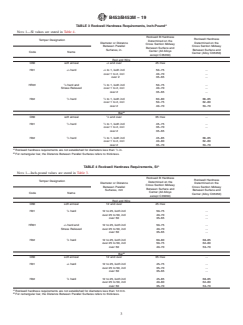
TABLE 3 Rockwell Hardness Requirements, Inch-Pound
NOTE 1—SI values are stated in Table 4.
Rockwell B Hardness
Rockwell Hardness
Temper Designation
Determined on the
Diameter or Distance Determined on the
Cross Section Midway
Between Parallel Cross Section Midway
Between Surface and
Surfaces, in. Between Surface and
Code Name Center (All Alloys
Center (Alloy C35350)
except C35350)
Rod and Wire
O60 soft anneal ⁄2 and over 45 max
1 1
H01 ⁄4 hard ⁄2 to 1, both incl 50–75 .
over 1 to 2, incl 40–70 .
over 2 35–65 .
1 1
HR01 ⁄4 hard and ⁄2
...
This document is not an ASTM standard and is intended only to provide the user of an ASTM standard an indication of what changes have been made to the previous version. Because
it may not be technically possible to adequately depict all changes accurately, ASTM recommends that users consult prior editions as appropriate. In all cases only the current version
of the standard as published by ASTM is to be considered the official document.
Designation: B453/B453M − 11 (Reapproved 2017) B453/B453M − 19
Standard Specification for
Copper-Zinc-Lead Alloy (Leaded-Brass) Rod, Bar, and
Shapes
This standard is issued under the fixed designation B453/B453M; the number immediately following the designation indicates the year
of original adoption or, in the case of revision, the year of last revision. A number in parentheses indicates the year of last reapproval.
A superscript epsilon (´) indicates an editorial change since the last revision or reapproval.
This standard has been approved for use by agencies of the U.S. Department of Defense.
1. Scope*
1.1 This specification establishes the requirements for copper-zinc-lead alloy (leaded-brass) rod, bar, wire, and shapes produced
from Copper Alloys UNS Nos. C33500, C34000, C34500, C35000, C35300, C35330, C35350, and C35600. These alloys have
nominal composition given in Table 1.
1.1.1 This product is suitable for applications requiring extensive machining before such cold-forming operations as swaging,
flaring, severe knurling, or thread rolling.
NOTE 1—Refer to Appendix X1 for additional applications information.
1.1.2 Typically, product made to this specification is furnished as straight lengths. Sizes ⁄2 in. [12 mm] and under may be
furnished as wire in coils or on reels when requested.
1.2 The values stated in either SI units or inch-pound units are to be regarded separately as standard. The values stated in each
system mayare not benecessarily exact equivalents; therefore, to ensure conformance with the standard, each system shall be used
independently of the other. Combiningother, and values from the two systems may result in non-conformance with the
standard.shall not be combined.
NOTE 2—Refer to Specifications B16/B16M and B140/B140M for copper-zinc-lead (leaded-brass) rod and bar for screw machine applications.
1.3 This international standard was developed in accordance with internationally recognized principles on standardization
established in the Decision on Principles for the Development of International Standards, Guides and Recommendations issued
by the World Trade Organization Technical Barriers to Trade (TBT) Committee.
2. Referenced Documents
2.1 ASTM Standards:
B16/B16M Specification for Free-Cutting Brass Rod, Bar and Shapes for Use in Screw Machines
B140/B140M Specification for Copper-Zinc-Lead (Red Brass or Hardware Bronze) Rod, Bar, and Shapes
B249/B249M Specification for General Requirements for Wrought Copper and Copper-Alloy Rod, Bar, Shapes and Forgings
B250/B250M Specification for General Requirements for Wrought Copper Alloy Wire
B601 Classification for Temper Designations for Copper and Copper Alloys—Wrought and Cast
E8/E8M Test Methods for Tension Testing of Metallic Materials
E18 Test Methods for Rockwell Hardness of Metallic Materials
E62 Test Methods for Chemical Analysis of Copper and Copper Alloys (Photometric Methods) (Withdrawn 2010)
E478 Test Methods for Chemical Analysis of Copper Alloys
3. General Requirements
3.1 The following sections of Specifications B249/B249M and B250/B250M are a part of this specification:
3.1.1 Terminology,
This specification is under the jurisdiction of ASTM Committee B05 on Copper and Copper Alloys and is the direct responsibility of Subcommittee B05.02 on Rod, Bar,
Wire, Shapes and Forgings.
Current edition approved Oct. 1, 2017April 1, 2019. Published October 2017April 2019. Originally approved in 1967. Last previous edition approved in 2011 as
ɛ1
B453/B453M – 11B453/B453M . –11 (2017). DOI: 10.1520/B0453_B0453M-11R17.10.1520/B0453_B0453M–19.
For referenced ASTM standards, visit the ASTM website, www.astm.org, or contact ASTM Customer Service at service@astm.org. For Annual Book of ASTM Standards
volume information, refer to the standard’s Document Summary page on the ASTM website.
The last approved version of this historical standard is referenced on www.astm.org.
*A Summary of Changes section appears at the end of this standard
Copyright © ASTM International, 100 Barr Harbor Drive, PO Box C700, West Conshohocken, PA 19428-2959. United States
B453/B453M − 19
TABLE 1 Nominal Composition, %
Copper Alloy
Copper Zinc Lead
UNS No.
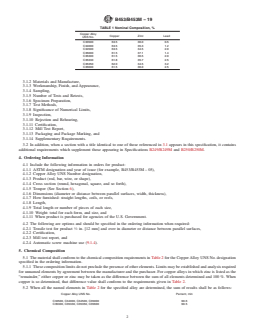
C33500 63.5 36.0 0.5
C34000 63.5 35.3 1.2
C34500 63.5 34.5 2.0
C35000 61.5 37.1 1.4
C35300 61.5 36.5 2.0
C35330 61.8 35.7 2.5
C35350 62.0 34.5 3.2
C35600 61.5 36.0 2.5
3.1.2 Materials and Manufacture,
3.1.3 Workmanship, Finish, and Appearance,
3.1.4 Sampling,
3.1.5 Number of Tests and Retests,
3.1.6 Specimen Preparation,
3.1.7 Test Methods,
3.1.8 Significance of Numerical Limits,
3.1.9 Inspection,
3.1.10 Rejection and Rehearing,
3.1.11 Certification,
3.1.12 Mill Test Report,
3.1.13 Packaging and Package Marking, and
3.1.14 Supplementary Requirements.
3.2 In addition, when a section with a title identical to one of those referenced in 3.1 appears in this specification, it contains
additional requirements which supplement those appearing in Specifications B249/B249M and B250/B250M.
4. Ordering Information
4.1 Include the following information in orders for product:
4.1.1 ASTM designation and year of issue (for example, B453/B453M – 05),
4.1.2 Copper Alloy UNS Number designation,
4.1.3 Product (rod, bar, wire, or shape),
4.1.4 Cross section (round, hexagonal, square, and so forth),
4.1.5 Temper (See Section 6),
4.1.6 Dimensions (diameter or distance between parallel surfaces, width, thickness),
4.1.7 How furnished: straight lengths, coils, or reels,
4.1.8 Length,
4.1.9 Total length or number of pieces of each size,
4.1.10 Weight: total for each form, and size, and
4.1.11 When product is purchased for agencies of the U.S. Government.
4.2 The following are options and should be specified in the ordering information when required:
4.2.1 Tensile test for product ⁄2 in. [12 mm] and over in diameter or distance between parallel surfaces,
4.2.2 Certification,
4.2.3 Mill test report, and
4.2.4 Automatic screw machine use (9.1.4).
5. Chemical Composition
5.1 The material shall conform to the chemical composition requirements in Table 2 for the Copper Alloy UNS No. designation
specified in the ordering information.
5.1.1 These composition limits do not preclude the presence of other elements. Limits may be established and analysis required
for unnamed elements by agreement between the manufacturer and the purchaser. For copper alloys in which zinc is listed as the
“remainder,” either copper or zinc may be taken as the difference between the sum of all elements determined and 100 %. When
copper is so determined, that difference value shall conform to the requirements given in Table 2.
5.2 When all the named elements in Table 2 for the specified alloy are determined, the sum of results shall be as follows:
Copper Alloy UNS No. Percent, min
C33500, C34000, C34500, C35000 99.6
C35300, C35330, C35350, C35600 99.5
B453/B453M − 19
TABLE 2 Chemical Requirements
Copper Alloy Composition, %
UNS No.
Copper Lead Iron Zinc
C33500 62.0–65.0 0.25–0.7 0.15 max remainder
C34000 62.0–65.0 0.8–1.5 0.15 max remainder
C34500 62.0–65.0 1.5–2.5 0.15 max remainder
C35000 61.0–63.0 0.8–2.0 0.15 max remainder
C35300 61.0–63.0 1.5–2.5 0.15 max remainder
A B
C35330 59.5–64.0 1.5–3.5 . remainder
C
C35350 61.0-63.0 2.0-4.5 0.40 remainder
C
C35350 61.0-63.0 2.0-4.5 0.4 max remainder
C35600 60.0–63.0 2.0–3.0 0.15 max remainder
A
0.02–0.25 As
B
Pb may be reduced to 1.0 % by agreement.
C
Includes nickel 0.05–0.30, phosphorus 0.05–0.20, tin 0.300.3 % max, phospho-
rus 0.05–0.2, tin 0.6 max.
5.3 In the event that heat identification or traceability is required, the purchaser shall specify the details desired.
NOTE 3—Due to the discontinuous nature of the processing of castings into wrought products, it is not always practical to identify a specific casting
analysis with a specific quantity of finished material.
6. Temper
6.1 The standard tempers, as defined in Classification B601, for products described in this specification are given in Tables 3-6.
6.1.1 O60 (soft anneal),
6.1.2 H01 ( ⁄4 hard),
6.1.3 HR01 ( ⁄4 hard and Stress Relieved), and
6.1.4 H02 ( ⁄2 hard) (UNS Alloy No. C35350 is available only in this temper).
6.2 Other tempers, and temper for other products including shapes, shall be subject to agreement between the manufacturer and
the purchaser.
A
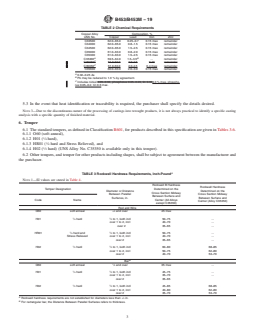
TABLE 3 Rockwell Hardness Requirements, Inch-Pound
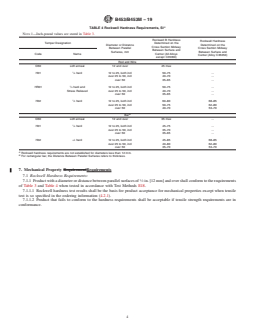
NOTE 1—SI values are stated in Table 4.
Rockwell B Hardness
Rockwell Hardness
Temper Designation Determined on the
Diameter or Distance Determined on the
Cross Section Midway
Between Parallel Cross Section Midway
Between Surface and
Surfaces, in. Between Surface and
Center (All Alloys
Code Name
Center (Alloy C35350)
except C35350)
Rod and Wire
O60 soft anneal ⁄2 and over 45 max
1 1
H01 ⁄4 hard ⁄2 to 1, both incl 50–75 .
over 1 to 2, incl 40–70 .
over 2 35–65 .
1 1
HR01 ⁄4 hard and ⁄2 to 1, both incl 50–75 .
Stress Relieved over 1 to 2, incl 40–70 .
over 2 35–65 .
1 1
H02 ⁄2 hard ⁄2 to 1, both incl 60–80 68–85
over 1 to 2, incl 50–75 62–80
over 2 40–70 53–70
B
Bar
O60 soft anneal ⁄2 and over 35 max .
1 1
H01 ⁄4 hard ⁄2 to 1, both incl 45–75 .
over 1 to 2, incl 35–70 .
over 2 35–65
1 1
H02 ⁄2 hard ⁄2 to 1, both incl 45–85 68–85
over 1 to 2, incl 40–80 62–80
over 2 35–70 53–70
A 1
Rockwell hardness requirements are not established for
...