

ASTM B601-18a
(Classification)Standard Classification for Temper Designations for Copper and Copper Alloys—Wrought and Cast
General Information
- Abstract
SIGNIFICANCE AND USE
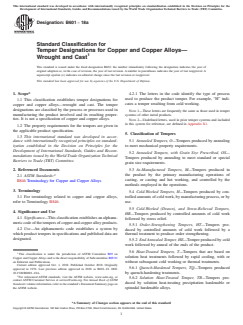
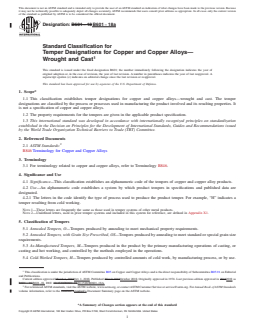
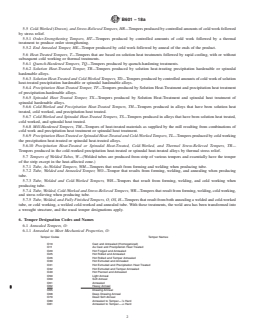
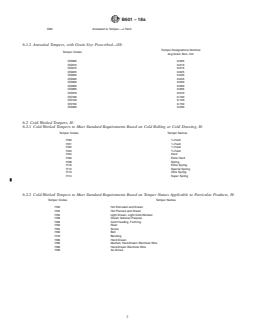
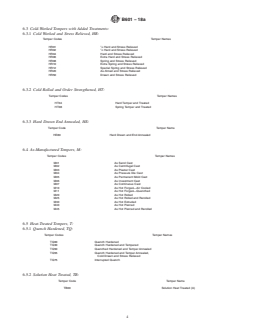
4.1 Significance—This classification establishes an alphanumeric code of the tempers of copper and copper alloy products.
4.2 Use—An alphanumeric code establishes a system by which product tempers in specifications and published data are designated.
4.2.1 The letters in the code identify the type of process used to produce the product temper. For example, “H” indicates a temper resulting from cold working.
Note 1: These letters are frequently the same as those used in temper systems of other metal products.
Note 2: Undefined letters, used in prior temper systems and included in this system for reference, are defined in Appendix X1.
SCOPE
1.1 This classification establishes temper designations for copper and copper alloys—wrought and cast. The temper designations are classified by the process or processes used in manufacturing the product involved and its resulting properties. It is not a specification of copper and copper alloys.
1.2 The property requirements for the tempers are given in the applicable product specification.
1.3 This international standard was developed in accordance with internationally recognized principles on standardization established in the Decision on Principles for the Development of International Standards, Guides and Recommendations issued by the World Trade Organization Technical Barriers to Trade (TBT) Committee.
- Status
- Published
- Publication Date
- 30-Sep-2018
- Technical Committee
- B05 - Copper and Copper Alloys
- Drafting Committee
- B05.91 - Editorial and Publications
Buy Documents
ASTM B601-18a - Standard Classification for Temper Designations for Copper and Copper Alloys—Wrought and Cast
REDLINE ASTM B601-18a - Standard Classification for Temper Designations for Copper and Copper Alloys—Wrought and Cast
Overview
ASTM B601-18a, issued by ASTM International, establishes a comprehensive system for classifying temper designations for copper and copper alloys-both wrought and cast. This standard introduces a globally recognized alphanumeric code that defines the temper, or condition, of copper products according to the processes used in manufacturing and the resulting material properties. It does not serve as a specification for copper or its alloys, but rather provides a standardized language for industry professionals to reference temper types in technical documentation, product specifications, and published data.
Key Topics
- Alphanumeric Temper Codes: The standard uses a combination of letters and numbers to represent specific tempers and processing methods. Primary letter codes indicate the fundamental type of treatment (for example, "O" for annealed, "H" for cold-worked, "T" for heat-treated, "M" for as-manufactured, and "W" for welded).
- Process-Based Classification: Each temper designation corresponds to the manufacturing process used-such as annealing, cold working, quench hardening, or solution heat treating-and the resultant mechanical properties.
- Standardization and Clarity: By providing a uniform system, ASTM B601-18a reduces ambiguity, improving communication throughout the copper industry value chain, from manufacturing and quality control to specification development.
- Cross-Material Similarities: Many temper code letters harmonize with systems used for other metals, supporting easier cross-reference for multi-material projects.
- Reference to Detailed Requirements: Specific property details for each temper are provided in associated product standards, emphasizing the classification’s role as a system of nomenclature, not a material property specification.
Applications
The ASTM B601-18a standard plays a critical role in a variety of industries and applications where copper and copper alloys are used, such as electrical engineering, plumbing, architecture, automotive manufacturing, and general construction. Key applications include:
- Product Specifications: Clearly defines temper conditions in procurement and manufacturing documents, ensuring material consistency and performance.
- Quality Assurance: Provides an established basis for verifying that processed copper meets required temper conditions, aiding compliance and traceability.
- Engineering Design: Enables designers and engineers to select appropriate tempers for copper materials based on mechanical property requirements, such as ductility, strength, and formability.
- Supply Chain Communication: Facilitates clear communication between suppliers, manufacturers, and end-users through standardized temper designations.
- Regulatory Compliance: Supports adherence to international trade and quality standards by aligning with World Trade Organization (WTO) principles on standardization.
Related Standards
For comprehensive understanding and effective use of temper designations, consider these related standards:
- ASTM B846 – Terminology for Copper and Copper Alloys: Provides definitions used in B601 and related documentation.
- Relevant ASTM product specifications for copper and copper alloys: These detail the specific mechanical property requirements for different tempers.
- International and regional standards for copper alloy products may reference or harmonize with ASTM B601’s temper system, promoting global interoperability.
Keywords: copper, copper alloys, temper classification, ASTM B601, temper designation, annealed, cold-worked, heat-treated, engineered copper, product specification, quality control.
ASTM B601-18a is essential for professionals seeking consistency and reliability in the classification and selection of copper alloy tempers across international markets and applications.
Relations
- Effective Date
- 01-Oct-2018
- Effective Date
- 01-Aug-2019
- Effective Date
- 01-Jan-2019
- Effective Date
- 01-Jun-2011
- Effective Date
- 01-Jan-2011
- Effective Date
- 15-Nov-2009
- Effective Date
- 01-Nov-2009
- Effective Date
- 15-Nov-2006
- Effective Date
- 15-May-2006
- Effective Date
- 01-Nov-2005
- Effective Date
- 10-May-2001
- Effective Date
- 10-May-2001
- Effective Date
- 10-May-2001
- Effective Date
- 01-Oct-2018
- Effective Date
- 01-Oct-2018
Buy Documents
ASTM B601-18a - Standard Classification for Temper Designations for Copper and Copper Alloys—Wrought and Cast
REDLINE ASTM B601-18a - Standard Classification for Temper Designations for Copper and Copper Alloys—Wrought and Cast
Get Certified
Connect with accredited certification bodies for this standard

Element Materials Technology
Materials testing and product certification.

Inštitut za kovinske materiale in tehnologije
Institute of Metals and Technology. Materials testing, metallurgical analysis, NDT.
Sponsored listings
Frequently Asked Questions
ASTM B601-18a is a standard published by ASTM International. Its full title is "Standard Classification for Temper Designations for Copper and Copper Alloys—Wrought and Cast". This standard covers: SIGNIFICANCE AND USE 4.1 Significance—This classification establishes an alphanumeric code of the tempers of copper and copper alloy products. 4.2 Use—An alphanumeric code establishes a system by which product tempers in specifications and published data are designated. 4.2.1 The letters in the code identify the type of process used to produce the product temper. For example, “H” indicates a temper resulting from cold working. Note 1: These letters are frequently the same as those used in temper systems of other metal products. Note 2: Undefined letters, used in prior temper systems and included in this system for reference, are defined in Appendix X1. SCOPE 1.1 This classification establishes temper designations for copper and copper alloys—wrought and cast. The temper designations are classified by the process or processes used in manufacturing the product involved and its resulting properties. It is not a specification of copper and copper alloys. 1.2 The property requirements for the tempers are given in the applicable product specification. 1.3 This international standard was developed in accordance with internationally recognized principles on standardization established in the Decision on Principles for the Development of International Standards, Guides and Recommendations issued by the World Trade Organization Technical Barriers to Trade (TBT) Committee.
SIGNIFICANCE AND USE 4.1 Significance—This classification establishes an alphanumeric code of the tempers of copper and copper alloy products. 4.2 Use—An alphanumeric code establishes a system by which product tempers in specifications and published data are designated. 4.2.1 The letters in the code identify the type of process used to produce the product temper. For example, “H” indicates a temper resulting from cold working. Note 1: These letters are frequently the same as those used in temper systems of other metal products. Note 2: Undefined letters, used in prior temper systems and included in this system for reference, are defined in Appendix X1. SCOPE 1.1 This classification establishes temper designations for copper and copper alloys—wrought and cast. The temper designations are classified by the process or processes used in manufacturing the product involved and its resulting properties. It is not a specification of copper and copper alloys. 1.2 The property requirements for the tempers are given in the applicable product specification. 1.3 This international standard was developed in accordance with internationally recognized principles on standardization established in the Decision on Principles for the Development of International Standards, Guides and Recommendations issued by the World Trade Organization Technical Barriers to Trade (TBT) Committee.
ASTM B601-18a is classified under the following ICS (International Classification for Standards) categories: 77.150.30 - Copper products. The ICS classification helps identify the subject area and facilitates finding related standards.
ASTM B601-18a has the following relationships with other standards: It is inter standard links to ASTM B601-18, ASTM B846-19a, ASTM B846-19, ASTM B846-11a, ASTM B846-11, ASTM B846-09a, ASTM B846-09, ASTM B846-06a, ASTM B846-06, ASTM B846-05, ASTM B846-01, ASTM B846-99e1, ASTM B846-01e1, ASTM B569-19, ASTM B188-15e1. Understanding these relationships helps ensure you are using the most current and applicable version of the standard.
ASTM B601-18a is available in PDF format for immediate download after purchase. The document can be added to your cart and obtained through the secure checkout process. Digital delivery ensures instant access to the complete standard document.
Standards Content (Sample)
This international standard was developed in accordance with internationally recognized principles on standardization established in the Decision on Principles for the
Development of International Standards, Guides and Recommendations issued by the World Trade Organization Technical Barriers to Trade (TBT) Committee.
Designation:B601 −18a
Standard Classification for
Temper Designations for Copper and Copper Alloys—
Wrought and Cast
This standard is issued under the fixed designation B601; the number immediately following the designation indicates the year of
original adoption or, in the case of revision, the year of last revision. A number in parentheses indicates the year of last reapproval. A
superscript epsilon (´) indicates an editorial change since the last revision or reapproval.
This standard has been approved for use by agencies of the U.S. Department of Defense.
1. Scope* 4.2.1 The letters in the code identify the type of process
used to produce the product temper. For example, “H” indi-
1.1 This classification establishes temper designations for
cates a temper resulting from cold working.
copper and copper alloys—wrought and cast. The temper
designations are classified by the process or processes used in
NOTE 1—These letters are frequently the same as those used in temper
manufacturing the product involved and its resulting proper-
systems of other metal products.
ties. It is not a specification of copper and copper alloys.
NOTE 2—Undefined letters, used in prior temper systems and included
in this system for reference, are defined in Appendix X1.
1.2 The property requirements for the tempers are given in
the applicable product specification.
5. Classification of Tempers
1.3 This international standard was developed in accor-
5.1 Annealed Tempers, O—Tempers produced by annealing
dance with internationally recognized principles on standard-
to meet mechanical property requirements.
ization established in the Decision on Principles for the
Development of International Standards, Guides and Recom-
5.2 Annealed Tempers, with Grain Size Prescribed, OS—
mendations issued by the World Trade Organization Technical
Tempers produced by annealing to meet standard or special
Barriers to Trade (TBT) Committee.
grain size requirements.
2. Referenced Documents
5.3 As-Manufactured Tempers, M—Tempers produced in
the product by the primary manufacturing operations of
2.1 ASTM Standards:
casting, or casting and hot working, and controlled by the
B846 Terminology for Copper and Copper Alloys
methods employed in the operations.
3. Terminology
5.4 Cold-Worked Tempers, H—Tempers produced by con-
3.1 For terminology related to copper and copper alloys, trolled amounts of cold work, by manufacturing process, or by
refer to Terminology B846. use.
5.5 Cold-Worked (Drawn), and Stress-Relieved Tempers,
4. Significance and Use
HR—Tempers produced by controlled amounts of cold work
4.1 Significance—This classification establishes an alphanu-
followed by stress relief.
meric code of the tempers of copper and copper alloy products.
5.5.1 Order-Strengthening Tempers, HT—Tempers pro-
4.2 Use—An alphanumeric code establishes a system by
duced by controlled amounts of cold work followed by a
which product tempers in specifications and published data are
thermal treatment to produce order strengthening.
designated.
5.5.2 End Annealed Temper, HE—Temper produced by cold
work followed by anneal of the ends of the product.
5.6 Heat-Treated Tempers, T—Tempers that are based on
This classification is under the jurisdiction of ASTM Committee B05 on
solution heat treatments followed by rapid cooling, with or
Copper and CopperAlloys and is the direct responsibility of Subcommittee B05.91
on Editorial and Publications.
without subsequent cold working or thermal treatments.
Current edition approved Oct. 1, 2018. Published October 2018. Originally
5.6.1 Quench-Hardened Tempers, TQ—Tempers produced
approved in 1974. Last previous edition approved in 2018 as B601–18. DOI:
by quench-hardening treatments.
10.1520/B0601–18A.
For referenced ASTM standards, visit the ASTM website, www.astm.org, or
5.6.2 Solution Heat-Treated Temper, TB—Tempers pro-
contact ASTM Customer Service at service@astm.org. For Annual Book of ASTM
duced by solution heat-treating precipitation hardenable or
Standards volume information, refer to the standard’s Document Summary page on
the ASTM website. spinodal hardenable alloys.
*A Summary of Changes section appears at the end of this standard
Copyright © ASTM International, 100 Barr Harbor Drive, PO Box C700, West Conshohocken, PA 19428-2959. United States
B601−18a
5.6.3 Solution Heat-Treated and Cold-Worked Tempers,
O26 Hot Rolled and Temper Annealed
O30 Hot Extruded and Annealed
TD—Tempers produced by controlled amounts of cold work of
O31 Hot Extruded and Precipitation Heat Treated
solution heat-treated precipitation hardenable or spinodal hard-
O32 Hot Extruded and Temper Annealed
enable alloys.
O40 Hot Pierced and Annealed
O50 Light Anneal
5.6.4 Precipitation Heat-Treated Temper, TF—Tempers pro-
O60 Soft Anneal
duced by Solution Heat-Treatment and precipitation heat
O61 Annealed
treatment of precipitation-hardenable alloys.
O62 Heavy Anneal
O65 Drawing Anneal
5.6.5 Spinodal Heat Treated Temper, TX—Tempers pro-
O68 Deep Drawing Anneal
duced by Solution Heat-Treatment and spinodal heat treatment
O70 Dead Soft Anneal
of spinodal hardenable alloys. O80 Annealed to Temper— ⁄8 Hard
O81 Annealed to Temper— ⁄4 Hard
5.6.6 Cold-Worked and Precipitation Heat-Treated
O82 Annealed to Temper— ⁄2 Hard
Tempers, TH—Tempers produced in alloys that have been
solution heat treated, cold worked, and precipitation heat
treated.
6.1.2 Annealed Tempers, with Grain Size Prescribed—OS:
5.6.7 Cold-Worked and Spinodal Heat-Treated Tempers,
Temper Designations Nominal
TS—Tempers produced in alloys that have been solution heat
Temper Codes
Avg Grain Size, mm
treated, cold worked, and spinodal heat treated.
5.6.8 Mill-Hardened Tempers, TM—Tempersofheat-treated
OS005 0.005
OS010 0.010
materials as supplied by the mill resulting from combinations
OS015 0.015
of cold work and precipitation heat treatment or spinodal heat
OS025 0.025
treatment. OS035 0.035
OS045 0.045
5.6.9 Precipitation Heat-Treated or Spinodal Heat-Treated
OS050 0.050
and Cold-Worked Tempers, TL—Tempers produced by cold
OS060 0.060
working the precipitation heat-treated or spinodal heat-treated
OS065 0.065
OS070 0.070
alloys.
OS100 0.100
5.6.10 Precipitation Heat-Treated or Spinodal Heat-
OS120 0.120
Treated, Cold-Worked, and Thermal Stress-Relieved Tempers, OS150 0.150
OS200 0.200
TR—Tempers produced in the cold-worked precipitation heat-
treated or spinodal heat-treated alloys by thermal stress relief.
5.7 Tempers of Welded Tubes, W—(Welded tubes are pro-
6.2 Cold-Worked Tempers, H:
duced from strip of various tempers and essentially have the
6.2.1 Cold-Worked Tempers to Meet Standard Requirements
temper of the strip except in the heat-affected zone.)
Based on Cold Rolling or Cold Drawing, H:
5.7.1 Tube, As-Welded Tempers, WM—Tempers that result
Temper Codes Temper Names
from forming and welding when producing tube.
5.7.2 Tube, Welded and Annealed Temper, WO—Temper
H00 ⁄8 Hard
H01 ⁄4 Hard
that results from forming, welding, and annealing when pro-
H02 ⁄2 Hard
ducing tube.
H03 ⁄4 Hard
5.7.3 Tube, Welded and Cold-Worked Tempers, WH—
H04 Hard
Tempers that result from forming, welding, and cold working H06 Extra Hard
H08 Spring
when producing tube.
H10 Extra Spring
5.7.4 Tube, Welded, Cold-Worked and Stress-Relieved
H12 Special Spring
H13 Ultra Spring
Tempers, WR—Tempers that result from forming, welding,
H14 Super Spring
cold working, and stress relieving when producing tube.
5.7.5 Tube, Welded, and Fully Finished Tempers, O, OS,
6.2.2 Cold-Worked Tempers to Meet Standard Requirements
H—Tempers that result from both annealing a welded and
Based on Temper NamesApplicable to Particular Products, H:
cold-worked tube, or cold working, a welded cold-worked and
Temper Codes Temper Names
annealed tube. With these treatments, the weld area has been
transformed into a wrought structure, and the usual temper
H50 Hot Extruded and Drawn
designations apply. H52 Hot Pierced and Drawn
H55 Light Drawn, Light Cold-Worked
H58 Drawn General Purpose
6. Temper Designation Codes and Names
H60 Cold Heading, Forming
H63 Rivet
6.1 Annealed Tempers, O:
H64 Screw
6.1.1 Annealed to Meet Mechanical Properties, O:
H66 Bolt
H70 Bending
Temper Codes Temper Names
H80 Hard Drawn
H85 Medium Hard-Drawn Electrical Wire
O10 Cast and Annealed (Homogenized)
H86 Hard-Drawn Electrical Wire
O11 As Cast and Precipitation Heat Treated
H90 As-finned
O20 Hot Forged and Annealed
O25 Hot Rolled and Annealed
B601−18a
6.3 Cold-Worked Tempers with Added Treatments: 6.5.3 Solution Heat Treated and Cold Worked, TD:
6.3.1 Cold Worked and Stress Relieved, HR:
Temper Codes Temper Names
Temper Codes Temper Names
TD00 Solution Heat Treated and Cold
Worked: ⁄8 Hard
HR01 ⁄4 Hard and Stress Relieved
TD01 Solution Heat Treated and Cold
HR02 ⁄2 Hard and Stress Relieved
1 1
Worked: ⁄4 Hard ( ⁄4 H)
HR04 Hard and Stress Relieved
TD02 Solution Heat Treated and Cold
HR06 Extra Hard and Stress Relieved
1 1
Worked: ⁄2 Hard ( ⁄2 H)
HR08 Spring and Stress Relieved
TD03 Solution Heat Treated and Cold
HR10 Extra Spring and Stress Relieved
3 3
Worked: ⁄4 Hard ( ⁄4 H)
HR12 Special Spring and Stress Relieved
TD04 Solut
...
This document is not an ASTM standard and is intended only to provide the user of an ASTM standard an indication of what changes have been made to the previous version. Because
it may not be technically possible to adequately depict all changes accurately, ASTM recommends that users consult prior editions as appropriate. In all cases only the current version
of the standard as published by ASTM is to be considered the official document.
Designation: B601 − 18 B601 − 18a
Standard Classification for
Temper Designations for Copper and Copper Alloys—
Wrought and Cast
This standard is issued under the fixed designation B601; the number immediately following the designation indicates the year of
original adoption or, in the case of revision, the year of last revision. A number in parentheses indicates the year of last reapproval. A
superscript epsilon (´) indicates an editorial change since the last revision or reapproval.
This standard has been approved for use by agencies of the U.S. Department of Defense.
1. Scope*
1.1 This classification establishes temper designations for copper and copper alloys—wrought and cast. The temper
designations are classified by the process or processes used in manufacturing the product involved and its resulting properties. It
is not a specification of copper and copper alloys.
1.2 The property requirements for the tempers are given in the applicable product specification.
1.3 This international standard was developed in accordance with internationally recognized principles on standardization
established in the Decision on Principles for the Development of International Standards, Guides and Recommendations issued
by the World Trade Organization Technical Barriers to Trade (TBT) Committee.
2. Referenced Documents
2.1 ASTM Standards:
B846 Terminology for Copper and Copper Alloys
3. Terminology
3.1 For terminology related to copper and copper alloys, refer to Terminology B846.
4. Significance and Use
4.1 Significance—This classification establishes an alphanumeric code of the tempers of copper and copper alloy products.
4.2 Use—An alphanumeric code establishes a system by which product tempers in specifications and published data are
designated.
4.2.1 The letters in the code identify the type of process used to produce the product temper. For example, “H” indicates a
temper resulting from cold working.
NOTE 1—These letters are frequently the same as those used in temper systems of other metal products.
NOTE 2—Undefined letters, used in prior temper systems and included in this system for reference, are defined in Appendix X1.
5. Classification of Tempers
5.1 Annealed Tempers, O—Tempers produced by annealing to meet mechanical property requirements.
5.2 Annealed Tempers, with Grain Size Prescribed, OS—Tempers produced by annealing to meet standard or special grain size
requirements.
5.3 As-Manufactured Tempers, M—Tempers produced in the product by the primary manufacturing operations of casting, or
casting and hot working, and controlled by the methods employed in the operations.
5.4 Cold-Worked Tempers, H—Tempers produced by controlled amounts of cold work, by manufacturing process, or by use.
This classification is under the jurisdiction of ASTM Committee B05 on Copper and Copper Alloys and is the direct responsibility of Subcommittee B05.91 on Editorial
and Publications.
Current edition approved March 1, 2018Oct. 1, 2018. Published March 2018October 2018. Originally approved in 1974. Last previous edition approved in 20162018 as
B601 – 16.B601–18. DOI: 10.1520/B0601-18.10.1520/B0601–18A.
For referenced ASTM standards, visit the ASTM website, www.astm.org, or contact ASTM Customer Service at service@astm.org. For Annual Book of ASTM Standards
volume information, refer to the standard’sstandard’s Document Summary page on the ASTM website.
*A Summary of Changes section appears at the end of this standard
Copyright © ASTM International, 100 Barr Harbor Drive, PO Box C700, West Conshohocken, PA 19428-2959. United States
B601 − 18a
5.5 Cold-Worked (Drawn), and Stress-Relieved Tempers, HR—Tempers produced by controlled amounts of cold work followed
by stress relief.
5.5.1 Order-Strengthening Tempers, HT—Tempers produced by controlled amounts of cold work followed by a thermal
treatment to produce order strengthening.
5.5.2 End Annealed Temper, HE—Temper produced by cold work followed by anneal of the ends of the product.
5.6 Heat-Treated Tempers, T—Tempers that are based on solution heat treatments followed by rapid cooling, with or without
subsequent cold working or thermal treatments.
5.6.1 Quench-Hardened Tempers, TQ—Tempers produced by quench-hardening treatments.
5.6.2 Solution Heat-Treated Temper, TB—Tempers produced by solution heat-treating precipitation hardenable or spinodal
hardenable alloys.
5.6.3 Solution Heat-Treated and Cold-Worked Tempers, TD—Tempers produced by controlled amounts of cold work of solution
heat-treated precipitation hardenable or spinodal hardenable alloys.
5.6.4 Precipitation Heat-Treated Temper, TF—Tempers produced by Solution Heat-Treatment and precipitation heat treatment
of precipitation-hardenable alloys.
5.6.5 Spinodal Heat Treated Temper, TX—Tempers produced by Solution Heat-Treatment and spinodal heat treatment of
spinodal hardenable alloys.
5.6.6 Cold-Worked and Precipitation Heat-Treated Tempers, TH—Tempers produced in alloys that have been solution heat
treated, cold worked, and precipitation heat treated.
5.6.7 Cold-Worked and Spinodal Heat-Treated Tempers, TS—Tempers produced in alloys that have been solution heat treated,
cold worked, and spinodal heat treated.
5.6.8 Mill-Hardened Tempers, TM—Tempers of heat-treated materials as supplied by the mill resulting from combinations of
cold work and precipitation heat treatment or spinodal heat treatment.
5.6.9 Precipitation Heat-Treated or Spinodal Heat-Treated and Cold-Worked Tempers, TL—Tempers produced by cold working
the precipitation heat-treated or spinodal heat-treated alloys.
5.6.10 Precipitation Heat-Treated or Spinodal Heat-Treated, Cold-Worked, and Thermal Stress-Relieved Tempers, TR—
Tempers produced in the cold-worked precipitation heat-treated or spinodal heat-treated alloys by thermal stress relief.
5.7 Tempers of Welded Tubes, W—(Welded tubes are produced from strip of various tempers and essentially have the temper
of the strip except in the heat-affected zone.)
5.7.1 Tube, As-Welded Tempers, WM—Tempers that result from forming and welding when producing tube.
5.7.2 Tube, Welded and Annealed Temper, WO—Temper that results from forming, welding, and annealing when producing
tube.
5.7.3 Tube, Welded and Cold-Worked Tempers, WH—Tempers that result from forming, welding, and cold working when
producing tube.
5.7.4 Tube, Welded, Cold-Worked and Stress-Relieved Tempers, WR—Tempers that result from forming, welding, cold working,
and stress relieving when producing tube.
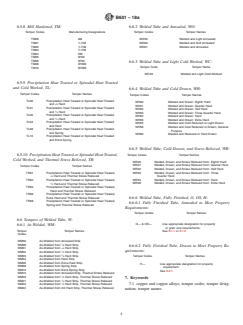
5.7.5 Tube, Welded, and Fully Finished Tempers, O, OS, H—Tempers that result from both annealing a welded and cold-worked
tube, or cold working, a welded cold-worked and annealed tube. With these treatments, the weld area has been transformed into
a wrought structure, and the usual temper designations apply.
6. Temper Designation Codes and Names
6.1 Annealed Tempers, O:
6.1.1 Annealed to Meet Mechanical Properties, O:
Temper Codes Temper Names
O10 Cast and Annealed (Homogenized)
O11 As Cast and Precipitation Heat Treated
O20 Hot Forged and Annealed
O25 Hot Rolled and Annealed
O26 Hot Rolled and Temper Annealed
O30 Hot Extruded and Annealed
O31 Hot Extruded and Precipitation Heat Treated
O32 Hot Extruded and Temper Annealed
O40 Hot Pierced and Annealed
O50 Light Anneal
O60 Soft Anneal
O61 Annealed
O62 Heavy Anneal
O65 Drawing Anneal
O68 Deep Drawing Anneal
O70 Dead Soft Anneal
O80 Annealed to Temper— ⁄8 Hard
O81 Annealed to Temper— ⁄4 Hard
B601 − 18a
O82 Annealed to Temper— ⁄2 Hard
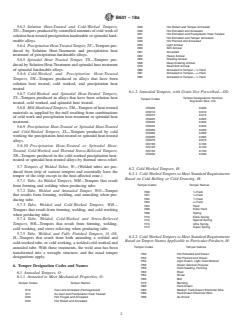
6.1.2 Annealed Tempers, with Grain Size Prescribed—OS:
Temper Designations Nominal
Temper Codes
Avg Grain Size, mm
OS005 0.005
OS010 0.010
OS015 0.015
OS025 0.025
OS035 0.035
OS045 0.045
OS050 0.050
OS060 0.060
OS065 0.065
OS070 0.070
OS100 0.100
OS120 0.120
OS150 0.150
OS200 0.200
6.2 Cold-Worked Tempers, H:
6.2.1 Cold-Worked Tempers to Meet Standard Requirements Based on Cold Rolling or Cold Drawing, H:
Temper Codes Temper Names
H00 ⁄8 Hard
H01 ⁄4 Hard
H02 ⁄2 Hard
H03 ⁄4 Hard
H04 Hard
H06 Extra Hard
H08 Spring
H10 Extra Spring
H12 Special Spring
H13 Ultra Spring
H14 Super Spring
6.2.2 Cold-Worked Tempers to Meet Standard Requirements Based on Temper Names Applicable to Particular Products, H:
Temper Codes Temper Names
H50 Hot Extruded and Drawn
H52 Hot Pierced and Drawn
H55 Light Drawn, Light Cold-Worked
H58 Drawn General Purpose
H60 Cold Heading, Forming
H63 Rivet
H64 Screw
H66 Bolt
H70 Bending
H80 Hard Drawn
H85 Medium Hard-Drawn Electrical Wire
H86 Hard-Drawn Electrical Wire
H90 As-finned
B601 − 18a
6.3 Cold-Worked Tempers with Added Treatments:
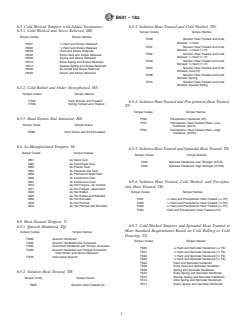
6.3.1 Cold Worked and Stress Relieved, HR:
Temper Codes Temper Names
HR01 ⁄4 Hard and Stress Relieved
HR02 ⁄2 Hard and Stress Relieved
HR04 Hard and Stress Relieved
HR06 Extra Hard and Stress Relieved
HR08 Spring and Stress Relieved
HR10 Extra Spring and Stress Relieved
HR12 Special Spring and Stress Relieved
HR20 As-finned and Stress Relieved
HR50 Drawn and Stress Relieved
6.3.2 Cold Rolled and Order Strengthened, HT:
Temper Codes Temper Names
HT04 Hard Temper and Treated
HT08 Spring Temper and Treated
6.3.3 Hard Drawn End Annealed, HE:
Temper Code Temper Name
HE80 Hard Drawn and End Annealed
6.4 As-Manufactured Tempers, M:
Temper Codes Temper Names
M01 As Sand Cast
M02 As Centrifugal Cast
M03 As Plaster Cast
M04 As Pressure
...