

ASTM B846-19a
(Terminology)Standard Terminology for Copper and Copper Alloys
General Information
- Abstract
SIGNIFICANCE AND USE
3.1 This terminology is not intended to apply to any standard, test method, practice, or other document not within the jurisdiction of Committee B05 on Copper and Copper Alloys.
SCOPE
1.1 The terms defined in this terminology standard are applicable to copper and copper alloy products specifications, test methods, practices, and other documents within the jurisdiction of Committee B05 on Copper and Copper Alloys.
1.2 The values stated in inch-pound units are to be regarded as standard. The values given in parentheses are mathematical conversions to SI units that are provided for information only and are not considered standard.
1.3 This international standard was developed in accordance with internationally recognized principles on standardization established in the Decision on Principles for the Development of International Standards, Guides and Recommendations issued by the World Trade Organization Technical Barriers to Trade (TBT) Committee.
- Status
- Published
- Publication Date
- 31-Jul-2019
- Technical Committee
- B05 - Copper and Copper Alloys
- Drafting Committee
- B05.93 - Terminology
Overview
ASTM B846-19a: Standard Terminology for Copper and Copper Alloys provides a comprehensive collection of standardized terms and definitions specific to copper and copper alloy products. Published by ASTM International and maintained by Committee B05 on Copper and Copper Alloys, this terminology standard ensures consistent language and understanding across specifications, test methods, and practices for copper materials. The standard is particularly essential for professionals working with copper products in manufacturing, engineering, construction, and quality assurance.
Key Topics
- Scope of Definitions: Covers terms relevant to copper and copper alloy materials, including their products, specifications, test methods, and practices within the jurisdiction of ASTM Committee B05.
- Measurement Units: Establishes inch-pound units as the primary standard, with SI unit equivalents provided for informational purposes.
- Standardization Principles: Developed in alignment with internationally recognized standardization guidelines, in accordance with World Trade Organization Technical Barriers to Trade (TBT) Committee recommendations.
- Terminology Coverage: Includes terms for various copper product forms (e.g., bar, rod, strip, tube), alloy types (brass, bronze, copper-nickel), processing methods (annealing, extrusion, rolling), and testing procedures (tension, hardness, impact tests).
- Property Descriptions: Defines key physical properties, finish types, processing defects, and application-specific attributes of copper and copper alloys.
Applications
The consistent use of terminology provided by ASTM B846-19a is fundamental in multiple practical contexts:
- Product Specifications: Ensures all stakeholders-manufacturers, purchasers, and regulators-use a common language when specifying copper and copper alloy products, reducing errors and miscommunication.
- Quality Assurance: Facilitates clear communication in material certification, quality inspection, and compliance documentation for copper product manufacturing and supply chains.
- Engineering and Design Documentation: Supports engineers and designers in describing materials and processing requirements precisely, aiding in the correct selection and use of copper and its alloys.
- Test Methods and Reporting: Standardizes the language used in test protocols and results, ensuring clarity and consistency in mechanical, chemical, and physical property testing for copper products.
- International Trade: Provides internationally recognized terminology, simplifying cross-border procurement, compliance, and regulatory review for copper and copper alloy goods.
Related Standards
ASTM B846-19a references and complements several other key ASTM copper standards:
- ASTM B153: Test Method for Expansion (Pin Test) of Copper and Copper-Alloy Pipe and Tubing
- ASTM B170: Specification for Oxygen-Free Electrolytic Copper-Refinery Shapes
- ASTM B379: Specification for Phosphorized Coppers-Refinery Shapes
- ASTM E8/E8M: Test Methods for Tension Testing of Metallic Materials
- ASTM E10: Test Method for Brinell Hardness of Metallic Materials
- ASTM E18: Test Methods for Rockwell Hardness of Metallic Materials
- ASTM E23: Test Methods for Notched Bar Impact Testing of Metallic Materials
- ASTM E112: Test Methods for Determining Average Grain Size
Practical Value
- Uniformity: Promotes uniform understanding and use of copper-related terms in industry documents.
- Clarity: Minimizes ambiguity and assists in accurate interpretation of technical and regulatory requirements.
- Interoperability: Supports compatibility among standards, facilitating efficient project execution and streamlined supply chains for copper products.
- Regulatory Compliance: Assists manufacturers and importers/exporters by aligning with globally recognized standardization criteria, essential for international markets.
ASTM B846-19a is an indispensable resource for anyone involved with copper and copper alloy products, ensuring precision, transparency, and reliability throughout the product lifecycle. For the most current and authoritative terminology, consult the official ASTM standard.
Relations
- Effective Date
- 01-Aug-2019
- Effective Date
- 01-Apr-2024
- Effective Date
- 01-Jan-2024
- Effective Date
- 15-Nov-2018
- Effective Date
- 01-Jul-2018
- Effective Date
- 01-Jul-2017
- Effective Date
- 15-Jul-2016
- Effective Date
- 01-Apr-2016
- Effective Date
- 01-Jan-2016
- Effective Date
- 15-Oct-2015
- Effective Date
- 01-Feb-2015
- Effective Date
- 01-May-2014
- Effective Date
- 01-Jun-2013
- Effective Date
- 01-Dec-2012
- Effective Date
- 15-Nov-2012
Get Certified
Connect with accredited certification bodies for this standard

Element Materials Technology
Materials testing and product certification.

Inštitut za kovinske materiale in tehnologije
Institute of Metals and Technology. Materials testing, metallurgical analysis, NDT.
Sponsored listings
Frequently Asked Questions
ASTM B846-19a is a standard published by ASTM International. Its full title is "Standard Terminology for Copper and Copper Alloys". This standard covers: SIGNIFICANCE AND USE 3.1 This terminology is not intended to apply to any standard, test method, practice, or other document not within the jurisdiction of Committee B05 on Copper and Copper Alloys. SCOPE 1.1 The terms defined in this terminology standard are applicable to copper and copper alloy products specifications, test methods, practices, and other documents within the jurisdiction of Committee B05 on Copper and Copper Alloys. 1.2 The values stated in inch-pound units are to be regarded as standard. The values given in parentheses are mathematical conversions to SI units that are provided for information only and are not considered standard. 1.3 This international standard was developed in accordance with internationally recognized principles on standardization established in the Decision on Principles for the Development of International Standards, Guides and Recommendations issued by the World Trade Organization Technical Barriers to Trade (TBT) Committee.
SIGNIFICANCE AND USE 3.1 This terminology is not intended to apply to any standard, test method, practice, or other document not within the jurisdiction of Committee B05 on Copper and Copper Alloys. SCOPE 1.1 The terms defined in this terminology standard are applicable to copper and copper alloy products specifications, test methods, practices, and other documents within the jurisdiction of Committee B05 on Copper and Copper Alloys. 1.2 The values stated in inch-pound units are to be regarded as standard. The values given in parentheses are mathematical conversions to SI units that are provided for information only and are not considered standard. 1.3 This international standard was developed in accordance with internationally recognized principles on standardization established in the Decision on Principles for the Development of International Standards, Guides and Recommendations issued by the World Trade Organization Technical Barriers to Trade (TBT) Committee.
ASTM B846-19a is classified under the following ICS (International Classification for Standards) categories: 01.040.77 - Metallurgy (Vocabularies); 77.120.30 - Copper and copper alloys. The ICS classification helps identify the subject area and facilitates finding related standards.
ASTM B846-19a has the following relationships with other standards: It is inter standard links to ASTM B846-19, ASTM E23-24, ASTM E8/E8M-24, ASTM B379-11(2018), ASTM E18-18, ASTM E18-17, ASTM E8/E8M-16, ASTM E23-16a, ASTM E23-16, ASTM B170-99(2015), ASTM E8/E8M-15, ASTM E10-14, ASTM E8/E8M-13, ASTM E18-12, ASTM E112-12. Understanding these relationships helps ensure you are using the most current and applicable version of the standard.
ASTM B846-19a is available in PDF format for immediate download after purchase. The document can be added to your cart and obtained through the secure checkout process. Digital delivery ensures instant access to the complete standard document.
Standards Content (Sample)
This international standard was developed in accordance with internationally recognized principles on standardization established in the Decision on Principles for the
Development of International Standards, Guides and Recommendations issued by the World Trade Organization Technical Barriers to Trade (TBT) Committee.
Designation: B846 − 19a
Standard Terminology for
Copper and Copper Alloys
This standard is issued under the fixed designation B846; the number immediately following the designation indicates the year of
original adoption or, in the case of revision, the year of last revision. A number in parentheses indicates the year of last reapproval. A
superscript epsilon (´) indicates an editorial change since the last revision or reapproval.
1. Scope* 3. Significance and Use
3.1 This terminology is not intended to apply to any
1.1 The terms defined in this terminology standard are
standard, test method, practice, or other document not within
applicable to copper and copper alloy products specifications,
the jurisdiction of Committee B05 on Copper and Copper
test methods, practices, and other documents within the juris-
Alloys.
diction of Committee B05 on Copper and Copper Alloys.
1.2 The values stated in inch-pound units are to be regarded
4. Terminology
as standard. The values given in parentheses are mathematical
conversions to SI units that are provided for information only acid dip—see dip solution.
and are not considered standard.
acid dipped-dry rolled finish—see finish, acid dipped-dry
1.3 This international standard was developed in accor-
rolled.
dance with internationally recognized principles on standard-
Admiralty—an alloy containing nominally 71 % copper: 1 %
ization established in the Decision on Principles for the
tin and 28 % zinc, originally developed by the British
Development of International Standards, Guides and Recom-
Admiralty and generally available in tube, flat products, and
mendations issued by the World Trade Organization Technical
wire. Its principal use is in heat exchanger and condenser
Barriers to Trade (TBT) Committee.
tubes.Aninhibitormaybeaddedtoincreasetheresistanceto
dezincification.
2. Referenced Documents
2 Admiralty, inhibited (arsenical, antimonial or
2.1 ASTM Standards:
phosphorized)—admiralty modified by the addition of
B153 Test Method for Expansion (Pin Test) of Copper and
small amounts of arsenic, antimony or phosphorus to inhibit
Copper-Alloy Pipe and Tubing
dezincification. (Copper Alloy Nos. C44300, C44400,
B170 Specification for Oxygen-Free Electrolytic Copper—
C44500)
Refinery Shapes
B379 Specification for Phosphorized Coppers—Refinery
air stain—see stain, air.
Shapes
alpha—the name of a phase or of a certain range of copper
E8/E8M Test Methods for Tension Testing of Metallic Ma-
alloys which contain one or more alloying elements dis-
terials
solved in copper, the phase being a homogeneous solid
E10 Test Method for Brinell Hardness of Metallic Materials
solution.
E18 Test Methods for Rockwell Hardness of Metallic Ma-
terials
alpha beta brass—a series of copper-zinc alloys containing
E23 Test Methods for Notched Bar Impact Testing of Me-
approximately 55 to 63 % copper and the remainder mostly,
tallic Materials
if not all, zinc and composed of crystals or grains of both the
E112 Test Methods for Determining Average Grain Size
alpha and the beta phases.
aluminum brass—a copper alloy containing nominally
77.5 % copper, 2 % aluminum and 20.5 % zinc with an
This terminology is under the jurisdiction ofASTM Committee B05 on Copper
arsenical inhibitor, available in tube form. Its principal use is
and Copper Alloys and is the direct responsibility of Subcommittee B05.93 on
in heat exchanger and condenser tubes. (Copper Alloy No.
Terminology.
Current edition approved Aug. 1, 2019. Published August 2019. Originally
C68700)
approved in 1993. Last previous edition approved in 2019 as B846–19. DOI:
10.1520/B0846–19A.
aluminum bronze—copper alloys with aluminum as the
For referenced ASTM standards, visit the ASTM website, www.astm.org, or
principal alloying element, normally in the range of 3 to
contact ASTM Customer Service at service@astm.org. For Annual Book of ASTM
11 % with or without the additions of other elements.
Standards volume information, refer to the standard’s Document Summary page on
the ASTM website. (Copper Alloy Nos. C60800 – 64699 incl.)
*A Summary of Changes section appears at the end of this standard
Copyright © ASTM International, 100 Barr Harbor Drive, PO Box C700, West Conshohocken, PA 19428-2959. United States
B846 − 19a
anneal (annealing)—a thermal treatment to change the prop- definition is the same for Average Outside Diameter or
erties or grain structure of the product. When applied to a Average Inside Diameter, as long as the calculation is made
cold-worked product having a single phase: to produce withI.D.onlyorO.D.onlymeasurementsbutnotmixed(see
softening by recrystallization or recrystallization and grain Fig. 1).
growth, with the accompanying changes in properties.When
average diameter (for round tubes only)—the average of the
applied to a product having two or more phases: to produce
maximum and minimum outside diameters or the maximum
softening by changes in the phase relationship that may
and minimum inside diameters, whichever is applicable, as
include recrystallization and grain growth.
determined at any one cross section of the tube.
annealability of copper rod—the ease with which a material
bar—asolidrectangularsection,oronewithtwoplaneparallel
will soften after cold work and subsequent thermal treat-
surfaces and round or other simple regularly shaped edges,
ments; this property is affected primarily by the purity of the
up to and including 12 in. (300 mm) in width and over 0.188
metal since all other variables are kept constant.
in. (5 mm) in thickness, furnished in straight lengths or in
annular ring—see circular ring. rolls and with finished edges, either rolled, drawn, or
extruded.
antimicrobial copper alloy—a solid wrought or cast copper
alloy that is listed under one of the following U.S. Environ-
bar, bus stock—high-conductivity copper bar stock of any
mental Protection Agency (EPA) registration numbers:
dimension intended for use as an electrical conductor.
82012-1, 82012-2, 82012-3, 82012-4, 82012-5, or 82012-6,
bar, cast—a flat casting for rolling into sheet and strip, or
or is otherwise identified by a Unified Numbering System
round casting for rolling and drawing into wire.
copperalloycodeinanactiveEPApublichealthregistration.
bar, cold-rolled—see cold-rolled bar.
arbor—a cylindrical core around which metal is wound to
obtain a desired inside diameter of the wound coil or roll.
bar, commutator segment stock—a bar for use in making
commutators of electric motors and generators, the cross-
arc welding—a group of welding processes wherein coales-
section of the bar being a trapezoid or truncated sector or
cence is produced by heating with an arc or arcs, with or
segment of a circle.
without the application of pressure, and with or without the
use of filler metal.
bar, drawn—see drawn bar.
architectural bronze—an alloy containing nominally 57 %
bar, extruded—see extruded bar.
copper, 3 % lead, and 40 % zinc, generally available in
bar, hot-rolled—see hot-rolled bar.
extrudedordrawnshapesandrod;usedforarchitecturaltrim
and for some mechanical applications. The alloy is not
barrel rolling—a method of polishing small parts in which the
technically a bronze, but because of long usage, the term
parts and a polishing medium are placed in a barrel, the
“Architectural Bronze” has been used. (Copper Alloy No.
polishing action resulting from the revolving of the barrel.
C38500)
base metal—the sheet or plate from which the pipe is formed.
area reduction—the decrease in cross-section of a product by
bend test—see test, bend.
rolling or drawing, which is a measure of the temper of the
metal in the cold worked condition.
beryllium copper—see copper-beryllium alloy.
argentiferous copper—see silver bearing copper.
billet—refinery shape used for piercing or extrusion into
arsenical tough pitch copper—a modified tough pitch copper tubular products or for extrusion into rods, bars, and shapes.
Circular in cross section, usually 3 to 16 in. (76 to 406 mm)
containing substantial amounts of arsenic regardless of
origin or treatment. in diameter, normally ranging in weight from 100 to 4200 lb
(45 to 1905 kg).
as-welded condition—a condition created as a result of
forming annealed sheet or plate into tubular form and bimetal tube—see tube, bimetal.
welding without subsequent heat treatment or cold work.
blank—a piece of flat product intended for subsequent fabri-
average diameter—the average of the maximum and mini- cation by forming, bending, cupping, drawing, hot pressing,
and so forth.
mum measured diameters at any one cross-section. This
FIG. 1 Average Diameter
B846 − 19a
blanking—the process of cutting metal blanks by a die and camber—see edgewise curvature.
punch set in a press, or by sawing or shearing.
capable of—the test need not be performed by the producer of
thematerial.However,ifsubsequenttestingbythepurchaser
Bourdon gauge tube—see tube, Bourdon gauge.
establishes that the material does not meet the specified
brass—any copper alloy with zinc as the principal alloying
requirements, the material shall be subject to rejection.
element, with or without small quantities of some other
elements. capacitor plate stock—strip manufactured to special flatness
and thickness tolerances for use in electrical variable capaci-
brazed tube—see tube, brazed.
tors.
brazing filler material—wire, rod, strip, or powder that is
cartridge brass—a copper alloy containing nominally 70 %
manufactured to special chemical composition for use in
copper and 30 % zinc and generally available in flat
joining metals by brazing.
products, rod, wire, and tube. (Copper Alloy No. C26000)
bridge plate—a low-friction plate of a copper alloy used to
cast bar—see bar, cast.
provide a bearing surface for the expansion end of trussed
cast shell process—a process for making seamless tube
bridge structures.
whereby the metal is cast in the form of a shell or tube and
bright annealed finish—see finish, bright annealed.
subsequently reduced to the finished size by a series of
suitable alternate cold drawing and annealing operations.
bright dip—see dip, bright.
casting—a general term for a metal object produced at or
bright dipped finish—see finish, bright dipped.
near-finished shape by pouring or otherwise introducing
bright rolled finish—see finish, dry rolled.
molten metal into a mold and allowing it to solidify.
Brinell hardness test—see test, Brinell hardness.
casting, centrifugal—a casting produced in a cylindrical mold
rotating on its axis with the major axis of the product
brush brass finish—see finish, brush brass.
coinciding with the axis of rotation.The axis of rotation may
buckle—alternate bulges and hollows recurring along the be horizontal, vertical, or any angle in between.
length of a flat product with the edges remaining relatively
casting, centrifuged—a casting produced in a mold, a number
flat.
of which may be mounted around a central sprue.The molds
are rotated, in a vertical position, about a central axis
buckle (centre bulge or oil can)—alternate bulges and hol-
lows recurring along the length of a strip with the edges concentric with the central sprue.
remaining relatively flat.
casting, continuous—a casting produced by the continuous
pouring and solidification of molten metal through a water-
buffed surface finish—see finish, buffed surface.
cooled mold which determines the cross-sectional shape.
bulging—the expanding of a portion of the body of a drawn
The length of the product is not restricted by mold dimen-
shell below the top or neck.
sions.
bull ring rod—copper rod manufactured to special surface
casting, permanent mold—a product produced in a reusable
requirements and furnished in coils for redrawing or re-
mold constructed of a durable material, usually iron or steel,
rolling.
with the molten metal being introduced by gravity, low-
pressure, or vacuum.
bull rod—see redraw rod.
casting, sand—a casting produced in a sand mold.
bursting pressure—the internal pressure required to burst
tubes or other hollow products.
casting, semicentrifugal—a casting produced in a manner
similar to the centrifugal casting except that a central core is
bus bar—includesmaterialofsolidrectangularorsquarecross
used to allow the formation of other than a cylindrical inside
sectionorasolidsectionwithtwoplaneparallelsurfacesand
surface. The axis of rotation is always vertical.
round or other simple regular-shaped edges.
cathode—unmelted, electrodeposited, and somewhat rough
bus conductor stock—a bar, rod, shape or tube of high
flat plate normally used for melting. The customary size is
conductivity copper used for the manufacture of bus con-
1 7
about 3 ft (0.914 m) square, about ⁄2 to ⁄8 in. (12.7 to 22.2
ductor or bus bar.
mm) thick, weighing up to about 300 lb (136 kg) and may
bus stock bar—see bar, bus stock.
have hanging loops attached. Cathodes may also be cut to
smaller dimensions.
butt seam tube—see tube, open seam.
cavitation corrosion—see corrosion, cavitation.
cake—refinery shape used for rolling into plate, sheet, strip, or
shape. Rectangular in cross section and of various sizes, chemically refined copper—copper recovered from an aque-
normally ranging in weight from 140 to 62 000 lb (63 to ous solution by other than electrolytic means. Usually when
28 123 kg). this term is used alone it refers to chemically refined tough
B846 − 19a
pitch copper. This designation applies to the following: (a) cold heading—see heading.
copper cast in refinery shapes suitable for hot or cold
cold-rolled bar—barstockbroughttofinaldimensionsbycold
working, or both, and by extension, to fabricators products
rolling, regardless of prior operations.
made therefrom, (b) ingots or ingot bars suitable for remelt-
ing. cold-rolled finish—see finish, cold-rolled.
cold-rolled rod—rod stock brought to final dimensions by
circle—a completely round, commercially flat, solid blank
made from a rolled product. cold rolling, regardless of prior operations.
cold-rolled shape—shapestockbroughttofinaldimensionsby
circular ring—a completely round, commercial flat blank
cold rolling, regardless of prior operations.
lacking the central concentric area.
cold-rolled wire—wire stock brought to final dimensions by
cladding ratio—ratio by percent thickness of the component
cold rolling, regardless of prior operations.
layers, for example.
cold rolling—see rolling.
clean annealed finish—see finish, clean annealed.
cold shortness—the characteristic of metals that are brittle at
clock brass—a term sometimes used to designate high-leaded
temperatures below the recommended hot working tempera-
brass. (Copper Alloy No. C34200)
ture range.
close nipple—a nipple with no shoulder or unthreaded portion
cold shut—(1) a discontinuity that appears on the surface of
between two threads; the shortest possible pipe nipple with
cast metal as a result of two streams of liquid metal meeting
complete threads.
and failing to unite. (2) on a forging, a portion of the surface
coalesced copper—a commercially pure oxygen-free copper
that is separated by oxide from the main body of the metal.
formed in a protective atmosphere at elevated temperature
cold side—as applied to forging, the temperature range below
but below its melting point by application of mechanical
the optimum hot working temperature.
pressure to particles of electrolytic cathode copper. (Copper
No. C10200)
cold work—controlledmechanicaloperationsforchangingthe
form or cross section of a product and for producing a
coil—a length of the product wound into a series of connected
strain-hardened product at temperatures below the recrystal-
turns. The unqualified term “coil” as applied to tube usually
lization temperature.
refers to a bunched coil.
collapsing pressure—the external hydrostatic or pneumatic
coil, bunched—a coil in which the turns are bunched and held
pressure required to collapse a tube or other hollow article.
together such that the cross section of the bunched turns is
approximately circular. collett brass—see high-leaded brass.
commercial bronze—a copper alloy containing nominally
coil, double layer flat—a coil in which the product is spirally
90 % copper and 10 % zinc, generally available in flat
wound into two connected disc-like layers such that one
products, wire, rod, and tube. The alloy is not technically a
layer is on top of the other. (Sometimes called “double layer
bronze, but because of long usage the term “commercial
pancake coil” or “double layer spirally wound coil.”)
bronze” has been used. (Copper Alloy No. C22000)
coil, helical—See coil, level or traverse wound.
commercially pure copper—metal for which the specified
coil, level or traverse wound—a coil in which the turns are
minimum copper content is not less than 99.88 %, silver
wound into layers parallel to the axis of the coil such that
being counted as copper.
successive turns in a given layer are next to one another.
commutator segment stock bar—see bar, commutator seg-
(Sometimes called a “helical coil.”)
ment stock.
coil, level or traverse wound on a reel or spool—a coil in
condenser tube plate—plate manufactured to special thick-
which the turns are positioned into layers on a reel or spool
ness tolerances and furnished in various contours as tube
parallel to the axis of the reel or spool such that successive
sheets or head plates for condensers and heat exchangers.
turns in a given layer are next to one another.
copper alloy—metal for which the specified minimum copper
coil set—as applied to strip, the natural curvature remaining in
content is less than 99.3 % and not less than 40 % and
strip after it has been unwound from a coil.
having no other element specified in excess of the copper
coil, single layer flat—a coil in which the product is spirally
content: exception to this definition occurs in the case of
wound into a single disc-like layer. (Sometimes called
copper-nickel-zinc alloys where zinc slightly exceeds the
“pancake coil” or “single layer spirally wound coil.”)
copper content in certain alloys which are commonly desig-
nated as copper alloys.
coil, stagger wound—a coil in which the turns are positioned
into layers approximately parallel to the axis of the coil, but Copper Alloy UNS No.—In the Unified Numbering System,
not necessarily with the fixed regularity of a level or traverse wrought copper alloys are designated as C16000 to C79999
wound coil. and cast copper alloys are designated as C81300 to C99999.
B846 − 19a
copper-beryllium alloy—heat-treatablecopperalloyscontain- crimped copper—copper in sheets or strips having relatively
ing varying amounts of beryllium and sometimes small small transverse corrugations applied subsequent to normal
amounts of cobalt, nickel, and chromium. It is capable of finishing operations to provide for expansion, to increase
being formed readily when in the soft condition and heat rigidity, or for ornamental purposes.
treated to hardnesses approaching those of steel. (Copper
cross rolling—rolling at a 90° angle to the long dimension of
Alloy Nos. C17000 – C17530 incl.)
the metal; usually done to increase width.
copper drainage tube—see tube, copper drainage (DWV).
cup test—see test, cup.
copper-iron alloy—copper alloys with iron as the principal
deep drawing brass—see cartridge brass or yellow brass.
alloying element with or without the addition of other
dents—depressions in the copper foil which do not signifi-
elements. (Copper Alloy Nos. C19200 – C19810 incl.)
cantly change the thickness of the copper foil.
copper-nickel alloy—copper alloys composed of copper and
deoxidized copper, high-residual phosphorus—copper de-
nickel with nickel content up to 40 % and with small
oxidized with phosphorus residual in amounts 0.015 to
additions of elements such as iron and manganese. (Copper
0.040 %. The copper is not susceptible to hydrogen
Alloy Nos. C70000 – C72950 incl.)
embrittlement, as determined in Specification B379. The
copper service tube—see tube, copper service.
copper is of relatively low-electrical conductivity due to the
amount of phosphorus present.
Copper UNS No.—In the Unified Numbering System,
wrought coppers are designated as C10000 to C15999 and
NOTE 1—International Standards Organization specifications permit up
cast coppers are designated as C80000 to C81199. to 0.050 % phosphorus.
deoxidized copper, low-residual phosphorus—copper deoxi-
core brass—see radiator core brass.
dized with phosphorus residual in amounts 0.004 to
cored forgings—forgings produced between closed dies, in-
0.012 %. The copper is not readily susceptible to hydrogen
cluding cores.
embrittlement, as determined in Specification B379. The
copper in the annealed condition has a minimum conductiv-
corner radius on square or rectangular wire—any configu-
ity of 90 % IACS.
rationonthecornerbetweenachamferandafullradius.The
measurement of a corner radius is the distance from the
dewetting—a condition that results when molten solder has
blend point on one surface to the extension of the other
coated a surface and then receded leaving irregular-shaped
surface.
mounds of solder separated by areas covered with a thin film
but base metal is not exposed.
corrosion, cavitation—the damage caused to a material by a
moving liquid and associated with the formation and col-
diameter at any point—inside or outside diameter can be
lapse of cavities in the liquid at the solid-liquid interface.
measured at any point around the circumference of the tube.
Theindividualreadingsmaydeviatefromthenominaldueto
corrosion, impingement attack—a type of localized corro-
the tube being larger or smaller than nominal, or out of
sion caused by the striking of a liquid over a period of time
roundness, or a combination of the two (see Fig. 2).
containing entrained gases, on a metal surface.
die forgings—forgings produced between closed dies.
corrosion, stress—spontaneous failure of metals by cracking
under combined action of corrosion and residual or applied
die scalping—drawing through a sharp-edged die to remove
stress.
the surface layer.
cracking, intercrystalline—see intercrystalline cracking. die scratch—a longitudinal scratch on the surface of any
drawn product resulting from the use of a roughened die or
cracking, intergranular—see intercrystalline cracking.
from the drag of a foreign particle between the die and the
creep test—see test, creep. product.
Deviation of Actual Diameter at any Point = Max. Diameter – Nominal Diameter
Or, alternately = Nominal Diameter – Min. Diameter
FIG. 2 Diameter at any Point
B846 − 19a
die shaving—see die scalping. drawn wire—wire stock brought to final dimensions by cold
drawing through a die, regardless of temper or prior opera-
dip, bright—a dip solution used to give a bright surface to
tions.
copper alloys.
drifting—the piercing of a hole and turning up a collar or
dip, matte—a dip solution used to obtain a matte or dull finish
flange, on sheet, strip, or articles made therefrom.
on copper alloys.
driving-band blank—see rotating-band blank.
dip solution—anychemicalsolutionusedtoproduceaspecific
color or finish on copper or copper alloys. dry rolled finish—see finish, dry rolled.
disc—a round, commercially flat solid blank made from a flat duplex tube—see tube, bimetal.
rolled product.
DWV tube—see tube, copper drainage (DWV).
disc straightening—see straightening, ring or disc type.
earing—a wavy projection in a regular geometric pattern on
dish (cross or transverse bow)—the departure from flatness the rim of drawn cups formed in the course of deep drawing,
across the full width of the strip in the form of a single arc,
asaresultofdirectionalpropertiesoranisotropyofthesheet.
excluding burrs.
eccentricity—thedifferencebetweenthemaximumwallthick-
disk—see circle.
ness and the minimum wall thickness determined at any one
cross-section (see Fig. 3).
distribution tube (Type D)—a seamless or welded copper
tube known as copper distribution tube (Type D).
edge contours—see finished edges.
drainage tube—see tube, copper drainage (DWV). edgewise curvature—the lateral departure of the edge from a
straight line, which may be unidirectional or reversing.
drawing brass—see cartridge brass or yellow brass.
electrolytic copper—copper of any origin, refined by electro-
drawn bar—bar stock brought to final dimensions by cold
lytic deposition including electrowinning. Usually when this
drawing through a die, regardless of temper or prior opera-
term is used alone it refers to electrolytic tough pitch copper.
tions.
This designation applies to the following: (a) cathodes that
drawn finish—see finish, drawn. arethedirectproductoftherefiningoperation,(b)electrode-
posited copper cast in refinery shapes suitable for hot or cold
drawn flat product—see flat product, drawn.
working or both, and by extension, to fabricators’ products
drawn rod—rod stock brought to final dimensions by cold made therefrom, (c) electrodeposited copper cast into ingots
or ingot bars suitable for remelting.
drawing through a die, regardless of temper or prior opera-
tions.
electrolytic tough pitch copper—a commercially pure high
drawn shape—shape stock brought to final dimensions by conductivity copper of any origin which has been produced
cold drawing through a die, regardless of temper or prior by electrolytic deposition, then melted, oxidized, and
operations. broughttotoughpitchorcontrolledlowoxygencontent,and
finally cast into cakes, billets, wire bars, etc., suitable for hot
drawn stress relieved (DSR)—a thermal treatment of a
or cold working, or both. (Copper No. C11000)
cold-drawn tubular product to improve ductility without
significantly affecting its tensile strength or microstructure. embossed tube—see tube, embossed.
drawn tube—tube stock brought to final dimensions by cold embrittlement—the reduction of the normal ductility in a
drawing through a die, regardless of temper or prior opera- metal due to a physical or chemical change. As it relates to
tions. these test methods, embrittlement is the loss of ductility
Eccentricity = Max. Wall – Min. Wall
Percent Eccentricity = (Max. Wall – Min. Wall) / Average Wall × 100
NOTE 1—There are no tolerances established for Eccentricity inASTM
Tube and Pipe documents. This parameter is controlled through Wall
Thickness at any Point Tolerances.
FIG. 3 Eccentricity
B846 − 19a
caused by the reaction of cuprous oxide in the copper finish, brush brass—a frosted surface obtained on brass by
productwhenexposedatelevatedtemperaturestoareducing brushing with a wheel that may or may not be treated with
atmosphere. brush rouge and rotating at high speeds.
finish, buffed surface—the surface obtained by buffing with
endurance test—see test, endurance.
rouge or similar fine abrasive, resulting in a high gloss or
engraver’s brass—see extra-high-leaded brass.
polish. This may be applied in one operation or two,
commonly known as cutting and coloring operations.
etching brass—a term used to indicate quality of material
rather than chemical composition. The term signifies a flat
finish, clean annealed—a surface characterized by a light
product having unusual freedom from surface defects; very
iridescent film generally obtained on copper alloys which
flat and usually of quarter-hard or half-hard temper.
have been annealed in a controlled atmosphere.
expansion test—see test, expansion (pin). finish, cold-rolled—the surface obtained by cold rolling of
strip with a lubricant, giving a relatively smooth appearance.
extra-high-leaded brass—a copper alloy containing nomi-
Inthecaseofsheetorstrip,coldrollingmaybedonewithout
nally 61.5 % copper, 2.5 % lead, and 36 % zinc, generally
any lubricant, the finish then being similar to that described
available in flat rolled products, and used for engraving and
under dry rolled finish.
other operations requiring considerable cutting. (Copper
Alloy No. C35600) finish, drawn—the surface obtained on tube, wire, and drawn
rod, bar, and strip by drawing through a die resulting in a
extruded bar—bar stock brought to final dimensions by
relatively smooth and bright appearance with some residual
extrusion.
lubricant on the surface.
extruded finish—see finish, extruded.
finish, dry rolled—(a) the surface obtained by cold rolling on
polished rolls without the use of any coolant or metal
extruded rod—rod stock brought to final dimensions by
lubricant; (b) the surface obtained by the rolling or tumbling
extrusion.
of brass articles in a barrel with either dry sawdust, leather,
or scrap cork.
extruded shape—shape stock brought to final dimensions by
extrusion.
finish, extruded—the surface obtained on tube, wire, and rod,
bar, and strip by hot extrusion through a die, resulting in an
extruded tube—tube stock brought to final dimensions by
oxidized and dull appearance.
extrusion.
finish, hot rolled—the surface obtained by rolling metal while
extrusion—a uniform metal shape, long in relation to its
hot resulting in a dark, oxidized, and relatively rough
cross-sectional dimensions, produced by forcing a suitably
surface.
preheated billet or preform through an orifice (die) of the
desired cross section. Extrusions generally are furnished in
finish, kerosine rolled—the surface obtained by cold rolling
straight lengths.
withkerosineasalubricant,givingasemi-burnishedappear-
ance. A similar finish can be obtained by cold rolling with
extrusion, hot—the process of shaping metal into a chosen
soap or soluble oil.
continuous form by forcing it from a closed container
through a die of appropriate shape.
finish, plain pickled—the surface obtained by immersion in a
sulfuric acid solution. This effectively removes most heavy
extrusion pipe—a defect that occurs during extrusion and is
scale and oxides on yellow brasses, but less effectively on
located internally at the back end of the extruded piece. This
other alloys and will not remove any thin surface films of
defect is removed by cropping off the back end.
deposited copper.The color, is, therefore, usually duller than
that of bright dipped.
eyelet brass—see cartridge brass.
finish, planish—a bright smooth surface usually obtained by
finish, acid dipped-dry rolled—the surface obtained by cold
rubbing metals together.
dry rolling on polished rolls of material previously dipped,
giving a burnished appearance and retaining the color
finish, scratch brushed—the surface obtained by mechani-
obtained by dipping.
cally brushing the surface with wire bristle brushes or by
buffing with greaseless compound.
finish, bright annealed—the surface obtained by annealing
under conditions of controlled atmosphere to prevent oxida-
finished edges—smooth edges produced on flat wire, strip, or
tion and to retain the original luster of the product.
bar by drawing or rolling with or without previous slitting.
The edge contours most commonly used are square corners,
finish, bright-dipped—a bright surface having the true color
rounded corners, rounded edges, and full rounded edges.
of the metal obtained by immersion in a bright dipping
solution.
finned tube—see tube, finned.
finish, bright-rolled—see finish, dry rolled. fire cracking—see heat cracking.
B846 − 19a
fire-refined copper—copper of any origin or type finished by forging, hammer—see hammer forging.
furnace refining without having been processed at any stage
forging range—temperature range within which the slug or
by electrolytic or chemical refining. Usually when the term
blank cut from wrought material should be heated and
fire-refinedcopperisusedaloneitreferstofire-refinedtough
maintained to give optimum forging conditions.
pitch copper. This designation applies to the following: (a)
copper cast in refinery shapes suitable for hot or cold
formed shape—shape made from a flat product and brought to
working or both, and by extension, to fabricators’ products
final dimensions by bending laterally by means of rolls or
made therefrom, (b) ingots or ingot bars suitable for remelt-
brakes. If the longitudinal gap is less than 25 % of the
ing.
outside diameter or greatest overall dimensions, the product
is classified as an open seam tube.
flash—asinwelding,themetalthatprotrudesattheweldofthe
tube,internally,externally,orboth,asaresultofthepressure
fourdrinier wire—wireusedinmakingthefourdrinierscreens
applied when a forge-type seam is produced; the two types
used in the manufacture of paper.
of flash are internal flash and external flash.
free-cutting—the property of a material that enables it to be
flatness—the degree to which a surface of a flat product
cut with high-speed machining equipment yielding a short,
approaches a plane.
brittle chip.
flat product—a rectangular or square solid section of rela-
free-cutting brass—a wrought copper alloy composed of
tively great length in proportion to thickness. Included in the
copper, zinc, and lead having chemical composition within
designation “flat product” depending on the width and
the defined limits of Copper Alloy UNS No. C36000.
thickness, are plate, sheet, strip, and bar.Also included is the
product known as “flat wire.”
free-cutting copper—a wrought copper enriched with tellu-
rium and phosphorus, sulfur and phosphorus, or lead, having
flat product, drawn—a flat product brought to final dimen-
chemical composition within the defined limits of either
sions by drawing through a die, and furnished in flat straight
Copper UNS Nos. C14500, C14510, C14520, C14700, or
lengths, on spools, or in rolls. The corners or edges may be
C18700.
square or of other contours.
free-cutting muntz metal—a wrought copper alloy composed
flat product, rolled—a flat product brought to final thickness
of copper, zinc, and lead having chemical composition
byrolling,andfurnishedinflatstraightlengths,onspools,or
within the defined limits of CopperAlloy UNS No. C37000.
inrolls.Longitudinaledgesmaybethoseresultingfromfinal
rolling to thickness or the product may be brought to final
free-cutting phosphor bronze—a copper alloy containing
width by shearing, slitting, sawing, machining or rolling.
nominally 88 % copper, 4 % tin, 4 % zinc, and 4 % lead,
The corners or edges may be square or of other contours.
generally available in rod and flat products. (Copper Alloy
No. C54400)
flat straight lengths—see straightening and flattening (pat-
ent levelling) applicable to flat straight lengths.
free-machining—the quality of an alloy which enables it to be
cut in automatic machines at relatively high speeds yielding
flattening—the mill operation performed on rolled flat prod-
a short brittle chip.
ucts to reduce departure from flatness, such as curl and dish.
See straightening and flattening.
free-turning—see free-cutting.
flattening test—see test, flattening.
full rounded edges—see finished edges.
flat wire—a product up to and including 0.188 in. (4.78 mm)
gauge number—a number in a specific series used to desig-
in thickness and up to and including 1 ⁄4 in. (31.8 mm) in
nate a dimension. There are several series of such gauge
width.
numbers, of which the most familiar are the American Wire
fluted outside and plain inside tube—see tube, fluted outside Gauge or Brown & Sharpe and Birmingham or Stubs.
and plain inside.
gilding metal—a copper alloy containing nominally 95 %
fluted tube—see tube, fluted.
copper, and 5 % zinc. This alloy is generally available in flat
products, rod, and wire. (Copper Alloy No. C21000)
foil—a term often applied to thin sheet or strip usually 0.005
in. (0.13 mm) or less in thickness.
grain size—theaveragediameterorgrains,usuallydetermined
microscopically,onanetchedplanesurfaceofthemetal.See
forging—see hot press forging.
Test Methods E112.
forging brass—a copper alloy containing nominally 59 %
hammer forging—a forging process in which the piece is
copper, 2 % lead, and 39 % zinc, generally available in rod,
deformed by repeated blows.
bar,tubeandshapesandrecommendedforfabricationbyhot
forging and hot pressing. It has excellent machinability,
hand forgings—forgings produced between open dies.
approaching that of free-cutting brass. (Copper Alloy No.
C37700) hand straightening—see straightening, hand.
B846 − 19a
hardness number—thenumberusedtodesignatethehardness hot-rolled wire—wire stock brought to final dimensions by
of metal. The number is related to the scale of values of a hot rolling.
particular hardness test, as for example Rockwell B80 or
hot rolling—see rolling.
Brinell 150.
hot working—controlled mechanical operations for shaping a
hardware bronze—see leaded commercial bronze or leaded
product at temperatures above the recrystallization tempera-
red brass.
ture.
heading—the operation of either cold or hot forming the head
hydrostatic test—see test, hydrostatic.
of bolts, rivets, screws, and similar products by upsetting the
end of a rod or a wire blank.
impact extrusion—the formation of a tubular closure by the
rapid application of force through a punch on a metal blank,
heat—alotofcastproductthatshares,andcanbeidentifiedby,
the metal flowing up around the punch to form the tubular
a common chemical analysis result.
section. Also known as Hooker Process.
heat cracking—spontaneous failure of some metals by crack-
impact test—see test, impact.
ing under combined action of elevated temperature and
stress (residual or applied). Fire cracking is a form of heat
impingement attack corrosion—see corrosion, impingement
crackingresultingfromresidualstressandexternallyapplied
attack.
heat.
inclined roll straightening—see straightening, inclined roll.
herringbone—a series of long continuous waves running at
inclusions—foreign particles which may or may not be en-
various angles to the rolling direction.
closed in the copper foil.
high brass—see yellow brass.
ingot and ingot bar—refinery shapes used for remelting (not
high-conductivity copper—copper that in the annealed con-
fabrication). Ingots normally range in weight from 20 to 35
dition has a minimum electrical conductivity of 100 %
lb (9 to 16 kg) and ingot bars from 50 to 70 lb (23 to 32 kg).
IACS.
Both are usually notched to facilitate breaking into smaller
pieces.
high-leaded brass—copper alloys containing nominally for
C34200, 63.5 % copper, 2 % lead, and 34.5 % zinc; and for
ingot bar—a small rectangular copper casting weighing about
C35300, 62 % copper, 2 % lead, and 36 % zinc, generally
50 to 70 lb for remelting.
available in flat products and rod. (Copper Alloy No.
intercrystalline—atermusedtoindicateapathalongthegrain
C34200, C35300)
boundaries and between the crystals or grains rather than
high-leaded brass tube—a copper alloy containing nominally
through the grains of a metal.
66 % copper, 1.6 % lead, and 32.4 % zinc. (Copper Alloy
intercrystalline cracking—fracture of a metal along the grain
No. C33200)
boundaries of the metal.
Hooker Process—see impact extrusion.
intergranular—see intercrystalline.
hot extrusion—see extrusion, hot.
jewelry bronze—a copper alloy containing nominally 87.5 %
hot forging—see hot press forging.
copper and 12.5 % zinc having a rich golden color. (Copper
Alloy No. C22600)
hot press forging—a method of forming parts by pressing a
heated slug or blank cut from wrought material in a closed
kerosine rolled finish—see finish, kerosine rolled.
impression die.
lake copper—a commercially pure copper from the Lake
hot-rolled bar—bar stock brought to final dimensions by hot
Superior district generally fire refined and containing
rolling.
variable, but controlled, amounts of silver and arsenic.
(Copper Nos. C12500, C12900)
hot rolled finish—see finish, hot rolled.
leaded brasses—copper alloys, of copper and zinc, to which
hot-rolled plate—plate stock brought to final dimensions by
lead has been added to improve machinability.
hot rolling.
leaded commercial bronze—a copper alloy containing nomi-
hot-rolled rod—rod stock brought to final dimensions by hot
nally 89 % copper, 1.75 % lead, and 9.25 % zinc, generally
rolling.
available in rod, shapes, and bar, and used extensively for
hot-rolled shape—shape stock brought to final dimensions by hardware. (Copper Alloy No. C31400)
hot rolling.
leaded muntz metal—a copper alloy containing nominally
hot-rolled sheet—sheet stock brought to final dimensions by 60 %copper,0.6 %lead,and39.4 %zinc,generallyusedfor
hot rolling. condenser tube plates. (Copper Alloy No. C36500)
B846 − 19a
leaded naval brass—a copper alloy containing nominally manganese bronze—a copper alloy containing nominally
60 % copper, 0.75 % tin, 1.75 % lead, and 37.5 % zinc, 58.5 % copper, 1 % tin, 1.4 % iron, 0.1 % manganese, and
generally available in rod, shapes, and bar. (Copper Alloy 39 % zinc, generally available in rod, flat products, shapes,
No. C48500) and wire. (Copper Alloy No. 67500)
Mannesmann Process—the process of piercing heated solid
leaded red brass—a copper alloy containing nominally 85 %
billets to form seamless tubes. Also known as piercing.
copper, 2 % lead, and 13 % zinc, generally available in rod
and drawn bar. (Copper Alloy No. C32000)
matrix brass—see medium leaded brass.
lengths—straight pieces of the product.
matte dip—see dip, matte.
lengths, ends—straight pieces, shorter than the nominal
medium leaded brass—a copper alloy containing nominally
length, left over after cutting the product into mill lengths,
63.5 % copper, 1 % lead, and 35.5 % zinc, generally avail-
stock lengths, or specific lengths. They are subject to
able in flat products, rod, shapes, and wire. (Copper Alloy
minimum length and maximum weight requirements.
No. C34000)
lengths, multiple—straight lengths of integral multiples of a
mischmetal—an alloying additive, which includes a mixture
base length, with suitable allowance for cutting, if and when
of rare earth elements (atomic numbers 57 through 71) in
specified.
metallic form, used during casting to improve processing
characteristics or to affect material properties or microstruc-
lengths, random—run of mill lengths without any indicated
ture.
preferred length.
modified copper—metal for which the specified minimum
lengths, specific—straight lengths that are uniform in length,
coppercontentislessthan99.88 %andnotlessthan99.3 %,
as specified, and subject to established length tolerances.
silver being counted as copper.
lengths, specific with ends—specific lengths, including ends.
Muntz metal—a copper alloy containing nominally 60 %
copper and 40 % zinc, generally available in flat products,
lengths, standard—uniform lengths recommended in a Sim-
rod, wire, and tube. (Copper Alloy No. C28000)
plified Practice Recommendation or established as a Com-
mercial Standard.
naval brass—a copper alloy containing nominally 60 %
copper, 0.75 % tin, and 39.25 % zinc, generally available in
lengths, stock with ends—stock lengths, including ends.
rod, bar, wire, shapes, tube, and flat products. (CopperAlloy
lip tube—see tube, lip.
No. C46400)
lock seam tube—see tube, lock seam. nickel silver—copper alloys containing nickel and zinc. (Cop-
per Alloy Nos. C73500 to C79860 incl. and C97300 to
longitudinal corrugation—a condition similar to dish except
C97800 incl.)
that the sense of curvature changes sign at least once across
nodules—small irregularly shaped imperfections in the elec-
the width of the strip.
trolytic copper foil which do not cause the foil to fail the
longitudinal curl—a unidirectional departure from longitudi-
thickness tolerance.
nal flatness.
nonrefractory—a term applied to those copper alloys which,
lot—a collection of like product (that is, same alloy, temper,
because of a lack of hardness or abrasiveness, present
and dimensions) produced under uniform conditions from
relatively little difficulty in maintaining standard dimen-
which a sample is to be drawn for inspection or testing, or
sional tolerances.
both.
oil burner tube—see tube, oil burner.
low brass—a copper alloy containing nominally 80 % copper
oil stain—see stain, oil.
and 20 % zinc, generally available in flat products, rod, and
wire. (Copper Alloy No. C24000)
open seam tube—see tube, open seam and formed shape.
low-leaded brass—a copper alloy containing nominally
order strengthening—a thermal treatment of a cold-worked
63.5 % copper, 0.5 % lead, and 36 % zinc, generally avail-
product at a temperature below its recrystallization tempera-
able in flat products. (Copper Alloy No. C33500)
ture causing ordering to occur to obtain an increase in yield
strength.
low-leaded brass tube—a copper alloy tube product contain-
ing nominally 66 % copper, 0.5 % lead, and 33.5 % zinc.
overhauling—the process of cutting away the surface layer
(Copper
...
This document is not an ASTM standard and is intended only to provide the user of an ASTM standard an indication of what changes have been made to the previous version. Because
it may not be technically possible to adequately depict all changes accurately, ASTM recommends that users consult prior editions as appropriate. In all cases only the current version
of the standard as published by ASTM is to be considered the official document.
Designation: B846 − 19 B846 − 19a
Standard Terminology for
Copper and Copper Alloys
This standard is issued under the fixed designation B846; the number immediately following the designation indicates the year of
original adoption or, in the case of revision, the year of last revision. A number in parentheses indicates the year of last reapproval. A
superscript epsilon (´) indicates an editorial change since the last revision or reapproval.
1. Scope*
1.1 The terms defined in this terminology standard are applicable to copper and copper alloy products specifications, test
methods, practices, and other documents within the jurisdiction of Committee B05 on Copper and Copper Alloys.
1.2 The values stated in inch-pound units are to be regarded as standard. The values given in parentheses are mathematical
conversions to SI units that are provided for information only and are not considered standard.
1.3 This international standard was developed in accordance with internationally recognized principles on standardization
established in the Decision on Principles for the Development of International Standards, Guides and Recommendations issued
by the World Trade Organization Technical Barriers to Trade (TBT) Committee.
2. Referenced Documents
2.1 ASTM Standards:
B153 Test Method for Expansion (Pin Test) of Copper and Copper-Alloy Pipe and Tubing
B170 Specification for Oxygen-Free Electrolytic Copper—Refinery Shapes
B379 Specification for Phosphorized Coppers—Refinery Shapes
E8/E8M Test Methods for Tension Testing of Metallic Materials
E10 Test Method for Brinell Hardness of Metallic Materials
E18 Test Methods for Rockwell Hardness of Metallic Materials
E23 Test Methods for Notched Bar Impact Testing of Metallic Materials
E112 Test Methods for Determining Average Grain Size
3. Significance and Use
3.1 This terminology is not intended to apply to any standard, test method, practice, or other document not within the
jurisdiction of Committee B05 on Copper and Copper Alloys.
4. Terminology
acid dip—see dip solution.
acid dipped-dry rolled finish—see finish, acid dipped-dry rolled.
Admiralty—an alloy containing nominally 71 % copper: 1 % tin and 28 % zinc, originally developed by the British Admiralty and
generally available in tube, flat products, and wire. Its principal use is in heat exchanger and condenser tubes. An inhibitor may
be added to increase the resistance to dezincification.
Admiralty, inhibited (arsenical, antimonial or phosphorized)—admiralty modified by the addition of small amounts of arsenic,
antimony or phosphorus to inhibit dezincification. (Copper Alloy Nos. C44300, C44400, C44500)
air stain—see stain, air.
alpha—the name of a phase or of a certain range of copper alloys which contain one or more alloying elements dissolved in copper,
the phase being a homogeneous solid solution.
This terminology is under the jurisdiction of ASTM Committee B05 on Copper and Copper Alloys and is the direct responsibility of Subcommittee B05.93 on
Terminology.
Current edition approved Jan. 1, 2019Aug. 1, 2019. Published February 2019August 2019. Originally approved in 1993. Last previous edition approved in 20112019 as
B846–11a.–19. DOI: 10.1520/B0846–19.10.1520/B0846–19A.
For referenced ASTM standards, visit the ASTM website, www.astm.org, or contact ASTM Customer Service at service@astm.org. For Annual Book of ASTM Standards
volume information, refer to the standard’s Document Summary page on the ASTM website.
*A Summary of Changes section appears at the end of this standard
Copyright © ASTM International, 100 Barr Harbor Drive, PO Box C700, West Conshohocken, PA 19428-2959. United States
B846 − 19a
alpha beta brass—a series of copper-zinc alloys containing approximately 55 to 63 % copper and the remainder mostly, if not
all, zinc and composed of crystals or grains of both the alpha and the beta phases.
aluminum brass—a copper alloy containing nominally 77.5 % copper, 2 % aluminum and 20.5 % zinc with an arsenical inhibitor,
available in tube form. Its principal use is in heat exchanger and condenser tubes. (Copper Alloy No. C68700)
aluminum bronze—copper alloys with aluminum as the principal alloying element, normally in the range of 3 to 11 % with or
without the additions of other elements. (Copper Alloy Nos. C60800 – 64699 incl.)
anneal (annealing)—a thermal treatment to change the properties or grain structure of the product. When applied to a cold-worked
product having a single phase: to produce softening by recrystallization or recrystallization and grain growth, with the
accompanying changes in properties. When applied to a product having two or more phases: to produce softening by changes
in the phase relationship that may include recrystallization and grain growth.
annealability of copper rod—the ease with which a material will soften after cold work and subsequent thermal treatments; this
property is affected primarily by the purity of the metal since all other variables are kept constant.
annular ring—see circular ring.
antimicrobial copper alloy—a solid wrought or cast copper alloy that is listed under one of the following U.S. Environmental
Protection Agency (EPA) registration numbers: 82012-1, 82012-2, 82012-3, 82012-4, 82012-5, or 82012-6, or is otherwise
identified by a Unified Numbering System copper alloy code in an active EPA public health registration.
arbor—a cylindrical core around which metal is wound to obtain a desired inside diameter of the wound coil or roll.
arc welding—a group of welding processes wherein coalescence is produced by heating with an arc or arcs, with or without the
application of pressure, and with or without the use of filler metal.
architectural bronze—an alloy containing nominally 57 % copper, 3 % lead, and 40 % zinc, generally available in extruded or
drawn shapes and rod; used for architectural trim and for some mechanical applications. The alloy is not technically a bronze,
but because of long usage, the term “Architectural Bronze” has been used. (Copper Alloy No. C38500)
area reduction—the decrease in cross-section of a product by rolling or drawing, which is a measure of the temper of the metal
in the cold worked condition.
argentiferous copper—see silver bearing copper.
arsenical tough pitch copper—a modified tough pitch copper containing substantial amounts of arsenic regardless of origin or
treatment.
as-welded condition—a condition created as a result of forming annealed sheet or plate into tubular form and welding without
subsequent heat treatment or cold work.
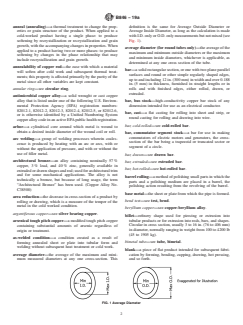
average diameter—the average of the maximum and minimum measured diameters at any one cross-section. This definition is
the same for Average Outside Diameter or Average Inside Diameter, as long as the calculation is made with I.D. only or O.D.
only measurements but not mixed (see Fig. 1).
average diameter (for round tubes only)—the average of the maximum and minimum outside diameters or the maximum and
minimum inside diameters, whichever is applicable, as determined at any one cross section of the tube.
bar—a solid rectangular section, or one with two plane parallel surfaces and round or other simple regularly shaped edges, up to
and including 12 in. (300 mm) in width and over 0.188 in. (5 mm) in thickness, furnished in straight lengths or in rolls and with
finished edges, either rolled, drawn, or extruded.
bar, bus stock—high-conductivity copper bar stock of any dimension intended for use as an electrical conductor.
bar, cast—a flat casting for rolling into sheet and strip, or round casting for rolling and drawing into wire.
FIG. 1 Average Diameter
B846 − 19a
bar, cold-rolled—see cold-rolled bar.
bar, commutator segment stock—a bar for use in making commutators of electric motors and generators, the cross-section of the
bar being a trapezoid or truncated sector or segment of a circle.
bar, drawn—see drawn bar.
bar, extruded—see extruded bar.
bar, hot-rolled—see hot-rolled bar.
barrel rolling—a method of polishing small parts in which the parts and a polishing medium are placed in a barrel, the polishing
action resulting from the revolving of the barrel.
base metal—the sheet or plate from which the pipe is formed.
bend test—see test, bend.
beryllium copper—see copper-beryllium alloy.
billet—refinery shape used for piercing or extrusion into tubular products or for extrusion into rods, bars, and shapes. Circular in
cross section, usually 3 to 16 in. (76 to 406 mm) in diameter, normally ranging in weight from 100 to 4200 lb (45 to 1905 kg).
bimetal tube—see tube, bimetal.
blank—a piece of flat product intended for subsequent fabrication by forming, bending, cupping, drawing, hot pressing, and so
forth.
blanking—the process of cutting metal blanks by a die and punch set in a press, or by sawing or shearing.
Bourdon gauge tube—see tube, Bourdon gauge.
brass—any copper alloy with zinc as the principal alloying element, with or without small quantities of some other elements.
brazed tube—see tube, brazed.
brazing filler material—wire, rod, strip, or powder that is manufactured to special chemical composition for use in joining metals
by brazing.
bridge plate—a low-friction plate of a copper alloy used to provide a bearing surface for the expansion end of trussed bridge
structures.
bright annealed finish—see finish, bright annealed.
bright dip—see dip, bright.
bright dipped finish—see finish, bright dipped.
bright rolled finish—see finish, dry rolled.
Brinell hardness test—see test, Brinell hardness.
brush brass finish—see finish, brush brass.
buckle—alternate bulges and hollows recurring along the length of a flat product with the edges remaining relatively flat.
buckle (centre bulge or oil can)—alternate bulges and hollows recurring along the length of a strip with the edges remaining
relatively flat.
buffed surface finish—see finish, buffed surface.
bulging—the expanding of a portion of the body of a drawn shell below the top or neck.
bull ring rod—copper rod manufactured to special surface requirements and furnished in coils for redrawing or rerolling.
bull rod—see redraw rod.
bursting pressure—the internal pressure required to burst tubes or other hollow products.
bus bar—includes material of solid rectangular or square cross section or a solid section with two plane parallel surfaces and round
or other simple regular-shaped edges.
bus conductor stock—a bar, rod, shape or tube of high conductivity copper used for the manufacture of bus conductor or bus bar.
B846 − 19a
bus stock bar—see bar, bus stock.
butt seam tube—see tube, open seam.
cake—refinery shape used for rolling into plate, sheet, strip, or shape. Rectangular in cross section and of various sizes, normally
ranging in weight from 140 to 62 000 lb (63 to 28 123 kg).
camber—see edgewise curvature.
capable of—the test need not be performed by the producer of the material. However, if subsequent testing by the purchaser
establishes that the material does not meet the specified requirements, the material shall be subject to rejection.
capacitor plate stock—strip manufactured to special flatness and thickness tolerances for use in electrical variable capacitors.
cartridge brass—a copper alloy containing nominally 70 % copper and 30 % zinc and generally available in flat products, rod,
wire, and tube. (Copper Alloy No. C26000)
cast bar—see bar, cast.
cast shell process—a process for making seamless tube whereby the metal is cast in the form of a shell or tube and subsequently
reduced to the finished size by a series of suitable alternate cold drawing and annealing operations.
casting—a general term for a metal object produced at or near-finished shape by pouring or otherwise introducing molten metal
into a mold and allowing it to solidify.
casting, centrifugal—a casting produced in a cylindrical mold rotating on its axis with the major axis of the product coinciding
with the axis of rotation. The axis of rotation may be horizontal, vertical, or any angle in between.
casting, centrifuged—a casting produced in a mold, a number of which may be mounted around a central sprue. The molds are
rotated, in a vertical position, about a central axis concentric with the central sprue.
casting, continuous—a casting produced by the continuous pouring and solidification of molten metal through a water-cooled
mold which determines the cross-sectional shape. The length of the product is not restricted by mold dimensions.
casting, permanent mold—a product produced in a reusable mold constructed of a durable material, usually iron or steel, with
the molten metal being introduced by gravity, low-pressure, or vacuum.
casting, sand—a casting produced in a sand mold.
casting, semicentrifugal—a casting produced in a manner similar to the centrifugal casting except that a central core is used to
allow the formation of other than a cylindrical inside surface. The axis of rotation is always vertical.
cathode—unmelted, electrodeposited, and somewhat rough flat plate normally used for melting. The customary size is about 3 ft
1 7
(0.914 m) square, about ⁄2 to ⁄8 in. (12.7 to 22.2 mm) thick, weighing up to about 300 lb (136 kg) and may have hanging loops
attached. Cathodes may also be cut to smaller dimensions.
cavitation corrosion—see corrosion, cavitation.
chemically refined copper—copper recovered from an aqueous solution by other than electrolytic means. Usually when this term
is used alone it refers to chemically refined tough pitch copper. This designation applies to the following: (a) copper cast in
refinery shapes suitable for hot or cold working, or both, and by extension, to fabricators products made therefrom, (b) ingots
or ingot bars suitable for remelting.
circle—a completely round, commercially flat, solid blank made from a rolled product.
circular ring—a completely round, commercial flat blank lacking the central concentric area.
cladding ratio—ratio by percent thickness of the component layers, for example.
clean annealed finish—see finish, clean annealed.
clock brass—a term sometimes used to designate high-leaded brass. (Copper Alloy No. C34200)
close nipple—a nipple with no shoulder or unthreaded portion between two threads; the shortest possible pipe nipple with
complete threads.
coalesced copper—a commercially pure oxygen-free copper formed in a protective atmosphere at elevated temperature but below
its melting point by application of mechanical pressure to particles of electrolytic cathode copper. (Copper No. C10200)
coil—a length of the product wound into a series of connected turns. The unqualified term “coil” as applied to tube usually refers
to a bunched coil.
B846 − 19a
coil, bunched—a coil in which the turns are bunched and held together such that the cross section of the bunched turns is
approximately circular.
coil, double layer flat—a coil in which the product is spirally wound into two connected disc-like layers such that one layer is
on top of the other. (Sometimes called “double layer pancake coil” or “double layer spirally wound coil.”)
coil, helical—See coil, level or traverse wound.
coil, level or traverse wound—a coil in which the turns are wound into layers parallel to the axis of the coil such that successive
turns in a given layer are next to one another. (Sometimes called a “helical coil.”)
coil, level or traverse wound on a reel or spool—a coil in which the turns are positioned into layers on a reel or spool parallel
to the axis of the reel or spool such that successive turns in a given layer are next to one another.
coil set—as applied to strip, the natural curvature remaining in strip after it has been unwound from a coil.
coil, single layer flat—a coil in which the product is spirally wound into a single disc-like layer. (Sometimes called “pancake coil”
or “single layer spirally wound coil.”)
coil, stagger wound—a coil in which the turns are positioned into layers approximately parallel to the axis of the coil, but not
necessarily with the fixed regularity of a level or traverse wound coil.
cold heading—see heading.
cold-rolled bar—bar stock brought to final dimensions by cold rolling, regardless of prior operations.
cold-rolled finish—see finish, cold-rolled.
cold-rolled rod—rod stock brought to final dimensions by cold rolling, regardless of prior operations.
cold-rolled shape—shape stock brought to final dimensions by cold rolling, regardless of prior operations.
cold-rolled wire—wire stock brought to final dimensions by cold rolling, regardless of prior operations.
cold rolling—see rolling.
cold shortness—the characteristic of metals that are brittle at temperatures below the recommended hot working temperature
range.
cold shut—(1) a discontinuity that appears on the surface of cast metal as a result of two streams of liquid metal meeting and
failing to unite. (2) on a forging, a portion of the surface that is separated by oxide from the main body of the metal.
cold side—as applied to forging, the temperature range below the optimum hot working temperature.
cold work—controlled mechanical operations for changing the form or cross section of a product and for producing a
strain-hardened product at temperatures below the recrystallization temperature.
collapsing pressure—the external hydrostatic or pneumatic pressure required to collapse a tube or other hollow article.
collett brass—see high-leaded brass.
commercial bronze—a copper alloy containing nominally 90 % copper and 10 % zinc, generally available in flat products, wire,
rod, and tube. The alloy is not technically a bronze, but because of long usage the term “commercial bronze” has been used.
(Copper Alloy No. C22000)
commercially pure copper—metal for which the specified minimum copper content is not less than 99.88 %, silver being counted
as copper.
commutator segment stock bar—see bar, commutator segment stock.
condenser tube plate—plate manufactured to special thickness tolerances and furnished in various contours as tube sheets or head
plates for condensers and heat exchangers.
copper alloy—metal for which the specified minimum copper content is less than 99.3 % and not less than 40 % and having no
other element specified in excess of the copper content: exception to this definition occurs in the case of copper-nickel-zinc
alloys where zinc slightly exceeds the copper content in certain alloys which are commonly designated as copper alloys.
Copper Alloy UNS No.—In the Unified Numbering System, wrought copper alloys are designated as C16000 to C79999 and cast
copper alloys are designated as C81300 to C99999.
B846 − 19a
copper-beryllium alloy—heat-treatable copper alloys containing varying amounts of beryllium and sometimes small amounts of
cobalt, nickel, and chromium. It is capable of being formed readily when in the soft condition and heat treated to hardnesses
approaching those of steel. (Copper Alloy Nos. C17000 – C17530 incl.)
copper drainage tube—see tube, copper drainage (DWV).
copper-iron alloy—copper alloys with iron as the principal alloying element with or without the addition of other elements.
(Copper Alloy Nos. C19200 – C19810 incl.)
copper-nickel alloy—copper alloys composed of copper and nickel with nickel content up to 40 % and with small additions of
elements such as iron and manganese. (Copper Alloy Nos. C70000 – C72950 incl.)
copper service tube—see tube, copper service.
Copper UNS No.—In the Unified Numbering System, wrought coppers are designated as C10000 to C15999 and cast coppers are
designated as C80000 to C81199.
core brass—see radiator core brass.
cored forgings—forgings produced between closed dies, including cores.
corner radius on square or rectangular wire—any configuration on the corner between a chamfer and a full radius. The
measurement of a corner radius is the distance from the blend point on one surface to the extension of the other surface.
corrosion, cavitation—the damage caused to a material by a moving liquid and associated with the formation and collapse of
cavities in the liquid at the solid-liquid interface.
corrosion, impingement attack—a type of localized corrosion caused by the striking of a liquid over a period of time containing
entrained gases, on a metal surface.
corrosion, stress—spontaneous failure of metals by cracking under combined action of corrosion and residual or applied stress.
cracking, intercrystalline—see intercrystalline cracking.
cracking, intergranular—see intercrystalline cracking.
creep test—see test, creep.
crimped copper—copper in sheets or strips having relatively small transverse corrugations applied subsequent to normal finishing
operations to provide for expansion, to increase rigidity, or for ornamental purposes.
cross rolling—rolling at a 90° angle to the long dimension of the metal; usually done to increase width.
cup test—see test, cup.
deep drawing brass—see cartridge brass or yellow brass.
dents—depressions in the copper foil which do not significantly change the thickness of the copper foil.
deoxidized copper, high-residual phosphorus—copper deoxidized with phosphorus residual in amounts 0.015 to 0.040 %. The
copper is not susceptible to hydrogen embrittlement, as determined in Specification B379. The copper is of relatively
low-electrical conductivity due to the amount of phosphorus present.
NOTE 1—International Standards Organization specifications permit up to 0.050 % phosphorus.
deoxidized copper, low-residual phosphorus—copper deoxidized with phosphorus residual in amounts 0.004 to 0.012 %. The
copper is not readily susceptible to hydrogen embrittlement, as determined in Specification B379. The copper in the annealed
condition has a minimum conductivity of 90 % IACS.
dewetting—a condition that results when molten solder has coated a surface and then receded leaving irregular-shaped mounds
of solder separated by areas covered with a thin film but base metal is not exposed.
diameter at any point—inside or outside diameter can be measured at any point around the circumference of the tube. The
individual readings may deviate from the nominal due to the tube being larger or smaller than nominal, or out of roundness, or
a combination of the two (see Fig. 2).
die forgings—forgings produced between closed dies.
die scalping—drawing through a sharp-edged die to remove the surface layer.
B846 − 19a
Deviation of Actual Diameter at any Point = Max. Diameter – Nominal Diameter
Or, alternately = Nominal Diameter – Min. Diameter
FIG. 2 Diameter at any Point
die scratch—a longitudinal scratch on the surface of any drawn product resulting from the use of a roughened die or from the drag
of a foreign particle between the die and the product.
die shaving—see die scalping.
dip, bright—a dip solution used to give a bright surface to copper alloys.
dip, matte—a dip solution used to obtain a matte or dull finish on copper alloys.
dip solution—any chemical solution used to produce a specific color or finish on copper or copper alloys.
disc—a round, commercially flat solid blank made from a flat rolled product.
disc straightening—see straightening, ring or disc type.
dish (cross or transverse bow)—the departure from flatness across the full width of the strip in the form of a single arc, excluding
burrs.
disk—see circle.
distribution tube (Type D)—a seamless or welded copper tube known as copper distribution tube (Type D).
drainage tube—see tube, copper drainage (DWV).
drawing brass—see cartridge brass or yellow brass.
drawn bar—bar stock brought to final dimensions by cold drawing through a die, regardless of temper or prior operations.
drawn finish—see finish, drawn.
drawn flat product—see flat product, drawn.
drawn rod—rod stock brought to final dimensions by cold drawing through a die, regardless of temper or prior operations.
drawn shape—shape stock brought to final dimensions by cold drawing through a die, regardless of temper or prior operations.
drawn stress relieved (DSR)—a thermal treatment of a cold-drawn tubular product to improve ductility without significantly
affecting its tensile strength or microstructure.
drawn tube—tube stock brought to final dimensions by cold drawing through a die, regardless of temper or prior operations.
drawn wire—wire stock brought to final dimensions by cold drawing through a die, regardless of temper or prior operations.
drifting—the piercing of a hole and turning up a collar or flange, on sheet, strip, or articles made therefrom.
driving-band blank—see rotating-band blank.
dry rolled finish—see finish, dry rolled.
duplex tube—see tube, bimetal.
DWV tube—see tube, copper drainage (DWV).
earing—a wavy projection in a regular geometric pattern on the rim of drawn cups formed in the course of deep drawing, as a
result of directional properties or anisotropy of the sheet.
eccentricity—the difference between the maximum wall thickness and the minimum wall thickness determined at any one
cross-section (see Fig. 3).
B846 − 19a
Eccentricity = Max. Wall – Min. Wall
Percent Eccentricity = (Max. Wall – Min. Wall) / Average Wall × 100
NOTE 1—There are no tolerances established for Eccentricity in ASTM
Tube and Pipe documents. This parameter is controlled through Wall
Thickness at any Point Tolerances.
FIG. 3 Eccentricity
edge contours—see finished edges.
edgewise curvature—the lateral departure of the edge from a straight line, which may be unidirectional or reversing.
electrolytic copper—copper of any origin, refined by electrolytic deposition including electrowinning. Usually when this term is
used alone it refers to electrolytic tough pitch copper. This designation applies to the following: (a) cathodes that are the direct
product of the refining operation, (b) electrodeposited copper cast in refinery shapes suitable for hot or cold working or both,
and by extension, to fabricators’ products made therefrom, (c) electrodeposited copper cast into ingots or ingot bars suitable for
remelting.
electrolytic tough pitch copper—a commercially pure high conductivity copper of any origin which has been produced by
electrolytic deposition, then melted, oxidized, and brought to tough pitch or controlled low oxygen content, and finally cast into
cakes, billets, wire bars, etc., suitable for hot or cold working, or both. (Copper No. C11000)
embossed tube—see tube, embossed.
embrittlement—the reduction of the normal ductility in a metal due to a physical or chemical change. As it relates to these test
methods, embrittlement is the loss of ductility caused by the reaction of cuprous oxide in the copper product when exposed at
elevated temperatures to a reducing atmosphere.
endurance test—see test, endurance.
engraver’s brass—see extra-high-leaded brass.
etching brass—a term used to indicate quality of material rather than chemical composition. The term signifies a flat product
having unusual freedom from surface defects; very flat and usually of quarter-hard or half-hard temper.
expansion test—see test, expansion (pin).
extra-high-leaded brass—a copper alloy containing nominally 61.5 % copper, 2.5 % lead, and 36 % zinc, generally available in
flat rolled products, and used for engraving and other operations requiring considerable cutting. (Copper Alloy No. C35600)
extruded bar—bar stock brought to final dimensions by extrusion.
extruded finish—see finish, extruded.
extruded rod—rod stock brought to final dimensions by extrusion.
extruded shape—shape stock brought to final dimensions by extrusion.
extruded tube—tube stock brought to final dimensions by extrusion.
extrusion—a uniform metal shape, long in relation to its cross-sectional dimensions, produced by forcing a suitably preheated
billet or preform through an orifice (die) of the desired cross section. Extrusions generally are furnished in straight lengths.
extrusion, hot—the process of shaping metal into a chosen continuous form by forcing it from a closed container through a die
of appropriate shape.
extrusion pipe—a defect that occurs during extrusion and is located internally at the back end of the extruded piece. This defect
is removed by cropping off the back end.
eyelet brass—see cartridge brass.
B846 − 19a
finish, acid dipped-dry rolled—the surface obtained by cold dry rolling on polished rolls of material previously dipped, giving
a burnished appearance and retaining the color obtained by dipping.
finish, bright annealed—the surface obtained by annealing under conditions of controlled atmosphere to prevent oxidation and
to retain the original luster of the product.
finish, bright-dipped—a bright surface having the true color of the metal obtained by immersion in a bright dipping solution.
finish, bright-rolled—see finish, dry rolled.
finish, brush brass—a frosted surface obtained on brass by brushing with a wheel that may or may not be treated with brush rouge
and rotating at high speeds.
finish, buffed surface—the surface obtained by buffing with rouge or similar fine abrasive, resulting in a high gloss or polish. This
may be applied in one operation or two, commonly known as cutting and coloring operations.
finish, clean annealed—a surface characterized by a light iridescent film generally obtained on copper alloys which have been
annealed in a controlled atmosphere.
finish, cold-rolled—the surface obtained by cold rolling of strip with a lubricant, giving a relatively smooth appearance. In the
case of sheet or strip, cold rolling may be done without any lubricant, the finish then being similar to that described under dry
rolled finish.
finish, drawn—the surface obtained on tube, wire, and drawn rod, bar, and strip by drawing through a die resulting in a relatively
smooth and bright appearance with some residual lubricant on the surface.
finish, dry rolled—(a) the surface obtained by cold rolling on polished rolls without the use of any coolant or metal lubricant;
(b) the surface obtained by the rolling or tumbling of brass articles in a barrel with either dry sawdust, leather, or scrap cork.
finish, extruded—the surface obtained on tube, wire, and rod, bar, and strip by hot extrusion through a die, resulting in an oxidized
and dull appearance.
finish, hot rolled—the surface obtained by rolling metal while hot resulting in a dark, oxidized, and relatively rough surface.
finish, kerosine rolled—the surface obtained by cold rolling with kerosine as a lubricant, giving a semi-burnished appearance. A
similar finish can be obtained by cold rolling with soap or soluble oil.
finish, plain pickled—the surface obtained by immersion in a sulfuric acid solution. This effectively removes most heavy scale
and oxides on yellow brasses, but less effectively on other alloys and will not remove any thin surface films of deposited copper.
The color, is, therefore, usually duller than that of bright dipped.
finish, planish—a bright smooth surface usually obtained by rubbing metals together.
finish, scratch brushed—the surface obtained by mechanically brushing the surface with wire bristle brushes or by buffing with
greaseless compound.
finished edges—smooth edges produced on flat wire, strip, or bar by drawing or rolling with or without previous slitting. The edge
contours most commonly used are square corners, rounded corners, rounded edges, and full rounded edges.
finned tube—see tube, finned.
fire cracking—see heat cracking.
fire-refined copper—copper of any origin or type finished by furnace refining without having been processed at any stage by
electrolytic or chemical refining. Usually when the term fire-refined copper is used alone it refers to fire-refined tough pitch
copper. This designation applies to the following: (a) copper cast in refinery shapes suitable for hot or cold working or both, and
by extension, to fabricators’ products made therefrom, (b) ingots or ingot bars suitable for remelting.
flash—as in welding, the metal that protrudes at the weld of the tube, internally, externally, or both, as a result of the pressure
applied when a forge-type seam is produced; the two types of flash are internal flash and external flash.
flatness—the degree to which a surface of a flat product approaches a plane.
flat product—a rectangular or square solid section of relatively great length in proportion to thickness. Included in the designation
“flat product” depending on the width and thickness, are plate, sheet, strip, and bar. Also included is the product known as “flat
wire.”
flat product, drawn—a flat product brought to final dimensions by drawing through a die, and furnished in flat straight lengths,
on spools, or in rolls. The corners or edges may be square or of other contours.
B846 − 19a
flat product, rolled—a flat product brought to final thickness by rolling, and furnished in flat straight lengths, on spools, or in rolls.
Longitudinal edges may be those resulting from final rolling to thickness or the product may be brought to final width by
shearing, slitting, sawing, machining or rolling. The corners or edges may be square or of other contours.
flat straight lengths—see straightening and flattening (patent levelling) applicable to flat straight lengths.
flattening—the mill operation performed on rolled flat products to reduce departure from flatness, such as curl and dish. See
straightening and flattening.
flattening test—see test, flattening.
flat wire—a product up to and including 0.188 in. (4.78 mm) in thickness and up to and including 1 ⁄4 in. (31.8 mm) in width.
fluted outside and plain inside tube—see tube, fluted outside and plain inside.
fluted tube—see tube, fluted.
foil—a term often applied to thin sheet or strip usually 0.005 in. (0.13 mm) or less in thickness.
forging—see hot press forging.
forging brass—a copper alloy containing nominally 59 % copper, 2 % lead, and 39 % zinc, generally available in rod, bar, tube
and shapes and recommended for fabrication by hot forging and hot pressing. It has excellent machinability, approaching that
of free-cutting brass. (Copper Alloy No. C37700)
forging, hammer—see hammer forging.
forging range—temperature range within which the slug or blank cut from wrought material should be heated and maintained to
give optimum forging conditions.
formed shape—shape made from a flat product and brought to final dimensions by bending laterally by means of rolls or brakes.
If the longitudinal gap is less than 25 % of the outside diameter or greatest overall dimensions, the product is classified as an
open seam tube.
fourdrinier wire—wire used in making the fourdrinier screens used in the manufacture of paper.
free-cutting—the property of a material that enables it to be cut with high-speed machining equipment yielding a short, brittle
chip.
free-cutting brass—a wrought copper alloy composed of copper, zinc, and lead having chemical composition within the defined
limits of Copper Alloy UNS No. C36000.
free-cutting copper—a wrought copper enriched with tellurium and phosphorus, sulfur and phosphorus, or lead, having chemical
composition within the defined limits of either Copper UNS Nos. C14500, C14510, C14520, C14700, or C18700.
free-cutting muntz metal—a wrought copper alloy composed of copper, zinc, and lead having chemical composition within the
defined limits of Copper Alloy UNS No. C37000.
free-cutting phosphor bronze—a copper alloy containing nominally 88 % copper, 4 % tin, 4 % zinc, and 4 % lead, generally
available in rod and flat products. (Copper Alloy No. C54400)
free-machining—the quality of an alloy which enables it to be cut in automatic machines at relatively high speeds yielding a short
brittle chip.
free-turning—see free-cutting.
full rounded edges—see finished edges.
gauge number—a number in a specific series used to designate a dimension. There are several series of such gauge numbers, of
which the most familiar are the American Wire Gauge or Brown & Sharpe and Birmingham or Stubs.
gilding metal—a copper alloy containing nominally 95 % copper, and 5 % zinc. This alloy is generally available in flat products,
rod, and wire. (Copper Alloy No. C21000)
grain size—the average diameter or grains, usually determined microscopically, on an etched plane surface of the metal. See Test
Methods E112.
hammer forging—a forging process in which the piece is deformed by repeated blows.
hand forgings—forgings produced between open dies.
B846 − 19a
hand straightening—see straightening, hand.
hardness number—the number used to designate the hardness of metal. The number is related to the scale of values of a particular
hardness test, as for example Rockwell B80 or Brinell 150.
hardware bronze—see leaded commercial bronze or leaded red brass.
heading—the operation of either cold or hot forming the head of bolts, rivets, screws, and similar products by upsetting the end
of a rod or a wire blank.
heat—a lot of cast product that shares, and can be identified by, a common chemical analysis result.
heat cracking—spontaneous failure of some metals by cracking under combined action of elevated temperature and stress
(residual or applied). Fire cracking is a form of heat cracking resulting from residual stress and externally applied heat.
herringbone—a series of long continuous waves running at various angles to the rolling direction.
high brass—see yellow brass.
high-conductivity copper—copper that in the annealed condition has a minimum electrical conductivity of 100 % IACS.
high-leaded brass—copper alloys containing nominally for C34200, 63.5 % copper, 2 % lead, and 34.5 % zinc; and for C35300,
62 % copper, 2 % lead, and 36 % zinc, generally available in flat products and rod. (Copper Alloy No. C34200, C35300)
high-leaded brass tube—a copper alloy containing nominally 66 % copper, 1.6 % lead, and 32.4 % zinc. (Copper Alloy No.
C33200)
Hooker Process—see impact extrusion.
hot extrusion—see extrusion, hot.
hot forging—see hot press forging.
hot press forging—a method of forming parts by pressing a heated slug or blank cut from wrought material in a closed impression
die.
hot-rolled bar—bar stock brought to final dimensions by hot rolling.
hot rolled finish—see finish, hot rolled.
hot-rolled plate—plate stock brought to final dimensions by hot rolling.
hot-rolled rod—rod stock brought to final dimensions by hot rolling.
hot-rolled shape—shape stock brought to final dimensions by hot rolling.
hot-rolled sheet—sheet stock brought to final dimensions by hot rolling.
hot-rolled wire—wire stock brought to final dimensions by hot rolling.
hot rolling—see rolling.
hot working—controlled mechanical operations for shaping a product at temperatures above the recrystallization temperature.
hydrostatic test—see test, hydrostatic.
impact extrusion—the formation of a tubular closure by the rapid application of force through a punch on a metal blank, the metal
flowing up around the punch to form the tubular section. Also known as Hooker Process.
impact test—see test, impact.
impingement attack corrosion—see corrosion, impingement attack.
inclined roll straightening—see straightening, inclined roll.
inclusions—foreign particles which may or may not be enclosed in the copper foil.
ingot and ingot bar—refinery shapes used for remelting (not fabrication). Ingots normally range in weight from 20 to 35 lb (9
to 16 kg) and ingot bars from 50 to 70 lb (23 to 32 kg). Both are usually notched to facilitate breaking into smaller pieces.
ingot bar—a small rectangular copper casting weighing about 50 to 70 lb for remelting.
intercrystalline—a term used to indicate a path along the grain boundaries and between the crystals or grains rather than through
the grains of a metal.
B846 − 19a
intercrystalline cracking—fracture of a metal along the grain boundaries of the metal.
intergranular—see intercrystalline.
jewelry bronze—a copper alloy containing nominally 87.5 % copper and 12.5 % zinc having a rich golden color. (Copper Alloy
No. C22600)
kerosine rolled finish—see finish, kerosine rolled.
lake copper—a commercially pure copper from the Lake Superior district generally fire refined and containing variable, but
controlled, amounts of silver and arsenic. (Copper Nos. C12500, C12900)
leaded brasses—copper alloys, of copper and zinc, to which lead has been added to improve machinability.
leaded commercial bronze—a copper alloy containing nominally 89 % copper, 1.75 % lead, and 9.25 % zinc, generally available
in rod, shapes, and bar, and used extensively for hardware. (Copper Alloy No. C31400)
leaded muntz metal—a copper alloy containing nominally 60 % copper, 0.6 % lead, and 39.4 % zinc, generally used for
condenser tube plates. (Copper Alloy No. C36500)
leaded naval brass—a copper alloy containing nominally 60 % copper, 0.75 % tin, 1.75 % lead, and 37.5 % zinc, generally
available in rod, shapes, and bar. (Copper Alloy No. C48500)
leaded red brass—a copper alloy containing nominally 85 % copper, 2 % lead, and 13 % zinc, generally available in rod and
drawn bar. (Copper Alloy No. C32000)
lengths—straight pieces of the product.
lengths, ends—straight pieces, shorter than the nominal length, left over after cutting the product into mill lengths, stock lengths,
or specific lengths. They are subject to minimum length and maximum weight requirements.
lengths, multiple—straight lengths of integral multiples of a base length, with suitable allowance for cutting, if and when
specified.
lengths, random—run of mill lengths without any indicated preferred length.
lengths, specific—straight lengths that are uniform in length, as specified, and subject to established length tolerances.
lengths, specific with ends—specific lengths, including ends.
lengths, standard—uniform lengths recommended in a Simplified Practice Recommendation or established as a Commercial
Standard.
lengths, stock with ends—stock lengths, including ends.
lip tube—see tube, lip.
lock seam tube—see tube, lock seam.
longitudinal corrugation—a condition similar to dish except that the sense of curvature changes sign at least once across the
width of the strip.
longitudinal curl—a unidirectional departure from longitudinal flatness.
lot—a collection of like product (that is, same alloy, temper, and dimensions) produced under uniform conditions from which a
sample is to be drawn for inspection or testing, or both.
low brass—a copper alloy containing nominally 80 % copper and 20 % zinc, generally available in flat products, rod, and wire.
(Copper Alloy No. C24000)
low-leaded brass—a copper alloy containing nominally 63.5 % copper, 0.5 % lead, and 36 % zinc, generally available in flat
products. (Copper Alloy No. C33500)
low-leaded brass tube—a copper alloy tube product containing nominally 66 % copper, 0.5 % lead, and 33.5 % zinc. (Copper
Alloy No. 33000)
malleability—the property of a metal that permits deformation by rolling, heading, hammering, or extension by pressure without
fracturing.
manganese bronze—a copper alloy containing nominally 58.5 % copper, 1 % tin, 1.4 % iron, 0.1 % manganese, and 39 % zinc,
generally available in rod, flat products, shapes, and wire. (Copper Alloy No. 67500)
B846 − 19a
Mannesmann Process—the process of piercing heated solid billets to form seamless tubes. Also known as piercing.
matrix brass—see medium leaded brass.
matte dip—see dip, matte.
medium leaded brass—a copper alloy containing nominally 63.5 % copper, 1 % lead, and 35.5 % zinc, generally available in flat
products, rod, shapes, and wire. (Copper Alloy No. C34000)
mischmetal—an alloying additive, which includes a mixture of rare earth elements (atomic numbers 57 through 71) in metallic
form, used during casting to improve processing characteristics or to affect material properties or microstructure.
modified copper—metal for which the specified minimum copper content is less than 99.88 % and not less than 99.3 %, silver
being counted as copper.
Muntz metal—a copper alloy containing nominally 60 % copper and 40 % zinc, generally available in flat products, rod, wire,
and tube. (Copper Alloy No. C28000)
naval brass—a copper alloy containing nominally 60 % copper, 0.75 % tin, and 39.25 % zinc, generally available in rod, bar, wire,
shapes, tube, and flat products. (Copper Alloy No. C46400)
nickel silver—copper alloys containing nickel and zinc. (Copper Alloy Nos. C73500 t
...