

ASTM A681-08(2022)
(Specification)Standard Specification for Tool Steels Alloy
General Information
- Abstract
ABSTRACT
This specification covers the chemical, mechanical, and physical requirements for available wrought alloy tool steel products. The material shall be made by an electric melting process. It shall be made from ingots that have been reduced in cross section in such a manner and to such a degree as to ensure proper refinement of the ingot structure. Chemical composition, hardness, macrostructure and decarburization of the material shall conform to the requirements in accordance to the referenced ASTM documents itemized herein.
SCOPE
1.1 This specification covers the chemical, mechanical, and physical requirements for available wrought alloy tool steel products.
1.2 These products, which include hot or cold finished bar, plate, sheet, strip, rod, wire, or forgings, are normally fabricated into tools, dies, or fixtures. The selection of a material for a particular application will depend upon design, service conditions, and desired properties.
1.3 The values stated in inch-pound units are to be regarded as standard. The values given in parentheses are mathematical conversions to SI units that are provided for information only and are not considered standard.
1.4 This international standard was developed in accordance with internationally recognized principles on standardization established in the Decision on Principles for the Development of International Standards, Guides and Recommendations issued by the World Trade Organization Technical Barriers to Trade (TBT) Committee.
- Status
- Published
- Publication Date
- 31-Aug-2022
- Technical Committee
- A01 - Steel, Stainless Steel and Related Alloys
- Drafting Committee
- A01.29 - Tool Steels
Overview
ASTM A681-08(2022) is the internationally recognized standard specification for wrought alloy tool steels. Developed by ASTM International, this standard sets forth the chemical, mechanical, and physical requirements for tool steels fabricated through electric melting and produced in the form of bars, plates, sheets, strips, rods, wires, and forgings. Materials adhering to ASTM A681 are engineered to deliver optimum performance in the manufacture of industrial tools, dies, and fixtures where properties like toughness, hardenability, wear resistance, and dimensional stability are critical.
Key Topics
Material Categories: ASTM A681 covers various categories of tool steels, each tailored for specific operational demands:
- Hot Work Tool Steels (such as H10-H43): For applications involving elevated temperatures.
- Cold Work Tool Steels (A2-A10, D2-D7, O1-O7): Designed for high wear resistance and toughness in room temperature applications.
- Shock-Resisting Steels (S1-S7): Optimized for impact and shock loading.
- Special Purpose and Mold Steels (L2-L6, F1-F2, P2-P21): Used in molds and for unique, specialized requirements.
Chemical Composition: Each steel type is strictly defined by its chemical makeup to ensure consistency in mechanical properties, dictated by their respective AISI designations.
Mechanical Properties: Hardness limits, both in annealed and cold-drawn conditions, are specified to guarantee tool durability and performance.
Macrostructure and Decarburization: The standard prescribes detailed macroetch and decarburization limits to ensure sound microstructural integrity, essential for the reliability of finished tools.
Dimensional Tolerances and Quality: ASTM A681 outlines permissible dimensional variations and surface finish quality requirements, ensuring tools are produced to precise specifications.
Applications
ASTM A681 tool steels are utilized extensively in industries where the reliability and reproducibility of finished tools are paramount. Typical uses include:
- Tool and Die Manufacture: Creation of cutting, forming, and shaping dies.
- Injection and Compression Molds: High-performance plastic and metal molding applications.
- Industrial Fixtures: Components requiring high stability under repetitive or static loads.
- Press Tools and Machine Parts: Where resistance to abrasive wear and mechanical shock is required.
By meeting ASTM A681 standards, manufacturers ensure their products can withstand demanding service conditions, contributing to increased longevity and reduced downtime in production environments.
Related Standards
ASTM A681 is intended to be used in conjunction with other industry standards and referenced documents to ensure broad compatibility and traceability. Key referenced standards include:
- ASTM A370 - Mechanical Testing of Steel Products
- ASTM A600 - High-Speed Tool Steels
- ASTM E30 - Chemical Analysis of Steel
- ASTM E45 - Determining Inclusion Content of Steel
- ASTM E527 / SAE J1086 - Numbering Metals and Alloys (UNS System)
- Packaging and Marking: ASTM A700, MIL-STD-163, Fed. Std. No. 123 / 183
These supporting standards help ensure comprehensive quality control, consistent classification, and reliable performance of wrought alloy tool steels across multiple engineering and manufacturing sectors.
Keywords: ASTM A681, tool steel specification, alloy steel, chemical composition, mechanical properties, die steel, tool manufacture, macrostructure, decarburization, industrial standards, hardness, hot work steels, cold work steels, shock-resisting steel, mold steel.
Relations
- Effective Date
- 01-Mar-2024
- Effective Date
- 01-Mar-2024
- Effective Date
- 01-Nov-2023
- Effective Date
- 01-Mar-2020
- Effective Date
- 01-Nov-2019
- Effective Date
- 01-Jul-2019
- Refers
ASTM A370-17a - Standard Test Methods and Definitions for Mechanical Testing of Steel Products - Effective Date
- 15-Nov-2017
- Effective Date
- 01-Jan-2017
- Effective Date
- 01-Mar-2016
- Effective Date
- 01-Nov-2015
- Effective Date
- 01-Nov-2014
- Effective Date
- 15-May-2014
- Effective Date
- 01-Mar-2014
- Effective Date
- 15-Nov-2013
- Refers
ASTM A370-12a - Standard Test Methods and Definitions for Mechanical Testing of Steel Products - Effective Date
- 15-Oct-2012
Get Certified
Connect with accredited certification bodies for this standard

Element Materials Technology
Materials testing and product certification.

Inštitut za kovinske materiale in tehnologije
Institute of Metals and Technology. Materials testing, metallurgical analysis, NDT.
Sponsored listings
Frequently Asked Questions
ASTM A681-08(2022) is a technical specification published by ASTM International. Its full title is "Standard Specification for Tool Steels Alloy". This standard covers: ABSTRACT This specification covers the chemical, mechanical, and physical requirements for available wrought alloy tool steel products. The material shall be made by an electric melting process. It shall be made from ingots that have been reduced in cross section in such a manner and to such a degree as to ensure proper refinement of the ingot structure. Chemical composition, hardness, macrostructure and decarburization of the material shall conform to the requirements in accordance to the referenced ASTM documents itemized herein. SCOPE 1.1 This specification covers the chemical, mechanical, and physical requirements for available wrought alloy tool steel products. 1.2 These products, which include hot or cold finished bar, plate, sheet, strip, rod, wire, or forgings, are normally fabricated into tools, dies, or fixtures. The selection of a material for a particular application will depend upon design, service conditions, and desired properties. 1.3 The values stated in inch-pound units are to be regarded as standard. The values given in parentheses are mathematical conversions to SI units that are provided for information only and are not considered standard. 1.4 This international standard was developed in accordance with internationally recognized principles on standardization established in the Decision on Principles for the Development of International Standards, Guides and Recommendations issued by the World Trade Organization Technical Barriers to Trade (TBT) Committee.
ABSTRACT This specification covers the chemical, mechanical, and physical requirements for available wrought alloy tool steel products. The material shall be made by an electric melting process. It shall be made from ingots that have been reduced in cross section in such a manner and to such a degree as to ensure proper refinement of the ingot structure. Chemical composition, hardness, macrostructure and decarburization of the material shall conform to the requirements in accordance to the referenced ASTM documents itemized herein. SCOPE 1.1 This specification covers the chemical, mechanical, and physical requirements for available wrought alloy tool steel products. 1.2 These products, which include hot or cold finished bar, plate, sheet, strip, rod, wire, or forgings, are normally fabricated into tools, dies, or fixtures. The selection of a material for a particular application will depend upon design, service conditions, and desired properties. 1.3 The values stated in inch-pound units are to be regarded as standard. The values given in parentheses are mathematical conversions to SI units that are provided for information only and are not considered standard. 1.4 This international standard was developed in accordance with internationally recognized principles on standardization established in the Decision on Principles for the Development of International Standards, Guides and Recommendations issued by the World Trade Organization Technical Barriers to Trade (TBT) Committee.
ASTM A681-08(2022) is classified under the following ICS (International Classification for Standards) categories: 77.140.10 - Heat-treatable steels. The ICS classification helps identify the subject area and facilitates finding related standards.
ASTM A681-08(2022) has the following relationships with other standards: It is inter standard links to ASTM A370-24, ASTM A600-92a(2024), ASTM E45-18a(2023), ASTM A561-08(2020), ASTM A700-14(2019), ASTM A370-19, ASTM A370-17a, ASTM A370-17, ASTM A600-92a(2016), ASTM A370-15, ASTM A700-14, ASTM A370-14, ASTM A561-08(2014), ASTM A370-13, ASTM A370-12a. Understanding these relationships helps ensure you are using the most current and applicable version of the standard.
ASTM A681-08(2022) is available in PDF format for immediate download after purchase. The document can be added to your cart and obtained through the secure checkout process. Digital delivery ensures instant access to the complete standard document.
Standards Content (Sample)
This international standard was developed in accordance with internationally recognized principles on standardization established in the Decision on Principles for the
Development of International Standards, Guides and Recommendations issued by the World Trade Organization Technical Barriers to Trade (TBT) Committee.
Designation:A681 −08 (Reapproved 2022)
Standard Specification for
Tool Steels Alloy
This standard is issued under the fixed designation A681; the number immediately following the designation indicates the year of
original adoption or, in the case of revision, the year of last revision. A number in parentheses indicates the year of last reapproval. A
superscript epsilon (´) indicates an editorial change since the last revision or reapproval.
This standard has been approved for use by agencies of the U.S. Department of Defense.
1. Scope E30 Test Methods for ChemicalAnalysis of Steel, Cast Iron,
Open-Hearth Iron, and Wrought Iron (Withdrawn 1995)
1.1 This specification covers the chemical, mechanical, and
E45 Test Methods for Determining the Inclusion Content of
physical requirements for available wrought alloy tool steel
Steel
products.
E59 Practice for Sampling Steel and Iron for Determination
of Chemical Composition (Withdrawn 1996)
1.2 These products, which include hot or cold finished bar,
E527 Practice for Numbering Metals and Alloys in the
plate, sheet, strip, rod, wire, or forgings, are normally fabri-
Unified Numbering System (UNS)
cated into tools, dies, or fixtures.The selection of a material for
2.2 Military Standard:
a particular application will depend upon design, service
MIL-STD-163 Steel Mill Products, Preparation for Ship-
conditions, and desired properties.
ment and Storage
1.3 The values stated in inch-pound units are to be regarded 2.3 Federal Standards:
as standard. The values given in parentheses are mathematical Fed. Std. No. 123 Marking and Shipment (Civil Agencies)
Fed. Std. No. 183 Continuous Identification Marking of Iron
conversions to SI units that are provided for information only
and are not considered standard. and Steel Products
2.4 Other Standard:
1.4 This international standard was developed in accor-
SAE J1086 Recommended Practice for Numbering Metals
dance with internationally recognized principles on standard-
and Alloys (UNS)
ization established in the Decision on Principles for the
Development of International Standards, Guides and Recom- 3. Classification
mendations issued by the World Trade Organization Technical
3.1 Material in accordance with this specification is classi-
Barriers to Trade (TBT) Committee.
fied by chemical composition. Types correspond to respective
AISI designations.
2. Referenced Documents
3.1.1 Hot Work Tool Steels, Identification H:
2 3.1.1.1 Types H10 to H19 are characterized by a controlled
2.1 ASTM Standards:
chromium content along with other alloying elements.The first
A370 Test Methods and Definitions for Mechanical Testing
four, containing molybdenum, offer excellent toughness and
of Steel Products
high hardenability and are frequently used in cold work
A561 Practice for Macroetch Testing of Tool Steel Bars
applications requiring toughness at relatively high hardness
A600 Specification for Tool Steel High Speed
levels.
A700 Guide for Packaging, Marking, and Loading Methods
3.1.1.2 Types H21 to H26 are characterized by a controlled
for Steel Products for Shipment
tungsten content along with other alloying elements. These
E3 Guide for Preparation of Metallographic Specimens
steels offer greater resistance to the softening effect of elevated
service temperatures but exhibit a lower degree of toughness.
3.1.1.3 Types H41 to H43 are low-carbon modifications of
This specification is under the jurisdiction of ASTM Committee A01 on Steel, molybdenum high speed tool steels (Note 1) and have charac-
Stainless Steel and Related Alloysand is the direct responsibility of Subcommittee
teristics similar to the tungsten types.
A01.29 on Tool Steels.
Current edition approved Sept. 1, 2022. Published September 2022. Originally
approved in 1973. Last previous edition approved in 2015 as A681 – 08 (2015). The last approved version of this historical standard is referenced on
DOI: 10.1520/A0681-08R22. www.astm.org.
2 4
For referenced ASTM standards, visit the ASTM website, www.astm.org, or Available from DLA Document Services, Building 4/D, 700 Robbins Ave.,
contact ASTM Customer Service at service@astm.org. For Annual Book of ASTM Philadelphia, PA 19111-5094, http://quicksearch.dla.mil.
Standards volume information, refer to the standard’s Document Summary page on Available from SAE International (SAE), 400 Commonwealth Dr.,Warrendale,
the ASTM website. PA 15096, http://www.sae.org.
Copyright © ASTM International, 100 Barr Harbor Drive, PO Box C700, West Conshohocken, PA 19428-2959. United States
A681−08 (2022)
NOTE 1—High-speed tool steels are covered in Specification A600.
6. Chemical Composition
3.1.2 Cold Work Tool Steels, Identification A—Types A2 to
6.1 An analysis of each heat of steel shall be made by the
A10 cover a wide range of carbon and alloy contents but all
manufacturer to determine the percentage of the elements
have high hardenability and may be hardened in air. The low
specified, and these values shall conform to the requirements
carbon Types A8 and A9 have less wear resistance but offer
for chemical composition specified in Table 1. If requested or
greater toughness than others in this group.TypeA7, with high
required, the chemical composition shall be reported to the
carbon and vanadium, offers exceptional wear resistance but at
purchaser or his representative.
a very low level of toughness.
6.2 Analysis may be made by the purchaser from finished
3.1.3 Cold Work Tool Steels, Identification D—Types D2 to
bars and forgings by machining off the entire cross section and
D7 are characterized by high carbon and high chromium
drilling parallel to the axis of the bar or forging at any point
contents and exhibit high resistance to abrasion. The types
midway between the center and surface in accordance with the
containing molybdenum may be hardened in air and offer a
latest issue of Practice E59. The chemical analysis of the
high degree of dimensional stability in heat treatment.
drilling chips shall be made in accordance with the latest issue
3.1.4 Cold Work Tool Steels, Identification O—Types O1 to
of Test Methods E30. The chemical composition thus deter-
O7 are low-alloy types that must be hardened by quenching in
mined shall not vary from the limits specified in Table 1.
oil. Sizes over about 2 in. (50 mm) in cross section usually
exhibit lower interior hardness.
7. Hardness Requirements
3.1.5 Shock-Resisting Steels, Identification S—Types S1 to
S7 vary in alloy content but are intended for shock-resisting
7.1 Annealed hardness values shall be obtained in accor-
applications.
dance with the latest issue of Test Methods and Definitions
3.1.6 Special-Purpose Tool Steels, Identification L—Types
A370, and shall not exceed the Brinell hardness values (or
L2 to L6 are low-alloy steels with a wide range of carbon
equivalent Rockwell hardness values) specified in Table 2.
content. The low-carbon types are generally used for structural
7.2 Specimens for determination of minimum response to
applications requiring good levels of toughness, while the
hardening shall be ⁄4 in. (6.4 mm) thick disks cut so as to
high-carbon types may be used for short-run tools.
represent either the full cross-sectional area or that midway
3.1.7 Special-Purpose Tool Steels, Identification F—Types
between the center and outer surface of the material. If the
F1 to F2 are high-carbon steels with varying tungsten content
material form or size does not lend itself to accurate hardness
used primarily for relatively short-run fine edge cutting tools.
determination on ⁄4 in. thick cross-sectional disks, then longi-
3.1.8 Mold Steels, Identification P:
tudinal specimens may be used for hardness testing. Examples
3.1.8.1 Types P2 to P6 are very low-carbon steels and must
are round bars less than ⁄2 in. (12.7 mm) in diameter or sheet.
be carburized after machining or hubbing.
In this case, the specimen shall be a minimum of 3 in. (76 mm)
3.1.8.2 Types P20 and P21 are usually supplied in the
in length and parallel flats shall be ground on the original mill
prehardened condition and can be placed in service directly
surfaces. The specimens shall be heat treated as prescribed in
after machining.
Table 3.
4. Ordering Information 7.2.1 The hardness of the specimen after the specified heat
treatment shall meet the minimum hardness value for the
4.1 Orders for material under this specification shall include
particular type of steel shown in Table 3. Rockwell C tests
the following information, as required to describe adequately
should be used where possible but light load tests may be
the desired material:
necessaryonthinspecimens.Thesetestsshouldbespecifiedby
4.1.1 Class of material (hot work tool steel, etc.),
agreement between the seller and the purchaser. The hardness
4.1.2 Type (H11, D2, etc.),
value shall be obtained in accordance with the latest issue of
4.1.3 Shape (sheet, strip, plate, flat bar, round bar, square
TestMethodsandDefinitionsA370,andshallbetheaverageof
bar, hexagon bar, octagon, special shapes),
at least five readings taken in an area midway between the
4.1.4 Dimensions (thickness, width, diameter, length),
center and surface of the largest dimension of the cross-
4.1.5 Finish (hot rolled, forged, blasted or pickled, cold
sectional specimen or along the parallel surfaces of the
drawn, machined, ground, precision ground and polished),
longitudinal specimen.
4.1.6 Condition (annealed, hardened and tempered, etc.),
4.1.7 ASTM designation and year of issue, and
8. Macrostructure
4.1.8 Special requirements.
8.1 Specimens for the determination of the macrostructure
5. Materials and Manufacture
shall represent the entire cross-sectional area in the annealed
conditionandbepreparedinaccordancewiththelatestissueof
5.1 Unless otherwise specified, material covered by this
specification shall be made by an electric melting process. It Practice A561. Material supplied to this specification shall be
shall be made from ingots or slabs that have been reduced in capable of exhibiting a structure free of excessive porosity,
crosssectioninsuchamannerandtosuchadegreeastoensure segregation, slag, dirt or other nonmetallic inclusions, pipe,
proper refinement of the solidification structure. checks, cracks, and other injurious defects.
A681−08 (2022)
A
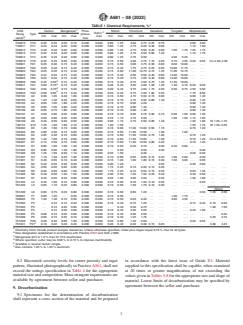
TABLE 1 Chemical Requirements,%
C
UNS Carbon Manganese Phos- Silicon Chromium Vanadium Tungsten Molybdenum
D
Sulfur,
Desig- Type phorus,
min max min max max min max min max min max min max min max
B
nation max
T20810 H10 0.35 0.45 0.20 0.70 0.030 0.030 0.80 1.25 3.00 3.75 0.25 0.75 . . . . . . 2.00 3.00
T20811 H11 0.33 0.43 0.20 0.60 0.030 0.030 0.80 1.25 4.75 5.50 0.30 0.60 . . . . . . 1.10 1.60
T20812 H12 0.30 0.40 0.20 0.60 0.030 0.030 0.80 1.25 4.75 5.50 0.20 0.50 1.00 1.70 1.25 1.75
T20813 H13 0.32 0.45 0.20 0.60 0.030 0.030 0.80 1.25 4.75 5.50 0.80 1.20 . . . . . . 1.10 1.75
T20814 H14 0.35 0.45 0.20 0.60 0.030 0.030 0.80 1.25 4.75 5.50 . . . . . . 4.00 5.25 . . . . . .
T20819 H19 0.32 0.45 0.20 0.50 0.030 0.030 0.15 0.50 4.00 4.75 1.75 2.20 3.75 4.50 0.30 0.55 Co 4.00–4.50
T20821 H21 0.26 0.36 0.15 0.40 0.030 0.030 0.15 0.50 3.00 3.75 0.30 0.60 8.50 10.00 . . . . . .
T20822 H22 0.30 0.40 0.15 0.40 0.030 0.030 0.15 0.40 1.75 3.75 0.25 0.50 10.00 11.75 . . . . . .
T20823 H23 0.25 0.35 0.15 0.40 0.030 0.030 0.15 0.60 11.00 12.75 0.75 1.25 11.00 12.75 . . . . . .
T20824 H24 0.42 0.53 0.15 0.40 0.030 0.030 0.15 0.40 2.50 3.50 0.40 0.60 14.00 16.00 . . . . . .
T20825 H25 0.22 0.32 0.15 0.40 0.030 0.030 0.15 0.40 3.75 4.50 0.40 0.60 14.00 16.00 . . . . . .
E
T20826 H26 0.45 0.55 0.15 0.40 0.030 0.030 0.15 0.40 3.75 4.50 0.75 1.25 17.25 19.00 . . . . . .
E
T20841 H41 0.60 0.75 0.15 0.40 0.030 0.030 0.20 0.45 3.50 4.00 1.00 1.30 1.40 2.10 8.20 9.20
E
T20842 H42 0.55 0.70 0.15 0.40 0.030 0.030 0.20 0.45 3.75 4.50 1.75 2.20 5.50 6.75 4.50 5.50
E
T20843 H43 0.50 0.65 0.15 0.40 0.030 0.030 0.20 0.45 3.75 4.50 1.80 2.20 . . . . . . 7.75 8.50
T30102 A2 0.95 1.05 0.40 1.00 0.030 0.030 0.10 0.50 4.75 5.50 0.15 0.50 . . . . . . 0.90 1.40
T30103 A3 1.20 1.30 0.40 0.60 0.030 0.030 0.10 0.70 4.75 5.50 0.80 1.40 . . . . . . 0.90 1.40
T30104 A4 0.95 1.05 1.80 2.20 0.030 0.030 0.10 0.70 0.90 2.20 . . . . . . . . . . . . 0.90 1.40
T30105 A5 0.95 1.05 2.80 3.20 0.030 0.030 0.10 0.70 0.90 1.40 . . . . . . . . . . . . 0.90 1.40
T30106 A6 0.65 0.75 1.80 2.50 0.030 0.030 0.10 0.70 0.90 1.40 . . . . . . . . . . . . 0.90 1.40
T30107 A7 2.00 2.85 0.20 0.80 0.030 0.030 0.10 0.70 5.00 5.75 3.90 5.15 0.50 1.50 0.90 1.40
T30108 A8 0.50 0.60 0.20 0.50 0.030 0.030 0.75 1.10 4.75 5.50 . . . . . . 1.00 1.50 1.15 1.65
T30109 A9 0.45 0.55 0.20 0.50 0.030 0.030 0.95 1.15 4.75 5.50 0.80 1.40 . . . . . . 1.30 1.80 Ni 1.25–1.75
T30110 A10 1.25 1.50 1.60 2.10 0.030 0.030 1.00 1.50 . . . . . . . . . . . . . . . . . . 1.25 1.75 Ni 1.55–2.05
T30402 D2 1.40 1.60 0.10 0.60 0.030 0.030 0.10 0.60 11.00 13.00 0.50 1.10 . . . . . . 0.70 1.20 . . .
T30403 D3 2.00 2.35 0.10 0.60 0.030 0.030 0.10 0.60 11.00 13.50 . . . 1.00 . . . 1.00 . . . . . .
T30404 D4 2.05 2.40 0.10 0.60 0.030 0.030 0.10 0.60 11.00 13.00 0.15 1.00 . . . . . . 0.70 1.20
T30405 D5 1.40 1.60 0.10 0.60 0.030 0.030 0.10 0.60 11.00 13.00 . . . 1.00 . . . . . . 0.70 1.20 Co 2.50–3.50
T30407 D7 2.15 2.50 0.10 0.60 0.030 0.030 0.10 0.60 11.50 13.50 3.80 4.40 . . . . . . 0.70 1.20
T31501 O1 0.85 1.00 1.00 1.40 0.030 0.030 0.10 0.50 0.40 0.70 . . . 0.30 0.40 0.60 . . . . . .
T31502 O2 0.85 0.95 1.40 1.80 0.030 0.030 . . . 0.50 . . . 0.50 . . . 0.30 . . . . . . . . . 0.30
T31506 O6 1.25 1.55 0.30 1.10 0.030 0.030 0.55 1.50 . . . 0.30 . . . . . . . . . . . . 0.20 0.30
T31507 O7 1.10 1.30 0.20 1.00 0.030 0.030 0.10 0.60 0.35 0.85 0.15 0.40 1.00 2.00 . . . 0.30
T41901 S1 0.40 0.55 0.10 0.40 0.030 0.030 0.15 1.20 1.00 1.80 0.15 0.30 1.50 3.00 . . . 0.50
T41902 S2 0.40 0.55 0.30 0.50 0.030 0.030 0.90 1.20 . . . . . . . . . 0.50 . . . . . . 0.30 0.60
T41904 S4 0.50 0.65 0.60 0.95 0.030 0.030 1.75 2.25 0.10 0.50 0.15 0.35 . . . . . . . . . . . . . . . . . .
T41905 S5 0.50 0.65 0.60 1.00 0.030 0.030 1.75 2.25 0.10 0.50 0.15 0.35 . . . . . . 0.20 1.35 . . . . . .
T41906 S6 0.40 0.50 1.20 1.50 0.030 0.030 2.00 2.50 1.20 1.50 0.20 0.40 . . . . . . 0.30 0.50 . . . . . .
T41907 S7 0.45 0.55 0.20 0.90 0.030 0.030 0.20 1.00 3.00 3.50 . . . 0.35 . . . . . . 1.30 1.80 . . . . . .
T61202 L2 0.45 1.00 0.10 0.90 0.030 0.030 0.10 0.50 0.70 1.20 0.10 0.30 . . . . . . . . . 0.25 . . . . . .
T61203 L3 0.95 1.10 0.25 0.80 0.030 0.030 0.10 0.50 1.30 1.70 0.10 0.30 . . . . . . . . . . . . . . . . . .
Nickel
T61206 L6 0.65 0.75 0.25 0.80 0.030 0.030 0.10 0.50 0.60 1.20 . . . . . . . . . . . . . . . 0.50 1.25 2.00
T60601 F1 0.95 1.25 . . . 0.50 0.030 0.030 0.10 0.50 . . . . . . . . . . . . 1.00 1.75 . . . . . . . . . . . .
T60602 F2 1.20 1.40 0.10 0.50 0.030 0.030 0.10 0.50 0.20 0.40 . . . . . . 3.00 4.50 . . . . . . . . . . . .
T51602 P2 . . . 0.10 0.10 0.40 0.030 0.030 0.10 0.40 0.75 1.25 . . . . . . . . . . . . 0.15 0.40 0.10 0.50
T51603 P3 . . . 0.10 0.20 0.60 0.030 0.030 . . . 0.40 0.40 0.75 . . . . . . . . . . . . . . . . . . 1.00 1.50
T51604 P4 . . . 0.12 0.20 0.60 0.030 0.030 0.10 0.40 4.00 5.25 . . . . . . . . . . . . 0.40 1.00 . . . . . .
T51605 P5 0.06 0.10 0.20 0.60 0.030 0.030 0.10 0.40 2.00 2.50 . . . . . . . . . . . . . . . . . . . . . 0.35
T51606 P6 0.05 0.15 0.35 0.70 0.030 0.030 0.10 0.40 1.25 1.75 . . . . . . . . . . . . . . . . . . 3.25 3.75
T51620 P20 0.28 0.40 0.60 1.00 0.030 0.030 0.20 0.80 1.40 2.00 . . . . . . . . . . . . 0.30 0.55 . . . . . .
F
T51621 P21 0.18 0.22 0.20 0.40 0.030 0.030 0.20 0.40 0.20 0.30 0.15 0.25 . . . . . . . . . . . . 3.90 4.25
A
Chemistry limits include product analysis tolerances. Unless otherwise specified, nickel plus copper equal 0.75 % max for all types.
B
New designation established in accordance with Practice E527 and SAE J1086.
C
Manganese limit is 1.0 % max for H13 resulfurized.
D
Where specified, sulfur may be 0.06 % to 0.15 % to improve machinability.
E
Available in several carbon ranges.
F
Also contains 1.05 % to 1.25 % aluminum.
8.2 Macroetch severity levels for center porosity and ingot in accordance with the latest issue of Guide E3. Material
pattern, illustrated photographically in Practice A561, shall not
supplied to this specification shall be capable, when examined
exceed the ratings specification in Table 4 for the appropriate
at 20 times or greater magnification, of not exceeding the
materialsizeandcomposition.Morestringentrequirementsare
values given in Tables 5-8 for the appropriate size and shape of
available by agreement between seller and purchaser.
material. Lower limits of decarburization may be specified by
agreement between the seller and purchaser.
9. Decarburization
9.1 Specimens for the determination of decarburization
shall represent a cross section of the material and be prepared
A681−08 (2022)
TABLE 2 Maximum Brinell Hardness in Annealed or Cold-Drawn
13.2 When specified in the purchase order, the inspector
Condition
representing the purchaser shall have access to the material
Cold Cold
subjecttoinspectionforthepurposeofwitnessingtheselection
Annealed Annealed
Type Drawn Type Drawn
BHN BHN
of samples, preparation of test pieces, and performance of the
BHN BHN
tests. For such tests, the inspector shall have the right to
H10 229 255 O1 212 241
H11 235 262 O2 217 241 indicate the pieces from which samples will be selected.
H12 235 262 O6 229 241
Otherwise the seller shall report to the purchaser, or his
H13 235 262 O7 241 255
representative, the results of the chemical analysis and the
H14 235 262
physical and mechanical property tests made in accordance
H19 241 262 S1 229 255
H21 235 262 S2 217 241
with this specification.
H22 235 262 S4 229 255
H23 255 269 S5 229 255
13.3 The purchaser may perform any of the inspections set
H24 241 262 S6 229 255
forth in this specification on the as-received material where
H25 235 262 S7 229 255
such inspections are deemed necessary to ensure that supplies
H26 241 262
L2 197 241 and services conform to the prescribed requirements.
H41 235 262 L3 201 241
H42 235 262 L6 235 262
14. Rejection and Rehearing
H43 235 262
14.1 Unless otherwise specified, any rejections based on
F1 207 241
A2 248 262 F2 235 262
tests made in accordance with this specification shall be
A3 229 255
reported to the seller within 30 days from the date of receipt of
A4 241 262 P2 100 . . .
the material.
A6 248 262 P3 143 . . .
A7 269 285 P4 131 . . .
14.2 Material that shows injurious defects subsequent to its
A8 241 262 P5 131 . . .
A9 248 262 P6 212 . . . acceptance by the purchaser shall be rejected and the seller
A
A10 269 285 P20 .
notified.
A
P21 .
D2 255 269
14.3 Samples tested in accordance with this specification
D3 255 269
that represent rejected material shall be preserved for 30 days
D4 255 269
from the date of the test report. In case of dissatisfaction with
D5 255 269
D7 262 277
theresultsofthetest,thesellermaymakeclaimforarehearing
A
Normally furnished in prehardened condition.
within that time.
15. Packaging, Loading, and Package Marking
15.1 Packaging and Loading:
9.2 Material ordered as ground and polished or ground
15.1.1 Unless otherwise specified, shipments shall be pack-
finished or machine finished shall be free of scale and
aged and loaded in accordance with Guide A700.
decarburization.
15.1.2 Whenspecifiedinthecontractororder,andfordirect
procurement by or direct shipment to the government, when
10. Permissible Variations for Dimensions
LevelAis specified, preservation, packaging, and loading shall
10.1 Permissible variations for dimensions shall not exceed
be in accordance with the Level A requirement of MIL-STD-
the applicable limits stated in Tables 9-28.
163.
15.2 Markings:
11. Workmanship, Finish, and Appearance
15.2.1 Shipmentsshallbeproperlymarkedwiththenameor
11.1 All alloy tool steels shall be free of heavy scale, deep
brand of manufacturer, purchaser’s name and order number,
pitting, laps, porosity, injurious segregations, excessive non-
designation (ASTM A681), heat number, grade or type, and
metallic inclusions, seams, cracks, checks, slivers, scale marks,
where appropriate, the size, length, and weight. Unless other-
dents, soft and hard spots, pipes, or any defects that would
wise specified, method of marking is at the option of the
detrimentally affect the suitability of the material after removal
manufacturer.
of the recommended stock allowance.
15.2.2 Whenspecifiedinthecontractororder,andfordirect
procurement by or direct shipment to the government, marking
12. Sampling
for shipment, in addition to any requirements specified in the
12.1 Each particular shipment of a heat of steel by type,
contract or order, shall be in accordance with MIL-STD-163
size, and shape shall be considered a lot and must conform to
for military agencies, and in accordance with Fed. Std. No. 123
the provisions of this specification.
for civil agencies.
15.2.3 For government procurement by the Defense Supply
13. Inspection
Agency,steelshallbecontinuouslymarkedforidentificationin
13.1 Unless otherwise specified in the contract or purchase
accordance with Fed. Std. No. 183.
order, the supplier is responsible for the performance of all
16. Keywords
inspection requirements as specified herein. The supplier may
utilize his own facilities or any other acceptable to the 16.1 alloy; cold work tool steels; decarburization; hardness;
purchaser. hot work tool steels; macrostructure; tool steel
A681−08 (2022)
TABLE 3 Heat-Treating Requirements
NOTE 1—The austenitizing temperatures are stipulated for the response to hardening test only. Other combinations of austenitizing and tempering
temperatures may be used for particular applications.
NOTE 2—Preheating temperature may be ±25 °F (14 °C), but austenitizing and tempering temperatures shall be ±10 °F (5.6 °C). If samples are
austenitized in salt, the sample shall be at the austenitizing temperature for the minimum time shown. If a controlled atmosphere furnace is used, the
sample shall be at the austenitizing temperature for 5 min to 15 min (10 min to 20 min for D types). The time at temperature is the time after the sample
reaches the austenitizing temperature. This range of time is given because of the difficulty in determining when the sample reaches temperature in some
types of controlled atmosphere furnaces.
NOTE 3—Those steels tempered at 400 °F (204 °C) shall have a single 2 h temper, while those tempered at 950 (510), 1025 (552), or 1200 °F (649 °C)
shall be double-tempered for 2 h each cycle.
NOTE 4—The P types shall not be tested for response to heat treatment since P2 to P6 are used in the carburized condition and P20 are normally
furnished in the prehardened condition.
NOTE 5—Specimens as described in 7.2 shall be capable of producing the specified minimum hardness when the stipulated heat treating parameters
are used.
Austenitizing Temperature, °F (°C)
Preheat Temperature,
Controlled Austenitiz- Tempering Minimum
Type Quench Medium
°F (°C)
Salt Bath Atmosphere ing Time Temperature, Hardness,
Furnaces (minutes) °F (°C) RC
H10 1450 (788) 1850 (1010) 1875 (1024) 5–15 Air 1025 (552) 55
H11 1450 (788) 1825 (996) 1850 (1010) 5–15 Air 1025 (552) 53
H12 1450 (788) 1825 (996) 1850 (1010) 5–15 Air 1025 (552) 53
H13 1450 (788) 1825 (996) 1850 (1010) 5–15 Air 1025 (552) 52
H14 1450 (788) 1900 (1038) 1925 (1052) 5–15 Air 1025 (552) 55
H19 1450 (788) 2150 (1177) 2175 (1191) 5–15 Air 1025 (552) 55
H21 1450 (788) 2150 (1177) 2175 (1191) 5–15 Air 1025 (552) 52
H22 1450 (788) 2150 (1177) 2175 (1191) 5–15 Air 1025 (552) 53
H23 1500 (816) 2275 (1246) 2300 (1260) 5–15 Oil 1200 (649) 42
H24 1450 (788) 2200 (1204) 2225 (1218) 5–15 Air 1025 (552) 55
H25 1450 (788) 2250 (1232) 2275 (1246) 5–15 Air 1025 (552) 44
H26 1550 (843) 2275 (1246) 2300 (1260) 5–15 Air 1025 (552) 58
H41 1450 (788) 2125 (1163) 2150 (1177) 5–15 Air 1025 (552) 60
H42 1450 (788) 2175 (1191) 2200 (1204) 5–15 Air 1025 (552) 60
H43 1450 (788) 2150 (1177) 2175 (1191) 5–15 Air 1025 (552) 58
A2 1450 (788) 1725 (941) 1750 (954) 5–15 Air 400 (204) 60
A3 1450 (788) 1775 (968) 1800 (982) 5–15 Air 400 (204) 63
A4 1250 (677) 1550 (843) 1575 (857) 5–15 Air 400 (204) 61
A6 1200 (649) 1525 (829) 1550 (843) 5–15 Air 400 (204) 58
A7 1500 (816) 1750 (954) 1775 (968) 5–15 Air 400 (204) 63
A8 1450 (788) 1825 (996) 1850 (1010) 5–15 Air 950 (510) 56
A9 1450 (788) 1825 (996) 1850 (1010) 5–15 Air 950 (510) 56
A10 1200 (649) 1475 (802) 1500 (816) 5–15 Air 400 (204) 59
D2 1500 (816) 1825 (996) 1850 (1010) 10–20 Air 400 (204) 59
D3 1500 (816) 1750 (954) 1775 (968) 10–20 Oil 400 (204) 61
D4 1500 (816) 1800 (982) 1825 (996) 10–20 Air 400 (204) 62
D5 1500 (816) 1825 (996) 1850 (1010) 10–20 Air 400 (204) 61
D7 1500 (816) 1925 (1052) 1950 (1066) 10–20 Air 400 (204) 63
O1 1200 (649) 1450 (788) 1475 (802) 5–15 Oil 400 (204) 59
O2 1200 (649) 1450 (788) 1475 (802) 5–15 Oil 400 (204) 59
O6 . . . 1450 (788) 1475 (802) 5–15 Oil 400 (204) 59
O7 1200 (649) 1575 (857) 1600 (871) 5–15 Oil 400 (204) 62
S1 1250 (677) 1725 (941) 1750 (954) 5–15 Oil 400 (204) 56
S2 1250 (677) 1625 (885) 1650 (899) 5–15 Brine 400 (204) 58
S4 1250 (677) 1625 (885) 1650 (899) 5–15 Oil 400 (204) 58
S5 1250 (677) 1625 (885) 1650 (899) 5–15 Oil 400 (204) 58
S6 1450 (788) 1700 (927) 1725 (941) 5–15 Oil 400 (204) 56
S7 1250 (677) 1725 (941) 1750 (954) 5–15 Air 400 (204) 56
A
L2 1200 (649) 1575 (857) 1600 (871) 5–15 Oil 400 (204) 53
L3 1200 (649) 1525 (829) 1550 (843) 5–15 Oil 400 (204) 62
L6 1200 (649) 1500 (816) 1525 (829) 5–15 Oil 400 (204) 58
F1 1200 (649) 1525 (829) 1550 (843) 5–15 Brine 400 (204) 64
F2 1200 (649) 1525 (829) 1550 (843) 5–15 Brine 400 (204) 64
A
0.45 % to 0.55 % carbon type.
A681−08 (2022)
TABLE 4 Macroetch Standards
A
(Maximum Allowable Rating)
B C
Low-Alloy Tool Steels High-Alloy Tool Steels
Bar Size, in. (mm) Porosity Ingot Pattern Porosity Ingot Pattern
Upto2(50.8),incl 4636
1 1
Over 2 to 3 (50.8 to 76), incl 4 ⁄2 63 ⁄2 6
Over 3 to 4 (76 to 102), incl 4 ⁄2 646
Over 4 to 5 (102 to 127), incl 5 6 4 ⁄2 6
Over 5 to 6 (127 to 152), incl 5656
Over 6 (152) As negotiated between seller and purchaser.
A
Refer to macroetch photographs in Practice A561.
B
Low-alloy tool steels include H10-13, A2-6, A8-10, A11O,S,L,F, and P types.
C
High-alloy tool steels include H14-43, D2-7, and A7.
TABLE 5 Maximum Decarburization Limits
(Rounds, Hexagons and Octagons Maximum
...