

ASTM A421/A421M-21
(Specification)Standard Specification for Stress-Relieved Steel Wire for Prestressed Concrete
General Information
- Abstract
ABSTRACT
This specification covers two types of uncoated stress-relieved round high-carbon steel wire commonly used in prestressed linear concrete construction. These two types are the type BA used for applications in which cold-end deformation is used for anchoring purposes and type WA wire which is used for application in which the ends are anchored by wedges, no cold-end deformation of the wire is involved. Required tensile strength, yield strength, and elongation shall be evaluated using stress-relaxation test. Heat analysis shall be used to determine the percentage of specified elements especially sulfur and phosphorus to meet the required chemical composition.
SCOPE
1.1 This specification covers two types of stress-relieved round high-carbon steel wire used in prestressed concrete construction, as follows:
1.1.1 Type BA wire is used for applications in which cold-end deformation is used for anchoring purposes (Button Anchorage), and
1.1.2 Type WA wire is used for application in which the ends are anchored by wedges, and no cold-end deformation of the wire is involved (Wedge Anchorage).
1.2 A supplementary requirement (S1) is provided for use where low-relaxation wire and relaxation testing for that product is required by the purchaser. The supplementary requirement applies only when specified in the purchase order or contract.
1.3 This specification is applicable for orders in either inch-pounds units (as Specification A421) or in SI units (as Specification A421M).
1.4 The values stated in either inch-pound or SI units are to be regarded separately as standard. Within the text, the SI units are shown in brackets. The values stated in each system may not be exact equivalents; therefore, each system shall be used independently of the other. Combining values from the two systems may result in non-conformance with the specification.
1.5 The text of this specification references notes and footnotes which provide explanatory material. These notes and footnotes (excluding those in tables) shall not be considered as requirements of the specification.
1.6 This international standard was developed in accordance with internationally recognized principles on standardization established in the Decision on Principles for the Development of International Standards, Guides and Recommendations issued by the World Trade Organization Technical Barriers to Trade (TBT) Committee.
- Status
- Published
- Publication Date
- 30-Apr-2021
- Technical Committee
- A01 - Steel, Stainless Steel and Related Alloys
- Drafting Committee
- A01.05 - Steel Reinforcement
Buy Documents
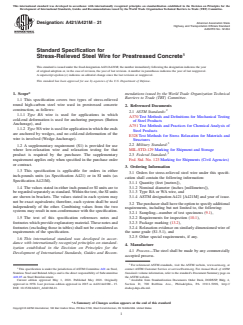
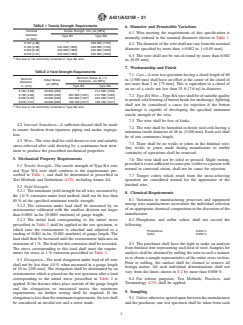
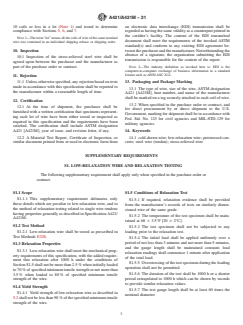

ASTM A421/A421M-21 - Standard Specification for Stress-Relieved Steel Wire for Prestressed Concrete
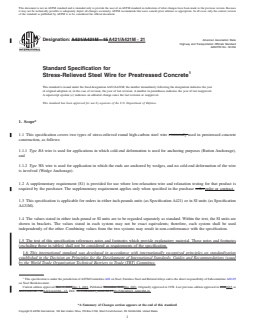
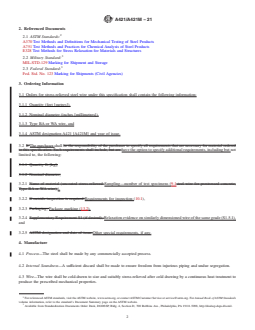
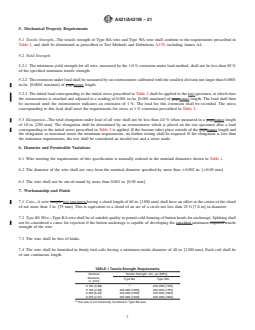
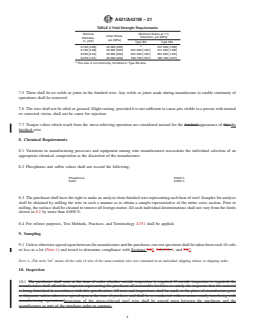
REDLINE ASTM A421/A421M-21 - Standard Specification for Stress-Relieved Steel Wire for Prestressed Concrete
Overview
ASTM A421/A421M-21 is the standard specification developed by ASTM International for stress-relieved steel wire used in prestressed concrete applications. This specification is applicable to two types of uncoated, high-carbon, stress-relieved round steel wires that provide the critical tensile reinforcement needed in linear prestressed concrete construction. The standard clearly defines the mechanical and chemical requirements, testing methods, and quality control necessary to ensure reliable performance and safety for both structural and civil engineering projects.
Key Topics
Types of Stress-Relieved Wire
- Type BA (Button Anchorage): Designed for applications where anchorage is achieved by cold-end deformation of the wire.
- Type WA (Wedge Anchorage): Used in cases where anchoring is by wedges, requiring no cold-end deformation.
Mechanical Requirements
- Required minimum values for tensile strength, yield strength (at 1% extension under load), and elongation, ensuring structural reliability.
- Stress-relaxation tests are included, especially for applications requiring low-relaxation properties.
Chemical Composition
- Limits specified for sulfur and phosphorus to maintain steel quality and durability.
- Heat analysis methods are employed for chemical verification.
Sizing and Tolerances
- Strict tolerance on nominal diameter and out-of-roundness to ensure compatibility and performance in prestressed concrete applications.
- Standard packaging, identification, and marking for traceability.
Supplementary Requirements
- Additional provisions for low-relaxation wire and corresponding relaxation testing where needed.
Applications
The ASTM A421/A421M-21 standard is widely utilized in the precast and prestressed concrete industry. Common applications include:
- Prestressed Concrete Beams: Used in bridges, parking decks, stadiums, and other civil infrastructure for improved load-bearing capacity.
- Railway Sleepers and Poles: Providing enhanced durability and strength in transportation and utility sectors.
- Commercial and Industrial Construction: Reinforcing floor slabs, wall panels, and other structural elements that require high tensile reinforcement.
- Infrastructure Projects: Essential for highway construction and other public works where prestressed concrete members are specified.
The steel wires specified under ASTM A421/A421M-21 help achieve crack control, increased load capacity, and longer service life in diverse concrete structures.
Related Standards
For effective implementation and integration, ASTM A421/A421M-21 should be referenced alongside other key standards:
- ASTM A370: Test methods and definitions for mechanical testing of steel products.
- ASTM A751: Test methods and practices for chemical analysis of steel products.
- ASTM E328: Test methods for stress relaxation in materials and structures.
- AASHTO M 204: Equivalent specification by the American Association of State Highway and Transportation Officials.
- MIL-STD-129 and Fed. Std. No. 123: Guidelines for marking for shipment and storage, relevant for government and civil agencies.
Practical Value
Adhering to ASTM A421/A421M-21 ensures that uncoated stress-relieved steel wire used in prestressed concrete construction meets critical performance criteria. This standard enhances product reliability, structural safety, and compliance with international quality expectations. Its adoption supports cost-effective, high-performance concrete structures in a variety of demanding environments.
By specifying ASTM A421/A421M-21, engineers, manufacturers, and contractors can assure stakeholders of the suitability and long-term performance of the steel reinforcement used in their projects, simplifying procurement, inspection, and certification processes across the construction industry.
Relations
- Effective Date
- 01-Mar-2024
- Effective Date
- 01-Jul-2019
- Refers
ASTM A370-17a - Standard Test Methods and Definitions for Mechanical Testing of Steel Products - Effective Date
- 15-Nov-2017
- Effective Date
- 01-Jan-2017
- Effective Date
- 01-Nov-2015
- Effective Date
- 15-May-2014
- Effective Date
- 01-Mar-2014
- Effective Date
- 15-Nov-2013
- Refers
ASTM A370-12a - Standard Test Methods and Definitions for Mechanical Testing of Steel Products - Effective Date
- 15-Oct-2012
- Effective Date
- 15-Mar-2012
- Refers
ASTM A370-11a - Standard Test Methods and Definitions for Mechanical Testing of Steel Products - Effective Date
- 15-Nov-2011
- Effective Date
- 15-Jun-2010
- Refers
ASTM A370-09a - Standard Test Methods and Definitions for Mechanical Testing of Steel Products - Effective Date
- 01-Jun-2009
- Refers
ASTM A370-09ae1 - Standard Test Methods and Definitions for Mechanical Testing of Steel Products - Effective Date
- 01-Jun-2009
- Effective Date
- 01-Jan-2009
Buy Documents
ASTM A421/A421M-21 - Standard Specification for Stress-Relieved Steel Wire for Prestressed Concrete
REDLINE ASTM A421/A421M-21 - Standard Specification for Stress-Relieved Steel Wire for Prestressed Concrete
Get Certified
Connect with accredited certification bodies for this standard

Element Materials Technology
Materials testing and product certification.

Inštitut za kovinske materiale in tehnologije
Institute of Metals and Technology. Materials testing, metallurgical analysis, NDT.
Sponsored listings
Frequently Asked Questions
ASTM A421/A421M-21 is a technical specification published by ASTM International. Its full title is "Standard Specification for Stress-Relieved Steel Wire for Prestressed Concrete". This standard covers: ABSTRACT This specification covers two types of uncoated stress-relieved round high-carbon steel wire commonly used in prestressed linear concrete construction. These two types are the type BA used for applications in which cold-end deformation is used for anchoring purposes and type WA wire which is used for application in which the ends are anchored by wedges, no cold-end deformation of the wire is involved. Required tensile strength, yield strength, and elongation shall be evaluated using stress-relaxation test. Heat analysis shall be used to determine the percentage of specified elements especially sulfur and phosphorus to meet the required chemical composition. SCOPE 1.1 This specification covers two types of stress-relieved round high-carbon steel wire used in prestressed concrete construction, as follows: 1.1.1 Type BA wire is used for applications in which cold-end deformation is used for anchoring purposes (Button Anchorage), and 1.1.2 Type WA wire is used for application in which the ends are anchored by wedges, and no cold-end deformation of the wire is involved (Wedge Anchorage). 1.2 A supplementary requirement (S1) is provided for use where low-relaxation wire and relaxation testing for that product is required by the purchaser. The supplementary requirement applies only when specified in the purchase order or contract. 1.3 This specification is applicable for orders in either inch-pounds units (as Specification A421) or in SI units (as Specification A421M). 1.4 The values stated in either inch-pound or SI units are to be regarded separately as standard. Within the text, the SI units are shown in brackets. The values stated in each system may not be exact equivalents; therefore, each system shall be used independently of the other. Combining values from the two systems may result in non-conformance with the specification. 1.5 The text of this specification references notes and footnotes which provide explanatory material. These notes and footnotes (excluding those in tables) shall not be considered as requirements of the specification. 1.6 This international standard was developed in accordance with internationally recognized principles on standardization established in the Decision on Principles for the Development of International Standards, Guides and Recommendations issued by the World Trade Organization Technical Barriers to Trade (TBT) Committee.
ABSTRACT This specification covers two types of uncoated stress-relieved round high-carbon steel wire commonly used in prestressed linear concrete construction. These two types are the type BA used for applications in which cold-end deformation is used for anchoring purposes and type WA wire which is used for application in which the ends are anchored by wedges, no cold-end deformation of the wire is involved. Required tensile strength, yield strength, and elongation shall be evaluated using stress-relaxation test. Heat analysis shall be used to determine the percentage of specified elements especially sulfur and phosphorus to meet the required chemical composition. SCOPE 1.1 This specification covers two types of stress-relieved round high-carbon steel wire used in prestressed concrete construction, as follows: 1.1.1 Type BA wire is used for applications in which cold-end deformation is used for anchoring purposes (Button Anchorage), and 1.1.2 Type WA wire is used for application in which the ends are anchored by wedges, and no cold-end deformation of the wire is involved (Wedge Anchorage). 1.2 A supplementary requirement (S1) is provided for use where low-relaxation wire and relaxation testing for that product is required by the purchaser. The supplementary requirement applies only when specified in the purchase order or contract. 1.3 This specification is applicable for orders in either inch-pounds units (as Specification A421) or in SI units (as Specification A421M). 1.4 The values stated in either inch-pound or SI units are to be regarded separately as standard. Within the text, the SI units are shown in brackets. The values stated in each system may not be exact equivalents; therefore, each system shall be used independently of the other. Combining values from the two systems may result in non-conformance with the specification. 1.5 The text of this specification references notes and footnotes which provide explanatory material. These notes and footnotes (excluding those in tables) shall not be considered as requirements of the specification. 1.6 This international standard was developed in accordance with internationally recognized principles on standardization established in the Decision on Principles for the Development of International Standards, Guides and Recommendations issued by the World Trade Organization Technical Barriers to Trade (TBT) Committee.
ASTM A421/A421M-21 is classified under the following ICS (International Classification for Standards) categories: 77.140.15 - Steels for reinforcement of concrete; 77.140.65 - Steel wire, wire ropes and link chains. The ICS classification helps identify the subject area and facilitates finding related standards.
ASTM A421/A421M-21 has the following relationships with other standards: It is inter standard links to ASTM A370-24, ASTM A370-19, ASTM A370-17a, ASTM A370-17, ASTM A370-15, ASTM A370-14, ASTM A751-14, ASTM A370-13, ASTM A370-12a, ASTM A370-12, ASTM A370-11a, ASTM A370-10, ASTM A370-09a, ASTM A370-09ae1, ASTM A370-09. Understanding these relationships helps ensure you are using the most current and applicable version of the standard.
ASTM A421/A421M-21 is available in PDF format for immediate download after purchase. The document can be added to your cart and obtained through the secure checkout process. Digital delivery ensures instant access to the complete standard document.
Standards Content (Sample)
This international standard was developed in accordance with internationally recognized principles on standardization established in the Decision on Principles for the
Development of International Standards, Guides and Recommendations issued by the World Trade Organization Technical Barriers to Trade (TBT) Committee.
Designation:A421/A421M −21 American Association State
Highway and Transportation Officials Standard
AASHTO No.: M 204
Standard Specification for
Stress-Relieved Steel Wire for Prestressed Concrete
This standard is issued under the fixed designationA421/A421M; the number immediately following the designation indicates the year
of original adoption or, in the case of revision, the year of last revision. A number in parentheses indicates the year of last reapproval.
A superscript epsilon (´) indicates an editorial change since the last revision or reapproval.
This standard has been approved for use by agencies of the U.S. Department of Defense.
1. Scope* mendations issued by the World Trade Organization Technical
Barriers to Trade (TBT) Committee.
1.1 This specification covers two types of stress-relieved
round high-carbon steel wire used in prestressed concrete
2. Referenced Documents
construction, as follows:
2.1 ASTM Standards:
1.1.1 Type BA wire is used for applications in which
A370 Test Methods and Definitions for Mechanical Testing
cold-end deformation is used for anchoring purposes (Button
of Steel Products
Anchorage), and
A751 Test Methods and Practices for Chemical Analysis of
1.1.2 TypeWAwireisusedforapplicationinwhichtheends
Steel Products
are anchored by wedges, and no cold-end deformation of the
E328 Test Methods for Stress Relaxation for Materials and
wire is involved (Wedge Anchorage).
Structures
2.2 Military Standard:
1.2 A supplementary requirement (S1) is provided for use
MIL-STD-129 Marking for Shipment and Storage
where low-relaxation wire and relaxation testing for that
2.3 Federal Standard:
product is required by the purchaser. The supplementary
Fed. Std. No. 123 Marking for Shipments (Civil Agencies)
requirement applies only when specified in the purchase order
or contract.
3. Ordering Information
1.3 This specification is applicable for orders in either
3.1 Orders for stress-relieved steel wire under this specifi-
inch-pounds units (as Specification A421) or in SI units (as
cation shall contain the following information:
Specification A421M).
3.1.1 Quantity (feet [metres]),
1.4 The values stated in either inch-pound or SI units are to 3.1.2 Nominal diameter (inches [millimetres]),
be regarded separately as standard.Within the text, the SI units 3.1.3 Type BA or WA wire, and
are shown in brackets. The values stated in each system may 3.1.4 ASTM designation A421 [A421M] and year of issue.
not be exact equivalents; therefore, each system shall be used
3.2 Thepurchasershallhavetheoptiontospecifyadditional
independently of the other. Combining values from the two
requirements, including but not limited to, the following:
systems may result in non-conformance with the specification.
3.2.1 Sampling—number of test specimens (9.1),
3.2.2 Requirements for inspection (10.1),
1.5 The text of this specification references notes and
footnotes which provide explanatory material. These notes and 3.2.3 Package marking (13.2),
footnotes (excluding those in tables) shall not be considered as 3.2.4 Relaxation evidence on similarly dimensioned wire of
requirements of the specification. the same grade (S1.5.1), and
3.2.5 Other special requirements, if any.
1.6 This international standard was developed in accor-
dance with internationally recognized principles on standard-
4. Manufacture
ization established in the Decision on Principles for the
4.1 Process—The steel shall be made by any commercially
Development of International Standards, Guides and Recom-
accepted process.
For referenced ASTM standards, visit the ASTM website, www.astm.org, or
This specification is under the jurisdiction ofASTM Committee A01 on Steel, contact ASTM Customer Service at service@astm.org. For Annual Book of ASTM
Stainless Steel and Related Alloys and is the direct responsibility of Subcommittee Standards volume information, refer to the standard’s Document Summary page on
A01.05 on Steel Reinforcement. the ASTM website.
Current edition approved May 1, 2021. Published May 2021. Originally Available from Standardization Documents Order Desk, DODSSP, Bldg. 4,
approved in 1958. Last previous edition approved in 2015 as A421/A421M – 15. Section D, 700 Robbins Ave., Philadelphia, PA 19111-5098, http://
DOI: 10.1520/A0421_A0421M-21. dodssp.daps.dla.mil.
*A Summary of Changes section appears at the end of this standard
Copyright © ASTM International, 100 Barr Harbor Drive, PO Box C700, West Conshohocken, PA 19428-2959. United States
A421/A421M−21
TABLE 1 Tensile Strength Requirements
6. Diameter and Permissible Variations
Nominal Tensile Strength, min, psi [MPa]
6.1 Wire meeting the requirements of this specification is
Diameter,
Type BA Type WA
normally ordered in the nominal diameters shown in Table 1.
in. [mm]
A
0.192 [4.88] 250 000 [1725]
6.2 Thediameterofthewireshallnotvaryfromthenominal
0.196 [4.98] 240 000 [1655] 250 000 [1725]
diameter specified by more than 60.002 in. [60.05 mm].
0.250 [6.35] 240 000 [1655] 240 000 [1655]
0.276 [7.01] 235 000 [1620] 235 000 [1620]
6.3 The wire shall not be out-of-round by more than 0.002
A
This size is not commonly furnished in Type BA wire.
in. [0.05 mm].
7. Workmanship and Finish
TABLE 2 Yield Strength Requirements
7.1 Cast—Awire test specimen having a chord length of 60
Minimum Stress at 1 %
Nominal
in. [1500 mm] shall have an offset at the center of the chord of
Initial Stress,
Extension, psi [MPa]
Diameter,
psi [MPa]
not more than 3 in. [75 mm]. This is equivalent to a chord of
in. [mm]
Type BA Type WA
an arc of a circle not less than 25 ft [7.6 m] in diameter.
A
0.192 [4.88] 29 000 [200] 212 500 [1465]
0.196 [4.98] 29 000 [200] 204 000 [1407] 212 500 [1465]
7.2 TypeBAWire—TypeBAwireshallbeofsuitablequality
0.250 [6.35] 29 000 [200] 204 000 [1407] 204 000 [1407]
to permit cold forming of button heads for anchorage. Splitting
0.276 [7.01] 29 000 [200] 199 750 [1377] 199 750 [1377]
shall not be considered a cause for rejection if the button
A
This size is not commonly furnished in Type BA wire.
anchorage is capable of developing the specified minimum
tensile strength of the wire.
7.3 The wire shall be free of kinks.
4.2 Internal Soundness—A sufficient discard shall be made
7.4 The wire shall be furnished in firmly tied coils having a
to ensure freedom from injurious piping and undue segrega-
minimum inside diameter of 48 in. [1200 mm]. Each coil shall
tion.
be of one continuous length.
4.3 Wire—The wire shall be cold-drawn to size and suitably
7.5 There shall be no welds or joints in the finished wire.
stress-relieved after cold drawing by a continuous heat treat-
Any welds or joints made during manufacture to enable
ment to produce the prescribed mechanical properties.
continuity of operations shall be removed.
5. Mechanical Property Requirements
7.6 The wire shall not be oiled or greased. Slight rusting,
provideditisnotsufficienttocausepitsvisibletoapersonwith
5.1 Tensile Strength—The tensile strength of Type BA wire
normal or corrected vision, shall not be cause for rejection.
and Type WA wire shall conform to the requirements pre-
scribed in Table 1, and shall be determined as prescribed in 7.7 Temper colors which result from the stress-relieving
Test Methods and Definitions A370, including Annex A4.
operation are considered normal for the appearance of the
finished wire.
5.2 Yield Strength:
5.2.1 The minimum yield strength for all wire, measured by
8. Chemical Requirements
the 1.0 % extension under load method, shall not be less than
8.1 Variations in manufacturing processes and equipment
85 % of the specified minimum tensile strength.
among wire manufacturers necessitate the individual selection
5.2.2 The extension under load shall be measured by an
of an appropriate chemical composition at the discretion of the
extensometer calibrated with the small
...
This document is not an ASTM standard and is intended only to provide the user of an ASTM standard an indication of what changes have been made to the previous version. Because
it may not be technically possible to adequately depict all changes accurately, ASTM recommends that users consult prior editions as appropriate. In all cases only the current version
of the standard as published by ASTM is to be considered the official document.
Designation: A421/A421M − 15 A421/A421M − 21 American Association State
Highway and Transportation Officials Standard
AASHTO No.: M 204
Standard Specification for
Stress-Relieved Steel Wire for Prestressed Concrete
This standard is issued under the fixed designation A421/A421M; the number immediately following the designation indicates the year
of original adoption or, in the case of revision, the year of last revision. A number in parentheses indicates the year of last reapproval.
A superscript epsilon (´) indicates an editorial change since the last revision or reapproval.
This standard has been approved for use by agencies of the U.S. Department of Defense.
1. Scope*
1.1 This specification covers two types of stress-relieved round high-carbon steel wire commonly used in prestressed concrete
construction, as follows:
1.1.1 Type BA wire is used for applications in which cold-end deformation is used for anchoring purposes (Button Anchorage),
and
1.1.2 Type WA wire is used for application in which the ends are anchored by wedges, and no cold-end deformation of the wire
is involved (Wedge Anchorage).
1.2 A supplementary requirement (S1) is provided for use where low-relaxation wire and relaxation testing for that product is
required by the purchaser. The supplementary requirement applies only when specified in the purchase order.order or contract.
1.3 This specification is applicable for orders in either inch-pounds units (as Specification A421) or in SI units (as Specification
A421M).
1.4 The values stated in either inch-pound or SI units are to be regarded separately as standard. Within the text, the SI units are
shown in brackets. The values stated in each system may not be exact equivalents; therefore, each system shall be used
independently of the other. Combining values from the two systems may result in non-conformance with the specification.
1.5 The text of this specification references notes and footnotes which provide explanatory material. These notes and footnotes
(excluding those in tables) shall not be considered as requirements of the specification.
1.6 This international standard was developed in accordance with internationally recognized principles on standardization
established in the Decision on Principles for the Development of International Standards, Guides and Recommendations issued
by the World Trade Organization Technical Barriers to Trade (TBT) Committee.
This specification is under the jurisdiction of ASTM Committee A01 on Steel, Stainless Steel and Related Alloys and is the direct responsibility of Subcommittee A01.05
on Steel Reinforcement.
Current edition approved Nov. 1, 2015May 1, 2021. Published November 2015May 2021. Originally approved in 1958. Last previous edition approved in 20102015 as
A421/A421M – 10.A421/A421M – 15. DOI: 10.1520/A0421_A0421M-15.10.1520/A0421_A0421M-21.
*A Summary of Changes section appears at the end of this standard
Copyright © ASTM International, 100 Barr Harbor Drive, PO Box C700, West Conshohocken, PA 19428-2959. United States
A421/A421M − 21
2. Referenced Documents
2.1 ASTM Standards:
A370 Test Methods and Definitions for Mechanical Testing of Steel Products
A751 Test Methods and Practices for Chemical Analysis of Steel Products
E328 Test Methods for Stress Relaxation for Materials and Structures
2.2 Military Standard:
MIL-STD-129 Marking for Shipment and Storage
2.3 Federal Standard:
Fed. Std. No. 123 Marking for Shipments (Civil Agencies)
3. Ordering Information
3.1 Orders for stress-relieved steel wire under this specification shall contain the following information:
3.1.1 Quantity (feet [metres]),
3.1.2 Nominal diameter (inches [millimetres]),
3.1.3 Type BA or WA wire, and
3.1.4 ASTM designation A421 [A421M] and year of issue.
3.2 It The purchaser shall be the responsibility of the purchaser to specify all requirements that are necessary for material ordered
to this specification. Such requirements shall include, but are have the option to specify additional requirements, including but not
limited to, the following:
3.1.1 Quantity lb [kg],
3.1.2 Nominal diameter,
3.2.1 Name of material (uncoated stress-relieved Sampling—number of test specimens (9.1steel wire for prestressed concrete,
Type BA or WA wire),),
3.2.2 If outside inspection is required Requirements for inspection (10.1),
3.2.3 Packaging, Package marking (13.2),
3.2.4 Supplementary Requirement S1 (if desired), Relaxation evidence on similarly dimensioned wire of the same grade (S1.5.1),
and
3.2.5 ASTM designation and date of issue.Other special requirements, if any.
4. Manufacture
4.1 Process—The steel shall be made by any commercially accepted process.
4.2 Internal Soundness—A sufficient discard shall be made to ensure freedom from injurious piping and undue segregation.
4.3 Wire—The wire shall be cold-drawn to size and suitably stress-relieved after cold drawing by a continuous heat treatment to
produce the prescribed mechanical properties.
For referenced ASTM standards, visit the ASTM website, www.astm.org, or contact ASTM Customer Service at service@astm.org. For Annual Book of ASTM Standards
volume information, refer to the standard’s Document Summary page on the ASTM website.
Available from Standardization Documents Order Desk, DODSSP, Bldg. 4, Section D, 700 Robbins Ave., Philadelphia, PA 19111-5098, http://dodssp.daps.dla.mil.
A421/A421M − 21
5. Mechanical Property Requirements
5.1 Tensile Strength—The tensile strength of Type BA wire and Type WA wire shall conform to the requirements prescribed in
Table 1, and shall be determined as prescribed in Test Methods and Definitions A370, including Annex A4.
5.2 Yield Strength:
5.2.1 The minimum yield strength for all wire, measured by the 1.0 % extension under load method, shall not be less than 85 %
of the specified minimum tensile strength.
5.2.2 The extension under load shall be measured by an extensometer calibrated with the smallest division not larger than 0.0001
in./in. [0.0001 mm/mm] of gagegauge length.
5.2.3 The initial load corresponding to the initial stress prescribed in Table 2 shall be applied to the test specimen, at which time
the extensometer is attached and adjusted to a reading of 0.001 in./in. [0.001 mm/mm] of gagegauge length. The load shall then
be increased until the extensometer indicates an extension of 1 %. The load for this extension shall be recorded. The stress
corresponding to this load shall meet the requirements for stress at 1 % extension prescribed in Table 2.
5.3 Elongation—The total elongation under load of all wire shall not be less than 4.0 % when measured in a gagegauge length
of 10 in. [250 mm]. The elongation shall be determined by an extensometer which is placed on the test specimen after a load
corresponding to the initial stress prescribed in Table 2 is applied. If the fracture takes place outside of the gagegauge length and
the elongation so measured meets the minimum requirements, no further testing shall be required. If the elongation is less than
the minimum requirements, the test shall be considered an invalid test and a retest made.
6. Diameter and Permissible Variations
6.1 Wire meeting the requirements of this specification is normally ordered in the nominal diameters shown in Table 1.
6.2 The diameter of the wire shall not vary from the nominal diameter specified by more than 60.002 in. [60.05 mm].
6.3 The wire shall not be out-of-round by more than 0.002 in. [0.05 mm].
7. Workmanship and Finish
7.1 Cast—A wire sample test specimen having a chord length of 60 in. [1500 mm] shall have an offset at the center of the chord
of not more than 3 in. [75 mm]. This is equivalent to a chord of an arc of a circle not less than 25 ft [7.6 m] in diameter.
7.2 Type BA Wire—Type BA wire shall be of suitable quality to permit cold forming of button heads for anchorage. Splitting shall
not be considered a cause for rejection if the button anchorage is capable of developing the specified minimum required tensile
strength of the wire.
7.3 The wire shall be free of kinks.
7.4 The wire shall be furnished in firmly tied coils having a minimum inside diameter of 48 in. [1200 mm]. Each coil shall be
of one continuous length.
TABLE 1 Tensile Strength Requirements
Nominal Tensile Strength, min, psi [MPa]
Diameter,
Type BA Type WA
in. [mm]
A
0.192 [4.88] 250 000 [1725]
0.196 [4.98] 240 000 [1655] 250 000 [1725]
0.250 [6.35] 240 000 [1655] 240 000 [1655]
0.276 [7.01] 235 000 [1620] 235 000 [1620]
A
This size is not commonly furnished in Type BA wire.
A421/A421M − 21
TABLE 2
...