

ASTM A320/A320M-24
(Specification)Standard Specification for Alloy-Steel and Stainless Steel Bolting for Low-Temperature Service
General Information
- Abstract
ABSTRACT
This specification covers alloy steel bolting materials for pressure vessels, valves, flanges, and fittings for low-temperature service. Each alloy shall conform to the prescribed chemical composition requirements. The material, as represented by the tension specimens, shall conform to the requirements as to tensile properties such as tensile strength, yield strength, elongation, and hardness. The material shall meet the prescribed impact energy absorption requirements and the recommended test temperature. Mechanical tests shall be conducted on the material, namely: impact testing, tension testing, and hardness testing.
SCOPE
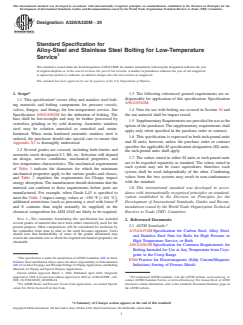
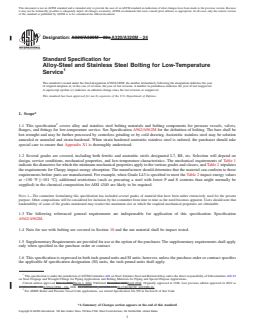
1.1 This specification2 covers alloy and stainless steel bolting materials and bolting components for pressure vessels, valves, flanges, and fittings for low-temperature service. See Specification A962/A962M for the definition of bolting. The bars shall be hot-wrought and may be further processed by centerless grinding or by cold drawing. Austenitic stainless steel may be solution annealed or annealed and strain-hardened. When strain hardened austenitic stainless steel is ordered, the purchaser should take special care to ensure that Appendix X1 is thoroughly understood.
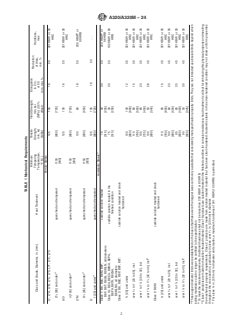
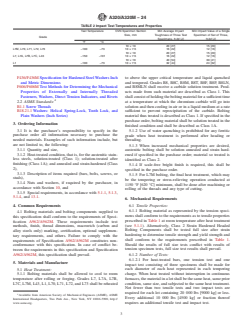
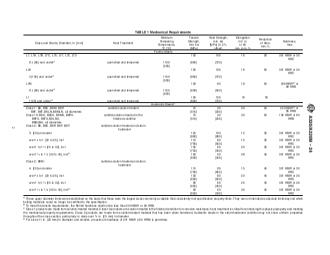
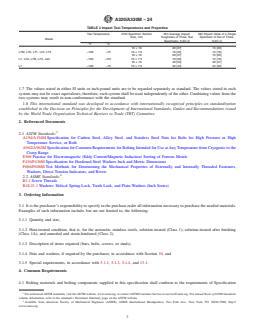
1.2 Several grades are covered, including both ferritic and austenitic steels designated L7, B8, etc. Selection will depend on design, service conditions, mechanical properties, and low-temperature characteristics. The mechanical requirements of Table 1 indicate the diameters for which the minimum mechanical properties apply to the various grades and classes, and Table 2 stipulates the requirements for Charpy impact energy absorption. The manufacturer should determine that the material can conform to these requirements before parts are manufactured. For example, when Grade L43 is specified to meet the Table 2 impact energy values at −150 °F [−101 °C], additional restrictions (such as procuring a steel with lower P and S contents than might normally be supplied) in the chemical composition for AISI 4340 are likely to be required.
Note 1: The committee formulating this specification has included several grades of material that have been rather extensively used for the present purpose. Other compositions will be considered for inclusion by the committee from time to time as the need becomes apparent. Users should note that hardenability of some of the grades mentioned may restrict the maximum size at which the required mechanical properties are obtainable.
1.3 The following referenced general requirements are indispensable for application of this specification: Specification A962/A962M.
1.4 Nuts for use with bolting are covered in Section 10 and the nut material shall be impact tested.
1.5 Supplementary Requirements are provided for use at the option of the purchaser. The supplementary requirements shall apply only when specified in the purchase order or contract.
1.6 This specification is expressed in both inch-pound units and SI units; however, unless the purchase order or contract specifies the applicable M specification designation (SI) units, the inch-pound units shall apply.
1.7 The values stated in either SI units or inch-pound units are to be regarded separately as standard. The values stated in each system may not be exact equivalents; therefore, each system shall be used independently of the other. Combining values from the two systems may result in non-conformance with the standard.
1.8 This international standard was developed in accordance with internationally recognized principles on standardization established in the Decision on Principles for the Development of International Standards, Guides and Recommendations issued by the World Trade Organization Technical Barriers to Trade (TBT) Committee.
- Status
- Published
- Publication Date
- 29-Feb-2024
- Technical Committee
- A01 - Steel, Stainless Steel and Related Alloys
Buy Documents
ASTM A320/A320M-24 - Standard Specification for Alloy-Steel and Stainless Steel Bolting for Low-Temperature Service
REDLINE ASTM A320/A320M-24 - Standard Specification for Alloy-Steel and Stainless Steel Bolting for Low-Temperature Service
Overview
ASTM A320/A320M-24 sets the standard specification for alloy-steel and stainless steel bolting materials used in low-temperature service applications. This international standard, developed by ASTM Committee A01, is essential for ensuring the quality and reliability of bolting components-such as bolts, studs, screws, and nuts-designed for pressure vessels, valves, flanges, and fittings operating under cryogenic and subzero conditions. The specification includes various grades of ferritic and austenitic steels and details the mechanical, chemical, and performance requirements for each grade and class.
Key Topics
- Scope and Application: Covers bolting materials for low-temperature service in critical pressure vessels and piping systems.
- Material Grades: Includes several grades, such as L7, L43, and B8 series, suitable for a wide range of applications depending on performance needs.
- Heat Treatment: Requirements for hot-wrought, solution annealed, tempered, or strain-hardened conditions to ensure mechanical strength.
- Mechanical Properties: Specifies minimum tensile strength, yield strength, elongation, reduction of area, and hardness.
- Impact Testing: Sets Charpy impact energy absorption benchmarks at prescribed low temperatures, vital for maintaining ductility and safety.
- Chemical Composition: Lists strict requirements for elements such as carbon, manganese, chromium, nickel, and molybdenum for each grade.
- Nuts and Washers: Includes specifications for compatible nut and washer types and requires impact testing for nuts in low-temperature environments.
- Marking and Certification: Enforces clear marking for traceability and mandates certification in accordance with Specification A962/A962M.
Applications
The ASTM A320/A320M-24 standard is widely used in industries where reliable performance at low temperatures is critical. Key applications include:
- Petrochemical and LNG Facilities: Bolting used in pressure vessels and piping transported or stored at cryogenic temperatures.
- Power Generation: Fasteners for boilers, turbines, and pressure equipment subjected to extreme cold.
- Marine and Offshore Platforms: Structural bolting and fittings required to perform reliably in cold marine environments.
- Industrial Refrigeration: Equipment and pipelines transporting liquefied gases or supercooled substances.
- Process Equipment Manufacturing: Valves, flanges, and fittings requiring verified mechanical integrity at subzero temperatures.
Engineers and procurement specialists refer to this standard to select appropriate bolting materials that can meet operational demands and regulatory compliance in safety-critical applications.
Related Standards
ASTM A320/A320M-24 references and aligns with several other standards, ensuring comprehensive material quality and compatibility:
- ASTM A194/A194M: Specification for carbon, alloy, and stainless steel nuts for high pressure or temperature applications.
- ASTM A962/A962M: Common requirements for bolting materials intended for use at any temperature, detailing testing, finish, thread dimensions, marking, and certification.
- ASTM F436/F436M: Specification for hardened steel washers for use with bolting.
- ASTM F606/F606M: Test methods for determining mechanical properties of fasteners, washers, and rivets.
- ASME B1.1 / B18.21.1: Standards for screw threads and washers dimensions relevant to bolting assemblies.
Practical Value
Complying with ASTM A320/A320M-24 ensures that alloy steel and stainless steel bolting components are manufactured, tested, and certified to provide reliable service life under the demanding conditions of low-temperature environments. This standard supports safe design, helps prevent brittle failure, and aids in regulatory and contractual compliance for industries relying on pressure equipment in cold service. By specifying mechanical, chemical, and performance requirements, this standard is a cornerstone for quality control and risk mitigation in critical engineering applications.
Keywords: ASTM A320, low-temperature service bolting, stainless steel bolts, pressure vessel fasteners, cryogenic bolting specification, alloy steel bolting, mechanical properties, impact testing, chemical composition, pressure vessel components.
Relations
- Effective Date
- 01-Mar-2024
- Effective Date
- 01-Mar-2024
- Referred By
ASTM C1533-15(2022) - Standard Guide for General Design Considerations for Hot Cell Equipment - Effective Date
- 01-Mar-2024
- Effective Date
- 01-Mar-2024
- Referred By
ASTM F1155-10(2019) - Standard Practice for Selection and Application of Piping System Materials - Effective Date
- 01-Mar-2024
- Effective Date
- 01-Mar-2024
- Effective Date
- 01-Mar-2024
Buy Documents
ASTM A320/A320M-24 - Standard Specification for Alloy-Steel and Stainless Steel Bolting for Low-Temperature Service
REDLINE ASTM A320/A320M-24 - Standard Specification for Alloy-Steel and Stainless Steel Bolting for Low-Temperature Service
Get Certified
Connect with accredited certification bodies for this standard

Element Materials Technology
Materials testing and product certification.

Inštitut za kovinske materiale in tehnologije
Institute of Metals and Technology. Materials testing, metallurgical analysis, NDT.
Sponsored listings
Frequently Asked Questions
ASTM A320/A320M-24 is a technical specification published by ASTM International. Its full title is "Standard Specification for Alloy-Steel and Stainless Steel Bolting for Low-Temperature Service". This standard covers: ABSTRACT This specification covers alloy steel bolting materials for pressure vessels, valves, flanges, and fittings for low-temperature service. Each alloy shall conform to the prescribed chemical composition requirements. The material, as represented by the tension specimens, shall conform to the requirements as to tensile properties such as tensile strength, yield strength, elongation, and hardness. The material shall meet the prescribed impact energy absorption requirements and the recommended test temperature. Mechanical tests shall be conducted on the material, namely: impact testing, tension testing, and hardness testing. SCOPE 1.1 This specification2 covers alloy and stainless steel bolting materials and bolting components for pressure vessels, valves, flanges, and fittings for low-temperature service. See Specification A962/A962M for the definition of bolting. The bars shall be hot-wrought and may be further processed by centerless grinding or by cold drawing. Austenitic stainless steel may be solution annealed or annealed and strain-hardened. When strain hardened austenitic stainless steel is ordered, the purchaser should take special care to ensure that Appendix X1 is thoroughly understood. 1.2 Several grades are covered, including both ferritic and austenitic steels designated L7, B8, etc. Selection will depend on design, service conditions, mechanical properties, and low-temperature characteristics. The mechanical requirements of Table 1 indicate the diameters for which the minimum mechanical properties apply to the various grades and classes, and Table 2 stipulates the requirements for Charpy impact energy absorption. The manufacturer should determine that the material can conform to these requirements before parts are manufactured. For example, when Grade L43 is specified to meet the Table 2 impact energy values at −150 °F [−101 °C], additional restrictions (such as procuring a steel with lower P and S contents than might normally be supplied) in the chemical composition for AISI 4340 are likely to be required. Note 1: The committee formulating this specification has included several grades of material that have been rather extensively used for the present purpose. Other compositions will be considered for inclusion by the committee from time to time as the need becomes apparent. Users should note that hardenability of some of the grades mentioned may restrict the maximum size at which the required mechanical properties are obtainable. 1.3 The following referenced general requirements are indispensable for application of this specification: Specification A962/A962M. 1.4 Nuts for use with bolting are covered in Section 10 and the nut material shall be impact tested. 1.5 Supplementary Requirements are provided for use at the option of the purchaser. The supplementary requirements shall apply only when specified in the purchase order or contract. 1.6 This specification is expressed in both inch-pound units and SI units; however, unless the purchase order or contract specifies the applicable M specification designation (SI) units, the inch-pound units shall apply. 1.7 The values stated in either SI units or inch-pound units are to be regarded separately as standard. The values stated in each system may not be exact equivalents; therefore, each system shall be used independently of the other. Combining values from the two systems may result in non-conformance with the standard. 1.8 This international standard was developed in accordance with internationally recognized principles on standardization established in the Decision on Principles for the Development of International Standards, Guides and Recommendations issued by the World Trade Organization Technical Barriers to Trade (TBT) Committee.
ABSTRACT This specification covers alloy steel bolting materials for pressure vessels, valves, flanges, and fittings for low-temperature service. Each alloy shall conform to the prescribed chemical composition requirements. The material, as represented by the tension specimens, shall conform to the requirements as to tensile properties such as tensile strength, yield strength, elongation, and hardness. The material shall meet the prescribed impact energy absorption requirements and the recommended test temperature. Mechanical tests shall be conducted on the material, namely: impact testing, tension testing, and hardness testing. SCOPE 1.1 This specification2 covers alloy and stainless steel bolting materials and bolting components for pressure vessels, valves, flanges, and fittings for low-temperature service. See Specification A962/A962M for the definition of bolting. The bars shall be hot-wrought and may be further processed by centerless grinding or by cold drawing. Austenitic stainless steel may be solution annealed or annealed and strain-hardened. When strain hardened austenitic stainless steel is ordered, the purchaser should take special care to ensure that Appendix X1 is thoroughly understood. 1.2 Several grades are covered, including both ferritic and austenitic steels designated L7, B8, etc. Selection will depend on design, service conditions, mechanical properties, and low-temperature characteristics. The mechanical requirements of Table 1 indicate the diameters for which the minimum mechanical properties apply to the various grades and classes, and Table 2 stipulates the requirements for Charpy impact energy absorption. The manufacturer should determine that the material can conform to these requirements before parts are manufactured. For example, when Grade L43 is specified to meet the Table 2 impact energy values at −150 °F [−101 °C], additional restrictions (such as procuring a steel with lower P and S contents than might normally be supplied) in the chemical composition for AISI 4340 are likely to be required. Note 1: The committee formulating this specification has included several grades of material that have been rather extensively used for the present purpose. Other compositions will be considered for inclusion by the committee from time to time as the need becomes apparent. Users should note that hardenability of some of the grades mentioned may restrict the maximum size at which the required mechanical properties are obtainable. 1.3 The following referenced general requirements are indispensable for application of this specification: Specification A962/A962M. 1.4 Nuts for use with bolting are covered in Section 10 and the nut material shall be impact tested. 1.5 Supplementary Requirements are provided for use at the option of the purchaser. The supplementary requirements shall apply only when specified in the purchase order or contract. 1.6 This specification is expressed in both inch-pound units and SI units; however, unless the purchase order or contract specifies the applicable M specification designation (SI) units, the inch-pound units shall apply. 1.7 The values stated in either SI units or inch-pound units are to be regarded separately as standard. The values stated in each system may not be exact equivalents; therefore, each system shall be used independently of the other. Combining values from the two systems may result in non-conformance with the standard. 1.8 This international standard was developed in accordance with internationally recognized principles on standardization established in the Decision on Principles for the Development of International Standards, Guides and Recommendations issued by the World Trade Organization Technical Barriers to Trade (TBT) Committee.
ASTM A320/A320M-24 is classified under the following ICS (International Classification for Standards) categories: 21.060.01 - Fasteners in general; 77.080.20 - Steels. The ICS classification helps identify the subject area and facilitates finding related standards.
ASTM A320/A320M-24 has the following relationships with other standards: It is inter standard links to ASTM A320/A320M-22a, ASTM F3394/F3394M-23, ASTM C1533-15(2022), ASTM A194/A194M-23, ASTM F1155-10(2019), ASTM A962/A962M-23a, ASTM A193/A193M-24. Understanding these relationships helps ensure you are using the most current and applicable version of the standard.
ASTM A320/A320M-24 is available in PDF format for immediate download after purchase. The document can be added to your cart and obtained through the secure checkout process. Digital delivery ensures instant access to the complete standard document.
Standards Content (Sample)
This international standard was developed in accordance with internationally recognized principles on standardization established in the Decision on Principles for the
Development of International Standards, Guides and Recommendations issued by the World Trade Organization Technical Barriers to Trade (TBT) Committee.
Designation: A320/A320M − 24
Standard Specification for
Alloy-Steel and Stainless Steel Bolting for Low-Temperature
Service
This standard is issued under the fixed designation A320/A320M; the number immediately following the designation indicates the year
of original adoption or, in the case of revision, the year of last revision. A number in parentheses indicates the year of last reapproval.
A superscript epsilon (´) indicates an editorial change since the last revision or reapproval.
This standard has been approved for use by agencies of the U.S. Department of Defense.
1. Scope* 1.3 The following referenced general requirements are in-
2 dispensable for application of this specification: Specification
1.1 This specification covers alloy and stainless steel bolt-
A962/A962M.
ing materials and bolting components for pressure vessels,
valves, flanges, and fittings for low-temperature service. See 1.4 Nuts for use with bolting are covered in Section 10 and
Specification A962/A962M for the definition of bolting. The the nut material shall be impact tested.
bars shall be hot-wrought and may be further processed by
1.5 Supplementary Requirements are provided for use at the
centerless grinding or by cold drawing. Austenitic stainless
option of the purchaser. The supplementary requirements shall
steel may be solution annealed or annealed and strain-
apply only when specified in the purchase order or contract.
hardened. When strain hardened austenitic stainless steel is
1.6 This specification is expressed in both inch-pound units
ordered, the purchaser should take special care to ensure that
and SI units; however, unless the purchase order or contract
Appendix X1 is thoroughly understood.
specifies the applicable M specification designation (SI) units,
1.2 Several grades are covered, including both ferritic and
the inch-pound units shall apply.
austenitic steels designated L7, B8, etc. Selection will depend
1.7 The values stated in either SI units or inch-pound units
on design, service conditions, mechanical properties, and
are to be regarded separately as standard. The values stated in
low-temperature characteristics. The mechanical requirements
each system may not be exact equivalents; therefore, each
of Table 1 indicate the diameters for which the minimum
system shall be used independently of the other. Combining
mechanical properties apply to the various grades and classes,
values from the two systems may result in non-conformance
and Table 2 stipulates the requirements for Charpy impact
with the standard.
energy absorption. The manufacturer should determine that the
1.8 This international standard was developed in accor-
material can conform to these requirements before parts are
manufactured. For example, when Grade L43 is specified to dance with internationally recognized principles on standard-
ization established in the Decision on Principles for the
meet the Table 2 impact energy values at −150 °F [−101 °C],
additional restrictions (such as procuring a steel with lower P Development of International Standards, Guides and Recom-
mendations issued by the World Trade Organization Technical
and S contents than might normally be supplied) in the
chemical composition for AISI 4340 are likely to be required. Barriers to Trade (TBT) Committee.
NOTE 1—The committee formulating this specification has included
2. Referenced Documents
several grades of material that have been rather extensively used for the
2.1 ASTM Standards:
present purpose. Other compositions will be considered for inclusion by
the committee from time to time as the need becomes apparent. Users
A194/A194M Specification for Carbon Steel, Alloy Steel,
should note that hardenability of some of the grades mentioned may
and Stainless Steel Nuts for Bolts for High Pressure or
restrict the maximum size at which the required mechanical properties are
High Temperature Service, or Both
obtainable.
A962/A962M Specification for Common Requirements for
Bolting Intended for Use at Any Temperature from Cryo-
genic to the Creep Range
This specification is under the jurisdiction of ASTM Committee A01 on Steel,
E566 Practice for Electromagnetic (Eddy Current/Magnetic
Stainless Steel and Related Alloys and is the direct responsibility of Subcommittee
Induction) Sorting of Ferrous Metals
A01.22 on Steel Forgings and Wrought Fittings for Piping Applications and Bolting
Materials for Piping and Special Purpose Applications.
Current edition approved March 1, 2024. Published April 2024. Originally
approved in 1948. Last previous edition approved in 2022 as A320/A320M – 22a. For referenced ASTM standards, visit the ASTM website, www.astm.org, or
DOI: 10.1520/A0320_A0320M-24. contact ASTM Customer Service at service@astm.org. For Annual Book of ASTM
For ASME Boiler and Pressure Vessel Code applications, see related Specifi- Standards volume information, refer to the standard’s Document Summary page on
cation SA-320 in Section II of that Code. the ASTM website.
*A Summary of Changes section appears at the end of this standard
Copyright © ASTM International, 100 Barr Harbor Drive, PO Box C700, West Conshohocken, PA 19428-2959. United States
A320/A320M − 24
TABLE 1 Mechanical Requirements
Minimum Tensile Yield Strength, Elongation
Reduction
Tempering Strength, min, ksi in 2 in. Hardness,
Class and Grade, Diameter, in. [mm] Heat Treatment of Area,
Temperature, min, ksi [MPa] (0.2 % or 50 max
min, %
°F [°C] [MPa] offset) mm, min, %
Ferritic Steels
L7, L7A, L7B, L7C, L70, L71, L72, L73 125 105 16 50 321 HBW or 35
HRC
A
2 ⁄2 [65] and under quenched and tempered 1100 [860] [725]
[593]
L43 125 105 16 50 321 HBW or 35
HRC
A
4 [100] and under quenched and tempered 1100 [860] [725]
[593]
B
L7M 100 80 18 50 235 HBW or
99 HRB
A
2 ⁄2 [65] and under quenched and tempered 1150 [690] [550]
[620]
L1 125 105 16 50 . . .
A
1 [25] and under quenched and tempered [860] [725]
C
Austenitic Steels
D
Class 1: B8, B8C, B8M, B8P, carbide solution treated 75 30 30 50 223 HBW or
96 HRB
B8F, B8T, B8LN, B8MLN, all diameters [515] [205]
Class 1A: B8A, B8CA, B8MA, B8PA, carbide solution treated in the 75 30 30 50 192 HBW or 90
B8FA, B8TA, B8LNA, finished condition [515] [205] HRB
B8MLNA, all diameters
Class 2: B8, B8C, B8P, B8F, B8T: carbide solution treated and strain
hardened
⁄4 [20] and under 125 100 12 35 321 HBW or 35
[860] [690] HRC
over ⁄4 to 1 [20 to 25], incl 115 80 15 35 321 HBW or 35
[795] [550] HRC
over 1 to 1 ⁄4 [25 to 32], incl 105 65 20 35 321 HBW or 35
[725] [450] HRC
A
1 1
over 1 ⁄4 to 1 ⁄2 [32 to 40], incl 100 50 28 45 321 HBW or 35
[690] [345] HRC
Class 2: B8M: carbide solution treated and strain
hardened
⁄4 [20] and under 110 95 15 45 321 HBW or 35
[760] [655] HRC
over ⁄4 to 1 [20 to 25], incl 100 80 20 45 321 HBW or 35
[690] [550] HRC
over 1 to 1 ⁄4 [25 to 32], incl 95 65 25 45 321 HBW or 35
[655] [450] HRC
A
1 1
over 1 ⁄4 to 1 ⁄2 [32 to 40], incl 90 50 30 45 321 HBW or 35
[620] [345] HRC
A
These upper diameter limits were established on the basis that these were the largest sizes commonly available that consistently met specification property limits. They are not intended as absolute limits beyond which
bolting materials could no longer be certified to the specification.
B
To meet the tensile requirements, the Brinell hardness shall not be less than 200 HBW or 93 HRB.
C
Class 1 products are made from solution-treated material. Class 1A products are solution treated in the finished condition for corrosion resistance; heat treatment is critical for enhancing this physical property and meeting
the mechanical property requirements. Class 2 products are made from solution-treated material that has been strain hardened. Austenitic steels in the strain-hardened condition may not show uniform properties
throughout the cross section, particularly in sizes over ⁄4 in. [20 mm] in diameter.
D
For sizes ⁄4 in. [20 mm] in diameter and smaller, a maximum hardness of 241 HBW (100 HRB) is permitted.
A320/A320M − 24
TABLE 2 Impact Test Temperatures and Properties
Test Temperature CVN Specimen Section Min Average Impact Min Impact Value of a Single
Size, mm Toughness of Three Test Specimen of Set of Three,
Grade
Specimens, ft-lbf [J] ft-lbf [J]
°F °C
10 × 10 20 [27] 15 [20]
L7M, L70, L71, L72, L73 –100 –73 10 × 7.5 16 [22] 12 [16]
10 × 10 20 [27] 15 [20]
L7, L7A, L7B, L7C, L43 –150 –101 10 × 7.5 16 [22] 12 [16]
10 × 10 40 [54] 30 [41]
L1 –100 –73 10 × 7.5 32 [44] 24 [32]
F436/F436M Specification for Hardened Steel Washers Inch to above the upper critical temperature and liquid quenched
and Metric Dimensions and tempered. Grades B8, B8C, B8M, B8T, B8F, B8P, B8LN,
F606/F606M Test Methods for Determining the Mechanical and B8MLN shall receive a carbide solution treatment. Prod-
Properties of Externally and Internally Threaded ucts made from such material are described as Class 1. This
Fasteners, Washers, Direct Tension Indicators, and Rivets shall consist of holding the bolting material for a sufficient time
2.2 ASME Standards: at a temperature at which the chromium carbide will go into
B1.1 Screw Threads solution and then cooling in air or in a liquid medium at a rate
B18.21.1 Washers: Helical Spring-Lock, Tooth Lock, and sufficient to prevent reprecipitation of the carbide. Bolting
Plain Washers (Inch Series) material thus treated is described as Class 1. If specified in the
purchase order, bolting material shall be solution treated in the
3. Ordering Information
finished condition and shall be described as Class 1A.
3.1 It is the purchaser’s responsibility to specify in the
5.1.2 Use of water quenching is prohibited for any ferritic
purchase order all information necessary to purchase the grade when heat treatment is performed after heading or
needed materials. Examples of such information include, but threading.
are not limited to, the following:
5.1.3 When increased mechanical properties are desired,
3.1.1 Quantity and size,
austenitic bolting shall be solution annealed and strain hard-
3.1.2 Heat-treated condition, that is, for the austenitic stain-
ened if specified in the purchase order; material so treated is
less steels, solution-treated (Class 1); solution-treated after
identified as Class 2.
finishing (Class 1A); and annealed and strain-hardened (Class
5.1.4 If scale-free bright finish is required, this shall be
2),
specified in the purchase order.
3.1.3 Description of items required (bars, bolts, screws, or
5.1.5 For L7M bolting, the final heat treatment, which may
studs),
be the tempering or stress-relieving operation conducted at
3.1.4 Nuts and washers, if required by the purchaser, in
1150 °F [620 °C] minimum, shall be done after machining or
accordance with Section 10, and
rolling of the threads and any type of cutting.
3.1.5 Special requirements, in accordance with 5.1.1, 5.1.3,
5.1.4, and 13.1.
6. Mechanical Requirements
4. Common Requirements
6.1 Tensile Properties:
6.1.1 Bolting material as represented by the tension speci-
4.1 Bolting materials and bolting components supplied to
mens shall conform to the requirements as to tensile properties
this specification shall conform to the requirements of Speci-
prescribed in Table 1 at room temperature after heat treatment
fication A962/A962M. These requirements include test
(see 5.1.1). Alternatively, Class 2 Strain Hardened Headed
methods, finish, thread dimensions, macroetch (carbon and
Bolting Components shall be tested full size after strain
alloy steels only) marking, certification, optional supplemen-
hardening to determine tensile strength and yield strength and
tary requirements, and others. Failure to comply with the
shall conform to the requirements prescribed in Table 1.
requirements of Specification A962/A962M constitutes non-
Should the results of full size tests conflict with results of
conformance with this specification. In case of conflict be-
tension specimen tests, full size test results shall prevail.
tween the requirements in this specification and Specification
6.1.2 Number of Tests:
A962/A962M, this specification shall prevail.
6.1.2.1 For heat-treated bars, one tension test and one
5. Materials and Manufacture
impact test consisting of three specimens shall be made for
5.1 Heat Treatment: each diameter of each heat represented in each tempering
charge. When heat treated without interruption in continuous
5.1.1 Bolting materials shall be allowed to cool to room
temperature after rolling or forging. Grades L7, L7A, L7B, furnaces, the material in a lot shall be the same heat, same prior
condition, same size, and subjected to the same heat treatment.
L7C, L7M, L43, L1, L70, L71, L72, and L73 shall be reheated
Not fewer than two tensile tests and two impact tests are
required for each lot containing 20 000 lbs [9000 kg] or less.
Available from American Society of Mechanical Engineers (ASME), ASME
Every additional 10 000 lbs [4500 kg] or fraction thereof
International Headquarters, Two Park Ave., New York, NY 10016-5990, http://
www.asme.org. requires an additional tensile test and impact test.
A320/A320M − 24
6.1.2.2 For studs, bolts, screws, etc., one tension test and suitably marked to identify the reported test temperature. When
one set of three impact specimens shall be made for each impact testing is required for austenitic grades, test criteria
diameter of each heat involved in the lot. Each lot shall consist
shall be agreed upon between the supplier and purchaser.
of the following:
6.2.1.3 The impact test requirements for standard and sub-
Diameter, in. [mm] Lot Size, lb [kg]
size Charpy V-notch (CVN) test specimens are prescribed in
Table 2. If the material is impact tested at a temperature lower
1 ⁄8 [30] and under 1500 [680] or fraction thereof
1 3 than the specified test temperature with impact energy absorp-
Over 1 ⁄8 [30] to 1 ⁄4 [45], 4500 [2040] or fraction
incl thereof
tion results equal to or greater than the specified required
3 1
Over 1 ⁄4 [45] to 2 ⁄2 [65], 6000 [2700] or fraction
impact energy absorption for that product, the material can be
incl thereof
considered suitable for the specified test temperature.
Over 2 ⁄2 [65] 100 pieces or fraction thereof
6.1.2.3 Full Size Specimens, Headed Bolting Components—
NOTE 2—As an example, the purchase order or contract requires an
Headed bolts or screws 1 ⁄2 in. in body diameter and smaller,
L-grade bolt to have an average 15 ft-lbs at –50 °F. If the Charpy V-notch
with body length three times the diameter or longer, and that testing indicates that the bolting material passes at –100 °F and if it also
meets other mechanical property or other environmental resistance
are produced by upsetting or forging (hot or cold) shall be
requirements, it is permissible or suitable for use if that specified
subjected to full size testing in accordance with 6.1.3. This
temperature reflects the minimum anticipated temperature range to which
testing shall be in addition to tensile testing as specified in
that the product or application will be subjected.
6.1.1. Wedge tensile testing shall be limited to product with
6.2.2 Number of Tests:
socket head cap screw, hexagon, square, hex flange, or twelve
point flange heads. The lot size shall be shown in 6.1.2.2. 6.2.2.1 The test requirements for heat-treated bars are given
Failure shall occur in the body or threaded section with no
in 6.1.2.1.
failure, or indications of failure, such as cracks, at the junction
6.2.2.2 For test requirements on studs, bolts, screws, etc.,
of the head and shank. Wedge tensile testing is not required for
see 6.1.2.2.
flat countersunk head or socket button products.
6.2.2.3 Impact tests are not required to be made on heat-
6.1.3 Full Size Bolting Components, Wedge Tensile
treated bars, bolts, screws, studs, and stud bolts ⁄2 in. [12.5
Testing—When applicable, see 6.1.2.3. Headed components
mm] and under in diameter.
shall be wedge tested full size. The minimum full size load
6.2.3 Test Specimens—For sections 1 in. [25 mm] or less in
applied (lbf or kN) for individual sizes shall be as follows:
diameter, test specimens shall be taken at the axis; for sections
W 5 T × A (1)
s t
over 1 in. [25 mm] in diameter, midway between the axis and
the surface.
where:
W = minimum wedge tensile load without fracture,
6.3 Hardness Requirements:
T = tensile strength specified in ksi or MPa in Tables 2 and
s
6.3.1 The hardness shall conform to the requirements pre-
3, and
scribed in Table 1. Hardness testing shall be performed in
A = stress area of the thread section, square inches or square
t
accordance with either Specification A962/A962M or with Test
millimetres, as shown in the Cone Proof
...
This document is not an ASTM standard and is intended only to provide the user of an ASTM standard an indication of what changes have been made to the previous version. Because
it may not be technically possible to adequately depict all changes accurately, ASTM recommends that users consult prior editions as appropriate. In all cases only the current version
of the standard as published by ASTM is to be considered the official document.
Designation: A320/A320M − 22a A320/A320M − 24
Standard Specification for
Alloy-Steel and Stainless Steel Bolting for Low-Temperature
Service
This standard is issued under the fixed designation A320/A320M; the number immediately following the designation indicates the year
of original adoption or, in the case of revision, the year of last revision. A number in parentheses indicates the year of last reapproval.
A superscript epsilon (´) indicates an editorial change since the last revision or reapproval.
This standard has been approved for use by agencies of the U.S. Department of Defense.
1. Scope*
1.1 This specification covers alloy and stainless steel bolting materials and bolting components for pressure vessels, valves,
flanges, and fittings for low-temperature service. See Specification A962/A962M for the definition of bolting. The bars shall be
hot-wrought and may be further processed by centerless grinding or by cold drawing. Austenitic stainless steel may be solution
annealed or annealed and strain-hardened. When strain hardened austenitic stainless steel is ordered, the purchaser should take
special care to ensure that Appendix X1 is thoroughly understood.
1.2 Several grades are covered, including both ferritic and austenitic steels designated L7, B8, etc. Selection will depend on
design, service conditions, mechanical properties, and low-temperature characteristics. The mechanical requirements of Table 1
indicate the diameters for which the minimum mechanical properties apply to the various grades and classes, and Table 2 stipulates
the requirements for Charpy impact energy absorption. The manufacturer should determine that the material can conform to these
requirements before parts are manufactured. For example, when Grade L43 is specified to meet the Table 2 impact energy values
at −150 °F [−101 °C], additional restrictions (such as procuring a steel with lower P and S contents than might normally be
supplied) in the chemical composition for AISI 4340 are likely to be required.
NOTE 1—The committee formulating this specification has included several grades of material that have been rather extensively used for the present
purpose. Other compositions will be considered for inclusion by the committee from time to time as the need becomes apparent. Users should note that
hardenability of some of the grades mentioned may restrict the maximum size at which the required mechanical properties are obtainable.
1.3 The following referenced general requirements are indispensable for application of this specification: Specification
A962/A962M.
1.4 Nuts for use with bolting are covered in Section 10 and the nut material shall be impact tested.
1.5 Supplementary Requirements are provided for use at the option of the purchaser. The supplementary requirements shall apply
only when specified in the purchase order or contract.
1.6 This specification is expressed in both inch-pound units and SI units; however, unless the purchase order or contract specifies
the applicable M specification designation (SI) units, the inch-pound units shall apply.
This specification is under the jurisdiction of ASTM Committee A01 on Steel, Stainless Steel and Related Alloys and is the direct responsibility of Subcommittee A01.22
on Steel Forgings and Wrought Fittings for Piping Applications and Bolting Materials for Piping and Special Purpose Applications.
Current edition approved Nov. 1, 2022March 1, 2024. Published November 2022April 2024. Originally approved in 1948. Last previous edition approved in 2022 as
A320/A320M – 22.A320/A320M – 22a. DOI: 10.1520/A0320_A0320M-22A.10.1520/A0320_A0320M-24.
For ASME Boiler and Pressure Vessel Code applications, see related Specification SA-320 in Section II of that Code.
*A Summary of Changes section appears at the end of this standard
Copyright © ASTM International, 100 Barr Harbor Drive, PO Box C700, West Conshohocken, PA 19428-2959. United States
A320/A320M − 24
TABLE 1 Mechanical Requirements
Minimum Tensile Yield Strength, Elongation
Reduction
Tempering Strength, min, ksi in 2 in. Hardness,
Class and Grade, Diameter, in. [mm] Heat Treatment of Area,
Temperature, min, ksi [MPa] (0.2 % or 50 max
min, %
°F [°C] [MPa] offset) mm, min, %
Ferritic Steels
L7, L7A, L7B, L7C, L70, L71, L72, L73 125 105 16 50 321 HBW or 35
HRC
A
2 ⁄2 [65] and under quenched and tempered 1100 [860] [725]
[593]
L43 125 105 16 50 321 HBW or 35
HRC
A
4 [100] and under quenched and tempered 1100 [860] [725]
[593]
B
L7M 100 80 18 50 235 HBW or
99 HRB
A
2 ⁄2 [65] and under quenched and tempered 1150 [690] [550]
[620]
L1 125 105 16 50 . . .
A
1 [25] and under quenched and tempered [860] [725]
C
Austenitic Steels
D
Class 1: B8, B8C, B8M, B8P, carbide solution treated 75 30 30 50 223 HBW or
96 HRB
B8F, B8T, B8LN, B8MLN, all diameters [515] [205]
Class 1A: B8A, B8CA, B8MA, B8PA, carbide solution treated in the 75 30 30 50 192 HBW or 90
B8FA, B8TA, B8LNA, finished condition [515] [205] HRB
B8MLNA, all diameters
Class 2: B8, B8C, B8P, B8F, B8T: carbide solution treated and strain
hardened
⁄4 [20] and under 125 100 12 35 321 HBW or 35
[860] [690] HRC
over ⁄4 to 1 [20 to 25], incl 115 80 15 35 321 HBW or 35
[795] [550] HRC
over 1 to 1 ⁄4 [25 to 32], incl 105 65 20 35 321 HBW or 35
[725] [450] HRC
A
1 1
over 1 ⁄4 to 1 ⁄2 [32 to 40], incl 100 50 28 45 321 HBW or 35
[690] [345] HRC
Class 2: B8M: carbide solution treated and strain
hardened
⁄4 [20] and under 110 95 15 45 321 HBW or 35
[760] [655] HRC
over ⁄4 to 1 [20 to 25], incl 100 80 20 45 321 HBW or 35
[690] [550] HRC
over 1 to 1 ⁄4 [25 to 32], incl 95 65 25 45 321 HBW or 35
[655] [450] HRC
A
1 1
over 1 ⁄4 to 1 ⁄2 [32 to 40], incl 90 50 30 45 321 HBW or 35
[620] [345] HRC
A
These upper diameter limits were established on the basis that these were the largest sizes commonly available that consistently met specification property limits. They are not intended as absolute limits beyond which
bolting materials could no longer be certified to the specification.
B
To meet the tensile requirements, the Brinell hardness shall not be less than 200 HBW or 93 HRB.
C
Class 1 products are made from solution-treated material. Class 1A products are solution treated in the finished condition for corrosion resistance; heat treatment is critical for enhancing this physical property and meeting
the mechanical property requirements. Class 2 products are made from solution-treated material that has been strain hardened. Austenitic steels in the strain-hardened condition may not show uniform properties
throughout the cross section, particularly in sizes over ⁄4 in. [20 mm] in diameter.
D
For sizes ⁄4 in. [20 mm] in diameter and smaller, a maximum hardness of 241 HBW (100 HRB) is permitted.
A320/A320M − 24
TABLE 2 Impact Test Temperatures and Properties
Test Temperature CVN Specimen Section Min Average Impact Min Impact Value of a Single
Size, mm Toughness of Three Test Specimen of Set of Three,
Grade
Specimens, ft-lbf [J] ft-lbf [J]
°F °C
10 × 10 20 [27] 15 [20]
L7M, L70, L71, L72, L73 –100 –73 10 × 7.5 16 [22] 12 [16]
10 × 10 20 [27] 15 [20]
L7, L7A, L7B, L7C, L43 –150 –101 10 × 7.5 16 [22] 12 [16]
10 × 10 40 [54] 30 [41]
L1 –100 –73 10 × 7.5 32 [44] 24 [32]
1.7 The values stated in either SI units or inch-pound units are to be regarded separately as standard. The values stated in each
system may not be exact equivalents; therefore, each system shall be used independently of the other. Combining values from the
two systems may result in non-conformance with the standard.
1.8 This international standard was developed in accordance with internationally recognized principles on standardization
established in the Decision on Principles for the Development of International Standards, Guides and Recommendations issued
by the World Trade Organization Technical Barriers to Trade (TBT) Committee.
2. Referenced Documents
2.1 ASTM Standards:
A194/A194M Specification for Carbon Steel, Alloy Steel, and Stainless Steel Nuts for Bolts for High Pressure or High
Temperature Service, or Both
A962/A962M Specification for Common Requirements for Bolting Intended for Use at Any Temperature from Cryogenic to the
Creep Range
E566 Practice for Electromagnetic (Eddy Current/Magnetic Induction) Sorting of Ferrous Metals
F436/F436M Specification for Hardened Steel Washers Inch and Metric Dimensions
F606/F606M Test Methods for Determining the Mechanical Properties of Externally and Internally Threaded Fasteners,
Washers, Direct Tension Indicators, and Rivets
2.2 ASME Standards:
B1.1 Screw Threads
B18.21.1 Washers: Helical Spring-Lock, Tooth Lock, and Plain Washers (Inch Series)
3. Ordering Information
3.1 It is the purchaser’s responsibility to specify in the purchase order all information necessary to purchase the needed materials.
Examples of such information include, but are not limited to, the following:
3.1.1 Quantity and size,
3.1.2 Heat-treated condition, that is, for the austenitic stainless steels, solution-treated (Class 1); solution-treated after finishing
(Class 1A); and annealed and strain-hardened (Class 2),
3.1.3 Description of items required (bars, bolts, screws, or studs),
3.1.4 Nuts and washers, if required by the purchaser, in accordance with Section 10, and
3.1.5 Special requirements, in accordance with 5.1.1, 5.1.3, 5.1.4, and 13.1.
4. Common Requirements
4.1 Bolting materials and bolting components supplied to this specification shall conform to the requirements of Specification
For referenced ASTM standards, visit the ASTM website, www.astm.org, or contact ASTM Customer Service at service@astm.org. For Annual Book of ASTM Standards
volume information, refer to the standard’s Document Summary page on the ASTM website.
Available from American Society of Mechanical Engineers (ASME), ASME International Headquarters, Two Park Ave., New York, NY 10016-5990, http://
www.asme.org.
A320/A320M − 24
A962/A962M. These requirements include test methods, finish, thread dimensions, macroetch (carbon and alloy steels only)
marking, certification, optional supplementary requirements, and others. Failure to comply with the requirements of Specification
A962/A962M constitutes nonconformance with this specification. In case of conflict between the requirements in this specification
and Specification A962/A962M, this specification shall prevail.
5. Materials and Manufacture
5.1 Heat Treatment:
5.1.1 Bolting materials shall be allowed to cool to room temperature after rolling or forging. Grades L7, L7A, L7B, L7C, L7M,
L43, L1, L70, L71, L72, and L73 shall be reheated to above the upper critical temperature and liquid quenched and tempered.
Grades B8, B8C, B8M, B8T, B8F, B8P, B8LN, and B8MLN shall receive a carbide solution treatment. Products made from such
material are described as Class 1. This shall consist of holding the bolting material for a sufficient time at a temperature at which
the chromium carbide will go into solution and then cooling in air or in a liquid medium at a rate sufficient to prevent
reprecipitation of the carbide. Bolting material thus treated is described as Class 1. If specified in the purchase order, bolting
material shall be solution treated in the finished condition and shall be described as Class 1A.
5.1.2 Use of water quenching is prohibited for any ferritic grade when heat treatment is performed after heading or threading.
5.1.3 When increased mechanical properties are desired, austenitic bolting shall be solution annealed and strain hardened if
specified in the purchase order; material so treated is identified as Class 2.
5.1.4 If scale-free bright finish is required, this shall be specified in the purchase order.
5.1.5 For L7M bolting, the final heat treatment, which may be the tempering or stress-relieving operation conducted at 1150 °F
[620 °C] minimum, shall be done after machining or rolling of the threads and any type of cutting.
6. Mechanical Requirements
6.1 Tensile Properties:
6.1.1 Bolting material as represented by the tension specimens shall conform to the requirements as to tensile properties prescribed
in Table 1 at room temperature after heat treatment (see 5.1.1). Alternatively, Class 2 Strain Hardened Headed Bolting Components
shall be tested full size after strain hardening to determine tensile strength and yield strength and shall conform to the requirements
prescribed in Table 1. Should the results of full size tests conflict with results of tension specimen tests, full size test results shall
prevail.
6.1.2 Number of Tests:
6.1.2.1 For heat-treated bars, one tension test and one impact test consisting of three specimens shall be made for each diameter
of each heat represented in each tempering charge. When heat treated without interruption in continuous furnaces, the material in
a lot shall be the same heat, same prior condition, same size, and subjected to the same heat treatment. Not fewer than two tensile
tests and two impact tests are required for each lot containing 20 000 lbs [9000 kg] or less. Every additional 10 000 lbs [4500
kg] or fraction thereof requires an additional tensile test and impact test.
6.1.2.2 For studs, bolts, screws, etc., one tension test and one set of three impact specimens shall be made for each diameter of
each heat involved in the lot. Each lot shall consist of the following:
Diameter, in. [mm] Lot Size, lb [kg]
1 ⁄8 [30] and under 1500 [680] or fraction thereof
1 3
Over 1 ⁄8 [30] to 1 ⁄4 [45], 4500 [2040] or fraction
incl thereof
3 1
Over 1 ⁄4 [45] to 2 ⁄2 [65], 6000 [2700] or fraction
incl thereof
Over 2 ⁄2 [65] 100 pieces or fraction thereof
6.1.2.3 Full Size Specimens, Headed Bolting Components—Headed bolts or screws 1 ⁄2 in. in body diameter and smaller, with
body length three times the diameter or longer, and that are produced by upsetting or forging (hot or cold) shall be subjected to
A320/A320M − 24
full size testing in accordance with 6.1.3. This testing shall be in addition to tensile testing as specified in 6.1.1. Wedge tensile
testing shall be limited to product with socket head cap screw, hexagon, square, hex flange, or twelve point flange heads. The lot
size shall be shown in 6.1.2.2. Failure shall occur in the body or threaded section with no failure, or indications of failure, such
as cracks, at the junction of the head and shank. Wedge tensile testing is not required for flat countersunk head or socket button
products.
6.1.3 Full Size Bolting Components, Wedge Tensile Testing—When applicable, see 6.1.2.3. Headed components shall be wedge
tested full size. The minimum full size load applied (lbf or kN) for individual sizes shall be as follows:
W 5 T ×A (1)
s t
where:
W = minimum wedge tensile load without fracture,
T = tensile strength specified in ksi or MPa in Tables 2 and 3, and
s
A = stress area of the thread section, square inches or square millimetres, as shown in the Cone Proof Load Tables in
t
Specification A962/A962M.
6.2 Impact Properties:
6.2.1 Requirements:
6.2.1.1 Impact tests are required for the grades shown in Table 3. Class 1, 1A, and 2 austenitic steels for temperatures above –325
°F [–200 °C]; Class 1 and 1A austenitic Grades B8, B8A, B8P, B8PA, B8C, B8CA, B8LN, and B8LNA above –425 °F [–255 °C];
and ferritic or austenitic bolting ⁄2 in. [12.5 mm] and smaller, are exempt from impact testing, unless Supplementary Requirement
S1 is specified in the purchase order (see 1.4). All other material furnished under this specification shall be tested. Material of
Grades L7, L7A, L7B, L7C, L7M, L43, L70, L71, L72, and L73 shall show a minimum impact energy absorption of 20 ft · lbf
[27 J] and of Grade L1 a minimum impact energy absorption of 40 ft · lbf [54 J] at the specified test temperature.
6.2.1.2 The temperature of the coolant used for chilling the test specimens shall be controlled within 62 °F [1 °C]. Test
temperatures for ferritic grades are listed in Table 2. Exceptions to this requirement are permissible, and the impact tests may be
made at specified temperatures different than those shown in Table 2, provided the test temperature is at least as low as the intended
service temperature and the bolting is suitably marked to identify the reported test temperature. When impact testing is required
for austenitic grades, test criteria shall be agreed upon between the supplier and purchaser.
6.2.1.3 The impact test requirements for standard and subsize Charpy V-notch (CVN) test specimens are prescribed in Table 2.
If the material is impact tested at a temperature lower than the specified test temperature with impact energy absorption results
equal to or greater than the specified required impact energy absorption for that product, the material can be considered suitable
for the specified test temperature.
NOTE 2—As an example, the purchase order or contract requires an L-grade bolt to have an average 15 ft-lbs at –50 °F. If the Charpy V-notch testing
indicates
...