

ASTM A194/A194M-23
(Specification)Standard Specification for Carbon Steel, Alloy Steel, and Stainless Steel Nuts for Bolts for High Pressure or High Temperature Service, or Both
General Information
- Abstract
ABSTRACT
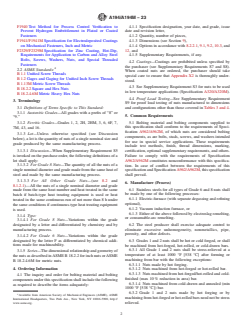
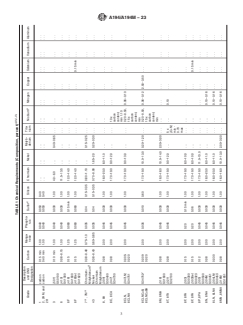
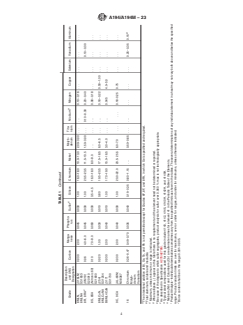
This specification covers a variety of carbon, alloy, and martensitic and austenitic stainless steel nuts. These nuts are intended for high-pressure or high-temperature service, or both. Bars from which the nuts are made shall be hot-wrought. The material may be further processed by centerless grinding or by cold drawing. Austenitic stainless steel may be solution annealed or annealed and strain-hardened. Each alloy shall conform to the chemical composition requirements prescribed. Hardness tests, proof of load tests, and cone proof load tests shall be made to all nuts to meet the requirements specified.
SCOPE
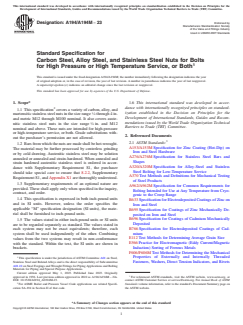
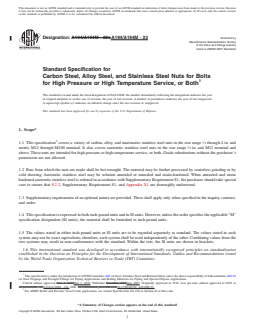
1.1 This specification2 covers a variety of carbon, alloy, and martensitic stainless steel nuts in the size range 1/4 through 4 in. and metric M12 through M100 nominal. It also covers austenitic stainless steel nuts in the size range 1/4 in. and M12 nominal and above. These nuts are intended for high-pressure or high-temperature service, or both. Grade substitutions without the purchaser's permission are not allowed.
1.2 Bars from which the nuts are made shall be hot-wrought. The material may be further processed by centerless grinding or by cold drawing. Austenitic stainless steel may be solution annealed or annealed and strain-hardened. When annealed and strain hardened austenitic stainless steel is ordered in accordance with Supplementary Requirement S1, the purchaser should take special care to ensure that 8.2.2, Supplementary Requirement S1, and Appendix X1 are thoroughly understood.
1.3 Supplementary requirements of an optional nature are provided. These shall apply only when specified in the inquiry, contract, and order.
1.4 This specification is expressed in both inch-pound units and in SI units. However, unless the order specifies the applicable “M” specification designation (SI units), the material shall be furnished to inch-pound units.
1.5 The values stated in either inch-pound units or SI units are to be regarded separately as standard. The values stated in each system may not be exact equivalents; therefore, each system shall be used independently of the other. Combining values from the two systems may result in non-conformance with the standard. Within the text, the SI units are shown in brackets.
1.6 This international standard was developed in accordance with internationally recognized principles on standardization established in the Decision on Principles for the Development of International Standards, Guides and Recommendations issued by the World Trade Organization Technical Barriers to Trade (TBT) Committee.
- Status
- Published
- Publication Date
- 30-Apr-2023
- Technical Committee
- A01 - Steel, Stainless Steel and Related Alloys
Buy Documents
ASTM A194/A194M-23 - Standard Specification for Carbon Steel, Alloy Steel, and Stainless Steel Nuts for Bolts for High Pressure or High Temperature Service, or Both
REDLINE ASTM A194/A194M-23 - Standard Specification for Carbon Steel, Alloy Steel, and Stainless Steel Nuts for Bolts for High Pressure or High Temperature Service, or Both
Overview
ASTM A194/A194M-23 establishes the requirements for carbon steel, alloy steel, and stainless steel nuts intended for use with bolts and related fasteners in high-pressure or high-temperature service, or both. This standard, developed by ASTM International, provides specifications for several grades of ferritic and austenitic materials, covering nuts from 1/4 through 4 inches and metric sizes M12 through M100. The scope includes requirements for manufacturing processes, chemical composition, mechanical properties, and testing, ensuring that these nuts deliver reliable performance in demanding industrial environments.
Key Topics
- Material Types: The standard covers a variety of carbon steel, alloy steel, martensitic, and austenitic stainless steels. Each material grade is designated according to its intended mechanical and chemical properties.
- Intended Use: Nuts specified by ASTM A194/A194M-23 are for bolted connections subjected to high pressure, high temperature, or both. These components are critical in applications where strength and resistance to corrosion, heat, or pressure are essential.
- Manufacturing Requirements:
- Bars for nuts must be hot-wrought with optional further processing such as centerless grinding or cold drawing.
- Austenitic stainless steel nuts may be solution annealed or strain-hardened.
- Testing and Quality Control:
- Each alloy must meet strict chemical composition requirements.
- Mechanical testing includes hardness tests, proof load tests, and cone proof load tests to verify compliance.
- Supplementary, optional requirements and testing are available and addressed through contractual agreements.
- Units: The specification is available in inch-pound and SI units; users must specify unit systems clearly to avoid non-conformance.
- Certification and Marking: Manufacturer certification must include chemical analysis and mechanical testing results. Nuts must be marked clearly with grade and manufacturing process for traceability.
Applications
Nuts manufactured in accordance with ASTM A194/A194M-23 are used in industries and environments where fastener integrity is paramount, especially where service involves:
- High-Pressure Vessels and Piping: Power generation, chemical processing, oil and gas, and refinery applications commonly employ these nuts due to their reliability under extreme conditions.
- High-Temperature Systems: Applications such as steam lines, superheaters, and heat exchangers utilize these components for their ability to maintain strength and stability at elevated temperatures.
- Critical Infrastructure: Facilities adhering to codes like the ASME Boiler and Pressure Vessel Code and standards referenced by the U.S. Department of Defense rely on ASTM-compliant fasteners for operational safety.
- Low-Temperature and Cryogenic Service: When supplemented with appropriate requirements, these nuts are suitable for low-temperature performance, as often required in certain energy or process systems.
Related Standards
Several standards and codes are directly related to or referenced within ASTM A194/A194M-23:
- ASTM A153/A153M: Zinc coating for iron and steel hardware
- ASTM A320/A320M: Alloy and stainless steel bolting for low-temperature service
- ASTM A962/A962M: Common requirements for bolting components
- ASTM A370 and F606/F606M: Mechanical testing methods
- ASME B18.2.2 / B18.2.4.6M: Hex and heavy hex nut dimensions (inch and metric)
- ASME B1.1 / B1.13M: Screw thread standards
For facilities and projects where bolted joint integrity under high stress, temperature, or corrosive conditions is critical, referencing and applying ASTM A194/A194M-23 ensures standardization, safety, and proven performance for mechanical fastening solutions.
Keywords: ASTM A194, high pressure nuts, high temperature nuts, carbon steel nuts, stainless steel nuts, alloy steel fasteners, mechanical testing, bolting components, industrial standards, proof load testing
Relations
- Effective Date
- 01-Mar-2024
- Effective Date
- 01-Mar-2024
- Effective Date
- 01-Feb-2024
- Effective Date
- 01-Jan-2024
- Effective Date
- 01-Nov-2023
- Effective Date
- 01-Aug-2019
- Effective Date
- 01-Jul-2019
- Effective Date
- 01-Sep-2018
- Refers
ASTM A370-17a - Standard Test Methods and Definitions for Mechanical Testing of Steel Products - Effective Date
- 15-Nov-2017
- Effective Date
- 01-Oct-2017
- Effective Date
- 01-May-2017
- Effective Date
- 01-May-2017
- Effective Date
- 15-Mar-2017
- Effective Date
- 01-Jan-2017
- Effective Date
- 01-Dec-2016
Buy Documents
ASTM A194/A194M-23 - Standard Specification for Carbon Steel, Alloy Steel, and Stainless Steel Nuts for Bolts for High Pressure or High Temperature Service, or Both
REDLINE ASTM A194/A194M-23 - Standard Specification for Carbon Steel, Alloy Steel, and Stainless Steel Nuts for Bolts for High Pressure or High Temperature Service, or Both
Frequently Asked Questions
ASTM A194/A194M-23 is a technical specification published by ASTM International. Its full title is "Standard Specification for Carbon Steel, Alloy Steel, and Stainless Steel Nuts for Bolts for High Pressure or High Temperature Service, or Both". This standard covers: ABSTRACT This specification covers a variety of carbon, alloy, and martensitic and austenitic stainless steel nuts. These nuts are intended for high-pressure or high-temperature service, or both. Bars from which the nuts are made shall be hot-wrought. The material may be further processed by centerless grinding or by cold drawing. Austenitic stainless steel may be solution annealed or annealed and strain-hardened. Each alloy shall conform to the chemical composition requirements prescribed. Hardness tests, proof of load tests, and cone proof load tests shall be made to all nuts to meet the requirements specified. SCOPE 1.1 This specification2 covers a variety of carbon, alloy, and martensitic stainless steel nuts in the size range 1/4 through 4 in. and metric M12 through M100 nominal. It also covers austenitic stainless steel nuts in the size range 1/4 in. and M12 nominal and above. These nuts are intended for high-pressure or high-temperature service, or both. Grade substitutions without the purchaser's permission are not allowed. 1.2 Bars from which the nuts are made shall be hot-wrought. The material may be further processed by centerless grinding or by cold drawing. Austenitic stainless steel may be solution annealed or annealed and strain-hardened. When annealed and strain hardened austenitic stainless steel is ordered in accordance with Supplementary Requirement S1, the purchaser should take special care to ensure that 8.2.2, Supplementary Requirement S1, and Appendix X1 are thoroughly understood. 1.3 Supplementary requirements of an optional nature are provided. These shall apply only when specified in the inquiry, contract, and order. 1.4 This specification is expressed in both inch-pound units and in SI units. However, unless the order specifies the applicable “M” specification designation (SI units), the material shall be furnished to inch-pound units. 1.5 The values stated in either inch-pound units or SI units are to be regarded separately as standard. The values stated in each system may not be exact equivalents; therefore, each system shall be used independently of the other. Combining values from the two systems may result in non-conformance with the standard. Within the text, the SI units are shown in brackets. 1.6 This international standard was developed in accordance with internationally recognized principles on standardization established in the Decision on Principles for the Development of International Standards, Guides and Recommendations issued by the World Trade Organization Technical Barriers to Trade (TBT) Committee.
ABSTRACT This specification covers a variety of carbon, alloy, and martensitic and austenitic stainless steel nuts. These nuts are intended for high-pressure or high-temperature service, or both. Bars from which the nuts are made shall be hot-wrought. The material may be further processed by centerless grinding or by cold drawing. Austenitic stainless steel may be solution annealed or annealed and strain-hardened. Each alloy shall conform to the chemical composition requirements prescribed. Hardness tests, proof of load tests, and cone proof load tests shall be made to all nuts to meet the requirements specified. SCOPE 1.1 This specification2 covers a variety of carbon, alloy, and martensitic stainless steel nuts in the size range 1/4 through 4 in. and metric M12 through M100 nominal. It also covers austenitic stainless steel nuts in the size range 1/4 in. and M12 nominal and above. These nuts are intended for high-pressure or high-temperature service, or both. Grade substitutions without the purchaser's permission are not allowed. 1.2 Bars from which the nuts are made shall be hot-wrought. The material may be further processed by centerless grinding or by cold drawing. Austenitic stainless steel may be solution annealed or annealed and strain-hardened. When annealed and strain hardened austenitic stainless steel is ordered in accordance with Supplementary Requirement S1, the purchaser should take special care to ensure that 8.2.2, Supplementary Requirement S1, and Appendix X1 are thoroughly understood. 1.3 Supplementary requirements of an optional nature are provided. These shall apply only when specified in the inquiry, contract, and order. 1.4 This specification is expressed in both inch-pound units and in SI units. However, unless the order specifies the applicable “M” specification designation (SI units), the material shall be furnished to inch-pound units. 1.5 The values stated in either inch-pound units or SI units are to be regarded separately as standard. The values stated in each system may not be exact equivalents; therefore, each system shall be used independently of the other. Combining values from the two systems may result in non-conformance with the standard. Within the text, the SI units are shown in brackets. 1.6 This international standard was developed in accordance with internationally recognized principles on standardization established in the Decision on Principles for the Development of International Standards, Guides and Recommendations issued by the World Trade Organization Technical Barriers to Trade (TBT) Committee.
ASTM A194/A194M-23 is classified under the following ICS (International Classification for Standards) categories: 21.060.20 - Nuts. The ICS classification helps identify the subject area and facilitates finding related standards.
ASTM A194/A194M-23 has the following relationships with other standards: It is inter standard links to ASTM A370-24, ASTM A320/A320M-24, ASTM A276/A276M-24a, ASTM A276/A276M-24, ASTM F2329/F2329M-15(2023), ASTM F1940-07a(2019), ASTM A370-19, ASTM A962/A962M-18, ASTM A370-17a, ASTM A320/A320M-17b, ASTM A962/A962M-17, ASTM A320/A320M-17a, ASTM A320/A320M-17, ASTM A370-17, ASTM F1941/F1941M-16. Understanding these relationships helps ensure you are using the most current and applicable version of the standard.
ASTM A194/A194M-23 is available in PDF format for immediate download after purchase. The document can be added to your cart and obtained through the secure checkout process. Digital delivery ensures instant access to the complete standard document.
Standards Content (Sample)
This international standard was developed in accordance with internationally recognized principles on standardization established in the Decision on Principles for the
Development of International Standards, Guides and Recommendations issued by the World Trade Organization Technical Barriers to Trade (TBT) Committee.
Designation: A194/A194M − 23 Endorsed by
Manufacturers Standardization Society
of the Valve and Fittings Industry
Used in USNRC-RDT Standards
Standard Specification for
Carbon Steel, Alloy Steel, and Stainless Steel Nuts for Bolts
for High Pressure or High Temperature Service, or Both
This standard is issued under the fixed designation A194/A194M; the number immediately following the designation indicates the year
of original adoption or, in the case of revision, the year of last revision. A number in parentheses indicates the year of last reapproval.
A superscript epsilon (´) indicates an editorial change since the last revision or reapproval.
This standard has been approved for use by agencies of the U.S. Department of Defense.
1. Scope* 1.6 This international standard was developed in accor-
dance with internationally recognized principles on standard-
1.1 This specification covers a variety of carbon, alloy, and
1 ization established in the Decision on Principles for the
martensitic stainless steel nuts in the size range ⁄4 through 4 in.
Development of International Standards, Guides and Recom-
and metric M12 through M100 nominal. It also covers auste-
1 mendations issued by the World Trade Organization Technical
nitic stainless steel nuts in the size range ⁄4 in. and M12
Barriers to Trade (TBT) Committee.
nominal and above. These nuts are intended for high-pressure
or high-temperature service, or both. Grade substitutions with-
2. Referenced Documents
out the purchaser’s permission are not allowed.
2.1 ASTM Standards:
1.2 Bars from which the nuts are made shall be hot-wrought.
A153/A153M Specification for Zinc Coating (Hot-Dip) on
The material may be further processed by centerless grinding
Iron and Steel Hardware
or by cold drawing. Austenitic stainless steel may be solution
A276/A276M Specification for Stainless Steel Bars and
annealed or annealed and strain-hardened. When annealed and
Shapes
strain hardened austenitic stainless steel is ordered in accor-
A320/A320M Specification for Alloy-Steel and Stainless
dance with Supplementary Requirement S1, the purchaser
Steel Bolting for Low-Temperature Service
should take special care to ensure that 8.2.2, Supplementary
A370 Test Methods and Definitions for Mechanical Testing
Requirement S1, and Appendix X1 are thoroughly understood.
of Steel Products
1.3 Supplementary requirements of an optional nature are
A962/A962M Specification for Common Requirements for
provided. These shall apply only when specified in the inquiry,
Bolting Intended for Use at Any Temperature from Cryo-
contract, and order.
genic to the Creep Range
1.4 This specification is expressed in both inch-pound units
B633 Specification for Electrodeposited Coatings of Zinc on
and in SI units. However, unless the order specifies the
Iron and Steel
applicable “M” specification designation (SI units), the mate-
B695 Specification for Coatings of Zinc Mechanically De-
rial shall be furnished to inch-pound units.
posited on Iron and Steel
B696 Specification for Coatings of Cadmium Mechanically
1.5 The values stated in either inch-pound units or SI units
Deposited
are to be regarded separately as standard. The values stated in
B766 Specification for Electrodeposited Coatings of Cad-
each system may not be exact equivalents; therefore, each
mium
system shall be used independently of the other. Combining
E112 Test Methods for Determining Average Grain Size
values from the two systems may result in non-conformance
E566 Practice for Electromagnetic (Eddy Current/Magnetic
with the standard. Within the text, the SI units are shown in
Induction) Sorting of Ferrous Metals
brackets.
F606/F606M Test Methods for Determining the Mechanical
Properties of Externally and Internally Threaded
This specification is under the jurisdiction of ASTM Committee A01 on Steel,
Stainless Steel and Related Alloys and is the direct responsibility of Subcommittee
Fasteners, Washers, Direct Tension Indicators, and Rivets
A01.22 on Steel Forgings and Wrought Fittings for Piping Applications and Bolting
Materials for Piping and Special Purpose Applications.
Current edition approved May 1, 2023. Published June 2023. Originally
approved in 1936. Last previous edition approved in 2022 as A194/A194M – 22a. For referenced ASTM standards, visit the ASTM website, www.astm.org, or
DOI: 10.1520/A0194_A0194M-23. contact ASTM Customer Service at service@astm.org. For Annual Book of ASTM
For ASME Boiler and Pressure Vessel Code applications see related Specifi- Standards volume information, refer to the standard’s Document Summary page on
cation SA-194 in Section II of that code. the ASTM website.
*A Summary of Changes section appears at the end of this standard
Copyright © ASTM International, 100 Barr Harbor Drive, PO Box C700, West Conshohocken, PA 19428-2959. United States
A194/A194M − 23
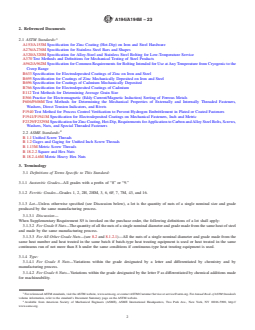
F1940 Test Method for Process Control Verification to 4.1.1 Specification designation, year date, and grade, issue
Prevent Hydrogen Embrittlement in Plated or Coated date and revision letter,
Fasteners 4.1.2 Quantity, number of pieces,
F1941/F1941M Specification for Electrodeposited Coatings 4.1.3 Dimensions (see Section 9),
on Mechanical Fasteners, Inch and Metric 4.1.4 Options in accordance with 8.2.2.1, 9.1, 9.2, 10.3, and
F2329/F2329M Specification for Zinc Coating, Hot-Dip, 12, and
Requirements for Application to Carbon and Alloy Steel 4.1.5 Supplementary Requirements, if any.
Bolts, Screws, Washers, Nuts, and Special Threaded
4.2 Coatings—Coatings are prohibited unless specified by
Fasteners
the purchaser (see Supplementary Requirements S7 and S8).
2.2 ASME Standards:
When coated nuts are ordered, the purchaser should take
B 1.1 Unified Screw Threads
special care to ensure that Appendix X2 is thoroughly under-
B 1.2 Gages and Gaging for Unified Inch Screw Threads
stood.
B 1.13M Metric Screw Threads
4.3 See Supplementary Requirement S3 for nuts to be used
B 18.2.2 Square and Hex Nuts
in low temperature applications (Specification A320/A320M).
B 18.2.4.6M Metric Heavy Hex Nuts
4.4 Proof Load Testing—See Supplementary Requirement
3. Terminology
S9 for proof load testing of nuts manufactured to dimensions
3.1 Definitions of Terms Specific to This Standard:
and configurations other than those covered in Tables 3 and 4.
3.1.1 Austenitic Grades—All grades with a prefix of “8” or
5. Common Requirements
“9.”
5.1 Bolting material and bolting components supplied to
3.1.2 Ferritic Grades—Grades 1, 2, 2H, 2HM, 3, 6, 6F, 7,
this specification shall conform to the requirements of Speci-
7M, 43, and 16.
fication A962/A962M, of which nuts are considered bolting
3.1.3 Lot—Unless otherwise specified (see Discussion
components, as are bolts, studs, screws, and washers intended
below), a lot is the quantity of nuts of a single nominal size and
for use in special service applications. These requirements
grade produced by the same manufacturing process.
include test methods, finish, thread dimensions, marking,
3.1.3.1 Discussion—When Supplementary Requirement S5
certification, optional supplementary requirements, and others.
is invoked on the purchase order, the following definitions of a Failure to comply with the requirements of Specification
lot shall apply:
A962/A962M constitutes nonconformance with this specifica-
3.1.3.2 For Grade 8 Nuts—The quantity of all the nuts of a tion. In case of conflict between the requirements of this
single nominal diameter and grade made from the same heat of
specification and Specification A962/A962M, this specification
steel and made by the same manufacturing process.
shall prevail.
3.1.3.3 For All Other Grade Nuts—(see 8.2 and
6. Manufacture (Process)
8.1.2.1)—All the nuts of a single nominal diameter and grade
6.1 Stainless steels for all types of Grade 6 and 8 nuts shall
made from the same heat number and heat treated in the same
be made by one of the following processes:
batch if batch-type heat treating equipment is used or heat
6.1.1 Electric-furnace (with separate degassing and refining
treated in the same continuous run of not more than 8 h under
optional),
the same conditions if continuous-type heat treating equipment
6.1.2 Vacuum induction furnace, or
is used.
6.1.3 Either of the above followed by electroslag remelting,
3.1.4 Type:
or consumable-arc remelting.
3.1.4.1 For Grade 8 Nuts—Variations within the grade
6.2 The steel producer shall exercise adequate control to
designated by a letter and differentiated by chemistry and by
eliminate excessive unhomogeneity, nonmetallics, pipe,
manufacturing process.
porosity, and other defects.
3.1.4.2 For Grade 6 Nuts—Variations within the grade
designated by the letter F as differentiated by chemical addi- 6.3 Grades 1 and 2 nuts shall be hot or cold forged, or shall
tions made for machineability. be machined from hot-forged, hot-rolled, or cold-drawn bars.
6.3.1 All Grade 1 and 2 nuts shall be stress-relieved at a
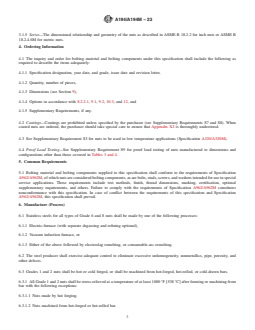
3.1.5 Series—The dimensional relationship and geometry of
temperature of at least 1000 °F [538 °C] after forming or
the nuts as described in ASME B 18.2.2 for inch nuts or ASME
machining from bar with the following exceptions:
B 18.2.4.6M for metric nuts.
6.3.1.1 Nuts made by hot forging.
4. Ordering Information
6.3.1.2 Nuts machined from hot-forged or hot-rolled bar.
6.3.1.3 Nuts machined from hot-forged/hot-rolled and cold-
4.1 The inquiry and order for bolting material and bolting
finished (max 10 % reduction in area) bar.
components under this specification shall include the following
6.3.1.4 Nuts machined from cold-drawn and annealed (min
as required to describe the items adequately:
1000 °F [538 °C]) bar.
6.3.2 Grade 1 and 2 nuts made by hot forging or by
Available from American Society of Mechanical Engineers (ASME), ASME
machining from hot-forged or hot-rolled bars need not be stress
International Headquarters, Two Park Ave., New York, NY 10016-5990, http://
www.asme.org. relieved.
A194/A194M − 23
A,B,C,D,I
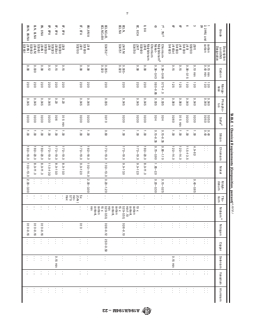
TABLE 1 Chemical Requirements (Composition, percent)
Description
Manga- Phospho- Molyb- Tita-
E H
Grade and UNS Carbon Sulfur Silicon Chromium Nickel Niobium Nitrogen Copper Selenium Vanadium Aluminum
nese rus denum nium
Designation
1 carbon 0.15 min 1.00 0.040 0.050 0.40 . . . . . . . . . . . . . . . . . . . . . . . . . . . . . .
2, 2HM, and carbon 0.40 min 1.00 0.040 0.050 0.40 . . . . . . . . . . . . . . . . . . . . . . . . . . . . . .
2H
3 (501) 0.10 min 1.00 0.040 0.030 1.00 4.0–6.0 . . . 0.40–0.65 . . . . . . . . . . . . . . . . . . . . .
S50100
6 (410) 0.08–0.15 1.00 0.040 0.030 1.00 11.5–13.5 . . . . . . . . . . . . . . . . . . . . . . . . . . .
S41000
6F (416) 0.15 1.25 0.060 0.15 min 1.00 12.0–14.0 . . . . . . . . . . . . . . . . . . . . . . . . . . .
S41600
6F (416Se) 0.15 1.25 0.060 0.060 1.00 12.0–14.0 . . . . . . . . . . . . . . . . . . 0.15 min . . . . . .
S41623
G G
7 , 7M Chromium- 0.38–0.48 0.75–1.0 0.035 0.04 0.15–0.35 0.80–1.10 . . . 0.15–0.25 . . . . . . . . . . . . . . . . . . . . .
G
Molybdenum
43 Nickel- 0.38–0.43 0.60–0.85 0.035 0.04 0.15–0.35 0.70–0.90 1.65–2.0 0.20–0.30 . . . . . . . . . . . . . . . . . . . . .
Chromium
Molybdenum
8, 8A (304) 0.08 2.00 0.045 0.030 1.00 18.0–20.0 8.0–11.0 . . . . . . . . . . . . . . . . . . . . . . . .
S30400
8C, 8CA (347) 0.08 2.00 0.045 0.030 1.00 17.0–19.0 9.0–12.0 . . . . . . 10 x . . . . . . . . . . . . . . .
S34700 carbon
content,
min 1.10
8CLN, (347LN) 0.005- 2.00 0.045 0.030 1.00 17.0–19.0 9.0–13.0 . . . . . . 0.20–0.50, 0.06–0.10 . . . . . . . . . . . .
8CLNA S34751 0.020 15 x
carbon
content,
min
J
8CLNCuB, S34752 0.005- 2.00 0.035 0.010 0.60 17.0–19.0 10.0–13.0 0.20–1.20 . . . 0.20–0.50, 0.06–0.12 2.50–3.50 . . . . . . . . .
8CLNCuBA 0.020 15 x
carbon
content,
min
8M, 8MA (316) 0.08 2.00 0.045 0.030 1.00 16.0–18.0 10.0–14.0 2.00–3.00 . . . . . . . . . . . . . . . . . . . . .
S31600
8T, 8TA (321) 0.08 2.00 0.045 0.030 1.00 17.0–19.0 9.0–12.0 . . . 5 x . . . 0.10 . . . . . . . . . . . .
S32100 (C+N)
min -
0.70
max
8F, 8FA (303) 0.15 2.00 0.20 0.15 min 1.00 17.0–19.0 8.0–10.0 . . . . . . . . . . . . . . . . . . . . . . . .
S30300
8F, 8FA (303Se) 0.15 2.00 0.20 0.06 1.00 17.0–19.0 8.0–10.0 . . . . . . . . . . . . 0.15 min . . . . . .
S30323
8P, 8PA (305) 0.12 2.00 0.045 0.030 1.00 17.0–19.0 11.0–13.0 . . . . . . . . . . . . . . . . . . . . . . . .
S30500
8N, 8NA (304N) 0.08 2.00 0.045 0.030 1.00 18.0–20.0 8.0–11.0 . . . . . . . . . 0.10–0.16 . . . . . . . . . . . .
S30451
8LN, 8LNA (304LN) 0.030 2.00 0.045 0.030 1.00 18.0–20.0 8.0–11.0 . . . . . . . . . 0.10–0.16 . . . . . . . . . . . .
S30453
8MN, 8MNA (316N) 0.08 2.00 0.045 0.030 1.00 16.0–18.0 10.0–13.0 2.00–3.00 . . . . . . 0.10–0.16 . . . . . . . . . . . .
S31651
A194/A194M − 23
TABLE 1 Continued
Description
Manga- Phospho- Molyb- Tita-
E H
Grade and UNS Carbon Sulfur Silicon Chromium Nickel Niobium Nitrogen Copper Selenium Vanadium Aluminum
nese rus denum nium
Designation
8MLN, (316LN) 0.030 2.00 0.045 0.030 1.00 16.0–18.0 10.0–13.0 2.00–3.00 . . . . . . 0.10–0.16 . . . . . . . . . . . .
8MLNA S31653
F
8R, 8RA (XM19) 0.06 4.0–6.0 0.045 0.030 1.00 20.5–23.5 11.5–13.5 1.50–3.00 . . . 0.10–0.30 0.20–0.40 0.10–0.30
S20910
8S, 8SA (Nitronic 60) 0.10 7.0–9.0 0.060 0.030 3.5–4.5 16.0–18.0 8.0–9.0 . . . . . . . . . 0.08–0.18 . . . . . . . . . . . .
S21800
8MLCuN, (254) 0.020 1.00 0.030 0.010 0.80 19.5–20.5 17.5–18.5 6.0–6.5 . . . . . . 0.18–0.22 0.50–1.00 . . . . . . . . .
8MLCuNA S31254
B8ML4CuN (317) 0.030 2.00 0.040 0.010 1.00 17.0–19.0 15.0–16.5 3.0–4.0 . . . . . . 0.045 4.0–5.0 . . . . . . . . .
S31730
9C, 9CA (AL-6XN) 0.030 2.00 0.040 0.030 1.00 20.0-22.0 23.5- 25.5 6.0-7.0 . . . . . . 0.18-0.25 0.75 . . . . . . . . .
N08367
B
16 Chromium 0.36–0.47 0.45–0.70 0.035 0.040 0.15–0.35 0.80–1.15 . . . 0.50–0.65 . . . . . . . . . . . . . . . 0.25–0.35 0.15
Molyb-
denum
Vanadium
A
The intentional addition of Bi, Se, Te, and Pb is not permitted except for Grades 6F, 8F, and 8FA, in which Se is specified and required.
B
Total aluminum, soluble and insoluble.
C
Maximum, unless minimum or range is indicated.
D
Where ellipses ({) appear in this table there is no requirement and the element need not be determined or reported.
E
Because of the degree to which sulfur segregates, product analysis for sulfur over 0.060 % max is not technologically appropriate.
F
As described in Specification A276/A276M.
G
Typical steel compositions used for this grade include 4140, 4142, 4145, 4140H, 4142H, and 4145H.
H
Niobium (Nb) and Columbium (Cb) are alternate names for element 41 in the Periodic Table of the Elements.
I
Product Analysis–Individual determinations sometimes vary from the specified limits as shown in the tables. The several determinations of any individual element in a heat may not vary both above and below the specified
range. Product variation limits are over for maximums, over or under for ranges, and under for minimums, unless otherwise indicated.
J
Boron content shall be in the range 0.001–0.005.
A194/A194M − 23
A
TABLE 2 Hardness Requirements
Completed Nuts Sample Nut after Treatment as in 8.1.5
Brinell Rockwell Hardness Brinell Rockwell
Grade and Type
Hardness Hardness, Hardness B
C Scale B Scale
min Scale, min
1 121 min . 70 min 121 70
2 159 to 352 . 84 min 159 84
2H to 1 ⁄2 in. or M36, incl 248 to 327 24 to 35 . 179 89
2H over 1 ⁄2 in. or M36 212 to 327 35 max 95 min 147 79
2HM and 7M 159 to 235 . 84 to 99 159 84
3, 7, 16, 43 248 to 327 24 to 35 . 201 94
6 and 6F 228 to 271 20 to 28 . . .
8, 8C, 8CLN, 8CLNCuB, 8M, 126 to 300 32 max 60 min . .
8T, 8F, 8P, 8N,
8MN, 8LN, 8MLN,
8MLCuN, 8ML4CuN,
and 9C
8A, 8CA, 8CLNA, 126 to 192 . 60 to 90 . .
8CLNCuBA, 8MA, 8TA,
8FA, 8PA, 8NA, 8MNA,
8LNA, 8MLNA,
8MLCuNA,
8ML4CuNA,
and 9CA
8R, 8RA, 8S, and 8SA 183 to 271 25 max 88 min . .
A
Where ellipses ({) appear in this table there is no requirement.
because no correlation can be drawn between the original tempering
6.4 Grades 2H, 2HM, 3, 6, 6F, 7, 7M, 43, and 16 nuts shall
temperature utilizing induction and the stress relieving temperature in a
be hot- or cold-forged or shall be machined from hot-forged,
standard furnace.
hot-rolled, or cold-drawn bars and shall be heat treated to meet
the required mechanical properties. These grades shall be 6.6 Grades 8, 8C, 8CLN, 8CLNCuB, 8M, 8T, 8F, 8P, 8N,
uniformly reheated to the proper austenitizing temperature (a
8MN, 8R, 8S, 8LN, 8MLN, 8MLCuN, 8ML4CuN, and 9C nuts
group thus reheated being known as a quenching charge) and
shall be hot or cold forged, or shall be machined from
quenched under substantially uniform conditions for each
hot-forged, hot-rolled or cold-drawn bars.
quenching charge and tempered as shown below. Grades 2H,
6.7 Grades 8A, 8CA, 8CLNA, 8CLNCuBA, 8MA, 8TA,
2HM, 3, 7, and 7M shall be liquid quenched. Grades 6 and 6F
8FA, 8PA, 8NA, 8MNA, 8RA, 8SA, 8LNA, 8MLNA,
shall be quenched in liquid or inert gas. Grade 16 shall be
8MLCuNA, 8ML4CuNA, and 9CA nuts shall be hot- or
heated to a temperature range from 1700 to 1750 °F (925 to
cold-forged or shall be machined from hot-forged, hot-rolled,
955 °C) and oil quenched.
or cold-drawn bars and the nuts shall subsequently be carbide-
Minimum Tempering Temperature, °F
solution treated by heating them for a sufficient time at a
Grade [°C]
2H 850 [455]
temperature to dissolve chromium carbides followed by cool-
2HM 1150 [620]
ing at a rate sufficient to prevent reprecipitation of the carbides.
3 1050 [565]
6 and 6F 1100 [595]
7 1100 [595]
7. Chemical Composition
7M 1150 [620]
43 1100 [595]
7.1 Each alloy shall conform to the chemical composition
16 1200 [650]
requirements prescribed in Table 1.
6.4.1 Grade 6 and 6F nuts shall be tempered for a minimum
of 1 h at the temperature.
8. Mechanical Requirements
6.5 For Grade 2HM and 7M nuts, a final stress relief shall be
8.1 Hardness Test:
performed, after all machining, cutting, and forming
8.1.1 Requirements:
operations, at a minimum temperature of 50°F (28°C) below
8.1.1.1 All nuts shall meet the hardness requirements speci-
the original tempering temperature. A tempering operation may
fied in Table 2.
be substituted for this post-machining/cutting/forming stress
relief. Surface preparation for hardness testing or nondestruc- 8.1.1.2 Sample nuts of Grades 1, 2, 2H, 2HM, 3, 7, 7M, 43,
tive evaluation is permitted.
and 16 which have been given the treatment described in 8.1.5
6.5.1 In the case where the original temper was performed shall meet the minimum hardness specified in Table 2.
via induction heat treatment at a temperature above 1300°F
8.1.2 Number of Tests—(Grades 1, 2, 2H, 3, 7, 43, and 16
(705°C) but the post-machining/cutting/forming stress relief
and all types of Grade 6):
will be performed in a standard furnace, the minimum stress
8.1.2.1 Tests on the number of sample nuts in accordance
relief temperature shall be 1200°F (650°C).
with the following table shall be performed by the manufac-
NOTE 1—A specific minimum stress relief temperature is given in 6.5.1 turer following all production heat treatments:
A194/A194M − 23
TABLE 3 Proof Load Using Threaded Mandrel — Inch Series
NOTE 1—Proof loads are not design loads.
A
Proof Load, lbf
Nominal Threads Stress Area
Grade 1 Grades 2, 2HM, 6, 6F, 7M Grades 2H, 3, 7, 16, 43
Size, in. per Inch in.
B C D E F G
Heavy Hex Hex Heavy Hex Hex Heavy Hex Hex
⁄4 20 0.0316 4 130 3 820 4 770 4 300 5 570 4 770
⁄16 18 0.0524 6 810 6 290 7 860 7 070 9 170 7 860
⁄8 16 0.0774 10 080 9 300 11 620 10 460 13 560 11 620
⁄16 14 0.1063 13 820 12 760 15 940 14 350 18 600 15 940
⁄2 13 0.1419 18 450 17 030 21 280 19 160 24 830 21 280
⁄16 12 0.182 23 660 21 840 27 300 24 570 31 850 27 300
⁄8 11 0.226 29 380 27 120 33 900 30 510 39 550 33 900
⁄4 10 0.334 43 420 40 080 50 100 45 090 58 450 50 100
⁄8 9 0.462 60 060 55 440 69 300 62 370 80 850 69 300
1 8 0.606 78 780 72 720 90 900 81 810 106 000 90 900
1 ⁄8 8 0.790 102 700 94 800 118 500 106 700 138 200 118 500
1 ⁄4 8 1.000 130 000 120 000 150 000 135 000 175 000 150 000
1 ⁄8 8 1.233 160 200 148 000 185 000 166 500 215 800 185 000
1 ⁄2 8 1.492 194 000 170 040 223 800 201 400 261 100 223 800
All Types of Grade 8, Grades 9C and 9CA
H I
Heavy Hex Hex
⁄4 20 0.0316 2 540 2 380
⁄16 18 0.0524 4 190 3 930
⁄8 16 0.0774 6 200 5 810
⁄16 14 0.1063 8 500 7 970
⁄2 13 0.1419 11 350 10 640
⁄16 12 0.182 14 560 13 650
⁄8 11 0.226 18 080 16 950
⁄4 10 0.334 26 720 25 050
⁄8 9 0.462 36 960 34 650
1 8 0.606 48 480 45 450
1 ⁄8 8 0.790 63 200 59 250
1 ⁄4 8 1.000 80 000 75 000
1 ⁄8 8 1.233 98 640 92 450
1 ⁄2 8 1.492 119 360 111 900
A
See limit for proof load test in 8.2.2.1. The proof load for jam nuts shall be 46 % of the tabulated load.
B
Based on proof stress of 130 000 psi.
C
Based on proof stress of 120 000 psi.
D
Based on proof stress of 150 000 psi.
E
Based on proof stress of 135 000 psi.
F
Based on proof stress of 175 000 psi.
G
Based on proof stress of 150 000 psi.
H
Based on proof stress of 80 000 psi.
I
Based on proof stress of 75 000 psi.
hardness, a random sample of a minimum of 100 pieces in each
Lot Size Samples
Up to 800 1
purchase lot (as defined in 3.1.3) shall be tested by indentation
801 to 8000 2
hardness methods. All samples must meet hardness require-
8001 to 22 000 3
Over 22 000 5
ments to permit acceptance of the lot. If any one sample is
outside of the specified maximum or minimum hardness, the
8.1.2.2 In addition, a hardness test shall be performed by the
manufacturer in accordance with 8.1.5 on one sample nut lot shall be rejected and either reprocessed and resampled, or
selected from each nominal diameter and series from each tested 100 % by indentation hardness methods.
grade and heat number followi
...
This document is not an ASTM standard and is intended only to provide the user of an ASTM standard an indication of what changes have been made to the previous version. Because
it may not be technically possible to adequately depict all changes accurately, ASTM recommends that users consult prior editions as appropriate. In all cases only the current version
of the standard as published by ASTM is to be considered the official document.
Designation: A194/A194M − 22a A194/A194M − 23 Endorsed by
Manufacturers Standardization Society
of the Valve and Fittings Industry
Used in USNRC-RDT Standards
Standard Specification for
Carbon Steel, Alloy Steel, and Stainless Steel Nuts for Bolts
for High Pressure or High Temperature Service, or Both
This standard is issued under the fixed designation A194/A194M; the number immediately following the designation indicates the year
of original adoption or, in the case of revision, the year of last revision. A number in parentheses indicates the year of last reapproval.
A superscript epsilon (´) indicates an editorial change since the last revision or reapproval.
This standard has been approved for use by agencies of the U.S. Department of Defense.
1. Scope*
1.1 This specification covers a variety of carbon, alloy, and martensitic stainless steel nuts in the size range ⁄4 through 4 in. and
metric M12 through M100 nominal. It also covers austenitic stainless steel nuts in the size range ⁄4 in. and M12 nominal and
above. These nuts are intended for high-pressure or high-temperature service, or both. Grade substitutions without the purchaser’s
permission are not allowed.
1.2 Bars from which the nuts are made shall be hot-wrought. The material may be further processed by centerless grinding or by
cold drawing. Austenitic stainless steel may be solution annealed or annealed and strain-hardened. When annealed and strain
hardened austenitic stainless steel is ordered in accordance with Supplementary Requirement S1, the purchaser should take special
care to ensure that 8.2.2, Supplementary Requirement S1, and Appendix X1 are thoroughly understood.
1.3 Supplementary requirements of an optional nature are provided. These shall apply only when specified in the inquiry, contract,
and order.
1.4 This specification is expressed in both inch-pound units and in SI units. However, unless the order specifies the applicable “M”
specification designation (SI units), the material shall be furnished to inch-pound units.
1.5 The values stated in either inch-pound units or SI units are to be regarded separately as standard. The values stated in each
system may not be exact equivalents; therefore, each system shall be used independently of the other. Combining values from the
two systems may result in non-conformance with the standard. Within the text, the SI units are shown in brackets.
1.6 This international standard was developed in accordance with internationally recognized principles on standardization
established in the Decision on Principles for the Development of International Standards, Guides and Recommendations issued
by the World Trade Organization Technical Barriers to Trade (TBT) Committee.
This specification is under the jurisdiction of ASTM Committee A01 on Steel, Stainless Steel and Related Alloys and is the direct responsibility of Subcommittee A01.22
on Steel Forgings and Wrought Fittings for Piping Applications and Bolting Materials for Piping and Special Purpose Applications.
Current edition approved Nov. 1, 2022May 1, 2023. Published December 2022June 2023. Originally approved in 1936. Last previous edition approved in 2022 as
A194/A194M – 22.A194/A194M – 22a. DOI: 10.1520/A0194_A0194M-22A.10.1520/A0194_A0194M-23.
For ASME Boiler and Pressure Vessel Code applications see related Specification SA-194 in Section II of that code.
*A Summary of Changes section appears at the end of this standard
Copyright © ASTM International, 100 Barr Harbor Drive, PO Box C700, West Conshohocken, PA 19428-2959. United States
A194/A194M − 23
2. Referenced Documents
2.1 ASTM Standards:
A153/A153M Specification for Zinc Coating (Hot-Dip) on Iron and Steel Hardware
A276/A276M Specification for Stainless Steel Bars and Shapes
A320/A320M Specification for Alloy-Steel and Stainless Steel Bolting for Low-Temperature Service
A370 Test Methods and Definitions for Mechanical Testing of Steel Products
A962/A962M Specification for Common Requirements for Bolting Intended for Use at Any Temperature from Cryogenic to the
Creep Range
B633 Specification for Electrodeposited Coatings of Zinc on Iron and Steel
B695 Specification for Coatings of Zinc Mechanically Deposited on Iron and Steel
B696 Specification for Coatings of Cadmium Mechanically Deposited
B766 Specification for Electrodeposited Coatings of Cadmium
E112 Test Methods for Determining Average Grain Size
E566 Practice for Electromagnetic (Eddy Current/Magnetic Induction) Sorting of Ferrous Metals
F606/F606M Test Methods for Determining the Mechanical Properties of Externally and Internally Threaded Fasteners,
Washers, Direct Tension Indicators, and Rivets
F1940 Test Method for Process Control Verification to Prevent Hydrogen Embrittlement in Plated or Coated Fasteners
F1941/F1941M Specification for Electrodeposited Coatings on Mechanical Fasteners, Inch and Metric
F2329/F2329M Specification for Zinc Coating, Hot-Dip, Requirements for Application to Carbon and Alloy Steel Bolts, Screws,
Washers, Nuts, and Special Threaded Fasteners
2.2 ASME Standards:
B 1.1 Unified Screw Threads
B 1.2 Gages and Gaging for Unified Inch Screw Threads
B 1.13M Metric Screw Threads
B 18.2.2 Square and Hex Nuts
B 18.2.4.6M Metric Heavy Hex Nuts
3. Terminology
3.1 Definitions of Terms Specific to This Standard:
3.1.1 Austenitic Grades—All grades with a prefix of “8” or “9.”
3.1.2 Ferritic Grades—Grades 1, 2, 2H, 2HM, 3, 6, 6F, 7, 7M, 43, and 16.
3.1.3 Lot—Unless otherwise specified (see Discussion below), a lot is the quantity of nuts of a single nominal size and grade
produced by the same manufacturing process.
3.1.3.1 Discussion—
When Supplementary Requirement S5 is invoked on the purchase order, the following definitions of a lot shall apply:
3.1.3.2 For Grade 8 Nuts—The quantity of all the nuts of a single nominal diameter and grade made from the same heat of steel
and made by the same manufacturing process.
3.1.3.3 For All Other Grade Nuts—(see 8.2 and 8.1.2.1)—All the nuts of a single nominal diameter and grade made from the
same heat number and heat treated in the same batch if batch-type heat treating equipment is used or heat treated in the same
continuous run of not more than 8 h under the same conditions if continuous-type heat treating equipment is used.
3.1.4 Type:
3.1.4.1 For Grade 8 Nuts—Variations within the grade designated by a letter and differentiated by chemistry and by
manufacturing process.
3.1.4.2 For Grade 6 Nuts—Variations within the grade designated by the letter F as differentiated by chemical additions made
for machineability.
For referenced ASTM standards, visit the ASTM website, www.astm.org, or contact ASTM Customer Service at service@astm.org. For Annual Book of ASTM Standards
volume information, refer to the standard’s Document Summary page on the ASTM website.
Available from American Society of Mechanical Engineers (ASME), ASME International Headquarters, Two Park Ave., New York, NY 10016-5990, http://
www.asme.org.
A194/A194M − 23
3.1.5 Series—The dimensional relationship and geometry of the nuts as described in ASME B 18.2.2 for inch nuts or ASME B
18.2.4.6M for metric nuts.
4. Ordering Information
4.1 The inquiry and order for bolting material and bolting components under this specification shall include the following as
required to describe the items adequately:
4.1.1 Specification designation, year date, and grade, issue date and revision letter,
4.1.2 Quantity, number of pieces,
4.1.3 Dimensions (see Section 9),
4.1.4 Options in accordance with 8.2.2.1, 9.1, 9.2, 10.3, and 12, and
4.1.5 Supplementary Requirements, if any.
4.2 Coatings—Coatings are prohibited unless specified by the purchaser (see Supplementary Requirements S7 and S8). When
coated nuts are ordered, the purchaser should take special care to ensure that Appendix X2 is thoroughly understood.
4.3 See Supplementary Requirement S3 for nuts to be used in low temperature applications (Specification A320/A320M).
4.4 Proof Load Testing—See Supplementary Requirement S9 for proof load testing of nuts manufactured to dimensions and
configurations other than those covered in Tables 3 and 4.
5. Common Requirements
5.1 Bolting material and bolting components supplied to this specification shall conform to the requirements of Specification
A962/A962M, of which nuts are considered bolting components, as are bolts, studs, screws, and washers intended for use in special
service applications. These requirements include test methods, finish, thread dimensions, marking, certification, optional
supplementary requirements, and others. Failure to comply with the requirements of Specification A962/A962M constitutes
nonconformance with this specification. In case of conflict between the requirements of this specification and Specification
A962/A962M, this specification shall prevail.
6. Manufacture (Process)
6.1 Stainless steels for all types of Grade 6 and 8 nuts shall be made by one of the following processes:
6.1.1 Electric-furnace (with separate degassing and refining optional),
6.1.2 Vacuum induction furnace, or
6.1.3 Either of the above followed by electroslag remelting, or consumable-arc remelting.
6.2 The steel producer shall exercise adequate control to eliminate excessive unhomogeneity, nonmetallics, pipe, porosity, and
other defects.
6.3 Grades 1 and 2 nuts shall be hot or cold forged, or shall be machined from hot-forged, hot-rolled, or cold-drawn bars.
6.3.1 All Grade 1 and 2 nuts shall be stress-relieved at a temperature of at least 1000 °F [538 °C] after forming or machining from
bar with the following exceptions:
6.3.1.1 Nuts made by hot forging.
6.3.1.2 Nuts machined from hot-forged or hot-rolled bar.
A194/A194M − 23
A,B,C,D,I
TABLE 1 Chemical Requirements (Composition, percent)
Description
Manga- Phospho- Molyb- Tita-
E H
Grade and UNS Carbon Sulfur Silicon Chromium Nickel Niobium Nitrogen Copper Selenium Vanadium Aluminum
nese rus denum nium
Designation
1 carbon 0.15 min 1.00 0.040 0.050 0.40 . . . . . . . . . . . . . . . . . . . . . . . . . . . . . .
2, 2HM, and carbon 0.40 min 1.00 0.040 0.050 0.40 . . . . . . . . . . . . . . . . . . . . . . . . . . . . . .
2H
3 (501) 0.10 min 1.00 0.040 0.030 1.00 4.0–6.0 . . . 0.40–0.65 . . . . . . . . . . . . . . . . . . . . .
S50100
6 (410) 0.08–0.15 1.00 0.040 0.030 1.00 11.5–13.5 . . . . . . . . . . . . . . . . . . . . . . . . . . .
S41000
6F (416) 0.15 1.25 0.060 0.15 min 1.00 12.0–14.0 . . . . . . . . . . . . . . . . . . . . . . . . . . .
S41600
6F (416Se) 0.15 1.25 0.060 0.060 1.00 12.0–14.0 . . . . . . . . . . . . . . . . . . 0.15 min . . . . . .
S41623
G G
7 , 7M Chromium- 0.38–0.48 0.75–1.0 0.035 0.04 0.15–0.35 0.80–1.10 . . . 0.15–0.25 . . . . . . . . . . . . . . . . . . . . .
G
Molybdenum
43 Nickel- 0.38–0.43 0.60–0.85 0.035 0.04 0.15–0.35 0.70–0.90 1.65–2.0 0.20–0.30 . . . . . . . . . . . . . . . . . . . . .
Chromium
Molybdenum
8, 8A (304) 0.08 2.00 0.045 0.030 1.00 18.0–20.0 8.0–11.0 . . . . . . . . . . . . . . . . . . . . . . . .
S30400
8C, 8CA (347) 0.08 2.00 0.045 0.030 1.00 17.0–19.0 9.0–12.0 . . . . . . 10 x . . . . . . . . . . . . . . .
S34700 carbon
content,
min 1.10
8CLN, (347LN) 0.005- 2.00 0.045 0.030 1.00 17.0–19.0 9.0–13.0 . . . . . . 0.20–0.50, 0.06–0.10 . . . . . . . . . . . .
8CLNA S34751 0.020 15 x
carbon
content,
min
J
8CLNCuB, S34752 0.005- 2.00 0.035 0.010 0.60 17.0–19.0 10.0–13.0 0.20–1.20 . . . 0.20–0.50, 0.06–0.12 2.50–3.50 . . . . . . . . .
8CLNCuBA 0.020 15 x
carbon
content,
min
8M, 8MA (316) 0.08 2.00 0.045 0.030 1.00 16.0–18.0 10.0–14.0 2.00–3.00 . . . . . . . . . . . . . . . . . . . . .
S31600
8T, 8TA (321) 0.08 2.00 0.045 0.030 1.00 17.0–19.0 9.0–12.0 . . . 5 x . . . 0.10 . . . . . . . . . . . .
S32100 (C+N)
min -
0.70
max
8F, 8FA (303) 0.15 2.00 0.20 0.15 min 1.00 17.0–19.0 8.0–10.0 . . . . . . . . . . . . . . . . . . . . . . . .
S30300
8F, 8FA (303Se) 0.15 2.00 0.20 0.06 1.00 17.0–19.0 8.0–10.0 . . . . . . . . . . . . 0.15 min . . . . . .
S30323
8P, 8PA (305) 0.12 2.00 0.045 0.030 1.00 17.0–19.0 11.0–13.0 . . . . . . . . . . . . . . . . . . . . . . . .
S30500
8N, 8NA (304N) 0.08 2.00 0.045 0.030 1.00 18.0–20.0 8.0–11.0 . . . . . . . . . 0.10–0.16 . . . . . . . . . . . .
S30451
8LN, 8LNA (304LN) 0.030 2.00 0.045 0.030 1.00 18.0–20.0 8.0–11.0 . . . . . . . . . 0.10–0.16 . . . . . . . . . . . .
S30453
8MN, 8MNA (316N) 0.08 2.00 0.045 0.030 1.00 16.0–18.0 10.0–13.0 2.00–3.00 . . . . . . 0.10–0.16 . . . . . . . . . . . .
S31651
A194/A194M − 23
TABLE 1 Continued
Description
Manga- Phospho- Molyb- Tita-
E H
Grade and UNS Carbon Sulfur Silicon Chromium Nickel Niobium Nitrogen Copper Selenium Vanadium Aluminum
nese rus denum nium
Designation
8MLN, (316LN) 0.030 2.00 0.045 0.030 1.00 16.0–18.0 10.0–13.0 2.00–3.00 . . . . . . 0.10–0.16 . . . . . . . . . . . .
8MLNA S31653
F
8R, 8RA (XM19) 0.06 4.0–6.0 0.045 0.030 1.00 20.5–23.5 11.5–13.5 1.50–3.00 . . . 0.10–0.30 0.20–0.40 0.10–0.30
S20910
8S, 8SA (Nitronic 60) 0.10 7.0–9.0 0.060 0.030 3.5–4.5 16.0–18.0 8.0–9.0 . . . . . . . . . 0.08–0.18 . . . . . . . . . . . .
S21800
8MLCuN, (254) 0.020 1.00 0.030 0.010 0.80 19.5–20.5 17.5–18.5 6.0–6.5 . . . . . . 0.18–0.22 0.50–1.00 . . . . . . . . .
8MLCuNA S31254
B8ML4CuN (317) 0.030 2.00 0.040 0.010 1.00 17.0–19.0 15.0–16.5 3.0–4.0 . . . . . . 0.045 4.0–5.0 . . . . . . . . .
S31730
9C, 9CA (AL-6XN) 0.030 2.00 0.040 0.030 1.00 20.0-22.0 23.5- 25.5 6.0-7.0 . . . . . . 0.18-0.25 0.75 . . . . . . . . .
N08367
B
16 Chromium 0.36–0.47 0.45–0.70 0.035 0.040 0.15–0.35 0.80–1.15 . . . 0.50–0.65 . . . . . . . . . . . . . . . 0.25–0.35 0.15
Molyb-
denum
Vanadium
A
The intentional addition of Bi, Se, Te, and Pb is not permitted except for Grades 6F, 8F, and 8FA, in which Se is specified and required.
B
Total aluminum, soluble and insoluble.
C
Maximum, unless minimum or range is indicated.
D
Where ellipses ({) appear in this table there is no requirement and the element need not be determined or reported.
E
Because of the degree to which sulfur segregates, product analysis for sulfur over 0.060 % max is not technologically appropriate.
F
As described in Specification A276/A276M.
G
Typical steel compositions used for this grade include 4140, 4142, 4145, 4140H, 4142H, and 4145H.
H
Niobium (Nb) and Columbium (Cb) are alternate names for element 41 in the Periodic Table of the Elements.
I
Product Analysis–Individual determinations sometimes vary from the specified limits as shown in the tables. The several determinations of any individual element in a heat may not vary both above and below the specified
range. Product variation limits are over for maximums, over or under for ranges, and under for minimums, unless otherwise indicated.
J
Boron content shall be in the range 0.001–0.005.
A194/A194M − 23
A
TABLE 2 Hardness Requirements
Completed Nuts Sample Nut after Treatment as in 8.1.5
Brinell Rockwell Hardness Brinell Rockwell
Grade and Type
Hardness Hardness, Hardness B
C Scale B Scale
min Scale, min
1 121 min . 70 min 121 70
2 159 to 352 . 84 min 159 84
2H to 1 ⁄2 in. or M36, incl 248 to 327 24 to 35 . 179 89
2H over 1 ⁄2 in. or M36 212 to 327 35 max 95 min 147 79
2HM and 7M 159 to 235 . 84 to 99 159 84
3, 7, 16, 43 248 to 327 24 to 35 . 201 94
6 and 6F 228 to 271 20 to 28 . . .
8, 8C, 8CLN, 8CLNCuB, 8M, 126 to 300 32 max 60 min . .
8T, 8F, 8P, 8N,
8MN, 8LN, 8MLN,
8MLCuN, 8ML4CuN,
and 9C
8A, 8CA, 8CLNA, 126 to 192 . 60 to 90 . .
8CLNCuBA, 8MA, 8TA,
8FA, 8PA, 8NA, 8MNA,
8LNA, 8MLNA,
8MLCuNA,
8ML4CuNA,
and 9CA
8R, 8RA, 8S, and 8SA 183 to 271 25 max 88 min . .
A
Where ellipses ({) appear in this table there is no requirement.
6.3.1.3 Nuts machined from hot-forged/hot-rolled and cold-finished (max 10 % reduction in area) bar.
6.3.1.4 Nuts machined from cold-drawn and annealed (min 1000 °F [538 °C]) bar.
6.3.2 Grade 1 and 2 nuts made by hot forging or by machining from hot-forged or hot-rolled bars need not be stress relieved.
6.4 Grades 2H, 2HM, 3, 6, 6F, 7, 7M, 43, and 16 nuts shall be hot- or cold-forged or shall be machined from hot-forged, hot-rolled,
or cold-drawn bars and shall be heat treated to meet the required mechanical properties. These grades shall be uniformly reheated
to the proper austenitizing temperature (a group thus reheated being known as a quenching charge) and quenched under
substantially uniform conditions for each quenching charge and tempered as shown below. Grades 2H, 2HM, 3, 7, and 7M shall
be liquid quenched. Grades 6 and 6F shall be quenched in liquid or inert gas. Grade 16 shall be heated to a temperature range from
1700 to 1750 °F (925 to 955 °C) and oil quenched.
Minimum Tempering Temperature, °F
Grade [°C]
2H 850 [455]
2HM 1150 [620]
3 1050 [565]
6 and 6F 1100 [595]
7 1100 [595]
7M 1150 [620]
43 1100 [595]
16 1200 [650]
6.4.1 Grade 6 and 6F nuts shall be tempered for a minimum of 1 h at the temperature.
6.5 For Grade 2HM and 7M nuts, a final stress relief shall be performed, after all machining, cutting, and forming operations, at
a minimum temperature of 50°F (28°C) below the original tempering temperature. A tempering operation may be substituted for
this post-machining/cutting/forming stress relief. Surface preparation for hardness testing or nondestructive evaluation is
permitted.
6.5.1 In the case where the original temper was performed via induction heat treatment at a temperature above 1300°F (705°C)
but the post-machining/cutting/forming stress relief will be performed in a standard furnace, the minimum stress relief temperature
shall be 1200°F (650°C).
A194/A194M − 23
TABLE 3 Proof Load Using Threaded Mandrel — Inch Series
NOTE 1—Proof loads are not design loads.
A
Proof Load, lbf
Nominal Threads Stress Area
Grade 1 Grades 2, 2HM, 6, 6F, 7M Grades 2H, 3, 7, 16, 43
Size, in. per Inch in.
B C D E F G
Heavy Hex Hex Heavy Hex Hex Heavy Hex Hex
⁄4 20 0.0316 4 130 3 820 4 770 4 300 5 570 4 770
⁄16 18 0.0524 6 810 6 290 7 860 7 070 9 170 7 860
⁄8 16 0.0774 10 080 9 300 11 620 10 460 13 560 11 620
⁄16 14 0.1063 13 820 12 760 15 940 14 350 18 600 15 940
⁄2 13 0.1419 18 450 17 030 21 280 19 160 24 830 21 280
⁄16 12 0.182 23 660 21 840 27 300 24 570 31 850 27 300
⁄8 11 0.226 29 380 27 120 33 900 30 510 39 550 33 900
⁄4 10 0.334 43 420 40 080 50 100 45 090 58 450 50 100
⁄8 9 0.462 60 060 55 440 69 300 62 370 80 850 69 300
1 8 0.606 78 780 72 720 90 900 81 810 106 000 90 900
1 ⁄8 8 0.790 102 700 94 800 118 500 106 700 138 200 118 500
1 ⁄4 8 1.000 130 000 120 000 150 000 135 000 175 000 150 000
1 ⁄8 8 1.233 160 200 148 000 185 000 166 500 215 800 185 000
1 ⁄2 8 1.492 194 000 170 040 223 800 201 400 261 100 223 800
All Types of Grade 8, Grades 9C and 9CA
H I
Heavy Hex Hex
⁄4 20 0.0316 2 540 2 380
⁄16 18 0.0524 4 190 3 930
⁄8 16 0.0774 6 200 5 810
⁄16 14 0.1063 8 500 7 970
⁄2 13 0.1419 11 350 10 640
⁄16 12 0.182 14 560 13 650
⁄8 11 0.226 18 080 16 950
⁄4 10 0.334 26 720 25 050
⁄8 9 0.462 36 960 34 650
1 8 0.606 48 480 45 450
1 ⁄8 8 0.790 63 200 59 250
1 ⁄4 8 1.000 80 000 75 000
1 ⁄8 8 1.233 98 640 92 450
1 ⁄2 8 1.492 119 360 111 900
A
See limit for proof load test in 8.2.2.1. The proof load for jam nuts shall be 46 % of the tabulated load.
B
Based on proof stress of 130 000 psi.
C
Based on proof stress of 120 000 psi.
D
Based on proof stress of 150 000 psi.
E
Based on proof stress of 135 000 psi.
F
Based on proof stress of 175 000 psi.
G
Based on proof stress of 150 000 psi.
H
Based on proof stress of 80 000 psi.
I
Based on proof stress of 75 000 psi.
NOTE 1—A specific minimum stress relief temperature is given in 6.5.1 because no correlation can be drawn between the original tempering temperature
utilizing induction and the stress relieving temperature in a standard furnace.
6.6 Grades 8, 8C, 8CLN, 8CLNCuB, 8M, 8T, 8F, 8P, 8N, 8MN, 8R, 8S, 8LN, 8MLN, 8MLCuN, 8ML4CuN, and 9C nuts shall
be hot or cold forged, or shall be machined from hot-forged, hot-rolled or cold-drawn bars.
6.7 Grades 8A, 8CA, 8CLNA, 8CLNCuBA, 8MA, 8TA, 8FA, 8PA, 8NA, 8MNA, 8RA, 8SA, 8LNA, 8MLNA, 8MLCuNA,
8ML4CuNA, and 9CA nuts shall be hot- or cold-forged or shall be machined from hot-forged, hot-rolled, or cold-drawn bars and
the nuts shall subsequently be carbide-solution treated by heating them for a sufficient time at a temperature to dissolve chromium
carbides followed by cooling at a rate sufficient to prevent reprecipitation of the carbides.
7. Chemical Composition
7.1 Each alloy shall conform to the chemical composition requirements prescribed in Table 1.
8. Mechanical Requirements
8.1 Hardness Test:
A194/A194M − 23
TABLE 4 Proof Load Using Threaded Mandrel — Metric
NOTE 1—Proof loads are not design loads.
A
Nominal Proof Load, kN
Threads Stress Area
Size, Grade 1 Grades 2, 2HM, 6, 6F, 7M Grades 2H, 3, 7, 16, 43
Pitch mm
B C D E F G
mm
Heavy Hex Hex Heavy Hex Hex Heavy Hex Hex
M12 1.75 84.3 75.5 69.5 87.3 78.4 101.6 87.3
M14 2.0 115.0 102.9 94.9 119.0 107.0 138.6 119.0
M16 2.0 157.0 140.5 129.5 162.5 146.0 189.2 162.5
M20 2.5 245.0 219.3 202.1 253.6 227.8 295.2 253.6
M22 2.5 303.0 271.2 249.9 313.6 281.8 365.1 313.6
M24 3.0 353.0 315.9 291.2 365.4 328.3 425.4 365.4
M27 3.0 459.0 411.0 378.7 475.1 426.9 553.4 475.1
M30 3.5 561.0 502.1 462.8 580.6 521.7 676.0 580.6
M36 4.0 817.0 731.2 674.0 845.6 759.8 984.5 845.6
All Types of Grade 8, and
Grades 9C and 9CA
H I
Nominal Size, mm Thread Pitch Stress Heavy Hex Hex
Area,
mm
M12 1.75 84.3 46.4 43.4
M14 2.0 115.0 63.3 59.2
M16 2.0 157.0 86.4 80.9
M20 2.5 245.0 134.8 126.2
M22 2.5 303.0 166.7 156.0
M24 3.0 353.0 194.2 181.8
M27 3.0 459.0 252.5 236.4
M30 3.5 561.0 308.6 288.9
M36 4.0 817.0 449.4 420.8
A
See limit for proof load test in 8.2.2.1. The proof load for jam nuts shall be 46 % of the tabulated load.
B
Based on proof stress of 895 MPa.
C
Based on proof stress of 825 MPa.
D
Based on proof stress of 1035 MPa.
E
Based on proof stress of 930 MPa.
F
Based on proof stress of 1205 MPa.
G
Based on proof st
...