

ASTM C1533-15(2022)
(Guide)Standard Guide for General Design Considerations for Hot Cell Equipment
General Information
- Abstract
SIGNIFICANCE AND USE
4.1 The purpose of this guide is to provide general guidelines for the design and operation of hot cell equipment to ensure longevity and reliability throughout the period of service.
4.2 It is intended that this guide record the general conditions and practices that experience has shown is necessary to minimize equipment failures and maximize the effectiveness and utility of hot cell equipment. It is also intended to alert designers to those features that are highly desirable for the selection of equipment that has proven reliable in high radiation environments.
4.3 This guide is intended as a supplement to other standards, and to federal and state regulations, codes, and criteria applicable to the design of equipment intended for hot cell use.
4.4 This guide is intended to be generic and to apply to a wide range of types and configurations of hot cell equipment.
SCOPE
1.1 Intent:
1.1.1 The intent of this guide is to provide general design and operating considerations for the safe and dependable operation of remotely operated hot cell equipment. Hot cell equipment is hardware used to handle, process, or analyze nuclear or radioactive material in a shielded room. The equipment is placed behind radiation shield walls and cannot be directly accessed by the operators or by maintenance personnel because of the radiation exposure hazards. Therefore, the equipment is operated remotely, either with or without the aid of viewing.
1.1.2 This guide may apply to equipment in other radioactive remotely operated facilities such as suited entry repair areas, canyons or caves, but does not apply to equipment used in commercial power reactors.
1.1.3 This guide does not apply to equipment used in gloveboxes.
1.2 Applicability:
1.2.1 This guide is intended for persons who are tasked with the planning, design, procurement, fabrication, installation, or testing of equipment used in remote hot cell environments.
1.2.2 The equipment will generally be used over a long-term life cycle (for example, in excess of two years), but equipment intended for use over a shorter life cycle is not excluded.
1.2.3 The system of units employed in this standard is the metric unit, also known as SI Units, which are commonly used for International Systems, and defined by IEEE/ASTM SI 10: American National Standard for Use of the International System of Units (SI): The Modern Metric System.
1.3 Caveats:
1.3.1 This guide does not address considerations relating to the design, construction, operation, or safety of hot cells, caves, canyons, or other similar remote facilities. This guide deals only with equipment intended for use in hot cells.
1.3.2 Specific design and operating considerations are found in other ASTM documents.
1.4 This standard does not purport to address all of the safety concerns, if any, associated with its use. It is the responsibility of the user of this standard to establish appropriate safety, health, and environmental practices and determine the applicability of regulatory limitations prior to use.
1.5 This international standard was developed in accordance with internationally recognized principles on standardization established in the Decision on Principles for the Development of International Standards, Guides and Recommendations issued by the World Trade Organization Technical Barriers to Trade (TBT) Committee.
- Status
- Published
- Publication Date
- 30-Jun-2022
- Technical Committee
- C26 - Nuclear Fuel Cycle
- Drafting Committee
- C26.14 - Remote Systems
Overview
ASTM C1533-15(2022) - Standard Guide for General Design Considerations for Hot Cell Equipment provides comprehensive guidelines for the design, operation, procurement, and maintenance of hot cell equipment. Hot cell equipment is essential for safely handling and processing radioactive or nuclear materials within shielded environments, where direct human access is restricted due to high radiation levels. This guide aims to maximize equipment reliability, longevity, and safety throughout its service life, thereby minimizing failures and operational downtime in remote, high-radiation facilities.
Key Topics
- Design and Operation: Focuses on the essential design and operational considerations for remotely operated hot cell equipment. Guides are provided to ensure the safety and dependable performance of equipment used in shielded nuclear environments.
- Material Selection: Highlights the importance of using radiation-resistant materials, such as corrosion-resistant alloys, to ensure durability and reduce contamination risks. Specific advice is given on the selection of metals, non-metallic materials, and coatings.
- Modularity and Maintenance: Encourages modular designs for easier remote replacement, maintainability, and standardization. This design approach helps reduce maintenance costs, operator training time, and spare parts inventory.
- Quality Assurance: Recommends implementing robust quality assurance programs in line with relevant standards and regulations, ensuring the reliability and integrity of hot cell equipment through its lifecycle.
- Safety and Regulatory Compliance: Stresses the importance of compliance with applicable safety regulations, standards, and codes, including nuclear criticality safety and environmental considerations.
- Decontamination and Disposal: Advises on design features that facilitate easier decontamination and ultimate disposal of spent equipment, reducing exposure risks for maintenance personnel and simplifying waste handling.
Applications
ASTM C1533-15(2022) applies to a broad range of remotely operated equipment used in:
- Hot cells: Shielded rooms for manipulation of radioactive materials
- Remote repair areas, canyons, or caves: Other shielded environments outside of commercial power reactors
- Research laboratories and nuclear facilities: Where containment and remote operation are critical due to high radiation
This standard is relevant for professionals involved in the planning, design, procurement, fabrication, installation, and testing of hot cell equipment, particularly for long-term or high-reliability applications. It is also useful for facility operators and maintenance teams seeking to enhance safety and efficiency.
Related Standards
A number of essential standards and references complement ASTM C1533-15(2022), helping ensure comprehensive coverage of safety, quality, and operational effectiveness:
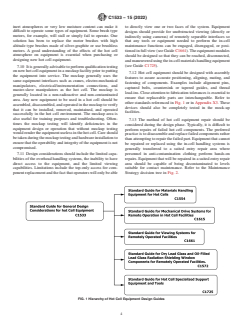
- ASTM C1217 - Guide for Design of Equipment for Processing Nuclear and Radioactive Materials
- ASTM C1572 - Guide for Dry Lead Glass and Oil-Filled Lead Glass Radiation Shielding Window Components
- IEEE/ASTM SI 10 - Use of the International System of Units (SI)
- ANSI/ASME NQA-1 - Quality Assurance Requirements for Nuclear Facility Applications
- ANSI/ANS-8.1 - Nuclear Criticality Safety in Operations with Fissionable Materials Outside Reactors
- ASME Y14.5 - Dimensioning and Tolerancing
Further technical insights can be found in referenced handbooks and documents covering radiation effects on materials, equipment design checklists, and maintenance strategies pertinent to hot cell operations.
Keywords: hot cell equipment, remote operation, nuclear materials, radiation-resistant design, equipment reliability, modular equipment, maintenance, quality assurance, decontamination, ASTM C1533, shielded room standards, radioactive material handling, nuclear facility safety.
Relations
- Effective Date
- 01-Mar-2024
- Effective Date
- 01-Mar-2024
- Effective Date
- 01-Jan-2024
- Effective Date
- 01-Nov-2023
- Effective Date
- 01-Oct-2023
- Effective Date
- 01-Jul-2020
- Effective Date
- 01-Sep-2019
- Effective Date
- 01-Nov-2018
- Effective Date
- 01-Mar-2018
- Effective Date
- 01-Mar-2018
- Effective Date
- 01-Jan-2018
- Effective Date
- 01-Nov-2017
- Effective Date
- 01-Oct-2017
- Effective Date
- 01-May-2017
- Effective Date
- 01-May-2017
Get Certified
Connect with accredited certification bodies for this standard

DNV
DNV is an independent assurance and risk management provider.

Lloyd's Register
Lloyd's Register is a global professional services organisation specialising in engineering and technology.
DNV Energy Systems
Energy and renewable energy certification.
Sponsored listings
Frequently Asked Questions
ASTM C1533-15(2022) is a guide published by ASTM International. Its full title is "Standard Guide for General Design Considerations for Hot Cell Equipment". This standard covers: SIGNIFICANCE AND USE 4.1 The purpose of this guide is to provide general guidelines for the design and operation of hot cell equipment to ensure longevity and reliability throughout the period of service. 4.2 It is intended that this guide record the general conditions and practices that experience has shown is necessary to minimize equipment failures and maximize the effectiveness and utility of hot cell equipment. It is also intended to alert designers to those features that are highly desirable for the selection of equipment that has proven reliable in high radiation environments. 4.3 This guide is intended as a supplement to other standards, and to federal and state regulations, codes, and criteria applicable to the design of equipment intended for hot cell use. 4.4 This guide is intended to be generic and to apply to a wide range of types and configurations of hot cell equipment. SCOPE 1.1 Intent: 1.1.1 The intent of this guide is to provide general design and operating considerations for the safe and dependable operation of remotely operated hot cell equipment. Hot cell equipment is hardware used to handle, process, or analyze nuclear or radioactive material in a shielded room. The equipment is placed behind radiation shield walls and cannot be directly accessed by the operators or by maintenance personnel because of the radiation exposure hazards. Therefore, the equipment is operated remotely, either with or without the aid of viewing. 1.1.2 This guide may apply to equipment in other radioactive remotely operated facilities such as suited entry repair areas, canyons or caves, but does not apply to equipment used in commercial power reactors. 1.1.3 This guide does not apply to equipment used in gloveboxes. 1.2 Applicability: 1.2.1 This guide is intended for persons who are tasked with the planning, design, procurement, fabrication, installation, or testing of equipment used in remote hot cell environments. 1.2.2 The equipment will generally be used over a long-term life cycle (for example, in excess of two years), but equipment intended for use over a shorter life cycle is not excluded. 1.2.3 The system of units employed in this standard is the metric unit, also known as SI Units, which are commonly used for International Systems, and defined by IEEE/ASTM SI 10: American National Standard for Use of the International System of Units (SI): The Modern Metric System. 1.3 Caveats: 1.3.1 This guide does not address considerations relating to the design, construction, operation, or safety of hot cells, caves, canyons, or other similar remote facilities. This guide deals only with equipment intended for use in hot cells. 1.3.2 Specific design and operating considerations are found in other ASTM documents. 1.4 This standard does not purport to address all of the safety concerns, if any, associated with its use. It is the responsibility of the user of this standard to establish appropriate safety, health, and environmental practices and determine the applicability of regulatory limitations prior to use. 1.5 This international standard was developed in accordance with internationally recognized principles on standardization established in the Decision on Principles for the Development of International Standards, Guides and Recommendations issued by the World Trade Organization Technical Barriers to Trade (TBT) Committee.
SIGNIFICANCE AND USE 4.1 The purpose of this guide is to provide general guidelines for the design and operation of hot cell equipment to ensure longevity and reliability throughout the period of service. 4.2 It is intended that this guide record the general conditions and practices that experience has shown is necessary to minimize equipment failures and maximize the effectiveness and utility of hot cell equipment. It is also intended to alert designers to those features that are highly desirable for the selection of equipment that has proven reliable in high radiation environments. 4.3 This guide is intended as a supplement to other standards, and to federal and state regulations, codes, and criteria applicable to the design of equipment intended for hot cell use. 4.4 This guide is intended to be generic and to apply to a wide range of types and configurations of hot cell equipment. SCOPE 1.1 Intent: 1.1.1 The intent of this guide is to provide general design and operating considerations for the safe and dependable operation of remotely operated hot cell equipment. Hot cell equipment is hardware used to handle, process, or analyze nuclear or radioactive material in a shielded room. The equipment is placed behind radiation shield walls and cannot be directly accessed by the operators or by maintenance personnel because of the radiation exposure hazards. Therefore, the equipment is operated remotely, either with or without the aid of viewing. 1.1.2 This guide may apply to equipment in other radioactive remotely operated facilities such as suited entry repair areas, canyons or caves, but does not apply to equipment used in commercial power reactors. 1.1.3 This guide does not apply to equipment used in gloveboxes. 1.2 Applicability: 1.2.1 This guide is intended for persons who are tasked with the planning, design, procurement, fabrication, installation, or testing of equipment used in remote hot cell environments. 1.2.2 The equipment will generally be used over a long-term life cycle (for example, in excess of two years), but equipment intended for use over a shorter life cycle is not excluded. 1.2.3 The system of units employed in this standard is the metric unit, also known as SI Units, which are commonly used for International Systems, and defined by IEEE/ASTM SI 10: American National Standard for Use of the International System of Units (SI): The Modern Metric System. 1.3 Caveats: 1.3.1 This guide does not address considerations relating to the design, construction, operation, or safety of hot cells, caves, canyons, or other similar remote facilities. This guide deals only with equipment intended for use in hot cells. 1.3.2 Specific design and operating considerations are found in other ASTM documents. 1.4 This standard does not purport to address all of the safety concerns, if any, associated with its use. It is the responsibility of the user of this standard to establish appropriate safety, health, and environmental practices and determine the applicability of regulatory limitations prior to use. 1.5 This international standard was developed in accordance with internationally recognized principles on standardization established in the Decision on Principles for the Development of International Standards, Guides and Recommendations issued by the World Trade Organization Technical Barriers to Trade (TBT) Committee.
ASTM C1533-15(2022) is classified under the following ICS (International Classification for Standards) categories: 27.120.10 - Reactor engineering. The ICS classification helps identify the subject area and facilitates finding related standards.
ASTM C1533-15(2022) has the following relationships with other standards: It is inter standard links to ASTM A320/A320M-24, ASTM A193/A193M-24, ASTM C859-24, ASTM A240/A240M-23a, ASTM C1661-23, ASTM C1217-00(2020), ASTM A479/A479M-19, ASTM C1661-18, ASTM A489-18e1, ASTM A489-18, ASTM A479/A479M-18, ASTM A240/A240M-17, ASTM A320/A320M-17b, ASTM A354-17e2, ASTM A354-17. Understanding these relationships helps ensure you are using the most current and applicable version of the standard.
ASTM C1533-15(2022) is available in PDF format for immediate download after purchase. The document can be added to your cart and obtained through the secure checkout process. Digital delivery ensures instant access to the complete standard document.
Standards Content (Sample)
This international standard was developed in accordance with internationally recognized principles on standardization established in the Decision on Principles for the
Development of International Standards, Guides and Recommendations issued by the World Trade Organization Technical Barriers to Trade (TBT) Committee.
Designation: C1533 − 15 (Reapproved 2022)
Standard Guide for
General Design Considerations for Hot Cell Equipment
This standard is issued under the fixed designation C1533; the number immediately following the designation indicates the year of
original adoption or, in the case of revision, the year of last revision.Anumber in parentheses indicates the year of last reapproval.A
superscript epsilon (´) indicates an editorial change since the last revision or reapproval.
1. Scope 1.4 This standard does not purport to address all of the
safety concerns, if any, associated with its use. It is the
1.1 Intent:
responsibility of the user of this standard to establish appro-
1.1.1 The intent of this guide is to provide general design
priate safety, health, and environmental practices and deter-
and operating considerations for the safe and dependable
mine the applicability of regulatory limitations prior to use.
operation of remotely operated hot cell equipment. Hot cell
1.5 This international standard was developed in accor-
equipment is hardware used to handle, process, or analyze
dance with internationally recognized principles on standard-
nuclear or radioactive material in a shielded room. The
ization established in the Decision on Principles for the
equipment is placed behind radiation shield walls and cannot
Development of International Standards, Guides and Recom-
be directly accessed by the operators or by maintenance
mendations issued by the World Trade Organization Technical
personnel because of the radiation exposure hazards.
Barriers to Trade (TBT) Committee.
Therefore, the equipment is operated remotely, either with or
without the aid of viewing.
2. Referenced Documents
1.1.2 This guide may apply to equipment in other radioac-
tive remotely operated facilities such as suited entry repair 2.1 ASTM Standards:
A193/A193MSpecification for Alloy-Steel and Stainless
areas, canyons or caves, but does not apply to equipment used
in commercial power reactors. Steel Bolting for High Temperature or High Pressure
Service and Other Special Purpose Applications
1.1.3 This guide does not apply to equipment used in
A240/A240MSpecification for Chromium and Chromium-
gloveboxes.
Nickel Stainless Steel Plate, Sheet, and Strip for Pressure
1.2 Applicability:
Vessels and for General Applications
1.2.1 Thisguideisintendedforpersonswhoaretaskedwith
A276Specification for Stainless Steel Bars and Shapes
the planning, design, procurement, fabrication, installation, or
A320/A320MSpecification for Alloy-Steel and Stainless
testing of equipment used in remote hot cell environments.
Steel Bolting for Low-Temperature Service
1.2.2 The equipment will generally be used over a long-
A354Specification for Quenched and TemperedAlloy Steel
term life cycle (for example, in excess of two years), but
Bolts, Studs, and Other Externally Threaded Fasteners
equipment intended for use over a shorter life cycle is not
A479/A479MSpecification for Stainless Steel Bars and
excluded.
Shapes for Use in Boilers and Other Pressure Vessels
1.2.3 The system of units employed in this standard is the
A489Specification for Carbon Steel Eyebolts
metricunit,alsoknownasSIUnits,whicharecommonlyused
A490Specification for Structural Bolts, Alloy Steel, Heat
for International Systems, and defined by IEEE/ASTM SI 10:
Treated, 150 ksi Minimum Tensile Strength (Withdrawn
American National Standard for Use of the International
2016)
System of Units (SI): The Modern Metric System.
C859Terminology Relating to Nuclear Materials
1.3 Caveats:
C1217Guide for Design of Equipment for Processing
1.3.1 This guide does not address considerations relating to
Nuclear and Radioactive Materials
thedesign,construction,operation,orsafetyofhotcells,caves,
C1572Guide for Dry Lead Glass and Oil-Filled Lead Glass
canyons, or other similar remote facilities. This guide deals
Radiation Shielding Window Components for Remotely
only with equipment intended for use in hot cells.
Operated Facilities
1.3.2 Specificdesignandoperatingconsiderationsarefound
in other ASTM documents.
For referenced ASTM standards, visit the ASTM website, www.astm.org, or
This guide is under the jurisdiction ofASTM Committee C26 on Nuclear Fuel contact ASTM Customer Service at service@astm.org. For Annual Book of ASTM
Cycle and is the direct responsibility of Subcommittee C26.14 on Remote Systems. Standards volume information, refer to the standard’s Document Summary page on
CurrenteditionapprovedJuly1,2022.PublishedJuly2022.Originallyapproved the ASTM website.
in 2002. Last previous edition approved in 2015 as C1533–15. DOI: 10.1520/ The last approved version of this historical standard is referenced on
C1533-15R22. www.astm.org.
Copyright © ASTM International, 100 Barr Harbor Drive, PO Box C700, West Conshohocken, PA 19428-2959. United States
C1533 − 15 (2022)
C1615Guide for Mechanical Drive Systems for Remote Human exposure is often expressed in terms of microsieverts
–6
Operation in Hot Cell Facilities (µSv), 1×10 sieverts, or in terms of millirem (mrem),
–3
C1661Guide for Viewing Systems for Remotely Operated 1×10 .
Facilities
3.3.4 electro-mechanical manipulator (E/M)—usually
C1725Guide for Hot Cell Specialized Support Equipment
mounted on a crane bridge, wall, pedestal, or ceiling and is
and Tools
used to handle heavy equipment in a hot cell. Each joint of the
D676MethodofTestforIndentationofRubberbyMeansof
E/M is operated by an electric motor or electric actuator. The
a Durometer; Replaced by D2240 (Withdrawn 1964)
E/M is operated remotely using controls from the uncontami-
D5144Guide for Use of Protective Coating Standards in
nated side of the hot cell. Most E/Ms have lifting capacities of
Nuclear Power Plants
100 lb or more.
F593Specification for Stainless Steel Bolts, Hex Cap
3.3.5 gamma radiation—high energy, short wavelength
Screws, and Studs
electromagnetic radiation which normally accompanies the
IEEE/ASTM SI 10American National Standard for Use of
other forms of particle emissions during radioactive decay.
theInternationalSystemofUnits(SI):TheModernMetric
Gamma radiation has no electrical charge.
System
3.3.6 high density concrete—a concrete having a density of
2.2 Other Standards:
3 3
greater than 2400 kg/m (150 lb/ft ).
10CFR830.120 Nuclear Safety Management QualityAssur-
ance Requirements
3.3.7 hot cell—an isolated shielded room that provides a
ANSI/ANS-8.1Nuclear Criticality Safety in Operations
controlled environment for containing highly radioactive and
with Fissionable Materials Outside Reactors
contaminated material and equipment. The radiation levels
ANSI/ASME NQA-1 Quality Assurance Requirements for
within a hot cell are typically 1 Gy/h (100 rads per hour) or
Nuclear Facility Applications
higher in air.
ANSI/ISO/ASQ 9001 Quality Management Systems
3.3.8 master-slave manipulator (MSM)—a device used to
ASME Y14.5Dimensioning and Tolerancing
handle items, tools, or radioactive material in a hot cell. The
ICRU Report 10bPhysical Aspects of Irradiation
in-cellorslaveportionofthemanipulatorreplicatestheactions
NCRP Report No. 82SI Units in radiation Protection and
of an operator outside of the hot cell by means of a through-
Measurements
wall mechanical connection between the two, usually with
metal tapes or cables. MSMs have lifting capacities of 9kg to
3. Terminology
23 kg (20lb to 50 lb).
3.1 The terminology employed in this guide conforms to
3.3.9 mock-up—a facility used to represent the physical
industry practice insofar as practicable.
environment of a radiological facility in a non-radiological
3.2 Fordefinitionsoftermsnotdescribedinthisguide,refer
setting. Mock-ups are full scale facilities used to assure proper
to Terminology C859.
clearances,accessibility,visibility,oroperabilityofitemstobe
subsequently installed in a radiological environment.
3.3 Definitions of Terms Specific to This Standard:
3.3.1 canyon—a long narrow, remotely operated and main-
3.3.10 radiation absorbed dose (rad)—radiation absorbed
tainedradiologicalareawithinafacilitywherenuclearmaterial
dose is the quotient of the mean energy imparted by ionizing
is processed or stored.
radiationtomatterofmass.TheSIunitforabsorbeddoseisthe
3.3.2 cave—typically a small-scale hot cell facility, but is gray (NCRP Report No. 82).
sometimes used synonymously with hot cell.
3.3.11 radiation streaming—unshielded beams of radiation.
3.3.3 dose equivalent—the measure of radiation dose from
3.3.12 roentgen equivalent man (rem)—a measure of the
all types of radiation expressed on a common scale. The
damaging effects of ionizing radiation to man. See dose
specialized unit for dose equivalent is the rem. The SI unit for
equivalent (NCRP Report No. 82, ICRU Report 10b).
dose equivalent is the sievert (Sv), which is equal to 100 rem.
4. Significance and Use
4.1 The purpose of this guide is to provide general guide-
AvailablefromU.S.GovernmentPrintingOfficeSuperintendentofDocuments,
lines for the design and operation of hot cell equipment to
732 N. Capitol St., NW, Mail Stop: SDE, Washington, DC 20401, http://
www.access.gpo.gov.
ensure longevity and reliability throughout the period of
Available fromAmerican National Standards Institute (ANSI), 25 W. 43rd St.,
service.
4th Floor, New York, NY 10036, http://www.ansi.org.
Available from American Society of Mechanical Engineers (ASME), ASME
4.2 It is intended that this guide record the general condi-
International Headquarters, Two Park Ave., New York, NY 10016-5990, http://
tions and practices that experience has shown is necessary to
www.asme.org.
minimize equipment failures and maximize the effectiveness
Available from International Commission on Radiation Units and
Measurements, Inc., 7910 Woodmont Ave., Suite 400, Bethesda, MD 20814-3095,
and utility of hot cell equipment. It is also intended to alert
http://www.icru.org.
designers to those features that are highly desirable for the
Available from National Council of Radiation Protection and Measurements,
selection of equipment that has proven reliable in high radia-
7910 Woodmont Ave., Suite 400, Bethesda, MD 20814-3095, http://
www.ncrponline.org. tion environments.
C1533 − 15 (2022)
4.3 This guide is intended as a supplement to other cycle within the highly radioactive environment. However, in
standards, and to federal and state regulations, codes, and many cases this may not be possible since radiation degrades
criteria applicable to the design of equipment intended for hot some materials over time. Alpha, beta, gamma, and neutron
cell use. radiation can severely damage most organic materials, for
example, oils, plastics, and elastomers. Materials that come
4.4 This guide is intended to be generic and to apply to a
into direct contact with alpha- and beta-emitting materials can
wide range of types and configurations of hot cell equipment.
experience severe radiation damage due to the large amount of
5. Quality Assurance Requirements energy transferred when stopping the alpha and beta particles.
Commercially available equipment containing organic materi-
5.1 The manufacturer and Owner-Operator of hot cell
als may require disassembly and the internal components
equipment should have a quality assurance program. QA
replaced with more radiation resistant materials. If suitable
programs may be required to comply with 10CFR830.120,
alternate materials cannot be used, special shielding may have
ANSI/ASME NQA-1, or ANSI/ISO/ASQ 9001.
to be integrated into the design to protect the degradable
5.2 The Owner-Operator should require appropriate quality
components. In the case of some electronic equipment, it may
assurance of purchased hot cell equipment to assure proper
be possible to separate and move the more radiation sensitive
remoteinstallation,operationandreliabilityofthecomponents
components outside of the hot cell and operate the equipment
when they are installed in the hot cell.
in the hot cell remotely. Where possible and appropriate,
equipment should be designed to withstand an accumulative
5.3 Hot cell equipment should be designed according to
8 60
radiation dose of approximately1×10 rads (H O)[ Co].
quality assurance requirements and undergo quality control
inspections as outlined by the authority having jurisdiction.
7.7 Since hot cells have a limited amount of space, the
equipment designs should be standardized where possible to
6. Nuclear Safety
reduce the number of one-of-a-kind parts. Standardization of
6.1 The handling and processing of special nuclear materi-
hot cell equipment will reduce design time, fabrication costs,
als requires the avoidance of criticality incidents. Equipment
operator training time, maintenance costs, and the number of
intended for use in handling materials having a special nuclear
specialtoolsrequiredtoperformacertainoperation.Standard-
material content should undergo a criticality assessment analy-
izationindesign,drawingcontrolandexcellentqualitycontrol
sis in accordance with the requirements ofANSI/ANS-8.1 and
assure that components are interchangeable. Specially de-
other such standards and regulations as may be applicable.
signed equipment should be standardized for use with equip-
ment in similar applications or systems to reduce spare parts
7. Design Considerations
inventories and to maintain familiarity for the operators.
7.1 Hotcellequipmentshouldbedesignedandfabricatedto
Commercially available components should be used, and
remain dimensionally stable throughout its life cycle.
modified if necessary, wherever possible in preference to
specially designed equipment.
7.2 Fabrication materials should be resistant to radiation
damage, or materials subject to such damage should be
7.8 All hot cell equipment should be designed in modules
shielded or placed and attached so as to be readily replaceable.
for ease of replacement, maintainability, interchangeability,
standardization, and ease of disposal. The modules should be
7.3 Special consideration should be given to designing hot
designed to be remotely removable and installed using the
cell equipment that may be exposed to or may create high
in-cell handling equipment, that is, master-slave manipulators,
temperatures, high rate of temperature changes, caustic
cranes, etc. Consideration should also be given to the transfer
conditions, or pressure changes.Abrupt changes in the hot cell
path to get equipment into the hot cell and size equipment
temperature or pressure may cause the hot cell windows to
modules accordingly. Components with a higher probability of
crack, lose clarity, and potentially lose containment and cause
failure should be made modular for ease of replacement.
liquid spillage. Refer to Guide C1572 for information regard-
Remotely operated electrical connectors must be compatible
inghotcellwindows.Theeffectofhandlingandoperatinghigh
with the hot cell materials handling equipment. Drawings of
temperature hot cell equipment utilizing master-slave manipu-
hot cell equipment should reflect the as-built configuration for
latorsorotherin-cellhandlingequipmentshouldbeconsidered
all replaceable components to provide reliable documentation
to preclude damage to those items.
control, and conform to ASME Y14.5 Dimensioning and
7.4 Preventivemaintenancebasedonpreviousexperiencein
Tolerancing.Interfacingcomponentsshouldbetolerancedtofit
similar environments and similar duty should be performed as
the in-field conditions. Replaceable components should be
required to prevent unscheduled repair of failed components.
labeled with a standard identification and the component
7.5 Hot cell equipment may be required to be leak-tight
weight.Examplesofmodulardesignsmightincludesubassem-
when handling liquids. Leak tightness prevents radioactive
blies of removable motors, resolvers, valves, limit switches,
liquid from entering the interior of hot cell equipment where it
and electrical cables.
can cause corrosion, shorting of electrical components, higher
7.9 The hot cell atmosphere can have an adverse affect on
chronicradiationtocomponentsanditcomplicatesdecontami-
hot cell equipment. Hot cells can have air or inert gas
nation.
atmospheres and are usually kept at a negative differential
7.6 Hot cell equipment should generally be designed to pressure of 2.5 cm to 5 cm (1.0in. to 2.0 in.) of water gauge
function indefinitely, or within a pre-planned specified life with respect to the surrounding operating areas. Hot cells with
C1533 − 15 (2022)
inert atmospheres or very low moisture content can make it to directly view one or two faces of the system. Equipment
difficult to operate some types of equipment. Some brush type designs should provide for unobstructed viewing (directly or
motors, for example, will stall or simply fail to operate. One
indirectly using cameras) of remotely separable interfaces so
solution has been to replace the motor brushes with high
that any tools or equipment needed to perform the in-cell
altitude type brushes made of silver-graphite or use brushless
maintenance functions can be engaged, disengaged, or posi-
motors. A good understanding of the effects of the hot cell
tionedinfullview(seeGuideC1661).Theequipmentmodules
atmosphere on equipment is essential when purchasing or
should be designed so that they can be reached, disconnected,
designing new hot cell equipment.
andmaneuveredusingthein-cellmaterialshandlingequipment
(see Guide C1725).
7.10 Itisgenerallyadvisabletoperformqualificationtesting
onnewhotcellequipmentinamockupfacilitypriortoputting
7.12 Hot cell equipment should be designed with assembly
the equipment into service. The mockup generally uses the
features to assure accurate positioning, aligning, mating, and
same equipment interfaces such as cranes, electro-mechanical
fastening of components. Examples include alignment pins,
manipulators, electrical/instrumentation connections, and
captured bolts, countersink or tapered guides, and thread
master-slave manipulators as the hot cell. The mockup is
lead-ins.Closeattentiontofabricationtolerancesisessentialto
generally located in a non-radioactive and non-contaminated
ensure that replaceable parts are interchangeable. Refer to
area. Any new equipment to be used i
...