

ASTM A489-18e1
(Specification)Standard Specification for Carbon Steel Eyebolts
General Information
- Abstract
ABSTRACT
This specification covers the chemical, mechanical, grain size, and dimensional requirements for weldless forged, quenched, and tempered carbon steel threaded lifting eyes (formerly pertained to as eyebolts) for overhead lifting. This specification covers two types denoting shank pattern, and one style denoting shank length, as follows: Type 1, plain pattern (straight shank); Type 2, shoulder pattern; and Style B, short length. The lifting eyes shall be manufactured as specified for the melting, forging, heat treatment, and machining processes. The mechanical properties to which the lifting eyes shall adhere are proof, breaking strength, tensile stress and strength, bend strength, impact strength, yield point, elongation, and reduction of area.
SCOPE
1.1 This specification covers chemical, physical and mechanical requirements for forged, carbon steel threaded eyebolts intended for overhead lifting.
1.2 The specification includes two types denoting shank pattern and two styles denoting shank length (both defined in ASME B 18.15) as follows:
1.2.1 Type 1—Plain pattern (straight shank).
1.2.2 Type 2—Shoulder pattern.
1.2.3 Style A—Long length.
1.2.4 Style B—Short length.
1.3 The values stated in inch-pound units are to be regarded as standard. No other units of measurement are included in this standard.
1.4 The terms used in this specification are defined in Terminology F1789 unless otherwise defined herein.
1.5 The following safety hazard caveat pertains to the test methods portion of this specification: This standard does not purport to address all of the safety concerns, if any, associated with its use. It is the responsibility of the user of this standard to establish appropriate safety, health, and environmental practices and determine the applicability of regulatory limitations prior to use.
1.6 This international standard was developed in accordance with internationally recognized principles on standardization established in the Decision on Principles for the Development of International Standards, Guides and Recommendations issued by the World Trade Organization Technical Barriers to Trade (TBT) Committee.
- Status
- Published
- Publication Date
- 28-Feb-2018
- Technical Committee
- F16 - Fasteners
- Drafting Committee
- F16.02 - Steel Bolts, Studs and Nuts

Overview
ASTM A489-18e1 is the globally recognized standard specification published by ASTM for carbon steel eyebolts, commonly referred to as threaded lifting eyes. This standard outlines the chemical, mechanical, dimensional, and manufacturing requirements for weldless forged, quenched, and tempered carbon steel eyebolts designed specifically for overhead lifting applications. The specification covers two types of shank patterns-plain (Type 1) and shoulder (Type 2)-as well as two styles of shank lengths, long (Style A) and short (Style B), as defined in ASME B18.15.
ASTM A489-18e1 ensures uniformity, quality, and safety in the production and use of carbon steel eyebolts, which are critical components in industrial lifting and rigging operations.
Key Topics
- Material Specifications: Covers requirements for carbon steel, including maximum levels for carbon, manganese, phosphorus, sulfur, and silicon content for durability and strength.
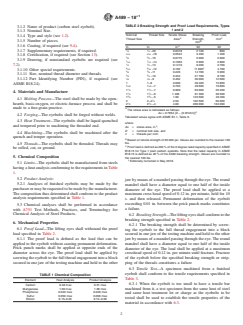
- Mechanical Properties: Specifies proof load, breaking strength, tensile strength, yield point, elongation, and reduction of area, ensuring the eyebolts meet rigorous load and safety standards.
- Product Types & Styles: Identifies two shank patterns (Type 1: straight/plain, Type 2: shoulder) and two shank lengths (Style A: long, Style B: short).
- Manufacturing Requirements: Details forging (weldless), heat treatment (quenching and tempering), and machining post-heat treatment.
- Thread Requirements: Specifies unified coarse threads (Class 2A) per ASME B1.1, with gauging per ASME B1.3.
- Surface Finish & Coatings: Allows for zinc electroplating and hot-dip galvanizing for corrosion protection.
- Product Identification: Mandates product marking, including the manufacturer’s identification and “A489” forged into the eyebolt.
- Inspection & Certification: Stipulates inspection rights, testing, and certification documentation when required by the purchaser.
Applications
ASTM A489-18e1 carbon steel eyebolts are vital for many industries wherever secure and reliable lifting is required. Typical applications include:
- Overhead Lifting: Used as lifting points for hoisting equipment, heavy machinery, and structural assemblies.
- Construction and Infrastructure Projects: Integral in rigging and moving materials safely.
- Industrial Environments: Used in manufacturing plants, shipyards, and energy sectors for handling large components.
- OEM Equipment: Often specified in machinery design where robust lifting eyes are required for assembly or maintenance.
ASTM A489-18e1 eyebolts are suitable for service temperatures between 32°F and 275°F. For lower temperatures, alternative alloy steel eyebolts (see ASTM F541) are recommended.
Related Standards
Organizations relying on ASTM A489-18e1 may also reference the following standards for compatibility, terminology, and additional requirements related to mechanical fasteners and eyebolts:
- ASME B18.15 - Forged Eyebolts (defining pattern and style)
- ASTM F541 - Specification for Alloy Steel Eyebolts (for applications below 32°F)
- ASTM F606/F606M - Test Methods for Determining Mechanical Properties of Fasteners
- ASTM F1470 - Practice for Fastener Sampling for Specified Mechanical Properties
- ASTM F1941/F1941M - Specification for Electrodeposited Coatings on Mechanical Fasteners
- ASTM F2329/F2329M - Specification for Hot-Dip Galvanized Coating on Mechanical Fasteners
- ASME B1.1 - Unified Inch Screw Threads
- ASME B1.3 - Screw Thread Gaging Systems
By conforming to ASTM A489-18e1, manufacturers, engineers, and procurement specialists help ensure that their lifting hardware meets rigorous international safety and performance standards, promoting reliability in demanding overhead lifting operations.
Relations
- Effective Date
- 01-Mar-2018
- Effective Date
- 01-Jan-2024
- Effective Date
- 01-Nov-2023
- Effective Date
- 01-Nov-2023
- Effective Date
- 01-Feb-2018
- Effective Date
- 01-Jun-2017
- Effective Date
- 01-Dec-2016
- Effective Date
- 01-Sep-2016
- Effective Date
- 01-Aug-2016
- Effective Date
- 01-Sep-2015
- Effective Date
- 01-Mar-2015
- Effective Date
- 01-Feb-2015
- Effective Date
- 01-Nov-2014
- Effective Date
- 01-Sep-2014
- Effective Date
- 01-Mar-2014
Frequently Asked Questions
ASTM A489-18e1 is a technical specification published by ASTM International. Its full title is "Standard Specification for Carbon Steel Eyebolts". This standard covers: ABSTRACT This specification covers the chemical, mechanical, grain size, and dimensional requirements for weldless forged, quenched, and tempered carbon steel threaded lifting eyes (formerly pertained to as eyebolts) for overhead lifting. This specification covers two types denoting shank pattern, and one style denoting shank length, as follows: Type 1, plain pattern (straight shank); Type 2, shoulder pattern; and Style B, short length. The lifting eyes shall be manufactured as specified for the melting, forging, heat treatment, and machining processes. The mechanical properties to which the lifting eyes shall adhere are proof, breaking strength, tensile stress and strength, bend strength, impact strength, yield point, elongation, and reduction of area. SCOPE 1.1 This specification covers chemical, physical and mechanical requirements for forged, carbon steel threaded eyebolts intended for overhead lifting. 1.2 The specification includes two types denoting shank pattern and two styles denoting shank length (both defined in ASME B 18.15) as follows: 1.2.1 Type 1—Plain pattern (straight shank). 1.2.2 Type 2—Shoulder pattern. 1.2.3 Style A—Long length. 1.2.4 Style B—Short length. 1.3 The values stated in inch-pound units are to be regarded as standard. No other units of measurement are included in this standard. 1.4 The terms used in this specification are defined in Terminology F1789 unless otherwise defined herein. 1.5 The following safety hazard caveat pertains to the test methods portion of this specification: This standard does not purport to address all of the safety concerns, if any, associated with its use. It is the responsibility of the user of this standard to establish appropriate safety, health, and environmental practices and determine the applicability of regulatory limitations prior to use. 1.6 This international standard was developed in accordance with internationally recognized principles on standardization established in the Decision on Principles for the Development of International Standards, Guides and Recommendations issued by the World Trade Organization Technical Barriers to Trade (TBT) Committee.
ABSTRACT This specification covers the chemical, mechanical, grain size, and dimensional requirements for weldless forged, quenched, and tempered carbon steel threaded lifting eyes (formerly pertained to as eyebolts) for overhead lifting. This specification covers two types denoting shank pattern, and one style denoting shank length, as follows: Type 1, plain pattern (straight shank); Type 2, shoulder pattern; and Style B, short length. The lifting eyes shall be manufactured as specified for the melting, forging, heat treatment, and machining processes. The mechanical properties to which the lifting eyes shall adhere are proof, breaking strength, tensile stress and strength, bend strength, impact strength, yield point, elongation, and reduction of area. SCOPE 1.1 This specification covers chemical, physical and mechanical requirements for forged, carbon steel threaded eyebolts intended for overhead lifting. 1.2 The specification includes two types denoting shank pattern and two styles denoting shank length (both defined in ASME B 18.15) as follows: 1.2.1 Type 1—Plain pattern (straight shank). 1.2.2 Type 2—Shoulder pattern. 1.2.3 Style A—Long length. 1.2.4 Style B—Short length. 1.3 The values stated in inch-pound units are to be regarded as standard. No other units of measurement are included in this standard. 1.4 The terms used in this specification are defined in Terminology F1789 unless otherwise defined herein. 1.5 The following safety hazard caveat pertains to the test methods portion of this specification: This standard does not purport to address all of the safety concerns, if any, associated with its use. It is the responsibility of the user of this standard to establish appropriate safety, health, and environmental practices and determine the applicability of regulatory limitations prior to use. 1.6 This international standard was developed in accordance with internationally recognized principles on standardization established in the Decision on Principles for the Development of International Standards, Guides and Recommendations issued by the World Trade Organization Technical Barriers to Trade (TBT) Committee.
ASTM A489-18e1 is classified under the following ICS (International Classification for Standards) categories: 21.060.10 - Bolts, screws, studs. The ICS classification helps identify the subject area and facilitates finding related standards.
ASTM A489-18e1 has the following relationships with other standards: It is inter standard links to ASTM A489-18, ASTM F1470-24, ASTM F2329/F2329M-15(2023), ASTM F1789-23, ASTM F1470-18, ASTM F1789-17, ASTM F1941/F1941M-16, ASTM F606/F606M-16, ASTM F1789-16, ASTM F1941/F1941M-15, ASTM F1789-15a, ASTM F1789-15, ASTM F606/F606M-14a, ASTM F1789-14a, ASTM A751-14. Understanding these relationships helps ensure you are using the most current and applicable version of the standard.
ASTM A489-18e1 is available in PDF format for immediate download after purchase. The document can be added to your cart and obtained through the secure checkout process. Digital delivery ensures instant access to the complete standard document.
Standards Content (Sample)
This international standard was developed in accordance with internationally recognized principles on standardization established in the Decision on Principles for the
Development of International Standards, Guides and Recommendations issued by the World Trade Organization Technical Barriers to Trade (TBT) Committee.
´1
Designation:A489 −18
Standard Specification for
Carbon Steel Eyebolts
This standard is issued under the fixed designation A489; the number immediately following the designation indicates the year of
original adoption or, in the case of revision, the year of last revision.Anumber in parentheses indicates the year of last reapproval.A
superscript epsilon (´) indicates an editorial change since the last revision or reapproval.
This standard has been approved for use by agencies of the U.S. Department of Defense.
ε NOTE—A value in Table 2 was editorially corrected in May 2018.
1. Scope* 2. Referenced Documents
1.1 This specification covers chemical, physical and me- 2.1 ASTM Standards:
chanical requirements for forged, carbon steel threaded eye- A751Test Methods, Practices, and Terminology for Chemi-
bolts intended for overhead lifting. cal Analysis of Steel Products
F541Specification for Alloy Steel Eyebolts
1.2 The specification includes two types denoting shank
F606/F606MTest Methods for Determining the Mechanical
pattern and two styles denoting shank length (both defined in
Properties of Externally and Internally Threaded
ASME B18.15) as follows:
Fasteners, Washers, Direct Tension Indicators, and Rivets
1.2.1 Type 1—Plain pattern (straight shank).
F1470Practice for Fastener Sampling for Specified Me-
1.2.2 Type 2—Shoulder pattern.
chanical Properties and Performance Inspection
1.2.3 Style A—Long length.
F1789Terminology for F16 Mechanical Fasteners
1.2.4 Style B—Short length.
F1941/F1941MSpecification for Electrodeposited Coatings
1.3 The values stated in inch-pound units are to be regarded
on Mechanical Fasteners, Inch and Metric
asstandard.Nootherunitsofmeasurementareincludedinthis
F2329/F2329MSpecification for Zinc Coating, Hot-Dip,
standard.
Requirements for Application to Carbon and Alloy Steel
Bolts, Screws, Washers, Nuts, and Special Threaded
1.4 The terms used in this specification are defined in
Terminology F1789 unless otherwise defined herein. Fasteners
2.2 ASME Standards:
1.5 The following safety hazard caveat pertains to the test
B1.1Unified Inch Screw Threads (UN and UNR Thread
methods portion of this specification: This standard does not
Form)
purport to address all of the safety concerns, if any, associated
B1.3 Screw Thread Gaging Systems forAcceptability: Inch
with its use. It is the responsibility of the user of this standard
and Metric Screw Threads (UN, UNR, UNJ, M, and MJ)
to establish appropriate safety, health, and environmental
B18.15 Forged Eyebolts
practices and determine the applicability of regulatory limita-
B18.24Part Identifying Number (PIN) Code System Stan-
tions prior to use.
dard for B18 Fastener Products
1.6 This international standard was developed in accor-
dance with internationally recognized principles on standard-
3. Ordering Information
ization established in the Decision on Principles for the
3.1 Orders for eyebolts under this specification should
Development of International Standards, Guides and Recom-
include the following information:
mendations issued by the World Trade Organization Technical
3.1.1 ASTM specification number and date of issue.
Barriers to Trade (TBT) Committee.
For referenced ASTM standards, visit the ASTM website, www.astm.org, or
This specification is under the jurisdiction of ASTM Committee F16 on contact ASTM Customer Service at service@astm.org. For Annual Book of ASTM
Fasteners and is the direct responsibility of Subcommittee F16.02 on Steel Bolts, Standards volume information, refer to the standard’s Document Summary page on
Nuts, Rivets and Washers. the ASTM website.
Current edition approved March 1, 2018. Published May 2018. Originally Available from American Society of Mechanical Engineers (ASME), ASME
approved in 1964. Last previous edition approved in 2012 as A489–12. DOI: International Headquarters, Three Park Ave., New York, NY 10016-5990, http://
10.1520/A0489-18E01. www.asme.org.
*A Summary of Changes section appears at the end of this standard
Copyright © ASTM International, 100 Barr Harbor Drive, PO Box C700, West Conshohocken, PA 19428-2959. United States
´1
A489−18
TABLE 2 Breaking Strength and Proof Load Requirements, Types
3.1.2 Name of product (carbon steel eyebolt).
1and2
3.1.3 Nominal Size.
Nominal Thread Size Tensile Stress Breaking Proof Load,
3.1.4 Type and style (see 1.2).
A C
Thread Size Area Strength, min
3.1.5 Number of pieces.
B
min
3.1.6 Coating, if required (see 9.4).
in. in. in. lbf lbf
1 1
3.1.7 Supplementary requirements, if required. ⁄4 ⁄4 –20 0.0318 2 100 800
5 5
⁄16 ⁄16 –18 0.0524 3 400 1 400
3.1.8 Certification, if required (see Section 13).
3 3
⁄8 ⁄8 –16 0.0775 5 000 2 000
3.1.9 Drawing, if nonstandard eyebolts are required (see
7 7
⁄16 ⁄16 –14 0.1063 6 900 2 800
1 1
7.2).
⁄2 ⁄2 –13 0.1419 9 200 3 700
†
9 9
⁄16 ⁄16 –12 0.182 11 800 4 700
3.1.10 Other special requirements.
5 5
⁄8 ⁄8 –11 0.226 14 700 5 900
3.1.11 Size, nominal thread diameter and threads.
3 3
⁄4 ⁄4 –10 0.334 21 700 8 700
7 7
3.1.12 Part Identifying Number (PIN), if required (see ⁄8 ⁄8 –9 0.462 30 000 12 000
1 1–8 0.606 39 400 15 800
ASME B18.24).
1 1
1 ⁄8 1 ⁄8 –7 0.763 49 600 19 800
1 1
1 ⁄4 1 ⁄4 –7 0.969 63 000 25 200
4. Materials and Manufacture
1 1
1 ⁄2 1 ⁄2 –6 1.405 91 300 36 500
3 3
1 ⁄4 1 ⁄4 –5 1.90 123 500 49 400
4.1 Melting Process—The steel shall be made by the open-
2 2–4 ⁄2 2.50 162 500 65 000
hearth, basic-oxygen, or electric-furnace process and shall be 1 1
2 ⁄2 2 ⁄2 –4 4.00 260 000 104 000
made to a fine-grain practice. A
The stress area is calculated as follows:
As = 0.7854 [D − (0.9743/n)]
4.2 Forging—The eyebolts shall be forged without welds.
Tabulated values agree with ASME B1.1, Table 6.
4.3 Heat Treatment—The eyebolts shall be liquid quenched
where:
and tempered prior to machining the threaded end. 2
As = stress area, in. ,
D = nominal bolt size, and
4.4 Machining—The eyebolts shall be machined after the
n = threads per inch.
quench and temper operation.
B
Based on tensile strength of 65 000 psi. Values are rounded to the nearest 100
lbs.
4.5 Threads—The eyebolts shall be threaded. Threads may
C
Proof load is defined as 200 % of the 0 degree rated capacity specified in ASME
be rolled, cut, or ground.
B18.15 for Type 1 plain pattern eyebolts. Note that the rated capacity in ASME
B18.15 is defined as 20 % of the A489 breaking strength. Values are rounded to
5. Chemical Composition
the nearest 100 lbs.
†
Editorially corrected in May 2018.
5.1 Limits—The eyebolts shall be manufactured from steels
havingaheatanalysisconformingtotherequirementsinTable
1.
5.2 Product Analysis:
jaw by means of a mandrel passing through the eye.The round
5.2.1 Analyses of finished eyebolts may be made by the
mandrel shall have a diameter equal to one half of the inside
purchaserormayberequestedtobemadebythemanufacturer.
diameter of the eye. The proof load shall be applied at a
The composition thus determined shall conform to the product
maximum cross head speed of 0.12 in. per minute, held for 10
analysis requirements specified in Table 1.
s. and then released. Permanent deformation of the eyebolt
exceeding 0.01 in. between the prick punch marks constitutes
5.3 Chemical analyses shall be performed in accordance
a failure.
with A751 Test Methods, Practices, and Terminology for
Chemical Analysis of Steel Products.
6.2 Breaking Strength—Theliftingeyesshallconformtothe
breaking strength specified in Table 2.
6. Mechanical Properties
6.2.1 The breaking strength shall be determined by screw-
6.1 Proof Load—The lifting eyes shall withstand the proof
ing the eyebolt to the full thread engagement into a block
load specified in Table 2. secured in one jaw of the testing machine and held to the other
6.1.1 The proof load is defined as the load that can be
jaw by means of a mandrel passing through the eye.The round
applied to the eyebolt without causing permanent deformation. mandrel shall have a diameter equal to one half of the inside
Prick punch marks shall be applied at opposite ends of the
diameter of the eye. The load shall be applied at a maximum
diameter across the eye. The proof load shall be applied
...